

ISO/IEC TR 30123:2026
(Main)Internet of Things (IoT) — Guidance on IoT application to home healthcare
General Information
- Abstract
This document provides guidance on applying IoT technologies to home healthcare systems, taking into account the specific characteristics.
- Status
- Published
- Publication Date
- 08-Mar-2026
- Technical Committee
- ISO/IEC JTC 1/SC 41 - Internet of things and digital twin
- Drafting Committee
- ISO/IEC JTC 1/SC 41 - Internet of things and digital twin
- Current Stage
- 6060 - International Standard published
- Start Date
- 09-Mar-2026
- Completion Date
- 09-Mar-2026
Overview
ISO/IEC TR 30123:2026, published by the International Organization for Standardization (ISO) and the International Electrotechnical Commission (IEC), provides comprehensive guidance on the application of Internet of Things (IoT) technologies to home healthcare systems. The document addresses the unique requirements and challenges of delivering healthcare in residential environments, focusing on aspects such as real-time health monitoring, data privacy and security, system reliability, and seamless integration with existing healthcare infrastructure.
This technical report is intended for stakeholders in the healthcare, technology, and regulatory sectors, including device manufacturers, service providers, standards developers, and healthcare professionals. It identifies the essential characteristics for IoT deployment in home healthcare and outlines the architectural considerations necessary to ensure safety, effectiveness, and interoperability.
Key Topics
- Fundamental Principles: Effectiveness in achieving clinical outcomes, safety for patients and caregivers, and interoperability between diverse devices and services.
- Confidentiality: Protection of health information using robust access controls and encryption, ensuring compliance with healthcare data regulations.
- Reliability: Uninterrupted operation and priority handling for critical healthcare devices and services, especially during network congestion or adverse events.
- Safety: Implementation of security measures such as authentication, secure data transfer, and protection against unauthorized access.
- Well-defined Components: Devices with clear descriptions of functionalities, interfaces, and security features for dependable integration.
- Accuracy: Prioritization of accurate data collection and transmission to support precise health monitoring and diagnostics.
- Auto-configuration: Streamlined onboarding and configuration of healthcare devices, minimizing manual setup and configuration errors.
- Compliance: Adherence to regulatory requirements for both regulated medical devices and consumer wellness devices.
- Context-awareness: Systems that dynamically respond to the patient’s state and healthcare context, supporting smart interventions and automation.
- Data Characteristics: Management of high-volume, diverse, and time-sensitive health data, ensuring integrity and relevance.
- Discoverability: Mechanisms to quickly identify, authenticate, and integrate new healthcare devices into home networks.
- Self-description: Devices providing detailed operational and interface information, enhancing automated management and reliability.
- Service Subscription: Fine-grained access management for multiple stakeholders, including patients, caregivers, and providers.
Applications
The guidance in ISO/IEC TR 30123:2026 is applicable to a broad spectrum of IoT-enabled home healthcare scenarios:
- Remote Patient Monitoring: Continuous tracking of vital signs via wearable devices and sensors, enabling early detection of health anomalies and supporting remote clinical consultations.
- Chronic Disease Management: Improved adherence and self-management for patients with long-term conditions, such as diabetes or cardiovascular disease, through automated reminders and personalized health recommendations.
- Assisted Living and Elder Care: Enhanced safety and independence for elderly individuals through integrated fall detection, smart beds, and environmental controls.
- Data Integration and Analytics: Aggregation and analysis of health data to support personalized care plans, real-time alerts, and data-driven decisions by both patients and healthcare professionals.
- Seamless Smart Home Integration: Coordination of healthcare IoT devices with general home automation systems, such as lighting, curtains, and climate control, tailored to the user’s health context.
- Regulatory Compliance Management: Simplified documentation, auditing, and enforcement of privacy and safety controls across heterogeneous healthcare and wellness devices.
Related Standards
Organizations deploying or developing home healthcare IoT solutions should consider integrating the guidance of ISO/IEC TR 30123:2026 with the following related international standards:
- ISO/IEC 30141:2024 - Reference architecture for IoT, providing general system characteristics and design considerations.
- ISO/IEC 20924:2024 - IoT and digital twin vocabulary, ensuring consistent terminology across IoT projects.
- ITU-T H.810:2019 - Interoperability design guidelines for personal health systems.
- ISO/IEC 27001 - Standards for information security management, relevant for ensuring confidentiality and integrity of health data.
- Regional Compliance Frameworks such as GDPR (General Data Protection Regulation) and HIPAA (Health Insurance Portability and Accountability Act), addressing privacy and security requirements for personal health data.
ISO/IEC TR 30123:2026 supports the safe, effective, and compliant adoption of IoT in home healthcare, serving as a critical resource for aligning technology solutions with the unique needs of patients and caregivers in residential environments.
Get Certified
Connect with accredited certification bodies for this standard

BSI Group
BSI (British Standards Institution) is the business standards company that helps organizations make excellence a habit.

NYCE
Mexican standards and certification body.
Sponsored listings
Frequently Asked Questions
ISO/IEC TR 30123:2026 is a technical report published by the International Organization for Standardization (ISO). Its full title is "Internet of Things (IoT) — Guidance on IoT application to home healthcare". This standard covers: This document provides guidance on applying IoT technologies to home healthcare systems, taking into account the specific characteristics.
This document provides guidance on applying IoT technologies to home healthcare systems, taking into account the specific characteristics.
ISO/IEC TR 30123:2026 is classified under the following ICS (International Classification for Standards) categories: 35.240.95 - Internet applications. The ICS classification helps identify the subject area and facilitates finding related standards.
ISO/IEC TR 30123:2026 is available in PDF format for immediate download after purchase. The document can be added to your cart and obtained through the secure checkout process. Digital delivery ensures instant access to the complete standard document.
Standards Content (Sample)
ISO/IEC TR 30123
Edition 1.0 2026-03
TECHNICAL
REPORT
Internet of Things (IoT) - Guidance on IoT application to home healthcare
ICS 35.020 ISBN 978-2-8327-1104-0
ISO/IEC TR 30123: 2026-03(en)
All rights reserved. Unless otherwise specified, no part of this publication may be reproduced or utilized in any form or
by any means, electronic or mechanical, including photocopying and microfilm, without permission in writing from either
IEC or IEC's member National Committee in the country of the requester. If you have any questions about IEC copyright
or have an enquiry about obtaining additional rights to this publication, please contact the address below or your local
IEC member National Committee for further information.
IEC Secretariat Tel.: +41 22 919 02 11
3, rue de Varembé info@iec.ch
CH-1211 Geneva 20 www.iec.ch
Switzerland
About the IEC
The International Electrotechnical Commission (IEC) is the leading global organization that prepares and publishes
International Standards for all electrical, electronic and related technologies.
About IEC publications
The technical content of IEC publications is kept under constant review by the IEC. Please make sure that you have the
latest edition, a corrigendum or an amendment might have been published.
IEC publications search - IEC Products & Services Portal - products.iec.ch
webstore.iec.ch/advsearchform Discover our powerful search engine and read freely all the
The advanced search enables to find IEC publications by a publications previews, graphical symbols and the glossary.
variety of criteria (reference number, text, technical With a subscription you will always have access to up to date
committee, …). It also gives information on projects, content tailored to your needs.
replaced and withdrawn publications.
Electropedia - www.electropedia.org
The world's leading online dictionary on electrotechnology,
IEC Just Published - webstore.iec.ch/justpublished
Stay up to date on all new IEC publications. Just Published containing more than 22 500 terminological entries in English
details all new publications released. Available online and and French, with equivalent terms in 25 additional languages.
once a month by email. Also known as the International Electrotechnical Vocabulary
(IEV) online.
IEC Customer Service Centre - webstore.iec.ch/csc
If you wish to give us your feedback on this publication or
need further assistance, please contact the Customer
Service Centre: sales@iec.ch.
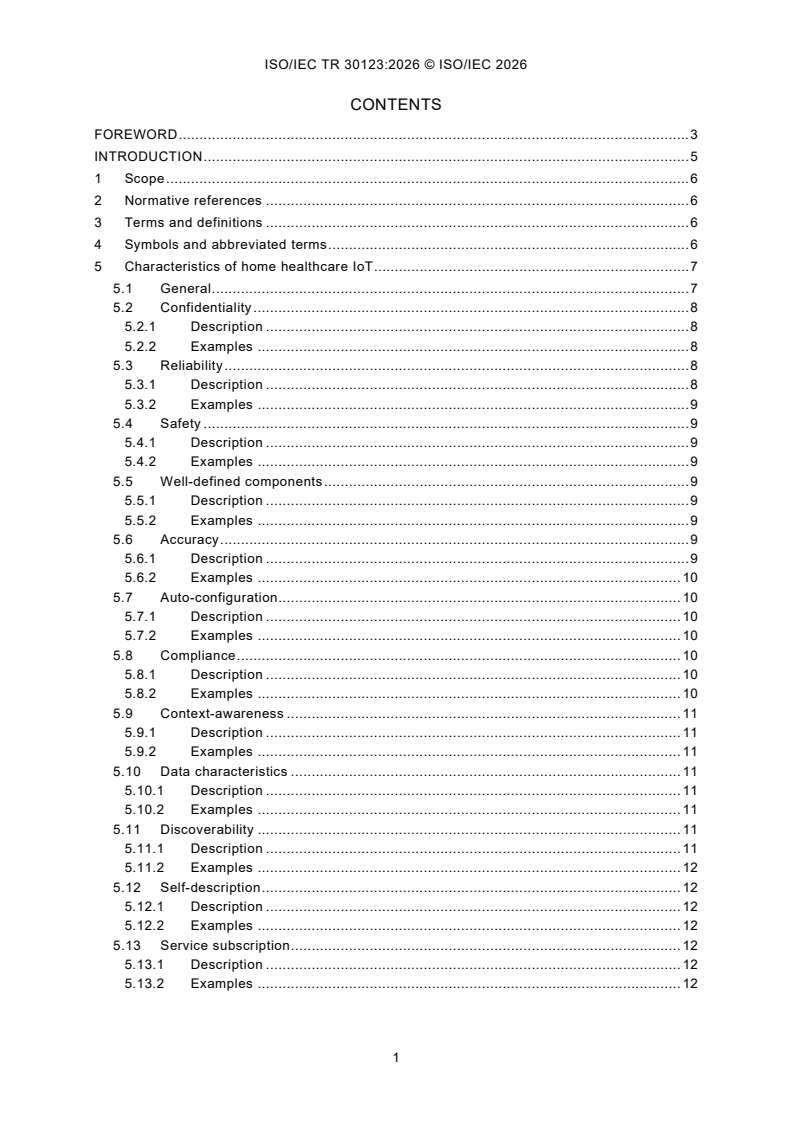
CONTENTS
FOREWORD . 3
INTRODUCTION . 5
1 Scope . 6
2 Normative references . 6
3 Terms and definitions . 6
4 Symbols and abbreviated terms . 6
5 Characteristics of home healthcare IoT . 7
5.1 General . 7
5.2 Confidentiality . 8
5.2.1 Description . 8
5.2.2 Examples . 8
5.3 Reliability . 8
5.3.1 Description . 8
5.3.2 Examples . 9
5.4 Safety . 9
5.4.1 Description . 9
5.4.2 Examples . 9
5.5 Well-defined components . 9
5.5.1 Description . 9
5.5.2 Examples . 9
5.6 Accuracy . 9
5.6.1 Description . 9
5.6.2 Examples . 10
5.7 Auto-configuration . 10
5.7.1 Description . 10
5.7.2 Examples . 10
5.8 Compliance . 10
5.8.1 Description . 10
5.8.2 Examples . 10
5.9 Context-awareness . 11
5.9.1 Description . 11
5.9.2 Examples . 11
5.10 Data characteristics . 11
5.10.1 Description . 11
5.10.2 Examples . 11
5.11 Discoverability . 11
5.11.1 Description . 11
5.11.2 Examples . 12
5.12 Self-description . 12
5.12.1 Description . 12
5.12.2 Examples . 12
5.13 Service subscription . 12
5.13.1 Description . 12
5.13.2 Examples . 12
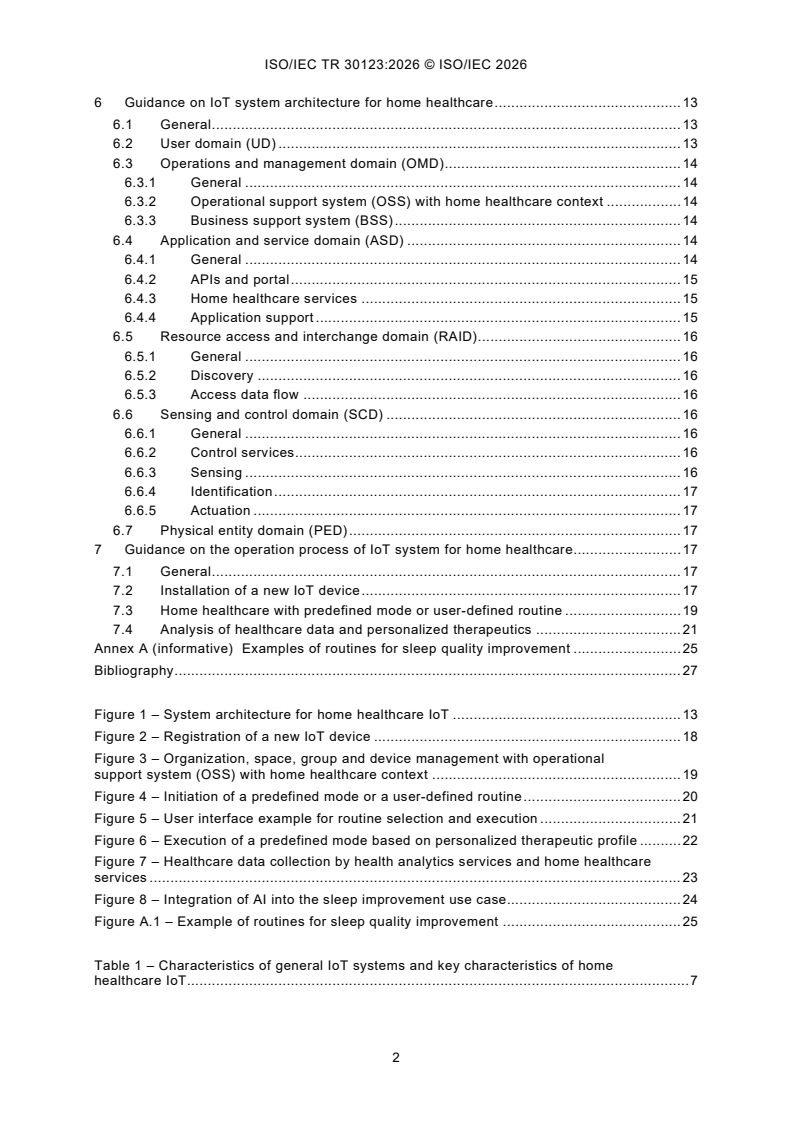
6 Guidance on IoT system architecture for home healthcare . 13
6.1 General . 13
6.2 User domain (UD) . 13
6.3 Operations and management domain (OMD) . 14
6.3.1 General . 14
6.3.2 Operational support system (OSS) with home healthcare context . 14
6.3.3 Business support system (BSS) . 14
6.4 Application and service domain (ASD) . 14
6.4.1 General . 14
6.4.2 APIs and portal . 15
6.4.3 Home healthcare services . 15
6.4.4 Application support . 15
6.5 Resource access and interchange domain (RAID) . 16
6.5.1 General . 16
6.5.2 Discovery . 16
6.5.3 Access data flow . 16
6.6 Sensing and control domain (SCD) . 16
6.6.1 General . 16
6.6.2 Control services . 16
6.6.3 Sensing . 16
6.6.4 Identification . 17
6.6.5 Actuation . 17
6.7 Physical entity domain (PED) . 17
7 Guidance on the operation process of IoT system for home healthcare. 17
7.1 General . 17
7.2 Installation of a new IoT device . 17
7.3 Home healthcare with predefined mode or user-defined routine . 19
7.4 Analysis of healthcare data and personalized therapeutics . 21
Annex A (informative) Examples of routines for sleep quality improvement . 25
Bibliography . 27
Figure 1 – System architecture for home healthcare IoT . 13
Figure 2 – Registration of a new IoT device . 18
Figure 3 – Organization, space, group and device management with operational
support system (OSS) with home healthcare context . 19
Figure 4 – Initiation of a predefined mode or a user-defined routine . 20
Figure 5 – User interface example for routine selection and execution . 21
Figure 6 – Execution of a predefined mode based on personalized therapeutic profile . 22
Figure 7 – Healthcare data collection by health analytics services and home healthcare
services . 23
Figure 8 – Integration of AI into the sleep improvement use case. 24
Figure A.1 – Example of routines for sleep quality improvement . 25
Table 1 – Characteristics of general IoT systems and key characteristics of home
healthcare IoT. 7
INTERNATIONAL ELECTROTECHNICAL COMMISSION
____________
Internet of Things (IoT) - Guidance on IoT application to home healthcare
FOREWORD
1) ISO (the International Organization for Standardization) and IEC (the International
Electrotechnical Commission) form the specialized system for worldwide standardization.
National bodies that are members of ISO or IEC participate in the development of International
Standards through technical committees established by the respective organization to deal with
particular fields of technical activity. ISO and IEC technical committees collaborate in fields of
mutual interest. Other international organizations, governmental and non-governmental, in
liaison with ISO and IEC, also take part in the work.
2) The formal decisions or agreements of IEC and ISO on technical matters express, as nearly
as possible, an international consensus of opinion on the relevant subjects since each technical
committee has representation from all interested IEC and ISO National bodies.
3) IEC and ISO documents have the form of recommendations for international use and are
accepted by IEC and ISO National bodies in that sense. While all reasonable efforts are made
to ensure that the technical content of IEC and ISO documents is accurate, IEC and ISO cannot
be held responsible for the way in which they are used or for any misinterpretation by any end
user.
4) In order to promote international uniformity, IEC and ISO National bodies undertake to apply
IEC and ISO documents transparently to the maximum extent possible in their national and
regional publications. Any divergence between any IEC and ISO document and the
corresponding national or regional publication shall be clearly indicated in the latter.
5) IEC and ISO do not provide any attestation of conformity. Independent certification bodies
provide conformity assessment services and, in some areas, access to IEC and ISO marks of
conformity. IEC and ISO are not responsible for any services carried out by independent
certification bodies.
6) All users should ensure that they have the latest edition of this document.
7) No liability shall attach to IEC and ISO or their directors, employees, servants or agents
including individual experts and members of its technical committees and IEC and ISO National
bodies for any personal injury, property damage or other damage of any nature whatsoever,
whether direct or indirect, or for costs (including legal fees) and expenses arising out of the
publication, use of, or reliance upon, this ISO/IEC document or any other IEC and ISO
documents.
8) Attention is drawn to the Normative references cited in this document. Use of the referenced
publications is indispensable for the correct application of this document.
9) IEC and ISO draw attention to the possibility that the implementation of this document may
involve the use of (a) patent(s). IEC and ISO take no position concerning the evidence, validity
or applicability of any claimed patent rights in respect thereof. As of the date of publication of
this document, IEC and ISO had not received notice of (a) patent(s), which may be required to
implement this document. However, implementers are cautioned that this may not represent the
latest information, which may be obtained from the patent database available at
https://patents.iec.ch and www.iso.org/patents. IEC and ISO shall not be held responsible for
identifying any or all such patent rights.
ISO/IEC TR 30123 has been prepared by subcommittee 41: Internet of Things and Digital Twin,
of ISO/IEC joint technical committee 1: Information technology. It is a Technical Report.
The text of this Technical Report is based on the following documents:
Draft Report on voting
JTC1-SC41/549/DTR JTC1-SC41/582/RVDTR
Full information on the voting for its approval can be found in the report on voting indicated in
the above table.
The language used for the development of this Technical Report is English.
This document was drafted in accordance with ISO/IEC Directives, Part 2, and developed in
accordance with ISO/IEC Directives, Part 1, and the ISO/IEC Directives, JTC 1 Supplement
available at http://www.iec.ch/members_experts/refdocs and http://www.iso.org/directives.
INTRODUCTION
As healthcare extends beyond traditional clinical settings into the home, IoT technologies
present unprecedented opportunities to enhance the quality of care, improve access to medical
services, and increase healthcare delivery efficiency. Home healthcare IoT constitutes a
specialized application of these technologies, intended to address the distinct requirements and
challenges associated with delivering healthcare in residential environments, including real-
time health monitoring, data security and privacy protection, remote diagnostics and treatment,
emergency response capabilities, and seamless integration with existing healthcare systems.
It includes a wide range of interconnected devices, systems, and services that monitor health,
support therapeutic interventions, and facilitate communication between patients, caregivers,
and healthcare providers.
1 Scope
This document provides guidance on applying IoT technologies to home healthcare systems,
taking into account the specific characteristics.
2 Normative references
The following documents are referred to in the text in such a way that some or all of their content
constitutes requirements of this document. For dated references, only the edition cited applies.
For undated references, the latest edition of the referenced document (including any
amendments) applies.
ISO/IEC 20924:2024, Internet of Things (IoT) and digital twin — Vocabulary
3 Terms and definitions
For the purposes of this document, the terms and definitions given in ISO/IEC 20924:2024 and
the following apply.
ISO and IEC maintain terminological databases for use in standardization at the following
addresses:
– IEC Electropedia: available at https://www.electropedia.org/
– ISO Online browsing platform: available at https://www.iso.org/obp
3.1
home healthcare IoT
infrastructure of interconnected entities, people, systems, and information resources along with
services, that applies IoT technologies to home healthcare systems to monitor, support, and
enhance healthcare delivery in the home environment
4 Symbols and abbreviated terms
AI artificial intelligence
API application programming interface
ASD application and service domain
BSS business support system
CPAP continuous positive airway pressure
ECG electrocardiogram
GDPR General Data Protection Regulation
HIPAA the Health Insurance Portability and Accountability Act
IoT Internet of Things
OMD operations and management domain
OSS operational support system
PED physical entity domain
RAID resource access interchange domain
SCD sensing and control domain
SDO super data object
UD user domain
5 Characteristics of home healthcare IoT
5.1 General
Home healthcare IoT extends general IoT principles through adaptations and enhancements.
This extension is governed by three fundamental principles.
a) Effectiveness: The ability to achieve intended healthcare outcomes and improve the quality
of care in home healthcare.
b) Safety: The capability to operate without causing harm to care recipients, caregivers, or the
environment, including the protection of health information.
c) Interoperability: The ability of diverse devices, systems and services to exchange and use
information seamlessly within the home healthcare system and with external healthcare
systems.
These principles form the foundation for the key characteristics that are more important in home
healthcare IoT than general IoT applications. [1], [2], ITU T.H810:2019 [3].
While home healthcare IoT builds on general IoT principles, it involves adaptations and
enhancements to address the critical nature of healthcare delivery, the sensitivity of health
information, and the varied needs of care recipients in home settings.
Clause 5 identifies twelve key characteristics of home healthcare IoT, which are examined in
the context of effectiveness, safety and interoperability, distinguishing them from their general
IoT counterparts.
Table 1 presents the general characteristics of IoT systems defined in ISO/IEC 30141:2024 [4]
in the categories of IoT system trustworthiness, IoT system architecture, and IoT system
functional characteristics. The key characteristics that are related to the three fundamental
principles of home healthcare IoT are highlighted in bold.
Table 1 – Characteristics of general IoT systems and key characteristics of home
healthcare IoT
Categories a
Related characteristics
IoT system trustworthiness characteristics Availability
Confidentiality
Integrity
Protection of personally identifiable information
Reliability
Resilience
Safety
IoT system architecture characteristics Composability
Functional and management capability separation
Heterogeneity
Legacy support
Modularity
Network connectivity
Scalability
Shareability
Unique identification
Well-defined components
Categories a
Related characteristics
IoT system functional characteristics Accuracy
Auto-configuration
Compliance
Content-awareness
Context-awareness
Data characteristics - volume, velocity, veracity,
variability and variety
Discoverability
Flexibility
Manageability
Network communication
Network management and operation
Real-time capability
Self-description
Service subscription
a
Key characteristics of home healthcare IoT are written in bold.
5.2 Confidentiality
5.2.1 Description
Confidentiality in home healthcare IoT ensures sensitive health information is accessible only
to authorized individuals, systems, and services. This characteristic is critical in healthcare
contexts due to the sensitive nature of health data and regulatory requirements governing health
information. Confidentiality measures include access controls, authentication mechanisms, and
encryption methods appropriate for diverse healthcare devices. Healthcare data require
particular protection as seemingly unimportant information can reveal sensitive medical
conditions when combined with other data. In home healthcare, confidentiality also
encompasses the protection of personally identifiable information and compliance with
applicable regulations, supporting both the effectiveness and safety of healthcare delivery.
5.2.2 Examples
A remote patient monitoring system for cardiac patients implements a multi-layered approach
to confidentiality. All health data transmissions use end-to-end encryption with specialized
protocols optimized for low-power devices. The system employs role-based access control,
providing different levels of data visibility to patients, family caregivers, and healthcare
professionals. Patient identification information is stored separately from clinical measurements
where possible, using techniques to reduce risk of unauthorized disclosure. The system
includes controls that allow patients to temporarily suspend monitoring during private activities
without triggering health alerts. Additionally, the system processes sensitive information at the
edge where appropriate, transmitting only necessary data to cloud services, and automatically
purging data according to clinical relevance and retention policies, all while maintaining
compliance with relevant healthcare data protection regulations.
5.3 Reliability
5.3.1 Description
Reliability in home healthcare IoT ensures the consistent performance of healthcare-specific
devices and services, giving them priority over non-healthcare devices and less urgent services.
Reliable home healthcare IoT systems and services enhance the effectiveness of care delivery
and user safety. In home healthcare IoT, reliable interoperation between healthcare devices is
very important, and it often requires a more stringent approach than interoperation between
non-healthcare devices.
5.3.2 Examples
During network congestion, a reliable home healthcare IoT ensures uninterrupted data
transmission from vital signs monitors while limiting bandwidth for smart home entertainment
devices.
5.4 Safety
5.4.1 Description
Safety in home healthcare IoT prioritizes the protection of patients and caregivers, and the
integrity of healthcare devices over the convenience features of non-healthcare IoT devices. It
ensures the effective delivery of care without compromising the well-being of care recipients.
Furthermore, safety measures facilitate interoperability by establishing secure and trusted
communication channels among home healthcare IoT devices. Security mechanisms are
essential components of safety in home healthcare IoT, incorporating appropriate solutions
such as strong authentication, data encryption, secure device update process, and monitoring
for unauthorized access. These security measures protect patient data and ensure the integrity
of healthcare devices.
5.4.2 Examples
A fall detection sensor prioritizes immediate alert signals over non-critical data transmissions.
When the sensor detects a fall event, the system ensures the urgent transmission of alert
signals through the network, potentially suspending or delaying non-critical data traffic. This
approach ensures timely response to safety-critical events while maintaining effective
integration between health and non-health devices.
5.5 Well-defined components
5.5.1 Description
In home healthcare IoT, well-defined components help ensure effectiveness, safety, and
interoperability. These components have precise descriptions of their capabilities and
characteristics, and associated uncertainties. Detail descriptions such as functionalities,
configurations, communication protocols, security measures, and reliability aspects support
seamless and effective operation within the home healthcare IoT.
5.5.2 Examples
A well-defined bed such as a smart bed provides detailed self-description, including sleep
tracking capability, body position monitoring and security features. This enables effective
interaction with other components such as a therapeutic thermal massager. When the bed
detects a user position suitable for therapeutic thermal therapy, it signals the massager to adjust
settings for targeted heat application, optimizing treatment effectiveness and user comfort.
5.6 Accuracy
5.6.1 Description
In home healthcare IoT, accuracy is an important feature in both data acquisition and
transmission. Accurate data collection, in particular, is prioritized as it directly impacts the
effectiveness of diagnosis and treatment. Maintaining accuracy during data transmission
ensures reliable interoperability with healthcare systems, emphasizing that healthcare-related
data takes precedence over non-healthcare IoT functions.
5.6.2 Examples
An IoT sleep tracker in a home healthcare system feeds data to an app analysing sleep patterns.
To enhance accuracy, the system suspends noisy operations for sleep tracker such as
scheduled robot cleaner operations when the sleep tracker detects the user has fallen asleep.
This prioritization of sleep tracking over household tasks ensures more precise data collection,
facilitating improved sleep quality assessments and recommendations. The accuracy of sleep
tracking directly impacts sleep quality assessment and subsequent therapeutic
recommendations. Inaccurate data can lead to inappropriate sleep interventions, potentially
negatively affecting the user's health and well-being. The prioritization of accurate data
collection ensures the effectiveness of the overall healthcare intervention.
5.7 Auto-configuration
5.7.1 Description
Auto-configuration in home healthcare IoT prioritizes setting up and optimizing healthcare
devices over less urgent functions. It enhances effectiveness by ensuring critical healthcare
functions are permanently properly configured. This feature improves safety by reducing
configuration errors in medical devices and supports interoperability by automatically
establishing correct interfaces for healthcare components. Security mechanisms ensure
authenticated and secure integration, allowing the massager to provide targeted thermal
therapy as part of a coordinated care plan.
5.7.2 Examples
When a therapeutic thermal massager is introduced to the home healthcare IoT, auto-
configuration enables the device to network with other components, such as an intermittent
pneumatic compression device and a health monitoring app. The system configures the
massager’s operational parameters based on the user’s health data and therapeutic
requirements.
5.8 Compliance
5.8.1 Description
Home healthcare IoT systems incorporate both regulated medical devices (e.g. respiratory
ventilators, blood pressure monitors, and glucose monitors) and wellness devices (e.g. fitness
trackers, smart scales, and sleep monitors). Medical devices are subject to stringent national
and international regulations, whereas wellness devices typically face different or less stringent
regulatory requirements. Compliance with applicable regulations for each device category is
essential for ensuring patient safety, data privacy, and system integrity when integrating these
devices into a home healthcare IoT.
5.8.2 Examples
A home healthcare IoT system integrating both a regulated continuous positive airway pressure
(CPAP) device and a wellness-oriented sleep tracker illustrates this compliance challenge. The
CPAP device must comply with medical device regulations regarding safety, performance, data
handling, and cybersecurity. These can include regulations such as the EU Medical Device
Regulation (MDR), US FDA requirements, or equivalent national frameworks. Additionally, the
system must adhere to data protection regulations like the General Data Protection Regulation
(GDPR) in Europe or the Health Insurance Portability and Accountability Act (HIPAA) in the
United States when handling patient data. The sleep tracker, while facing less stringent
requirements, must still adhere to consumer product safety standards and data privacy
regulations. The integrated system must implement appropriate controls to maintain compliance
with all applicable regulations while providing a unified user experience. This includes
implementing proper security measures, ensuring reliable communications, maintaining data
integrity, supporting secure software updates, and establishing clear boundaries between
regulated and non-regulated components of the system. Properly documenting these aspects
is essential for demonstrating compliance during regulatory reviews or audits.
5.9 Context-awareness
5.9.1 Description
Context-awareness in home healthcare IoT prioritizes understanding and responding to
healthcare-related contexts over general smart home scenarios [5], [6], [7]. This enhances the
effectiveness of care by providing more relevant and timely interventions. It improves safety by
ensuring healthcare needs are recognized and addressed promptly and supports
interoperability by sharing relevant context with healthcare providers.
5.9.2 Examples
A smart bed with an integrated the
...