

ISO 19650-2:2018
(Main)Organization and digitization of information about buildings and civil engineering works, including building information modelling (BIM) — Information management using building information modelling — Part 2: Delivery phase of the assets
General Information
- Abstract
This document specifies requirements for information management, in the form of a management process, within the context of the delivery phase of assets and the exchanges of information within it, using building information modelling. This document can be applied to all types of assets and by all types and sizes of organizations, regardless of the chosen procurement strategy.
- Status
- Published
- Publication Date
- 06-Dec-2018
- Current Stage
- 9092 - International Standard to be revised
- Start Date
- 07-Nov-2024
- Completion Date
- 29-Aug-2026
Buy Documents

ISO 19650-2:2018 - Organization and digitization of information about buildings and civil engineering works, including building information modelling (BIM) — Information management using building information modelling — Part 2: Delivery phase of the assets Released:12/7/2018

ISO 19650-2:2018 - Organisation et numérisation des informations relatives aux bâtiments et ouvrages de génie civil, y compris modélisation des informations de la construction (BIM) — Gestion de l'information par la modélisation des informations de la construction — Partie 2: Phase de réalisation des actifs Released:2/7/2019
Overview
ISO 19650-2:2018 defines requirements for information management using Building Information Modelling (BIM) during the delivery phase of assets (projects, buildings, infrastructure). It specifies a management process for planning, producing and exchanging information so that deliverables are consistent, traceable and suitable for handover into asset management. The standard is applicable to all asset types and organizations of any size and supports proportionate implementation according to project complexity.
Key Topics and Requirements
- Information management process - structured activities covering: assessment & need; invitation to tender; tender response; appointment; mobilization; collaborative production; information model delivery; and project close‑out.
- Exchange Information Requirements (EIR) - appointing party’s needs for the information to be delivered.
- Common Data Environment (CDE) - agreed shared resource for storing, managing and exchanging project information.
- Master and Task Information Delivery Plans (MIDP/TIDP) - schedules and responsibilities for information deliverables.
- BIM Execution Plan - delivery team’s approach to meet project information requirements (pre‑ and post‑appointment).
- Roles and responsibilities - appointment, nomination of information managers and lead appointed party duties.
- Quality assurance and review - processes for checking, authorizing and accepting information models (PIM/AIM).
- Proportionality principle - many clauses use “shall consider” to allow tailoring based on project scale and complexity.
Applications and Who Uses It
ISO 19650-2 is intended for practitioners who manage, produce or procure information in the delivery phase:
- Appointing parties and owners defining Exchange Information Requirements and accepting deliverables.
- Design teams, contractors and consultants producing coordinated BIM deliverables and PIMs.
- Information managers and BIM leads responsible for CDE setup, BIM execution plans and delivery schedules.
- Procurement and project managers using standardized tender and appointment information to drive collaboration.
- Asset managers preparing to receive an Asset Information Model (AIM) at handover.
Practical benefits include reduced rework, clearer responsibilities, consistent data for operation, and more efficient procurement and collaboration using BIM workflows.
Related Standards
- ISO 19650-1 - concepts and principles for information management using BIM.
- ISO 55000 - guidance on asset management (useful for aligning handover and lifecycle needs).
Keywords: ISO 19650-2, BIM, information management, delivery phase, common data environment, exchange information requirements, BIM execution plan, project information model.
Relations
- Effective Date
- 09-Feb-2026
- Effective Date
- 09-Feb-2026
- Effective Date
- 09-Feb-2026
- Effective Date
- 09-Feb-2026
- Effective Date
- 12-Feb-2026
- Effective Date
- 06-Jun-2022
Buy Documents
ISO 19650-2:2018 - Organization and digitization of information about buildings and civil engineering works, including building information modelling (BIM) — Information management using building information modelling — Part 2: Delivery phase of the assets Released:12/7/2018
ISO 19650-2:2018 - Organisation et numérisation des informations relatives aux bâtiments et ouvrages de génie civil, y compris modélisation des informations de la construction (BIM) — Gestion de l'information par la modélisation des informations de la construction — Partie 2: Phase de réalisation des actifs Released:2/7/2019
Get Certified
Connect with accredited certification bodies for this standard

BSI Group
BSI (British Standards Institution) is the business standards company that helps organizations make excellence a habit.

DIBt (Deutsches Institut für Bautechnik)
German Institute for Building Technology.
DIN CERTCO
DIN Group product certification.
Sponsored listings
Frequently Asked Questions
ISO 19650-2:2018 is a standard published by the International Organization for Standardization (ISO). Its full title is "Organization and digitization of information about buildings and civil engineering works, including building information modelling (BIM) — Information management using building information modelling — Part 2: Delivery phase of the assets". This standard covers: This document specifies requirements for information management, in the form of a management process, within the context of the delivery phase of assets and the exchanges of information within it, using building information modelling. This document can be applied to all types of assets and by all types and sizes of organizations, regardless of the chosen procurement strategy.
This document specifies requirements for information management, in the form of a management process, within the context of the delivery phase of assets and the exchanges of information within it, using building information modelling. This document can be applied to all types of assets and by all types and sizes of organizations, regardless of the chosen procurement strategy.
ISO 19650-2:2018 is classified under the following ICS (International Classification for Standards) categories: 35.240.67 - IT applications in building and construction industry; 91.010.01 - Construction industry in general; 93.010 - Civil engineering in general. The ICS classification helps identify the subject area and facilitates finding related standards.
ISO 19650-2:2018 has the following relationships with other standards: It is inter standard links to EN ISO 19650-5:2020, EN ISO 19650-4:2022, EN ISO 19650-6:2025, EN ISO 19650-3:2020, EN ISO 19650-2:2018, ISO/IEC 24770-62:2015. Understanding these relationships helps ensure you are using the most current and applicable version of the standard.
ISO 19650-2:2018 is available in PDF format for immediate download after purchase. The document can be added to your cart and obtained through the secure checkout process. Digital delivery ensures instant access to the complete standard document.
Standards Content (Sample)
INTERNATIONAL ISO
STANDARD 19650-2
First edition
2018-12
Organization and digitization of
information about buildings and civil
engineering works, including building
information modelling (BIM) —
Information management using
building information modelling —
Part 2:
Delivery phase of the assets
Organisation et numérisation des informations relatives aux
bâtiments et ouvrages de génie civil, y compris modélisation des
informations de la construction (BIM) — Gestion de l'information par
modélisation des informations de la construction —
Partie 2: Phase de réalisation des actifs
Reference number
©
ISO 2018
© ISO 2018
All rights reserved. Unless otherwise specified, or required in the context of its implementation, no part of this publication may
be reproduced or utilized otherwise in any form or by any means, electronic or mechanical, including photocopying, or posting
on the internet or an intranet, without prior written permission. Permission can be requested from either ISO at the address
below or ISO’s member body in the country of the requester.
ISO copyright office
CP 401 • Ch. de Blandonnet 8
CH-1214 Vernier, Geneva
Phone: +41 22 749 01 11
Fax: +41 22 749 09 47
Email: copyright@iso.org
Website: www.iso.org
Published in Switzerland
ii © ISO 2018 – All rights reserved
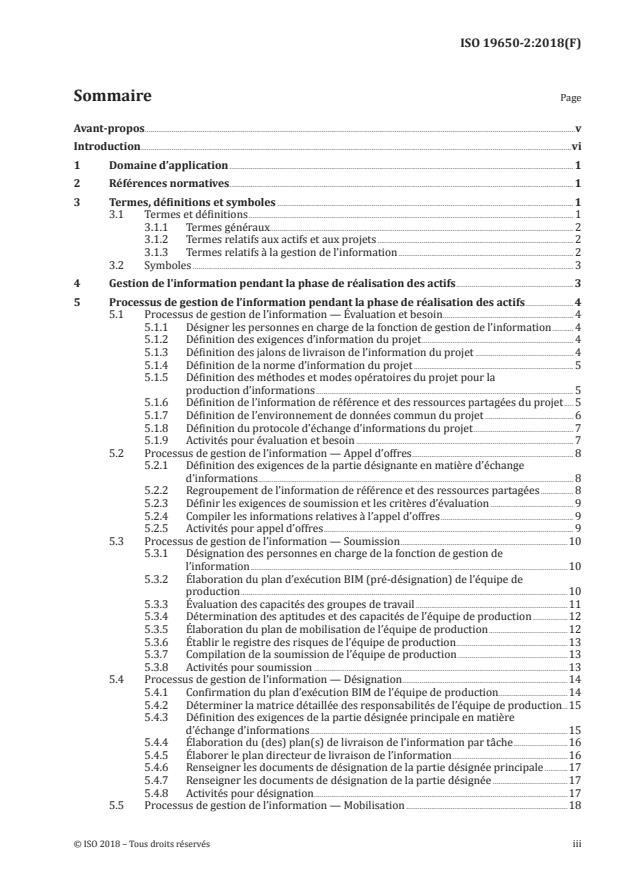
Contents Page
Foreword .v
Introduction .vi
1 Scope . 1
2 Normative references . 1
3 Terms, definitions and symbols . 1
3.1 Terms and definitions . 1
3.1.1 General terms . 1
3.1.2 Terms related to assets and projects . 2
3.1.3 Terms related to information management . 2
3.2 Symbols . 2
4 Information management during the delivery phase of assets . 3
5 Information management process during the delivery phase of assets .3
5.1 Information management process — Assessment and need . 3
5.1.1 Appoint individuals to undertake the information management function . 3
5.1.2 Establish the project’s information requirements . 4
5.1.3 Establish the project’s information delivery milestones . 4
5.1.4 Establish the project’s information standard . 4
5.1.5 Establish the project’s information production methods and procedures . 5
5.1.6 Establish the project’s reference information and shared resources. 5
5.1.7 Establish the project’s common data environment . 5
5.1.8 Establish the project’s information protocol . 6
5.1.9 Activities for assessment and need . 6
5.2 Information management process — Invitation to tender . 7
5.2.1 Establish the appointing party’s exchange information requirements . 7
5.2.2 Assemble reference information and shared resources . 8
5.2.3 Establish tender response requirements and evaluation criteria . 8
5.2.4 Compile invitation to tender information . 8
5.2.5 Activities for invitation to tender . 9
5.3 Information management process — Tender response . 9
5.3.1 Nominate individuals to undertake the information management function . 9
5.3.2 Establish the delivery team’s (pre-appointment) BIM execution plan .10
5.3.3 Assess task team capability and capacity .10
5.3.4 Establish the delivery team’s capability and capacity .11
5.3.5 Establish the delivery team’s mobilization plan .11
5.3.6 Establish the delivery team’s risk register .12
5.3.7 Compile the delivery team’s tender response .12
5.3.8 Activities for tender response .12
5.4 Information management process — Appointment .13
5.4.1 Confirm the delivery team’s BIM execution plan .13
5.4.2 Establish the delivery team’s detailed responsibility matrix .13
5.4.3 Establish the lead appointed party’s exchange information requirements .14
5.4.4 Establish the task information delivery plan(s) .15
5.4.5 Establish the master information delivery plan .15
5.4.6 Complete lead appointed party’s appointment documents .16
5.4.7 Complete appointed party’s appointment documents .16
5.4.8 Activities for appointment .16
5.5 Information management process — Mobilization .17
5.5.1 Mobilize resources .17
5.5.2 Mobilize information technology .17
5.5.3 Test the project’s information production methods and procedures .17
5.5.4 Activities for mobilization .17
5.6 Information management process — Collaborative production of information .18
5.6.1 Check availability of reference information and shared resources .18
5.6.2 Generate information . .18
5.6.3 Undertake quality assurance check .19
5.6.4 Review information and approve for sharing .19
5.6.5 Information model review . .20
5.6.6 Activities for collaborative production of information .20
5.7 Information management process — Information model delivery .20
5.7.1 Submit information model for lead appointed party authorization .20
5.7.2 Review and authorize the information model.20
5.7.3 Submit information model for appointing party acceptance .21
5.7.4 Review and accept the information model.21
5.7.5 Activities for information model delivery .21
5.8 Information management process — Project close-out .22
5.8.1 Archive the project information model .22
5.8.2 Capture lessons learned for future projects .22
5.8.3 Activities for project close-out .22
Annex A (informative) Information management assignment matrix .24
Bibliography .26
iv © ISO 2018 – All rights reserved
Foreword
ISO (the International Organization for Standardization) is a worldwide federation of national standards
bodies (ISO member bodies). The work of preparing International Standards is normally carried out
through ISO technical committees. Each member body interested in a subject for which a technical
committee has been established has the right to be represented on that committee. International
organizations, governmental and non-governmental, in liaison with ISO, also take part in the work.
ISO collaborates closely with the International Electrotechnical Commission (IEC) on all matters of
electrotechnical standardization.
The procedures used to develop this document and those intended for its further maintenance are
described in the ISO/IEC Directives, Part 1. In particular, the different approval criteria needed for the
different types of ISO documents should be noted. This document was drafted in accordance with the
editorial rules of the ISO/IEC Directives, Part 2 (see www .iso .org/directives).
Attention is drawn to the possibility that some of the elements of this document may be the subject of
patent rights. ISO shall not be held responsible for identifying any or all such patent rights. Details of
any patent rights identified during the development of the document will be in the Introduction and/or
on the ISO list of patent declarations received (see www .iso .org/patents).
Any trade name used in this document is information given for the convenience of users and does not
constitute an endorsement.
For an explanation of the voluntary nature of standards, the meaning of ISO specific terms and
expressions related to conformity assessment, as well as information about ISO's adherence to the
World Trade Organization (WTO) principles in the Technical Barriers to Trade (TBT) see www .iso
.org/iso/foreword .html.
This document was prepared by Technical Committee ISO/TC 59, Buildings and civil engineering works,
Subcommittee SC 13, Organization and digitalization of information about buildings and civil engineering
works, including building information modelling (BIM).
A list of all parts in the ISO 19650 series can be found on the ISO website.
Any feedback or questions on this document should be directed to the user’s national standards body. A
complete listing of these bodies can be found at www .iso .org/members .html.
Introduction
0.1 Purpose
This document is designed to enable an appointing party to establish their requirements for information
during the delivery phase of assets and to provide the right commercial and collaborative environment
within which (multiple) appointed parties can produce information in an effective and efficient manner.
This document is applicable to built assets and construction projects of all sizes and all levels of
complexity. This includes large estates, infrastructure networks, individual buildings and pieces of
infrastructure, and the projects or programmes that deliver them. However, the requirements included
in this document should be applied in a way that is proportionate and appropriate to the scale and
complexity of the asset or project. In particular, procurement and mobilization of asset or project
appointed parties should be integrated as far as possible with documented processes for technical
procurement and mobilization.
This document makes wide use of the phrase “shall consider”, particularly in the requirements in
Clause 5. This phrase is used to introduce a list of items that the person in question needs to think
about carefully in connection with the primary requirement described in the clause. The amount of
thought involved, the time taken to complete it and the need for supporting evidence will depend on the
complexity of the project, the experience of the person(s) involved and the requirements of any national
policy on introducing building information modelling. On a relatively small or straightforward project,
it can be possible to complete, or dismiss as not relevant, some of these “shall consider” items very
quickly.
One way to help identify which of the “shall consider” statements are relevant, can be to review each
statement and create templates for projects of different sizes and complexity.
This document can be used by any appointing party. If the appointing party intends this document to
apply to any asset (project) this should be reflected in the appointment.
This document defines the information management process, containing the activities through which
delivery teams can collaboratively produce information and minimize wasteful activities.
This document is primarily intended for use by the following (see Figure 1):
— those involved in the management or production of information during the delivery phase of assets;
— those involved in the definition and procurement of construction projects;
— those involved in the specification of appointments and facilitation of collaborative working;
— those involved in the design, construction, operation, maintenance and decommissioning of
assets; and
— those responsible for the realization of value for their organization from their asset base.
This document contains the requirements associated with the management of information during the
delivery phase of built assets, which will need to be reviewed and revised on a regular basis until the
best practice is established.
vi © ISO 2018 – All rights reserved
Key
AIM asset information model
PIM project information model
A start of delivery phase — transfer of relevant information from AIM to PIM
B progressive development of the design intent model into the virtual construction model
C end of delivery phase — transfer of relevant information from PIM to AIM
Figure 1 — Scope of this document
0.2 National annex with relevant national standards
There are several standards required for the successful implementation of this document, relating
to specific regions or countries, that are currently not suitable for inclusion within an international
standard. As such, national standards bodies are encouraged to compile and document the standards,
relevant to the region or country they represent, within a national annex. National annexes can also
provide localised guidance and advice on how to implement this document for projects of varying
complexity.
0.3 Relationship with other standards
The concepts and principles relating to the application of the requirements within this document are
provided in ISO 19650-1.
General information on asset management can be found in ISO 55000.
Appointing parties can find that consideration of the concepts and principles contained within both
ISO 19650-1 and ISO 55000 can assist the implementation of the requirements presented in this
document and development of asset management in their organization.
0.4 Benefits of the ISO 19650 series
The aim of this series is to support all parties towards achieving their business objectives through
the effective and efficient procurement, use and management of information during the delivery
phase of assets.
International cooperation in the preparation of these documents has identified a common information
management process that can be applied to the broadest range of assets, in the broadest range of
organizations, across the broadest range of cultures and under the broadest range of appointment routes.
0.5 Interfaces between parties and teams for the purpose of information management
For the purpose of this document, Figure 2 shows the interfaces between parties and teams in terms of
information management and should not be seen as identification of contractual relationships.
The terms for both parties and teams have been used throughout this document to identify and assign
the accountable party for each sub-activity.
NOTE Delivery teams can join and leave the project team at any time.
viii © ISO 2018 – All rights reserved
Key
A appointing party
B lead appointed party
C appointed party
… variable amount
1 project team
2 illustration of a delivery team
3 task team(s)
information requirements and information exchange
information coordination
Figure 2 — Interfaces between parties and teams for the purpose of information management
INTERNATIONAL STANDARD ISO 19650-2:2018(E)
Organization and digitization of information about
buildings and civil engineering works, including building
information modelling (BIM) — Information management
using building information modelling —
Part 2:
Delivery phase of the assets
1 Scope
This document specifies requirements for information management, in the form of a management
process, within the context of the delivery phase of assets and the exchanges of information within it,
using building information modelling.
This document can be applied to all types of assets and by all types and sizes of organizations, regardless
of the chosen procurement strategy.
2 Normative references
The following documents are referred to in the text in such a way that some or all of their content
constitutes requirements of this document. For dated references, only the edition cited applies. For
undated references, the latest edition of the referenced document (including any amendments) applies.
ISO 19650-1, Organization of information about construction works — Information management using
building information modelling — Part 1:Concepts and Principles
ISO 12006-2, Building construction — Organization of information about construction works — Part 2:
Framework for classification
3 Terms, definitions and symbols
3.1 Terms and definitions
For the purposes of this document, the terms and definitions given in ISO 19650-1 and the following apply.
ISO and IEC maintain terminological databases for use in standardization at the following addresses:
— ISO Online browsing platform: available at https: //www .iso .org/obp
— IEC Electropedia: available at http: //www .electropedia .org/
3.1.1 General terms
3.1.1.1
acceptance criteria
evidence required for considering that requirements have been fulfilled
[SOURCE: ISO 22263:2008, 2.1]
3.1.2 Terms related to assets and projects
3.1.2.1
project team
appointing party and all delivery teams
3.1.2.2
plan of work
document that details principal stages in the design, construction work and maintenance of a project
and identifies the main tasks and people
Note 1 to entry: A plan of work may be extended to include the stages in demolition and recycling of a project.
[SOURCE: ISO 6707-2:2017, 3.2.19, modified — Alternative terms “staging plan, US” and “project plan,
US” have been removed; Note 1 to entry has been added.]
3.1.3 Terms related to information management
3.1.3.1
BIM execution plan
plan that explains how the information management aspects of the appointment will be carried out by
the delivery team
Note 1 to entry: The pre-appointment BIM execution plan focuses on the delivery team’s proposed approach to
information management and their capability and capacity to manage information.
3.1.3.2
information delivery milestone
scheduled event for a predefined information exchange
3.1.3.3
master information delivery plan
MIDP
plan incorporating all relevant task information delivery plans (3.1.3.4)
3.1.3.4
task information delivery plan
TIDP
schedule of information containers and delivery dates, for a specific task team
3.2 Symbols
start
end
collapsed sub-process
activity
NOTE the symbols used within this document have been adapted from symbols defined within ISO/
IEC 19510.
2 © ISO 2018 – All rights reserved
4 Information management during the delivery phase of assets
The information management process (Figure 3) shall be applied throughout the delivery phase for
each appointment, regardless of project stage.
Activities
1 assessment and need A information model progressed by subsequent delivery
2 invitation to tender team(s) for each appointment
3 tender response B activities undertaken per project
4 appointment C activities undertaken per appointment
5 mobilization D activities undertaken during the procurement stage
6 collaborative production of information (of each appointment)
7 information model delivery E activities undertaken during the information planning
8 project close-out (end of delivery phase) stage (of each appointment)
F activities undertaken during the information production
stage (of each appointment)
Figure 3 — Information management process during the delivery phase of assets
NOTE 1 It is these activities that have been used as the structure for this document, in particular Clause 5.
NOTE 2 The order in which activities are presented in Figure 3 reflects the order in which they are undertaken.
NOTE 3 In the event that the information management process is undertaken within a single organization,
the appointment can be supplemented by an internal work instruction, followed by an acceptance of the work
instruction and confirmation to proceed. See ISO 19650-1:2018, 6.3 and 8.1 for more information.
5 Information management process during the delivery phase of assets
5.1 Information management process — Assessment and need
5.1.1 Appoint individuals to undertake the information management function
The appointing party shall have regard to the effective management of information throughout the
project and reflect the long-term asset information management strategy, as described in ISO 19650-1
:2018, 5.3, by nominating individuals from within the appointing party’s organization to undertake the
information management function on behalf of the appointing party.
Alternatively, the appointing party can appoint a prospective lead appointed party or a third-party to
undertake all or part of the information management function, in which case, the appointing party shall
establish a scope of services.
In doing this, the appointing party shall consider:
— the tasks that the prospective lead appointed party or third party will be responsible for;
— the authority that the appointing party will delegate to the prospective lead appointed party or
third party; and
— the competency (knowledge or skills) that the individuals undertaking the function will need.
NOTE Where the appointing party appoints a prospective lead appointed party or a third party to undertake
all or part of the information management function, the use of the information management assignment matrix
(Annex A) can help with establishing the scope of services needed.
5.1.2 Establish the project’s information requirements
The appointing party shall establish the project’s information requirements, as described in
ISO 19650-1:2018, 5.3, to address the questions to which the appointing party needs answer(s) at each
of the key decision points throughout the project.
In doing this, the appointing party shall consider:
— the project scope;
— the intended purpose for which the information will be used by the appointing party;
— the project plan of work;
— the intended procurement route;
— the number of key decision points throughout the project;
— the decisions that the appointing party needs to make at each key decision point; and
— the questions to which the appointing party needs answers, to make informed decisions.
5.1.3 Establish the project’s information delivery milestones
The appointing party shall establish the project’s information delivery milestones in accordance with
the project’s plan of work.
In doing this, the appointing party shall consider:
— the appointing party’s key decision points;
— its own information delivery obligations (if any);
— the nature and substance of information to be delivered at each key decision point; and
— the date(s) relative to each key decision point that the information model is to be delivered.
5.1.4 Establish the project’s information standard
The appointing party shall establish any specific information standards required by the appointing
party’s organization within the project’s information standard.
In doing this, the appointing party shall consider:
a) the exchange of information:
— within the appointing party’s organization,
— between the appointing party and external stakeholders,
— between the appointing party and external operators or maintainers,
— between the prospective lead appointed party and the appointing party,
4 © ISO 2018 – All rights reserved
— between prospective appointed parties on the same project, and
— between interdependent projects;
b) the means of structuring and classifying information;
c) the method of assignment for level of information need; and
d) the use of information during the operational phase of the asset.
5.1.5 Establish the project’s information production methods and procedures
The appointing party shall establish any specific information production methods and procedures
required by their organization within the project’s information production methods and procedures.
In doing this, the appointing party shall consider:
a) the capture of existing asset information;
b) the generation, review or approval of new information;
c) the security or distribution of information; and
d) the delivery of information to the appointing party.
5.1.6 Establish the project’s reference information and shared resources
The appointing party shall establish the reference information and shared resources that they intend
to share with the prospective lead appointed parties during the tender process or appointment, using
open data standards whenever possible to avoid duplication of effort and interoperability issues.
In doing this, the appointing party shall consider:
a) existing asset information:
— from within the appointing party’s organization;
— from adjacent asset owners (utility companies, etc.);
— under license from external providers (mapping and imagery, etc.); and
— within public libraries and other sources of historical records.
b) shared resources, for example:
— process output templates (BIM execution plan, master information delivery plan, etc.);
— information container templates (2D/3D geometrical models, documents, etc.);
— style libraries (lines, text and hatch, etc.); or
— object libraries (2D symbols, 3D objects, etc.).
c) library objects defined within national and regional standards.
NOTE The appointing party can seek support from specialist suppliers to establish reference information or
shared resources.
5.1.7 Establish the project’s common data environment
The appointing party shall establish (implement, configure and support) the project’s common data
environment (CDE) to serve the overall requirements of the project and to support the collaborative
production of information (5.6).
The project’s common data environment shall enable:
a) each information container to have a unique ID, based upon an agreed and documented convention
comprised of fields separated by a delimiter;
b) each field to be assigned a value from an agreed and documented codification standard;
c) each information container to have the following attributes assigned:
— status (suitability);
— revision;
— classification (in accordance with the framework defined in ISO 12006-2);
d) the ability for information containers to transition between states;
e) the recording of the name of user and date when information container revisions transition
between each state; and
f) controlled access at an information container level.
It is strongly recommended that the project CDE is in place prior to issuing the invitation to tender, so
that information can be shared with tendering organizations in a secure manner.
The appointing party can also appoint a third-party to host, manage or support the project’s CDE. In this
case, it is recommended that this is done as a separate appointment before procurement of any other
appointed party starts. Or the appointing party can also, at a later date, appoint an appointed party to
take over the hosting, management or support of the project’s CDE. In either case, it is recommended
that the appointing party defines a functional and non-functional requirements specification.
5.1.8 Establish the project’s information protocol
The appointing party shall establish the project’s information protocol, as defined below, including any
associated license agreements, which will, subsequently and appropriately, be incorporated into all
appointments.
In doing this, the appointing party shall consider:
— specific obligations of the appointing party, prospective lead appointed parties and prospective
appointed parties relating to the management or production of information, including the use of the
project’s common data environment;
— any warranties or liabilities associated to the project information model;
— background and foreground intellectual property rights of information;
— the use of existing asset information;
— the use of shared resources;
— the use of information during the project, including any associated licensing terms; and
— the re-use of information following the appointment or in the event of termination.
5.1.9 Activities for assessment and need
Activities for assessment and need are shown in Figure 4.
6 © ISO 2018 – All rights reserved
Key
1.1 appoint individuals to undertake the information management function
1.2 establish the project's information requirements
1.3 establish the project's information delivery milestones
1.4 establish the project’s information standard
1.5 establish the project's information production methods and procedures
1.6 establish the project’s reference information and shared resources
1.7 establish the project's common data environment
1.8 establish the project's information protocol
A information model progressed by subsequent delivery team(s) for each appointment
NOTE Activities shown in parallel are to highlight that these activities can be undertaken concurrently and
apply to all instances.
Figure 4 — Information management process — Assessment and need
5.2 Information management process — Invitation to tender
5.2.1 Establish the appointing party’s exchange information requirements
The appointing party shall establish their exchange information requirements to be met by the
prospective lead appointed party during the appointment.
In doing this, the appointing party shall:
a) establish the appointing party’s information requirements to be served during the appointment,
and in doing so shall consider their:
— organizational information requirements,
— asset information requirements, and
— project information requirements;
b) establish the level of information need required to meet each information requirement;
NOTE Other metrics to describe the status of information, such as level of accuracy, can be added to
these metrics as considered appropriate.
c) establish the acceptance criteria for each information requirement, and in doing so shall consider:
— the project’s information standard,
— the project’s information production methods and procedures, and
— the use of reference information or shared resources provided by the appointing party;
d) establish the supporting information that the prospective lead appointed party might need, to fully
understand or evaluate each information requirement or its acceptance criteria, and in doing so
shall consider:
— existing asset information,
— shared resources,
— supporting documents or guidance material,
— references to relevant international, national or industry standards, and
— exemplars of similar information deliverables;
e) establish the dates, relative to the project’s information delivery milestones and appointing party’s
key decision points, that each requirement has to be met, and in doing so shall consider:
— the time needed by the appointing party to review and accept information, and
— the appointing party’s internal assurance processes.
5.2.2 Assemble reference information and shared resources
The appointing party shall assemble the reference information or shared resources that they intend to
provide to the prospective lead appointed party during the tender process or appointment.
In doing this, the appointing party shall consider:
— reference information or shared resources identified during project initiation;
— information generated during previous stages of the project; and
— the suitability for which the information can be used by the prospective lead appointed party.
It is recommended that reference information and shared resources are made available to tendering
organizations in a secure environment, such as the project’s common data environment.
It is recommended that appointing parties identify the suitability for which the information can be used
by tendering organizations and delivery teams, by way of a status code associated to each information
container.
5.2.3 Establish tender response requirements and evaluation criteria
The appointing party shall establish the requirements that tendering organizations shall meet within
their tender response.
In doing this, the appointing party shall consider:
— the contents of the delivery team’s (pre-appointment) BIM execution plan;
— the competency of the prospective individuals undertaking the information management function
on behalf of the delivery team;
— the prospective lead appointed party’s assessment of the delivery team’s capability and capacity;
— the delivery team’s proposed mobilization plan; and
— the delivery team’s information delivery risk assessment.
5.2.4 Compile invitation to tender information
The appointing party shall compile the information to be included within the invitation to tender
package.
8 © ISO 2018 – All rights reserved
In doing this, the appointing party shall consider:
— the appointing party’s exchange information requirements;
— the relevant reference information and shared resources (within the project’s common data
environment);
— the tender response requirements and evaluation criteria (if applicable);
— the project information delivery milestones;
— the project’s information standard;
— the project’s information production methods and procedure; and
— the project’s information protocol.
5.2.5 Activities for invitation to tender
Activities for invitation to tender are shown in Figure 5.
Key
2.1 establish the appointing party’s exchange information requirements
2.2 assemble reference information and shared resources
2.3 establish tender response requirements and evaluation criteria
2.4 compile invitation to tender information
A information model progressed by subsequent delivery team(s) for each appointment
NOTE Activities shown in parallel are to highlight that these activities can be undertaken concurrently.
Figure 5 — Information management process — Invitation to tender
5.3 Information management process — Tender response
5.3.1 Nominate individuals to undertake the information management function
The prospective lead appointed party shall have regard to the effective management of information
throughout the appointment by nominating individuals from within its own organization to undertake
the information management function on behalf of the lead appointed party.
Alternatively, the prospective lead appointed party can appoint a prospective appointed party or
third party to undertake all or part of the information management function, in which case, the lead
appointed party shall establish a scope of services.
In doing this, the appointing party shall consider:
— the appointing party’s exchange information requirements;
— the tasks that the prospective appointed party or third party will be responsible for;
— the authority that the prospective lead appointed party will delegate to the prospective appointed
party or third party;
— the competency (knowledge or skills) that the individuals undertaking the function will need; and
— probity arrangements if potential conflicts of interest may arise.
The appointing party can appoint the prospective lead appointed party to undertake all or part of the
information management function on their behalf. In this scenario, to avoid any potential conflict of
interest, it is recommended that individuals undertake the information management function on behalf
of either the appointing party or the prospective lead appointed party.
5.3.2 Establish the delivery team’s (pre-appointment) BIM execution plan
The prospective lead appointed party shall establish the delivery team’s (pre-appointment) BIM
execution plan, to be included within the prospective lead appointed party’s tender response.
In doing this, the prospective lead appointed party shall consider:
a) the proposed names and professional résumés of the individuals who will undertake the
information management function on behalf of the delivery team;
b) the delivery team’s information delivery strategy, containing:
— the delivery team’s approach to meeting the appointing party’s exchange information
requirements,
— a set of objectives/goals for the collaborative production of information,
— an overview of the delivery team’s organizational structure and commercial relationships, and
— an overview of the delivery team’s composition, in the form of one or more task teams;
c) the proposed federation strategy to be adopted by the delivery team;
d) the delivery team’s high-level responsibility matrix, containing the allocated responsibility for each
element of the information model and the key deliverables associated to each element;
e) any proposed additions or amendments to the project’s information production methods and
procedures that the delivery team require to facilitate the effective:
— capture of existing asset information,
— generation, review, approval and authorization of information,
— security and distribution of information, and
— delivery of information to the appointing party;
f) any proposed additions or amendments to the project’s information standard that the delivery
team require to facilitate the effective:
— exchange of information between task teams,
— distribution of information to external parties, or
— delivery of information to the appointing party;
g) a proposed schedule of software (including versions), hardware and IT infrastructure the delivery
team intend to adopt.
5.3.3 Assess task team capability and capacity
Each task team shall undertake an assessment of their capability and capacity to deliver information
in accordance with the appointing party’s exchange information requirements and the delivery team’s
proposed (pre-appointment) BIM execution plan.
10 © ISO 2018 – All rights reserved
In doing this, each task team shall consider:
a) the task team’s capability and capacity to manage information, based upon:
— the relevant experience and number of task team members who have managed information in
accordance with the proposed information delivery strategy; and
— the relevant education and training available to task team members;
b) the task team’s capability and capacity to produce information, based upon:
— the relevant experience and number of task team members who have produced information in
accordance with the project’s information production methods and procedures; and
— the relevant education and training available to task team members;
c) the availability of information technology (IT) within the task team, based upon:
— the proposed IT schedule;
— the specification and quantity of the task team’s hardware;
— the architecture, maximum capacity and current utilization of the task team’s IT
infrastructure; and
— the associated support and service level agreements available to the task team
...
NORME ISO
INTERNATIONALE 19650-2
Première édition
2018-12
Organisation et numérisation des
informations relatives aux bâtiments
et ouvrages de génie civil, y compris
modélisation des informations de
la construction (BIM) — Gestion de
l'information par la modélisation des
informations de la construction —
Partie 2:
Phase de réalisation des actifs
Organization and digitization of information about buildings and
civil engineering works, including building information modelling
(BIM) — Information management using building information
modelling —
Part 2: Delivery phase of the assets
Numéro de référence
©
ISO 2018
DOCUMENT PROTÉGÉ PAR COPYRIGHT
© ISO 2018
Tous droits réservés. Sauf prescription différente ou nécessité dans le contexte de sa mise en œuvre, aucune partie de cette
publication ne peut être reproduite ni utilisée sous quelque forme que ce soit et par aucun procédé, électronique ou mécanique,
y compris la photocopie, ou la diffusion sur l’internet ou sur un intranet, sans autorisation écrite préalable. Une autorisation peut
être demandée à l’ISO à l’adresse ci-après ou au comité membre de l’ISO dans le pays du demandeur.
ISO copyright office
Case postale 401 • Ch. de Blandonnet 8
CH-1214 Vernier, Genève
Tél.: +41 22 749 01 11
Fax: +41 22 749 09 47
E-mail: copyright@iso.org
Web: www.iso.org
Publié en Suisse
ii © ISO 2018 – Tous droits réservés
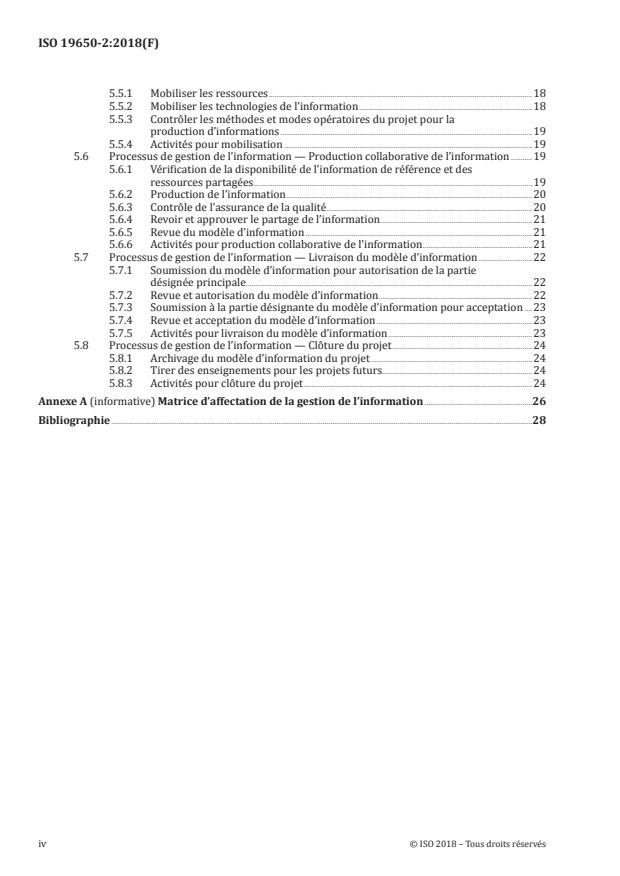
Sommaire Page
Avant-propos .v
Introduction .vi
1 Domaine d’application . 1
2 Références normatives . 1
3 Termes, définitions et symboles . 1
3.1 Termes et définitions . 1
3.1.1 Termes généraux. 2
3.1.2 Termes relatifs aux actifs et aux projets . 2
3.1.3 Termes relatifs à la gestion de l’information . 2
3.2 Symboles . 3
4 Gestion de l’information pendant la phase de réalisation des actifs .3
5 Processus de gestion de l’information pendant la phase de réalisation des actifs .4
5.1 Processus de gestion de l’information — Évaluation et besoin . 4
5.1.1 Désigner les personnes en charge de la fonction de gestion de l’information . 4
5.1.2 Définition des exigences d’information du projet . 4
5.1.3 Définition des jalons de livraison de l’information du projet . 4
5.1.4 Définition de la norme d’information du projet . 5
5.1.5 Définition des méthodes et modes opératoires du projet pour la
production d’informations . 5
5.1.6 Définition de l’information de référence et des ressources partagées du projet . 5
5.1.7 Définition de l’environnement de données commun du projet . 6
5.1.8 Définition du protocole d’échange d’informations du projet . 7
5.1.9 Activités pour évaluation et besoin . 7
5.2 Processus de gestion de l’information — Appel d’offres . 8
5.2.1 Définition des exigences de la partie désignante en matière d’échange
d’informations . . 8
5.2.2 Regroupement de l’information de référence et des ressources partagées . 8
5.2.3 Définir les exigences de soumission et les critères d’évaluation . 9
5.2.4 Compiler les informations relatives à l’appel d’offres . 9
5.2.5 Activités pour appel d’offres . 9
5.3 Processus de gestion de l’information — Soumission .10
5.3.1 Désignation des personnes en charge de la fonction de gestion de
l’information .10
5.3.2 Élaboration du plan d’exécution BIM (pré-désignation) de l’équipe de
production .10
5.3.3 Évaluation des capacités des groupes de travail .11
5.3.4 Détermination des aptitudes et des capacités de l’équipe de production .12
5.3.5 Élaboration du plan de mobilisation de l’équipe de production .12
5.3.6 Établir le registre des risques de l’équipe de production .13
5.3.7 Compilation de la soumission de l’équipe de production .13
5.3.8 Activités pour soumission .13
5.4 Processus de gestion de l’information — Désignation .14
5.4.1 Confirmation du plan d’exécution BIM de l’équipe de production . .14
5.4.2 Déterminer la matrice détaillée des responsabilités de l’équipe de production.15
5.4.3 Définition des exigences de la partie désignée principale en matière
d’échange d’informations .15
5.4.4 Élaboration du (des) plan(s) de livraison de l’information par tâche .16
5.4.5 Élaborer le plan directeur de livraison de l’information .16
5.4.6 Renseigner les documents de désignation de la partie désignée principale .17
5.4.7 Renseigner les documents de désignation de la partie désignée .17
5.4.8 Activités pour désignation .17
5.5 Processus de gestion de l’information — Mobilisation .18
5.5.1 Mobiliser les ressources .18
5.5.2 Mobiliser les technologies de l’information .18
5.5.3 Contrôler les méthodes et modes opératoires du projet pour la
production d’informations .19
5.5.4 Activités pour mobilisation .19
5.6 Processus de gestion de l’information — Production collaborative de l’information .19
5.6.1 Vérification de la disponibilité de l’information de référence et des
ressources partagées . .19
5.6.2 Production de l’information .20
5.6.3 Contrôle de l’assurance de la qualité .20
5.6.4 Revoir et approuver le partage de l’information .21
5.6.5 Revue du modèle d’information .21
5.6.6 Activités pour production collaborative de l’information .21
5.7 Processus de gestion de l’information — Livraison du modèle d’information .22
5.7.1 Soumission du modèle d’information pour autorisation de la partie
désignée principale . .22
5.7.2 Revue et autorisation du modèle d’information.22
5.7.3 Soumission à la partie désignante du modèle d’information pour acceptation .23
5.7.4 Revue et acceptation du modèle d’information .23
5.7.5 Activités pour livraison du modèle d’information .23
5.8 Processus de gestion de l’information — Clôture du projet .24
5.8.1 Archivage du modèle d’information du projet .24
5.8.2 Tirer des enseignements pour les projets futurs .24
5.8.3 Activités pour clôture du projet .24
Annexe A (informative) Matrice d’affectation de la gestion de l’information .26
Bibliographie .28
iv © ISO 2018 – Tous droits réservés
Avant-propos
L’ISO (Organisation internationale de normalisation) est une fédération mondiale d’organismes
nationaux de normalisation (comités membres de l’ISO). L’élaboration des Normes internationales est
en général confiée aux comités techniques de l’ISO. Chaque comité membre intéressé par une étude
a le droit de faire partie du comité technique créé à cet effet. Les organisations internationales,
gouvernementales et non gouvernementales, en liaison avec l’ISO participent également aux travaux.
L’ISO collabore étroitement avec la Commission électrotechnique internationale (IEC) en ce qui
concerne la normalisation électrotechnique.
Les procédures utilisées pour élaborer le présent document et celles destinées à sa mise à jour sont
décrites dans les Directives ISO/IEC, Partie 1. Il convient, en particulier de prendre note des différents
critères d’approbation requis pour les différents types de documents ISO. Le présent document a été
rédigé conformément aux règles de rédaction données dans les Directives ISO/IEC, Partie 2 (voir www
.iso .org/directives).
L’attention est attirée sur le fait que certains des éléments du présent document peuvent faire l’objet de
droits de propriété intellectuelle ou de droits analogues. L’ISO ne saurait être tenue pour responsable
de ne pas avoir identifié de tels droits de propriété et averti de leur existence. Les détails concernant
les références aux droits de propriété intellectuelle ou autres droits analogues identifiés lors de
l’élaboration du document sont indiqués dans l’Introduction et/ou dans la liste des déclarations de
brevets reçues par l’ISO (voir www .iso .org/brevets).
Les appellations commerciales éventuellement mentionnées dans le présent document sont données
pour information, par souci de commodité, à l’intention des utilisateurs et ne sauraient constituer un
engagement.
Pour une explication de la nature volontaire des normes, la signification des termes et expressions
spécifiques de l’ISO liés à l’évaluation de la conformité, ou pour toute information au sujet de l’adhésion
de l’ISO aux principes de l’Organisation mondiale du commerce (OMC) concernant les obstacles
techniques au commerce (OTC), voir le lien suivant: www .iso .org/iso/fr/avant -propos.
Le présent document a été élaboré par le comité technique ISO/TC 59, Bâtiments et ouvrages de génie
civil, sous-comité SC 13, Organisation et numérisation des informations relatives aux bâtiments et ouvrages
de génie civil, y compris modélisation des informations de la construction (BIM).
Une liste de toutes les parties de la série ISO 19650 se trouve sur le site web de l’ISO.
Il convient que l’utilisateur adresse tout retour d’information ou toute question concernant le présent
document à l’organisme national de normalisation de son pays. Une liste exhaustive desdits organismes
se trouve à l’adresse www .iso .org/fr/members .html.
Introduction
0.1 Objet
Le présent document est conçu pour permettre à une partie désignante d’établir ses exigences
d’information au cours de la phase de réalisation des actifs et de fournir l’environnement commercial et
collaboratif adapté dans lequel les (multiples) parties désignées peuvent produire de l’information de
manière efficiente et efficace.
Le présent document s’applique aux actifs bâtis et aux ouvrages de construction de toutes tailles et
de tous niveaux de complexité, notamment les grandes opérations d’aménagement, les réseaux
d’infrastructure, les bâtiments individuels et les éléments d’infrastructure, ainsi que les projets ou
programmes permettant leur livraison. Il convient toutefois d’appliquer les exigences exposées dans
le présent document de manière proportionnée et adaptée à l’échelle et à la complexité de l’actif ou du
projet. Dans la mesure du possible, il est également important d’intégrer et de mobiliser les parties
désignées pour l’exploitation des actifs ou des projets dans les processus existants de définition
technique et de mobilisation.
Le présent document utilise largement les termes «doit tenir compte», en particulier concernant les
exigences de l’Article 5. Cette phrase est utilisée pour introduire une liste d’éléments auxquels la
personne en question doit réfléchir soigneusement en liaison avec l’exigence principale décrite dans
l’article. La somme de réflexion, le temps à y consacrer et le besoin de preuves en soutien dépendent
de la complexité du projet, de l’expérience de la ou des personnes impliquées et des exigences d’une
éventuelle politique nationale sur l’introduction de la modélisation des informations de la construction.
Sur un projet relativement petit ou simple, il est possible de compléter très rapidement certains de ces
éléments «doit tenir compte», voire de les écarter comme non pertinents.
Pour identifier plus facilement ceux des énoncés «doit tenir compte» qui sont pertinents, il est possible
d’examiner chaque énoncé et de créer des modèles pour des projets de différentes tailles et complexités.
Le présent document peut être utilisé par toute partie désignante. Si la partie désignante prévoit
d’appliquer le présent document à un actif (projet), il convient qu’elle le précise dans la désignation.
Le présent document définit également le processus de gestion de l’information, contenant les
activités par le biais desquelles les équipes de production peuvent produire l’information de manière
collaborative et réduire au minimum les activités superflues.
Le présent document s’adresse principalement aux parties suivantes (voir Figure 1):
— les parties impliquées dans la gestion ou la production d’informations pendant la phase de réalisation
d’actifs;
— les parties intervenant dans la définition et la passation des marchés de projets de construction;
— les parties jouant un rôle dans la spécification des désignations et la facilitation du travail collaboratif;
— les parties impliquées dans la conception, la construction, l’exploitation, la maintenance et la mise
hors service d’actifs; et
— les responsables de la création de valeur pour leur organisation à partir de leur base d’actifs.
Le présent document contient les exigences associées à la gestion de l’information pendant la phase de
réalisation des actifs bâtis, qui devront être examinées et révisées à intervalles réguliers jusqu’à ce que
la meilleure pratique soit établie.
vi © ISO 2018 – Tous droits réservés
Légende
AIM modèle d’information d’actif
PIM modèle d’information du projet
A début de la phase de réalisation— transfert de l’information pertinente de l’AIM au PIM
B développement progressif du modèle de conception prévu dans le modèle de construction virtuelle
C fin de la phase de réalisation— transfert de l’information pertinente au PIM à l’AIM
Figure 1 — Domaine d’application du présent document
0.2 Annexes nationales avec normes nationales pertinentes
Plusieurs normes sont exigées pour la mise en œuvre réussie du présent document, se rapportant à des
régions ou pays spécifiques et non adaptées pour être incluses dans une Norme internationale. En tant
que tels, les organismes de normalisation nationaux sont encouragés à compiler et documenter, dans
une annexe nationale, les normes pertinentes pour la région ou le pays qu’ils représentent. Les annexes
nationales peuvent également fournir des recommandations et des conseils localisés sur la mise en
œuvre du présent document pour des projets de différentes complexités.
0.3 Relation avec d’autres normes
Les concepts et principes se rapportant à l’application des exigences spécifiées dans le présent document
sont exposés dans l’ISO 19650-1.
L’ISO 55000 fournit quant à elle des informations générales sur la gestion d’actifs.
Les parties désignantes peuvent estimer que la prise en compte des concepts et principes contenus dans
l’ISO 19650-1 et l’ISO 55000 peut aider à la mise en œuvre des exigences présentées dans ce document
et au développement de la gestion d’actifs dans leur organisation.
0.4 Avantages de la série ISO 19650
L’objectif de cette série est d'aider toutes les parties à atteindre leurs objectifs opérationnels grâce à
l'acquisition, à l'utilisation et à la gestion efficaces et efficientes de l'information pendant la phase de
réalisation des actifs.
La coopération internationale pour la préparation de ces documents a identifié un processus commun
de gestion de l’information qui peut être appliqué à la palette d’actifs la plus étendue, dans la plus
grande majorité des organisations, dans la plus grande diversité de cultures, avec le plus large éventail
de voies de désignation.
0.5 Interfaces entre les parties et les équipes aux fins de la gestion de l’information
Pour les besoins du présent document, la Figure 2 représente les interfaces entre les parties et
les équipes en termes de gestion de l’information, et il convient de ne pas la considérer comme une
identification des relations contractuelles.
Les mêmes termes pour les parties et les équipes ont été utilisés tout au long du présent document afin
d’identifier et de désigner la partie responsable de chaque activité secondaire.
NOTE Les équipes de production peuvent rejoindre et quitter l’équipe du projet à tout moment.
viii © ISO 2018 – Tous droits réservés
Légende
A partie désignante
B partie désignée principale
C partie désignée
… quantité variable
1 équipe du projet
2 illustration d’une équipe de production
3 équipe(s) de travail
exigences d’information et échange d’informations
coordination des informations
Figure 2 — Interfaces entre les parties et les équipes aux fins de la gestion de l’information
NORME INTERNATIONALE ISO 19650-2:2018(F)
Organisation et numérisation des informations relatives
aux bâtiments et ouvrages de génie civil, y compris
modélisation des informations de la construction
(BIM) — Gestion de l'information par la modélisation des
informations de la construction —
Partie 2:
Phase de réalisation des actifs
1 Domaine d’application
Le présent document spécifie les exigences relatives à la gestion de l’information, sous la forme d’un
processus de gestion, dans le contexte de la phase de réalisation d’actifs et les échanges d’informations
au cours de cette phase, en utilisant la modélisation des informations de la construction.
Le présent document peut être appliqué à tous les types d’actifs et par tous les types et tailles
d’organisations, quelle que soit la stratégie de passation de marchés choisie.
2 Références normatives
Les documents suivants sont cités dans le texte de sorte qu’ils constituent, pour tout ou partie de leur
contenu, des exigences du présent document. Pour les références datées, seule l’édition citée s’applique.
Pour les références non datées, la dernière édition du document de référence s'applique (y compris les
éventuels amendements).
ISO 19650-1, Organisation des informations concernant les ouvrages de construction — Gestion de
l’information par la modélisation des informations de la construction — Partie 1: Concepts et principes
ISO 12006-2, Construction immobilière — Organisation de l'information des travaux de construction —
Partie 2: Plan type pour la classification
3 Termes, définitions et symboles
3.1 Termes et définitions
Pour les besoins du présent document, les termes et définitions de l’ISO 19650-1 ainsi que les suivants,
s’appliquent.
L’ISO et l’IEC tiennent à jour des bases de données terminologiques destinées à être utilisées en
normalisation, consultables aux adresses suivantes:
— ISO Online browsing platform: disponible à l’adresse https: //www .iso .org/obp;
— IEC Electropedia: disponible à l’adresse http: //www .electropedia .org/.
3.1.1 Termes généraux
3.1.1.1
critères d’acceptation
preuve exigée pour considérer que les exigences ont été satisfaites
[SOURCE: ISO 22263:2008, 2.1]
3.1.2 Termes relatifs aux actifs et aux projets
3.1.2.1
équipe du projet
partie désignante et toutes les équipes de production
3.1.2.2
plan de travail
document détaillant les principales étapes de conception, de construction et de maintenance d’un projet
et identifiant les principales tâches et les personnes concernées
Note 1 à l'article: Un plan de travail peut être étendu pour inclure les étapes de démolition et de recyclage
d’un projet.
[SOURCE: ISO 6707-2:2017, 3.2.19, modifiée — Les termes alternatifs «plan d’activation, É-U» et «plan
de projet, É-U» ont été supprimés; la Note 1 à l’article a été ajoutée.]
3.1.3 Termes relatifs à la gestion de l’information
3.1.3.1
plan d’exécution BIM
(BEP, BIM execution plan)
plan décrivant la manière dont l’équipe de production traitera les aspects de la désignation relatifs à la
gestion de l’information
Note 1 à l'article: Le pré-plan d’exécution BIM de la désignation est axé sur l’approche proposée par l’équipe de
production pour la gestion de l’information et son aptitude et sa capacité à gérer l’information.
3.1.3.2
jalon de livraison de l’information
événement planifié pour un échange d’informations prédéfini
3.1.3.3
plan directeur de livraison de l’information
MIDP
plan incorporant tous les plans de livraison de l’information par tâche (3.1.3.4) pertinents
3.1.3.4
plan de livraison de l’information par tâche
TIDP
programme des conteneurs d’information et des dates de livraison, pour une équipe de travail
spécifique
2 © ISO 2018 – Tous droits réservés
3.2 Symboles
Début
Fin
Sous-processus réduit
Activité
NOTE Les symboles utilisés dans le présent document ont été adaptés à partir de ceux définis dans l’ISO/
IEC 19510.
4 Gestion de l’information pendant la phase de réalisation des actifs
Le processus de gestion de l’information (Figure 3) doit être appliqué tout au long de la phase de
réalisation, pour chaque désignation, quelle que soit l’étape du projet.
Activités
1 évaluation et besoin A modèle d’information enrichi par les équipes de
production
2 appel d’offres suivantes pour chaque désignation
3 soumission B activités réalisées dans le cadre d’un projet
4 désignation C activités réalisées dans le cadre d’une désignation
5 mobilisation D activités réalisées pendant la phase de passation de
6 production collaborative d’informations marché (de chaque désignation)
7 livraison du modèle d’information E activités réalisées pendant la phase de planification de
8 clôture du projet (fin de la phase de réalisation) l’information (de chaque désignation)
F activités réalisées pendant la phase de production de
l’information (de chaque désignation)
Figure 3 — Processus de gestion de l’information pendant la phase de réalisation des actifs
NOTE 1 Il s’agit des activités qui ont été utilisées dans toute la structure du présent document, en particulier à
l’Article 5.
NOTE 2 L’ordre dans lequel sont présentées les activités (Figure 3) reflète l'ordre dans lequel elles sont
entreprises.
NOTE 3 Si le processus de gestion de l’information est exécuté au sein d’une seule organisation, la désignation
peut être complétée par une instruction de travail interne, suivie d’une acceptation de l’instruction de travail et
de la confirmation de sa prise en compte. Se reporter à l’ISO 19650-1:2018, 6.3 et 8.1 pour plus d’informations.
5 Processus de gestion de l’information pendant la phase de réalisation des actifs
5.1 Processus de gestion de l’information — Évaluation et besoin
5.1.1 Désigner les personnes en charge de la fonction de gestion de l’information
La partie désignante doit tenir compte de la gestion efficace de l’information tout au long du projet et
appliquer la stratégie à long terme en matière de gestion de l’information d’actifs, telle que décrite dans
l’ISO 19650-1:2018, 5.3, en désignant des personnes au sein de l’organisation de la partie désignante
pour assurer la fonction de gestion de l’information pour le compte de la partie désignante.
La partie désignante peut également désigner une partie désignée principale envisagée ou une tierce
partie pour qu’elle remplisse tout ou partie de la fonction de gestion de l’information du projet, auquel
cas la partie désignante doit établir un périmètre de services.
À ce stade, la partie désignante doit tenir compte des éléments suivants:
— les tâches dont la partie désignée principale envisagée ou la tierce partie sera responsable;
— l’autorité que la partie désignante délèguera à la partie désignée principale envisagée ou à la tierce
partie; et
— les compétences (connaissances ou aptitudes) exigées de la part des personnes qui assurent cette
fonction.
NOTE Lorsque la partie désignante désigne une partie désignée principale ou un tiers envisagé(e) pour
prendre en charge tout ou partie de la fonction de gestion de l’information, l’utilisation de la matrice d’affectation
de gestion de l’information (Annexe A) peut faciliter l’établissement du domaine d’application des services requis.
5.1.2 Définition des exigences d’information du projet
La partie désignante doit établir les exigences d’information du projet, conformément à la description
de l’ISO 19650-1:2018, 5.3, permettant de traiter les questions auxquelles la partie désignante doit
trouver des réponses à chaque point de décision principal du projet.
À ce stade, la partie désignante doit tenir compte des éléments suivants:
— le périmètre du projet;
— le but dans lequel l’information sera utilisée par la partie désignante;
— le plan de travail du projet;
— les modalités de passation de marché;
— le nombre de principaux points de décision tout au long du projet;
— les décisions que la partie désignante doit prendre à chaque point de décision principal; et
— les questions auxquelles la partie désignante doit répondre afin de prendre des décisions éclairées.
5.1.3 Définition des jalons de livraison de l’information du projet
La partie désignante doit définir les jalons de livraison de l’information du projet en fonction du plan de
travail du projet.
4 © ISO 2018 – Tous droits réservés
À ce stade, la partie désignante doit tenir compte des éléments suivants:
— les principaux points de décision de la partie désignante;
— ses propres obligations en matière de livraison de l’information (le cas échéant);
— la nature et la substance de l’information à livrer à chaque point de décision principal; et
— la (les) date(s) se rapportant à chaque point de décision principal où le modèle d’information doit
être livré.
5.1.4 Définition de la norme d’information du projet
La partie désignante doit établir toutes les normes d’information spécifiques exigées par son
organisation dans le cadre de la norme d’information du projet.
À ce stade, la partie désignante doit tenir compte des éléments suivants:
a) l’échange d’informations:
— au sein de l’organisation de la partie désignante;
— entre la partie désignante et les parties prenantes externes;
— entre la partie désignante et les exploitants ou prestataires de maintenance externes;
— entre la partie désignée principale envisagée et la partie désignante;
— entre les parties désignées envisagées pour le même projet; et
— entre des projets interdépendants;
b) les outils disponibles pour structurer et classer les informations;
c) la méthode d’affectation pour le niveau du besoin d’information; et
d) l’utilisation de l’information pendant la phase d’exploitation de l’actif.
5.1.5 Définition des méthodes et modes opératoires du projet pour la production
d’informations
La partie désignante doit établir tous les modes opératoires et méthodes spécifiques de production
d’informations exigés par son organisation dans le cadre des méthodes et modes opératoires du projet
pour la production d’informations.
À ce stade, la partie désignante doit tenir compte des éléments suivants:
a) l’acquisition d’informations existantes sur les actifs;
b) la production, la revue ou l’approbation de nouvelles informations;
c) la sécurité ou la diffusion des informations; et
d) la transmission des informations à la partie désignante.
5.1.6 Définition de l’information de référence et des ressources partagées du projet
La partie désignante doit établir l’information de référence et les ressources partagées qu’il a l’intention
de partager avec les parties désignées principales envisagées au cours de la procédure d’appel d’offres
ou de la désignation, au moyen de normes de données ouvertes lorsque c’est possible pour éviter la
multiplication des efforts et les problèmes d’interopérabilité.
À ce stade, la partie désignante doit tenir compte des éléments suivants:
a) les informations d’actifs existantes:
— provenant de l’organisation de la partie désignante;
— provenant de propriétaires d’actifs environnants (entreprises de services publics, etc.);
— provenant de fournisseurs externes et sous licence (cartographie et imagerie, etc.); et
— contenues dans les bibliothèques publiques et d’autres sources d’enregistrements historiques;
b) les ressources partagées, par exemple:
— modèles de sortie de processus (plan d’exécution BIM-(BEP), plan directeur de livraison de
l’information-(MIDP), etc.);
— modèles de conteneurs d’information (modèles géométriques 2D/3D, documents, etc.);
— bibliothèques de styles (traits, texte et hachurage, etc.); ou
— bibliothèques d’objets (symboles 2D, objets 3D, etc.);
c) les objets de bibliothèques définis dans des normes nationales et régionales.
NOTE La partie désignante peut recourir aux services de fournisseurs spécialisés pour établir l’information
de référence ou les ressources partagées.
5.1.7 Définition de l’environnement de données commun du projet
La partie désignante doit établir (mettre en œuvre, configurer et prendre en charge) l’environnement
de données commun (CDE) du projet pour répondre à la totalité des exigences du projet et assurer la
production collaborative de l’information (5.6).
L’environnement de données commun du projet doit permettre:
a) d’affecter à chaque conteneur d’information un ID unique basé sur une convention convenue et
documentée, et formé de champs séparés par un délimiteur;
b) d’attribuer à chaque champ une valeur déterminée conformément à une norme de codification
convenue et documentée;
c) d’affecter les attributs suivants à chaque conteneur d’information:
— état (pertinence);
— révision;
— classification (conformément au cadre défini dans l’ISO 12006-2);
d) de changer l’état des conteneurs d’information;
e) d’enregistrer le nom d’utilisateur et la date à chaque changement d’état d’une révision de conteneur
d’information; et
f) de contrôler l’accès information un niveau d’un conteneur d’information.
Il est fortement recommandé que le CDE du projet soit en place avant la publication de l’appel d’offres
afin de pouvoir partager, de manière sécurisée, les informations avec les organisations participant à cet
appel d’offres.
La partie désignante peut désigner une partie tierce pour héberger, gérer ou prendre en charge le CDE
du projet. Dans ce cas, il est recommandé de procéder séparément à cette désignation, avant le début de
la désignation d’une autre partie désignée. La partie désignante peut également, à une date ultérieure,
6 © ISO 2018 – Tous droits réservés
désigner une partie désignée qui assurera l’hébergement, la gestion ou la prise en charge du CDE du
projet. Dans les deux cas, il est recommandé que la partie désignante définisse une spécification des
exigences fonctionnelles et non fonctionnelles.
5.1.8 Définition du protocole d’échange d’informations du projet
La partie désignante doit établir le protocole d’échange d’informations du projet, comme défini ci-
dessous, y compris tout contrat de licence associé, qui sera ensuite intégré de manière appropriée dans
toutes les désignations.
À ce stade, la partie désignante doit tenir compte des éléments suivants:
— les obligations spécifiques de la partie désignante, des parties désignées principales envisagées
et des parties désignées envisagées se rapportant à la gestion ou à la production d’informations, y
compris l’utilisation de l’environnement de données commun du projet;
— les garanties ou responsabilités associées au modèle d’information du projet;
— les droits de propriété intellectuelle d’aval et d’amont de l’information;
— l’utilisation d’informations existantes sur les actifs;
— l’utilisation des ressources partagées;
— l’utilisation des informations au cours du projet, y compris les conditions de licence associées; et
— la réutilisation d’informations après la désignation ou en cas de résiliation de contrat.
5.1.9 Activités pour évaluation et besoin
Les activités pour évaluation et besoin sont représentées à la Figure 4.
Légende
1.1 Désigner les personnes en charge de la fonction de gestion de l’information
1.2 Définir les exigences d’information du projet
1.3 Définir les jalons de livraison de l’information du projet
1.4 Définir la norme d’information du projet
1.5 Définir les méthodes et modes opératoires du projet pour la production d’informations
1.6 Définir l’information de référence et les ressources partagées du projet
1.7 Définir l’environnement de données commun du projet
1.8 Définir le protocole d’échange d’informations du projet
A Modèle d’information enrichi par les équipes de production suivantes pour chaque désignation
NOTE Les activités représentées en parallèle sont destinées à mettre en exergue le fait qu’elles peuvent être
entreprises simultanément et qu’elles s’appliquent à tous les cas.
Figure 4 — Processus de gestion de l’information — Évaluation et besoin
5.2 Processus de gestion de l’information — Appel d’offres
5.2.1 Définition des exigences de la partie désignante en matière d’échange d’informations
La partie désignante doit établir ses exigences en matière d’échange d’informations auxquelles la partie
désignée principale envisagée devra se conformer au cours de la désignation.
À ce stade, la partie désignante doit:
a) définir les exigences d’information de la partie désignante à satisfaire pendant la désignation, en
tenant compte:
— des exigences d’information de l’organisation;
— des exigences d’information de l’actif; et
— des exigences d’information du projet;
b) établir le niveau du besoin d’information exigé pour satisfaire à chaque exigence d’information;
NOTE D’autres grandeurs de mesure destinées à décrire l’état de l’information, tel que le niveau de
précision, peuvent être ajoutées à ces grandeurs, si elles sont jugées appropriées.
c) établir les critères d’acceptation pour chaque exigence d’information, en tenant compte:
— de la norme d’information du projet;
— des méthodes et des modes opératoires du projet pour la production d’informations; et
— de l’utilisation de l’information de référence ou des ressources partagées fournies par la partie
désignante;
d) établir les informations de support dont la partie désignée principale envisagée pourrait avoir
besoin afin de bien comprendre ou d’évaluer chaque exigence d’information ou ses critères
d’acceptation, en tenant compte:
— des informations d’actifs existants;
— des ressources partagées;
— des documents de support ou d’orientation;
— des références aux normes internationales, nationales ou industrielles pertinentes; et
— des exemplaires d’information similaire à livrer;
e) établir les dates, en fonction des jalons de livraison de l’information du projet et des principaux points
de décision de la partie désignante, auxquelles chaque exigence doit être satisfaite, en tenant compte:
— du délai de revue et d’acception des informations par la partie désignante; et
— des processus d’assurance internes de la partie désignante.
5.2.2 Regroupement de l’information de référence et des ressources partagées
La partie désignante doit regrouper l’information de référence ou les ressources partagées qu’elle a
l’intention de transmettre à la partie désignée principale envisagée au cours de la procédure d’appel
d’offres ou de la désignation.
À ce stade, la partie désignante doit tenir compte des éléments suivants:
— l’information de référence ou les ressources partagées identifiées au lancement du projet;
8 © ISO 2018 – Tous droits réservés
— les informations produites au cours des phases précédentes du projet; et
— le code de pertinence pour lequel l’information peut être utilisée par la partie désignée principale
envisagée.
Il est recommandé de tenir l’information de référence et les ressources partagées à la disposition des
organisations participant à l’appel d’offres, dans un environnement sécurisé tel que l’environnement de
données commun du projet.
Il est recommandé que les parties désignantes identifient le code de pertinence pour lequel l’information
peut être utilisée par les organisations participant à l’appel d’offres et les équipes de production, au
moyen d’un code de statut associé à chaque conteneur d’information.
5.2.3 Définir les exigences de soumission et les critères d’évaluation
La partie désignante doit établir les exigences auxquelles les organisations formulant une offre doivent
se conformer dans le cadre de leur soumission.
À ce stade, la partie désignante doit tenir compte des éléments suivants:
— le contenu du plan d’exécution BIM (pré-désignation) de l’équipe de production;
— les compétences exigées de la part des personnes envisagées pour exercer la fonction de gestion de
l’information pour le compte de l’équipe de production;
— l’évaluation par la partie désignée principale envisagée des aptitudes et capacités de l’équipe de
production;
— le plan de mobilisation proposé par l’équipe de production; et
— l’évaluation des risques liés à la livraison d’informations par l’équipe de production.
5.2.4 Compiler les informations relatives à l’appel d’offres
La partie désignante doit compiler les informations à inclure dans le dossier de l’appel d’offres.
À ce stade, la partie désignante doit tenir compte des éléments suivants:
— les exigences de la partie désignante en matière d’échange d’informations;
— l’information de référence pertinente et les ressources partagées (au sein de l’environnement de
données commun du projet);
— les exigences de soumission et les critères d’évaluation (le cas échéant);
— les jalons de livraison de l’information du projet;
— la norme d’information du projet;
— les méthodes et le mode opératoire du projet pour la production d’informations; et
— le protocole d’échange d’informations du projet.
5.2.5 Activités pour appel d’offres
Les activités pour appel d’offres sont représentées à la Figure 5.
Légende
2.1 Définir les exigences de la partie désignante en matière d’échange d’informations
2.2 Regrouper l’information de référence et les ressources partagées
2.3 Définir les exigences de soumission et les critères d’évaluation
2.4 Compiler les informations relatives à l’appel d’offres
A Modèle d’information enrichi par les équipes de production suivantes pour chaque désignation
NOTE Les activités représentées en parallèle sont destinées à mettre en exergue le fait qu’elles peuvent être
entreprises simultanément.
Figure 5 — Processus de gestion de l’information — Appel d’offres
5.3 Processus de gestion de l’information — Soumission
5.3.
...