

ISO 19650-1:2018
(Main)Organization and digitization of information about buildings and civil engineering works, including building information modelling (BIM) — Information management using building information modelling — Part 1: Concepts and principles
General Information
- Abstract
This document outlines the concepts and principles for information management at a stage of maturity described as "building information modelling (BIM) according to the ISO 19650 series". This document provides recommendations for a framework to manage information including exchanging, recording, versioning and organizing for all actors. This document is applicable to the whole life cycle of any built asset, including strategic planning, initial design, engineering, development, documentation and construction, day-to-day operation, maintenance, refurbishment, repair and end-of-life. This document can be adapted to assets or projects of any scale and complexity, so as not to hamper the flexibility and versatility that characterize the large range of potential procurement strategies and so as to address the cost of implementing this document.
- Status
- Published
- Publication Date
- 06-Dec-2018
- Current Stage
- 9092 - International Standard to be revised
- Start Date
- 07-Nov-2024
- Completion Date
- 29-Aug-2026
Buy Documents
REDLINE ISO 19650-1:2018 - Organization and digitization of information about buildings and civil engineering works, including building information modelling (BIM) — Information management using building information modelling — Part 1: Concepts and principles Released:12/7/2018

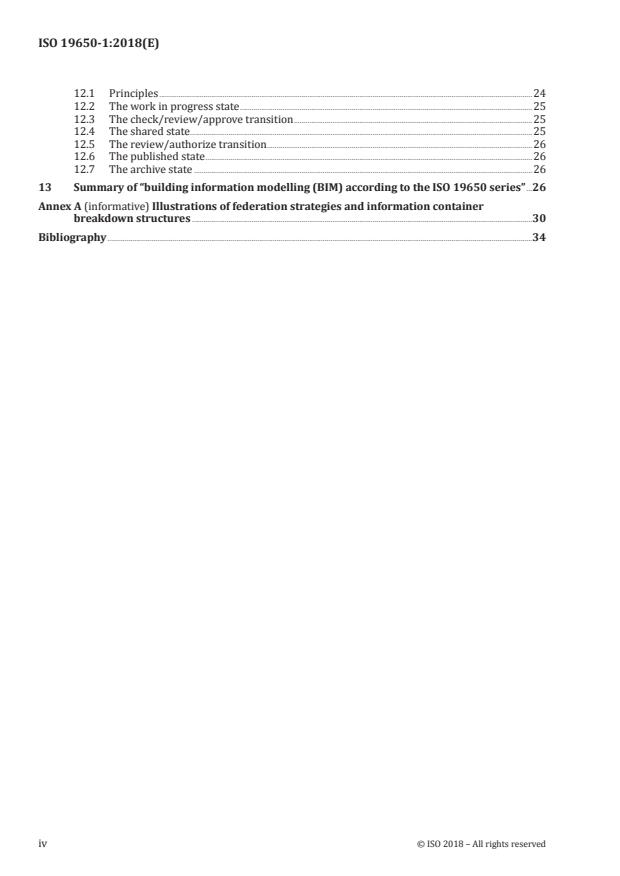
ISO 19650-1:2018 - Organization and digitization of information about buildings and civil engineering works, including building information modelling (BIM) — Information management using building information modelling — Part 1: Concepts and principles Released:12/7/2018

ISO 19650-1:2018 - Organisation et numérisation des informations relatives aux bâtiments et ouvrages de génie civil, y compris modélisation des informations de la construction (BIM) — Gestion de l'information par la modélisation des informations de la construction — Partie 1: Concepts et principes Released:2/7/2019
Overview
ISO 19650-1:2018 defines the concepts and principles for information management using Building Information Modelling (BIM) across the full life cycle of built assets. It provides a recommended framework for exchanging, recording, versioning and organising digital information so that project and asset teams can collaborate efficiently. The standard is applicable to buildings, civil engineering works and infrastructure at any scale, from strategic planning and design through construction, operation, maintenance, refurbishment and end‑of‑life.
Keywords: ISO 19650-1, BIM, information management, built assets, asset life cycle, common data environment
Key Topics
- Information management concepts: Principles to support consistent production and use of asset and project information models (AIM, PIM).
- Information requirements: Definitions and roles of Organizational Information Requirements (OIR), Asset Information Requirements (AIR), Project Information Requirements (PIR) and Exchange Information Requirements (EIR).
- Information delivery cycle: Planning, verification and validation of information through project stages aligned with the asset life cycle.
- Collaborative working: Use of a Common Data Environment (CDE) with states (work-in-progress, shared, published, archived) and review/approval workflows.
- Information containers & federation: Strategies and breakdown structures for grouping and federating information from multiple sources.
- Roles & capabilities: Guidance on delivery team capability, capacity review and responsibilities for information delivery.
- Quality and levels of information need: Principles for information quality, level of detail/definition and consistent handover.
Keywords: asset information model, project information model, common data environment, exchange information requirements, information delivery planning
Applications
ISO 19650-1 is used to:
- Establish a consistent BIM-based information management framework for projects and asset management.
- Define and flow information requirements from asset owners/clients down supply chains.
- Plan and verify information deliverables during procurement, design, construction and operation.
- Improve interoperability, reduce rework and manage risk related to information loss or misinterpretation.
Typical users:
- Asset owners/operators, clients and facility managers
- Architects, engineers and design consultants
- Contractors, sub‑contractors and specialist suppliers
- BIM managers, information managers and project managers
- Public authorities, investors and insurers
Keywords: BIM standards, information delivery, facilities management, construction project management
Related Standards
- ISO 19650 series (further parts, including ISO 19650-2 for delivery phase requirements)
- ISO 55000 (asset management-useful for aligning asset information requirements)
- ISO 9001 (quality management-supports systematic approaches to information quality)
Adopting ISO 19650-1 helps organisations implement scalable, proportionate BIM information management that supports better decision-making, lifecycle cost control and collaborative delivery.
Relations
- Effective Date
- 25-Aug-2026
- Effective Date
- 25-Aug-2026
- Effective Date
- 25-Aug-2026
- Effective Date
- 25-Aug-2026
- Effective Date
- 12-Feb-2026
- Effective Date
- 06-Jun-2022
- Effective Date
- 06-Jun-2022
Buy Documents
REDLINE ISO 19650-1:2018 - Organization and digitization of information about buildings and civil engineering works, including building information modelling (BIM) — Information management using building information modelling — Part 1: Concepts and principles Released:12/7/2018
ISO 19650-1:2018 - Organization and digitization of information about buildings and civil engineering works, including building information modelling (BIM) — Information management using building information modelling — Part 1: Concepts and principles Released:12/7/2018
ISO 19650-1:2018 - Organisation et numérisation des informations relatives aux bâtiments et ouvrages de génie civil, y compris modélisation des informations de la construction (BIM) — Gestion de l'information par la modélisation des informations de la construction — Partie 1: Concepts et principes Released:2/7/2019
Get Certified
Connect with accredited certification bodies for this standard

BSI Group
BSI (British Standards Institution) is the business standards company that helps organizations make excellence a habit.

DIBt (Deutsches Institut für Bautechnik)
German Institute for Building Technology.
DIN CERTCO
DIN Group product certification.
Sponsored listings
Frequently Asked Questions
ISO 19650-1:2018 is a standard published by the International Organization for Standardization (ISO). Its full title is "Organization and digitization of information about buildings and civil engineering works, including building information modelling (BIM) — Information management using building information modelling — Part 1: Concepts and principles". This standard covers: This document outlines the concepts and principles for information management at a stage of maturity described as "building information modelling (BIM) according to the ISO 19650 series". This document provides recommendations for a framework to manage information including exchanging, recording, versioning and organizing for all actors. This document is applicable to the whole life cycle of any built asset, including strategic planning, initial design, engineering, development, documentation and construction, day-to-day operation, maintenance, refurbishment, repair and end-of-life. This document can be adapted to assets or projects of any scale and complexity, so as not to hamper the flexibility and versatility that characterize the large range of potential procurement strategies and so as to address the cost of implementing this document.
This document outlines the concepts and principles for information management at a stage of maturity described as "building information modelling (BIM) according to the ISO 19650 series". This document provides recommendations for a framework to manage information including exchanging, recording, versioning and organizing for all actors. This document is applicable to the whole life cycle of any built asset, including strategic planning, initial design, engineering, development, documentation and construction, day-to-day operation, maintenance, refurbishment, repair and end-of-life. This document can be adapted to assets or projects of any scale and complexity, so as not to hamper the flexibility and versatility that characterize the large range of potential procurement strategies and so as to address the cost of implementing this document.
ISO 19650-1:2018 is classified under the following ICS (International Classification for Standards) categories: 35.240.67 - IT applications in building and construction industry; 91.010.01 - Construction industry in general; 93.010 - Civil engineering in general. The ICS classification helps identify the subject area and facilitates finding related standards.
ISO 19650-1:2018 has the following relationships with other standards: It is inter standard links to EN ISO 19650-2:2018, EN ISO 19650-6:2025, EN ISO 19650-4:2022, EN ISO 19650-3:2020, EN ISO 19650-1:2018, ISO 20400:2017, ISO 19472-2:2022. Understanding these relationships helps ensure you are using the most current and applicable version of the standard.
ISO 19650-1:2018 is available in PDF format for immediate download after purchase. The document can be added to your cart and obtained through the secure checkout process. Digital delivery ensures instant access to the complete standard document.
Standards Content (Sample)
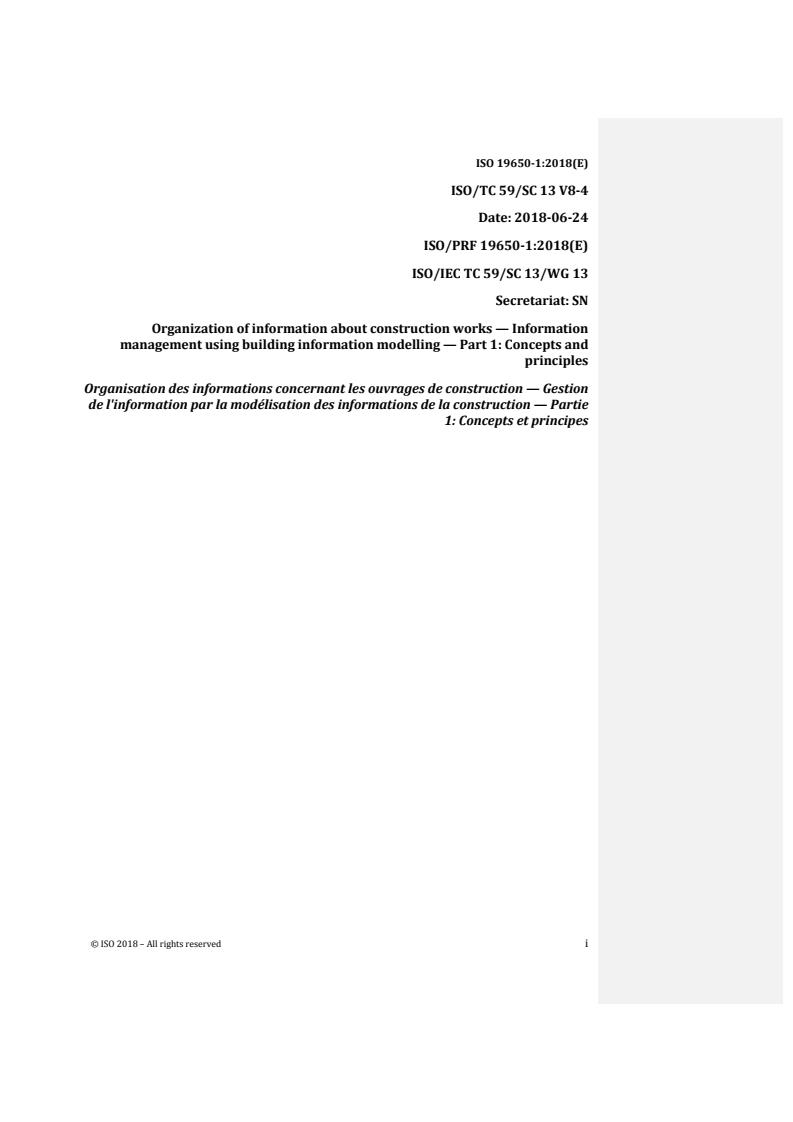
ISO/TC 59/SC 13 V8-4
Date: 2018-06-24
ISO/PRF 19650-1:2018(E)
ISO/IEC TC 59/SC 13/WG 13
Secretariat: SN
Organization of information about construction works — Information
management using building information modelling — Part 1: Concepts and
principles
Organisation des informations concernant les ouvrages de construction — Gestion
de l'information par la modélisation des informations de la construction — Partie
1: Concepts et principes
© ISO 2018 – All rights reserved i
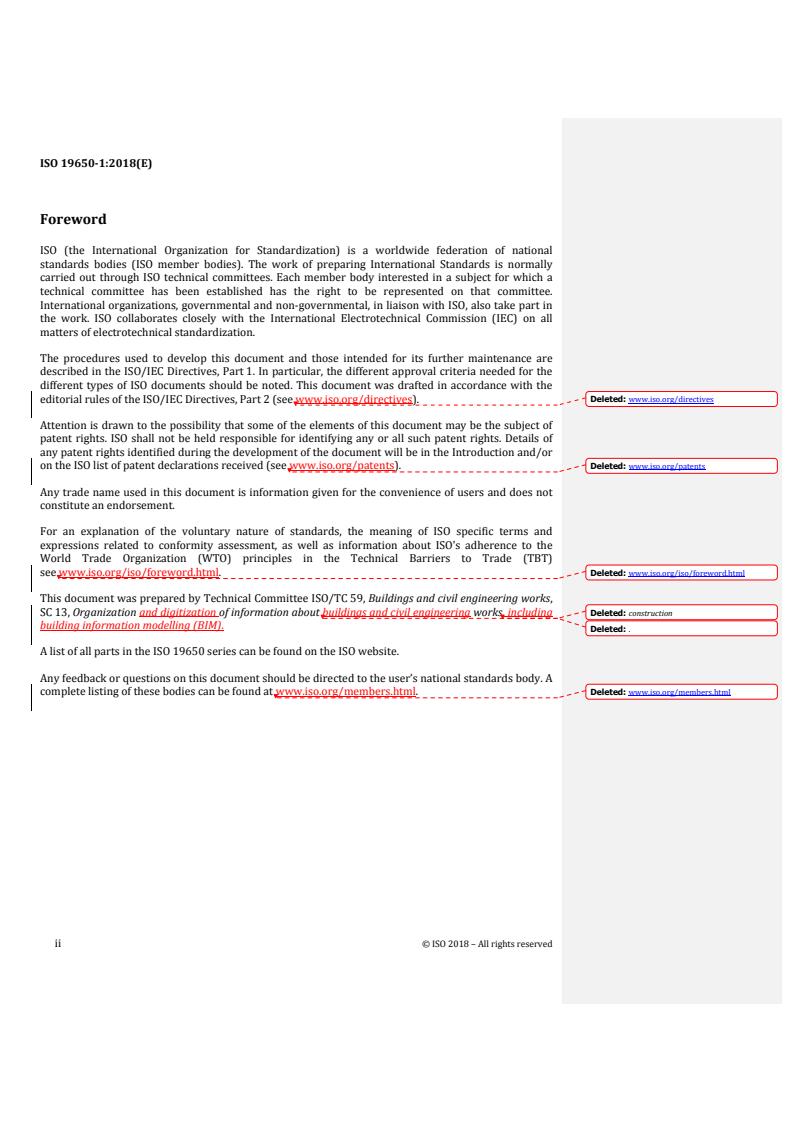
Foreword
ISO (the International Organization for Standardization) is a worldwide federation of national
standards bodies (ISO member bodies). The work of preparing International Standards is normally
carried out through ISO technical committees. Each member body interested in a subject for which a
technical committee has been established has the right to be represented on that committee.
International organizations, governmental and non‐governmental, in liaison with ISO, also take part in
the work. ISO collaborates closely with the International Electrotechnical Commission (IEC) on all
matters of electrotechnical standardization.
The procedures used to develop this document and those intended for its further maintenance are
described in the ISO/IEC Directives, Part 1. In particular, the different approval criteria needed for the
different types of ISO documents should be noted. This document was drafted in accordance with the
Deleted: www.iso.org/directives
editorial rules of the ISO/IEC Directives, Part 2 (see www.iso.org/directives).
Attention is drawn to the possibility that some of the elements of this document may be the subject of
patent rights. ISO shall not be held responsible for identifying any or all such patent rights. Details of
any patent rights identified during the development of the document will be in the Introduction and/or
on the ISO list of patent declarations received (see www.iso.org/patents). Deleted: www.iso.org/patents
Any trade name used in this document is information given for the convenience of users and does not
constitute an endorsement.
For an explanation of the voluntary nature of standards, the meaning of ISO specific terms and
expressions related to conformity assessment, as well as information about ISO's adherence to the
World Trade Organization (WTO) principles in the Technical Barriers to Trade (TBT)
see www.iso.org/iso/foreword.html. Deleted: www.iso.org/iso/foreword.html
This document was prepared by Technical Committee ISO/TC 59, Buildings and civil engineering works,
Deleted: construction
SC 13, Organization and digitization of information about buildings and civil engineering works, including
building information modelling (BIM).
Deleted: .
A list of all parts in the ISO 19650 series can be found on the ISO website.
Any feedback or questions on this document should be directed to the user’s national standards body. A
complete listing of these bodies can be found at www.iso.org/members.html. Deleted: www.iso.org/members.html
ii © ISO 2018 – All rights reserved
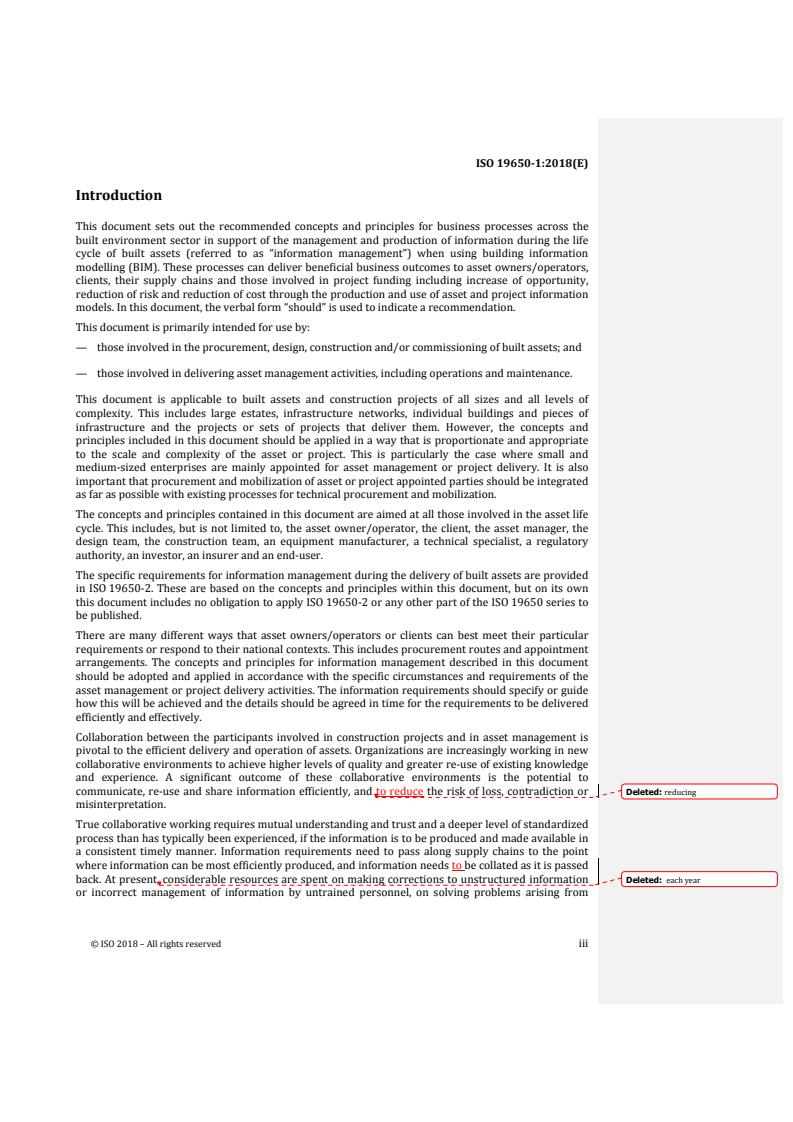
Introduction
This document sets out the recommended concepts and principles for business processes across the
built environment sector in support of the management and production of information during the life
cycle of built assets (referred to as “information management”) when using building information
modelling (BIM). These processes can deliver beneficial business outcomes to asset owners/operators,
clients, their supply chains and those involved in project funding including increase of opportunity,
reduction of risk and reduction of cost through the production and use of asset and project information
models. In this document, the verbal form “should” is used to indicate a recommendation.
This document is primarily intended for use by:
— those involved in the procurement, design, construction and/or commissioning of built assets; and
— those involved in delivering asset management activities, including operations and maintenance.
This document is applicable to built assets and construction projects of all sizes and all levels of
complexity. This includes large estates, infrastructure networks, individual buildings and pieces of
infrastructure and the projects or sets of projects that deliver them. However, the concepts and
principles included in this document should be applied in a way that is proportionate and appropriate
to the scale and complexity of the asset or project. This is particularly the case where small and
medium‐sized enterprises are mainly appointed for asset management or project delivery. It is also
important that procurement and mobilization of asset or project appointed parties should be integrated
as far as possible with existing processes for technical procurement and mobilization.
The concepts and principles contained in this document are aimed at all those involved in the asset life
cycle. This includes, but is not limited to, the asset owner/operator, the client, the asset manager, the
design team, the construction team, an equipment manufacturer, a technical specialist, a regulatory
authority, an investor, an insurer and an end‐user.
The specific requirements for information management during the delivery of built assets are provided
in ISO 19650‐2. These are based on the concepts and principles within this document, but on its own
this document includes no obligation to apply ISO 19650‐2 or any other part of the ISO 19650 series to
be published.
There are many different ways that asset owners/operators or clients can best meet their particular
requirements or respond to their national contexts. This includes procurement routes and appointment
arrangements. The concepts and principles for information management described in this document
should be adopted and applied in accordance with the specific circumstances and requirements of the
asset management or project delivery activities. The information requirements should specify or guide
how this will be achieved and the details should be agreed in time for the requirements to be delivered
efficiently and effectively.
Collaboration between the participants involved in construction projects and in asset management is
pivotal to the efficient delivery and operation of assets. Organizations are increasingly working in new
collaborative environments to achieve higher levels of quality and greater re‐use of existing knowledge
and experience. A significant outcome of these collaborative environments is the potential to
communicate, re‐use and share information efficiently, and to reduce the risk of loss, contradiction or Deleted: reducing
misinterpretation.
True collaborative working requires mutual understanding and trust and a deeper level of standardized
process than has typically been experienced, if the information is to be produced and made available in
a consistent timely manner. Information requirements need to pass along supply chains to the point
where information can be most efficiently produced, and information needs to be collated as it is passed
back. At present, considerable resources are spent on making corrections to unstructured information Deleted: each year
or incorrect management of information by untrained personnel, on solving problems arising from
© ISO 2018 – All rights reserved iii
uncoordinated efforts of delivery teams, and on solving problems related to information reuse and
reproduction. These delays can be reduced if the concepts and principles within this document are
adopted.
To improve future editions of the ISO 19650 series, national asset owners, public clients and authorities
are recommended to gather information and experiences about its implementation and use.
The ISO 19650 series can benefit from a formal process for managing assets, for example as in the
ISO 55000 series. The ISO 19650 series can also benefit from a systematic approach to quality within an
organization, for example as in ISO 9001, although certification to ISO 9001 is not a requirement of the
ISO 19650 series. Other standards that relate to information structures and delivery methods are also
listed in the Bibliography.
iv © ISO 2018 – All rights reserved
INTERNATIONAL STANDARD ISO 19650-1 :2018(E)
Organization of information about construction works —
Information management using building information
modelling — Part 1: Concepts and principles
1 Scope
This document outlines the concepts and principles for information management at a stage of maturity
described as “building information modelling (BIM) according to the ISO 19650 series”.
This document provides recommendations for a framework to manage information including
exchanging, recording, versioning and organizing for all actors.
This document is applicable to the whole life cycle of any built asset, including strategic planning, initial
design, engineering, development, documentation and construction, day‐to‐day operation, maintenance,
refurbishment, repair and end‐of‐life.
This document can be adapted to assets or projects of any scale and complexity, so as not to hamper the
flexibility and versatility that characterize the large range of potential procurement strategies and so as
to address the cost of implementing this document.
2 Normative references
There are no normative references in this document.
3 Terms and definitions
For the purposes of this document, the following terms and definitions apply.
ISO and IEC maintain terminological databases for use in standardization at the following addresses:
— ISO Online browsing platform: available at https://www.iso.org/obp Deleted: https://www.iso.org/obp
— IEC Electropedia: available at http://www.electropedia.org/ Deleted: http://www.electropedia.or
g/
3.1 General terms
3.1.1
responsibility matrix
chart that describes the participation by various functions in completing tasks or deliverables
Note 1 to entry: A responsibility matrix can indicate accountability, consultation and informing, alongside the
obligation to complete tasks or deliverables.
[SOURCE: ISO 37500:2014, 3.16, modified — The word “roles” has been replaced with “functions”; the
words “for an outsourcing arrangement” have been removed; Note 1 to entry has been added.]
3.1.2
space
limited three‐dimensional extent defined physically or notionally
© ISO 2018 – All rights reserved
[SOURCE: ISO 12006‐2:2015, 3.1.8]
3.2 Terms related to assets and projects
3.2.1
actor
person, organization or organizational unit involved in a construction process
Note 1 to entry: Organizational units include, but are not limited to, departments, teams.
Note 2 to entry: In the context of this document, construction processes take place during the delivery phase
(3.2.11) and the operational phase (3.2.12).
[SOURCE: ISO 29481‐1:2016, 3.1, modified — The words “such as a department, team, etc.” have been
removed; Note 1 and 2 to entry have been added.]
3.2.2
appointment
agreed instruction for the provision of information (3.3.1) concerning works, goods or services
Note 1 to entry: This term is used whether or not there is a formal appointment between the parties.
3.2.3
appointed party
provider of information (3.3.1) concerning works, goods or services
Note 1 to entry: A lead appointed party should be identified for each delivery team (3.2.6) but this can be the same
organization as one of the task teams (3.2.7).
Note 2 to entry: This term is used whether or not there is a formal written appointment (3.2.2) in place.
3.2.4
appointing party
receiver of information (3.3.1) concerning works, goods or services from a lead appointed party (3.2.3)
Note 1 to entry: In some countries the appointing party can be termed client (3.2.5), owner or employer but the
appointing party is not limited to these functions.
Note 2 to entry: This term is used whether or not there is a formal appointment (3.2.2) between the parties.
3.2.5
client
actor (3.2.1) responsible for initiating a project and approving the brief
3.2.6
delivery team
lead appointed party (3.2.3) and their appointed parties
Note 1 to entry: A delivery team can be any size, from one person carrying out all the necessary functions through
to complex, multi‐layered task teams (3.2.7). The size and structure of each delivery team are in response to the
scale and complexity of the asset management or project delivery activities.
Deleted: (3.2.8)
© ISO 2018 – All rights reserved
Note 2 to entry: Multiple delivery teams can be appointed simultaneously and/or sequentially in connection with
a single asset or project, in response to the scale and complexity of the asset management or project delivery
activities.
Note 3 to entry: A delivery team can consist of multiple task teams from within the lead appointed party’s
organization and any appointed parties.
Note 4 to entry: A delivery team can be assembled by the appointing party (3.2.4) rather than the lead appointed
party.
3.2.7
task team
individuals assembled to perform a specific task
3.2.8
asset
item, thing or entity that has potential or actual value to an organization
[SOURCE: ISO 55000:2014, 3.2.1, modified — Note 1, 2 and 3 to entry have been removed.]
3.2.9
project information
information (3.3.1) produced for, or utilized in, a particular project
[SOURCE: ISO 6707‐2:2017, 3.2.3]
3.2.10
life cycle
life of the asset (3.2.8) from the definition of its requirements to the termination of its use, covering its
conception, development, operation, maintenance support and disposal
[SOURCE: ISO/TS 12911:2012, 3.13, modified — The words “stages and activities spanning the life of
the system” have been replaced with “life of the asset”; NOTEs 1 and 2 have been removed.]
3.2.11
delivery phase
part of the life cycle (3.2.10), during which an asset (3.2.8) is designed, constructed and commissioned
Note 1 to entry: Delivery phase normally reflects a stage‐based approach to a project.
3.2.12
operational phase
part of the life cycle (3.2.10), during which an asset (3.2.8) is used, operated and maintained
3.2.13
trigger event
planned or unplanned event that changes an asset (3.2.8) or its status during its life cycle (3.2.10), which
results in information exchange (3.3.7)
Note 1 to entry: During the delivery phase (3.2.11), trigger events normally reflect the ends of project stages.
3.2.14
key decision point
point in time during the life cycle (3.2.10) when a decision crucial to the direction or viability of the
asset (3.2.8) is made
© ISO 2018 – All rights reserved
Note 1 to entry: During a project these generally align with project stages.
3.3 Terms related to information management
3.3.1
information
reinterpretable representation of data in a formalized manner suitable for communication,
interpretation or processing
Note 1 to entry: Information can be processed by human or automatic means.
[SOURCE: IEC 82045‐1:2001, 3.1.4, modified — The term has been changed from “data” to
“information”: in the definition, the word “information” has been replaced with “data”.]
3.3.2
information requirement
specification for what, when, how and for whom information (3.3.1) is to be produced
3.3.3
organizational information requirements
OIR
information requirements (3.3.2) in relation to organizational objectives
3.3.4
asset information requirements
AIR
information requirements (3.3.2) in relation to the operation of an asset (3.2.8)
3.3.5
project information requirements
PIR
information requirements (3.3.2) in relation to the delivery of an asset (3.2.8)
3.3.6
exchange information requirements
EIR
information requirements (3.3.2) in relation to an appointment (3.2.2)
3.3.7
information exchange, verb
act of satisfying an information requirement (3.3.2) or part thereof
3.3.8
information model
set of structured and unstructured information containers (3.3.12)
3.3.9
asset information model
AIM
information model (3.3.8) relating to the operational phase (3.2.12)
3.3.10
© ISO 2018 – All rights reserved
project information model
PIM
information model (3.3.8) relating to the delivery phase (3.2.11)
Note 1 to entry: During the project, the project information model can be used to convey the design intent
(sometimes called the design intent model) or the virtual representation of the asset (3.2.8) to be constructed
(sometimes called the virtual construction model).
3.3.11
federation
creation of a composite information model (3.3.8) from separate information containers (3.3.12)
Note 1 to entry: The separate information containers used during federation can come from different task teams
(3.2.7).
3.3.12
information container
named persistent set of information (3.3.1) retrievable from within a file, system or application storage
hierarchy
EXAMPLE Including sub‐directory, information file (including model, document, table, schedule), or distinct
sub‐set of an information file such as a chapter or section, layer or symbol.
Note 1 to entry: Structured information containers include geometrical models, schedules and databases.
Unstructured information containers include documentation, video clips and sound recordings.
Note 2 to entry: Persistent information exists over a timescale long enough for it to have to be managed, i.e. this
excludes transient information such as internet search results.
Note 3 to entry: Naming of an information container should be according to an agreed naming convention.
3.3.13
status code
meta‐data describing the suitability of the content of an information container (3.3.12)
3.3.14
building information modelling
BIM
use of a shared digital representation of a built asset (3.2.8) to facilitate design, construction and
operation processes to form a reliable basis for decisions
Note 1 to entry: Built assets include, but are not limited to, buildings, bridges, roads, process plants.
[SOURCE: ISO 29481‐1:2016, 3.2, modified — The word “object” has been replaced with “asset”; the
words “including buildings, bridges, roads, process plants, etc.” have been removed; original Note 1 to
entry has been replaced with a new one.]
3.3.15
common data environment
CDE
agreed source of information (3.3.1) for any given project or asset (3.2.8), for collecting, managing and
disseminating each information container (3.3.12) through a managed process
Note 1 to entry: A CDE workflow describes the processes to be used and a CDE solution can provide the
technology to support those processes.
© ISO 2018 – All rights reserved
3.3.16
level of information need
framework which defines the extent and granularity of information (3.3.1)
Note 1 to entry: One purpose of defining the level of information need is to prevent delivery of too much
information.
3.3.18
capability
measure of ability to perform and function
Note 1 to entry: In the context of this document, this relates to skill, knowledge or expertise to manage information
(3.3.1).
[SOURCE: ISO 6707‐1:2017, 3.7.1.11, modified — Note 1 to entry has been added.]
3.3.19
capacity
resources available to perform and function
Note 1 to entry: In the context of this document, this relates to means, resources and procedures to manage
information (3.3.1).
4 Asset and project information, perspectives and collaborative working
4.1 Principles
Asset information models (AIM) and project information models (PIM) are the structured repositories Deleted: model
of information needed for making decisions during the whole life cycle of a built environment asset.
Deleted: model
This includes the design and construction of new assets, refurbishment of existing assets, and the
operation and maintenance of an asset. It should be expected that the amount of information stored in
information models, and the different purposes it will be used for, will mostly increase during project
delivery and asset management.
AIM and PIM can include structured and unstructured information. Examples of structured information
include geometrical models, schedules and databases. Examples of unstructured information include
documentation, video clips and sound recordings. Physical sources of information, such as soil and
product samples, should be managed using the information management process described in this
document through appropriate cross‐references, for example sample numbers.
Most projects involve work on an existing asset, even if this is a previously undeveloped site. These
projects should include some pre‐existing asset information to support the development of the project Deleted: ,
brief and be available for lead appointed parties working on the project.
Information management processes within this document include the transfer of relevant information
between an AIM and a PIM at the start and end of a project.
Asset and project information has substantial value to appointing, lead appointed and appointed parties
involved in asset management and project delivery. This includes where no formal appointments exist.
Appointing, lead appointed and appointed parties include the owners, operators and managers of built
assets, and those delivering design and construction projects. Asset and project information is also
valuable to policymakers, regulators, investors, insurers and other external parties.
The concepts and principles contained within this document should be applied in a way that is
proportionate and appropriate to the scale and complexity of the asset or project.
© ISO 2018 – All rights reserved
4.2 Information management according to the ISO 19650 series
The recommendations and requirements for information management in the ISO 19650 series are
based on appointing, lead appointed and appointed parties working collaboratively together, and all
parties should participate in the implementation of the ISO 19650 series.
Information management can be represented as a sequence of maturity stages, shown as Stages 1, 2 and
3 in Figure 1. This Figure shows that development of standards, advances in technology and more
sophisticated forms of information management all combine to deliver increasing business benefit. The
ISO 19650 series has application mainly at Stage 2 maturity, but also can be partly applied at Stages 1
and 3.
Stage 2 maturity is also identified as “BIM according to the ISO 19650 series”. This is where a mixture of
manual and automated information management processes are used to generate a federated
information model. The information model includes all information containers delivered by task teams
in relation to an asset or a project.
Figure 1 — A perspective on stages of maturity of analogue and digital information management
4.3 Information management perspectives
Different information management perspectives should be recognized by the information management
process and should be incorporated in the process in the following ways:
— in the specification of information requirements;
— in the planning for information delivery; and
— in the delivery of information.
Information management perspectives should be defined on a case‐by‐case basis, but the four
perspectives described in Table 1 are recommended. Other perspectives can also be helpful, depending
on the nature of the asset or project.
© ISO 2018 – All rights reserved
Table 1 — Information management perspectives
Perspective Purpose Example deliverables
Business plan
To establish and maintain the purpose of the
Asset owner’s perspective asset or project. To make the strategic Strategic asset portfolio review
business decisions.
Life cycle cost analysis
Project brief
To identify the true requirements of the user
AIM
Asset user’s perspective and make sure the asset solution has the
PIM
right qualities and capacities.
Product documentation
Plans, for example BIM Execution
To plan and organize the work, mobilize the
Plans
Project delivery or asset
right resources, coordinate and control
management perspective Organizational charts
development.
Function definitions
Political decisions
To make sure the community’s interest is
Society’s perspective taken care of during the asset life cycle Area plans
(planning, delivery and operation).
Building permits, concessions
NOTE The example deliverables are relevant to the point of view of each perspective and do not indicate ownership of the
deliverables or who does the work to produce the deliverables.
5 Definition of information requirements and resulting information models
5.1 Principles
The appointing party should understand what information is required concerning their asset(s) or
project(s) to support their organizational or project objectives. These requirements can come from
their own organization or interested external parties. The appointing party should be able to express
these requirements to other organizations and individuals that have to know them to either specify or
inform their work. This applies to assets and projects of all sizes, but the principles in this document
should be applied proportionately. Less experienced appointing parties can seek expert assistance to
help with these tasks.
Appointed parties, including lead appointed parties, can add their own information requirements to
those they receive. Some of the information requirements can be passed to their own appointed parties,
particularly where information exchange within a delivery team is necessary and this information is not
to be exchanged with the appointing party.
The appointing party should state their purposes for requiring information deliverables, including the
aspects of the asset that are intended to be managed. These purposes can include:
— asset register: a register of assets should be provided to support accurate auditing and reporting;
this should include both spatial and physical assets and their groupings;
— support for compliance and regulatory responsibilities: the appointing party should specify the
information required to support the maintenance of the health and safety of the users of the asset;
© ISO 2018 – All rights reserved
— risk management: information should be required or suppressed to support risk management,
especially to identify and review the risks that a project or asset can be exposed to, for example
natural hazards, extreme weather events or fire; or
— support for business questions: the appointing party should specify the information required to
support the review of the business case for ownership and operation of the asset; this should
include continuous development of the following impacts and beneficial aspects of the asset from
the earliest deliverable onwards:
— management of capacity and utilization: documentation of the intended capacity and utilization
of the asset should be provided as it is required to support comparisons of actual use and
utilization and portfolio management;
— management of security and surveillance: information should be required or suppressed to
support the management of the security and surveillance of the asset and neighbouring or
adjacent sites in line with security requirements;
— support for renovation: renovation of each space or location and the whole asset should be
supported with detailed information about the capacity, in terms of areas, spaces,
occupancy, environmental conditions and structural load bearing;
— predicted and actual impacts: the appointing party should require information relating to the
impacts from quality, cost, scheduling, carbon (CO2e), energy, waste, water consumption or
other environmental effects;
— operations: information necessary for the normal operations of the asset should be provided to
help the appointing party anticipate the cost of asset operation;
— maintenance and repair: information on the recommended maintenance tasks, including
planned preventative maintenance, should be provided to help the appointing party to
anticipate and plan for costs of maintenance;
— replacement: information on the reference or expected replacement service life and costs
should be available to the appointing party to anticipate the costs of replacement; recycling
of the physical assets should be supported with detailed information relating to the
principal constituent materials; and
— decommissioning and disposal: information on the recommended decommissioning should be
provided to help the appointing party anticipate and plan for end‐of‐life costs.
Information requirements associated with the delivery phase of an asset should be expressed in terms
of the project stages that the appointing party or lead appointed party intends to use. Information
requirements associated with the operational phase of an asset should be expressed in terms of
foreseeable life cycle trigger events such as planned or reactive maintenance, fire equipment inspection,
component replacement or change of asset management provider.
The different types of information requirements and information models are shown in Figure 2 and
explained in 5.2 to 5.7.
© ISO 2018 – All rights reserved
NOTE In this figure, “encapsulates” means “provides the input to”, “contributes to” means “provides an input
to”, “specifies” means “determines the content, structure and methodology”.
Figure 2 — Hierarchy of information requirements
5.2 Organizational information requirements (OIR)
OIR explain the information needed to answer or inform high‐level strategic objectives within the
appointing party. These requirements can arise for a variety of reasons, including:
— strategic business operation;
— strategic asset management;
— portfolio planning;
— regulatory duties; or
— policy‐making.
OIR can exist for reasons other than asset management, for example in relation to submitting annual
financial accounts. These OIR are not considered further in this document.
5.3 Asset information requirements (AIR)
AIR set out managerial, commercial and technical aspects of producing asset information. The
managerial and commercial aspects should include the information standard and the production
methods and procedures to be implemented by the delivery team.
The technical aspects of the AIR specify those detailed pieces of information needed to answer the
asset‐related OIR. These requirements should be expressed in such a way that they can be incorporated
into asset management appointments to support organizational decision‐making.
A set of AIR should be prepared in response to each trigger event during asset operation and where
appropriate should also refer to security requirements.
Where there is a supply chain, the AIR received by a lead appointed party can be sub‐divided and
passed on in any of its own appointments. AIR received by a lead appointed party can be augmented
with its own information requirements.
© ISO 2018 – All rights reserved
Across an asset management strategy and plan there can exist several different appointments. The AIR
from all these should form a single coherent and coordinated set of information requirements, sufficient
to address all the asset‐related OIR.
5.4 Project information requirements (PIR)
PIR explain the information needed to answer or inform high‐level strategic objectives within the
appointing party in relation to a particular built asset project. PIR are identified from both the project
management process and the asset management process.
A set of information requirements should be prepared for each of the appointing party’s key decision
points during the project.
Repeat clients may develop a generic set of PIR that can be adopted, with or without amendment, on all
of their projects.
5.5 Exchange information requirements (EIR)
EIR set out managerial, commercial and technical aspects of producing project information. The
managerial and commercial aspects should include the information standard and the production
methods and procedures to be implemented by the delivery team.
The technical aspects of the EIR should specify those detailed pieces of information needed to answer
the PIR. These requirements should be expressed in such a way that they can be incorporated into
project‐related appointments. EIR should normally align with trigger events representing the
completion of some or all project stages.
EIR should be identified wherever appointments are being established. In particular, EIR received by a
lead appointed party can be sub‐divided and passed on in any of its own appointments, and so on along
the supply chain. EIR received by appointed parties, including lead appointed parties, can be augmented
with their own EIR. Some of the EIR can be passed to their own appointed parties, particularly where
information exchange within a delivery team is necessary and this information is not to be exchanged
with the appointing party.
Across a project there can exist several different appointments. The EIR from all these appointments
should form a single coherent and coordinated set of information requirements, sufficient to address all
the PIR.
5.6 Asset information model (AIM)
The AIM supports the strategic and day‐to‐day asset management processes established by the
appointing party. It can also provide information at the start of the project delivery process. For
example, the AIM can contain equipment registers, cumulative maintenance costs, records of
installation and maintenance dates, property ownership details and other details that the appointing
party regards as valuable and wishes to manage in a systematic way.
5.7 Project information model (PIM)
The PIM supports the delivery of the project and contributes to the AIM to support asset management
activities. The PIM should also be stored to provide a long‐term archive of the project and for auditing
purposes. For example, the PIM can contain details of project geometry, location of equipment,
performance requirements during project design, method of construction, scheduling, costing and
details of installed systems, components and equipment, including maintenance requirements, during
project construction.
© ISO 2018 – All rights reserved
6 The information delivery cycle
6.1 Principles
The specification and delivery of project and asset information follows four overarching principles, each
of which is the subject of more detailed discussion in this document:
1. Information is needed for decision‐making during all parts of the asset life cycle, including when
there is an intention to develop a new asset, modify or enhance an existing asset, or decommission
an asset, all as part of the overall asset management system.
2. Information is specified progressively through sets of requirements defined by the appointing
party, and the delivery of information is planned and progressively delivered by the delivery teams.
In addition, some reference information can also be provided by the appointing party to one or
more appointed parties.
3. Where a delivery team contains more than one party then information requirements should be
passed to the most relevant party or the point at which the information can be most easily
provided.
4. Information exchange involves the sharing and coordination of information through a CDE, using Deleted: exchanges involve
open standards whenever possible and clearly defined operating procedures to enable a consistent
approach by all organizations involved.
These principles should be applied in a way that is proportionate to the asset management or project
delivery context.
6.2 Alignment with the asset life cycle
AIM and PIM are produced throughout the information life cycle. These information models are used
during the asset life cycle for making asset‐related and project‐related decisions.
Figure 3 shows the asset life cycle for operational and delivery phases of an asset (the green circle) and
some information management activities (points A to C). In addition to the three points shown in the
figure, verification of designers’ intentions should take place through review of asset performance
during the operational phase. Timing will depend on when and how frequently tests after completion
and performance review are done. If the verification fails then remedial works can be required. During
the operational phase, trigger events take place that can require an information management response,
resulting in one or more information exchanges.
Figure 3 also shows that the ISO 19650 series for information management takes place within the
context of an asset management system, such as ISO 55000, or a project management framework, such
as ISO 21500, which itself takes place within organizational management according to a quality
management system, such as ISO 9001. Other standards such as ISO 8000 (data quality) and
ISO/IEC 27000 (information security management) and ISO 31000 (risk management) are also relevant
but are omitted from the figure for clarity.
The following key principles (as set out in ISO 55000) are important for asset information management
as set out in the ISO 19650 series:
— the appointing party specifically links asset management to the achievement of its business
objectives through asset management policies, strategies and plans;
— appropriate and timely asset information is one of the fundamental requirements for successful
asset management; and
© ISO 2018 – All rights reserved
— leadership and governance in relation to asset information management comes from the top
management within the asset owner/operator.
The following key principles (as set out in ISO 9001) are important for asset information management
as set out in the ISO 19650 series:
— there is a focus on the customer (the recipient or user of asset or project information);
— a Plan‐Do‐Check‐Act cycle is used (to develop and provide asset or project information);
— engagement of people and the encouragement of appropriate behaviours is central to the delivery
of consistent outputs; and
— there is a focus on sharing of lessons learned and continual improvement.
Key
A start of delivery phase — transfer of relevant information from AIM to PIM
B progressive development of the design intent model into the virtual construction model (see 3.3.10, Note 1 to entry)
C end of delivery phase — transfer of relevant information from PIM to AIM
Figure 3 — Generic project and asset information management life cycle
© ISO 2018 – All rights reserved
6.3 Setting information requirements and planning for information delivery
6.3.1 General principles
All asset and project information that is to be supplied during the asset life cycle should be specified by
the appointing party through sets of information requirements. The relevant information requirements
should be issued to each prospective lead appointed party as part of the procurement process. This also
applies when work instructions are issued by one part of an organization to another part of the same
organization. A response to each requirement should be prepared by the prospective lead appointed
party and reviewed by the appointing party before appointment. The response to the information
requirements is then managed and developed by each lead appointed party and included in the plan for
their asset management or project delivery activities. Information is managed and delivered by each
lead appointed party and accepted by the party specifying the requirements. Feedback loops provide
for information deliverables to be revised if necessary. The generic flowchart for this process is shown
in Figure 4.
A documented risk assessment for delivery of asset or project information should be included in the
overall asset or project risk assessment, so that the nature of the information delivery risks, their
consequences and likelihood of occurring are understood, communicated and managed. The concepts
and principles in this document should be considered in the information delivery risk assessment.
Information requirements are defined to address the questions that have to be answered to make key
asset‐related decisions at different points during the delivery and operation of the asset. Information
delivery plans are made every time a lead appointed party is appointed in relation to asset management
or project delivery activities. This includes the parallel appointments made by the appointing party in
relation to design, construction or any other services, and the sequential appointments made to form a
supply chain, for example, within a construction team.
Figure 4 —Generic specification and planning for information delivery
Figure 5 illustrates the sub‐division of information management processes and how they apply to each
appointment within a project. A similar sub‐division of processes should apply for each appointment
during asset management.
© ISO 2018 – All rights reserved
Figure 5 — Illustration of the sub-division of processes
The cascade of information requirements and the supply of information have some key features that are
explained in 6.3.2 to 6.3.5 and illustrated for one particular form of procurement.
Further principles concerning information management functions, collaborative working and appointed
party capability are set out in Clauses 7, 8 and 9. Further principles concerning information delivery
planning are set out in Clause 10. Further principles concerning information production and delivery
are set out in Clauses 11 and 12.
6.3.2 Delivery team provides information for asset owner/operator or client decisions
Figure 6 shows one instance of a key decision to be made by the appointing party. That decision is made
at a key decision point, the diamond, where a set of information requirements is defined and cascaded
to the delivery team (lead appointed party and appointed parties as appropriate). The information is
delivered through information exchange, the solid circle.
The appointing party should define the occasions or times when they have to make key decisions, and
precisely what information they require from the delivery team to make each decision. Any significant
changes to the information requirements should be discussed and agreed between the appointing party
and the lead appointed party, either of whom may make such a request.
Figure 6 — Relationship between key decision and information from a lead appointed party
© ISO 2018 – All rights reserved
6.3.3 Information verification and validation at start and end of project stages
Figure 7 shows information exchange occurring between the end of one project delivery stage and the
start of the next project delivery stage.
The solid circle represents the information exchange. The vertical arrows represent information
requirements and information deliverables flowing between appointing party and lead appointed party.
The circular arrows to the left of the vertical arrows represent the delivery of information by the lead
appointed party, the checking of that information by the appointing party against the requirements, and
any iteration that is needed to complete the information exchange (for example where required
information is missing or not supplied to the require
...
INTERNATIONAL ISO
STANDARD 19650-1
First edition
2018-12
Organization and digitization of
information about buildings and civil
engineering works, including building
information modelling (BIM) —
Information management using
building information modelling —
Part 1:
Concepts and principles
Organisation et numérisation des informations relatives aux
bâtiments et ouvrages de génie civil, y compris modélisation des
informations de la construction (BIM) — Gestion de l'information par
la modélisation des informations de la construction —
Partie 1: Concepts et principes
Reference number
©
ISO 2018
© ISO 2018
All rights reserved. Unless otherwise specified, or required in the context of its implementation, no part of this publication may
be reproduced or utilized otherwise in any form or by any means, electronic or mechanical, including photocopying, or posting
on the internet or an intranet, without prior written permission. Permission can be requested from either ISO at the address
below or ISO’s member body in the country of the requester.
ISO copyright office
CP 401 • Ch. de Blandonnet 8
CH-1214 Vernier, Geneva
Phone: +41 22 749 01 11
Fax: +41 22 749 09 47
Email: copyright@iso.org
Website: www.iso.org
Published in Switzerland
ii © ISO 2018 – All rights reserved
Contents Page
Foreword .v
Introduction .vi
1 Scope . 1
2 Normative references . 1
3 Terms and definitions . 1
3.1 General terms . 1
3.2 Terms related to assets and projects . 2
3.3 Terms related to information management . 3
4 Asset and project information, perspectives and collaborative working .6
4.1 Principles . 6
4.2 Information management according to the ISO 19650 series . 6
4.3 Information management perspectives . 7
5 Definition of information requirements and resulting information models .8
5.1 Principles . 8
5.2 Organizational information requirements (OIR) .10
5.3 Asset information requirements (AIR) .10
5.4 Project information requirements (PIR) .10
5.5 Exchange information requirements (EIR) .10
5.6 Asset information model (AIM) .11
5.7 Project information model (PIM) .11
6 The information delivery cycle .11
6.1 Principles .11
6.2 Alignment with the asset life cycle .11
6.3 Setting information requirements and planning for information delivery .13
6.3.1 General principles .13
6.3.2 Delivery team provides information for asset owner/operator or client
decisions .15
6.3.3 Information verification and validation at start and end of project stages.15
6.3.4 Information is drawn from the whole delivery team .16
6.3.5 Summary of information delivery from project and asset delivery teams .17
7 Project and asset information management functions .18
7.1 Principles .18
7.2 Asset information management functions .19
7.3 Project information management functions .19
7.4 Task information management functions .19
8 Delivery team capability and capacity .20
8.1 Principles .20
8.2 Extent of capability and capacity review .20
9 Information container-based collaborative working .20
10 Information delivery planning.21
10.1 Principles .21
10.2 Timing of information delivery .21
10.3 Responsibility matrix .22
10.4 Defining the federation strategy and breakdown structure for information containers.22
11 Managing the collaborative production of information .23
11.1 Principles .23
11.2 Level of information need.23
11.3 Information quality .23
12 Common data environment (CDE) solution and workflow .24
12.1 Principles .24
12.2 The work in progress state .25
12.3 The check/review/approve transition .25
12.4 The shared state .25
12.5 The review/authorize transition .26
12.6 The published state .26
12.7 The archive state .26
13 Summary of “building information modelling (BIM) according to the ISO 19650 series” .26
Annex A (informative) Illustrations of federation strategies and information container
breakdown structures .30
Bibliography .34
iv © ISO 2018 – All rights reserved
Foreword
ISO (the International Organization for Standardization) is a worldwide federation of national standards
bodies (ISO member bodies). The work of preparing International Standards is normally carried out
through ISO technical committees. Each member body interested in a subject for which a technical
committee has been established has the right to be represented on that committee. International
organizations, governmental and non-governmental, in liaison with ISO, also take part in the work.
ISO collaborates closely with the International Electrotechnical Commission (IEC) on all matters of
electrotechnical standardization.
The procedures used to develop this document and those intended for its further maintenance are
described in the ISO/IEC Directives, Part 1. In particular, the different approval criteria needed for the
different types of ISO documents should be noted. This document was drafted in accordance with the
editorial rules of the ISO/IEC Directives, Part 2 (see www .iso .org/directives).
Attention is drawn to the possibility that some of the elements of this document may be the subject of
patent rights. ISO shall not be held responsible for identifying any or all such patent rights. Details of
any patent rights identified during the development of the document will be in the Introduction and/or
on the ISO list of patent declarations received (see www .iso .org/patents).
Any trade name used in this document is information given for the convenience of users and does not
constitute an endorsement.
For an explanation of the voluntary nature of standards, the meaning of ISO specific terms and
expressions related to conformity assessment, as well as information about ISO's adherence to the
World Trade Organization (WTO) principles in the Technical Barriers to Trade (TBT) see www .iso
.org/iso/foreword .html.
This document was prepared by Technical Committee ISO/TC 59, Buildings and civil engineering works,
SC 13, Organization and digitization of information about buildings and civil engineering works, including
building information modelling (BIM).
A list of all parts in the ISO 19650 series can be found on the ISO website.
Any feedback or questions on this document should be directed to the user’s national standards body. A
complete listing of these bodies can be found at www .iso .org/members .html.
Introduction
This document sets out the recommended concepts and principles for business processes across the
built environment sector in support of the management and production of information during the
life cycle of built assets (referred to as “information management”) when using building information
modelling (BIM). These processes can deliver beneficial business outcomes to asset owners/operators,
clients, their supply chains and those involved in project funding including increase of opportunity,
reduction of risk and reduction of cost through the production and use of asset and project information
models. In this document, the verbal form “should” is used to indicate a recommendation.
This document is primarily intended for use by:
— those involved in the procurement, design, construction and/or commissioning of built assets; and
— those involved in delivering asset management activities, including operations and maintenance.
This document is applicable to built assets and construction projects of all sizes and all levels of
complexity. This includes large estates, infrastructure networks, individual buildings and pieces
of infrastructure and the projects or sets of projects that deliver them. However, the concepts and
principles included in this document should be applied in a way that is proportionate and appropriate to
the scale and complexity of the asset or project. This is particularly the case where small and medium-
sized enterprises are mainly appointed for asset management or project delivery. It is also important
that procurement and mobilization of asset or project appointed parties should be integrated as far as
possible with existing processes for technical procurement and mobilization.
The concepts and principles contained in this document are aimed at all those involved in the asset life
cycle. This includes, but is not limited to, the asset owner/operator, the client, the asset manager, the
design team, the construction team, an equipment manufacturer, a technical specialist, a regulatory
authority, an investor, an insurer and an end-user.
The specific requirements for information management during the delivery of built assets are provided
in ISO 19650-2. These are based on the concepts and principles within this document, but on its own
this document includes no obligation to apply ISO 19650-2 or any other part of the ISO 19650 series to
be published.
There are many different ways that asset owners/operators or clients can best meet their particular
requirements or respond to their national contexts. This includes procurement routes and appointment
arrangements. The concepts and principles for information management described in this document
should be adopted and applied in accordance with the specific circumstances and requirements of the
asset management or project delivery activities. The information requirements should specify or guide
how this will be achieved and the details should be agreed in time for the requirements to be delivered
efficiently and effectively.
Collaboration between the participants involved in construction projects and in asset management
is pivotal to the efficient delivery and operation of assets. Organizations are increasingly working
in new collaborative environments to achieve higher levels of quality and greater re-use of existing
knowledge and experience. A significant outcome of these collaborative environments is the potential
to communicate, re-use and share information efficiently, and to reduce the risk of loss, contradiction
or misinterpretation.
True collaborative working requires mutual understanding and trust and a deeper level of standardized
process than has typically been experienced, if the information is to be produced and made available
in a consistent timely manner. Information requirements need to pass along supply chains to the point
where information can be most efficiently produced, and information needs to be collated as it is passed
back. At present, considerable resources are spent on making corrections to unstructured information
or incorrect management of information by untrained personnel, on solving problems arising from
uncoordinated efforts of delivery teams, and on solving problems related to information reuse and
reproduction. These delays can be reduced if the concepts and principles within this document are
adopted.
vi © ISO 2018 – All rights reserved
To improve future editions of the ISO 19650 series, national asset owners, public clients and authorities
are recommended to gather information and experiences about its implementation and use.
The ISO 19650 series can benefit from a formal process for managing assets, for example as in the
ISO 55000 series. The ISO 19650 series can also benefit from a systematic approach to quality within an
organization, for example as in ISO 9001, although certification to ISO 9001 is not a requirement of the
ISO 19650 series. Other standards that relate to information structures and delivery methods are also
listed in the Bibliography.
INTERNATIONAL STANDARD ISO 19650-1:2018(E)
Organization and digitization of information about
buildings and civil engineering works, including building
information modelling (BIM) — Information management
using building information modelling —
Part 1:
Concepts and principles
1 Scope
This document outlines the concepts and principles for information management at a stage of maturity
described as “building information modelling (BIM) according to the ISO 19650 series”.
This document provides recommendations for a framework to manage information including
exchanging, recording, versioning and organizing for all actors.
This document is applicable to the whole life cycle of any built asset, including strategic planning,
initial design, engineering, development, documentation and construction, day-to-day operation,
maintenance, refurbishment, repair and end-of-life.
This document can be adapted to assets or projects of any scale and complexity, so as not to hamper the
flexibility and versatility that characterize the large range of potential procurement strategies and so
as to address the cost of implementing this document.
2 Normative references
There are no normative references in this document.
3 Terms and definitions
For the purposes of this document, the following terms and definitions apply.
ISO and IEC maintain terminological databases for use in standardization at the following addresses:
— ISO Online browsing platform: available at https: //www .iso .org/obp
— IEC Electropedia: available at http: //www .electropedia .org/
3.1 General terms
3.1.1
responsibility matrix
chart that describes the participation by various functions in completing tasks or deliverables
Note 1 to entry: A responsibility matrix can indicate accountability, consultation and informing, alongside the
obligation to complete tasks or deliverables.
[SOURCE: ISO 37500:2014, 3.16, modified — The word “roles” has been replaced with “functions”; the
words “for an outsourcing arrangement” have been removed; Note 1 to entry has been added.]
3.1.2
space
limited three-dimensional extent defined physically or notionally
[SOURCE: ISO 12006-2:2015, 3.1.8]
3.2 Terms related to assets and projects
3.2.1
actor
person, organization or organizational unit involved in a construction process
Note 1 to entry: Organizational units include, but are not limited to, departments, teams.
Note 2 to entry: In the context of this document, construction processes take place during the delivery phase
(3.2.11) and the operational phase (3.2.12).
[SOURCE: ISO 29481-1:2016, 3.1, modified — The words “such as a department, team, etc.” have been
removed; Note 1 and 2 to entry have been added.]
3.2.2
appointment
agreed instruction for the provision of information (3.3.1) concerning works, goods or services
Note 1 to entry: This term is used whether or not there is a formal appointment between the parties.
3.2.3
appointed party
provider of information (3.3.1) concerning works, goods or services
Note 1 to entry: A lead appointed party should be identified for each delivery team (3.2.6) but this can be the
same organization as one of the task teams (3.2.7).
Note 2 to entry: This term is used whether or not there is a formal written appointment (3.2.2) in place.
3.2.4
appointing party
receiver of information (3.3.1) concerning works, goods or services from a lead appointed party (3.2.3)
Note 1 to entry: In some countries the appointing party can be termed client (3.2.5), owner or employer but the
appointing party is not limited to these functions.
Note 2 to entry: This term is used whether or not there is a formal appointment (3.2.2) between the parties.
3.2.5
client
actor (3.2.1) responsible for initiating a project and approving the brief
3.2.6
delivery team
lead appointed party (3.2.3) and their appointed parties
Note 1 to entry: A delivery team can be any size, from one person carrying out all the necessary functions through
to complex, multi-layered task teams (3.2.7). The size and structure of each delivery team are in response to the
scale and complexity of the asset management or project delivery activities.
Note 2 to entry: Multiple delivery teams can be appointed simultaneously and/or sequentially in connection with
a single asset or project, in response to the scale and complexity of the asset management or project delivery
activities.
Note 3 to entry: A delivery team can consist of multiple task teams from within the lead appointed party’s
organization and any appointed parties.
2 © ISO 2018 – All rights reserved
Note 4 to entry: A delivery team can be assembled by the appointing party (3.2.4) rather than the lead
appointed party.
3.2.7
task team
individuals assembled to perform a specific task
3.2.8
asset
item, thing or entity that has potential or actual value to an organization
[SOURCE: ISO 55000:2014, 3.2.1, modified — Note 1, 2 and 3 to entry have been removed.]
3.2.9
project information
information (3.3.1) produced for, or utilized in, a particular project
[SOURCE: ISO 6707-2:2017, 3.2.3]
3.2.10
life cycle
life of the asset (3.2.8) from the definition of its requirements to the termination of its use, covering its
conception, development, operation, maintenance support and disposal
[SOURCE: ISO/TS 12911:2012, 3.13, modified — The words “stages and activities spanning the life of
the system” have been replaced with “life of the asset”; NOTEs 1 and 2 have been removed.]
3.2.11
delivery phase
part of the life cycle (3.2.10), during which an asset (3.2.8) is designed, constructed and commissioned
Note 1 to entry: Delivery phase normally reflects a stage-based approach to a project.
3.2.12
operational phase
part of the life cycle (3.2.10), during which an asset (3.2.8) is used, operated and maintained
3.2.13
trigger event
planned or unplanned event that changes an asset (3.2.8) or its status during its life cycle (3.2.10), which
results in information exchange (3.3.7)
Note 1 to entry: During the delivery phase (3.2.11), trigger events normally reflect the ends of project stages.
3.2.14
key decision point
point in time during the life cycle (3.2.10) when a decision crucial to the direction or viability of the
asset (3.2.8) is made
Note 1 to entry: During a project these generally align with project stages.
3.3 Terms related to information management
3.3.1
information
reinterpretable representation of data in a formalized manner suitable for communication,
interpretation or processing
Note 1 to entry: Information can be processed by human or automatic means.
[SOURCE: IEC 82045-1:2001, 3.1.4, modified — The term has been changed from “data” to “information”:
in the definition, the word “information” has been replaced with “data”.]
3.3.2
information requirement
specification for what, when, how and for whom information (3.3.1) is to be produced
3.3.3
organizational information requirements
OIR
information requirements (3.3.2) in relation to organizational objectives
3.3.4
asset information requirements
AIR
information requirements (3.3.2) in relation to the operation of an asset (3.2.8)
3.3.5
project information requirements
PIR
information requirements (3.3.2) in relation to the delivery of an asset (3.2.8)
3.3.6
exchange information requirements
EIR
information requirements (3.3.2) in relation to an appointment (3.2.2)
3.3.7
information exchange, verb
act of satisfying an information requirement (3.3.2) or part thereof
3.3.8
information model
set of structured and unstructured information containers (3.3.12)
3.3.9
asset information model
AIM
information model (3.3.8) relating to the operational phase (3.2.12)
3.3.10
project information model
PIM
information model (3.3.8) relating to the delivery phase (3.2.11)
Note 1 to entry: During the project, the project information model can be used to convey the design intent
(sometimes called the design intent model) or the virtual representation of the asset (3.2.8) to be constructed
(sometimes called the virtual construction model).
3.3.11
federation
creation of a composite information model (3.3.8) from separate information containers (3.3.12)
Note 1 to entry: The separate information containers used during federation can come from different task teams
(3.2.7).
3.3.12
information container
named persistent set of information (3.3.1) retrievable from within a file, system or application storage
hierarchy
EXAMPLE Including sub-directory, information file (including model, document, table, schedule), or distinct
sub-set of an information file such as a chapter or section, layer or symbol.
4 © ISO 2018 – All rights reserved
Note 1 to entry: Structured information containers include geometrical models, schedules and databases.
Unstructured information containers include documentation, video clips and sound recordings.
Note 2 to entry: Persistent information exists over a timescale long enough for it to have to be managed, i.e. this
excludes transient information such as internet search results.
Note 3 to entry: Naming of an information container should be according to an agreed naming convention.
3.3.13
status code
meta-data describing the suitability of the content of an information container (3.3.12)
3.3.14
building information modelling
BIM
use of a shared digital representation of a built asset (3.2.8) to facilitate design, construction and
operation processes to form a reliable basis for decisions
Note 1 to entry: Built assets include, but are not limited to, buildings, bridges, roads, process plants.
[SOURCE: ISO 29481-1:2016, 3.2, modified — The word “object” has been replaced with “asset”; the
words “including buildings, bridges, roads, process plants, etc.” have been removed; original Note 1 to
entry has been replaced with a new one.]
3.3.15
common data environment
CDE
agreed source of information (3.3.1) for any given project or asset (3.2.8), for collecting, managing and
disseminating each information container (3.3.12) through a managed process
Note 1 to entry: A CDE workflow describes the processes to be used and a CDE solution can provide the technology
to support those processes.
3.3.16
level of information need
framework which defines the extent and granularity of information (3.3.1)
Note 1 to entry: One purpose of defining the level of information need is to prevent delivery of too much
information.
3.3.18
capability
measure of ability to perform and function
Note 1 to entry: In the context of this document, this relates to skill, knowledge or expertise to manage
information (3.3.1).
[SOURCE: ISO 6707-1:2017, 3.7.1.11, modified — Note 1 to entry has been added.]
3.3.19
capacity
resources available to perform and function
Note 1 to entry: In the context of this document, this relates to means, resources and procedures to manage
information (3.3.1).
4 Asset and project information, perspectives and collaborative working
4.1 Principles
Asset information models (AIM) and project information models (PIM) are the structured repositories
of information needed for making decisions during the whole life cycle of a built environment asset.
This includes the design and construction of new assets, refurbishment of existing assets, and the
operation and maintenance of an asset. It should be expected that the amount of information stored in
information models, and the different purposes it will be used for, will mostly increase during project
delivery and asset management.
AIM and PIM can include structured and unstructured information. Examples of structured information
include geometrical models, schedules and databases. Examples of unstructured information include
documentation, video clips and sound recordings. Physical sources of information, such as soil and
product samples, should be managed using the information management process described in this
document through appropriate cross-references, for example sample numbers.
Most projects involve work on an existing asset, even if this is a previously undeveloped site. These
projects should include some pre-existing asset information to support the development of the project
brief and be available for lead appointed parties working on the project.
Information management processes within this document include the transfer of relevant information
between an AIM and a PIM at the start and end of a project.
Asset and project information has substantial value to appointing, lead appointed and appointed parties
involved in asset management and project delivery. This includes where no formal appointments exist.
Appointing, lead appointed and appointed parties include the owners, operators and managers of built
assets, and those delivering design and construction projects. Asset and project information is also
valuable to policymakers, regulators, investors, insurers and other external parties.
The concepts and principles contained within this document should be applied in a way that is
proportionate and appropriate to the scale and complexity of the asset or project.
4.2 Information management according to the ISO 19650 series
The recommendations and requirements for information management in the ISO 19650 series are
based on appointing, lead appointed and appointed parties working collaboratively together, and all
parties should participate in the implementation of the ISO 19650 series.
Information management can be represented as a sequence of maturity stages, shown as Stages 1, 2
and 3 in Figure 1. This Figure shows that development of standards, advances in technology and more
sophisticated forms of information management all combine to deliver increasing business benefit.
The ISO 19650 series has application mainly at Stage 2 maturity, but also can be partly applied at
Stages 1 and 3.
Stage 2 maturity is also identified as “BIM according to the ISO 19650 series”. This is where a mixture
of manual and automated information management processes are used to generate a federated
information model. The information model includes all information containers delivered by task teams
in relation to an asset or a project.
6 © ISO 2018 – All rights reserved
Figure 1 — A perspective on stages of maturity of analogue and digital information
management
4.3 Information management perspectives
Different information management perspectives should be recognized by the information management
process and should be incorporated in the process in the following ways:
— in the specification of information requirements;
— in the planning for information delivery; and
— in the delivery of information.
Information management perspectives should be defined on a case-by-case basis, but the four
perspectives described in Table 1 are recommended. Other perspectives can also be helpful, depending
on the nature of the asset or project.
Table 1 — Information management perspectives
Perspective Purpose Example deliverables
Business plan
To establish and maintain the purpose of the
Asset owner’s perspective asset or project. To make the strategic busi- Strategic asset portfolio review
ness decisions.
Life cycle cost analysis
Project brief
To identify the true requirements of the user
AIM
Asset user’s perspective and make sure the asset solution has the
PIM
right qualities and capacities.
Product documentation
Plans, for example BIM Execu-
To plan and organize the work, mobilize tion Plans
Project delivery or asset
the right resources, coordinate and control
management perspective Organizational charts
development.
Function definitions
Political decisions
To make sure the community’s interest is
Society’s perspective taken care of during the asset life cycle (plan- Area plans
ning, delivery and operation).
Building permits, concessions
NOTE The example deliverables are relevant to the point of view of each perspective and do not indicate ownership of the
deliverables or who does the work to produce the deliverables.
5 Definition of information requirements and resulting information models
5.1 Principles
The appointing party should understand what information is required concerning their asset(s) or
project(s) to support their organizational or project objectives. These requirements can come from
their own organization or interested external parties. The appointing party should be able to express
these requirements to other organizations and individuals that have to know them to either specify or
inform their work. This applies to assets and projects of all sizes, but the principles in this document
should be applied proportionately. Less experienced appointing parties can seek expert assistance to
help with these tasks.
Appointed parties, including lead appointed parties, can add their own information requirements to
those they receive. Some of the information requirements can be passed to their own appointed parties,
particularly where information exchange within a delivery team is necessary and this information is
not to be exchanged with the appointing party.
The appointing party should state their purposes for requiring information deliverables, including the
aspects of the asset that are intended to be managed. These purposes can include:
— asset register: a register of assets should be provided to support accurate auditing and reporting;
this should include both spatial and physical assets and their groupings;
— support for compliance and regulatory responsibilities: the appointing party should specify the
information required to support the maintenance of the health and safety of the users of the asset;
— risk management: information should be required or suppressed to support risk management,
especially to identify and review the risks that a project or asset can be exposed to, for example
natural hazards, extreme weather events or fire; or
— support for business questions: the appointing party should specify the information required
to support the review of the business case for ownership and operation of the asset; this should
8 © ISO 2018 – All rights reserved
include continuous development of the following impacts and beneficial aspects of the asset from
the earliest deliverable onwards:
— management of capacity and utilization: documentation of the intended capacity and utilization
of the asset should be provided as it is required to support comparisons of actual use and
utilization and portfolio management;
— management of security and surveillance: information should be required or suppressed to
support the management of the security and surveillance of the asset and neighbouring or
adjacent sites in line with security requirements;
— support for renovation: renovation of each space or location and the whole asset should be
supported with detailed information about the capacity, in terms of areas, spaces, occupancy,
environmental conditions and structural load bearing;
— predicted and actual impacts: the appointing party should require information relating to the
impacts from quality, cost, scheduling, carbon (CO e), energy, waste, water consumption or
other environmental effects;
— operations: information necessary for the normal operations of the asset should be provided to
help the appointing party anticipate the cost of asset operation;
— maintenance and repair: information on the recommended maintenance tasks, including
planned preventative maintenance, should be provided to help the appointing party to anticipate
and plan for costs of maintenance;
— replacement: information on the reference or expected replacement service life and costs
should be available to the appointing party to anticipate the costs of replacement; recycling
of the physical assets should be supported with detailed information relating to the principal
constituent materials; and
— decommissioning and disposal: information on the recommended decommissioning should be
provided to help the appointing party anticipate and plan for end-of-life costs.
Information requirements associated with the delivery phase of an asset should be expressed in terms
of the project stages that the appointing party or lead appointed party intends to use. Information
requirements associated with the operational phase of an asset should be expressed in terms of
foreseeable life cycle trigger events such as planned or reactive maintenance, fire equipment inspection,
component replacement or change of asset management provider.
The different types of information requirements and information models are shown in Figure 2 and
explained in 5.2 to 5.7.
NOTE In this figure, “encapsulates” means “provides the input to”, “contributes to” means “provides an input
to”, “specifies” means “determines the content, structure and methodology”.
Figure 2 — Hierarchy of information requirements
5.2 Organizational information requirements (OIR)
OIR explain the information needed to answer or inform high-level strategic objectives within the
appointing party. These requirements can arise for a variety of reasons, including:
— strategic business operation;
— strategic asset management;
— portfolio planning;
— regulatory duties; or
— policy-making.
OIR can exist for reasons other than asset management, for example in relation to submitting annual
financial accounts. These OIR are not considered further in this document.
5.3 Asset information requirements (AIR)
AIR set out managerial, commercial and technical aspects of producing asset information. The
managerial and commercial aspects should include the information standard and the production
methods and procedures to be implemented by the delivery team.
The technical aspects of the AIR specify those detailed pieces of information needed to answer the
asset-related OIR. These requirements should be expressed in such a way that they can be incorporated
into asset management appointments to support organizational decision-making.
A set of AIR should be prepared in response to each trigger event during asset operation and where
appropriate should also refer to security requirements.
Where there is a supply chain, the AIR received by a lead appointed party can be sub-divided and passed
on in any of its own appointments. AIR received by a lead appointed party can be augmented with its
own information requirements.
Across an asset management strategy and plan there can exist several different appointments. The AIR
from all these should form a single coherent and coordinated set of information requirements, sufficient
to address all the asset-related OIR.
5.4 Project information requirements (PIR)
PIR explain the information needed to answer or inform high-level strategic objectives within the
appointing party in relation to a particular built asset project. PIR are identified from both the project
management process and the asset management process.
A set of information requirements should be prepared for each of the appointing party’s key decision
points during the project.
Repeat clients may develop a generic set of PIR that can be adopted, with or without amendment, on all
of their projects.
5.5 Exchange information requirements (EIR)
EIR set out managerial, commercial and technical aspects of producing project information. The
managerial and commercial aspects should include the information standard and the production
methods and procedures to be implemented by the delivery team.
The technical aspects of the EIR should specify those detailed pieces of information needed to
answer the PIR. These requirements should be expressed in such a way that they can be incorporated
into project-related appointments. EIR should normally align with trigger events representing the
completion of some or all project stages.
10 © ISO 2018 – All rights reserved
EIR should be identified wherever appointments are being established. In particular, EIR received by a
lead appointed party can be sub-divided and passed on in any of its own appointments, and so on along
the supply chain. EIR received by appointed parties, including lead appointed parties, can be augmented
with their own EIR. Some of the EIR
...
NORME ISO
INTERNATIONALE 19650-1
Première édition
2018-12
Organisation et numérisation des
informations relatives aux bâtiments
et ouvrages de génie civil, y compris
modélisation des informations de
la construction (BIM) — Gestion de
l'information par la modélisation des
informations de la construction —
Partie 1:
Concepts et principes
Organization and digitization of information about buildings and
civil engineering works, including building information modelling
(BIM) — Information management using building information
modelling —
Part 1: Concepts and principles
Numéro de référence
©
ISO 2018
DOCUMENT PROTÉGÉ PAR COPYRIGHT
© ISO 2018
Tous droits réservés. Sauf prescription différente ou nécessité dans le contexte de sa mise en œuvre, aucune partie de cette
publication ne peut être reproduite ni utilisée sous quelque forme que ce soit et par aucun procédé, électronique ou mécanique,
y compris la photocopie, ou la diffusion sur l’internet ou sur un intranet, sans autorisation écrite préalable. Une autorisation peut
être demandée à l’ISO à l’adresse ci-après ou au comité membre de l’ISO dans le pays du demandeur.
ISO copyright office
Case postale 401 • Ch. de Blandonnet 8
CH-1214 Vernier, Genève
Tél.: +41 22 749 01 11
Fax: +41 22 749 09 47
E-mail: copyright@iso.org
Web: www.iso.org
Publié en Suisse
ii © ISO 2018 – Tous droits réservés
Sommaire Page
Avant-propos .v
Introduction .vi
1 Domaine d’application . 1
2 Références normatives . 1
3 Termes et définitions . 1
3.1 Termes généraux . 1
3.2 Termes relatifs aux actifs et aux projets . 2
3.3 Termes relatifs à la gestion de l’information . 4
4 Informations d’actifs et de projets, perspectives et travail collaboratif .6
4.1 Principes . 6
4.2 Gestion de l’information selon la série ISO 19650 . 7
4.3 Perspectives en matière de gestion de l’information . 7
5 Définition des exigences d’information et des modèles d’information résultants .8
5.1 Principes . 8
5.2 Exigences d’information de l’organisation (OIR) .10
5.3 Exigences d’information de l’actif (AIR) .10
5.4 Exigences d’information du projet (PIR) .11
5.5 Exigences d’échange d’informations (EIR) .11
5.6 Modèle d’information d’actif (AIM) .11
5.7 Modèle d’information du projet (PIM) .11
6 Cycle de livraison de l’information .12
6.1 Principes .12
6.2 Alignement sur le cycle de vie des actifs.12
6.3 Définition des exigences d’information et planification de la livraison de l’information .14
6.3.1 Principes généraux .14
6.3.2 Livraison de l’information par l’équipe de production pour les décisions
du propriétaire/de l’exploitant d’actif ou du maître d’ouvrage .15
6.3.3 Vérification et validation de l’information au début à la fin des phases du
projet .16
6.3.4 Informations provenant de l’ensemble des équipes de production .17
6.3.5 Résumé de la livraison des informations provenant des équipes de
production du projet et des actifs .18
7 Fonctions de gestion de l’information du projet et des actifs .19
7.1 Principes .19
7.2 Fonctions de gestion de l’information des actifs .20
7.3 Fonctions de gestion de l’information du projet .20
7.4 Fonctions de gestion de l’information des tâches .21
8 Aptitudes et capacités des équipes de production.21
8.1 Principes .21
8.2 Étendue de l’examen des aptitudes et capacités .21
9 Travail collaboratif à base de conteneurs d’information .21
10 Planification de la livraison d’informations .22
10.1 Principes .22
10.2 Calendrier de livraison d’informations .23
10.3 Matrice des responsabilités .23
10.4 Définition de la stratégie de fédération et de la structure de répartition des
conteneurs d’information .23
11 Gestion de la production collaborative des informations .24
11.1 Principes .24
11.2 Niveau du besoin d’information .24
11.3 Qualité de l’information .25
12 Solution basée sur un environnement de données commun (CDE) et flux de travaux .25
12.1 Principes .25
12.2 État «Travail en cours» .27
12.3 Transition «Contrôle/revue/approbation» .27
12.4 État «Partagé» .27
12.5 Transition «Revue/autorisation» .28
12.6 État «Publié» .28
12.7 État «Archivé» .28
13 Résumé du «BIM selon la série ISO 19650» .28
Annexe A (informative) Illustrations des stratégies de fédération et des structures de
répartition des conteneurs d’information .32
Bibliographie .36
iv © ISO 2018 – Tous droits réservés
Avant-propos
L’ISO (Organisation internationale de normalisation) est une fédération mondiale d’organismes
nationaux de normalisation (comités membres de l’ISO). L’élaboration des Normes internationales est
en général confiée aux comités techniques de l’ISO. Chaque comité membre intéressé par une étude
a le droit de faire partie du comité technique créé à cet effet. Les organisations internationales,
gouvernementales et non gouvernementales, en liaison avec l’ISO participent également aux travaux.
L’ISO collabore étroitement avec la Commission électrotechnique internationale (IEC) en ce qui
concerne la normalisation électrotechnique.
Les procédures utilisées pour élaborer le présent document et celles destinées à sa mise à jour sont
décrites dans les Directives ISO/IEC, Partie 1. Il convient, en particulier de prendre note des différents
critères d’approbation requis pour les différents types de documents ISO. Le présent document a été
rédigé conformément aux règles de rédaction données dans les Directives ISO/IEC, Partie 2 (voir www
.iso .org/directives).
L’attention est attirée sur le fait que certains des éléments du présent document peuvent faire l’objet de
droits de propriété intellectuelle ou de droits analogues. L’ISO ne saurait être tenue pour responsable
de ne pas avoir identifié de tels droits de propriété et averti de leur existence. Les détails concernant
les références aux droits de propriété intellectuelle ou autres droits analogues identifiés lors de
l’élaboration du document sont indiqués dans l’Introduction et/ou dans la liste des déclarations de
brevets reçues par l’ISO (voir www .iso .org/brevets).
Les appellations commerciales éventuellement mentionnées dans le présent document sont données
pour information, par souci de commodité, à l’intention des utilisateurs et ne sauraient constituer un
engagement.
Pour une explication de la nature volontaire des normes, la signification des termes et expressions
spécifiques de l’ISO liés à l’évaluation de la conformité, ou pour toute information au sujet de l’adhésion
de l’ISO aux principes de l’Organisation mondiale du commerce (OMC) concernant les obstacles
techniques au commerce (OTC), voir le lien suivant: www .iso .org/iso/fr/avant -propos.
Le présent document a été élaboré par le comité technique ISO/TC 59, Bâtiments et ouvrages de génie
civil, sous-comité SC 13, Organisation et numérisation des informations relatives aux bâtiments et ouvrages
de génie civil, y compris modélisation des informations de la construction (BIM).
Une liste de toutes les parties de la série ISO 19650 se trouve sur le site web de l’ISO.
Il convient que l’utilisateur adresse tout retour d’information ou toute question concernant le présent
document à l’organisme national de normalisation de son pays. Une liste exhaustive desdits organismes
se trouve à l’adresse www .iso .org/fr/members .html.
Introduction
Le présent document spécifie les concepts et les principes recommandés pour les processus métiers
mis en œuvre dans le secteur du cadre bâti en soutien de la gestion et de la production d’informations
pendant le cycle de vie des actifs bâtis (collectivement désignés «gestion de l’information»), en utilisant
la modélisation des informations de la construction (BIM). Ces processus peuvent produire des
résultats opérationnels bénéfiques pour les propriétaires/exploitants d’actifs, les maîtres d’ouvrage,
leurs chaînes logistiques et les personnes impliquées dans le financement des projets, notamment
l’accroissement des opportunités, la réduction des risques et la baisse des coûts par la production et
l’utilisation de modèles d’information d’actifs et de projets. Dans le présent document, la forme verbale
«il convient de» est utilisée pour indiquer une recommandation.
Le présent document s’adresse principalement:
— aux parties impliquées dans la programmation, la conception, la construction et/ou la mise en
service d’actifs bâtis; et
— aux parties impliquées dans les activités de gestion d’actifs, y compris l’exploitation et la maintenance.
Le présent document s’applique aux actifs bâtis et aux ouvrages de construction de toutes tailles et
de tous niveaux de complexité, notamment les grandes opérations d’aménagement, les infrastructures
réseaux, les bâtiments individuels et les infrastructures ouvrages, ainsi que les projets ou ensembles
de projets permettant leur livraison. Il convient toutefois d’appliquer les concepts et principes exposés
dans le présent document de manière proportionnée et adaptée à l’échelle et à la complexité de l’actif ou
du projet. Tel est particulièrement le cas lorsque de petites et moyennes entreprises sont principalement
désignées pour la gestion d’actifs ou la réalisation de projets. Dans la mesure du possible, il est également
important d'intégrer les besoins des parties désignées pour l'exploitation des ouvrages ou des projets
dans les processus de la gestion de l'information par le BIM.
Les concepts et principes énoncés dans le présent document s’adressent aux personnes impliquées
dans le cycle de vie de l’actif concerné. Ces personnes comprennent, mais de manière non exhaustive, le
propriétaire/l’exploitant de l’actif, le maître d’ouvrage, le gestionnaire de l’actif, l’équipe de conception,
l’équipe de construction, un fabricant, un spécialiste technique, une autorité de régulation, un
investisseur, un assureur ou un utilisateur final.
Les exigences spécifiques relatives à la gestion de l’information pendant la réalisation des actifs bâtis
sont spécifiées dans l’ISO 19650-2. Ces exigences sont fondées sur les concepts et principes exposés
dans le présent document qui, à lui seul, ne contient aucune obligation d’appliquer l’ISO 19650-2 ou
toute autre partie de la série ISO 19650 restant à publier.
Les propriétaires/exploitants d’actifs ou les maîtres d’ouvrage peuvent répondre au mieux à leurs
exigences spécifiques ou à leurs contextes nationaux de nombreuses manières différentes, notamment
par le biais de modalités de passation de marché et des accords de désignation. Il y a lieu d’adopter les
concepts et principes de gestion de l’information décrits dans le présent document et de les appliquer en
fonction des circonstances et exigences particulières des activités de gestion des actifs ou de réalisation
de projet. Il convient de spécifier les exigences d’information ou de préciser leurs moyens d’obtention,
et de s’accorder en temps voulu sur les détails afin de répondre aux exigences de manière efficace et
efficiente.
La collaboration entre les personnes impliquées dans les projets de construction et la gestion des
actifs est primordiale pour l’efficacité de la réalisation et de l’exploitation des actifs. Les organisations
travaillent de plus en plus dans de nouveaux environnements collaboratifs pour satisfaire à des niveaux
de qualité plus élevés et capitaliser les connaissances et les expériences existantes. Un résultat majeur de
ces environnements collaboratifs est la possibilité de communiquer, réutiliser et partager efficacement
l’information, tout en réduisant le risque de perte, de contradiction ou de mauvaise interprétation.
Un travail réellement collaboratif nécessite une compréhension et une confiance mutuelles et un niveau
de processus normalisé plus approfondi que celui généralement rencontré, si l’information doit être
produite et être disponible de manière uniforme et dans les délais impartis. Les exigences d’information
vi © ISO 2018 – Tous droits réservés
doivent transiter par les chaînes logistiques jusqu’au point où l’information peut être produite avec la
plus grande efficacité et l’information doit être recueillie au fur et à mesure. À l’heure actuelle, une
quantité considérable de ressources sont consacrées à la correction d’informations non structurées
ou à la gestion incorrecte de l’information par un personnel non formé, à la résolution de problèmes
résultant d’efforts non coordonnés des équipes de production, et à la résolution des problèmes liés
à la réutilisation et à la reproduction de l’information. Ces pertes de temps peuvent être réduites en
adoptant les concepts et principes exposés dans le présent document.
Afin d’améliorer les futures éditions de la série ISO 19650, il est recommandé aux propriétaires d’actifs
nationaux, aux maîtres d’ouvrage et aux pouvoirs publics de recueillir les informations et expériences
concernant sa mise en œuvre et son utilisation.
La série ISO 19650 peut tirer parti d’un processus formel de gestion des actifs (série ISO 55000,
par exemple). La série ISO 19650 peut également bénéficier d’une approche qualité systématique au
sein d’une organisation, par exemple celle de l’ISO 9001, bien que la certification à l’ISO 9001 ne soit
pas une exigence de la série ISO 19650. La Bibliographie fournit également une liste d’autres normes se
rapportant aux structures d’information et aux méthodes de livraison.
NORME INTERNATIONALE ISO 19650-1:2018(F)
Organisation et numérisation des informations relatives
aux bâtiments et ouvrages de génie civil, y compris
modélisation des informations de la construction
(BIM) — Gestion de l'information par la modélisation des
informations de la construction —
Partie 1:
Concepts et principes
1 Domaine d’application
Le présent document expose les concepts et principes de gestion de l’information à un stade de maturité
décrit comme la «modélisation des informations de la construction (BIM) selon la série ISO 19650».
Ce document fournit des recommandations pour définir un cadre de gestion de l’information incluant
l’échange, l’enregistrement, le contrôle de version et l’organisation, à destination de tous les acteurs.
Il s’applique à la totalité du cycle de vie de tout actif bâti, y compris la planification stratégique, la
conception initiale, l’ingénierie, le développement, la documentation et la construction, l’exploitation
quotidienne, la maintenance, la réhabilitation, la réparation et la fin de vie.
Le présent document peut être adapté aux actifs ou aux projets d’échelle et de complexité diverses,
afin de ne pas entraver la flexibilité et la versatilité qui caractérisent la large plage de types de marché
potentiels et afin de répondre au coût de mise en œuvre du présent document.
2 Références normatives
Le présent document ne contient aucune référence normative.
3 Termes et définitions
Pour les besoins du présent document, les termes et définitions suivants s’appliquent.
L’ISO et l’IEC tiennent à jour des bases de données terminologiques destinées à être utilisées en
normalisation, consultables aux adresses suivantes:
— ISO Online browsing platform: disponible à l’adresse https: //www .iso .org/obp;
— IEC Electropedia: disponible à l’adresse http: //www .electropedia .org/.
3.1 Termes généraux
3.1.1
matrice des responsabilités
organigramme décrivant la participation, par différentes fonctions, à l’exécution des tâches ou à la
fourniture de livrables
Note 1 à l'article: Une matrice des responsabilités peut indiquer une responsabilité, une consultation et une
information, ainsi que l’obligation d’exécuter les tâches ou de fournir les livrables.
[SOURCE: ISO 37500:2014, 3.16, modifiée — le mot «rôles» a été remplacé par «fonctions»; les mots
«pour un accord d’externalisation» ont été supprimés; la Note 1 à l’article a été ajoutée.]
3.1.2
espace
étendue tridimensionnelle limitée, définie physiquement ou de manière théorique
[SOURCE: ISO 12006-2:2015, 3.1.8]
3.2 Termes relatifs aux actifs et aux projets
3.2.1
acteur
personne, organisation ou unité d’organisation impliquée dans un processus de construction
Note 1 à l'article: Les unités d’organisation comprennent, mais sans s’y limiter, les services et les équipes.
Note 2 à l'article: Dans le contexte du présent document, les processus de construction se déroulent au cours de la
phase de réalisation (3.2.11) et de la phase d’exploitation (3.2.12).
[SOURCE: ISO 29481-1:2016, 3.1, modifiée — Les mots «département, équipe, etc.» ont été supprimés; la
Note 1 et la Note 2 à l’article ont été ajoutées.]
3.2.2
désignation
instruction ayant fait l’objet d’un accord pour la fourniture d’informations (3.3.1) relatives à des
ouvrages, des produits ou des services
Note 1 à l'article: Ce terme est employé quelle que soit la nature de la désignation entre les parties (formelle
ou non).
3.2.3
partie désignée
partie fournissant des informations (3.3.1) relatives à des ouvrages, des produits ou des services
Note 1 à l'article: Pour chaque équipe de production (3.2.6), il convient d’identifier une partie désignée principale
qui peut être la même organisation que celle des équipes de travail (3.2.7).
Note 2 à l'article: Ce terme est employé quelle que soit la nature de la désignation (3.2.2) écrite, formelle ou non,
en place.
3.2.4
partie désignante
récepteur des informations (3.3.1) relatives aux ouvrages, produits ou services fournis par une partie
désignée (3.2.3) principale
Note 1 à l'article: Dans certains pays, la partie désignante peut être appelée maître d’ouvrage (3.2.5), propriétaire
ou employeur, mais la partie désignante ne se limite pas à ces fonctions.
Note 2 à l'article: Ce terme est employé quelle que soit la nature de la désignation (3.2.2) entre les parties (formelle
ou non).
3.2.5
maître d’ouvrage
acteur (3.2.1) responsable du lancement d’un projet et de l’approbation du programme de construction
2 © ISO 2018 – Tous droits réservés
3.2.6
équipe de production
partie désignée (3.2.3) principale et parties désignées associées
Note 1 à l'article: La taille d’une équipe de production peut aller d’une seule personne exécutant toutes les
fonctions nécessaires jusqu’à des équipes de travail (3.2.7) muticouches complexes. La taille et la structure de
chaque équipe de production sont adaptées à l’échelle et à la complexité des activités de gestion d’actifs ou de
réalisation de projet.
Note 2 à l'article: Plusieurs équipes de production peuvent être désignées simultanément et/ou séquentiellement
en lien avec un seul actif ou projet, en fonction de l’échelle et de la complexité des activités de gestion d’actifs ou
de réalisation de projet.
Note 3 à l'article: Une équipe de production peut se composer de plusieurs équipes de travail au sein de
l’organisation de la partie désignée principale et de toutes parties désignées.
Note 4 à l'article: Dans certains pays, une équipe de production peut être constituée par la partie désignante
(3.2.4), et non par la partie désignée principale.
3.2.7
équipe de travail
personnes rassemblées pour exécuter une tâche spécifique
3.2.8
actif
item, chose ou entité qui a une valeur potentielle ou réelle pour un organisme
[SOURCE: ISO 55000:2014, 3.2.1, modifiée — Les Notes 1, 2 et 3 à l’article ont été supprimées.]
3.2.9
informations de projet
informations (3.3.1) produites pour ou utilisées dans un projet particulier
[SOURCE: ISO 6707-2:2017, 3.2.3]
3.2.10
cycle de vie
vie de l’actif (3.2.8) allant de la définition de ses exigences jusqu’au terme de son utilisation, et englobant
sa conception, son développement, son exploitation, sa maintenance et son élimination
[SOURCE: ISO/TS 12911:2012, 3.13, modifiée — Les mots «.étapes et activités englobant la vie du
système» ont été remplacés par «vie de l’actif»; les NOTES 1 et 2 ont été supprimées.]
3.2.11
phase de réalisation
partie du cycle de vie (3.2.10) pendant laquelle un actif (3.2.8) est conçu, construit et mis en service
Note 1 à l'article: La phase de réalisation reflète normalement une approche en plusieurs étapes d’un projet.
3.2.12
phase d’exploitation
partie du cycle de vie (3.2.10) pendant laquelle l’actif (3.2.8) est utilisé, exploité et entretenu
3.2.13
événement déclencheur
événement planifié ou non planifié qui change un actif (3.2.8) ou son état pendant son cycle de vie
(3.2.10), en entraînant ainsi un échange d’informations (3.3.7)
Note 1 à l'article: Pendant la phase de réalisation (3.2.11), les événements déclencheurs reflètent normalement la
fin des étapes du projet.
3.2.14
principal point de décision
moment au cours du cycle de vie (3.2.10) où est prise une décision cruciale pour la conduite ou la viabilité
de l’actif (3.2.8)
Note 1 à l'article: Au cours d’un projet, ces points de décision sont généralement alignés sur les étapes du projet.
3.3 Termes relatifs à la gestion de l’information
3.3.1
information
représentation des données qui est réinterprétable sous un aspect formalisé adapté à la communication,
à l’interprétation ou au traitement
Note 1 à l'article: L’information peut être traitée par des moyens humains ou automatiques.
[SOURCE: IEC 82045-1:2001, 3.1.4, modifiée — Le terme «données» a été remplacé par «information»:
dans la définition, le mot «information» a été remplacé par «données».]
3.3.2
exigence d’information
spécification établissant l’information (3.3.1) à produire, l’instant où elle doit l’être, sa méthode de
production et son destinataire
3.3.3
exigences d’information de l’organisation
OIR (organizational information requirements)
exigences d’information (3.3.2) en lien avec les objectifs de l’organisation
3.3.4
exigences d’information d’actif
AIR (asset information requirements)
exigences d’information (3.3.2) en lien avec l’exploitation d’un actif (3.2.8)
3.3.5
exigences d’information du projet
PIR (project information requirements)
exigences d’information (3.3.2) en lien avec la livraison d’un actif (3.2.8)
3.3.6
exigences d’échange d’informations
EIR (exchange information requirements)
exigences d’information (3.3.2) en lien avec une désignation (3.2.2)
3.3.7
échanger des informations
action consistant à satisfaire une exigence d’information (3.3.2) ou l’une de ses parties
3.3.8
modèle d’information
ensemble de conteneurs d’information (3.3.12) structurés et non structurés
3.3.9
modèle d’information d’actif
AIM (asset information model)
modèle d’information (3.3.8) se rapportant à la phase d’exploitation (3.2.12)
4 © ISO 2018 – Tous droits réservés
3.3.10
modèle d’information du projet
PIM (project information model)
modèle d’information (3.3.8) se rapportant à la phase de réalisation (3.2.11)
Note 1 à l'article: Pendant le projet, le modèle d’information du projet peut être utilisé pour illustrer la conception
prévue (quelquefois appelée le modèle de conception prévu) ou la représentation virtuelle de l’actif (3.2.8) à
construire (quelquefois appelée le modèle de construction virtuel).
3.3.11
fédération
création d’un modèle d’information (3.3.8) composite à partir de conteneurs d’information (3.3.12) séparés
Note 1 à l'article: Les conteneurs d’information séparés utilisés pendant la fédération peuvent provenir de
différentes équipes de travail (3.2.7).
3.3.12
conteneur d’information
ensemble nommé persistant d’informations (3.3.1) récupérables au sein d’une hiérarchie de stockage de
fichier, de système ou d’application
EXEMPLE Sous-répertoire, fichier d’informations (modèle, document, tableau et calendrier inclus), ou sous-
ensemble distinct d’un fichier d’informations tel qu’un chapitre ou une section, une couche ou un symbole.
Note 1 à l'article: Les conteneurs d’information structurés incluent les modèles géométriques, les calendriers et
les bases de données. Les conteneurs d’information non structurés incluent la documentation, les clips vidéo et
les enregistrements sonores.
Note 2 à l'article: Les informations persistantes existent sur une échelle de temps suffisamment longue pour
pouvoir les gérer, c’est-à-dire qu’elles excluent les informations transitoires telles que les résultats de recherches
sur Internet.
Note 3 à l'article: Il convient que les conteneurs d’information soient conformes à une convention de nommage
convenue.
3.3.13
code de statut
métadonnée décrivant l’adéquation du contenu d’un conteneur d’information (3.3.12)
3.3.14
modélisation d’informations de la construction
BIM (building information modelling)
utilisation d’une représentation numérique partagée d’un actif (3.2.8) bâti pour faciliter les processus
de conception, de construction et d’exploitation et former une base fiable permettant les prises de
décision
Note 1 à l'article: Les actifs bâtis comprennent, mais sans s’y limiter, les bâtiments, les ponts, les routes, les usines.
[SOURCE: ISO 29481-1:2016, 3.2, modifiée — Le mot «objet» a été remplacé par «actif»; les mots
«comprenant bâtiments, ponts, routes, usines, etc.» ont été supprimés; la Note 1 à l’article d’origine a
été remplacée par une nouvelle.]
3.3.15
environnement de données commun
CDE (common data environment)
source convenue d’information (3.3.1) sur un projet ou un actif (3.2.8) donné, utilisée pour collecter,
gérer et diffuser chaque conteneur d’information (3.3.12) par le biais d’un processus géré
Note 1 à l'article: Le flux de travaux d’un CDE décrit les processus à utiliser et une solution CDE peut offrir la
technologie de prise en charge de ces processus.
3.3.16
niveau du besoin d’information
cadre qui définit l’étendue et la granularité de l’information (3.3.1)
Note 1 à l'article: La définition du niveau du besoin d’information vise notamment à éviter la livraison d’une
quantité d’informations trop importante.
3.3.17
aptitude
mesure du potentiel d’exécution et de fonctionnement
Note 1 à l'article: Dans le contexte du présent document, ceci concerne la compétence, les connaissances ou
l’expertise nécessaires pour gérer l’information (3.3.1).
[SOURCE: ISO 6707-1:2017, 3.7.1.11, modifiée — La Note 1 à l’article a été ajoutée.]
3.3.18
capacité
ressources disponibles pour l’exécution et le fonctionnement
Note 1 à l'article: Dans le contexte du présent document, ceci concerne les moyens, ressources et modes
opératoires de gestion de l’information (3.3.1).
4 Informations d’actifs et de projets, perspectives et travail collaboratif
4.1 Principes
Les modèles d’information d’actif (AIM) et les modèles d’information de projet (PIM) sont les référentiels
structurés de l’information nécessaire à la prise de décisions tout au long du cycle de vie d’un actif
d’un cadre bâti. Ils incluent la conception et la construction de nouveaux actifs, la réhabilitation
d’actifs existants et l’exploitation et la maintenance d’un actif. Il convient d’anticiper que la quantité
d’informations stockées dans ces modèles, ainsi que les différents buts dans lesquels elles seront
utilisées, augmenteront surtout au cours de la réalisation du projet et de la gestion des actifs.
L’AIM et le PIM peuvent inclure des informations structurées et non structurées. Les modèles
géométriques, les calendriers et les bases de données sont des exemples d’informations structurées.
La documentation, les clips vidéo et les enregistrements sonores sont des exemples d’informations non
structurées. Il convient de gérer les sources d’informations physiques, telles que les échantillons de sol
et de produits, en appliquant le processus de gestion de l’information exposé dans le présent document
avec des références croisées appropriées, par exemple des numéros d’échantillons.
La plupart des projets impliquent une intervention sur un actif existant, même s’il s’agit d’un site
n’ayant fait l’objet d’aucune étude antérieure. Il convient que ces projets incluent certaines informations
préexistantes sur les actifs, afin de faciliter l’élaboration du programme de construction du projet et
qu’ils soient tenus à disposition des parties désignées principales qui travaillent sur ce projet.
Les processus de gestion de l’information exposés dans le présent document comprennent le transfert
de l’information pertinente entre un AIM et un PIM, au lancement et à la fin d’un projet.
Les informations d’actifs et de projets ont une valeur non négligeable pour les parties désignée, désignée
principale et désignée impliquées dans la gestion des actifs et la réalisation du projet, y compris lorsqu’il
n’existe aucune désignation formelle. Les parties désignante, désignante principale et désignée incluent
les propriétaires, les exploitants et les gestionnaires d’actifs bâtis, ainsi que ceux qui conçoivent
et réalisent les projets de construction. Les informations sur les actifs et les projets sont également
précieuses pour les législateurs, les organismes de régulation, les investisseurs, les assureurs et autres
parties externes.
Il convient d’appliquer les concepts et principes contenus dans le présent document de manière
proportionnée et adaptée à l’échelle et à la complexité de l’actif ou du projet.
6 © ISO 2018 – Tous droits réservés
4.2 Gestion de l’information selon la série ISO 19650
Les recommandations et les exigences de la série ISO 19650 relatives à la gestion de l’information sont
basées sur des parties désignante, désignée principale et désignée qui travaillent en collaboration, et il
convient que toutes les parties prennent part à la mise en œuvre de la série ISO 19650.
La gestion de l’information peut être représentée sous la forme d’une série de stades de maturité,
désignés Stades 1, 2 et 3 à la Figure 1. Cette figure montre que l’élaboration des normes, les avancées
technologiques et des formes plus sophistiquées de gestion de l’information se combinent pour accroître
les bénéfices opérationnels. La série ISO 19650 trouve principalement une application au Stade 2, mais
peut aussi partiellement s’appliquer aux Stades 1 et 3.
Le Stade 2 est également appelé «BIM selon la série ISO 19650». Il combine un mélange de processus
manuels et automatiques de gestion de l’information, qui sont utilisés pour générer un modèle
d’information fédéré incluant tous les conteneurs d’information fournis par les équipes de travail en
lien avec un actif ou un projet.
Figure 1 — Perspective des stades de maturité de la gestion des informations analogiques et
numériques
4.3 Perspectives en matière de gestion de l’information
Il convient que le processus de gestion de l’information identifie différentes perspectives en matière de
gestion d’information et les intègre dans le processus de la manière suivante:
— dans la spécification des exigences d’information;
— dans la planification de la livraison de l’information; et
— dans la livraison de l’information.
Il convient de définir les perspectives de la gestion de l’information au cas par cas, les quatre perspectives
décrites dans le Tableau 1 étant toutefois recommandées. D’autres perspectives peuvent également
s’avérer utiles, selon la nature de l’actif ou du projet.
Tableau 1 — Perspectives en matière de gestion de l’information
Perspective Objectif Exemples de livrables
Plan d’activités
Établir et maintenir l’objectif de l’actif ou
Perspective du pro-
du projet. Prendre des décisions opéra- Revue du portefeuille d’actifs stratégiques
priétaire d’actif
tionnelles stratégiques.
Analyse de coût sur le cycle de vie
Programme de construction du projet
Identifier les exigences réelles de l’utilisa-
AIM
Perspective de l’utilisa-
teur et s’assurer que la solution de l’actif a
teur d’actif
PIM
la qualité et les capacités appropriées.
Documentation des produits
Plans (par exemple plans d’exécution BIM)
Perspective de la réali- Planifier et organiser le travail, mobiliser
sation du projet ou de les ressources adaptées, coordonner et Organigrammes de l’organisation
la gestion d’actifs contrôler le développement.
Définition des fonctions
S’assurer que les intérêts de la communau- Décisions politiques
té sont pris en compte au cours du cycle de
Perspective sociétale Plans des zones
vie de l’actif (planification, réalisation et
exploitation). Permis de construire, concessions
NOTE Les exemples de livrables sont pertinents du point de vue de chaque type de perspective et n’indiquent ni la propriété
des livrables, ni la personne qui réalise le travail pour produire les livrables.
5 Définition des exigences d’information et des modèles d’information
résultants
5.1 Principes
Il convient que la partie désignante comprenne les informations qui sont exigées au sujet de son (ses)
actif(s) ou projet(s) afin d’appuyer ses objectifs en termes d’organisation ou de projet. Ces exigences
peuvent être issues de leur propre organisation ou de parties intéressées externes. Il convient que la
partie désignante soit en mesure de présenter ces exigences aux autres organisations et personnes
qui doivent en avoir connaissance afin de leur spécifier, ou de les informer sur, leur travail. Cette
recommandation s’applique aux actifs et aux projets de toutes tailles, mais il y a lieu d’appliquer les
principes du présent document de manière proportionnée. Les parties désignantes moins expérimentées
pourront solliciter l’aide d’experts pour les assister dans ces tâches.
Les parties désignées, y compris les parties désignées principales, peuvent, sous réserve de l’accord des
autres parties, ajouter leurs propres exigences d’information à celles qui leur ont été communiquées.
Certaines des exigences d’information peuvent être transmises à leurs propres parties désignées, avec
leur accord, en particulier lorsqu’il est nécessaire d’échanger des informations au sein d’une équipe de
production et que ces informations peuvent ne pas avoir à être échangées avec la partie désignante.
Il est recommandé à la partie désignante d’indiquer les objectifs des exigences en matière d’information
à livrer, y compris les aspects de l’actif qui sont destinés à être gérés. Ces objectifs peuvent comprendre:
— registre des actifs: il convient de fournir un registre des actifs pour permettre un audit et un compte-
rendu précis; il convient d’inclure les actifs spatiaux et physiques ainsi que leurs regroupements;
— support pour la conformité et les responsabilités réglementaires: il convient que la partie désignante
spécifie les informations exigées pour appuyer la préservation de la santé et de la sécurité des
utilisateurs de l’actif;
— management du risque: il convient d’exiger des informations ou d’en supprimer afin de soutenir
le management du risque, notamment pour identifier et revoir les risques auxquels un projet ou
un actif peut être exposé, par exemple pour les risques naturels, les événements météorologiques
extrêmes ou les incendies; ou
8 © ISO 2018 – Tous droits réservés
— support pour les questions opérationnelles: il convient que la partie désignante spécifie les
informations exigées pour appuyer la revue de l’analyse de rentabilité pour la possession et
l’exploitation de l’actif; il y a lieu d’y inclure le développement continu des impacts et aspects
bénéfiques suivants de l’actif dès le premier livrable:
— gestion des capacités et de l’utilisation: il convient de fournir une documentation sur les capacités
et l’utilisation prévues de l’actif lorsque celle-ci est exigée pour venir à l’appui de comparaisons
d’utilisation réelle et de la gestion de portefeuille;
— gestion de la sécurité et surveillance: il convient d’exiger des informations ou d’en éliminer afin
d’appuyer la gestion de la sécurité et la surveillance de l’actif et des sites voisins ou adjacents
conformément aux exigences de sécurité;
— soutien à la rénovation: il convient d’appuyer la rénovation de chaque espace ou endroit et de
l’actif complet par des informations détaillées sur la capacité, en termes de surfaces, d’espaces,
d’occupation, de conditions environnementales et de support de charges structurelles;
— impacts prédits et réels: il convient que la partie désignante exige des informations concernant
les impacts en termes de qualité,
...