

ISO 22400-1:2014
(Main)Automation systems and integration — Key performance indicators (KPIs) for manufacturing operations management — Part 1: Overview, concepts and terminology
General Information
- Abstract
ISO 22400 specifies an industry-neutral framework for defining, composing, exchanging, and using key performance indicators (KPIs) for manufacturing operations management (MOM), as defined in IEC 62264‑1 for batch, continuous and discrete industries. ISO 22400-1:2014: provides an overview of what a KPI is, presents concepts of relevance for working with KPIs including criteria for constructing KPIs, specifies terminology related to KPIs, and describes how a KPI can be used.
- Status
- Published
- Publication Date
- 30-Sep-2014
- Current Stage
- 9093 - International Standard confirmed
- Start Date
- 10-Aug-2025
- Completion Date
- 29-Aug-2026

Overview
ISO 22400-1:2014 - "Automation systems and integration - Key performance indicators (KPIs) for manufacturing operations management - Part 1: Overview, concepts and terminology" defines an industry-neutral framework for understanding and working with KPIs in Manufacturing Operations Management (MOM). Aligned with IEC 62264‑1, this part presents what a KPI is, core concepts and terminology, criteria for good KPIs, and how KPIs are used to provide decision support across Levels 1–4 of the automation hierarchy.
Key topics and technical requirements
- Scope and context
- KPI framework for batch, continuous and discrete industries within the MOM domain (Level 3).
- KPIs are intended to be calculated from control-domain (Levels 1–2) data and used by MOM and enterprise domains.
- Core definitions
- Clear definitions for KPI, element (measurement used in KPI formulas), process, manufacturing resource, interoperability and integration.
- KPI criteria - what makes a useful KPI:
- Aligned, Balanced, Standardized, Valid, Quantifiable, Accurate, Timely, Predictive, Actionable, Trackable, Relevant, Correct, Complete.
- KPI structure and characterization
- Concepts such as KPI composition from measurements, types by unit of measure, categories by purpose, time models, table structures and effect model diagrams.
- Exchange and interoperability
- Abstract structures for exchanging KPI definitions and values; focus on consistent semantics for sharing KPI data.
- Relationships, dependencies and maturity
- Models describing KPI relationships, dependencies, KPI effectiveness, and a maturity model for KPI collection and use.
Practical applications and who uses it
ISO 22400-1 is a foundational standard for anyone formalizing industrial KPI programs:
- Plant and operations managers using KPIs for real-time monitoring and continuous improvement.
- MOM/MES architects and integrators implementing KPI calculations from control systems.
- Automation and OT/IT engineers ensuring interoperability and standardized KPI exchange.
- Industrial data analysts and BI teams building dashboards, trend analysis and predictive metrics.
- Vendors of MES, SCADA and manufacturing analytics solutions aiming for consistent KPI semantics and benchmarking.
Practical uses include standardized KPI definitions for cross-site benchmarking, building reliable dashboards from control data, improving decision support in MOM, and enabling consistent KPI exchange between systems.
Related standards
- IEC 62264‑1 (MOM functional model) - defines MOM domain and hierarchical levels.
- ISO 22400‑2 - Definitions and descriptions (companion part).
- ISO 18435‑1 - referenced for integration and interoperability terminology.
Keywords: ISO 22400-1, KPI standard, manufacturing operations management, MOM KPIs, IEC 62264, industrial KPI framework, KPI criteria, KPI interoperability.
Get Certified
Connect with accredited certification bodies for this standard

DVS-ZERT GmbH
German welding certification society.
CARES (UK Certification Authority for Reinforcing Steels)
UK certification for reinforcing steels and construction.
EWF/IIW (European/International Welding Federation)
International welding personnel certification.
Sponsored listings
Frequently Asked Questions
ISO 22400-1:2014 is a standard published by the International Organization for Standardization (ISO). Its full title is "Automation systems and integration — Key performance indicators (KPIs) for manufacturing operations management — Part 1: Overview, concepts and terminology". This standard covers: ISO 22400 specifies an industry-neutral framework for defining, composing, exchanging, and using key performance indicators (KPIs) for manufacturing operations management (MOM), as defined in IEC 62264‑1 for batch, continuous and discrete industries. ISO 22400-1:2014: provides an overview of what a KPI is, presents concepts of relevance for working with KPIs including criteria for constructing KPIs, specifies terminology related to KPIs, and describes how a KPI can be used.
ISO 22400 specifies an industry-neutral framework for defining, composing, exchanging, and using key performance indicators (KPIs) for manufacturing operations management (MOM), as defined in IEC 62264‑1 for batch, continuous and discrete industries. ISO 22400-1:2014: provides an overview of what a KPI is, presents concepts of relevance for working with KPIs including criteria for constructing KPIs, specifies terminology related to KPIs, and describes how a KPI can be used.
ISO 22400-1:2014 is classified under the following ICS (International Classification for Standards) categories: 25.040.01 - Industrial automation systems in general. The ICS classification helps identify the subject area and facilitates finding related standards.
ISO 22400-1:2014 is available in PDF format for immediate download after purchase. The document can be added to your cart and obtained through the secure checkout process. Digital delivery ensures instant access to the complete standard document.
Standards Content (Sample)
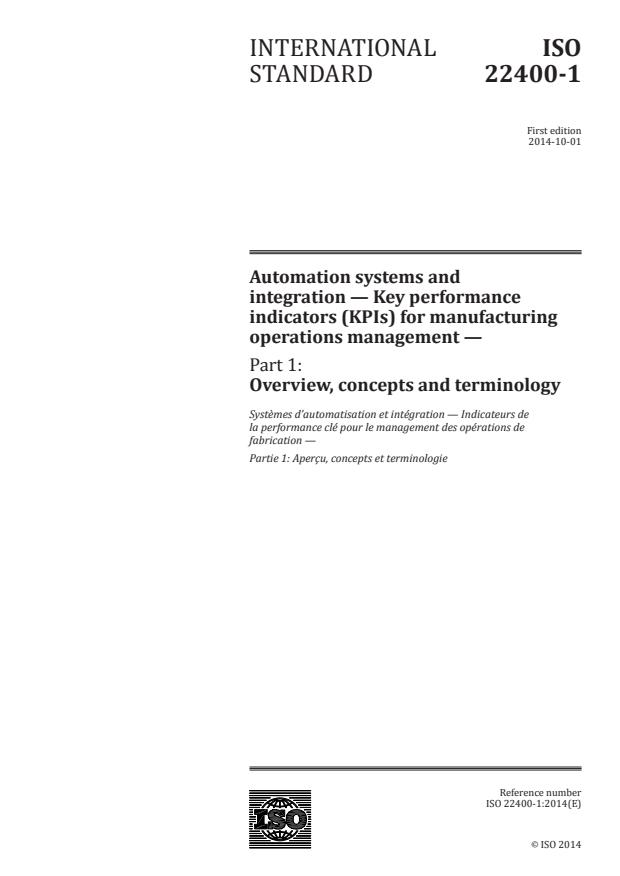
INTERNATIONAL ISO
STANDARD 22400-1
First edition
2014-10-01
Automation systems and
integration — Key performance
indicators (KPIs) for manufacturing
operations management —
Part 1:
Overview, concepts and terminology
Systèmes d’automatisation et intégration — Indicateurs de
la performance clé pour le management des opérations de
fabrication —
Partie 1: Aperçu, concepts et terminologie
Reference number
©
ISO 2014
© ISO 2014
All rights reserved. Unless otherwise specified, no part of this publication may be reproduced or utilized otherwise in any form
or by any means, electronic or mechanical, including photocopying, or posting on the internet or an intranet, without prior
written permission. Permission can be requested from either ISO at the address below or ISO’s member body in the country of
the requester.
ISO copyright office
Case postale 56 • CH-1211 Geneva 20
Tel. + 41 22 749 01 11
Fax + 41 22 749 09 47
E-mail copyright@iso.org
Web www.iso.org
Published in Switzerland
ii © ISO 2014 – All rights reserved
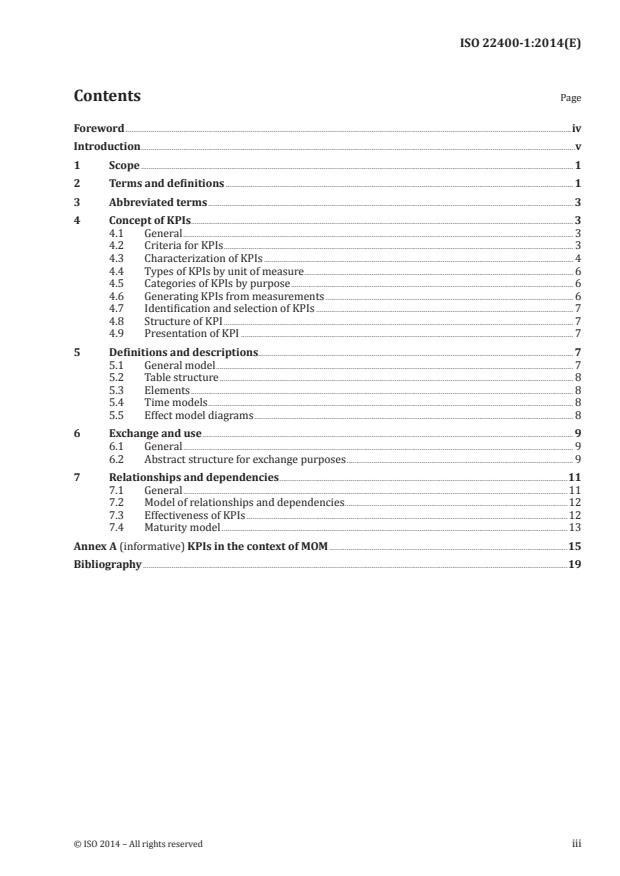
Contents Page
Foreword .iv
Introduction .v
1 Scope . 1
2 Terms and definitions . 1
3 Abbreviated terms . 3
4 Concept of KPIs . 3
4.1 General . 3
4.2 Criteria for KPIs . 3
4.3 Characterization of KPIs . 4
4.4 Types of KPIs by unit of measure . 6
4.5 Categories of KPIs by purpose . 6
4.6 Generating KPIs from measurements . 6
4.7 Identification and selection of KPIs . 7
4.8 Structure of KPI . 7
4.9 Presentation of KPI . 7
5 Definitions and descriptions. 7
5.1 General model . 7
5.2 Table structure . 8
5.3 Elements . 8
5.4 Time models . 8
5.5 Effect model diagrams . 8
6 Exchange and use . 9
6.1 General . 9
6.2 Abstract structure for exchange purposes . 9
7 Relationships and dependencies .11
7.1 General .11
7.2 Model of relationships and dependencies .12
7.3 Effectiveness of KPIs .12
7.4 Maturity model .13
Annex A (informative) KPIs in the context of MOM .15
Bibliography .19
Foreword
ISO (the International Organization for Standardization) is a worldwide federation of national standards
bodies (ISO member bodies). The work of preparing International Standards is normally carried out
through ISO technical committees. Each member body interested in a subject for which a technical
committee has been established has the right to be represented on that committee. International
organizations, governmental and non-governmental, in liaison with ISO, also take part in the work.
ISO collaborates closely with the International Electrotechnical Commission (IEC) on all matters of
electrotechnical standardization.
The procedures used to develop this document and those intended for its further maintenance are
described in the ISO/IEC Directives, Part 1. In particular the different approval criteria needed for the
different types of ISO documents should be noted. This document was drafted in accordance with the
editorial rules of the ISO/IEC Directives, Part 2 (see www.iso.org/directives).
Attention is drawn to the possibility that some of the elements of this document may be the subject of
patent rights. ISO shall not be held responsible for identifying any or all such patent rights. Details of
any patent rights identified during the development of the document will be in the Introduction and/or
on the ISO list of patent declarations received (see www.iso.org/patents).
Any trade name used in this document is information given for the convenience of users and does not
constitute an endorsement.
For an explanation on the meaning of ISO specific terms and expressions related to conformity
assessment, as well as information about ISO’s adherence to the WTO principles in the Technical Barriers
to Trade (TBT) see the following URL: Foreword - Supplementary information
The committee responsible for this document is Technical Committee ISO/TC 184, Automation systems
and integration, Subcommittee SC 5, Interoperability, integration and architectures of automation systems
and applications.
ISO 22400 consists of the following parts, under the general title Automation systems and integration —
Key performance indicators (KPIs) for manufacturing operations management:
— Part 1: Overview, concepts and terminology
— Part 2: Definitions and descriptions
The following parts are planned:
— Part 3: Exchange and use
— Part 4: Relationships and dependencies
iv © ISO 2014 – All rights reserved
Introduction
Using key performance indicators (KPIs) for manufacturing operations management (MOM) is motivated
by the possibility to use them to improve the value creation processes of an enterprise.
Measuring performance enables an enterprise to quantify aspects of all its activities. ISO 22400 focuses
on performance measures found to be particularly meaningful for the realization of operational
performance improvement. These performance measures can be achieved through combining various
measurements from operations and forming what are called KPIs. The monitoring of performance is
specific to identified objectives of the enterprise, and KPIs are most useful when their values can be
used to identify trends relative to certain operational objectives.
Within an enterprise, the various operational areas, such as sales, manufacturing, engineering, marketing,
and other business support functions, have different sets of performance indicators. These various
performance indicators are used together to monitor the realization of enterprise business objectives.
An International Standard for KPIs is beneficial for comparing enterprise operations over extended
periods of time and for comparing similar operations of enterprises within an industry.
The management of manufacturing operations is normally associated with an intermediate level
within the functional hierarchy of a manufacturing enterprise. In IEC 62264-1, the MOM domain is the
intermediate domain between the enterprise domain (Level 4) and the control domain (Levels 1 and 2).
The KPIs defined in this part of ISO 22400 are intended to be calculated using data from the control
domain, and to provide both the enterprise domain and the MOM domain with decision support
information to manage the enterprise.
This part of ISO 22400 presents an overview, concepts and terminology for KPIs. ISO 22400-2 covers
guidelines for computing and for measuring the components of a KPI. Future parts of ISO 22400 will
cover definitions for the content and context of the exchange and the use of KPIs, and specifications of
relationships, dependencies among KPIs, and the maturity of the collection and use of KPIs.
INTERNATIONAL STANDARD ISO 22400-1:2014(E)
Automation systems and integration — Key performance
indicators (KPIs) for manufacturing operations
management —
Part 1:
Overview, concepts and terminology
1 Scope
ISO 22400 specifies an industry-neutral framework for defining, composing, exchanging, and using
key performance indicators (KPIs) for manufacturing operations management (MOM), as defined in
IEC 62264-1, for batch, continuous and discrete industries.
This part of ISO 22400
— provides an overview of a KPI;
— presents concepts of relevance for working with KPIs, including criteria for constructing KPIs;
— specifies terminology related to KPIs;
— describes how a KPI can be used.
2 Terms and definitions
For the purposes of this document, the following terms and definitions apply.
2.1.1
capability
ability to perform actions
Note 1 to entry: The definition includes attributes on qualifications and measures of the ability, as in the
definition of capacity.
[SOURCE: IEC 62264–1:2013, 3.1.6, modified]
2.1.2
element
relevant measurements for use in the formula of a key performance indicator (2.1.5)
2.1.3
integration
state or condition wherein two or more entities are able to form, or be observed as, a single entity
exhibiting a structure, a behaviour, and a boundary that are determined by the interoperability (2.1.4)
properties of the forming entities, as needed to perform a common task
[SOURCE: ISO 18435-1:2009, 3.9, modified]
2.1.4
interoperability
capability (2.1.1) of two or more entities to exchange items in accordance with a set of rules and
mechanisms implemented by an interface in each entity, in order to perform their respective tasks
Note 1 to entry: Examples of entities include devices, equipment, machines, people, processes (2.1.8), applications,
software units, systems and enterprises.
Note 2 to entry: Examples of items include information, material, energy, control, assets and ideas.
[SOURCE: ISO 18435-1:2009, 3.12]
2.1.5
key performance indicator
KPI
quantifiable level of achieving a critical objective
Note 1 to entry: The KPIs are derived directly from, or through an aggregation function of, physical measurements,
data and/or other KPIs.
2.1.6
manufacturing operations management
MOM
activities within Level 3 of a manufacturing facility that coordinate the personnel, equipment and
material in manufacturing
[SOURCE: IEC 62264–1: 2013, 3.1.22]
2.1.7
manufacturing resource
physical or logical entity that enables a manufacturing process (2.1.8)
Note 1 to entry: Manufacturing resources include (but are not limited to) manufacturing assets such as equipment,
machinery, software, automation units, control devices, instrumentation, tooling, and other resources, e.g.
operators, materials, fuels and the physical plant wherein the resources are deployed.
[SOURCE: ISO 18435-1:2009, 3.17]
2.1.8
process
set of activities performed with a set of resources to realize an objective within a specified timeline
2.1.9
(role-based) equipment hierarchy
equipment model defined in terms of the Level 3 and 4 functions and activities that equipment
entities can perform
Note 1 to entry: Adapted from IEC 62264–1:2013, 5.3.1, Note 1.
2 © ISO 2014 – All rights reserved
3 Abbreviated terms
ID Identification
KPI Key Performance Indicator
KPI-E Key Performance Indicator Effectiveness
MOM Manufacturing Operations Management
UML Unified Modeling Language
URL Uniform Resource Locator
XML eXtensible Mark-up Language
4 Concept of KPIs
4.1 General
The motivation for using KPIs in the MOM domain starts with a description of the value creation
processes (see Clause A.2). An enterprise is described by three hierarchical models:
— physical asset;
— functional;
— equipment.
The functional and the equipment hierarchy models are of importance in ISO 22400. The KPIs in
ISO 22400 are limited to the MOM domain (see Clause A.4). Selection of KPIs depends on the production
methodology that is used by the enterprise (see Clause A.5). KPIs in the MOM domain identify and
achieve improvement targets based on actionable information (see Clauses A.6 and A.7).
4.2 Criteria for KPIs
A good KPI has certain criteria which ensure its usefulness in achieving various goals in the
manufacturing operation. The criteria are listed below, along with the process for performing each
individual measurement.
a) Aligned: the KPI is aligned to the degree to which the KPI affects change in relevant higher-level
KPIs, where alignment implies a high ratio of the percent improvement (assuming positive impact)
in important higher-level metrics to the percent improvement in a KPI (or KPI set), given no other
changes in the system.
b) Balanced: the extent to which a KPI is balanced within its chosen set of KPIs.
c) Standardized: the KPI is standardized to the extent to which a standard for the KPI exists and that
standard is correct, complete, and unambiguous; the standard can be plant-wide, corporate-wide,
or industry-wide.
d) Valid: the KPI is valid to the extent of the syntactic (i.e. grammar) and semantic (i.e. meaning)
compliance between the operational definition of the KPI and the standard definition. If no standard
exists, then validity is zero.
e) Quantifiable: the KPI is quantifiable to the extent to which the value of the KPI can be numerically
specified; there is no penalty for the presence of uncertainty, as long as the uncertainty can also
be quantified.
f) Accurate: the KPI is accurate to the extent to which the measured value of the KPI is close to the true
value, where a departure from the true value can be affected by poor data quality, poor accessibility
to the measurement location, or the presence of substandard measurement devices and methods.
g) Timely: the KPI is timely to the extent it is computed and accessible in real-time, where real-time
depends on the operational context.
h) Predictive: the KPI is predictive to extent to which a KPI is able to predict non-steady-state operations.
i) Actionable: the KPI is actionable to the extent to which a team responsible for the KPI has the
knowledge, ability, and authority to improve the actual value of the KPI within their own process.
j) Trackable: the KPI is trackable to the extent to which the appropriate steps to take to fix a problem
are known, documented, and accessible, where the particular problem is indicated by particular
values or temporal trends of the KPI.
k) Relevant: the KPI is relevant to the extent to which the KPI enables performance improvement in
the target operation, demonstrates real-time performance, allows the accurate prediction of future
events, and reveals a record of the past performance valuable for analysis and feedback control.
l) Correct: the KPI is correct to the extent that, compared to the standard definition (if one exists), the
calculation required to compute the value of the KPI compared to the standard definition (if one
exists) has no errors with respect to the standard definition.
m) Complete: the KPI is complete to the extent that, compared to the standard definition (if one exists),
the definition of the KPI, and the calculation required to compute the value of the KPI, covers all
parts, and no more, of the standard definition.
n) Unambiguous: the KPI is unambiguous to the extent that the syntax (i.e. grammar) and semantics
(i.e. meaning) in the definition of the KPI lacks ambiguity or uncertainty.
o) Automated: the KPI is automated to the extent that KPI collection, transfer, computation,
implementation, and reporting are automated.
p) Buy-in: the KPI has buy-in to the extent that the team responsible for the target operation, as well
as teams responsible for both upper and lower level KPIs, are willing to support the use of the KPI
and perform the tasks necessary to achieve target values for the KPI; includes difficulty of obtaining
official approval by management for the KPI.
q) Documented: the KPI is documented to the extent that the documented instructions for
implementation of a KPI are up-to-date, correct, complete, and unambiguous, including instructions
on how to compute the KPI, what measurements are necessary for its computation, and what actions
to take for different KPI values.
r) Comparable: the KPI is comparable to the extent that means are defined to reference supporting
measurements over a period of time, and a normalizing factor to express the indicator in absolute
terms with appropriate units of measure.
s) Understandable: the KPI is understandable to the extent that the meaning of the KPI is comprehended
by team members, management, and customers, particularly with respect to corporate goals.
t) Inexpensive: the KPI is inexpensive to the extent that the cost of measuring, computing, and
reporting the KPI is low.
4.3 Characterization of KPIs
4.3.1 General
A KPI is characterized by information regarding its content and context:
a) content information: a quantifiable element with a specific unit of measure;
4 © ISO 2014 – All rights reserved
b) context information: a verifiable list of conditions that are met.
The factors that determine the value of a KPI are assumed to be accessible to change using a particular
action plan. The action plan describes the activities that will lead to achieving the objective of the
operation, the resources and actors required for performing the activities, and the timeframe for
completing these activities.
4.3.2 Content information
When a definition of a KPI is given, it should contain information about its content:
a) name: name of KPI, e.g. availability, worker effectiveness;
b) ID: a user-defined unique identification of the KPI in the user’s environment;
c) description: a description of the KPI;
d) scope: identification of the element for which the KPI is relevant, e.g. a work unit, work centre, work
order, product, or personnel (see IEC 62264-3);
e) formula: the mathematical formula of the KPI defined in terms of elements;
f) unit of measure: the basic unit or dimension in which the KPI is expressed;
g) range: the upper and lower logical limits of the KPI;
h) trend: information about the improvement direction, i.e. higher-is-better or lower-is-better.
4.3.3 Context information
The specification of a KPI should contain information about its context, including timing, audience,
production methodology, effect model diagram, and notes.
a) The timing context information should specify the frequency of KPI calculation as following:
1) real-time (as the process is occurring): after each new data acquisition event,
2) periodically: done at a certain interval, e.g. one time per day, or
3) on-demand: after a specific data selection request.
b) Constraints: information about possible constraints on how the KPI can be used.
c) Usage: in
...