


ISO 34257:2024
(Main)Adhesives - Wood adhesives - Determination of tensile strength of lap joints at elevated temperature (WATT '91)
Adhesives - Wood adhesives - Determination of tensile strength of lap joints at elevated temperature (WATT '91)
This document specifies a method for testing the strength of wood adhesives at 80 °C. NOTE The procedure described is based on a test developed in Germany known originally as the WATT '91 test. It uses the test piece described in ISO 19210.
Adhésifs — Adhésifs pour bois — Détermination de la résistance en traction à température élevée des joints à recouvrement (essai WATT '91)
Le présent document spécifie une méthode d’essai de la résistance à 80 °C des adhésifs pour bois. NOTE La méthode décrite reprend un essai mis au point en Allemagne, initialement connu sous le nom d’essai WATT ’91. Elle utilise l’éprouvette correspondant à la description de l’ISO 19210.
General Information
Relations
Overview
ISO 34257:2024 specifies a standardized method to determine the tensile strength of wood adhesive lap joints at an elevated temperature of 80 °C. Known as the WATT '91 test, this method evaluates adhesive performance under heat stress by testing bonded wood lap joints using procedures aligned with ISO 19210. Developed originally in Germany and now adopted internationally, this method provides a reliable metric for assessing the durability and strength of wood adhesives at elevated temperatures, supporting quality assurance and product development in woodworking and adhesive manufacturing.
Key Topics
Test Conditions
The standard mandates testing lap joints at (80 ± 2) °C for 60 minutes in a fan-assisted oven with controlled airflow to ensure consistent heating.Sample Preparation
Test specimens are prepared following ISO 19210 guidelines, with 20 samples conditioned for a minimum of seven days at specified temperature and humidity levels before testing.Testing Procedure
After heat conditioning, samples are immediately subjected to tensile strength testing at controlled strain rates. The force applied until rupture is recorded to calculate the tensile strength of the adhesive bond.Apparatus Requirements
A tensile testing machine compliant with ISO 5893 is required for constant strain rate testing, equipped for jaw self-alignment to ensure accurate load application. Temperature control is maintained by a fan-assisted oven.Calculation of Results
Tensile strength is calculated by dividing the maximum applied force by the bonded surface area, expressed in newtons per square millimeter (N/mm²). Results are reported with mean values, standard deviation, and coefficients of variation.Test Reporting
Detailed test reports must include adhesive information, wood species and moisture content, bonding procedure specifics, conditioning details, test results, failure modes, and any deviations from the standard.
Applications
ISO 34257:2024 applies broadly in industries concerned with wood bonding, including:
Woodworking and Furniture Manufacturing
Ensures adhesives used in joints maintain strength under elevated temperature exposure, critical for heat-treated furniture products.Building and Construction
Assesses adhesives in structural and non-structural applications where joints might face elevated temperatures, improving safety and reliability.Adhesive Development and Quality Control
Assists manufacturers in testing adhesive formulations to optimize performance under thermal stress and in certifying products for market compliance.Research and Testing Laboratories
Provides a standardized method for comparative evaluation of wood adhesive performance, supporting innovation and verification in material science.
Related Standards
ISO 19210 – Specifies the preparation and testing of wood adhesive lap joint samples for tensile shear strength evaluation under standard conditions.
ISO 5893 – Defines requirements for tensile, flexural, and compression testing machines ensuring consistent test equipment performance.
EN 923 – Contains terms and definitions relevant to adhesives, providing unified vocabulary for standardization.
Practical Value
ISO 34257:2024 enhances product reliability by offering a reproducible test for wood adhesives under thermal stress, essential for designing durable wood joints exposed to elevated temperatures. Its international acceptance facilitates global trade by harmonizing test methods and reporting, aiding manufacturers and testers in delivering consistent quality and compliance. By adopting this standard, stakeholders can confidently assess tensile strength of wood adhesive lap joints, optimize adhesive selection, and ensure performance longevity in real-world applications.
Keywords: ISO 34257, wood adhesives, tensile strength test, lap joint, elevated temperature testing, WATT ’91 test, adhesive durability, wood bonding, tensile shear strength, adhesive quality control.
Standards Content (Sample)
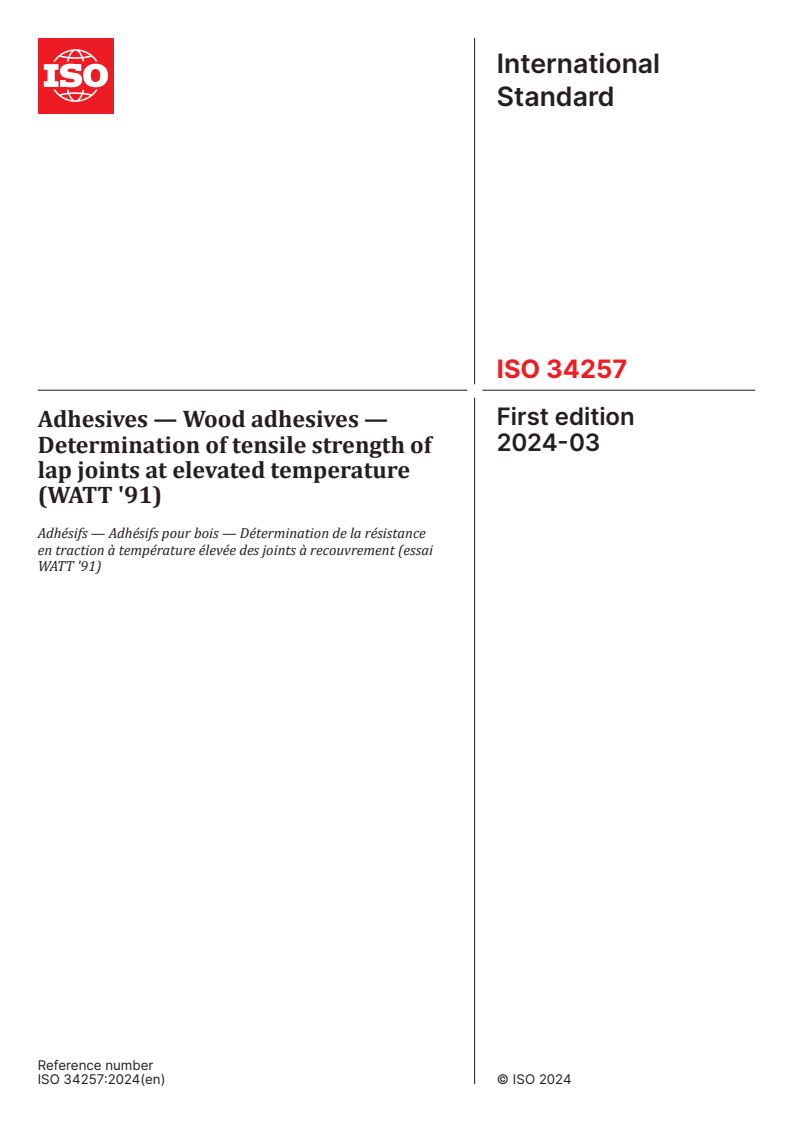
International
Standard
ISO 34257
First edition
Adhesives — Wood adhesives —
2024-03
Determination of tensile strength of
lap joints at elevated temperature
(WATT '91)
Adhésifs — Adhésifs pour bois — Détermination de la résistance
en traction à température élevée des joints à recouvrement (essai
WATT '91)
Reference number
© ISO 2024
All rights reserved. Unless otherwise specified, or required in the context of its implementation, no part of this publication may
be reproduced or utilized otherwise in any form or by any means, electronic or mechanical, including photocopying, or posting on
the internet or an intranet, without prior written permission. Permission can be requested from either ISO at the address below
or ISO’s member body in the country of the requester.
ISO copyright office
CP 401 • Ch. de Blandonnet 8
CH-1214 Vernier, Geneva
Phone: +41 22 749 01 11
Email: copyright@iso.org
Website: www.iso.org
Published in Switzerland
ii
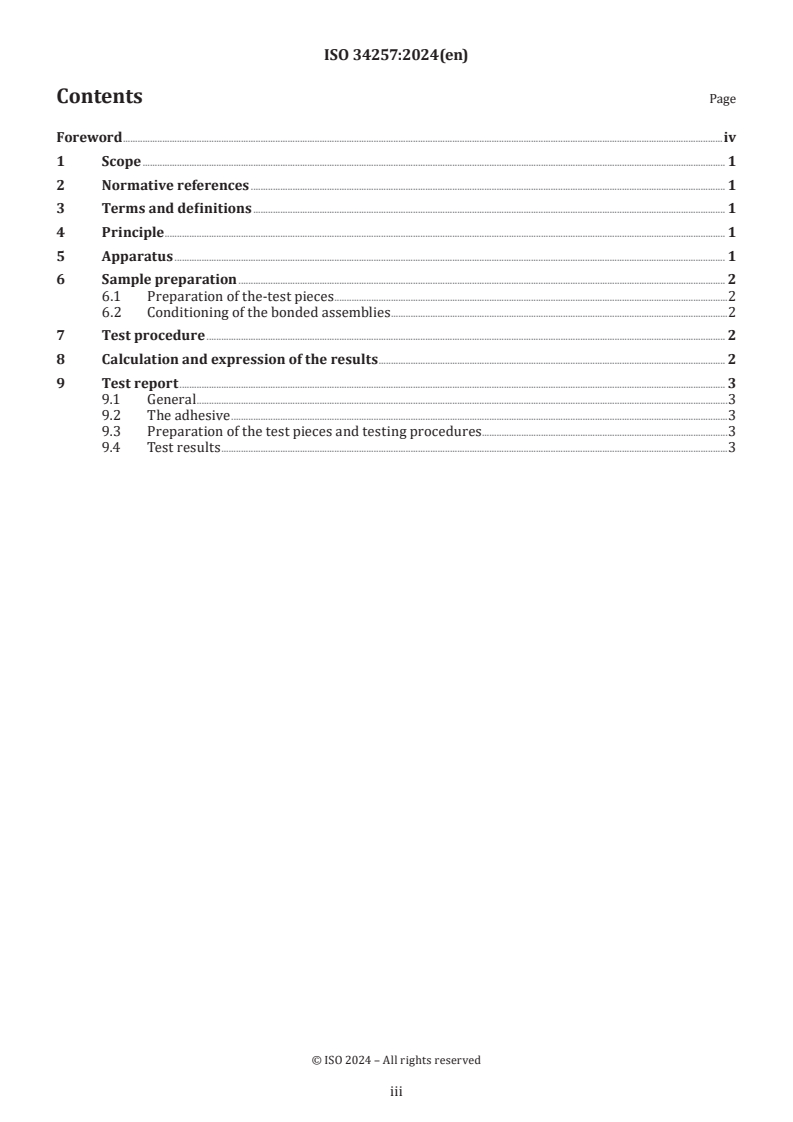
Contents Page
Foreword .iv
1 Scope . 1
2 Normative references . 1
3 Terms and definitions . 1
4 Principle . 1
5 Apparatus . 1
6 Sample preparation . 2
6.1 Preparation of the-test pieces .2
6.2 Conditioning of the bonded assemblies .2
7 Test procedure . 2
8 Calculation and expression of the results . 2
9 Test report . 3
9.1 General .3
9.2 The adhesive .3
9.3 Preparation of the test pieces and testing procedures .3
9.4 Test results .3
iii
Foreword
ISO (the International Organization for Standardization) is a worldwide federation of national standards
bodies (ISO member bodies). The work of preparing International Standards is normally carried out through
ISO technical committees. Each member body interested in a subject for which a technical committee
has been established has the right to be represented on that committee. International organizations,
governmental and non-governmental, in liaison with ISO, also take part in the work. ISO collaborates closely
with the International Electrotechnical Commission (IEC) on all matters of electrotechnical standardization.
The procedures used to develop this document and those intended for its further maintenance are described
in the ISO/IEC Directives, Part 1. In particular, the different approval criteria needed for the different types
of ISO document should be noted (see www.iso.org/directives).
ISO draws attention to the possibility that the implementation of this document may involve the use of (a)
patent(s). ISO takes no position concerning the evidence, validity or applicability of any claimed patent
rights in respect thereof. As of the date of publication of this document, ISO had not received notice of (a)
patent(s) which may be required to implement this document. However, implementers are cautioned that
this may not represent the latest information, which may be obtained from the patent database available at
www.iso.org/patents. ISO shall not be held responsible for identifying any or all such patent rights.
Any trade name used in this document is information given for the convenience of users and does not
constitute an endorsement.
For an explanation of the voluntary nature of standards, the meaning of ISO specific terms and expressions
related to conformity assessment, as well as information about ISO's adherence to the World Trade
Organization (WTO) principles in the Technical Barriers to Trade (TBT), see www.iso.org/iso/foreword.html.
This document was prepared by European Committee for Standardization as EN 14257:2019, and drafted in
accordance with its editorial rules. It was assigned to Technical Committee ISO/TC 61, Plastics, subcommit
...
Frequently Asked Questions
ISO 34257:2024 is a standard published by the International Organization for Standardization (ISO). Its full title is "Adhesives - Wood adhesives - Determination of tensile strength of lap joints at elevated temperature (WATT '91)". This standard covers: This document specifies a method for testing the strength of wood adhesives at 80 °C. NOTE The procedure described is based on a test developed in Germany known originally as the WATT '91 test. It uses the test piece described in ISO 19210.
This document specifies a method for testing the strength of wood adhesives at 80 °C. NOTE The procedure described is based on a test developed in Germany known originally as the WATT '91 test. It uses the test piece described in ISO 19210.
ISO 34257:2024 is classified under the following ICS (International Classification for Standards) categories: 83.180 - Adhesives. The ICS classification helps identify the subject area and facilitates finding related standards.
ISO 34257:2024 has the following relationships with other standards: It is inter standard links to ISO/IEC 11801-2:2017. Understanding these relationships helps ensure you are using the most current and applicable version of the standard.
You can purchase ISO 34257:2024 directly from iTeh Standards. The document is available in PDF format and is delivered instantly after payment. Add the standard to your cart and complete the secure checkout process. iTeh Standards is an authorized distributor of ISO standards.
Questions, Comments and Discussion
Ask us and Technical Secretary will try to provide an answer. You can facilitate discussion about the standard in here.
Loading comments...