

ISO/IEC 11801-2:2017
(Main)Information technology — Generic cabling for customer premises — Part 2: Office premises
General Information
- Abstract
ISO/IEC 11801-2:2017(E) This document specifies generic cabling within and between the buildings of office premises, or office spaces within other types of building. Additionally those premises can include industrial spaces (for which generic cabling is specified in ISO/IEC 11801-3) or data centre spaces (for which generic cabling is specified in ISO/IEC 11801-5).
- Status
- Published
- Publication Date
- 20-Nov-2017
- Technical Committee
- ISO/IEC JTC 1/SC 25 - Interconnection of information technology equipment
- Current Stage
- 6060 - International Standard published
- Start Date
- 21-Nov-2017
- Due Date
- 05-Jun-2018
- Completion Date
- 05-Jun-2018
Buy Documents



ISO/IEC 11801-2:2017 - Information technology -- Generic cabling for customer premises

ISO/IEC 11801-2:2017 - Information technology — Generic cabling for customer premises — Part 2: Office premises/12/2020
Overview
ISO/IEC 11801-2:2017 - "Information technology - Generic cabling for customer premises - Part 2: Office premises" specifies the requirements for structured cabling systems used within and between buildings of office premises or office spaces inside other building types. First published in 2017, this part of the ISO/IEC 11801 series focuses on office-specific design, installation and performance considerations and is intended to be read together with ISO/IEC 11801-1 (general requirements).
Key Topics
The standard addresses practical and technical aspects of generic cabling for offices, including:
- System structure and hierarchy: Functional elements (work area, horizontal cabling, backbone/campus cabling, telecommunications rooms) and options such as centralized architectures.
- Cabling media: Requirements for balanced copper cabling and optical fibre cabling, and guidance on component selection.
- Channel and link performance: Transmission and environmental performance requirements for channels, permanent links and cords.
- Cabling components: Specifications for cables, connecting hardware (patch panels, outlets), cords (work area and equipment cords), jumpers and patch cords.
- Installation and accommodation: Guidance for telecommunications rooms, equipment rooms, consolidation points and space planning to accommodate functional elements.
- Reference implementations and modelling: Typical horizontal cabling models, backbone/horizontal channel examples and dimensioning principles used for design and verification.
- Conformance and documentation: Normative references, terms and definitions, and conformance considerations to ensure interoperability and consistent performance.
Applications and Who Uses It
ISO/IEC 11801-2:2017 is a practical resource for professionals involved in office network infrastructure:
- Network architects and designers - to define cabling topology and specify media for performance targets.
- Cabling contractors and installers - for installation practices, component selection and testing criteria.
- IT managers and facilities planners - to plan telecommunications rooms, consolidation points and future-proof office layouts.
- Procurement and compliance teams - to develop specifications, acceptance tests and supplier contracts.
- Consultants and auditors - to assess conformance, validate performance and document cabling systems.
Use cases include new office fit-outs, retrofits, multi‑building office campuses and upgrades to support higher-speed Ethernet and fibre deployments.
Related Standards
- ISO/IEC 11801-1 (General) - read in conjunction for channel and link specifications.
- ISO/IEC 11801-3 - industrial spaces.
- ISO/IEC 11801-5 - data centre spaces.
- ISO/IEC 11801-6 - distributed building services.
Keywords: ISO/IEC 11801-2:2017, generic cabling, office premises, structured cabling, balanced cabling, optical fibre, horizontal cabling, backbone cabling, telecommunications room, cabling standards.
Relations
- Effective Date
- 06-Jun-2022
- Effective Date
- 01-Mar-2014
- Effective Date
- 01-Mar-2014
- Effective Date
- 01-Mar-2014
Buy Documents
ISO/IEC 11801-2:2017 - Information technology -- Generic cabling for customer premises
ISO/IEC 11801-2:2017 - Information technology — Generic cabling for customer premises — Part 2: Office premises/12/2020
Get Certified
Connect with accredited certification bodies for this standard

BSI Group
BSI (British Standards Institution) is the business standards company that helps organizations make excellence a habit.

NYCE
Mexican standards and certification body.
Sponsored listings
Frequently Asked Questions
ISO/IEC 11801-2:2017 is a standard published by the International Organization for Standardization (ISO). Its full title is "Information technology — Generic cabling for customer premises — Part 2: Office premises". This standard covers: ISO/IEC 11801-2:2017(E) This document specifies generic cabling within and between the buildings of office premises, or office spaces within other types of building. Additionally those premises can include industrial spaces (for which generic cabling is specified in ISO/IEC 11801-3) or data centre spaces (for which generic cabling is specified in ISO/IEC 11801-5).
ISO/IEC 11801-2:2017(E) This document specifies generic cabling within and between the buildings of office premises, or office spaces within other types of building. Additionally those premises can include industrial spaces (for which generic cabling is specified in ISO/IEC 11801-3) or data centre spaces (for which generic cabling is specified in ISO/IEC 11801-5).
ISO/IEC 11801-2:2017 is classified under the following ICS (International Classification for Standards) categories: 35.200 - Interface and interconnection equipment. The ICS classification helps identify the subject area and facilitates finding related standards.
ISO/IEC 11801-2:2017 has the following relationships with other standards: It is inter standard links to ISO 34257:2024, ISO/IEC 11801:2002, ISO/IEC 11801:2002/Amd 2:2010, ISO/IEC 11801:2002/Amd 1:2008. Understanding these relationships helps ensure you are using the most current and applicable version of the standard.
ISO/IEC 11801-2:2017 is available in PDF format for immediate download after purchase. The document can be added to your cart and obtained through the secure checkout process. Digital delivery ensures instant access to the complete standard document.
Standards Content (Sample)
ISO/IEC 11801-2
Edition 1.0 2017-11
INTERNATIONAL
STANDARD
Information technology – Generic cabling for customer premises –
Part 2: Office premises
All rights reserved. Unless otherwise specified, no part of this publication may be reproduced or utilized in any form
or by any means, electronic or mechanical, including photocopying and microfilm, without permission in writing from
either IEC or IEC's member National Committee in the country of the requester. If you have any questions about
ISO/IEC copyright or have an enquiry about obtaining additional rights to this publication, please contact the address
below or your local IEC member National Committee for further information.
IEC Central Office Tel.: +41 22 919 02 11
3, rue de Varembé Fax: +41 22 919 03 00
CH-1211 Geneva 20 info@iec.ch
Switzerland www.iec.ch
About the IEC
The International Electrotechnical Commission (IEC) is the leading global organization that prepares and publishes
International Standards for all electrical, electronic and related technologies.
About IEC publications
The technical content of IEC publications is kept under constant review by the IEC. Please make sure that you have the
latest edition, a corrigenda or an amendment might have been published.
IEC Catalogue - webstore.iec.ch/catalogue Electropedia - www.electropedia.org
The stand-alone application for consulting the entire The world's leading online dictionary of electronic and
bibliographical information on IEC International Standards, electrical terms containing 20 000 terms and definitions in
Technical Specifications, Technical Reports and other English and French, with equivalent terms in 16 additional
documents. Available for PC, Mac OS, Android Tablets and languages. Also known as the International Electrotechnical
iPad. Vocabulary (IEV) online.
IEC publications search - www.iec.ch/searchpub IEC Glossary - std.iec.ch/glossary
The advanced search enables to find IEC publications by a 65 000 electrotechnical terminology entries in English and
variety of criteria (reference number, text, technical French extracted from the Terms and Definitions clause of
committee,…). It also gives information on projects, replaced IEC publications issued since 2002. Some entries have been
and withdrawn publications. collected from earlier publications of IEC TC 37, 77, 86 and
CISPR.
IEC Just Published - webstore.iec.ch/justpublished
Stay up to date on all new IEC publications. Just Published IEC Customer Service Centre - webstore.iec.ch/csc
details all new publications released. Available online and If you wish to give us your feedback on this publication or
also once a month by email. need further assistance, please contact the Customer Service
Centre: csc@iec.ch.
ISO/IEC 11801-2
Edition 1.0 2017-11
INTERNATIONAL
STANDARD
Information technology – Generic cabling for customer premises –
Part 2: Office premises
INTERNATIONAL
ELECTROTECHNICAL
COMMISSION
ICS 35.200 ISBN 978-2-8322-5034-1
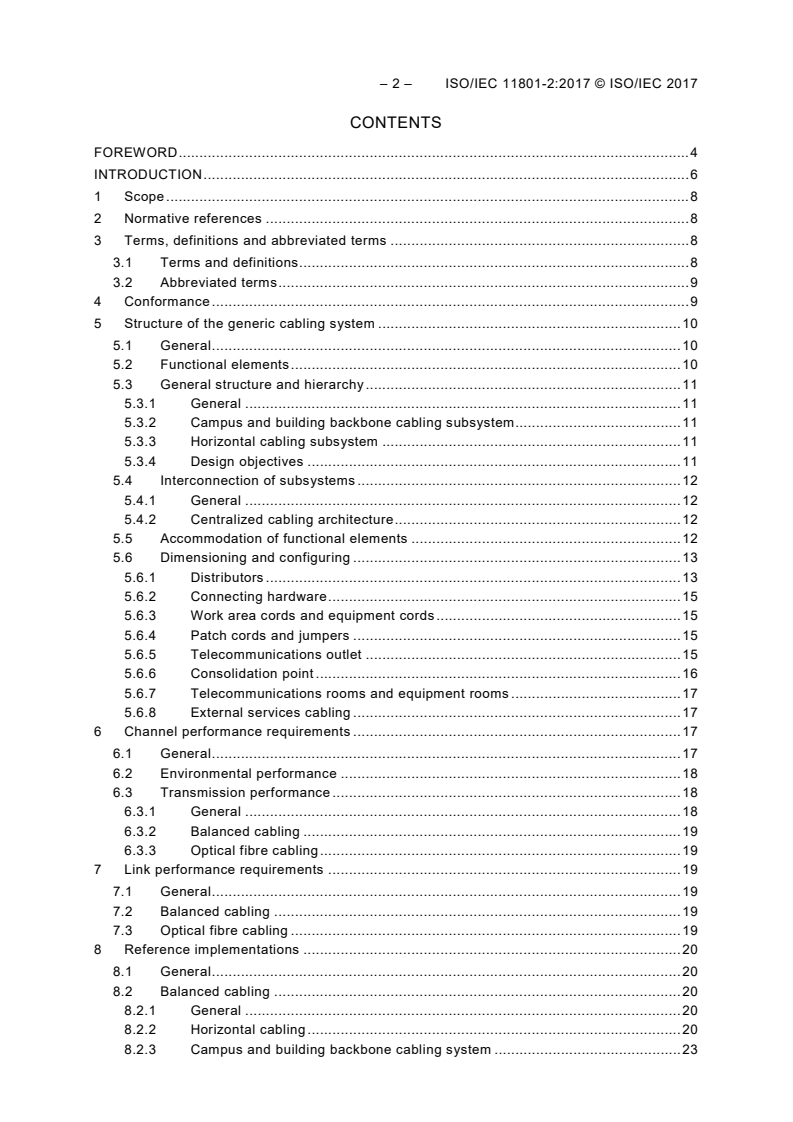
– 2 – ISO/IEC 11801-2:2017 © ISO/IEC 2017
CONTENTS
FOREWORD . 4
INTRODUCTION . 6
1 Scope . 8
2 Normative references . 8
3 Terms, definitions and abbreviated terms . 8
3.1 Terms and definitions . 8
3.2 Abbreviated terms . 9
4 Conformance . 9
5 Structure of the generic cabling system . 10
5.1 General . 10
5.2 Functional elements . 10
5.3 General structure and hierarchy . 11
5.3.1 General . 11
5.3.2 Campus and building backbone cabling subsystem . 11
5.3.3 Horizontal cabling subsystem . 11
5.3.4 Design objectives . 11
5.4 Interconnection of subsystems . 12
5.4.1 General . 12
5.4.2 Centralized cabling architecture . 12
5.5 Accommodation of functional elements . 12
5.6 Dimensioning and configuring . 13
5.6.1 Distributors . 13
5.6.2 Connecting hardware . 15
5.6.3 Work area cords and equipment cords . 15
5.6.4 Patch cords and jumpers . 15
5.6.5 Telecommunications outlet . 15
5.6.6 Consolidation point . 16
5.6.7 Telecommunications rooms and equipment rooms . 17
5.6.8 External services cabling . 17
6 Channel performance requirements . 17
6.1 General . 17
6.2 Environmental performance . 18
6.3 Transmission performance . 18
6.3.1 General . 18
6.3.2 Balanced cabling . 19
6.3.3 Optical fibre cabling . 19
7 Link performance requirements . 19
7.1 General . 19
7.2 Balanced cabling . 19
7.3 Optical fibre cabling . 19
8 Reference implementations . 20
8.1 General . 20
8.2 Balanced cabling . 20
8.2.1 General . 20
8.2.2 Horizontal cabling . 20
8.2.3 Campus and building backbone cabling system . 23
8.3 Optical fibre cabling . 23
8.3.1 General . 23
8.3.2 Component selection . 23
8.3.3 Dimensions . 23
9 Cable requirements . 25
9.1 General . 25
9.2 Balanced cables . 26
9.3 Optical fibre cables . 26
10 Connecting hardware requirements . 26
10.1 General requirements . 26
10.2 Connecting hardware for balanced cabling . 26
10.2.1 General requirements . 26
10.2.2 Electrical, mechanical and environmental performance . 26
10.3 Connecting hardware for optical fibre cabling . 27
10.3.1 General requirements . 27
10.3.2 Optical, mechanical and environmental performance . 27
11 Cord requirements . 27
11.1 Jumpers . 27
11.2 Balanced cords . 27
11.2.1 General . 27
11.2.2 Additional requirements for work area cords . 27
11.3 Optical fibre cords . 27
Bibliography . 28
Figure 1 – Relationships between the generic cabling documents produced by
ISO/IEC JTC 1/SC 25 . 6
Figure 2 – Structure of generic cabling . 11
Figure 3 – Hierarchical structure of generic cabling . 12
Figure 4 – Structures for centralized generic cabling . 12
Figure 5 – Accommodation of functional elements . 13
Figure 6 – Example of a generic cabling system with combined BD and FD . 14
Figure 7 – Inter-relationship of functional elements in an installation with redundancy . 15
Figure 8 –Channel, permanent link and CP link . 18
Figure 9 – Example of a system showing the location of cabling interfaces and extent
of associated channels . 18
Figure 10 – Horizontal cabling models . 21
Figure 11 – Combined backbone/horizontal channels. 25
Table 1 – Maximum channel lengths . 14
Table 2 – Length assumptions used in the mathematical modelling of balanced
horizontal cabling . 22
Table 3 – Horizontal link length equations . 22
– 4 – ISO/IEC 11801-2:2017 © ISO/IEC 2017
INFORMATION TECHNOLOGY –
GENERIC CABLING FOR CUSTOMER PREMISES –
Part 2: Office premises
FOREWORD
1) ISO (the International Organization for Standardization) and IEC (the International Electrotechnical
Commission) form the specialized system for worldwide standardization. National bodies that are members of
ISO or IEC participate in the development of International Standards through technical committees established
by the respective organization to deal with particular fields of technical activity. ISO and IEC technical
committees collaborate in fields of mutual interest. Other international organizations, governmental and non-
governmental, in liaison with ISO and IEC, also take part in the work. In the field of information technology,
ISO and IEC have established a joint technical committee, ISO/IEC JTC 1.
2) The formal decisions or agreements of IEC and ISO on technical matters express, as nearly as possible, an
international consensus of opinion on the relevant subjects since each technical committee has representation
from all interested IEC National Committees and ISO member bodies.
3) IEC, ISO and ISO/IEC publications have the form of recommendations for international use and are accepted
by IEC National Committees and ISO member bodies in that sense. While all reasonable efforts are made to
ensure that the technical content of IEC, ISO and ISO/IEC publications is accurate, IEC or ISO cannot be held
responsible for the way in which they are used or for any misinterpretation by any end user.
4) In order to promote international uniformity, IEC National Committees and ISO member bodies undertake to
apply IEC, ISO and ISO/IEC publications transparently to the maximum extent possible in their national and
regional publications. Any divergence between any ISO, IEC or ISO/IEC publication and the corresponding
national or regional publication should be clearly indicated in the latter.
5) ISO and IEC do not provide any attestation of conformity. Independent certification bodies provide conformity
assessment services and, in some areas, access to IEC marks of conformity. ISO or IEC are not responsible
for any services carried out by independent certification bodies.
6) All users should ensure that they have the latest edition of this publication.
7) No liability shall attach to IEC or ISO or its directors, employees, servants or agents including individual
experts and members of their technical committees and IEC National Committees or ISO member bodies for
any personal injury, property damage or other damage of any nature whatsoever, whether direct or indirect, or
for costs (including legal fees) and expenses arising out of the publication of, use of, or reliance upon, this
ISO/IEC publication or any other IEC, ISO or ISO/IEC publications.
8) Attention is drawn to the normative references cited in this publication. Use of the referenced publications is
indispensable for the correct application of this publication.
9) Attention is drawn to the possibility that some of the elements of this ISO/IEC publication may be the subject
of patent rights. ISO and IEC shall not be held responsible for identifying any or all such patent rights.
International Standard ISO/IEC 11801-2 was prepared by subcommittee 25: Interconnection
of information technology equipment, of ISO/IEC joint technical committee 1: Information
technology.
This first edition, together with ISO/IEC 11801-1, cancels and replaces ISO/IEC 11801:2002,
Amendment 1:2008 and Amendment 2:2010. This edition constitutes a technical revision.
This edition includes the following significant technical changes with respect to the previous
edition:
a) standard re-structured to contain only those requirements that are specific for generic
cabling systems installed in offices,
b) alignment of functional element designations with the generic terminology of
ISO/IEC 11801-1,
c) reference to the campus and building backbone cabling system specification of
ISO/IEC 11801-1,
d) reference to the channel and link specifications of ISO/IEC 11801-1.
ISO/IEC 11801-2 is to be read in conjunction with ISO/IEC 11801-1.
This International Standard has been approved by vote of the member bodies, and the voting
results may be obtained from the address given on the second title page.
This document has been drafted in accordance with the ISO/IEC Directives, Part 2.
A list of all parts in the ISO/IEC 11801 series, published under the general title Information
technology – Generic cabling for customer premises, can be found on the IEC website.
The contents of the corrigendum of April 2018 have been included in this copy.
– 6 – ISO/IEC 11801-2:2017 © ISO/IEC 2017
INTRODUCTION
The importance of cabling infrastructure is similar to that of other fundamental utilities such as
water and energy supply and interruptions to the services provided over that infrastructure
can have a serious impact. A lack of design foresight, the use of inappropriate components,
incorrect installation, poor administration or inadequate support can threaten quality of service
and have commercial consequence for all types of users.
This document specifies generic cabling within and between the buildings of office premises,
or office spaces within other types of building.
Additionally those premises can include
• industrial spaces for which generic cabling is specified in ISO/IEC 11801-3,
• data centre spaces for which generic cabling is specified in ISO/IEC 11801-5.
Generic cabling for distributed building services in office spaces is specified in
ISO/IEC 11801-6, which addresses all of the above premises and spaces within them.
Figure 1 shows the schematic and contextual relationships between the standards relating to
information technology cabling produced by ISO/IEC JTC 1/SC 25, namely the ISO/IEC 11801
series of standards for generic cabling design, standards for the installation, operation and
administration of generic cabling and for testing of installed generic cabling.
Figure 1 – Relationships between the generic cabling
documents produced by ISO/IEC JTC 1/SC 25
The generic cabling specified by this document provides users with
a) an application independent system capable of supporting a wide range of applications in a
range of installation and operating environments,
b) a flexible scheme such that modifications are both easy and economical,
c) a multi-vendor supply chain within an open market for cabling components.
In addition, this document provides
d) relevant industry professionals with guidance allowing the accommodation of cabling
before specific requirements are known, i.e. in the initial planning either for construction or
refurbishment and for further deployment as the requirements of areas are defined,
e) industry and standardization bodies with a cabling system which supports current products
and provides a basis for future product development and applications standardization.
Applications addressed in this document include those developed by the technical committees
of IEC (including the subcommittees of ISO/IEC JTC 1) and study groups of ITU-T.
Physical layer requirements for the applications listed in Annex E of ISO/IEC 11801-1:2017
have been analysed to determine their compatibility with the cabling performance specified in
this document and, together with statistics concerning premises geography from different
countries and the models described in Clause 6, have been used to develop the requirements
for cabling components and to stipulate their arrangement into cabling systems.
As a result, this document
1) specifies a structure for generic cabling supporting a wide variety of applications,
2) adopts balanced cabling channel and link Classes E, E , F, and F specified in
A A
ISO/IEC 11801-1,
3) adopts optical fibre cabling channel and link requirements specified in ISO/IEC 11801-1,
4) adopts component requirements, specified in ISO/IEC 11801-1, and specifies cabling
implementations that ensure performance of permanent links and of channels that meet or
exceed the requirements of a specified group (e.g. Class) of applications.
Life expectancy of generic cabling systems can vary depending on environmental conditions,
supporting applications, aging of materials used in cables, and other factors, such as access
to pathways (campus pathways are more difficult to access than building pathways). With
appropriate choice of components, generic cabling systems meeting the requirements of this
document are expected to have a life expectancy of at least ten years.
This document has taken into account requirements specified in application standards listed
in ISO/IEC 11801-1:2017, Annex E. It refers to International Standards for components and
test methods whenever appropriate International Standards are available.
– 8 – ISO/IEC 11801-2:2017 © ISO/IEC 2017
INFORMATION TECHNOLOGY –
GENERIC CABLING FOR CUSTOMER PREMISES –
Part 2: Office premises
1 Scope
This part of ISO/IEC 11801 specifies generic cabling for use within office premises, which can
comprise single or multiple buildings on a campus. It covers balanced cabling and optical fibre
cabling.
This document is optimized for premises in which the maximum distance over which
telecommunications services can be distributed is 2 000 m. The principles of this document
can be applied to larger installations.
Cabling specified by this document supports a wide range of services including voice, data,
and video that can also incorporate the supply of power.
This document specifies directly or via reference to ISO/IEC 11801-1
a) the structure and minimum configuration for generic cabling within office premises,
b) the interfaces at the telecommunications outlet (TO),
c) the performance requirements for cabling links and channels,
d) the implementation requirements and options,
e) the performance requirements for cabling components,
f) the conformance requirements and verification procedures.
Safety (e.g. electrical safety and protection and fire) and electromagnetic compatibility (EMC)
requirements are outside the scope of this document, and are covered by other standards and
by regulations. However, information given by this document can be of assistance.
2 Normative references
The following documents are referred to in the text in such a way that some or all of their
content constitutes requirements of this document. For dated references, only the edition
cited applies. For undated references, the latest edition of the referenced document (including
any amendments) applies.
IEC 61754-20 (all parts), Fibre optic interconnecting devices and passive components – Fibre
optic connector interfaces – Part 20: Type LC connector family
ISO/IEC 11801-1:2017, Information technology – Generic cabling for customer premises –
Part 1: General requirements
ISO/IEC 14763-2, Information technology – Implementation and operation of customer
premises cabling – Part 2: Planning and installation
ISO/IEC 30129, Information technology – Telecommunications bonding networks for buildings
and other structures
3 Terms, definitions and abbreviated terms
3.1 Terms and definitions
For the purposes of this document, the terms and definitions given in ISO/IEC 11801-1,
ISO/IEC 14763-2 and the following apply.
ISO and IEC maintain terminological databases for use in standardization at the following
addresses:
• IEC Electropedia: available at http://www.electropedia.org/
• ISO Online browsing platform: available at http://www.iso.org/obp
3.1.1
equipment room
room dedicated to housing distributors and application specific equipment
3.1.2
floor distributor
distributor used to connect between the horizontal cable and other cabling subsystems or
equipment
Note 1 to entry: See also telecommunications room.
3.1.3
horizontal cable
cable connecting the floor distributor to the consolidation point (CP) if a CP is present, or to
the telecommunications outlet if no CP is present
3.1.4
individual work area
minimum building space that would be reserved for an occupant
3.1.5
multi-user telecommunications outlet assembly
grouping in one location of several telecommunications outlets
3.1.6
telecommunications room
enclosed space for housing telecommunications equipment, cable terminations, interconnect
and cross-connect
3.1.7
work area
building space where the occupants interact with telecommunications terminal equipment
3.1.8
work area cord
cord connecting the telecommunications outlet to the terminal equipment
3.2 Abbreviated terms
For the purposes of this document, the abbreviated terms given in ISO/IEC 11801-1 and the
following apply.
FD floor distributor
MUTO multi-user telecommunications outlet
PBX private branch exchange
4 Conformance
For a cabling installation to conform to this document the following applies.
a) The configuration and structure shall conform to the requirements outlined in Clause 5.
b) Channels shall meet the requirements specified in Clause 6 when subjected to
environment conditions, local to the channels (see NOTE below), as defined by the
applicable environmental Class(es) of Clause 6.
This shall be achieved by one of the following:
– 10 – ISO/IEC 11801-2:2017 © ISO/IEC 2017
1) a channel design and implementation ensuring that the prescribed channel
performance of Clause 6 is met;
2) attachment of appropriate components to a permanent link or CP link design meeting
the prescribed performance class of Clause 7. Channel performance shall be ensured
where a channel is created by adding more than one cord to either end of a link
meeting the requirements of Clause 7;
3) for E environments, using the reference implementations of Clause 8 and compatible
cabling components conforming to the requirements of Clauses 9, 10, and 11, that is
based upon a statistical approach of performance modelling.
c) The interfaces to the cabling at the TO shall conform to the requirements of Clause 10
with respect to mating interfaces and performance when subjected to environment
conditions, local to the connecting hardware (see NOTE below), as defined by the
applicable environmental Class(es) of Clause 6.
d) Connecting hardware at other places in the cabling structure shall meet the performance
requirements specified in Clause 10 when subjected to environment conditions, local to
the connecting hardware (see NOTE below), as defined by the applicable environmental
Class(es) of Clause 6.
e) The requirements of ISO/IEC 14763-2 and ISO/IEC 30219 shall be met.
This document does not specify which tests and sampling levels should be adopted. Test
methods to assess conformance with the channel and link requirements of Clause 6 and
Clause 7, respectively, are specified in ISO/IEC 11801-1. The test parameters to be
measured, the sampling levels and the treatment of measured results to be applied for
particular installations shall be defined in the installation specification and quality plan for that
installation, prepared in accordance with ISO/IEC 14763-2.
In the absence of the channel, the conformance of the link shall be used to verify
conformance to this document.
Specifications marked "ffs" are preliminary specifications, and are not required for
conformance to this document.
NOTE The applicable environmental classification of ISO/IEC 11801-1:2017, 6.2, local to the cabling or cabling
component(s), is that of the environment immediately adjacent to the cabling or cabling component(s).
5 Structure of the generic cabling system
5.1 General
Clause 5 identifies the functional elements of generic cabling, describes how they are
connected together to form subsystems and identifies the interfaces at which application-
specific components are connected to the generic cabling.
Applications are supported by connecting equipment to the telecommunications outlets and
distributors.
5.2 Functional elements
In addition to the functional elements of ISO/IEC 11801-1, cabling in accordance with this
document specifies the following functional elements:
a) floor distributor (FD) – equivalent to distributor 1 in ISO/IEC 11801-1;
b) horizontal cable – equivalent to fixed cable (cable Z) within cabling subsystem 1 in
ISO/IEC 11801-1;
c) consolidation point (CP) – equivalent to consolidation point in ISO/IEC 11801-1;
d) consolidation point cable (CP cable) – equivalent to cable Y in ISO/IEC 11801-1;
e) telecommunications outlet (TO) or multi-user telecommunications outlet (MUTO) –
equivalent to TE outlet in ISO/IEC 11801-1.
Groups of these functional elements are connected together to form cabling subsystems to
provide the required connectivity to the terminal equipment.
5.3 General structure and hierarchy
5.3.1 General
Generic cabling systems contain up to three cabling subsystems: campus backbone, building
backbone and horizontal cabling. The composition of the subsystems is described in 5.3.2
and 5.3.3. The cabling subsystems are connected together to create a generic cabling system
with a structure as shown in Figure 2. The distributors provide the means to configure the
cabling to support different topologies like bus, star and ring.
In generic cabling, the functional elements of the cabling subsystems are interconnected to
form a hierarchical structure as shown in Figure 3.
It is possible to combine multiple functional elements into a single element (see 5.6.1).
Connections between cabling subsystems are either active, requiring application-specific
equipment, or passive. Connection to application-specific equipment adopts either an
interconnect or a cross-connect approach (see ISO/IEC 11801-1). Passive connections
between cabling subsystems adopt a cross-connect approach, by way of either patch cords or
jumpers.
IEC
Figure 2 – Structure of generic cabling
5.3.2 Campus and building backbone cabling subsystem
See ISO/IEC 11801-1:2017, 5.3.3.
5.3.3 Horizontal cabling subsystem
The horizontal cabling subsystem (equivalent to the cabling subsystem 1 of ISO/IEC 11801-1)
extends from a floor distributor to the telecommunications outlet(s) connected to it. Although
work area cords (equivalent to the TE cords of ISO/IEC 11801-1) and equipment cords are
used to connect terminal and transmission equipment, respectively, to the cabling subsystem,
they are not considered part of the cabling subsystem because they can be application
specific. Horizontal cables shall be continuous from the floor distributor to the
telecommunications outlets unless a consolidation point is installed (see 5.6.6).
5.3.4 Design objectives
Horizontal cabling should be designed to support the broadest set of existing and emerging
applications and therefore provide the longest operational life. This will minimize disruption
and the high cost of re-cabling in the work area.
Building backbone cabling should be designed for the entire life of the generic cabling system.
However, it is common to adopt short-term approaches that support current and foreseeable
application requirements, particularly where there is good physical access to pathways. The
selection of campus backbone cabling can require a longer-term approach than that adopted
for the building backbone, particularly if access to pathways is more limited.
– 12 – ISO/IEC 11801-2:2017 © ISO/IEC 2017
5.4 Interconnection of subsystems
5.4.1 General
The hierarchical structure of generic cabling is shown in Figure 3.
IEC
Figure 3 – Hierarchical structure of generic cabling
5.4.2 Centralized cabling architecture
Centralized cabling structures, as shown in Figure 4 create combined backbone/horizontal
channels. The channels are provided by passive connections in the distributors. The
connections are achieved by using either cross-connections or interconnections. In addition,
for centralized optical fibre cabling, it is possible to create connections at the distributors
using splices although this reduces the ability of the cabling to support re-configuration.
IEC
Figure 4 – Structures for centralized generic cabling
5.5 Accommodation of functional elements
Figure 5 shows an example of how the functional elements are accommodated in a building.
IEC
Figure 5 – Accommodation of functional elements
Distributors can be located in equipment rooms or telecommunications rooms. Requirements
for the accommodation of distributors are given in ISO/IEC 14763-2.
Cables are routed using pathways. A variety of cable management systems can be used to
support the cables within the pathways including ducts, conduits and trays. Requirements for
pathways and the cable management systems are provided in ISO/IEC 14763-2.
Telecommunications outlets are typically located in the work area.
5.6 Dimensioning and configuring
5.6.1 Distributors
The number and type of subsystems that are included in a generic cabling implementation
depends upon the geography and size of the campus or building, and upon the strategy of the
user. Usually there would be one campus distributor per campus, one building distributor per
building, and one floor distributor per floor. If the premises comprise only a single building
which is small enough to be served by a single building distributor, there is no need for a
campus backbone cabling subsystem. Similarly larger buildings can be served by multiple
building distributors interconnected via a campus distributor.
The design of the floor distributor should ensure that the lengths of patch cords/jumpers and
equipment cords are minimized and administration should ensure that the design lengths are
maintained during operation.
Distributors shall be located in such a way that the resulting cable lengths are consistent with
the channel performance requirements of Clause 6.
In the case of the reference implementations described in Clause 8, distributors shall be
located to ensure that the channel lengths in Table 1 are not exceeded. However, not all
applications are supported over the maximum lengths shown in Table 1 using a single cable
type.
Table 2 and Table 3 indicate that the support of specific applications over installed channels
can require a mix of cabling media and performance specifications.
– 14 – ISO/IEC 11801-2:2017 © ISO/IEC 2017
Table 1 – Maximum channel lengths
Length
Channel
m
Horizontal 100
Horizontal + building backbone + campus backbone 2 000
NOTE In some implementations of the horizontal cabling subsystem in Clause 8, the FD might not support TOs
up to the maximum distance shown.
A minimum of one floor distributor shall be provided for every floor; for floor spaces exceeding
2 2
1 000 m , a minimum of one floor distributor should be provided for every 1 000 m of floor
space reserved for offices. If a floor space is sparsely populated (for example, a lobby), it is
permissible to serve this floor from the floor distributor located on an adjacent floor. The
functions of multiple distributors can be combined. Figure 6 shows an example of generic
cabling. The building in the foreground shows an example with each distributor housed
separately. The building in the background shows an example where the functions of a floor
distributor and the building distributor have been combined into a single distributor.
Figure 6 – Example of a generic cabling system with combined BD and FD
In certain circumstances, for example for reasons of security or reliability, redundancy can be
built into a cabling design. Figure 7 gives one of many possible examples of the connection of
functional elements within the structured framework in order to provide protection against
failure within one or more parts of the cabling infrastructure. This might form the basis for the
design of generic cabling for a building, providing some protection against such hazards as
fire damage or the failure of the cables providing connection to external service provision.
IEC
Figure 7 – Inter-relationship of functional elements in an installation with redundancy
5.6.2 Connecting hardware
Connecting hardware shall only provide direct onward attachment for each conductor and
shall not provide contact between more than one incoming or outgoing conductor
(for example, bridge taps shall not be used).
5.6.3 Work area cords and equipment cords
The work area cord connects the telecommunications outlet to the terminal equipment.
Equipment cords connect equipment to the generic cabling at distributors. Both are non-
permanent and can be application specific. Assumptions have been made concerning the
length and the transmission performance of these cords; the assumptions are identified when
relevant. The performance contribution of these cords shall be taken into account in the
design of the channel. Clause 8 provides guidance on cord length for reference
implementations of generic cabling.
5.6.4 Patch cords and jumpers
Patch cords and jumpers are used within cross-connect implementations at distributors. The
performance contribution of these cords shall be taken into account in the design of the
channel. Clause 8 provides guidance on cord/jumper lengths for reference implementations of
generic cabling.
5.6.5 Telecommunications outlet
5.6.5.1 General requirements
The design of generic cabling should ensure that telecommunications outlets are installed
throughout the usable floor space. A high density of telecommunications outlets will enhance
the ability of the cabling to accommodate changes. Telecommunications outlets may be
presented individually or in groups according to the requirements as follows.
– 16 – ISO/IEC 11801-2:2017 © ISO/IEC 2017
a) Each individual work area shall be served by a minimum of two TOs. Requirements on
work area size are given in ISO/IEC 14763-2.
b) The first outlet should be for four-pair balanced cable terminated in accordance with
10.2.2.1.
c) The second outlet may be for
1) optical fibre terminated in accordance with 10.3.2.1,
2) four-pair balanced cable terminated in accordance with 10.2.2.1.
d) Each telecommunications outlet shall have a permanent means of identification that is
visible to the user.
e) Devices such as baluns and impedance matching adapters, if used, shall be external to
the outlet.
f) The performance contribution of work area cords, equipment cords, patch cords and
jumpers shall be taken into account to ensure that the channel requirements of Clause 6
(for balanced cabling) and 8.3 (for optical fibre cabling) are met.
For balanced cables, two pairs per TO may be used as an alternative to four pairs. However,
four pairs per TO is recommended to support common applications. (see
ISO/IEC 11801-1:2017, Annex E). Care should be taken that the initial pair assignment, and
all subsequent changes, are recorded (see ISO/IEC 14763-2 for details of administration
requirements). Pair reassignment by means of inserts is allowed.
5.6.5.2 Single user TO assembly
In a general implementation of generic cabling, one assembly of TOs serves a single work
area. The length of work area cords should be minimized. The implementation topology shall
be selected from the options described in 8.2.2.2 (for balanced cabling) and in 8.3 (for optical
fibre cabling). The assembly of TOs shall be known as a single user TO assembly.
In addition, where the single user TO assembly is used, it should be located in user-
accessible locations.
5.6.5.3 Multi-user TO assembly
In an open office environment, a single assembly of TOs may be used to serve more than one
work area. The implementation topology shall be selected from the options described
in 8.2.2.2 (for balanced cabling) and in 8.3 (for optical fibre cabling), and the assembly of TOs
shall be known as a multi-user TO assembly.
In addition, where the multi-user TO assembly is used
a) a multi-user TO assembly shall be located in an open work area so that each work area
group is served by at least one multi-user TO assembly,
b) a multi-user TO assembly should be limited to serving a maximum of twelve work areas,
c) a multi-user TO assembly should be located in user-accessible, permanent locations such
as on building columns and permanent walls,
d) a multi-user TO assembly shall not be installed in obstructed areas,
e) the length of the work area cord should be limited to ensure cable management in the
work area.
5.6.6 Consolidation point
The installation of a consolidation point in the horizontal cabling between the FD and the TO
can be useful in an open office space where the flexibility of relocating TOs is required. One
consolidation point is permitted between an FD and any TO. The consolidation point shall only
contain passive connecting hardware and shall not be used for cross-connections.
In addition, where a consolidation point is used
a) the consolidation point shall be located so that each work area group is served by at least
one consolidation point,
b) the consolidation point should be limited to serving a maximum of twelve work areas,
c) a consolidation point should be located in accessible locations,
d) a consolidation point shall be part of the administration system.
5.6.7 Telecommunications rooms and equipment rooms
A telecommunications room should provide all the facilities (e.g. space, power and
environmental control) for passive components, active devices, and external network
interfaces housed within it. Each telecommunications room should have direct access to the
backbone cabling subsystem.
An equipment room is an area within a building where equipment is housed. Equipment rooms
are treated differently from telecommunications rooms because of the nature or complexity of
the equipment (for ex
...
ISO/IEC 11801-2
Edition 1.0 2017-11
INTERNATIONAL
STANDARD
Information technology – Generic cabling for customer premises –
Part 2: Office premises
All rights reserved. Unless otherwise specified, no part of this publication may be reproduced or utilized in any form
or by any means, electronic or mechanical, including photocopying and microfilm, without permission in writing from
either IEC or IEC's member National Committee in the country of the requester. If you have any questions about
ISO/IEC copyright or have an enquiry about obtaining additional rights to this publication, please contact the address
below or your local IEC member National Committee for further information.
IEC Central Office Tel.: +41 22 919 02 11
3, rue de Varembé Fax: +41 22 919 03 00
CH-1211 Geneva 20 info@iec.ch
Switzerland www.iec.ch
About the IEC
The International Electrotechnical Commission (IEC) is the leading global organization that prepares and publishes
International Standards for all electrical, electronic and related technologies.
About IEC publications
The technical content of IEC publications is kept under constant review by the IEC. Please make sure that you have the
latest edition, a corrigenda or an amendment might have been published.
IEC Catalogue - webstore.iec.ch/catalogue Electropedia - www.electropedia.org
The stand-alone application for consulting the entire The world's leading online dictionary of electronic and
bibliographical information on IEC International Standards, electrical terms containing 20 000 terms and definitions in
Technical Specifications, Technical Reports and other English and French, with equivalent terms in 16 additional
documents. Available for PC, Mac OS, Android Tablets and languages. Also known as the International Electrotechnical
iPad. Vocabulary (IEV) online.
IEC publications search - www.iec.ch/searchpub IEC Glossary - std.iec.ch/glossary
The advanced search enables to find IEC publications by a 65 000 electrotechnical terminology entries in English and
variety of criteria (reference number, text, technical French extracted from the Terms and Definitions clause of
committee,…). It also gives information on projects, replaced IEC publications issued since 2002. Some entries have been
and withdrawn publications. collected from earlier publications of IEC TC 37, 77, 86 and
CISPR.
IEC Just Published - webstore.iec.ch/justpublished
Stay up to date on all new IEC publications. Just Published IEC Customer Service Centre - webstore.iec.ch/csc
details all new publications released. Available online and If you wish to give us your feedback on this publication or
also once a month by email. need further assistance, please contact the Customer Service
Centre: csc@iec.ch.
ISO/IEC 11801-2
Edition 1.0 2017-11
INTERNATIONAL
STANDARD
Information technology – Generic cabling for customer premises –
Part 2: Office premises
INTERNATIONAL
ELECTROTECHNICAL
COMMISSION
ICS 35.200 ISBN 978-2-8322-5034-1
– 2 – ISO/IEC 11801-2:2017 © ISO/IEC 2017
CONTENTS
FOREWORD . 4
INTRODUCTION . 6
1 Scope . 8
2 Normative references . 8
3 Terms, definitions and abbreviated terms . 8
3.1 Terms and definitions . 8
3.2 Abbreviated terms . 9
4 Conformance . 9
5 Structure of the generic cabling system . 10
5.1 General . 10
5.2 Functional elements . 10
5.3 General structure and hierarchy . 11
5.3.1 General . 11
5.3.2 Campus and building backbone cabling subsystem . 11
5.3.3 Horizontal cabling subsystem . 11
5.3.4 Design objectives . 11
5.4 Interconnection of subsystems . 12
5.4.1 General . 12
5.4.2 Centralized cabling architecture . 12
5.5 Accommodation of functional elements . 12
5.6 Dimensioning and configuring . 13
5.6.1 Distributors . 13
5.6.2 Connecting hardware . 15
5.6.3 Work area cords and equipment cords . 15
5.6.4 Patch cords and jumpers . 15
5.6.5 Telecommunications outlet . 15
5.6.6 Consolidation point . 16
5.6.7 Telecommunications rooms and equipment rooms . 17
5.6.8 External services cabling . 17
6 Channel performance requirements . 17
6.1 General . 17
6.2 Environmental performance . 18
6.3 Transmission performance . 18
6.3.1 General . 18
6.3.2 Balanced cabling . 19
6.3.3 Optical fibre cabling . 19
7 Link performance requirements . 19
7.1 General . 19
7.2 Balanced cabling . 19
7.3 Optical fibre cabling . 19
8 Reference implementations . 20
8.1 General . 20
8.2 Balanced cabling . 20
8.2.1 General . 20
8.2.2 Horizontal cabling . 20
8.2.3 Campus and building backbone cabling system . 23
8.3 Optical fibre cabling . 23
8.3.1 General . 23
8.3.2 Component selection . 23
8.3.3 Dimensions . 23
9 Cable requirements . 25
9.1 General . 25
9.2 Balanced cables . 26
9.3 Optical fibre cables . 26
10 Connecting hardware requirements . 26
10.1 General requirements . 26
10.2 Connecting hardware for balanced cabling . 26
10.2.1 General requirements . 26
10.2.2 Electrical, mechanical and environmental performance . 26
10.3 Connecting hardware for optical fibre cabling . 27
10.3.1 General requirements . 27
10.3.2 Optical, mechanical and environmental performance . 27
11 Cord requirements . 27
11.1 Jumpers . 27
11.2 Balanced cords . 27
11.2.1 General . 27
11.2.2 Additional requirements for work area cords . 27
11.3 Optical fibre cords . 27
Bibliography . 28
Figure 1 – Relationships between the generic cabling documents produced by
ISO/IEC JTC 1/SC 25 . 6
Figure 2 – Structure of generic cabling . 11
Figure 3 – Hierarchical structure of generic cabling . 12
Figure 4 – Structures for centralized generic cabling . 12
Figure 5 – Accommodation of functional elements . 13
Figure 6 – Example of a generic cabling system with combined BD and FD . 14
Figure 7 – Inter-relationship of functional elements in an installation with redundancy . 15
Figure 8 –Channel, permanent link and CP link . 18
Figure 9 – Example of a system showing the location of cabling interfaces and extent
of associated channels . 18
Figure 10 – Horizontal cabling models . 21
Figure 11 – Combined backbone/horizontal channels. 25
Table 1 – Maximum channel lengths . 14
Table 2 – Length assumptions used in the mathematical modelling of balanced
horizontal cabling . 22
Table 3 – Horizontal link length equations . 22
– 4 – ISO/IEC 11801-2:2017 © ISO/IEC 2017
INFORMATION TECHNOLOGY –
GENERIC CABLING FOR CUSTOMER PREMISES –
Part 2: Office premises
FOREWORD
1) ISO (the International Organization for Standardization) and IEC (the International Electrotechnical
Commission) form the specialized system for worldwide standardization. National bodies that are members of
ISO or IEC participate in the development of International Standards through technical committees established
by the respective organization to deal with particular fields of technical activity. ISO and IEC technical
committees collaborate in fields of mutual interest. Other international organizations, governmental and non-
governmental, in liaison with ISO and IEC, also take part in the work. In the field of information technology,
ISO and IEC have established a joint technical committee, ISO/IEC JTC 1.
2) The formal decisions or agreements of IEC and ISO on technical matters express, as nearly as possible, an
international consensus of opinion on the relevant subjects since each technical committee has representation
from all interested IEC National Committees and ISO member bodies.
3) IEC, ISO and ISO/IEC publications have the form of recommendations for international use and are accepted
by IEC National Committees and ISO member bodies in that sense. While all reasonable efforts are made to
ensure that the technical content of IEC, ISO and ISO/IEC publications is accurate, IEC or ISO cannot be held
responsible for the way in which they are used or for any misinterpretation by any end user.
4) In order to promote international uniformity, IEC National Committees and ISO member bodies undertake to
apply IEC, ISO and ISO/IEC publications transparently to the maximum extent possible in their national and
regional publications. Any divergence between any ISO, IEC or ISO/IEC publication and the corresponding
national or regional publication should be clearly indicated in the latter.
5) ISO and IEC do not provide any attestation of conformity. Independent certification bodies provide conformity
assessment services and, in some areas, access to IEC marks of conformity. ISO or IEC are not responsible
for any services carried out by independent certification bodies.
6) All users should ensure that they have the latest edition of this publication.
7) No liability shall attach to IEC or ISO or its directors, employees, servants or agents including individual
experts and members of their technical committees and IEC National Committees or ISO member bodies for
any personal injury, property damage or other damage of any nature whatsoever, whether direct or indirect, or
for costs (including legal fees) and expenses arising out of the publication of, use of, or reliance upon, this
ISO/IEC publication or any other IEC, ISO or ISO/IEC publications.
8) Attention is drawn to the normative references cited in this publication. Use of the referenced publications is
indispensable for the correct application of this publication.
9) Attention is drawn to the possibility that some of the elements of this ISO/IEC publication may be the subject
of patent rights. ISO and IEC shall not be held responsible for identifying any or all such patent rights.
International Standard ISO/IEC 11801-2 was prepared by subcommittee 25: Interconnection
of information technology equipment, of ISO/IEC joint technical committee 1: Information
technology.
This first edition, together with ISO/IEC 11801-1, cancels and replaces ISO/IEC 11801:2002,
Amendment 1:2008 and Amendment 2:2010. This edition constitutes a technical revision.
This edition includes the following significant technical changes with respect to the previous
edition:
a) standard re-structured to contain only those requirements that are specific for generic
cabling systems installed in offices,
b) alignment of functional element designations with the generic terminology of
ISO/IEC 11801-1,
c) reference to the campus and building backbone cabling system specification of
ISO/IEC 11801-1,
d) reference to the channel and link specifications of ISO/IEC 11801-1.
ISO/IEC 11801-2 is to be read in conjunction with ISO/IEC 11801-1.
This International Standard has been approved by vote of the member bodies, and the voting
results may be obtained from the address given on the second title page.
This document has been drafted in accordance with the ISO/IEC Directives, Part 2.
A list of all parts in the ISO/IEC 11801 series, published under the general title Information
technology – Generic cabling for customer premises, can be found on the IEC website.
The contents of the corrigendum of April 2018 have been included in this copy.
– 6 – ISO/IEC 11801-2:2017 © ISO/IEC 2017
INTRODUCTION
The importance of cabling infrastructure is similar to that of other fundamental utilities such as
water and energy supply and interruptions to the services provided over that infrastructure
can have a serious impact. A lack of design foresight, the use of inappropriate components,
incorrect installation, poor administration or inadequate support can threaten quality of service
and have commercial consequence for all types of users.
This document specifies generic cabling within and between the buildings of office premises,
or office spaces within other types of building.
Additionally those premises can include
• industrial spaces for which generic cabling is specified in ISO/IEC 11801-3,
• data centre spaces for which generic cabling is specified in ISO/IEC 11801-5.
Generic cabling for distributed building services in office spaces is specified in
ISO/IEC 11801-6, which addresses all of the above premises and spaces within them.
Figure 1 shows the schematic and contextual relationships between the standards relating to
information technology cabling produced by ISO/IEC JTC 1/SC 25, namely the ISO/IEC 11801
series of standards for generic cabling design, standards for the installation, operation and
administration of generic cabling and for testing of installed generic cabling.
Figure 1 – Relationships between the generic cabling
documents produced by ISO/IEC JTC 1/SC 25
The generic cabling specified by this document provides users with
a) an application independent system capable of supporting a wide range of applications in a
range of installation and operating environments,
b) a flexible scheme such that modifications are both easy and economical,
c) a multi-vendor supply chain within an open market for cabling components.
In addition, this document provides
d) relevant industry professionals with guidance allowing the accommodation of cabling
before specific requirements are known, i.e. in the initial planning either for construction or
refurbishment and for further deployment as the requirements of areas are defined,
e) industry and standardization bodies with a cabling system which supports current products
and provides a basis for future product development and applications standardization.
Applications addressed in this document include those developed by the technical committees
of IEC (including the subcommittees of ISO/IEC JTC 1) and study groups of ITU-T.
Physical layer requirements for the applications listed in Annex E of ISO/IEC 11801-1:2017
have been analysed to determine their compatibility with the cabling performance specified in
this document and, together with statistics concerning premises geography from different
countries and the models described in Clause 6, have been used to develop the requirements
for cabling components and to stipulate their arrangement into cabling systems.
As a result, this document
1) specifies a structure for generic cabling supporting a wide variety of applications,
2) adopts balanced cabling channel and link Classes E, E , F, and F specified in
A A
ISO/IEC 11801-1,
3) adopts optical fibre cabling channel and link requirements specified in ISO/IEC 11801-1,
4) adopts component requirements, specified in ISO/IEC 11801-1, and specifies cabling
implementations that ensure performance of permanent links and of channels that meet or
exceed the requirements of a specified group (e.g. Class) of applications.
Life expectancy of generic cabling systems can vary depending on environmental conditions,
supporting applications, aging of materials used in cables, and other factors, such as access
to pathways (campus pathways are more difficult to access than building pathways). With
appropriate choice of components, generic cabling systems meeting the requirements of this
document are expected to have a life expectancy of at least ten years.
This document has taken into account requirements specified in application standards listed
in ISO/IEC 11801-1:2017, Annex E. It refers to International Standards for components and
test methods whenever appropriate International Standards are available.
– 8 – ISO/IEC 11801-2:2017 © ISO/IEC 2017
INFORMATION TECHNOLOGY –
GENERIC CABLING FOR CUSTOMER PREMISES –
Part 2: Office premises
1 Scope
This part of ISO/IEC 11801 specifies generic cabling for use within office premises, which can
comprise single or multiple buildings on a campus. It covers balanced cabling and optical fibre
cabling.
This document is optimized for premises in which the maximum distance over which
telecommunications services can be distributed is 2 000 m. The principles of this document
can be applied to larger installations.
Cabling specified by this document supports a wide range of services including voice, data,
and video that can also incorporate the supply of power.
This document specifies directly or via reference to ISO/IEC 11801-1
a) the structure and minimum configuration for generic cabling within office premises,
b) the interfaces at the telecommunications outlet (TO),
c) the performance requirements for cabling links and channels,
d) the implementation requirements and options,
e) the performance requirements for cabling components,
f) the conformance requirements and verification procedures.
Safety (e.g. electrical safety and protection and fire) and electromagnetic compatibility (EMC)
requirements are outside the scope of this document, and are covered by other standards and
by regulations. However, information given by this document can be of assistance.
2 Normative references
The following documents are referred to in the text in such a way that some or all of their
content constitutes requirements of this document. For dated references, only the edition
cited applies. For undated references, the latest edition of the referenced document (including
any amendments) applies.
IEC 61754-20 (all parts), Fibre optic interconnecting devices and passive components – Fibre
optic connector interfaces – Part 20: Type LC connector family
ISO/IEC 11801-1:2017, Information technology – Generic cabling for customer premises –
Part 1: General requirements
ISO/IEC 14763-2, Information technology – Implementation and operation of customer
premises cabling – Part 2: Planning and installation
ISO/IEC 30129, Information technology – Telecommunications bonding networks for buildings
and other structures
3 Terms, definitions and abbreviated terms
3.1 Terms and definitions
For the purposes of this document, the terms and definitions given in ISO/IEC 11801-1,
ISO/IEC 14763-2 and the following apply.
ISO and IEC maintain terminological databases for use in standardization at the following
addresses:
• IEC Electropedia: available at http://www.electropedia.org/
• ISO Online browsing platform: available at http://www.iso.org/obp
3.1.1
equipment room
room dedicated to housing distributors and application specific equipment
3.1.2
floor distributor
distributor used to connect between the horizontal cable and other cabling subsystems or
equipment
Note 1 to entry: See also telecommunications room.
3.1.3
horizontal cable
cable connecting the floor distributor to the consolidation point (CP) if a CP is present, or to
the telecommunications outlet if no CP is present
3.1.4
individual work area
minimum building space that would be reserved for an occupant
3.1.5
multi-user telecommunications outlet assembly
grouping in one location of several telecommunications outlets
3.1.6
telecommunications room
enclosed space for housing telecommunications equipment, cable terminations, interconnect
and cross-connect
3.1.7
work area
building space where the occupants interact with telecommunications terminal equipment
3.1.8
work area cord
cord connecting the telecommunications outlet to the terminal equipment
3.2 Abbreviated terms
For the purposes of this document, the abbreviated terms given in ISO/IEC 11801-1 and the
following apply.
FD floor distributor
MUTO multi-user telecommunications outlet
PBX private branch exchange
4 Conformance
For a cabling installation to conform to this document the following applies.
a) The configuration and structure shall conform to the requirements outlined in Clause 5.
b) Channels shall meet the requirements specified in Clause 6 when subjected to
environment conditions, local to the channels (see NOTE below), as defined by the
applicable environmental Class(es) of Clause 6.
This shall be achieved by one of the following:
– 10 – ISO/IEC 11801-2:2017 © ISO/IEC 2017
1) a channel design and implementation ensuring that the prescribed channel
performance of Clause 6 is met;
2) attachment of appropriate components to a permanent link or CP link design meeting
the prescribed performance class of Clause 7. Channel performance shall be ensured
where a channel is created by adding more than one cord to either end of a link
meeting the requirements of Clause 7;
3) for E environments, using the reference implementations of Clause 8 and compatible
cabling components conforming to the requirements of Clauses 9, 10, and 11, that is
based upon a statistical approach of performance modelling.
c) The interfaces to the cabling at the TO shall conform to the requirements of Clause 10
with respect to mating interfaces and performance when subjected to environment
conditions, local to the connecting hardware (see NOTE below), as defined by the
applicable environmental Class(es) of Clause 6.
d) Connecting hardware at other places in the cabling structure shall meet the performance
requirements specified in Clause 10 when subjected to environment conditions, local to
the connecting hardware (see NOTE below), as defined by the applicable environmental
Class(es) of Clause 6.
e) The requirements of ISO/IEC 14763-2 and ISO/IEC 30219 shall be met.
This document does not specify which tests and sampling levels should be adopted. Test
methods to assess conformance with the channel and link requirements of Clause 6 and
Clause 7, respectively, are specified in ISO/IEC 11801-1. The test parameters to be
measured, the sampling levels and the treatment of measured results to be applied for
particular installations shall be defined in the installation specification and quality plan for that
installation, prepared in accordance with ISO/IEC 14763-2.
In the absence of the channel, the conformance of the link shall be used to verify
conformance to this document.
Specifications marked "ffs" are preliminary specifications, and are not required for
conformance to this document.
NOTE The applicable environmental classification of ISO/IEC 11801-1:2017, 6.2, local to the cabling or cabling
component(s), is that of the environment immediately adjacent to the cabling or cabling component(s).
5 Structure of the generic cabling system
5.1 General
Clause 5 identifies the functional elements of generic cabling, describes how they are
connected together to form subsystems and identifies the interfaces at which application-
specific components are connected to the generic cabling.
Applications are supported by connecting equipment to the telecommunications outlets and
distributors.
5.2 Functional elements
In addition to the functional elements of ISO/IEC 11801-1, cabling in accordance with this
document specifies the following functional elements:
a) floor distributor (FD) – equivalent to distributor 1 in ISO/IEC 11801-1;
b) horizontal cable – equivalent to fixed cable (cable Z) within cabling subsystem 1 in
ISO/IEC 11801-1;
c) consolidation point (CP) – equivalent to consolidation point in ISO/IEC 11801-1;
d) consolidation point cable (CP cable) – equivalent to cable Y in ISO/IEC 11801-1;
e) telecommunications outlet (TO) or multi-user telecommunications outlet (MUTO) –
equivalent to TE outlet in ISO/IEC 11801-1.
Groups of these functional elements are connected together to form cabling subsystems to
provide the required connectivity to the terminal equipment.
5.3 General structure and hierarchy
5.3.1 General
Generic cabling systems contain up to three cabling subsystems: campus backbone, building
backbone and horizontal cabling. The composition of the subsystems is described in 5.3.2
and 5.3.3. The cabling subsystems are connected together to create a generic cabling system
with a structure as shown in Figure 2. The distributors provide the means to configure the
cabling to support different topologies like bus, star and ring.
In generic cabling, the functional elements of the cabling subsystems are interconnected to
form a hierarchical structure as shown in Figure 3.
It is possible to combine multiple functional elements into a single element (see 5.6.1).
Connections between cabling subsystems are either active, requiring application-specific
equipment, or passive. Connection to application-specific equipment adopts either an
interconnect or a cross-connect approach (see ISO/IEC 11801-1). Passive connections
between cabling subsystems adopt a cross-connect approach, by way of either patch cords or
jumpers.
IEC
Figure 2 – Structure of generic cabling
5.3.2 Campus and building backbone cabling subsystem
See ISO/IEC 11801-1:2017, 5.3.3.
5.3.3 Horizontal cabling subsystem
The horizontal cabling subsystem (equivalent to the cabling subsystem 1 of ISO/IEC 11801-1)
extends from a floor distributor to the telecommunications outlet(s) connected to it. Although
work area cords (equivalent to the TE cords of ISO/IEC 11801-1) and equipment cords are
used to connect terminal and transmission equipment, respectively, to the cabling subsystem,
they are not considered part of the cabling subsystem because they can be application
specific. Horizontal cables shall be continuous from the floor distributor to the
telecommunications outlets unless a consolidation point is installed (see 5.6.6).
5.3.4 Design objectives
Horizontal cabling should be designed to support the broadest set of existing and emerging
applications and therefore provide the longest operational life. This will minimize disruption
and the high cost of re-cabling in the work area.
Building backbone cabling should be designed for the entire life of the generic cabling system.
However, it is common to adopt short-term approaches that support current and foreseeable
application requirements, particularly where there is good physical access to pathways. The
selection of campus backbone cabling can require a longer-term approach than that adopted
for the building backbone, particularly if access to pathways is more limited.
– 12 – ISO/IEC 11801-2:2017 © ISO/IEC 2017
5.4 Interconnection of subsystems
5.4.1 General
The hierarchical structure of generic cabling is shown in Figure 3.
IEC
Figure 3 – Hierarchical structure of generic cabling
5.4.2 Centralized cabling architecture
Centralized cabling structures, as shown in Figure 4 create combined backbone/horizontal
channels. The channels are provided by passive connections in the distributors. The
connections are achieved by using either cross-connections or interconnections. In addition,
for centralized optical fibre cabling, it is possible to create connections at the distributors
using splices although this reduces the ability of the cabling to support re-configuration.
IEC
Figure 4 – Structures for centralized generic cabling
5.5 Accommodation of functional elements
Figure 5 shows an example of how the functional elements are accommodated in a building.
IEC
Figure 5 – Accommodation of functional elements
Distributors can be located in equipment rooms or telecommunications rooms. Requirements
for the accommodation of distributors are given in ISO/IEC 14763-2.
Cables are routed using pathways. A variety of cable management systems can be used to
support the cables within the pathways including ducts, conduits and trays. Requirements for
pathways and the cable management systems are provided in ISO/IEC 14763-2.
Telecommunications outlets are typically located in the work area.
5.6 Dimensioning and configuring
5.6.1 Distributors
The number and type of subsystems that are included in a generic cabling implementation
depends upon the geography and size of the campus or building, and upon the strategy of the
user. Usually there would be one campus distributor per campus, one building distributor per
building, and one floor distributor per floor. If the premises comprise only a single building
which is small enough to be served by a single building distributor, there is no need for a
campus backbone cabling subsystem. Similarly larger buildings can be served by multiple
building distributors interconnected via a campus distributor.
The design of the floor distributor should ensure that the lengths of patch cords/jumpers and
equipment cords are minimized and administration should ensure that the design lengths are
maintained during operation.
Distributors shall be located in such a way that the resulting cable lengths are consistent with
the channel performance requirements of Clause 6.
In the case of the reference implementations described in Clause 8, distributors shall be
located to ensure that the channel lengths in Table 1 are not exceeded. However, not all
applications are supported over the maximum lengths shown in Table 1 using a single cable
type.
Table 2 and Table 3 indicate that the support of specific applications over installed channels
can require a mix of cabling media and performance specifications.
– 14 – ISO/IEC 11801-2:2017 © ISO/IEC 2017
Table 1 – Maximum channel lengths
Length
Channel
m
Horizontal 100
Horizontal + building backbone + campus backbone 2 000
NOTE In some implementations of the horizontal cabling subsystem in Clause 8, the FD might not support TOs
up to the maximum distance shown.
A minimum of one floor distributor shall be provided for every floor; for floor spaces exceeding
2 2
1 000 m , a minimum of one floor distributor should be provided for every 1 000 m of floor
space reserved for offices. If a floor space is sparsely populated (for example, a lobby), it is
permissible to serve this floor from the floor distributor located on an adjacent floor. The
functions of multiple distributors can be combined. Figure 6 shows an example of generic
cabling. The building in the foreground shows an example with each distributor housed
separately. The building in the background shows an example where the functions of a floor
distributor and the building distributor have been combined into a single distributor.
Figure 6 – Example of a generic cabling system with combined BD and FD
In certain circumstances, for example for reasons of security or reliability, redundancy can be
built into a cabling design. Figure 7 gives one of many possible examples of the connection of
functional elements within the structured framework in order to provide protection against
failure within one or more parts of the cabling infrastructure. This might form the basis for the
design of generic cabling for a building, providing some protection against such hazards as
fire damage or the failure of the cables providing connection to external service provision.
IEC
Figure 7 – Inter-relationship of functional elements in an installation with redundancy
5.6.2 Connecting hardware
Connecting hardware shall only provide direct onward attachment for each conductor and
shall not provide contact between more than one incoming or outgoing conductor
(for example, bridge taps shall not be used).
5.6.3 Work area cords and equipment cords
The work area cord connects the telecommunications outlet to the terminal equipment.
Equipment cords connect equipment to the generic cabling at distributors. Both are non-
permanent and can be application specific. Assumptions have been made concerning the
length and the transmission performance of these cords; the assumptions are identified when
relevant. The performance contribution of these cords shall be taken into account in the
design of the channel. Clause 8 provides guidance on cord length for reference
implementations of generic cabling.
5.6.4 Patch cords and jumpers
Patch cords and jumpers are used within cross-connect implementations at distributors. The
performance contribution of these cords shall be taken into account in the design of the
channel. Clause 8 provides guidance on cord/jumper lengths for reference implementations of
generic cabling.
5.6.5 Telecommunications outlet
5.6.5.1 General requirements
The design of generic cabling should ensure that telecommunications outlets are installed
throughout the usable floor space. A high density of telecommunications outlets will enhance
the ability of the cabling to accommodate changes. Telecommunications outlets may be
presented individually or in groups according to the requirements as follows.
– 16 – ISO/IEC 11801-2:2017 © ISO/IEC 2017
a) Each individual work area shall be served by a minimum of two TOs. Requirements on
work area size are given in ISO/IEC 14763-2.
b) The first outlet should be for four-pair balanced cable terminated in accordance with
10.2.2.1.
c) The second outlet may be for
1) optical fibre terminated in accordance with 10.3.2.1,
2) four-pair balanced cable terminated in accordance with 10.2.2.1.
d) Each telecommunications outlet shall have a permanent means of identification that is
visible to the user.
e) Devices such as baluns and impedance matching adapters, if used, shall be external to
the outlet.
f) The performance contribution of work area cords, equipment cords, patch cords and
jumpers shall be taken into account to ensure that the channel requirements of Clause 6
(for balanced cabling) and 8.3 (for optical fibre cabling) are met.
For balanced cables, two pairs per TO may be used as an alternative to four pairs. However,
four pairs per TO is recommended to support common applications. (see
ISO/IEC 11801-1:2017, Annex E). Care should be taken that the initial pair assignment, and
all subsequent changes, are recorded (see ISO/IEC 14763-2 for details of administration
requirements). Pair reassignment by means of inserts is allowed.
5.6.5.2 Single user TO assembly
In a general implementation of generic cabling, one assembly of TOs serves a single work
area. The length of work area cords should be minimized. The implementation topology shall
be selected from the options described in 8.2.2.2 (for balanced cabling) and in 8.3 (for optical
fibre cabling). The assembly of TOs shall be known as a single user TO assembly.
In addition, where the single user TO assembly is used, it should be located in user-
accessible locations.
5.6.5.3 Multi-user TO assembly
In an open office environment, a single assembly of TOs may be used to serve more than one
work area. The implementation topology shall be selected from the options described
in 8.2.2.2 (for balanced cabling) and in 8.3 (for optical fibre cabling), and the assembly of TOs
shall be known as a multi-user TO assembly.
In addition, where the multi-user TO assembly is used
a) a multi-user TO assembly shall be located in an open work area so that each work area
group is served by at least one multi-user TO assembly,
b) a multi-user TO assembly should be limited to serving a maximum of twelve work areas,
c) a multi-user TO assembly should be located in user-accessible, permanent locations such
as on building columns and permanent walls,
d) a multi-user TO assembly shall not be installed in obstructed areas,
e) the length of the work area cord should be limited to ensure cable management in the
work area.
5.6.6 Consolidation point
The installation of a consolidation point in the horizontal cabling between the FD and the TO
can be useful in an open office space where the flexibility of relocating TOs is required. One
consolidation point is permitted between an FD and any TO. The consolidation point shall only
contain passive connecting hardware and shall not be used for cross-connections.
In addition, where a consolidation point is used
a) the consolidation point shall be located so that each work area group is served by at least
one consolidation point,
b) the consolidation point should be limited to serving a maximum of twelve work areas,
c) a consolidation point should be located in accessible locations,
d) a consolidation point shall be part of the administration system.
5.6.7 Telecommunications rooms and equipment rooms
A telecommunications room should provide all the facilities (e.g. space, power and
environmental control) for passive components, active devices, and external network
interfaces housed within it. Each telecommunications room should have direct access to the
backbone cabling subsystem.
An equipment room is an area within a building where equipment is housed. Equipment rooms
are treated differently from telecommunications rooms because of the nature or complexity of
the equipment (for ex
...