

ISO/IEC 30129:2015/Amd 2:2025
(Amendment)Information technology — Telecommunications bonding networks for buildings and other structures — Amendment 2
General Information
- Abstract
- Status
- Published
- Publication Date
- 17-Jul-2025
- Technical Committee
- ISO/IEC JTC 1/SC 25 - Interconnection of information technology equipment
- Current Stage
- 6060 - International Standard published
- Start Date
- 18-Jul-2025
- Due Date
- 16-Jan-2027
- Completion Date
- 18-Jul-2025
Overview
ISO/IEC 30129:2015/Amd 2:2025 is an amendment to the internationally recognized standard on telecommunications bonding networks for buildings and other structures. Developed by ISO and IEC’s Joint Technical Committee 1 (JTC 1), this amendment provides updated requirements and recommendations for the design and installation of bonding connections in constructions or refurbishments where information or telecommunications technology equipment is deployed.
The primary objectives of this standard are to:
- Minimize DC and AC potential differences in telecommunications networks caused by electromagnetic disturbances and power transients.
- Ensure a reliable signal reference that improves immunity to electromagnetic interference (EMI).
This amendment replaces earlier references with updated standards, adds new bonding network definitions, revises installation requirements, and enhances guidance on bonding network types and performance.
Key Topics
1. Bonding Network Types:
The amendment identifies four main types of bonding networks used within buildings:
- Star
- Ring
- Local mesh
- Mesh
Each type increases in complexity and effectiveness for controlling electromagnetic interference in telecommunications systems. Detailed descriptions and requirements for these types are covered in Clauses 9 through 11 of the standard.
2. Design and Installation Requirements:
The document specifies how to design and install telecommunications bonding networks to achieve low DC contact resistance (≤100 mΩ). This includes the correct installation of bonding conductors with respect to minimum bend radius and prohibitions on coiling or doubling back cables.
3. Telecommunications Bonding Backbone (TBB) and Primary Bonding Busbar (PBB):
The amendment provides updated guidance on the installation of main bonding elements such as TBB and PBB. It emphasizes protecting TBB conductors from mechanical damage and minimizing splices, which should be accessible and located in telecommunications spaces.
4. Electromagnetic Compatibility and Signal Reference:
The bonding networks aim to reduce electromagnetic disturbances and provide a stable signal reference, essential for maintaining the operational integrity and immunity of telecommunication installations against EMI and power transients.
5. Documentation and Compliance:
The amendment stresses the importance of thorough documentation for the bonding network, including schematics, layouts, termination details, and supporting pictures. For complex installations, the use of Automated Infrastructure Management (AIM) systems compliant with ISO/IEC 18598 is recommended.
6. Adjustments to Technical References:
Updates to normative references include replacing IEC 60950-1 with IEC 62368-1 and revising citations to ISO/IEC 14763-2. These changes reflect the latest safety and installation standards for ICT equipment.
Applications
ISO/IEC 30129:2015/Amd 2:2025 is practically applied during the construction, refurbishment, or upgrading of buildings and structures where telecommunications or information technology equipment is installed. Typical application environments include:
- Commercial office buildings
- Data centers and telecommunication facilities
- Access provider premises
- Industrial and institutional buildings
The standard ensures the integrity and reliability of telecommunications networks by addressing bonding that controls electromagnetic interference and improves signal reference stability. Implementers can apply this amendment to:
- Design effective telecommunications bonding networks tailored to building requirements
- Enhance network resilience against electrical disturbances and EMI
- Comply with internationally accepted best practices and safety guidelines
- Optimize operational availability and minimize risk of telecommunications service disruption
Related Standards
ISO/IEC 30129:2015/Amd 2:2025 aligns with and references several key related standards critical for telecommunications infrastructure and safety:
- ISO/IEC 14763-2 – Provides guidelines for the planning and installation of generic cabling systems.
- ISO/IEC 18598 – Covers requirements for Automated Infrastructure Management (AIM) systems used for managing infrastructure documentation.
- ISO/IEC 11801 (all parts) – Specifies generic cabling for customer premises across various network applications.
- IEC 62368-1 – Defines safety requirements for audio, video, information, and communication technology equipment, replacing the outdated IEC 60950-1.
Together, these standards form a comprehensive framework supporting the design, safety, and maintenance of telecommunications bonding networks in modern infrastructure.
Keywords: ISO/IEC 30129 Amendment 2, telecommunications bonding networks, bonding network installation, electromagnetic interference mitigation, telecommunications infrastructure, signal reference, TBB, PBB, AIM systems, IEC 62368-1, ISO/IEC 14763-2, building telecommunications standards.
Relations
- Effective Date
- 19-Jul-2025
Get Certified
Connect with accredited certification bodies for this standard

BSI Group
BSI (British Standards Institution) is the business standards company that helps organizations make excellence a habit.

NYCE
Mexican standards and certification body.
Sponsored listings
Frequently Asked Questions
ISO/IEC 30129:2015/Amd 2:2025 is a standard published by the International Organization for Standardization (ISO). Its full title is "Information technology — Telecommunications bonding networks for buildings and other structures — Amendment 2". This standard covers: Information technology — Telecommunications bonding networks for buildings and other structures — Amendment 2
Information technology — Telecommunications bonding networks for buildings and other structures — Amendment 2
ISO/IEC 30129:2015/Amd 2:2025 is classified under the following ICS (International Classification for Standards) categories: 35.200 - Interface and interconnection equipment. The ICS classification helps identify the subject area and facilitates finding related standards.
ISO/IEC 30129:2015/Amd 2:2025 has the following relationships with other standards: It is inter standard links to ISO/IEC 30129:2015. Understanding these relationships helps ensure you are using the most current and applicable version of the standard.
ISO/IEC 30129:2015/Amd 2:2025 is available in PDF format for immediate download after purchase. The document can be added to your cart and obtained through the secure checkout process. Digital delivery ensures instant access to the complete standard document.
Standards Content (Sample)
ISO/IEC 30129
Edition 1.0 2025-07
INTERNATIONAL
STANDARD
AMENDMENT 2
Information technology - Telecommunications bonding networks for buildings
and other structures
ICS 35.200 ISBN 978-2-8327-0563-6
ISO/IEC 30129:2015-10/AMD2:2025-07(en)
All rights reserved. Unless otherwise specified, no part of this publication may be reproduced or utilized in any form or
by any means, electronic or mechanical, including photocopying and microfilm, without permission in writing from either
IEC or IEC's member National Committee in the country of the requester. If you have any questions about IEC copyright
or have an enquiry about obtaining additional rights to this publication, please contact the address below or your local
IEC member National Committee for further information.
IEC Secretariat Tel.: +41 22 919 02 11
3, rue de Varembé info@iec.ch
CH-1211 Geneva 20 www.iec.ch
Switzerland
About the IEC
The International Electrotechnical Commission (IEC) is the leading global organization that prepares and publishes
International Standards for all electrical, electronic and related technologies.
About IEC publications
The technical content of IEC publications is kept under constant review by the IEC. Please make sure that you have the
latest edition, a corrigendum or an amendment might have been published.
IEC publications search - IEC Products & Services Portal - products.iec.ch
webstore.iec.ch/advsearchform Discover our powerful search engine and read freely all the
The advanced search enables to find IEC publications by a publications previews, graphical symbols and the glossary. With
variety of criteria (reference number, text, technical a subscription you will always have access to up to date content
committee, …). It also gives information on projects, replaced tailored to your needs.
and withdrawn publications.
Electropedia - www.electropedia.org
The world's leading online dictionary on electrotechnology,
IEC Just Published - webstore.iec.ch/justpublished
Stay up to date on all new IEC publications. Just Published containing more than 22 500 terminological entries in English
details all new publications released. Available online and and French, with equivalent terms in 25 additional languages.
once a month by email. Also known as the International Electrotechnical Vocabulary
(IEV) online.
IEC Customer Service Centre - webstore.iec.ch/csc
If you wish to give us your feedback on this publication or need
further assistance, please contact the Customer Service
Centre: sales@iec.ch.
ISO/IEC 30129:2015/AMD2:2025 © ISO/IEC 2025
Information technology -
Telecommunications bonding networks
for buildings and other structures
AMENDMENT 2
FOREWORD
1) ISO (the International Organization for Standardization) and IEC (the International Electrotechnical Commission)
form the specialized system for worldwide standardization. National bodies that are members of ISO or IEC
participate in the development of International Standards through technical committees established by the
respective organization to deal with particular fields of technical activity. ISO and IEC technical committees
collaborate in fields of mutual interest. Other international organizations, governmental and non-governmental,
in liaison with ISO and IEC, also take part in the work.
2) The formal decisions or agreements of IEC and ISO on technical matters express, as nearly as possible, an
international consensus of opinion on the relevant subjects since each technical committee has representation
from all interested IEC and ISO National bodies.
3) IEC and ISO documents have the form of recommendations for international use and are accepted by IEC and
ISO National bodies in that sense. While all reasonable efforts are made to ensure that the technical content of
IEC and ISO documents is accurate, IEC and ISO cannot be held responsible for the way in which they are used
or for any misinterpretation by any end user.
4) In order to promote international uniformity, IEC and ISO National bodies undertake to apply IEC and
ISO documents transparently to the maximum extent possible in their national and regional publications. Any
divergence between any IEC and ISO document and the corresponding national or regional publication shall be
clearly indicated in the latter.
5) IEC and ISO do not provide any attestation of conformity. Independent certification bodies provide conformity
assessment services and, in some areas, access to IEC and ISO marks of conformity. IEC and ISO are not
responsible for any services carried out by independent certification bodies.
6) All users should ensure that they have the latest edition of this document.
7) No liability shall attach to IEC and ISO or their directors, employees, servants or agents including individual
experts and members of its technical committees and IEC and ISO National bodies for any personal injury,
property damage or other damage of any nature whatsoever, whether direct or indirect, or for costs (including
legal fees) and expenses arising out of the publication, use of, or reliance upon, this ISO/IEC document or any
other IEC and ISO documents.
8) Attention is drawn to the Normative references cited in this document. Use of the referenced publications is
indispensable for the correct application of this document.
9) IEC and ISO draw attention to the possibility that the implementation of this document may involve the use of (a)
patent(s). IEC and ISO take no position concerning the evidence, validity or applicability of any claimed patent
rights in respect thereof. As of the date of publication of this document, IEC and ISO had not received notice of
(a) patent(s), which may be required to implement this document. However, implementers are cautioned that this
may not represent the latest information, which may be obtained from the patent database available at
https://patents.iec.ch and www.iso.org/patents. IEC and ISO shall not be held responsible for identifying any or
all such patent rights.
Amendment 2 to ISO/IEC 30129:2015 has been prepared by subcommittee 25: Interconnection
of information technology equipment, of ISO/IEC joint technical committee 1: Information
technology.
The text of this Amendment is based on the following documents:
Draft Report on voting
JTC1-SC25/3308/FDIS JTC1-SC25/3325/RVD
Full information on the voting for its approval can be found in the report on voting indicated in
the above table.
The language used for the development of this Amendment is English.
ISO/IEC 30129:2015/AMD2:2025 © ISO/IEC 2025
This document was drafted in accordance with ISO/IEC Directives, Part 2, and developed in
accordance with ISO/IEC Directives, Part 1, and the ISO/IEC Directives, JTC 1 Supplement
available at www.iec.ch/members_experts/refdocs and www.iso.org/directives.
___________
INTRODUCTION
Replace the first paragraph with the following:
This International Standard specifies requirements and recommendations for the design and
installation of connections (bonds) between various electrically conductive elements in
buildings and other structures, during their construction or refurbishment, in which information
or telecommunications technology equipment is intended to be installed in order to
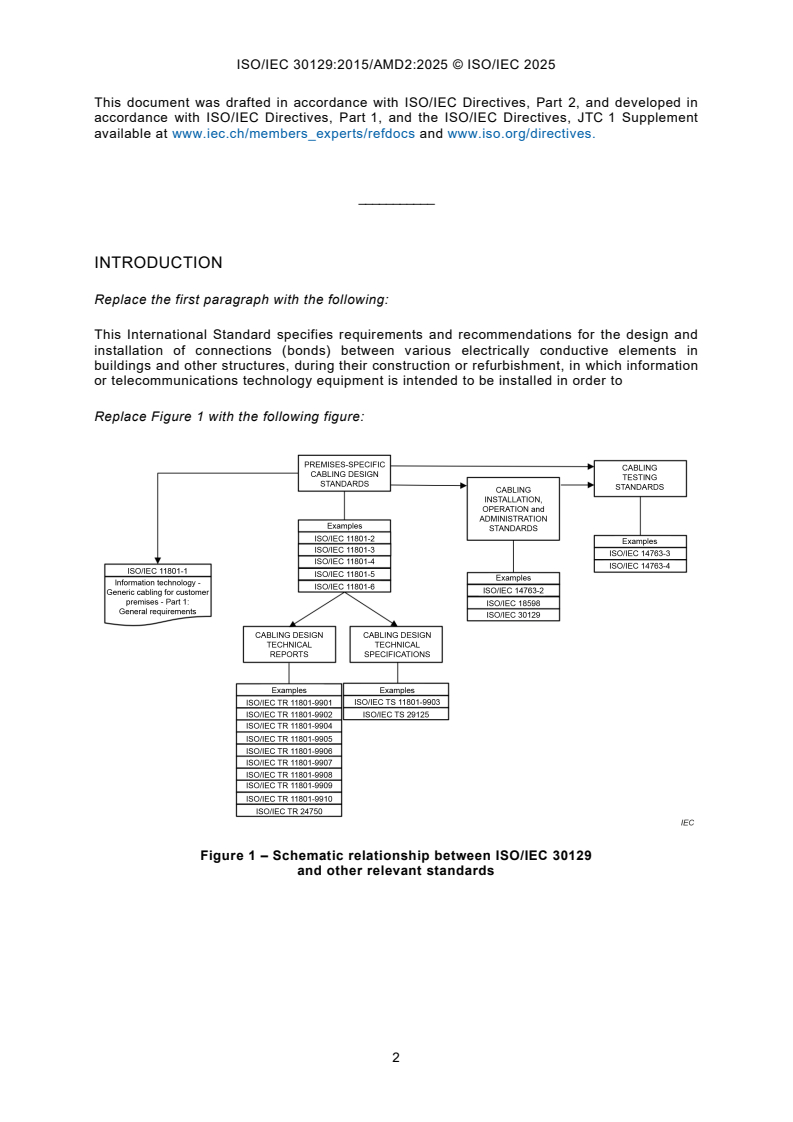
Replace Figure 1 with the following figure:
Figure 1 – Schematic relationship between ISO/IEC 30129
and other relevant standards
ISO/IEC 30129:2015/AMD2:2025 © ISO/IEC 2025
1 Scope
Replace the first paragraph including the list with the following:
This International Standard specifies requirements and recommendations for the design and
installation of connections (bonds) between various electrically conductive elements in
buildings and other structures, during their construction or refurbishment, in which information
or telecommunications technology equipment is intended to be installed in order to
a) minimise the d.c. and a.c. potential differences in telecommunications networks due to
electromagnetic disturbance, power transients, and other causes to reduce the risk of
malfunction of equipment, and
b) provide the telecommunications installation with a reliable signal reference – which
improves immunity from electromagnetic interference (EMI).
2 Normative references
Replace the IEC 60950-1 reference with the following new reference:
IEC 62368-1, Audio/video, information and
...