

ISO/IEC TR 11801-9911:2024
(Main)Information technology — Generic cabling for customer premises — Part 9911: Guidelines for the use of balanced single pair applications within a balanced 4-pair cabling system
General Information
- Abstract
This document, which is a Technical Report, a) describes the rules of implementation of balanced single pair as described by ISO/IEC 11801-6:2017/AMD1:202x within a balanced 4- pair cabling system with a current carrying capacity of 0,75 A per conductor; b) describes the use of components and cabling to implement and configure according to ISO/IEC 11801-6:2017/AMD1:202x c) describes links and components for generic single pair channels according to ISO/IEC 11801-1:2017/AMD1:202x. Particular areas of interest are: • remote powering according to IEEE Std 802.3, Clause 104 • loop resistance, max. current • insertion loss • return loss • noise considerations • frequency range requirements (low and high) • length calculation of the SCP-Link-4-pair-cable • number of channels d) describes the use of application specific single pair channels in addition to ISO/IEC 11801:2017/AMD1:202x, 6.6.4 e) describes guidance on single pair remote powering applications when using 4-pair cabling with current carrying capacity specified f) describes guidelines for planning, administration and installation
- Status
- Published
- Publication Date
- 05-Nov-2024
- Technical Committee
- ISO/IEC JTC 1/SC 25 - Interconnection of information technology equipment
- Current Stage
- 6060 - International Standard published
- Start Date
- 06-Nov-2024
- Completion Date
- 06-Nov-2024
Buy Documents
ISO/IEC TR 11801-9911:2024 - Information technology — Generic cabling for customer premises — Part 9911: Guidelines for the use of balanced single pair applications within a balanced 4-pair cabling system Released:11/6/2024
Overview - ISO/IEC TR 11801-9911:2024
ISO/IEC TR 11801-9911:2024 is a Technical Report that provides guidelines for using balanced single‑pair applications within an engineered balanced 4‑pair cabling system. It explains how single‑pair channels (as addressed in the evolving ISO/IEC 11801 single‑pair amendment) can be implemented using existing 4‑pair components that have a specified current carrying capacity of 0.75 A per conductor. This document is guidance (not a separate prescriptive cabling class) and covers electrical, mechanical and planning considerations for mixed single‑pair and 4‑pair deployments.
Key topics and technical requirements
The report focuses on practical parameters and evaluation criteria required to ensure reliable single‑pair operation over 4‑pair infrastructure:
- Remote powering (per IEEE Std 802.3dd) and guidance for powering single‑pair devices using 4‑pair cabling.
- DC loop resistance and maximum current limits tied to the 0.75 A/conductor rating.
- Insertion loss and return loss requirements for single‑pair channels when sharing 4‑pair links.
- Noise considerations and alien crosstalk metrics (PS ANEXT / PS AACR‑F) affecting signal integrity.
- Frequency range requirements for low and high bands and related impact on channel performance.
- Length calculations for SCP‑Link over 4‑pair cable and allowed extension lengths for specific single‑pair types.
- Connector, cable and component guidance: dielectric withstand, propagation delay, unbalance attenuation (TCL/ELTCTL), coupling attenuation, bonding and installation practices.
- Planning, administration and installation guidance, including segregation of 0.75 A cabling from higher power applications.
Practical applications and who uses this standard
ISO/IEC TR 11801-9911 is targeted at professionals who design, install and certify structured cabling that will support single‑pair IoT and M2M devices alongside traditional Ethernet systems:
- Network and cabling designers assessing feasibility of single‑pair devices on existing 4‑pair infrastructure.
- Systems integrators and installers planning remote power delivery for sensors, actuators, building automation, and industrial IoT.
- Facility managers and IT architects developing premises cabling strategies that mix single‑pair and 4‑pair channels.
- Component and cable manufacturers validating compatibility and current carrying capacity for mixed deployments.
Related standards
- ISO/IEC 11801 series - Generic cabling for customer premises (Part 1 general requirements).
- ISO/IEC 11801‑6 - Balanced single pair cabling (reference in the report).
- IEEE Std 802.3dd - Remote powering for single‑pair Ethernet devices.
- ISO/IEC 11801‑3 and ‑4 - Guidance on specific cabling environments referenced for implementation.
Keywords: ISO/IEC TR 11801-9911:2024, balanced single pair, 4‑pair cabling, SCP link, remote powering, IEEE 802.3dd, insertion loss, return loss, alien crosstalk, cabling planning.
Buy Documents
ISO/IEC TR 11801-9911:2024 - Information technology — Generic cabling for customer premises — Part 9911: Guidelines for the use of balanced single pair applications within a balanced 4-pair cabling system Released:11/6/2024
Get Certified
Connect with accredited certification bodies for this standard

BSI Group
BSI (British Standards Institution) is the business standards company that helps organizations make excellence a habit.

NYCE
Mexican standards and certification body.
Sponsored listings
Frequently Asked Questions
ISO/IEC TR 11801-9911:2024 is a technical report published by the International Organization for Standardization (ISO). Its full title is "Information technology — Generic cabling for customer premises — Part 9911: Guidelines for the use of balanced single pair applications within a balanced 4-pair cabling system". This standard covers: This document, which is a Technical Report, a) describes the rules of implementation of balanced single pair as described by ISO/IEC 11801-6:2017/AMD1:202x within a balanced 4- pair cabling system with a current carrying capacity of 0,75 A per conductor; b) describes the use of components and cabling to implement and configure according to ISO/IEC 11801-6:2017/AMD1:202x c) describes links and components for generic single pair channels according to ISO/IEC 11801-1:2017/AMD1:202x. Particular areas of interest are: • remote powering according to IEEE Std 802.3, Clause 104 • loop resistance, max. current • insertion loss • return loss • noise considerations • frequency range requirements (low and high) • length calculation of the SCP-Link-4-pair-cable • number of channels d) describes the use of application specific single pair channels in addition to ISO/IEC 11801:2017/AMD1:202x, 6.6.4 e) describes guidance on single pair remote powering applications when using 4-pair cabling with current carrying capacity specified f) describes guidelines for planning, administration and installation
This document, which is a Technical Report, a) describes the rules of implementation of balanced single pair as described by ISO/IEC 11801-6:2017/AMD1:202x within a balanced 4- pair cabling system with a current carrying capacity of 0,75 A per conductor; b) describes the use of components and cabling to implement and configure according to ISO/IEC 11801-6:2017/AMD1:202x c) describes links and components for generic single pair channels according to ISO/IEC 11801-1:2017/AMD1:202x. Particular areas of interest are: • remote powering according to IEEE Std 802.3, Clause 104 • loop resistance, max. current • insertion loss • return loss • noise considerations • frequency range requirements (low and high) • length calculation of the SCP-Link-4-pair-cable • number of channels d) describes the use of application specific single pair channels in addition to ISO/IEC 11801:2017/AMD1:202x, 6.6.4 e) describes guidance on single pair remote powering applications when using 4-pair cabling with current carrying capacity specified f) describes guidelines for planning, administration and installation
ISO/IEC TR 11801-9911:2024 is classified under the following ICS (International Classification for Standards) categories: 35.200 - Interface and interconnection equipment. The ICS classification helps identify the subject area and facilitates finding related standards.
ISO/IEC TR 11801-9911:2024 is available in PDF format for immediate download after purchase. The document can be added to your cart and obtained through the secure checkout process. Digital delivery ensures instant access to the complete standard document.
Standards Content (Sample)
ISO/IEC TR 11801-9911
Edition 1.0 2024-11
TECHNICAL
REPORT
colour
inside
Information technology – Generic cabling for customer premises –
Part 9911: Guidelines for the use of balanced single pair applications within
a balanced 4-pair cabling system
All rights reserved. Unless otherwise specified, no part of this publication may be reproduced or utilized in any form or
by any means, electronic or mechanical, including photocopying and microfilm, without permission in writing from either
IEC or IEC's member National Committee in the country of the requester. If you have any questions about ISO/IEC
copyright or have an enquiry about obtaining additional rights to this publication, please contact the address below or
your local IEC member National Committee for further information.
IEC Secretariat Tel.: +41 22 919 02 11
3, rue de Varembé info@iec.ch
CH-1211 Geneva 20 www.iec.ch
Switzerland
About the IEC
The International Electrotechnical Commission (IEC) is the leading global organization that prepares and publishes
International Standards for all electrical, electronic and related technologies.
About IEC publications
The technical content of IEC publications is kept under constant review by the IEC. Please make sure that you have the
latest edition, a corrigendum or an amendment might have been published.
IEC publications search - webstore.iec.ch/advsearchform IEC Products & Services Portal - products.iec.ch
The advanced search enables to find IEC publications by a
Discover our powerful search engine and read freely all the
variety of criteria (reference number, text, technical publications previews, graphical symbols and the glossary.
committee, …). It also gives information on projects, replaced With a subscription you will always have access to up to date
and withdrawn publications. content tailored to your needs.
IEC Just Published - webstore.iec.ch/justpublished
Electropedia - www.electropedia.org
Stay up to date on all new IEC publications. Just Published
The world's leading online dictionary on electrotechnology,
details all new publications released. Available online and once
containing more than 22 500 terminological entries in English
a month by email.
and French, with equivalent terms in 25 additional languages.
Also known as the International Electrotechnical Vocabulary
IEC Customer Service Centre - webstore.iec.ch/csc
(IEV) online.
If you wish to give us your feedback on this publication or need
further assistance, please contact the Customer Service
Centre: sales@iec.ch.
ISO/IEC TR 11801-9911
Edition 1.0 2024-11
TECHNICAL
REPORT
colour
inside
Information technology – Generic cabling for customer premises –
Part 9911: Guidelines for the use of balanced single pair applications within
a balanced 4-pair cabling system
INTERNATIONAL
ELECTROTECHNICAL
COMMISSION
ICS 35.200 ISBN 978-2-8322-9937-1
– 2 – ISO/IEC TR 11801-9911:2024 © IEC 2024
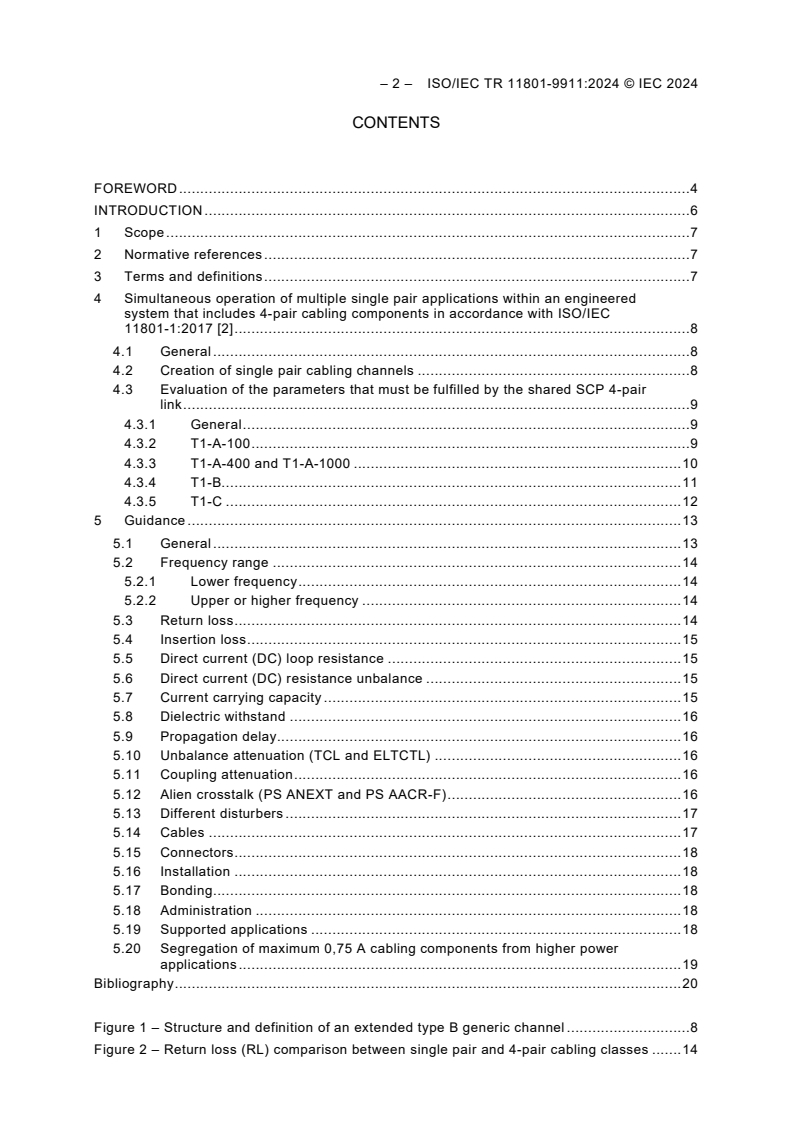
CONTENTS
FOREWORD .4
INTRODUCTION .6
1 Scope .7
2 Normative references .7
3 Terms and definitions .7
4 Simultaneous operation of multiple single pair applications within an engineered
system that includes 4-pair cabling components in accordance with ISO/IEC
11801-1:2017 [2] .8
4.1 General .8
4.2 Creation of single pair cabling channels .8
4.3 Evaluation of the parameters that must be fulfilled by the shared SCP 4-pair
link .9
4.3.1 General .9
4.3.2 T1-A-100 .9
4.3.3 T1-A-400 and T1-A-1000 . 10
4.3.4 T1-B. 11
4.3.5 T1-C . 12
5 Guidance . 13
5.1 General . 13
5.2 Frequency range . 14
5.2.1 Lower frequency . 14
5.2.2 Upper or higher frequency . 14
5.3 Return loss . 14
5.4 Insertion loss . 15
5.5 Direct current (DC) loop resistance . 15
5.6 Direct current (DC) resistance unbalance . 15
5.7 Current carrying capacity . 15
5.8 Dielectric withstand . 16
5.9 Propagation delay . 16
5.10 Unbalance attenuation (TCL and ELTCTL) . 16
5.11 Coupling attenuation . 16
5.12 Alien crosstalk (PS ANEXT and PS AACR-F) . 16
5.13 Different disturbers . 17
5.14 Cables . 17
5.15 Connectors . 18
5.16 Installation . 18
5.17 Bonding . 18
5.18 Administration . 18
5.19 Supported applications . 18
5.20 Segregation of maximum 0,75 A cabling components from higher power
applications . 19
Bibliography . 20
Figure 1 – Structure and definition of an extended type B generic channel .8
Figure 2 – Return loss (RL) comparison between single pair and 4-pair cabling classes . 14
Figure 3 – Insertion loss (IL) comparison between ISO/IEC/IEEE 8802-3:2021/Amd
5:2021 [7] and cabling classes . 15
Figure 4 – Comparison between 4-pair and single pair link requirements in linear and
logarithmic scale . 17
Table 1 – Evaluation of a 4-pair SCP link for T1-A-100 .9
Table 2 – Allowed extension lengths for T1-A-1000 extensions based on 4-pair SCP
classes . 10
Table 3 – Allowed extension lengths for T1-A-400 extension based on 4-pair SCP
classes . 10
Table 4 – Evaluation of an 4-pair SCP link for T1-A-400 and T1-A-1000 . 11
Table 5 – Evaluation of a 4-pair SCP link for T1-B . 11
Table 6 – Evaluation of a 4-pair SCP link for T1-C . 12
Table 7 – Nominal cable DC loop resistance . 15
Table 8 – Support of single pair cabling classes by 4-pair cabling classes based on
alien crosstalk . 17
Table 9 – Support of single pair cabling classes by 4-pair cabling classes based on
IEEE Std 802.3dd [6] powering classes . 18
– 4 – ISO/IEC TR 11801-9911:2024 © IEC 2024
INTERNATIONAL ELECTROTECHNICAL COMMISSION
____________
Information technology – Generic cabling for customer premises –
Part 9911: Guidelines for the use of balanced single pair applications
within a balanced 4-pair cabling system
FOREWORD
1) ISO (the International Organization for Standardization) and IEC (the International Electrotechnical Commission)
form the specialized system for worldwide standardization. National bodies that are members of ISO or IEC
participate in the development of International Standards through technical committees established by the
respective organization to deal with particular fields of technical activity. ISO and IEC technical committees
collaborate in fields of mutual interest. Other international organizations, governmental and non-governmental,
in liaison with ISO and IEC, also take part in the work.
2) The formal decisions or agreements of IEC and ISO on technical matters express, as nearly as possible, an
international consensus of opinion on the relevant subjects since each technical committee has representation
from all interested IEC and ISO National bodies.
3) IEC and ISO documents have the form of recommendations for international use and are accepted by IEC and
ISO National bodies in that sense. While all reasonable efforts are made to ensure that the technical content of
IEC and ISO documents is accurate, IEC and ISO cannot be held responsible for the way in which they are used
or for any misinterpretation by any end user.
4) In order to promote international uniformity, IEC and ISO National bodies undertake to apply IEC and ISO
documents transparently to the maximum extent possible in their national and regional publications. Any
divergence between any IEC and ISO document and the corresponding national or regional publication shall be
clearly indicated in the latter.
5) IEC and ISO do not provide any attestation of conformity. Independent certification bodies provide conformity
assessment services and, in some areas, access to IEC and ISO marks of conformity. IEC and ISO are not
responsible for any services carried out by independent certification bodies.
6) All users should ensure that they have the latest edition of this document.
7) No liability shall attach to IEC and ISO or their directors, employees, servants or agents including individual
experts and members of its technical committees and IEC and ISO National bodies for any personal injury,
property damage or other damage of any nature whatsoever, whether direct or indirect, or for costs (including
legal fees) and expenses arising out of the publication, use of, or reliance upon, this ISO/IEC document or any
other IEC and ISO documents.
8) Attention is drawn to the Normative references cited in this document. Use of the referenced publications is
indispensable for the correct application of this document.
9) IEC and ISO draw attention to the possibility that the implementation of this document may involve the use of (a)
patent(s). IEC and ISO take no position concerning the evidence, validity or applicability of any claimed patent
rights in respect thereof. As of the date of publication of this document, IEC and ISO had not received notice of
(a) patent(s), which may be required to implement this document. However, implementers are cautioned that this
may not represent the latest information, which may be obtained from the patent database available at
https://patents.iec.ch and www.iso.org/patents. IEC and ISO shall not be held responsible for identifying any or
all such patent rights.
ISO/IEC TR 11801-9911 has been prepared by subcommittee 25: Interconnection of information
technology equipment, of ISO/IEC joint technical committee 1: Information technology. It is a
Technical Report.
The list of all currently available parts of the ISO/IEC 11801 series, under the general title
Information technology - Generic cabling for customer premises, can be found on the IEC and
ISO websites.
The text of this Technical Report is based on the following documents:
DTR Report on voting
JTC1-SC25/3253/DTR JTC1-SC25/3282/RVDTR
Full information on the voting for the approval of this Technical Report can be found in the
report on voting indicated in the above table.
The language used for the development of this Technical Report is English.
This document was drafted in accordance with ISO/IEC Directives, Part 2, and developed in
accordance with ISO/IEC Directives, Part 1 and ISO/IEC Directives, JTC 1 Supplement,
available at http://www.iec.ch/members_experts/refdocs and http://www.iso.org/directives.
IMPORTANT – The "colour inside" logo on the cover page of this document indicates
that it contains colours which are considered to be useful for the correct understanding
of its contents. Users should therefore print this document using a colour printer.
– 6 – ISO/IEC TR 11801-9911:2024 © IEC 2024
INTRODUCTION
The ISO/IEC 11801 series is currently being revised to cover “balanced single pair cabling
systems”, which will expand the range of use for structured cabling systems. With the capability
of delivering data and power, these systems are ideally suited for incorporating Internet of
Things (IoT) devices into premises cabling systems. Single pair applications are increasingly
important for all operators of automation networks in buildings and industrial areas.
Implementing these new single pair cabling structures provides for application of device-level
diagnostics and security and provides for improved system scalability. Single pair cabling is not
meant to replace traditional 4-pair cabling, but to support emerging applications, such as
interconnecting IoT and M2M (machine-to-machine) devices.
This document gives guidance and instructions for the use of balanced single pair cabling as
specified in ISO/IEC 11801-1:2017/AMD1:- [1] and 4-pair components specified in ISO/IEC
11801-1:2017 [2] together in the same balanced cabling system assuring application support in
accordance with ISO/IEC 11801-6 [3].
___________
Under preparation. Stage at the time of publication: ISO/IEC CD 11801-1:2017/AMD1:2023.
Information technology – Generic cabling for customer premises –
Part 9911: Guidelines for the use of balanced single pair applications
within a balanced 4-pair cabling system
1 Scope
This part of ISO/IEC 11801, which is a Technical Report,
a) describes the rules of implementation of balanced single pair cabling as specified by
ISO/IEC 11801-6 [3] within a balanced 4-pair cabling system with a current carrying capacity
of 0,75 A per conductor as specified in ISO/IEC 11801-1:2017 [2];
b) describes the use of ISO/IEC 11801-1:2017 [2] components and cabling to implement and
configure in accordance with ISO/IEC 11801-3:2017/AMD1:2021 [4], ISO/IEC 11801-4 [5]
and ISO/IEC 11801-6 [3];
c) describes links and components for generic single pair channels in accordance with ISO/IEC
11801-1:2017/AMD1:- [1]. Particular areas of interest are
1) remote powering in accordance with IEEE Std 802.3dd [6],
2) loop resistance and maximum current,
3) insertion loss,
4) return loss,
5) noise considerations,
6) frequency range requirements (low and high),
7) length calculation of the SCP link 4-pair-cable, and
8) number of channels;
d) describes the use of application-specific single pair channels in addition to ISO/IEC 11801-
1:2017/AMD1:- [1], 6.6.4;
e) describes guidance on single pair remote powering applications when using 4-pair cabling
with current carrying capacity specified by ISO/IEC 11801-1:2017 [2];
f) describes guidelines for planning, administration and installation.
NOTE This document compares requirements of existing 4-pair cabling classes and single-pair classes. The
described approach can be adjusted to any number of pairs.
2 Normative references
The following documents are referred to in the text in such a way that some or all of their content
constitutes requirements of this document. For dated references, only the edition cited applies.
For undated references, the latest edition of the referenced document (including any
amendments) applies.
ISO/IEC 11801-1, Information technology - Generic cabling for customer premises - Part 1:
General requiements
3 Terms and definitions
For the purposes of this document, the terms and definitions given in ISO/IEC 11801-1 apply.
ISO and IEC maintain terminology databases for use in standardization at the following
addresses:
• IEC Electropedia: available at https://www.electropedia.org/
– 8 – ISO/IEC TR 11801-9911:2024 © IEC 2024
• ISO Online browsing platform: available at https://www.iso.org/obp
4 Simultaneous operation of multiple single pair applications within an
engineered system that includes 4-pair cabling components in accordance
with ISO/IEC 11801-1:2017 [2]
4.1 General
This document assumes an extension of a 2-connector SCP link 4-pair type B cabling as
specified in ISO/IEC 11801-6 [3] with single pair components to create up to four channels that
conform to single pair generic channels (see Figure 1).
SD service distributor
SCP service concentration point
1P single pair
4P 4-pair
SO 1P service outlet, see ISO/IEC 11801-1:2017/AMD1:- [1], 10.14 and 10.15, TE outlet
TE 1P terminal equipment single pair
Cord 1P (SD + SO) single pair patchcord at both ends
Cord 4P (SD) 4-pair patchcord at SD end
SCP link 4P 4-pair service concentration point link
CP cable 1P concentration point cable single pair
Figure 1 – Structure and definition of an extended type B generic channel
4.2 Creation of single pair cabling channels
Based on 4.1 cabling channels can be achieved by:
a) creating up to four single pair channels based on 4-pair cabling that conforms to T1-A, T1-
B or T1-C;
b) creating up to four single pair links based on SCP link 4-pair cabling that conforms to T1-A,
T1-B or T1-C and adding single pair conformant cords;
c) reference implementation using single pair conformant single pair and 4-pair components
(see Clauses 9 and 10 of ISO/IEC 11801-1:2017/AMD1:- [1]).
4.3 Evaluation of the parameters that must be fulfilled by the shared SCP 4-pair link
4.3.1 General
Parameters that must be fulfilled by the shared cabling portion (SCP link 4-pair) to create a
single pair channel are specified by a single pair 2-connector link in ISO/IEC 11801-
1:2017/AMD1:- [1]. The result of the evaluation for M I C E is given in the respective tables.
1 1 1 1
For other environments the result is re-evaluated with the requirements given in ISO/IEC 11801-
1:2017/AMD1:- [1] .
In Table 1, Table 3, Table 4, Table 5, Table 6, Table 8 and Table 9, “D”, “Q”, “M”, “NA” and “N”
are used with the following meaning:
a) D: met by design
b) Q: met when passing a qualification test
c) M: met when mitigation action is taken
d) NA: not applicable
e) N: not possible
Guidance is given in Clause 5.
4.3.2 T1-A-100
The evaluation of the 4-pair SCP link to create a T1-A-100 link is shown in Table 1.
Table 1 – Evaluation of a 4-pair SCP link for T1-A-100
4-pair SCP link parameter Fulfilled by Class Guidance
D E E F F subclause
A A
Frequency range: 5.2
low Q Q Q Q Q 5.2.1
high D D D D D 5.2.2
Return loss Q Q Q Q Q 5.3
Insertion loss M D D D D 5.4
Direct current (DC) loop resistance M M D D D 5.5
Direct current (DC) resistance unbalance Q Q D D D 5.6
Current carrying capacity D D D D D 5.7
Dielectric withstand D D D D D 5.8
Propagation delay D D D D D 5.9
TCL (unscreened only) Q Q Q NA NA 5.10
ELTCTL (unscreened only) Q Q Q NA NA 5.10
Coupling attenuation (screened only) D D D D D 5.11
PS ANEXT Q Q D D D 5.12
PS AACR-F Q Q D D D 5.12
Additional criteria to be considered
Different disturbers 5.13
Cables 5.14
Connectors 5.15
Installation 5.16
Bonding 5.17
-------
...