

ISO/IEC 30129:2015
(Main)Information technology — Telecommunications bonding networks for buildings and other structures
General Information
- Abstract
ISO/IEC 30129:2015(E) specifies requirements and recommendations for the design and installation of connections (bonds) between various electrically conductive elements in buildings and other structures, during their construction or refurbishment, in which information technology (IT) and, more generally, telecommunications equipment is intended to be installed in order to a) minimise the risk to the correct function of that equipment and interconnecting cabling from electrical hazards and b) provide the telecommunications installation with a reliable signal reference - which may improve immunity from electromagnetic interference (EMI).
- Status
- Published
- Publication Date
- 18-Oct-2015
- Technical Committee
- ISO/IEC JTC 1/SC 25 - Interconnection of information technology equipment
- Current Stage
- 6060 - International Standard published
- Start Date
- 19-Oct-2015
- Due Date
- 06-Aug-2015
- Completion Date
- 06-Aug-2015

Overview
ISO/IEC 30129:2015 - Information technology - Telecommunications bonding networks for buildings and other structures - specifies requirements and recommendations for the design, installation and maintenance of bonds between electrically conductive elements in buildings where telecommunications and IT equipment will be installed. The standard aims to minimise electrical hazards to equipment and cabling and to provide a reliable signal reference that can improve immunity to electromagnetic interference (EMI).
Key topics and requirements
- Scope and conformance: applies to construction and refurbishment where telecoms/IT equipment is intended to be installed.
- Bonding network approaches: defines and compares dedicated telecommunications bonding networks, local telecommunications bonding used together with protective bonding, and mesh bonded networks (including local mesh and building mesh variants).
- Components and topology: guidance on Primary Bonding Busbar (PBB), Secondary Bonding Busbar (SBB), Telecommunications Bonding Backbone (TBB), Telecommunications Entrance Facility (TEF), Telecommunications Equipment Bonding Conductors (TEBC), Protective Bonding Network Conductors (PBNCs) and Main Earthing Terminal (MET).
- Performance measures: requirements and methods for d.c. resistance measurements, impedance control, and conductor sizing (see normative Annex B).
- Installation details: connections to cabinets, frames, racks, structural metal and continuous conductive pathways; recommendations for access floors and transient suppression plates.
- Maintenance and lifecycle: normative Annex A covers periodic checks, causes of deterioration (e.g., galvanic corrosion) and recommended maintenance schedules.
- Documentation: requirements for recording bonding layouts and test results.
Practical applications
ISO/IEC 30129 is intended for practical use in:
- Data center and server room design (rack bonding, backbone bonding).
- Office buildings, hospitals, educational and commercial facilities during new build or refurbishment.
- Telecommunications entrance facilities and equipment rooms where cabling integrity and EMI immunity are critical.
- EMC mitigation planning and grounding/earthing work tied to IT installations.
Benefits include improved equipment reliability, reduced risk of signal disturbance from electrical faults, and clearer installation and testing criteria for bonding systems.
Who should use this standard
- Cabling and low-voltage contractors
- Telecommunications and IT infrastructure designers and installers
- Data centre and facilities engineers
- EMC and electrical safety engineers
- Facility managers and maintenance teams
Related standards
ISO/IEC 30129 complements other international standards for cabling, grounding/earthing, EMC and electrical safety. Refer to relevant ISO, IEC and national standards for cabling categories, earthing practice and EMC testing when implementing bonding networks.
Relations
- Effective Date
- 19-Jul-2025
- Effective Date
- 07-Aug-2021
Get Certified
Connect with accredited certification bodies for this standard

BSI Group
BSI (British Standards Institution) is the business standards company that helps organizations make excellence a habit.

NYCE
Mexican standards and certification body.
Sponsored listings
Frequently Asked Questions
ISO/IEC 30129:2015 is a standard published by the International Organization for Standardization (ISO). Its full title is "Information technology — Telecommunications bonding networks for buildings and other structures". This standard covers: ISO/IEC 30129:2015(E) specifies requirements and recommendations for the design and installation of connections (bonds) between various electrically conductive elements in buildings and other structures, during their construction or refurbishment, in which information technology (IT) and, more generally, telecommunications equipment is intended to be installed in order to a) minimise the risk to the correct function of that equipment and interconnecting cabling from electrical hazards and b) provide the telecommunications installation with a reliable signal reference - which may improve immunity from electromagnetic interference (EMI).
ISO/IEC 30129:2015(E) specifies requirements and recommendations for the design and installation of connections (bonds) between various electrically conductive elements in buildings and other structures, during their construction or refurbishment, in which information technology (IT) and, more generally, telecommunications equipment is intended to be installed in order to a) minimise the risk to the correct function of that equipment and interconnecting cabling from electrical hazards and b) provide the telecommunications installation with a reliable signal reference - which may improve immunity from electromagnetic interference (EMI).
ISO/IEC 30129:2015 is classified under the following ICS (International Classification for Standards) categories: 35.200 - Interface and interconnection equipment. The ICS classification helps identify the subject area and facilitates finding related standards.
ISO/IEC 30129:2015 has the following relationships with other standards: It is inter standard links to ISO/IEC 30129:2015/Amd 2:2025, ISO/IEC 30129:2015/Amd 1:2019. Understanding these relationships helps ensure you are using the most current and applicable version of the standard.
ISO/IEC 30129:2015 is available in PDF format for immediate download after purchase. The document can be added to your cart and obtained through the secure checkout process. Digital delivery ensures instant access to the complete standard document.
Standards Content (Sample)
ISO/IEC 30129
Edition 1.0 2015-10
INTERNATIONAL
STANDARD
colour
inside
Information technology – Telecommunications bonding networks for buildings
and other structures
All rights reserved. Unless otherwise specified, no part of this publication may be reproduced or utilized in any form
or by any means, electronic or mechanical, including photocopying and microfilm, without permission in writing from
either IEC or IEC's member National Committee in the country of the requester. If you have any questions about
ISO/IEC copyright or have an enquiry about obtaining additional rights to this publication, please contact the address
below or your local IEC member National Committee for further information.
IEC Central Office Tel.: +41 22 919 02 11
3, rue de Varembé Fax: +41 22 919 03 00
CH-1211 Geneva 20 info@iec.ch
Switzerland www.iec.ch
About the IEC
The International Electrotechnical Commission (IEC) is the leading global organization that prepares and publishes
International Standards for all electrical, electronic and related technologies.
About IEC publications
The technical content of IEC publications is kept under constant review by the IEC. Please make sure that you have the
latest edition, a corrigenda or an amendment might have been published.
IEC Catalogue - webstore.iec.ch/catalogue Electropedia - www.electropedia.org
The stand-alone application for consulting the entire The world's leading online dictionary of electronic and
bibliographical information on IEC International Standards, electrical terms containing more than 30 000 terms and
Technical Specifications, Technical Reports and other definitions in English and French, with equivalent terms in 15
documents. Available for PC, Mac OS, Android Tablets and additional languages. Also known as the International
iPad. Electrotechnical Vocabulary (IEV) online.
IEC publications search - www.iec.ch/searchpub IEC Glossary - std.iec.ch/glossary
The advanced search enables to find IEC publications by a More than 60 000 electrotechnical terminology entries in
variety of criteria (reference number, text, technical English and French extracted from the Terms and Definitions
committee,…). It also gives information on projects, replaced clause of IEC publications issued since 2002. Some entries
and withdrawn publications. have been collected from earlier publications of IEC TC 37,
77, 86 and CISPR.
IEC Just Published - webstore.iec.ch/justpublished
Stay up to date on all new IEC publications. Just Published IEC Customer Service Centre - webstore.iec.ch/csc
details all new publications released. Available online and If you wish to give us your feedback on this publication or
also once a month by email. need further assistance, please contact the Customer Service
Centre: csc@iec.ch.
ISO/IEC 30129
Edition 1.0 2015-10
INTERNATIONAL
STANDARD
colour
inside
Information technology – Telecommunications bonding networks for buildings
and other structures
INTERNATIONAL
ELECTROTECHNICAL
COMMISSION
ICS 35.200 ISBN 978-2-8322-2924-8
– 2 – ISO/IEC 30129:2015
ISO/IEC 2015
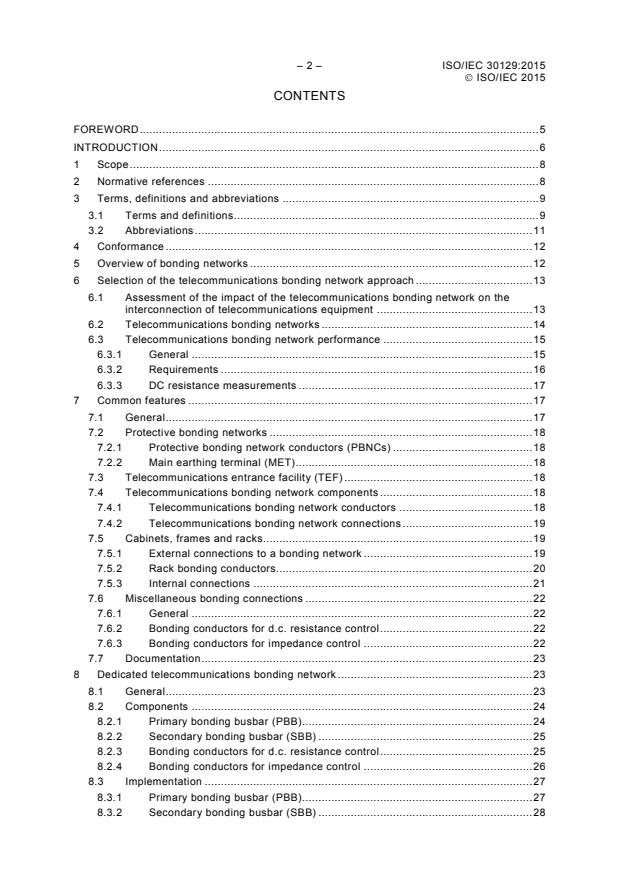
CONTENTS
FOREWORD . 5
INTRODUCTION . 6
1 Scope . 8
2 Normative references . 8
3 Terms, definitions and abbreviations . 9
3.1 Terms and definitions . 9
3.2 Abbreviations . 11
4 Conformance . 12
5 Overview of bonding networks . 12
6 Selection of the telecommunications bonding network approach . 13
6.1 Assessment of the impact of the telecommunications bonding network on the
interconnection of telecommunications equipment . 13
6.2 Telecommunications bonding networks . 14
6.3 Telecommunications bonding network performance . 15
6.3.1 General . 15
6.3.2 Requirements . 16
6.3.3 DC resistance measurements . 17
7 Common features . 17
7.1 General . 17
7.2 Protective bonding networks . 18
7.2.1 Protective bonding network conductors (PBNCs) . 18
7.2.2 Main earthing terminal (MET) . 18
7.3 Telecommunications entrance facility (TEF) . 18
7.4 Telecommunications bonding network components . 18
7.4.1 Telecommunications bonding network conductors . 18
7.4.2 Telecommunications bonding network connections . 19
7.5 Cabinets, frames and racks . 19
7.5.1 External connections to a bonding network . 19
7.5.2 Rack bonding conductors. 20
7.5.3 Internal connections . 21
7.6 Miscellaneous bonding connections . 22
7.6.1 General . 22
7.6.2 Bonding conductors for d.c. resistance control . 22
7.6.3 Bonding conductors for impedance control . 22
7.7 Documentation . 23
8 Dedicated telecommunications bonding network . 23
8.1 General . 23
8.2 Components . 24
8.2.1 Primary bonding busbar (PBB) . 24
8.2.2 Secondary bonding busbar (SBB) . 25
8.2.3 Bonding conductors for d.c. resistance control . 25
8.2.4 Bonding conductors for impedance control . 26
8.3 Implementation . 27
8.3.1 Primary bonding busbar (PBB) . 27
8.3.2 Secondary bonding busbar (SBB) . 28
ISO/IEC 2015
8.3.3 Telecommunications bonding conductor (TBC) . 28
8.3.4 Telecommunications bonding backbone (TBB) . 29
8.3.5 Backbone bonding conductor (BBC) . 29
8.3.6 Bonds to continuous conductive pathway systems . 29
8.3.7 Bonds to structural metal . 29
9 Local telecommunications bonding networks in conjunction with protective
bonding networks . 30
9.1 Bonding for local distribution . 30
9.1.1 Star protective bonding networks . 30
9.1.2 Ring protective bonding networks . 31
9.2 Telecommunications bonding conductors . 32
9.2.1 Bonding conductors for d.c. resistance control . 32
9.2.2 Bonding conductors for impedance control . 32
9.3 Bonding for areas of telecommunications equipment concentration . 33
10 Local telecommunications bonding networks in conjunction with dedicated
telecommunications bonding networks . 33
10.1 Bonding for areas of telecommunications equipment concentration . 33
10.1.1 Requirements . 33
10.1.2 Recommendations . 33
10.1.3 Cabinets, frames and racks . 33
10.2 Telecommunications equipment bonding conductors (TEBC) . 33
10.2.1 TEBC for d.c. resistance control . 33
10.2.2 TEBC for impedance control . 34
10.2.3 Implementation . 34
11 Mesh bonded networks . 34
11.1 General . 34
11.2 Mesh bonding alternatives . 35
11.2.1 Local mesh bonding (MESH-IBN) networks . 35
11.2.2 MESH-BN . 37
11.3 Bonding conductors of a mesh bonding network . 38
11.3.1 Requirements . 38
11.3.2 Recommendations . 38
11.4 Bonding conductors to the mesh bonding network . 38
11.5 Supplementary bonding grid (SBG) . 39
11.6 System reference potential plane (SRPP) . 39
11.6.1 General . 39
11.6.2 Access floors . 40
11.6.3 Transient suppression plate (TSP) . 41
Annex A (normative) Maintenance of telecommunications bonding network
performance . 42
A.1 General . 42
A.2 Periodic activity . 42
A.2.1 Schedule . 42
A.2.2 Implementation . 42
A.3 Causes of performance deterioration . 43
A.3.1 Galvanic corrosion . 43
A.3.2 Requirements . 43
Annex B (normative) Bonding conductor cross-sectional area . 44
Annex C (infomative) Alternative terminology . 45
– 4 – ISO/IEC 30129:2015
ISO/IEC 2015
Bibliography . 46
Figure 1 – Schematic relationship between ISO/IEC 30129 and other relevant
standards . 7
Figure 2 – Schematic of telecommunications equipment distribution and associated
bonding connections . 13
Figure 3 – Example of three methods of equipment and rack bonding . 20
Figure 4 – Example of a bond connection from a cabinet to the cabinet door . 22
Figure 5 – Example of bonding straps . 23
Figure 6 – Illustrative example of a large building . 24
Figure 7 – Illustrative example of a smaller building . 24
Figure 8 – Schematic of PBB . 25
Figure 9 – Schematic of SBB . 25
Figure 10 – Star protective bonding and supplementary telecommunications bonding . 30
Figure 11 – Example of high common impedance and large loop . 30
Figure 12 – Example of low common impedance and small loop . 31
Figure 13 – Ring protective bonding and supplementary telecommunications bonding . 31
Figure 14 – MESH-BN example . 32
Figure 15 – Example TEBC to rack bonding conductor connection . 34
Figure 16 – Local mesh bonding network . 36
Figure 17 – A MESH-IBN having a single point of connection (SPC) . 36
Figure 18 – A MESH-BN with equipment cabinets, frames, racks and CBN bonded
together . 37
Figure 19 – Example of access floor . 40
Figure 20 – Example of installation details for an under floor transient suppression
plate . 41
Table 1 – Sensitivity of cabling media to bonding network performance . 14
Table 2 – Telecommunications bonding network requirements . 14
Table 3 – DC resistance requirements for protective bonding networks . 16
Table 4 – DC resistance requirements for dedicated telecommunications bonding
networks . 17
Table 5 – TBB conductor sizing . 26
Table B.1 – Bonding conductor cross-sectional areas . 44
Table C.1 – Alternative terminology . 45
ISO/IEC 2015
INFORMATION TECHNOLOGY –
TELECOMMUNICATIONS BONDING NETWORKS
FOR BUILDINGS AND OTHER STRUCTURES
FOREWORD
1) ISO (the International Organization for Standardization) and IEC (the International Electrotechnical Commission)
form the specialized system for worldwide standardization. National bodies that are members of ISO or IEC
participate in the development of International Standards through technical committees established by the
respective organization to deal with particular fields of technical activity. ISO and IEC technical committees
collaborate in fields of mutual interest. Other international organizations, governmental and non-governmental, in
liaison with ISO and IEC, also take part in the work. In the field of information technology, ISO and IEC have
established a joint technical committee, ISO/IEC JTC 1.
2) The formal decisions or agreements of IEC and ISO on technical matters express, as nearly as possible, an
international consensus of opinion on the relevant subjects since each technical committee has representation
from all interested IEC National Committees and ISO member bodies.
3) IEC, ISO and ISO/IEC publications have the form of recommendations for international use and are accepted
by IEC National Committees and ISO member bodies in that sense. While all reasonable efforts are made to
ensure that the technical content of IEC, ISO and ISO/IEC publications is accurate, IEC or ISO cannot be held
responsible for the way in which they are used or for any misinterpretation by any end user.
4) In order to promote international uniformity, IEC National Committees and ISO member bodies undertake to
apply IEC, ISO and ISO/IEC publications transparently to the maximum extent possible in their national and
regional publications. Any divergence between any ISO, IEC or ISO/IEC publication and the corresponding
national or regional publication should be clearly indicated in the latter.
5) ISO and IEC do not provide any attestation of conformity. Independent certification bodies provide conformity
assessment services and, in some areas, access to IEC marks of conformity. ISO or IEC are not responsible
for any services carried out by independent certification bodies.
6) All users should ensure that they have the latest edition of this publication.
7) No liability shall attach to IEC or ISO or its directors, employees, servants or agents including individual experts
and members of their technical committees and IEC National Committees or ISO member bodies for any
personal injury, property damage or other damage of any nature whatsoever, whether direct or indirect, or for
costs (including legal fees) and expenses arising out of the publication of, use of, or reliance upon, this ISO/IEC
publication or any other IEC, ISO or ISO/IEC publications.
8) Attention is drawn to the normative references cited in this publication. Use of the referenced publications is
indispensable for the correct application of this publication.
9) Attention is drawn to the possibility that some of the elements of this ISO/IEC publication may be the subject of
patent rights. ISO and IEC shall not be held responsible for identifying any or all such patent rights.
International Standard ISO/IEC 30129 was prepared by subcommittee 25: Interconnection of
information technology equipment, of ISO/IEC joint technical committee 1: Information
technology.
This International Standard has been approved by vote of the member bodies, and the voting
results may be obtained from the address given on the second title page.
This publication has been drafted in accordance with the ISO/IEC Directives, Part 2.
IMPORTANT – The 'colour inside' logo on the cover page of this publication indicates
that it contains colours which are considered to be useful for the correct
understanding of its contents. Users should therefore print this document using a
colour printer.
– 6 – ISO/IEC 30129:2015
ISO/IEC 2015
INTRODUCTION
This International Standard specifies requirements and recommendations for the design and
installation of connections (bonds) between various electrically conductive elements in
buildings and other structures, during their construction or refurbishment, in which information
technology (IT) and, more generally, telecommunications equipment is intended to be
installed in order to
a) minimise the risk to the correct function of that equipment and interconnecting cabling
from electrical hazards,
b) provide the telecommunications installation with a reliable signal reference – which may
improve immunity from electromagnetic interference (EMI).
This International Standard
– specifies assessment criteria to determine the relevant bonding configurations that are
appropriate,
– enables the implementation of any bonding configurations that may be necessary by
means of either
• the provision of a bonding network that utilises the existing protective bonding network
for electrical safety, or
• the provision of a dedicated bonding network for the telecommunications infrastructure.
This standard is intended for
• building architects, owners and managers,
• designers and installers of electrical and telecommunications cabling installations.
This International Standard is one of a number of documents prepared in support of
international standards and technical reports for cabling design produced by
ISO/IEC JTC 1/SC 25. Figure 1 shows the inter-relationship between these standards and
technical reports.
Users of this standard should be familiar with all applicable cabling design and installation
standards.
NOTE Telecommunications infrastructure affects raw material consumption. The infrastructure design and
installation methods also influence product life and sustainability of electronic equipment life cycling. These
aspects of telecommunications infrastructure impact our environment. Since building life cycles are typically
planned for decades, technological electronic equipment upgrades are necessary. The telecommunications
infrastructure design and installation process magnifies the need for sustainable infrastructures with respect to
building life, electronic equipment life cycling and considerations of effects on environmental waste.
Telecommunications designers are encouraged to research local building practices for a sustainable environment
and conservation of fossil fuels as part of the design process.
ISO/IEC 2015
ISO/IEC 11801:
Information technology – Generic
cabling for customer premises
ISO/IEC 15018:
Information technology – Generic
cabling for homes
IEC 61935-1:
Specification for the testing of balanced
and coaxial information technology
ISO/IEC 24764:
cabling – Part 1: Installed balanced
Information technology – Generic
cabling as specified in ISO/IEC 11801
cabling systems for data centres
and related standards
IEC 61935-3:
Testing of balanced and coaxial
ISO/IEC 24702: ISO/IEC 14763-2:
information technology cabling - Part 3:
Information technology – Generic Implementation and Operation of
Installed cabling as specified in ISO/IEC
cabling for industrial premises Customer Premises Cabling - Part 2:
15018 and related standards
Planning and installation
ISO/IEC TR 24704: ISO/IEC 14763-3:
Information technology – Customer Implementation and Operation of
premises cabling for wireless access customer premises cabling - Part 3:
ISO/IEC 30129:
points Testing of optical fibre cabling
Telecommunications bonding
networks for buildings and other
structures
ISO/IEC 14709-1:
Information technology – Configuration
of customer premises cabling for
applications - Part 1: ISDN basic access
ISO/IEC 14709-2:
Information technology – Configuration
of customer premises cabling for
applications - Part 2: ISDN primary rate
IEC
Figure 1 – Schematic relationship between ISO/IEC 30129
and other relevant standards
– 8 – ISO/IEC 30129:2015
ISO/IEC 2015
INFORMATION TECHNOLOGY –
TELECOMMUNICATIONS BONDING NETWORKS
FOR BUILDINGS AND OTHER STRUCTURES
1 Scope
This International Standard specifies requirements and recommendations for the design and
installation of connections (bonds) between various electrically conductive elements in
buildings and other structures, during their construction or refurbishment, in which information
technology (IT) and, more generally, telecommunications equipment is intended to be
installed in order to
a) minimise the risk to the correct function of that equipment and interconnecting cabling
from electrical hazards,
b) provide the telecommunications installation with a reliable signal reference – which may
improve immunity from electromagnetic interference (EMI).
The requirements of this International Standard are applicable to the buildings and other
structures within premises addressed by ISO/IEC 14763-2 (e.g. residential, office, industrial
and data centres) but information given in this International Standard may be of assistance for
other types of buildings and structures.
NOTE Telecommunications centres (operator buildings) are addressed by ITU-T K.27.
This International Standard does not apply to power supply distribution of voltages over AC
1 000 V.
Electromagnetic compatibility (EMC) requirements and safety requirements for power supply
installation are outside the scope of this International Standard and are covered by other
standards and regulations. However, information given in this International Standard may be
of assistance in meeting the requirements of these standards and regulations.
2 Normative references
The following documents, in whole or in part, are normatively referenced in this document and
are indispensable for its application. For dated references, only the edition cited applies. For
undated references, the latest edition of the referenced document (including any
amendments) applies.
IEC 60364-4-41, Low-voltage electrical installations – Part 4-41: Protection for safety –
Protection against electric shock
IEC 60364-4-44:2007, Low-voltage electrical installations – Part 4-44: Protection for safety –
Protection against voltage disturbances and electromagnetic disturbances
IEC 60364-5-54, Low-voltage electrical installations – Part 5-54: Selection and erection of
electrical equipment – Earthing arrangements and protective conductors
IEC 60950-1, Information technology equipment – Safety – Part 1: General requirements
IEC 61140, Protection against electric shock – Common aspects for installation and
equipment
ISO/IEC 2015
ISO/IEC 14763-2:2012, Information technology – Implementation and operation of customer
premises cabling – Part 2: Planning and installation
3 Terms, definitions and abbreviations
3.1 Terms and definitions
For the purposes of this document the following definitions apply in addition to those of
ISO/IEC 14763-2. Alternatives to certain terms are provided in Annex C.
3.1.1
access provider
operator or another entity providing the means to enable external telecommunications
services provision to a subscriber
3.1.2
asymmetric cabling
cabling within which the cable elements are asymmetric (unbalanced)
3.1.3
application
system, including its associated transmission method, which is supported by
telecommunications cabling
[SOURCE: ISO/IEC 11801:2002, 3.1.2]
3.1.4
backbone bonding conductor
telecommunications bonding connection which interconnects telecommunications bonding
backbones
3.1.5
balanced application
application designed and optimized to operate over symmetric cabling
3.1.6
common bonding network
set of interconnected conductive structures that combine the functions of a protective bonding
network and a telecommunications bonding network
3.1.7
equipment bonding conductor
conductor that connects a protective bonding network to an item of telecommunications
equipment
3.1.8
main earthing terminal
terminal or busbar which is part of the earthing arrangement of an installation and enabling
the electric connection of a number of conductors for earthing purposes
, modified – The terms "main earthing busbar main",
[SOURCE: IEC 60050-826:2004, 826-13-15
"grounding terminal (US)" and "main grounding busbar (US)" have been deleted.]
3.1.9
mesh isolated bonding network
mesh bonding network with a single point of connection to either the protective bonding
network or another isolated bonding network
– 10 – ISO/IEC 30129:2015
ISO/IEC 2015
3.1.10
mesh size
maximum length of conducting material between two adjacent connection points that create
the grid of the telecommunications bonding network
3.1.11
primary bonding busbar
telecommunications bonding connection element, connected to the main earthing terminal,
that is used to attach telecommunications bonding backbone conductors and equipment
bonding conductors
3.1.12
protective bonding network
set of interconnected conductive elements to ensure electrical safety
Note 1 to entry: The protective bonding network meets the protective equipotential bonding system as defined in
IEC 60050-195:1998, 195-02-23.
3.1.13
rack bonding conductor
conductor that connects a rack bonding busbar or items of equipment within a cabinet, frame
or rack to the telecommunications bonding network within a local area
3.1.14
rack bonding busbar
attachment element within a cabinet, frame or rack or for multiple unit bonding conductors
3.1.15
secondary bonding busbar
telecommunications bonding connection element for telecommunications systems and
equipment in the area, served by a distributor
3.1.16
system block
functional group of equipment depending in its operation and performance on its connection to
the same system reference potential plane, inherent to a mesh bonding network
3.1.17
system reference potential plane
conductive solid plane, as an ideal goal in potential equalizing, that is approached in practice
by horizontal or vertical meshes
Note 1 to entry: The mesh width thereof is adapted to the frequency range to be considered. Horizontal and
vertical meshes may be interconnected to form a grid structure approximating a Faraday cage.
Note 2 to entry: The SRPP facilitates signalling with reference to a common potential.
3.1.18
symmetric cabling
screened or unscreened cabling within which the cable elements comprise balanced pairs or
quads
EXAMPLE Twisted pairs or quads.
3.1.19
telecommunications bonding backbone
conductor installed within telecommunications pathways that interconnects a primary bonding
busbar to its secondary bonding busbars within the building, and that is intended to minimise
potential differences but not intended to serve as a conductor providing a fault current return
path
ISO/IEC 2015
3.1.20
telecommunications bonding conductor
conductor between the primary bonding busbar and the main earthing terminal
3.1.21
telecommunications bonding network
set of interconnected conductive elements that provide functional equipotential bonding for
telecommunications equipment
3.1.22
telecommunications equipment bonding conductor
conductor that connects a primary or secondary bonding busbar to a supplementary bonding
network, a rack bonding conductor or to an item of telecommunications equipment
3.1.23
telecommunications entrance facility
entrance point where the telecommunications facilities enter the building
Note 1 to entry: The telecommunications entrance facility may also include antenna cable entrances and
electronic equipment serving telecommunications functions.
3.1.24
unbalanced application
application not optimised for transmission over symmetric cabling
3.1.25
unit bonding conductor
conductor that connects the telecommunications equipment within a cabinet, frame or rack to
the rack bonding busbar or to a rack bonding conductor
3.2 Abbreviations
For the purposes of this document the abbreviations of ISO/IEC 14763-2 and the following
apply.
a.c. alternating current
BBC Backbone Bonding Conductor
CBN Common Bonding Network
d.c. direct current
EMI ElectroMagnetic Interference
IACS International Annealed Copper Standard
MESH-BN MESH Bonding Network
MESH-IBN MESH Isolated Bonding Network
MET Main Earthing Terminal
PBB Primary Bonding Busbar
PBNC Protective Bonding Network Conductor
RBB Rack Bonding Busbar
RBC Rack Bonding Conductor
SBB Secondary Bonding Busbar
SBG Supplementary Bonding Grid
SRPP System Reference Potential Plane
SPC Single Point Of Connection
TBB Telecommunications Bonding Backbone
– 12 – ISO/IEC 30129:2015
ISO/IEC 2015
TBC Telecommunications Bonding Conductor
TEBC Telecommunications Equipment Bonding Conductor
TEF Telecommunications Entrance Facility
TSP Transient Suppression Plate
UBC Unit Bonding Conductor
4 Conformance
For bonding infrastructures to conform to this International Standard
a) an assessment in accordance with Clause 6 shall be undertaken,
b) based on the results of the assessment any necessary bonding shall be implemented as
follows
1) the backbone and building entrance bonding shall either
• use the protective bonding network provided that it delivers the performance
required by the assessment of Clause 6, or
• conform to the requirements of Clause 8 for a dedicated bonding system,
2) the local bonding shall either
• conform to Clause 9 in line with the requirements of the assessment of Clause 5, or
• conform to the requirements of Clause 10 for a dedicated telecommunications
bonding system in line with the requirements of the assessment of Clause 6,
or
3) a mesh bonding network in accordance with Clause 11,
c) the requirements of Clause 7 shall be applied to all telecommunications bonding networks
implemented,
d) the cross-sectional areas of bonding conductors shall conform to the requirements of
Clauses 7 to 11 as amended by the region-specific application of Annex B,
e) local regulations, including safety, shall be met.
NOTE The proper implementation of the requirements of this International Standard assumes that electrical
installations, protective bonding networks and protective measures against overvoltages are undertaken in
accordance with the local regulations, as appropriate.
5 Overview of bonding networks
This International Standard assumes that buildings, or other structures, containing or intended
to contain telecommunications equipment are of vertical extent (where a backbone connects
zones of different floors) and/or horizontal extent (where a backbone connects multiple zones
on a floor) and feature, as follows:
a) one or more entrance facilities,
b) one or more identifiable areas within each zone containing concentrations of tele-
communications equipment (e.g. spaces associated with the generic cabling distributors of
standards supported by ISO/IEC 14763-2),
c) areas in each zone within which telecommunications equipment is distributed (e.g.
locations associated with the generic cabling outlets of standards supported by ISO/IEC
14763-2).
For the purposes of this International Standard
1) the term “backbone” refers to connections between the areas of concentrations of tele-
communications equipment and between any given area of concentration and a main
earthing terminal (MET),
ISO/IEC 2015
2) the term “local” refers to connections between a given area of concentration of tele-
communications equipment and the area of distributed telecommunications equipment
which it serves or other connections within that area.
This is shown schematically in Figure 2 for telecommunications equipment distribution and
telecommunications bonding network terminology.
Local connections
Areas of telecommunications equipment
distribution
Areas of telecommunications equipment
concentration
Local connections
Backbone connections
Zones
MET MET
IEC
Figure 2 – Schematic of telecommunications equipment distribution
and associated bonding connections
The objective of this International Standard is, following the completion of the assessment of
Clause 6, to ensure that backbone and local bonding networks
• minimise d.c. and a.c. potential differences in order to reduce the risk to the correct
function of telecommunications equipment interconnected by metallic cabling,
• have adequate a.c. and radio frequency performance to provide the telecommunications
installation with a reliable signal reference and improved resistance to EMI.
It should be noted that failure to implement correct telecommunications bonding networks can
act against this objective.
6 Selection of the telecommunications bonding network approach
6.1 Assessment of the impact of the telecommunications bonding network on the
interconnection of telecommunications equipment
The requirements applied to a telecommunications bonding network depend upon the
intended type of connectivity between the telecommunications equipment within and between
the zones of Figure 2.
The mesh bonded network of Clause 11 is intended to support the most demanding
requirements of both cabling media and the applications supported over those media. The
mesh bonded network provides complete flexibility in relation to the types and locations of
telecommunications equipment that may be installed (subject to the transmission performance
limits of the applications when using the selected telecommunications cabling). This is further
enhanced by the installation of power distribution systems conforming to TN-S as described in
the IEC 60364 series of standards.
The installation of such a telecommunications bonding network is most easily implemented
during construction or refurbishment of a building or structure. However, within an existing
building
– 14 – ISO/IEC 30129:2015
ISO/IEC 2015
a) the cost and complexity of installing a telecommunications bonding network that will
support the requirements of applications operating over asymmetric cabling between any
two points in a building may be prohibitive,
b) the implementation of an all-optical network has no implications for the
telecommunications bonding network but would substantially impact on the cost of
transmission and terminal equipment and may not be viable for all intended applications.
Therefore an assessment has to be made based on a balance between complexity of the
telecommunications bonding network and the type of cabling media and the application
supported over those media between and within the zones described in Figure 2. This
assessment has also to take into consideration the transmission performance requirements of
the applications when using the selected telecommunications cabling.
The comparative sensitivity of the various types of cabling media and the applications
supported using them to a lack of bonding network performance (d.c. resistance and
impedance) is shown in Table 1.
Table 1 – Sensitivity of cabling media to bonding network performance
Sensitivity to
Cabling medium bonding networking
performance
Asymmetric cabling or High
symmetric cabling
(unbalanced applications)
Symmetric cabling
(screened or unscreened with
balanced applications)
Optical fibre
Low
Based upon the outcome of this assessment, the appropriate requirements of this standard
shall be applied to the relevant infrastructures to be used to provide an adequate
telecommunications bonding network as detailed in Table 2.
Table 2 – Telecommunications bonding network requirements
Transmission
(subject to maximum channel length limits)
Media Between zones Within a zone
Using the protective d.c. resistance and d.c. resistance and
bonding network impedance control impedance control
Asymmetric cabling or
requirements of 6.3.1.1 requirements of Clause 9
symmetric cabling
(unbalanced
Using a dedicated d.c. resistance and d.c. resistance and
applications)
telecommunications impedance control impedance control of
bonding network requirements of 6.3.1.2 Clause 10
Using the protective d.c. resistance d.c. resistance control
Symmetric cabling
bonding network requirements of 6.3.1.1 requirements of Clause 9
(screened or
Using a dedicated d.c. resistance d.c. resistance control of
unscreened with
telecommunications requirements of 6.3.1.2 Clause 10
balanced applications)
bonding network
Optical fibre No requirements No requirements
6.2 Telecommunications bonding networks
Telecommunications equipment is generally connected to a protective bonding network that
meets basic safety requirements in accordance with the IEC 60364 series. If the design or
ISO/IEC 2015
measured performance of the protective bonding network fails to meet the requirements of 6.3
then either
a) supplementary telecommunications bonding solutions shall be employed as defined in
Clauses 8, 9, 10 or 11, or
b) restrictions shall apply in relation to the interconnection of telecommunications equipment
as described in Clause 6.
For the construction of a new building, or structure, and when it is desired to employ the most
flexible approach for the accommodation of telecommunications equipment then the mesh
bonded network of Clause 11 shall be applied provided that the lightning protection is in
accordance with IEC 62305-4.
NOTE Where other lightning protection has been installed, including “isolated lightning protection” according to
IEC 62305-3, specific restrictions may be applicable to the implementation of the telecommunications cabling, the
telecommunications bonding network and the lightning protection.
Where the requirements of Clause 11 are determined to be inappropriate but an effective
telecommunications bonding network is required then
1) Clause 8 provides requirements and recommendations for the construction of a dedicated
telecommunicatio
...