

ISO/IEC 30129:2015/Amd 1:2019
(Amendment)Information technology — Telecommunications bonding networks for buildings and other structures — Amendment 1
General Information
- Abstract
- Status
- Published
- Publication Date
- 26-Feb-2019
- Technical Committee
- ISO/IEC JTC 1/SC 25 - Interconnection of information technology equipment
- Current Stage
- 6060 - International Standard published
- Start Date
- 27-Feb-2019
- Due Date
- 20-Sep-2020
- Completion Date
- 20-Sep-2020
Overview
ISO/IEC 30129:2015/Amd 1:2019 is an amendment to the international standard for telecommunications bonding networks for buildings and other structures. It updates definitions, measurement requirements, performance targets and guidance on selecting bonding approaches - with particular emphasis on mesh bonded networks for improved electromagnetic immunity and lightning integration. The amendment also adds normative references for test equipment and clarifies conformance and installation considerations.
Key topics and requirements
- New normative references: IEC 61557-4 and IEC 61557-5 for resistance-to-earth and bonding test equipment - measurement accuracy must be reported with test results.
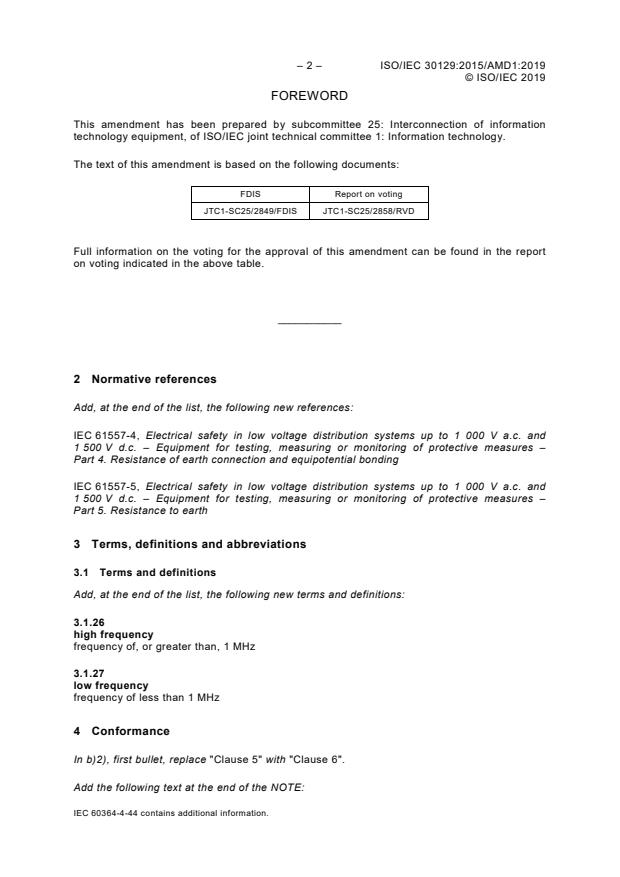
- Terms added: “high frequency” (≥ 1 MHz) and “low frequency” (< 1 MHz).
- Mesh bonded network performance: objective values include approximately 1 mΩ DC resistance between adjacent grid points and an inductance target of no more than 6 μH between adjacent points - intended to mitigate steady-state and transient voltages (lightning, power faults) and EMI.
- DC resistance limits (shortest bonding conductor length basis):
- Protective bonding networks: 2.5 mΩ/m between busbars in distributors (adjacent zones).
- Dedicated telecommunications bonding networks: 1.67 mΩ/m for connections between bonding network points and MET, between PBB and SBB, and to structural steel.
- Testing: Use equipment conforming to IEC 61557-4/5; include measurement accuracy in documentation.
- Design guidance: Mesh bonding is best for high-frequency performance and provides flexibility for cabling and equipment locations; however, cost/complexity may be prohibitive for retrofit projects - evaluate against cabling media and application transmission requirements.
- Lightning protection: Mesh networks can be used with an “integrated lightning protection system” per IEC 62305-4; other lightning systems require coordination and restrictions.
- Installation notes: Multiple bonding conductors improve impedance proportionally to the number of connections; separation of conductors affects cable management space.
Applications and users
Practical uses include:
- Designing building telecommunications infrastructure for robust EMI immunity and lightning resilience
- Specifying bonding for enterprise networks, data centers, hospitals, industrial facilities and other structures with demanding telecom/electronic systems
- Commissioning and testing bonding networks to verify DC resistance and earth continuity Primary users:
- Telecommunications and electrical engineers
- Cabling and infrastructure designers, installers and contractors
- EMC consultants, risk and safety assessors, facilities managers, standards/compliance teams
Related standards
- IEC 61557-4, IEC 61557-5 (testing equipment for earth/bonding resistance)
- IEC 60364-4-44 (protection against voltage and electromagnetic disturbances)
- IEC 62305 (all parts) for lightning protection
Keywords: ISO/IEC 30129 amendment, telecommunications bonding networks, mesh bonded network, DC resistance, EMI immunity, lightning protection, IEC 61557.
Relations
- Effective Date
- 07-Aug-2021
Get Certified
Connect with accredited certification bodies for this standard

BSI Group
BSI (British Standards Institution) is the business standards company that helps organizations make excellence a habit.

NYCE
Mexican standards and certification body.
Sponsored listings
Frequently Asked Questions
ISO/IEC 30129:2015/Amd 1:2019 is a standard published by the International Organization for Standardization (ISO). Its full title is "Information technology — Telecommunications bonding networks for buildings and other structures — Amendment 1". This standard covers: Information technology — Telecommunications bonding networks for buildings and other structures — Amendment 1
Information technology — Telecommunications bonding networks for buildings and other structures — Amendment 1
ISO/IEC 30129:2015/Amd 1:2019 is classified under the following ICS (International Classification for Standards) categories: 35.200 - Interface and interconnection equipment. The ICS classification helps identify the subject area and facilitates finding related standards.
ISO/IEC 30129:2015/Amd 1:2019 has the following relationships with other standards: It is inter standard links to ISO/IEC 30129:2015. Understanding these relationships helps ensure you are using the most current and applicable version of the standard.
ISO/IEC 30129:2015/Amd 1:2019 is available in PDF format for immediate download after purchase. The document can be added to your cart and obtained through the secure checkout process. Digital delivery ensures instant access to the complete standard document.
Standards Content (Sample)
ISO/IEC 30129
Edition 1.0 2019-02
INTERNATIONAL
STANDARD
AMENDMENT 1
Information technology – Telecommunications bonding networks for buildings
and other structures
ISO/IEC 30129:2015-10/AMD1:2019-02(en)
All rights reserved. Unless otherwise specified, no part of this publication may be reproduced or utilized in any form
or by any means, electronic or mechanical, including photocopying and microfilm, without permission in writing from
either IEC or IEC's member National Committee in the country of the requester. If you have any questions about
ISO/IEC copyright or have an enquiry about obtaining additional rights to this publication, please contact the address
below or your local IEC member National Committee for further information.
IEC Central Office Tel.: +41 22 919 02 11
3, rue de Varembé info@iec.ch
CH-1211 Geneva 20 www.iec.ch
Switzerland
About the IEC
The International Electrotechnical Commission (IEC) is the leading global organization that prepares and publishes
International Standards for all electrical, electronic and related technologies.
About IEC publications
The technical content of IEC publications is kept under constant review by the IEC. Please make sure that you have the
latest edition, a corrigendum or an amendment might have been published.
IEC publications search - webstore.iec.ch/advsearchform Electropedia - www.electropedia.org
The advanced search enables to find IEC publications by a The world's leading online dictionary on electrotechnology,
variety of criteria (reference number, text, technical containing more than 22 000 terminological entries in English
committee,…). It also gives information on projects, replaced and French, with equivalent terms in 16 additional languages.
and withdrawn publications. Also known as the International Electrotechnical Vocabulary
(IEV) online.
IEC Just Published - webstore.iec.ch/justpublished
Stay up to date on all new IEC publications. Just Published IEC Glossary - std.iec.ch/glossary
details all new publications released. Available online and 67 000 electrotechnical terminology entries in English and
once a month by email. French extracted from the Terms and Definitions clause of
IEC publications issued since 2002. Some entries have been
IEC Customer Service Centre - webstore.iec.ch/csc collected from earlier publications of IEC TC 37, 77, 86 and
If you wish to give us your feedback on this publication or CISPR.
need further assistance, please contact the Customer Service
Centre: sales@iec.ch.
ISO/IEC 30129
Edition 1.0 2019-02
INTERNATIONAL
STANDARD
AMENDMENT 1
Information technology – Telecommunications bonding networks for buildings
and other structures
INTERNATIONAL
ELECTROTECHNICAL
COMMISSION
ICS 35.200 ISBN 978-2-8322-6570-3
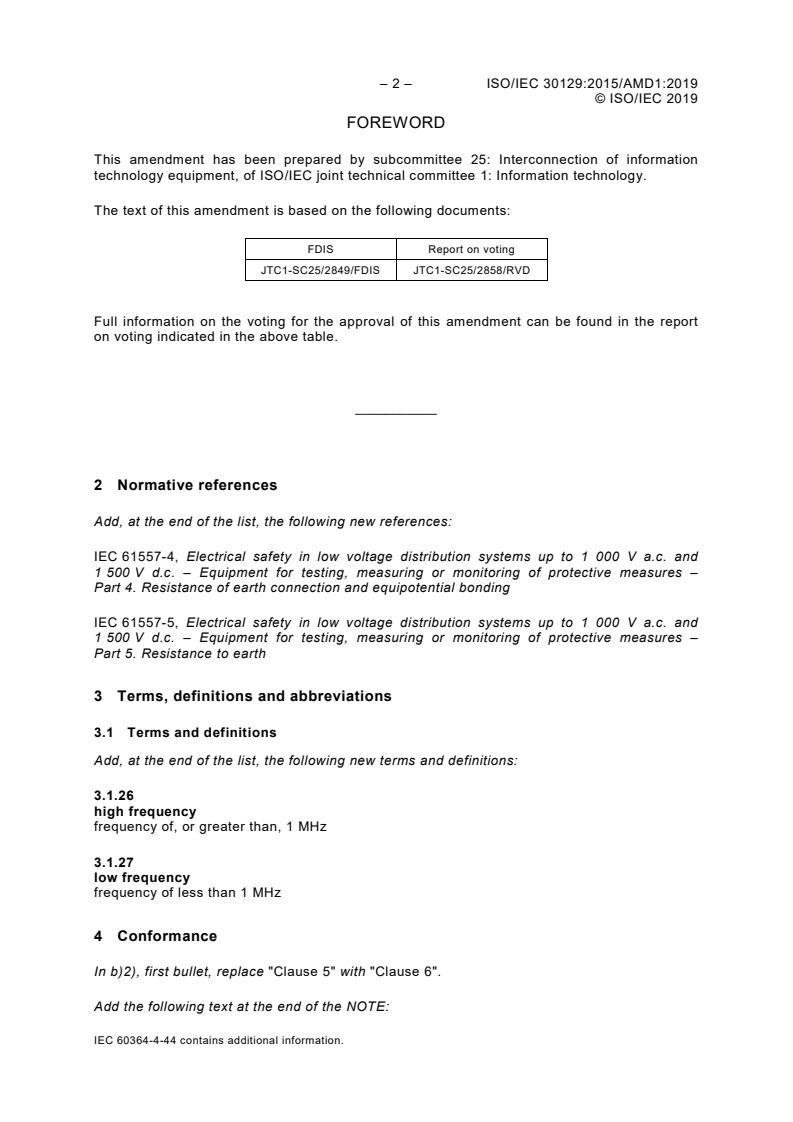
– 2 – ISO/IEC 30129:2015/AMD1:2019
© ISO/IEC 2019
FOREWORD
This amendment has been prepared by subcommittee 25: Interconnection of information
technology equipment, of ISO/IEC joint technical committee 1: Information technology.
The text of this amendment is based on the following documents:
FDIS Report on voting
JTC1-SC25/2849/FDIS JTC1-SC25/2858/RVD
Full information on the voting for the approval of this amendment can be found in the report
on voting indicated in the above table.
___________
2 Normative references
Add, at the end of the list, the following new references:
IEC 61557-4, Electrical safety in low voltage distribution systems up to 1 000 V a.c. and
1 500 V d.c. – Equipment for testing, measuring or monitoring of protective measures –
Part 4. Resistance of earth connection and equipotential bonding
IEC 61557-5, Electrical safety in low voltage distribution systems up to 1 000 V a.c. and
1 500 V d.c. – Equipment for testing, measuring or monitoring of protective measures –
Part 5. Resistance to earth
3 Terms, definitions and abbreviations
3.1 Terms and definitions
Add, at the end of the list, the following new terms and definitions:
3.1.26
high frequency
frequency of, or greater than, 1 MHz
3.1.27
low frequency
frequency of less than 1 MHz
4 Conformance
In b)2), first bullet, replace "Clause 5" with "Clause 6".
Add the following text at the end of the NOTE:
IEC 60364-4-44 contains additional information.
ISO/IEC 30129:2015/AMD1:2019 – 3 –
© ISO/IEC 2019
6 Selection of the telecommunications bonding network approach
6.1 Assessment of the impact of the telecommunications bonding network on the
interconnection of telecommunications equipment
Replace paragraphs 2, 3 and 4 with the following:
The mesh bonding network of Clause 11 provides the most effective bonding at high
frequencies and can provide effective bonding at low frequencies. It is intended to support the
most demanding requirements of both cabling media and the applications supported over
those media (see Table 1). In addition, it provides the most flexibility in relation to the types
and locations of telecommunications equipment that may be installed (subject to the
transmission performance limits of the applications when using the selected
telecommunications cabling).
The installation of such a telecommunications bonding network is most easily implemented
during new construction or refurbishment of a building or s
...
ISO/IEC 30129
Edition 1.0 2019-02
INTERNATIONAL
STANDARD
AMENDMENT 1
Information technology – Telecommunications bonding networks for buildings
and other structures
ISO/IEC 30129:2015-10/AMD1:2019-02(en)
All rights reserved. Unless otherwise specified, no part of this publication may be reproduced or utilized in any form
or by any means, electronic or mechanical, including photocopying and microfilm, without permission in writing from
either IEC or IEC's member National Committee in the country of the requester. If you have any questions about
ISO/IEC copyright or have an enquiry about obtaining additional rights to this publication, please contact the address
below or your local IEC member National Committee for further information.
IEC Central Office Tel.: +41 22 919 02 11
3, rue de Varembé info@iec.ch
CH-1211 Geneva 20 www.iec.ch
Switzerland
About the IEC
The International Electrotechnical Commission (IEC) is the leading global organization that prepares and publishes
International Standards for all electrical, electronic and related technologies.
About IEC publications
The technical content of IEC publications is kept under constant review by the IEC. Please make sure that you have the
latest edition, a corrigendum or an amendment might have been published.
IEC publications search - webstore.iec.ch/advsearchform Electropedia - www.electropedia.org
The advanced search enables to find IEC publications by a The world's leading online dictionary on electrotechnology,
variety of criteria (reference number, text, technical containing more than 22 000 terminological entries in English
committee,…). It also gives information on projects, replaced and French, with equivalent terms in 16 additional languages.
and withdrawn publications. Also known as the International Electrotechnical Vocabulary
(IEV) online.
IEC Just Published - webstore.iec.ch/justpublished
Stay up to date on all new IEC publications. Just Published IEC Glossary - std.iec.ch/glossary
details all new publications released. Available online and 67 000 electrotechnical terminology entries in English and
once a month by email. French extracted from the Terms and Definitions clause of
IEC publications issued since 2002. Some entries have been
IEC Customer Service Centre - webstore.iec.ch/csc collected from earlier publications of IEC TC 37, 77, 86 and
If you wish to give us your feedback on this publication or CISPR.
need further assistance, please contact the Customer Service
Centre: sales@iec.ch.
ISO/IEC 30129
Edition 1.0 2019-02
INTERNATIONAL
STANDARD
AMENDMENT 1
Information technology – Telecommunications bonding networks for buildings
and other structures
INTERNATIONAL
ELECTROTECHNICAL
COMMISSION
ICS 35.200 ISBN 978-2-8322-6570-3
– 2 – ISO/IEC 30129:2015/AMD1:2019
© ISO/IEC 2019
FOREWORD
This amendment has been prepared by subcommittee 25: Interconnection of information
technology equipment, of ISO/IEC joint technical committee 1: Information technology.
The text of this amendment is based on the following documents:
FDIS Report on voting
JTC1-SC25/2849/FDIS JTC1-SC25/2858/RVD
Full information on the voting for the approval of this amendment can be found in the report
on voting indicated in the above table.
___________
2 Normative references
Add, at the end of the list, the following new references:
IEC 61557-4, Electrical safety in low voltage distribution systems up to 1 000 V a.c. and
1 500 V d.c. – Equipment for testing, measuring or monitoring of protective measures –
Part 4. Resistance of earth connection and equipotential bonding
IEC 61557-5, Electrical safety in low voltage distribution systems up to 1 000 V a.c. and
1 500 V d.c. – Equipment for testing, measuring or monitoring of protective measures –
Part 5. Resistance to earth
3 Terms, definitions and abbreviations
3.1 Terms and definitions
Add, at the end of the list, the following new terms and definitions:
3.1.26
high frequency
frequency of, or greater than, 1 MHz
3.1.27
low frequency
frequency of less than 1 MHz
4 Conformance
In b)2), first bullet, replace "Clause 5" with "Clause 6".
Add the following text at the end of the NOTE:
IEC 60364-4-44 contains additional information.
ISO/IEC 30129:2015/AMD1:2019 – 3 –
© ISO/IEC 2019
6 Selection of the telecommunications bonding network approach
6.1 Assessment of the impact of the telecommunications bonding network on the
interconnection of telecommunications equipment
Replace paragraphs 2, 3 and 4 with the following:
The mesh bonding network of Clause 11 provides the most effective bonding at high
frequencies and can provide effective bonding at low frequencies. It is intended to support the
most demanding requirements of both cabling media and the applications supported over
those media (see Table 1). In addition, it provides the most flexibility in relation to the types
and locations of telecommunications equipment that may be installed (subject to the
transmission performance limits of the applications when using the selected
telecommunications cabling).
The installation of such a telecommunications bonding network is most easily implemented
during new construction or refurbishment of a building or s
...