


ISO/IEC 11801:2002/Amd 2:2010
(Amendment)Information technology — Generic cabling for customer premises — Amendment 2
Information technology — Generic cabling for customer premises — Amendment 2
Technologies de l'information — Câblage générique des locaux d'utilisateurs — Amendement 2
General Information
- Status
- Withdrawn
- Publication Date
- 29-Apr-2010
- Withdrawal Date
- 29-Apr-2010
- Technical Committee
- ISO/IEC JTC 1/SC 25 - Interconnection of information technology equipment
- Current Stage
- 9599 - Withdrawal of International Standard
- Start Date
- 21-Nov-2017
- Completion Date
- 12-Feb-2026
Relations
- Effective Date
- 23-Apr-2020
- Effective Date
- 01-Mar-2014
- Effective Date
- 01-Mar-2014
Get Certified
Connect with accredited certification bodies for this standard

BSI Group
BSI (British Standards Institution) is the business standards company that helps organizations make excellence a habit.

NYCE
Mexican standards and certification body.
Sponsored listings
Frequently Asked Questions
ISO/IEC 11801:2002/Amd 2:2010 is a standard published by the International Organization for Standardization (ISO). Its full title is "Information technology — Generic cabling for customer premises — Amendment 2". This standard covers: Information technology — Generic cabling for customer premises — Amendment 2
Information technology — Generic cabling for customer premises — Amendment 2
ISO/IEC 11801:2002/Amd 2:2010 is classified under the following ICS (International Classification for Standards) categories: 35.200 - Interface and interconnection equipment. The ICS classification helps identify the subject area and facilitates finding related standards.
ISO/IEC 11801:2002/Amd 2:2010 has the following relationships with other standards: It is inter standard links to ISO/IEC 11801:2002, ISO/IEC 11801-2:2017, ISO/IEC 11801-1:2017. Understanding these relationships helps ensure you are using the most current and applicable version of the standard.
ISO/IEC 11801:2002/Amd 2:2010 is available in PDF format for immediate download after purchase. The document can be added to your cart and obtained through the secure checkout process. Digital delivery ensures instant access to the complete standard document.
Standards Content (Sample)
ISO/IEC 11801
Edition 2.0 2010-04
INTERNATIONAL
STANDARD
AMENDMENT 2
Information technology – Generic cabling for customer premises
ISO/IEC 11801:2002/A2:2010(E)
All rights reserved. Unless otherwise specified, no part of this publication may be reproduced or utilized in any form
or by any means, electronic or mechanical, including photocopying and microfilm, without permission in writing from
either IEC or IEC's member National Committee in the country of the requester.
If you have any questions about ISO/IEC copyright or have an enquiry about obtaining additional rights to this
publication, please contact the address below or your local IEC member National Committee for further information.
IEC Central Office
3, rue de Varembé
CH-1211 Geneva 20
Switzerland
Email: inmail@iec.ch
Web: www.iec.ch
About the IEC
The International Electrotechnical Commission (IEC) is the leading global organization that prepares and publishes
International Standards for all electrical, electronic and related technologies.
About IEC publications
The technical content of IEC publications is kept under constant review by the IEC. Please make sure that you have the
latest edition, a corrigenda or an amendment might have been published.
ƒ Catalogue of IEC publications: www.iec.ch/searchpub
The IEC on-line Catalogue enables you to search by a variety of criteria (reference number, text, technical committee,…).
It also gives information on projects, withdrawn and replaced publications.
ƒ IEC Just Published: www.iec.ch/online_news/justpub
Stay up to date on all new IEC publications. Just Published details twice a month all new publications released. Available
on-line and also by email.
ƒ Electropedia: www.electropedia.org
The world's leading online dictionary of electronic and electrical terms containing more than 20 000 terms and definitions
in English and French, with equivalent terms in additional languages. Also known as the International Electrotechnical
Vocabulary online.
ƒ Customer Service Centre: www.iec.ch/webstore/custserv
If you wish to give us your feedback on this publication or need further assistance, please visit the Customer Service
Centre FAQ or contact us:
Email: csc@iec.ch
Tel.: +41 22 919 02 11
Fax: +41 22 919 03 00
ISO/IEC 11801
Edition 2.0 2010-04
INTERNATIONAL
STANDARD
AMENDMENT 2
Information technology – Generic cabling for customer premises
INTERNATIONAL
ELECTROTECHNICAL
COMMISSION
PRICE CODE
XA
ICS 35.200 ISBN 978-2-88910-819-0
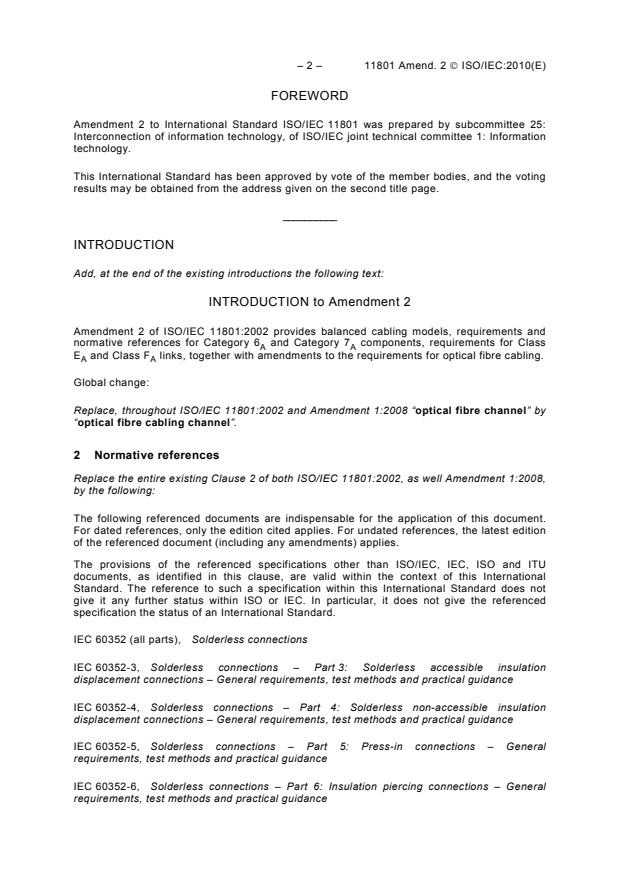
– 2 – 11801 Amend. 2 © ISO/IEC:2010(E)
FOREWORD
Amendment 2 to International Standard ISO/IEC 11801 was prepared by subcommittee 25:
Interconnection of information technology, of ISO/IEC joint technical committee 1: Information
technology.
This International Standard has been approved by vote of the member bodies, and the voting
results may be obtained from the address given on the second title page.
__________
INTRODUCTION
Add, at the end of the existing introductions the following text:
INTRODUCTION to Amendment 2
Amendment 2 of ISO/IEC 11801:2002 provides balanced cabling models, requirements and
normative references for Category 6 and Category 7 components, requirements for Class
A A
E and Class F links, together with amendments to the requirements for optical fibre cabling.
A A
Global change:
Replace, throughout ISO/IEC 11801:2002 and Amendment 1:2008 “optical fibre channel” by
“optical fibre cabling channel”.
2 Normative references
Replace the entire existing Clause 2 of both ISO/IEC 11801:2002, as well Amendment 1:2008,
by the following:
The following referenced documents are indispensable for the application of this document.
For dated references, only the edition cited applies. For undated references, the latest edition
of the referenced document (including any amendments) applies.
The provisions of the referenced specifications other than ISO/IEC, IEC, ISO and ITU
documents, as identified in this clause, are valid within the context of this International
Standard. The reference to such a specification within this International Standard does not
give it any further status within ISO or IEC. In particular, it does not give the referenced
specification the status of an International Standard.
IEC 60352 (all parts), Solderless connections
IEC 60352-3, Solderless connections – Part 3: Solderless accessible insulation
displacement connections – General requirements, test methods and practical guidance
IEC 60352-4, Solderless connections – Part 4: Solderless non-accessible insulation
displacement connections – General requirements, test methods and practical guidance
IEC 60352-5, Solderless connections – Part 5: Press-in connections – General
requirements, test methods and practical guidance
IEC 60352-6, Solderless connections – Part 6: Insulation piercing connections – General
requirements, test methods and practical guidance
11801 Amend. 2 © ISO/IEC:2010(E) – 3 –
IEC 60352-7, Solderless connections – Part 7: Spring clamp connections – General
requirements, test methods and practical guidance
IEC 60352-8, Solderless connections – Part 8: Compression mount connections – General
requirements, test methods and practical guidance
IEC 60364-1, Low-voltage electrical installations – Part 1: Fundamental principles,
assessment of general characteristics, definitions
IEC 60512-2-1, Connectors for electronic equipment – Tests and measurements – Part 2-1:
Electrical continuity and contact resistance tests – Test 2a: Contact resistance – Millivolt level
method
IEC 60512-3-1, Connectors for electronic equipment – Tests and measurements – Part 3-1:
Insulation tests – Test 3a: Insulation resistance
IEC 60512-4-1, Connectors for electronic equipment – Tests and measurements – Part 4-1:
Voltage stress tests – Test 4a: Voltage proof
IEC 60512-5-2, Connectors for electronic equipment – Tests and measurements – Part 5-2:
Current-carrying capacity tests – Test 5b: Current-temperature derating
IEC 60512-25-1, Connectors for electronic equipment – Tests and measurements –
Part 25-1: Test 25a – Crosstalk ratio
IEC 60512-25-2:2002, Connectors for electronic equipment – Tests and measurements –
Part 25-2: Test 25b – Attenuation (insertion loss)
IEC 60512-25-4:2001, Connectors for electronic equipment – Tests and measurements –
Part 25-4: Test 25d – Propagation delay
IEC 60512-25-5, Connectors for electronic equipment – Tests and measurements –
Part 25-5: Test 25e – Return loss
IEC 60512-25-9:2008, Connectors for electronic equipment – Tests and measurements –
Part 25-9: Signal integrity tests – Test 25i: Alien crosstalk
IEC 60512-26-100, Connectors for electronic equipment – Tests and measurements –
Part 26-100: Measurement setup, test and reference arrangements and measurements for
connectors according to IEC 60603-7 – Tests 26a to 26g
IEC 60603-7, Connectors for electronic equipment – Part 7: Detail specification for 8-way,
unshielded, free and fixed connectors
IEC 60603-7-1, Connectors for electronic equipment – Part 7-1: Detail specification for
8-way, shielded free and fixed connectors
IEC 60603-7-2:–, Connectors for electronic equipment – Part 7-2: Detail specification for
8-way, unshielded, free and fixed connectors, for data transmissions with frequencies up to
100 MHz
___________
To be published.
Second edition to be published.
– 4 – 11801 Amend. 2 © ISO/IEC:2010(E)
IEC 60603-7-3:–, Connectors for electronic equipment – Part 7-3: Detail specification for 8-
way, shielded, free and fixed connectors, for data transmissions with frequencies up to
100 MHz
IEC 60603-7-4:–, Connectors for electronic equipment – Part 7-4: Detail specification for 8-
way, unshielded, free and fixed connectors, for data transmissions with frequencies up to
250 MHz
IEC 60603-7-5:–, Connectors for electronic equipment – Part 7-5: Detail specification for 8-
way, shielded, free and fixed connectors, for data transmissions with frequencies up to
250 MHz
IEC 60603-7-7:–, Connectors for electronic equipment – Part 7-7: Detail specification for 8-
way, shielded, free and fixed connectors, for data transmission with frequencies up to
600 MHz
IEC 60603-7-41:–, Connectors for electronic equipment – Part 7-41: Detail specification for
8-way, unshielded, free and fixed connectors, for data transmissions with frequencies up to
500 MHz
IEC 60603-7-51:–, Connectors for electronic equipment – Part 7-51: Detail specification for
8-way, shielded, free and fixed connectors, for data transmissions with frequencies up to
500 MHz
IEC 60603-7-71:–, Connectors for electronic equipment – Part 7-71: Detail specification for
8-way, shielded, free and fixed connectors, for data transmission with frequencies up to
1 000 MHz
IEC 60793-1-40, Optical fibres – Part 1-40: Measurement methods and test procedures –
Attenuation
IEC 60793-1-44, Optical fibres – Part 1-44: Measurement methods and test procedures –
Cut-off wavelength
IEC 60793-1-49, Optical fibres – Part 1-49: Measurement methods and test procedures –
Differential mode delay
IEC 60793-2:2007, Optical fibres – Part 2: Product specifications – General
IEC 60793-2-10, Optical fibres – Part 2-10: Product specifications – Sectional specification
for category A1 multimode fibres
IEC 60793-2-50, Optical fibres – Part 2-50: Product specifications – Sectional specification
for class B single-mode fibres
IEC 60794 (all parts), Optical fibre cables
IEC 60794-2, Optical fibre cables – Part 2: Indoor cables – Sectional specification
___________
Second edition to be published.
Second edition to be published.
Second edition to be published.
Third edition to be published.
To be published.
11801 Amend. 2 © ISO/IEC:2010(E) – 5 –
IEC 60825 (all parts), Safety of laser products
IEC 60874-19-1:2007, Fibre optic interconnecting devices and passive components
Connectors for optical fibres and cables – Part 19-1: Fibre optic patch cord connector
type SC-PC (floating duplex) standard terminated on multimode fibre type A1a, A1b – Detail
specification
IEC 60874-19-2:1999, Connectors for optical fibres and cables – Part 19-2: Fibre optic
adaptor (duplex) type SC for single-mode fibre connectors – Detail specification
IEC 60874-19-3:2007, Fibre optic interconnecting devices and passive components –
Connectors for optical fibres and cables – Part 19-3 Fibre optic adaptor (duplex) type SC for
multimode fibre connectors – Detail specification
IEC 61073-1, Fibre optic interconnecting devices and passive components – Mechanical
splices and fusion splice protectors for optical fibres and cables – Part 1: Generic
specification
IEC 61076-3-104, Connectors for electronic equipment – Part 3-104: Detail specification for
8-way, shielded free and fixed connectors for data transmissions with frequencies up to
1 000 MHz
IEC 61076-3-110, Connectors for electronic equipment – Part 3-110: Detail specification for
shielded, free and fixed connectors for data transmission with frequencies up to 1 000 MHz
IEC 61156 (all parts), Multicore and symmetrical pair/quad cables for digital communications
IEC 61156-1:2007, Multicore and symmetrical pair/quad cables for digital communications –
Part 1: Generic specification
Amendment 1 (2009)
IEC 61156-2:, Multicore and symmetrical pair/quad cables for digital communications –
Part 2: Symmetrical pair/quad cables with transmission characteristics up to 100 MHz –
Horizontal floor cable – Sectional specification
IEC 61156-3:2008, Multicore and symmetrical pair/quad cables for digital communications –
Part 3: Work area wiring – Sectional specification
IEC 61156-4:2009, Multicore and symmetrical pair/quad cables for digital communications –
Part 4: Riser cables – Sectional specification
IEC 61156-5:2009, Multicore and symmetrical pair/quad cables for digital communications –
Part 5: Symmetrical pair/quad cables with transmission characteristics up to 1 000 MHz –
Horizontal floor wiring – Sectional specification
IEC 61156-6, Multicore and symmetrical pair/quad cables for digital communications –
Part 6: Symmetrical pair/quad cables with transmission characteristics up to 1 000 MHz –
Work area wiring – Sectional specification
IEC 61300-1, Fibre optic interconnecting devices and passive components – Basic test and
measurement procedures – Part 1: General and guidance
IEC 61300-2-2:1995, Fibre optic interconnecting devices and passive components – Basic
test and measurement procedures – Part 2-2: Tests – Mating durability
___________
Refers to the third edition which is currently in preparation
– 6 – 11801 Amend. 2 © ISO/IEC:2010(E)
IEC 61300-3-6:1997, Fibre optic interconnecting devices and passive components – Basic
test and measurement procedures – Part 3-6: Examinations and measurements – Return loss
Amendment 1:1998
Amendment 2:1999
IEC 61300-3-34:2001, Fibre optic interconnecting devices and passive components – Basic
test and measurement procedures – Part 3-34: Examinations and measurements –
Attenuation of random mated connectors
IEC 61754-20:2002, Fibre optic connector interfaces – Part 20: Type LC connector family
IEC 61935-1, Specification for the testing of balanced communication cabling in accordance
with ISO/IEC 11801 – Part 1: Installed cabling
IEC 61935-2, Testing of balanced communication cabling in accorance with
ISO/IEC 11801 – Part 2: Patch cords and work area cords
IEC 62153-4-12, Metallic communication cable test methods – Part 4-12: Electromagnetic
compatibility (EMC) – Coupling attenuation or screened attenuation of connecting hardware –
Absorbing clamp method
ISO/IEC TR 14763-2:2000, Information technology – Implementation and operation of
customer premises cabling – Part 2: Planning and installation
ISO/IEC 14763-3, Information technology – Implementation and operation of customer
premises cabling – Part 3: Testing of optical fibre cabling
ISO/IEC 15018, Information technology – Generic cabling for homes
ISO/IEC 18010, Information technology – Pathways and spaces for customer premises
cabling
ISO/IEC TR 24750:2007, Information technology – Assessment and mitigation of installed
balanced cabling channels in order to suport 10GBASE-T
ITU-T Recommendation O.9: Measuring arrangements to assess the degree of unbalance
about earth
3.1 Terms and definitions
Add the following new terms and definitions:
3.1.84
cabled optical fibre category
system of defining requirements for the cabled optical fibre performance within optical fibre
cabling channels and links
NOTE Also referred to as performance codes in some standards.
3.1.85
equipment interface
location where a connection between equipment and the cabling system occurs
___________
Standards developed by IEC subcommittee 86C use this definition in support of JTC 1/SC25 standards.
11801 Amend. 2 © ISO/IEC:2010(E) – 7 –
3.1.86
test interface
location where a connection between test equipment and the cabling to be tested occurs
3.1.74
Replace, in ISO/IEC 11801:2002, the existing definition 3.1.56 for the term “small form factor
connector” (renumbered as 3.1.74 by Amendment 1:2008) by the following:
3.1.74
small form factor connector
optical fibre connector designed to accommodate two or more optical fibres with at least the
same mounting density as achievable within the IEC 60603-7 series
3.2 Abbreviations
Add the following new abbreviations:
EI Equipment interface
TI Test interface
4 Conformance
Replace, in Amendment 1:2008, point 2) of item b) by the following:
2) attachment of appropriate components to a permanent link or CP link design meeting the
prescribed performance class of Clause 6 and Annex A. Channel performance shall be
ensured where a channel is created by adding more than one cord to either end of a link
meeting the requirements of Annex A;
Delete, in Amendment 1:2008, the following text and referenced footnote:
Until amendment 2 of ISO/IEC 11801:2002 has been published:
• conformance for Classes D, E and F with regards to TCL, ELTCTL and coupling
attenuation can only be achieved by option 1) above;
• conformance for Classes E and F can only be achieved by option 1) above.
A A
Add, after bullet h), the following text:
Test methods to assess conformance with the channel and link requirements of Clause 6 and
Annex A respectively are specified in IEC 61935-1 for balanced cabling and ISO/IEC 14763-3
for optical fibre cabling. The treatment of measured results that fail to meet the requirements
of Clause 6 and Annex A respectively, or lie within the relevant measurement accuracy, shall
be clearly documented within a quality plan as described in ISO/IEC 14763-2.
Installation and administration of cabling in accordance with this International Standard shall
be undertaken in accordance with ISO/IEC 14763-2.
This International Standard does not specify which tests and sampling levels should be
adopted. The test parameters to be measured and the sampling levels to be applied for a
particular installation shall be defined in the installation specification and quality plans for that
installation prepared in accordance with ISO/IEC 14763-2.
___________
The entire Clause 4 of ISO/IEC 11801:2002, has been replaced by Amendment 1:2008.
– 8 – 11801 Amend. 2 © ISO/IEC:2010(E)
5.5 Accommodation of functional elements
Replace, in ISO/IEC 11801:2002, the second sentence of the second paragraph beginning
with “Guidance for …” by the following:
Requirements for the accommodation of distributors are given in ISO/IEC 14763-2 (first
edition). Until ISO/IEC 14763-2 is published, relevant information can be found in
ISO/IEC TR 14763-2.
Replace, in ISO/IEC 11801:2002, the second sentence of the third paragraph beginning with
“Requirements for …” by the following:
Requirements for pathways and cable management systems are provided in ISO/IEC 14763-2
(first edition). Until ISO/IEC 14763-2 is published, relevant information can be found in
ISO/IEC 18010.
5.6.1 Equipment interfaces and test interfaces
Replace, in ISO/IEC 11801:2002, the existing Figure 7 by the following new Figure 7:
Horizontal cabling
EI
EI
EI
C C C C C C
EQP TE
CP
TO
TI TI
TI TI TI
Backbone cabling EI EI EI EI
EQP C C C C C C EQP
TI
TI C = connection TI TI
Key
EI Equipment interface
TI Test interface
Figure 7 – Equipment and test interfaces
5.6.2 Channel and permanent link
Replace, in ISO/IEC 11801:2002, the existing first paragraph of by the following:
The transmission performance of generic cabling is detailed in Clauses 6, 8 and Annex A, in
terms of the channel and the permanent link.
5.7.5.1 General requirements
Replace, in ISO/IEC 11801:2002, the second sentence of the first bullet point by the following:
Requirements on work area size are given in ISO/IEC 14763-2 (first edition). Until
/IEC 14763-2 is published, relevant information can be found in ISO/IEC TR 14763-2.
11801 Amend. 2 © ISO/IEC:2010(E) – 9 –
Replace the last paragraph by the following:
For balanced cables, 2 pairs per TO may be used as an alternative to 4 pairs. However, this
may require pair reassignment and will not support some applications (see Annex F). Care
should be taken that the initial pair assignment, and all subsequent changes, are recorded
(see ISO/IEC 14763-2 for details of administration requirements. Until ISO/IEC 14763-2 (first
edition) is published, relevant information can be found in ISO/IEC TR 14763-2). Pair
reassignment by means of inserts is allowed.
5.7.6 Consolidation point
Replace, in ISO/IEC 11801:2002, the existing text of bullet point d) by “void”.
6.2 Layout
Delete, in Amendment 1:2008, the NOTE which reads:
NOTE Component performance requirements for Category 6 and Category 7 will be available in Amendment 2
A A
to ISO/IEC 11801:2002.
Delete, in ISO/IEC 11801:2002, the entire fourth paragraph beginning with “Most Class F
channels…”.
Replace, in ISO/IEC 11801:2002, the existing paragraph prior to Figure 11, as well as
Figure 11 by the following:
Figure 11 shows an example of terminal equipment in the work area connected to
transmission equipment using two different media channels which are cascaded. In fact, there
is an optical fibre cabling channel (see Clause 8) connected via an active component in the
FD to a balanced cabling channel. There are four channel interfaces; one at each end of the
balanced channel and one at each end of the optical fibre cabling channel.
BD
C C C C C C C TE
TO
C C C
Optical fibre cabling channel Balanced cabling
channel
C C C
EQP OE EQP
CD FD
= connection
C
= optional connection
C
OE EQP = Opto-electronic equipment
Figure 11 – Example of a system showing the location of cabling interfaces
and extent of associated channels
– 10 – 11801 Amend. 2 © ISO/IEC:2010(E)
Delete, in Amendment 1:2008, the NOTE which reads:
NOTE Permanent link and CP link requirements for Class E and Class F will be available in amendment 2 to
A A
ISO/IEC 11801:2002.
Delete, in ISO/IEC 11801:2002, the entire last paragraph beginning with “Most Class F
channels…”.
6.3 Classification of balanced cabling
Replace, in ISO/IEC 11801:2002, the second sentence of the second paragraph by the
following:
Similarly, Class B, C, D, E, E , F and F channels provide the transmission performance to
A A
support Class B, C, D, E, E , F and F applications respectively.
A A
6.4.2 Return loss
Replace, in ISO/IEC 11801:2002, the existing first paragraph by he following:
The return loss requirements are applicable to Classes C, D, E, E , F and F only.
A A
6.4.3 Insertion loss/attenuation
Replace, in ISO/IEC 11801:2002, the last paragraph before Table 4 by the following:
When required, the insertion loss shall be measured according to IEC 61935-1.
6.4.5.1 General
Replace, in Amendment 1:2008, the entire text of this subclause by the following:
ACR-N and PS ACR-N requirements are applicable to Classes D, E, E , F and F only.
A A
Except for the name, the definition and equations for ACR-N and PS ACR-N are identical to
those used for ACR and PS ACR, respectively, in prior editions of this standard.
6.4.6.1 General
Replace, in Amendment 1:2008, the first paragraph by the following:
ACR-F and PS ACR-F requirements are applicable to Classes D, E, E , F and F only.
A A
6.4.9 Current carrying capacity
Replace, in ISO/IEC 11801:2002, the existing subclause by the following:
The minimum current carrying capacity for channels of Classes D, E, E , F and F shall be
A A
0,175 A d.c. per conductor for all temperatures at which the cabling will be used. This shall be
achieved by an appropriate design.
For information on current carrying capacity in respect to applications using remote power
supplied over balanced cabling, see ISO/IEC TR 29125.
11801 Amend. 2 © ISO/IEC:2010(E) – 11 –
6.4.13 Delay skew
Replace, in ISO/IEC 11801:2002, the existing second paragraph by the following:
When required, the delay skew shall be calculated according to IEC 61935-1.
6.4.15.5 PS AFEXT for Class E channels
A
Replace, in Amendment 1:2008, the existing third paragraph by the following:
The measured pair-to-pair AFEXT values of a wire pair k in a disturbed channel from the
disturbing channel l are normalized by the difference of the insertion losses of disturbing and
disturbed channels.
7.1 General
Replace, in ISO/IEC 11801:2002, the existing text by the following:
This clause describes implementations of generic balanced cabling that utilise components
and assemblies referenced in Clauses 9, 10 and 13. These reference implementations meet
the requirements of Clause 5, and when installed in accordance with ISO/IEC 14763-2 (until
ISO/IEC 14763-2 is published, relevant information can be found in ISO/IEC TR 14763-2),
comply with the channel performance requirements of Clause 6.
7.2.1 General
Replace, in ISO/IEC 11801:2002, the first paragraph by the following:
Balanced components referenced in Clauses 9 and 10 are defined in terms of impedance and
category. In the reference implementations of this clause, the components used in each
cabling channel shall have the same nominal impedance in accordance with 9.2.
7.2.2.1 Component choice
Replace, in Amendment 1 to ISO/IEC 11801:2008, the existing bullet points for Category 6
A
and Category 7 by the following:
A
• Category 6 components provide Class E balanced cabling performance;
A A
• Category 7 components provide Class F balanced cabling performance;
A A
7.2.2.2 Dimensions
Replace, in ISO/IEC 11801:2002, the existing Figure 12 by the following:
– 12 – 11801 Amend. 2 © ISO/IEC:2010(E)
a) Interconnect - TO Model
Channel = 100 m max.
Fixed horizontal cable
FD
EQP C C C C TE
TO
Equipment
Work area
cord
cord
= connection
C
b) Cros sconnect - T O Model
Channel = 100 m max.
Fixed horizontal cable
FD
EQP C C C C C TE
TO
Equipment Patch cord/
Work area
cord Jumper
cord
= connection
C
c) Interconnect - CP - TO Model
Channel = 100 m max.
Fixed horizontal cable
FD
EQP C C C C C TE
CP TO
Equipment
CP Work area
cord
cable cord
= connection
C
d) Cros sconnect - C P - TO Model
Channel = 100 m max.
Fixed horizontal cable
FD
EQP C C C C C C TE
CP TO
Equipment Patch cord/
CP Work area
cord Jumper
cable cord
= connection
C
Figure 12 – Horizontal cabling models
11801 Amend. 2 © ISO/IEC:2010(E) – 13 –
7.2.2.2 Dimensions
Replace, in Amendment 1:2008, the existing paragraph before Table 31 by the following:
Table 31 contains the length assumptions of the mathematical model used to validate channel
performance using components of Clauses 9, 10 and 13. They do not represent absolute
restrictions on the implementation of channels and permanent links, but may be used for
guidance in reference implementations.
Table 31
Replace, in Amendment 1:2008, the table title by the following:
Table 31 – Length assumptions used in the mathematical modelling of balanced
horizontal cabling
Add, in Amendment 1:2008, the following text before Table 32:
In addition to the cords, the channels shown in Figure 12c and Figure 12d contain a CP cable.
The insertion loss specification for the CP cable may differ from that of both the fixed
horizontal cable and the cords. In order to accommodate cables used for work area cords, CP
cables, patch cords, jumpers and equipment cords with different insertion loss, the length of
the cables used within a channel shall be determined by the equations shown in Table 32.
Replace, in Amendment 1:2008, Table 32 by the following:
(Note that Table 21 in ISO/IEC 11801:2002 has been replaced and renumbered by Amend-
ment 1:2008 as Table 32.)
Table 32 – Horizontal channel length equations
Implementation equation
Model Figure Class D Class E and E Class F and F
A A
a a
Interconnect - TO 12a H = 109 – FX H = 107 – 3 – FX H = 107 – 2 – FX
a a
Cross-connect - TO – FX H = 106 – 3 – FX
12b H = 107 – FX H = 106 – 3
a a
Interconnect - CP -TO 12c H = 107 – FX – CY H = 106 - 3 – FX – CY H = 106 – 3 – FX – CY
a a
Cross-connect - CP - TO 12d H = 105 – FX – CY H = 105 - 3 – FX – CY H = 105 – 3 – FX – CY
H the maximum length of the fixed horizontal cable (m)
F combined length of patch cords/jumpers, equipment and work area cords (m)
C the length of the CP cable (m)
X the ratio of cord cable insertion loss (dB/m) to fixed horizontal cable insertion loss (dB/m)
Y the ratio of CP cable insertion loss (dB/m) to fixed horizontal cable insertion loss (dB/m)
NOTE For operating temperatures above 20 °C, H should be reduced by 0,2 % per °C for screened cables; 0,4 %
per °C (20 °C to 40 °C) and 0,6 % per °C (>40 °C to 60 °C) for unscreened cables.
a
This length reduction is to provide an allocated margin to accommodate insertion loss deviation.
Move, in Amendment 1:2008, after Table 32 the following text above the bulleted list:
For the purpose of calculation in Table 32 it is assumed that:
___________
Refers to Table 31 as added by Amendment 1 and not Table 31 (renumbered as Table 42 by Amend-
ment 1:2008) in ISO/IEC 11801:2002.
– 14 – 11801 Amend. 2 © ISO/IEC:2010(E)
7.2.3.2 Dimensions
Replace, in ISO/IEC 11801:2002, the last sentence of the first paragraph by the following:
This represents the maximum configuration for a Class D, E, E , F or F backbone channel.
A A
Replace, in ISO/IEC 11801:2002, the existing Figure 13 of by the following:
Channel
Backbone cable
FD or BD BD or CD
EQP C C C C C C EQP
Equipment Patch cord/ Patch cord/ Equipment
cord Jumper cable Jumper cable cable
EQP = equipment; C = connection (mated pair)
Figure 13 – Backbone cabling model
Replace, in ISO/IEC 11801:2002, the introductory sentence of the second paragraph with
bullet points by the following:
The following general restrictions apply for Classes D, E, E , F and F :
A A
Replace, in Amendment 1:2008, Table 33 by the following:
(Note that Table 22 in ISO/IEC 11801:2002 has been replaced and renumbered by Amend-
ment 1:2008 as Table 33.)
11801 Amend. 2 © ISO/IEC:2010(E) – 15 –
Table 33 – Backbone channel length equations
a
Implementation equations
Component Class
Class B Class C Class D Class E Class E Class F Class F
A A
Category A
B = B = B =
5 2 000 – – – –
250 − FX 170 − FX 105 − FX
B = B = B = B =
6 2 000 – – –
b
260 − FX 185 − FX 111 − FX 105 − 3 − FX
B = B = B = B = B =
6 2 000 – –
A
b b
260 − FX 189 − FX 114 − FX 108 − 3 − FX 105 − 3 − FX
B = B = B = B = B = B =
7 2 000 –
b b b
260 − FX 190 − FX 115 − FX 109 − 3 − FX 107 − 3 − FX 105 − 3 − FX
B = B = B = B = B = B = B =
7 2 000
A
b b b b
260 − FX 192 − FX 117 − FX 111 − 3 − FX 105 − 3 − FX 105 − 3 − FX 105 − 3 − FX
B the maximum length of the backbone cable (m)
F combined length of patch cords/jumpers and equipment cords (m)
X the ratio of cord cable insertion loss (dB/m) to backbone cable insertion loss (dB/m)
NOTE 1 Where channels contain a different number of connections than in the model shown in Figure 13, the fixed
cable length is reduced (where more connections exist) or increased (where fewer connections exist) by 2 m per
connection for Category 5 cables and 1 m per connection for Category 6, 6 , 7 and 7 cables. Additionally, the
A A
NEXT, return loss (RL) and ACR-F performance should be verified.
NOTE 2 For operating temperatures above 20 °C, B should be reduced by 0,2 % per °C for screened cables; 0,4 %
per °C (20 °C to 40 °C) and 0,6 % per °C (>40 °C to 60 °C) for unscreened cables.
a
Applications limited by propagation delay or delay skew may not be supported if channel lengths exceed 100 m.
b
This length reduction is to provide an allocated margin to accommodate insertion loss deviation.
8.1 General
Replace, in ISO/IEC 11801:2002, the entire text of this subclause by the following:
The selection of an optical fibre cabling channel design for use within a generic cabling
system should be made with reference to Annex F. This standard specifies the following
classes for optical fibre cabling:
Class OF-300 channels support applications over the cabled optical fibre Categories
referenced in Clause 9 to a minimum of 300 m
Class OF-500 channels support applications over the cabled optical fibre Categories
referenced in Clause 9 to a minimum of 500 m
Class OF-2 000 channels support applications over the cabled optical fibre Categories
referenced in Clause 9 to a minimum of 2 000 m
Optical fibre cabling channels shall be comprised of components that comply with Clauses 9
and 10. These clauses specify physical construction (core/cladding diameter and numerical
aperture) and transmission performance. Within the reference implementations of this clause,
the cabled optical fibres used in each cabling channel shall be of the same specification.
– 16 – 11801 Amend. 2 © ISO/IEC:2010(E)
8.2 Component choice
Replace, in ISO/IEC 11801:2002, the existing first paragraph by the following:
The selection of optical fibre components shall take into account the initial class of
applications to be supported, and the required channel lengths, and should take into account
any predicted changes to the class of applications to be supported during the expected life of
the cabling.
8.3 Channel attenuation
Replace, in ISO/IEC 11801:2002, the existing last sentence of the first paragraph by the
following:
The attenuation of channels and permanent links at a specified wavelength shall not exceed
the sum of the specified attenuation values for the components at that wavelength (where the
attenuation of a length of cabled optical fibre is calculated from its attenuation coefficient
multiplied by its length).
8.4 Channel topology
Replace, in ISO/IEC 11801:2002, the existing first sentence of the second paragraph by the
following:
The delivery of cabled optical fibre to the TO would not generally require transmission
equipment at the FD (unless the design of optical fibre in the backbone cabling subsystem
differs from that in the horizontal cabling subsystem).
11801 Amend. 2 © ISO/IEC:2010(E) – 17 –
Replace, in ISO/IEC 11801:2002, the existing Figure 14 by the following:
a) “Patched” combined channel
Channel
Fixed horizontal
Backbone cable cable
BD FD
EQP C C C C C C C C TE
CP TO
Equipment Patch cord/ Patch cord/
CP Work area
cord Jumper
jumper
cable cord
EQP C C C C C C C TE
TO
Fixed horizontal
cable
= connection
C
b) “Spliced” combined channel
Channel
Backbone cable Fixed horizontal cable
BD FD
EQP C C C s C C C TE
CP TO
Equipment Patch cord/
CP Work area
cable Jumper cord
cable
EQP C C C s C C TE
TO
Fixed horizontal cable
= connection
C
= splice
s
c) “Direct” combined channel
Channel
Backbone/fixed horizontal cable
BD FD
EQP C C C C C C TE
CP TO
Equipment Patch cord/
Work area
CP
cable Jumper
cord
cable
EQP C C C C C TE
TO
Backbone/fixed horizontal cable
= connection
C
Figure 14 – Combined backbone/horizontal channels
– 18 – 11801 Amend. 2 © ISO/IEC:2010(E)
8.5 Propagation delay
Replace, in ISO/IEC 11801:2002, the existing text of this subclause by the following:
For some applications, knowledge of the delay of optical fibre cabling channels is important.
This ensures compliance with end-to-end delay requirements of complex networks consisting
of multiple cascaded channels. For this reason, it is important to know the lengths of the
optical fibre cabling channels. It is possible to calculate propagation delay based on cable
performance (see Clause 9).
9.1 General
Replace, in ISO/IEC 11801:2002, the existing first paragraph by the following:
This clause specifies the minimum cable performance requirements for the reference
implementations in Clause 7. The requirements in this clause are specified at a temperature
of 20 °C. They include:
9.2 Balanced cables
9.2.1 Basic performance requirements
Replace, in ISO/IEC 11801:2002, the existing title of this subclause as follows:
9.2.1 Performance for balanced cables
Replace, in ISO/IEC 11801:2002, Table 24 (renumbered as Table 35 by Amendment 1:2008)
by the following new title and Table 35:
Table 35 – Performance for balanced cables
IEC 61156-2, Sectional specification for multicore and symmetrical pair/quad cables for digital
a
third edition communications – Horizontal wiring
IEC 61156-3, Sectional specification for multicore and symmetrical pair/quad cables for digital
a
third edition communications – Work area wiring
IEC 61156-4 Sectional specification for multicore and symmetrical pair/quad cables for digital
a
third edition communications – Riser cables
IEC 61156-5 Symmetrical pair/quad cables for digital communications with transmission
a
second edition characteristics up to 1 000 MHz – Part 5: Horizontal wiring
IEC 61156-6 Symmetrical pair/quad cables for digital communications with transmission
a
third edition characteristics up to 1 000 MHz – Part 6: Work area wiring
a
In preparation, see Clause 2.
9.2.2.3 Mean characteristic impedance
Replace, in ISO/IEC 11801:2002, the title and the text of the entire subclause by the
following:
9.2.2.3 Characteristic impedance
Refer to 6.3.10 of IEC 61156-5:2009, measured according to 6.3.10.1.1 of IEC 61156-1:2007,
on a standard length of 100 m. The nominal impedance shall be 100 Ω.
Alternative test methodologies that have been shown to correlate with these requirements
may also be used.
11801 Amend. 2 © ISO/IEC:2010(E) – 19 –
9.2.2.4 Attenuation
Replace, in ISO/IEC 11801:2002, the first paragraph by the following:
For the attenuation of Category 5 cable the constants specified in 6.3.3.2 of
IEC 61156-5:2009 shall be used. They result in a lower attenuation than given in Table 4 of
6.3.3.1 of IEC 61156-5:2009, for example in 21,3 dB/100 m at 100 MHz.
9.2.2.5 ELFEXT and PS ELFEXT
Replace, in ISO/IEC 11801:2002, the title and text of the entire subclause by the following:
9.2.2.5 ACR-F and PS ACR-F
9.2.2.5.1 ACR-F
The ACR-F of each pair combination shall meet the requirements derived by the equation in
Table 60.
Table 60 – ACR-F for cables
a, b
Minimum ACR-F
dB
Frequency
MHz
Cable category
5 6 6 7 7
A A
1 ≤ f ≤ 100 63,8 − 20 lg(f) – – – –
– – – –
1 ≤ f ≤ 250 67,8 − 20 lg(f)
1 ≤ f ≤ 500 – – 67,8 − 20 lg(f) – –
– – –
1 ≤ f ≤ 600 94,0 − 20 lg(f) –
– – –
1 ≤ f ≤ 1 000 – 105,3 − 20 lg(f)
a
ACR-F at frequencies that correspond to measured FEXT values of greater than 70 dB, are
for information only.
b
ACR-F at frequencies that correspond to calculated values of greater than 75,0 dB shall
revert to a minimum requirement of 75,0 dB.
Table 61 – Informative ACR-F values for cables at key frequencies
Minimum ACR-F
dB
Frequency
MHz
Cable category
5 6 6 7 7
A A
1 63,8 67,8 67,8 75,0 75,0
100 23,8 27,8 27,8 54,0 65,3
250 – 19,8 19,8 46,0 57,3
500 – – 13,8 40,0 51,3
600 – – – 38,4 49,7
1 000 – – – – 45,3
9.2.2.5.2 PS ACR-F
The PS ACR-F of each pair combination shall meet the requirements derived by the equation
in Table 62.
– 20 – 11801 Amend. 2 © ISO/IEC:2010(E)
Table 62 – PS ACR-F for cables
a, b
Minimum PS ACR-F
dB
Frequency
MHz
Cable category
5 6 6 7 7
A A
– – – –
1 ≤ f ≤ 100 60,8 − 20 lg(f)
– – –
1 ≤ f ≤ 250 – 64,8 − 20 lg(f)
64,8 − 20 lg(f) – –
1 ≤ f ≤ 500 – –
1 ≤ f ≤ 600 – – – 91,0 − 20 lg(f) –
1 ≤ f ≤ 1 000 – – – – 102,3 − 20 lg(f)
a
PS ACR-F at frequencies that correspond to measured PS FEXT values of greater than
67 dB, are for information only.
b
PS ACR-F at frequencies that correspond to calculated values of greater than 72,0 dB
shall revert to a minimum requirement of 72,0 dB.
Table 63 – Informative PS ACR-F values for cables at key frequencies
Minimum PS ACR-F
dB
Frequency
MHz
Cable category
5 6 6 7 7
A A
1 60,8 64,8 64,8 72,0 72,0
100 20,8 24,8 24,8 51,0 62,3
250 – 16,8 16,8 43,0 54,3
– –
500 10,8 37,0 48,3
600 – – – 35,4 46,7
1 000 – – – – 42,3
9.2.2.6 Current carrying capacity
Replace, in ISO/IEC 11801:2002, the entire text of this subclause by the following:
Minimum d.c. current carrying capacity per conductor shall be as indicated in Table 64.
Table 64 – Minimum current carrying capacity
Minimum current Operating temperature
t
A d.c.
°C
0,300
t ≤ (T – 10)
R
0,175
(T – 10) < t ≤ T
R R
NOTE T is the lowest specified operating tempe-
R
rature (maximum) of the cables comprising the cabling
subsystem.
Conformance shall be achieved by design.
Refer to ISO/IEC TR 29125 for additional information on current carrying capacity under
different installation conditions.
11801 Amend. 2 © ISO/IEC:2010(E) – 21 –
9.2.2.7 Coupling attenuation
Replace, in ISO/IEC 11801:2002, the entire text of this subclause by the following:
Screened cables shall meet the requirements of Type II as described in IEC 61156-5.
9.2.2.8 Transfer impedance
Replace, in ISO/IEC 11801:2002, the entire text of this subclause by the following:
Screened cables shall meet the grade 2 transfer impedance requirements as described in
IEC 61156-5.
Insert, after 9.2.2.8, the following new subclause:
9.2.2.9 Unbalance attenuation, near-end
Unscreened cables shall meet the requirements of level 2 as described in IEC 61156-5.
9.3 Additional crosstalk considerations for cable sharing in balanced cables
9.3.1 General
Replace, in ISO/IEC 11801:2002, the titles of 9.3 and 9.3.1 as follows:
9.3 Additional crosstalk considerations for balanced cables
9.3.1 Cable sharing
Delete the first paragraph of 9.3.1.
9.3.2 Power summation in backbone cables
Replace the last sentence of the first paragraph of by the following:
These cables shall additionally meet the PS NEXT requirements for crosstalk in bundled
cable, i.e. 3.3.10 of IEC 61156-5:2002 .
Insert, after subclause 9.3.3, the following new subclause:
9.3.4 Alien crosstalk
Cables used in class E and class F channels shall meet alien crosstalk requirements for
A A
category 6 and category 7 cables respectively, as specified in IEC 61156-5 and
A A
IEC 61156-6.
___________
IEC 61156-5:2002, Multicore and symmetrical pair/quad cables for digital communications – Part 5:
Symmetrical pair/quad cables with transmission characteristics up to 600 MHz – Horizontal floor wiring –
Sectional specification
– 22 – 11801 Amend. 2 © ISO/IEC:2010(E)
9.4 Optical fibre cables
Replace, in ISO/IEC 11801:2002, the title of this subclause as follows:
9.4 Optical fibre cable (cabled optical fibres)
9.4.1 Optical fibre types
Replace, in ISO/IEC 11801:2002, the title and the entire subclause by the following:
9.4.1 Cabled optical fibre Categories
Six cabled optical fibre Categories are specified to support various classes of applications,
four multimode Categories (OM1, OM2, OM3 and OM4) and two single-mode Categories (OS1
and OS2).
Replace, in ISO/IEC 11801:2002, Table 26 (renumbered as Table 37 by Amendment 1:2008)
by the following:
Table 37 – Cabled optical fibre attenuation
Cabled optical fibre attenuation (maximum)
dB/km
OM1, OM2 OM3 and
OS1 single-mode OS2 single-mode
OM4 multimode
Wavelength 850 nm 1 300 nm 1 310 nm 1 550 nm 1 310 nm 1 383 nm 1 550 nm
Attenuation 3,5 1,5 1,0 1,0 0,4 0,4 0,4
9.4.3 Multimode optical fibre cable
Replace, in ISO/IEC 11801:2002, the entire text and table of this subclause by the following:
(Note that Table 27 was renumbered as Table 38 by Amendment 1:2008.)
Requirements of multimode optical fibre cables include compliance to
a) the cabled optical fibre performance,
b) the type of fibre,
c) the physical cable performance.
The cabled optical fibre Category designated as OM1 and OM2 is achieved using a
multimode, graded-index optical fibre waveguide with nominal 50/125 μm or 62,5/125 μm
core/cladding diameter and numerical aperture complying with A1b or A1a.1 optical fibre,
respectively, of IEC 60793-2-10.
The cabled optical fibre Category designated as OM3 and OM4 is achieved using a
multimode, graded-index optical fibre waveguide with nominal 50/125 μm core/cladding
diameter and numerical aperture complying with A1a.2 and A1a.3 optical fibre respectively of
IEC 60793-2-10.
The limits to be met for cabled optical fibre transmission performance are specified in
Table 37 and Table 38. Attenuation shall be measured in accordance with IEC 60793-1-40.
The optical fibre cable shall meet mechanical and environmental requirements of the relevant
specification of the IEC 60794 series.
...
Questions, Comments and Discussion
Ask us and Technical Secretary will try to provide an answer. You can facilitate discussion about the standard in here.
Loading comments...