


ISO 10083:2006
(Main)Oxygen concentrator supply systems for use with medical gas pipeline systems
Oxygen concentrator supply systems for use with medical gas pipeline systems
ISO 10083:2006 specifies requirements for the design and installation of an oxygen concentrator supply system for use with a medical gas pipeline distribution system that complies with ISO 7396-1. The standard applies only to oxygen concentrator supply systems that produce oxygen-enriched air with an oxygen concentration not less than 90 %. Oxygen concentrators for domiciliary use are excluded from the scope of the standard (they are specified in ISO 8359).
Systèmes d'approvisionnement par concentrateurs d'oxygène pour utilisation dans des réseaux de distribution de gaz médicaux
L'ISO 10083:2006 spécifie des exigences pour la conception et l'installation d'un système d'approvisionnement concentrateur d'oxygène destiné à être utilisé en association avec un réseau de canalisations de gaz à usages médicaux qui satisfait à ISO 7396-1. L'ISO 10083:2006 ne s'applique qu'aux systèmes d'approvisionnement concentrateur d'oxygène qui produisent de l'oxygène par enrichissement d'air de concentration en oxygène non inférieure à 90 %. Les concentrateurs d'oxygène pour utilisation à domicile sont exclus du domaine d'application de l'ISO 10083:2006 (ils sont spécifiés dans l'ISO 8359).
General Information
- Status
- Withdrawn
- Publication Date
- 16-Jul-2006
- Withdrawal Date
- 16-Jul-2006
- Technical Committee
- ISO/TC 121/SC 6 - Medical gas supply systems
- Drafting Committee
- ISO/TC 121/SC 6 - Medical gas supply systems
- Current Stage
- 9599 - Withdrawal of International Standard
- Start Date
- 15-Feb-2016
- Completion Date
- 12-Feb-2026
Relations
- Effective Date
- 12-Feb-2026
- Effective Date
- 21-Nov-2015
- Effective Date
- 15-Apr-2008

ISO 10083:2006 - Oxygen concentrator supply systems for use with medical gas pipeline systems
ISO 10083:2006 - Systemes d'approvisionnement par concentrateurs d'oxygene pour utilisation dans des réseaux de distribution de gaz médicaux

Get Certified
Connect with accredited certification bodies for this standard

BSI Group
BSI (British Standards Institution) is the business standards company that helps organizations make excellence a habit.

TÜV Rheinland
TÜV Rheinland is a leading international provider of technical services.

TÜV SÜD
TÜV SÜD is a trusted partner of choice for safety, security and sustainability solutions.
Sponsored listings
Frequently Asked Questions
ISO 10083:2006 is a standard published by the International Organization for Standardization (ISO). Its full title is "Oxygen concentrator supply systems for use with medical gas pipeline systems". This standard covers: ISO 10083:2006 specifies requirements for the design and installation of an oxygen concentrator supply system for use with a medical gas pipeline distribution system that complies with ISO 7396-1. The standard applies only to oxygen concentrator supply systems that produce oxygen-enriched air with an oxygen concentration not less than 90 %. Oxygen concentrators for domiciliary use are excluded from the scope of the standard (they are specified in ISO 8359).
ISO 10083:2006 specifies requirements for the design and installation of an oxygen concentrator supply system for use with a medical gas pipeline distribution system that complies with ISO 7396-1. The standard applies only to oxygen concentrator supply systems that produce oxygen-enriched air with an oxygen concentration not less than 90 %. Oxygen concentrators for domiciliary use are excluded from the scope of the standard (they are specified in ISO 8359).
ISO 10083:2006 is classified under the following ICS (International Classification for Standards) categories: 11.040.10 - Anaesthetic, respiratory and reanimation equipment. The ICS classification helps identify the subject area and facilitates finding related standards.
ISO 10083:2006 has the following relationships with other standards: It is inter standard links to prEN ISO 10083, ISO 7396-1:2016, ISO 10083:1992. Understanding these relationships helps ensure you are using the most current and applicable version of the standard.
ISO 10083:2006 is available in PDF format for immediate download after purchase. The document can be added to your cart and obtained through the secure checkout process. Digital delivery ensures instant access to the complete standard document.
Standards Content (Sample)
INTERNATIONAL ISO
STANDARD 10083
Second edition
2006-07-15
Oxygen concentrator supply systems for
use with medical gas pipeline systems
Systèmes d'approvisionnement par concentrateurs d'oxygène pour
utilisation dans des réseaux de distribution de gaz médicaux
Reference number
©
ISO 2006
PDF disclaimer
This PDF file may contain embedded typefaces. In accordance with Adobe's licensing policy, this file may be printed or viewed but
shall not be edited unless the typefaces which are embedded are licensed to and installed on the computer performing the editing. In
downloading this file, parties accept therein the responsibility of not infringing Adobe's licensing policy. The ISO Central Secretariat
accepts no liability in this area.
Adobe is a trademark of Adobe Systems Incorporated.
Details of the software products used to create this PDF file can be found in the General Info relative to the file; the PDF-creation
parameters were optimized for printing. Every care has been taken to ensure that the file is suitable for use by ISO member bodies. In
the unlikely event that a problem relating to it is found, please inform the Central Secretariat at the address given below.
© ISO 2006
All rights reserved. Unless otherwise specified, no part of this publication may be reproduced or utilized in any form or by any means,
electronic or mechanical, including photocopying and microfilm, without permission in writing from either ISO at the address below or
ISO's member body in the country of the requester.
ISO copyright office
Case postale 56 • CH-1211 Geneva 20
Tel. + 41 22 749 01 11
Fax + 41 22 749 09 47
E-mail copyright@iso.org
Web www.iso.org
Published in Switzerland
ii © ISO 2006 – All rights reserved
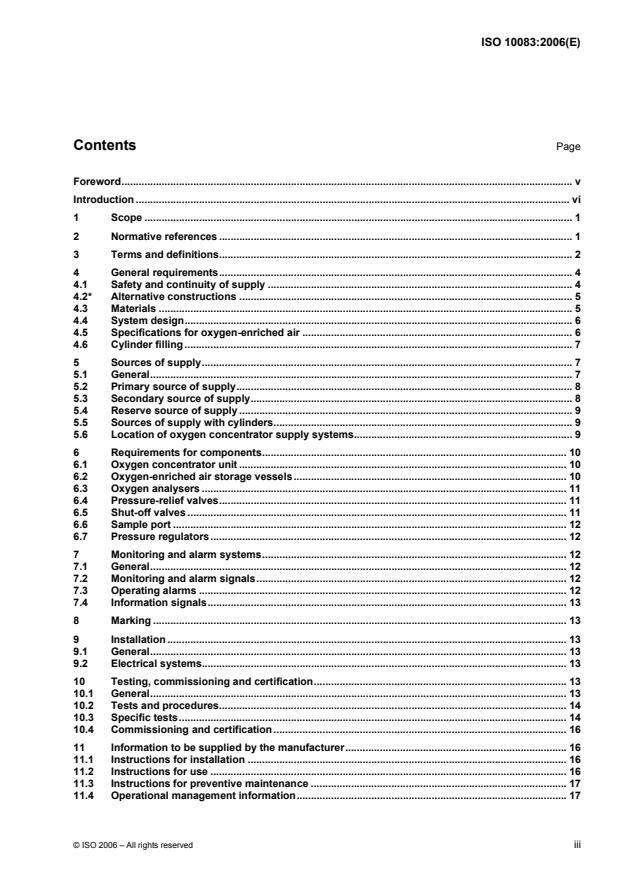
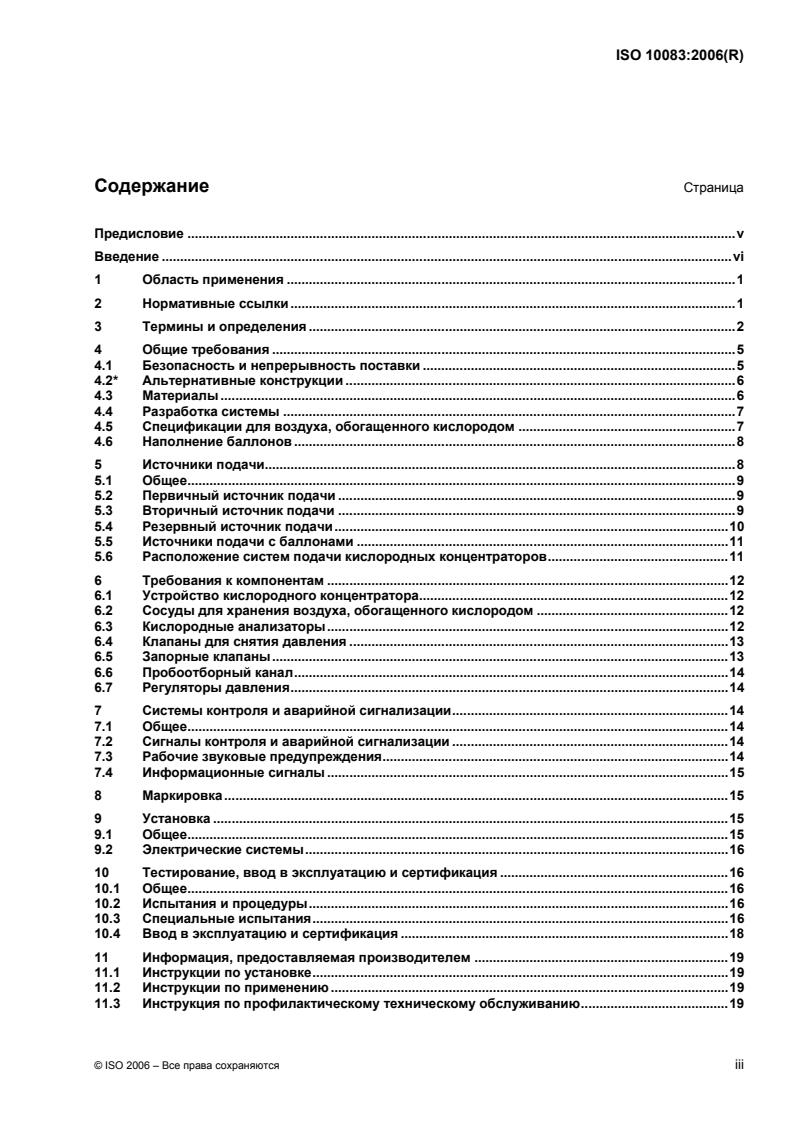
Contents Page
Foreword. v
Introduction . vi
1 Scope . 1
2 Normative references . 1
3 Terms and definitions. 2
4 General requirements. 4
4.1 Safety and continuity of supply . 4
4.2* Alternative constructions . 5
4.3 Materials . 5
4.4 System design. 6
4.5 Specifications for oxygen-enriched air . 6
4.6 Cylinder filling . 7
5 Sources of supply. 7
5.1 General. 7
5.2 Primary source of supply. 8
5.3 Secondary source of supply. 8
5.4 Reserve source of supply . 9
5.5 Sources of supply with cylinders. 9
5.6 Location of oxygen concentrator supply systems. 9
6 Requirements for components. 10
6.1 Oxygen concentrator unit . 10
6.2 Oxygen-enriched air storage vessels. 10
6.3 Oxygen analysers . 11
6.4 Pressure-relief valves. 11
6.5 Shut-off valves . 11
6.6 Sample port . 12
6.7 Pressure regulators. 12
7 Monitoring and alarm systems. 12
7.1 General. 12
7.2 Monitoring and alarm signals. 12
7.3 Operating alarms . 12
7.4 Information signals. 13
8 Marking . 13
9 Installation . 13
9.1 General. 13
9.2 Electrical systems. 13
10 Testing, commissioning and certification.13
10.1 General. 13
10.2 Tests and procedures. 14
10.3 Specific tests. 14
10.4 Commissioning and certification . 16
11 Information to be supplied by the manufacturer. 16
11.1 Instructions for installation . 16
11.2 Instructions for use . 16
11.3 Instructions for preventive maintenance .17
11.4 Operational management information.17
11.5 “As installed” drawings. 17
11.6 Electrical schematics. 17
11.7 Disclosure by the manufacturer . 17
12 Implementation of use of oxygen-enriched air . 17
12.1 Acceptance of oxygen-enriched air . 17
12.2 Timing. 17
12.3 Mixing of oxygen-enriched air and oxygen . 17
12.4 Calibration of medical equipment . 17
12.5 Labelling. 18
12.6 Compliance with ISO 7396-1 . 18
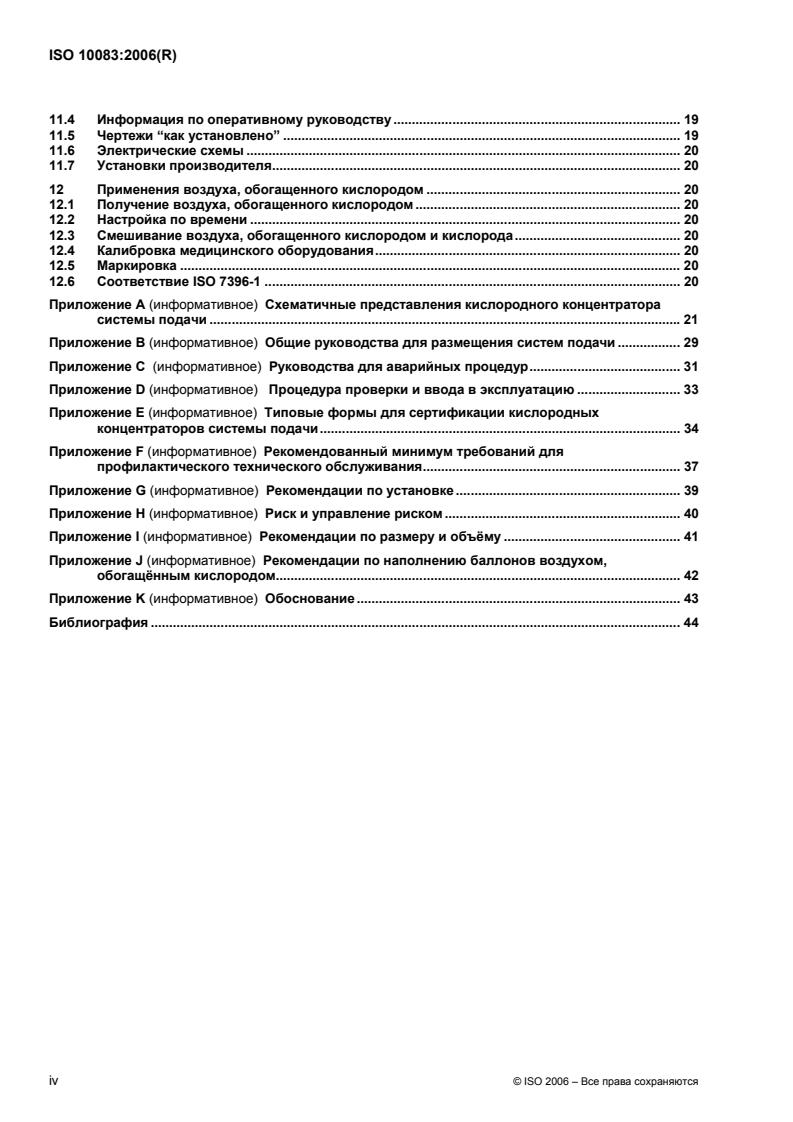
Annex A (informative) Schematic representations of oxygen concentrator supply systems. 19
Annex B (informative) General guidelines for location of supply systems. 27
Annex C (informative) Guidelines for emergency procedures . 29
Annex D (informative) Procedure for testing and commissioning . 31
Annex E (informative) Typical forms for certification of an oxygen concentrator supply system . 32
Annex F (informative) Recommended minimum requirements for preventive maintenance. 35
Annex G (informative) Recommendations for installation . 37
Annex H (informative) Risk and risk management. 38
Annex I (informative) Recommendations for sizing and capacity. 39
Annex J (informative) Recommendations for filling cylinders with oxygen-enriched air. 40
Annex K (informative) Rationale . 41
Bibliography . 42
iv © ISO 2006 – All rights reserved
Foreword
ISO (the International Organization for Standardization) is a worldwide federation of national standards bodies
(ISO member bodies). The work of preparing International Standards is normally carried out through ISO
technical committees. Each member body interested in a subject for which a technical committee has been
established has the right to be represented on that committee. International organizations, governmental and
non-governmental, in liaison with ISO, also take part in the work. ISO collaborates closely with the
International Electrotechnical Commission (IEC) on all matters of electrotechnical standardization.
International Standards are drafted in accordance with the rules given in the ISO/IEC Directives, Part 2.
The main task of technical committees is to prepare International Standards. Draft International Standards
adopted by the technical committees are circulated to the member bodies for voting. Publication as an
International Standard requires approval by at least 75 % of the member bodies casting a vote.
Attention is drawn to the possibility that some of the elements of this document may be the subject of patent
rights. ISO shall not be held responsible for identifying any or all such patent rights.
ISO 10083 was prepared by Technical Committee ISO/TC 121, Anaesthetic and respiratory equipment,
Subcommittee SC 6, Medical gas systems.
This second edition cancels and replaces the first edition (ISO 10083:1992), which has been technically
revised.
Introduction
This purpose of this International Standard is to specify minimum safety and performance requirements for
oxygen concentrator supply systems used to deliver oxygen-enriched air to a medical gas pipeline distribution
system. The minimum oxygen concentration produced by oxygen concentrator supply systems is specified.
National, regional or local regulations may, however, stipulate the minimum concentration of oxygen to be
produced by an oxygen concentrator supply system, or the range of concentrations which the supply system
shall produce.
Oxygen concentrators can be used to deliver oxygen-enriched air to a medical gas pipeline system as a
substitute for medical oxygen. Oxygen concentrators may be combined with sources of supply containing
100 % medical oxygen (i.e. cylinders or cryogenic vessels).
Oxygen concentrators can supply a product gas with an oxygen concentration variable within a specified
range depending on the characteristics of the concentrator and the flow supplied.
The decision to use oxygen-enriched air should be made at an early stage by the health care facility in
accordance with regional or national regulations, and is outside the scope of this International Standard. The
possible use of a mixture of oxygen-enriched air and oxygen is also a decision of the health care facility. The
use of a supply system incorporating oxygen concentrator(s) may require the approval of regional or national
authorities.
This International Standard should not be regarded as an endorsement or recommendation of one
concentration of oxygen over another.
Regional or national regulations that require the use of gas-specific terminal units for oxygen-enriched air may
exist.
A supply system with oxygen concentrators can be installed at the time of the installation of the pipeline
distribution system or as a replacement or addition to an existing supply system. A supply system with oxygen
concentrators can be supplied as a package and may be installed by a third party. In this case, the
manufacturer of the oxygen concentrator supply system must provide the installer with appropriate information
for installation and testing before connecting the supply system to the pipeline distribution system and before
use.
Objectives of this International Standard are to ensure the following:
⎯ appropriate introduction of an oxygen concentrator supply system into a health care facility;
⎯ quality of the oxygen-enriched air delivered by the supply system;
⎯ continuous supply of oxygen-enriched air;
⎯ use of suitable materials;
⎯ cleanliness of components;
⎯ correct installation;
⎯ provision of appropriate control, monitoring and alarm systems for the supply system;
⎯ testing, commissioning and certification.
vi © ISO 2006 – All rights reserved
It is intended for use by persons involved in the design, construction, inspection or operation of health care
facilities. Those persons involved in the design, manufacture, calibration or testing of equipment intended to
be connected to a pipeline system supplied by an oxygen concentrator supply system should also be aware of
the contents of this document.
Annex K contains rationale statements for some of the requirements of this International Standard. It is
included to provide additional insight into the reasoning that led to the requirements and recommendations
that have been incorporated in this International Standard. The clauses and subclauses marked with an
asterix (*) after their number have corresponding rationale contained in Annex K. It is considered that
knowledge of the reasons for the requirements will not only facilitate the proper application of this International
Standard, but will expedite any subsequent revisions.
INTERNATIONAL STANDARD ISO 10083:2006(E)
Oxygen concentrator supply systems for use with medical gas
pipeline systems
1 Scope
1.1 This International Standard specifies requirements for the design and installation of an oxygen
concentrator supply system for use with a medical gas pipeline distribution system that complies with
ISO 7396-1.
1.2 It applies only to oxygen concentrator supply systems that produce oxygen-enriched air with an oxygen
concentration not less than 90 % (see 4.5.1).
1.3 Oxygen concentrators for domiciliary use are excluded from the scope of this International Standard.
NOTE Requirements for oxygen concentrators for domiciliary use are specified in ISO 8359.
2 Normative references
The following referenced documents are indispensable for the application of this document. For dated
references, only the edition cited applies. For undated references, the latest edition of the referenced
document (including any amendments) applies.
ISO 5145, Cylinder valve outlets for gases and gas mixtures — Selection and dimensioning
ISO 7396-1:2002, Medical gas pipeline systems — Part 1: Pipelines for compressed medical gases and
vacuum
ISO 10524-2, Pressure regulators for use with medical gases — Part 2: Manifold and line pressure regulators
ISO 14644-1:1999, Cleanrooms and associated controlled environments — Part 1: Classification of air
cleanliness
ISO 14971, Medical devices — Application of risk management to medical devices
ISO 15001, Anaesthetic and respiratory equipment — Compatibility with oxygen
ISO 21969, High-pressure flexible connections for use with medical gas systems
EN 286-1, Simple unfired pressure vessels designed to contain air or nitrogen — Part 1: Pressure vessels for
general purposes
3 Terms and definitions
For the purposes of this document, the following terms and definitions apply.
3.1
commissioning
proof of function to verify that the agreed system specification is met and is accepted by the user or his
representative
3.2
control equipment
those items necessary to maintain the oxygen-enriched air supply system within the specified operating
parameters
NOTE Examples are pressure regulators, pressure-relief valves, alarms, sensors and oxygen analysers.
3.3
cylinder bundle
pack or pallet of cylinders linked together with a single connector for filling and emptying
3.4
double-stage pipeline distribution system
pipeline distribution system in which gas is initially distributed from the supply system at a higher pressure
than the nominal distribution pressure, this higher pressure (nominal supply system pressure) then being
reduced to the nominal distribution pressure by additional line pressure regulators
3.5
gas-specific
having characteristics which prevent connections between different gas services
3.6
manifold
device for connecting the outlet(s) of one or more cylinders or cylinder bundles for the same medical gas to
the pipeline system
3.7
manufacturer
natural or legal person with responsibility for the design, manufacture, packaging and labelling of a device
before it is placed on the market under his own name, regardless of whether these operations are carried out
by that person himself or on his behalf by a third party
3.8
medical gas pipeline system
complete system which comprises a supply system, a monitoring and alarm system and a pipeline distribution
system with terminal units at the points where medical gases or vacuum may be required
3.9
nominal distribution pressure
pressure which the medical gas pipeline system is intended to deliver at the terminal units
3.10
nominal supply system pressure
pressure of gas which the supply system is intended to deliver at the inlet to the line pressure regulator
3.11
non-return valve
valve which permits flow in one direction only
2 © ISO 2006 – All rights reserved
3.12
operating alarm
alarm to indicate to technical staff that it is necessary to replenish the supply or to correct a malfunction
3.13
oxygen concentrator
device which produces oxygen-enriched air from ambient air by extraction of nitrogen
3.14
oxygen concentrator supply system
supply system containing one or more oxygen concentrator units
3.15
oxygen concentrator unit
component of source of supply that produces oxygen-enriched air
3.16
oxygen-enriched air storage vessel
pressurized container to store oxygen-enriched air
3.17*
oxygen-enriched air
gas produced by an oxygen concentrator
NOTE Regional or national regulations may specify the name, symbol and color coding for oxygen-enriched air.
3.18
peak demand
maximum anticipated oxygen flow rate required by a health care facility
NOTE This is commonly expressed in litres per minute.
3.19
pipeline distribution system
that portion of a medical gas pipeline system linking the supply system to the terminal units
3.20
pressure regulator
device which reduces the inlet pressure of a gas and maintains its set outlet pressure within specified limits
3.21
pressure-relief valve
device activated at a preset pressure and intended to relieve excess pressure
3.22
primary source of supply
that portion of the supply system which supplies the pipeline distribution system
3.23
reserve source of supply
that portion of the supply system which supplies the complete, or portion(s) of the, pipeline distribution system
in the event of failure or exhaustion of both the primary and secondary sources of supply
3.24
safety
freedom from unacceptable risk
3.25
secondary source of supply
that portion of the supply system which supplies the pipeline distribution system in the event of exhaustion or
failure of the primary source of supply
3.26
shut-off valve
valve which prevents flow in both directions when closed
3.27
single-fault condition
condition in which a single means for protection against a safety hazard in equipment is defective or a single
external abnormal condition is present
3.28
single-stage pipeline distribution system
pipeline distribution system in which gas is distributed from the supply system at the nominal distribution
pressure
3.29
source of supply
that portion of the supply system with associated control equipment which supplies the pipeline distribution
system
3.30
supply system
assembly which supplies the pipeline distribution system and which includes all sources of supply
3.31
system design flow rate
flow rate calculated from the maximum flow rate requirement of the health care facility and corrected by the
diversity factor(s)
3.32
terminal unit
outlet assembly (inlet for vacuum) in a medical gas pipeline system at which the operator makes connections
and disconnections
4 General requirements
4.1 Safety and continuity of supply
4.1.1 Oxygen concentrator supply systems shall, when installed, commissioned, operated in normal use
and maintained in accordance with the instructions of the manufacturer, cause no safety hazard which could
reasonably be foreseen using risk analysis procedures in accordance with ISO 14971 and which is connected
with their intended application, in the normal condition or in a single-fault condition.
4.1.2 In order to ensure continuity of supply, the manufacturer of the supply system shall determine, in
cooperation with the health care facility management, and using risk management procedures in accordance
with ISO 14971, whether a source of supply incorporating oxygen concentrator unit(s) shall be connected to a
suitable emergency power supply. The results of such activity shall be recorded and made part of the
permanent record of the medical gas pipeline system.
NOTE 1 Loss of mains electrical power or water supply is considered a single-fault condition.
NOTE 2 Some risks and risk management measures are given in Annex H.
4 © ISO 2006 – All rights reserved
NOTE 3 Risk management may require that critical components [e.g. air compressor(s)] be rated for continuous
service.
NOTE 4 See ISO/TR 16142 for more information.
4.1.3 Control equipment shall be designed so that any component can be maintained without interrupting
the gas supply to the pipeline distribution system.
4.1.4 The system shall be designed so that maintenance or failure of any component shall not require the
isolation of two sources of supply at the same time.
4.1.5 An oxygen concentrator supply system shall cause no interruption of supply in the normal condition or
in a single-fault condition.
NOTE Loss of mains electrical power or water supply is a single-fault condition.
4.1.6 Shutting off or failure of an oxygen concentrator unit shall not affect the delivery of gas from the
oxygen concentrator supply system to the pipeline distribution system.
NOTE An oxygen concentrator takes a certain time to achieve the specified concentration of oxygen after a
prolonged shutdown.
4.1.7 The oxygen concentrator supply system shall be designed and manufactured to minimize the risk of
creating an electromagnetic field. National or regional regulations concerning electromagnetic compatibility
may exist.
4.1.8 Measures shall be taken to minimize electrical and mechanical hazards. National or regional
regulations concerning such hazards may exist.
4.1.9 Potential hazards arising from the implementation and use of oxygen-enriched air within the health
care facility shall be reduced and controlled using risk management procedures in accordance with ISO 14971.
The results of this activity shall be implemented via the instructions for use. See Clause 12.
4.2* Alternative constructions
Installations and components, or parts thereof, using materials or having forms of construction different from
those detailed in this International Standard shall be accepted if it can be demonstrated that an equivalent
degree of safety and performance is obtained. The evidence of an equivalent degree of safety and
performance shall be provided by the manufacturer.
NOTE Regional or national regulations may require the provision of evidence to a notified body or competent
authority upon request.
4.3 Materials
4.3.1 Compatibility with oxygen
4.3.1.1 All components of an oxygen concentrator supply system that are liable to come into contact with
compressed air, oxygen or oxygen-enriched air shall be compatible with oxygen under the operating
conditions specified by the manufacturer, taking into account the requirements of 4.1.1.
NOTE 1 Criteria for the selection of metallic and non-metallic materials are given in ISO 15001.
NOTE 2 Compatibility with oxygen or oxygen-enriched air involves both combustibility and ease of ignition. Materials
which burn in air will burn violently in pure oxygen or oxygen-enriched air. Many materials which do not burn in air will do
so in pure oxygen or oxygen-enriched air, particularly under pressure. Similarly, materials which can be ignited in air
require less energy to ignite in oxygen or oxygen-enriched air. Many such materials may be ignited by friction at a valve
seat or by adiabatic compression produced when oxygen or oxygen-enriched air at high pressure is rapidly introduced into
a system initially at low pressure.
4.3.1.2 If lubricants are used, they shall be compatible with oxygen at the operating conditions of the
supply system.
Evidence of compliance with 4.3.1.1 and 4.3.1.2 shall be made available by the manufacturer upon request.
4.3.1.3 The specific hazards of toxic products of combustion or decomposition from non-metallic
materials (including lubricants, if used) and potential contaminants shall be addressed.
Evidence of compliance with 4.3.1.3 shall be made available by the manufacturer upon request.
NOTE 1 Some potential products of combustion and/or decomposition for some commonly available non-metallic
materials are listed in Table D.7 of ISO 15001:2003.
NOTE 2 Typical “oxygen-compatible” lubricants can generate toxic products on combustion or decomposition.
4.3.2 Cleanliness
All components of an oxygen concentrator supply system that are liable to come into contact with compressed
air, oxygen or oxygen-enriched air shall meet the cleanliness requirements of ISO 15001. Such components
shall be protected from contamination prior to and during installation.
Evidence of compliance shall be made available by the manufacturer upon request.
NOTE Examples of cleaning procedures are given in ISO 15001.
4.3.3 Resistance to corrosion
The manufacturer shall disclose, upon request, evidence of the corrosion resistance of the materials used for
oxygen concentrator supply system components in contact with oxygen-enriched air.
NOTE Corrosion resistance includes resistance against the influence of moisture and the surrounding materials.
4.3.4 Exposure to cylinder pressure
Components which may be exposed to cylinder pressure in the normal or a single-fault condition shall function
in accordance with their specifications after being exposed to a pressure of 1,5 × cylinder working pressure for
5 min.
Evidence shall be provided by the manufacturer upon request.
4.4 System design
An oxygen concentrator supply system shall be designed by the manufacturer in consultation with the health
care facility, using risk management principles, to deliver the system design flow rate specified by the health
care facility at the nominal supply system pressure which permits the pressure at the terminal units to be
maintained within the range specified in ISO 7396-1.
NOTE Design specifications, such as pressure and flow rate, should take into account circumstances such as daily
flow rate increases, peak demand and seasonal increases. See Annex I for information on sizing.
4.5 Specifications for oxygen-enriched air
4.5.1 National or regional regulations which apply to oxygen-enriched air produced by an oxygen
concentrator supply system may exist. Where such regulations do not exist, the oxygen-enriched air shall
comply with the following at system design flow rate:
a) minimum oxygen concentration 90 % volume fraction of oxygen
b) maximum carbon monoxide concentration 5 ml/m
6 © ISO 2006 – All rights reserved
c) maximum carbon dioxide concentration 300 ml/m
d) maximum oil concentration 0,1 mg/m measured at ambient temperature and
pressure and corrected to 0 °C
e) maximum water vapour concentration 67 ml/m
NOTE 1 The balance of the gas comprises predominantly argon and nitrogen.
NOTE 2 Other terms may be used by national or regional regulations.
4.5.2 Oxygen-enriched air shall be filtered immediately downstream of the oxygen concentrator unit(s) to
maintain the particulate contamination below the level provided by ISO Class 5 in Table 1 of
ISO 14644-1:1999.
Evidence shall be provided by the manufacturer upon request.
4.5.3 Means shall be provided to indicate the status of filter elements (e.g. by measuring the pressure drop
across the filter).
Compliance with this subclause shall be checked by inspection.
4.6 Cylinder filling
If an oxygen concentrator unit is used to fill cylinders with oxygen-enriched air, the following conditions shall
be met:
a) Means shall be provided to ensure that cylinder filling does not affect delivery of oxygen-enriched air to
the pipeline distribution system.
b) A sample port with a shut-off valve shall be provided adjacent to the filling system.
NOTE 1 Regional or national regulations that apply to the filling of transportable cylinders may exist.
NOTE 2 Regional or national regulations that apply to the cylinder filling system may exist.
NOTE 3 Recommendations for filling cylinders with oxygen-enriched air are provided in Annex J.
5 Sources of supply
NOTE Schematic representations of oxygen concentrator supply systems are shown in Annex A.
5.1 General
5.1.1 An oxygen concentrator supply system shall be designed for automatic operation, and shall contain
the following sources of supply (see Annex A):
a) a primary source of supply;
b) a secondary source of supply;
c) a reserve source of supply.
5.1.2 Each source of supply shall be capable of delivering the system design flow rate, which is determined
by the health care facility, at the nominal supply system pressure which permits the pressure at the terminal
units to be maintained within the range specified in ISO 7396-1. See I.4 in Annex I.
NOTE An oxygen compressor may be needed to maintain the nominal supply system pressure.
5.1.3 A non-return valve and a shut-off valve shall be fitted immediately downstream of each source of
supply.
5.2 Primary source of supply
5.2.1 The primary source of supply shall consist of one of the following:
a) one or more oxygen concentrator unit(s);
b) a combination of one or more oxygen concentrator unit(s) and high-pressure cylinders or cryogenic
vessel(s);
c) a combination of one or more oxygen concentrator unit(s) and cryogenic vessel(s).
5.2.2 The primary source of supply shall include the following:
a) at least one oxygen-enriched air storage vessel;
b) a sample port with a shut-off valve immediately downstream of the oxygen-enriched air storage vessel;
c) pressure regulator(s);
d) filter(s);
e) an oxygen analyser.
5.2.3 The cylinder(s) or cylinder bundle(s), if fitted, shall be connected downstream of the oxygen storage
vessel shut-off valve and upstream of the connection of the secondary supply.
5.3 Secondary source of supply
5.3.1 The secondary source of supply shall be permanently connected and shall automatically supply the
pipeline in the event that the primary source of supply is unable to supply the pipeline.
5.3.2 The secondary source of supply shall consist of one of the following:
a) one or more oxygen concentrator units;
b) gas (oxygen or oxygen-enriched air) in cylinder(s) or cylinder bundle(s);
c) a cryogenic liquid oxygen supply.
5.3.3 If the secondary source of supply consists of one or more oxygen concentrator unit(s), it shall include
the following:
a) at least one oxygen-enriched air storage vessel;
b) a sample port with a shut-off valve immediately downstream of the oxygen-enriched air storage vessel;
c) pressure regulator(s);
d) filter(s);
e) oxygen analyser(s).
5.3.4 If the secondary source of supply consists of only cylinders or cylinder bundles, the manifold shall:
a) consist of at least two banks of cylinders;
b) be supplied from one bank of cylinders at a time;
c) on depletion of one bank of cylinders switch automatically to another bank.
NOTE This configuration is needed to facilitate replenishment of the secondary source of supply without interruption
of supply.
8 © ISO 2006 – All rights reserved
5.3.5 If an emergency electrical power supply is not available, the secondary source of supply shall not
comprise only oxygen concentrator unit(s).
5.3.6 The secondary source of supply shall be connected downstream of the oxygen-enriched air storage
vessel in the primary supply.
5.4 Reserve source of supply
5.4.1 The reserve source of supply shall be permanently connected and shall automatically supply the
pipeline if the primary and secondary sources of supply are unable to supply the pipeline.
5.4.2 The reserve source of supply shall consist of gas (oxygen or oxygen-enriched air) in cylinders or
cylinder bundles.
5.4.3 The reserve source of supply shall:
a) consist of at least two banks of cylinders;
b) be supplied from one bank of cylinders at a time;
c) on depletion of one bank of cylinders switch automatically or manually to another bank.
NOTE This configuration is needed to facilitate replenishment of the reserve source of supply without interruption of
supply.
5.4.4 The point of connection for the reserve source of supply may be either upstream or downstream of the
supply system shut-off valve.
5.5 Sources of supply with cylinders
NOTE A source of supply with cylinders may contain cylinders or cylinder bundles or both.
5.5.1 Each bank of cylinders shall have its cylinders connected to a manifold with its own pressure regulator.
Vent valves, if fitted on manifolds, should be vented outside of the building.
5.5.2 A filter having a pore size no greater than 100 µm shall be provided between the cylinders and the
first pressure regulator.
Evidence of compliance with this subclause shall be made available by the manufacturer upon request.
5.5.3 A non-return valve shall be installed at the manifold end of each flexible connection between a
cylinder and the manifold.
5.5.4 The flexible connections between each cylinder and the manifold shall comply with ISO 21969.
Evidence shall be made available by the manufacturer upon request.
5.5.5 Cylinder valve outlets shall be in accordance with ISO 5145 or the relevant national standard.
Evidence shall be made available by the manufacturer upon request.
5.6 Location of oxygen concentrator supply systems
NOTE 1 Informative guidelines for location of supply systems are given in Annex B.
NOTE 2 Oxygen concentrator units may generate noise in excess of 70 dB (A-weighted).
NOTE 3 National and regional regulations concerning noise levels may exist.
NOTE 4 The location of the oxygen concentrator system should be defined by the management of the health care
facility in consultation with the system supplier, using risk management principles.
5.6.1 The ambient temperature in rooms for the oxygen concentrator supply system shall be in the range
10 °C to 40 °C.
5.6.2 The intake(s) for the air compressors shall be located where there is minimal contamination from
internal combustion engine exhaust (e.g. from motor vehicles), vacuum system exhausts, vents from medical
gas pipeline systems, anaesthetic-gas scavenging systems, ventilation system discharges and other sources
of contamination. The intake(s) shall be provided with means to prevent the ingress of insects, debris and
water. Consideration shall be given to the potential effects of prevailing winds on the location of intake(s).
NOTE The above requirements are taken from ISO 7396-1.
Compliance shall be checked by visual inspection.
6 Requirements for components
NOTE Regional or national regulations concerning pressure equipment may exist.
6.1 Oxygen concentrator unit
6.1.1 An oxygen concentrator unit shall consist of:
a) a compressed air supply with at least one air compressor;
b) at least one sieve bed;
c) switching valves.
6.1.2 An air compressor may be connected to an air receiver.
6.1.3 An air receiver may be served by more than one compressor.
6.1.4 Air receivers shall:
a) comply with EN 286-1 or equivalent national standards;
b) be fitted with shut-off valve(s), an automatic drain, a pressure gauge and a pressure-relief valve.
Evidence shall be made available by the manufacturer upon request.
6.1.5 Each air receiver shall be fitted with a means of pressure control, e.g. pressure switch(es) or pressure
transducer(s).
6.1.6 If venting of waste gases generated during production of oxygen-enriched air to the outside of the
building is required, the vents shall be provided with means to prevent the ingress of insects, debris and
precipitation. The vents shall be located remote from any air intakes, doors, windows or other openings in
buildings. Consideration shall be given to the potential effects of prevailing winds on the location of the vents.
Compliance shall be checked by visual inspection.
6.2 Oxygen-enriched air storage vessels
Each oxygen-enriched air storage vessel or group of oxygen-enriched air storage vessels shall:
a) comply with relevant international, regional or national standards;
b) be fitted with shut-off valve(s), a pressure gauge and a pressure-relief valve;
c) be fitted with a means of pressure control, e.g. pressure switch(es) or pressure transducer(s);
d) be arranged so that each vessel can be maintained separately.
NOTE An oxygen-enriched air storage vessel may be supplied by more than one oxygen concentrator.
10 © ISO 2006 – All rights reserved
6.3 Oxygen analysers
6.3.1 One or more oxygen analyser(s) shall be provided to permit the oxygen concentration from each
source of supply incorporating an oxygen concentrator unit to be measured continuously.
NOTE Means to display and record oxygen concentration may be required by regional or national regulations.
6.3.2 If only one oxygen analyser is installed, appropriate measures to ensure that the correct oxygen
concentration is continuously supplied shall be defined by risk management (see 4.1.1).
NOTE A second oxygen analyser may be required by regional or national regulations.
6.3.3 Controls shall be provided such that each source of supply incorporating an oxygen concentrator unit
automatically shuts down if the oxygen concentration of the oxygen-enriched air produced by that source of
supply falls below that specified in 4.5.1.
6.3.4 Each oxygen analyser shall be equipped with a low-concentration alarm. Means shall be provided to
prevent unauthorized changes of the alarm setting.
6.3.5 Each oxygen analyser shall include compensation for temperature and barometric-pressure variations
to ensure an accuracy of ± 1 % of the measured value in the range of 90 % to 100 %.
NOTE 1 National or regional regulations concerning the oxygen analyser may exist.
NOTE 2 Additional monitoring may be required to show compliance of oxygen-enriched air with national or regional
regulations.
6.4 Pressure-relief valves
6.4.1 Pressure-relief valves shall comply with the supply system manufacturer’s design specifications,
taking into account that national or regional regulations may exist. Evidence shall be made available by the
manufacturer upon request.
6.4.2 All pressure-relief valves shall close automatically when excess pressure has been released.
6.4.3 Pressure-relief valves on vessels containing oxygen or oxygen-enriched air shall be vented to the
outside of the building and the vents shall be provided with means to prevent the ingress of insects, debris
and precipitation. The vents shall be located remote from any air intakes, doors, windows or other openings in
buildings. Consideration shall be given to the potential effects of prevailing winds on the location of the vents.
Compliance is checked by inspection.
6.4.4 Means of pressure relief shall not be isolated, for example by a shut-off val
...
NORME ISO
INTERNATIONALE 10083
Deuxième édition
2006-07-15
Systèmes d'approvisionnement par
concentrateurs d'oxygène pour utilisation
dans des réseaux de distribution de gaz
médicaux
Oxygen concentrator supply systems for use with medical gas pipeline
systems
Numéro de référence
©
ISO 2006
PDF – Exonération de responsabilité
Le présent fichier PDF peut contenir des polices de caractères intégrées. Conformément aux conditions de licence d'Adobe, ce fichier
peut être imprimé ou visualisé, mais ne doit pas être modifié à moins que l'ordinateur employé à cet effet ne bénéficie d'une licence
autorisant l'utilisation de ces polices et que celles-ci y soient installées. Lors du téléchargement de ce fichier, les parties concernées
acceptent de fait la responsabilité de ne pas enfreindre les conditions de licence d'Adobe. Le Secrétariat central de l'ISO décline toute
responsabilité en la matière.
Adobe est une marque déposée d'Adobe Systems Incorporated.
Les détails relatifs aux produits logiciels utilisés pour la création du présent fichier PDF sont disponibles dans la rubrique General Info
du fichier; les paramètres de création PDF ont été optimisés pour l'impression. Toutes les mesures ont été prises pour garantir
l'exploitation de ce fichier par les comités membres de l'ISO. Dans le cas peu probable où surviendrait un problème d'utilisation,
veuillez en informer le Secrétariat central à l'adresse donnée ci-dessous.
© ISO 2006
Droits de reproduction réservés. Sauf prescription différente, aucune partie de cette publication ne peut être reproduite ni utilisée sous
quelque forme que ce soit et par aucun procédé, électronique ou mécanique, y compris la photocopie et les microfilms, sans l'accord écrit
de l'ISO à l'adresse ci-après ou du comité membre de l'ISO dans le pays du demandeur.
ISO copyright office
Case postale 56 • CH-1211 Geneva 20
Tel. + 41 22 749 01 11
Fax. + 41 22 749 09 47
E-mail copyright@iso.org
Web www.iso.org
Publié en Suisse
ii © ISO 2006 – Tous droits réservés
Sommaire Page
Avant-propos. v
Introduction . vi
1 Domaine d'application. 1
2 Références normatives . 1
3 Termes et définitions. 2
4 Exigences générales . 4
4.1 Sécurité et continuité de l'alimentation. 4
4.2 * Autres constructions . 5
4.3 Matériaux . 5
4.4 Conception du système . 6
4.5 Spécifications pour l'oxygène par enrichissement d'air . 7
4.6 Remplissage des bouteilles. 7
5 Centrales d'alimentation . 8
5.1 Généralités . 8
5.2 Centrale d'alimentation primaire. 8
5.3 Centrale d'alimentation secondaire . 9
5.4 Centrale d'alimentation de secours . 9
5.5 Centrales d'alimentation avec des bouteilles . 10
5.6 Localisation des systèmes d'approvisionnement à concentrateur d'oxygène. 10
6 Exigences relatives aux composants. 11
6.1 Unité de concentrateur d'oxygène. 11
6.2 Récipient de stockage d'oxygène par enrichissement d'air . 11
6.3 Analyseurs d'oxygène. 12
6.4 Soupapes de décharge. 12
6.5 Vannes de sectionnement . 13
6.6 Orifice de prélèvement . 13
6.7 Régulateurs de pression. 13
7 Systèmes de surveillance et d'alarme . 13
7.1 Généralités . 13
7.2 Signaux de surveillance et d'alarme. 13
7.3 Alarmes de contrôle de fonctionnement. 13
7.4 Signaux d'information . 14
8 Marquage . 14
9 Installation . 14
9.1 Généralités . 14
9.2 Systèmes électriques . 15
10 Essais, mise en service et certification. 15
10.1 Généralités . 15
10.2 Essais et modes opératoires . 15
10.3 Essais spécifiques. 15
10.4 Mise en service et certification. 17
11 Informations à fournir par le fabricant. 17
11.1 Instructions d'installation . 17
11.2 Instructions d'utilisation . 18
11.3 Instructions de maintenance préventive.18
11.4 Informations de gestion opérationnelle . 18
11.5 Schémas de système «tel qu'installé». 18
11.6 Schémas électriques . 18
11.7 Déclaration par le fabricant. 18
12 Utilisation de l'oxygène par enrichissement d'air . 19
12.1 Acceptation de l'oxygène par enrichissement d'air . 19
12.2 Planification. 19
12.3 Mélange d'oxygène par enrichissement d'air et d'oxygène . 19
12.4 Étalonnage du matériel médical . 19
12.5 Étiquetage. 19
12.6 Conformité à l'ISO 7396-1. 19
Annexe A (informative) Représentations schématiques de systèmes d'approvisionnement
par concentrateurs d'oxygène. 20
Annexe B (informative) Lignes directrices générales relatives à l'emplacement des systèmes
d'alimentation . 28
Annexe C (informative) Lignes directrices relatives aux modes opératoires d'urgence . 30
Annexe D (informative) Mode opératoire d'essai et de mise en service. 32
Annexe E (informative) Formulaires types pour la certification d'un système d'approvisionnement
concentrateur d'oxygène. 34
Annexe F (informative) Exigences minimales recommandées pour la maintenance préventive . 37
Annexe G (informative) Recommandations relatives à l'installation . 39
Annexe H (informative) Risques et gestion des risques . 40
Annexe I (informative) Recommandations relatives au dimensionnement et à la capacité . 41
Annexe J (informative) Recommandations relatives au remplissage de bouteilles avec de l'air
enrichi en oxygène. 42
Annexe K (informative) Justification . 43
Bibliographie . 44
iv © ISO 2006 – Tous droits réservés
Avant-propos
L'ISO (Organisation internationale de normalisation) est une fédération mondiale d'organismes nationaux de
normalisation (comités membres de l'ISO). L'élaboration des Normes internationales est en général confiée
aux comités techniques de l'ISO. Chaque comité membre intéressé par une étude a le droit de faire partie du
comité technique créé à cet effet. Les organisations internationales, gouvernementales et non
gouvernementales, en liaison avec l'ISO participent également aux travaux. L'ISO collabore étroitement avec
la Commission électrotechnique internationale (CEI) en ce qui concerne la normalisation électrotechnique.
Les Normes internationales sont rédigées conformément aux règles données dans les Directives ISO/CEI,
Partie 2.
La tâche principale des comités techniques est d'élaborer les Normes internationales. Les projets de Normes
internationales adoptés par les comités techniques sont soumis aux comités membres pour vote. Leur
publication comme Normes internationales requiert l'approbation de 75 % au moins des comités membres
votants.
L'attention est appelée sur le fait que certains des éléments du présent document peuvent faire l'objet de
droits de propriété intellectuelle ou de droits analogues. L'ISO ne saurait être tenue pour responsable de ne
pas avoir identifié de tels droits de propriété et averti de leur existence.
L'ISO 10083 a été élaborée par le comité technique ISO/TC 121, Matériel d'anesthésie et de réanimation
respiratoire, sous-comité SC 6, Systèmes de gaz médicaux.
Cette deuxième édition annule et remplace la première édition (ISO 10083:1992), qui a fait l'objet d'une
révision technique.
Introduction
La présente Norme internationale a pour objet de spécifier les exigences minimales en matière de
performances et de sécurité pour les systèmes d'approvisionnement par concentrateurs d'oxygène pour
délivrer de l'oxygène par enrichissement d'air à un système de distribution de gaz médicaux. La concentration
minimale d'oxygène fournie par les systèmes d'approvisionnement par concentrateurs d'oxygène est spécifiée.
Des dispositions réglementaires à l'échelon national, régional ou local, peuvent stipuler la concentration
minimale d'oxygène devant être fournie par un système d'alimentation par concentrateurs d'oxygènes, ou la
plage de concentrations que le système d'alimentation doit fournir.
Des concentrateurs d'oxygène peuvent être utilisés pour délivrer de l'oxygène par enrichissement d'air à un
système de distribution de gaz médicaux, en remplacement de l'oxygène médical. Les concentrateurs
d'oxygène peuvent être combinés avec des centrales d'alimentation contenant de l'oxygène médical à 100 %
(c'est-à-dire dans des bouteilles ou des récipients cryogéniques).
Les concentrateurs d'oxygène peuvent fournir un produit gazeux contenant une concentration d'oxygène
variable dans une plage spécifiée, selon les caractéristiques du concentrateur et le débit délivré.
La décision d'utiliser de l'oxygène par enrichissement d'air devra être prise à un stade précoce par
l'établissement de santé, en conformité avec les dispositions réglementaires régionales ou nationales, et elle
est extérieure au domaine d'application de la présente Norme internationale. L'utilisation possible d'un
mélange d'oxygène par enrichissement d'air et d'oxygène est, elle aussi, une décision du ressort de
l'établissement de santé. L'utilisation d'un système d'approvisionnement par concentrateurs d'oxygène est
susceptible de requérir l'approbation d'autorités administratives régionales ou nationales.
La présente Norme internationale ne saurait être considérée comme avalisant ou recommandant le choix de
telle concentration d'oxygène par rapport à telle autre.
Des dispositions réglementaires régionales ou nationales imposant l'utilisation de prises murales spécifiques
pour l'oxygène par enrichissement d'air sont susceptibles d'exister.
Un système d'approvisionnement par concentrateurs d'oxygène peut être installé lors de l'installation du
système de distribution ou en remplacement ou en complément d'un système d'approvisionnement existant.
Un système d'approvisionnement par concentrateurs d'oxygène peut être fourni en tant que produit
indépendant et peut être installé par un tiers. Dans ce cas, le fabricant du système d'approvisionnement par
concentrateurs d'oxygène doit fournir à l'installateur les informations appropriées pour l'installation et les
essais avant de raccorder le système d'alimentation au système de distribution et avant son utilisation.
Les objectifs de la présente Norme internationale sont d'assurer:
⎯ l'introduction appropriée d'un système d'approvisionnement par concentrateurs d'oxygène dans un
hôpital;
⎯ la qualité de l'oxygène par enrichissement d'air délivré par le système d'alimentation;
⎯ l'alimentation continue d'oxygène par enrichissement d'air;
⎯ l'utilisation de matériaux adaptés;
⎯ la propreté des composants;
⎯ une installation correcte;
vi © ISO 2006 – Tous droits réservés
⎯ la fourniture de systèmes de commande, de surveillance et d'alarme appropriés pour le système
d'alimentation;
⎯ les essais, la mise en service et la certification.
Elle est destinée à être utilisée par les personnes impliquées dans la conception, la construction, l'inspection
ou le fonctionnement d'installations médicales. Il convient que les personnes impliquées dans la conception,
la fabrication, l'étalonnage ou les essais de matériel destiné à être raccordé à un système de distribution
alimenté par un système d'alimentation d'oxygène par concentrateur prennent également connaissance du
contenu du présent document.
L'Annexe K contient des éléments de justification de certaines des exigences de la présente Norme
internationale. Elle est incluse afin de fournir des explications complémentaires sur le raisonnement qui a
conduit aux exigences et aux recommandations qui ont été incorporées dans la présente Norme
Internationale. Les articles et les paragraphes marqués avec avec un astérisque (*) après leur numéro ont
une justification correspondante dans l'Annexe K. Il est considéré que la connaissance des justifications des
exigences facilitera non seulement l'application correcte de la présente Norme internationale, mais facilitera
également les révisions ultérieures.
NORME INTERNATIONALE ISO 10083:2006(F)
Systèmes d'approvisionnement par concentrateurs d'oxygène
pour utilisation dans des réseaux de distribution de gaz
médicaux
1 Domaine d'application
1.1 La présente Norme internationale spécifie des exigences pour la conception et l'installation d'un
système d'approvisionnement par concentrateurs d'oxygène, destiné à être utilisé en association avec un
réseau de canalisations de gaz à usages médicaux qui satisfait à l'ISO 7396-1.
1.2 La présente Norme internationale ne s'applique qu'aux systèmes d'approvisionnement par
concentrateurs d'oxygène qui produisent de l'oxygène par enrichissement d'air de concentration en oxygène
non inférieure à 90 % (voir 4.5.1).
1.3 Les concentrateurs d'oxygène pour utilisation à domicile sont exclus du domaine d'application de la
présente Norme internationale.
NOTE Les exigences relatives aux concentrateurs d'oxygène pour utilisation à domicile sont spécifiées dans
l'ISO 8359.
2 Références normatives
Les documents de référence suivants sont indispensables pour l'application du présent document. Pour les
références datées, seule l'édition citée s'applique. Pour les références non datées, la dernière édition du
document de référence s'applique (y compris les éventuels amendements).
ISO 5145, Raccords de sortie de robinets de bouteilles à gaz et mélanges de gaz — Choix et
dimensionnement
ISO 7396-1:2002, Réseaux de distribution de gaz médicaux — Partie 1: Réseaux de distribution de gaz
médicaux comprimés et de vide
ISO 10524-2, Détendeurs pour l'utilisation avec les gaz médicaux — Partie 2: Détendeurs de rampes et de
canalisations
ISO 14644-1:1999, Salles propres et environnements maîtrisés apparentés — Partie 1: Classification de la
propreté de l'air
ISO 14971, Dispositifs médicaux — Application de la gestion des risques aux dispositifs médicaux
ISO 15001:2003, Matériel d'anesthésie et respiratoire — Compatibilité avec l'oxygène
ISO 21969, Raccords flexibles haute pression pour utilisation avec les systèmes de gaz médicaux
EN 286-1, Récipients à pression simples, non soumis à la flamme, destinés à contenir de l'air ou de l'azote —
Partie 1: Récipients
3 Termes et définitions
Pour les besoins du présent document, les termes et définitions suivants s'appliquent.
3.1
mise en service
preuve de mise en fonction permettant de vérifier que la spécification agréée pour le système est obtenue et
acceptée par l'utilisateur ou son représentant
3.2
équipement de contrôle
éléments nécessaires pour maintenir l'alimentation d'oxygène par enrichissement d'air conforme aux
paramètres de fonctionnement spécifiés
NOTE Par exemple des régulateurs de pression, des soupapes de décharge, des alarmes, des capteurs et des
analyseurs d'oxygène.
3.3
cadre de bouteille
ensemble ou palette de bouteilles reliées entre elles par un raccord simple permettant de les vider et de les
remplir
3.4
réseau de canalisations à double détente
réseau de distribution dans lequel le gaz est, dans un premier temps, distribué par le système
d'approvisionnement à une pression plus élevée que la pression de distribution nominale. Cette pression
élevée (pression nominale du système d'alimentation) est ensuite réduite pour atteindre la pression nominale
de distribution, par des détendeurs de canalisations supplémentaires
3.5
spécifique à un gaz
doté de caractéristiques qui empêchent l'interchangeabilité, permettant ainsi l'affectation à un gaz unique ou
au vide
3.6
rampe
dispositif raccordant la (ou les) sortie(s) d'une (ou de plusieurs) bouteille(s) ou cadre(s) de bouteilles du même
gaz médical à l'intérieur du système de distribution
3.7
fabricant
personne morale ou physique responsable de la conception, de la fabrication, du conditionnement et de
l'étiquetage d'un dispositif avant qu'il soit mis sur le marché sous son propre nom, indépendamment du fait
que ces opérations sont conduites par cette personne ou par un tiers en son nom
3.8
système de distribution de gaz médicaux
système complet comprenant une centrale d'alimentation, un réseau de canalisation et des prises murales en
des points où des gaz médicaux ou des évacuations de gaz anesthésiques peuvent être requis
3.9
pression nominale du système de distribution
pression que le système de distribution de gaz médicaux est destiné à délivrer aux prises murales
3.10
pression nominale du système d'alimentation
pression de gaz que le système d'alimentation est censé délivrer à l'entrée du détendeur de canalisation
3.11
clapet antiretour
clapet qui ne permet un écoulement que dans un seul sens
2 © ISO 2006 – Tous droits réservés
3.12
alarme de contrôle de fonctionnement
alarme visuelle, ou visuelle et sonore, indiquant la nécessité pour le personnel technique de réapprovisionner
en gaz ou de remédier à un défaut de fonctionnement
3.13
concentrateur d'oxygène
dispositif qui produit de l'oxygène par enrichissement d'air à partir d'air ambiant par extraction d'azote
3.14
système d'approvisionnement par concentrateurs d'oxygène
système d'alimentation contenant une ou plusieurs unités de concentrateurs d'oxygène
3.15
unité de concentrateur d'oxygène
composant de la centrale d'alimentation qui produit de l'oxygène par enrichissement d'air
3.16
récipient de stockage d'oxygène par enrichissement d'air
récipient sous pression pour stocker de l'air enrichi en oxygène
3.17*
oxygène par enrichissement d'air
gaz produit par un concentrateur d'oxygène
NOTE Des dispositions réglementaires régionales ou nationales sont susceptibles de spécifier le nom, le symbole et
le code couleur désignant l'oxygène par enrichissement d'air.
3.18
demande de pointe
débit d'oxygène maximal prévu pouvant être requis par une installation médicale
NOTE Celui-ci est couramment exprimé en litres par minute.
3.19
réseau de canalisations
partie d'un système de distribution de gaz médicaux reliant le système d'alimentation aux prises murales
3.20
régulateur de pression
dispositif qui réduit la pression d'entrée d'un gaz et qui maintient sa pression de sortie dans les limites spécifiées
3.21
soupape de sécurité
dispositif mis en service à une pression préréglée et ayant pour but de relâcher la pression lorsqu'elle devient
excessive
3.22
centrale d'alimentation primaire
partie du système d'alimentation qui alimente le réseau de canalisations
3.23
centrale d'alimentation de secours
partie du système d'alimentation qui alimente la totalité ou une ou plusieurs parties du réseau de canalisations
de distribution, en cas de panne ou d'épuisement de l'une et de l'autre des centrales d'alimentation principale
et secondaire
3.24
sécurité
immunité vis-à-vis des risques inacceptables
3.25
centrale d'alimentation secondaire
partie du système d'alimentation qui alimente le réseau de canalisations de distribution, en cas d'épuisement
ou de panne de la centrale d'alimentation principale
3.26
vanne de sectionnement
vanne qui empêche un écoulement dans les deux sens lorsqu'elle est fermée
3.27
condition de premier défaut
condition réalisée lorsqu'un défaut affecte une seule des mesures de protection contre les risques de
l'appareil ou en présence d'une seule condition anormale extérieure à l'appareil
3.28
réseau de distribution à simple détente
réseau de distribution dans lequel le gaz est distribué par le système d'alimentation à la pression nominale de
distribution
3.29
centrale d'alimentation
partie du système d'alimentation avec le tableau de mise en œuvre associé qui alimente le système de
distribution
3.30
système d'alimentation
ensemble qui alimente le système de distribution et qui comprend toutes les centrales d'alimentation
3.31
débit nominal du système
débit calculé à partir de l'exigence de débit maximal de l'installation médicale et corrigé par le(s) facteur(s) de
diversité
3.32
prise murale
raccordement de sortie (d'entrée pour le vide) d'un système de distribution de gaz médicaux, auquel
l'utilisateur peut brancher et débrancher des appareils
4 Exigences générales
4.1 Sécurité et continuité de l'alimentation
4.1.1 Les systèmes d'alimentation à concentrateur d'oxygène doivent, lorsqu'ils sont installés, mis en
service, mis en œuvre en fonctionnement normal et maintenus conformément aux instructions du fabricant, ne
présenter aucun risque qui pourrait être raisonnablement prévisible en utilisant des modes opératoires
d'analyse des risques conformément à l'ISO 14971, et qui sont associées à leur application prévue, dans des
conditions normales et en condition de premier défaut.
4.1.2 En vue de garantir la continuité de l'alimentation, il incombe au fabricant du système d'alimentation de
déterminer, en coopération avec l'administration de l'établissement de santé et en recourant aux modes
opératoires de gestion des risques conformément à ISO 14971, si une centrale d'alimentation comportant un
ou plusieurs ensembles concentrateurs d'oxygène doit être raccordée à une source d'alimentation électrique
de secours appropriée. Les résultats d'une telle activité doivent être enregistrés et intégrés dans le dossier
permanent du système de distribution de gaz à usages médicaux.
NOTE 1 Une panne d'alimentation électrique ou d'alimentation d'eau est considérée comme une condition de premier
défaut.
NOTE 2 Certains risques et mesures de contrôle des risques sont présentés dans l'Annexe H.
4 © ISO 2006 – Tous droits réservés
NOTE 3 Le contrôle des risques peut nécessiter que des composants critiques [par exemple le(s) compresseur(s) d'air]
soient spécifiés pour un fonctionnement continu.
NOTE 4 Voir l'ISO/TR 16142 pour de plus amples informations.
4.1.3 Le tableau de mise en œuvre doit être conçu de telle manière que la maintenance de composants
puisse être effectuée sans interrompre l'alimentation de gaz au système de distribution.
4.1.4 Le système doit être conçu de telle manière que la maintenance ou une panne d'un composant
quelconque ne requière pas l'isolement simultané de deux centrales d'alimentation.
4.1.5 Un système d'approvisionnement par concentrateurs d'oxygène ne doit pas causer d'interruption
d'alimentation dans des conditions normales et en condition de premier défaut.
NOTE Une panne d'alimentation électrique ou d'alimentation d'eau est une condition de premier défaut.
4.1.6 L'arrêt ou la panne d'un concentrateur d'oxygène ne doit pas affecter l'alimentation en gaz entre le
système d'alimentation à concentrateur d'oxygène et le réseau de canalisations.
NOTE Il faut un certain temps pour qu'un concentrateur d'oxygène atteigne la concentration d'oxygène spécifiée
après une période d'arrêt prolongée.
4.1.7 Le système d'alimentation à concentrateur d'oxygène doit être conçu et fabriqué en sorte de réduire
au minimum le risque de création d'un champ électromagnétique. Des dispositions réglementaires nationales
ou régionales sont susceptibles d'exister en ce qui concerne la compatibilité électromagnétique.
4.1.8 Des mesures doivent être prises pour réduire au minimum les risques électriques et mécaniques. Des
dispositions réglementaires nationales ou régionales sont susceptibles d'exister en ce qui concerne ces
risques.
4.1.9 Les dangers potentiels découlant de la mise en œuvre et de l'usage d'oxygène par enrichissement
d'air au sein de l'établissement de santé doivent être réduits et contrôlés en recourant aux procédures de
gestion des risques prévues par l'ISO 14971. Les résultats de cette activité doivent être mis en œuvre par le
biais des instructions d'emploi. Voir Article 12.
4.2 * Autres constructions
Les installations et composants ou éléments de ces installations qui utilisent des matériaux ou présentent des
formes de construction différents de ceux détaillés dans la présente Norme internationale doivent être
acceptés s'il peut être démontré qu'ils procurent un degré équivalent de sécurité et de performances. Il
incombe au fabricant d'apporter la preuve d'un degré équivalent de sécurité et de performances.
NOTE Des dispositions réglementaires régionales ou nationales sont susceptibles d'imposer la présentation de
preuves à un organisme certificateur ou à un autre organisme compétent sur demande.
4.3 Matériaux
4.3.1 Compatibilité avec l'oxygène
4.3.1.1 Tous les composants d'un système d'approvisionnement par concentrateurs d'oxygène qui sont
susceptibles d'entrer en contact avec de l'air comprimé, de l'oxygène ou de l'oxygène par enrichissement d'air
doivent être compatibles avec l'oxygène dans les conditions de fonctionnement spécifiées par le fabricant, en
tenant compte des exigences de 4.1.1.
NOTE 1 On trouvera des critères pour la sélection de matériaux métalliques et non métalliques dans ISO 15001.
NOTE 2 La compatibilité avec l'oxygène ou l'oxygène par enrichissement d'air concerne à la fois la combustibilité et la
facilité d'ignition. Les matériaux qui brûlent dans l'air s'enflammeront encore plus violemment dans de l'oxygène pur ou
l'air enrichi en oxygène. De nombreux matériaux brûleront dans l'oxygène pur ou l'air enrichi en oxygène, en particulier
sous pression, alors qu'ils ne le peuvent pas dans l'air. Dans le même ordre d'idée, l'énergie d'ignition dans l'oxygène ou
l'oxygène par enrichissement d'air est plus faible que dans l'air. Beaucoup de ces matériaux peuvent être enflammés au
niveau d'un siège de soupape ou par compression adiabatique produite lorsque l'oxygène ou l'oxygène par
enrichissement d'air à haute pression est introduit rapidement dans un réseau initialement à basse pression.
4.3.1.2 Si des lubrifiants sont utilisés, ceux-ci doivent être compatibles avec l'oxygène dans les
conditions de fonctionnement du système d'alimentation.
Le fabricant doit fournir sur demande des preuves de conformité à 4.3.1.1 et à 4.3.1.2.
4.3.1.3 Les dangers spécifiques des produits toxiques de la combustion ou de la décomposition des
matériaux non métalliques (incluant les lubrifiants, s'il en est utilisé) sont à prendre en considération.
Le fabricant doit fournir sur demande des preuves de conformité à 4.3.1.3.
NOTE 1 Certains produits de combustion et/ou de décomposition possibles de certains matériaux non métalliques
communément disponibles sont présentés dans l'ISO 15001:2003, Tableau D.7.
NOTE 2 Des lubrifiants «compatibles avec l'oxygène» classiques peuvent donner naissance à des produits toxiques
par combustion ou décomposition.
4.3.2 Propreté
Tous les composants d'un système d'alimentation à concentrateur d'oxygène qui sont susceptibles d'entrer en
contact avec de l'ai comprimé, de l'oxygène ou de l'oxygène par enrichissement d'air doivent satisfaire aux
exigences de propreté de l'ISO 15001. Ces composants doivent être protégés contre les contaminations
avant et durant l'installation.
Le fabricant doit fournir sur demande des preuves de conformité.
NOTE Des exemples de modes opératoires de nettoyage sont présentés dans l'ISO 15001.
4.3.3 Résistance à la corrosion
Le fabricant doit fournir, sur demande, des preuves de la résistance à la corrosion des matériaux utilisés pour
les composants d'un système d'approvisionnement par concentrateurs d'oxygène en contact avec de l'air
enrichi en oxygène.
NOTE La résistance à la corrosion inclut la résistance aux effets de l'humidité et des matériaux environnants.
4.3.4 Exposition à la pression de la bouteille
Les composants qui peuvent être exposés à la pression de la bouteille dans des conditions normales ou en
condition de premier défaut doivent fonctionner conformément à leurs spécifications, après avoir été exposés
à une pression de 1,5 fois la pression de service de la bouteille pendant 5 min.
Le fabricant doit fournir sur demande des preuves de conformité.
4.4 Conception du système
Un système d'approvisionnement par concentrateurs d'oxygène doit être conçu par le fabricant en
concertation avec l'établissement de santé, en appliquant les principes de la gestion des risques, pour délivrer
le débit nominal spécifié par l'établissement de santé à la pression de délivrance nominale du système qui
permet à la pression au niveau des prises murales de rester comprise dans l'intervalle spécifié dans
l'ISO 7396-1.
NOTE Les spécifications de conception, telles que pression et débit, doivent prendre en compte les circonstances
telles qu'augmentations journalières de débit, demande de pointe et augmentations saisonnières. Voir l'Annexe I pour des
indications sur le dimensionnement.
6 © ISO 2006 – Tous droits réservés
4.5 Spécifications pour l'oxygène par enrichissement d'air
4.5.1 Des dispositions réglementaires nationales ou régionales s'appliquant à l'oxygène par enrichissement
d'air produit par un système d'alimentation à concentrateur d'oxygène peuvent exister. Lorsque de telles
dispositions n'existent pas, l'oxygène par enrichissement d'air doit satisfaire, au débit nominal du système,
aux conditions suivantes:
a) concentration d'oxygène minimale 90 % en fraction volumique d'oxygène
b) concentration de monoxyde de carbone maximale 5 ml/m
c) concentration de dioxyde de carbone maximale 300 ml/m
d) concentration maximale d'huile 0,1 mg/m mesurée aux température et pression
ambiantes et corrigée pour 0 °C
e) concentration maximale de vapeur d'eau 67 ml/m
NOTE 1 Le complément du gaz comprend principalement de l'argon et de l'azote.
NOTE 2 D'autres termes peuvent être utilisés par les réglementations nationales ou régionales.
4.5.2 L'oxygène par enrichissement d'air doit être filtré immédiatement en aval du ou des ensembles
concentrateurs d'oxygène, afin de maintenir la contamination particulaire au-dessous du niveau prévu pour la
Classe 5 de l'ISO dans le Tableau 1 de l'ISO 14644-1:1999.
Le fabricant doit fournir des preuves de conformité sur demande.
4.5.3 Des moyens doivent être fournis pour indiquer l'état des éléments de filtre, par exemple en mesurant
la différence de pression de part et d'autre du filtre.
La conformité avec le présent paragraphe doit être contrôlée par une inspection.
4.6 Remplissage des bouteilles
Si une unité de concentrateur d'oxygène est utilisée pour remplir des bouteilles avec de l'air enrichi en
oxygène, les conditions suivantes doivent être satisfaites:
a) Des moyens doivent être fournis pour assurer que le remplissage de la bouteille n'affecte pas
l'alimentation en oxygène par enrichissement d'air au système de distribution.
b) Un orifice de prélèvement avec une vanne de sectionnement doit être disposé en position adjacente au
système de remplissage.
NOTE 1 Des dispositions réglementaires régionales ou nationales s'appliquant au remplissage des bouteilles
transportables peuvent exister.
NOTE 2 Des dispositions réglementaires régionales ou nationales s'appliquant au système de remplissage des
bouteilles peuvent exister.
NOTE 3 Des recommandations pour le remplissage de bouteilles avec de l'air enrichi en oxygène sont présentées
dans l'Annexe J.
5 Centrales d'alimentation
NOTE Les représentations schématiques de systèmes d'approvisionnement par concentrateurs d'oxygène sont
présentées dans l'Annexe A.
5.1 Généralités
5.1.1 Un système d'approvisionnement par concentrateurs d'oxygène doit être conçu pour fonctionner
automatiquement et doit comprendre les centrales d'alimentation suivantes (voir Annexe A):
a) une centrale d'alimentation primaire;
b) une centrale d'alimentation secondaire;
c) une centrale d'alimentation de secours.
5.1.2 Chaque centrale d'alimentation doit être capable de délivrer le débit nominal du système, qui est
déterminé par l'établissement de santé, sous la pression d'alimentation nominale du système qui permet à la
pression disponible au niveau des prises murales de rester comprise dans l'intervalle spécifié dans
l'ISO 7396-1. Voir Annexe I, I.4.
NOTE Un compresseur d'oxygène peut être nécessaire pour maintenir la pression du système d'alimentation à sa
valeur nominale.
5.1.3 Un clapet antiretour et une vanne de sectionnement doivent être installés immédiatement en aval de
chaque centrale d'alimentation.
5.2 Centrale d'alimentation primaire
5.2.1 La centrale d'alimentation primaire doit être de l'un des types suivants:
a) une ou plusieurs unité(s) de concentrateur d'oxygène;
b) une combinaison d'une ou plusieurs unité(s) de concentrateur d'oxygène et de bouteilles haute pression
ou de récipients cryogéniques;
c) une combinaison d'une ou plusieurs unité(s) de concentrateur d'oxygène et de récipient(s) cryogénique(s).
5.2.2 La centrale d'alimentation primaire doit prendre en compte:
a) au moins un récipient de stockage d'oxygène par enrichissement d'air;
b) un orifice de prélèvement avec une vanne de sectionnement immédiatement en aval du récipient de
stockage d'oxygène par enrichissement d'air;
c) un ou des régulateurs de pression;
d) un ou des filtres;
e) un analyseur d'oxygène.
5.2.3 Le(s) bouteille(s) ou cadre(s) de bouteilles, le cas échéant, doivent être raccordés en aval de la vanne
de sectionnement de récipient de stockage d'oxygène et en amont du raccordement de l'alimentation
secondaire.
8 © ISO 2006 – Tous droits réservés
5.3 Centrale d'alimentation secondaire
5.3.1 La centrale d'alimentation secondaire doit être branchée en permanence et être à même d'alimenter
automatiquement le réseau au cas où la centrale d'alimentation principale serait dans l'incapacité d'alimenter
le réseau.
5.3.2 La centrale d'alimentation secondaire doit être de l'un des types suivants:
a) une ou plusieurs unité(s) de concentrateur d'oxygène;
b) du gaz (oxygène ou oxygène par enrichissement d'air) dans des bouteille(s) ou des cadre(s) de
bouteilles;
c) une source d'oxygène liquide cryogénique.
5.3.3 Si la centrale d'alimentation secondaire est constituée d'un ou de plusieurs ensembles concentrateurs
d'oxygène, elle devra comporter les éléments suivants:
a) au moins un récipient de stockage d'oxygène par enrichissement d'air;
b) un orifice de prélèvement avec une vanne de sectionnement immédiatement en aval du récipient de
stockage d'oxygène par enrichissement d'air;
c) un ou des régulateurs de pression;
d) un ou des filtres;
e) un ou des analyseurs d'oxygène.
5.3.4 Si la centrale d'alimentation secondaire est constituée exclusivement de bouteilles ou de cadres de
bouteilles, la rampe doit:
a) être constituée d'au moins deux bancs de bouteilles;
b) être alimentée par un banc de bouteilles à la fois;
c) lors de l'épuisement d'un banc de bouteilles, commuter automatiquement sur un autre banc.
NOTE Cette configuration est nécessaire pour faciliter le réapprovisionnement de la centrale d'alimentation
secondaire sans interruption de l'alimentation.
5.3.5 Si une alimentation électrique de secours n'est pas disponible, la centrale d'alimentation secondaire
ne doit pas être exclusivement constituée d'unité(s) de concentrateur d'oxygène.
5.3.6 La centrale d'alimentation secondaire doit être raccordée en aval du réservoir de stockage d'oxygène
par enrichissement d'air de la centrale principale.
5.4 Centrale d'alimentation de secours
5.4.1 La centrale d'alimentation de secours doit être branchée en permanence et doit alimenter
automatiquement le réseau si les centrales d'alimentation principale et secondaire sont dans l'incapacité
d'alimenter le réseau.
5.4.2 La centrale d'alimentation de secours doit être constituée de bouteilles ou de cadres de bouteilles de
gaz (oxygène ou oxygène par enrichissement d'air).
5.4.3 La centrale d'alimentation de secours doit:
a) être constituée d'au moins deux bancs de bouteilles;
b) être alimentée par un banc de bouteilles à la fois;
c) lors de l'épuisement d'un banc de bouteilles, commuter automatiquement ou manuellement sur un autre
banc.
NOTE Cette configuration est nécessaire pour faciliter le réapprovisionnement de la centrale d'alimentation de
secours sans interruption de l'alimentation.
5.4.4 Le point de raccordement de la centrale d'alimentation de réserve peut se situer en amont ou bien en
aval de la vanne de sectionnement du système d'alimentation.
5.5 Centrales d'alimentation avec des bouteilles
NOTE Une centrale d'alimentation à bouteilles peut contenir des bouteilles, des cadres de bouteilles ou des
bouteilles et des cadres de bouteilles.
5.5.1 Pour chaque cadre de bouteilles, les bouteilles doivent être raccordées à une rampe avec son propre
régulateur de pression. Il convient que les soupapes de décharge, si elles sont installées sur les rampes,
soient raccordées vers l'extérieur du bâtiment.
5.5.2 Un filtre ayant une grosseur de pores non supérieure à 100 µm doit être prévu entre les bouteilles et
le premier régulateur de pression.
Le fabricant doit fournir sur demande des preuves de conformité avec le
...
МЕЖДУНАРОДНЫЙ ISO
СТАНДАРТ 10083
Второе издание
2006-07-15
Системы подачи кислородных
концентраторов, используемые в
медицинских газовых трубопроводных
системах
Oxygen concentrator supply systems for use with medical gas pipeline
systems
Ответственность за подготовку русской версии несёт GOST R
(Российская Федерация) в соответствии со статьёй 18.1 Устава ISO
Ссылочный номер
©
ISO 2006
Отказ от ответственности при работе в PDF
Настоящий файл PDF может содержать интегрированные шрифты. В соответствии с условиями лицензирования, принятыми
фирмой Adobe, этот файл можно распечатать или смотреть на экране, но его нельзя изменить, пока не будет получена
лицензия на интегрированные шрифты и они не будут установлены на компьютере, на котором ведется редактирование. В
случае загрузки настоящего файла заинтересованные стороны принимают на себя ответственность за соблюдение
лицензионных условий фирмы Adobe. Центральный секретариат ISO не несет никакой ответственности в этом отношении.
Adobe - торговый знак фирмы Adobe Systems Incorporated.
Подробности, относящиеся к программным продуктам, использованные для создания настоящего файла PDF, можно найти в
рубрике General Info файла; параметры создания PDF были оптимизированы для печати. Были приняты во внимание все
меры предосторожности с тем, чтобы обеспечить пригодность настоящего файла для использования комитетами-членами
ISO. В редких случаях возникновения проблемы, связанной со сказанным выше, просьба проинформировать Центральный
секретариат по адресу, приведенному ниже.
ДОКУМЕНТ ЗАЩИЩЕН АВТОРСКИМ ПРАВОМ
Все права сохраняются. Если не указано иное, никакую часть настоящей публикации нельзя копировать или использовать в
какой-либо форме или каким-либо электронным или механическим способом, включая фотокопии и микрофильмы, без
предварительного письменного согласия ISO, которое должно быть получено после запроса о разрешении, направленного по
адресу, приведенному ниже, или в комитет-член ISO в стране запрашивающей стороны.
ISO copyright office
Case postale 56 • CH-1211 Geneva 20
Tel. + 41 22 749 01 11
Fax + 41 22 749 09 47
E-mail copyright@iso.org
Web www.iso.org
Опубликовано в Швейцарии
ii © ISO 2006 – Все права сохраняются
Содержание Страница
Предисловие .v
Введение .vi
1 Область применения .1
2 Нормативные ссылки .1
3 Термины и определения .2
4 Общие требования .5
4.1 Безопасность и непрерывность поставки .5
4.2* Альтернативные конструкции .6
4.3 Материалы .6
4.4 Разработка системы .7
4.5 Спецификации для воздуха, обогащенного кислородом .7
4.6 Наполнение баллонов .8
5 Источники подачи.8
5.1 Общее.9
5.2 Первичный источник подачи .9
5.3 Вторичный источник подачи .9
5.4 Резервный источник подачи.10
5.5 Источники подачи с баллонами .11
5.6 Расположение систем подачи кислородных концентраторов.11
6 Требования к компонентам .12
6.1 Устройство кислородного концентратора.12
6.2 Сосуды для хранения воздуха, обогащенного кислородом .12
6.3 Кислородные анализаторы.12
6.4 Клапаны для снятия давления .13
6.5 Запорные клапаны.13
6.6 Пробоотборный канал.14
6.7 Регуляторы давления.14
7 Системы контроля и аварийной сигнализации.14
7.1 Общее.14
7.2 Сигналы контроля и аварийной сигнализации .14
7.3 Рабочие звуковые предупреждения.14
7.4 Информационные сигналы .15
8 Маркировка .15
9 Установка .15
9.1 Общее.15
9.2 Электрические системы.16
10 Тестирование, ввод в эксплуатацию и сертификация .16
10.1 Общее.16
10.2 Испытания и процедуры.16
10.3 Специальные испытания.16
10.4 Ввод в эксплуатацию и сертификация .18
11 Информация, предоставляемая производителем .19
11.1 Инструкции по установке.19
11.2 Инструкции по применению .19
11.3 Инструкция по профилактическому техническому обслуживанию.19
11.4 Информация по оперативному руководству . 19
11.5 Чертежи “как установлено” . 19
11.6 Электрические схемы . 20
11.7 Установки производителя. 20
12 Применения воздуха, обогащенного кислородом . 20
12.1 Получение воздуха, обогащенного кислородом . 20
12.2 Настройка по времени . 20
12.3 Смешивание воздуха, обогащенного кислородом и кислорода. 20
12.4 Калибровка медицинского оборудования. 20
12.5 Маркировка . 20
12.6 Соответствие ISO 7396-1 . 20
Приложение А (информативное) Схематичные представления кислородного концентратора
системы подачи .21
Приложение В (информативное) Общие руководства для размещения систем подачи . 29
Приложение С (информативное) Руководства для аварийных процедур. 31
Приложение D (информативное) Процедура проверки и ввода в эксплуатацию . 33
Приложение Е (информативное) Типовые формы для сертификации кислородных
концентраторов системы подачи. 34
Приложение F (информативное) Рекомендованный минимум требований для
профилактического технического обслуживания. 37
Приложение G (информативное) Рекомендации по установке . 39
Приложение H (информативное) Риск и управление риском . 40
Приложение I (информативное) Рекомендации по размеру и объёму . 41
Приложение J (информативное) Рекомендации по наполнению баллонов воздухом,
обогащённым кислородом. 42
Приложение K (информативное) Обоснование. 43
Библиография . 44
iv © ISO 2006 – Все права сохраняются
Предисловие
Международная организация по стандартизации (ISO) является всемирной федерацией национальных
организаций по стандартизации (комитетов-членов ISO). Разработка международных стандартов
обычно осуществляется техническими комитетами ISO. Каждый комитет-член, заинтересованный в
деятельности, для которой был создан технический комитет, имеет право быть представленным в
этом комитете. Международные правительственные и неправительственные организации, имеющие
связи с ISO, также принимают участие в работах. Что касается стандартизации в области
электротехники, то ISO работает в тесном сотрудничестве с Международной электротехнической
комиссией (IEC).
Проекты международных стандартов разрабатываются в соответствии с правилами Директив ISO/IEC,
Часть 2.
Основная задача технических комитетов заключается в подготовке международных стандартов.
Проекты международных стандартов, принятые техническими комитетами, рассылаются комитетам-
членам на голосование. Их опубликование в качестве международных стандартов требует одобрения
не менее 75 % комитетов-членов, принимающих участие в голосовании.
Следует иметь в виду, что некоторые элементы настоящего международного стандарта могут быть
объектом патентных прав. ISO не может нести ответственность за идентификацию какого-либо одного
или всех патентных прав.
ISO 10083 был подготовлен Техническим комитетом ISO/TC 121, Анестезирующее и респираторное
оборудование, Подкомитетом SC 6, Медицинские газовые системы
Данное второе издание аннулирует и заменяет первое издание (ISO 10083:1992), которое было
технически пересмотрено.
Введение
Целью данного международного стандарта является определение минимальных требований
безопасности и требований к рабочим характеристикам для систем подачи кислородных
концентраторов, используемых для доставки воздуха, обогащенного кислородом, по медицинской
газовой трубопроводной системе поставки. Точно определена минимальная концентрация кислорода,
создаваемая системами подачи кислородных концентраторов. Тем не менее, национальные,
региональные или местные регламенты могут оговаривать минимальную концентрацию кислорода,
создаваемую системой подачи кислородных концентраторов, или диапазон концентраций, который
должна создавать система подачи.
Кислородные концентраторы могут быть использованы для доставки воздуха, обогащенного
кислородом, по медицинской газовой трубопроводной системе в качестве заменителя медицинского
кислорода. Кислородные концентраторы могут быть объединены с источниками подачи, содержащими
100 % медицинский кислород (т.е. баллоны или криогенные сосуды).
Кислородные концентраторы могут поставлять газ с результирующей концентрацией кислорода,
изменяющейся внутри определенного диапазона, зависящего от характеристик концентратора и
поставляемого потока.
Решение об использовании воздуха, обогащенного кислородом, должно приниматься на ранних
стадиях в учреждениях здравоохранения в соответствии с региональными или национальными
регламентами, и выходит за рамки области действия данного международного стандарта.
Возможность применения смеси воздуха, обогащенного кислородом, и кислорода также определяется
учреждениями здравоохранения. Применение системы подачи, включающей в себя кислородный
концентратор (концентраторы), может требовать утверждения региональных или национальных
полномочных органов.
Данный международный стандарт не должен рассматриваться как подтверждение или рекомендация
использования одной концентрации кислорода над другими.
Могут иметь место региональные или национальные регламенты, которые требуют применения
специальных газовых оконечных устройств, применяемых для воздуха, обогащенного кислородом.
Система подачи с кислородными концентраторами может быть установлена во время установки
трубопроводной системы поставки или в качестве замены или дополнения существующей системы
поставки. Система подачи с кислородными концентраторами может поставляться, как отдельный
комплект и может быть установлен как отдельная часть. В этом случае, производитель системы
подачи кислородных концентраторов должен обеспечить установщика оборудования соответствующей
информацией для установки и тестирования до соединения системы подачи с трубопроводной
системой поставки и до ее использования.
Целями данного международного стандарта является обеспечение следующего:
⎯ соответствующего введения системы подачи кислородного концентратора в медицинских
учреждениях;
⎯ качества воздуха, обогащенного кислородом, доставленного системой подачи;
⎯ непрерывной поставки воздуха, обогащенного кислородом;
⎯ применения подходящих материалов;
⎯ чистоты компонентов;
vi © ISO 2006 – Все права сохраняются
⎯ правильной установки;
⎯ обеспечения соответствующими системами контроля, проверки и тревоги для систем подачи;
⎯ тестирования, ввода в эксплуатацию и сертификации.
Данный стандарт предназначен для использования лицами, участвующими в разработке,
конструировании, проверке или работе в медицинских учреждениях. Лица, участвующие в разработке,
производстве, калибровке или тестировании оборудования, предназначенного для соединения с
трубопроводной системой, снабженной системой подачи кислородного концентратора, должны также
знать содержание данного документа.
Приложение K содержит в себе обоснование положений некоторых требований данного
международного стандарта. Данное приложение включено для дополнительного понимания
рассуждений, приведенных для требований и рекомендаций, которые являются частями данного
международного стандарта. Разделы и подразделы, помеченные знаком (*) после их номера имеют
соответствующее обоснование, содержащееся в приложении K. Принимается во внимание то, что
знания причин требований будет не только помогать правильному применению данного
международного стандарта, но будет содействовать другим последующим пересмотрам.
МЕЖДУНАРОДНЫЙ СТАНДАРТ ISO 10083:2006(R)
Системы подачи кислородных концентраторов,
используемые в медицинских газовых трубопроводных
системах
1 Область применения
1.1 Данный международный стандарт определяет требования к конструкции и установке системы
подачи кислородного концентратора, используемой с медицинской газовой трубопроводной системой
поставки, которая соответствует ISO 7396-1.
1.2 Данный стандарт применятся только для систем подачи кислородных концентраторов, которые
производят воздух, обогащенный кислородом, с концентрацией кислорода не менее чем 90 %
(см. 4.5.1).
1.3 Кислородные концентраторы для домашнего использования исключены из области действия
данного международного стандарта.
ПРИМЕЧАНИЕ Требования для кислородных концентраторов для домашнего использования определены в
ISO 8359.
2 Нормативные ссылки
Ссылка на следующие документы обязательны при использовании данного документа. Для жестких
ссылок применяются только указанное по тексту издание. Для плавающих ссылок необходимо
использовать самое последнее издание нормативного ссылочного документа (включая любые
изменения).
ISO 5145, Выходной клапан баллона для газов и газовых смесей. Выбор и определение размеров
ISO 7396-1:2002, Медицинские газовые трубопроводные системы. Часть 1. Трубопроводы для
сжатых медицинских газов и вакуума
ISO 10524-2, Регуляторы давления для применения с медицинскими газами. Часть 2. Трубопровод и
линия регуляторов давления
ISO 14644-1:1999, Помещения для чистки и связанное с ними среда с регулируемыми условиями.
Часть 1. Классификация чистоты воздуха
ISO 14971, Медицинские устройства. Применение управления риском для медицинских устройств
ISO 15001, Анестезирующее и респираторное оборудование. Совместимость с кислородом.
ISO 21969, Гибкие соединители высокого давления для применения с газовыми системами.
EN 286-1, Простые необожженные сосуды высокого давления, разработанные для воздуха или
азота. Часть 1. Сосуды высокого давления общего назначения
3 Термины и определения
В рамках данного документа приняты следующие термины и определения.
3.1
ввод в эксплуатацию
commissioning
проверка функционирования для контроля того, что устройство удовлетворяет принятой системе
спецификации, согласованной с пользователем или его представителем
3.2
контрольное оборудование
control equipment
элементы, необходимые для эксплуатации систем подачи воздуха, обогащенного кислородом, с
определенными параметрами работы
ПРИМЕЧАНИЕ Примерами являются регуляторы давления, клапаны снятия давления, аварийная
сигнализация, сенсоры и кислородные анализаторы
3.3
баллонный комплект
cylinder bundle
пакет или паллет баллонов, связанных вместе с одним соединителем для наполнения и опустошения
3.4
двухступенчатая трубопроводная система поставки
double-stage pipeline distribution system
трубопроводная система, в которой газ сначала распространяется в системе подачи при давлении,
большем, чем номинальное давление поставки, затем повышенное давление (номинальное давление
системы подачи) понижается до номинального давления поставки за счет дополнительной линии
регуляторов давления
3.5
специфичность к газу
gas-specific
наличие характеристик, которые препятствуют соединениям между различными газовыми линиями
связи
3.6
трубопровод
manifold
устройство для соединения вывода (выводов) одного или более баллонов или комплекта баллонов
для одинакового медицинского газа в трубопроводной системе
3.7
производитель
manufacturer
физическое или юридическое лицо, ответственное за разработку, производство, упаковку и маркировку
устройства до помещения его на рынок под именем данного лица, независимо от того, выполняются ли
эти операции непосредственно данным лицом или от его имени третьей стороной
3.8
медицинская газовая трубопроводная система
medical gas pipeline system
законченная система, которая включает в себя систему подачи, системы контроля и аварийной
сигнализации и трубопроводную систему поставки с конечными элементами в местах, где может
потребоваться медицинские газы или вакуум
2 © ISO 2006 – Все права сохраняются
3.9
номинальное давление поставки
nominal distribution pressure
давление, которое в медицинской газовой трубопроводной системе необходимо для доставки газа к
конечным элементам
3.10
номинальное давление системы подачи
nominal supply system pressure
давление газа, которое необходимо поддерживать на входе системы подачи для доставки газа к линии
регулятора давления
3.11
обратный клапан
non-return valve
клапан, который пропускает поток только в одном направлении
3.12
система сигнализации рабочего состояния
operating alarm
система для отображения технического состава, необходимая для обеспечения подачи и для
устранения неисправностей
3.13
кислородный концентратор
oxygen concentrator
устройство, которое производит воздух, обогащенный кислородом, на основе окружающего воздуха с
помощью извлечения азота
3.14
система подачи кислородного концентратора
oxygen concentrator supply system
система подачи, содержащая один или более устройств кислородного концентратора
3.15
единица кислородного концентратора
oxygen concentrator unit
компонент источника подачи, который производит воздух, обогащенный кислородом
3.16
сосуд для хранения воздуха, обогащенного кислородом
oxygen-enriched air storage vessel
герметичный сосуд для хранения воздуха, обогащенного кислородом
3.17*
воздух, обогащенный кислородом
oxygen-enriched air
газ, производимый кислородным концентратором
ПРИМЕЧАНИЕ Региональные или национальные регламенты могут определять название, обозначение, цвет
для кодировки воздуха, обогащенного кислородом.
3.18
максимальный расход
peak demand
максимальная используемая скорость потока, определяемая медицинскими учреждениями
ПРИМЕЧАНИЕ Данная величина обычно выражается в литрах в минуту.
3.19
трубопроводная система подачи
pipeline distribution system
часть медицинской газовой трубопроводной системы, соединяющая систему подачи с конечными
устройствами
3.20
регулятор давления
pressure regulator
устройство, которое уменьшает входное давление газа и поддерживает его установленное выходное
давление в определенных пределах
3.21
клапан снятия давления
pressure-relief valve
устройство, активируемое предварительно установленным давлением и предназначенное для
уменьшения избыточного давления
3.22
первичный источник подачи
primary source of supply
часть системы подачи, которая обеспечивает трубопроводную систему поставки
3.23
резервный источник подачи
reserve source of supply
часть системы подачи, которая обеспечивает полностью всю трубопроводную систему поставки или ее
часть (части) в случае отказа или исчерпания основного и вторичного источников подачи
3.24
безопасность
safety
свобода от недопустимого риска
3.25
вторичный источник подачи
secondary source of supply
часть системы подачи, которая обеспечивает трубопроводную систему поставки в случае отказа или
исчерпания основного источника подачи
3.26
запорный клапан
shut-off valve
клапан, который когда он закрыт, предотвращает поток в обоих направлениях
3.27
состояние единичного отказа
single-fault condition
состояние, при котором неисправно одно устройство для защиты от нарушения безопасности в
оборудовании или имеет место состояние единичного внешнего ненормального состояния
3.28
одноступенчатая трубопроводная система поставки
single-stage pipeline distribution system
трубопроводная система подачи, в которой газ распространяется по системе поставки при
номинальном давлении поставки
4 © ISO 2006 – Все права сохраняются
3.29
источник подачи
source of supply
часть системы подачи, связанная с контрольным оборудованием, которая снабжает трубопроводную
систему поставки
3.30
система подачи
supply system
сборочный узел, который снабжает трубопроводную систему подачи и включает в себя все источники
подачи
3.31
система расчета скорости потока
system design flow rate
скорость потока, вычисляемая из максимальной скорости потока, рекомендуемой медицинскими
учреждениями и уточняемая разнообразными факторами
3.32
конечное устройство
terminal unit
выходная сборка (входная для вакуума) в медицинской газовой трубопроводной системе, через
которую оператор осуществляет соединение и разъединение
4 Общие требования
4.1 Безопасность и непрерывность поставки
4.1.1 Системы подачи кислородных концентраторов, установленные, введенные в эксплуатацию,
функционирующие при нормальном использовании и поддерживаемые в соответствии с инструкциями
производителя не должны быть причиной нарушения безопасности, которые достаточно точно могут
быть предсказаны, используя методы анализа риска в соответствии с ISO 14971 и которые соединены
в соответствии с их предназначенным применением, в нормальном состоянии или при состоянии
единичного отказа
4.1.2 Для того, чтобы обеспечить непрерывность поставки, производитель, учитывая рекомендации
медицинских учреждений и используя методику управления риском в соответствии с ISO 14971,
должен определить должен ли источник подачи, включающий устройство (устройства) кислородного
концентратора, быть подключен к подходящему аварийному источнику питания. Результатами данной
деятельности должна быть запись, являющаяся частью записи на медицинской газовой
трубопроводной системе.
ПРИМЕЧАНИЕ 1 Выход из строя электро- и водоснабжения относится к состоянию единичного отказа.
ПРИМЕЧАНИЕ 2 Некоторые риски и мероприятия по управлению рисками даны в Приложении A.
ПРИМЕЧАНИЕ 3 Управление риском может потребоваться, когда важные компоненты (например, компрессор
(компрессоры)) установлены для постоянного использования.
ПРИМЕЧАНИЕ 4 См. ISO/TR 16142 для большей информации.
4.1.3 Контрольное оборудование должно быть разработано так, чтобы любой компонент мог
обслуживаться без прерывания подачи газа по трубопроводным системам поставки.
4.1.4 Система должна быть разработана так, чтобы техническое обслуживание или выход из строя
любого компонента не требовало одновременной изоляции двух источников.
4.1.5 Кислородный концентратор системы подачи не должны быть причиной прерывания поставки в
нормальном состоянии или в состоянии единичного отказа
ПРИМЕЧАНИЕ Выход из строя электро- и водоснабжения является состоянием единичного отказа.
4.1.6 Выключение или выход из строя устройства кислородного концентратора не должно
действовать на поставку газа из системы подачи кислородного концентратора в трубопроводную
систему поставки.
ПРИМЕЧАНИЕ Кислородным концентраторам необходимо некоторое время для достижения определенной
концентрации после длительной остановки.
4.1.7 Система подачи кислородного концентратора должна быть разработана и произведена с
минимальным риском, создаваемым электромагнитным полем. Могут существовать национальные и
региональные регламенты, касающиеся электромагнитной совместимости.
4.1.8 Должны быть проведены мероприятия по минимизации электрической и магнитной опасностей.
Могут существовать национальные и региональные регламенты, касающиеся возможности
существовании таких опасностей.
4.1.9 Потенциально возможные опасности, связанные с вводом в эксплуатацию и использованием
воздуха, обогащенного кислородом, в медицинских учреждениях должны быть уменьшены, и
контролироваться с использованием методов управления риском в соответствии с ISO 14971.
Результатом данной деятельности должна быть реализация посредством инструкции по применению.
См. Раздел 12.
4.2* Альтернативные конструкции
Установки и компоненты, или их части, использующие материалы или варианты конструкций,
отличающиеся от детально описанных в данном международном стандарте, должны приниматься,
если может быть показано, что получены эквивалентные степень безопасности и рабочие
характеристики. Доказательство эквивалентной степени безопасности и рабочих характеристик должно
быть обеспечено производителем.
ПРИМЕЧАНИЕ Региональные и национальные регламенты могут требовать предоставления доказательства
для уведомления соответствующих органов и компетентных специалистов по требованию.
4.3 Материалы
4.3.1 Совместимость с кислородом
4.3.1.1 Все компоненты системы подачи кислородного концентратора, в которых предусмотрен
контакт с сжатым воздухом, кислородом или воздухом, насыщенным кислородом, должны быть
совместимы с кислородом в рабочих режимах, описанных производителем, с учетом требований 4.1.1.
ПРИМЕЧАНИЕ 1 Критерии для выбора металлических и неметаллических материалов даны в ISO 15001.
ПРИМЕЧАНИЕ 2 Совместимость с кислородом и воздухом, обогащенным кислородом, включает в себя
возгораемость и легкость воспламенения. Материалы, которые горят на воздухе, будут сильно гореть в чистом
кислороде и воздухе, обогащенном кислородом. Многие материалы, которые не горят на воздухе, буду вести себя
также в чистом кислороде или в воздухе, обогащенном кислородом, особенно под давлением. Так же материалам,
которые могут воспламениться на воздухе, требуется меньше энергии для воспламенения в кислороде или в
воздухе, обогащенном кислородом. Многие такие материалы могут воспламениться за счет трения в основании
воздух, насыщенный кислородом, при высоком
клапана или за счет адиабатического сжатия, когда кислород или
давлении быстро вносится в систему в начальном состоянии при низком давлении.
4.3.1.2 Если используются смазочные материалы, они должны быть совместимы с кислородом в
рабочих состояниях системы подачи.
6 © ISO 2006 – Все права сохраняются
Доказательства соответствия 4.3.1.1 и 4.3.1.2 должны приводиться производителем по требованию.
4.3.1.3 Должны быть учтены особые опасности токсичных веществ, выделяемых при горении или
декомпозиции неметаллических материалов (включая смазочные материалы, если они используются),
и возможные загрязняющие вещества.
Доказательства соответствия должны приводиться производителем по требованию.
ПРИЕЧАНИЕ 1 Некоторые возможные продукты горения и/или декомпозиции некоторых обычно применяемых
неметаллических материалов перечислены в Таблице D.7 ISO 15001:2003.
ПРИМЕЧАНИЕ 2 Типовые “совместимые с кислородом” смазочные материалы могут выделять токсичные
вещества при горении или декомпозиции
4.3.2 Чистота
Все компоненты системы подачи кислородного концентратора, которые подлежат контакту с сжатым
воздухом, кислородом или воздухом, обогащенном кислородом, должны соответствовать требованиям
чистоты ISO 15001. Такие компоненты должны быть защищены от предварительного загрязнения и
загрязнения в процессе установки.
Доказательства соответствия должны приводиться производителем по требованию.
ПРИМЕЧАНИЕ Примеры процедур очистки даны в ISO 15001.
4.3.3 Стойкость к коррозии
Производитель должен, по требованию, представлять доказательства того, что материалы,
используемые в компонентах системы подачи кислородного концентратора, контактирующие с
воздухом, обогащенным кислородом, обладают коррозионной стойкостью.
ПРИМЕЧАНИЕ Коррозионная стойкость включает в себя стойкость по отношению к влаге и близлежащим
материалам.
4.3.4 Воздействие давления на баллон
Компоненты, которые могут подвергаться действию давления на баллон в нормальном состоянии или
при состоянии единичного отказа, должны функционировать в соответствии с их техническими
требованиями после воздействия давления, равного 1,5 × рабочее давление баллона в течение 5 мин.
Доказательства соответствия должны приводиться производителем по требованию.
4.4 Разработка системы
Система подачи кислородного концентратора должна быть разработана производителем с учетом
рекомендаций медицинских учреждений, используя принципы управления риском, для обеспечения
скорости потока, определенной медицинскими учреждениями, при номинальном давлении системы
поставки, которое обеспечивает давление в конечных элементах и поддерживает его в диапазоне,
описанном в ISO 7396-1.
ПРИМЕЧАНИЕ Технические характеристики разработки, такие как давление и скорость потока, должны
даваться с учетом обстоятельств, таких как постоянное возрастание скорости потока, максимальный расход и его
периодическое возрастание. См. Приложение I для получения информации о классификации.
4.5 Спецификации для воздуха, обогащенного кислородом
4.5.1 Могут существовать национальные и региональные регламенты, которые применимы к воздуху,
обогащенному кислородом, создаваемому системой подачи кислородного концентратора. Там, где
такие регламенты не существуют, воздух, обогащенный кислородом, должен соответствовать
следующему системному расчету скорости потока:
a) минимальная концентрация кислорода 90 % объемная часть кислорода
b) максимальная концентрация оксида углерода 5 мл/м
c) максимальная концентрация углекислого газа 300 мл/м
d) максимальная концентрация масла 0,1 мг/м , измеренная при реальных температуре
и давлении и приведенная к значению при 0 °C.
e) максимальная концентрация водных паров 67 мл/м
ПРИМЕЧАНИЕ 1 Должен быть баланс газовых составляющих, особенно аргона и азота.
ПРИМЕЧАНИЕ 2 Другие термины могут использоваться национальными или региональными регламентами.
4.5.2 Воздух, обогащенный кислородом, должен быть отфильтрован непосредственно после
устройства (устройств) кислородного концентратора для поддержания количества загрязняющих
частиц ниже уровня, предусмотренного ISO Класс 5 в Таблице 1 ISO 14644-1:1999.
Доказательства соответствия должны приводиться производителем по требованию.
4.5.3 Должны быть обеспечены устройства для определения состояния фильтрующих элементов
(например, для измерения падения давления на фильтре).
Соответствие данному подразделу должно контролироваться проверкой.
4.6 Наполнение баллонов
Если устройство кислородного концентратора используется для наполнения баллонов воздухом,
обогащенным кислородом, должны быть выполнены следующие условия:
a) Необходимо обеспечить устройства гарантии того, что наполнение баллонов не повлияет на
доставку воздуха, обогащенного кислородом, по трубопроводной системе поставки.
b) Пробоотборник с запорным клапаном должны быть расположены рядом с системой наполнения.
ПРИМЕЧАНИЕ 1 Могут существовать региональные или национальные регламенты, которые применяются для
наполнения и передвижения баллонов.
ПРИМЕЧАНИЕ 2 Могут существовать региональные или национальные регламенты, которые применяются для
наполнения системы баллонов.
ПРИМЕЧАНИЕ 3 Рекомендации по наполнению баллонов воздухом, обогащенным кислородом, представлены в
Приложении J.
5 Источники подачи
ПРИМЕЧЕНИЕ Схематические изображения систем подачи кислородных концентраторов показаны в
Приложении A.
8 © ISO 2006 – Все права сохраняются
5.1 Общее
5.1.1 Система подачи кислородного концентратора должна быть разработана для автоматической
работы, и должна содержать следующие источники подачи (см. Приложение A):
a) первичный источник подачи;
b) вторичный источник подачи;
c) резервный источник подачи.
5.1.2 Каждый источник подачи должен быть способен доставлять газ с системно рассчитанной
скоростью потока, которая определяется медицинскими учреждениями, при номинальном давлении
системы подачи, которая обеспечивает давление конечных устройств и поддержает его в диапазоне,
определенном ISO 7396-1. См. I.4 в Приложении I.
ПРИМЕЧАНИЕ Кислородный компрессор может быть необходим для поддержания номинального давления
системы подачи.
5.1.3 Обратный и запорный клапаны должны быть установлены непосредственно вниз по потоку
после каждого источника подачи.
5.2 Первичный источник подачи
5.2.1 Первичный источник подачи должен включать одно из ниже следующего:
a) одно или более устройств кислородного концентратора;
b) сочетание одного или более устройств кислородного концентратора и баллонов высокого
давления или криогенных сосудов;
c) сочетание одного или более устройств кислородного концентратора и криогенных сосудов.
5.2.2 Первичный источник подачи должен включать в себя следующее:
a) по меньшей мере, один сосуд для хранения воздуха, насыщенного кислородом;
b) пробоотборный канал с обратным клапаном, установленным непосредственно после сосуда для
хранения воздуха, обогащенного кислородом;
c) регулятор(ы) давления;
d) фильтр(ы);
e) кислородный анализатор(ы).
5.2.3 Баллон (баллоны) или комплект (комплекты) баллонов, если они установлены, должны
подсоединяться ниже по течению относительно запорного клапана сосуда для хранения кислорода и
выше по течению относительно соединения с вторичным источником подачи.
5.3 Вторичный источник подачи
5.3.1 Вторичный источник подачи должен быть постоянно подключен и должен автоматически
снабжать трубопровод в случае, если основной источник подачи не способен снабжать трубопровод.
5.3.2 Вторичный источник подачи должен включать одно из ниже следующего:
a) одно или более устройство кислородного концентратора;
b) газ (кислород или воздух, обогащенный кислородом) в баллоне (баллонах) или в комплекте
(комплектах) баллонов;
c) подача криогенного жидкого кислорода.
5.3.3 Если вторичный источник подачи включает в себя одно или более устройств кислородного
концентратора, он должен включать в себя следующее:
a) по меньшей мере, один сосуд для хранения воздуха, насыщенного кислородом;
b) пробоотборный канал с запорным клапаном, установленным непосредственно после сосуда для
хранения воздуха, обогащенного кислородом;
c) регулятор(ы) давления;
d) фильтр(ы);
e) кислородный анализатор(ы).
5.3.4 Если вторичный источник подачи включает в себя только баллоны или комплекты баллонов,
трубопровод должен:
a) состоять из двух групп баллонов;
b) снабжаться одной группой баллонов за раз;
c) при истощении запасов одной группы баллонов автоматически переключаться на другую группу.
ПРИМЕЧАНИЕ Данная конфигурация нуждается в облегчении процесса пополнения вторичного источника
подачи без прерывания подачи.
5.3.5 Если нет в распоряжении запасного источника электрической энергии для подачи, то
вторичный источник подачи должен состоять не только из устройства кислородного концентратора.
5.3.6 Вторичный источник подачи должен быть подсоединен в месте, расположенном ниже по потоку
после сосуда для хранения воздуха, обогащенного кислородом, в основной поставке.
5.4 Резервный источник подачи
5.4.1 Резервный источник подачи должен быть постоянно подключен и должен автоматически
снабжать трубопровод, если основной и вторичный источники подачи неспособны снабжать
трубопровод.
5.4.2 Резервный источник подачи должен включать в себя газ (воздух, обогащенный кислородом) в
баллонах или комплектах баллонов.
5.4.3 Резервный источник подачи должен:
a) состоять, по меньшей мере, из двух групп баллонов;
b) снабжаться от одной группы баллонов за раз;
c) при истощении одной группы баллонов автоматически или вручную переключаться на другую
группу.
ПРИМЕЧАНИЕ Данная конфигурация нуждается в облегчении процесса пополнения вторичного источника
подачи без прерывания подачи.
10 © ISO 2006 – Все права сохраняются
5.4.4 Место соединения резервного источника может располагаться как выше, так и ниже по потоку
относительно запорного клапана.
5.5 Источники подачи с баллонами
ПРИМЕЧАНИЕ Источник подачи с баллонами может содержать в себе баллоны или комплекты баллонов или
и то, и другое.
5.5.1 Каждая группа должна иметь баллон, который подключается к трубопроводу через свой
собственный регулятор давления. Выходной клапан, если он установлен в трубопроводе, должен
выпускать газ за пределы здания.
5.5.2 Фильтр, имеющий размеры не более 100 мкм должен быть установлен между баллонами и
первым регулятором давления.
Доказательства соответствия данному подразделу должны приводиться производителем по
требованию.
5.5.3 Обратный клапан должен быть установлен в трубопроводе в конце каждого гибкого соединения
между баллоном и трубопроводом.
5.5.4 Гибкие соединители между каждым баллоном и трубопроводом должны соответствовать
ISO 21969.
Доказательства соответствия должны приводиться производителем по требованию.
5.5.5 Выходной клапан баллона должен соответствовать ISO 5145 или соответствующему
национальному стандарту.
Доказательства соответствия должны приводиться производителем по требованию.
5.6 Расположение систем подачи кислородных концентраторов
ПРИМЕЧАНИЕ 1 Информативные рекомендации для расположения систем подачи кислородных концентраторов
даны в Приложении B.
ПРИМЕЧАНИЕ 2 Устройства кислородного концентратора могут генерировать шум, превышающий 70 дБ
(A-утяжеленный).
ПРИМЕЧАНИЕ 3 Могут существовать национальные и региональные регламенты, касающиеся уровня шума.
ПРИМЕЧАНИЕ 4 Расположение системы кислородного концентратора должно быть определено медицинским
учреждением с учетом системы подачи, используя принципы управления риском.
5.6.1 Температура воздуха в помещениях для системы подачи кислородного концентратора должна
быть в пределах от 10 °C до 40 °C.
5.6.2 Заборное устройство для воздушных компрессоров должно быть расположено там, где
происходит минимальное загрязнение от внутреннего горения выпускных механизмов (например, от
мотора), вакуумных выходных систем, вентиляции медицинских газовых трубопроводных систем,
систем откачки анестезирующего газа, выходных вентиляционных систем и других источников
загрязнения. Заборные устройства должны быть обеспечены устройствами для предохранения от
проникновения насекомых, грязи и воды. Необходимо рассмотреть влияние превалирующего
воздушного потока на расположение заборных устройств.
ПРИМЕЧАНИЕ Дополнительные требования взяты из ISO 7396-1.
Соответствие должно быть проверено визуальным осмотром.
...
Questions, Comments and Discussion
Ask us and Technical Secretary will try to provide an answer. You can facilitate discussion about the standard in here.
Loading comments...