


ISO 22188:2023
(Main)Monitoring for inadvertent movement and illicit trafficking of radioactive material
Monitoring for inadvertent movement and illicit trafficking of radioactive material
This document specifies methods and means of monitoring for inadvertent movement and illicit trafficking of radioactive material. It provides guidelines on the use of both stationary and portable, for example hand-held, instruments to monitor for radiation signatures from radioactive material. Emphasis is placed on the operational aspects, i.e., requirements derived for monitoring of traffic and commodities mainly at border-crossing facilities. Although the term border is used repeatedly in this document, it is meant to apply not only to international land borders but also maritime ports, airports, and similar locations where goods or individuals are being checked. This document does not specifically address the issue of detection of radioactive materials at recycling facilities, although it is recognized that transboundary movement of metals for recycling occurs, and that monitoring of scrap metals might be done at the borders of a state. This document is applicable to — regulatory bodies and other competent authorities seeking guidance on implementation of action plans to combat illicit trafficking, — law enforcement agencies, for example border guards, to obtain guidelines on recommended monitoring procedures, — equipment manufacturers in order to understand minimum requirements derived from operational necessities according to this document, and — end-users of radiation detection equipment applicable to this document.
Surveillance des mouvements non déclarés et des trafics illicites de matière radioactive
Le présent document spécifie des méthodes et moyens de surveillance des mouvements non déclarés et des trafics illicites de matière radioactive. Il fournit des lignes directrices d’utilisation d’instruments fixes et mobiles, par exemple des instruments portables, qui permettent de rechercher les signatures de rayonnement de matières radioactives. Il insiste particulièrement sur les aspects opérationnels, c’est-à-dire les exigences établies pour la surveillance de la circulation et des marchandises, surtout au niveau des passages de frontières. Bien que le terme frontière soit fréquemment utilisé dans le présent document, il convient d’indiquer qu’il désigne ici non seulement les frontières terrestres internationales, mais également les ports maritimes, les aéroports et endroits similaires où l’on contrôle des marchandises ou des personnes. Le présent document ne traite pas spécifiquement la question de la détection des matières radioactives au niveau des installations de recyclage bien qu’il soit reconnu que des mouvements transfrontaliers de métaux à recycler interviennent et que la surveillance de métaux de rebut puisse se faire aux frontières d’un État. Le présent document s’applique: — aux organismes de réglementation et aux autres autorités compétentes qui souhaitent obtenir des recommandations sur la mise en œuvre des plans d’action de lutte contre le trafic illicite; — les organismes chargés de l’application de la loi, par exemple les gardes-frontières, afin d’obtenir des lignes directrices sur les procédures de contrôle recommandées; — aux fabricants d’équipements afin de comprendre les exigences minimales découlant des nécessités opérationnelles conformément au présent document; — aux utilisateurs finaux d’équipements de détection de rayonnements applicables au présent document.
General Information
- Status
- Published
- Publication Date
- 22-Aug-2023
- Technical Committee
- ISO/TC 85/SC 2 - Radiological protection
- Drafting Committee
- ISO/TC 85/SC 2 - Radiological protection
- Current Stage
- 6060 - International Standard published
- Start Date
- 23-Aug-2023
- Due Date
- 14-Dec-2023
- Completion Date
- 23-Aug-2023
Relations
- Revises
ISO 22188:2004 - Monitoring for inadvertent movement and illicit trafficking of radioactive material - Effective Date
- 06-Jun-2022
Overview
ISO 22188:2023 - "Monitoring for inadvertent movement and illicit trafficking of radioactive material" provides operational guidance for detecting radioactive materials at borders and other checkpoints. The standard specifies methods and means for both stationary and portable monitoring, emphasizes operational aspects (traffic, commodities, passenger screening) and covers training, instrument use, calibration and maintenance. It is focused on practical radiological monitoring at land borders, seaports, airports and similar control points.
Key topics and technical requirements
- Monitoring methods and procedures for detection, verification, localization and identification of radiation signatures.
- Instrument categories described: personal radiation devices (PRDs), hand-held instruments, hand-held radionuclide identification devices (RIDs), installed radiation portal monitors (RPMs), mobile systems, backpack detectors, and active interrogation / imaging systems.
- Operational requirements: procedure design for checkpoints, search techniques, alarm management, threshold-level considerations and follow-up actions.
- Training: recommended training requirements for border agents, inspectors and first responders to ensure consistent and safe monitoring operations.
- Equipment lifecycle: guidance on operation, calibration, routine testing and maintenance of detection equipment.
- Cyber assurance: Clause 6 addresses computer security and resilience of networked monitoring systems to protect data integrity, availability and authenticity.
- Informative annexes: alarms and threshold levels, lists of possibly trafficked devices and radionuclides, and examples of naturally occurring radioactive materials (NORM).
Note: performance specifications and test methods for instrumentation are covered by referenced IEC standards (see Related Standards).
Applications
ISO 22188:2023 is designed for practical implementation in scenarios such as:
- Border-crossing radiation screening of vehicles, cargo and people
- Port and airport security programs to detect illicit trafficking of radioactive material
- Mobile or ad hoc monitoring during law-enforcement operations and incident response
- Planning and procurement of detection systems and operational procedures
The standard supports consistent, interoperable approaches to detecting inadvertent movements (e.g., contaminated goods, NORM in scrap metal) and deliberate illicit trafficking.
Who should use this standard
- Regulatory bodies and competent authorities developing national action plans against illicit trafficking
- Law enforcement and border agencies (border guards, customs) implementing monitoring procedures
- Manufacturers of radiation detection equipment aligning product features with operational needs
- End-users and facility operators responsible for deploying and maintaining detection systems
Related standards
ISO 22188:2023 references IEC standards for instrument performance and testing, including:
- IEC 60325, IEC 61526, IEC 62244, IEC 62327, IEC 62387, IEC 62401 and IEC 62484
Using ISO 22188:2023 helps organizations establish robust, operationally sound radiation monitoring programs that are interoperable and aligned with international best practice.

Frequently Asked Questions
ISO 22188:2023 is a standard published by the International Organization for Standardization (ISO). Its full title is "Monitoring for inadvertent movement and illicit trafficking of radioactive material". This standard covers: This document specifies methods and means of monitoring for inadvertent movement and illicit trafficking of radioactive material. It provides guidelines on the use of both stationary and portable, for example hand-held, instruments to monitor for radiation signatures from radioactive material. Emphasis is placed on the operational aspects, i.e., requirements derived for monitoring of traffic and commodities mainly at border-crossing facilities. Although the term border is used repeatedly in this document, it is meant to apply not only to international land borders but also maritime ports, airports, and similar locations where goods or individuals are being checked. This document does not specifically address the issue of detection of radioactive materials at recycling facilities, although it is recognized that transboundary movement of metals for recycling occurs, and that monitoring of scrap metals might be done at the borders of a state. This document is applicable to — regulatory bodies and other competent authorities seeking guidance on implementation of action plans to combat illicit trafficking, — law enforcement agencies, for example border guards, to obtain guidelines on recommended monitoring procedures, — equipment manufacturers in order to understand minimum requirements derived from operational necessities according to this document, and — end-users of radiation detection equipment applicable to this document.
This document specifies methods and means of monitoring for inadvertent movement and illicit trafficking of radioactive material. It provides guidelines on the use of both stationary and portable, for example hand-held, instruments to monitor for radiation signatures from radioactive material. Emphasis is placed on the operational aspects, i.e., requirements derived for monitoring of traffic and commodities mainly at border-crossing facilities. Although the term border is used repeatedly in this document, it is meant to apply not only to international land borders but also maritime ports, airports, and similar locations where goods or individuals are being checked. This document does not specifically address the issue of detection of radioactive materials at recycling facilities, although it is recognized that transboundary movement of metals for recycling occurs, and that monitoring of scrap metals might be done at the borders of a state. This document is applicable to — regulatory bodies and other competent authorities seeking guidance on implementation of action plans to combat illicit trafficking, — law enforcement agencies, for example border guards, to obtain guidelines on recommended monitoring procedures, — equipment manufacturers in order to understand minimum requirements derived from operational necessities according to this document, and — end-users of radiation detection equipment applicable to this document.
ISO 22188:2023 is classified under the following ICS (International Classification for Standards) categories: 13.280 - Radiation protection. The ICS classification helps identify the subject area and facilitates finding related standards.
ISO 22188:2023 has the following relationships with other standards: It is inter standard links to ISO 22188:2004. Understanding these relationships helps ensure you are using the most current and applicable version of the standard.
You can purchase ISO 22188:2023 directly from iTeh Standards. The document is available in PDF format and is delivered instantly after payment. Add the standard to your cart and complete the secure checkout process. iTeh Standards is an authorized distributor of ISO standards.
Standards Content (Sample)
INTERNATIONAL ISO
STANDARD 22188
Second edition
2023-08
Monitoring for inadvertent movement
and illicit trafficking of radioactive
material
Surveillance des mouvements non déclarés et des trafics illicites de
matière radioactive
Reference number
© ISO 2023
All rights reserved. Unless otherwise specified, or required in the context of its implementation, no part of this publication may
be reproduced or utilized otherwise in any form or by any means, electronic or mechanical, including photocopying, or posting on
the internet or an intranet, without prior written permission. Permission can be requested from either ISO at the address below
or ISO’s member body in the country of the requester.
ISO copyright office
CP 401 • Ch. de Blandonnet 8
CH-1214 Vernier, Geneva
Phone: +41 22 749 01 11
Email: copyright@iso.org
Website: www.iso.org
Published in Switzerland
ii
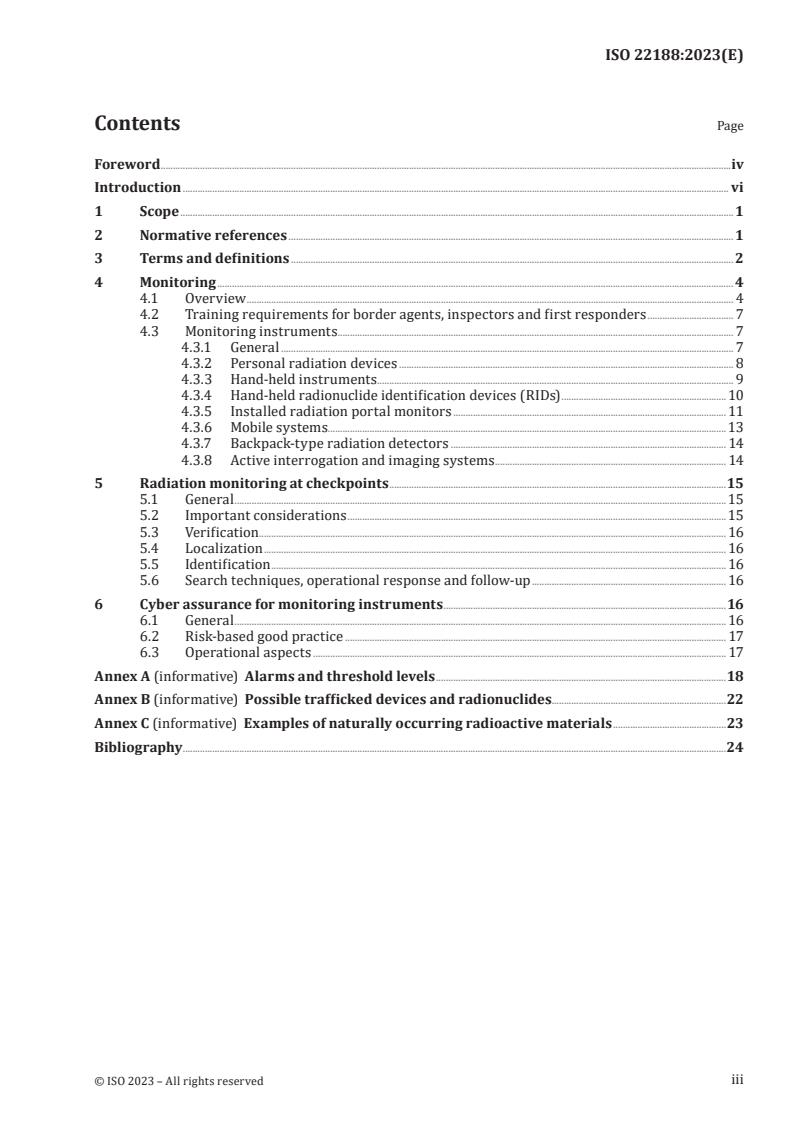
Contents Page
Foreword .iv
Introduction . vi
1 Scope . 1
2 Normative references . 1
3 Terms and definitions . 2
4 Monitoring . 4
4.1 Overview . 4
4.2 Training requirements for border agents, inspectors and first responders . 7
4.3 Monitoring instruments . 7
4.3.1 General . 7
4.3.2 Personal radiation devices . 8
4.3.3 Hand-held instruments. 9
4.3.4 Hand-held radionuclide identification devices (RIDs) . 10
4.3.5 Installed radiation portal monitors . 11
4.3.6 Mobile systems . . .13
4.3.7 Backpack-type radiation detectors . 14
4.3.8 Active interrogation and imaging systems . 14
5 Radiation monitoring at checkpoints .15
5.1 General . 15
5.2 Important considerations .15
5.3 Verification . . 16
5.4 Localization . 16
5.5 Identification . 16
5.6 Search techniques, operational response and follow-up . 16
6 Cyber assurance for monitoring instruments .16
6.1 General . 16
6.2 Risk-based good practice . 17
6.3 Operational aspects . 17
Annex A (informative) Alarms and threshold levels .18
Annex B (informative) Possible trafficked devices and radionuclides.22
Annex C (informative) Examples of naturally occurring radioactive materials .23
Bibliography .24
iii
Foreword
ISO (the International Organization for Standardization) is a worldwide federation of national standards
bodies (ISO member bodies). The work of preparing International Standards is normally carried out
through ISO technical committees. Each member body interested in a subject for which a technical
committee has been established has the right to be represented on that committee. International
organizations, governmental and non-governmental, in liaison with ISO, also take part in the work.
ISO collaborates closely with the International Electrotechnical Commission (IEC) on all matters of
electrotechnical standardization.
The procedures used to develop this document and those intended for its further maintenance are
described in the ISO/IEC Directives, Part 1. In particular, the different approval criteria needed for the
different types of ISO document should be noted. This document was drafted in accordance with the
editorial rules of the ISO/IEC Directives, Part 2 (see www.iso.org/directives).
ISO draws attention to the possibility that the implementation of this document may involve the use
of (a) patent(s). ISO takes no position concerning the evidence, validity or applicability of any claimed
patent rights in respect thereof. As of the date of publication of this document, ISO had not received
notice of (a) patent(s) which may be required to implement this document. However, implementers are
cautioned that this may not represent the latest information, which may be obtained from the patent
database available at www.iso.org/patents. ISO shall not be held responsible for identifying any or all
such patent rights.
Any trade name used in this document is information given for the convenience of users and does not
constitute an endorsement.
For an explanation of the voluntary nature of standards, the meaning of ISO specific terms and
expressions related to conformity assessment, as well as information about ISO's adherence to
the World Trade Organization (WTO) principles in the Technical Barriers to Trade (TBT), see
www.iso.org/iso/foreword.html.
This document was prepared by Technical Committee ISO/TC 85, Nuclear energy, nuclear technologies
and radiological protection, Subcommittee SC 2, Radiological protection.
This second edition cancels and replaces the first edition (ISO 22188:2004), which has been technically
revised.
The main changes are as follows:
— Update of the introduction, considering the continuous development of technology.
— Update of Clause 2.
— There were 14 terms and definitions listed in the first edition (ISO 22188:2004). According to
related standards and IAEA technical documents,
— the following terms have been deleted: 3.1 control of radioactive material, 3.9 non-proliferation,
3.10 physical protection, 3.12 response, 3.13 safeguards and 3.14 special nuclear material;
— the following terms have been added: 3.1 check source, 3.2 competent authority, 3.3 computer
security, 3.9 nuclear material, 3.10 radioactive contamination, 3.11 radioactive material,
3.12 radiological monitoring, 3.13 radionuclide, 3.15 threat, 3.16 threat assessment and 3.17
threshold level. Terms and definitions count updated to 17.
— According to the standard’s title, “instruments” in the title of Clause 4 was deleted. Originally, there
were 4 types of instruments categorized in the first edition (ISO 22188:2004); they were pocket-
type instruments, hand-held instruments, installed instruments and radionuclide identifiers. In
this second edition, the kinds of devices are updated to 7. Individually, they are personal radiation
devices, hand-held instruments, hand-held radionuclide identification devices, installed radiation
portal monitors, mobile systems, backpack-type radiation detectors, active interrogation and
iv
imaging systems. For each instrument the general characteristics, operation, calibration and
routine testing, minimum performance requirements and test methods are presented. References
to the IEC standards covering the performance requirements for these types of instruments were
added and the requirements listed in this document were removed.
— This document primarily covers radiological monitoring at borders from a technical and operational
viewpoint. Whether, when or where to establish radiological monitoring at borders should be the
result of a comprehensive national regulatory strategy for radioactive material control. Therefore,
the training requirements for border agents, inspectors and first responders have been added (see
4.2).
— Radiation monitoring systems, particularly those which are networked, connected to the internet or
use cloud services, are vulnerable to a range of cyber threats. The computer security of these systems
seeks to maintain the integrity, accessibility, authenticity and, where required, the confidentiality
of data and instrument control. Guidance from national authorities for computer security should
be sought by end-users for maintaining business continuity and reliability of radiation monitoring
services and systems. A new Clause 6 has been added to deal with this issue.
— Parts of Annex A, and all of Annex B and Annex C were integrated into the text of Clauses 4 and 5
of the revised document. Annex D was eliminated and references to applicable IEC standards were
given for performance requirements and test methods. Annex A was rewritten and simplified as
Alarms and threshold levels. A new Annex B was added to list the possible trafficked devices and
radionuclides. Examples of naturally occurring radioactive material remain as Annex C.
— Update of the Bibliography.
Any feedback or questions on this document should be directed to the user’s national standards body. A
complete listing of these bodies can be found at www.iso.org/members.html.
v
Introduction
The International Atomic Energy Agency (IAEA) Incident and Trafficking Database (ITDB) system
has been recording incidents of inadvertent movement and illicit trafficking of nuclear and other
radioactive materials since 1995. Although the numbers of reported incidents fluctuate over time, those
related to trafficking or malicious use remain a concern. A small number of these reported incidents
involve seizures of potentially weapons-usable nuclear material, but the majority involve unauthorized
activities including stolen or missing radioactive material and the detection of contaminated
manufactured goods. Examples include unintentional incorporation of radioactive materials into
recycled steel, handling of lost radioactive sources by unsuspecting individuals, and deliberate theft of
radioactive material.
The potential radiological hazard to workers, the general public and the environment caused by
misappropriated radioactive materials adds an additional threat to inadvertent movement and illicit
trafficking. There have been instances in which loss of control over radioactive materials has led to
serious, even fatal, consequences. Detection of radioactive materials at border crossings as well as
maritime ports, airports and inside countries, for example at check points, is therefore an important
issue.
This document addresses the procedural aspects of detecting radioactive materials. The procedural
aspects cover the techniques to search, locate and possibly identify radioactive substances. Guidelines
for appropriate training programs and maintenance of equipment are also considered a relevant aspect.
Instruments used in the process are characterized with respect to minimum requirements in order
to make the recommended procedures applicable. These include personal radiation devices, hand-
held instruments, hand-held radionuclide identification devices, installed radiation portal monitors,
backpack-type radiation detectors, mobile systems, active interrogation, and imaging systems.
Specifications for the minimum performance requirements and test methods for instrumentation are
covered by other existing standards, which are listed in the normative references clause.
Due to advances continually being made in the field of border radiation monitoring equipment, it is
assumed that it can represent a consensus on the minimum specifications presently achievable.
It is assumed that this document will allow more efficient use and operation of existing equipment,
enhance communication across borders, and encourage activities to detect and counteract inadvertent
movement and illicit trafficking of radioactive materials. The benefits thus gained contribute towards
the efforts to counter nuclear weapons proliferation and increase radiation protection. A lack of
standardization can delay implementation of intended activities, specifically if certain parameters, for
example threshold level, are not agreed upon internationally. Technical documents published by the
IAEA in this subject area provide a set of technical specification that can be used in design testing,
qualifying and purchasing border radiation monitoring equipment, they are the basis for recommending
justifiable and agreed specifications and procedures, see References [1], [2], [3], [4], [5], [6] and [7].
vi
INTERNATIONAL STANDARD ISO 22188:2023(E)
Monitoring for inadvertent movement and illicit trafficking
of radioactive material
1 Scope
This document specifies methods and means of monitoring for inadvertent movement and illicit
trafficking of radioactive material. It provides guidelines on the use of both stationary and portable,
for example hand-held, instruments to monitor for radiation signatures from radioactive material.
Emphasis is placed on the operational aspects, i.e., requirements derived for monitoring of traffic
and commodities mainly at border-crossing facilities. Although the term border is used repeatedly
in this document, it is meant to apply not only to international land borders but also maritime ports,
airports, and similar locations where goods or individuals are being checked. This document does not
specifically address the issue of detection of radioactive materials at recycling facilities, although it is
recognized that transboundary movement of metals for recycling occurs, and that monitoring of scrap
metals might be done at the borders of a state.
This document is applicable to
— regulatory bodies and other competent authorities seeking guidance on implementation of action
plans to combat illicit trafficking,
— law enforcement agencies, for example border guards, to obtain guidelines on recommended
monitoring procedures,
— equipment manufacturers in order to understand minimum requirements derived from operational
necessities according to this document, and
— end-users of radiation detection equipment applicable to this document.
2 Normative references
The following documents are referred to in the text in such a way that some or all of their content
constitutes requirements of this document. For dated references, only the edition cited applies. For
undated references, the latest edition of the referenced document (including any amendments) applies.
IEC 60325, Radiation protection instrumentation — Alpha, beta and alpha/beta (beta energy > 60keV)
contamination meters and monitors
IEC 61526, Radiation protection instrumentation — Measurement of personal dose equivalents H (10) and
p
H (0,07) for X, gamma, neutron and beta radiations – Direct reading personal dose equivalent meters
p
IEC 62244, Radiation protection instrumentation — Installed radiation portal monitors (RPMs) for the
detection of illicit trafficking of radioactive and nuclear materials
IEC 62327, Radiation protection instrumentation — Hand-held instruments for the detection and
identification of radionuclides and for the estimation of ambient dose equivalent rate from photon radiation
IEC 62387, Radiation protection instrumentation — Dosimetry systems with integrating passive detectors
for individual, workplace and environmental monitoring of photon and beta radiation
IEC 62401, Radiation protection instrumentation — Alarming personal radiation devices (PRDs) for the
detection of illicit trafficking of radioactive material
IEC 62484, Radiation protection instrumentation — Spectrometric radiation portal monitors (SRPMs)
used for the detection and identification of illicit trafficking of radioactive material
IEC 62533, Radiation protection instrumentation — Highly sensitive hand-held instruments for photon
detection of radioactive material
IEC 62534, Radiation protection instrumentation — Highly sensitive hand-held instruments for neutron
detection of radioactive material
IEC 62618, Radiation protection instrumentation — Spectroscopy-based alarming Personal Radiation
Detectors (SPRD) for the detection of illicit trafficking of radioactive material
IEC 62694, Radiation protection instrumentation — Backpack-type radiation detector (BRD) for the
detection of illicit trafficking of radioactive material
IEC 62945, Radiation protection instrumentation — Measuring the imaging performance of X-ray
computed tomography (CT) security screening systems
IEC 62963, Radiation protection instrumentation — X-ray computed tomography (CT) inspection systems
of bottled/canned liquids
IEC 63085, Radiation protection instrumentation — System of spectral identification of liquids in
transparent and semitransparent container (Raman systems)
IEC 63121, Radiation protection instrumentation — Vehicle-mounted mobile systems for the detection of
illicit trafficking of radioactive materials
3 Terms and definitions
For the purposes of this document, the following terms and definitions apply.
ISO and IEC maintain terminology databases for use in standardization at the following addresses:
— ISO Online browsing platform: available at https:// www .iso .org/ obp
— IEC Electropedia: available at https:// www .electropedia .org/
3.1
check source
radioactive source, not necessarily calibrated, used to confirm the continuing satisfactory operation of
an instrument designed to detect photonic or particulate radiation
3.2
competent authority
any body or authority designated or otherwise recognized as such for any purpose in connection with
the transport regulations
[SOURCE: IAEA Nuclear Safety and Security Glossary: 2022(interim) edition. Vienna: IAEA, 2022. 248 p]
Note 1 to entry: This term is used only with reference to the Transport Regulations for consistency with
terminology used in the wider field of regulation of the transport of dangerous goods. Otherwise, the more
general term regulatory body should be used, with which competent authority is essentially synonymous.
3.3
computer security
particular aspect of information security that is concerned with the protection of computer-based
systems against compromise
[SOURCE: IAEA Nuclear Safety and Security Glossary: 2022(interim) edition. Vienna: IAEA, 2022. 248 p]
3.4
detection
discovery of the presence of radioactive material on the basis of measurements and interpretation of
results
3.5
detection limit
smallest true value of the measurand which ensures a specified probability of being detectable by the
measurement procedure
[SOURCE: ISO 12749-1: 2020, 3.4.11]
3.6
false-alarm rate
rate of alarms which are not caused by a radioactive source under the specified background conditions
3.7
illicit trafficking
any intentional unauthorized movement of radioactive materials, particularly across national borders,
for subsequent illegal sale, use, storage or further transfer
3.8
inadvertent movement
any unintentional unauthorized receipt, possession, use or transfer of radioactive materials
3.9
nuclear material
238 233
plutonium except that with isotopic concentration exceeding 80 % in Pu; U; uranium enriched in
the isotope 235 or 233; uranium containing the mixture of isotopes as occurring in nature other than in
the form of ore or ore residue; any material containing one or more of the foregoing
[SOURCE: IAEA Nuclear Safety and Security Glossary: 2022(interim) edition. Vienna: IAEA, 2022. 248 p]
3.10
radioactive contamination
radioactive substances on surfaces, or within solids, liquids or gases (including the human body), where
their presence is unintended or undesirable, or the process giving rise to their presence in such places
[SOURCE: ISO 12749-1: 2020, 3.3.4]
3.11
radioactive material
material designated in national law or by a regulatory body as being subject to regulatory control
because of its radioactivity
[SOURCE: IAEA Nuclear Safety and Security Glossary: 2022(interim) edition. Vienna: IAEA, 2022. 248 p]
Note 1 to entry: This is the “regulatory” meaning of radioactive, and should not be confused with the “scientific”
meaning of radioactive.
Note 2 to entry: The term radioactive substance is also used to indicate that the “scientific” meaning of radioactive
is intended, rather than the “regulatory” meaning of radioactive suggested by the term radioactive material.
3.12
radiological monitoring
radiation monitoring
measurement of dose, dose rate or activity for reasons relating to the assessment or control of exposure
to radiation or exposure due to radioactive substances, and the interpretation of the results
[SOURCE: ISO 12749-1: 2020, 3.3.5]
Note 1 to entry: The general term “dose” refers to ambient dose equivalent if not stated otherwise in this
document.
3.13
radionuclide
nuclide which is in an unstable state due to excess of internal energy and which will attain a stable state
by emitting radiation
40 235 238 232
Note 1 to entry: Radionuclides are either naturally occurring radionuclides, such as K, U, U, Th and
their radioactive decay products or produced by activation or other artificial means.
[SOURCE: ISO 12749-1: 2020, 3.1.8]
3.14
regulatory body
authority or system of authorities designated by the government of a State as having legal authority for
conducting the regulatory process, including issuing authorizations, and thereby regulating nuclear,
radiation, radioactive waste and transport safety
[SOURCE: IAEA Nuclear Safety and Security Glossary: 2022(interim) edition. Vienna: IAEA, 2022. 248 p]
3.15
threat
person or group of persons with motivation, intention and capability to commit a malicious act
[SOURCE: IAEA Nuclear Safety and Security Glossary: 2022(interim) edition. Vienna: IAEA, 2022. 248 p]
3.16
threat assessment
evaluation of the threat (3.15), based on available intelligence, law enforcement, and open source
information, that describes the motivation, intentions, and capabilities of these threats
[SOURCE: IAEA Nuclear Safety and Security Glossary: 2022(interim) edition. Vienna: IAEA, 2022. 248 p]
3.17
threshold level
level of some measurable (or otherwise assessable) quantity such that, if that level is exceeded,
something happens.
[SOURCE: IAEA Nuclear Security glossary: 2020 edition, draft. Vienna: IAEA, 2020. 60 p]
Note 1 to entry: The threshold level for a detection instrument is a level of the measured quantity (for example, of
dose rate) that, if exceeded, triggers the instrument to generate an alarm. Such a threshold level is set by the user
of the instrument at the lowest level that might indicate some form of malicious act.
4 Monitoring
4.1 Overview
The process for detection of inadvertent movement or illicit trafficking of radioactive material
is illustrated by the flowchart in Figure 1. This provides an outline for the various clauses of this
document. It has the following main steps:
a) strategic evaluation of the need for border monitoring;
b) selection of instruments;
c) determination of threshold levels;
d) evaluation of alarms, by verification and localization of the radioactive material;
e) evaluation of radioactive material found.
This document primarily covers radiological monitoring at borders from a technical and operational
viewpoint. The decisions regarding whether, when, or where to establish radiological monitoring at
borders should result in a comprehensive national regulatory strategy for radioactive materials control.
One of the key factors in the development of a national strategy is threat assessment. By evaluating
historical, political, sociological, economic and geographic factors, a State can come to a reasonable
assessment as to the potential, or threat of illicit trafficking or inadvertent movement of radioactive
materials across its borders. For some countries, at certain border locations, monitoring may be
regarded as a necessary component of their overall strategy. For many others, the potential problem
is so low that it would not be considered sufficiently cost-beneficial to implement border monitoring.
However, it is recognized that sometimes radiological monitoring at borders is put in place more for
political, or public peace-of-mind reasons rather than a rational need based on a significant threat.
Should it be determined that border monitoring is needed, the results of the strategic analysis also
helps in the determination of the types of instruments to be used and where they should be deployed.
The monitoring process is most effective if it is conducted at locations that have the greatest potential
for identifying and intercepting illicit trafficking or inadvertent movement of radioactive material. In
general terms, these are “control points” or “nodal points” where the flow of people, vehicle movement
or freight converges. These locations may already be control points for other purposes, such as weigh-
stations or customs.
Figure 1 — Flowchart for detection of inadvertent movement or illicit trafficking of radioactive
material
4.2 Training requirements for border agents, inspectors and first responders
It is recommended that the agencies in charge of performing the monitoring for inadvertent movement
or illicit trafficking of radioactive material develop an operating procedure or tactical response plan
that describes the roles and responsibilities of the personnel involved in these activities. In addition, a
description of the type of response that the personnel follow based on the instruments’ measurement
results may also be part of the operating procedure. Training may be required to ensure that the
operating procedures are followed and that the users of instruments understand the functionality and
limitations of the instrumentation.
The monitoring and detection of inadvertent movement or illicit trafficking of radioactive materials
requires specialized training and basic technical knowledge. In the event that front-line officers are
unable to conduct an initial radiological hazard assessment, or recognize that they require assistance,
they should inform their duty supervisor. This individual should contact a pre-designated radiological
advisor. Suggested duties of the radiological advisor are listed in Reference [4] Annex III, and should
be contained in the State’s tactical response plan. This individual should automatically be deployed to
the scene if inadvertent movement or illicit trafficking of radioactive material incident is encountered.
However, it is appropriate to seek advice from the radiological advisor on the management of routine
incidents when there is any doubt or ambiguity in making the initial hazard assessment.
To minimize the potential for harmful radiation exposure and/or a serious incident, border agents,
inspectors and first responders tasked with the monitoring and detection of radioactive materials
should, as a minimum, have basic requisite training consisting of but not limited to
a) basic concepts on physics and types of radiation,
b) radioactivity and radiation hazards,
c) general awareness/familiarization as per Reference [1] subclause 313(a),
d) radiation protection and safety as per Reference [1] subclause 313(c),
e) radiation monitoring processes, detection and measurement skills, including theory of operation
for instruments on hand, routine checking (testing), maintenance, etc.,
f) risk and situation assessment, and
g) response to a radiation alarm.
Training shall be provided by an accredited individual; and shall be updated as required over the period
of employment. Personnel should receive a certificate, or record of training, upon successful completion.
Records of training shall be retained by the employer for the duration of the trainee’s employment, or
as required by regulatory authorities.
4.3 Monitoring instruments
4.3.1 General
There are different types of instruments that can be used for monitoring and detection of inadvertent
movement and illicit trafficking of radioactive material, these include
a) personal radiation devices,
b) hand-held instruments,
c) hand-held radionuclide identification devices (RIDs),
d) installed radiation portal monitors with or without spectrometry capabilities (SRPMs or RPMs) ,
e) backpack-type radiation detectors (BRDs),
f) mobile systems,
g) active interrogation, and
h) imaging systems.
As for most radiation detectors, manufacturers’ recommendations should be followed. The general
climatic, electromagnetic and mechanical performance requirements and methods of tests
requirements can address from Reference [8]. The data format used in the detection of illicit trafficking
of radioactive material should refer to Reference [9]. The guidance and recommendations for radiation
sources used in illicit trafficking detection are described in Reference [10].
Generally, the instrument is not used for routine measurements, and while some instrument
manufacturers provide recommendations for periodic calibrations, general guidance on appropriate
performance maintenance is lacking. Annual laboratory calibration intervals may not be practical or
appropriate for monitoring and detection of inadvertent movement and illicit trafficking of radioactive
material that are not covered by regulations. It is typically recommended that instrument calibration
be carried out annually by a qualified individual or maintenance facility. The period of calibration can
be adjusted based on the instrument performance and the user capabilities. (See Reference [11] [12]
[13] [14] [15] [16]).
The general characteristics, applications, requirements, and operation for each type of instruments are
listed in the subclauses below.
4.3.2 Personal radiation devices
4.3.2.1 General characteristics
These devices are small, lightweight devices used to detect the presence of radioactive material and to
inform the user about radiation levels. These devices, roughly the size of a mobile phone, which can be
worn on a belt or carried in a pocket for hands-free operation and alert the operator to the presence of
radioactive materials. Because of their small size, these devices are ideally suited for use by individual
law or border enforcement officers and first responders, for example front-line officer, fire fighters,
without requiring extensive training. Some of these devices can also provide radionuclide identification
capabilities.
There are different types of personal radiation devices. Even if similar in appearance these devices are
required to meet different types of requirements. These may include
a) personal radiation detectors (PRDs),
b) spectroscopy-based personal radiation detectors (SPRDs),
c) electronic personal dosimeters (EPDs),
d) extended range personal radiation detectors (ER-PRDs), and
e) personal emergency radiation detectors (PERDs).
A PRD is a small, lightweight, robust device, which alerts the wearer to radiation levels above
background from gamma-ray and X-ray radiation, and in some cases for neutrons. The SPRDs have the
same capabilities as the PRDs, but in addition have radionuclide identification capabilities. EPDs are
designed to be worn on workers in planned radiation exposure situations to measure the individual
dose. The ER-PRDs are dual detector instruments that extend the measurement range of a PRD without
losing the low dose rate sensitivity. PERDs are designed to measure the individual dose. These devices
can display radiation dose and dose rate. Its alarm function can work if the dose or dose rate exceeds a
pre-set threshold and can be used as a tool for responder dose monitoring.
4.3.2.2 Operation
PRDs, ER-PRDs and SPRDs are commonly used for monitoring for inadvertent movement and illicit
trafficking of radioactive materials. PRDs should be worn on the body, ideally the torso, in a pocket, on
a lanyard or belt or similar secured method. A self-testing feature should verify proper operation of the
instrument (including battery charge level) before usage. False alarms, i.e. alarms without radioactive
materials present, occur occasionally due to the fluctuations in background. When the alarm-threshold
is set properly, false alarms should occur not more than once per day. There is always a trade-off between
detection sensitivity and false alarms. Radiation triggering innocent alarms may be detected on an
occasional basis. This is due to the fact that many objects including, for example foodstuffs, dinnerware,
tiles, concrete, fertilizer, ice melt, sand, cat litter, etc., contain small quantities of radioactive material
such as potassium, radium, thorium or uranium. Also, persons who have undergone radiation therapy
or diagnosis may be sources of radiation. In some cases when the treatment or test was recently carried
out, the levels of radiation can be high.
4.3.2.3 Calibration and routine checking
Most personal radiation devices go through a self-checking routine when turned on. For its continued
ability to detect radiation, a personal radiation device should be checked on a daily basis or prior to
use, if possible. Functionality tests may be performed on these devices to assure proper response.
This may be done by placing the instrument near a low activity radioactive check source or naturally
occurring radioactive materials (NORM) (see Annex C) and observing its response to the radiation.
Manufacturers’ recommendations should be followed. Appropriate check sources (see Reference [14]),
with sufficient output to produce a significant reading on the instruments used, are very useful.
Like most radiation detectors, it is recommended that EPDs be regularly calibrated (as required by the
national regulatory authority).
4.3.2.4 Minimum performance requirements and test methods
PRDs shall meet the performance requirements described in IEC 62401, SPRDs in IEC 62618 and EPDs
in IEC 61526 and IEC 62387. These documents also describe the associated test methods.
4.3.3 Hand-held instruments
4.3.3.1 General characteristics
Hand-held instruments provide greater sensitivity of detection compared to PRDs, but they are heavier
and usually more expensive. For example, they would be chosen
a) when a suspicion of illicit trafficking already exists based on intelligence reports,
b) to localize a source,
c) to measure the dose rate, and
d) to identify the radionuclide.
Hand-held instruments are small, battery-powered radiation detection instruments that measure
the ambient background level and then calculate an alarm-threshold based on a sigma level above
background. Thus, these instruments can compensate for variations in the background level when
turned on, or on command. These instruments continuously make short time measurements of
the radiation level and compare the results to the alarm-threshold. The hand-held instruments
can effectively search pedestrians, packages, cargo, and motor vehicles at a close distance. These
instruments can alert the user to unexpected levels of radiation present in the background.
The most significant difference between the hand-held instruments and installed portal monitors is
the human factor that strongly influences the ability of a hand-held instrument to detect radioactive
materials in the field when placed at a close distance and moved at a slow speed. If the officer does not
move the instrument at a slow enough speed and in close enough proximity to any radioactive material
that is present, it may not be detected.
The hand-held instruments can be placed nearer to the radioactive material where the dose rate is
higher, thus yielding higher sensitivity to the radiation signature. To achieve that sensitivity, border
agents, inspectors and first responders shall be trained in the proper technique to conduct effective
searches, and the training should be repeated periodically.
Hand-held instruments are designed to measure one or more of photon, alpha, beta or neutron
radiations. For interdiction and detection activities, the most common type is the hand-held instruments
with gamma detection capabilities, and in some cases with neutron detection. Hand-held instruments
with alpha and beta detectors are mostly used for detection of radioactive contamination. These may
be used by agencies to clear people or packages that are potentially contaminated with radioactive
materials.
4.3.3.2 Operation
Hand-held instruments can be used either as the primary search instruments or as second-stage search
instruments for installed radiation portal monitors. This type of instruments is used to facilitate the
localisation of radiation sources by providing an alarm and/or a frequency dependent alarm indication
on dose rate or count rate.
4.3.3.3 Calibration and routine testing
A hand-held instrument should be source checked daily or prior to use, if possible, for its continued
ability to detect radiation. This may be done by placement of the instrument near a radiation check
source and observing a repeatable radiation level.
Like most radiation detectors that provide dose rate measurements, it is recommended that these
instruments be calibrated periodically (as required by the national regulatory authority).
4.3.3.4 Minimum performance requirements and test methods
Hand-held instruments shall meet the performance requirements of one of the following standards:
— contamination meters covered by IEC 60325;
— highly sensitive gamma detectors covered by IEC 62533;
— highly sensitive neutron detectors covered by IEC 62534.
These documents also describe the associated test methods.
4.3.4 Hand-held radionuclide identification devices (RIDs)
4.3.4.1 General characteristics
RIDs are hand-held, battery-powered devices used for in field radionuclide identification of radioactive
materials by non-experts. These instruments provide self-calibration and gain stabilization based on
137 40
an internal or external source (e.g. Cs, K).
Most of the radionuclides encountered at borders can be identified by instruments capable of identifying
gamma-ray energy peaks between 60 keV and at least 1,5 MeV (in most cases a maximum range
232 232
of 3 MeV is recommended for the identification of U or Th). These devices use scintillator or solid-
state detectors (such as sodium iodine (NaI(Tl)), high purity germanium (HPGe), etc.) to discriminate
different gamma-ray energies emitted by radioactive nuclides (i.e. radionuclides).
These devices can provide a radiation exposure or dose rate display, as they are equipped with several
detectors that may include a Geiger-Muller (GM) tube. Some of these devices are also equipped with a
neutron detector.
A library of common radionuclides (and in some cases the number of gamma-ray lines for a given
radionuclide) stored within the RID’s CPU allows the devices to identify the radionuclides found with
a high level confidence. Compilation, editing, optimizing and testing of the radionuclide libraries used
are essential and should be carefully programmed by the developer or an expert user. The radionuclide
library should be tailored to the radionuclides commonly encountered at a given location. These
devices provide a message when radiation is detected, the radionuclide is not in the library, or when the
counting statistics are poor.
For the purpose of this document, the term radioactive materials may be used in reference to nuclear
materials, industrial radionuclides, medical radionuclides and NORMs, for example
233 235 238 239 241
a) Nuclear materials: U, U, U, Pu, Pu,
57 60 75 90 133 137 152 192 203 226 241 238
b) Industrial radionuclides: Co, Co, Se, Sr, Ba, Cs, Eu, Ir, Hg, Ra, Am, Pu,
Cf,
18 22 51 67 99 99m 103 201 123 125 131 133 111
c) Medical radionuclides:
...
Questions, Comments and Discussion
Ask us and Technical Secretary will try to provide an answer. You can facilitate discussion about the standard in here.
Loading comments...