

ISO 24427:2025
(Main)Radiological protection — Medical proton accelerators — Requirements and recommendations for shielding design and evaluation
General Information
- Abstract
This document is applicable to the radiation shielding design and evaluation work for medical proton accelerators of proton energies ranging from 70 MeV to 250 MeV, with subsystems such as beam transport system and nozzle components. The radiation protection recommendations given in this document cover the aspects relating to regulations, shielding design goals and other design criteria, role of the manufacturers, of the radiation protection officer or qualified expert, the medical physicist, the licensee and interactions between them, sources and radiations around a proton accelerator, shielding for accelerators and its subsystems (including shielding materials and transmission values, calculations for various room configurations, duct impact on radiation protection) and the radiological measurements. FLASH proton therapy is not covered by this document. NOTE 1 Annex A provides a list of the most used Monte-Carlo codes for shielding calculation. NOTE 2 Annex B provides the analytical methods and the corresponding necessary data for shielding calculation. NOTE 3 Annex C provides a set of examples on shielding calculation of barriers, maze and skyshine problems. NOTE 4 Annex D provides radiation shielding consideration on special topics.
- Status
- Published
- Publication Date
- 15-Sep-2025
- Technical Committee
- ISO/TC 85/SC 2 - Radiological protection
- Current Stage
- 6060 - International Standard published
- Start Date
- 16-Sep-2025
- Due Date
- 21-Jun-2025
- Completion Date
- 16-Sep-2025
Overview
ISO 24427:2025 - Radiological protection - Medical proton accelerators - Requirements and recommendations for shielding design and evaluation provides an international framework for the radiation shielding design and evaluation of medical proton accelerators with proton energies from 70 MeV to 250 MeV. It addresses shielding for the accelerator, beam transport systems and nozzle components, defines design goals and assumptions, and sets out measurement and evaluation practices. FLASH proton therapy is explicitly excluded.
Key topics and technical requirements
- Shielding design goals and criteria: guidance on regulatory compliance, design assumptions, and acceptable exposure limits for controlled and supervised areas.
- Roles and interactions: responsibilities of manufacturers, general contractors, radiation protection officers/qualified experts, medical physicists and licensees during design, construction and commissioning.
- Radiation sources: description of prompt and shutdown radiation fields around proton accelerators, including secondary neutrons and photon radiation produced at beam-loss locations (cyclotron/synchrotron, beam transport, nozzles, patient/phantom).
- Shielding materials and transmission: discussion of common materials (ordinary and high-density concrete, steel) and transmission values used in shielding calculations.
- Calculation methods: recommended use of Monte‑Carlo simulation (Annex A lists commonly used codes and basic requirements) and analytical methods (Annex B) for barrier, maze, duct and skyshine problems. Annex C provides worked examples; Annex D covers special topics.
- Practical evaluation: measurement methodologies, survey instrumentation and evaluation procedures to verify that installed shielding meets design intent and national requirements.
Practical applications - who uses ISO 24427:2025
- Medical physicists and radiation protection officers: for defining shielding specifications, acceptance testing and ongoing radiological surveys.
- Proton therapy system manufacturers: to provide required shielding data and integration guidance.
- Architects and general contractors: to implement barrier designs and duct/maze configurations that meet radioprotection goals.
- Regulatory bodies and licensees: to assess compliance with national radiation protection rules during licensing and commissioning.
- Shielding engineers and consultants: to perform Monte‑Carlo or analytical calculations and produce verification reports.
Related standards
- ISO 16645 - Radiological protection for medical electron accelerators (complementary guidance).
- ISO 12749-2 and ISO 80000-10 - terminology and quantities.
- IEC 60601-2-64 - device-level safety for light‑ion/proton accelerators (complementary to facility shielding).
ISO 24427:2025 is essential for anyone involved in the design, construction, commissioning or regulatory oversight of proton therapy facilities seeking standardized, practical guidance on shielding design, calculation methods and radiological evaluation.
Get Certified
Connect with accredited certification bodies for this standard

CIS Institut d.o.o.
Personal Protective Equipment (PPE) certification body. Notified Body NB-2890 for EU Regulation 2016/425 PPE.

Kiwa BDA Testing
Building and construction product certification.
Kmetijski inštitut Slovenije
Agricultural Institute of Slovenia. Soil testing, plant health, agricultural product analysis.
Sponsored listings
Frequently Asked Questions
ISO 24427:2025 is a standard published by the International Organization for Standardization (ISO). Its full title is "Radiological protection — Medical proton accelerators — Requirements and recommendations for shielding design and evaluation". This standard covers: This document is applicable to the radiation shielding design and evaluation work for medical proton accelerators of proton energies ranging from 70 MeV to 250 MeV, with subsystems such as beam transport system and nozzle components. The radiation protection recommendations given in this document cover the aspects relating to regulations, shielding design goals and other design criteria, role of the manufacturers, of the radiation protection officer or qualified expert, the medical physicist, the licensee and interactions between them, sources and radiations around a proton accelerator, shielding for accelerators and its subsystems (including shielding materials and transmission values, calculations for various room configurations, duct impact on radiation protection) and the radiological measurements. FLASH proton therapy is not covered by this document. NOTE 1 Annex A provides a list of the most used Monte-Carlo codes for shielding calculation. NOTE 2 Annex B provides the analytical methods and the corresponding necessary data for shielding calculation. NOTE 3 Annex C provides a set of examples on shielding calculation of barriers, maze and skyshine problems. NOTE 4 Annex D provides radiation shielding consideration on special topics.
This document is applicable to the radiation shielding design and evaluation work for medical proton accelerators of proton energies ranging from 70 MeV to 250 MeV, with subsystems such as beam transport system and nozzle components. The radiation protection recommendations given in this document cover the aspects relating to regulations, shielding design goals and other design criteria, role of the manufacturers, of the radiation protection officer or qualified expert, the medical physicist, the licensee and interactions between them, sources and radiations around a proton accelerator, shielding for accelerators and its subsystems (including shielding materials and transmission values, calculations for various room configurations, duct impact on radiation protection) and the radiological measurements. FLASH proton therapy is not covered by this document. NOTE 1 Annex A provides a list of the most used Monte-Carlo codes for shielding calculation. NOTE 2 Annex B provides the analytical methods and the corresponding necessary data for shielding calculation. NOTE 3 Annex C provides a set of examples on shielding calculation of barriers, maze and skyshine problems. NOTE 4 Annex D provides radiation shielding consideration on special topics.
ISO 24427:2025 is classified under the following ICS (International Classification for Standards) categories: 13.280 - Radiation protection. The ICS classification helps identify the subject area and facilitates finding related standards.
ISO 24427:2025 is available in PDF format for immediate download after purchase. The document can be added to your cart and obtained through the secure checkout process. Digital delivery ensures instant access to the complete standard document.
Standards Content (Sample)
International
Standard
ISO 24427
First edition
Radiological protection —
2025-09
Medical proton accelerators
— Requirements and
recommendations for shielding
design and evaluation
Radioprotection — Accélérateurs médicaux de protons —
Exigences et recommendations pour la conception et l'évaluation
du blindage
Reference number
© ISO 2025
All rights reserved. Unless otherwise specified, or required in the context of its implementation, no part of this publication may
be reproduced or utilized otherwise in any form or by any means, electronic or mechanical, including photocopying, or posting on
the internet or an intranet, without prior written permission. Permission can be requested from either ISO at the address below
or ISO’s member body in the country of the requester.
ISO copyright office
CP 401 • Ch. de Blandonnet 8
CH-1214 Vernier, Geneva
Phone: +41 22 749 01 11
Email: copyright@iso.org
Website: www.iso.org
Published in Switzerland
ii
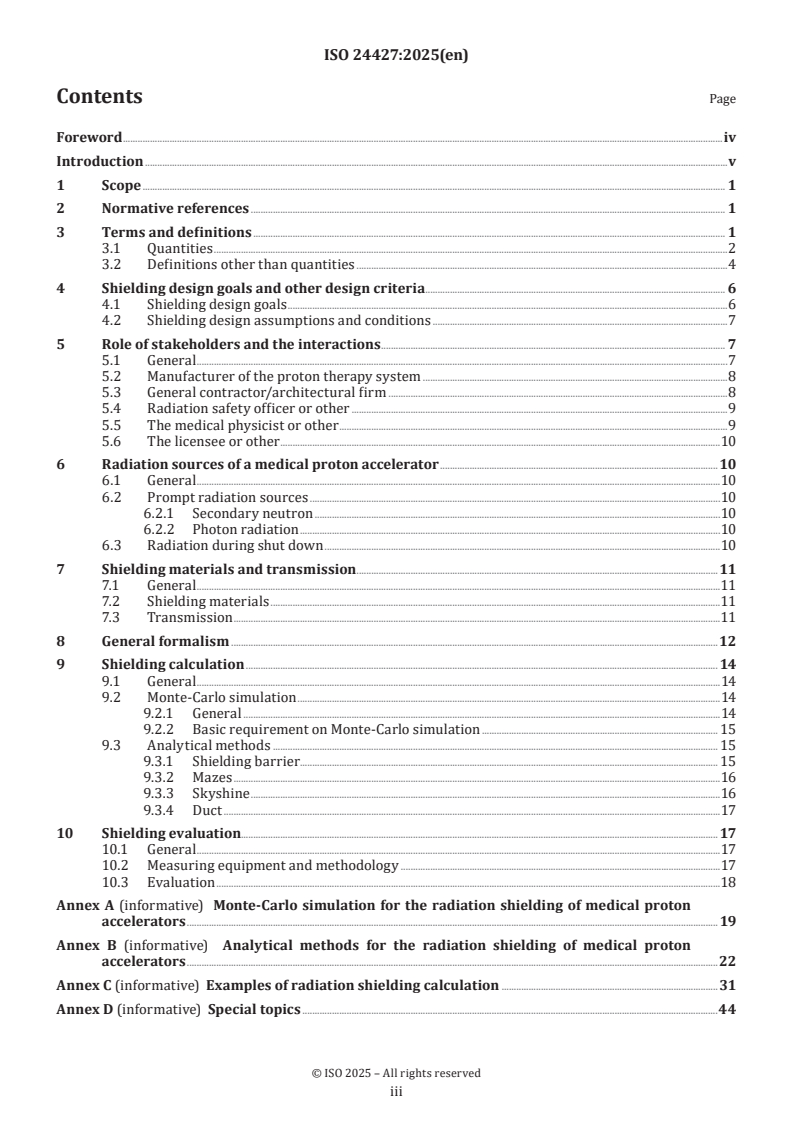
Contents Page
Foreword .iv
Introduction .v
1 Scope . 1
2 Normative references . 1
3 Terms and definitions . 1
3.1 Quantities .2
3.2 Definitions other than quantities .4
4 Shielding design goals and other design criteria . 6
4.1 Shielding design goals .6
4.2 Shielding design assumptions and conditions .7
5 Role of stakeholders and the interactions . 7
5.1 General .7
5.2 Manufacturer of the proton therapy system .8
5.3 General contractor/architectural firm .8
5.4 Radiation safety officer or other .9
5.5 The medical physicist or other .9
5.6 The licensee or other .10
6 Radiation sources of a medical proton accelerator . 10
6.1 General .10
6.2 Prompt radiation sources .10
6.2.1 Secondary neutron .10
6.2.2 Photon radiation .10
6.3 Radiation during shut down .10
7 Shielding materials and transmission . .11
7.1 General .11
7.2 Shielding materials .11
7.3 Transmission .11
8 General formalism .12
9 Shielding calculation . 14
9.1 General .14
9.2 Monte-Carlo simulation .14
9.2.1 General .14
9.2.2 Basic requirement on Monte-Carlo simulation . 15
9.3 Analytical methods . 15
9.3.1 Shielding barrier. 15
9.3.2 Mazes .16
9.3.3 Skyshine .16
9.3.4 Duct .17
10 Shielding evaluation. 17
10.1 General .17
10.2 Measuring equipment and methodology .17
10.3 Evaluation .18
Annex A (informative) Monte-Carlo simulation for the radiation shielding of medical proton
accelerators . 19
Annex B (informative) Analytical methods for the radiation shielding of medical proton
accelerators .22
Annex C (informative) Examples of radiation shielding calculation .31
Annex D (informative) Special topics .44
iii
Foreword
ISO (the International Organization for Standardization) is a worldwide federation of national standards
bodies (ISO member bodies). The work of preparing International Standards is normally carried out through
ISO technical committees. Each member body interested in a subject for which a technical committee
has been established has the right to be represented on that committee. International organizations,
governmental and non-governmental, in liaison with ISO, also take part in the work. ISO collaborates closely
with the International Electrotechnical Commission (IEC) on all matters of electrotechnical standardization.
The procedures used to develop this document and those intended for its further maintenance are described
in the ISO/IEC Directives, Part 1. In particular the different approval criteria needed for the different types
of ISO documents should be noted. This document was drafted in accordance with the editorial rules of the
ISO/IEC Directives, Part 2 (see www.iso.org/directives).
ISO draws attention to the possibility that the implementation of this document may involve the use of (a)
patent(s). ISO takes no position concerning the evidence, validity or applicability of any claimed patent
rights in respect thereof. As of the date of publication of this document, ISO had not received notice of (a)
patent(s) which may be required to implement this document. However, implementers are cautioned that
this may not represent the latest information, which may be obtained from the patent database available at
www.iso.org/patents. ISO shall not be held responsible for identifying any or all such patent rights.
Any trade name used in this document is information given for the convenience of users and does not
constitute an endorsement.
For an explanation on the voluntary nature of standards, the meaning of ISO specific terms and
expressions related to conformity assessment, as well as information about ISO's adherence to the World
Trade Organization (WTO) principles in the Technical Barriers to Trade (TBT) see the following URL:
www.iso.org/iso/foreword.html.
This document was prepared by Technical Committee ISO/TC 85, Nuclear energy, nuclear technologies, and
radiological protection, Subcommittee SC 2, Radiological protection.
Any feedback or questions on this document should be directed to the user's national standards body. A
complete listing of these bodies can be found at www.iso.org/members.html.
iv
Introduction
Protons deliver most of their energy at a prescribed, programmable distance inside the body, known as the
Bragg Peak. With this feature, proton therapy is used to treat many cancers and is particularly appropriate in
situations where treatment options are limited and conventional radiotherapy using photon beam presents
unacceptable risks to patients. The use of proton accelerators to administer external beam radiation has
been evolving and the proton therapy centres are rising worldwide.
A typical large proton therapy centre consists of an injector, a cyclotron or synchrotron to accelerate the
particles, high-energy beam selection and transport system, several treatment rooms (fixed beam and/or
gantry) and, occasionally, a research room. Strong secondary radiation, particularly high energy neutrons,
is produced at locations where beam losses occur. Such losses may occur in the cyclotron or synchrotron
along the beam transport system during acceleration, extraction, energy degradation and transport of the
protons to the treatment room, and in the treatment and research nozzles. In addition, the production of
proton beam interactions in the patient, beam stop, or dosimetry phantom also results in stray radiation
production. As a result, meters-thick barriers are generally used around the entire accelerator system.
The radiation shielding of proton therapy centre is quite complex and become one of the key elements to
commission a proton therapy centre, in the perspective of both capital and time consumed.
IEC 60601-2-64 relates to the design and the construction of the light ion, including proton, accelerators
[1] [2][3] [4][5][5]
to ensure the safety of their operation . Several national or international reports propose
recommendations concerning the installation, the commissioning, and the operation of these accelerators,
the safety devices, the design and the calculation of protection barriers, the radiological control and
[7][8][9][10]
monitoring. National standards have been established in certain countries. Moreover, national
regulations generally impose rules of protection against radiation, in particular relating to the definition of
the controlled area and supervised area and the calculation of shielding.
Considering the developments of proton therapy techniques and of new designs of proton therapy facilities on
the one hand, and the variety of guidelines or normative documents on the other hand, it appeared judicious
to establish an international standard to be used as a general framework. This document is intended to be
complementary to the other international standards (IEC and IAEA).
The following items are discussed in this document:
— shielding design assumption and goals;
— radiation fields;
— materials for radiation shielding: concrete (ordinary or high density), steels;
— role of stakeholders;
— general formalism for shielding calculations;
— calculation methods;
— radiation survey of the completed installation to ensure national requirements have been met and the
shielding design is fit for purpose after installation of the accelerator.
v
International Standard ISO 24427:2025(en)
Radiological protection — Medical proton accelerators —
Requirements and recommendations for shielding design and
evaluation
1 Scope
This document is applicable to the radiation shielding design and evaluation work for medical proton
accelerators of proton energies ranging from 70 MeV to 250 MeV, with subsystems such as beam transport
system and nozzle components.
The radiation protection recommendations given in this document cover the aspects relating to regulations,
shielding design goals and other design criteria, role of the manufacturers, of the radiation protection
officer or qualified expert, the medical physicist, the licensee and interactions between them, sources and
radiations around a proton accelerator, shielding for accelerators and its subsystems (including shielding
materials and transmission values, calculations for various room configurations, duct impact on radiation
protection) and the radiological measurements.
FLASH proton therapy is not covered by this document.
NOTE 1 Annex A provides a list of the most used Monte-Carlo codes for shielding calculation.
NOTE 2 Annex B provides the analytical methods and the corresponding necessary data for shielding calculation.
NOTE 3 Annex C provides a set of examples on shielding calculation of barriers, maze and skyshine problems.
NOTE 4 Annex D provides radiation shielding consideration on special topics.
2 Normative references
The following documents are referred to in the text in such a way that some or all of their content constitutes
requirements of this document. For dated references, only the edition cited applies. For undated references,
the latest edition of the referenced document (including any amendments) applies.
ISO 12749-2, Nuclear energy, nuclear technologies, and radiological protection — Vocabulary — Part 2:
Radiological protection
ISO 16645, Radiological protection — Medical electron accelerators — Requirements and recommendations for
shielding design and evaluation
ISO 80000-10, Quantities and units — Part 10: Atomic and nuclear physics
3 Terms and definitions
For the purposes of this document, the terms and definitions given in ISO 12749-2, ISO 16645, ISO 80000-10
and the following apply.
ISO and IEC maintain terminology databases for use in standardization at the following addresses:
— ISO Online browsing platform: available at https:// www .iso .org/ obp
— IEC Electropedia: available at https:// www .electropedia .org/
3.1 Quantities
3.1.1
absorbed dose
D
differential quotient of ε with respect to m, where ε is the mean energy imparted by ionizing radiation to
matter of mass m:
dε
D=
m
d
-1
Note 1 to entry: The gray (Gy) is special name for Joule per kilogram (J·kg ) to be used as the coherent SI unit for
absorbed dose.
[SOURCE: ISO 12749-2:2022, 3.1.20]
3.1.2
dose equivalent
H
product of the absorbed dose D (3.1.1) to tissue at the point of interest and the quality factor Q at that point:
HD=⋅Q
-1
Note 1 to entry: The sievert (Sv) is special name for Joule per kilogram (J·kg ) to be used as the coherent SI unit for
dose equivalent.
[SOURCE: ISO 12749-2:2022, 3.1.22]
3.1.3
effective dose
E
tissue-weighted sum of the equivalent doses in all specified tissues and organs of the body, given by the
expression:
Ew= wD or Ew= H
∑∑T RT,R ∑ TT
T R T
where H or wD is the equivalent dose in a tissue or organ, T and w is the tissue weighting factor.
T RT,R T
-1
Note 1 to entry: The sievert (Sv) is special name for Joule per kilogram (J·kg ) to be used as the coherent SI unit for
effective dose.
[SOURCE: ISO 12749-2:2022, 3.1.24]
3.1.4
instantaneous dose equivalent rate
H
IDR
-1
"ambient/personal" dose equivalent rate (Sv·h ) as measured with the accelerator operating
Note 1 to entry: This is the direct reading of the ratemeter that gives a stable reading in dose equivalent per hour.
-1
[SOURCE: ISO 16645:2016, 3.1.5, modified by deleting “at the absorbed dose rate DR (Gy·h ) and H is
0 IDR
specified at a reference point (30 cm) beyond the penetrated barrier”]
3.1.5
time averaged dose equivalent rate
H
TADR
barrier attenuated dose equivalent rate averaged over a specified period of accelerator operation
Note 1 to entry: H is proportional to instantaneous dose equivalent rate, H (3.1.4), and depends on the values
TADR IDR
of workload (W) and orientation or use factor (U).
[SOURCE: ISO 16645:2016, 3.1.14]
3.1.6
occupancy factor
T
typical fraction of time for which a location is occupied by an individual or group.
[SOURCE: ISO 12749-2:2022, 3.2.23]
3.1.7
orientation or use factor
U
fraction of the time during which the radiation under consideration is directed at a particular barrier
[SOURCE: ISO 16645:2016, 3.1.8]
3.1.8
shielding design goal
P
practical values of dose equivalent, H (3.1.2) or effective dose, E (3.1.3), for a single proton therapy source or
set of sources, evaluated at a reference point beyond a protective barrier
Note 1 to entry: The shielding design goals ensure that the respective annual values for effective dose limit defined by
national regulation or IAEA/ICRP for controlled and uncontrolled areas are not exceeded.
[SOURCE: ISO 16645:2016, 3.1.10]
3.1.9
transmission factor
B
ratio of radiation field intensity at a location behind the barrier on which radiation is incident to the field
intensity at the same location without the presence of the shield, for a given radiation type and quality
Note 1 to entry: B is a measure of the shielding effectiveness of the barrier.
[SOURCE: ISO 16645:2016, 3.1.15]
3.1.10
attenuation length
λ
thickness of a specific material that reduces a specified radiation field intensity by a factor of e of its original
value, under broad beam condition
Note 1 to entry: e is the natural constant.
3.1.11
half-value layer
d
HVL
thickness of a specific material that reduces a specified radiation field intensity half of its original value,
under broad beam condition
Note 1 to entry: d is expressed in m or cm of a defined material or in kg·m- (thickness × density).
HVL
3.1.12
tenth-value layer
d
TVL
thickness of a specific material that reduces a specified radiation field intensity by a factor of 10 of its
original value, under broad beam condition
Note 1 to entry: d is expressed in m or cm of a defined material or in kg·m- (thickness × density).
TVL
Note 2 to entry: d is the first tenth-value layer in the shield nearest the radiation source.
TVL
Note 3 to entry: d is the equilibrium tenth-value layer, and for each subsequent tenth-value layer in the region in
TVL
e
which the directional and spectral distributions of the radiation field are practically independent of thickness.
3.1.13
workload
W
number of proton particles delivered to target volume by a proton therapy system
Note 1 to entry: The workload is specified in number of proton particles for proton therapy system, while it is generally
specified in Gray for traditional radiotherapy.
Note 2 to entry: The workload shall include also the proton accelerator (3.2.1) usage not associated to patient
treatment (e.g. QA (3.2.13), maintenance, and research activities). A separate workload allocation may be appropriate
for modalities such as research activities.
Note 3 to entry: The workload is used further as an input for the estimation of lost proton particles (positions,
directions, energies and the intensities/numbers) with the whole proton therapy system, for radiation shielding
calculation.
Note 4 to entry: The time period should be consistent between shielding design goal P (3.1.8) and workload W (3.1.3).
3.2 Definitions other than quantities
3.2.1
proton accelerator
machine that uses electromagnetic fields to propel protons to very high speeds and energies, and to contain
them in well-defined beams
Note 1 to entry: For medical treatment, the proton energy for therapy is generally from 70 MeV to 250 MeV.
Note 2 to entry: Cyclotron, synchrotron and synchrocyclotron are the typical medical proton accelerators.
3.2.2
beam transport system
system that transports and manipulates the proton beam from the proton accelerator (3.2.1) to the treatment
nozzle in a proton therapy system
Note 1 to entry: The beam transport system performs multiple functions, such as the energy selection (for cyclotron),
beam shaping, beam monitoring, beam stop etc. By performing the functions, proton beams are consumed, and the
corresponding secondary radiation are produced.
3.2.3
passive scattering
technique by using passive scatterers to shape and spread the narrow proton beam, to allows precise three-
dimensional dose deposition in the target volume
3.2.4
pencil beam scanning
PBS
technique that uses magnets to sweep a narrow proton pencil-beam and allows precise three-dimensional
dose deposition. Both the intensity and energy of the protons can be manipulated throughout the scan
Note 1 to entry: For radiation shielding design and evaluation, it sometimes includes similar techniques such as "spot
scanning" and "raster scanning". In this document, the pencil beam scanning is used in general.
Note 2 to entry: In some PBS systems, respiration-gated technology that uses tracking and interception methods to
reduce the dose to normal tissues surrounding the tumour that moves due to respiration, without compromising the
dose to the tumour.
3.2.5
equipment reference point
ERP
point in space used for referencing dimensions of equipment and performing dosimetry measurements
Note 1 to entry: Typically, the equipment reference point is coincident with the isocentre. if the beam delivery
equipment is not isocentric, then the centre of the patient alignment systems may be used.
[SOURCE: IEC 60601-2-64:2014, 201.3.212]
3.2.6
Bragg peak
pronounced peak on the Bragg curve that plots the energy loss on ion beams during their passage through matter
Note 1 to entry: For protons, the peak occurs near the end of their range.
Note 2 to entry: In proton therapy, the term ‘Bragg peak’ is used for the peak in the curve of absorbed dose (3.1.1)
against depth in the irradiated patient or phantom.
[11]
[SOURCE: ICRP Publication 127, 2014 Glossary ]
3.2.7
barrier
protective barrier
protective wall of radiation attenuating material(s) used to reduce the dose equivalent (3.1.2) on the side
beyond the radiation source
[SOURCE: ISO 16645:2016, 3.2.1, modified by deleting “to an acceptable level compatible with national
legislation or international guidance]
3.2.8
controlled area
defined area in which specific protection measures and safety provisions are or could be required for
controlling exposures or preventing the spread of contamination in normal working conditions, and
preventing or limiting the extent of potential exposures
[SOURCE: ISO 12749-2:2022, 3.6.5]
3.2.9
supervised area
defined area in which specific protection measures and safety provisions are or could be required for
controlling normal exposures during normal working conditions, and preventing or limiting the extent of
potential exposures
[SOURCE: ISO 12749-2:2022, 3.6.6]
3.2.10
occupied area
room or other space, indoors or outdoors, that is likely to be occupied by any person, either regularly or
periodically during the course of the person’s work, habitation or recreation, and in which an ionizing
radiation field exists because of radiation sources in the vicinity
[SOURCE: ISO 16645:2016, 3.2.12]
3.2.11
radiation safety officer
radiation protection officer
RSO
a person technically competent in radiation protection matters relevant for a given type of practice who is
designated by the registrant, licensee or employer to oversee the application of regulatory requirements
[12]
[SOURCE: IAEA Nuclear Safety and Security Glossary ]
3.2.12
qualified expert
individual who, by virtue of certification by appropriate boards or societies, professional licence or academic
qualifications and experience, is duly recognized as having expertise in a relevant field of specialization, e.g.
medical physics, radiation protection, occupational health, fire safety, quality management or any relevant
engineering or safety specialty
[SOURCE: ISO 16645:2016, 3.2.14]
3.2.13
quality assurance
QA
the maintenance of a desired level of quality in a service or product, especially by means of attention to
every stage of the process of delivery or production
3.2.14
regulatory body
an authority or a system of authorities designated by the government of a State as having legal authority
for conducting the regulatory process, including issuing authorizations, and thereby regulating the nuclear,
radiation, radioactive waste and transport safety.
Note 1 to entry: The regulatory body is generally a national entity, established and empowered by law, whose
organization, management, functions, processes, responsibilities and competences are subject to the requirements of
IAEA safety standards.
Note 2 to entry: it supersedes the term regulatory authority, which should not be used.
[SOURCE: IAEA Nuclear Safety and Security Glossary]
3.2.15
commissioning
the process by means of which systems and components of facilities and activities, having been constructed,
are made operational and verified to be in accordance with the design and to have met the required
performance criteria.
[SOURCE: IAEA Nuclear Safety and Security Glossary]
3.2.16
low level waste
LLW
radioactive waste that is above clearance levels, but with limited amounts of long-lived radionuclides.
Note 1 to entry: LLW is one of the waste classes defined in IAEA GSG-1, which is organized to take into account matters
considered of prime importance for the safety of disposal of radioactive waste.
Note 2 to entry: LLW covers a very broad range of waste. LLW may include short lived radionuclides at higher levels
of activity concentration, and also long-lived radionuclides, but only at relatively low levels of activity concentration.
[13]
[SOURCE: IAEA Nuclear Safety and Security Glossary and IAEA GSG-1 ]
4 Shielding design goals and other design criteria
4.1 Shielding design goals
The shielding design should follow the principle of optimization of protection and safety, i.e., the process
of determining what level of protection and safety would result in the magnitude of individual doses,
the number of individuals (workers and members of the public) subject to exposure and the likelihood of
exposure being “as low as reasonably achievable, economic and social factors being taken into account”
[14]
(ALARA) .
Shielding design goals, P, are levels of dose equivalent, H, or effective dose, E, used in the design calculations
and evaluation of barriers constructed for the protection of workers or members of the public. Different
shielding design goals shall be defined for supervised area, controlled area and areas accessible to members
of the public. They have to be in accordance with existing national regulation or if not available according
to IAEA basic safety standards on radiation protection related to effective dose limits for workers and
members of the public.
The P value (Sv) set by national authorities should be a fraction of dose limits for workers or for members of
the public. They can be expressed as weekly values (mSv·week). But according to national regulation, other
time periods can be used.
Shielding design goals, P, are practical values that are evaluated at a reference point beyond a protective
barrier.
4.2 Shielding design assumptions and conditions
The medical proton accelerator is always delivered and utilized in conjunction with subsystems such as
beam transport system and treatment nozzle(s), forming a proton therapy system.
A proton therapy system that uses the assumption proposed above would produce effective dose values
lower than the regulation statements for supervised area, controlled area, and areas accessible to members
of the public. This is the result of the conservatively safe nature of the shielding design methodology
recommended.
Some design assumption should be made:
— it is essential to avoid human exposure to the primary proton beams, except for patients being exposed
for medical purposes;
— to avoid the direct impinging of primary proton beams on shielding walls, a sufficient load should always
be set or added in front of nozzle, when proton beam is delivered;
— the attenuation of the secondary particles from proton beam by the patient should be neglected. The self-
shielding of equipment or components of the proton therapy system, such as the yoke of cyclotron and
the counterweight in front of nozzle with gantry, are usually considered in the shielding design;
— effective thickness (i.e. oblique incidence) should be used in the analytical calculations of recommended
barrier thickness for the secondary neutron attenuation;
— the minimum distance to the occupied area from a shielding wall (or barrier) is assumed to be 0,3 m
(considered as representative for whole body exposure).
Because of the operating characteristic and large dimensions of a proton therapy system, the calculated and
measured dose rate of a concern position behind the shielding barriers may be a summation, which results
from multiple prompt radiation sources.
5 Role of stakeholders and the interactions
5.1 General
Ensuring adequate protection for both workers and the members of the public from medical proton
accelerator radiation is a cooperative effort. This clause provides general guidance on the roles,
responsibilities, and interaction among the various stakeholders involved in this process.
It is highly noted that the roles, responsibilities, and interaction of the stakeholders depend on the
commercial contracts between them and should be in accordance with existing national regulation. The
licensee of a proton therapy system is primarily responsible for the radiation safety.
The stakeholders may include:
— manufacturer of the proton therapy system;
— general contractor/architectural firm;
— radiation protection officer or other;
— medical physicist or other;
— the licensee or other.
For a typical turnkey system, the stakeholders may be independent companies or personnel. Meanwhile, in
certain case, a proton therapy centre may run in a total owner-control style.
5.2 Manufacturer of the proton therapy system
The manufacturer of the proton therapy system shall provide detailed technical documents containing at
least the following information, according to the contract.
a) Dimension sheets containing:
— the required vault dimensions of the proton therapy system, including the medical proton accelerator,
beam transport system, treatment rooms; minimum dimensions, location, and requirements for
control rooms.
— requirements on electrical cables, water pipes, heating, and air-conditioning ventilation ducts
necessary to operate the equipment.
b) Functional performance characteristics:
— the highest energy and intensity of the proton beam deliverable, and their variations;
— the positions, directions, energies and the intensities of the proton beam loss during injection,
acceleration, extraction, energy degradation (if any), and transportation of the particles in the beam
line to the treatment room, and beam shaping devices in the treatment nozzle, at required energies
and intensities;
— the general size and materials of components with which the beam is lost.
c) Other necessary information and data to be used for radiation shielding:
— the component(s) of proton therapy system, that can be considered as shielding barrier(s);
5.3 General contractor/architectural firm
To ensure that the facility is built according to the intent of the licensee, the general contractor/architectural
firm should:
— ensure the facility is constructed in consistent with the radiation shielding design;
— specify the overall density and composition of the shielding material. If Monte-Carlo calculations are to
be performed, further information on atomic composition for elements (Ca, Fe, H, O, Si… in atom densities
or atom fractions or mass fractions) relevant to evaluate the shielding properties shall be provided;
— coordinate with the radiation protection officer or qualified expert any situation arising during
construction that may compromise the shielding. In particular, shielding for locations where structural
constraints exist shall be coordinated between stakeholders.
If precast normal or high-density concrete block, pre-moulded high-density interlocking blocks of different
materials, or specific patented building methods are used, the effectiveness of shielding should be evaluated
in collaborative with the radiation protection officer or qualified expert. Attention should be paid on the
penetration and gap effect resulting from these prefabricated blocks.
Information on all radiation pathways shall be communicated to the contractor (e.g. via beam lines, electrical
cables, water pipes, heating, and air-conditioning ventilation ducts, doors, openings).
5.4 Radiation safety officer or other
The radiation safety officer for the medical proton accelerator installation or other (such as the qualified
expert) should provide, in close collaboration with the other stakeholders (medical physicist, radiation
oncologists…), detailed documents containing the specifications essential for construction and the intended
operation. The shielding plan should use conservative and realistic shielding assumptions to reach the
facility’s shielding goal.
The documents should contain information according to national regulation. They should at least contain
the following specifications:
— the positions, directions, energies and the intensities/numbers of the protons delivered and lost with the
whole proton therapy system, according to the workload, W;
— specifications regarding the intended demarcation of supervised area, controlled area and areas
accessible to members of the public, and, in particular, specifications regarding the intended demarcation
of the access prohibited areas within controlled area when the proton beam is transported;
— drawings of the buildings, rooms and external facilities belonging to the supervised area and controlled
area of the proton therapy system and of any adjacent buildings, rooms and traffic areas from which the
dimensions and distances required for radiation shielding calculation can be derived;
— type and use of areas outside the proton therapy system and related occupancy factors, T, on basis of
conservative assumption;
— specific requirements regarding type of treatments planned to be realized and their impact on
dimensions of the treatment room. Specific requirements regarding type of research activities planned
to be realised in a research room (if it exists).
The radiation protection officer or qualified expert should provide a shielding evaluation report
demonstrating that the barriers in the structure (material type, thickness, and location) can provide
adequate protection for workers and members of the public. A clear statement of all assumptions used to
generate the shielding design should be included in the report. It should be ensured that a radiation survey
after machine installation is performed and that a report is provided demonstrating the dose rate outside
the structure housing the proton accelerator is suitable for occupancy by the workers and, for locations with
uncontrolled access, the members of the public.
Data on activation of components to be considered for the occupational exposure of workers and the
decommissioning stage report.
5.5 The medical physicist or other
The medical physicist for proton therapy or other should provide, in close collaboration with the
other stakeholders (radiation protection officer or qualified expert, radiation oncologists…) detailed
information about:
— the treatment plans with the highest dose delivered to patient, beam stop or dosimetry phantom;
— the maximum number of each type of intended treatment and the related mean dose during the reference
period defined for achieving the shielding goal;
— the maximum number of each type of intended QA procedure and the related mean dose during the
reference period defined for achieving the shielding goal. Other intended maintenance and research
activities.
Based on the maximum number of each type of intended treatments, QA procedures, maintenance and
research activities, a complete workload, W, estimation should be defined as one of the key inputs for the
radiation shielding calculation.
The radiation shielding evaluation report should be checked by the medical physicist.
5.6 The licensee or other
As required by local or national regulations, the radiation survey report should be submitted by a
representative of the licensee or other to the appropriate regulatory body for approval prior to the start of
clinical treatment.
6 Radiation sources of a medical proton accelerator
6.1 General
High energy proton losses may occur during the acceleration and extraction of protons in the accelerator,
the energy degradation (as needed), selection and transport of the protons in beam transport system, and
the beam shaping in nozzle with PBS or passive scattering technique. At the end, protons with requested
energies are delivered to tissues, dosimetry phantom or beam dump. These proton losses and delivery shall
be clearly identified as the primary proton source. As the human exposure to the primary proton beams is
not allowed except for patients being exposed for medical purposes, only the radiation of secondary particles
are concerned.
To allow reasonable penetration in tissue, the maximum proton energy typically range from about 200 MeV
to 250 MeV. When these protons react with matter, a hadronic or nuclear cascade (spray of particles) is
[6]
produced and the corresponding secondary radiation field is quite complex . In the point of radiation
shielding, the prompt radiation mainly consisting of a mixture of:
— secondary neutrons, with energies as high as the proton energy;
— photons.
With high energy primary protons and the corresponding secondary particles, the activation issues shall also
be concerned for the exposure of workers, the disposal of activated components and the decommissioning
of accelerator.
6.2 Prompt radiation sources
6.2.1 Secondary neutron
In the proton therapeutic energy range, neutrons are basically produced in two processes. Intra-nuclear
cascade occurs when protons interact with individual nucleons inside the nucleus, which generate "forward-
peaked" neutrons known as cascade neutrons. The maximum energy of cascade neutrons is up to the initial
protons. On the other hand, after interaction with the incoming hadron, the excited nucleus will de-excite by
emitting particles, mainly neutrons and protons with relatively lower energies. In this process, the emitted
[6]
neutrons peaked at ~2 MeV are called evaporation neutrons and have an isotropic spatial distribution .
Meanwhile, neutrons are also moderated to thermal energy during the transmission through shielding
barrier. As a res
...