

ISO/TR 10992-2:2017
(Main)Intelligent transport systems — Use of nomadic and portable devices to support ITS service and multimedia provision in vehicles — Part 2: Definition and use cases for mobile service convergence
General Information
- Abstract
ISO/TR 10992-2:2017 specifies the introduction of multimedia and telematics nomadic devices in the public transport and automotive world to support intelligent transport systems (ITS) service provisions and multimedia use such as passenger information, automotive information, driver advisory and warning systems, and entertainment system interfaces to ITS service providers and motor vehicle communication networks. ISO/TR 10992-2:2017 focuses on the convergence software framework to identify mobile cloud connectivity services while driving utilizing nomadic device application for intelligent transport systems (ITS) technologies in vehicles. The use cases described in this document include: - IVI interaction configuration This competence is provided by automatic application suppliers. - Biosignal measurement configuration This competence is provided by IT application companies. - Cloud service configuration This competence is provided by third-party providers such as parking service providers and insurance service providers. ISO/TR 10992-2:2017 includes the identification of existing International Standards for ITS in ISO/TC 204 and existing vehicle communication network access standards.
- Status
- Published
- Publication Date
- 20-Nov-2017
- Technical Committee
- ISO/TC 204 - Intelligent transport systems
- Drafting Committee
- ISO/TC 204/WG 17 - Nomadic Devices in ITS Systems
- Current Stage
- 6060 - International Standard published
- Start Date
- 21-Nov-2017
- Due Date
- 09-Dec-2017
- Completion Date
- 09-Dec-2017
Buy Documents
ISO/TR 10992-2:2017 - Intelligent transport systems — Use of nomadic and portable devices to support ITS service and multimedia provision in vehicles — Part 2: Definition and use cases for mobile service convergence Released:11/21/2017
ISO/TR 10992-2:2017 - Intelligent transport systems — Use of nomadic and portable devices to support ITS service and multimedia provision in vehicles — Part 2: Definition and use cases for mobile service convergence/21/2017
Overview
ISO/TR 10992-2:2017 - Intelligent transport systems - Use of nomadic and portable devices to support ITS service and multimedia provision in vehicles - Part 2: Definition and use cases for mobile service convergence - defines how nomadic and portable devices (personal ITS stations) integrate with vehicle systems and cloud services to enable mobile service convergence for intelligent transport systems (ITS). The report describes a convergence software framework and a set of practical use cases that illustrate mobile cloud connectivity while driving, supporting services such as passenger information, telematics, driver advisory/warning systems and in-vehicle infotainment (IVI).
Key topics and requirements
- Convergence software framework: guidance to identify mobile cloud connectivity services accessed via nomadic device applications interacting with vehicle systems.
- Use case clusters: three primary groups - Before Driving, While Driving, After Driving - with defined sample use cases:
- Before Driving: Smart Start Service, Photo tagging–Navigation Service
- While Driving: UX Mirroring Service, Driver Emotion Care Service
- After Driving: Parking Concierge Service, Car Security Monitoring Service
- Component roles: clear definitions for Vehicle Station (IVI + VSG), Personal Station (nomadic/portable devices and biosignal sensors), and Cloud Station (third‑party cloud services).
- Configuration roles: IVI interaction configuration (by IVI/app suppliers), biosignal measurement configuration (by IT application companies), and cloud service configuration (by third‑party providers such as parking and insurance services).
- Security and access considerations: references to the Vehicle Station Gateway (VSG) concept to ensure authorized access to in-vehicle networks and safe integration with external services.
- Standards mapping: identification of related ITS standards developed under ISO/TC 204 and existing vehicle network access standards (including integration with CALM architecture).
Practical applications
- Enabling remote vehicle control (e.g., Smart Start) and pre-trip planning via smartphone apps.
- Providing driver monitoring and biosignal-based safety/advisory services that feed into IVI and cloud analytics.
- Extending IVI UX to nomadic devices (UX mirroring) and delivering seamless multimedia and infotainment experiences.
- Supporting third‑party services such as parking concierge, telematics-based insurance, and post‑trip security monitoring through cloud integration.
Who should use this standard
- Automotive OEMs and IVI system designers
- Telematics and mobile application developers (nomadic device apps)
- Third‑party service providers (parking, insurance, fleet management)
- ITS integrators, system architects and regulators concerned with safe, standardized vehicle–device–cloud interactions
Related standards
- ISO/TC 204 ITS family standards (referenced for existing ITS specifications)
- CALM (Continuous Air-interface Long and Medium range) architecture - for integration context
ISO/TR 10992-2:2017 is a practical reference for teams designing interoperable, secure mobile-to-vehicle-to-cloud services that leverage nomadic devices to enhance the in‑vehicle experience and ITS service delivery.
Buy Documents
ISO/TR 10992-2:2017 - Intelligent transport systems — Use of nomadic and portable devices to support ITS service and multimedia provision in vehicles — Part 2: Definition and use cases for mobile service convergence Released:11/21/2017
ISO/TR 10992-2:2017 - Intelligent transport systems — Use of nomadic and portable devices to support ITS service and multimedia provision in vehicles — Part 2: Definition and use cases for mobile service convergence/21/2017
Get Certified
Connect with accredited certification bodies for this standard

BSI Group
BSI (British Standards Institution) is the business standards company that helps organizations make excellence a habit.

TÜV Rheinland
TÜV Rheinland is a leading international provider of technical services.

TÜV SÜD
TÜV SÜD is a trusted partner of choice for safety, security and sustainability solutions.
Sponsored listings
Frequently Asked Questions
ISO/TR 10992-2:2017 is a technical report published by the International Organization for Standardization (ISO). Its full title is "Intelligent transport systems — Use of nomadic and portable devices to support ITS service and multimedia provision in vehicles — Part 2: Definition and use cases for mobile service convergence". This standard covers: ISO/TR 10992-2:2017 specifies the introduction of multimedia and telematics nomadic devices in the public transport and automotive world to support intelligent transport systems (ITS) service provisions and multimedia use such as passenger information, automotive information, driver advisory and warning systems, and entertainment system interfaces to ITS service providers and motor vehicle communication networks. ISO/TR 10992-2:2017 focuses on the convergence software framework to identify mobile cloud connectivity services while driving utilizing nomadic device application for intelligent transport systems (ITS) technologies in vehicles. The use cases described in this document include: - IVI interaction configuration This competence is provided by automatic application suppliers. - Biosignal measurement configuration This competence is provided by IT application companies. - Cloud service configuration This competence is provided by third-party providers such as parking service providers and insurance service providers. ISO/TR 10992-2:2017 includes the identification of existing International Standards for ITS in ISO/TC 204 and existing vehicle communication network access standards.
ISO/TR 10992-2:2017 specifies the introduction of multimedia and telematics nomadic devices in the public transport and automotive world to support intelligent transport systems (ITS) service provisions and multimedia use such as passenger information, automotive information, driver advisory and warning systems, and entertainment system interfaces to ITS service providers and motor vehicle communication networks. ISO/TR 10992-2:2017 focuses on the convergence software framework to identify mobile cloud connectivity services while driving utilizing nomadic device application for intelligent transport systems (ITS) technologies in vehicles. The use cases described in this document include: - IVI interaction configuration This competence is provided by automatic application suppliers. - Biosignal measurement configuration This competence is provided by IT application companies. - Cloud service configuration This competence is provided by third-party providers such as parking service providers and insurance service providers. ISO/TR 10992-2:2017 includes the identification of existing International Standards for ITS in ISO/TC 204 and existing vehicle communication network access standards.
ISO/TR 10992-2:2017 is classified under the following ICS (International Classification for Standards) categories: 35.240.60 - IT applications in transport; 43.040.15 - Car informatics. On board computer systems. The ICS classification helps identify the subject area and facilitates finding related standards.
ISO/TR 10992-2:2017 is available in PDF format for immediate download after purchase. The document can be added to your cart and obtained through the secure checkout process. Digital delivery ensures instant access to the complete standard document.
Standards Content (Sample)
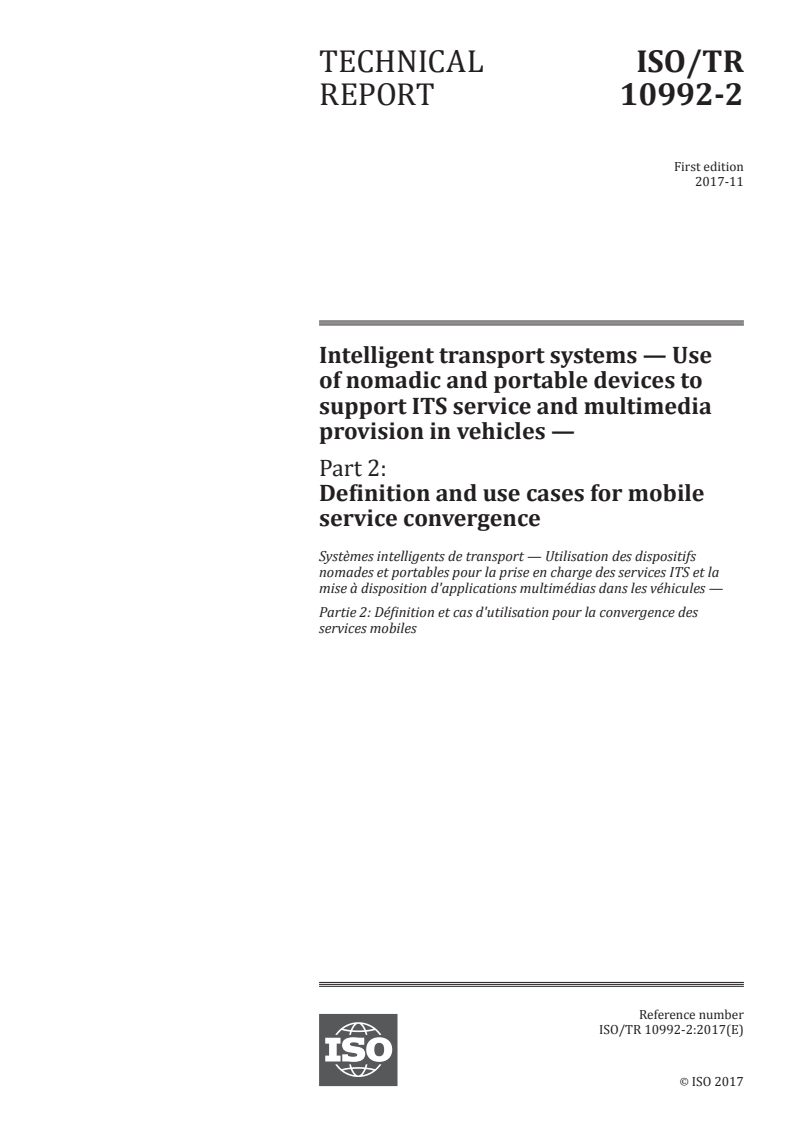
TECHNICAL ISO/TR
REPORT 10992-2
First edition
2017-11
Intelligent transport systems — Use
of nomadic and portable devices to
support ITS service and multimedia
provision in vehicles —
Part 2:
Definition and use cases for mobile
service convergence
Systèmes intelligents de transport — Utilisation des dispositifs
nomades et portables pour la prise en charge des services ITS et la
mise à disposition d'applications multimédias dans les véhicules —
Partie 2: Définition et cas d'utilisation pour la convergence des
services mobiles
Reference number
©
ISO 2017
© ISO 2017, Published in Switzerland
All rights reserved. Unless otherwise specified, no part of this publication may be reproduced or utilized otherwise in any form
or by any means, electronic or mechanical, including photocopying, or posting on the internet or an intranet, without prior
written permission. Permission can be requested from either ISO at the address below or ISO’s member body in the country of
the requester.
ISO copyright office
Ch. de Blandonnet 8 • CP 401
CH-1214 Vernier, Geneva, Switzerland
Tel. +41 22 749 01 11
Fax +41 22 749 09 47
copyright@iso.org
www.iso.org
ii © ISO 2017 – All rights reserved
Contents Page
Foreword .iv
Introduction .v
1 Scope . 1
2 Normative references . 1
3 Terms and definitions . 1
4 Abbreviated terms . 2
5 Document overview and structure . 3
6 General information . 3
6.1 Purpose of this document . 3
6.2 Overview of mobile service convergence. 3
7 Use cases overview and definitions . 5
7.1 General . 5
7.2 Use cases overview . 5
7.2.1 Basic principles for use cases . 5
7.2.2 Use cases clusters . 5
7.3 Use cases definition . 6
7.3.1 UC cluster 1 — Before Driving . 6
7.3.2 UC cluster 2 — While Driving . 7
7.3.3 UC cluster 3 — After Driving . 8
Bibliography .10
Foreword
ISO (the International Organization for Standardization) is a worldwide federation of national standards
bodies (ISO member bodies). The work of preparing International Standards is normally carried out
through ISO technical committees. Each member body interested in a subject for which a technical
committee has been established has the right to be represented on that committee. International
organizations, governmental and non-governmental, in liaison with ISO, also take part in the work.
ISO collaborates closely with the International Electrotechnical Commission (IEC) on all matters of
electrotechnical standardization.
The procedures used to develop this document and those intended for its further maintenance are
described in the ISO/IEC Directives, Part 1. In particular the different approval criteria needed for the
different types of ISO documents should be noted. This document was drafted in accordance with the
editorial rules of the ISO/IEC Directives, Part 2 (see www.iso.org/directives).
Attention is drawn to the possibility that some of the elements of this document may be the subject of
patent rights. ISO shall not be held responsible for identifying any or all such patent rights. Details of
any patent rights identified during the development of the document will be in the Introduction and/or
on the ISO list of patent declarations received (see www.iso.org/patents).
Any trade name used in this document is information given for the convenience of users and does not
constitute an endorsement.
For an explanation on the voluntary nature of standards, the meaning of ISO specific terms and
expressions related to conformity assessment, as well as information about ISO's adherence to the
World Trade Organization (WTO) principles in the Technical Barriers to Trade (TBT) see the following
URL: www.iso.org/iso/foreword.html.
This document was prepared by Technical Committee ISO/TC 204, Intelligent transport systems.
A list of all parts in the ISO/TR 10992 series can be found on the ISO website.
iv © ISO 2017 – All rights reserved
Introduction
ISO/TC 204 is designed to facilitate the development, promotion and standardization of the use of
nomadic and portable devices to support ITS service provision and multimedia use such as passenger
information, automotive information, driver advisory and warning systems, and entertainment system
interfaces to ITS service providers and motor vehicle communication networks. The ISO 10992 series
fosters the introduction of multimedia and telematics nomadic devices in the public transport and
automotive world.
This project provides the convergence software framework to identify mobile cloud connectivity
services while driving and related standards required to develop a nomadic device application with
intelligent transport systems (ITS) technologies in vehicles.
TECHNICAL REPORT ISO/TR 10992-2:2017(E)
Intelligent transport systems — Use of nomadic and
portable devices to support ITS service and multimedia
provision in vehicles —
Part 2:
Definition and use cases for mobile service convergence
1 Scope
This document specifies the introduction of multimedia and telematics nomadic devices in the public
transport and automotive world to support intelligent transport systems (ITS) service provisions
and multimedia use such as passenger information, automotive information, driver advisory and
warning systems, and entertainment system interfaces to ITS service providers and motor vehicle
communication networks.
This document focuses on the convergence software framework to identify mobile cloud connectivity
services while driving utilizing nomadic device application for intelligent transport systems (ITS)
technologies in vehicles.
The use cases described in this document include:
— IVI interaction configuration
This competence is provided by automatic application suppliers.
— Biosignal measurement configuration
This competence is provided by IT application companies.
— Cloud service configuration
This competence is provided by third-party providers such as parking service providers and insurance
service providers.
This document includes the identification of existing International Standards for ITS in ISO/TC 204 and
existing vehicle communication network access standards.
2 Normative references
There are no normative references in this document.
3 Terms and definitions
For the purposes of this document, the following terms and definitions apply.
ISO and IEC maintain terminological databases for use in standardization at the following addresses:
— IEC Electropedia: available at https://www.electropedia.org/
— ISO Online browsing platform: available at https://www.iso.org/obp
3.1
nomadic device
ND
personal ITS station which provides communication connectivity via equipment such as cellular
telephones, mobile wireless broadband (WIMAX, HC-SDMA, etc.), WiFi, etc. and includes short range
links such as Bluetooth, Zigbee, etc. to connect portable devices to the motor vehicle communications
system network
3.2
portable device
PD
handheld device or mobile device which is primarily a battery-powered device with base computing
resources in the form of a processor, memory, and storage and network access
Note 1 to entry: The latest portable devices are thin and lightweight, making them easy to carry and hold. This
was not the case for earlier attempts at portable computers.
3.3
in-vehicle selective gateway
in-vehicle infotainment
IVI
entertainment and information system which includes a device or a technology that provides a variety
of services for navigating the internet, for enjoying a movie, and for playing games and social network
services (SNS) in vehicles
3.4
vehicle station gateway
VSG
system that provides security and safety functionality in order to allow only authorized access to the
in-vehicle networks (IVN)
Note 1 to entry: Vehicles will be electronically integrated into the IT infrastructure with the risk of unauthorized
access. ISO (International Standardization Organization) is going to establish a joint working group standardizing
the Vehicle Station Gateway (VSG).
4 Abbreviated terms
ITS Intelligent Transportation Systems
IVI In-Vehicle Infotainment
VSG Vehicle Station Gateway
VIN Vehicle Identification Number
UI User Interface
UX User eXperience
ND Nomadic Device
PD Portable Device
ICT Information and Communication Technology
2 © ISO 2017 – All rights reserved
5 Document overview and structure
This document provides all information and references required to support the implementation of the
requirements related to standardized access to definition and use cases for mobile service convergence.
The document consists of the following parts:
— Part 1: Overview
This part provides an overview of the communications architecture and generic requirements
to enable the connectivity between the vehicle and the infrastructure or other vehicles by using
nomadic links within the vehicle and devices introduced into the vehicle including the provision
of connectivity via mobile devices to the infrastructure; the support of application services within
the vehicle; and integration within the CALM architecture and in vehicle gateways.
— Part 2: Definition and use cases for mobile service convergence
This part specifies general requirements related to the integrated mobile service convergence to
be used on nomadic devices and personal ITS stations. It provides an overview of the document
set and structure along with the use cases definition and common set of resources (definitions,
references), which are used for all subsequent parts.
6 General information
6.1 Purpose of this document
This document addresses two
...
TECHNICAL ISO/TR
REPORT 10992-2
First edition
2017-11
Intelligent transport systems — Use
of nomadic and portable devices to
support ITS service and multimedia
provision in vehicles —
Part 2:
Definition and use cases for mobile
service convergence
Systèmes intelligents de transport — Utilisation des dispositifs
nomades et portables pour la prise en charge des services ITS et la
mise à disposition d'applications multimédias dans les véhicules —
Partie 2: Définition et cas d'utilisation pour la convergence des
services mobiles
Reference number
©
ISO 2017
© ISO 2017, Published in Switzerland
All rights reserved. Unless otherwise specified, no part of this publication may be reproduced or utilized otherwise in any form
or by any means, electronic or mechanical, including photocopying, or posting on the internet or an intranet, without prior
written permission. Permission can be requested from either ISO at the address below or ISO’s member body in the country of
the requester.
ISO copyright office
Ch. de Blandonnet 8 • CP 401
CH-1214 Vernier, Geneva, Switzerland
Tel. +41 22 749 01 11
Fax +41 22 749 09 47
copyright@iso.org
www.iso.org
ii © ISO 2017 – All rights reserved
Contents Page
Foreword .iv
Introduction .v
1 Scope . 1
2 Normative references . 1
3 Terms and definitions . 1
4 Abbreviated terms . 2
5 Document overview and structure . 3
6 General information . 3
6.1 Purpose of this document . 3
6.2 Overview of mobile service convergence. 3
7 Use cases overview and definitions . 5
7.1 General . 5
7.2 Use cases overview . 5
7.2.1 Basic principles for use cases . 5
7.2.2 Use cases clusters . 5
7.3 Use cases definition . 6
7.3.1 UC cluster 1 — Before Driving . 6
7.3.2 UC cluster 2 — While Driving . 7
7.3.3 UC cluster 3 — After Driving . 8
Bibliography .10
Foreword
ISO (the International Organization for Standardization) is a worldwide federation of national standards
bodies (ISO member bodies). The work of preparing International Standards is normally carried out
through ISO technical committees. Each member body interested in a subject for which a technical
committee has been established has the right to be represented on that committee. International
organizations, governmental and non-governmental, in liaison with ISO, also take part in the work.
ISO collaborates closely with the International Electrotechnical Commission (IEC) on all matters of
electrotechnical standardization.
The procedures used to develop this document and those intended for its further maintenance are
described in the ISO/IEC Directives, Part 1. In particular the different approval criteria needed for the
different types of ISO documents should be noted. This document was drafted in accordance with the
editorial rules of the ISO/IEC Directives, Part 2 (see www.iso.org/directives).
Attention is drawn to the possibility that some of the elements of this document may be the subject of
patent rights. ISO shall not be held responsible for identifying any or all such patent rights. Details of
any patent rights identified during the development of the document will be in the Introduction and/or
on the ISO list of patent declarations received (see www.iso.org/patents).
Any trade name used in this document is information given for the convenience of users and does not
constitute an endorsement.
For an explanation on the voluntary nature of standards, the meaning of ISO specific terms and
expressions related to conformity assessment, as well as information about ISO's adherence to the
World Trade Organization (WTO) principles in the Technical Barriers to Trade (TBT) see the following
URL: www.iso.org/iso/foreword.html.
This document was prepared by Technical Committee ISO/TC 204, Intelligent transport systems.
A list of all parts in the ISO/TR 10992 series can be found on the ISO website.
iv © ISO 2017 – All rights reserved
Introduction
ISO/TC 204 is designed to facilitate the development, promotion and standardization of the use of
nomadic and portable devices to support ITS service provision and multimedia use such as passenger
information, automotive information, driver advisory and warning systems, and entertainment system
interfaces to ITS service providers and motor vehicle communication networks. The ISO 10992 series
fosters the introduction of multimedia and telematics nomadic devices in the public transport and
automotive world.
This project provides the convergence software framework to identify mobile cloud connectivity
services while driving and related standards required to develop a nomadic device application with
intelligent transport systems (ITS) technologies in vehicles.
TECHNICAL REPORT ISO/TR 10992-2:2017(E)
Intelligent transport systems — Use of nomadic and
portable devices to support ITS service and multimedia
provision in vehicles —
Part 2:
Definition and use cases for mobile service convergence
1 Scope
This document specifies the introduction of multimedia and telematics nomadic devices in the public
transport and automotive world to support intelligent transport systems (ITS) service provisions
and multimedia use such as passenger information, automotive information, driver advisory and
warning systems, and entertainment system interfaces to ITS service providers and motor vehicle
communication networks.
This document focuses on the convergence software framework to identify mobile cloud connectivity
services while driving utilizing nomadic device application for intelligent transport systems (ITS)
technologies in vehicles.
The use cases described in this document include:
— IVI interaction configuration
This competence is provided by automatic application suppliers.
— Biosignal measurement configuration
This competence is provided by IT application companies.
— Cloud service configuration
This competence is provided by third-party providers such as parking service providers and insurance
service providers.
This document includes the identification of existing International Standards for ITS in ISO/TC 204 and
existing vehicle communication network access standards.
2 Normative references
There are no normative references in this document.
3 Terms and definitions
For the purposes of this document, the following terms and definitions apply.
ISO and IEC maintain terminological databases for use in standardization at the following addresses:
— IEC Electropedia: available at https://www.electropedia.org/
— ISO Online browsing platform: available at https://www.iso.org/obp
3.1
nomadic device
ND
personal ITS station which provides communication connectivity via equipment such as cellular
telephones, mobile wireless broadband (WIMAX, HC-SDMA, etc.), WiFi, etc. and includes short range
links such as Bluetooth, Zigbee, etc. to connect portable devices to the motor vehicle communications
system network
3.2
portable device
PD
handheld device or mobile device which is primarily a battery-powered device with base computing
resources in the form of a processor, memory, and storage and network access
Note 1 to entry: The latest portable devices are thin and lightweight, making them easy to carry and hold. This
was not the case for earlier attempts at portable computers.
3.3
in-vehicle selective gateway
in-vehicle infotainment
IVI
entertainment and information system which includes a device or a technology that provides a variety
of services for navigating the internet, for enjoying a movie, and for playing games and social network
services (SNS) in vehicles
3.4
vehicle station gateway
VSG
system that provides security and safety functionality in order to allow only authorized access to the
in-vehicle networks (IVN)
Note 1 to entry: Vehicles will be electronically integrated into the IT infrastructure with the risk of unauthorized
access. ISO (International Standardization Organization) is going to establish a joint working group standardizing
the Vehicle Station Gateway (VSG).
4 Abbreviated terms
ITS Intelligent Transportation Systems
IVI In-Vehicle Infotainment
VSG Vehicle Station Gateway
VIN Vehicle Identification Number
UI User Interface
UX User eXperience
ND Nomadic Device
PD Portable Device
ICT Information and Communication Technology
2 © ISO 2017 – All rights reserved
5 Document overview and structure
This document provides all information and references required to support the implementation of the
requirements related to standardized access to definition and use cases for mobile service convergence.
The document consists of the following parts:
— Part 1: Overview
This part provides an overview of the communications architecture and generic requirements
to enable the connectivity between the vehicle and the infrastructure or other vehicles by using
nomadic links within the vehicle and devices introduced into the vehicle including the provision
of connectivity via mobile devices to the infrastructure; the support of application services within
the vehicle; and integration within the CALM architecture and in vehicle gateways.
— Part 2: Definition and use cases for mobile service convergence
This part specifies general requirements related to the integrated mobile service convergence to
be used on nomadic devices and personal ITS stations. It provides an overview of the document
set and structure along with the use cases definition and common set of resources (definitions,
references), which are used for all subsequent parts.
6 General information
6.1 Purpose of this document
This document addresses two
...