


ISO/TS 24816:2025
(Main)Exchange formats for audit data collection — Government regulated financial reports and payroll extension: XML and JSON
Exchange formats for audit data collection — Government regulated financial reports and payroll extension: XML and JSON
This document specifies technical exchange formats for audit data collection, government regulated financial reports and payroll extension, in Extensible Markup Language (XML), JavaScript Object Notation (JSON) and flat file (CSV) as output file formats for the functional content defined in ISO 5405. This document also contains the following schema files and mapping tables related to ISO 5405: — XML schema files; — JSON schema files; — CSV mapping tables, included as separate sheets in an Excel file. To keep the three exchange formats (XML, JSON, CSV) consistent, this document also specifies how to use the technical solution in the CSV format.
Formats d'échange pour la collecte de données d'audit — Extension pour les rapports financiers et paiements réglementés par le gouvernement : XML et JSON
General Information
- Status
- Published
- Publication Date
- 09-Jun-2025
- Technical Committee
- ISO/TC 295 - Audit data services
- Drafting Committee
- ISO/TC 295/WG 1 - Audit Data Collection for Non-financial Enterprises
- Current Stage
- 6060 - International Standard published
- Start Date
- 10-Jun-2025
- Due Date
- 18-Jul-2025
- Completion Date
- 10-Jun-2025
Overview - ISO/TS 24816:2025 (Exchange formats for audit data collection)
ISO/TS 24816:2025 specifies technical exchange formats for audit data collection focused on government regulated financial reports and payroll extension. It defines machine-readable output formats - XML, JSON, and CSV - for the functional content defined in ISO 5405. The specification includes published XML schema files, JSON schema files, and CSV mapping tables (as Excel sheets), and it prescribes how to keep these three formats consistent and interoperable for audit data exchange.
Key topics and technical requirements
- Exchange formats: Detailed requirements for XML, JSON and flat-file (CSV) outputs that carry the same functional audit content per ISO 5405.
- Schemas and mappings: Provided XML Schema (XSD) and JSON Schema artifacts, plus CSV mapping tables to map ISO 5405 data structures to each format.
- Format consistency and conversion: Rules to ensure XML, JSON and CSV are technically consistent and convertible from one to another.
- Data modelling: ISO 5405 tables are modelled into parent/child entities and reusable data groups to promote uniform structure and reuse.
- Cross-topic requirements: Character encoding conventions, versioning, multi-platform data transfer, folder/file naming conventions, file compression, representation of special field types, extension rules (alignment with ISO 21378/ISO 21377), and encryption of sensitive data.
- Standards alignment: References to ISO 5405, ISO 21378, ISO/TS 21377, ISO 8601-1, W3C XML and JSON Schema specifications for interoperability and best practice.
Applications and who uses it
ISO/TS 24816:2025 is intended for practitioners who need standardized, auditable data exchange of regulated financial and payroll information:
- External and internal auditors requiring consistent audit data feeds for government-regulated reporting and payroll audits.
- Finance and payroll software vendors implementing standardized export formats (XML/JSON/CSV) to support audits and regulatory reporting.
- Tax authorities and regulatory bodies specifying or consuming structured audit data for compliance checks.
- Enterprise IT/data integrators building extract-transform-load (ETL) pipelines, secure data transfer processes, or automated audit data collection tools.
- Service providers (outsourced payroll, accounting firms) aiming for interoperability and reduced manual data translation.
Practical benefits include improved interoperability, reduced manual reconciliation, support for automated auditing workflows, and clearer compliance with government-regulated reporting requirements.
Related standards
- ISO 5405 - Audit data collection extension (government regulated financial reports and payroll)
- ISO 21378 - Audit data collection (core tables and model)
- ISO/TS 21377 - Exchange formats for ISO 21378 (XML and JSON)
- ISO 8601-1 - Date/time representation
- W3C XML and JSON Schema specifications
Keywords: ISO/TS 24816:2025, audit data collection, XML schema, JSON schema, CSV mapping, government regulated financial reports, payroll extension, ISO 5405, data exchange, audit interoperability.
Get Certified
Connect with accredited certification bodies for this standard

BSI Group
BSI (British Standards Institution) is the business standards company that helps organizations make excellence a habit.

NYCE
Mexican standards and certification body.
Sponsored listings
Frequently Asked Questions
ISO/TS 24816:2025 is a technical specification published by the International Organization for Standardization (ISO). Its full title is "Exchange formats for audit data collection — Government regulated financial reports and payroll extension: XML and JSON". This standard covers: This document specifies technical exchange formats for audit data collection, government regulated financial reports and payroll extension, in Extensible Markup Language (XML), JavaScript Object Notation (JSON) and flat file (CSV) as output file formats for the functional content defined in ISO 5405. This document also contains the following schema files and mapping tables related to ISO 5405: — XML schema files; — JSON schema files; — CSV mapping tables, included as separate sheets in an Excel file. To keep the three exchange formats (XML, JSON, CSV) consistent, this document also specifies how to use the technical solution in the CSV format.
This document specifies technical exchange formats for audit data collection, government regulated financial reports and payroll extension, in Extensible Markup Language (XML), JavaScript Object Notation (JSON) and flat file (CSV) as output file formats for the functional content defined in ISO 5405. This document also contains the following schema files and mapping tables related to ISO 5405: — XML schema files; — JSON schema files; — CSV mapping tables, included as separate sheets in an Excel file. To keep the three exchange formats (XML, JSON, CSV) consistent, this document also specifies how to use the technical solution in the CSV format.
ISO/TS 24816:2025 is classified under the following ICS (International Classification for Standards) categories: 35.240.99 - IT applications in other fields. The ICS classification helps identify the subject area and facilitates finding related standards.
ISO/TS 24816:2025 is available in PDF format for immediate download after purchase. The document can be added to your cart and obtained through the secure checkout process. Digital delivery ensures instant access to the complete standard document.
Standards Content (Sample)
Technical
Specification
ISO/TS 24816
First edition
Exchange formats for audit data
2025-06
collection — Government regulated
financial reports and payroll
extension: XML and JSON
Formats d'échange pour la collecte de données d'audit —
Extension pour les rapports financiers et paiements réglementés
par le gouvernement : XML et JSON
Reference number
© ISO 2025
All rights reserved. Unless otherwise specified, or required in the context of its implementation, no part of this publication may
be reproduced or utilized otherwise in any form or by any means, electronic or mechanical, including photocopying, or posting on
the internet or an intranet, without prior written permission. Permission can be requested from either ISO at the address below
or ISO’s member body in the country of the requester.
ISO copyright office
CP 401 • Ch. de Blandonnet 8
CH-1214 Vernier, Geneva
Phone: +41 22 749 01 11
Email: copyright@iso.org
Website: www.iso.org
Published in Switzerland
ii
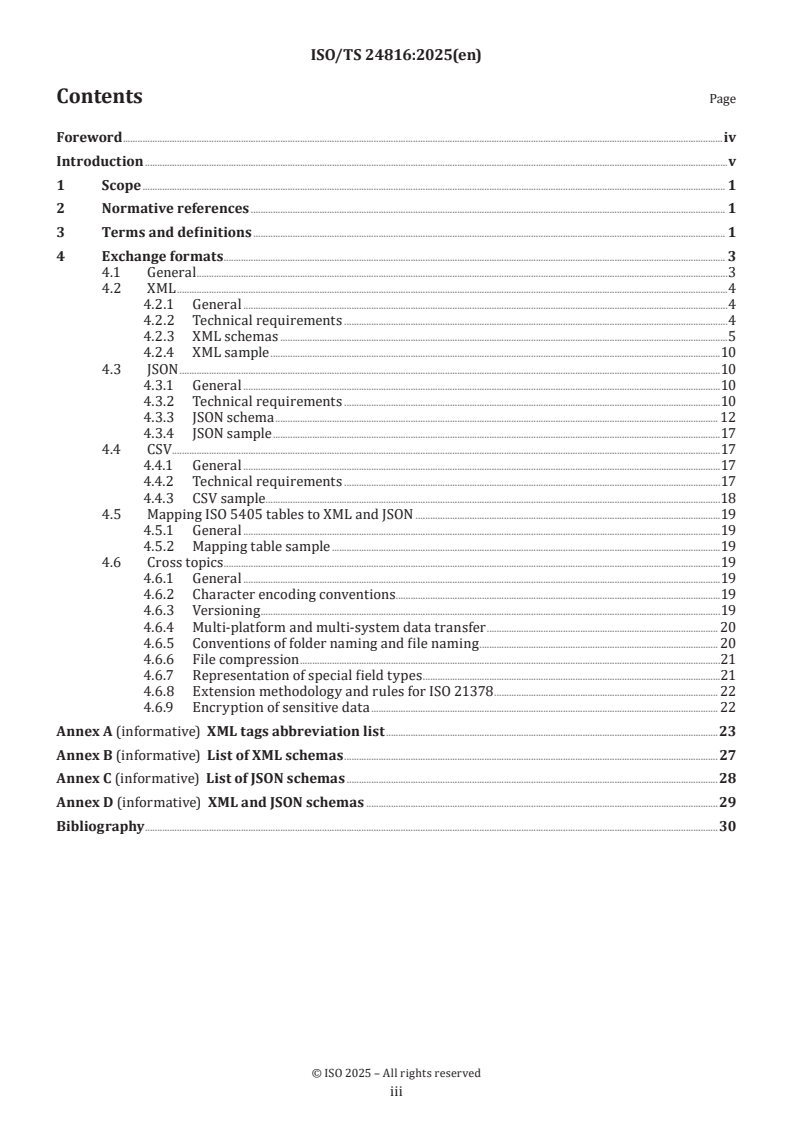
Contents Page
Foreword .iv
Introduction .v
1 Scope . 1
2 Normative references . 1
3 Terms and definitions . 1
4 Exchange formats . 3
4.1 General .3
4.2 XML .4
4.2.1 General .4
4.2.2 Technical requirements .4
4.2.3 XML schemas .5
4.2.4 XML sample .10
4.3 JSON .10
4.3.1 General .10
4.3.2 Technical requirements .10
4.3.3 JSON schema . 12
4.3.4 JSON sample .17
4.4 CSV .17
4.4.1 General .17
4.4.2 Technical requirements .17
4.4.3 CSV sample.18
4.5 Mapping ISO 5405 tables to XML and JSON .19
4.5.1 General .19
4.5.2 Mapping table sample .19
4.6 Cross topics .19
4.6.1 General .19
4.6.2 Character encoding conventions .19
4.6.3 Versioning .19
4.6.4 Multi-platform and multi-system data transfer . 20
4.6.5 Conventions of folder naming and file naming . 20
4.6.6 File compression .21
4.6.7 Representation of special field types .21
4.6.8 Extension methodology and rules for ISO 21378 . 22
4.6.9 Encryption of sensitive data . 22
Annex A (informative) XML tags abbreviation list .23
Annex B (informative) List of XML schemas .27
Annex C (informative) List of JSON schemas .28
Annex D (informative) XML and JSON schemas .29
Bibliography .30
iii
Foreword
ISO (the International Organization for Standardization) is a worldwide federation of national standards
bodies (ISO member bodies). The work of preparing International Standards is normally carried out through
ISO technical committees. Each member body interested in a subject for which a technical committee
has been established has the right to be represented on that committee. International organizations,
governmental and non-governmental, in liaison with ISO, also take part in the work. ISO collaborates closely
with the International Electrotechnical Commission (IEC) on all matters of electrotechnical standardization.
The procedures used to develop this document and those intended for its further maintenance are described
in the ISO/IEC Directives, Part 1. In particular, the different approval criteria needed for the different types
of ISO document should be noted. This document was drafted in accordance with the editorial rules of the
ISO/IEC Directives, Part 2 (see www.iso.org/directives).
ISO draws attention to the possibility that the implementation of this document may involve the use of (a)
patent(s). ISO takes no position concerning the evidence, validity or applicability of any claimed patent
rights in respect thereof. As of the date of publication of this document, ISO had not received notice of (a)
patent(s) which may be required to implement this document. However, implementers are cautioned that
this may not represent the latest information, which may be obtained from the patent database available at
www.iso.org/patents. ISO shall not be held responsible for identifying any or all such patent rights.
Any trade name used in this document is information given for the convenience of users and does not
constitute an endorsement.
For an explanation of the voluntary nature of standards, the meaning of ISO specific terms and expressions
related to conformity assessment, as well as information about ISO's adherence to the World Trade
Organization (WTO) principles in the Technical Barriers to Trade (TBT), see www.iso.org/iso/foreword.html.
This document was prepared by Technical Committee ISO/TC 295, Audit data services.
Any feedback or questions on this document should be directed to the user’s national standards body. A
complete listing of these bodies can be found at www.iso.org/members.html.
iv
Introduction
As one of the follow-up standards for audit data services, this document is based on the previous standards,
including ISO 5405 (government regulated financial reports and payroll extension), ISO 21378 (audit data
collection standard) and ISO/TS 21377 (exchange formats for the audit data collection standard, XML and JSON).
ISO 21378 establishes common definitions of accounting data elements and provides the information
necessary to extract relevant audit data. ISO 21378 specifies 71 tables which serve as a basis for data
extraction in the areas of general ledger, accounts receivable, sales, accounts payable, purchasing, inventory
(including both inventory and movement data), and property, plant, and equipment. ISO 21378 primarily
focuses on the access of audit data for financial audits (financial statements).
ISO/TS 21377 specifies technical exchange formats in extensible markup language (XML), JavaScript object
notation (JSON) and comma-separated values (CSV) as output file formats for the functional content defined
in ISO 21378.
ISO 5405 is an addition of 6 specified tables to the 71 tables of ISO 21378, with the aim of collecting additional
data to perform government regulated financial reports and payroll audits. The ISO 5405 tables are set up in
accordance with the specifications in ISO 21378.
v
Technical Specification ISO/TS 24816:2025(en)
Exchange formats for audit data collection — Government
regulated financial reports and payroll extension: XML and JSON
1 Scope
This document specifies technical exchange formats for audit data collection, government regulated
financial reports and payroll extension, in Extensible Markup Language (XML), JavaScript Object Notation
(JSON) and flat file (CSV) as output file formats for the functional content defined in ISO 5405.
This document also contains the following schema files and mapping tables related to ISO 5405:
— XML schema files;
— JSON schema files;
— CSV mapping tables, included as separate sheets in an Excel file.
To keep the three exchange formats (XML, JSON, CSV) consistent, this document also specifies how to use
the technical solution in the CSV format.
2 Normative references
The following documents are referred to in the text in such a way that some or all of their content constitutes
requirements of this document. For dated references, only the edition cited applies. For undated references,
the latest edition of the referenced document (including any amendments) applies.
ISO 5405, Audit data collection extension — Government regulated financial reports and payroll
ISO 21378, Audit data collection
ISO/TS 21377, Exchange formats for the audit data collection standard: XML and JSON
ISO 8601-1, Date and time — Representations for information interchange — Part 1: Basic rules
ISO/IEC 21778, Information technology — The JSON data interchange syntax
W3C Extensible Markup Language (XML) 1.0 (Fifth Edition). Available at https:// www .w3 .org/ TR/ 2008/
REC -xml -20081126/
W3C XML Schema Part 1: Structures Second Edition. Available at https:// www .w3 .org/ TR/ 2004/ REC
-xmlschema -1 -20041028/
W3C XML Schema Definition Language (XSD) 1.1 Part 2: Datatypes. Available at https:// www .w3 .org/ TR/
2012/ REC -xmlschema11 -2 -20120405/
JSON Schema: A Media Type for Describing JSON Documents. Available at https:// json -schema .org/ draft/
2020 -12/ json -schema -core .html
3 Terms and definitions
For the purposes of this document, the following terms and definitions apply.
ISO and IEC maintain terminology databases for use in standardization at the following addresses:
— ISO Online browsing platform: available at https:// www .iso .org/ obp
— IEC Electropedia: available at https:// www .electropedia .org/
3.1
data
reinterpretable representation of information in a formalized manner suitable for communication,
interpretation or processing
[SOURCE: ISO/IEC 11179-1:2023, 3.2.23, modified — Notes to entry have been deleted.]
3.2
data element
basic unit of identifiable and definable data (3.1)
[SOURCE: ISO 2146:2010, 3.4, modified — The admitted term "element" has been deleted.]
3.3
data file
collection of data (3.1) records having a homogeneous structure
[SOURCE: ISO 21378:2019, 3.4]
3.4
data structure
framework comprising a number of data elements (3.2) in a prescribed form
[SOURCE: ISO 21007-1:2005, 2.16, modified — The word "element" has been deleted from the term.]
3.5
syntax
set of rules, principles and processes that govern the data structure (3.4)
3.6
data model
graphical, lexical or combined representation of data (3.1), specifying their properties, structure, and
interrelationships
[SOURCE: ISO/IEC 11179-1:2023, 3.2.24]
3.7
entity
group of data elements (3.2) describing an object
Note 1 to entry: It is equivalent to “object class” in ISO/IEC 11179-1.
3.8
relation
relationship between two entities (3.7)
3.9
attribute
data element (3.2) describing an object
Note 1 to entry: It is equivalent to “property” in ISO/IEC 11179-1.
3.10
domain
set of properties to define the value space of attributes (3.9)
Note 1 to entry: A domain contains code lists (3.11) and code values (3.12). It is equivalent to “representation” in
ISO/IEC 11179-1.
3.11
code list
standardized list of code values (3.12) with a common scope
3.12
code value
one value from a code list (3.11)
3.13
data group
structured collection of related data elements (3.2) that are grouped together based on a shared characteristic
or purpose
Note 1 to entry: A data group may represent a logical unit within a dataset, such as all attributes (3.9) related to a
customer, product, or transaction, and is often used to organize data hierarchically or to simplify data exchange and
processing.
4 Exchange formats
4.1 General
The data format is the carrier of data exchange between auditor and auditee. So, it is necessary to make an
agreement on data format between the two sides in data exchange. There are multiple options for output
data formats.
In case of ISO 5405, three exchange formats are specified:
— XML data files defined by XML Schema specification (W3C);
— JSON data files defined by JSON Schema specification (json-schema.org);
— CSV data files.
These three formats shall contain the same functional audit data content specification in accordance with
ISO 5405, but differ on the technical level only.
This means that these exchange formats are convertible from one to the other. For instance, it is possible to
convert XML data files to CSV data files or CSV data files to JSON data files.
The XML and JSON schemas described in this document are an extension of the schemas described in
ISO/TS 21377. It is therefore necessary to combine the ISO/TS 21377 schemas in one directory with the
schemas described in this document, so that the common data type XML schema from ISO/TS 21377 can be
imported by all XML schemas.
To generate the XML and JSON schemas in a consistent way, a data model was set up from ISO 5405 in
accordance with ISO/IEC 11179-1. This data model is used to create consistent exchange format specifications.
Each ISO 5405 table is modelled into a “Parent Entity” and reusable data groups, if applicable, within a table
are modelled into “Child Entities”, e.g. “Physical Address”, “Billing Address”, “Tax”, “Created”, “Modified”,
“Posted”, in line with ISO 5405. Depending on the context of a “Parent Entity”, it may have a relation to one or
more “Child Entities”. For example, a “Customer” has a relation with a “Billing Address”. This way of working
guarantees that all reusable groups that occur in multiple tables are defined in the same way.
As the data model is not in scope of this project, it is only documented for reference purposes in
ISO/TS 21377:2023, Annex D.
The various technical specifications are explained in this document and the additional packaging and
communication agreements are defined.
4.2 XML
4.2.1 General
This subclause describes how to exchange the ISO 5405 tables using XML data files.
XML data files shall be created in accordance with:
— the syntax specifications in W3C Extensible Markup Language (XML) 1.0 (Fifth Edition);
— the functional requirements in ISO 5405;
— the functional requirements in ISO 21378;
— the technical requirements in ISO/TS 21377.
4.2.2 Technical requirements
4.2.2.1 General
Each XML data file shall contain only one ISO 5405 table, with all records (lines) for that table included
within the file.
The filename shall be in accordance with 4.6.5.
Each ISO 5405 table requires an individual XML schema for defining its XML file structure. For instance, if
there are 6 tables, there will be 6 corresponding XML schemas, one for each table.
Such an XML data file contains (schematic):
xsi:schemaLocation='name-space xml-schema-name.xsd'
xmlns='name-space'
xmlns:xsi='http://www.w3.org/2001/XMLSchema-instance'>
value
value
Italicized text shall be replaced by the definitions in this document.
4.2.2.2 Root tag
The root tag equals "Adc" followed by the ISO 5405 table name like: “AdcPayPayslipDetail”.
4.2.2.3 Target name space definition
The target name space equals "http:// schemas .iso .org/ AdcsML/ Messages/ " followed by the message name
and message version like: "http:// schemas .iso .org/ AdcsML/ Messages/ AdcPayPayslipDetail -v1".
4.2.2.4 XML tags
Table-line-tag, group-tag and data-element-tag are XML tags which are defined in the related XML schema.
XML tags are in the first step derived from the full data element names, and in the second step shortened in
a consistent manner, according to an abbreviations list (see Annex A).
Because auditors and auditees usually exchange bulk files according to ISO 5405, abbreviated tags can
reduce the file sizes by 30 % to 40 %.
Full data element names and abbreviated XML tags are together specified in ISO 5405 to XML mapping
tables (see 4.5 for explanation and example of mapping tables).
In XML schemas the full data element names are documented as annotations.
This means that programmers can have easy access to the full data element names, either from the mapping
tables or from the XML schemas.
4.2.2.5 Optional fields
Optional fields and optional groups of fields can be omitted from the XML data file, only if these data
elements are not available in the source system that delivers the audit data.
4.2.2.6 Repeating groups
Repeating groups like “Tax” can occur up to the maximum number that is defined in the XML schema.
4.2.2.7 Special characters to be escaped
The following special characters shall be escaped in XML data files as follows:
< (less than) to be replaced with <
> (greater than) to be replaced with >
& (ampersand) to be replaced with &
‘ (apostrophe) to be replaced with '
“ (quotation mark) to be replaced with "
4.2.3 XML schemas
4.2.3.1 General
Each ISO 5405 file is technically specified by an XML schema and can also be validated by using that schema.
XML schema files shall be created in accordance with the syntax specifications in W3C Extensible Markup
Language (XML) 1.0 (Fifth Edition), W3C XML Schema Part 1: Structures Second Edition, W3C XML Schema
Definition Language (XSD) 1.1 Part 2: Datatypes and the functional requirements in ISO 5405.
Table 1 shows the ISO 5405 representation formats and the equivalents used in XML schema.
Table 1 — Representation specification in XML schema
ISO 5405 representation XML schema representation
%ns
%nc
%m.nf
%nd
Table 2 shows the ISO 5405 datatypes and the equivalents used in XML schema.
Table 2 — Datatypes in XML schema
ISO 5405 datatype XML schema datatype
Date
Time
String
Decimal
Integer
Boolean
All schema files are bundled in one official ISO delivery package, which contains the schemas that have been
established in this document, used for exchanging the ISO 5405 audit data.
A development package is also available, which contains the schemas that are used to develop new versions
of the existing schemas and for the development of extension schemas.
To download the electronic version of these XML schemas, see Annex D.
4.2.3.2 Official ISO delivery package
All schema files in this package have one and the same version number, which can be found in the schema
file itself.
The first delivery of the package has version number 1. After a certain period, if there are sufficient reasons
for this, a new package of schemas will be delivered with a successor version number, for example, version
number 2.
This package contains all ISO 5405 table schemas where the name of the schema file is equal to the root tag
name like “AdcPayPayslipDetail.xsd”.
All XML schemas in this package shall import the data type schema “Adc_DataTypes.xsd”. This data type
schema is part of the XML delivery package of ISO/TS 21377. It is therefore necessary to place the XML
schemas of ISO/TS 21377 and the XML schemas that belong to this document in one directory. Then the data
type schema Adc_DataTypes.xsd can be imported by all schemas.
A list of these XML schemas can be found in Annex B.
EXAMPLE 1 “AdcPayPayslipDetail.xsd”:
xmlns:cdt="http://schemas.iso.org/AdcsML/Adc_DataTypes-v1" xmlns:xsd="http://www.w3.org/2001/
XMLSchema" targetNamespace="http://schemas.iso.org/AdcsML/Messages/AdcPayPayslipDetail-v1"
elementFormDefault="qualified" attributeFormDefault="unqualified" version="1.0">
MESSAGE
PAY PAYSLIP DETAIL
Payslip ID
Payslip Line ID
maxOccurs="1">
Payslip Line Number
maxOccurs="1">
Payroll Item ID
maxOccurs="1">
Payroll Item Code
maxOccurs="1">
Payroll Item Name
maxOccurs="1">
Payroll Category
maxOccurs="1">
Payroll Item Value
maxOccurs="1">
GL Account Number
EXAMPLE 2 Part of Adc_DataTypes.xsd which is part of the XML schema delivery package of ISO/TS 21377:
xmlns:xsd="http://www.w3.org/2001/XMLSchema"
targetNamespace="http://schemas.iso.org/AdcsML/Adc_DataTypes-v1"
elementFormDefault="qualified" attributeFormDefault="unqualified" version="1.0">
4.2.3.3 Development package
This package contains the schemas that are used to develop new versions of the existing schemas and for the
development of extension schemas.
In this package each schema has its own version number, which is included in the version attribute and which
is added to the name of the XML schema file. In the first delivery of this package, all schemas have version 1.0
like “AdcPayPayslipDetail-v1.0.xsd”. When a schema changes, the minor version number is incremented each
time (e.g. version number changes from 1.0 to 1.1).
In this package, all schemas contain their own data type definitions, so that they can be further developed
independently and there is no common data type schema.
After a certain period of time, if there are sufficient reasons to do this, a new official ISO delivery package
will be delivered with the next successor major version number, for example, version number 2 (see 4.2.3.2);
and the new common data type schema (Adc_DataTypes.xsd) will be delivered.
A new development package will also be delivered, in which all schemas will have version 2.0.
EXAMPLE “AdcPayPayslipDetail-v1.1.xsd”:
xmlns:xsd="http://www.w3.org/2001/XMLSchema" targetNamespace="http://schemas.iso.org/AdcsML/
Messages/AdcPayPayslipDetail-v1" elementFormDefault="qualified" attributeFormDefault="unqualif
ied" version="1.1">
MESSAGE
PAY PAYSLIP DETAIL
Payslip ID
Payslip Line ID
maxOccurs="1">
Payslip Line Number
maxOccurs="1">
Payroll Item ID
maxOccurs="1">
Payroll Item Code
maxOccurs="1">
Payroll Item Name
maxOccurs="1">
Payroll Category
maxOccurs="1">
Payroll Item Value
maxOccurs="1">
GL Account Number
4.2.4 XML sample
The following example shows one XML data file that contains only one record of an ISO 5405 table:
xmlns="http://schemas.iso.org/AdcsML/Messages/AdcPayPayslipDetail-v1"
xmlns:xsi="http://www.w3.org/2001/XMLSchema-instance">
202001000000001
202001000000001001
001
01001
BS
Basic Salary
Fixed Payroll
7000
ACC123456789
4.3 JSON
4.3.1 General
This subclause describes how to exchange the ISO 5405 tables using JSON data files.
JSON data files shall be created in accordance with:
— the syntax specifications in ISO/IEC 21778;
— the functional requirements in ISO 5405;
— the functional requirements in ISO 21378;
— the technical requirements in ISO/TS 21377.
4.3.2 Technical requirements
4.3.2.1 General
Each JSON data file shall contain only one ISO 5405 table, with all records (lines) for that table included
within the file.
The filename shall be in accordance with 4.6.5.
Each ISO 5405 table requires an individual JSON schema for defining its JSON file structure. For instance, if
there are 6 tables, there will be 6 corresponding JSON schemas, one for each table.
JSON uses the same tags as XML.
Such a JSON data file contains (schematic):
{
"table-line-tag": [{
"data-element-tag": "value",
"group-tag": {
"data-element-tag": "value"
}
}]
}
Italicized text shall be replaced by the definitions in this document.
4.3.2.2 $id
JSON data files do not contain a namespace definition and root tag, in contrast to XML data files. "$id"
is the first data element in each JSON data file. The value of $id includes the ISO 5401 table name (e.g.
AdcPayPayslipDetail) and main version number (e.g. -v1).
Example of $id:
"$id": "http:// schemas .iso .org/ AdcsML/ Messages/ AdcPayPayslipDetail _jsd6 -v1"
4.3.2.3 JSON tags
A JSON data file contains the table-line-tag like "PayPayslipDetail" only one time with a number of the table lines.
Table-line-tag, group-tag and data-element-tag are the JSON tags which are defined in the related JSON schema.
JSON uses the XML tags. XML tags are in the first step derived from the field names, and in the second step
shortened in a consistent manner, according to an abbreviations list (see Annex A).
Because auditors and auditees usually exchange bulk files according to ISO 5405, abbreviated tags can
reduce the file sizes by 30 % to 40 %.
Full data element names and abbreviated XML tags are together specified in ISO 5405 to XML mapping
tables (see 4.5 for explanation and example of mapping tables).
This means that programmers can have easy access to the full data element names from the mapping tables.
4.3.2.4 Optional fields
Optional fields and optional groups of fields can be omitted from the JSON data file, only if these data
elements are not available in the source system that delivers the audit data.
4.3.2.5 Repeating groups
Repeating groups like “Tax” can occur up to the maximum number that is defined in the JSON- schema. In
case of a repeating group all occurrences in total shall be enclosed by square brackets [ ].
EXAMPLE 1 Repeating group Tax with only one occurrence:
"Tax": [ {
"TaxTypCd": "TAX01",
"TaxLocAmt": 12.50,
"GlTaxDbAcntNr": "ACC123456789",
"GlTaxCrAcntNr": "ACC123456789"
} ],
EXAMPLE 2 Repeating group Tax with 4 occurrences:
"Tax": [ {
"TaxTypCd": "TAX01",
"TaxLocAmt": 12.50,
"GlTaxDbAcntNr": "ACC123456789",
"GlTaxCrAcntNr": "ACC123456789"
},
{
"TaxTypCd": "TAX02",
"TaxLocAmt": 5.00,
"GlTaxDbAcntNr": "ACC123456789",
"GlTaxCrAcntNr": "ACC123456789"
},
{
"TaxTypCd": "TAX03",
"TaxLocAmt": 0.75,
"GlTaxDbAcntNr": "ACC123456789",
"GlTaxCrAcntNr": "ACC123456789"
},
{
"TaxTypCd": "TAX04",
"TaxLocAmt": 1.00,
"GlTaxDbAcntNr": "ACC123456789",
"GlTaxCrAcntNr": "ACC123456789"
} ],
4.3.2.6 Special characters to be escaped
The following characters are reserved characters and cannot be used in JSON and shall be properly replaced
to be used in strings:
backspace to be replaced with \b;
form feed to be replaced with \f;
newline to be replaced with \n;
carriage return to be replaced with \r;
tab to be replaced with \t;
double quote to be replaced with \";
backslash to be replaced with \\.
4.3.3 JSON schema
4.3.3.1 General
Each ISO 5405 file is technically specified by a JSON schema and can also be validated by using that schema.
JSON schema files shall be created in accordance with the syntax specifications in ISO/IEC 21778, JSON
Schema: A Media Type for Describing JSON Documents and the functional requirements in ISO 5405.
Table 3 shows the ISO 5405 representation formats and the equivalents used in JSON schema.
Table 3 — Representation specification in JSON schema
ISO 5405 representation JSON schema representation
%ns "type": "string",
"maxLength": n,
%nc "type": "string",
"minLength": n,
"maxLength": n,
%m.nf "type": "number",
"multipleOf": 0.0001, (when n = 4)
"multipleOf": 0.00000001, (when n = 8)
%nd "type": "number",
Table 4 shows the ISO 5405 datatypes and the equivalents used in JSON schema.
Table 4 — Datatypes in JSON schema
ISO 5405 datatype JSON schema datatype
Date "type": "string",
"minLength": 10,
"maxLength": 10,
"pattern": "^\\d{4}-(0[1-9]|1[0-2])-(0[1-9]|[1-2]\\d|3[0-1])$",
Time "type": "string",
"minLength": 8,
"maxLength": 8,
"pattern": "^([0-1]\\d|2[0-3]):([0-5]\\d):([0-5]\\d)$",
String "type": "string",
Decimal "type": "number",
Integer "type": "number",
Boolean "type": "boolean",
All schema files are bundled in one official ISO delivery package which contains the schemas that have been
established in this document, used for exchanging the ISO 5405 audit data.
A development package is also available, which contains the schemas that are used to develop new versions
of the existing schemas and for the development of extension schemas.
To download the electronic version of these JSON schemas, see Annex D.
4.3.3.2 Official ISO delivery package
All schema files in this package have one and the same version number, which can be found in the schema
file itself.
The first delivery of the package will have version number 1. After a certain period, if there are sufficient
reasons for this, a new package of schemas will be delivered with a successor version number, for example
version number 2.
This package contains all ISO 5405 table schemas. The name of the JSON schema file is equal to "Adc"
followed by the ISO 5405 table name and then followed by “_jsd6.json” like: “AdcPayPayslipDetail_jsd6.json”.
In this package, all schemas have their own datatype definitions.
A list of these JSON schemas can be found in Annex C.
EXAMPLE “AdcPayPayslipDetail_jsd6.json”:
{
"$schema": "http://json-schema.org/draft-06/schema#",
"$id": "http://schemas.iso.org/AdcsML/Messages/AdcPayPayslipDetail_jsd6-v1",
"description": "JSON Definition of message hierarchy: ADC PAY Payslip Detail v1.0",
"modelRef": [
"Message: ADC PAY Payslip Detail v1.
...
Questions, Comments and Discussion
Ask us and Technical Secretary will try to provide an answer. You can facilitate discussion about the standard in here.
Loading comments...