

ISO/TR 29922:2017
(Main)Natural gas — Supporting information on the calculation of physical properties according to ISO 6976
General Information
- Abstract
ISO/TR 29922:2017 acts as a repository for those manifold technical details which justify and explain the methods presented in the third edition of ISO 6976 but which are not directly needed in the everyday routine implementation of the standard. Each main clause addresses a specific aspect of the calculational method described in ISO 6976:2016, and is intended to be self-sufficient and essentially independent of each other clause. For this reason, the user should not expect the whole to be accessible to study as a sequentially coherent narrative.
- Status
- Published
- Publication Date
- 02-Mar-2017
- Technical Committee
- ISO/TC 193/SC 1 - Analysis of natural gas
- Drafting Committee
- ISO/TC 193/SC 1/WG 18 - Revision of ISO 6976
- Current Stage
- 6060 - International Standard published
- Start Date
- 03-Mar-2017
- Due Date
- 25-Jul-2017
- Completion Date
- 25-Jul-2017
Buy Documents

ISO/TR 29922:2017 - Natural gas -- Supporting information on the calculation of physical properties according to ISO 6976

ISO/TR 29922:2017 - Natural gas — Supporting information on the calculation of physical properties according to ISO 6976/3/2017
Overview
ISO/TR 29922:2017 is a technical report that provides supporting information for the calculation of physical properties of natural gas as specified in ISO 6976:2016. Rather than adding new normative requirements, this TR acts as a repository of technical detail, justification, worked examples and uncertainty discussion for the calculational methods used to determine calorific values, enthalpy and related physical properties of natural gas. Clauses are largely self-contained and intended to support implementers, metrologists and developers of calculation software.
Key topics
The report covers a wide set of technical topics that expand on ISO 6976 methodology, including:
- Enthalpy of combustion (ideal gas) and its temperature dependence, plus illustrative examples and uncertainty analysis.
- Real-gas (non-ideality) effects: pressure dependence of enthalpy, enthalpic corrections and compression factor effects on volume-basis calorific values.
- Virial equation of state and methods for estimating second virial coefficients, summation factors and mixture compression factors.
- Quantification of volumetric non-ideality for major natural gas components (including hydrogen, helium and water).
- Effects of water vapour on calorific value (excluded volume, latent heat and compression factor effects).
- Selection and evaluation of methane calorific value data and derived component calorific values (mass- and volume-basis).
- Conversion between reference conditions and metric reference conditions for reporting.
- Uncertainty estimation: principles, sensitivity coefficients, Monte Carlo and finite-difference approaches, and detailed derivation of uncertainty equations corresponding to ISO 6976.
- Miscellaneous data such as atomic weights and composition of dry air relevant to calculations.
Applications and users
ISO/TR 29922:2017 is intended for professionals who implement, verify or extend ISO 6976 calculations, including:
- Natural gas measurement and custody transfer engineers
- Laboratory analysts and calorimetry specialists
- Pipeline operators and gas trading organisations performing energy accounting
- Software developers creating property calculation and billing tools
- Metrologists and uncertainty analysts validating measurement systems
The TR is especially useful when high-accuracy energy determinations, uncertainty analysis or software validation are required.
Related standards
- ISO 6976:2016 - Primary standard for calculation of calorific values, density, relative density and Wobbe index from composition. ISO/TR 29922:2017 provides supporting documentation and technical justification for ISO 6976 methods.
Keywords: natural gas, ISO/TR 29922, ISO 6976, calorific value, enthalpy, compression factor, virial equation, uncertainty, gas measurement.
Buy Documents
ISO/TR 29922:2017 - Natural gas -- Supporting information on the calculation of physical properties according to ISO 6976
ISO/TR 29922:2017 - Natural gas — Supporting information on the calculation of physical properties according to ISO 6976/3/2017
Get Certified
Connect with accredited certification bodies for this standard

Element Materials Technology
Materials testing and product certification.

ABS Group Brazil
ABS Group certification services in Brazil.

ABS Quality Evaluations Inc.
American Bureau of Shipping quality certification.
Sponsored listings
Frequently Asked Questions
ISO/TR 29922:2017 is a technical report published by the International Organization for Standardization (ISO). Its full title is "Natural gas — Supporting information on the calculation of physical properties according to ISO 6976". This standard covers: ISO/TR 29922:2017 acts as a repository for those manifold technical details which justify and explain the methods presented in the third edition of ISO 6976 but which are not directly needed in the everyday routine implementation of the standard. Each main clause addresses a specific aspect of the calculational method described in ISO 6976:2016, and is intended to be self-sufficient and essentially independent of each other clause. For this reason, the user should not expect the whole to be accessible to study as a sequentially coherent narrative.
ISO/TR 29922:2017 acts as a repository for those manifold technical details which justify and explain the methods presented in the third edition of ISO 6976 but which are not directly needed in the everyday routine implementation of the standard. Each main clause addresses a specific aspect of the calculational method described in ISO 6976:2016, and is intended to be self-sufficient and essentially independent of each other clause. For this reason, the user should not expect the whole to be accessible to study as a sequentially coherent narrative.
ISO/TR 29922:2017 is classified under the following ICS (International Classification for Standards) categories: 75.060 - Natural gas. The ICS classification helps identify the subject area and facilitates finding related standards.
ISO/TR 29922:2017 is available in PDF format for immediate download after purchase. The document can be added to your cart and obtained through the secure checkout process. Digital delivery ensures instant access to the complete standard document.
Standards Content (Sample)
TECHNICAL ISO/TR
REPORT 29922
First edition
2017-03
Natural gas — Supporting information
on the calculation of physical
properties according to ISO 6976
Gaz naturel — Informations supplémentaires pour le calcul des
propriétés physiques selon l’ISO 6976
Reference number
©
ISO 2017
© ISO 2017, Published in Switzerland
All rights reserved. Unless otherwise specified, no part of this publication may be reproduced or utilized otherwise in any form
or by any means, electronic or mechanical, including photocopying, or posting on the internet or an intranet, without prior
written permission. Permission can be requested from either ISO at the address below or ISO’s member body in the country of
the requester.
ISO copyright office
Ch. de Blandonnet 8 • CP 401
CH-1214 Vernier, Geneva, Switzerland
Tel. +41 22 749 01 11
Fax +41 22 749 09 47
copyright@iso.org
www.iso.org
ii © ISO 2017 – All rights reserved
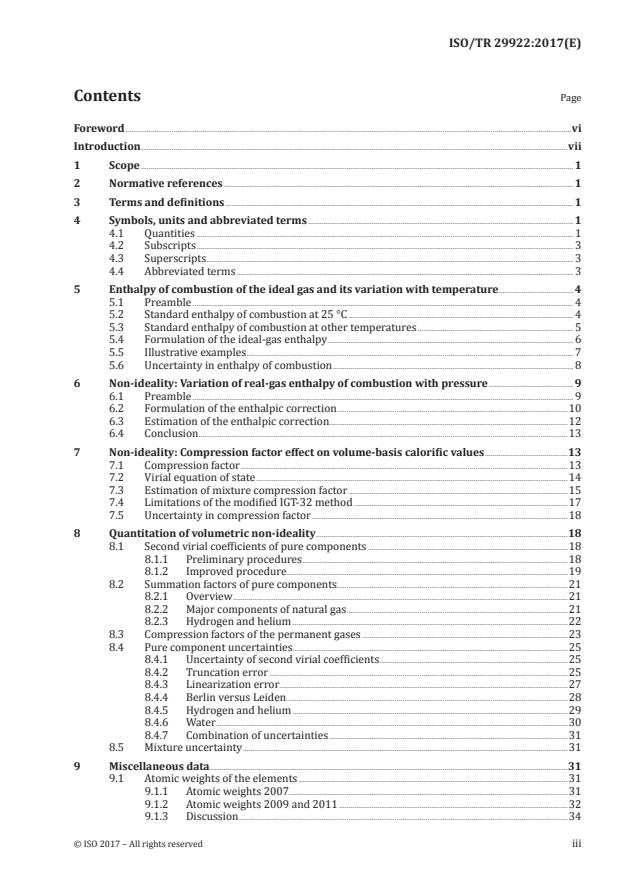
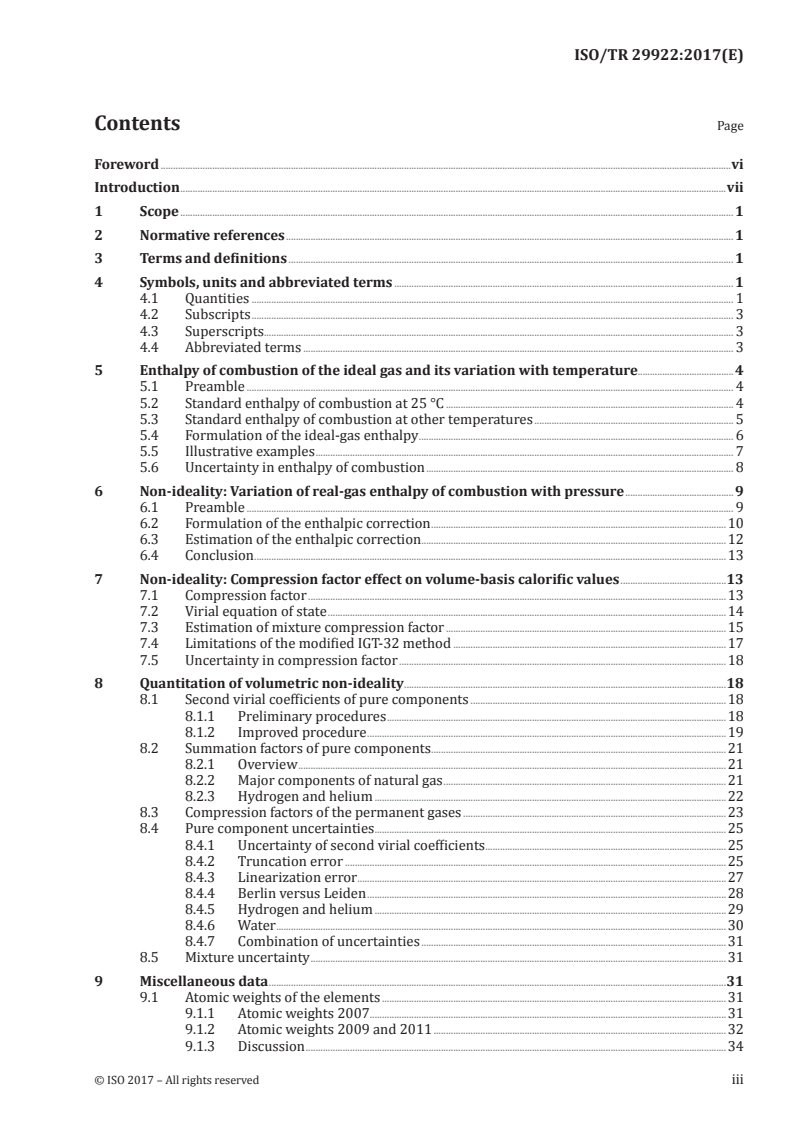
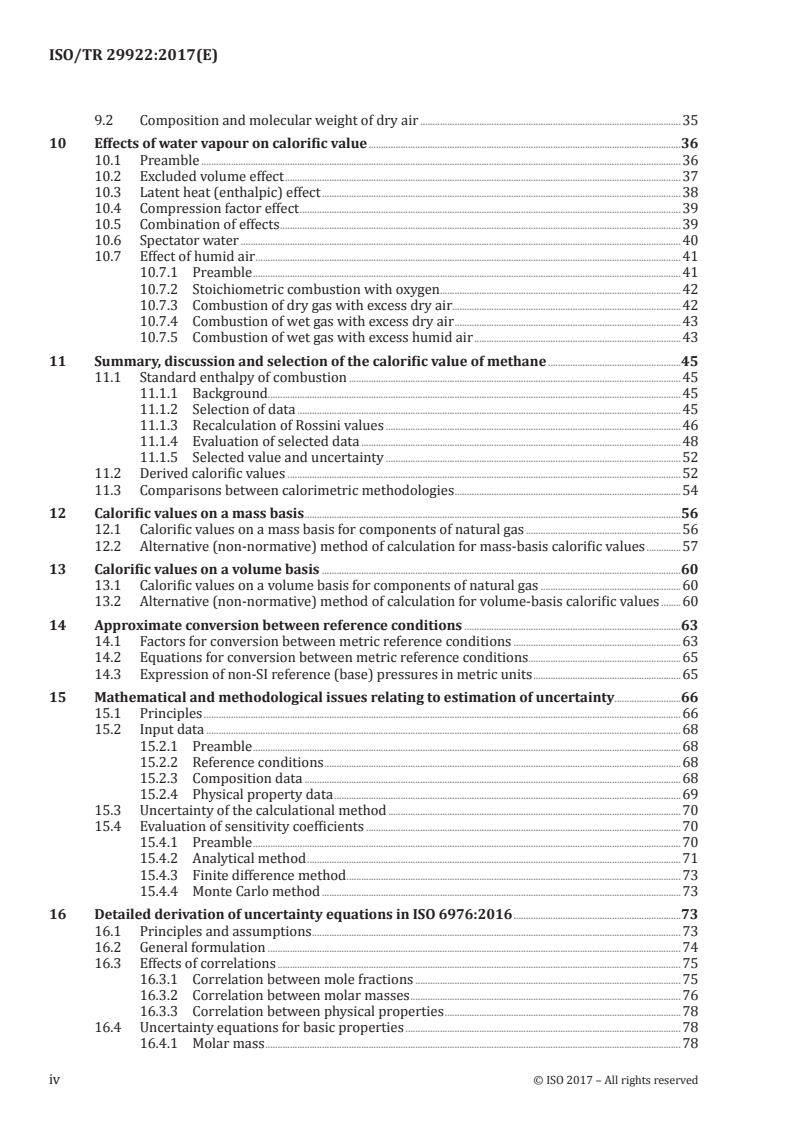
Contents Page
Foreword .vi
Introduction .vii
1 Scope . 1
2 Normative references . 1
3 Terms and definitions . 1
4 Symbols, units and abbreviated terms . 1
4.1 Quantities . 1
4.2 Subscripts . 3
4.3 Superscripts . . 3
4.4 Abbreviated terms . 3
5 Enthalpy of combustion of the ideal gas and its variation with temperature .4
5.1 Preamble . 4
5.2 Standard enthalpy of combustion at 25 °C . 4
5.3 Standard enthalpy of combustion at other temperatures . 5
5.4 Formulation of the ideal-gas enthalpy . 6
5.5 Illustrative examples . 7
5.6 Uncertainty in enthalpy of combustion . 8
6 Non-ideality: Variation of real-gas enthalpy of combustion with pressure .9
6.1 Preamble . 9
6.2 Formulation of the enthalpic correction .10
6.3 Estimation of the enthalpic correction .12
6.4 Conclusion .13
7 Non-ideality: Compression factor effect on volume-basis calorific values .13
7.1 Compression factor .13
7.2 Virial equation of state .14
7.3 Estimation of mixture compression factor .15
7.4 Limitations of the modified IGT-32 method .17
7.5 Uncertainty in compression factor .18
8 Quantitation of volumetric non-ideality .18
8.1 Second virial coefficients of pure components .18
8.1.1 Preliminary procedures .18
8.1.2 Improved procedure .19
8.2 Summation factors of pure components . .21
8.2.1 Overview .21
8.2.2 Major components of natural gas .21
8.2.3 Hydrogen and helium .22
8.3 Compression factors of the permanent gases .23
8.4 Pure component uncertainties .25
8.4.1 Uncertainty of second virial coefficients .25
8.4.2 Truncation error .25
8.4.3 Linearization error . .27
8.4.4 Berlin versus Leiden .28
8.4.5 Hydrogen and helium .29
8.4.6 Water .30
8.4.7 Combination of uncertainties .31
8.5 Mixture uncertainty .31
9 Miscellaneous data .31
9.1 Atomic weights of the elements .31
9.1.1 Atomic weights 2007.31
9.1.2 Atomic weights 2009 and 2011 .32
9.1.3 Discussion .34
9.2 Composition and molecular weight of dry air .35
10 Effects of water vapour on calorific value .36
10.1 Preamble .36
10.2 Excluded volume effect .37
10.3 Latent heat (enthalpic) effect .38
10.4 Compression factor effect .39
10.5 Combination of effects .39
10.6 Spectator water .40
10.7 Effect of humid air .41
10.7.1 Preamble .41
10.7.2 Stoichiometric combustion with oxygen.42
10.7.3 Combustion of dry gas with excess dry air.42
10.7.4 Combustion of wet gas with excess dry air .43
10.7.5 Combustion of wet gas with excess humid air .43
11 Summary, discussion and selection of the calorific value of methane .45
11.1 Standard enthalpy of combustion .45
11.1.1 Background.45
11.1.2 Selection of data .45
11.1.3 Recalculation of Rossini values .46
11.1.4 Evaluation of selected data .48
11.1.5 Selected value and uncertainty .52
11.2 Derived calorific values .52
11.3 Comparisons between calorimetric methodologies .54
12 Calorific values on a mass basis .56
12.1 Calorific values on a mass basis for components of natural gas .56
12.2 Alternative (non-normative) method of calculation for mass-basis calorific values .57
13 Calorific values on a volume basis .60
13.1 Calorific values on a volume basis for components of natural gas .60
13.2 Alternative (non-normative) method of calculation for volume-basis calorific values .60
14 Approximate conversion between reference conditions .63
14.1 Factors for conversion between metric reference conditions .63
14.2 Equations for conversion between metric reference conditions.65
14.3 Expression of non-SI reference (base) pressures in metric units .65
15 Mathematical and methodological issues relating to estimation of uncertainty.66
15.1 Principles .66
15.2 Input data .68
15.2.1 Preamble .68
15.2.2 Reference conditions .68
15.2.3 Composition data .68
15.2.4 Physical property data .69
15.3 Uncertainty of the calculational method .70
15.4 Evaluation of sensitivity coefficients .70
15.4.1 Preamble .70
15.4.2 Analytical method .71
15.4.3 Finite difference method .73
15.4.4 Monte Carlo method .73
16 Detailed derivation of uncertainty equations in ISO 6976:2016 .73
16.1 Principles and assumptions .73
16.2 General formulation .74
16.3 Effects of correlations .75
16.3.1 Correlation between mole fractions .75
16.3.2 Correlation between molar masses .76
16.3.3 Correlation between physical properties .78
16.4 Uncertainty equations for basic properties .78
16.4.1 Molar mass .78
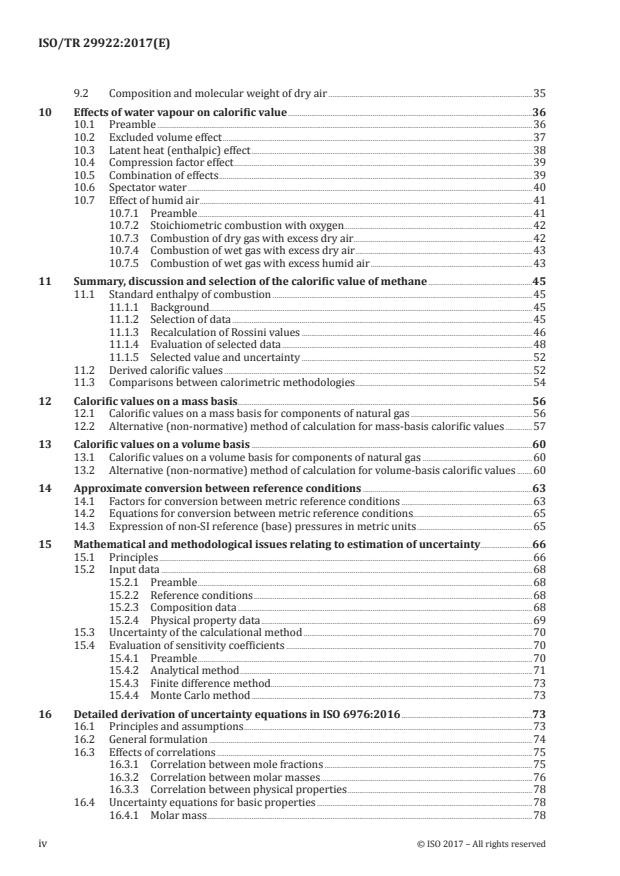
iv © ISO 2017 – All rights reserved
16.4.2 Molar-basis gross calorific value .79
16.4.3 Molar-basis net calorific value .79
16.4.4 Summation factor .80
16.4.5 Compression factor .80
16.5 Uncertainty equations for compound properties .81
16.5.1 Mass-basis gross calorific value .81
16.5.2 Mass-basis net calorific value .82
16.5.3 Volume-basis gross calorific value .83
16.5.4 Volume-basis net calorific value .84
16.5.5 Density .86
16.5.6 Relative density .87
16.5.7 Gross Wobbe index.88
16.5.8 Net Wobbe index .89
16.6 Repeatability and reproducibility.91
17 Computer implementation of recommended methods .92
17.1 Compiled BASIC shareware program .92
17.2 Spreadsheet implementation .94
Bibliography .97
Foreword
ISO (the International Organization for Standardization) is a worldwide federation of national standards
bodies (ISO member bodies). The work of preparing International Standards is normally carried out
through ISO technical committees. Each member body interested in a subject for which a technical
committee has been established has the right to be represented on that committee. International
organizations, governmental and non-governmental, in liaison with ISO, also take part in the work.
ISO collaborates closely with the International Electrotechnical Commission (IEC) on all matters of
electrotechnical standardization.
The procedures used to develop this document and those intended for its further maintenance are
described in the ISO/IEC Directives, Part 1. In particular, the different approval criteria needed for the
different types of ISO documents should be noted. This document was drafted in accordance with the
editorial rules of the ISO/IEC Directives, Part 2 (see www .iso .org/ directives).
Attention is drawn to the possibility that some of the elements of this document may be the subject of
patent rights. ISO shall not be held responsible for identifying any or all such patent rights. Details of
any patent rights identified during the development of the document will be in the Introduction and/or
on the ISO list of patent declarations received (see www .iso .org/ patents).
Any trade name used in this document is information given for the convenience of users and does not
constitute an endorsement.
For an explanation on the meaning of ISO specific terms and expressions related to conformity assessment,
as well as information about ISO’s adherence to the World Trade Organization (WTO) principles in the
Technical Barriers to Trade (TBT) see the following URL: www . i so .org/ iso/ foreword .html.
The committee responsible for this document is ISO/TC 193, Natural gas, Subcommittee SC 1, Analysis
of natural gas.
vi © ISO 2017 – All rights reserved
Introduction
Both international and intranational custody transfer of natural gas usually require precise
determination of both the quantity and the quality of the gas to be traded. ISO 6976:2016, which cancels
and replaces ISO 6976:1995, specifies methods for the calculation of those properties, often known
as the combustion properties, which (in part) describe gas quality, namely gross (superior) and net
(inferior) calorific value, density, relative density, gross and net Wobbe index. The methods provide the
means of calculating the properties, including uncertainties, of any natural gas, natural gas substitute,
or similar combustible gaseous fuel of known composition at commonly used reference conditions.
Some 80-odd years ago, in the Introduction to Hyde and Mills’ classic text Gas Calorimetry, Sir Charles
[109]
Vernon (‘CV’) Boys wrote the words “ … I hesitate to give the number of actual tests of the calorific
value of gas which are made every year, but . it will be evident that any machinery set up to ascertain
its value must be extensive . The fact is that no single commodity generally purchased by the public is so
carefully watched and maintained of its guaranteed quality as gas … ”. Since that time, the technology of
gas calorimetry has changed beyond either recognition or imagination, but the truth of the sentiment
expressed remains unchanged and refers every bit as much to 2017 as it did to 1932.
This document acts as a repository for those manifold technical details which justify and explain the
methods presented in the new third (2016) edition of ISO 6976 but which are not directly needed in its
everyday routine implementation. In short, it is conceived and intended as a complete(ish) knowledge
base which provides full and proper technical authentication of ISO 6976.
TECHNICAL REPORT ISO/TR 29922:2017(E)
Natural gas — Supporting information on the calculation of
physical properties according to ISO 6976
1 Scope
This document acts as a repository for those manifold technical details which justify and explain the
methods presented in the third edition of ISO 6976 but which are not directly needed in the everyday
routine implementation of the standard.
Each main clause addresses a specific aspect of the calculational method described in ISO 6976:2016,
and is intended to be self-sufficient and essentially independent of each other clause. For this reason,
the user should not expect the whole to be accessible to study as a sequentially coherent narrative.
2 Normative references
There are no normative references in this document.
3 Terms and definitions
For the purposes of this document, the terms and definitions given in ISO 6976 apply.
ISO and IEC maintain terminological databases for use in standardization at the following addresses:
— IEC Electropedia: available at http:// www .electropedia .org/
— ISO Online browsing platform: available at http:// www .iso .org/ obp
4 Symbols, units and abbreviated terms
4.1 Quantities
Symbol Meaning Unit
a atomic index for carbon in the generalized molecular species C H N O S —
a b c d e
b atomic index for hydrogen in the generalized molecular species C H N O S —
a b c d e
c atomic index for nitrogen in the generalized molecular species C H N O S —
a b c d e
d atomic index for oxygen in the generalized molecular species C H N O S —
a b c d e
e atomic index for sulfur in the generalized molecular species C H N O S —
a b c d e
g coefficients in equation for B —
−1
h molar enthalpy kJ·mol
k coverage factor —
m number of sets of values —
n number of determinations in a set of values —
p pressure (absolute) kPa
q exact input quantity in calculation of Y (varies)
r correlation coefficient —
s summation factor —
t Celsius temperature °C
u(Y) standard uncertainty of Y (varies)
Symbol Meaning Unit
u(Y,Y’) covariance of Y and Y’ (varies)
w repeatability or reproducibility (varies)
x mole fraction —
y inexact input quantity in calculation of Y (varies)
−1
A atomic mass (atomic weight) kg·kmol
3 -1
B second virial coefficient m ·mol
6 −2
C third virial coefficient m ·mol
−1 −1
Cp molar isobaric heat capacity kJ·mol ·K
−3
D (mass) density kg·m
−3
Đ molar density mol·m
−1
E non-random (systematic) bias from the true value of Hc kJ·mol
F function that generates property Y —
G relative density —
−1
Hc molar-basis calorific value (negative enthalpy of combustion) kJ·mol
−1
Hf enthalpy of formation kJ·mol
−1
Hm mass-basis calorific value MJ·kg
−3
Hv volume-basis calorific value MJ·m
3( j-1) -( j-1)
J j-th virial coefficient m ·mol
−1
L molar enthalpy of vaporization of water kJ·mol
−1
M molar mass (molecular weight) kg·kmol
N number of components in a mixture —
number of input values of y —
−1
Q amount of heat released kJ·mol
−1 −1
R molar gas constant J·mol ·K
S sum of mole fractions (= 1) —
T thermodynamic (absolute) temperature K
U(Y) expanded uncertainty of Y (varies)
3 −1
V molar volume m ·mol
−3
W Wobbe index MJ·m
Y general (unspecified) physical property (varies)
Z compression factor —
α mole fraction of nitrogen in dry combustion air —
β mole fraction of oxygen in dry combustion air —
γ mole fraction of argon in dry combustion air —
δ mole fraction of water vapour in humid combustion air —
ε molar amount of air (including any excess) per mole of reactant —
ζ zero-value parameter having non-zero uncertainty —
η unity-value factor having non-zero uncertainty —
θ a + b/4 —
−1
λ random contribution of offset from the true value of Hc kJ·mol
μ dipole moment debyes
ν stoichiometric coefficient —
ξ relative humidity —
τ 100 K/T —
φ molar amount of saturated exhaust gases per mole of reactant —
2 © ISO 2017 – All rights reserved
Symbol Meaning Unit
ω acentric factor —
o
—
Λ constants in the Aly-Lee Cp formulation
1-9
Φ function that generates the third term of a virial expansion —
4.2 Subscripts
c at the gas-liquid critical point
g for the sample gas
i serial counter
component identifier
j serial counter
component identifier
k serial counter
m serial counter
n serial counter
r value made dimensionless (reduced) using values for the gas-liquid critical properties
s at the vapour-liquid saturation point
w for water vapour
G gross/superior (calorific value or Wobbe index)
N net/inferior (calorific value or Wobbe index)
air for air
0 reference (base) value of pressure or temperature
1 combustion reference state/condition
2 metering reference state/condition
4.3 Superscripts
o for the ideal gas state
* pre-normalization value
+ modified value
4.4 Abbreviated terms
liq liquid
ppm parts per million (moles per million moles)
sat saturated with water vapour
vap vapour
AGA American Gas Association (USA)
BAM Bundesanstalt für Materialforschung und Prüfung (Germany)
BBC British Broadcasting Corporation (UK)
CIAAW IUPAC Commission on Isotopic Abundances and Atomic Weights
GERG Groupe Européen de Recherches Gazières
GOMB Gas and Oil Measurement Branch (UK Department of Energy)
GPA Gas Processors Association (USA)
IAPWS International Association for the Properties of Water and Steam
IGT Institute of Gas Technology (USA)
IUPAC International Union of Pure and Applied Chemistry
NAMAS National Measurement Accreditation Service (UK)
NBS National Bureau of Standards (U.S. Department of Commerce)
NIST National Institute of Standards and Technology (U.S. Department of Commerce)
NPL National Physical Laboratory (UK)
OFGEM Office of Gas and Electricity Markets (UK National Regulatory Authority)
PTB Physikalische-Technische Bundesanstalt (Germany)
PVT pressure-volume-temperature
SD standard deviation
SE experimental standard deviation of the mean (standard error)
SI Système Internationale des Unités
UKAS United Kingdom Accreditation Service (UK)
5 Enthalpy of combustion of the ideal gas and its variation with temperature
5.1 Preamble
The most fundamental thermophysical properties required in the calculation of the calorific values of a
o
gas or gas mixture are the ideal-gas (standard) enthalpies of combustion ()−Hc of each of its
j
component molecular species at any temperature at which combustion may be deemed to take place,
i.e. the combustion reference temperature.
o
In ISO 6976:2016, 6.1, the user is advised that each of these quantities ()−Hc , equal numerically to
j
o
the corresponding ideal-gas gross (superior) calorific value ()Hc of component j varies, albeit weakly,
G
with the combustion reference temperature. The variation observed is nevertheless significant and
cannot be ignored in the kind of high-precision calculations that are made possible by ISO 6976.
o
The theoretical variation of Hc with temperature is in general mathematically unwieldy and, in
consequence, it is not practicable to provide simple formulations that would enable the user to
o o
determine Hc at any arbitrary combustion reference temperature. Instead, values of ()Hc for each
j
distinct molecular species j listed in ISO 6976 are given in ISO 6976, Table 3 for each of the commonly
used combustion reference temperatures of 298,15 K, 293,15 K, 288,71 K, 288,15 K and 273,15 K (25 °C,
20 °C, 60 °F, 15 °C and 0 °C, respectively).
The first of these temperatures, 298,15 K, is the temperature adopted by the International Union of
Pure and Applied Chemistry (IUPAC) as the reference temperature for thermochemistry and, in
o
consequence, critically evaluated values of Hc ()25 are readily available in the published scientific
literature.
o
Values of Hc have therefore been carefully selected for each of the chemical species listed in
ISO 6976:2016 at this temperature (see 5.2), and used as the basis for the calculation of values for the
other temperatures as described below (see 5.3 and 5.4).
5.2 Standard enthalpy of combustion at 25 °C
Except for methane, for which a new and specially detailed re-evaluation is given in Clause 11 and for
[3]
water (changed by a trivially small amount in accordance with the latest IAPWS documentation ), the
o
values of Hc ()25 listed in ISO 6976:2016, Table 3 are unchanged from those given in ISO 6976:1995.
[4]
All of these values were, in turn, taken from fully-referenced tabulations in GERG TPC/1 , the major
[5] [6]
sources for which were Garvin et al. and tables published by the Thermodynamics Research Center .
4 © ISO 2017 – All rights reserved
For those components new to the third edition of ISO 6976, namely n-undecane, n-dodecane, n-tridecane,
o
[6]
n-tetradecane and n-pentadecane, values of Hc ()25 have been taken without change from .
5.3 Standard enthalpy of combustion at other temperatures
The values listed in ISO 6976:2016, Table 3 for temperatures other than 25 °C have been derived as
follows.
Consider the generalized combustion reaction for the pure, supposedly gaseous, chemical species
C H N O S , in which the atomic indices a to e are small non-negative integers (including zero) whose
a b c d e
values define the specific species in question (e.g. for a = 1, b = 4, c = d = e = 0, the species is CH ), viz.
C H N O S (g) + (a + b/4 - d/2 + e) O (g) = a CO (g) + b/2 H O(liq) + c/2 N (g) + e SO(g) (1)
a b c d e 2 2 2 2 2
NOTE In some applications, it might be better to consider any sulfur in the products of combustion to be
present as H SO , either gaseous or liquid as appropriate but, in the present application, gaseous sulfur dioxide is
2 4
the likely product.
o
Suppose that the standard enthalpy of combustion at 25 °C, −Hc ()25 , for this reaction is available in
o
authoritative publications (as is indeed the case for all species considered herein). The value of Hc ()t
at some other temperature t, for this same species j, is then given by
o o o o
[(−=Hc tH)] [(−+ct )] ν ×−[(ht )(ht)] (2)
∑
j 00ji i i
i
or, equivalently,
t
o o o
[(−=Hc tH)] [(−+ct )] vC× ptd (3)
∑ )
j 0 ji (
∫
i
t
i
where
t is equal to 25 °C;
o
ht() is the ideal-gas molar enthalpy of component i;
i
o
is the ideal-gas isobaric molar heat capacity of component i (except for product water
()Cp
i
which is taken as the liquid);
ν is the stoichiometric coefficient for component i, being taken as positive for reactants
i
(unity for the “object” species j) and negative for products.
The summation is taken over all species i (including j) that appear in the combustion reaction (a
maximum of 6 in the most general case).
For convenience, we may set
a) i = 1 for the combusted species j, from which it follows that ν = 1 for all j,
b) i = 2 for the reactant oxygen, whence ν = [a+(b/4)-(d/2)+e],
c) i = 3 for the product carbon dioxide, whence ν = -a,
d) i = 4 for the product water, whence ν = -b/2,
e) i = 5 for any product nitrogen, whence ν = -c/2, and
f) i = 6 for any product sulfur dioxide, whence ν = -e.
o o
Thus, the calculation is reduced to having sufficient knowledge of either h or, equivalently, Cp as a
function of temperature, for the “object” species j and for the 5 “auxiliary” species O , CO , N and SO
2 2 2 2
(in the gas phase) and liquid water. Either quantity is a complicated function of temperature, historically
often expressed in polynomial form, for all molecular species.
5.4 Formulation of the ideal-gas enthalpy
o o
Appropriate data for the enthalpy differences [ht()− ht() ] between specific temperatures, which
i 0 i
o
thus enable direct calculations of Hc ()t , without recourse to polynomial expressions, may be found
[7]
for several of the present components in the compilations of Armstrong and Jobe and (less explicitly)
[5][8]
of Garvin et al. For components not considered in these sources recourse is indeed necessary to
polynomial expressions that are available in the research literature.
o
Several types of polynomial expression have been used over the years to represent the variation of h
o
and Cp with temperature. For the present application, the temperature range over which the variation
is needed is rather small (a maximum of 25 K). Partially as a consequence of this, the entire second
term on the right-hand side of Formulae (2) and (3) is very small by comparison with the leading term,
o
and any reasonable formulation should produce essentially identical results for Hc ()t . Polynomials of
[9]
the simple functional form given by Passut and Danner (a power series in absolute temperature T) or
[10][11][12]
of the somewhat more complex modified Wilhoit-Harmens form are available for a very wide
range of molecular species.
o
For preliminary investigations in ISO 6976:1995, calculations for Hc ()t were, wherever possible,
carried out by a variety of routes in order to confirm their equivalence. No significant discrepancies
−1
were revealed - that is, differences were generally only to be found at the level of hundredths of kJ·mol
(the second place of decimal in ISO 6976:2016, Table 3). This level of uncertainty is usually not significant
in terms of either measurement accuracy or the required precision of calculation, and the second place
of decimal is retained in Table 3 only for interpolative purposes.
Since somewhat before (but not used in) the preparation of the second edition of ISO 6976, a more
o o
complex formulation for hT() and Cp ()T has become available through the publications of Lee et al.
o
[13][14][15]
, reproduced here for Cp as Formula (4).
2 2
o
Λ /T Λ /T
Cp ()T
3 5
=+ΛΛ ⋅ +⋅Λ
12 4
R sinh(/Λ T) cosh(/Λ T)
3 5
(4)
2 2
Λ /T Λ /T
7 9
+⋅Λ +⋅Λ
6 8
sinh(/Λ T) cosh(/Λ T)
7 9
This formulation, involving the use of hyperbolic functions, has gained much popularity and has been
[16]
applied to many components of natural gas by Jaeschke and Schley , who give values of the constants
Λ for each of these components. Furthermore, it has been incorporated into the methodology given
1-9
[17] [18]
in ISO 20765-1:2005 and ISO 20765-2:2015 for the calculation of thermodynamic properties of
natural gas.
For this reason, the Aly-Lee method, as implemented in the commercially available thermophysical
1) ®
properties computer package GasVLe , has been used for the purpose of deriving final values of
o o o o o
Hc ()20 , Hc (,15 55) , Hc ()15 and Hc ()0 from Hc ()25 to list in ISO 6976:2016, Table 3. In general,
the values so derived are unchanged from those listed in ISO 6976:1995, Table 3, but in a few cases
−1
there are trivial changes of one or two hundredths of kJ·mol . ®
1) GasVLe is an example of a suitable product available commercially. This information is given for the
convenience of users of this document and does not constitute an endorsement by ISO of this product.
6 © ISO 2017 – All rights reserved
5.5 Illustrative examples
Figure 1 is an example, in this case for methane, of how conversion from standard enthalpy of
combustion at 25 °C (assumed known) to the corresponding value at 15 °C is carried out. The calculation
is performed in accordance with Formula (2) and is presented in Figure 1 in a simple flowsheet-cum-
o o
spreadsheet style layout. All the values of [h ()25 - h ()15 ] are taken directly from tabulations given
[7]
in Armstrong and Jobe . No further explanation seems to be necessary.
Another example is given as Figure 2, in this case for hydrogen sulfide, a non-hydrocarbon for which
not all of the required data are available in Armstrong and Jobe. This time the conversion is carried out
from 25 °C to 0 °C. In this example, of course, the products include sulfur dioxide but no carbon dioxide,
o o
and not all of the stoichiometric coefficients are integral. This time the values of [h ()25 - h ()0 ] have
[12]
mostly been calculated using the modified Wilhoit-Harmens formulation , as formerly implemented ®
in the computer package GasVLe .
Figure 1 — Conversion of the enthalpy of combustion of the ideal gas from 25 °C to 15 °C —
Methane
Figure 2 — Conversion of the enthalpy of combustion of the ideal gas from 25 °C to 0 °C —
Hydrogen sulfide
5.6 Uncertainty in enthalpy of combustion
o
The final (right-most) column of ISO 6976:2016, Table 3 lists values for the standard uncertainty uH()c
in the standard enthalpy of combustion, or gross (superior) calorific value, for each of the molecular
species considered in the standard. These values properly refer, in the first instance, to the standard
uncertainty in the standard enthalpy of combustion at 25 °C, but they may also be applied to the
standard enthalpy of combustion at each of the other reference temperatures with no loss of fitness-for-
purpose.
A range of sources and techniques has been used in the derivation of the values listed, as follows:
a) For methane, see 11.1.4.
b) For ethane, propane, all isomers of butane (2), pentane (3) and hexane (5), ethene, propene, ethyne,
cyclopentane, cyclohexane and benzene, the values are taken without change [except for division
o o
by 2 to convert from expanded uncertainty UH()c to standard uncertainty uH()c ] from the
[7]
Table A7g column 7 of Armstrong and Jobe .
o
c) For hydrogen, the standard uncertainty uH()c in the standard enthalpy of combustion is taken as
...
TECHNICAL ISO/TR
REPORT 29922
First edition
2017-03
Natural gas — Supporting information
on the calculation of physical
properties according to ISO 6976
Gaz naturel — Informations supplémentaires pour le calcul des
propriétés physiques selon l’ISO 6976
Reference number
©
ISO 2017
© ISO 2017, Published in Switzerland
All rights reserved. Unless otherwise specified, no part of this publication may be reproduced or utilized otherwise in any form
or by any means, electronic or mechanical, including photocopying, or posting on the internet or an intranet, without prior
written permission. Permission can be requested from either ISO at the address below or ISO’s member body in the country of
the requester.
ISO copyright office
Ch. de Blandonnet 8 • CP 401
CH-1214 Vernier, Geneva, Switzerland
Tel. +41 22 749 01 11
Fax +41 22 749 09 47
copyright@iso.org
www.iso.org
ii © ISO 2017 – All rights reserved
Contents Page
Foreword .vi
Introduction .vii
1 Scope . 1
2 Normative references . 1
3 Terms and definitions . 1
4 Symbols, units and abbreviated terms . 1
4.1 Quantities . 1
4.2 Subscripts . 3
4.3 Superscripts . . 3
4.4 Abbreviated terms . 3
5 Enthalpy of combustion of the ideal gas and its variation with temperature .4
5.1 Preamble . 4
5.2 Standard enthalpy of combustion at 25 °C . 4
5.3 Standard enthalpy of combustion at other temperatures . 5
5.4 Formulation of the ideal-gas enthalpy . 6
5.5 Illustrative examples . 7
5.6 Uncertainty in enthalpy of combustion . 8
6 Non-ideality: Variation of real-gas enthalpy of combustion with pressure .9
6.1 Preamble . 9
6.2 Formulation of the enthalpic correction .10
6.3 Estimation of the enthalpic correction .12
6.4 Conclusion .13
7 Non-ideality: Compression factor effect on volume-basis calorific values .13
7.1 Compression factor .13
7.2 Virial equation of state .14
7.3 Estimation of mixture compression factor .15
7.4 Limitations of the modified IGT-32 method .17
7.5 Uncertainty in compression factor .18
8 Quantitation of volumetric non-ideality .18
8.1 Second virial coefficients of pure components .18
8.1.1 Preliminary procedures .18
8.1.2 Improved procedure .19
8.2 Summation factors of pure components . .21
8.2.1 Overview .21
8.2.2 Major components of natural gas .21
8.2.3 Hydrogen and helium .22
8.3 Compression factors of the permanent gases .23
8.4 Pure component uncertainties .25
8.4.1 Uncertainty of second virial coefficients .25
8.4.2 Truncation error .25
8.4.3 Linearization error . .27
8.4.4 Berlin versus Leiden .28
8.4.5 Hydrogen and helium .29
8.4.6 Water .30
8.4.7 Combination of uncertainties .31
8.5 Mixture uncertainty .31
9 Miscellaneous data .31
9.1 Atomic weights of the elements .31
9.1.1 Atomic weights 2007.31
9.1.2 Atomic weights 2009 and 2011 .32
9.1.3 Discussion .34
9.2 Composition and molecular weight of dry air .35
10 Effects of water vapour on calorific value .36
10.1 Preamble .36
10.2 Excluded volume effect .37
10.3 Latent heat (enthalpic) effect .38
10.4 Compression factor effect .39
10.5 Combination of effects .39
10.6 Spectator water .40
10.7 Effect of humid air .41
10.7.1 Preamble .41
10.7.2 Stoichiometric combustion with oxygen.42
10.7.3 Combustion of dry gas with excess dry air.42
10.7.4 Combustion of wet gas with excess dry air .43
10.7.5 Combustion of wet gas with excess humid air .43
11 Summary, discussion and selection of the calorific value of methane .45
11.1 Standard enthalpy of combustion .45
11.1.1 Background.45
11.1.2 Selection of data .45
11.1.3 Recalculation of Rossini values .46
11.1.4 Evaluation of selected data .48
11.1.5 Selected value and uncertainty .52
11.2 Derived calorific values .52
11.3 Comparisons between calorimetric methodologies .54
12 Calorific values on a mass basis .56
12.1 Calorific values on a mass basis for components of natural gas .56
12.2 Alternative (non-normative) method of calculation for mass-basis calorific values .57
13 Calorific values on a volume basis .60
13.1 Calorific values on a volume basis for components of natural gas .60
13.2 Alternative (non-normative) method of calculation for volume-basis calorific values .60
14 Approximate conversion between reference conditions .63
14.1 Factors for conversion between metric reference conditions .63
14.2 Equations for conversion between metric reference conditions.65
14.3 Expression of non-SI reference (base) pressures in metric units .65
15 Mathematical and methodological issues relating to estimation of uncertainty.66
15.1 Principles .66
15.2 Input data .68
15.2.1 Preamble .68
15.2.2 Reference conditions .68
15.2.3 Composition data .68
15.2.4 Physical property data .69
15.3 Uncertainty of the calculational method .70
15.4 Evaluation of sensitivity coefficients .70
15.4.1 Preamble .70
15.4.2 Analytical method .71
15.4.3 Finite difference method .73
15.4.4 Monte Carlo method .73
16 Detailed derivation of uncertainty equations in ISO 6976:2016 .73
16.1 Principles and assumptions .73
16.2 General formulation .74
16.3 Effects of correlations .75
16.3.1 Correlation between mole fractions .75
16.3.2 Correlation between molar masses .76
16.3.3 Correlation between physical properties .78
16.4 Uncertainty equations for basic properties .78
16.4.1 Molar mass .78
iv © ISO 2017 – All rights reserved
16.4.2 Molar-basis gross calorific value .79
16.4.3 Molar-basis net calorific value .79
16.4.4 Summation factor .80
16.4.5 Compression factor .80
16.5 Uncertainty equations for compound properties .81
16.5.1 Mass-basis gross calorific value .81
16.5.2 Mass-basis net calorific value .82
16.5.3 Volume-basis gross calorific value .83
16.5.4 Volume-basis net calorific value .84
16.5.5 Density .86
16.5.6 Relative density .87
16.5.7 Gross Wobbe index.88
16.5.8 Net Wobbe index .89
16.6 Repeatability and reproducibility.91
17 Computer implementation of recommended methods .92
17.1 Compiled BASIC shareware program .92
17.2 Spreadsheet implementation .94
Bibliography .97
Foreword
ISO (the International Organization for Standardization) is a worldwide federation of national standards
bodies (ISO member bodies). The work of preparing International Standards is normally carried out
through ISO technical committees. Each member body interested in a subject for which a technical
committee has been established has the right to be represented on that committee. International
organizations, governmental and non-governmental, in liaison with ISO, also take part in the work.
ISO collaborates closely with the International Electrotechnical Commission (IEC) on all matters of
electrotechnical standardization.
The procedures used to develop this document and those intended for its further maintenance are
described in the ISO/IEC Directives, Part 1. In particular, the different approval criteria needed for the
different types of ISO documents should be noted. This document was drafted in accordance with the
editorial rules of the ISO/IEC Directives, Part 2 (see www .iso .org/ directives).
Attention is drawn to the possibility that some of the elements of this document may be the subject of
patent rights. ISO shall not be held responsible for identifying any or all such patent rights. Details of
any patent rights identified during the development of the document will be in the Introduction and/or
on the ISO list of patent declarations received (see www .iso .org/ patents).
Any trade name used in this document is information given for the convenience of users and does not
constitute an endorsement.
For an explanation on the meaning of ISO specific terms and expressions related to conformity assessment,
as well as information about ISO’s adherence to the World Trade Organization (WTO) principles in the
Technical Barriers to Trade (TBT) see the following URL: www . i so .org/ iso/ foreword .html.
The committee responsible for this document is ISO/TC 193, Natural gas, Subcommittee SC 1, Analysis
of natural gas.
vi © ISO 2017 – All rights reserved
Introduction
Both international and intranational custody transfer of natural gas usually require precise
determination of both the quantity and the quality of the gas to be traded. ISO 6976:2016, which cancels
and replaces ISO 6976:1995, specifies methods for the calculation of those properties, often known
as the combustion properties, which (in part) describe gas quality, namely gross (superior) and net
(inferior) calorific value, density, relative density, gross and net Wobbe index. The methods provide the
means of calculating the properties, including uncertainties, of any natural gas, natural gas substitute,
or similar combustible gaseous fuel of known composition at commonly used reference conditions.
Some 80-odd years ago, in the Introduction to Hyde and Mills’ classic text Gas Calorimetry, Sir Charles
[109]
Vernon (‘CV’) Boys wrote the words “ … I hesitate to give the number of actual tests of the calorific
value of gas which are made every year, but . it will be evident that any machinery set up to ascertain
its value must be extensive . The fact is that no single commodity generally purchased by the public is so
carefully watched and maintained of its guaranteed quality as gas … ”. Since that time, the technology of
gas calorimetry has changed beyond either recognition or imagination, but the truth of the sentiment
expressed remains unchanged and refers every bit as much to 2017 as it did to 1932.
This document acts as a repository for those manifold technical details which justify and explain the
methods presented in the new third (2016) edition of ISO 6976 but which are not directly needed in its
everyday routine implementation. In short, it is conceived and intended as a complete(ish) knowledge
base which provides full and proper technical authentication of ISO 6976.
TECHNICAL REPORT ISO/TR 29922:2017(E)
Natural gas — Supporting information on the calculation of
physical properties according to ISO 6976
1 Scope
This document acts as a repository for those manifold technical details which justify and explain the
methods presented in the third edition of ISO 6976 but which are not directly needed in the everyday
routine implementation of the standard.
Each main clause addresses a specific aspect of the calculational method described in ISO 6976:2016,
and is intended to be self-sufficient and essentially independent of each other clause. For this reason,
the user should not expect the whole to be accessible to study as a sequentially coherent narrative.
2 Normative references
There are no normative references in this document.
3 Terms and definitions
For the purposes of this document, the terms and definitions given in ISO 6976 apply.
ISO and IEC maintain terminological databases for use in standardization at the following addresses:
— IEC Electropedia: available at http:// www .electropedia .org/
— ISO Online browsing platform: available at http:// www .iso .org/ obp
4 Symbols, units and abbreviated terms
4.1 Quantities
Symbol Meaning Unit
a atomic index for carbon in the generalized molecular species C H N O S —
a b c d e
b atomic index for hydrogen in the generalized molecular species C H N O S —
a b c d e
c atomic index for nitrogen in the generalized molecular species C H N O S —
a b c d e
d atomic index for oxygen in the generalized molecular species C H N O S —
a b c d e
e atomic index for sulfur in the generalized molecular species C H N O S —
a b c d e
g coefficients in equation for B —
−1
h molar enthalpy kJ·mol
k coverage factor —
m number of sets of values —
n number of determinations in a set of values —
p pressure (absolute) kPa
q exact input quantity in calculation of Y (varies)
r correlation coefficient —
s summation factor —
t Celsius temperature °C
u(Y) standard uncertainty of Y (varies)
Symbol Meaning Unit
u(Y,Y’) covariance of Y and Y’ (varies)
w repeatability or reproducibility (varies)
x mole fraction —
y inexact input quantity in calculation of Y (varies)
−1
A atomic mass (atomic weight) kg·kmol
3 -1
B second virial coefficient m ·mol
6 −2
C third virial coefficient m ·mol
−1 −1
Cp molar isobaric heat capacity kJ·mol ·K
−3
D (mass) density kg·m
−3
Đ molar density mol·m
−1
E non-random (systematic) bias from the true value of Hc kJ·mol
F function that generates property Y —
G relative density —
−1
Hc molar-basis calorific value (negative enthalpy of combustion) kJ·mol
−1
Hf enthalpy of formation kJ·mol
−1
Hm mass-basis calorific value MJ·kg
−3
Hv volume-basis calorific value MJ·m
3( j-1) -( j-1)
J j-th virial coefficient m ·mol
−1
L molar enthalpy of vaporization of water kJ·mol
−1
M molar mass (molecular weight) kg·kmol
N number of components in a mixture —
number of input values of y —
−1
Q amount of heat released kJ·mol
−1 −1
R molar gas constant J·mol ·K
S sum of mole fractions (= 1) —
T thermodynamic (absolute) temperature K
U(Y) expanded uncertainty of Y (varies)
3 −1
V molar volume m ·mol
−3
W Wobbe index MJ·m
Y general (unspecified) physical property (varies)
Z compression factor —
α mole fraction of nitrogen in dry combustion air —
β mole fraction of oxygen in dry combustion air —
γ mole fraction of argon in dry combustion air —
δ mole fraction of water vapour in humid combustion air —
ε molar amount of air (including any excess) per mole of reactant —
ζ zero-value parameter having non-zero uncertainty —
η unity-value factor having non-zero uncertainty —
θ a + b/4 —
−1
λ random contribution of offset from the true value of Hc kJ·mol
μ dipole moment debyes
ν stoichiometric coefficient —
ξ relative humidity —
τ 100 K/T —
φ molar amount of saturated exhaust gases per mole of reactant —
2 © ISO 2017 – All rights reserved
Symbol Meaning Unit
ω acentric factor —
o
—
Λ constants in the Aly-Lee Cp formulation
1-9
Φ function that generates the third term of a virial expansion —
4.2 Subscripts
c at the gas-liquid critical point
g for the sample gas
i serial counter
component identifier
j serial counter
component identifier
k serial counter
m serial counter
n serial counter
r value made dimensionless (reduced) using values for the gas-liquid critical properties
s at the vapour-liquid saturation point
w for water vapour
G gross/superior (calorific value or Wobbe index)
N net/inferior (calorific value or Wobbe index)
air for air
0 reference (base) value of pressure or temperature
1 combustion reference state/condition
2 metering reference state/condition
4.3 Superscripts
o for the ideal gas state
* pre-normalization value
+ modified value
4.4 Abbreviated terms
liq liquid
ppm parts per million (moles per million moles)
sat saturated with water vapour
vap vapour
AGA American Gas Association (USA)
BAM Bundesanstalt für Materialforschung und Prüfung (Germany)
BBC British Broadcasting Corporation (UK)
CIAAW IUPAC Commission on Isotopic Abundances and Atomic Weights
GERG Groupe Européen de Recherches Gazières
GOMB Gas and Oil Measurement Branch (UK Department of Energy)
GPA Gas Processors Association (USA)
IAPWS International Association for the Properties of Water and Steam
IGT Institute of Gas Technology (USA)
IUPAC International Union of Pure and Applied Chemistry
NAMAS National Measurement Accreditation Service (UK)
NBS National Bureau of Standards (U.S. Department of Commerce)
NIST National Institute of Standards and Technology (U.S. Department of Commerce)
NPL National Physical Laboratory (UK)
OFGEM Office of Gas and Electricity Markets (UK National Regulatory Authority)
PTB Physikalische-Technische Bundesanstalt (Germany)
PVT pressure-volume-temperature
SD standard deviation
SE experimental standard deviation of the mean (standard error)
SI Système Internationale des Unités
UKAS United Kingdom Accreditation Service (UK)
5 Enthalpy of combustion of the ideal gas and its variation with temperature
5.1 Preamble
The most fundamental thermophysical properties required in the calculation of the calorific values of a
o
gas or gas mixture are the ideal-gas (standard) enthalpies of combustion ()−Hc of each of its
j
component molecular species at any temperature at which combustion may be deemed to take place,
i.e. the combustion reference temperature.
o
In ISO 6976:2016, 6.1, the user is advised that each of these quantities ()−Hc , equal numerically to
j
o
the corresponding ideal-gas gross (superior) calorific value ()Hc of component j varies, albeit weakly,
G
with the combustion reference temperature. The variation observed is nevertheless significant and
cannot be ignored in the kind of high-precision calculations that are made possible by ISO 6976.
o
The theoretical variation of Hc with temperature is in general mathematically unwieldy and, in
consequence, it is not practicable to provide simple formulations that would enable the user to
o o
determine Hc at any arbitrary combustion reference temperature. Instead, values of ()Hc for each
j
distinct molecular species j listed in ISO 6976 are given in ISO 6976, Table 3 for each of the commonly
used combustion reference temperatures of 298,15 K, 293,15 K, 288,71 K, 288,15 K and 273,15 K (25 °C,
20 °C, 60 °F, 15 °C and 0 °C, respectively).
The first of these temperatures, 298,15 K, is the temperature adopted by the International Union of
Pure and Applied Chemistry (IUPAC) as the reference temperature for thermochemistry and, in
o
consequence, critically evaluated values of Hc ()25 are readily available in the published scientific
literature.
o
Values of Hc have therefore been carefully selected for each of the chemical species listed in
ISO 6976:2016 at this temperature (see 5.2), and used as the basis for the calculation of values for the
other temperatures as described below (see 5.3 and 5.4).
5.2 Standard enthalpy of combustion at 25 °C
Except for methane, for which a new and specially detailed re-evaluation is given in Clause 11 and for
[3]
water (changed by a trivially small amount in accordance with the latest IAPWS documentation ), the
o
values of Hc ()25 listed in ISO 6976:2016, Table 3 are unchanged from those given in ISO 6976:1995.
[4]
All of these values were, in turn, taken from fully-referenced tabulations in GERG TPC/1 , the major
[5] [6]
sources for which were Garvin et al. and tables published by the Thermodynamics Research Center .
4 © ISO 2017 – All rights reserved
For those components new to the third edition of ISO 6976, namely n-undecane, n-dodecane, n-tridecane,
o
[6]
n-tetradecane and n-pentadecane, values of Hc ()25 have been taken without change from .
5.3 Standard enthalpy of combustion at other temperatures
The values listed in ISO 6976:2016, Table 3 for temperatures other than 25 °C have been derived as
follows.
Consider the generalized combustion reaction for the pure, supposedly gaseous, chemical species
C H N O S , in which the atomic indices a to e are small non-negative integers (including zero) whose
a b c d e
values define the specific species in question (e.g. for a = 1, b = 4, c = d = e = 0, the species is CH ), viz.
C H N O S (g) + (a + b/4 - d/2 + e) O (g) = a CO (g) + b/2 H O(liq) + c/2 N (g) + e SO(g) (1)
a b c d e 2 2 2 2 2
NOTE In some applications, it might be better to consider any sulfur in the products of combustion to be
present as H SO , either gaseous or liquid as appropriate but, in the present application, gaseous sulfur dioxide is
2 4
the likely product.
o
Suppose that the standard enthalpy of combustion at 25 °C, −Hc ()25 , for this reaction is available in
o
authoritative publications (as is indeed the case for all species considered herein). The value of Hc ()t
at some other temperature t, for this same species j, is then given by
o o o o
[(−=Hc tH)] [(−+ct )] ν ×−[(ht )(ht)] (2)
∑
j 00ji i i
i
or, equivalently,
t
o o o
[(−=Hc tH)] [(−+ct )] vC× ptd (3)
∑ )
j 0 ji (
∫
i
t
i
where
t is equal to 25 °C;
o
ht() is the ideal-gas molar enthalpy of component i;
i
o
is the ideal-gas isobaric molar heat capacity of component i (except for product water
()Cp
i
which is taken as the liquid);
ν is the stoichiometric coefficient for component i, being taken as positive for reactants
i
(unity for the “object” species j) and negative for products.
The summation is taken over all species i (including j) that appear in the combustion reaction (a
maximum of 6 in the most general case).
For convenience, we may set
a) i = 1 for the combusted species j, from which it follows that ν = 1 for all j,
b) i = 2 for the reactant oxygen, whence ν = [a+(b/4)-(d/2)+e],
c) i = 3 for the product carbon dioxide, whence ν = -a,
d) i = 4 for the product water, whence ν = -b/2,
e) i = 5 for any product nitrogen, whence ν = -c/2, and
f) i = 6 for any product sulfur dioxide, whence ν = -e.
o o
Thus, the calculation is reduced to having sufficient knowledge of either h or, equivalently, Cp as a
function of temperature, for the “object” species j and for the 5 “auxiliary” species O , CO , N and SO
2 2 2 2
(in the gas phase) and liquid water. Either quantity is a complicated function of temperature, historically
often expressed in polynomial form, for all molecular species.
5.4 Formulation of the ideal-gas enthalpy
o o
Appropriate data for the enthalpy differences [ht()− ht() ] between specific temperatures, which
i 0 i
o
thus enable direct calculations of Hc ()t , without recourse to polynomial expressions, may be found
[7]
for several of the present components in the compilations of Armstrong and Jobe and (less explicitly)
[5][8]
of Garvin et al. For components not considered in these sources recourse is indeed necessary to
polynomial expressions that are available in the research literature.
o
Several types of polynomial expression have been used over the years to represent the variation of h
o
and Cp with temperature. For the present application, the temperature range over which the variation
is needed is rather small (a maximum of 25 K). Partially as a consequence of this, the entire second
term on the right-hand side of Formulae (2) and (3) is very small by comparison with the leading term,
o
and any reasonable formulation should produce essentially identical results for Hc ()t . Polynomials of
[9]
the simple functional form given by Passut and Danner (a power series in absolute temperature T) or
[10][11][12]
of the somewhat more complex modified Wilhoit-Harmens form are available for a very wide
range of molecular species.
o
For preliminary investigations in ISO 6976:1995, calculations for Hc ()t were, wherever possible,
carried out by a variety of routes in order to confirm their equivalence. No significant discrepancies
−1
were revealed - that is, differences were generally only to be found at the level of hundredths of kJ·mol
(the second place of decimal in ISO 6976:2016, Table 3). This level of uncertainty is usually not significant
in terms of either measurement accuracy or the required precision of calculation, and the second place
of decimal is retained in Table 3 only for interpolative purposes.
Since somewhat before (but not used in) the preparation of the second edition of ISO 6976, a more
o o
complex formulation for hT() and Cp ()T has become available through the publications of Lee et al.
o
[13][14][15]
, reproduced here for Cp as Formula (4).
2 2
o
Λ /T Λ /T
Cp ()T
3 5
=+ΛΛ ⋅ +⋅Λ
12 4
R sinh(/Λ T) cosh(/Λ T)
3 5
(4)
2 2
Λ /T Λ /T
7 9
+⋅Λ +⋅Λ
6 8
sinh(/Λ T) cosh(/Λ T)
7 9
This formulation, involving the use of hyperbolic functions, has gained much popularity and has been
[16]
applied to many components of natural gas by Jaeschke and Schley , who give values of the constants
Λ for each of these components. Furthermore, it has been incorporated into the methodology given
1-9
[17] [18]
in ISO 20765-1:2005 and ISO 20765-2:2015 for the calculation of thermodynamic properties of
natural gas.
For this reason, the Aly-Lee method, as implemented in the commercially available thermophysical
1) ®
properties computer package GasVLe , has been used for the purpose of deriving final values of
o o o o o
Hc ()20 , Hc (,15 55) , Hc ()15 and Hc ()0 from Hc ()25 to list in ISO 6976:2016, Table 3. In general,
the values so derived are unchanged from those listed in ISO 6976:1995, Table 3, but in a few cases
−1
there are trivial changes of one or two hundredths of kJ·mol . ®
1) GasVLe is an example of a suitable product available commercially. This information is given for the
convenience of users of this document and does not constitute an endorsement by ISO of this product.
6 © ISO 2017 – All rights reserved
5.5 Illustrative examples
Figure 1 is an example, in this case for methane, of how conversion from standard enthalpy of
combustion at 25 °C (assumed known) to the corresponding value at 15 °C is carried out. The calculation
is performed in accordance with Formula (2) and is presented in Figure 1 in a simple flowsheet-cum-
o o
spreadsheet style layout. All the values of [h ()25 - h ()15 ] are taken directly from tabulations given
[7]
in Armstrong and Jobe . No further explanation seems to be necessary.
Another example is given as Figure 2, in this case for hydrogen sulfide, a non-hydrocarbon for which
not all of the required data are available in Armstrong and Jobe. This time the conversion is carried out
from 25 °C to 0 °C. In this example, of course, the products include sulfur dioxide but no carbon dioxide,
o o
and not all of the stoichiometric coefficients are integral. This time the values of [h ()25 - h ()0 ] have
[12]
mostly been calculated using the modified Wilhoit-Harmens formulation , as formerly implemented ®
in the computer package GasVLe .
Figure 1 — Conversion of the enthalpy of combustion of the ideal gas from 25 °C to 15 °C —
Methane
Figure 2 — Conversion of the enthalpy of combustion of the ideal gas from 25 °C to 0 °C —
Hydrogen sulfide
5.6 Uncertainty in enthalpy of combustion
o
The final (right-most) column of ISO 6976:2016, Table 3 lists values for the standard uncertainty uH()c
in the standard enthalpy of combustion, or gross (superior) calorific value, for each of the molecular
species considered in the standard. These values properly refer, in the first instance, to the standard
uncertainty in the standard enthalpy of combustion at 25 °C, but they may also be applied to the
standard enthalpy of combustion at each of the other reference temperatures with no loss of fitness-for-
purpose.
A range of sources and techniques has been used in the derivation of the values listed, as follows:
a) For methane, see 11.1.4.
b) For ethane, propane, all isomers of butane (2), pentane (3) and hexane (5), ethene, propene, ethyne,
cyclopentane, cyclohexane and benzene, the values are taken without change [except for division
o o
by 2 to convert from expanded uncertainty UH()c to standard uncertainty uH()c ] from the
[7]
Table A7g column 7 of Armstrong and Jobe .
o
c) For hydrogen, the standard uncertainty uH()c in the standard enthalpy of combustion is taken as
...