

ISO 6597:2005
(Main)Road vehicles — Hydraulic braking systems, including those with electronic control functions, for motor vehicles — Test procedures
General Information
- Abstract
ISO 6597:2005 specifies the method of testing the hydraulic braking systems of vehicles of categories M and N which are built to comply with ECE-R 13/09, including supplements 1 to 7.The values in square brackets [ ] are taken from ECE Regulation No. 13 for information. Hydraulic braking systems include vacuum-assisted and power hydraulic-assisted braking systems as well as full power hydraulic braking systems.
- Status
- Published
- Publication Date
- 28-Jun-2005
- Technical Committee
- ISO/TC 22/SC 33 - Vehicle dynamics and chassis components
- Drafting Committee
- ISO/TC 22/SC 33 - Vehicle dynamics and chassis components
- Current Stage
- 9060 - Close of review
- Completion Date
- 04-Mar-2030
Overview
ISO 6597:2005 - Road vehicles - Hydraulic braking systems, including those with electronic control functions, for motor vehicles - Test procedures - specifies standardized test methods for hydraulic braking systems on vehicles of categories M (passenger) and N (goods) that comply with ECE‑R 13/09 (including supplements 1–7). The standard covers vacuum‑assisted, power hydraulic‑assisted and full‑power hydraulic braking systems, and incorporates ABS test methodology from ISO 11835. Note: electrical regenerative braking for hybrid/electric vehicles is not included in this edition.
Key topics and requirements
- Scope and applicability: Tests apply to hydraulic braking systems with or without electronic control (e.g., ABS, EBS) on M and N vehicles built to ECE‑R 13/09.
- Test site and ambient conditions: Specifies road surface requirements, gradient (±1% tolerance over 50 m), camber (≤2%), wind limits (≤5 m/s) and temperature guidance (≤35 °C, up to 45 °C in exceptional cases).
- ABS and split‑adhesion testing: Detailed requirements for low/high adhesion areas, adhesion measurement (peak k, k at 100% slip), and surface ratios for split‑adhesion tests.
- Test sequencing and preparation: Recommended test order, grouped unladen then laden tests, limits on number of stops per condition, and driver skill requirements to achieve optimum braking without wheel lock.
- Performance metrics: Uses mean fully developed deceleration (MFDD) and stopping distance in line with ECE Regulation No. 13 performance criteria.
- Special tests and annexes: Normative annexes cover pre‑test/static tests, basic performance (laden/unladen), failure tests, ABS function tests (laden/unladen), energy assistance (boosters and full power), fade tests, and special procedures (Annexes A–I).
Practical applications
- Vehicle manufacturers: validate hydraulic brake system performance during development and type‑approval to meet ECE R13 requirements.
- Test laboratories and technical services: conduct standardized braking tests (ABS, failure modes, fade, laden/unladen) and report MFDD and stopping distances.
- Regulatory agencies and homologation bodies: assess compliance for vehicle approval and safety certification.
- Component suppliers and OEMs: verify booster, master cylinder and electronic brake control interactions under prescribed conditions.
Related standards
- ECE Regulation No. 13 - Uniform provisions concerning vehicle braking (referenced throughout ISO 6597).
- ISO 11835 - Measurement of braking performance under ABS operation (portions incorporated into this edition).
- ECE R.E.3 - Vehicle construction resolutions (normative reference).
ISO 6597:2005 is essential for anyone involved in hydraulic braking system testing, type‑approval, and safety validation - ensuring consistent, repeatable test procedures and clear criteria for braking performance and ABS functionality.
Relations
- Effective Date
- 15-Apr-2008
Get Certified
Connect with accredited certification bodies for this standard

TÜV Rheinland
TÜV Rheinland is a leading international provider of technical services.

TÜV SÜD
TÜV SÜD is a trusted partner of choice for safety, security and sustainability solutions.

DEKRA Certification Inc.
DEKRA US certification services.
Sponsored listings
Frequently Asked Questions
ISO 6597:2005 is a standard published by the International Organization for Standardization (ISO). Its full title is "Road vehicles — Hydraulic braking systems, including those with electronic control functions, for motor vehicles — Test procedures". This standard covers: ISO 6597:2005 specifies the method of testing the hydraulic braking systems of vehicles of categories M and N which are built to comply with ECE-R 13/09, including supplements 1 to 7.The values in square brackets [ ] are taken from ECE Regulation No. 13 for information. Hydraulic braking systems include vacuum-assisted and power hydraulic-assisted braking systems as well as full power hydraulic braking systems.
ISO 6597:2005 specifies the method of testing the hydraulic braking systems of vehicles of categories M and N which are built to comply with ECE-R 13/09, including supplements 1 to 7.The values in square brackets [ ] are taken from ECE Regulation No. 13 for information. Hydraulic braking systems include vacuum-assisted and power hydraulic-assisted braking systems as well as full power hydraulic braking systems.
ISO 6597:2005 is classified under the following ICS (International Classification for Standards) categories: 43.040.40 - Braking systems. The ICS classification helps identify the subject area and facilitates finding related standards.
ISO 6597:2005 has the following relationships with other standards: It is inter standard links to ISO 6597:2002. Understanding these relationships helps ensure you are using the most current and applicable version of the standard.
ISO 6597:2005 is available in PDF format for immediate download after purchase. The document can be added to your cart and obtained through the secure checkout process. Digital delivery ensures instant access to the complete standard document.
Standards Content (Sample)
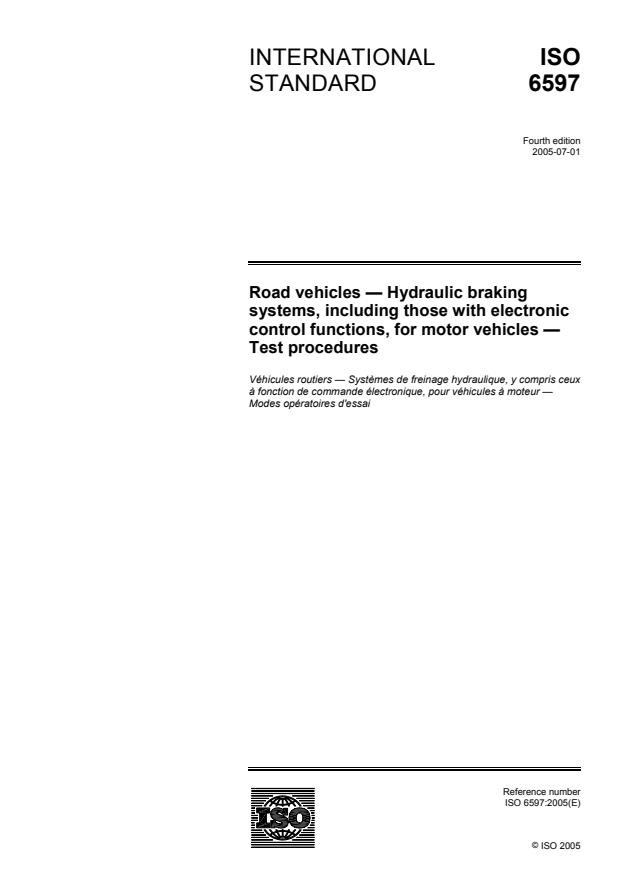
INTERNATIONAL ISO
STANDARD 6597
Fourth edition
2005-07-01
Road vehicles — Hydraulic braking
systems, including those with electronic
control functions, for motor vehicles —
Test procedures
Véhicules routiers — Systèmes de freinage hydraulique, y compris ceux
à fonction de commande électronique, pour véhicules à moteur —
Modes opératoires d'essai
Reference number
©
ISO 2005
PDF disclaimer
This PDF file may contain embedded typefaces. In accordance with Adobe's licensing policy, this file may be printed or viewed but
shall not be edited unless the typefaces which are embedded are licensed to and installed on the computer performing the editing. In
downloading this file, parties accept therein the responsibility of not infringing Adobe's licensing policy. The ISO Central Secretariat
accepts no liability in this area.
Adobe is a trademark of Adobe Systems Incorporated.
Details of the software products used to create this PDF file can be found in the General Info relative to the file; the PDF-creation
parameters were optimized for printing. Every care has been taken to ensure that the file is suitable for use by ISO member bodies. In
the unlikely event that a problem relating to it is found, please inform the Central Secretariat at the address given below.
© ISO 2005
All rights reserved. Unless otherwise specified, no part of this publication may be reproduced or utilized in any form or by any means,
electronic or mechanical, including photocopying and microfilm, without permission in writing from either ISO at the address below or
ISO's member body in the country of the requester.
ISO copyright office
Case postale 56 • CH-1211 Geneva 20
Tel. + 41 22 749 01 11
Fax + 41 22 749 09 47
E-mail copyright@iso.org
Web www.iso.org
Published in Switzerland
ii © ISO 2005 – All rights reserved
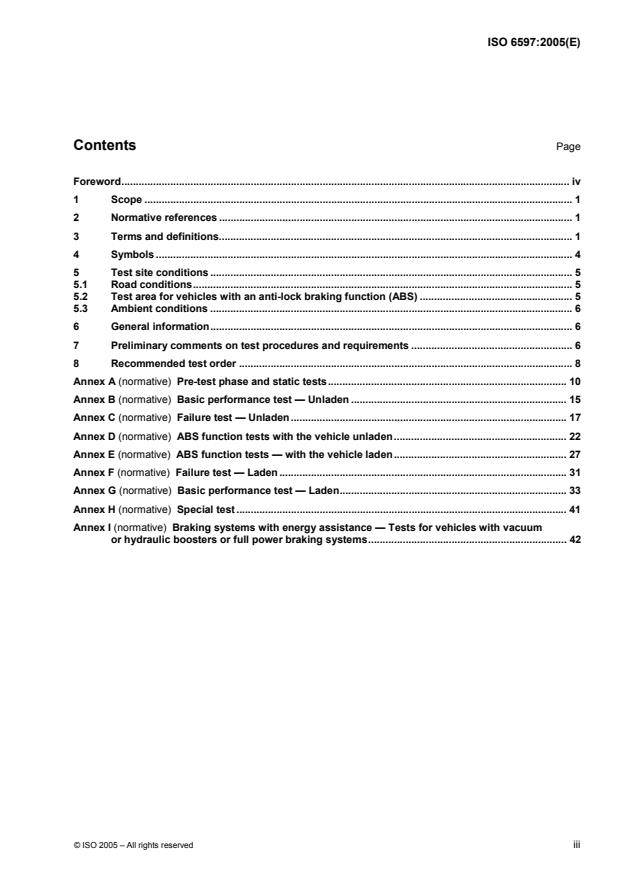
Contents Page
Foreword. iv
1 Scope . 1
2 Normative references . 1
3 Terms and definitions. 1
4 Symbols . 4
5 Test site conditions . 5
5.1 Road conditions. 5
5.2 Test area for vehicles with an anti-lock braking function (ABS) . 5
5.3 Ambient conditions . 6
6 General information. 6
7 Preliminary comments on test procedures and requirements . 6
8 Recommended test order . 8
Annex A (normative) Pre-test phase and static tests. 10
Annex B (normative) Basic performance test — Unladen . 15
Annex C (normative) Failure test — Unladen. 17
Annex D (normative) ABS function tests with the vehicle unladen. 22
Annex E (normative) ABS function tests — with the vehicle laden. 27
Annex F (normative) Failure test — Laden. 31
Annex G (normative) Basic performance test — Laden. 33
Annex H (normative) Special test . 41
Annex I (normative) Braking systems with energy assistance — Tests for vehicles with vacuum
or hydraulic boosters or full power braking systems. 42
Foreword
ISO (the International Organization for Standardization) is a worldwide federation of national standards bodies
(ISO member bodies). The work of preparing International Standards is normally carried out through ISO
technical committees. Each member body interested in a subject for which a technical committee has been
established has the right to be represented on that committee. International organizations, governmental and
non-governmental, in liaison with ISO, also take part in the work. ISO collaborates closely with the
International Electrotechnical Commission (IEC) on all matters of electrotechnical standardization.
International Standards are drafted in accordance with the rules given in the ISO/IEC Directives, Part 2.
The main task of technical committees is to prepare International Standards. Draft International Standards
adopted by the technical committees are circulated to the member bodies for voting. Publication as an
International Standard requires approval by at least 75 % of the member bodies casting a vote.
Attention is drawn to the possibility that some of the elements of this document may be the subject of patent
rights. ISO shall not be held responsible for identifying any or all such patent rights.
ISO 6597 was prepared by Technical Committee ISO/TC 22, Road vehicles, Subcommittee SC 2, Braking
systems and equipment.
This fourth edition cancels and replaces the third edition (ISO 6597:2002), which has been technically revised.
This fourth edition incorporates the relevant portions of the International Standard ISO 11835: “Road Vehicles-
Motor vehicles. Measurement of braking performance under ABS operation” for testing vehicles which are
fitted with anti lock function.
iv © ISO 2005 – All rights reserved
INTERNATIONAL STANDARD ISO 6597:2005(E)
Road vehicles — Hydraulic braking systems, including those
with electronic control functions, for motor vehicles — Test
procedures
1 Scope
This International Standard specifies the method of testing the hydraulic braking systems of vehicles of
categories M and N which are built to comply with ECE-R 13/09, including supplements 1 to 7. The values in
square brackets [ ] are taken from ECE Regulation No. 13 for information.
Hydraulic braking systems include vacuum-assisted and power hydraulic-assisted braking systems as well as
full power hydraulic braking systems.
NOTE Test methods covering the Electrical Regenerative Braking Systems of Electrical and Hybrid Vehicles are not
included in this edition. This omission may be corrected by a further annex once these vehicles are in more common use
and suitable practical test methods have been developed.
2 Normative references
The following referenced documents are indispensable for the application of this document. For dated
references, only the edition cited applies. For undated references, the latest edition of the referenced
document (including any amendments) applies.
ECE Regulation No. 13, Uniform provisions concerning the approval of vehicles with regard to braking,
incorporating the 09 series of amendments including supplements 1 to 7
ECE R.E.3, Consolidated Resolution on the Construction of Vehicles
3 Terms and definitions
For the purposes of this document, the following terms and definitions apply.
3.1
vehicle categories as defined in ECE R.E.3
3.1.1
category M
power-driven vehicles having at least four wheels and used for the carriage of passengers
3.1.2
category N
power-driven vehicles having at least four wheels and used for carriage of goods
3.2
categories of anti-lock braking function (ABS) as defined in ECE Regulation No. 13, Annex 13
3.2.1
category 1
that which meets all the requirements of ECE R 13, Annex 13
3.2.2
category 2
that which meets all the requirements of ECE R 13, Annex 13 except paragraph 5.3.5.
NOTE No braking rate on split-adhesion surfaces is prescribed.
3.2.3
category 3
that which meets all the requirements of ECE R 13, Annex 13 except paragraphs 5.3.4 and 5.3.5
NOTE All split-adhesion tests are omitted.
3.3
vehicle loading
3.3.1
laden vehicle
vehicle laden to its maximum technically permissible mass M as specified by the vehicle manufacturer and
max
acknowledged by the Technical Services
NOTE This mass may exceed the “maximum authorized total mass” permitted by national regulations. Mass
distribution on the axles is to be stated by the vehicle manufacturer. In the event of several load distribution patterns being
planned, the distribution of the maximum mass among the axles is such that the load on each axle is proportional to that
maximum technically permissible load for that axle.
3.3.2
unladen vehicle
vehicle at its kerb mass [without load or occupant but with the fuel tank filled at the start of the test to at least
90 % of the capacity stated by the vehicle manufacturer and complete with cooling fluid and lubricants, and
tools and spare wheel(s)]
NOTE During the tests, the fuel quantity is maintained at least at 50 % of the tank capacity, with an allowed increase
of up to 200 kg over the unladen vehicle level. This comprises, for instance, the driver, one observer and instrumentation.
If necessary, some vehicle mass may have to be removed. For a vehicle without a body, the manufacturer declares the
minimum mass which has to be reached on each axle, to represent the vehicle with a body and spare wheel(s) if these
provisions are foreseen.
3.4
hydraulic pressures (Booster and Full Power Systems)
3.4.1
cut-in pressure
system operational pressure in an energy storage device at which the energy source is reconnected
3.4.2
cut-out pressure
system operational pressure in an energy storage device at which the energy source is disconnected
3.5
cold brakes
brakes, the hottest of which has an initial temperature, when measured on the disc or on the outside of the
drum or on the brake linings, lower than 100 °C before each stop
NOTE With the exception of the hot braking performance test, all other tests are carried out with the brakes in this
cold condition.
2 © ISO 2005 – All rights reserved
3.6
wheel control in anti-lock braking (ABS) functions
3.6.1
directly controlled wheel
wheel whose braking force is modulated according to data provided at least by its own sensor
3.6.2
indirectly controlled wheel
wheel whose braking force is modulated according to data provided by the sensor(s) of another wheel or other
wheels
NOTE Anti-lock braking functions with select-high control are deemed to include both directly and indirectly controlled
wheels. In functions with select-low control, all sensed wheels are deemed to be directly controlled wheels.
3.7
full cycling
that state of the anti-lock system in which the brake force is repeatedly modulated to prevent the directly
controlled wheels from locking
NOTE Brake applications where modulation only occurs once during the stop are not considered to meet this
definition.
3.8
Electronic braking system (EBS)
braking system in which control is generated and processed as an electrical signal in the control transmission
4 Symbols
Table 1 — Symbols
Symbols Meaning Unit
E Wheelbase m
F Force N
Normal reaction of road surface under dynamic conditions with the anti-lock system
F N
dyn
operative
F Normal reaction of road surface on axle i (f or r) under static conditions N
i
F F on axle i (f or r) in case of power-driven vehicles N
idyn dyn
2 2
g Acceleration due to gravity (9,81 m/s) m/s
Height of centre of gravity specified by the manufacturer and agreed by the Technical
h m
Service conducting the approval test
k Coefficient of adhesion between tyre and road 1
k k-factor of the front axle 1
f
k k-value determined on high-adhesion surface 1
H
k k-value determined on the low-adhesion surface 1
L
k Value of adhesion for 100 % slip 1
lock
k Mean k-factor of the vehicle (dynamically weighted) 1
m
k Maximum value of the curve “adhesion versus slip” 1
peak
k k-factor of the rear axle 1
r
M Mass of individual vehicle kg
M Permissible maximum mass kg
max
p Pressure bar
s Stopping distance m
t Time interval s
t Mean value of several measurements of t s
m
t Minimum value of t s
min
v Vehicle speed km/h
v Maximum speed of vehicle (declared by the manufacturer) km/h
max
z Braking rate 1
z Braking rate z of the vehicle with the antilock system operative 1
AL
z Mean braking rate 1
m
z z of the power-driven vehicle on a “split surface” 1
MALS AL
The adhesion utilized by the vehicle: quotient of the maximum braking rate with the
ε
anti-lock system operative (z ) and the coefficient of adhesion (k) values for high and 1
AL
ε , ε
low-adhesion surfaces respectively
L H
4 © ISO 2005 – All rights reserved
5 Test site conditions
5.1 Road conditions
5.1.1 Surface
Except for ABS tests (see 5.2), the road surface shall be a smooth, hard-surfaced roadway of asphalt,
concrete, or other surface with an equivalent coefficient of adhesion.
The road surface shall be free from loose material and dry for those tests requiring high adhesion.
5.1.2 Gradient
The road surface shall be substantially level; a tolerance of ± 1 % average gradient, measured over a
minimum distance of 50 m, is allowed.
The type II test or the braking system hill-holding test may be conducted on a specified gradient or on a level
road using a towing vehicle.
5.1.3 Camber
The camber or transverse gradient across the road surface shall not exceed 2 %.
5.2 Test area for vehicles with an anti-lock braking function (ABS)
5.2.1 An area for tests on vehicles with ABS shall be provided consisting of a surface providing a peak
coefficient of adhesion (k u 0,4) and of a size sufficient to enable the tests to be performed in safety.
peak
Furthermore this area shall be preceded and followed by a surface which provides a peak coefficient of
adhesion of about 0,8, which is of sufficient length on the approach side to enable the test speeds to be
attained.
For testing vehicles fitted with ABS of categories 1 or 2, a low-adhesion surface shall have a high-adhesion
surface on at least one side so as to enable the split-adhesion tests to be performed. Each surface shall be
sufficiently wide to allow the separate determination of its peak coefficient of adhesion.
5.2.2 The surfaces used for the split adhesion tests shall be such that:
k W [0,5] and k /k W [2]
H H L
If any doubt arises that this requirement is met, the peak coefficient of adhesion shall be ascertained by using
the procedure detailed in D.3. It is always necessary to measure the peak coefficient of adhesion when testing
a vehicle fitted with ABS of categories 1 or 2.
5.2.3 For tests of the ABS, the track used shall be regularly characterized by preparation (for the low-
adhesion surface) of a curve showing the actual coefficient of adhesion versus slip from 0 to 100 % slip at a
speed of approximately 40 km/h.
NOTE Plotting this graph may require a special ABS capable of operating at any preset level of slip.
The peak value k and the value at 100 % slip k shall be measured and the ratio k /k calculated
peak lock peak lock
and rounded to 1 decimal place.
For the surface to qualify, this ratio shall be:
1 u k /k u 2
peak lock
Information on the method of measurement of adhesion levels shall be made available.
5.3 Ambient conditions
The wind speed shall not exceed an average of 5 m/s.
The air temperature shall not exceed 35 °C. In exceptional circumstances, up to 45 °C may be accepted.
This shall be recorded in the test report.
6 General information
6.1 Deceleration measurements used in this procedure refer to the “mean fully developed deceleration”
(MFDD). When reference is made to “prescribed effectiveness”, this is the MFDD and stopping distance
performance required in ECE Regulation No. 13 for the relevant test.
6.2 The use of either pedal-application machines or of robots does not reflect real-life vehicle braking and
should be discouraged.
6.3 The determination of the optimum vehicle braking performance shall be entrusted to skilled test drivers.
This shall be achieved without wheel-locking except immediately before stopping and without significant
deviation being caused by braking. A period of familiarization with the vehicle braking, steering and
suspension systems should be allowed.
7 Preliminary comments on test procedures and requirements
7.1 The tests should be carried out in the recommended sequence described in Table 2, but it is recognized
that practical circumstances may require variations from this sequence. However, because of thermal
influence on friction material behaviour, it is most strongly recommended that:
the fade test is performed at the end of the sequence; and
adhesion utilization tests be performed before the corresponding k factor determination.
Any variation in the recommended sequence shall be noted.
7.2 To reduce load changes, all unladen tests are grouped together and followed by the laden tests.
7.3 The parking braking system tests and the response time measurements may be carried out at any time
selected by the vehicle manufacturer and agreed with the Technical Services during the testing sequence.
7.4 A preliminary series of five braking system applications may be carried out for vehicle familiarization.
Because the total number of stops can significantly change the thermal and mechanical properties of the
friction materials (and thus possibly the vehicle braking performance), it is recommended that each test
condition be run no more than four times.
7.5 Re-testing in the course of the full procedure shall be avoided, although one or two extra stops are
unlikely to prejudice subsequent road test results.
7.6 Full or partial re-tests, after a failed test or to approve alternative braking system components, shall
again follow this procedure and with particular emphasis on the vehicle preparation and bedding procedures.
7.7 In order to avoid delays, tests may be carried out under adverse conditions but with due consideration
for safety; such adverse conditions shall be reported. Any failed test under such conditions may be repeated
under the correct conditions, but it is not necessary that all tests be repeated.
7.8 During the tests with the engine connected, on vehicles with a manual gearbox, the clutch may be
disengaged just before the vehicle stops, to avoid stalling the engine.
6 © ISO 2005 – All rights reserved
7.9 Tests with the engine connected should be carried out in the appropriate gear, defined as the lowest
gear which would normally be used to reach the speed without exceeding the manufacturer's recommended
maximum engine speed.
7.10 Control forces should be applied rapidly, but without significant overshoot, and then be maintained
constant during the stop to allow meaningful measurements to be made. Any departure from this International
Standard shall be mentioned in the appropriate test procedure paragraph.
7.11 All tests start with cold brakes, except the hot performance tests.
7.12 During all phases of this procedure, any unusual braking performance characteristics, such as deviation
or vibration, shall be reported.
7.13 Each specific failure mode appropriate to the vehicle braking equipment shall be considered and the
service braking system shall be checked for the worst case failure modes (for EBS see Annex 18 reference
in A.1 d)).
7.14 Where fault conditions are imposed on the braking system, they shall be removed after the appropriate
test has been conducted and the correct operation of the braking system shall then be verified.
8 Recommended test order
Table 2 — Recommended test order
Engine status
ECE Reg. 13
Test required
Connected Disconnected
Paragraph/Comments
or in gear or neutral
A — Pre-Test Phase
1 Documents required A1, A18
2 Preparation (instrumentation, bedding, etc.)
3 Line pressure vs. control force, at engine idling Common practice
after boost is established (not an R 13 requirement)
4 Characteristic of pressure reduction valve
5 Line pressure vs. time curve (vehicle stationary) A3 § 4
6 ABS warning lamp and mode change check A13, § 4.1, 4.1.1, 4.1.2
7 Additional tests on vehicles equipped with EBS § 5.2.1.27.1
B — Basic Performance Tests — unladen
1 Type 0 performance X
A4 § 1.4.2, 2.1.1 plot deceleration
vs. line pressure
2 Type 0 performance X A4 § 1.4.3
3 Wheel locking sequence A10 § 3.1.4.2-4
C — Failure Tests — unladen
1 Partial system failure Type 0 performance X A4 § 2.2
2 Failed load sensing-proportioning valve control X A10 § 6
3 Sensor fault memory test A13 § 4.1.1
4 Failure of the energy source on vehicles § 5.2.1.27.5, 5.2.1.27.6,
equipped with EBS 5.2.1.27.7, 5.2.1.27.8
D — ABS Tests — unladen
1 ABS – failed case X A13 § 4.3, A 4 § 2.4, 2.2
2 ABS – adhesion, utilisation on high adhesion X A13 § 5.2.2
3 ABS – determination of k X A13 - App.2
H
4 ABS – adhesion, utilisation on low adhesion X A13 § 5.2.2
5 ABS – determination of k X A13 - App.2
L
6 ABS – wheel behaviour test on homogeneous X A13 § 5.3
surfaces
7 ABS – transition from high to low adhesion X A13 § 5.3.2
8 ABS – transition from low to high adhesion X A13 § 5.3.3
9 ABS – split adhesion test X A13 App.3 for ABS cat. 1 or 2
8 © ISO 2005 – All rights reserved
Table 2 (continued)
Engine status
ECE Reg. 13
Test required
Connected Disconnected
Paragraph/Comments
or in gear or neutral
E — ABS Tests — laden
1 ABS – failed case as D1
2 ABS – adhesion utilisation on high adhesion X as D2
3 ABS – determination of k X as D3
H
4 ABS – adhesion utilisation on low adhesion X as D4
5 ABS – determination of k X as D5
L
6 ABS – wheel behaviour tests on homogeneous X as D6
surfaces
7 ABS – transition from high to low adhesion X as D7
8 ABS – transition from low to high adhesion X as D8
9 ABS – split adhesion test X as D9
10 ABS – energy consumption X A13 § 5.1
F — Failure Tests — laden
1 Partial system failure Type 0 performance X A4 § 2.2
2 Failed load sensing /proportioning valve X A10 § 6
3 Failed booster test X § 5.2.1.2.7 & A4 § 1.4.2, 2.2
G — Basic Performance Tests — laden
1 Type 0 performance X as B1
2 Type 0 performance X as B2
3 Wheel locking sequence test A10 § 3.1.4.2 to 3.1.4.4
4 Response time X A4 § 4.1.1
5 Type II (engine braking, only M3 urban buses) X A4 § 1.6 & 1.8.2 if applicable
6 Parking braking system dynamic test X A4 § 2.3.6
7 Parking braking system static test X A4 § 2.3.1 to 2.3.5
8 Additional tests on vehicles equipped with § 5.2.1.26 to § 5.2.1.26.4
electrical parking brake
9 Type I fade test X A4 § 1.5.1
10 Type 0 hot performance X A4 § 1.5.3.1/2, 1.5.4
H — Special test
Whilst not directly required by ECE Regulation No. 13, this test is called for in Directive 71/320 & 98/12 EEC
1 Temporary use spare wheels, laden X EEC Directive, Annex XIII
I — Special tests — Vacuum/hydr. assisted or power hydraulic actuation
1 General information
2 Vacuum booster system tests A7B § 1.2, 2.2
3 Hydraulic booster system tests A7C § 1.2, 2.1.2/3
4 Hydraulic full power system tests X 5.2.1.5 & A7C § 1.2, 2.1.2/3
5 Low pressure warning
X
Indicates the status of the engine (connected or disconnected)
Annex A
(normative)
Pre-test phase and static tests
A.1 Documents and basic data
The vehicle shall be verified based upon the documentation as follows:
a) Main technical data according to Annex 2 of ECE Regulation No. 13.
b) Layout and list of the elements of the braking system.
c) Braking system performance calculation (optional if vehicle is equipped with ABS).
d) Documentation according to Annex 18 of ECE Regulation No. 13, if the vehicle is equipped with EBS.
This documentation includes an explanation of design provisions guaranteeing compliance with all
relevant parts of ECE Regulation No. 13 paragraphs 5.1.4.7, 5.2.1.8 and 5.2.1.27 which deal with the
special requirements for the verification of the correct operational status, brake force compensation and
for EBS. This documentation may also indicate the worst-case failures for EBS.
e) Report/approval of EMC Tests (if vehicle is equipped with ABS or EBS) in accordance with ECE
Regulation No. 10.02.
A.2 Vehicle preparation
A.2.1 Vehicle loading
See 3.3.
A.2.2 Basic instrumentation needed for vehicle tests
The vehicle shall be prepared for testing by the addition of the following instruments and/or calibration of
existing standard instruments, as required. Other instruments may be useful in providing accurate data, but
care needs to be exercised to ensure that instruments added to the standard vehicle braking equipment do
not significantly affect the braking system performance.
All the following appropriate data acquisition system instruments shall be checked to ensure that they are
functioning correctly and, with the vehicle stationary on a level test surface and without any brake application,
all the instruments shall be set to zero:
a) control force gauge for the service braking systems;
b) control force gauge for the parking braking system;
c) control force gauge for the secondary braking system, if this system is not part of either the service or the
parking braking system;
d) decelerometer;
e) speed-measuring device or calibrated speedometer;
10 © ISO 2005 – All rights reserved
f) stopping-distance-measuring means;
g) time-measuring means;
h) brake temperature indicating system;
i) line pressure gauges/transducers. Regulations call for pressure measurements to be made at the least
favourable brake actuator and in other parts of the system;
j) optional instruments may include wheel lock indicators, control device travel gauges.
A.2.3 Additional instrumentation needed for test on vehicles with ABS
a) vehicle speed and, optionally, stopping distance and/or deceleration-measuring equipment shall be
capable of producing a permanent record of these variables during braking. The acquisition system shall
also produce a time base;
b) optional equipment to ascertain when and for what period the wheels directly controlled by an ABS
actually lock during the test;
c) for ABS/EBS which depend on stored energy assistance rather than an electrically powered energy
source, a device shall be provided to isolate the energy source;
d) it is standard practice to use adjustable pressure-limiting valves in the line to each wheel brake that will
be used during the determination of k or k ;
f r
e) optional equipment to show the point of transition of the vehicle from the low to the high-adhesion surface
on the permanent record;
f) optional means of measuring steering wheel angles (only for vehicles which are fitted with a category 1
ABS).
A.2.4 Provisions for failure simulation
The vehicle shall be equipped with the necessary added devices, piping and wiring according to the
manufacturer's recommendations and agreed with the Technical Services, to provide the required failure
simulations. Such added devices, piping and wiring shall not significantly affect the intact and/or failed braking
system performance.
When a leakage is simulated, the brake fluid shall be returned to the reservoir.
In the electric part of the braking system, a failure generally corresponds to a disconnection, but a short circuit
or a ground connection may be specified by the manufacturer in certain instances. This may be done by using
prepared components or sections of wiring.
A.2.5 Tyre conditions
The tyres shall be inflated to the vehicle manufacturer's recommended pressure levels.
It is recommended that the tyre tread wear should not exceed 50 % of the new condition.
A.2.6 Braking system condition
The braking system components shall be new, or capable of functioning as if new, and within the vehicle
manufacturer's specifications. The service and parking brake linings shall be bedded according to the vehicle
manufacturer's recommendations.
A.2.7 Adjustment of braking equipment
Adjustable brake components shall be set according to the vehicle manufacturer's recommendations. Manual
re-adjustment of the brakes, even including those with automatic adjusters, may be made in accordance with
the vehicle manufacturer's recommendations, prior to each test listed in Table 2, apart from the G10 Hot test
and subsequent test for free running of wheels.
Where a secondary braking system effectiveness test is carried out on one axle only, automatic adjustment
devices may be disconnected, if requested by the manufacturer.
A.3 Line pressure versus control force
A graph shall be produced by applying the service brake control, fitted with a force gauge and recording the
corresponding readings of the pressure gauge in the line. The pedal force should be slowly increased from 0
to the maximum permitted force which is prescribed as [500] N for M1, [700] N for all other classes and the
results recorded. A minimum of two curves shall be plotted to show the normal and zero boost conditions as
set out below:
−1
a) with engine idling after previously having been operated above 2 500 rpm (41,667s ) four or five times
(for petrol engines only);
b) without any assistance force (booster disconnected from the vacuum/energy source and stored energy
depleted).
A.4 Characteristic of the pressure reduction (proportioning) valve
With pressure gauges fitted in both the input and output lines, the pressure transfer characteristic shall be
recorded as the pedal force is slowly increased from zero to the maximum as listed in A.2 above. This shall be
done for both unladen and laden conditions.
The ambient conditions and any relevant vehicle or component information shall be noted and the method
(measurement or calculation) by which the characteristic was obtained shall appear in the report.
A.5 Line pressure versus time curve (vehicle stationary)
NOTE This curve will be used to determine the static response time (see G.4).
A.5.1 Simulate the laden vehicle
This is done by setting the load-sensing device in the position corresponding to a laden vehicle.
A.5.2 Initial energy level
The initial energy level in reservoirs or accumulators is important where assistance is given to the driver at
each brake application. This level shall be set at 90 % of the value specified by the vehicle manufacturer.
Systems such as vacuum boosters, which have no external reservoir, shall be conditioned as indicated in A.2
before each performance test or recording.
12 © ISO 2005 – All rights reserved
A.5.3 Determination of the “line pressure versus time” curve
This curve is most easily measured with the vehicle stationary, by recording the pressure rise at the least
favourably placed axle/wheel in response to a sudden brake application.
The force on the service brake control, up to a maximum value of [500] N for vehicles of category M1 and
[700] N for vehicles of other categories, shall be applied as quickly as possible but without significant
overshoot, as soon as the recorder is started.
The beginning of the movement of the service brake control shall also be recorded as this will provide the start
point for the response time assessment.
A.6 ABS/EBS function — Warning lamp check and mode change check
A.6.1 Static warning lamp check
Verify that a specific optical warning device is fitted, which will signal to the driver any electrical break in the
supply of electricity to the ABS/EBS or in the external wiring to the controller(s) and any system disconnection
or ABS mode change. Check that this warning device lights up when the ABS/EBS is energized and that it is
extinguished after a brief verification phase, only if none of the above-mentioned faults are present. This will
require the simulation of such faults in order to check the detection capability of the electronic controller.
Check that the warning signal is visible in daylight and that the switch-on warning flash shows it to be in
working order.
NOTE 1 With no defect present, the warning signal may light up again, but it shall be extinguished before the vehicle
speed reaches 15 km/h, by which point in the speed range all the wheel speed sensors shall be generating reliable signals.
NOTE 2 To check the function of sensor fault memory see C.3.
A.6.2 Mode change check
Check if the subject vehicle specification shows it to be an off-road power driven vehicle of category N2 as
defined in Annex 7 of the UN Consolidated Resolution on the Construction of Vehicles/RE3. If this is the case
and it is equipped with means to manually disconnect or change the control mode of the ABS function, check
that the manufacturer's calculations show that, with this function disabled or in the changed mode, the vehicle
conforms to Annex 10 of ECE Regulation No. 13 in that front wheels lock before rear wheels. (Simultaneous
locking is accepted for 4WD vehicles.)
NOTE This check is not necessary if, in this changed control mode, all the requirements of the normal system are
fulfilled.
Check that an optical warning signal informs the driver of the system disconnection or mode change. The ABS
optical warning device may be used for this purpose.
Check that the ABS function is automatically reset to the operational condition in the normal mode when the
vehicle ignition switch is again set to the ON condition.
Check that the user handbook, provided by the manufacturer, explains the consequences of such manual
disconnection or mode change on the operation of the ABS function.
A.7 Additional tests on vehicles equipped with EBS
A.7.1 Test for system operation with ignition off
This test is not necessary if documentary evidence is provided which shows that the electric control
transmission is fully operational within 2 s after the brake pedal is fully applied. This is also the case when the
ignition key cannot be removed unless the parking brake is applied and where subsequent release is
prevented.
The vehicle shall be left stationary with the parking brake released, the ignition in the “off” position and the key
removed for 5 to 10 m.
Fully apply the service brake control within 1 s.
The test shall show that the required static total braking force is produced within 2 s after the control is fully
applied. Force build-up shall start no later than 300 ms after the initial application of the control.
The static total braking force shall be at least equivalent to that required in the Type-0 test. Testing may be
done on a roller bench tester for each axle.
14 © ISO 2005 – All rights reserved
Annex B
(normative)
Basic performance test — Unladen
B.1 Service braking system cold effectiveness (type 0) test with engine disconnected
B.1.1 Test procedure and requirement
ECE Regulation No. 13 requires results from a single type 0 test, but in practice it is recommended to
undertake, from the speed set out in Table B.1, a series of stops, using reasonably spaced increments of line
pressure/control force. This is used to build up a picture of the service braking capability. From this speed, it is
good practice to make at least three stops to condition the linings, before actually measuring the performance.
These stops can be used to ascertain the maximum pedal force which can be applied without the onset of
wheel locking.
Check that the brake temperatures are all below 100 °C and if energy assistance, such as vacuum boost, is
provided, that this is at the initial level recommended by the manufacturer. Drive the vehicle at 5 km/h above
the test speed on the selected flat, level, high-adhesion surface and disengage the gear being employed
whilst starting the recorder at the same time. When the speed drops to the test speed, apply the service brake
as quickly as possible, to the planned level. (Line pressure limiters as used in ABS testing can help in this
series of tests.)
During this series of tests, record the control pedal force, the deceleration achieved and the resulting stopping
distance. From the resulting Mean Fully Developed Deceleration (MFDD) figures and stopping distances, a
graph shall be produced showing the braking rate and stopping distance against control force and line
pressure, up to the point where the tendency to wheel lock would occur.
This graph will provide figures to demonstrate that both the required deceleration level and stopping distance
targets, as specified in Table B.1, have been obtained without exceeding the force limit on the control pedal.
Table B.1 — Service braking with engine disconnected
Vehicle M1 M2 M3 N1 N2
category
v (km/h) 80 60 60 80 60
Type 0 test with
s < = (m) 2 2
0,1vv+ /150 0,15vv+ /130
engine
( ) ()
disconnected
5,80 5,00
dm > = (m/s )
Control force limit F < = (N) 500 700
B.2 Service braking system — Cold effectiveness (type 0) test with engine connected
B.2.1 Test procedure and requirements
Following a similar procedure to that used in B.1.1, but without disengaging the gear used for building up
speed, make stops from speeds of 30 %, 55 % and 80 % of v (not exceeding the limits of Table B.2). Carry
max
out single brake applications with a level of control force such as to achieve and record the maximum practical
vehicle braking performance.
The vehicle shall show no abnormality such as skidding, pulling off line or requiring serious steering correction
to hold on line. The maximum MFDD and the stopping distances shall be noted for the record.
Further tests shall be carried out from the appropriate speed of Table B.2, with control pedal forces which will
just allow the deceleration and stopping distances to exceed the required levels of Table B.2, and the control
force needed shall be noted.
Table B.2 — Service braking with engine connected
Vehicle category M1 M2 M3 N1 N2
80 % v but not 160 100 90 120 100
m
exceeding (km/h)
Type 0 test with engine
2 2
0,1vv+ /130 0,15vv+ /103,5
connected s < = (m)
( ) ( )
5,00 4,00
dm > = (m/s )
Control force limit F < = (N) 500 700
B.3 Wheel locking sequence test
This test is required only for vehicles with permanent 4 wheel drive in which it is not possible to calculate the
adhesion utilization curves for the vehicle due to the torque balancing effects of the 4WD linkages.
The wheel locking sequence shall be checked by making wheel speed recordings as the braking pressures
are increased up to the point where all wheels show the development of a lock-up condition. These recordings
shall then be analysed to verify the order in which lock-up occurred.
The tests, which may call for some practice in braking application rates, are required to be made on both high
and low-adhesion surfaces with adhesion coefficient levels of about 0,8 (normal dry road) and not greater than
0,3 as used for ABS testing.
Commence with the test on the high-adhesion surface and brake from 80 km/h or the maximum speed
possible if 80 km/h cannot be achieved. The brake control force shall be built up steadily so that the second
wheel reaches lock-up between 0,5 s and 1,0 s after the commencement of braking and the build-up shall be
continued until all wheels approach or reach the lock-up condition. It may be necessary to exceed the brake
control force limit in order to produce this condition.
The test shall then be repeated and the resulting recordings examined to verify that, in both tests, both rear
wheels did not lock up before both front wheels. If the results show that this condition was met on only one
test, a third test may be made which shall meet the requirement for the vehicle to be acceptable.
NOTE Simultaneous (within 0,1 s) locking of front and rear wheels is acceptable.
These tests shall be repeated on the low-adhesion surface from a speed of 60 km/h or 80 % v whichever is
max
the lower, and similar results shall be obtained.
16 © ISO 2005 – All rights reserved
Annex C
(normative)
Failure test — Unladen
C.1 Secondary braking system — Service braking system partial failure (type 0) test
C.1.1 General
C.1.1.1 Secondary braking system
Two types of secondary braking system are considered, depending on the basic design of the braking system
in use on the vehicle:
a) one which is part of the service braking system;
b) one which is independent of the service braking system; e.g. this may require the secondary braking
performance to be achieved by the parking brake system.
C.1.1.2 Secondary braking performance
This is considered to be the minimum performance required of the secondary braking system, whichever
secondary provision, a) or b) above, is made.
C.1.1.3 Residual braking performance of the service braking system
This is considered to be the minimum performance required of the service braking system in case of a
transmission circuit failure, even though the secondary braking system is not part of the service braking
system.
NOTE Residual braking has no meaning in case C.1.1.1 a).
C.1.2 Test procedure and requirements
C.1.2.1 The secondary and/or residual braking performance (see C.1.1.2 or C.1.1.3) shall be checked for
the worst-case failure modes appropriate to the vehicle braking system where all circuits shall be considered.
C.1.2.2 The conditions of the test shall be as follows:
a) vehicle speed (see Table C.1);
b) with the engine disconnected;
c) without wheel-locking, except immediately before stopping;
d) with steering-wheel corrections, if necessary, to keep the vehicle on course;
e) unladen as defined in 3.3.2 (the laden test appears in Annex F);
f) a single stop suffices for each test; additional stops may be run, if necessary;
g) each test shall be made with cold brakes as defined in 3.5;
h) if the secondary braking system is independent of the service braking system as in C.1.1.1 b), both the
service braking system with a partial failure and the secondary braking system need to be tested.
C.1.2
...