


ISO 9782:2026
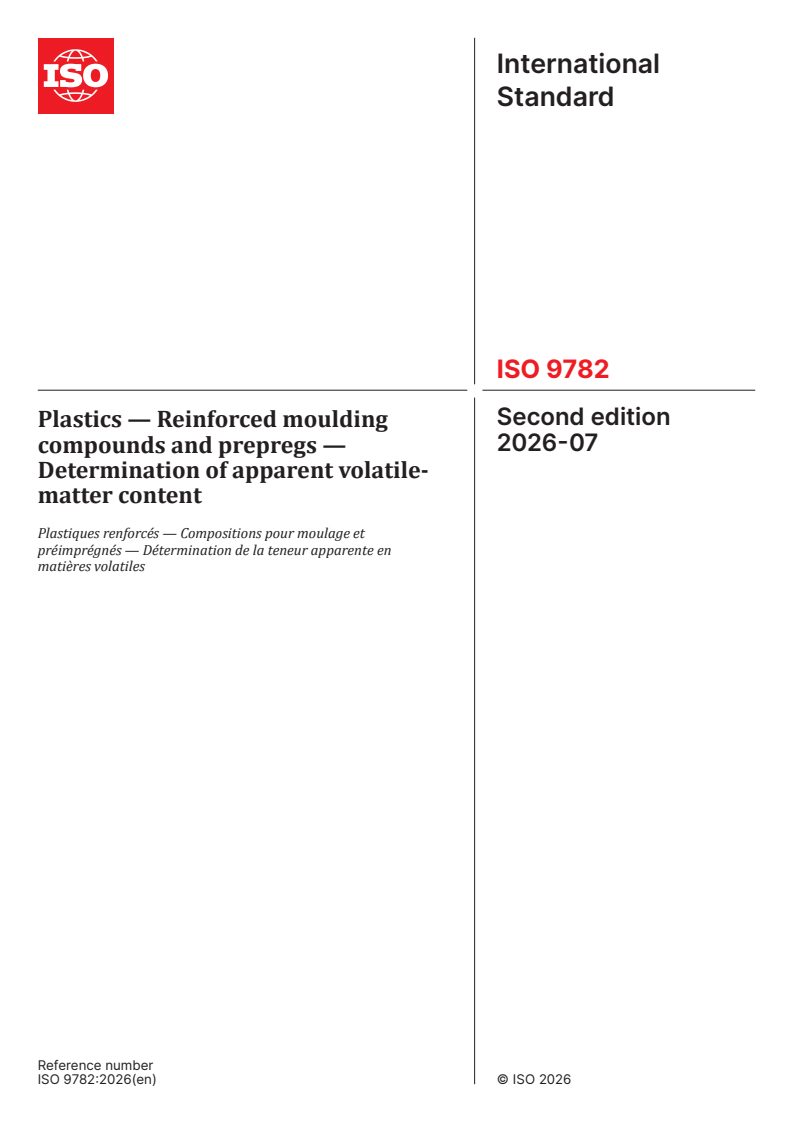
(Main)Plastics — Reinforced moulding compounds and prepregs — Determination of apparent volatile-matter content
General Information
- Abstract
This document specifies a method for the determination of the apparent volatile-matter content in pre-impregnated yarns, tapes, mats (SMC) and fabrics. The method is applicable to all unidirectional and multidirectional fibre-reinforced prepregs and all thermosetting-resin matrices, unless otherwise specified in product specifications. The method does not apply to unimpregnated reinforcement fibres. NOTE For products with a polyester-resin matrix (UP), the result will be lower than the real value.
- Status
- Published
- Publication Date
- 06-Jul-2026
- Technical Committee
- ISO/TC 61/SC 13 - Composites and reinforcement fibres
- Drafting Committee
- ISO/TC 61/SC 13/WG 2 - Laminates and moulding compounds
- Current Stage
- 6060 - International Standard published
- Start Date
- 07-Jul-2026
- Due Date
- 21-Nov-2027
- Completion Date
- 07-Jul-2026
Overview
ISO 9782:2026 - Plastics - Reinforced moulding compounds and prepregs - Determination of apparent volatile-matter content is an international standard published by ISO, applicable to the plastics and composites industry. This standard specifies a consistent method for determining the apparent volatile-matter content in pre-impregnated yarns, tapes, mats (such as sheet moulding compounds - SMC), and fabrics. It addresses all unidirectional and multidirectional fibre-reinforced prepregs with thermosetting resin matrices unless otherwise instructed in the product's specification. Notably, it does not apply to unimpregnated reinforcement fibres.
This standardized test ensures reliable quality control and supports harmonization across manufacturers and laboratories, helping to manage material properties and product performance in reinforced plastics applications.
Key Topics
Scope of Application
- Prepregs made with thermosetting resin matrices (e.g., epoxy, phenolic, polyester, silicone, polyimide)
- All fibre orientations: unidirectional and multidirectional
- Exclusion of unimpregnated fibres
Principle of the Method
- The method measures the percentage of matter lost after heating a test specimen in an air-ventilated oven at a specified temperature and duration.
- The change in mass indicates the apparent volatile-matter content, critical for assessing the integrity and curing conditions of prepreg materials.
Sample Preparation and Conditioning
- At least three specimens are tested from each sample, distributed across its width or length for accurate representation.
- Standard conditioning and test atmospheres are referenced according to ISO 291.
Test Procedures
- Precise weighing (accuracy to 0.1 mg), cutting, and handling of specimens before and after oven treatment.
- Specific recommendations for oven temperature and heating time based on resin type.
Calculation and Reporting
- Results are computed as percent mass loss and averaged across specimens.
- Full documentation of testing parameters, dates, and results is required.
Precision and Reproducibility
- Data from interlaboratory tests provide statistical insight into method precision, supporting credibility and traceability in quality control programs.
Applications
ISO 9782:2026 supports industries where quality and consistency of fibre-reinforced plastics are crucial, such as:
- Composites Manufacturing: Ensures proper resin content and volatile matter release, affecting product strength, durability, and handling.
- Automotive and Aerospace: Helps meet safety and performance criteria for reinforced plastic components, such as panels, structural frames, and interior parts.
- Quality Assurance Laboratories: Provides a trusted, standardized approach for testing prepreg batches and verifying material conformity.
- Product Development and R&D: Assists in evaluating new prepreg formulations and optimizing processing conditions.
- Regulatory Compliance: Facilitates adherence to international supply chain requirements and customer specifications for advanced composites.
Related Standards
For comprehensive material testing and quality control in the plastics and composites sectors, the following standards are frequently used along with ISO 9782:2026:
- ISO 291: Plastics - Standard atmospheres for conditioning and testing
- Defines the environmental conditions for preconditioning and testing plastic specimens, ensuring consistent and comparable results.
- ISO 11357 (series): Plastics - Differential scanning calorimetry (DSC)
- Related to thermal analysis of plastics and polymers.
- ISO 527: Plastics - Determination of tensile properties
- For mechanical property evaluation of reinforced plastics and composites.
- ISO 14125: Fibre-reinforced plastic composites - Determination of flexural properties
- Relevant for mechanical behavior characterization.
ISO 9782:2026 ensures that stakeholders in plastics and composite materials can measure volatile-matter content accurately and consistently, supporting performance, safety, and compliance in advanced materials applications.
Relations
- Effective Date
- 07-Jan-2025
Get Certified
Connect with accredited certification bodies for this standard

DIN CERTCO
DIN Group product certification.

Smithers Quality Assessments
US management systems and product certification.
Sponsored listings
Frequently Asked Questions
ISO 9782:2026 is a standard published by the International Organization for Standardization (ISO). Its full title is "Plastics — Reinforced moulding compounds and prepregs — Determination of apparent volatile-matter content". This standard covers: This document specifies a method for the determination of the apparent volatile-matter content in pre-impregnated yarns, tapes, mats (SMC) and fabrics. The method is applicable to all unidirectional and multidirectional fibre-reinforced prepregs and all thermosetting-resin matrices, unless otherwise specified in product specifications. The method does not apply to unimpregnated reinforcement fibres. NOTE For products with a polyester-resin matrix (UP), the result will be lower than the real value.
This document specifies a method for the determination of the apparent volatile-matter content in pre-impregnated yarns, tapes, mats (SMC) and fabrics. The method is applicable to all unidirectional and multidirectional fibre-reinforced prepregs and all thermosetting-resin matrices, unless otherwise specified in product specifications. The method does not apply to unimpregnated reinforcement fibres. NOTE For products with a polyester-resin matrix (UP), the result will be lower than the real value.
ISO 9782:2026 is classified under the following ICS (International Classification for Standards) categories: 83.120 - Reinforced plastics. The ICS classification helps identify the subject area and facilitates finding related standards.
ISO 9782:2026 has the following relationships with other standards: It is inter standard links to ISO 9782:1993. Understanding these relationships helps ensure you are using the most current and applicable version of the standard.
ISO 9782:2026 is available in PDF format for immediate download after purchase. The document can be added to your cart and obtained through the secure checkout process. Digital delivery ensures instant access to the complete standard document.
Standards Content (Sample)
International
Standard
ISO 9782
Second edition
Plastics — Reinforced moulding
2026-07
compounds and prepregs —
Determination of apparent volatile-
matter content
Plastiques renforcés — Compositions pour moulage et
préimprégnés — Détermination de la teneur apparente en
matières volatiles
Reference number
© ISO 2026
All rights reserved. Unless otherwise specified, or required in the context of its implementation, no part of this publication may
be reproduced or utilized otherwise in any form or by any means, electronic or mechanical, including photocopying, or posting on
the internet or an intranet, without prior written permission. Permission can be requested from either ISO at the address below
or ISO’s member body in the country of the requester.
ISO copyright office
CP 401 • Ch. de Blandonnet 8
CH-1214 Vernier, Geneva
Phone: +41 22 749 01 11
Email: copyright@iso.org
Website: www.iso.org
Published in Switzerland
ii
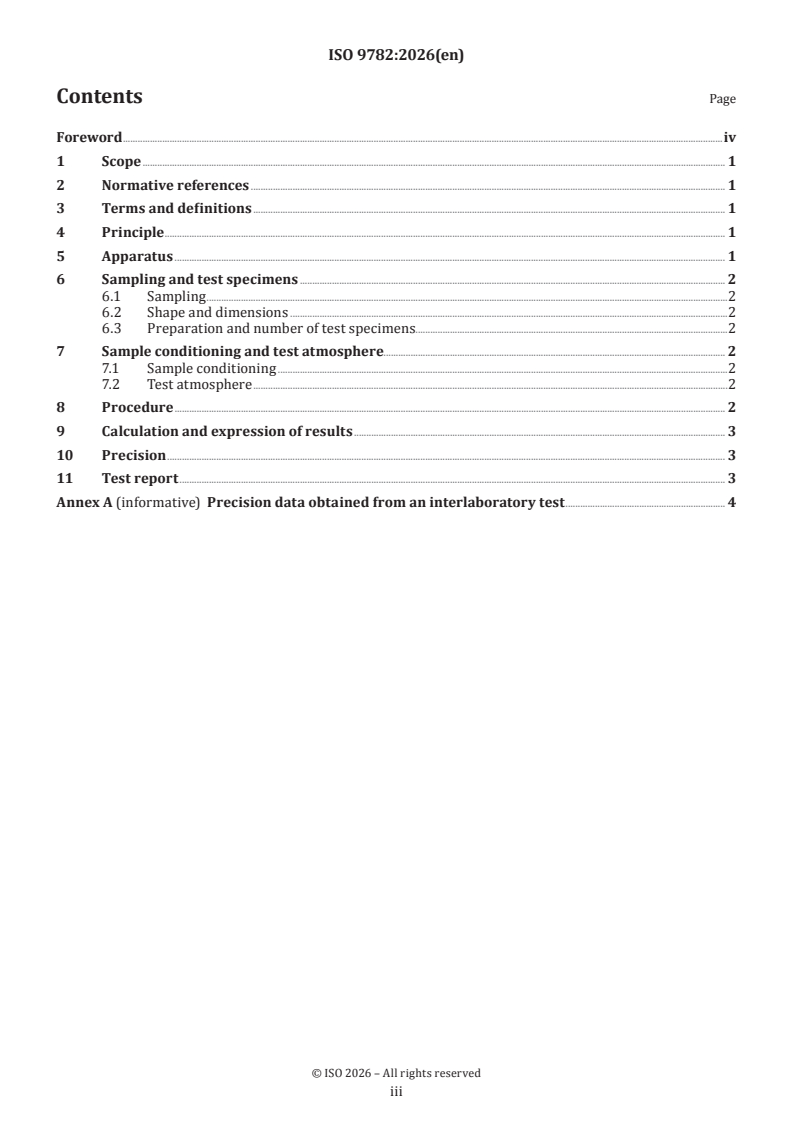
Contents Page
Foreword .iv
1 Scope . 1
2 Normative references . 1
3 Terms and definitions . 1
4 Principle . 1
5 Apparatus . 1
6 Sampling and test specimens . 2
6.1 Sampling .2
6.2 Shape and dimensions .2
6.3 Preparation and number of test specimens.2
7 Sample conditioning and test atmosphere. 2
7.1 Sample conditioning .2
7.2 Test atmosphere .2
8 Procedure . 2
9 Calculation and expression of results . 3
10 Precision . 3
11 Test report . 3
Annex A (informative) Precision data obtained from an interlaboratory test . 4
iii
Foreword
ISO (the International Organization for Standardization) is a worldwide federation of national standards
bodies (ISO member bodies). The work of preparing International Standards is normally carried out through
ISO technical committees. Each member body interested in a subject for which a technical committee
has been established has the right to be represented on that committee. International organizations,
governmental and non-governmental, in liaison with ISO, also take part in the work. ISO collaborates closely
with the International Electrotechnical Commission (IEC) on all matters of electrotechnical standardization.
The procedures used to develop this document and those intended for its further maintenance are described
in the ISO/IEC Directives, Part 1. In particular, the different approval criteria needed for the different types
of ISO document should be noted. This document was drafted in accordance with the editorial rules of the
ISO/IEC Directives, Part 2 (see www.iso.org/directives).
ISO draws attention to the possibility that the implementation of this document may involve the use of (a)
patent(s). ISO takes no position concerning the evidence, validity or applicability of any claimed patent
rights in respect thereof. As of the date of publication of this document, ISO had not received notice of (a)
patent(s) which may be required to implement this document. However, implementers are cautioned that
this may not represent the latest information, which may be obtained from the patent database available at
www.iso.org/patents. ISO shall not be held responsible for identifying any or all such patent rights.
Any trade name used in this document is information given for the convenience of users and does not
constitute an endorsement.
For an explanation of the voluntary nature of standards, the meaning of ISO specific terms and expressions
related to conformity assessment, as well as information about ISO's adherence to the World Trade
Organization (WTO) principles in the Technical Barriers to Trade (TBT), see www.iso.org/iso/foreword.html.
This document was prepared by Technical Committee ISO/TC 61, Plastics, Subcommittee SC 13, Composites
and reinforcement fibres.
This second edition cancels and replaces the first edition (ISO 9782:1993), which has been technically
revised.
The main changes are as follows:
— the requirement for the weighing accuracy of balances has been raised from ±1 mg to ±0,1 mg;
— a timer has been added in the apparatus clause;
— the symbol V for volatile-matter content in the calculation formula has been supplemented;
c
— the number of test specimens has been changed from "three" to "at least three";
— the following instruction has been added to 8.4 “The specimens should be placed so that the maximum
surface area is exposed to the circulating heat.”;
— a precision statement has been added in Annex A.
Any feedback or questions on this document should be directed to the user’s national standards body. A
complete listing of these bodies can be found at www.iso.org/members.html.
iv
International Standard ISO 9782:2026(en)
Plastics — Reinforced moulding compounds and prepregs —
Determination of apparent volatile-matter content
1 Scope
This document specifies a method for the determination of the apparent volatile-matter content in pre-
impregnated yarns, tapes, mats (SMC) and fabrics.
The method is applicable to all unidirectional and multidirectional fibre-reinforced prepregs and all
thermosetting-resin matrices, unless otherwise specified in product specifications.
The method does not apply to unimpregnated reinforceme
...