


ISO 8828:2014
(Main)Implants for surgery — Guidance on care and handling of orthopaedic implants
Implants for surgery — Guidance on care and handling of orthopaedic implants
ISO 8828:2014 specifies the recommended procedures for handling orthopaedic implants, hereafter referred to as implants, from receipt at the hospital until they are implanted or discarded. This guidance applies to implants (such as currently used metal, ceramic, or polymeric implants) and also to acrylic resin and other bone cements. This guidance does not apply to the implant manufacturer. However, it contains references to the stocking of implants that can be useful for manufacturers and especially for third-party suppliers.
Implants chirurgicaux — Principes directeurs pour l'entretien et la manipulation des implants orthopédiques
General Information
- Status
- Withdrawn
- Publication Date
- 09-Nov-2014
- Withdrawal Date
- 09-Nov-2014
- Technical Committee
- ISO/TC 150 - Implants for surgery
- Drafting Committee
- ISO/TC 150/WG 10 - Use and retrieval of surgical implants
- Current Stage
- 9599 - Withdrawal of International Standard
- Start Date
- 30-Apr-2020
- Completion Date
- 12-Feb-2026
Relations
- Consolidated By
ISO 20024:2020 - Solid biofuels — Safe handling and storage of solid biofuel pellets in commercial and industrial applications - Effective Date
- 06-Jun-2022
- Effective Date
- 05-Feb-2011
Get Certified
Connect with accredited certification bodies for this standard

BSI Group
BSI (British Standards Institution) is the business standards company that helps organizations make excellence a habit.

TÜV Rheinland
TÜV Rheinland is a leading international provider of technical services.

TÜV SÜD
TÜV SÜD is a trusted partner of choice for safety, security and sustainability solutions.
Sponsored listings
Frequently Asked Questions
ISO 8828:2014 is a standard published by the International Organization for Standardization (ISO). Its full title is "Implants for surgery — Guidance on care and handling of orthopaedic implants". This standard covers: ISO 8828:2014 specifies the recommended procedures for handling orthopaedic implants, hereafter referred to as implants, from receipt at the hospital until they are implanted or discarded. This guidance applies to implants (such as currently used metal, ceramic, or polymeric implants) and also to acrylic resin and other bone cements. This guidance does not apply to the implant manufacturer. However, it contains references to the stocking of implants that can be useful for manufacturers and especially for third-party suppliers.
ISO 8828:2014 specifies the recommended procedures for handling orthopaedic implants, hereafter referred to as implants, from receipt at the hospital until they are implanted or discarded. This guidance applies to implants (such as currently used metal, ceramic, or polymeric implants) and also to acrylic resin and other bone cements. This guidance does not apply to the implant manufacturer. However, it contains references to the stocking of implants that can be useful for manufacturers and especially for third-party suppliers.
ISO 8828:2014 is classified under the following ICS (International Classification for Standards) categories: 11.040.40 - Implants for surgery, prosthetics and orthotics. The ICS classification helps identify the subject area and facilitates finding related standards.
ISO 8828:2014 has the following relationships with other standards: It is inter standard links to ISO 20024:2020, ISO 8828:1988. Understanding these relationships helps ensure you are using the most current and applicable version of the standard.
ISO 8828:2014 is available in PDF format for immediate download after purchase. The document can be added to your cart and obtained through the secure checkout process. Digital delivery ensures instant access to the complete standard document.
Standards Content (Sample)
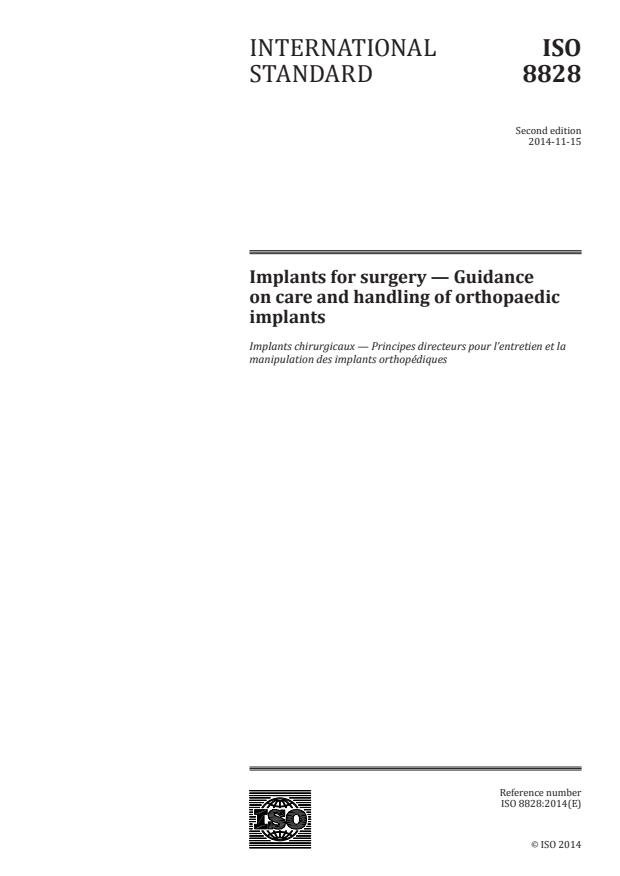
INTERNATIONAL ISO
STANDARD 8828
Second edition
2014-11-15
Implants for surgery — Guidance
on care and handling of orthopaedic
implants
Implants chirurgicaux — Principes directeurs pour l’entretien et la
manipulation des implants orthopédiques
Reference number
©
ISO 2014
© ISO 2014
All rights reserved. Unless otherwise specified, no part of this publication may be reproduced or utilized otherwise in any form
or by any means, electronic or mechanical, including photocopying, or posting on the internet or an intranet, without prior
written permission. Permission can be requested from either ISO at the address below or ISO’s member body in the country of
the requester.
ISO copyright office
Case postale 56 • CH-1211 Geneva 20
Tel. + 41 22 749 01 11
Fax + 41 22 749 09 47
E-mail copyright@iso.org
Web www.iso.org
Published in Switzerland
ii © ISO 2014 – All rights reserved
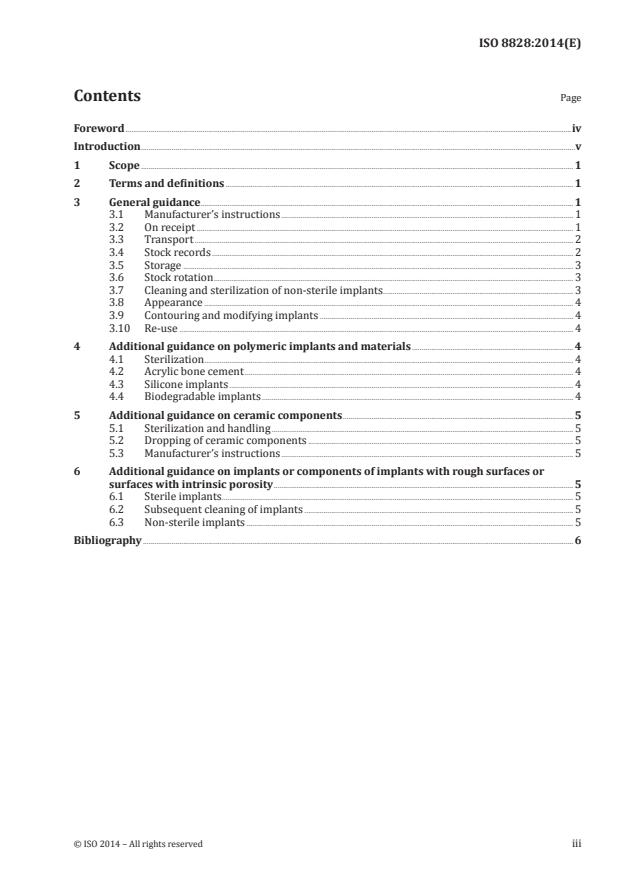
Contents Page
Foreword .iv
Introduction .v
1 Scope . 1
2 Terms and definitions . 1
3 General guidance . 1
3.1 Manufacturer’s instructions . 1
3.2 On receipt . 1
3.3 Transport . 2
3.4 Stock records . 2
3.5 Storage . 3
3.6 Stock rotation . 3
3.7 Cleaning and sterilization of non-sterile implants . 3
3.8 Appearance . 4
3.9 Contouring and modifying implants . 4
3.10 Re-use . 4
4 Additional guidance on polymeric implants and materials . 4
4.1 Sterilization . 4
4.2 Acrylic bone cement . 4
4.3 Silicone implants . 4
4.4 Biodegradable implants . 4
5 Additional guidance on ceramic components . 5
5.1 Sterilization and handling . 5
5.2 Dropping of ceramic components . 5
5.3 Manufacturer’s instructions . 5
6 Additional guidance on implants or components of implants with rough surfaces or
surfaces with intrinsic porosity . 5
6.1 Sterile implants. 5
6.2 Subsequent cleaning of implants . 5
6.3 Non-sterile implants . 5
Bibliography . 6
Foreword
ISO (the International Organization for Standardization) is a worldwide federation of national standards
bodies (ISO member bodies). The work of preparing International Standards is normally carried out
through ISO technical committees. Each member body interested in a subject for which a technical
committee has been established has the right to be represented on that committee. International
organizations, governmental and non-governmental, in liaison with ISO, also take part in the work.
ISO collaborates closely with the International Electrotechnical Commission (IEC) on all matters of
electrotechnical standardization.
The procedures used to develop this document and those intended for its further maintenance are
described in the ISO/IEC Directives, Part 1. In particular the different approval criteria needed for the
different types of ISO documents should be noted. This document was drafted in accordance with the
editorial rules of the ISO/IEC Directives, Part 2 (see www.iso.org/directives).
Attention is drawn to the possibility that some of the elements of this document may be the subject of
patent rights. ISO shall not be held responsible for identifying any or all such patent rights. Details of
any patent rights identified during the development of the document will be in the Introduction and/or
on the ISO list of patent declarations received (see www.iso.org/patents).
Any trade name used in this document is information given for the convenience of users and does not
constitute an endorsement.
For an explanation on the meaning of ISO specific terms and expressions related to conformity
assessment, as well as information about ISO’s adherence to the WTO principles in the Technical Barriers
to Trade (TBT) see the following URL: Foreword - Supplementary information
The committee responsible for this document is ISO/TC 150, Implants for surgery.
This second edition cancels and replaces the first edition (ISO 8828:1988), which has been technically
revised.
iv © ISO 2014 – All rights reserved
Introduction
The guidance given in this International Standard on the care and handling of orthopaedic implants
after delivery to the purchaser is intended to help ensure that implants remain free from contamination
or damage prior to insertion into the patient. Guidance is given on the procedures for receiving, storing,
transporting, handling, cleaning, and sterilizing implants. Guidance on procedures for preparing the
implants for use, as well as handling during the surgery, are also outlined. This guidance is aimed at
all personnel involved in receiving and handling implants, including surgeons. It is important that all
personnel be familiar with recommended procedures in order to minimize the risk and occurrence of
damage to implants.
INTERNATIONAL STANDARD ISO 8828:2014(E)
Implants for surgery — Guidance on care and handling of
orthopaedic implants
1 Scope
This International Standard specifies the recommended procedures for handling orthopaedic implants,
hereafter referred to as implants, from receipt at the hospital until they are implanted or discarded.
This guidance applies to implants (such as currently used metal, ceramic, or polymeric implants) and
also to acrylic resin and other bone cements.
This guidance does not apply to the implant manufacturer. However, it contains references to the
stocking of implants that can be useful for manufacturers and especially for third-party suppliers.
2 Terms and definitions
For the purposes of this document, the following terms and definitions apply.
2.1
orthopaedic implant
implant
device implanted surgically, wholly or partially, in the body, either temporarily or permanently, and used
either as an aid in the repair of bone or related tissues, or as a temporary or permanent replacement for
these tissues
Note 1 to entry: Acrylic resin cement, used for fixing certain devices, is deemed to be an “implant”.
3 General guidance
3.1 Manufacturer’s instructions
All of the manufacturer’s instructions should be followed and take precedence over the guidance
provided in this International Standard.
3.2 On receipt
3.2.1 General
Packaged implants can arrive either
a) pre-sterilized (see 3.2.2), or
b) non-sterilized (see 3.2.3).
3.2.2 Products supplied sterile
The packaging of products supplied sterile shall be left intact until the time of use. The packaging shall
be inspected for damage. If damage is found, the implant shall be considered non-sterile. The implant
shall then either
a) be returned to the manufacturer for reprocessing, or,
b) if appropriate and not proh
...
Questions, Comments and Discussion
Ask us and Technical Secretary will try to provide an answer. You can facilitate discussion about the standard in here.
Loading comments...