

ISO 7372:2005
(Main)Trade data interchange — Trade data elements directory
General Information
- Abstract
ISO 7372:2005 lists standard data elements intended to facilitate open interchange of data in international trade. The standard data elements listed can be used with any method for data interchange on paper documents as well as with other means of data processing and communication.
- Status
- Published
- Publication Date
- 14-Jun-2005
- Current Stage
- 9092 - International Standard to be revised
- Start Date
- 10-Oct-2025
- Completion Date
- 29-Aug-2026


Overview
ISO 7372:2005 - Trade data interchange: Trade data elements directory (TDED) defines a standardized directory of data elements to support open, interoperable data interchange in international trade. The standard provides a structured catalogue (Volume I) of reusable data element definitions that can be used on paper trade documents or in electronic systems (EDI, XML, ebXML, etc.). ISO 7372:2005 is maintained jointly by ISO and UNECE and is fully aligned with UN/EDIFACT directories and the UN Codes Library (UNCL).
Key topics and technical requirements
- Data element registry (Volume I): canonical names, tags, descriptions and representation terms for trade-related data elements (e.g., parties, dates, amounts, goods, transport).
- User code lists (Volume II / UNCL): standardized codes and qualifiers that map to data elements (supports UN/EDIFACT code lists).
- Compendium (Volume III): trade facilitation recommendations and class 3 code lists such as ISO country, currency and location codes.
- Interoperability and compliance:
- Technology- and syntax-independent: usable with paper forms, EDIFACT (ISO 9735), XML, ebXML.
- Conforms to naming and metadata rules (ISO 11179 and ebXML Core Components Technical Specification).
- Backward compatible where possible, with migration paths for deleted or superseded elements.
- Maintenance and governance:
- Maintained by a joint ISO–UNECE Maintenance Agency with documented change procedures, Data Maintenance Requests (DMRs), and voting/implementation rules.
- Coordination with UN/CEFACT, WCO, IMO and other international bodies to ensure consistency.
Applications and who uses it
ISO 7372:2005 is used by organizations that need consistent data definitions across systems and borders:
- EDI and XML implementers (UN/EDIFACT, ebXML, UBL)
- Customs administrations, freight forwarders, shipping lines and logistics providers
- Trade finance institutions and banks exchanging invoices, bills of lading, certificates
- Software vendors, data architects and systems integrators building trade/transport solutions
- Standards bodies and domain experts harmonizing code lists (UNCL, ISO 3166, ISO 4217)
Practical benefits include reduced ambiguity in data exchange, improved automation of trade processes, and simplified integration between paper-based workflows and electronic systems.
Related standards (selected)
- ISO 9735 (UN/EDIFACT syntax rules)
- ISO 6422 (Layout Key for trade documents)
- ISO 8601 (date/time formats)
- ISO 3166 (country codes), ISO 4217 (currency codes)
- ebXML Core Components Technical Specification (CCTS)
- UN/EDIFACT UNCL code lists and WCO Customs Data Model
Keywords: ISO 7372:2005, Trade Data Elements Directory, TDED, trade data interchange, UN/EDIFACT, UNCL, ebXML, data elements, international trade.
Relations
- Effective Date
- 25-Aug-2026
- Consolidated By
ISO 9863-1:2016 - Geosynthetics — Determination of thickness at specified pressures — Part 1: Single layers - Effective Date
- 06-Jun-2022
- Effective Date
- 15-Apr-2008
Frequently Asked Questions
ISO 7372:2005 is a standard published by the International Organization for Standardization (ISO). Its full title is "Trade data interchange — Trade data elements directory". This standard covers: ISO 7372:2005 lists standard data elements intended to facilitate open interchange of data in international trade. The standard data elements listed can be used with any method for data interchange on paper documents as well as with other means of data processing and communication.
ISO 7372:2005 lists standard data elements intended to facilitate open interchange of data in international trade. The standard data elements listed can be used with any method for data interchange on paper documents as well as with other means of data processing and communication.
ISO 7372:2005 is classified under the following ICS (International Classification for Standards) categories: 01.140.30 - Documents in administration, commerce and industry. The ICS classification helps identify the subject area and facilitates finding related standards.
ISO 7372:2005 has the following relationships with other standards: It is inter standard links to EN 1545-1:2005, ISO 9863-1:2016, ISO 7372:1993. Understanding these relationships helps ensure you are using the most current and applicable version of the standard.
ISO 7372:2005 is available in PDF format for immediate download after purchase. The document can be added to your cart and obtained through the secure checkout process. Digital delivery ensures instant access to the complete standard document.
Standards Content (Sample)
INTERNATIONAL ISO
STANDARD 7372
Third edition
2005-06-15
Trade data interchange — Trade data
elements directory
Échange de données dans le commerce — Répertoire d'éléments de
données commerciales
Reference number
©
ISO 2005
PDF disclaimer
This PDF file may contain embedded typefaces. In accordance with Adobe's licensing policy, this file may be printed or viewed but
shall not be edited unless the typefaces which are embedded are licensed to and installed on the computer performing the editing. In
downloading this file, parties accept therein the responsibility of not infringing Adobe's licensing policy. The ISO Central Secretariat
accepts no liability in this area.
Adobe is a trademark of Adobe Systems Incorporated.
Details of the software products used to create this PDF file can be found in the General Info relative to the file; the PDF-creation
parameters were optimized for printing. Every care has been taken to ensure that the file is suitable for use by ISO member bodies. In
the unlikely event that a problem relating to it is found, please inform the Central Secretariat at the address given below.
© ISO 2005
All rights reserved. Unless otherwise specified, no part of this publication may be reproduced or utilized in any form or by any means,
electronic or mechanical, including photocopying and microfilm, without permission in writing from either ISO at the address below or
ISO's member body in the country of the requester.
ISO copyright office
Case postale 56 • CH-1211 Geneva 20
Tel. + 41 22 749 01 11
Fax + 41 22 749 09 47
E-mail copyright@iso.org
Web www.iso.org
Published in Switzerland
ii © ISO 2005 – All rights reserved
UNTDED 2005 ISO 7372:2005(E)
Trade Data Elements Directory (TDED)
UNTDED 2005
Vol. I - Data Elements
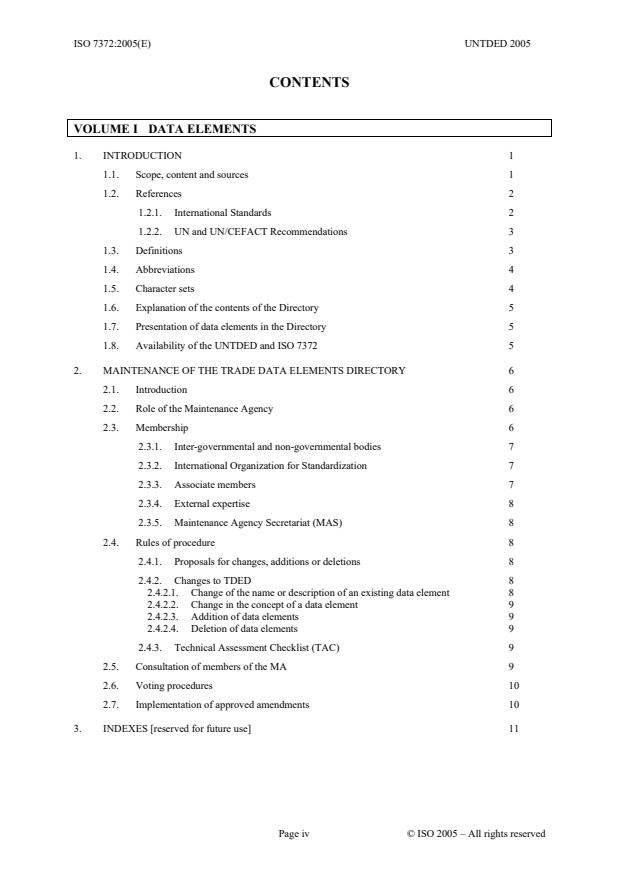
CONTENTS
VOLUME I DATA ELEMENTS
1. INTRODUCTION 1
1.1. Scope, content and sources 1
1.2. References 2
1.2.1. International Standards 2
1.2.2. UN and UN/CEFACT Recommendations 3
1.3. Definitions 3
1.4. Abbreviations 4
1.5. Character sets 4
1.6. Explanation of the contents of the Directory 5
1.7. Presentation of data elements in the Directory 5
1.8. Availability of the UNTDED and ISO 7372 5
2. MAINTENANCE OF THE TRADE DATA ELEMENTS DIRECTORY 6
2.1. Introduction 6
2.2. Role of the Maintenance Agency 6
2.3. Membership 6
2.3.1. Inter-governmental and non-governmental bodies 7
2.3.2. International Organization for Standardization 7
2.3.3. Associate members 7
2.3.4. External expertise 8
2.3.5. Maintenance Agency Secretariat (MAS) 8
2.4. Rules of procedure 8
2.4.1. Proposals for changes, additions or deletions 8
2.4.2. Changes to TDED 8
2.4.2.1. Change of the name or description of an existing data element 8
2.4.2.2. Change in the concept of a data element 9
2.4.2.3. Addition of data elements 9
2.4.2.4. Deletion of data elements 9
2.4.3. Technical Assessment Checklist (TAC) 9
2.5. Consultation of members of the MA 9
2.6. Voting procedures 10
2.7. Implementation of approved amendments 10
3. INDEXES [reserved for future use] 11
Page iv © ISO 2005 – All rights reserved
UNTDED 2005 ISO 7372:2005(E)
4 DATA ELEMENTS 12
4.1 Presentation, descriptions of categories, abbreviations 12
4.1.1 Layout of data element entries 12
4.1.2 Abbreviations of character representations 13
4.1.3 References concerning character representations 14
4.1.4 Grouping of data elements into broad categories 14
4.1.5 Explicit cross-referencing between data elements and codes: () and [] 16
4.1.6 Categories of data elements, allocation of identifiers (tags) 17
4.1.7 Data element issue numbering 17
4.2 Trade Data Elements Directory TDED 18
4.2.0 (0001-0699) Service data elements 18
4.2.1 (1000-1699) documentation, references 18
4.2.2 (2000-2699) Dates, times, periods of time 18
4.2.3 (3000-3699) Parties, addresses, places, countries 18
4.2.4 (4000-4699) Clauses, conditions, terms, instructions 18
4.2.5 (5000-5699) Amounts, charges, percentages 18
4.2.6 (6000-6699) Measure identifiers, quantities (other than monetary) 18
4.2.7 (7000-7699) Goods and articles: descriptions and identifiers 19
4.2.8 (8000-8699) Transport modes, means and equipments 19
4.2.9 (9000-9699) Other data elements (Customs, etc.) 19
VOLUME II USER CODE LIST
Vol. II is the User Code list, part of UNCL (UN Code lists) of UN/EDIFACT directory
D.02A. Sample:
----------------------------------------------------------------------
* 3035 Party function code qualifier
Desc: Code giving specific meaning to a party.
Repr: an.3
[…]
BY Buyer
(3002) Party to whom merchandise and/or service is sold.
[…]
----------------------------------------------------------------------]
VOLUME III COMPENDIUM OF TRADE FACILITATION RECOMMENDATIONS
This Compendium of UNECE Trade Facilitation Recommendations includes Class 3 code
lists as for example:
UNECE ISO # Name
Rec. #
3 3166 ISO Country Code for Representation of Names of Countries
5 Abbreviations of INCOTERMS
7 8601 Numerical Representation of Dates, Time and Periods of Time
9 4217 Alphabetic Code for the Representation of Currencies
16 LOCODE - Code for Ports and other Locations
17 PAYTERMS - Abbreviations for Terms of Payment
19 Codes for Modes of Transport
20 1000 Codes for Units of Measurement used in International Trade
21 Codes for Types of Cargo, Packages and Packaging Materials
23 Freight Cost Code – FCC
24 Trade and Transport Status Codes
28 Codes for Types of means of transport
Page vi © ISO 2005 – All rights reserved
UNTDED 2005 ISO 7372:2005(E)
Foreword
ISO (the International Organization for Standardization) is a worldwide federation of national
standards bodies (ISO member bodies). The work of preparing International Standards is
normally carried out through ISO technical committees. Each member body interested in a
subject for which a technical committee has been established has the right to be represented
on that committee. International Organizations, governmental and non-governmental, in
liaison with ISO, also take part in the work.
Attention is drawn to the possibility that some of the elements of this International Standard
may be the subject of patent rights. ISO shall not be held responsible for identifying any or all
such patent rights.
International Standard ISO 7372 was prepared jointly with the United Nations Economic
Commission for Europe (UNECE) and adopted by Technical Committee ISO/TC 154,
Processes, data elements and documents in commerce, industry and administration, as the
Trade Data Elements Directory (TDED); and is maintained by a joint ISO-UNECE
Maintenance Agency (see section 2).
This third edition cancels and replaces the second edition (ISO 7372:1993).
This International Standard adopted by the technical committee has been circulated to the
member bodies for voting and formally adopted by ISO and by the UN compliant to the
procedures of each.
When producing this edition of the Trade Data Elements Directory, the Maintenance Agency
has delivered a directory that is:
• supporting the UN Layout Key for Trade Documents (ISO6422) by registering data
elements that can be conveyed in such documents
• fully consistent with the set of UN/EDIFACT directories supporting electronic data
interchange, especially with the EDIFACT Data Element Directory (EDED) and the UN
Codes Library (UNCL).
• multimodal (all means of transport); (uni)modal requirements are satisfied by using
business terms or synonyms, and not by specific entries; multimodal requirements are
satisfied by generic entries
• multisectoral (trade/transport/Customs/etc.)
• technology and syntax independent
• ebXML Core Components Technical Specification compliant, providing the core
component dictionary entry name with 1) object class, 2) property term and 3)
representation term, and support the Controlled Vocabulary with list of permissible words
• backward compatible wherever possible and allows a migration path from previous
editions; when an element (a duplicate) has been marked for deletion a preferred element is
recommended.
Achieving the last point was crucial to ensuring consistency among the directories and also
with the data elements of other international organizations. Developments in international
trade since the publication of the previous edition of the TDED in 1993 resulted in some
incompatibility with other UN publications. This current revision of the TDED has
eliminated the inconsistencies and again secured the bi-directional references by the use of
round and square brackets in the UN/EDIFACT UNCL code list, and similar notations in the
TDED. Changes made in the TDED, for example the removal of duplicate data elements, are
fully reflected in the EDIFACT Directories and Code Lists.
This approach should provide the framework that reduces the risk of divergence between the
publications in the future.
The main resources used in this revision were: UN/EDIFACT D.02A edition, UN/CEFACT
TBG3 (Transport), the International Maritime Organization (IMO), the World Customs
Organization Customs Data Model Version 1 (2002), UNCTAD ASYCUDA and the joint
UNeDocs SITPRO project team. In summer 2004, at the time of the finalisation of the draft
for this new edition of TDED, the targets as listed above have been met within the framework
of the resources and time available.
During the revision process, the Maintenance Agency has developed data element names
which fully comply with the naming rules defined by ISO 11179, and required by the ebXML
Core Components Technical Specification. The Maintenance Agency will submit these
compliant data elements to UN/CEFACT for Core Component harmonization.
Throughout the production process the Maintenance Agency continually updated the revision
drafts and performed numerous quality checks and public reviews.
Additionally, the Maintenance Agency reviewed and revised the procedures for submitting
Data Maintenance Requests (DMRs). The MA recognized that its work must be as universal
as possible; and consequently cooperated closely with the following bodies:
• UN/CEFACT Forum: TBG, ATG, ICG and their Regional Entry Points:
UN/EDIFACT and XML DMR procedures
• UN/CEFACT Forum TMG : ebXML CCTS WG DMR procedures
• OASIS UBL TC DMR procedures
• ISO9735 JSWG Joint Syntax WG DMR procedures
• WCO Customs Data Model DMR procedures
• UNCTAD ASYCUDA DMR procedures
• As well as other Maintenance Agency members’ DMR procedures as UIC for CIM, IATA
for CIMP and IMO for FAL.
Management and registration of aggregates, composites and other combinations of single
TDED entries are outside the scope of the Maintenance Agency; this work is the
responsibility of standardization bodies such as JTC1/SC32 and UN/CEFACT TBG17
(Harmonization).
Last, but not least, all members of the Maintenance Agency kept clearly in mind that the best
is the enemy of the good, and that some revisions and improvement to the TDED could have a
significant migration cost for some users. To assist users in migration, explicit paths have
been provided, especially for the deleted entries. Items in the previous version which were
inconsistently tagged (e.g. wrong Group, or wrong even/uneven tag) have not been corrected,
except when an explicit business requirement had been identified. In this way, the
Maintenance Agency did its utmost to meet the needs of members and TDED users.
* * *
Page viii © ISO 2005 – All rights reserved
UNTDED 2005 ISO 7372:2005(E)
Section
1. INTRODUCTION
1.1. Scope, content and sources
The standard data elements included in this Directory are intended to facilitate an open
interchange of data in international trade.
These standard data elements can be used with any method for data interchange on paper
documents as well as with other means of data processing and communication: they can be
selected for transmission one by one, or used within a particular system of interchange rules,
e.g. the United Nations rules for Electronic Data Interchange for Administration, Commerce
and Transport (UN/EDIFACT), developed within the UN/CEFACT of the United Nations
Economic Commission for Europe (UNECE) and published as International Standard
ISO9735.
This Directory has been compiled by the TDED Maintenance Agency (see Section 2 below),
on the basis of the work within this UN/CEFACT, as well as work within other Maintenance
Agency members as specially WCO and IMO. This edition has been adopted by Technical
Committee ISO/TC 154 and the UN/CEFACT.
Volume I of the Directory constitutes International Standard ISO 7372. Annexes A, B, C and
D of this International standard are for information only.
Volume II includes the User Code List. The preparation and maintenance of Vol. II is an
activity of the UN/CEFACT.
Volume III is a Compendium of Trade Facilitation Recommendations. The preparation
and maintenance of Vol. III is a joint activity of the UNECE and the UN Conference on trade
and Development (UNCTAD), Special Programme for Trade Efficiency (SPTE).
The main source of this edition of TDED is the set of UN/EDIFACT directories D.02A:
- Vol. I has been built as a true superset of D.02A EDED = data elements
- Vol. II is a straight forward subset of D.02A UNCL = codes.
This third edition supersedes the second, 1993 edition of the TDED.
1.2. References
(1)
1.2.1. International Standards
The following standards contain provisions, which, through reference in this text, constitute
provisions of this International Standard. All standards are subject to revision, and parties to
agreements based on this International Standard are encouraged to investigate the possibility
of applying the most recent editions of the standards indicated below. Members of IEC and
ISO maintain registers of currently valid International Standards.
Dates provided in the table below are based upon checking the ISO website 2004-09-08
ISO 216:1975 Writing paper and certain classes of printed matter - Trimmed sizes - A
and B series
Codes for the representation of names of languages
ISO 639-1:2002 -- Part 1: Alpha-2 code
ISO 639-2:1998 -- Part 2: Alpha-3 code
ISO 1000:1992 SI units and recommendations for the use of their multiples and of
and Amd 1:1998 certain other units
ISO/IEC 2382-1:1993 Information technology -- Vocabulary -- Part 1: Fundamental terms
ISO 2784:1974 Continuous forms used for information processing - Sizes and sprocket
feed holes
ISO 2955:1983 Information processing - Representation of SI and other units for use in
systems with limited character sets (Withdrawn)
Codes for the representation of names of countries and their
subdivisions
ISO 3166-1:1997 -- Part 1: Country codes
ISO 3166-2:1998 -- Part 2: Country subdivision code
ISO 3166-3:1999 -- Part 3: Code for formerly used names of countries
ISO 3535:1977 Forms design sheet and layout chart
ISO 4217:2001 Codes for the representation of currencies and funds
ISO 6346:1995 Freight containers - Coding, identification and marking
ISO 6422:1985 Layout Key for trade documents
ISO 8601:2004 Data elements and interchange formats - information interchange –
representation of dates and times
Information processing - 8 bit single-byte coded graphic character sets-
ISO/IEC 8859-1:1998 Part 1: Latin alphabet No. 1
ISO/IEC 8859-2:1999 Part 2: Latin alphabet No. 2
ISO/IEC 8859-5:1999 Part 5: Latin/Cyrillic alphabet
ISO/IEC 8859-7:2003 Part 7: Latin/Greek alphabet
ISO 9735:2002-1/10 Electronic data interchange for administration, commerce and transport
(EDIFACT) -- Application level syntax rules
(1)
Available from the International Organization for Standardization (ISO), 1, Rue de Varembé CH - 1211 Geneva 20
Page 2 © ISO 2005 – All rights reserved
UNTDED 2005 ISO 7372:2005(E)
(2)
1.2.2. UN and UN/CEFACT Recommendations
Recommendation No. 1 United Nations Layout Key for Trade Documents;
reflected as ISO 6422:1985, 8439:1990 and 8440:1986 and
Corr.1:2000
Recommendation No. 6 Aligned Invoice Layout Key for International Trade
Recommendation No. 8 Unique Identification Code Methodology – UNIC
Recommendation No. 11 Documentary Aspects of the International Transport of
Dangerous Goods
Recommendation No. 12 Measures to Facilitate Maritime Transport Documents
Procedures
Recommendation No. 15 Simpler Shipping Marks
Recommendation No. 22 Layout Key for Standard Consignment Instructions
Recommendation No. 25 Use of the United Nations Electronic Data Interchange for
Administration, Commerce and Transport (UN/EDIFACT)
1.3. Definitions
For the purpose of this International Standard, the following definitions apply.
1.3.1. alphabetic character set: a character set that contains letters and may contain control
characters, and special characters, but not digits (Source: ISO 2382/4).
1.3.2. alphanumeric character set: a character set that contains both letters and digits and
may contain control characters, and special characters (Source: ISO 2382/4).
1.3.3. blank (Character): a character that represents an empty position in a graphic
character string (Source: ISO 2382/4)
1.3.4. character: a member of a set of elements that is used for the representation,
organization, or control of data (Source: ISO 2382/4).
1.3.5. character set: a finite set of different characters that is complete for a given purpose
(Source: ISO 2382/4).
1.3.6. code: a collection of rules that maps the data elements of one set on to the elements of
a second set (Source: ISO 2382/4).
1.3.7. data: a representation of facts, concepts or instructions in a formalized manner
suitable for communication, interpretation or processing by human beings or by automatic
means (Source: ISO 2382/1).
1.3.8. data element: a unit of data that in a certain context is considered indivisible (Source:
ISO 2382/4). Unit of data described in a data element specification (Source: ISO 9735:2002)
(2)
Available from the UN/ECE Trade Division, Palais des Nations CH-1211, Geneva 10 (Volume III of UNTDED)
1.3.9. data element tag: a unique identifier for a data element in a data elements directory
(Source: ISO 9735:1988).
1.3.10. data element value: specific instance of a simple data element, represented as
specified in a simple data element specification and, if the simple data element is coded, in a
code list (Source: ISO 9735:2002).
1.3.11. data element value length: the number of characters in a data element value (Source:
ECE).
1.3.12. digit (Numeric character): a graphic character that represents a non-negative integer
(Source: ISO 2382/4).
1.3.13. letter: a graphic character that, when appearing alone or combined with others, is
primarily used to represent a sound element of a spoken language (Source: ISO 2382/4).
1.3.14. numeric character set: a character set that contains digits and may contain control
characters and special characters, but not letters (Source: ISO 2382/4).
1.3.15. special character: a graphic character that is not a letter, a digit, or blank character,
and usually not an ideogram (Source: ISO 2382/4).
1.4. Abbreviations
The following acronyms or abbreviations are used for making reference to documents,
conventions and interchange standards:
AWB IATA Air Waybill
CIM Rail Consignment Note (CIM Convention)
CIMP IATA Cargo Interchange Message Procedures Manual
(CARGO-IMP manual)
CMR Road Consignment Note (CMR Convention)
EC European Communities
EFTA European Free Trade Association
IATA International Air Transport Association
ICC International Chamber of Commerce (ICC)
INV United Nations Layout Key for Aligned Invoices
MAR IMO Model forms and ICS Standard Bill of Lading
SAD Single Administrative Document (EC and EFTA)
SWIFT Society for Worldwide Interbank Financial Telecommunication
UNLK United Nations Layout Key
UNSM United Nations Standard Message (UN/EDIFACT)
1.5. Character sets
The characters in ISO 8859 shall be used for the representation of the data elements in this
Directory.
Page 4 © ISO 2005 – All rights reserved
UNTDED 2005 ISO 7372:2005(E)
1.6. Explanation of the contents of the Directory
In addition to this introduction, the Directory contains the following sections:
Section 2 provides rules and procedures for maintenance.
Section 3 reserved for future indexes
Section 4 is the main part of the Directory and contains the complete list of standard data
elements presented as described in 1.6 and 1.7 hereafter. In principle, each
entry in this part should be self-contained and consultation of other parts of the
Directory or outside sources should be required only exceptionally;
1.7. Presentation of data elements in the Directory
Each identified data element has been given:
a) a data element name;
b) a description of the concept to explain the agreed meaning and to aid in determining the
content of the information (data value) to be provided with the data element;
c) a specification of the character representation of the data value, with indication of space
(in number of characters) available and location in aligned forms, and of field lengths
where such have been established in particular interchange protocols;
and, when applicable or required:
1) notes providing additional information;
2) references to other parts of the Directory, or to other sources, as appropriate;
3) synonyms of data element names where such are widely used.
The values of a data element can either be expressed in plain language or in code, and it is
recognized that there will be a need to refer to either of these versions, and sometimes to both.
1.8. Availability of the UNTDED and ISO 7372
• The UNTDED (Vol. I) can be obtained from the ECE/TRADE Division, Palais des
Nations, CH-1211 Geneva 10 ,Fax: +41 22 9170037.
• ISO 7372 is available from ISO Central Secretariat, 1, Rue de Varembé, CH-1211
Geneva 20.
Section
2. MAINTENANCE OF THE TRADE DATA ELEMENTS DIRECTORY
Volume I of TDED is continuously updated, based on a review by the Maintenance Agency.
Amendments and additions are subsequently incorporated in the Directory.
2.1. Introduction
A joint UNECE - ISO Maintenance Agency is entrusted with the maintenance of the Trade
Data Elements Directory (TDED), also known as the United Nations Trade Data Elements
Directory (UNTDED) and as the International Standard ISO 7372, in order to keep
UNTDED/ISO7372 up to date to meet changing or new requirements in trade. The
membership and procedures of the MA, as set out below, have been designed to reflect the
dual nature of the TDED as an intergovernmental recommendation and a non-governmental
ISO International Standard.
The ISO Council, in accordance with the provisions of Annex 1G of the Directives for the
technical work of ISO, has designated an ISO 7372 Maintenance Agency (ISO 7372/MA).
The ISO 7372/MA together with the maintenance function set up by the UNECE WP.4
Working Party on Facilitation of International Trade Procedures (now UNECE CEFACT),
jointly constitute the TDED Maintenance Agency, hereafter referred to as MA.
2.2. Role of the Maintenance Agency
The MA, as authorized by the UNECE WP.4 and by the ISO Council, is entrusted with the
following functions:
a) To add to or to eliminate data elements from TDED and to assign numeric identifiers
(tags) in accordance with the rules provided in Section 5 of TDED;
b) To inform interested parties appropriately of such changes, etc.;
c) To prepare periodically and disseminate amendment sheets to users in order to allow
proper up-dating of TDED;
d) To establish as required, in the normal course of work, additional rules for the practical
application of the principles for:
- selecting data elements and assigning them a name and a numeric identifier (tag);
- grouping data elements into broad categories;
- the presentation of standard data elements and their use for international trade
information interchange.
2.3. Membership
The secretariat of UNECE and the ISO Central Secretariat participate ex officio in the MA,
whose membership - besides the UNECE WP4 Working Party on Facilitation of International
Page 6 © ISO 2005 – All rights reserved
UNTDED 2005 ISO 7372:2005(E)
Trade Procedures, now UN/CEFACT, its Forum and empowered groups - is composed of
inter-governmental and non-governmental bodies and of representatives of ISO national
Member Bodies, of ISO TCs (Technical Committees) and ISO/IEC JTC1 SCs (Sub-
Committees) concerned, as set out below, each being entitled to appoint one official
participant (head of delegation).
2.3.1. Inter-governmental and non-governmental bodies
The following inter-governmental and non-governmental bodies have requested to be
associated with the maintenance work:
- CCC Customs Cooperation Council: use WCO
- CIT International Railway Transport Committee
- FIATA International Federation of Freight Forwarders Associations
- IATA International Air Transport Association
- ICC International Chamber of Commerce
- ICS International Chamber of Shipping
- IMO International Maritime Organization
- IRU International Road Transport Union
- OASIS Organization for the Advancement of Structured Information Standards
[UBL TC Universal Business Language Technical Committee]
- UIC International Union of Railways
- UN/CEFACT UNECE (Economic Commission for Europe) Centre for Trade Facilitation
and Electronic Business
- UNCTAD United Nations Conference on Trade and Development
- UPU Universal Postal Union
- WCO World Customs Organization, established as CCC
2.3.2. International Organization for Standardization
The membership of the ISO 7372/MA shall be open to one official representative (head of
delegation) from each of the ISO Member bodies being ISO/TC154 P members
and the following technical bodies:
- ISO/TC37 Terminology and other language resources
- ISO/TC46 Information and documentation
- ISO/TC68 Financial services
- ISO/TC154 Processes, data elements and documents in commerce, industry
and administration
- ISO/TC184 Industrial automation systems and integration
- ISO/TC204 Intelligent transport systems
- ISO/TC215 Health informatics
- ISO/IEC JTC1/SC31 Automatic identification and data capture techniques
- ISO/IEC JTC1/SC32 Data management and interchange
2.3.3. Associate members
At the proposal of MA, other international organizations may be invited to become associate
members of the MA and to appoint a representative.
2.3.4. External expertise
The MA is authorized to seek external expert advice where necessary.
2.3.5. Maintenance Agency Secretariat (MAS)
The United Nations Economic Commission for Europe (UNECE), through the Trade Division
and the International Organization for Standardization (ISO) jointly provide the secretariat for
the MA.
The responsibilities of the MAS are:
- To receive proposals for changes and additions to, or deletions of, data elements in TDED;
- To make appropriate suggestions or proposals and to circulate them to MA members for
comments and/or decision within a specified period of time;
- To maintain a master of the TDED.
2.4. Rules of procedure
2.4.1. Proposals for changes, additions or deletions
Proposals for changes and additions to, or deletions of, data elements in the TDED can be
received from:
- any ISO member body;
- any government and international organization member of UN/CEFACT;
- any other international organization representing users of the directory;
and shall be submitted to the MAS, using the TDED Change request form. This form can be
obtained from the ISO/TC154 web: http://www.iso.org/tc154 .
Any proposals for changes, additions or deletions which have a bearing on an existing data
element used in UN/EDIFACT should be submitted by the MA to the UN/EDIFACT
maintenance procedures.
Any proposals for changes, additions or deletions of a data element used in UN/EDIFACT
which have a bearing on an existing non-UN/EDIFACT data element in TDED should be
submitted to the MA.
2.4.2. Changes to TDED
As a general principle, to ensure continuity and stability in the TDED, changes should be kept
to a minimum.
2.4.2.1. Change of the name or description of an existing data element
If the concept of the data element is not affected, a change of the name or description of an
existing data element will not result in a change of the already assigned numeric identifier
(tag).
The previous name will be cross-referenced.
Page 8 © ISO 2005 – All rights reserved
UNTDED 2005 ISO 7372:2005(E)
If it is proposed to change the name or description of a data element in such a way that,
without substantially changing the concept, its application area is extended or further
clarified, the numeric identifier may be retained provided that there are no objections from
users who might be adversely affected by the change.
2.4.2.2. Change in the concept of a data element
A change in a concept of a data element will result in the assignment of a new numeric
identifier.
The previous concept and identifier will be retained for a transitional period of time, to be
determined in each case after consultation with users.
2.4.2.3. Addition of data elements
Any new data element agreed upon by the MA for inclusion in the TDED will be assigned a
numeric identifier within the group to which the data element belongs. This applies also to
provisional data elements.
2.4.2.4. Deletion of data elements
Data elements marked for deletion (with only tag, name and date of deletion) shall stay
forever in the Directory, with provision of the migration path “use instead: …”. Hence the
numeric identifier of a data element marked for deletion shall not be re-used for a new data
element.
2.4.3. Technical Assessment Checklist (TAC)
The MA, recognizing that:
- its Data Maintenance Request (DMR) procedures shall be predictable, fully documented
and transparent,
- the best available tool is the Core Component Technical Assessment Checklist (cc TAC,
see ISO/TS15000-5 ebXML CCTS), and that in addition,
- the ISO 7372/MA DMR procedures shall be, where relevant, fully consistent with the
UN/CEFACT DMR procedures,
the MA resolved to have the possibility of issuing and applying a Technical Assessment
Checklist (TAC) for the production of a later edition of TDED.
2.5. Consultation of members of the MA
Proposals received by the MAS shall be circulated to MA members along with suggestions by
the secretariat as appropriate, for response within a specified period of time, normally not less
than two months. The need for MA members to institute internal consultations before
committing themselves will be taken into account by the MAS in determining the time for
response.
Before circulating a proposal, the MAS shall endeavour to assess the implications of this
proposal on data element applications, which are known to it. For this purpose, the MA
through the MAS may consult directly users of the TDED, national facilitation bodies and
other interested parties, as required.
If an urgent need arises for the introduction of a new data element, or for change of an
existing one, the MAS is authorized to accept a proposal on a provisional basis, subject to
subsequent considerations as set out above, and on conditions that the proposing party accepts
the possibility of rejection of, or amendment to, the proposal in the course of normal
procedure.
2.6. Voting procedures
Agreement on proposals is obtained either by correspondence or at a meeting of the MA,
provided that the matter has been included in the draft agenda of the meeting.
In accordance with ISO rules, as far as the ISO members of the MA are concerned, decisions
shall be reached by a vote. Each ISO member of the MA has one vote. An associate member
has the same status as an ordinary member but does not participate in voting.
In cases of urgency, the views of the members of the MA may be obtained by telephone; these
should be confirmed in writing, by e-mail or similar means.
Failure to reply within the reply period specified is considered as an abstention.
Decisions of the MA should be supported by a substantial majority of its members.
If a substantial majority is not achieved, the voting will be repeated or considered at a
following meeting of the MA. The letter ballot shall be accompanied by all comments
received from the first vote and a MAS recommendation. Time for response: one month. In
determining the outcome of the second vote, the majority is calculated on the basis of
expressed affirmative and negative votes.
If voting is repeated on individual proposals this procedure shall not delay publication of
those proposals, which have gained the necessary support. In cases where it has not been
possible to accept a proposal, the submitter of the proposal shall be informed of the reasons.
2.7. Implementation of approved amendments
An amendment (i.e. change, addition or deletion) becomes effective when approved by the
MA and will be published as often as required and possible, but not more often than annually.
The availability of amendments to ISO 7372 shall be announced to the ISO member bodies
and to UNECE users by the MAS.
Practical arrangements for the preparation, reproduction and dissemination of TDED and
amendment sheets to TDED shall be the responsibility of the secretariat of UNECE.
Page 10 © ISO 2005 – All rights reserved
UNTDED 2005 ISO 7372:2005(E)
Section
3. INDEXES [reserved for future use]
Section
4 DATA ELEMENTS
4.1 Presentation, descriptions of categories, abbreviations
4.1.1 Layout of data element entries
All names and definitions in TDED shall comply with the Oxford English Dictionary (both
spelling and meanings).
The first line of each data element entry contains the numeric tag and the name of the data
element and elements belonging to the United Nations Trade Data Interchange Directory
(UNTDID) are noted with an "E" (see section 1.8).
In addition, and in accordance with the principles set out in section 1.6, each data element
entry contains a number of parts, identified by a header. The following headers are used to
designate the different parts of the entries:
Desc = description of the data element
Repr = character representation, space available and location of the data
entry, as explained below
Note = additional information, when appropriate
Ref = reference to an indicated source of information in cases where a
"Note" is not sufficient. (Reference to other sections in the
Directory is normally indicated by "cf" and the section number.)
Syn = synonymous names of the data element
A line separates data element entries from each other. Data elements with directly related
clear text (even tag number) and coded (the next odd number) value representations appears
one after the other.
The change indicator marks shall be:
add = added
cn = changed name
cnd = changed name + description
cnr = changed name + representation
cndr = changed name + desc. + repr.
x = marked for deletion (with tag + name)
= undeleted (re-instated)
u
Page 12 © ISO 2005 – All rights reserved
UNTDED 2005 ISO 7372:2005(E)
Change indicator marks for deleted and undeleted data elements are now:
In 1990 and In 2005 edition Change indicator
1993 editions shall be
active entry => deleted entry x
=> active entry
deleted entry u
deleted entry => deleted entry x
That means that the mfd change indicator shall not anymore be used
4.1.2 Abbreviations of character representations
The following abbreviations are used to explain character representation:
a = alphabetic characters
n = numeric characters
an = alphabetic and numeric characters
3 = fixed length of 3 characters
..17 = variable data unit size where "17" indicates the maximum
number of available character positions;
..35x5 = undefined length where space is available to accommodate up to
5 lines of 35 characters each;
..35xn = undefined length where the data item requires an undefined
number of lines of up to 35 characters each
an5 (aannn) = fixed length of 5 alphanumeric characters, with 2 alphabetic
characters to be followed by 3 numeric digits, in that order,
without separation
an5 (aa-nn) = fixed length of 5 alphanumeric characters, composed of two sub-
elements as shown, with mandatory separation by hyphen( - )
n7 (nn,nnnn,n) = fixed length of 7 numeric digits, composed of three sub-elements
as shown, without mandatory separation; the comma ( , )
indicates the division between the sub-elements
(n2) a3 = fixed length of 3 alphabetic characters, to be preceded by another
data element of 2 numeric digits;
L = line, to be followed by the line number (or numbers) for the data
entry according to ISO 3535 and the UNLK
P = position, to be followed by the character position number (or
numbers) for the data entry according to ISO 3535 and UNLK
4.1.3 References concerning character representations
When character representation is specified, using these abbreviations, it refers either to the
space available for the data entry, and the location of the entry in the United Nations Layout
Key (UNLK), or in another aligned international document referred to, or to the
representation in an identified interchange protocol.
Whenever line and character positions are given for data elements appearing in
internationally-established, aligned forms, this is done with a view either to confirm
conformity to the UNLK, or to indicate deviations from the UNLK, or differences between
such forms.
If fixed field lengths have been specified in a particular interchange protocol, this will be
shown after an acronym, e.g. SWIFT: n6, CIMP: an.12, UNSM: an5. This is done mainly to
indicate possible constraints for data items likely to be transmitted through such systems. In
some instances organizations have introduced sectoral codes other than those recommended
within UNECE. Such cases are indicated by reference to the relevant organization or
Convention, e.g. currency code in Rail Consignment Note: CIM n2.
The acronyms used to reference documents, conventions, and interchange standards are listed
in section 1.4. Entry location abbreviations are listed in 4.1.2.
In specifications of character representation and entry location in aligned forms, these
acronyms are used as follows:
a) Representation and location unique for AWB:
Repr: AWB: a2; L 24, P 49-50
b) Representation and location in AWB deviates from general UNLK-based standard:
Repr: n.10; L 54-60, P 49-56
- AWB: n.8; L 33-44, P 39-46
c) Representation in AWB and CMR follows general standard but location is specific for
each document:
Repr: an.17; L 04, P 63-80
- AWB: L 01, P 08-22
- CMR: L 59, P 20-26
d) Representation in AWB follows general standard but differs in CIM:
Repr: n.14
- AWB: L 60, P 09-22
- CIM: an.8; L 49, P 51-58
4.1.4 Grouping of data elements into broad categories
As set out in 1.8, the data elements have been grouped into broad categories in a way that will
assist users of the Directory, at the same time taking into account the need to reserve
substantial capacity for national and company use.
Page 14 © ISO 2005 – All rights reserved
UNTDED 2005 ISO 7372:2005(E)
This version of the directory does not included the service data elements (tags 0001-0699), as
they are provided within the ISO9735 EDIFACT Syntax, version 4 release 1 Part 10, 2002.
The following grouping is used in the Directory:
Group 1
(1000-1699) documentation, references
Data elements intended for data handling or documentation purposes, such as
those required to service the interchange of user data, document and message
names, references and reference numbers, ordinal numbers such as item and page
numbers, number of copies of documents;
Group 2 (2000-2699) Dates, times, periods of time
All expressions of time, such as calendar dates, periods of time (month, week,
day), time limits, commencement and expiry dates;
Group 3 (3000-3699) Parties, addresses, places, countries
Names and addresses of legal and physical persons, designations of officials,
organizational units, places, countries, routes;
Group 4 (4000-4699) Clauses, conditions, terms, instructions
Authentications, authorizations, endorsements, certifications, clauses, conditions,
terms, reference clauses, stamps, labels, requests, instructions, receipts,
statements, information texts;
Group 5 (5000-5699) Amounts, charges, percentages
Financial values, amounts, charges; other quantities and values for commercial,
transport, Customs, statistical and any other purposes; other details, such as
prices, rates, percentages and discounts, used as a basis for invoice calculations,
etc.;
Group 6 (6000-6699) Measure identifiers, quantities (other than monetary)
Dimensions, weights, volumes, distances, temperature, currency, other quantities,
with the exception of monetary quantities in Group 5, measure unit specifiers;
Group 7 (7000-7699) Goods and articles: descriptions and identifiers
Descriptions, classifications and identification of goods and articles, consignment
identifiers, number and kind of packages, dangerous goods details;
Group 8 (8000-8699) Transport modes, means and equipments
Identification and description of means of transport and transport equipments
(including containers), transport equipment details, transport modes and
movements, voyage and flight numbers;
Group 9 (9000-9699) Other data elements (Customs, etc.)
Data elements not belonging to any of the specific categories 1 - 8.
The system selected for the Directory for grouping data elements into broad categories is
based on the characteristics of the data item, taking into account its nature rather than its
application area. This means that all dates are placed in one group, all names in another, and
all amounts in a third, without any consideration of the kind of date, name and amount.
Users, even if they do not know the exact name of a data element, or in which application area
a particular data element might have been placed, are
...