

ISO 9863-1:2016
(Main)Geosynthetics — Determination of thickness at specified pressures — Part 1: Single layers
General Information
- Abstract
ISO 9863-1:2016 specifies a method for the determination of the thickness of geosynthetics at specified pressures and specified load plate areas or under specified point loads. It defines the pressures or the load at which the thickness is determined. The test results are intended for identification purposes and for use in technical data sheets and/or as part of other test methods, e.g. tests of hydraulic properties. The method is applicable to all geosynthetics.
- Status
- Published
- Publication Date
- 14-Jul-2016
- Technical Committee
- ISO/TC 221 - Geosynthetics
- Drafting Committee
- ISO/TC 221/WG 2 - Terminology, identification and sampling
- Current Stage
- 9093 - International Standard confirmed
Buy Documents

ISO 9863-1:2016 - Geosynthetics — Determination of thickness at specified pressures — Part 1: Single layers Released:7/15/2016

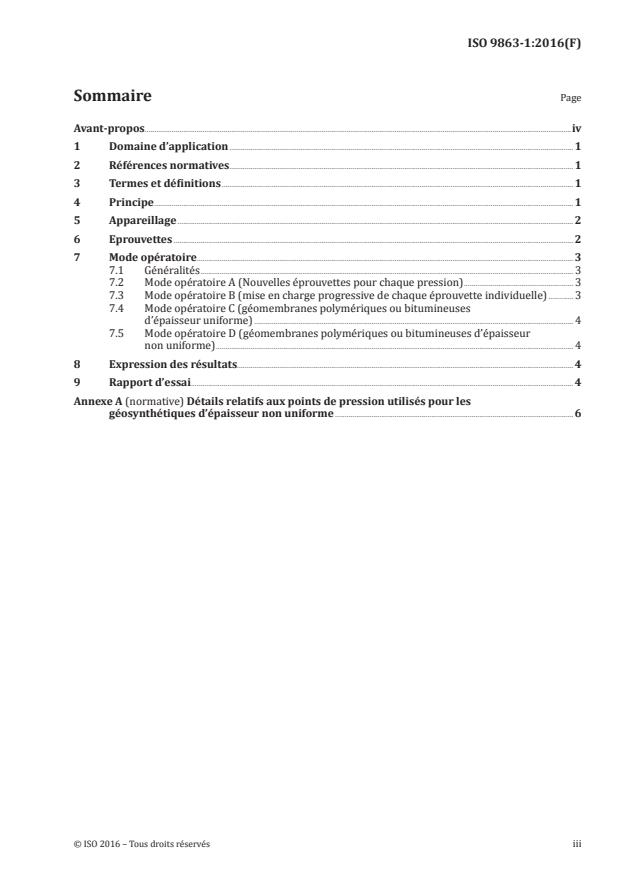

ISO 9863-1:2016 - Géosynthétiques — Détermination de l'épaisseur a des pressions spécifiées — Partie 1: Couches individuelles Released:7/15/2016
Overview
ISO 9863-1:2016 - "Geosynthetics - Determination of thickness at specified pressures - Part 1: Single layers" defines a standard laboratory method to measure the thickness of geosynthetic materials under specified pressures or point loads. The method produces identification data for product datasheets and can be used as an input to other test methods (for example hydraulic or compressive tests). It is applicable to all single-layer geosynthetics, including polymeric and bituminous barriers, geogrids, drainage geocomposites and other geosynthetic products.
Key Topics and Requirements
- Test principle: Measure thickness as the distance between a reference plate and a parallel presser-foot applying a defined pressure or point load; report mean thickness and coefficient of variation.
- Specified pressures/loads: Typical pressures are 2 kPa, 20 kPa and 200 kPa. For polymeric/bituminous barriers nominal thickness is defined at 20 ±0.2 kPa; textured barriers use a point load of 0.6 ±0.1 N.
- Presser-foot sizes and geometry: Defined sizes for different products:
- Polymeric/bituminous barriers: circular (10 ±0.05 mm) or square (≥100 × 100 mm)
- Other geosynthetics: presser-foot area ≈ 25 cm²
- Apparatus accuracy: Gauge resolution 0.01 mm; presser-foot must apply pressures within tight tolerances (±0.5%).
- Specimens and conditioning: Minimum 10 specimens per pressure; if new specimens are used for each pressure, at least 30 specimens are required. Condition specimens per ISO 554 (typically 24 h).
- Procedures A–D: Options include new specimen per pressure (A), incremental loading on same specimen (B), and special procedures for uniform (C) and non‑uniform (D) polymeric/bituminous barriers.
- Reporting: Must state procedure used, presser-foot size, conditioning atmosphere, number of specimens, mean nominal thickness (mm), coefficient of variation, and any deviations.
Applications
- Producing reliable nominal thickness values for product technical data sheets and quality control.
- Providing standardized input for related tests (e.g., hydraulic conductivity, compressive behaviour).
- Comparing products (geotextiles, geomembranes, geogrids) and verifying conformance to specifications.
- Useful in geotechnical engineering, landfill lining, drainage systems, road and rail reinforcement, and environmental containment design.
Who uses it:
- Manufacturers and R&D laboratories for product characterization
- Testing laboratories and quality assurance teams
- Specifiers, design engineers and contractors when selecting geosynthetics for projects
Related Standards
- ISO 554 - Standard atmospheres for conditioning/testing
- EN ISO 9862 - Sampling and preparation of test specimens for geosynthetics
- EN ISO 25619-1 - Determination of compressive behaviour (relevant for drainage geocomposites)
Keywords: ISO 9863-1, geosynthetics, thickness determination, nominal thickness, presser-foot, test method, specimen conditioning, technical data sheet.
Relations
- Effective Date
- 25-Aug-2026
- Effective Date
- 25-Aug-2026
- Effective Date
- 25-Aug-2026
- Effective Date
- 25-Aug-2026
- Effective Date
- 25-Aug-2026
- Effective Date
- 08-Jul-2026
- Effective Date
- 12-Feb-2026
- Effective Date
- 06-Jun-2022
- Effective Date
- 25-Dec-2021
- Effective Date
- 23-Apr-2011
Buy Documents
ISO 9863-1:2016 - Geosynthetics — Determination of thickness at specified pressures — Part 1: Single layers Released:7/15/2016
ISO 9863-1:2016 - Géosynthétiques — Détermination de l'épaisseur a des pressions spécifiées — Partie 1: Couches individuelles Released:7/15/2016
Get Certified
Connect with accredited certification bodies for this standard

Control Union Certifications
Global certification for agriculture and sustainability.

Hohenstein Institut
Textile testing and certification.

Bureau Veritas Bangladesh
Bureau Veritas certification services in Bangladesh.
Sponsored listings
Frequently Asked Questions
ISO 9863-1:2016 is a standard published by the International Organization for Standardization (ISO). Its full title is "Geosynthetics — Determination of thickness at specified pressures — Part 1: Single layers". This standard covers: ISO 9863-1:2016 specifies a method for the determination of the thickness of geosynthetics at specified pressures and specified load plate areas or under specified point loads. It defines the pressures or the load at which the thickness is determined. The test results are intended for identification purposes and for use in technical data sheets and/or as part of other test methods, e.g. tests of hydraulic properties. The method is applicable to all geosynthetics.
ISO 9863-1:2016 specifies a method for the determination of the thickness of geosynthetics at specified pressures and specified load plate areas or under specified point loads. It defines the pressures or the load at which the thickness is determined. The test results are intended for identification purposes and for use in technical data sheets and/or as part of other test methods, e.g. tests of hydraulic properties. The method is applicable to all geosynthetics.
ISO 9863-1:2016 is classified under the following ICS (International Classification for Standards) categories: 59.080.70 - Geotextiles. The ICS classification helps identify the subject area and facilitates finding related standards.
ISO 9863-1:2016 has the following relationships with other standards: It is inter standard links to EN ISO 10319:2024, EN ISO 13428:2024, EN ISO 12958-1:2020, EN ISO 12958-2:2020, EN ISO 25619-1:2021, EN ISO 12236:2026, EN ISO 9863-1:2016, ISO 7372:2005, ISO 9863-1:2016/Amd 1:2019, ISO 9863-1:2005. Understanding these relationships helps ensure you are using the most current and applicable version of the standard.
ISO 9863-1:2016 is available in PDF format for immediate download after purchase. The document can be added to your cart and obtained through the secure checkout process. Digital delivery ensures instant access to the complete standard document.
Standards Content (Sample)
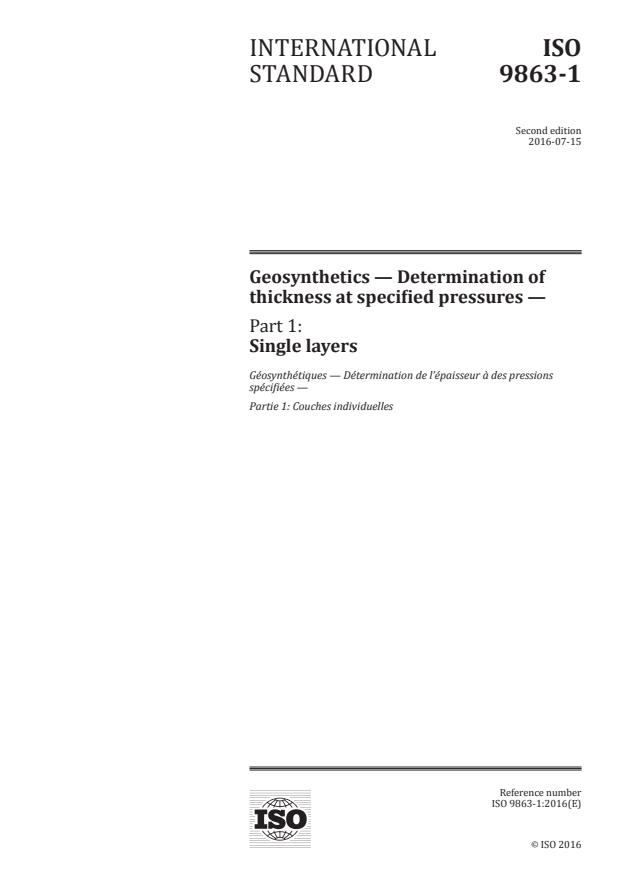
INTERNATIONAL ISO
STANDARD 9863-1
Second edition
2016-07-15
Geosynthetics — Determination of
thickness at specified pressures —
Part 1:
Single layers
Géosynthétiques — Détermination de l’épaisseur à des pressions
spécifiées —
Partie 1: Couches individuelles
Reference number
©
ISO 2016
© ISO 2016, Published in Switzerland
All rights reserved. Unless otherwise specified, no part of this publication may be reproduced or utilized otherwise in any form
or by any means, electronic or mechanical, including photocopying, or posting on the internet or an intranet, without prior
written permission. Permission can be requested from either ISO at the address below or ISO’s member body in the country of
the requester.
ISO copyright office
Ch. de Blandonnet 8 • CP 401
CH-1214 Vernier, Geneva, Switzerland
Tel. +41 22 749 01 11
Fax +41 22 749 09 47
copyright@iso.org
www.iso.org
ii © ISO 2016 – All rights reserved
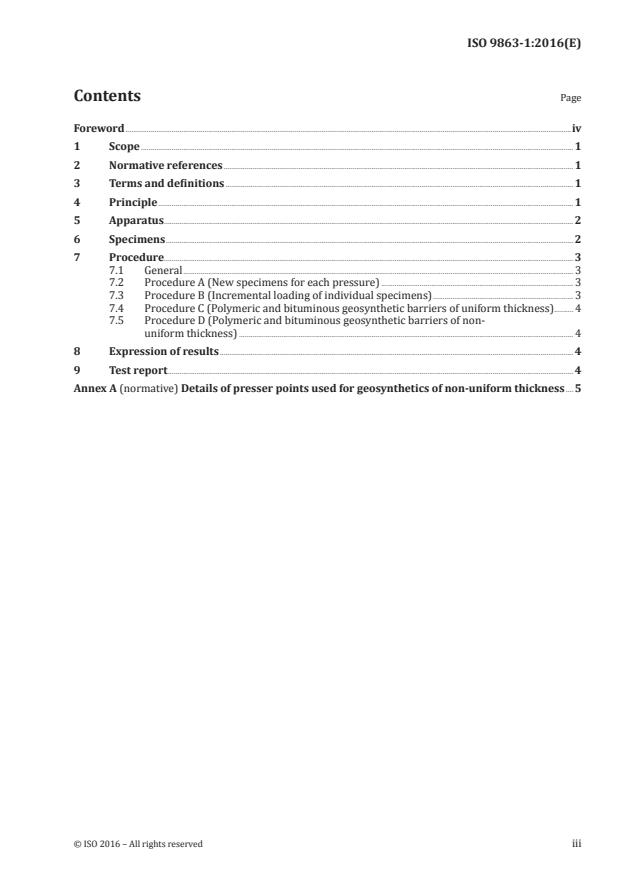
Contents Page
Foreword .iv
1 Scope . 1
2 Normative references . 1
3 Terms and definitions . 1
4 Principle . 1
5 Apparatus . 2
6 Specimens . 2
7 Procedure. 3
7.1 General . 3
7.2 Procedure A (New specimens for each pressure) . 3
7.3 Procedure B (Incremental loading of individual specimens) . 3
7.4 Procedure C (Polymeric and bituminous geosynthetic barriers of uniform thickness) . 4
7.5 Procedure D (Polymeric and bituminous geosynthetic barriers of non-
uniform thickness) . 4
8 Expression of results . 4
9 Test report . 4
Annex A (normative) Details of presser points used for geosynthetics of non-uniform thickness .5
Foreword
ISO (the International Organization for Standardization) is a worldwide federation of national standards
bodies (ISO member bodies). The work of preparing International Standards is normally carried out
through ISO technical committees. Each member body interested in a subject for which a technical
committee has been established has the right to be represented on that committee. International
organizations, governmental and non-governmental, in liaison with ISO, also take part in the work.
ISO collaborates closely with the International Electrotechnical Commission (IEC) on all matters of
electrotechnical standardization.
The procedures used to develop this document and those intended for its further maintenance are
described in the ISO/IEC Directives, Part 1. In particular the different approval criteria needed for the
different types of ISO documents should be noted. This document was drafted in accordance with the
editorial rules of the ISO/IEC Directives, Part 2 (see www.iso.org/directives).
Attention is drawn to the possibility that some of the elements of this document may be the subject of
patent rights. ISO shall not be held responsible for identifying any or all such patent rights. Details of
any patent rights identified during the development of the document will be in the Introduction and/or
on the ISO list of patent declarations received (see www.iso.org/patents).
Any trade name used in this document is information given for the convenience of users and does not
constitute an endorsement.
For an explanation on the meaning of ISO specific terms and expressions related to conformity assessment,
as well as information about ISO’s adherence to the World Trade Organization (WTO) principles in the
Technical Barriers to Trade (TBT) see the following URL: www.iso.org/iso/foreword.html.
The committee responsible for this document is ISO/TC 221, Geosynthetics.
This second edition cancels and replaces the first edition (ISO 9863-1:2005), which has been technically
revised.
ISO 9863-1 consists of the following parts, under the general title Geosynthetics — Determination of
thickness at specified pressures:
— Part 1: Single layers
— Part 2: Procedure for determination of thickness of single layers of multilayer products
iv © ISO 2016 – All rights reserved
INTERNATIONAL STANDARD ISO 9863-1:2016(E)
Geosynthetics — Determination of thickness at specified
pressures —
Part 1:
Single layers
1 Scope
This part of ISO 9863 specifies a method for the determination of the thickness of geosynthetics at
specified pressures and specified load plate areas or under specified point loads. It defines the pressures
or the load at which the thickness is determined.
The test results are intended for identification purposes and for use in technical data sheets and/or as
part of other test methods, e.g. tests of hydraulic properties.
The method is applicable to all geosynthetics.
2 Normative references
The following documents are referred to in the text in such a way that some or all of their content
constitutes requirements of this document. For dated references, only the edition cited applies. For
undated references, the latest edition of the referenced document (including any amendments) applies.
ISO 9862, Geosynthetics — Sampling and preparation of test specimens
ISO 25619-1, Geosynthetics — Determination of compressive behaviour — Part 1: Compressive creep
properties
3 Terms and definitions
For the purposes of this document, the following terms and definitions apply.
ISO and IEC maintain terminological databases for use in standardization at the following addresses:
— IEC Electropedia: available at http://www.electropedia.org/
— ISO Online browsing platform: available at http://www.iso.org/obp
3.1
thickness
distance between a reference plate on which the specimen rests and the contacting face of a parallel
pressure-foot applying a given pressure to the specimen or distance between two reference points
applying a given load to the specimen
4 Principle
4.1 The thickness of a numbe
...
NORME ISO
INTERNATIONALE 9863-1
Deuxième édition
2016-07-15
Géosynthétiques — Détermination
de l’épaisseur à des pressions
spécifiées —
Partie 1:
Couches individuelles
Geosynthetics — Determination of thickness at specified pressures —
Part 1: Single layers
Numéro de référence
©
ISO 2016
DOCUMENT PROTÉGÉ PAR COPYRIGHT
© ISO 2016, Publié en Suisse
Droits de reproduction réservés. Sauf indication contraire, aucune partie de cette publication ne peut être reproduite ni utilisée
sous quelque forme que ce soit et par aucun procédé, électronique ou mécanique, y compris la photocopie, l’affichage sur
l’internet ou sur un Intranet, sans autorisation écrite préalable. Les demandes d’autorisation peuvent être adressées à l’ISO à
l’adresse ci-après ou au comité membre de l’ISO dans le pays du demandeur.
ISO copyright office
Ch. de Blandonnet 8 • CP 401
CH-1214 Vernier, Geneva, Switzerland
Tel. +41 22 749 01 11
Fax +41 22 749 09 47
copyright@iso.org
www.iso.org
ii © ISO 2016 – Tous droits réservés
Sommaire Page
Avant-propos .iv
1 Domaine d’application . 1
2 Références normatives . 1
3 Termes et définitions . 1
4 Principe . 1
5 Appareillage . 2
6 Eprouvettes . 2
7 Mode opératoire. 3
7.1 Généralités . 3
7.2 Mode opératoire A (Nouvelles éprouvettes pour chaque pression) . 3
7.3 Mode opératoire B (mise en charge progressive de chaque éprouvette individuelle) . 3
7.4 Mode opératoire C (géomembranes polymériques ou bitumineuses
d’épaisseur uniforme) . 4
7.5 Mode opératoire D (géomembranes polymériques ou bitumineuses d’épaisseur
non uniforme) . 4
8 Expression des résultats. 4
9 Rapport d’essai . 4
Annexe A (normative) Détails relatifs aux points de pression utilisés pour les
géosynthétiques d’épaisseur non uniforme . 6
Avant-propos
L’ISO (Organisation internationale de normalisation) est une fédération mondiale d’organismes
nationaux de normalisation (comités membres de l’ISO). L’élaboration des Normes internationales est
en général confiée aux comités techniques de l’ISO. Chaque comité membre intéressé par une étude
a le droit de faire partie du comité technique créé à cet effet. Les organisations internationales,
gouvernementales et non gouvernementales, en liaison avec l’ISO participent également aux travaux.
L’ISO collabore étroitement avec la Commission électrotechnique internationale (IEC) en ce qui
concerne la normalisation électrotechnique.
Les procédures utilisées pour élaborer le présent document et celles destinées à sa mise à jour sont
décrites dans les Directives ISO/IEC, Partie 1. Il convient, en particulier de prendre note des différents
critères d’approbation requis pour les différents types de documents ISO. Le présent document a été
rédigé conformément aux règles de rédaction données dans les Directives ISO/IEC, Partie 2 (voir www.
iso.org/directives).
L’attention est appelée sur le fait que certains des éléments du présent document peuvent faire l’objet de
droits de propriété intellectuelle ou de droits analogues. L’ISO ne saurait être tenue pour responsable
de ne pas avoir identifié de tels droits de propriété et averti de leur existence. Les détails concernant
les références aux droits de propriété intellectuelle ou autres droits analogues identifiés lors de
l’élaboration du document sont indiqués dans l’Introduction et/ou dans la liste des déclarations de
brevets reçues par l’ISO (voir www.iso.org/brevets).
Les appellations commerciales éventuellement mentionnées dans le présent document sont données
pour information, par souci de commodité, à l’intention des utilisateurs et ne sauraient constituer un
engagement.
Pour une explication de la signification des termes et expressions spécifiques de l’ISO liés à l’évaluation
de la conformité, ou pour toute information au sujet de l’adhésion de l’ISO aux principes de l’Organisation
mondiale du commerce (OMC) concernant les obstacles techniques au commerce (OTC), voir le lien
suivant: www.iso.org/iso/fr/foreword.html
Le comité chargé de l’élaboration du présent document est l’ISO/TC 221, Produits géosynthétiques.
Cette seconde édition annule et remplace la première édition (ISO 9863-1:2005) qui été révisée du point
de vue technique.
L’ISO 9863-1 comprend les parties suivantes, sous le titre générique Géosynthétiques — Détermination
de l’épaisseur à des pressions spécifiées:
— Partie 1: Couches individuelles
— Partie 2: Procédure pour la détermination de l’épaisseur de couches individuelles de produits multicouches
iv © ISO 2016 – Tous droits réservés
NORME INTERNATIONALE ISO 9863-1:2016(F)
Géosynthétiques — Détermination de l’épaisseur à des
pressions spécifiées —
Partie 1:
Couches individuelles
1 Domaine d’application
La présente partie de l’ISO 9863 spécifie une méthode permettant de déterminer l’épaisseur des
géosynthétiques à des pressions spécifiées et définit la pression à laquelle l’épaisseur nominale est
déterminée.
Les résultats d’essai sont prévus à des fins d’identification et utilisés pour les fiches techniques et/ou
comme partie d’autres méthodes d’essai, par exemple les essais des propriétés hydrauliques.
La méthode est applicable à tous les géosynthétiques.
2 Références normatives
Les documents suivants cités dans le texte constituent, pour tout ou partie de leur contenu, des
exigences du présent document. Pour les références datées, seule l’édition citée s’applique. Pour les
références non datées, la dernière édition du document de référence s’applique (y compris les éventuels
amendements).
EN ISO 9862, Echantillonnage et préparation des éprouvettes
EN ISO 25619-1, Géosynthétiques — Détermination du comportement en compression — Partie 1:
propriétés de fluage en compression
3 Termes et définitions
Pour les besoins du présent document, les termes et définitions suivants s’appliquent.
L’ISO et l’IEC tiennent à jour des bases de données terminologiques destinées à être utilisées en
normalisation, consultables aux adresses suivantes:
— IEC Electropedia: disponible à l’adresse http://www.electropedia.org/
— ISO Online browsing platform: disponible à l’adresse http://www.iso.org/obp
3.1
épaisseur
distance comprise entre une plaque de référence sur laquelle repose une éprouvette et la face de
contact d’un pied presseur parallèle exerçant une pression donnée sur l’éprouvette ou distance entre
deux points de référence exerçant une pression donnée sur l’éprouvette.
4 Principe
4.1 L’épaisseur d’un certain nombre d’éprouvettes individuelles d’un géosynthétique est mesurée
comme la distance comprise entre la plaque de référence sur laquelle repose l’éprouvette et la face de
contact d’un pied-presseur circulaire parallèle exerçant une pression spécifiée sur une aire de dimensions
définies dans une surface plus la
...