

ISO 8601-2:2019
(Main)Date and time — Representations for information interchange — Part 2: Extensions
General Information
- Abstract
This document specifies additional representations of dates of the Gregorian calendar and times based on the 24-hour clock that extend the basic rules and composite elements of those defined in ISO 8601-1. These representations are specified as character strings for use in information interchange. It is also applicable for representing times and time shifts based on Coordinated Universal Time (UTC). These extensions include: — uncertain or approximate dates, or dates with portions unspecified; — extended time intervals; — divisions of a year; — sets and choices of calendar dates; — grouped time scale units; — repeat rules for recurring time intervals; and — date and time arithmetic. This document excludes the representation of date elements from non-Gregorian calendars, or times not from the 24-hour clock. This document does not address character encoding of representations specified in this document.
- Status
- Published
- Publication Date
- 24-Feb-2019
- Technical Committee
- ISO/TC 154 - Processes, data elements and documents in commerce, industry and administration
- Drafting Committee
- ISO/TC 154/WG 5 - Representation of dates and times
- Current Stage
- 9092 - International Standard to be revised
- Start Date
- 05-Dec-2024
- Completion Date
- 29-Aug-2026
Buy Documents
ISO 8601-2:2019 - Date and time -- Representations for information interchange
ISO 8601-2:2019 - Date and time — Representations for information interchange — Part 2: Extensions/25/2019
Overview
ISO 8601-2:2019 - "Date and time - Representations for information interchange - Part 2: Extensions" extends the base ISO 8601 rules to specify additional, standardized character-string representations of Gregorian calendar dates and 24-hour clock times for information interchange. It covers extended forms for uncertain or approximate dates, expanded time intervals, grouped time units, recurring intervals and simple date/time arithmetic. The standard is also applicable to times and time shifts based on Coordinated Universal Time (UTC). It explicitly excludes non‑Gregorian calendars, non‑24‑hour clocks and character encoding issues.
Key topics and technical requirements
- Extended date/time representations: additional explicit forms that build on ISO 8601-1, including expanded calendar years and unspecified digits.
- Uncertain/approximate dates: syntax for indicating uncertainty, approximation or partially unspecified date components.
- Extended time intervals & recurring intervals: rules for representing long or complex intervals and repeat rules for recurring time ranges.
- Sets and choices of dates: representations for sets (collections) and choices of calendar dates, including range expansion.
- Grouped time scale units: definition and use of grouped units (e.g., custom sub-year groupings, seasons) and rules for conversion to basic units.
- Divisions of a year: specification of seasons, decades, centuries and other sub-year groupings.
- Date/time arithmetic: standardized expressions for performing or representing simple arithmetic on date and time values.
- Time shift and UTC: representation of time shifts and offsets consistent with UTC-based time scales.
- Qualification and precision: mechanisms to qualify components (complete, group, individual) and indicate precision.
- Exclusions: does not define character encoding or non-Gregorian calendar elements.
Practical applications and who uses it
ISO 8601-2 is useful wherever precise, machine-readable extended date/time semantics are required:
- Software developers and API designers needing standardized timestamp and interval formats for data interchange (APIs, microservices).
- Database architects and data modelers who store recurring schedules, sets of dates, or uncertain/approximate historical dates.
- Archivists, historians and scientific data managers requiring representation of partially known dates and long time intervals.
- Scheduling systems, calendar apps and IoT platforms managing grouped time units, repeats and time shifts.
- Standards implementers and integrators extending ISO 8601 compliance with more expressive temporal constructs.
Related standards
- ISO 8601-1 - Core date and time representations (base rules that ISO 8601-2 extends).
- Standards for character encoding (e.g., UTF‑8) should be applied separately, as ISO 8601-2 does not address encoding.
Keywords: ISO 8601-2, date and time representations, extensions, UTC, uncertain dates, recurring intervals, grouped time units, ISO 8601 extensions.
Relations
- Effective Date
- 25-Aug-2026
- Effective Date
- 25-Aug-2026
- Effective Date
- 25-Aug-2026
- Effective Date
- 25-Aug-2026
- Referred By
CEN/TS 17489-2:2024 - Secure and interoperable European Breeder Documents — Part 2: Data model - Effective Date
- 25-Aug-2026
- Effective Date
- 25-Aug-2026
- Effective Date
- 25-Aug-2026
- Effective Date
- 25-Aug-2026
- Effective Date
- 25-Aug-2026
- Effective Date
- 25-Aug-2026
- Effective Date
- 25-Aug-2026
- Referred By
EN ISO 10477:2020 - Dentistry - Polymer-based crown and veneering materials (ISO 10477:2020) - Effective Date
- 25-Aug-2026
- Effective Date
- 10-Feb-2026
- Effective Date
- 06-Jun-2022
- Effective Date
- 26-Nov-2022
Buy Documents
ISO 8601-2:2019 - Date and time -- Representations for information interchange
ISO 8601-2:2019 - Date and time — Representations for information interchange — Part 2: Extensions/25/2019
Frequently Asked Questions
ISO 8601-2:2019 is a standard published by the International Organization for Standardization (ISO). Its full title is "Date and time — Representations for information interchange — Part 2: Extensions". This standard covers: This document specifies additional representations of dates of the Gregorian calendar and times based on the 24-hour clock that extend the basic rules and composite elements of those defined in ISO 8601-1. These representations are specified as character strings for use in information interchange. It is also applicable for representing times and time shifts based on Coordinated Universal Time (UTC). These extensions include: — uncertain or approximate dates, or dates with portions unspecified; — extended time intervals; — divisions of a year; — sets and choices of calendar dates; — grouped time scale units; — repeat rules for recurring time intervals; and — date and time arithmetic. This document excludes the representation of date elements from non-Gregorian calendars, or times not from the 24-hour clock. This document does not address character encoding of representations specified in this document.
This document specifies additional representations of dates of the Gregorian calendar and times based on the 24-hour clock that extend the basic rules and composite elements of those defined in ISO 8601-1. These representations are specified as character strings for use in information interchange. It is also applicable for representing times and time shifts based on Coordinated Universal Time (UTC). These extensions include: — uncertain or approximate dates, or dates with portions unspecified; — extended time intervals; — divisions of a year; — sets and choices of calendar dates; — grouped time scale units; — repeat rules for recurring time intervals; and — date and time arithmetic. This document excludes the representation of date elements from non-Gregorian calendars, or times not from the 24-hour clock. This document does not address character encoding of representations specified in this document.
ISO 8601-2:2019 is classified under the following ICS (International Classification for Standards) categories: 01.140.30 - Documents in administration, commerce and industry. The ICS classification helps identify the subject area and facilitates finding related standards.
ISO 8601-2:2019 has the following relationships with other standards: It is inter standard links to EN ISO 15854:2021, EN ISO 6709:2022, EN ISO 23386:2020, EN ISO 15223-1:2021, CEN/TS 17489-2:2024, EN ISO 17730:2025, EN ISO 12381:2019, EN ISO 3696:1995, EN ISO 28399:2020, EN ISO 22598:2020, EN ISO 28399:2021, EN ISO 10477:2020, EN IEC 62656-8:2020, ISO 15877-5:2009/Amd 2:2020, ISO 8601-2:2019/Amd 1:2025. Understanding these relationships helps ensure you are using the most current and applicable version of the standard.
ISO 8601-2:2019 is available in PDF format for immediate download after purchase. The document can be added to your cart and obtained through the secure checkout process. Digital delivery ensures instant access to the complete standard document.
Standards Content (Sample)
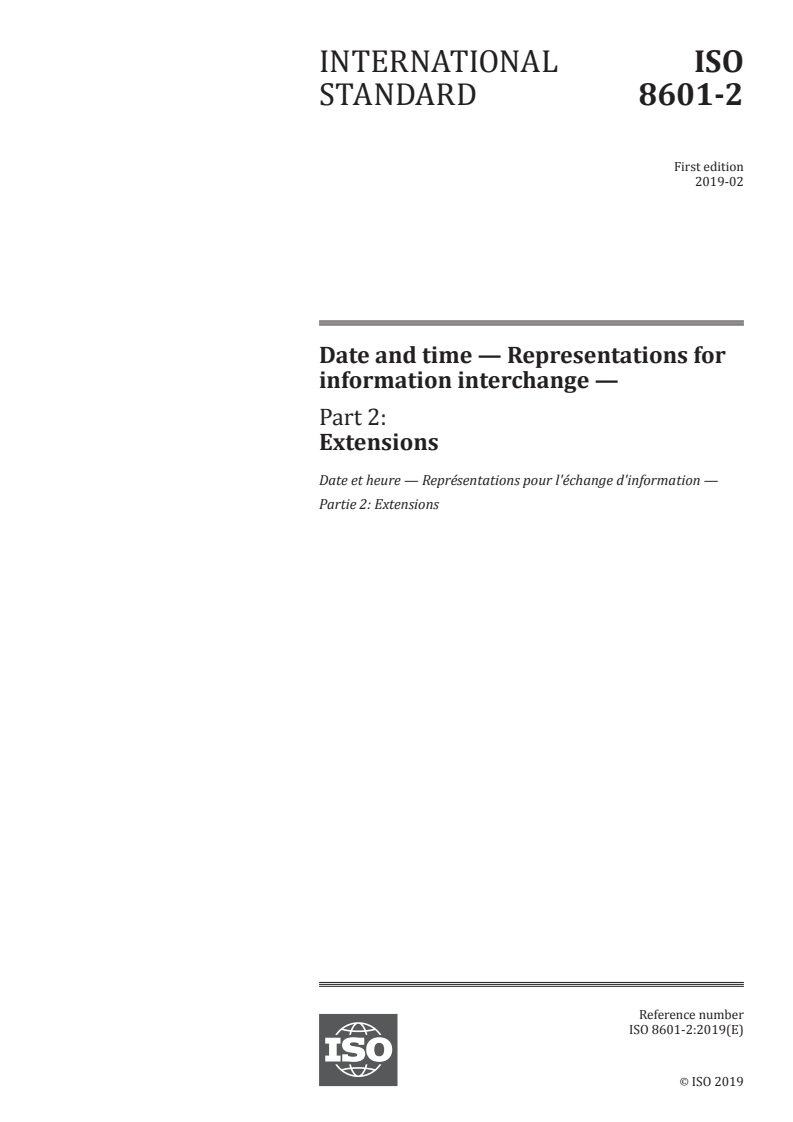
INTERNATIONAL ISO
STANDARD 8601-2
First edition
2019-02
Date and time — Representations for
information interchange —
Part 2:
Extensions
Date et heure — Représentations pour l'échange d'information —
Partie 2: Extensions
Reference number
©
ISO 2019
© ISO 2019
All rights reserved. Unless otherwise specified, or required in the context of its implementation, no part of this publication may
be reproduced or utilized otherwise in any form or by any means, electronic or mechanical, including photocopying, or posting
on the internet or an intranet, without prior written permission. Permission can be requested from either ISO at the address
below or ISO’s member body in the country of the requester.
ISO copyright office
CP 401 • Ch. de Blandonnet 8
CH-1214 Vernier, Geneva
Phone: +41 22 749 01 11
Fax: +41 22 749 09 47
Email: copyright@iso.org
Website: www.iso.org
Published in Switzerland
ii © ISO 2019 – All rights reserved
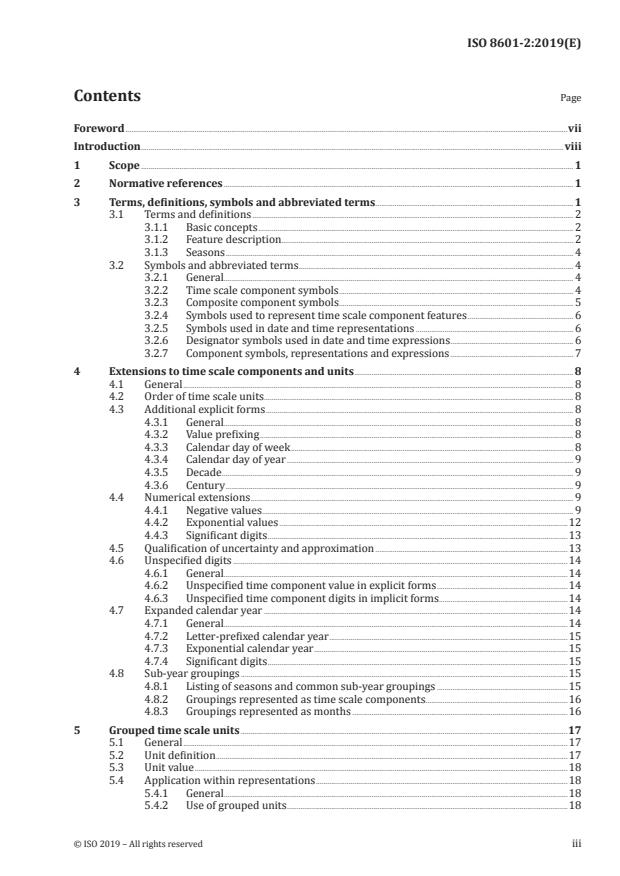
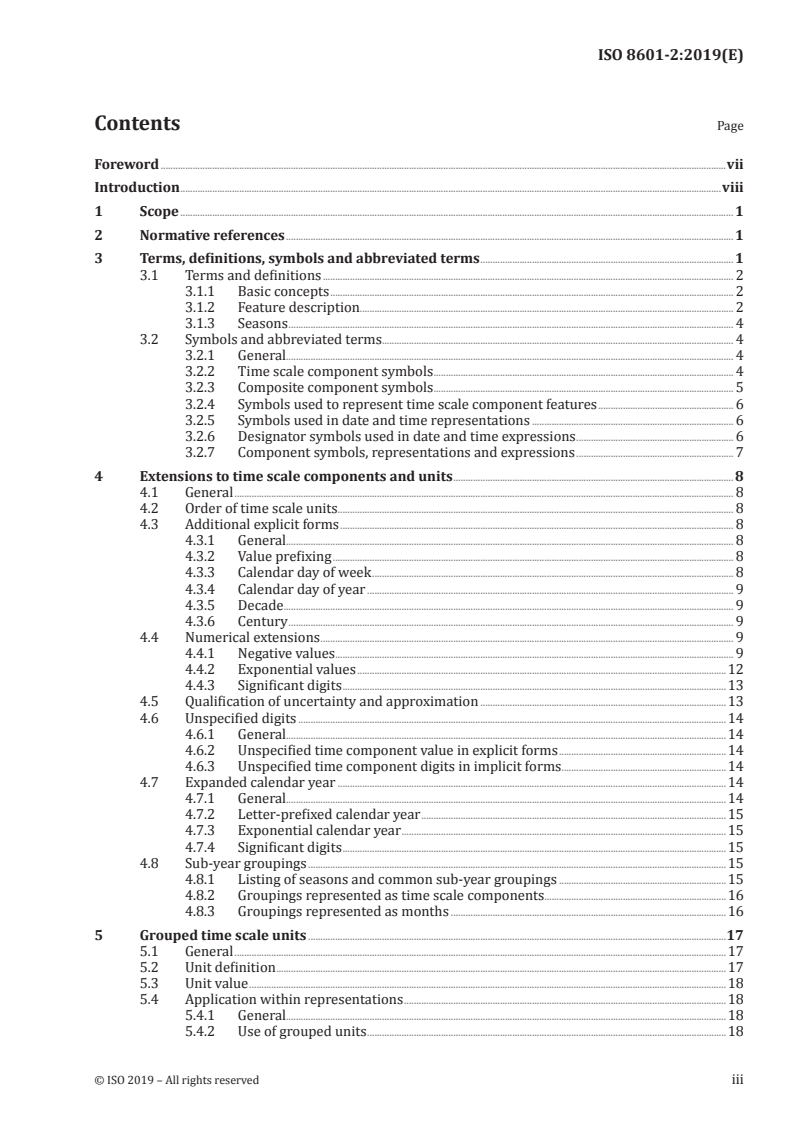
Contents Page
Foreword .vii
Introduction .viii
1 Scope . 1
2 Normative references . 1
3 Terms, definitions, symbols and abbreviated terms . 1
3.1 Terms and definitions . 2
3.1.1 Basic concepts . 2
3.1.2 Feature description. 2
3.1.3 Seasons . 4
3.2 Symbols and abbreviated terms. 4
3.2.1 General. 4
3.2.2 Time scale component symbols . 4
3.2.3 Composite component symbols . 5
3.2.4 Symbols used to represent time scale component features . 6
3.2.5 Symbols used in date and time representations . 6
3.2.6 Designator symbols used in date and time expressions . 6
3.2.7 Component symbols, representations and expressions . 7
4 Extensions to time scale components and units . 8
4.1 General . 8
4.2 Order of time scale units. 8
4.3 Additional explicit forms . 8
4.3.1 General. 8
4.3.2 Value prefixing . 8
4.3.3 Calendar day of week . 8
4.3.4 Calendar day of year . 9
4.3.5 Decade . . 9
4.3.6 Century . 9
4.4 Numerical extensions . 9
4.4.1 Negative values . 9
4.4.2 Exponential values .12
4.4.3 Significant digits .13
4.5 Qualification of uncertainty and approximation .13
4.6 Unspecified digits .14
4.6.1 General.14
4.6.2 Unspecified time component value in explicit forms .14
4.6.3 Unspecified time component digits in implicit forms.14
4.7 Expanded calendar year .14
4.7.1 General.14
4.7.2 Letter-prefixed calendar year .15
4.7.3 Exponential calendar year .15
4.7.4 Significant digits .15
4.8 Sub-year groupings .15
4.8.1 Listing of seasons and common sub-year groupings .15
4.8.2 Groupings represented as time scale components.16
4.8.3 Groupings represented as months .16
5 Grouped time scale units .17
5.1 General .17
5.2 Unit definition .17
5.3 Unit value .18
5.4 Application within representations .18
5.4.1 General.18
5.4.2 Use of grouped units .18
5.4.3 Adherence to grouped unit boundaries .20
5.4.4 Representation with time shift .20
5.4.5 Conversion to basic time scale units .20
6 Set representation .21
6.1 Set of date and time expressions .21
6.2 Single element amongst set .21
6.3 Range element expansion .21
6.4 Set representations and expansion .22
6.5 Expressions with time scale components .22
6.6 Integer expressions .22
7 Explicit representation for date and time .23
7.1 General .23
7.2 Date .23
7.2.1 General.23
7.2.2 Calendar date .23
7.2.3 Ordinal date .23
7.2.4 Week date .23
7.3 Time of day .23
7.3.1 Local time of day .23
7.3.2 Beginning of the day .24
7.4 Time shift .24
7.5 Date with shift .25
7.6 Time of day with time shift .25
7.7 Date and time of day .25
7.7.1 General.25
7.7.2 Date and time only .25
7.7.3 Date and time with shift .25
7.8 Decade .25
7.9 Century .26
7.10 Omission of zero-valued components .26
7.11 Indication of precision .26
7.12 Decimal fractions for time .26
7.13 Representations other than complete .26
7.14 Time intervals .27
7.14.1 General.27
7.14.2 Time scale component order . .27
7.14.3 Time shift indication.27
7.15 Recurring time intervals .27
8 Qualification of date and time expressions .28
8.1 General .28
8.2 Principles .28
8.2.1 Complete qualification .28
8.2.2 Group qualification .28
8.2.3 Individual qualification .28
8.2.4 Preferred representations for resolving ambiguity .28
8.3 Time scale components allowing qualification .29
8.3.1 General.29
8.3.2 Calendar year, left qualified: .29
8.3.3 Calendar month, left qualified .29
8.3.4 Calendar week of year, left qualified .29
8.3.5 Calendar day of month, left qualified .30
8.3.6 Calendar day of week, left qualified .30
8.3.7 Calendar day of year, left qualified .30
8.3.8 Clock hour, left qualified .30
8.3.9 Clock minute, left qualified .30
8.3.10 Clock second, left qualified.31
8.3.11 Decade, left qualified .31
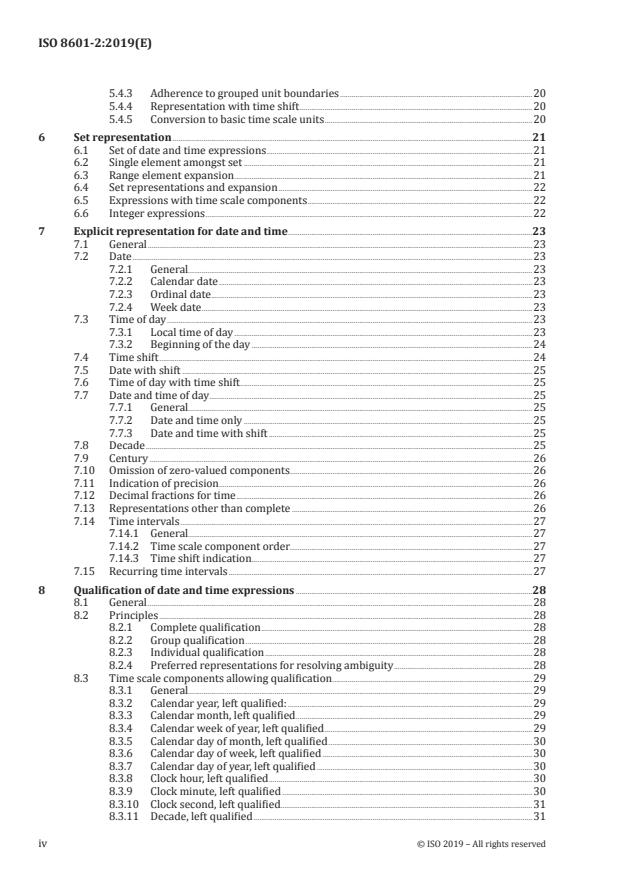
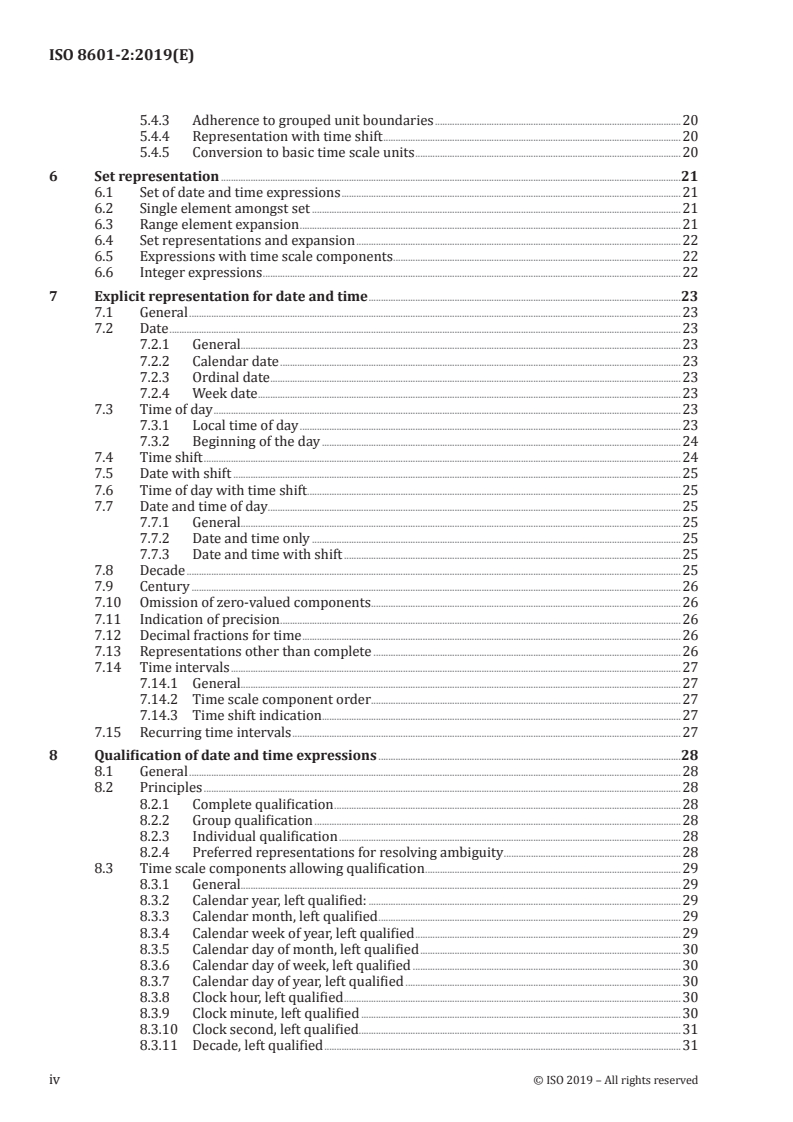
iv © ISO 2019 – All rights reserved
8.3.12 Century, left qualified .31
8.4 Calendar date representations with qualification .31
8.4.1 Complete representation of a calendar date .31
8.4.2 Representations of calendar dates with reduced precision .32
8.4.3 Expanded representations of calendar dates.33
8.4.4 Qualification of a group of time scale components from the right .34
8.4.5 Qualification of individual time scale components .34
8.4.6 Allowing group and individual qualifications of time scale components .35
8.5 Date and time expressions with qualification .35
9 Unspecified digits .35
9.1 General .35
9.2 Calendar date representations with unspecified digits .36
9.2.1 Unspecified time scale component values from the right .36
9.2.2 Unspecified digit anywhere in time scale component .38
9.3 Date and time expressions with unspecified digits .38
10 Extended time interval representations .39
10.1 General .39
10.2 Unknown or open start or end time intervals .39
10.3 Qualification of dates in time intervals .40
10.3.1 General.40
10.3.2 Complete qualification .40
10.3.3 Partial qualification .40
10.4 Unspecified portions of dates in time intervals .40
10.5 Uncertain and approximate dates in unknown or open time intervals .40
10.6 Before and after with qualified time scale components .40
11 Explicit duration and extensions .41
11.1 General .41
11.2 Durational units .41
11.3 Representations .41
11.3.1 General.41
11.3.2 Composite representation .41
11.3.3 Precedence representation .42
11.4 Fractional duration .43
12 Selection of date and time .43
12.1 General .43
12.2 Selection rules .44
12.2.1 Selection of calendar month of year.44
12.2.2 Selection of calendar week of year .44
12.3 Selection of calendar day of month .45
12.4 Selection of week days.45
12.5 Selection of ordinal days in calendar year .45
12.6 Selection of hours .45
12.7 Selection of minutes .46
12.8 Selection of seconds .46
12.9 Selection of position .46
12.10 Selection with time interval .47
12.11 Application within representations .47
12.11.1 General . .47
12.11.2 Context set by selection .48
12.11.3 Within time intervals .48
13 Recurring time intervals with repeat rules .48
13.1 General .48
13.2 Method of specification .49
13.3 Specification of time interval .49
13.4 Repeat rule .49
13.4.1 General.49
13.4.2 Eligibility part and eligible time intervals .49
13.4.3 Selection part and selection rules .50
13.5 Representations .50
13.6 Evaluation of a repeat rule .51
13.6.1 General.51
13.6.2 Time scale unit precision .52
13.6.3 Inheritance of component values from time interval start .52
14 Date and time arithmetic .53
14.1 General .53
14.2 Addition and subtraction .53
14.3 Multiplication .54
14.4 Date time modified by duration .55
15 Profiles .56
15.1 General .56
15.2 Requirements .56
Annex A (informative) Profile: Extended Date/Time Format .57
Annex B (informative) Interactions between eligible time intervals with the selection part .63
Annex C (informative) Compatibility considerations of repeat rules with IETF RFC 5545
recurrences .66
Annex D (informative) Evaluation of date time formulas and duration considerations .68
Bibliography .75
vi © ISO 2019 – All rights reserved
Foreword
ISO (the International Organization for Standardization) is a worldwide federation of national standards
bodies (ISO member bodies). The work of preparing International Standards is normally carried out
through ISO technical committees. Each member body interested in a subject for which a technical
committee has been established has the right to be represented on that committee. International
organizations, governmental and non-governmental, in liaison with ISO, also take part in the work.
ISO collaborates closely with the International Electrotechnical Commission (IEC) on all matters of
electrotechnical standardization.
The procedures used to develop this document and those intended for its further maintenance are
described in the ISO/IEC Directives, Part 1. In particular, the different approval criteria needed for the
different types of ISO documents should be noted. This document was drafted in accordance with the
editorial rules of the ISO/IEC Directives, Part 2 (see www .iso .org/directives).
Attention is drawn to the possibility that some of the elements of this document may be the subject of
patent rights. ISO shall not be held responsible for identifying any or all such patent rights. Details of
any patent rights identified during the development of the document will be in the Introduction and/or
on the ISO list of patent declarations received (see www .iso .org/patents).
Any trade name used in this document is information given for the convenience of users and does not
constitute an endorsement.
For an explanation of the voluntary nature of standards, the meaning of ISO specific terms and
expressions related to conformity assessment, as well as information about ISO's adherence to the
World Trade Organization (WTO) principles in the Technical Barriers to Trade (TBT) see www .iso
.org/iso/foreword .html.
This document was prepared by Technical Committee ISO/TC 154, Processes, data elements and
documents in commerce, industry and administration.
This first edition of ISO 8601-2, together with ISO 8601-1, cancels and replaces ISO 8601:2004, which
has been technically revised.
The main changes compared to ISO 8601:2004 are as follows:
— addition of standard representations for concepts not previously supported, such as negative values,
qualification, sets, seasons, extended time intervals, selections, grouped units, repeating rules and
profiles.
A list of all parts in the ISO 8601 series can be found on the ISO website.
Any feedback or questions on this document should be directed to the user’s national standards body. A
complete listing of these bodies can be found at www .iso .org/members .html.
Introduction
The purpose of this document is to provide a set of date and time format representations for information
interchange beyond those supported by ISO 8601-1.
There are various concepts and representations that many applications find useful not supported by
ISO 8601-1, including:
— negative values for time scale components;
— qualification of expressions and time scale components;
— set representation of date and time expressions;
— seasons;
— time intervals with open or unknown starts or ends;
— expression of movable days through date and time selection;
— date and time expressions without digit length limits; and
— profiles for specifying feature support amongst ISO 8601 (all parts) features.
Such concepts are often represented according to various ad-hoc conventions; this document aims to
provide a standard syntax for their representation.
The extended representations allow unambiguous interpretation, enforce the confidence of
interoperability and minimize the risk of misinterpretations and their consequences.
viii © ISO 2019 – All rights reserved
INTERNATIONAL STANDARD ISO 8601-2:2019(E)
Date and time — Representations for information
interchange —
Part 2:
Extensions
1 Scope
This document specifies additional representations of dates of the Gregorian calendar and times based
on the 24-hour clock that extend the basic rules and composite elements of those defined in ISO 8601-1.
These representations are specified as character strings for use in information interchange. It is also
applicable for representing times and time shifts based on Coordinated Universal Time (UTC).
These extensions include:
— uncertain or approximate dates, or dates with portions unspecified;
— extended time intervals;
— divisions of a year;
— sets and choices of calendar dates;
— grouped time scale units;
— repeat rules for recurring time intervals; and
— date and time arithmetic.
This document excludes the representation of date elements from non-Gregorian calendars, or times
not from the 24-hour clock. This document does not address character encoding of representations
specified in this document.
2 Normative references
The following documents are referred to in the text in such a way that some or all of their content
constitutes requirements of this document. For dated references, only the edition cited applies. For
undated references, the latest edition of the referenced document (including any amendments) applies.
ISO 8601-1:2019, Date and time — Representation for information interchange — Part 1: Basic rules
3 Terms, definitions, symbols and abbreviated terms
For the purposes of this document, the terms and definitions given in ISO 8601-1 and the following apply.
ISO and IEC maintain terminological databases for use in standardization at the following addresses:
— ISO Online browsing platform: available at https: //www .iso .org/obp
— IEC Electropedia: available at http: //www .electropedia .org/
3.1 Terms and definitions
3.1.1 Basic concepts
3.1.1.1
approximate date
calendar date which is an estimate whose value is asserted to be possibly correct
Note 1 to entry: The degree of confidence in approximation depends on the application.
3.1.1.2
uncertain date
calendar date whose source is considered dubious (3.1.1.4)
3.1.1.3
date with unspecified part
calendar date of which a part is unstated
Note 1 to entry: The unstated part can be year, year and month, month, month and day, or year and day. It is
unstated because it has not (yet) been assigned (it can be assigned in the future), or because it is classified or
unknown, or for any other reason.
3.1.1.4
dubious
not to be relied upon
3.1.1.5
qualification symbol
symbol that indicates certain qualification to a value it applies to
EXAMPLE The symbol [?] indicates that the value it applies to is uncertain.
3.1.1.6
movable day
repeatedly occurring day in a calendar that is represented by criteria set by one or more selection rules
(3.1.2.6), but does not always resolve to a fixed calendar day in every repeating cycle
EXAMPLE 1 Thanksgiving Day in the U.S. and Canada are considered movable days, set to the fourth Thursday
in November and the second Monday in October, respectively.
EXAMPLE 2 First Day of Summer (sumardagurinn fyrsti) in Iceland is considered a movable day, set to the first
Thursday after April 18th.
EXAMPLE 3 Father’s Day is celebrated on the third Sunday in June in North America and is considered a
movable day.
Note 1 to entry: The selection of this term pays homage to the phrase "movable feast" used in some calendars to
indicate the rule-based determination of annual events.
3.1.1.7
negative duration
duration in the reverse direction to the proceeding time scale
3.1.2 Feature description
3.1.2.1
feature
single function or group of functions
2 © ISO 2019 – All rights reserved
3.1.2.2
conformity level
value assigned to a subset of features (3.1.2.1) within a profile (3.1.2.3)
Note 1 to entry: A profile may refer to these conformity levels to facilitate the specification of conformance to the
profile.
3.1.2.3
profile
subset of features (3.1.2.1) described in a standard or a set of standards
Note 1 to entry: A community may develop a profile to describe how to carry out functions or apply features
specified in a standard or family of standards in a manner relevant to that community.
Note 2 to entry: A profile often describes what features are to be supported and how to apply those features.
In cases where multiple methods are allowed for a required feature, a profile may select a single method. In
cases where a particular function allows different interpretations, a profile may select a single interpretation or
provide clarification. A profile may list out features that need not be supported. It may specify several conformity
levels (3.1.2.2).
Note 3 to entry: The term “profile” is used in this document with the specific definition (including the notes)
given here, despite its various meanings in other contexts.
3.1.2.4
ISO 8601 profile
profile (3.1.2.3) whose base standard is the ISO 8601 series
3.1.2.5
repeat rule
set of eligible time intervals (3.1.2.8) and selection rules (3.1.2.6) that allows computation of a set of
matching instants (3.1.2.9)
3.1.2.6
selection rule
rule specifying restrictions on the value of a time scale component
3.1.2.7
repeat cycle
set of repeating instants, calculated by a specified start instant and specified duration gap between the
repeating instants
3.1.2.8
eligible time interval
time interval eligible for matching using selection rules (3.1.2.6)
3.1.2.9
matching instants
set of instants, computed by a repeat rule (3.1.2.5), that belongs within eligible time intervals (3.1.2.8)
and fulfils criteria set by specified selection rules (3.1.2.6)
3.1.2.10
date time formula
expression that specifies modification of a date and time expression with a duration
3.1.2.11
durational unit
time scale component that composes the duration date and time representation
3.1.2.12
grouped time scale unit
time sc
...
INTERNATIONAL ISO
STANDARD 8601-2
First edition
2019-02
Date and time — Representations for
information interchange —
Part 2:
Extensions
Date et heure — Représentations pour l'échange d'information —
Partie 2: Extensions
Reference number
©
ISO 2019
© ISO 2019
All rights reserved. Unless otherwise specified, or required in the context of its implementation, no part of this publication may
be reproduced or utilized otherwise in any form or by any means, electronic or mechanical, including photocopying, or posting
on the internet or an intranet, without prior written permission. Permission can be requested from either ISO at the address
below or ISO’s member body in the country of the requester.
ISO copyright office
CP 401 • Ch. de Blandonnet 8
CH-1214 Vernier, Geneva
Phone: +41 22 749 01 11
Fax: +41 22 749 09 47
Email: copyright@iso.org
Website: www.iso.org
Published in Switzerland
ii © ISO 2019 – All rights reserved
Contents Page
Foreword .vii
Introduction .viii
1 Scope . 1
2 Normative references . 1
3 Terms, definitions, symbols and abbreviated terms . 1
3.1 Terms and definitions . 2
3.1.1 Basic concepts . 2
3.1.2 Feature description. 2
3.1.3 Seasons . 4
3.2 Symbols and abbreviated terms. 4
3.2.1 General. 4
3.2.2 Time scale component symbols . 4
3.2.3 Composite component symbols . 5
3.2.4 Symbols used to represent time scale component features . 6
3.2.5 Symbols used in date and time representations . 6
3.2.6 Designator symbols used in date and time expressions . 6
3.2.7 Component symbols, representations and expressions . 7
4 Extensions to time scale components and units . 8
4.1 General . 8
4.2 Order of time scale units. 8
4.3 Additional explicit forms . 8
4.3.1 General. 8
4.3.2 Value prefixing . 8
4.3.3 Calendar day of week . 8
4.3.4 Calendar day of year . 9
4.3.5 Decade . . 9
4.3.6 Century . 9
4.4 Numerical extensions . 9
4.4.1 Negative values . 9
4.4.2 Exponential values .12
4.4.3 Significant digits .13
4.5 Qualification of uncertainty and approximation .13
4.6 Unspecified digits .14
4.6.1 General.14
4.6.2 Unspecified time component value in explicit forms .14
4.6.3 Unspecified time component digits in implicit forms.14
4.7 Expanded calendar year .14
4.7.1 General.14
4.7.2 Letter-prefixed calendar year .15
4.7.3 Exponential calendar year .15
4.7.4 Significant digits .15
4.8 Sub-year groupings .15
4.8.1 Listing of seasons and common sub-year groupings .15
4.8.2 Groupings represented as time scale components.16
4.8.3 Groupings represented as months .16
5 Grouped time scale units .17
5.1 General .17
5.2 Unit definition .17
5.3 Unit value .18
5.4 Application within representations .18
5.4.1 General.18
5.4.2 Use of grouped units .18
5.4.3 Adherence to grouped unit boundaries .20
5.4.4 Representation with time shift .20
5.4.5 Conversion to basic time scale units .20
6 Set representation .21
6.1 Set of date and time expressions .21
6.2 Single element amongst set .21
6.3 Range element expansion .21
6.4 Set representations and expansion .22
6.5 Expressions with time scale components .22
6.6 Integer expressions .22
7 Explicit representation for date and time .23
7.1 General .23
7.2 Date .23
7.2.1 General.23
7.2.2 Calendar date .23
7.2.3 Ordinal date .23
7.2.4 Week date .23
7.3 Time of day .23
7.3.1 Local time of day .23
7.3.2 Beginning of the day .24
7.4 Time shift .24
7.5 Date with shift .25
7.6 Time of day with time shift .25
7.7 Date and time of day .25
7.7.1 General.25
7.7.2 Date and time only .25
7.7.3 Date and time with shift .25
7.8 Decade .25
7.9 Century .26
7.10 Omission of zero-valued components .26
7.11 Indication of precision .26
7.12 Decimal fractions for time .26
7.13 Representations other than complete .26
7.14 Time intervals .27
7.14.1 General.27
7.14.2 Time scale component order . .27
7.14.3 Time shift indication.27
7.15 Recurring time intervals .27
8 Qualification of date and time expressions .28
8.1 General .28
8.2 Principles .28
8.2.1 Complete qualification .28
8.2.2 Group qualification .28
8.2.3 Individual qualification .28
8.2.4 Preferred representations for resolving ambiguity .28
8.3 Time scale components allowing qualification .29
8.3.1 General.29
8.3.2 Calendar year, left qualified: .29
8.3.3 Calendar month, left qualified .29
8.3.4 Calendar week of year, left qualified .29
8.3.5 Calendar day of month, left qualified .30
8.3.6 Calendar day of week, left qualified .30
8.3.7 Calendar day of year, left qualified .30
8.3.8 Clock hour, left qualified .30
8.3.9 Clock minute, left qualified .30
8.3.10 Clock second, left qualified.31
8.3.11 Decade, left qualified .31
iv © ISO 2019 – All rights reserved
8.3.12 Century, left qualified .31
8.4 Calendar date representations with qualification .31
8.4.1 Complete representation of a calendar date .31
8.4.2 Representations of calendar dates with reduced precision .32
8.4.3 Expanded representations of calendar dates.33
8.4.4 Qualification of a group of time scale components from the right .34
8.4.5 Qualification of individual time scale components .34
8.4.6 Allowing group and individual qualifications of time scale components .35
8.5 Date and time expressions with qualification .35
9 Unspecified digits .35
9.1 General .35
9.2 Calendar date representations with unspecified digits .36
9.2.1 Unspecified time scale component values from the right .36
9.2.2 Unspecified digit anywhere in time scale component .38
9.3 Date and time expressions with unspecified digits .38
10 Extended time interval representations .39
10.1 General .39
10.2 Unknown or open start or end time intervals .39
10.3 Qualification of dates in time intervals .40
10.3.1 General.40
10.3.2 Complete qualification .40
10.3.3 Partial qualification .40
10.4 Unspecified portions of dates in time intervals .40
10.5 Uncertain and approximate dates in unknown or open time intervals .40
10.6 Before and after with qualified time scale components .40
11 Explicit duration and extensions .41
11.1 General .41
11.2 Durational units .41
11.3 Representations .41
11.3.1 General.41
11.3.2 Composite representation .41
11.3.3 Precedence representation .42
11.4 Fractional duration .43
12 Selection of date and time .43
12.1 General .43
12.2 Selection rules .44
12.2.1 Selection of calendar month of year.44
12.2.2 Selection of calendar week of year .44
12.3 Selection of calendar day of month .45
12.4 Selection of week days.45
12.5 Selection of ordinal days in calendar year .45
12.6 Selection of hours .45
12.7 Selection of minutes .46
12.8 Selection of seconds .46
12.9 Selection of position .46
12.10 Selection with time interval .47
12.11 Application within representations .47
12.11.1 General . .47
12.11.2 Context set by selection .48
12.11.3 Within time intervals .48
13 Recurring time intervals with repeat rules .48
13.1 General .48
13.2 Method of specification .49
13.3 Specification of time interval .49
13.4 Repeat rule .49
13.4.1 General.49
13.4.2 Eligibility part and eligible time intervals .49
13.4.3 Selection part and selection rules .50
13.5 Representations .50
13.6 Evaluation of a repeat rule .51
13.6.1 General.51
13.6.2 Time scale unit precision .52
13.6.3 Inheritance of component values from time interval start .52
14 Date and time arithmetic .53
14.1 General .53
14.2 Addition and subtraction .53
14.3 Multiplication .54
14.4 Date time modified by duration .55
15 Profiles .56
15.1 General .56
15.2 Requirements .56
Annex A (informative) Profile: Extended Date/Time Format .57
Annex B (informative) Interactions between eligible time intervals with the selection part .63
Annex C (informative) Compatibility considerations of repeat rules with IETF RFC 5545
recurrences .66
Annex D (informative) Evaluation of date time formulas and duration considerations .68
Bibliography .75
vi © ISO 2019 – All rights reserved
Foreword
ISO (the International Organization for Standardization) is a worldwide federation of national standards
bodies (ISO member bodies). The work of preparing International Standards is normally carried out
through ISO technical committees. Each member body interested in a subject for which a technical
committee has been established has the right to be represented on that committee. International
organizations, governmental and non-governmental, in liaison with ISO, also take part in the work.
ISO collaborates closely with the International Electrotechnical Commission (IEC) on all matters of
electrotechnical standardization.
The procedures used to develop this document and those intended for its further maintenance are
described in the ISO/IEC Directives, Part 1. In particular, the different approval criteria needed for the
different types of ISO documents should be noted. This document was drafted in accordance with the
editorial rules of the ISO/IEC Directives, Part 2 (see www .iso .org/directives).
Attention is drawn to the possibility that some of the elements of this document may be the subject of
patent rights. ISO shall not be held responsible for identifying any or all such patent rights. Details of
any patent rights identified during the development of the document will be in the Introduction and/or
on the ISO list of patent declarations received (see www .iso .org/patents).
Any trade name used in this document is information given for the convenience of users and does not
constitute an endorsement.
For an explanation of the voluntary nature of standards, the meaning of ISO specific terms and
expressions related to conformity assessment, as well as information about ISO's adherence to the
World Trade Organization (WTO) principles in the Technical Barriers to Trade (TBT) see www .iso
.org/iso/foreword .html.
This document was prepared by Technical Committee ISO/TC 154, Processes, data elements and
documents in commerce, industry and administration.
This first edition of ISO 8601-2, together with ISO 8601-1, cancels and replaces ISO 8601:2004, which
has been technically revised.
The main changes compared to ISO 8601:2004 are as follows:
— addition of standard representations for concepts not previously supported, such as negative values,
qualification, sets, seasons, extended time intervals, selections, grouped units, repeating rules and
profiles.
A list of all parts in the ISO 8601 series can be found on the ISO website.
Any feedback or questions on this document should be directed to the user’s national standards body. A
complete listing of these bodies can be found at www .iso .org/members .html.
Introduction
The purpose of this document is to provide a set of date and time format representations for information
interchange beyond those supported by ISO 8601-1.
There are various concepts and representations that many applications find useful not supported by
ISO 8601-1, including:
— negative values for time scale components;
— qualification of expressions and time scale components;
— set representation of date and time expressions;
— seasons;
— time intervals with open or unknown starts or ends;
— expression of movable days through date and time selection;
— date and time expressions without digit length limits; and
— profiles for specifying feature support amongst ISO 8601 (all parts) features.
Such concepts are often represented according to various ad-hoc conventions; this document aims to
provide a standard syntax for their representation.
The extended representations allow unambiguous interpretation, enforce the confidence of
interoperability and minimize the risk of misinterpretations and their consequences.
viii © ISO 2019 – All rights reserved
INTERNATIONAL STANDARD ISO 8601-2:2019(E)
Date and time — Representations for information
interchange —
Part 2:
Extensions
1 Scope
This document specifies additional representations of dates of the Gregorian calendar and times based
on the 24-hour clock that extend the basic rules and composite elements of those defined in ISO 8601-1.
These representations are specified as character strings for use in information interchange. It is also
applicable for representing times and time shifts based on Coordinated Universal Time (UTC).
These extensions include:
— uncertain or approximate dates, or dates with portions unspecified;
— extended time intervals;
— divisions of a year;
— sets and choices of calendar dates;
— grouped time scale units;
— repeat rules for recurring time intervals; and
— date and time arithmetic.
This document excludes the representation of date elements from non-Gregorian calendars, or times
not from the 24-hour clock. This document does not address character encoding of representations
specified in this document.
2 Normative references
The following documents are referred to in the text in such a way that some or all of their content
constitutes requirements of this document. For dated references, only the edition cited applies. For
undated references, the latest edition of the referenced document (including any amendments) applies.
ISO 8601-1:2019, Date and time — Representation for information interchange — Part 1: Basic rules
3 Terms, definitions, symbols and abbreviated terms
For the purposes of this document, the terms and definitions given in ISO 8601-1 and the following apply.
ISO and IEC maintain terminological databases for use in standardization at the following addresses:
— ISO Online browsing platform: available at https: //www .iso .org/obp
— IEC Electropedia: available at http: //www .electropedia .org/
3.1 Terms and definitions
3.1.1 Basic concepts
3.1.1.1
approximate date
calendar date which is an estimate whose value is asserted to be possibly correct
Note 1 to entry: The degree of confidence in approximation depends on the application.
3.1.1.2
uncertain date
calendar date whose source is considered dubious (3.1.1.4)
3.1.1.3
date with unspecified part
calendar date of which a part is unstated
Note 1 to entry: The unstated part can be year, year and month, month, month and day, or year and day. It is
unstated because it has not (yet) been assigned (it can be assigned in the future), or because it is classified or
unknown, or for any other reason.
3.1.1.4
dubious
not to be relied upon
3.1.1.5
qualification symbol
symbol that indicates certain qualification to a value it applies to
EXAMPLE The symbol [?] indicates that the value it applies to is uncertain.
3.1.1.6
movable day
repeatedly occurring day in a calendar that is represented by criteria set by one or more selection rules
(3.1.2.6), but does not always resolve to a fixed calendar day in every repeating cycle
EXAMPLE 1 Thanksgiving Day in the U.S. and Canada are considered movable days, set to the fourth Thursday
in November and the second Monday in October, respectively.
EXAMPLE 2 First Day of Summer (sumardagurinn fyrsti) in Iceland is considered a movable day, set to the first
Thursday after April 18th.
EXAMPLE 3 Father’s Day is celebrated on the third Sunday in June in North America and is considered a
movable day.
Note 1 to entry: The selection of this term pays homage to the phrase "movable feast" used in some calendars to
indicate the rule-based determination of annual events.
3.1.1.7
negative duration
duration in the reverse direction to the proceeding time scale
3.1.2 Feature description
3.1.2.1
feature
single function or group of functions
2 © ISO 2019 – All rights reserved
3.1.2.2
conformity level
value assigned to a subset of features (3.1.2.1) within a profile (3.1.2.3)
Note 1 to entry: A profile may refer to these conformity levels to facilitate the specification of conformance to the
profile.
3.1.2.3
profile
subset of features (3.1.2.1) described in a standard or a set of standards
Note 1 to entry: A community may develop a profile to describe how to carry out functions or apply features
specified in a standard or family of standards in a manner relevant to that community.
Note 2 to entry: A profile often describes what features are to be supported and how to apply those features.
In cases where multiple methods are allowed for a required feature, a profile may select a single method. In
cases where a particular function allows different interpretations, a profile may select a single interpretation or
provide clarification. A profile may list out features that need not be supported. It may specify several conformity
levels (3.1.2.2).
Note 3 to entry: The term “profile” is used in this document with the specific definition (including the notes)
given here, despite its various meanings in other contexts.
3.1.2.4
ISO 8601 profile
profile (3.1.2.3) whose base standard is the ISO 8601 series
3.1.2.5
repeat rule
set of eligible time intervals (3.1.2.8) and selection rules (3.1.2.6) that allows computation of a set of
matching instants (3.1.2.9)
3.1.2.6
selection rule
rule specifying restrictions on the value of a time scale component
3.1.2.7
repeat cycle
set of repeating instants, calculated by a specified start instant and specified duration gap between the
repeating instants
3.1.2.8
eligible time interval
time interval eligible for matching using selection rules (3.1.2.6)
3.1.2.9
matching instants
set of instants, computed by a repeat rule (3.1.2.5), that belongs within eligible time intervals (3.1.2.8)
and fulfils criteria set by specified selection rules (3.1.2.6)
3.1.2.10
date time formula
expression that specifies modification of a date and time expression with a duration
3.1.2.11
durational unit
time scale component that composes the duration date and time representation
3.1.2.12
grouped time scale unit
time sc
...