


ISO 10555-1:2013
(Main)Intravascular catheters — Sterile and single-use catheters — Part 1: General requirements
Intravascular catheters — Sterile and single-use catheters — Part 1: General requirements
ISO 10555-1:2013 specifies general requirements for intravascular catheters, supplied in the sterile condition and intended for single use, for any application.
Cathéters intravasculaires — Cathéters stériles et non réutilisables — Partie 1: Exigences générales
L'ISO 10555-1:2013 spécifie les exigences générales relatives aux cathéters intravasculaires fournis en condition stérile, non réutilisables, pour toute application.
General Information
- Status
- Withdrawn
- Publication Date
- 05-Jun-2013
- Technical Committee
- ISO/TC 84 - Devices for administration of medicinal products and catheters
- Current Stage
- 9599 - Withdrawal of International Standard
- Start Date
- 14-Nov-2023
- Completion Date
- 12-Feb-2026
Relations
- Effective Date
- 09-Feb-2026
- Effective Date
- 09-Feb-2026
- Effective Date
- 12-Feb-2026
- Effective Date
- 06-Jun-2022
- Effective Date
- 19-Jun-2021
- Effective Date
- 23-Apr-2020
- Revises
ISO 10555-2:1996 - Sterile, single-use intravascular catheters — Part 2: Angiographic catheters - Effective Date
- 10-Aug-2013
- Effective Date
- 25-Jul-2009
- Revises
ISO 10555-1:1995 - Sterile, single-use intravascular catheters — Part 1: General requirements - Effective Date
- 25-Jul-2009
- Effective Date
- 25-Jul-2009


ISO 10555-1:2013 - Intravascular catheters -- Sterile and single-use catheters

ISO 10555-1:2013 - Cathéters intravasculaires -- Cathéters stériles et non réutilisables

Get Certified
Connect with accredited certification bodies for this standard

BSI Group
BSI (British Standards Institution) is the business standards company that helps organizations make excellence a habit.

TÜV Rheinland
TÜV Rheinland is a leading international provider of technical services.

TÜV SÜD
TÜV SÜD is a trusted partner of choice for safety, security and sustainability solutions.
Sponsored listings
Frequently Asked Questions
ISO 10555-1:2013 is a standard published by the International Organization for Standardization (ISO). Its full title is "Intravascular catheters — Sterile and single-use catheters — Part 1: General requirements". This standard covers: ISO 10555-1:2013 specifies general requirements for intravascular catheters, supplied in the sterile condition and intended for single use, for any application.
ISO 10555-1:2013 specifies general requirements for intravascular catheters, supplied in the sterile condition and intended for single use, for any application.
ISO 10555-1:2013 is classified under the following ICS (International Classification for Standards) categories: 11.040.25 - Syringes, needles an catheters. The ICS classification helps identify the subject area and facilitates finding related standards.
ISO 10555-1:2013 has the following relationships with other standards: It is inter standard links to EN ISO 10555-6:2017, EN ISO 11608-3:2022, EN ISO 10555-1:2013, ISO 702-3:2007, ISO 10555-1:2013/Amd 1:2017, ISO 10555-1:2023, ISO 10555-2:1996, ISO 10555-1:1995/Amd 1:1999, ISO 10555-1:1995, ISO 10555-1:1995/Amd 2:2004. Understanding these relationships helps ensure you are using the most current and applicable version of the standard.
ISO 10555-1:2013 is available in PDF format for immediate download after purchase. The document can be added to your cart and obtained through the secure checkout process. Digital delivery ensures instant access to the complete standard document.
Standards Content (Sample)
INTERNATIONAL ISO
STANDARD 10555-1
Second edition
2013-06-15
Corrected version
2014-01-15
Intravascular catheters — Sterile and
single-use catheters —
Part 1:
General requirements
Cathéters intravasculaires — Cathéters stériles et non réutilisables —
Partie 1: Exigences générales
Reference number
©
ISO 2013
© ISO 2013
All rights reserved. Unless otherwise specified, no part of this publication may be reproduced or utilized otherwise in any form
or by any means, electronic or mechanical, including photocopying, or posting on the internet or an intranet, without prior
written permission. Permission can be requested from either ISO at the address below or ISO’s member body in the country of
the requester.
ISO copyright office
Case postale 56 • CH-1211 Geneva 20
Tel. + 41 22 749 01 11
Fax + 41 22 749 09 47
E-mail copyright@iso.org
Web www.iso.org
Published in Switzerland
ii © ISO 2013 – All rights reserved
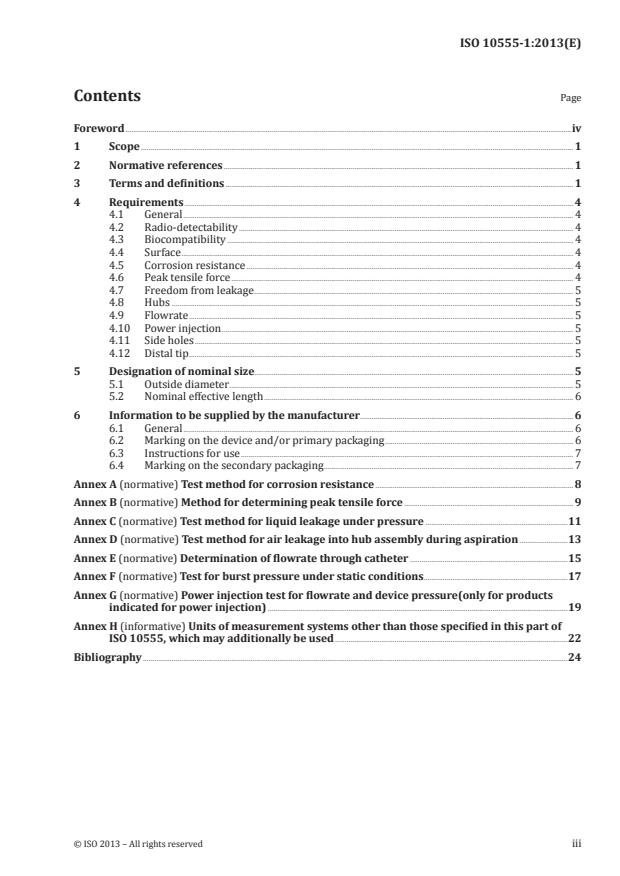
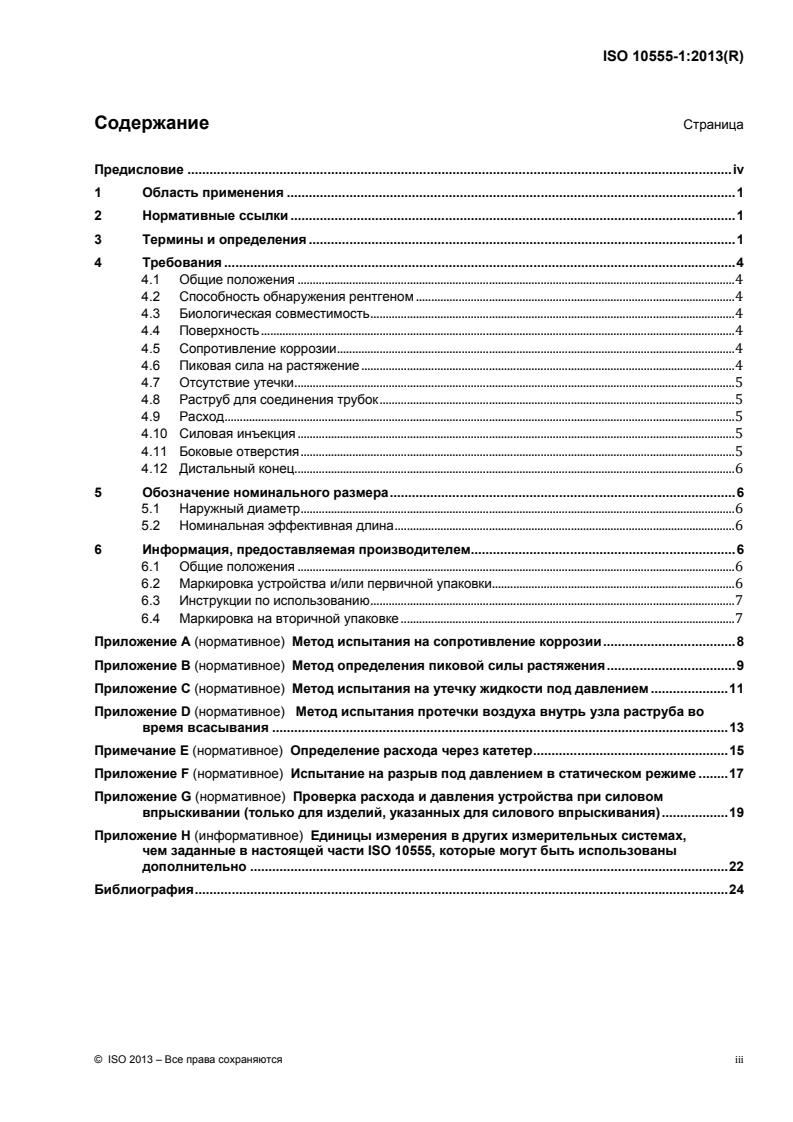
Contents Page
Foreword .iv
1 Scope . 1
2 Normative references . 1
3 Terms and definitions . 1
4 Requirements . 4
4.1 General . 4
4.2 Radio-detectability . 4
4.3 Biocompatibility . 4
4.4 Surface . 4
4.5 Corrosion resistance . 4
4.6 Peak tensile force . 4
4.7 Freedom from leakage . 5
4.8 Hubs . 5
4.9 Flowrate . 5
4.10 Power injection . 5
4.11 Side holes . 5
4.12 Distal tip . 5
5 Designation of nominal size. 5
5.1 Outside diameter . 5
5.2 Nominal effective length . 6
6 Information to be supplied by the manufacturer . 6
6.1 General . 6
6.2 Marking on the device and/or primary packaging . 6
6.3 Instructions for use . 7
6.4 Marking on the secondary packaging. 7
Annex A (normative) Test method for corrosion resistance . 8
Annex B (normative) Method for determining peak tensile force . 9
Annex C (normative) Test method for liquid leakage under pressure .11
Annex D (normative) Test method for air leakage into hub assembly during aspiration .13
Annex E (normative) Determination of flowrate through catheter .15
Annex F (normative) Test for burst pressure under static conditions.17
Annex G (normative) Power injection test for flowrate and device pressure(only for products
indicated for power injection) .19
Annex H (informative) Units of measurement systems other than those specified in this part of
ISO 10555, which may additionally be used .22
Bibliography .24
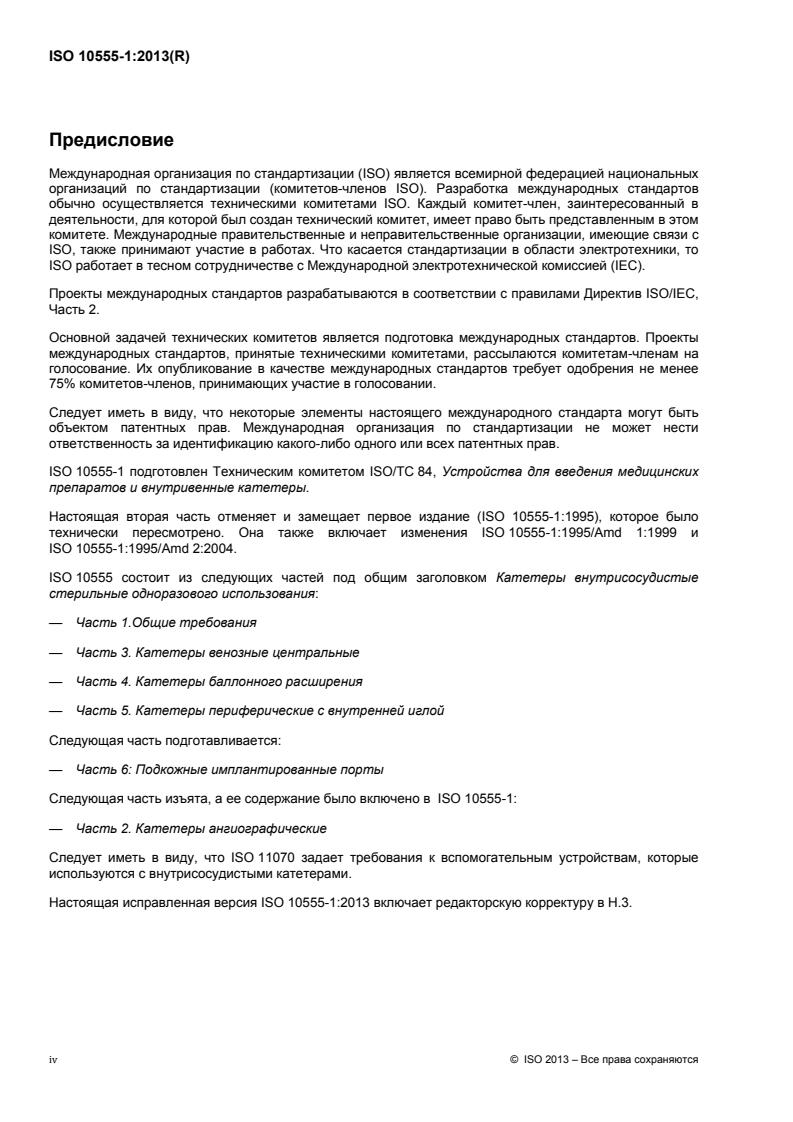
Foreword
ISO (the International Organization for Standardization) is a worldwide federation of national standards
bodies (ISO member bodies). The work of preparing International Standards is normally carried out
through ISO technical committees. Each member body interested in a subject for which a technical
committee has been established has the right to be represented on that committee. International
organizations, governmental and non-governmental, in liaison with ISO, also take part in the work.
ISO collaborates closely with the International Electrotechnical Commission (IEC) on all matters of
electrotechnical standardization.
International Standards are drafted in accordance with the rules given in the ISO/IEC Directives, Part 2.
The main task of technical committees is to prepare International Standards. Draft International
Standards adopted by the technical committees are circulated to the member bodies for voting.
Publication as an International Standard requires approval by at least 75 % of the member bodies
casting a vote.
Attention is drawn to the possibility that some of the elements of this document may be the subject of
patent rights. ISO shall not be held responsible for identifying any or all such patent rights.
ISO 10555-1 was prepared by Technical Committee ISO/TC 84, Devices for administration of medicinal
products and intravascular catheters.
This second edition cancels and replaces the first edition (ISO 10555-1:1995), which has been technically
revised. It also incorporates the amendments ISO 10555-1:1995/Amd 1:1999 and ISO 10555-1:1995/Amd
2:2004.
ISO 10555 consists of the following parts, under the general title Intravascular catheters — Sterile and
single-use catheters:
— Part 1: General requirements
— Part 3: Central venous catheters
— Part 4: Balloon dilatation catheters
— Part 5: Over-needle peripheral catheters
The following part is under preparation:
— Part 6: Subcutaneous implanted ports
The following part has been withdrawn and the content has been included in ISO 10555-1:
— Part 2: Angiographic catheters
Attention is drawn to ISO 11070, which specifies requirements for accessory devices for use with
intravascular catheters.
This corrected version of ISO 10555-1:2013 incorporates an editorial correction in H.3.
iv © ISO 2013 – All rights reserved
INTERNATIONAL STANDARD ISO 10555-1:2013(E)
Intravascular catheters — Sterile and single-use
catheters —
Part 1:
General requirements
1 Scope
This part of ISO 10555 specifies general requirements for intravascular catheters, supplied in the sterile
condition and intended for single use, for any application.
lt is not applicable to intravascular catheter accessories, e.g. those covered by ISO 11070.
2 Normative references
The following documents, in whole or in part, are normatively referenced in this document and are
indispensable for its application. For dated references, only the edition cited applies. For undated
references, the latest edition of the referenced document (including any amendments) applies.
ISO 594-1, Conical fittings with a 6 % (Luer) taper for syringes, needles and certain other medical
1)
equipment — Part 1: General requirements
ISO 594-2, Conical fittings with 6 % (Luer) taper for syringes, needles and certain other medical equipment —
1)
Part 2: Lock fittings
ISO 7886-1, Sterile hypodermic syringes for single use — Part 1: Syringes for manual use
ISO 15223-1, Medical devices — Symbols to be used with medical device labels, labelling and information to
be supplied — Part 1: General requirements
3 Terms and definitions
For the purposes of this document, the following terms and definitions apply.
3.1
intravascular catheter
tubular device, single or multilumen, designed to be partially or totally inserted or implanted into the
cardiovascular system for diagnostic and/or therapeutic purposes
3.2
distal end
end of the catheter inserted furthest into the patient
3.3
distal end configuration
shape of the catheter which is designed to facilitate its manual manipulation through the cardiovascular
system and the placement and anchoring of the distal tip in the chosen location
1) Upon its publication, ISO 80369-7 will replace ISO 594-1 and ISO 594-2.
3.4
proximal end
access end
end of the catheter to which connection can be made
3.5
hub
connector(s) at the proximal end of the catheter which may either be integral with the catheter or be
capable of being securely fitted to the proximal end of the catheter
3.6
effective length
l
length of the catheter, or pre- and post-hydration lengths
of hydratable catheters that can be inserted into the body
SEE: Figure 1.
3.7
outside diameter
largest diameter of the catheter or pre- and post-hydration largest diameters of hydratable catheters
that can be inserted into the vessel
3.8
junction
the joining of one tube or more tubes, where the assembly of the tubes provide mechanical support in
tension/compression during clinical use
3.9
hydratable intravascular catheter
intravascular catheter consisting of a material that manifests clinically significant hydration when
subjected to an aqueous medium
3.10
post-hydration
state of a hydratable intravascular catheter after immersion in aqueous medium at (37 ± 2) °C for a
clinically appropriate period of time
3.11
clinically significant hydration
hydrated state in which either the post-hydration effective length is greater than the pre-hydration
effective length by more than 1 % of the effective length, or the post-hydration outside diameter is
greater than the pre-hydration outside diameter by 10 % or more
3.12
power injection
rapid injection of fluid at high pressure
3.13
primary packaging
packaging which has direct contact with the device and/or maintains the sterility of the product
3.14
secondary packaging
packaging designed to contain one or more primary packages
2 © ISO 2013 – All rights reserved
Key
l effective length
1 catheter hub
2 catheter strain reinforcement
3 length mark
4 junction
5 pre-connected port
Figure 1 — Examples of effective length of catheters
3.15
angiographic catheter
intravascular catheter used for the injection of contrast media and/or fluids and which may be used for
pressure measurements and to obtain blood samples or insertion of coaxial inner catheter, occlusion
coils or other devices
4 Requirements
4.1 General
The catheter shall have been sterilized by an appropriate validated method, and shall comply with 4.2
to 4.8 in the sterile condition.
4.2 Radio-detectability
Parts of the catheter shall be radio-detectable if required as determined by the risk assessment.
Compliance should be demonstrated by an appropriate test method, such as ASTM F640-12 or DIN 13273-
7.
4.3 Biocompatibility
The catheter shall be free from biological hazard.
NOTE See ISO 10993-1 for the selection of appropriate test methods.
4.4 Surface
When examined by normal or corrected to normal vision, with a minimum x 2,5 magnification the
external surface of the effective length of the catheter shall appear free from extraneous matter.
The external surface of the effective length of the catheter, including the distal end, shall be free from
process and surface defects which could cause trauma to vessels during use.
If the catheter is lubricated, the lubricant shall not be visible as drops of fluid on the external surface
when the catheter is examined under normal or corrected to normal vision.
4.5 Corrosion resistance
When tested in accordance with the method given in Annex A, metallic components of the catheter
intended for fluid path contact shall show no signs of corrosion.
4.6 Peak tensile force
When tested in accordance with the method given in Annex B, the peak tensile force of each test piece
shall be as given in Table 1.
Table 1 — Peak tensile force of catheter test pieces
Smallest outside diameter of tubular Minimum peak tensile force
portion of test piece
N
mm
≥ 0,55 < 0,75 3
≥ 0,75 < 1,15 5
≥ 1,15 < 1,85 10
≥ 1,85 15
NOTE This part of ISO 10555 does not specify requirements for peak tensile force for
tubing of less than 0,55 mm outside diameter (prehydration outside diameter for hydratable
intravascular catheters) or for a distal tip and its junction to the shaft tube. These values
should be determined by the manufacturer based on risk assessment.
4 © ISO 2013 – All rights reserved
4.7 Freedom from leakage
4.7.1 The hub or connection fitting assembly or any other part of the catheter shall not leak liquid when
tested in accordance with the method given in Annex C.
For hydratable intravascular catheters, this requirement shall be met in both the pre- and post-hydration
states.
4.7.2 Air shall not leak into the hub assembly during aspiration when tested in accordance with the
method given in Annex D.
For hydratable intravascular catheters, this requirement shall be met in both the pre- and post-hydration
states.
4.8 Hubs
If the catheter is supplied with either an integral or a separate hub, it shall be a female hub that shall
comply with ISO 594-1 and ISO 594-2.
4.9 Flowrate
For devices for which flow rate is defined, when tested in accordance with Annex E, the flow rate for each
lumen shall be a minimum of 80 % of that stated by the manufacturer for catheters of nominal outside
diameter less than 1,0 mm or a minimum of 90 % of that stated by the manufacturer for catheters of
nominal outside diameter equal to 1,0 mm or greater.
If the flowrate through hydratable catheters is determined, it shall be determined in post-hydration
states.
4.10 Power injection
If the catheter is indicated for power injection, the catheter burst pressure shall exceed the peak pressure
present in the catheter at maximum flow conditions as determined by Annexes F and G.
4.11 Side holes
The design, number and positioning of side holes shall be such as to minimize adverse effects on the
catheter and trauma to the tissues.
4.12 Distal tip
The distal tip shall be smooth, rounded, tapered or similarly finished in order to minimize trauma to
vessels during use.
5 Designation of nominal size
The nominal size of the catheter shall be designated as specified in 5.1 and 5.2.
5.1 Outside diameter
Unless otherwise specified in one other part of this International Standard for a particular type of
catheter, the outside diameter shall be expressed as the nominal dimension in millimetres, rounded
upwards to the nearest 0,01 mm or 0,1 mm.
For devices which are not round by design, the size shall be designated by the dimension of the largest
axis. Where relevant, manufacturers may choose to report additional information regarding the device
profile, such as the dimension of the second axis for an oval shape.
5.2 Nominal effective length
The nominal effective length shall be expressed in millimetres for effective lengths of less than 100 mm.
The nominal effective length shall be expressed in millimetres or centimetres for effective lengths of
100 mm or more.
NOTE Tolerances to the effective length are not specified.
6 Information to be supplied by the manufacturer
6.1 General
Each device shall be accompanied by the information needed to use it safely and properly. All dimensions
given shall be expressed in SI units of measurement.
Units of measurement systems other than those specified may additionally be used.
Where appropriate, ISO 15223-1 should be used.
6.2 Marking on the device and/or primary packaging
NOTE The primary packaging is often transparent. Therefore, for the purposes of this subclause, the
combination of marking of the device which is visible through the package and the primary packaging itself are to
be considered.
The information listed below shall be specified on the first practical level in the following order: device,
primary packaging, instructions for use:
a) the name or trade name and address of the manufacturer and/or his authorized representative;
b) the details strictly necessary to identify the device (including the nominal size as designated
in Clause 5) and the contents of the packaging and, if applicable, the guidewire that is intended by the
manufacturer for use with the catheter;
c) the word “STERILE” or the appropriate symbol in ISO 15223-1;
d) the method of sterilization;
e) the batch code, preceded by the word ‘LOT’, or the serial number or the appropriate symbol in
ISO 15223-1;
f) an indication of the date by which the device should be used, in safety, expressed as, at a minimum,
the year and month (e.g. as YYYY-MM);
g) an indication that the device is for single use;
h) any special storage and/or handling conditions;
i) if the intended purpose of the device is not obvious to the user, the manufacturer shall clearly
state it (where a device is provided with separate instructions for use, this requirement may be omitted
from the primary packaging);
j) where appropriate, an indication to consult the instructions for use;
k) for angiographic catheters, a depiction or description of the distal end configuration, if not
identifiable through the package.
6 © ISO 2013 – All rights reserved
6.3 Instructions for use
When a separate instruction for use is provided, it shall at least contain information on the following:
a) the details referred to in 6.2 with the exception of d) f), j) and k);
b) precautions to be taken and any warnings (e.g. to cleaning agents, if relevant);
c) if the device is intended to be connected to other devices or accessories in order to operate as
required for its intended purpose, sufficient details of its characteristics to identify the correct
devices in order to obtain a safe combination;
d) description of additives or coatings;
e) any unique requirements for disposal of device, taking into account item d) above;
f) if applicable, special claims made because of the presence of an additive or coating, and as applicable:
— description of the additive or coating material,
— duration of effectiveness in use,
— any contra-indications, warnings and precautions based on the additive or coating material(s);
g) if applicable, known reactions between the catheter and magnetic resonance imaging (MRI);
h) date of issue or the latest revision of the instructions for use;
i) for devices indicated for power injection, the following information shall be included:
— recommended power injector pressure limit setting(s);
— maximum flow rates for a range of clinically applicable viscocities and/or specific injectates.
6.4 Marking on the secondary packaging
Where devices are provided in secondary packaging, the marking on the secondary packaging shall
include the details referred to in 6.2, if appropriate.
Annex A
(normative)
Test method for corrosion resistance
A.1 Principle
The catheter is immersed in sodium chloride solution, then in boiling distilled water, and
...
NORME ISO
INTERNATIONALE 10555-1
Deuxième édition
2013-06-15
Version corrigée
2014-01-15
Cathéters intravasculaires —
Cathéters stériles et non
réutilisables —
Partie 1:
Exigences générales
Intravascular catheters — Sterile and single-use catheters —
Part 1: General requirements
Numéro de référence
©
ISO 2013
DOCUMENT PROTÉGÉ PAR COPYRIGHT
© ISO 2013
Droits de reproduction réservés. Sauf indication contraire, aucune partie de cette publication ne peut être reproduite ni utilisée
sous quelque forme que ce soit et par aucun procédé, électronique ou mécanique, y compris la photocopie, l’affichage sur
l’internet ou sur un Intranet, sans autorisation écrite préalable. Les demandes d’autorisation peuvent être adressées à l’ISO à
l’adresse ci-après ou au comité membre de l’ISO dans le pays du demandeur.
ISO copyright office
Case postale 56 • CH-1211 Geneva 20
Tel. + 41 22 749 01 11
Fax + 41 22 749 09 47
E-mail copyright@iso.org
Web www.iso.org
Publié en Suisse
ii © ISO 2013 – Tous droits réservés
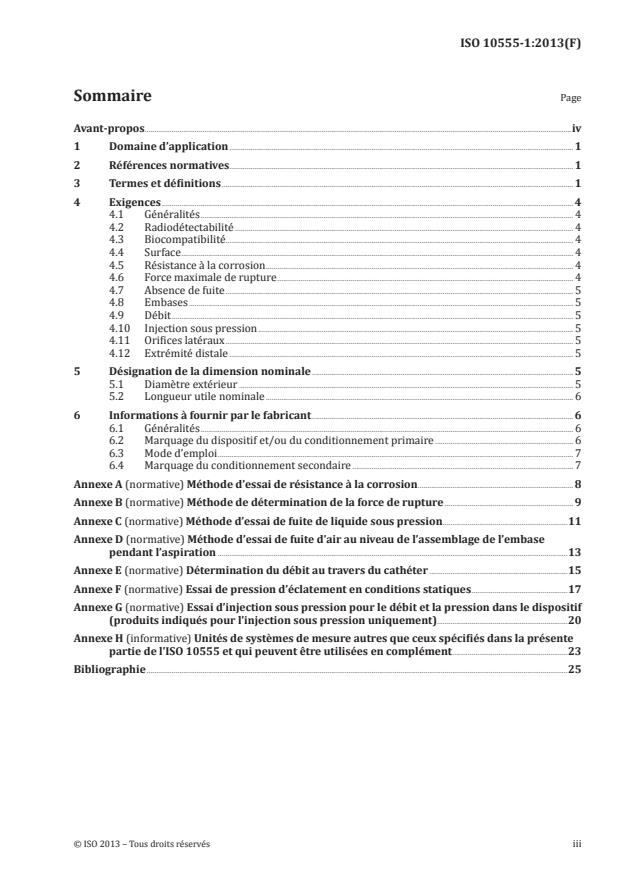
Sommaire Page
Avant-propos .iv
1 Domaine d’application . 1
2 Références normatives . 1
3 Termes et définitions . 1
4 Exigences . 4
4.1 Généralités . 4
4.2 Radiodétectabilité . 4
4.3 Biocompatibilité. 4
4.4 Surface . 4
4.5 Résistance à la corrosion . 4
4.6 Force maximale de rupture . 4
4.7 Absence de fuite . 5
4.8 Embases . 5
4.9 Débit . 5
4.10 Injection sous pression . 5
4.11 Orifices latéraux . 5
4.12 Extrémité distale . 5
5 Désignation de la dimension nominale . 5
5.1 Diamètre extérieur . 5
5.2 Longueur utile nominale . 6
6 Informations à fournir par le fabricant . 6
6.1 Généralités . 6
6.2 Marquage du dispositif et/ou du conditionnement primaire . 6
6.3 Mode d’emploi . 7
6.4 Marquage du conditionnement secondaire . 7
Annexe A (normative) Méthode d’essai de résistance à la corrosion . 8
Annexe B (normative) Méthode de détermination de la force de rupture . 9
Annexe C (normative) Méthode d’essai de fuite de liquide sous pression .11
Annexe D (normative) Méthode d’essai de fuite d’air au niveau de l’assemblage de l’embase
pendant l’aspiration .13
Annexe E (normative) Détermination du débit au travers du cathéter .15
Annexe F (normative) Essai de pression d’éclatement en conditions statiques .17
Annexe G (normative) Essai d’injection sous pression pour le débit et la pression dans le dispositif
(produits indiqués pour l’injection sous pression uniquement).20
Annexe H (informative) Unités de systèmes de mesure autres que ceux spécifiés dans la présente
partie de l’ISO 10555 et qui peuvent être utilisées en complément .23
Bibliographie .25
Avant-propos
L’ISO (Organisation internationale de normalisation) est une fédération mondiale d’organismes
nationaux de normalisation (comités membres de l’ISO). L’élaboration des Normes internationales est
en général confiée aux comités techniques de l’ISO. Chaque comité membre intéressé par une étude
a le droit de faire partie du comité technique créé à cet effet. Les organisations internationales,
gouvernementales et non gouvernementales, en liaison avec l’ISO participent également aux travaux.
L’ISO collabore étroitement avec la Commission électrotechnique internationale (CEI) en ce qui concerne
la normalisation électrotechnique.
Les Normes internationales sont rédigées conformément aux règles données dans les Directives ISO/CEI,
Partie 2.
La tâche principale des comités techniques est d’élaborer les Normes internationales. Les projets de
Normes internationales adoptés par les comités techniques sont soumis aux comités membres pour vote.
Leur publication comme Normes internationales requiert l’approbation de 75 % au moins des comités
membres votants.
L’attention est appelée sur le fait que certains des éléments du présent document peuvent faire l’objet de
droits de propriété intellectuelle ou de droits analogues. L’ISO ne saurait être tenue pour responsable de
ne pas avoir identifié de tels droits de propriété et averti de leur existence.
L’ISO 10555-1 a été élaborée par le comité technique ISO/TC 84, Dispositifs pour administration des
produits médicaux et cathéters intravasculaires.
Cette deuxième édition annule et remplace la première édition (ISO 10555-1:1995), qui a fait l’objet
d’une révision technique. Elle incorpore également les amendements ISO 10555-1:1995/Amd.1:1999 et
ISO 10555-1:1995/Amd.2:2004.
L’ISO 10555 comprend les parties suivantes, présentées sous le titre général Cathéters intravasculaires —
Stériles et non-réutilisables:
— Partie 1: Exigences générales
— Partie 2: Cathéters angiographiques
— Partie 3: Cathéters veineux centraux
— Partie 4: Cathéters de dilatation à ballonnets
— Partie 5: Cathéters périphériques à aiguille interne
La partie suivante est en cours d’élaboration:
— Partie 6: Chambres à cathéter implantables
La partie suivante a été annulée et son contenu a été inclus dans l’ISO 10555-1:
— Partie 2: Cathéters angiographiques
L’attention est attirée sur l’ISO 11070, qui spécifie les exigences relatives aux dispositifs accessoires
pour utilisation avec les cathéters intravasculaires.
La présente version corrigée de l’ISO 10555-1:2013 inclut des corrections rédactionnelles dans l’Article 3,
en 4.9, 5.1, 6.3, E.4.3 et E.6.
iv © ISO 2013 – Tous droits réservés
NORME INTERNATIONALE ISO 10555-1:2013(F)
Cathéters intravasculaires — Cathéters stériles et non
réutilisables —
Partie 1:
Exigences générales
1 Domaine d’application
La présente partie de l’ISO 10555 spécifie les exigences générales relatives aux cathéters intravasculaires
fournis en condition stérile, non réutilisables, pour toute application.
Elle n’est pas applicable aux accessoires de cathéters intravasculaires, qui sont couverts par l’ISO 11070.
2 Références normatives
Les documents suivants, en totalité ou en partie, sont référencés de manière normative dans le présent
document et sont indispensables pour son application. Pour les références datées, seule l’édition citée
s’applique. Pour les références non datées, la dernière édition du document de référence s’applique (y
compris les éventuels amendements).
ISO 594-1, Assemblages coniques à 6 % (Luer) des seringues et aiguilles et de certains autres appareils à
1)
usage médical — Partie 1: Spécifications générales
ISO 594-2, Assemblages coniques à 6 % (Luer) des seringues et aiguilles et de certains autres appareils à
1)
usage médical — Partie 2: Assemblages à verrouillage
ISO 7886-1, Seringues hypodermiques stériles, non réutilisables — Partie 1: Seringues pour utilisation
manuelle
ISO 15223-1, Dispositifs médicaux — Symboles à utiliser avec les étiquettes, l’étiquetage et les informations
à fournir relatifs aux dispositifs médicaux — Partie 1: Exigences générales
3 Termes et définitions
Pour les besoins du présent document, les termes et définitions suivants s’appliquent.
3.1
cathéter intravasculaire
dispositif tubulaire, à un ou plusieurs canaux, destiné à être introduit partiellement ou totalement ou
implanté dans le système cardiovasculaire à des fins de diagnostic et/ou de thérapeutique
3.2
extrémité distale
extrémité du cathéter introduite le plus profondément dans le corps du patient
3.3
configuration d’extrémité distale
forme du cathéter conçue pour faciliter sa manipulation dans le système cardiovasculaire, ainsi que le
placement et l’ancrage de l’extrémité distale à l’emplacement choisi
1) Lors de sa publication l’ISO 80369-7 remplacera l’ISO 594-1 et l’ISO 594-2.
3.4
extrémité proximale
extrémité d’accès
extrémité du cathéter avec laquelle il est possible d’établir un raccordement
3.5
embase
raccord(s) sur l’extrémité proximale du cathéter, qui peut former un tout avec le cathéter, ou qui peut
être solidement fixé à l’extrémité proximale du cathéter
3.6
longueur utile
l
longueur du cathéter ou somme des longueurs des parties non hydratée et
hydratée des cathéters hydratables que l’on peut introduire dans le corps
VOIR: Figure 1.
3.7
diamètre extérieur
diamètre maximal indiqué du cathéter ou diamètres maximaux avant et après hydratation des cathéters
hydratables que l’on peut introduire dans les vaisseaux
3.8
jonction
jonction d’un ou plusieurs tubes, où l’assemblage des tubes apporte un soutien mécanique à la
tension/compression pendant l’utilisation clinique
3.9
cathéter intravasculaire hydratable
cathéter intravasculaire constitué d’un matériau qui présente une hydratation cliniquement significative
lorsqu’il est soumis à un milieu aqueux
3.10
post-hydratation
état d’un cathéter intravasculaire hydratable après immersion dans un milieu aqueux approprié à
(37 ± 2) °C pendant une période appropriée cliniquement
3.11
hydratation cliniquement significative
état hydraté dans lequel la longueur utile après hydratation est supérieure à la longueur utile avant
hydratation de plus de 1 % de la longueur utile, ou bien état hydraté dans lequel le diamètre extérieur
après hydratation est supérieur à la valeur avant hydratation de 10 % ou plus
3.12
injection sous pression
injection rapide de fluide sous haute pression
3.13
conditionnement primaire
conditionnement en contact direct avec le dispositif et/ou qui maintient la stérilité du produit
3.14
conditionnement secondaire
conditionnement qui contient un ou plusieurs conditionnements primaires
2 © ISO 2013 – Tous droits réservés
Légende
l longueur effective
1 embase du cathéter
2 renfort du cathéter destiné à augmenter la résistance à la contrainte
3 marque de longueur
4 jonction
5 orifice préconnecté
Figure 1 — Exemples de longueurs utiles de cathéters
3.15
cathéters angiographiques
cathéter intravasculaire utilisé pour injecter des produits de contraste, et qui peut être utilisé pour
mesurer la pression et prélever des échantillons de sang
4 Exigences
4.1 Généralités
Le cathéter doit avoir été stérilisé par une méthode validée, et doit être conforme à 4.2 à 4.8 à l’état
stérile.
4.2 Radiodétectabilité
Certaines parties du cathéter doivent être radiodétectables, en fonction de l’évaluation des risques.
Il convient de démontrer la conformité à l’aide d’une méthode d’essai appropriée, telle que celle indiquée
dans l’ASTM F640-12 ou la DIN 13273-7.
4.3 Biocompatibilité
Le cathéter ne doit pas présenter de risque biologique.
NOTE Voir l’ISO 10993-1 pour la sélection des méthodes d’essai appropriées.
4.4 Surface
Lorsqu’elle est examinée en vision normale ou corrigée, avec un grossissement minimal ×2,5, la surface
externe de la longueur utile du cathéter doit être exempte de substances étrangères.
La surface externe de la longueur utile du cathéter, y compris l’extrémité distale, ne doit présenter aucun
défaut de fabrication et de surface susceptible de traumatiser les vaisseaux lors de l’utilisation.
Si le cathéter est lubrifié, le lubrifiant ne doit pas être visible sous forme de gouttes de fluide sur la
surface externe quand le cathéter est examiné en vision normale ou corrigée.
4.5 Résistance à la corrosion
Après essai conformément à la méthode donnée dans l’Annexe A, les composants métalliques du cathéter
destinés à entrer en contact avec des fluides ne doivent pas présenter de traces de corrosion.
4.6 Force maximale de rupture
Après essai conformément à la méthode donnée dans l’Annexe B, la force maximale de rupture de chaque
échantillon doit être conforme au Tableau 1.
Tableau 1 — Force maximale de rupture d’éprouvette du cathéter
Plus petit diamètre extérieur de la partie tubulaire de Force minimale de rupture
l’éprouvette
N
mm
≥ 0,55 < 0,75 3
≥ 0,75 < 1,15 5
≥ 1,15 < 1,85 10
≥ 1,85 15
NOTE La présente partie de l’ISO 10555 ne fixe pas les exigences relatives à la force maximale de rupture du tube à un
diamètre inférieur à 0,55 mm (pré-hydratation du diamètre extérieur pour les cathéters intravasculaires hydratables) ou à
l’extrémité distale et sa jonction au tube de protection de l’arbre de transmission. Il convient que le fabricant détermine ces
valeurs en se fondant sur l’évaluation des risques.
4 © ISO 2013 – Tous droits réservés
4.7 Absence de fuite
4.7.1 L’embase, le système d’assemblage ou toute autre partie du cathéter ne doit pas présenter de fuite
de liquide durant l’essai conformément à la méthode donnée dans l’Annexe C.
Pour les cathéters intravasculaires hydratables, cette exigence doit être satisfaite dans les états à la fois
de pré- et de post-hydratation.
4.7.2 L’air ne doit pas fuir dans l’assemblage de I’embase pendant l’aspiration durant l’essai
conformément à la méthode donnée dans l’Annexe D.
Pour les cathéters intravasculaires hydratables, cette exigence doit être satisfaite dans les états à la fois
de pré-hydratation et de post-hydratation.
4.8 Embases
Si le cathéter est doté d’une embase intégrée ou d’une embase séparée, il doit s’agir d’une embase femelle,
conforme à I’ISO 594-1 et I’ISO 594-2.
4.9 Débit
Pour les dispositifs dont le débit est défini, après essai conformément à l’Annexe E, le débit de chaque
canal doit représenter au minimum 80 % du débit indiqué par le fabricant pour les cathéters de diamètre
extérieur nominal inférieur à 1,0 mm ou au minimum 90 % du débit indiqué par le fabricant pour les
cathéters de diamètre extérieur nominal de 1,0 mm ou plus.
Si le débit est déterminé pour les cathéters hydratables, il doit l’être dans les états de post-hydratation.
4.10 Injection sous pression
Lors de la détermination de la compatibilité d’un cathéter pour une injection sous pression, la pression
d’éclatement du cathéter doit être supérieure aux pressions de crête présentes dans le cathéter dans des
conditions de débit maximal déterminées dans les Annexes F et G.
4.11 Orifices latéraux
La conception, le nombre et le positionnement des orifices latéraux doivent être prévus de manière à
limiter les effets néfastes sur le cathéter ainsi que le traumatisme aux tissus.
4.12 Extrémité distale
L’extrémité distale doit être lisse, arrondie, conique ou finie de façon similaire afin de réduire les
traumatismes aux vaisseaux lors de l’utilisation.
5 Désignation de la dimension nominale
La dimension nominale du cathéter doit être désignée comme spécifié en 5.1 et 5.2.
5.1 Diamètre extérieur
Sauf spécification contraire figurant dans une autre partie de la présente Norme internationale pour un
type particulier de cathéter, le diamètre extérieur doit être exprimé comme étant la dimension nominale
en millimètres et arrondi au 0,01 mm ou au 0,1 mm supérieur.
Pour les dispositifs dont le profil n’a pas été conçu comme un cercle, la taille doit être désignée par la
dimension de l’axe le plus grand. Le cas échéant, les fabricants peuvent choisir de donner des informations
supplémentaires concernant le profil du dispositif, par exemple la dimension du second axe pour une
forme ovale.
5.2 Longueur utile nominale
Il convient d’exprimer la longueur utile nominale en millimètres pour des longueurs utiles inférieures
à 100 mm.
La longueur utile nominale doit être exprimée en millimètres ou en centimètres pour des longueurs
utiles d’au moins 100 mm.
NOTE Les tolérances de la longueur utile ne sont pas spécifiées.
6 Informations à fournir par le fabricant
6.1 Généralités
Chaque dispositif doit être accompagné des informations nécessaires à une utilisation correcte et en
toute sécurité. Toutes les dimensions indiquées doivent être exprimées en unités de mesure SI.
Les unités des systèmes de mesure autres que ceux spécifiés peuvent également être utilisées.
Le cas échéant, il convient d’utiliser l’ISO 15223-1.
6.2 Marquage du dispositif et/ou du conditionnement primaire
NOTE Le conditionnement primaire est souvent transparent. Pour les besoins du présent paragraphe, la
combinaison de marquage du dispositif visible à travers le conditionnement et le conditionnement primaire en
lui-même doivent être pris en compte.
Les informations ci-dessous doivent être spécifiées sur le premier niveau utilisable en pratique dans
l’ordre suivant: dispositif, conditionnement principal, instructions d’utilisation:
a) le nom du fabricant ou de la marque déposée et son adresse;
b) les détails strictement nécessaires à l’identification du dispositif (y compris la dimension nominale
présentée à l’Article 5) et du contenu du conditionnement et, le cas échéant, le plus grand guide
prévu par le fabricant pour être utilisé avec le cathéter;
c) le mot «STÉRILE» ou le symbole harmonisé de l’ISO 15223-1;
d) la méthode de stérilisation;
e) le code de lot, précédé du mot «LOT», le numéro de série ou le symbole approprié dans l’ISO 15223-1;
f) la date jusqu’à laquelle il convient d’utiliser le dispositif, en toute sécurité, au minimum au format
année et mois (par exemple AAAA-MM);
g) une indication précisant que le dispositif est destiné à un usage unique;
h) les conditions particulières de stockage et/ou de manipulation éventuelles;
i) si l’usage prévu du dispositif n’est pas évident pour l’utilisateur, le fabricant doit clairement le
mentionner (si un appareil est fourni sans instructions d’utilisation séparées, cette exigence peut
être omise du conditionnement primaire);
j) le cas échéant, une indication précisant de consulter les instructions d’utilisation.
k) pour les cathéters angiographiques, un dessin ou une description de la configuration de l’extrémité
distale, si elle n’est pas identifiable à travers le conditionnement.
6 © ISO 2013 – Tous droits réservés
6.3 Mode d’emploi
Si des instructions d’utilisation distinctes sont fournies, elles doivent au moins contenir des informations
relatives aux éléments suivants:
a) les détails indiqués en 6.2 à l’exception de d), f), j) et k),
b) les précautions à prendre et tous les avertissements (par exemple relatifs aux agents nettoyants, le
cas échéant);
c) une description suffisante de ses caractéristiques afin d’identifier les dispositifs compatibles et
d’obtenir une combinaison sûre, si le dispositif est destiné à être connecté à d’autres dispositifs ou
accessoires afin de fonctionner conformément à son usage prévu;
d) une description des additifs ou des revêtements;
e) les exigences spécifiques relatives à l’élimination du dispositif, en prenant en compte l’élément d)
ci-dessus;
f) le cas échéant, des déclarations particulières faites en raison de la présence d’un additif ou d’un
revêtement, et selon le cas;
— une description de l’additif ou du matériau de revêtement;
— la durée de l’efficacité en conditions d’utilisation;
— toute contre-indication, tout avertissement et toute précaution relatifs à l’additif ou au(x)
matériau(x) de revêtement;
g) le cas échéant, les réactions connues entre le cathéter et les appareils d’imagerie par résonance
magnétique (IRM);
h) la date de publication ou de dernière révision des instructions d’utilisation.
i) pour les dispositifs indiqués pour l’injection sous pression, les informations suivantes doivent être
incluses:
— paramètre(s) de limitation de la pression recommandé(s) pour l’injecteur;
— débits maximaux pour une gamme de viscosités cliniquement applicables et/ou solutés d’injection
spécifiques.
6.4 Marquage du conditionnement secondaire
Si les dispositifs sont fournis dans un conditionnement secondaire, le marquage de ce dernier doit
contenir les détails indiqués en 6.2, le cas échéant.
Annexe A
(normative)
Méthode d’essai de résistance à la corrosion
A.1 Principe
Le cathéter est plongé dans une solution de chlorure de sodium, puis dans de l’eau distillée portée à
ébullition, puis fait ensuite l’objet d’un examen visuel pour détecter d’éventuelles traces de corrosion.
A.2 Réactifs
A.2.1 Solution saline, comprenant une solution de chlorure de sodium de qualité analytique dans de
l’eau distillée fraîchement préparée[c(NaCI) = 0,15 mol/l].
A.2.2 Eau distillée ou déionisée.
A.3 Appareillage
A.3.1 Récipients en verre borosilicaté.
A.4 Mode opératoire
Immerger le cathéter dans une solution saline (A.2.1) dans un récipient en verre (A.3.1) à température
ambiante pendant 5 h. Reti
...
МЕЖДУНАРОДНЫЙ ISO
СТАНДАРТ 10555-1
Второе издание
2013-06-15
Исправленнаяверсия
2013-07-01
Катетеры внутрисосудистые стерильные
одноразового использования.
Часть 1.
Общие требования
Intravascular catheters – Sterile and single-use catheters –
Part 1. General requirements
Ответственность за подготовку русской версии несёт GOST R
(Российская Федерация) в соответствии со статьёй 18.1 Устава ISO
Ссылочный номер
©
ISO 2013
ДОКУМЕНТ ЗАЩИЩЕН АВТОРСКИМ ПРАВОМ
© ISO 2013
Все права сохраняются. Если не указано иное, никакую часть настоящей публикации нельзя копировать или использовать в
какой-либо форме или каким-либо электронным или механическим способом, включая фотокопии и микрофильмы, без
предварительного письменного согласия офиса ISO или членов ISO в стране регистрации пребывания.
ISO copyright office
Case postale 56 • CH-1211 Geneva 20
Tel. + 41 22 749 01 11
Fax + 41 22 749 09 47
E-mail copyright@iso.org
Web www.iso.org
Отпечатано в Швейцарии
ii © ISO 2013 – Все права сохраняются
Содержание Страница
Предисловие .iv
1 Область применения .1
2 Нормативные ссылки .1
3 Термины и определения .1
4 Требования .4
Общие положения.4
4.1
4.2 Способность обнаружения рентгеном.4
4.3 Биологическая совместимость.4
4.4 Поверхность.4
4.5 Сопротивление коррозии.4
4.6 Пиковая сила на растяжение.4
4.7 Отсутствие утечки.5
4.8 Раструб для соединения трубок.5
4.9 Расход.5
4.10 Силовая инъекция.5
4.11 Боковые отверстия.5
4.12 Дистальный конец.6
5 Обозначение номинального размера.6
5.1 Наружный диаметр.6
5.2 Номинальная эффективная длина.6
6 Информация, предоставляемая производителем.6
6.1 Общие положения.6
6.2 Маркировка устройства и/или первичной упаковки.6
6.3 Инструкции по использованию.7
6.4 Маркировка на вторичной упаковке.7
Приложение A (нормативное) Метод испытания на сопротивление коррозии.8
Приложение B (нормативное) Метод определения пиковой силы растяжения.9
Приложение C (нормативное) Метод испытания на утечку жидкости под давлением .11
Приложение D (нормативное) Метод испытания протечки воздуха внутрь узла раструба во
время всасывания .13
Примечание E (нормативное) Определение расхода через катетер.15
Приложение F (нормативное) Испытание на разрыв под давлением в статическом режиме .17
Приложение G (нормативное) Проверка расхода и давления устройства при силовом
впрыскивании (только для изделий, указанных для силового впрыскивания).19
Приложение H (информативное) Единицы измерения в других измерительных системах,
чем заданные в настоящей части ISO 10555, которые могут быть использованы
дополнительно .22
Библиография.24
© ISO 2013 – Все права сохраняются iii
Предисловие
Международная организация по стандартизации (ISO) является всемирной федерацией национальных
организаций по стандартизации (комитетов-членов ISO). Разработка международных стандартов
обычно осуществляется техническими комитетами ISO. Каждый комитет-член, заинтересованный в
деятельности, для которой был создан технический комитет, имеет право быть представленным в этом
комитете. Международные правительственные и неправительственные организации, имеющие связи с
ISO, также принимают участие в работах. Что касается стандартизации в области электротехники, то
ISO работает в тесном сотрудничестве с Международной электротехнической комиссией (IEC).
Проекты международных стандартов разрабатываются в соответствии с правилами Директив ISO/IEC,
Часть 2.
Основной задачей технических комитетов является подготовка международных стандартов. Проекты
международных стандартов, принятые техническими комитетами, рассылаются комитетам-членам на
голосование. Их опубликование в качестве международных стандартов требует одобрения не менее
75% комитетов-членов, принимающих участие в голосовании.
Следует иметь в виду, что некоторые элементы настоящего международного стандарта могут быть
объектом патентных прав. Международная организация по стандартизации не может нести
ответственность за идентификацию какого-либо одного или всех патентных прав.
ISO 10555-1 подготовлен Техническим комитетом ISO/TC 84, Устройства для введения медицинских
препаратов и внутривенные катетеры.
Настоящая вторая часть отменяет и замещает первое издание (ISO 10555-1:1995), которое было
технически пересмотрено. Она также включает изменения ISO 10555-1:1995/Amd 1:1999 и
ISO 10555-1:1995/Amd 2:2004.
ISO 10555 состоит из следующих частей под общим заголовком Катетеры внутрисосудистые
стерильные одноразового использования:
— Часть 1.Общие требования
— Часть 3. Катетеры венозные центральные
— Часть 4. Катетеры баллонного расширения
— Часть 5. Катетеры периферические с внутренней иглой
Следующая часть подготавливается:
— Часть 6: Подкожные имплантированные порты
Следующая часть изъята, а ее содержание было включено в ISO 10555-1:
— Часть 2. Катетеры ангиографические
Следует иметь в виду, что ISO 11070 задает требования к вспомогательным устройствам, которые
используются с внутрисосудистыми катетерами.
Настоящая исправленная версия ISO 10555-1:2013 включает редакторскую корректуру в H.3.
iv © ISO 2013 – Все права сохраняются
МЕЖДУНАРОДНЫЙ СТАНДАРТ ISO 10555-1:2013(R)
Катетеры внутрисосудистые стерильные одноразового
использования.
Часть 1.
Общие требования
1 Область применения
Настоящая часть ISO 10555 задает общие требования к внутрисосудистым катетерам, поставляемым в
стерильном состоянии и предназначенным для одноразового использования при любом применении.
Она не применяется к принадлежностям катетеров, например, тем, которые охвачены ISO 11070.
2 Нормативные ссылки
Следующие ссылочные документы являются обязательными для применения настоящего документа.
Для устаревших ссылок применяется только цитируемое издание. Для недатированных ссылок
применяется самое последнее издание ссылочного документа (включая поправки).
ISO 594-1, Детали соединительные с конусностью 6 % (Люэр) для шприцев, игл и определенного
другого медицинского оборудования. Часть 1. Общие требования
ISO 594-2, Детали соединительные с конусностью 6 % (Люэр) для шприцев, игл и определенного
)
другого медицинского оборудования. Часть 2: Замковые фитинги
ISO 7886-1, Шприцы стерильные подкожные одноразового использования. Часть 1. Шприцы для
ручного применения
ISO 15223-1, Медицинские устройства. Символы для применения с этикетками медицинских
устройств. Маркировка и информация, которую надо указывать. Часть 1. Общие требования
3 Термины и определения
В настоящем документе применяются следующие термины и определения.
3.1
внутрисосудистый катетер
intravascular catheter
трубчатое устройство, одноканальное или многоканальное, предназначенное для того, чтобы частично
или полностью вводить или имплантировать в сердечнососудистую систему для диагностики и/или
терапевтических целей
3.2
дистальный конец
distal end
конец катетера, который вводится в самое дальнее положение в сосуде пациента
С публикацией ISO 80369-7 произойдет замена ISO 594-1 и ISO 594-2.
© ISO 2013 – Все права сохраняются 1
3.3
конфигурация дистального конца
distal end configuration
форма катетера, которая разрабатывается с целью облегчить его ручное манипулирование через
сердечнососудистую систему, размещение и закрепление дистального конца в избранном месте
3.4
проксимальный конец
proximal end
доступный конец
access end
конец катетера для возможного подсоединения
3.5
раструб
hub
соединитель(и) на проксимальном конце катетера, который может быть либо неотъемлемой частью
катетера, либо его можно надежно прикрепить к проксимальному концу катетера
3.6
эффективная длина
effective length
l
длина катетера или значения длины до и после гидратации способных к гидратации катетеров,
которая может быть введена в тело
См. Рисунок 1.
3.7
наружный диаметр
outside diameter
наибольший диаметр катетера или значения диаметров до и после гидратации способных к
гидратации катетеров, который может быть введен внутрь сосуда
3.8
сочленение
junction
сращивание одной или больше трубок в случае, когда сборка трубок обеспечивает механическую
опору в растяжении/сжатии во время клинического использования
3.9
внутрисосудистый катетер, способный к гидратации
hydratable intravascular catheter
внутрисосудистый катетер, состоящий из материала, который проявляет клинически значимую
гидратацию в условиях водной среды
3.10
после гидратации
post-hydration
состояние способного к гидратации внутрисосудистого катетера после погружения в водную среду при
температуре (37 ± 2) °C в течение клинически подходящего периода времени
3.11
клинически значимая гидратация
clinically significant hydration
гидратированное состояние, в котором эффективная длина после гидратации больше эффективной
длины до гидратации на 1 % эффективной длины или наружный диаметр после гидратации больше
наружного диаметра до гидратации на 10 % или больше
3.12
силовая инъекция
power injection
быстрая инъекция жидкости под большим давлением
2 © ISO 2006 – Все права сохраняются
3.13
первичная упаковка
primary packaging
упаковка, которая непосредственно соприкасается с устройством и/или сохраняет стерильность
изделия
3.14
вторичная упаковка
secondary packaging
упаковка, предназначенная содержать одну или две первичные упаковки
Обозначение
l эффективная длина
1 раструб для соединения трубок
2 усиление при растяжении катетера
3 метка длины
4 сочленение
5 предварительно соединенный порт
Рисунок 1 — Примеры эффективной длины катетеров
© ISO 2013 – Все права сохраняются
3.15
ангиографический катетер
angiographic catheter
внутрисосудистый катетер, используемый для инъекции контрастной среды и/или жидкости, который
может быть применен для измерений давления и получения проб крови или вставки коаксиальной
внутренней части катетера или спиралей закупорки или других устройств
4 Требования
4.1 Общие положения
Катетер должен быть стерилизован подходящим, проверенным на достоверность методом и должен
соответствовать состоянию стерилизации от 4.2 до 4.8.
4.2 Способность обнаружения рентгеном
Части катетера должны обнаруживаться рентгеном, если требуется согласно оценке рисков.
Соответствие следует демонстрировать подходящим испытательным методом, например,
ASTM F640-12 или DIN 13273-7.
4.3 Биологическая совместимость
Катетер не должен обладать возможностью нанесения вреда.
ПРИМЕЧАНИЕ Выбор подходящих испытательных методов см. в ISO 10993-1.
4.4 Поверхность
Осмотр катетера нормальным или скорректированным зрением и с минимальным увеличением в 2,5
раза должен показать, что наружная поверхность эффективной длины катетера является свободной от
постороннего вещества.
Наружная поверхность эффективной длины катетера, включая дистальный конец, не должна иметь
дефектов от технологической обработки и поверхностных недостатков, которые могли бы
травмировать сосуды во время использования катетера.
Если катетер имеет смазку, то она не должна быть видимой как капли жидкости на внешней
поверхности при осмотре катетера нормальным или скорректированным зрением.
4.5 Сопротивление коррозии
При испытании в соответствии с методом, данным в Приложении A, металлические компоненты
катетера, предназначенные для соприкосновения с жидкостью канала, не должна показывать
признаков коррозии.
4.6 Пиковая сила на растяжение
При испытании в соответствии с методом, данным в Приложении B, пиковая растягивающая сила
каждого испытываемого образца должна быть такой, как указано в Таблице 1.
4 © ISO 2006 – Все права сохраняются
Таблица 1 — Пиковая сила на растяжение испытываемых образцов катетера
Наименьший наружный диаметр трубчатой части Минимальная пиковая растягивающая сила
образца для испытания N
мм
W 0,55 < 0,75 3
W 0,75 < 1,15
W 1,15 < 1,85
W 1,85
ПРИМЕЧАНИЕ Настоящая часть ISO 10555 не задает требования для пиковой силы растяжения трубок с
наружным диаметром меньше 0,55 мм (наружный диаметр предварительной гидратации для способных к
гидратации катетеров) или для дистального конца и его сочленения с трубкой одинакового сечения выходного и
входного канала. Производителю следует определять эти значения на основе оценки рисков.
4.7 Отсутствие утечки
4.7.1 Раструб или узел соединения фитингов или любая другая часть катетера не должны иметь
утечку жидкости при испытании в соответствии с методом, данным в Приложении C.
Для внутрисосудистых катетеров, способных к гидратации, это требование должно быть
удовлетворено для обоих состояний: до и после гидратации.
4.7.2 Не должно быть проникновения воздуха в узел сборки раструбной втулки при испытании в
соответствии с методом, данным в Приложении D.
Для внутрисосудистых катетеров, способных к гидратации, это требование должно быть
удовлетворено для обоих состояний: до и после гидратации.
4.8 Раструб для соединения трубок
Если катетер поставляется с неотъемлемой или отделяемой раструбной втулкой, то ее раструб
должен иметь коническую расточку в соответствии с ISO 594-1 и ISO 594-2.
4.9 Расход
Для устройств с определенным расходом, который определяется на испытании в соответствии с
Приложением F, расход для каждого продольного канала (lumen) должен быть минимум 80 % или 90 %
величины, заявленной производителем для катетеров с номинальным наружным диаметром меньше
10 мм или 10 мм и свыше соответственно.
Если определяется расход для катетеров, способных к гидратации, то он должен быть установлен в
состояниях после гидратации.
4.10 Силовая инъекция
Если катетер указывается для силовой инъекции, то давление разрыва катетера должно превышать
пиковое давление, присутствующее в катетере на максимальном режиме потока, как определено в
Приложениях F и G.
4.11 Боковые отверстия
Дизайн, количество и позиционирование боковых отверстий должно быть такое, чтобы
минимизировать их вредное влияние на катетер и травму тканей.
© ISO 2013 – Все права сохраняются
4.12 Дистальный конец
Дистальный конец должен быть гладким, закругленным, конусообразным или подобным образом
обработанным, чтобы минимизировать травму сосудов во время использования.
5 Обозначение номинального размера
Номинальный размер катетера должен быть обозначен, как задано в 5.1 и 5.2.
5.1 Наружный диаметр
Если не задано иначе в одной из других частей настоящего международного стандарта для
конкретного типа катетера, то наружный диаметр должен быть выражен как номинальный размер в
миллиметрах, округленный с точностью до 0,01 мм или 0,1 мм.
Для устройств, которые не являются круглыми в сечении согласно дизайну, этот размер должен быть
обозначен размером наибольшей оси. В уместном случае производитель может сообщить
дополнительную информацию в отношении профиля устройства, например, размер второй оси для
овальной формы.
5.2 Номинальная эффективная длина
Номинальная эффективная длина может быть выражена в миллиметрах значений эффективной длины
меньше 100 мм.
Номинальная эффективная длина должна быть выражена в миллиметрах или сантиметрах для
эффективных значений длины 100 мм и свыше.
ПРИМЕЧАНИЕ Допустимые отклонения эффективной длины не задаются.
6 Информация, предоставляемая производителем
6.1 Общие положения
Каждое устройство должно иметь сопроводительную информацию, необходимую для правильного и
безопасного использования устройства. Все указанные размеры должны быть выражены в единицах
измерения СИ.
Единицы измерения в других измерительных системах, помимо заданных, могут быть использованы
как дополнительные.
В подходящем случае следует использовать ISO 15223-1.
6.2 Маркировка устройства и/или первичной упаковки
ПРИМЕЧАНИЕ Первичная упаковка часто бывает прозрачной. Поэтому в настоящем подпункте надо принимать во
внимание комбинацию маркировки устройства, которая просматривается через упаковку, и саму первичную упаковку.
Информация, перечисленная ниже, должна быть задана на первом практическом уровне в следующем
порядке: устройство, первичная упаковка, инструкции по использованию.
a) название или торговая марка и адрес производителя и/или его уполномоченного представителя
b) подробности, строго необходимые для идентификации устройства (включая номинальный размер
согласно обозначению в разделе 5), и содержимое упаковки, а в приемлемом случае проводник,
который производитель предполагает для использования с катетером;
c) слово “СТЕРИЛЬНО” или подходящий символ в ISO 15223-1;
6 © ISO 2006 – Все права сохраняются
d) метод стерилизации;
e) код партии после слова 'ЛОТ' или серийный номер, или подходящий символ в ISO 15223-1;
f) указание даты безопасного использования, выраженной, как минимум, годом и месяцем (например,
YYYY-MM);
g) указание о том, что устройство служит для одноразового применения;
h) любые условия специального хранения и/или обращения;
i) если применение по назначению не является очевидным для пользователя, то производитель
должен ясно заявить об этом (в случае, когда устройство обеспечивается отдельными
инструкциями по использованию, это требование может быть опущено из первичной упаковки);
j) в подходящем случае, указание о необходимости обращения к инструкции по использованию;
k) для ангиографических катетеров, изображение или описание конфигурации дистального конца,
если это не распознается через упаковку.
6.3 Инструкции по использованию
Когда предоставляется отдельная инструкция по использованию, то она должна содержать, по
меньшей мере, информацию о следующем:
a) подробности согласно 6.2 с исключением d) f), j) и k);
b) меры предосторожности, которые надо принимать, и любые предупреждения (например, чистящие
агенты в уместном случае);
c) если устройство предполагается подсоединять к другим устройствам или принадлежностям, чтобы
работать с ним согласно его назначению, то достаточные характеристики по идентификации правильных
устройств, которые должны подсоединяться, чтобы получить безопасную комбинацию;
d) описание добавок или покрытий;
e) любые уникальные требования для удаления устройства в отход с учетом d) выше;
f) если применимо, то специальные заявления, сделанные из-за присутствия добавки или покрытия,
а также следующее, в зависимости от ситуации:
— описание добавки или материала покрытия,
— продолжительность эффективности при использовании,
— любые контр-указания, предупреждения и предосторожности на основе добавки или
материала покрытия
g) если применимо, то известные реакции между катетером и отображением магнитного резонанса (MRI);
h) дату выпуска последней ревизии инструкций по использованию;
i) для устройств силовой инъекции необходимо включить следующую информацию:
— рекомендованные установочные параметры предела давления силовой инъекции;
— максимальные расходы для диапазона клинически приемлемых вязкостей и/или
специфических вливаний.
6.4 Маркировка на вторичной упаковке
В случае, когда устройство предоставляется во вторичной упаковке, то маркировка на вторичной
упаковке должна включать подробности, указанные в 6.2, в зависимости от ситуации.
© ISO 2013 – Все права сохраняются
Приложение A
(нормативное)
Метод испытания на сопротивление коррозии
A.1 Принцип
Катетер погружается в раствор хлорида натрия, затем в кипящую дистиллированную воду и после
этого визуально осматривается на признаки коррозии.
A.2 Реагенты
A.2.1 Раствор соли, включающий в себе хлорид натрия аналитического качества в только что
приготовленную дистиллированную воду [c(NaCl) = 0,15 моль/л].
A.2.2 Дистиллированная деионизированная вода.
A.3 Аппаратура
A.3.1 Боросиликатный стеклянный химический стакан.
A.4 Процедура
Погрузите катетер на 5 часов в раствор соли (A.2.1) в стеклянном химическом стакане (A.3.1) при
комнатной температуре. Извлеките исследуемый образец. Погрузите этот образец в кипящую
дистиллированную воду (A.2.2) на 30 мин. Дайте воде и исследуемому образцу остыть до 37° C и
поддерживайте их при этой температуре в течение 48 ч. Извлеките исследуемый образец и дайте ему
обсохнуть при комнатной температуре. Разберите образцы, кот
...
Questions, Comments and Discussion
Ask us and Technical Secretary will try to provide an answer. You can facilitate discussion about the standard in here.
Loading comments...