

ISO 4211-7:2026
(Main)Furniture — Tests for surface finishes — Part 7: Assessment of resistance to light
- Abstract
This document specifies a method for the assessment of the effects of light in indoor conditions, by exposure to artificial radiation. This document is applicable to rigid surfaces of all finished products regardless of material. It does not apply to finishes on leather and fabrics. The test is intended to be carried out on a part of the finished furniture, but can be carried out on test panels of the same material, finished in an identical manner to the finished product, and of a size sufficient to meet the requirements of the test. This document describes the most important parameters, such as the colour change when a surface is exposed and specifies the conditions to be used in the exposure apparatus. The light resistance of a surface can be assessed by using two apparatus as specified in Clause 4, one as a reference test method, and the other for in-company testing.
- Status
- Published
- Publication Date
- 01-Nov-2026
- Technical Committee
- ISO/TC 136 - Furniture
- Drafting Committee
- ISO/TC 136/WG 8 - Furniture surfaces - Methods of test
- Current Stage
- 6060 - International Standard published - 60 Publication
- Start Date
- 02-Nov-2026
- Due Date
- 02-Nov-2026
- Completion Date
- 02-Nov-2026
ISO 4211-7:2026 is the first edition of an ISO standard for assessing the effect of indoor light on furniture surface finishes by exposure to artificial radiation. It applies to rigid surfaces of finished products, regardless of material, and it is written for testing finished furniture surfaces or matched test panels.
The standard sets out two xenon-arc exposure approaches, one for reference testing and one for in-company testing. It focuses on colour change and contrast after exposure, so users can compare surface finishes in a repeatable way.
What does ISO 4211-7:2026 specify?
ISO 4211-7:2026 specifies a method for assessing the resistance of furniture surface finishes to light under indoor conditions. It also states what to compare, how to expose the surface, and how to report the result.
The document is organized into clauses on scope, normative references, terms and definitions, principle, apparatus and materials, preparation and conditioning, procedure, assessment of results, and test report. In practice, that means the standard tells a lab or manufacturer how to prepare a specimen, run the exposure, judge the colour change, and document the outcome.
What are the key requirements of ISO 4211-7:2026?
Test piece selection and conditioning
ISO 4211-7:2026 requires testing on unused surfaces, or surfaces that have not already been affected by light. The test can be done on the finished furniture itself or on a test panel made in the same way as the finished product.
The test surface must be substantially flat, taken at least 20 mm from the edge, and cleaned before exposure. It must also be conditioned in a standard atmosphere before testing, and the conditioning time has to be stated in the test report. In practice, this means the surface has to be representative and stable before it enters the exposure apparatus.
Exposure apparatus and choice of method
ISO 4211-7:2026 uses xenon-arc exposure with filtered radiation. Clause 4 says the method with humidity control is the reference method when humidity influence cannot be excluded, while the method without humidity control may be used for in-company testing when humidity influence can be excluded.
Clause 5 gives the apparatus conditions and materials, including specimen holders, a conditioning chamber, cleaning materials, masking foil or stainless steel, and a blue wool scale. Table 1 and Table 2 set the exposure conditions for the two apparatus types, so the user must select the correct setup before testing begins.
Exposure time and irradiation control
ISO 4211-7:2026 links the exposure time to the total irradiation amount, with about 100 hours used as the standard exposure point. Table 3 gives the correlation between irradiation time and total irradiation amount for different irradiance ranges.
The standard also allows other exposure times if the parties agree, but those times cannot be used for classification and must be reported as a deviation. In practice, this keeps routine testing comparable while still allowing special agreements for development work.
Assessment of the exposed surface
ISO 4211-7:2026 requires comparison of the exposed section with a masked control section or a separated control section from the same test surface. The result is assessed after the exposed surface is returned to the conditioning atmosphere and viewed under defined lighting conditions.
The standard calls for an experienced observer, or three observers in case of dispute, and uses the grey scale from ISO 105-A02 to judge colour change. It also relates the result to blue wool standard no. 6 and allows additional colour measurement for plain and non-plain colours. That gives users a practical way to describe whether the finish has shifted in appearance after light exposure.
Test report content
ISO 4211-7:2026 requires the report to identify the document used, the test panel, the apparatus, the exposure method, the backing if used, the observers, the control section used for assessment, the colour-change rating, the resistance to light, and any deviations. It also requires the test facility, date, and unusual observations.
For buyers and quality teams, this matters because it shows exactly how the result was produced and whether two tests can be compared.
What terms does ISO 4211-7:2026 define?
- Test panel - A panel that includes the test surface, either cut from a finished item of furniture or made separately in the same way.
- Test surface - The part of the test panel that contains both the exposed section and the control sections.
- Control section - The non-exposed reference area used for comparison with the exposed area.
- Exposed section - The part of the test surface that is placed in the apparatus and exposed to radiation.
- Reference method - The apparatus with humidity control, used when the influence of humidity cannot be excluded.
- In-company testing - The apparatus without humidity control, intended for internal testing when humidity influence can be excluded.
Who uses ISO 4211-7:2026?
ISO 4211-7:2026 is used by furniture manufacturers, finish suppliers, and test laboratories that need to check how a surface finish changes under indoor light exposure. Quality managers and buyers use it to compare finishes, set acceptance criteria, or review test reports from suppliers.
It is also relevant in product development, routine quality control, and dispute testing when a surface finish needs a repeatable light-resistance assessment.
Which standards are used with ISO 4211-7:2026?
- ISO 105-A02 - Provides the grey scale used to assess colour change.
- ISO 105-B02:2014 - Provides the blue wool scale used in the assessment and for checking the test device.
- ISO 4892-1 - Gives general guidance and requirements for laboratory light exposure devices.
- ISO 4892-2:2013 - Specifies xenon-arc lamp exposure conditions and the window glass filter method used here.
- ISO 4892-2:2013/Amd 1:2021 - Updates the xenon-arc lamp method and daylight filter classification used with this standard.
What does the ISO 4211-7:2026 document contain?
The document includes apparatus conditions in Tables 1 and 2, a time-to-irradiation relationship in Table 3, and the resistance-to-light classification in Table 4. Figures 1 and 2 show how to cut and arrange the test surface, including the masked control section and the exposed section.
Clause 5 covers the apparatus and materials, including the cleaning solution, masking material, and blue wool scale. Clauses 6 to 9 cover conditioning, specimen preparation, exposure, result assessment, and the minimum report content, so the standard can be used for testing, comparison, and documentation.
Frequently Asked Questions
ISO 4211-7:2026 is a standard published by the International Organization for Standardization (ISO). Its full title is "Furniture — Tests for surface finishes — Part 7: Assessment of resistance to light". This standard covers: This document specifies a method for the assessment of the effects of light in indoor conditions, by exposure to artificial radiation. This document is applicable to rigid surfaces of all finished products regardless of material. It does not apply to finishes on leather and fabrics. The test is intended to be carried out on a part of the finished furniture, but can be carried out on test panels of the same material, finished in an identical manner to the finished product, and of a size sufficient to meet the requirements of the test. This document describes the most important parameters, such as the colour change when a surface is exposed and specifies the conditions to be used in the exposure apparatus. The light resistance of a surface can be assessed by using two apparatus as specified in Clause 4, one as a reference test method, and the other for in-company testing.
This document specifies a method for the assessment of the effects of light in indoor conditions, by exposure to artificial radiation. This document is applicable to rigid surfaces of all finished products regardless of material. It does not apply to finishes on leather and fabrics. The test is intended to be carried out on a part of the finished furniture, but can be carried out on test panels of the same material, finished in an identical manner to the finished product, and of a size sufficient to meet the requirements of the test. This document describes the most important parameters, such as the colour change when a surface is exposed and specifies the conditions to be used in the exposure apparatus. The light resistance of a surface can be assessed by using two apparatus as specified in Clause 4, one as a reference test method, and the other for in-company testing.
ISO 4211-7:2026 is classified under the following ICS (International Classification for Standards) categories: 97.140 - Furniture. The ICS classification helps identify the subject area and facilitates finding related standards.
ISO 4211-7:2026 is available in PDF format for immediate download after purchase. The document can be added to your cart and obtained through the secure checkout process. Digital delivery ensures instant access to the complete standard document.
Standards Content (Sample)
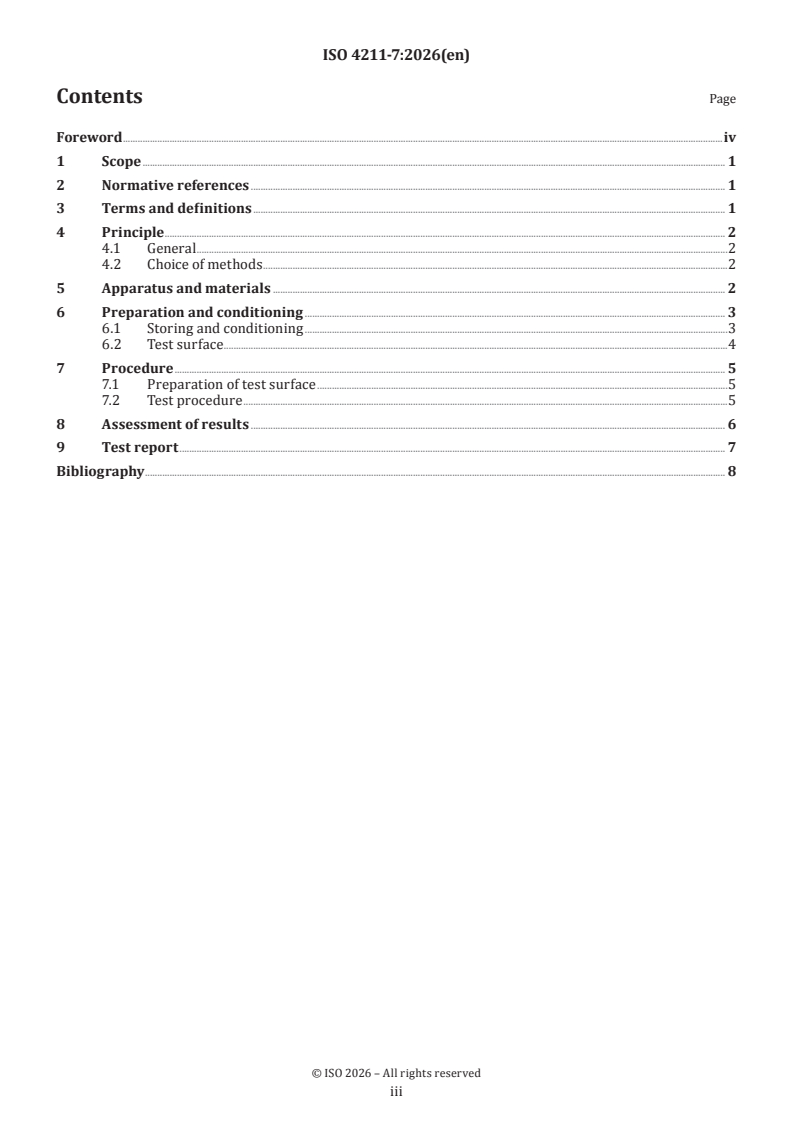
Contents
- 1 Scope
- 2 Normative references
- 3 Terms and definitions
- 3.1 test panel
- 3.2 test surface
- 4 Principle
- 4.1 General
- 4.2 Choice of methods
- 5 Apparatus and materials
- 6 Preparation and conditioning
- 6.1 Storing and conditioning
- 6.2 Test surface
- 7 Procedure
- 7.1 Preparation of test surface
- 7.2 Test procedure
- 8 Assessment of results
- 9 Test report
- Bibliography
1 Scope
This document specifies a method for the assessment of the effects of light in indoor conditions, by exposure to artificial radiation.
This document is applicable to rigid surfaces of all finished products regardless of material. It does not apply to finishes on leather and fabrics.
The test is intended to be carried out on a part of the finished furniture, but can be carried out on test panels of the same material, finished in an identical manner to the finished product, and of a size sufficient to meet the requirements of the test.
This document describes the most important parameters, such as the colour change when a surface is exposed and specifies the conditions to be used in the exposure apparatus. The light resistance of a surface can be assessed by using two apparatus as specified in Clause 4, one as a reference test method, and the other for in-company testing.
2 Normative references
The following documents are referred to in the text in such a way that some or all of their content constitutes requirements of this document. For dated references, only the edition cited applies. For undated references, the latest edition of the referenced document (including any amendments) applies. ISO 105-A02, Textiles — Tests for colour fastness — Part A02: Grey scale for assessing change in colour I S O 105 -B 02: 2014, Textiles — Tests for colour fastness — Part B02: Colour fastness to artificial light: Xenon arc fading lamp test ISO 4892-1, Plastics — Methods of exposure to laboratory light sources — Part 1: General guidance and requirements ISO 4892-2:2013, Plastics — Methods of exposure to laboratory light sources — Part 2: Xenon-arc lamps ISO 4892-2:2013/Amd 1:2021, Plastics — Methods of exposure to laboratory light sources — Part 2: Xenon-arc lamps — Amendment 1: Classification of daylight filters
3 Terms and definitions
For the purposes of this document, the following terms and definitions apply. ISO and IEC maintain terminology databases for use in standardization at the following addresses:
- ISO Online browsing platform: available at https:// www .iso .org/ obp
- IEC Electropedia: available at https:// www .electropedia .org/
ISO 4211-7:2026(en)
3.1 test panel
panel including the test surface (3.2) Note 1 to entry: It can be cut from a finished item of furniture or it can be a separate panel produced in the same manner as the finished item of furniture.
3.2 test surface
part of the test panel including an exposed section as well as the control sections Note 1 to entry: See Figure 1 and Figure 2.
4 Principle
4.1 General
Accelerated exposure to light of furniture surfaces to filtered xenon-arc radiation is carried out in order to assess the change of contrast and colour. The surface is assessed by comparing the exposed section with the masked control section or with the separated control section (see Clause 8) from the same test surface.
4.2 Choice of methods
The apparatus specified in 5.1 shall be used as a reference method in cases where the influence of humidity cannot be excluded.
The apparatus specified in 5.2 can be used for in-company testing in cases where the influence of humidity can be excluded.
5 Apparatus and materials
The following apparatus and materials shall be used.
5.1 Apparatus with humidity control.
A test device as specified in ISO 4892-1, ISO 4892-2:2013 and ISO 4892-2:2013/Amd 1:2021 with xenon lamp using window glass filters according to method B in ISO 4892-2:2013 and ISO 4892-2:2013/Amd 1:2021, and test parameters, as specified in Table 1.
Table 1 — General conditions for the apparatus with humidity control Irradiance Broadband Narrowband Black-standard Chamber Relative (300 nm to 400 nm) (420 nm) temperature temperature humidity 2 2 a W/m W/(m × nm) °C °C % 50 ± 2 1,10 ± 0,02 55 ± 3 38 ± 3 50 ± 10 a A black-standard sensor in accordance with ISO 4892-1 shall be used (with insulation on the backside of the black metal sheet).
5.2 Apparatus without humidity control.
A test device as specified in ISO 4892-1, ISO 4892-2:2013 and ISO 4892-2:2013/Amd 1:2021 with xenon lamp using window glass filters according to method B in ISO 4892-2:2013 and ISO 4892-2:2013/Amd 1:2021, and test parameters as specified in Table 2.
ISO 4211-7:2026(en) Table 2 — General conditions for the apparatus without humidity control Irradiance Broadband Narrowband Wideband Black-standard Chamber Relative (300 nm to (420 nm) (300 nm to temperature temperature humidity 400 nm) 800 nm) 2 2 2 a b W/m W/(m × nm) W/m °C °C % 50 ± 2 1,10 ± 0,02 550 ± 55 55 ± 3 Not controlled Not controlled a A black-standard sensor in accordance with ISO 4892-1 shall be used (with insulation on the backside of the black metal sheet).
b For instruments without chamber air temperature or relative humidity control, these parameters are allowed to find their own level.
...