

ISO 13691:2001
(Main)Petroleum and natural gas industries — High-speed special-purpose gear units
General Information
- Abstract
This International Standard specifies the minimum requirements for enclosed, precision, single and double helical, one- and two-stage speed increasers and reducers of parallel shaft design with pinion speeds of 3000 min−1 or greater, or pitch line velocities of 25 m/s or greater, for special purpose applications. Such applications will typically be required to operate continuously for extended periods, without installed spare equipment and are critical to the continued operation of the installation. By agreement this International Standard may be used for other services. This International Standard also specifies a method of rating gears which meet the following criteria: a) gear accuracy teeth accuracy: accuracy grade 4 or better as given in ISO 1328-1:1995, for both single pitch deviation, fpt, and total cumulative pitch deviation, Fp, total helix deviation Fβ between the helices of the pinion and wheel: accuracy grade 4 or better as given in ISO 1328-1:1995; b) range of the transverse contact ratios: 1,2 c) overlap ratio εβ W 1,0; d) helix angle: 5 u β u 35°; e) working flanks of the pinion or gear: provided with profile modifications to obtain a good conjugate tooth load distribution along the path of contact; f) working flanks of pinion or gear: modified as necessary to compensate for both torsional and bending deflections and, when necessary for gears with pitch line velocities in excess of 100 m/s, also for thermal distortions; g) gear lubrication: straight mineral oil, viscosity grade VG-32 or VG-46 (see ISO 3448); h) material of the gear teeth: quality MQ or better, in accordance with ISO 6336-5:1996.
- Status
- Published
- Publication Date
- 19-Dec-2001
- Technical Committee
- ISO/TC 60/SC 2 - Gear capacity calculation
- Drafting Committee
- ISO/TC 60/SC 2 - Gear capacity calculation
- Current Stage
- 9093 - International Standard confirmed
- Start Date
- 23-Sep-2022
- Completion Date
- 29-Aug-2026
Buy Documents

ISO 13691:2001 - Petroleum and natural gas industries — High-speed special-purpose gear units Released:12/20/2001
ISO 13691:2001 - Industries du pétrole et du gaz naturel — Engrenages a grande vitesse pour applications particulieres Released:12/20/2001
Overview
ISO 13691:2001 - "Petroleum and natural gas industries - High-speed special-purpose gear units" - defines minimum design, construction and rating requirements for enclosed, precision high-speed special-purpose gear units used in critical continuous-service applications. It targets single- and double‑helical, one- and two‑stage, parallel‑shaft speed increasers and reducers with pinion speeds ≥ 3 000 min−1 or pitch line velocities ≥ 25 m/s. The standard is based on API 613 and is intended for the petroleum, petrochemical and natural gas sectors but may be applied elsewhere by agreement.
Key topics and technical requirements
- Scope of equipment: enclosed precision helical gear units (parallel shaft), one- or two-stage, single/double helical.
- Speed/velocity limits: pinion speeds ≥ 3 000 min−1 or pitch line velocity ≥ 25 m/s.
- Gear accuracy: teeth and helix deviations meeting accuracy grade 4 per ISO 1328‑1:1995 (single pitch fpt, total cumulative pitch Fp, total helix deviation Fβ).
- Contact and overlap ratios: transverse contact ratio approximately 1.2–2.0; overlap ratio εβ ≥ 1.0.
- Helix angle: 5° to 35°.
- Tooth modifications: working flanks must have profile modifications to ensure good conjugate load distribution and compensate for torsional, bending and (when pitch line velocity >100 m/s) thermal distortions.
- Lubrication: straight mineral oil, viscosity grade VG‑32 or VG‑46 (ISO 3448).
- Material quality: gear tooth materials of quality MQ or better (ISO 6336‑5:1996).
- Gear rating method: specifies procedures for rating gears that meet the listed accuracy and design criteria.
- Inspection, testing and documentation: covers acceptance testing, inspection practices and vendor data (annexes provide checklists, tooth inspection guidance and vendor drawing requirements).
Applications and users
ISO 13691 is intended for:
- OEMs and designers of high-speed gearboxes for compressors, drivers, turbines and special-purpose rotating equipment.
- Asset owners, operators and procurement teams in petroleum, petrochemical and natural gas installations where gear units are critical to continuous operation.
- Inspection, maintenance and reliability engineers specifying test, balancing and lubrication regimes.
- Vendors and manufacturers preparing proposals, vendor data and quality documentation.
Practical benefits include improved reliability, predictable gear ratings, standardized inspection/testing, and guidance for critical continuous‑service gear applications.
Related standards
Commonly referenced documents include ISO 1328‑1, ISO 6336‑3/5, ISO 3448, ISO 9084, API 613, and ISO 10438 series (lubrication and oil systems). These provide complementary requirements for accuracy, material, lubrication and testing.
Relations
- Effective Date
- 25-Aug-2026
- Effective Date
- 25-Aug-2026
- Effective Date
- 25-Aug-2026
- Effective Date
- 12-Feb-2026
Buy Documents
ISO 13691:2001 - Petroleum and natural gas industries — High-speed special-purpose gear units Released:12/20/2001
ISO 13691:2001 - Industries du pétrole et du gaz naturel — Engrenages a grande vitesse pour applications particulieres Released:12/20/2001
Frequently Asked Questions
ISO 13691:2001 is a standard published by the International Organization for Standardization (ISO). Its full title is "Petroleum and natural gas industries — High-speed special-purpose gear units". This standard covers: This International Standard specifies the minimum requirements for enclosed, precision, single and double helical, one- and two-stage speed increasers and reducers of parallel shaft design with pinion speeds of 3000 min−1 or greater, or pitch line velocities of 25 m/s or greater, for special purpose applications. Such applications will typically be required to operate continuously for extended periods, without installed spare equipment and are critical to the continued operation of the installation. By agreement this International Standard may be used for other services. This International Standard also specifies a method of rating gears which meet the following criteria: a) gear accuracy teeth accuracy: accuracy grade 4 or better as given in ISO 1328-1:1995, for both single pitch deviation, fpt, and total cumulative pitch deviation, Fp, total helix deviation Fβ between the helices of the pinion and wheel: accuracy grade 4 or better as given in ISO 1328-1:1995; b) range of the transverse contact ratios: 1,2 c) overlap ratio εβ W 1,0; d) helix angle: 5 u β u 35°; e) working flanks of the pinion or gear: provided with profile modifications to obtain a good conjugate tooth load distribution along the path of contact; f) working flanks of pinion or gear: modified as necessary to compensate for both torsional and bending deflections and, when necessary for gears with pitch line velocities in excess of 100 m/s, also for thermal distortions; g) gear lubrication: straight mineral oil, viscosity grade VG-32 or VG-46 (see ISO 3448); h) material of the gear teeth: quality MQ or better, in accordance with ISO 6336-5:1996.
This International Standard specifies the minimum requirements for enclosed, precision, single and double helical, one- and two-stage speed increasers and reducers of parallel shaft design with pinion speeds of 3000 min−1 or greater, or pitch line velocities of 25 m/s or greater, for special purpose applications. Such applications will typically be required to operate continuously for extended periods, without installed spare equipment and are critical to the continued operation of the installation. By agreement this International Standard may be used for other services. This International Standard also specifies a method of rating gears which meet the following criteria: a) gear accuracy teeth accuracy: accuracy grade 4 or better as given in ISO 1328-1:1995, for both single pitch deviation, fpt, and total cumulative pitch deviation, Fp, total helix deviation Fβ between the helices of the pinion and wheel: accuracy grade 4 or better as given in ISO 1328-1:1995; b) range of the transverse contact ratios: 1,2 c) overlap ratio εβ W 1,0; d) helix angle: 5 u β u 35°; e) working flanks of the pinion or gear: provided with profile modifications to obtain a good conjugate tooth load distribution along the path of contact; f) working flanks of pinion or gear: modified as necessary to compensate for both torsional and bending deflections and, when necessary for gears with pitch line velocities in excess of 100 m/s, also for thermal distortions; g) gear lubrication: straight mineral oil, viscosity grade VG-32 or VG-46 (see ISO 3448); h) material of the gear teeth: quality MQ or better, in accordance with ISO 6336-5:1996.
ISO 13691:2001 is classified under the following ICS (International Classification for Standards) categories: 21.200 - Gears. The ICS classification helps identify the subject area and facilitates finding related standards.
ISO 13691:2001 has the following relationships with other standards: It is inter standard links to EN ISO 10439:2002, EN ISO 10440-1:2007, EN ISO 10437:2003, EN ISO 13691:2002. Understanding these relationships helps ensure you are using the most current and applicable version of the standard.
ISO 13691:2001 is available in PDF format for immediate download after purchase. The document can be added to your cart and obtained through the secure checkout process. Digital delivery ensures instant access to the complete standard document.
Standards Content (Sample)
2003-01.Slovenski inštitut za standardizacijo. Razmnoževanje celote ali delov tega standarda ni dovoljeno.QDPHQHIndustries du pétrole et du gaz naturel -- Engrenages à grande vitesse pour applications particulièresPetroleum and natural gas industries -- High-speed special-purpose gear units75.180.20Predelovalna opremaProcessing equipment21.200GonilaGearsICS:Ta slovenski standard je istoveten z:ISO 13691:2001SIST ISO 13691:2002en01-december-2002SIST ISO 13691:2002SLOVENSKI
STANDARD
Reference numberISO 13691:2001(E)© ISO 2001
INTERNATIONAL STANDARD ISO13691First edition2001-12-15Petroleum and natural gas industries — High-speed special-purpose gear units Industries du pétrole et du gaz naturel — Engrenages à grande vitesse pour applications particulières
©
ISO 2001 All rights reserved. Unless otherwise specified, no part of this publication may be reproduced or utilized in any form or by any means, electronic or mechanical, including photocopying and microfilm, without permission in writing from either ISO at the address below or ISO's member body in the country of the requester. ISO copyright office Case postale 56 • CH-1211 Geneva 20 Tel.
+ 41 22 749 01 11 Fax
+ 41 22 749 09 47 E-mail
copyright@iso.ch Web
www.iso.ch Printed in Switzerland
ii © ISO 2001 – All rights reserved
Special-purpose gear unit data sheets.42 Annex B (informative)
Lateral critical speed map and mode shapes for typical rotor.47 Annex C (informative)
Couplings for high-speed gear units.49 Annex D (informative)
Vendor requirements regarding drawings and data.54 Annex E (informative)
Gear tooth inspection.60 Annex F (informative)
Inspector´s checklist.61 Annex G (informative)
Relationship of tooth rating factors between ISO 13691, ISO 9084 and API 613.66 Bibliography.70
Foreword ISO (the International Organization for Standardization) is a worldwide federation of national standards bodies (ISO member bodies). The work of preparing International Standards is normally carried out through ISO technical committees. Each member body interested in a subject for which a technical committee has been established has the right to be represented on that committee. International organizations, governmental and non-governmental, in liaison with ISO, also take part in the work. ISO collaborates closely with the International Electrotechnical Commission (IEC) on all matters of electrotechnical standardization. International Standards are drafted in accordance with the rules given in the ISO/IEC Directives, Part 3. The main task of technical committees is to prepare International Standards. Draft International Standards adopted by the technical committees are circulated to the member bodies for voting. Publication as an International Standard requires approval by at least 75 % of the member bodies casting a vote. Attention is drawn to the possibility that some of the elements of this International Standard may be the subject of patent rights. ISO shall not be held responsible for identifying any or all such patent rights. ISO 13691 was prepared by Technical Committee ISO/TC 60, Gears, Subcommittee SC 2, Gear capacity calculation. ISO 13691 is based on API 613 and is intended to give ratings similar to those found when using API 613. Annexes A to G of this International Standard are for information only.
INTERNATIONAL STANDARD ISO 13691:2001(E) © ISO 2001 – All rights reserved 1 Petroleum and natural gas industries — High-speed special-purpose gear units 1 Scope This International Standard specifies the minimum requirements for enclosed, precision, single and double helical, one- and two-stage speed increasers and reducers of parallel shaft design with pinion speeds of 3000 min−1 or greater, or pitch line velocities of 25 m/s or greater, for special purpose applications. Such applications will typically be required to operate continuously for extended periods, without installed spare equipment and are critical to the continued operation of the installation. By agreement this International Standard may be used for other services. This International Standard also specifies a method of rating gears which meet the following criteria: a) gear accuracy =teeth accuracy: accuracy grade 4 or better as given in ISO 1328-1:1995, for both single pitch deviation, fpt, and total cumulative pitch deviation, Fp, =total helix deviation Fβ between the helices of the pinion and wheel: accuracy grade 4 or better as given in ISO 1328-1:1995; b) range of the transverse contact ratios: 1,2 < εα < 2,0; c) overlap ratio
εβ W 1,0; d) helix angle: 5
u β u 35°; e) working flanks of the pinion or gear: provided with profile modifications to obtain a good conjugate tooth load distribution along the path of contact; f) working flanks of pinion or gear: modified as necessary to compensate for both torsional and bending deflections and, when necessary for gears with pitch line velocities in excess of 100 m/s, also for thermal distortions; g) gear lubrication: straight mineral oil, viscosity grade VG-32 or VG-46 (see ISO 3448); h) material of the gear teeth: quality MQ or better, in accordance with ISO 6336-5:1996. 2 Normative references The following normative documents contain provisions which, through reference in this text, constitute provisions of this International Standard. For dated references, subsequent amendments to, or revisions of, any of these publications do not apply. However, parties to agreements based on this International Standard are encouraged to investigate the possibility of applying the most recent editions of the normative documents indicated below. For undated references, the latest edition of the normative document referred to applies. Members of ISO and IEC maintain registers of currently valid International Standards. ISO 7-1, Pipe threads where pressure-tight joints are made on the threads — Part 1: Dimensions, tolerances and designation ISO 261, ISO general-purpose metric screw threads — General plan SIST ISO 13691:2002
ISO 262, ISO general-purpose metric screw threads — Selected sizes for screws, bolts and nuts ISO 724, ISO general-purpose metric screw threads — Basic dimensions ISO 965-1, ISO general-purpose metric screw threads — Tolerances — Part 1: Principles and basic data ISO 965-2, ISO general- purpose metric screw threads — Tolerances — Part 2: Limits of sizes for general purpose external and internal screw threads — Medium quality ISO 965-3, ISO general-purpose metric screw threads — Tolerances — Part 3: Deviations for constructional screw threads ISO 1122-1, Vocabulary of gear terms — Part 1: Definitions related to geometry ISO 1328-1:1995, Cylindrical gears — ISO system of accuracy — Part 1: Definitions and allowable values of deviations relevant to corresponding flanks of gear teeth ISO 1940-1:1986, Mechanical vibration — Balance quality requirements of rigid rotors — Part 1: Determination of permissible residual unbalance ISO 2953, Mechanical vibration — Balancing machines — Description and evaluation ISO 3448:1992, Industrial liquid lubricants — ISO viscosity classification ISO 6336-3, Calculation of load capacity of spur and helical gears — Part 3: Calculation of tooth bending strength ISO 6336-5, Calculation of load capacity of spur and helical gears — Part 5: Strength and quality of materials ISO 6743-6, Lubricants, industrial oils and related products (class L) — Classification — Part 6: Family C (Gears) ISO 7005-1, Metallic flanges — Part 1: Steel flanges ISO 7005-2, Metallic flanges — Part 2: Cast iron flanges ISO 8501-1:1988, Preparation of steel substrates before application of paints and related products — Visual assessment of surface cleanliness — Part 1: Rust grades and preparation grades of uncoated steel substrates and of steel substrates after overall removal of previous coatings ISO 8579-1, Acceptance code for gear units — Part 1: Test code for airborne sound
ISO 8821, Mechanical vibration — Balancing — Shaft and fitment key convention ISO 9084:2000, Calculation of load capacity of spur and helical gears — Application to high speed gears and gears of similar requirement ISO/TR 10064-4, Cylindrical gears — Code of inspection practice — Part 4: Recommendations relative to surface texture and tooth contact pattern checking ISO 10438-1, Petroleum and natural gas industries — Lubrication, shaft-sealing and control-oil systems and auxiliaries — Part 1: General requirements
ISO 10438-2, Petroleum and natural gas industries — Lubrication, shaft-sealing and control-oil systems and auxiliaries — Part 2: Special-purpose oil systems
ISO 10438-3, Petroleum and natural gas industries — Lubrication, shaft-sealing and control-oil systems and auxiliaries — Part 3: General-purpose oil systems ISO 10441, Petroleum and natural gas industries — Flexible couplings for mechanical power transmission — Special purpose applications SIST ISO 13691:2002
API 670, Vibration, axial position and bearing-temperature monitoring systems
ASME B16.11, Forged fittings, Socket-Welding and Threaded ASME, Boiler and pressure vessel code — Section V ASME, Boiler and pressure vessel code — Section VIII, Division 1 ASME Y 14.2 M, Line conventions and lettering ASTM A956, Standard test method for Leeb hardness testing of steel products
ASTM E94, Standard guide for radiographic examination ASTM E125, Standard reference photographs for magnetic particle indications on ferrous castings ASTM E709, Standard guide for magnetic particle examination 3 Terms and definitions For the purposes of this International Standard, the terms and definitions given in ISO 1122-1 and the following apply. NOTE The use of the word design in any term (such as design power, design pressure, design temperature, or design speed) should be avoided in the purchaser’s specifications. This terminology should be used only by the equipment designer and the manufacturer. 3.1 axially [horizontally] split casing joint casing joint parallel to the shaft centreline 3.2 critical speed
shaft rotational speed at which the rotor-bearing-support system is in a state of resonance with any exciting frequency associated with that speed 3.3 wheel lower speed gear element in mesh 3.4 pinion higher speed gear element in mesh 3.5 gear rated power maximum power specified by the purchaser on the data sheet and stamped on the nameplate cf. 5.2.1. SIST ISO 13691:2002
3.6 normal transmitted power power at which usual operation is expected and optimum efficiency is desired NOTE The normal transmitted power may be equal to or less than the gear rated power. 3.7 mechanical rating gear rated power (3.5) multiplied by the specified gear selection factor (3.17). 3.8 hunting tooth combination ·mating gearsÒ combination existing when a tooth on the pinion does not repeat contact with a tooth on the gear until it has contacted all the other gear teeth 3.9 maximum allowable speed highest rotational speed at which the manufacturer’s design will permit continuous operation 3.10 maximum continuous speed ·variable-speed unitÒ rotational speed at least equal to 105 % of the rated speed
3.11 maximum continuous speed ·constant-speed unitÒ rotational speed equal to the rated speed 3.12 minimum allowable speed lowest rotational speed at which the manufacturer’s design will permit continuous operation 3.13 rated input speed specified (or nominal) rated speed of the driver, as designated by the purchaser 3.14 rated output speed specified (or nominal) rated speed of the driven equipment, as designated by the purchaser. NOTE In selecting the number of teeth for the pinion and gear, it is often impracticable for the vendor to match exactly both the rated input and the rated output speeds designated on the data sheets. The purchaser therefore indicates which of the two is specified (that is, must be exactly adhered to by the vendor) and which is nominal (that is, permits some variation). The letter S is used to indicate the specified speed, and the letter N to indicate the nominal speed. The purchaser also indicates on the data sheets the allowable percentage of variation in the designed gear ratio. 3.15 contact stress number
σH contact stress calculated based on the Hertzian contact pressure 3.16 bending stress number σF bending stress calculated from the resistance to fatigue cracking at the tooth root fillet SIST ISO 13691:2002
NOTE 2 For steam turbines and reciprocating engines, the trip speed is at least 110 % of the maximum continuous speed. For gas turbines, the trip speed is at least 105 % of the maximum continuous speed. 3.19 special-purpose application application for which the equipment is designed for uninterrupted, continuous operation in critical service and for which there is usually no spare equipment 3.20 total indicated runout
total indicator reading TIR runout of a diameter or face determined by measurement with a dial indicator NOTE The indicator reading implies an out-of-squareness equal to the reading or an eccentricity equal to half the reading. 3.21 Gauss level magnetic field level of a component measured with a “Hall effect” probe with no interference from adjacent magnetic parts or structures 3.22 unit responsibility responsibility for coordinating the technical aspects of the equipment and all auxiliary systems included in the scope of the order NOTE Responsibility for such factors as the power requirements, speed, rotation, general arrangement, couplings, dynamics, noise, lubrication, sealing system, material test reports, instrumentation, piping, and testing of components is included. 3.23 purchaser individual or organization that issues the order and specification to the vendor NOTE The purchaser may be the owner of the plant in which the equipment is to be installed, or the owner´s agent (often the vendor of the equipment to be driven by the gear). 3.24 vendor organization that supplies the equipment NOTE The vendor may be the manufacturer of the equipment or the manufacturer´s agent and is normally responsible for service support. SIST ISO 13691:2002
4 Symbols and abbreviated terms See Table 1. Table 1 Symbol Meaning or term Unit a centre distance mm b facewidth mm bB facewidth of one helix on a double helical gear mm B total facewidth of a double helical gear including the gap width mm d1,2 reference diameter of pinion, wheel mm D1,2 shaft diameter at coupling of pinion, wheel mm fpt single pitch deviation µm Fp total cumulative pitch deviation µm Ft (nominal) transverse tangential force at reference cylinder N FR external force (coupling) N Fβ total helix deviation µm HBW Brinell hardness — HRC Rockwell hardness number (C scale) — Kv dynamic factor — KFβ face load factor (root stress) — KHβ face load factor (contact stress) — KSL selection factor — mn normal module mm n1,2 rotational speed of pinion, of wheel, nominal min−1 P gear rated power kW Ra arithmetic average roughness value µm u gear ratio z2/z1 W 1 — v pitch line velocity at reference cylinder m/s ΥF form factor — YS stress correction factor — Yβ helix angle factor (root stress) — z1, z2 number of teeth of pinion, of wheel — ZE elasticity factor N/mm² ZH zone factor — Zβ helix angle factor (contact stress) — Zε contact ratio factor (contact stress) — αn normal pressure angle ° αt transverse pressure angle ° αwt pressure angle at the pitch cylinder ° β helix angle at the reference cylinder ° βb base helix angle ° SIST ISO 13691:2002
It is recognized that under certain conditions a running-in period may be requested. If a running-in period is required, the vendor shall specify in the proposal the required load, speed and duration of the period. The vendor shall also specify in the proposal any additional field inspection and commissioning required during the break-in period. z 5.1.12 The gearing shall be designed to withstand all internal and external loads inherent to geared, rotating machinery systems. The gearing shall be capable of withstanding the specified external loads (thrust, lube-oil piping, and so forth) while the unit is operating at the gear rated power specified by the purchaser. 5.1.13 All equipment shall be designed to permit rapid and economical maintenance. Major parts such as casing components and bearing housings shall be designed (shouldered or cylindrical dowelled) and manufactured to ensure accurate alignment on reassembly. Where practical, components should be dowelled, keyed or shouldered asymmetrically to prevent incorrect assembly. 5.1.14 Spare parts for the machine and all furnished auxiliaries shall meet all the criteria of this International Standard. z 5.1.15 The purchaser shall specify the appropriate shaft assembly designation selected from the combinations listed in Table 2 and illustrated in Figure 1. The purchaser may alternatively circle one or more of the assembly designations on a copy of Figure 1 and submit the copy with the quotation request. If the shaft arrangement has not been finalized at the time of the quotation request, the purchaser shall designate all of the combinations under consideration. Table 2 — Shaft assembly combinations High-speed shaft Low-speed shaft L R R L L L R R R LR L LR LR L LR R LR LR NOTE
L = left; R = right. The letters refer to the number and direction of shaft extensions (see Figure 1).
5.1.16 The rotational direction of high-speed and low-speed shafts is either clockwise (CW) or counterclockwise (CCW) as viewed from the coupling ends of the respective shaft. 5.1.16.1 On the data sheets and in drawings and tables, the shaft rotational direction shall be designated by the abbreviations CW or CCW, as indicated by the circular arrows in Figure 2.
z 5.1.16.2 The purchaser shall specify the rotational direction of both the high-speed and the low-speed shafts. When either or both shafts have an extension at each end, the purchaser may alternatively indicate the rotational directions on the appropriate assembly designation (see Figure 1) and submit a copy of the figure with the quotation request. z 5.1.16.3 In finalizing the data for purchase, the purchaser shall prepare a sketch that shows the direction of rotation of each item in the train. SIST ISO 13691:2002
Key 1 Low-speed shaft 2 High-speed shaft NOTE 1 L = left; R = right NOTE 2 Arrows indicate the line of sight used to determine the direction of the shaft extensions. (The figure depicts plan views.) NOTE 3 The letter(s) before the hyphen refer to the number and direction of high-speed shaft extensions; the letter(s) after the hyphen refer to the number and direction of low speed shaft extensions. NOTE 4 The material for this figure was extracted from AGMA 6010-F97 with permission of the publisher. Figure 1 — Shaft assembly designations (for parallel-shaft, single- and double-helical one- and two-stage speed increasers and reducers) CW CCW
Figure 2 — Shaft rotation designations SIST ISO 13691:2002
5.2 Gear rating 5.2.1 General The rating method to be used for gears which are not within the limits in clause 1 a) to h) shall be subject to agreement between purchaser and vendor. It is recognized that special cases will exist in which it may be desirable or even mandatory to deviate from the rating rules specified in 5.2.1 through 5.2.9. The vendor shall describe and justify such deviations in the proposal. 5.2.2 Gear rated power, P z The required gear rated power P shall be specified by the purchaser. All modes of normal and abnormal operation should be considered. Modes of operation should include the number of starts per unit of time, reduced load, reversed load (if possible), reduced speed, overload and overspeed conditions. For electric motor drives, the gear rated power will be the motor manufacturer's name plate rating multiplied by the motor service factor. For gear units located next to a single-ended driver, the required gear rated power should be the maximum installed power capability of the driver. For gear units located between two items of driven equipment, or where the drive is taken from both ends of the driver, the required rated power of the gear should be not less than item a) or b) below, whichever is greater: a) 110 % of the maximum power required by the equipment driven by the gear; b) the maximum power of the driver pro-rated between the driven equipment, based on normal power demands. If the maximum transmitted torque occurs at an operating speed other than the maximum continuous speed, this torque and its corresponding speed should be specified by the purchaser and should be the basis for sizing the gear. 5.2.3 Rating criteria For each gear mesh of the unit, the stress numbers shall be calculated with regard to =surface durability (pitting), =tooth-bending strength. The calculated stress numbers shall not exceed the allowable design stress numbers as shown in Table 3. In addition, scuffing resistance should be considered.
The rating factors used assume that the working flanks of pinion and gear have been modified as necessary to compensate for both torsional and bending deflections and, when necessary for gears with pitch line velocities in excess of 100 m/s, also for thermal distortions. SIST ISO 13691:2002
The relation between calculated bending stress number σF and the allowable design bending stress number σFAD is: sF u sFAD (4) (see Table 3). 5.2.6 Allowable design stress numbers σHAD, σFAD 5.2.6.1 General Table 3 presents allowable design contact stress numbers σHAD (for surface durability) and allowable design bending stress numbers σFAD (for bending strength) and also maximum length-to-diameter (L/d) ratios of pinion for several materials in current use (see 7.2.2.6.3). The L/d values shown in Table 3 apply to helical gears when designed to transmit the rated power. When a L/d ratio higher than tabulated in Table 3 is proposed, the gear vendor shall submit justification in the proposal for using a higher L/d ratio. Purchaser’s approval is required when L/d ratios exceed those in Table 3. When operating conditions other than the gear rated power are specified by the purchaser, such as the normal transmitted power, the gear vendor shall consider in the analysis the length of time and load range at which the gear unit will operate at each condition, so that the correct helix modification can be determined. When modified helices are to be furnished, purchaser and vendor shall agree on the tooth contact patterns obtained in the checking stand, housing or test stand.
For through-hardened steel, the following formulae may be used to determine the allowable design stress numbers for hardness values intermediate between the tabulated values: HAD2530,9HBWσ=+ (5) FAD1490,33HBWσ=+ (6) 5.2.6.2 Hardness combinations Some common hardness combinations of the pinion and gear are given in Table 4. These values are listed for reference and are not intended to indicate the only combinations of hardness that are satisfactory. Table 4 — Some commonly used hardness combinations for the pinion and gear Minimum gear hardness Minimum pinion hardness 302 HBW 341 HBW 321 HBW 341 HBW 341 HBW 363 HBW 363 HBW 58 HRC a 58 HRC a 58 HRC a 58 HRC b 58 HRC a 58 HRC b 58 HRC b a Carburized and case-hardened steels. b Gas-nitrided steels. SIST ISO 13691:2002
Table 5 — Selection factors, KSL Driver type Synchronous motors and variable frequency motors Induction motors Gas or steam turbines Internal combustion engines
(multi-cylinder) Driven equipment Selection factors KSL Centrifugal blowers 1,6 1,4 1,6 1,7 Compressors
Centrifugal 1,6 1,4 1,6 1,7 Axial 1,6 1,4 1,6 1,7 Rotary lobe (radial, axial, screw, etc.) 1,8 1,7 1,7 2,0 Reciprocating 2,1 2,0 2,0 2,3 Contactors
1,8 1,7 1,7 2,0 Extruders 1,8 1,7 1,7 — Fans
Centrifugal 1,5 1,4 1,6 1,7 Forced draft 1,5 1,4 1,6 1,7 Induced draft 1,8 1,7 2,0 2,2 Generators and exciters
Base load and continuous 1,1 1,1 1,1 1,3 Peak-duty cycle 1,3 1,3 1,3 1,7 Pumps
Centrifugal (all services, except as listed below) 1,5 1,3 1,5 1,7 Centrifugal, boiler feed 1,8 1,7 2,0 — Centrifugal, hot oil 1,8 1,7 2,0 — Centrifugal, high speed
(over 3 600 r/min) — 1,7 2,0 — Centrifugal, water supply 1,6 1,5 1,7 2,0 Rotary, axial flow (all types) 1,6 1,5 1,5 1,8 Rotary gear 1,6 1,5 1,5 1,8 Reciprocating 2,1 2,0 2,0 2,3 5.2.9 Tooth bending strength factors 5.2.9.1 Form factor, YF The form factor is the factor by means of which the influence of tooth form on nominal bending stress is taken into account. It is based on the application of load at the outer limit of single-pair tooth contact. The form factor YF shall be determined in accordance with ISO 9084, which is method B from ISO 6336-3:1996, and shall be determined separately for pinion and wheel. SIST ISO 13691:2002
The stress correction factor, YS, shall be determined in accordance with ISO 9084 and shall be determined separately for pinion and wheel. 5.2.9.3 Helix angle factor, Yβ The helix angle factor converts the tooth root stress of the virtual spur gear to that of the corresponding helical gear. 1120Ybb=-∞ (9) 5.3 Gear elements 5.3.1 General 5.3.1.1 All gear teeth shall be finish-cut or finish-ground on the assembled gear and shaft. One or more of the following processes shall be used in finishing the gear teeth: a) grinding; b) shaving; c) honing; d) precision hobbing. All gear teeth finished by shaving or honing shall have been generated by hobbing. Shaving cutters and rotary hones shall have a hunting tooth combination with the workpiece. The accuracy of the gear teeth and the modifications on profile and helix shall be consistent with the method of rating the gear [see clause 1 a)]. This shall be demonstrated on purchaser request. 5.3.1.2 The unplated tooth surface on loaded faces of completed gears shall have a finish of Ra 0,8 µm or smoother, measured at the pitch line in accordance with ISO/TR 10064-4. 5.3.1.3 Teeth may be silver- or copper-plated to provide added protection from scuffing during initial operation. The desirability of such plating shall be mutually determined by the purchaser and the vendor. 5.3.1.4 The design of single-helical gear units shall be such that the effects of the moments on the gear elements, resulting from axial tooth reaction at the gear mesh, do not impair the expected performance of the gear unit. 5.3.1.5 Hunting tooth combinations are required. To achieve this requirement, it may be necessary to adjust the exact gear ratio. If such adjustment is not acceptable, the purchaser and the vendor shall agree a solution. 5.3.1.6 Each gear and each pinion shall be supported on two bearings. Overhung designs are not acceptable. 5.3.2 Quality assurance z 5.3.2.1 With each gear or pinion mounted on the hobbing, shaving or grinding machine, prior to the final finishing operation, the journal runouts of each principal rotating element shall be charted using a surface-contact-type electronic indicator or a purchaser-approved equivalent. For gears
...
INTERNATIONAL ISO
STANDARD 13691
First edition
2001-12-15
Petroleum and natural gas industries —
High-speed special-purpose gear units
Industries du pétrole et du gaz naturel — Engrenages à grande vitesse
pour applications particulières
Reference number
©
ISO 2001
PDF disclaimer
This PDF file may contain embedded typefaces. In accordance with Adobe's licensing policy, this file may be printed or viewed but shall not
be edited unless the typefaces which are embedded are licensed to and installed on the computer performing the editing. In downloading this
file, parties accept therein the responsibility of not infringing Adobe's licensing policy. The ISO Central Secretariat accepts no liability in this
area.
Adobe is a trademark of Adobe Systems Incorporated.
Details of the software products used to create this PDF file can be found in the General Info relative to the file; the PDF-creation parameters
were optimized for printing. Every care has been taken to ensure that the file is suitable for use by ISO member bodies. In the unlikely event
that a problem relating to it is found, please inform the Central Secretariat at the address given below.
© ISO 2001
All rights reserved. Unless otherwise specified, no part of this publication may be reproduced or utilized in any form or by any means, electronic
or mechanical, including photocopying and microfilm, without permission in writing from either ISO at the address below or ISO's member body
in the country of the requester.
ISO copyright office
Case postale 56 • CH-1211 Geneva 20
Tel. + 41 22 749 01 11
Fax + 41 22 749 09 47
E-mail copyright@iso.ch
Web www.iso.ch
Printed in Switzerland
ii © ISO 2001 – All rights reserved
Contents Page
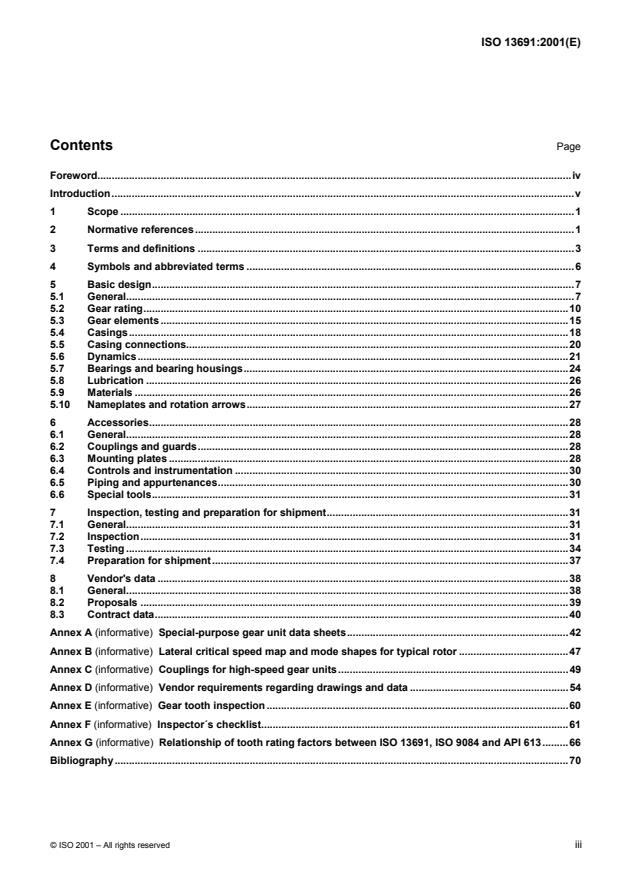
Foreword.iv
Introduction.v
1 Scope.1
2 Normative references.1
3 Terms and definitions .3
4 Symbols and abbreviated terms .6
5 Basic design.7
5.1 General.7
5.2 Gear rating.10
5.3 Gear elements.15
5.4 Casings.18
5.5 Casing connections.20
5.6 Dynamics.21
5.7 Bearings and bearing housings.24
5.8 Lubrication.26
5.9 Materials.26
5.10 Nameplates and rotation arrows.27
6 Accessories.28
6.1 General.28
6.2 Couplings and guards.28
6.3 Mounting plates.28
6.4 Controls and instrumentation .30
6.5 Piping and appurtenances.30
6.6 Special tools.31
7 Inspection, testing and preparation for shipment.31
7.1 General.31
7.2 Inspection.31
7.3 Testing.34
7.4 Preparation for shipment.37
8 Vendor's data.38
8.1 General.38
8.2 Proposals.39
8.3 Contract data.40
Annex A (informative) Special-purpose gear unit data sheets.42
Annex B (informative) Lateral critical speed map and mode shapes for typical rotor .47
Annex C (informative) Couplings for high-speed gear units.49
Annex D (informative) Vendor requirements regarding drawings and data .54
Annex E (informative) Gear tooth inspection.60
Annex F (informative) Inspector´s checklist.61
Annex G (informative) Relationship of tooth rating factors between ISO 13691, ISO 9084 and API 613.66
Bibliography.70
Foreword
ISO (the International Organization for Standardization) is a worldwide federation of national standards bodies (ISO
member bodies). The work of preparing International Standards is normally carried out through ISO technical
committees. Each member body interested in a subject for which a technical committee has been established has
the right to be represented on that committee. International organizations, governmental and non-governmental, in
liaison with ISO, also take part in the work. ISO collaborates closely with the International Electrotechnical
Commission (IEC) on all matters of electrotechnical standardization.
International Standards are drafted in accordance with the rules given in the ISO/IEC Directives, Part 3.
The main task of technical committees is to prepare International Standards. Draft International Standards adopted
by the technical committees are circulated to the member bodies for voting. Publication as an International
Standard requires approval by at least 75 % of the member bodies casting a vote.
Attention is drawn to the possibility that some of the elements of this International Standard may be the subject of
patent rights. ISO shall not be held responsible for identifying any or all such patent rights.
ISO 13691 was prepared by Technical Committee ISO/TC 60, Gears, Subcommittee SC 2, Gear capacity
calculation.
ISO 13691 is based on API 613 and is intended to give ratings similar to those found when using API 613.
Annexes A to G of this International Standard are for information only.
iv © ISO 2001 – All rights reserved
Introduction
This International Standard is based on the accumulated knowledge and experience of manufacturers and users of
gear units. It has been developed to satisfy the requirements of the petroleum, petrochemical and natural gas
industries, but its use is not restricted to these industries.
The purpose of this International Standard is to establish minimum requirements for design and construction so
that the equipment is suitable for the purpose for which it is required.
Energy conservation and protection of the environment are matters of concern and are important in all aspects of
equipment design, application and operation. The manufacturers and users of equipment should aggressively
pursue alternative, innovative approaches which improve energy utilization and/or minimize the environmental
impact, without sacrificing safety or reliability. Such approaches should be thoroughly investigated and purchase
options should increasingly be based on the estimation of whole-life costs and the environmental consequences
rather than acquisition costs alone.
This International Standard requires the purchaser to specify certain details and features.
Users of this International Standard should be aware that further or differing requirements may be needed for
individual applications. This international Standard is not intended to inhibit a vendor from offering, or the purchaser
from accepting, alternative equipment or engineering solutions for the individual application. This may be
particularly appropriate where there is innovative or developing technology. Where an alternative is offered, the
vendor should identify any variations from this International Standard and provide details.
A bullet (z) at the beginning of a paragraph indicates that either a decision is required or further information is to be
provided by the purchaser. This information should be indicated on the data sheets; otherwise it should be stated in
the quotation request or in the order.
INTERNATIONAL STANDARD ISO 13691:2001(E)
Petroleum and natural gas industries — High-speed special-
purpose gear units
1 Scope
This International Standard specifies the minimum requirements for enclosed, precision, single and double helical,
−1
one- and two-stage speed increasers and reducers of parallel shaft design with pinion speeds of 3000 min or
greater, or pitch line velocities of 25 m/s or greater, for special purpose applications. Such applications will typically
be required to operate continuously for extended periods, without installed spare equipment and are critical to the
continued operation of the installation. By agreement this International Standard may be used for other services.
This International Standard also specifies a method of rating gears which meet the following criteria:
a) gear accuracy
teeth accuracy: accuracy grade 4 or better as given in ISO 1328-1:1995, for both single pitch deviation, f ,
pt
and total cumulative pitch deviation, F ,
p
total helix deviation F between the helices of the pinion and wheel: accuracy grade 4 or better as given in
β
ISO 1328-1:1995;
b) range of the transverse contact ratios: 1,2 < ε < 2,0;
α
c) overlap ratio ε W 1,0;
β
d) helix angle: 5 u β u 35°;
e) working flanks of the pinion or gear: provided with profile modifications to obtain a good conjugate tooth load
distribution along the path of contact;
f) working flanks of pinion or gear: modified as necessary to compensate for both torsional and bending
deflections and, when necessary for gears with pitch line velocities in excess of 100 m/s, also for thermal
distortions;
g) gear lubrication: straight mineral oil, viscosity grade VG-32 or VG-46 (see ISO 3448);
h) material of the gear teeth: quality MQ or better, in accordance with ISO 6336-5:1996.
2 Normative references
The following normative documents contain provisions which, through reference in this text, constitute provisions of
this International Standard. For dated references, subsequent amendments to, or revisions of, any of these
publications do not apply. However, parties to agreements based on this International Standard are encouraged to
investigate the possibility of applying the most recent editions of the normative documents indicated below. For
undated references, the latest edition of the normative document referred to applies. Members of ISO and IEC
maintain registers of currently valid International Standards.
ISO 7-1, Pipe threads where pressure-tight joints are made on the threads — Part 1: Dimensions, tolerances and
designation
ISO 261, ISO general-purpose metric screw threads — General plan
ISO 262, ISO general-purpose metric screw threads — Selected sizes for screws, bolts and nuts
ISO 724, ISO general-purpose metric screw threads — Basic dimensions
ISO 965-1, ISO general-purpose metric screw threads — Tolerances — Part 1: Principles and basic data
ISO 965-2, ISO general- purpose metric screw threads — Tolerances — Part 2: Limits of sizes for general purpose
external and internal screw threads — Medium quality
ISO 965-3, ISO general-purpose metric screw threads — Tolerances — Part 3: Deviations for constructional screw
threads
ISO 1122-1, Vocabulary of gear terms — Part 1: Definitions related to geometry
ISO 1328-1:1995, Cylindrical gears — ISO system of accuracy — Part 1: Definitions and allowable values of
deviations relevant to corresponding flanks of gear teeth
ISO 1940-1:1986, Mechanical vibration — Balance quality requirements of rigid rotors — Part 1: Determination of
permissible residual unbalance
ISO 2953, Mechanical vibration — Balancing machines — Description and evaluation
ISO 3448:1992, Industrial liquid lubricants — ISO viscosity classification
ISO 6336-3, Calculation of load capacity of spur and helical gears — Part 3: Calculation of tooth bending strength
ISO 6336-5, Calculation of load capacity of spur and helical gears — Part 5: Strength and quality of materials
ISO 6743-6, Lubricants, industrial oils and related products (class L) — Classification — Part 6: Family C (Gears)
ISO 7005-1, Metallic flanges — Part 1: Steel flanges
ISO 7005-2, Metallic flanges — Part 2: Cast iron flanges
ISO 8501-1:1988, Preparation of steel substrates before application of paints and related products — Visual
assessment of surface cleanliness — Part 1: Rust grades and preparation grades of uncoated steel substrates and
of steel substrates after overall removal of previous coatings
ISO 8579-1, Acceptance code for gear units — Part 1: Test code for airborne sound
ISO 8821, Mechanical vibration — Balancing — Shaft and fitment key convention
ISO 9084:2000, Calculation of load capacity of spur and helical gears — Application to high speed gears and gears
of similar requirement
ISO/TR 10064-4, Cylindrical gears — Code of inspection practice — Part 4: Recommendations relative to surface
texture and tooth contact pattern checking
ISO 10438-1, Petroleum and natural gas industries — Lubrication, shaft-sealing and control-oil systems and
auxiliaries — Part 1: General requirements
ISO 10438-2, Petroleum and natural gas industries — Lubrication, shaft-sealing and control-oil systems and
auxiliaries — Part 2: Special-purpose oil systems
ISO 10438-3, Petroleum and natural gas industries — Lubrication, shaft-sealing and control-oil systems and
auxiliaries — Part 3: General-purpose oil systems
ISO 10441, Petroleum and natural gas industries — Flexible couplings for mechanical power transmission —
Special purpose applications
2 © ISO 2001 – All rights reserved
ISO/TR 13593, Enclosed gear drives for industrial applications
ISO/TR 13989-1, Calculation of scuffing load capacity of cylindrical, bevel and hypoid gears — Part 1: Flash
temperature method
ISO/TR 13989-2, Calculation of scuffing load capacity of cylindrical, bevel and hypoid gears — Part 2: Integral
temperature method
IEC 60079-0, Electrical apparatus for explosive gas atmospheres — Part 0: General requirements
API 670, Vibration, axial position and bearing-temperature monitoring systems
ASME B16.11, Forged fittings, Socket-Welding and Threaded
ASME, Boiler and pressure vessel code — Section V
ASME, Boiler and pressure vessel code — Section VIII, Division 1
ASME Y 14.2 M, Line conventions and lettering
ASTM A956, Standard test method for Leeb hardness testing of steel products
ASTM E94, Standard guide for radiographic examination
ASTM E125, Standard reference photographs for magnetic particle indications on ferrous castings
ASTM E709, Standard guide for magnetic particle examination
3 Terms and definitions
For the purposes of this International Standard, the terms and definitions given in ISO 1122-1 and the following
apply.
NOTE The use of the word design in any term (such as design power, design pressure, design temperature, or design
speed) should be avoided in the purchaser’s specifications. This terminology should be used only by the equipment designer
and the manufacturer.
3.1
axially [horizontally] split casing joint
casing joint parallel to the shaft centreline
3.2
critical speed
shaft rotational speed at which the rotor-bearing-support system is in a state of resonance with any exciting
frequency associated with that speed
3.3
wheel
lower speed gear element in mesh
3.4
pinion
higher speed gear element in mesh
3.5
gear rated power
maximum power specified by the purchaser on the data sheet and stamped on the nameplate
cf. 5.2.1.
3.6
normal transmitted power
power at which usual operation is expected and optimum efficiency is desired
NOTE The normal transmitted power may be equal to or less than the gear rated power.
3.7
mechanical rating
gear rated power (3.5) multiplied by the specified gear selection factor (3.17).
3.8
hunting tooth combination
·mating gearsÒ combination existing when a tooth on the pinion does not repeat contact with a tooth on the gear
until it has contacted all the other gear teeth
3.9
maximum allowable speed
highest rotational speed at which the manufacturer’s design will permit continuous operation
3.10
maximum continuous speed
·variable-speed unitÒ rotational speed at least equal to 105 % of the rated speed
3.11
maximum continuous speed
·constant-speed unitÒ rotational speed equal to the rated speed
3.12
minimum allowable speed
lowest rotational speed at which the manufacturer’s design will permit continuous operation
3.13
rated input speed
specified (or nominal) rated speed of the driver, as designated by the purchaser
3.14
rated output speed
specified (or nominal) rated speed of the driven equipment, as designated by the purchaser.
NOTE In selecting the number of teeth for the pinion and gear, it is often impracticable for the vendor to match exactly both
the rated input and the rated output speeds designated on the data sheets. The purchaser therefore indicates which of the two
is specified (that is, must be exactly adhered to by the vendor) and which is nominal (that is, permits some variation). The letter
S is used to indicate the specified speed, and the letter N to indicate the nominal speed. The purchaser also indicates on the
data sheets the allowable percentage of variation in the designed gear ratio.
3.15
contact stress number
σ
H
contact stress calculated based on the Hertzian contact pressure
3.16
bending stress number
σ
F
bending stress calculated from the resistance to fatigue cracking at the tooth root fillet
4 © ISO 2001 – All rights reserved
3.17
gear selection factor
K
SL
factor applied to the calculated contact stress number and the calculated bending stress number, depending on the
characteristics of the driver and the driven equipment, to account for potential overload, shock load and/or
continuous oscillatory torque characteristics
3.18
trip speed
rotational speed at which the independent emergency overspeed device operates to shut down a prime mover
NOTE 1 For fixed-frequency alternating current motor drives, the trip speed is taken to be the speed corresponding to the
synchronous speed of the motor at the highest supply frequency.
NOTE 2 For steam turbines and reciprocating engines, the trip speed is at least 110 % of the maximum continuous speed.
For gas turbines, the trip speed is at least 105 % of the maximum continuous speed.
3.19
special-purpose application
application for which the equipment is designed for uninterrupted, continuous operation in critical service and for
which there is usually no spare equipment
3.20
total indicated runout
total indicator reading
TIR
runout of a diameter or face determined by measurement with a dial indicator
NOTE The indicator reading implies an out-of-squareness equal to the reading or an eccentricity equal to half the reading.
3.21
Gauss level
magnetic field level of a component measured with a “Hall effect” probe with no interference from adjacent
magnetic parts or structures
3.22
unit responsibility
responsibility for coordinating the technical aspects of the equipment and all auxiliary systems included in the
scope of the order
NOTE Responsibility for such factors as the power requirements, speed, rotation, general arrangement, couplings,
dynamics, noise, lubrication, sealing system, material test reports, instrumentation, piping, and testing of components is
included.
3.23
purchaser
individual or organization that issues the order and specification to the vendor
NOTE The purchaser may be the owner of the plant in which the equipment is to be installed, or the owner´s agent (often
the vendor of the equipment to be driven by the gear).
3.24
vendor
organization that supplies the equipment
NOTE The vendor may be the manufacturer of the equipment or the manufacturer´s agent and is normally responsible for
service support.
4 Symbols and abbreviated terms
See Table 1.
Table 1
Symbol Meaning or term Unit
a centre distance mm
b facewidth mm
b facewidth of one helix on a double helical gear mm
B
B total facewidth of a double helical gear including the gap width mm
d reference diameter of pinion, wheel mm
1,2
D shaft diameter at coupling of pinion, wheel mm
1,2
f single pitch deviation µm
pt
F total cumulative pitch deviation µm
p
F (nominal) transverse tangential force at reference cylinder N
t
F external force (coupling) N
R
F total helix deviation µm
β
HBW Brinell hardness —
HRC Rockwell hardness number (C scale) —
K dynamic factor —
v
K face load factor (root stress) —
F
β
K face load factor (contact stress) —
H
β
K selection factor —
SL
m normal module mm
n
−1
n rotational speed of pinion, of wheel, nominal min
1,2
P gear rated power kW
Ra arithmetic average roughness value µm
u gear ratio z /z W 1 —
2 1
v pitch line velocity at reference cylinder m/s
Υ form factor —
F
Y stress correction factor —
S
Y helix angle factor (root stress) —
β
z , z number of teeth of pinion, of wheel —
1 2
Z elasticity factor N/mm²
E
Z zone factor —
H
Z helix angle factor (contact stress) —
β
Z contact ratio factor (contact stress) —
ε
α normal pressure angle °
n
α transverse pressure angle °
t
α pressure angle at the pitch cylinder °
wt
β helix angle at the reference cylinder °
β base helix angle °
b
6 © ISO 2001 – All rights reserved
Table 1 (continued)
Symbol Meaning or term Unit
ε transverse contact ratio —
α
ε overlap ratio —
β
σ calculated bending stress number N/mm
F
σ allowable design bending stress number N/mm
FAD
σ calculated contact stress number N/mm
H
σ allowable design contact stress number N/mm
HAD
5 Basic design
5.1 General
5.1.1 The equipment (including auxiliaries) covered by this International Standard shall be designed and
constructed for a minimum service life of 20 years and at least three years of uninterrupted operation. It is
recognized that this is a design criterion.
5.1.2 The vendor shall assume responsibility for the engineering coordination of the equipment and all auxiliary
systems included in the scope of the order.
z 5.1.3 Control of the sound pressure level (SPL) of all equipment furnished shall be a joint effort of the purchaser
and the vendor. Unless otherwise specified, the equipment furnished by the vendor shall conform to the
requirements of ISO 8579-1 and to the maximum allowable sound pressure level specified by the purchaser.
5.1.4 Equipment shall be designed to run safely to the trip speed setting. Unless otherwise agreed, rotors for
turbine driven gear units shall be designed to operate safely at momentary speeds up to 130 %of the rated speed.
5.1.5 The arrangement of the equipment, including piping and auxiliaries, shall be developed jointly by the
purchaser and the vendor. The arrangement shall provide adequate clearance areas and safe access for operation
and maintenance.
z 5.1.6 Electrical components and installations shall be suitable for the area classification (class, group and
division) specified and shall comply with the requirements of IEC 60079-0 and with any local codes specified and
furnished by the purchaser.
5.1.7 Oil reservoirs and housings that enclose moving lubricated parts (such as bearings, shaft seals), highly
polished parts, instruments and control elements, shall be designed to minimize contamination by moisture, dust
and other foreign matter during periods of operation and idleness.
5.1.8 The gear shall perform on the test stand and on its permanent foundation within the specified acceptance
criteria. After installation, the performance of the combined units shall be the joint responsibility of the purchaser
and the vendor who has unit responsibility.
z 5.1.9 Many factors (such as piping loads, alignment at operating conditions, supporting structure, handling
during shipment, and handling and assembly at the site) may adversely affect site performance. To minimize the
influence of these factors, the vendor shall review and comment on the purchaser’s baseplate and foundation
drawings. In addition, the vendor’s representative may be requested to check alignment at the operating
temperature and may be requested to be present during the initial alignment check and the tooth contact check.
z 5.1.10 The purchaser shall specify whether the installation is indoors (heated or unheated) or outdoors (with or
without a roof) as well as the weather and environmental conditions in which the equipment must operate (including
maximum and minimum temperatures, unusual humidity and dusty or corrosive conditions).
5.1.11 Unless otherwise agreed, gear units shall not require a running-in period at reduced speed and load in the
field.
It is recognized that under certain conditions a running-in period may be requested. If a running-in period is
required, the vendor shall specify in the proposal the required load, speed and duration of the period. The vendor
shall also specify in the proposal any additional field inspection and commissioning required during the break-in
period.
z 5.1.12 The gearing shall be designed to withstand all internal and external loads inherent to geared, rotating
machinery systems. The gearing shall be capable of withstanding the specified external loads (thrust, lube-oil
piping, and so forth) while the unit is operating at the gear rated power specified by the purchaser.
5.1.13 All equipment shall be designed to permit rapid and economical maintenance. Major parts such as casing
components and bearing housings shall be designed (shouldered or cylindrical dowelled) and manufactured to
ensure accurate alignment on reassembly. Where practical, components should be dowelled, keyed or shouldered
asymmetrically to prevent incorrect assembly.
5.1.14 Spare parts for the machine and all furnished auxiliaries shall meet all the criteria of this International
Standard.
z 5.1.15 The purchaser shall specify the appropriate shaft assembly designation selected from the combinations
listed in Table 2 and illustrated in Figure 1. The purchaser may alternatively circle one or more of the assembly
designations on a copy of Figure 1 and submit the copy with the quotation request. If the shaft arrangement has not
been finalized at the time of the quotation request, the purchaser shall designate all of the combinations under
consideration.
Table 2 — Shaft assembly combinations
High-speed shaft Low-speed shaft
L R
R L
L L
R R
R LR
L LR
LR L
LR R
LR LR
NOTE L = left; R = right. The letters refer to the number and direction
of shaft extensions (see Figure 1).
5.1.16 The rotational direction of high-speed and low-speed shafts is either clockwise (CW) or counterclockwise
(CCW) as viewed from the coupling ends of the respective shaft.
5.1.16.1 On the data sheets and in drawings and tables, the shaft rotational direction shall be designated by the
abbreviations CW or CCW, as indicated by the circular arrows in Figure 2.
z 5.1.16.2 The purchaser shall specify the rotational direction of both the high-speed and the low-speed shafts.
When either or both shafts have an extension at each end, the purchaser may alternatively indicate the rotational
directions on the appropriate assembly designation (see Figure 1) and submit a copy of the figure with the
quotation request.
z 5.1.16.3 In finalizing the data for purchase, the purchaser shall prepare a sketch that shows the direction of rotation
of each item in the train.
8 © ISO 2001 – All rights reserved
Key
1 Low-speed shaft
2 High-speed shaft
NOTE 1 L = left; R = right
NOTE 2 Arrows indicate the line of sight used to determine the direction of the shaft extensions. (The figure depicts plan
views.)
NOTE 3 The letter(s) before the hyphen refer to the number and direction of high-speed shaft extensions; the letter(s) after
the hyphen refer to the number and direction of low speed shaft extensions.
NOTE 4 The material for this figure was extracted from AGMA 6010-F97 with permission of the publisher.
Figure 1 — Shaft assembly designations (for parallel-shaft, single- and double-helical one- and two-stage
speed increasers and reducers)
CW CCW
Figure 2 — Shaft rotation designations
5.2 Gear rating
5.2.1 General
The rating method to be used for gears which are not within the limits in clause 1 a) to h) shall be subject to
agreement between purchaser and vendor.
It is recognized that special cases will exist in which it may be desirable or even mandatory to deviate from the
rating rules specified in 5.2.1 through 5.2.9. The vendor shall describe and justify such deviations in the proposal.
5.2.2 Gear rated power, P
z The required gear rated power P shall be specified by the purchaser. All modes of normal and abnormal operation
should be considered. Modes of operation should include the number of starts per unit of time, reduced load,
reversed load (if possible), reduced speed, overload and overspeed conditions. For electric motor drives, the gear
rated power will be the motor manufacturer's name plate rating multiplied by the motor service factor.
For gear units located next to a single-ended driver, the required gear rated power should be the maximum
installed power capability of the driver.
For gear units located between two items of driven equipment, or where the drive is taken from both ends of the
driver, the required rated power of the gear should be not less than item a) or b) below, whichever is greater:
a) 110 % of the maximum power required by the equipment driven by the gear;
b) the maximum power of the driver pro-rated between the driven equipment, based on normal power demands.
If the maximum transmitted torque occurs at an operating speed other than the maximum continuous speed, this
torque and its corresponding speed should be specified by the purchaser and should be the basis for sizing the
gear.
5.2.3 Rating criteria
For each gear mesh of the unit, the stress numbers shall be calculated with regard to
surface durability (pitting),
tooth-bending strength.
The calculated stress numbers shall not exceed the allowable design stress numbers as shown in Table 3.
In addition, scuffing resistance should be considered.
The rating factors used assume that the working flanks of pinion and gear have been modified as necessary to
compensate for both torsional and bending deflections and, when necessary for gears with pitch line velocities in
excess of 100 m/s, also for thermal distortions.
10 © ISO 2001 – All rights reserved
Table 3 — Allowable design stress numbers σ , σ — Maximum (L/d) ratios of pinion
HAD FAD
Allowable design stress number Maximum L/d ratio of pinion
of contact of bending
Tooth
Material
hardness σ σ
HAD FAD
double helical single helical
N/mm
Through-hardened steels 302 HBW 525 250 2,2 1,6
321 HBW 542 256 2,2 1,6
341 HBW 560 263 2,2 1,6
363 HBW 580 270 2,2 1,6
Carburized and case-
58 HRC 760 350 2,0 1,6
hardened steels
Nitrided steels 58 HRC 660 270 2,2 1,6
NOTE 1 HBW = Brinell hardness number, HRC = Rockwell “C” hardness number.
NOTE 2 L = b (for single-helical gear); L = B (for double-helical gear); d = pinion operating pitch diameter, in millimetres.
NOTE 3 For gears which are subject to full load reversal in each load cycle, the values of σ shall be multiplied by a factor 0,7.
FAD
5.2.4 Surface durability
The surface stress of the gear teeth is based on the Hertzian contact pressure theory. The following equation has
been derived from the method in ISO 9084, see annex G.
F u +1
t
s = 426 ◊ K (1)
HSL
db u
(for a double-helical gear, b = 2b )
B
The value of the factor K in the above equation shall be determined in accordance with 5.2.8. The symbols are
SL
defined in clause 4.
The relation between the calculated contact stress number σ and the allowable design contact stress number
H
σ is:
HAD
s u s (2)
H HAD
(see Table 3).
5.2.5 Tooth-bending strength
The bending strength of a gear is a measure of the resistance to fatigue cracking at the tooth root fillet. The
calculated bending stress number σ shall be determined separately for the pinion and the gear. For an explanation
F
of the factors used, see annex G. The following equation has been derived from the method in ISO 9084, see
annex G.
F
t
s =KY◊◊1, 55 ◊Y◊Y◊ (3)
FSL F S β
mb
n
The values of the factors in the above equation shall be determined in accordance with 5.2.8 and 5.2.9. For double-
helical gears, b = 2b .
B
The relation between calculated bending stress number σ and the allowable design bending stress number σ
F FAD
is:
s u s (4)
F FAD
(see Table 3).
5.2.6 Allowable design stress numbers σ , σ
HAD FAD
5.2.6.1 General
Table 3 presents allowable design contact stress numbers σ (for surface durability) and allowable design
HAD
bending stress numbers σ (for bending strength) and also maximum length-to-diameter (L/d) ratios of pinion for
FAD
several materials in current use (see 7.2.2.6.3).
The L/d values shown in Table 3 apply to helical gears when designed to transmit the rated power.
When a L/d ratio higher than tabulated in Table 3 is proposed, the gear vendor shall submit justification in the
proposal for using a higher L/d ratio. Purchaser’s approval is required when L/d ratios exceed those in Table 3.
When operating conditions other than the gear rated power are specified by the purchaser, such as the normal
transmitted power, the gear vendor shall consider in the analysis the length of time and load range at which the
gear unit will operate at each condition, so that the correct helix modification can be determined. When modified
helices are to be furnished, purchaser and vendor shall agree on the tooth contact patterns obtained in the
checking stand, housing or test stand.
For through-hardened steel, the following formulae may be used to determine the allowable design stress numbers
for hardness values intermediate between the tabulated values:
σ =+253 0,9HBW (5)
HAD
σ =+149 0,33HBW (6)
FAD
5.2.6.2 Hardness combinations
Some common hardness combinations of the pinion and gear are given in Table 4. These values are listed for
reference and are not intended to indicate the only combinations of hardness that are satisfactory.
Table 4 — Some commonly used hardness combinations for the pinion and gear
Minimum gear hardness Minimum pinion hardness
302 HBW 341 HBW
321 HBW 341 HBW
341 HBW 363 HBW
a
363 HBW 58 HRC
a a
58 HRC 58 HRC
b a
58 HRC 58 HRC
b b
58 HRC 58 HRC
a
Carburized and case-hardened steels.
b
Gas-nitrided steels.
12 © ISO 2001 – All rights reserved
5.2.7 Scuffing
Scuffing is a form of gear tooth surface damage due to the absence or breakdown of a lubricant film between the
contacting tooth flanks of mating gears.
The risk of scuffing damage varies with the properties of the gear material, the lubricant used, the surface
roughness of the tooth flanks, the sliding velocities and the load.
Two established methods for calculating scuffing resistance are:
a) the flash temperature method,
b) the integral temperature method.
Both methods are described in ISO/TR 13989-1 and ISO/TR 13989-2.
The vendor may use an alternative method to evaluate scuffing resistance but, when required, shall provide
evidence to support the method used.
5.2.8 Common influence factors
5.2.8.1 Nominal tangential load F
t
The nominal tangential load, F , is determined in the transverse plane at the reference cylinder based on the gear
t
rated power.
1000PP19 098 ¥ 1000
F== (7)
t
vd ¥n
12,,12
5.2.8.2 Pitch line velocity, v
The pitch line velocity, v, is determined at the reference cylinder.
dn¥
12, 12,
v = (8)
19 098
5.2.8.3 Selection factor, K
SL
The selection factor, K , is intended to allow for incremental gear loads from external sources. These incremental
SL
loads may result from the characteristics of the driving and driven machines, possible torsional amplification effects
in the coupled train, and the probability, in the industry for which this standard is intended, that the operating
conditions of the driving or driven machines may change.
Where the characteristics of the whole machine train and the application are precisely known, the magnitude of
these effects can be calculated and an appropriate value for K determined. By agreement, this calculated value
SL
may be used.
Unless otherwise agreed, the values given in Table 5 shall be used.
Table 5 — Selection factors, K
SL
Driver type
Synchronous Internal combustion
Gas or steam
motors and variable Induction motors engines
Driven equipment turbines
frequency motors (multi-cylinder)
Selection factors
K
SL
Centrifugal blowers 1,6 1,4 1,6 1,7
Compressors
Centrifugal 1,6 1,4 1,6 1,7
Axial 1,6 1,4 1,6 1,7
Rotary lobe (radial, axial,
1,8 1,7 1,7 2,0
screw, etc.)
Reciprocating 2,1 2,0 2,0 2,3
Contactors 1,8 1,7 1,7 2,0
Extruders 1,8 1,7 1,7 —
Fans
Centrifugal 1,5 1,4 1,6 1,7
Forced draft 1,5 1,4 1,6 1,7
Induced draft 1,8 1,7 2,0 2,2
Generators and exciters
Base load and continuous 1,1 1,1 1,1 1,3
Peak-duty cycle 1,3 1,3 1,3 1,7
Pumps
Centrifugal (all services, except
1,5 1,3 1,5 1,7
as listed below)
Centrifugal, boiler feed 1,8 1,7 2,0 —
Centrifugal, hot oil 1,8 1,7 2,0 —
Centrifugal, high speed
— 1,7 2,0 —
(over 3 600 r/min)
Centrifugal, water supply 1,6 1,5 1,7 2,0
Rotary, axial flow (all types) 1,6 1,5 1,5 1,8
Rotary gear 1,6 1,5 1,5 1,8
Reciprocating 2,1 2,0 2,0 2,3
5.2.9 Tooth bending strength factors
5.2.9.1 Form factor, Y
F
The form factor is the factor by means of which the influence of tooth form on nominal bending stress is taken into
account. It is based on the application of load at the outer limit of single-pair tooth contact.
The form factor Y shall be determined in accordance with ISO 9084, which is method B from ISO 6336-3:1996,
F
and shall be determined separately for pinion and wheel.
14 © ISO 2001 – All rights reserved
5.2.9.2 Stress correction factor, Y
S
The stress correction factor is used to convert the nominal bending stress to local tooth root stress.
The stress correction factor, Y , shall be determined in accordance with ISO 9084 and shall be determined
S
separately for pinion and wheel.
5.2.9.3 Helix angle factor, Y
β
The helix angle factor converts the tooth root stress of the virtual spur gear to that of the corresponding helical
gear.
b
Y =-1 (9)
b
120∞
5.3 Gear elements
5.3.1 General
5.3.1.1 All gear teeth shall be finish-cut or finish-ground on the assembled gear and shaft. One or more of the
following processes shall be used in finishing the gear teeth:
a) grinding;
b) shaving;
c) honing;
d) precision hobbing.
All gear teeth finished by shaving or honing shall have been generated by hobbing. Shaving cutters and rotary
hones shall have a hunting tooth combination with the workpiece. The accuracy of the gear teeth and the
modifications on profile and helix shall be consistent with the method of rating the gear [see clause 1 a)]. This shall
be demonstrated on purchaser request.
5.3.1.2 The unplated tooth surface on loaded faces of completed gears shall have a finish of Ra 0,8 µm or
smoother, measured at the pitch line in accordance with ISO/TR 10064-4.
5.3.1.3 Teeth may be silver- or copper-plated to provide added protection
...
NORME ISO
INTERNATIONALE 13691
Première édition
2001-12-15
Industrie du pétrole et du gaz naturel —
Engrenages à grande vitesse pour
applications particulières
Petroleum and natural gas industries — High speed special-purpose gear
units
Numéro de référence
©
ISO 2001
PDF – Exonération de responsabilité
Le présent fichier PDF peut contenir des polices de caractères intégrées. Conformément aux conditions de licence d'Adobe, ce fichier peut
être imprimé ou visualisé, mais ne doit pas être modifié à moins que l'ordinateur employé à cet effet ne bénéficie d'une licence autorisant
l'utilisation de ces polices et que celles-ci y soient installées. Lors du téléchargement de ce fichier, les parties concernées acceptent de fait la
responsabilité de ne pas enfreindre les conditions de licence d'Adobe. Le Secrétariat central de l'ISO décline toute responsabilité en la
matière.
Adobe est une marque déposée d'Adobe Systems Incorporated.
Les détails relatifs aux produits logiciels utilisés pour la création du présent fichier PDF sont disponibles dans la rubrique General Info du
fichier; les paramètres de création PDF ont été optimisés pour l'impression. Toutes les mesures ont été prises pour garantir l'exploitation de
ce fichier par les comités membres de l'ISO. Dans le cas peu probable où surviendrait un problème d'utilisation, veuillez en informer le
Secrétariat central à l'adresse donnée ci-dessous.
© ISO 2001
Droits de reproduction réservés. Sauf prescription différente, aucune partie de cette publication ne peut être reproduite ni utilisée sous quelque
forme que ce soit et par aucun procédé, électronique ou mécanique, y compris la photocopie et les microfilms, sans l'accord écrit de l’ISO à
l’adresse ci-après ou du comité membre de l’ISO dans le pays du demandeur.
ISO copyright office
Case postale 56 • CH-1211 Geneva 20
Tel. + 41 22 749 01 11
Fax. + 41 22 749 09 47
E-mail copyright@iso.ch
Web www.iso.ch
Imprimé en Suisse
ii © ISO 2001 – Tous droits réservés
Sommaire Page
Avant-propos .iv
Introduction.v
1 Domaine d'application .1
2 Références normatives .2
3 Termes et définitions.4
4 Symboles et abréviations .6
5 Conception de base.7
5.1 Généralités .7
5.2 Évaluation de l'engrenage .11
5.3 Pièces d'engrenage .17
5.4 Carters .20
5.5 Raccordements au carter .22
5.6 Dynamique .23
5.7 Paliers et logements de palier.26
5.8 Lubrification .28
5.9 Matériaux .29
5.10 Plaques signalétiques et flèches de rotation .30
6 Accessoires.30
6.1 Généralités .30
6.2 Accouplements et protecteurs.31
6.3 Plaques de montage.31
6.4 Commandes et instrumentation.33
6.5 Canalisations et accessoires de canalisation .34
6.6 Outillage spécial .34
7 Contrôle, essais et préparation pour expédition.34
7.1 Généralités .34
7.2 Inspection.35
7.3 Essais.37
7.4 Préparation pour expédition.40
8 Informations du vendeur.41
8.1 Généralités .41
8.2 Propositions.42
8.3 Données contractuelles .44
Annex A (informative) Fiches techniques des engrenages pour applications particulières .46
Annex B (informative) Représentation des vitesses critiques latérales et formes de mode pour les
rotors types .51
Annex C (informative) Accouplements pour engrenages à grande vitesse .53
Annex D (informative) Exigences du vendeur en matière de plans et de données.58
Annex E (informative) Contrôle de la denture.64
Annex F (informative) Liste de contrôle du vérificateur.65
Annex G (informative) Relation des facteurs d'évaluation de la denture entre la présente Norme
internationale, l'ISO 9084 et l'API 613.70
Bibliographie.74
Avant-propos
L'ISO (Organisation internationale de normalisation) est une fédération mondiale d'organismes nationaux de
normalisation (comités membres de l'ISO). L'élaboration des Normes internationales est en général confiée aux
comités techniques de l'ISO. Chaque comité membre intéressé par une étude a le droit de faire partie du comité
technique créé à cet effet. Les organisations internationales, gouvernementales et non gouvernementales, en
liaison avec l'ISO participent également aux travaux. L'ISO collabore étroitement avec la Commission
électrotechnique internationale (CEI) en ce qui concerne la normalisation électrotechnique.
Les Normes internationales sont rédigées conformément aux règles données dans les Directives ISO/CEI,
Partie 3.
La tâche principale des comités techniques est d'élaborer les Normes internationales. Les projets de Normes
internationales adoptés par les comités techniques sont soumis aux comités membres pour vote. Leur publication
comme Normes internationales requiert l'approbation de 75 % au moins des comités membres votants.
L'attention est appelée sur le fait que certains des éléments de la présente Norme internationale peuvent faire
l'objet de droits de propriété intellectuelle ou de droits analogues. L'ISO ne saurait être tenue pour responsable de
ne pas avoir identifié de tels droits de propriété et averti de leur existence.
La Norme internationale ISO 13691 a été élaborée par le comité technique ISO/TC 60, Engrenages, sous-comité
SC 2, Calcul de la capacité des engrenages.
L'ISO 13691 est basée sur l'API 613 et est destinée à donner des évaluations identiques à celles trouver lors de
l'utilisation de l'API 613.
Les annexes A à G de la présente Norme internationale sont données uniquement à titre d'information.
iv © ISO 2001 – Tous droits réservés
Introduction
La présente Norme internationale est fondée sur les connaissances et l'expérience acquises par les fabricants et
les utilisateurs d'engrenages. Elle a été élaborée pour satisfaire aux exigences des industries du pétrole, de la
pétrochimie et des gaz naturels, mais son utilisation ne se limite pas à ces industries.
Le but de la présente Norme internationale est d'établir des exigences minimales relatives à la conception et à la
construction de telle sorte que les matériels soient appropriés aux besoins requérant leur utilisation.
La préservation de l'énergie et la protection de l'environnement sont des questions importantes dans tous les
aspects de la conception, de l'application et du fonctionnement des matériels. Il convient que les fabricants et les
utilisateurs des matériels concernés perdurent l'utilisation de méthodes innovatrices alternatives, qui utilisent au
mieux l'énergie et/ou minimisent l'impact sur l'environnement, sans renoncer à la sécurité ou à la fiabilité. Il y a lieu
que ces méthodes fassent l'objet d'analyses approfondies et que les options d'achat soient de plus en plus fondées
sur l'estimation des coûts d'exploitation et de maintenance ainsi que des conséquences sur l'environnement plutôt
que sur les seuls coûts d'acquisition.
La présente Norme internationale requiert de l'acheteur qu'il spécifie certains détails et caractéristiques.
Il est recommandé aux utilisateurs de la présente Norme internationale de faire attention au fait que des
prescriptions supplémentaires ou différentes peuvent être nécessaires pour des applications particulières. La
présente Norme internationale n'est pas destinée à permettre à un vendeur d'offrir ou à un acheteur d'accepter des
matériels ou des solutions techniques de substitutions pour des applications particulières. Celle-ci peut être
particulièrement appropriée quand il y a des innovations ou des développements technologiques. Quand une
alternative est possible, il convient que le vendeur identifie toutes les variations entre la présente Norme
internationale et les détails fournis.
Le point (z) figurant au début d'un paragraphe indique qu'une décision doit être prise ou qu'un complément
d'informations doit être fourni par l'acheteur. Il est recommandé d'indiquer ces informations sur les fiches
techniques. À défaut, il convient de les mentionner dans la demande de devis ou sur la commande.
NORME INTERNATIONALE ISO 13691:2001(F)
Industrie du pétrole et du gaz naturel — Engrenages à grande
vitesse pour applications particulières
1 Domaine d'application
La présente Norme internationale spécifie les exigences minimales relatives aux multiplicateurs et aux réducteurs
de vitesse sous carter, de précision, simple ou en chevron, à un ou deux étages, de conception d'arbre parallèle,
−1
avec des vitesses de pignon supérieures ou égales à 3 000 min ou des vitesses de ligne primitive supérieures ou
égales à 25 m/s, destinés à des applications particulières. Certaines applications requièrent généralement un
fonctionnement continu pendant de longues périodes, sans installation de matériels de rechange et sont
importantes pour le fonctionnement continu de l'installation. La présente Norme internationale peut, selon accord,
être utilisée pour d'autres services.
La présente Norme internationale spécifie également une méthode d'évaluation des engrenages satisfaisant aux
critères suivants:
a) précision des engrenages:
précision de la denture: classe de précision 4 ou meilleure de l'ISO 1328-1:1995, pour l'écart du pas
simple, f , et l'écart total du pas cumulé, F ,
pt p
écart total d'hélice, F , entre les hélices des pignons-roues: classe de précision 4 ou meilleure de
β
l'ISO 1328-1:1995;
b) plage des rapports de conduite apparents: 1,2 < ε < 2,0;
α
c) rapport de recouvrement ε W 1,0;
β
d) angle d'hélice: 5° u β u 35°;
e) flancs de travail du pignon ou de la roue: fournis avec des modifications de profil afin d'obtenir une distribution
conjuguée correcte de la charge de la denture le long de la ligne de conduite;
f) flancs actifs du pignon ou de la roue: modifiés, si nécessaire, pour compenser les déformations par torsion et
par flexion et, le cas échéant, pour les engrenages dont les vitesses de ligne primitive dépassent 100 m/s,
ainsi que pour les déformations thermiques;
g) lubrification des engrenages: huile minérale pure, d'une classe de viscosité VG 32 ou VG 46 (voir ISO 3448);
h) matériau des dentures d'engrenage: conforme à la qualité MQ de l'ISO 6336-5:1996 ou supérieure.
2 Références normatives
Les documents normatifs suivants contiennent des dispositions qui, par suite de la référence qui y est faite,
constituent des dispositions valables pour la présente Norme internationale. Pour les références datées, les
amendements ultérieurs ou les révisions de ces publications ne s'appliquent pas. Toutefois, les parties prenantes
aux accords fondés sur la présente Norme internationale sont invitées à rechercher la possibilité d'appliquer les
éditions les plus récentes des documents normatifs indiqués ci-après. Pour les références non datées, la dernière
édition du document normatif en référence s'applique. Les membres de l'ISO et de la CEI possèdent le registre des
Normes internationales en vigueur.
ISO 7-1, Filetages de tuyauterie pour raccordement avec étanchéité dans le filet — Partie 1: Dimensions,
tolérances et désignation
ISO 261, Filetages métriques ISO pour usages généraux — Vue d'ensemble
ISO 262, Filetages métriques ISO pour usages généraux — Sélection de dimensions pour la boulonnerie
ISO 724, Filetages métriques ISO pour usages généraux — Dimensions de base
ISO 965-1, Filetages métriques ISO pour usages généraux — Tolérances — Partie 1: Principes et données
fondamentales
ISO 965-2, Filetages métriques ISO pour usages généraux — Tolérances — Partie 2: Dimensions limites pour
filetages intérieurs et extérieurs d'usages généraux — Qualité moyenne
ISO 965-3, Filetages métriques ISO pour usages généraux — Tolérances — Partie 3: Écarts pour filetages de
construction
ISO 1122-1, Vocabulaire des engrenages — Partie 1: Définitions géométriques
ISO 1328-1:1995, Engrenages cylindriques — Système ISO de précision — Partie 1: Définitions et valeurs
admissibles des écarts pour les flancs homologues de la denture
ISO 1940-1, Vibrations mécaniques — Exigences en matière de qualité dans l'équilibrage des rotors rigides —
Partie 1: Détermination du balourd résiduel admissible
ISO 2953, Vibrations mécaniques — Machines à équilibrer — Description et évaluation
ISO 3448:1992, Lubrifiants liquides industriels — Classification ISO selon la viscosité
ISO 6336-3:1996, Calcul de la capacité de charge des engrenages cylindriques à dentures droite et hélicoïdale —
Partie 3: Calcul de la résistance à la flexion en pied de dent
ISO 6336-5:1996, Calcul de la capacité de charge des engrenages cylindriques à dentures droite et hélicoïdale —
Partie 5: Résistance et qualité des matériaux
ISO 6743-6, Lubrifiants, huiles industrielles et produits connexes (classe L) — Classification — Partie 6: Famille C
(Engrenages)
ISO 7005-1, Brides métalliques — Partie 1: Brides en acier
ISO 7005-2, Brides métalliques — Partie 2: Brides en fonte
ISO 8501-1:1988, Préparation des subjectiles d'acier avant application de peintures et de produits assimilés —
Évaluation visuelle de la propreté d'un subjectile — Partie 1: Degrés de rouille et degrés de préparation des
subjectiles d'acier non recouverts et des subjectiles d'acier après décapage sur toute la surface des revêtements
précédents
2 © ISO 2001 – Tous droits réservés
ISO 8579-1, Code de réception des engrenages sous carter — Partie 1: Code d’essai pour la détermination du
bruit aérien
ISO 8821, Vibrations mécaniques — Équilibrage — Convention relative aux clavettes d'arbres et aux éléments
rapportés
ISO 9084:2000, Calcul de la capacité de charge des engrenages cylindriques à dentures droite et hélicoïdale —
Application aux engrenages à grande vitesse et aux engrenages d'exigences similaires
ISO/TR 10064-4, Engrenages cylindriques – Code pratique de réception – Partie 4: Recommandations relatives à
la rugosité de surface et au contrôle de la marque de portée
1)
ISO 10438-1 , Industrie du pétrole et du gaz naturel — Système de lubrification, étanchéité à l'huile et systèmes
de contrôle — Partie 1: Exigences générales
1)
ISO 10438-2 , Industrie du pétrole et du gaz naturel — Système de lubrification, étanchéité à l'huile et systèmes
de contrôle — Partie 2: Système à destination spéciale
1)
ISO 10438-3 , Industrie du pétrole et du gaz naturel — Système de lubrification, étanchéité à l'huile et systèmes
de contrôle — Partie 3: Systèmes à destination générale
ISO 10441, Industries du pétrole et du gaz naturel — Accouplements flexibles pour transmission de puissance
mécanique — Applications spéciales
ISO/TR 13593, Transmissions de puissance par engrenages sous carter pour usage industriel
ISO/TR 13989-1, Calcul de la capacité de charge au grippage des engrenages cylindriques, coniques et
hypoïdes — Partie 1: Méthode de la température-éclair
ISO/TR 13989-2, Calcul de la capacité de charge au grippage des engrenages cylindriques, coniques et
hypoïdes — Partie 2: Méthode de la température intégrale
CEI 60079-0, Matériel électrique pour atmosphères explosives gazeuses — Partie 0: Règles générales
API 670, Vibration, axial position and bearing-temperature monitoring systems
ASME, Boiler and pressure vessel code. Section V
ASME, Boiler and pressure vessel code. Section VIII, Division 1
ASME B16.11, Forged Fittings, Socket-Welding and Threaded
ASME Y 14.2 M, Line conventions and lettering
ASTM A 956, Standard test method for heeb hardness testing of steel products
ASTM E94, Standard guide for radiographic examination
ASTM E125, Standard reference photographs for magnetic particle indications on ferrous castings
ASTM E709, Standard guide for magnetic particle examination
1) À publier.
3 Termes et définitions
Pour les besoins de la présente Norme internationale, les termes et définitions donnés dans l'ISO 1122-1 et les
suivants s'appliquent.
NOTE Il convient d'éviter l'utilisation du vocable calcul avec chaque terme (tel que puissance de calcul, pression de calcul,
température de calcul ou vitesse de calcul) dans les spécifications d'achat. Il est recommandé que seuls le concepteur et le
fabricant des matériels concernés utilisent cette terminologie.
3.1
joint à segmentation axiale (horizontale)
joint de carter parallèle l'axe de l'arbre
3.2
vitesse critique
vitesse de rotation de l'arbre à laquelle le système corps de palier/rotor est à l'état de résonance avec toute
fréquence d'excitation associée à cette vitesse
3.3
roue d'engrenage
élément d'engrènement petite vitesse
3.4
pignon
élément d'engrènement grande vitesse
3.5
puissance nominale de l'engrenage
puissance maximale spécifiée par l'acheteur sur la fiche technique et apposée sur la plaque du constructeur
cf. 5.2.2.
3.6
puissance normale transmise
puissance habituelle de fonctionnement et de rendement optimal souhaité
NOTE Elle peut être inférieure ou égale à la puissance nominale de l'engrenage.
3.7
puissance nominale mécanique
puissance nominale de l'engrenage (3.5) multipliée par le facteur de sélection de l'engrenage spécifié (3.17)
3.8
combinaison de dents additionnelles
〈engrenages conjugués〉 combinaison existant lorsque le nombre de dents du pignon et de la roue sont premiers
entre eux
3.9
vitesse maximale admissible
vitesse de rotation la plus élevée à laquelle la conception de fabrication autorise un fonctionnement continu
3.10
vitesse continue maximale
〈engrenages à vitesse variable〉 vitesse en rotation au moins égale à 105 % de la vitesse nominale du pignon
3.11
vitesse continue maximale
〈engrenages à vitesse constante〉 vitesse nominale du pignon
4 © ISO 2001 – Tous droits réservés
3.12
vitesse minimale admissible
vitesse de rotation la plus faible à laquelle la conception de fabrication autorise un fonctionnement continu
3.13
vitesse d'entrée nominale de l'engrenage
vitesse nominale spécifiée (ou normale) de l'organe moteur, telle que désignée par l'acheteur
3.14
vitesse de sortie nominale de l'engrenage
vitesse nominale spécifiée (normale) de ses organes récepteurs, telle que désignée par l'acheteur
NOTE En sélectionnant le nombre de dents du pignon et de la roue, il est souvent impossible pour le vendeur de
correspondre exactement aux vitesses d'entrée et de sortie nominales désignées sur les fiches techniques. L'acheteur indiquera
par conséquent la vitesse spécifiée (c'est-à-dire celle qui est adoptée par le vendeur) et la vitesse nominale (c'est-à-dire celle
qui autorise une certaine variation). La lettre S est utilisée pour indiquer la vitesse spécifiée et la lettre N pour indiquer la vitesse
nominale. L'acheteur indiquera également sur les fiches techniques le pourcentage admissible de variation du rapport
d'engrenage de conception.
3.15
contrainte de pression de contact calculée
σ
H
contrainte de pression calculée sur la base de la pression de contact hertzienne
3.16
contrainte de flexion calculée
σ
F
contrainte calculée à partir de la mesure de la résistance à la fissuration par fatigue au niveau de l'arrondi du pied
de dent
3.17
facteur de sélection de l'engrenage
K
SL
facteur appliqué à l'indice de contrainte de pression de contact calculé et à l'indice de contrainte en flexion calculé,
en fonction des caractéristiques du mécanisme de transmission et des organes menés, afin de tenir compte de la
surcharge potentielle, de la charge avec choc et/ou des caractéristiques de couple oscillatoire continu
3.18
vitesse de déclenchement
vitesse de rotation à laquelle le dispositif de survitesse d'urgence indépendant intervient pour arrêter le moteur
NOTE 1 Pour les organes moteurs à courant alternatif de fréquence fixe, la vitesse de déclenchement est considérée
comme la vitesse correspondant à la vitesse synchrone du moteur à la fréquence d'alimentation maximale.
NOTE 2 Pour les turbines à vapeur et les moteurs alternatifs, la vitesse de déclenchement est au moins égale à 110 % de la
vitesse continue maximale. Pour les turbines à gaz, la vitesse de déclenchement est au moins égale à 105 % de la vitesse
continue maximale.
3.19
application spéciale
application pour laquelle le matériel est conçu pour fonctionner de manière continue et sans interruption en service
critique et sans aucun organe de rechange
3.20
faux-rond total à l'indicateur
2)
TIR
faux-rond d'un diamètre ou d'une surface déterminé par une mesure à l'aide d'un comparateur à cadran
NOTE La lecture implique un défaut d'équerrage égal à la lecture ou à une excentration égale à une demi-lecture.
2) Total indicated runout (également désigné «lecture totale»).
3.21
niveau de Gauss
niveau de champ magnétique d'un composant mesuré avec une sonde «d'effet de Hall» sans aucune interférence
des parties ou des structures magnétiques adjacentes
3.22
responsabilité d'ensemble
responsabilité de coordination des aspects techniques des matériels et de tous les systèmes auxiliaires inclus dans
le domaine d'application de la commande
NOTE La responsabilité de facteurs tels que les exigences de puissance, la vitesse, la rotation, le dispositif général, les
accouplements, la dynamique, le bruit, la lubrification, le système d'étanchéité, les rapports d'essais de matériaux,
l'instrumentation, les canalisations et autres essais de composants est également incluse.
3.23
acheteur
individu ou organisation qui donne les ordres et les spécifications au vendeur
NOTE L'acheteur peut être le propriétaire de l'installation dans laquelle les équipements sont installés, ou le
concessionnaire (souvent le vendeur du matériel mené par l'engrenage).
3.24
vendeur
organisation qui fournit le matériel
NOTE Le vendeur peut être le fabricant des équipements ou le concessionnaire du fabricant, et il est normalement
responsable du service fourni.
4 Symboles et abréviations
Voir Tableau 1.
Tableau 1
Symbole Désignation ou terme Unité
a entraxe mm
b largeur de denture mm
b largeur de denture d'une des ailes d'une roue à denture hélicoïdale double mm
B
B largeur de denture totale d'une roue à denture hélicoïdale double y compris la gorge centrale mm
d diamètre de référence du pignon, de la roue mm
1,2
D diamètre de l'arbre à l'accouplement du pignon, de la roue mm
1,2
f écart du pas simple µm
pt
F écart total du pas cumulé µm
p
F force tangentielle (nominale) apparente au cylindre de référence N
t
F force extérieure (accouplement) N
R
F écart total d'hélice µm
β
HBW dureté Brinell —
HRC dureté Rockwell (échelle C) —
K facteur dynamique —
v
K facteur de distribution longitudinale de la charge (contrainte en pied de dent) —
Fβ
6 © ISO 2001 – Tous droits réservés
Tableau 1 (suite)
Symbole Désignation ou terme Unité
K facteur de distribution longitudinale de la charge (pression de contact) —
Hβ
K facteur de sélection —
SL
m module normal mm
n
−1
n vitesse de rotation nominale du pignon, de la roue min
1,2
P puissance nominale d'engrenage kW
Ra écart moyen arithmétique du profil évalué µm
u rapport de réduction z /z W 1 —
2 1
v vitesse de la ligne primitive sur le cylindre de référence m/s
Υ facteur de forme —
F
Y facteur de concentration de contrainte —
S
Y facteur d'inclinaison d'hélice (contrainte en pied de dent) —
β
z , z nombre de dents du pignon, de la roue —
1 2
Z facteur d'élasticité N/mm²
E
Z facteur géométrique —
H
Z facteur d'inclinaison d'hélice (pression de contact) —
β
Z facteur de rapport de conduite (pression de contact) —
ε
α angle de pression normal °
n
α angle de pression apparent °
t
α angle de pression au cylindre primitif de fonctionnement °
wt
β angle d'hélice au cylindre de référence °
β angle d'hélice de base °
b
ε rapport de conduite apparent —
α
ε rapport de recouvrement —
β
σ contrainte de flexion calculée N/mm
F
σ contrainte effective admissible de flexion N/mm
FAD
Symbole Désignation ou terme Unité
σ contrainte de pression de contact calculée N/mm
H
σ contrainte effective admissible de pression de contact N/mm
HAD
5 Conception de base
5.1 Généralités
5.1.1 Les matériels (y compris les organes auxiliaires) couverts par la présente Norme internationale doivent être
conçus et construits pour une durée de vie utile minimale de 20 ans et au moins 3 ans de fonctionnement
ininterrompu. Il est admis que cela constitue un critère de conception.
5.1.2 Le vendeur doit être responsable de la coordination technique des matériels et de tous les systèmes
auxiliaires relevant de l'étendue de la commande.
z 5.1.3 Le contrôle du niveau de pression acoustique (NPA) de tous les matériels fournis doit faire l'objet d'un
effort commun entre l'acheteur et le vendeur. Sauf spécification contraire, les matériels fournis par le vendeur
doivent être conformes aux exigences de l'ISO 8579-1 et au niveau de pression acoustique maximale admissible
spécifié par l'acheteur.
5.1.4 Les matériels doivent être conçus pour fonctionner en toute sécurité à la vitesse de déclenchement fixée.
Sauf accord contraire, les engrenages commandés par des turbines doivent être conçus pour fonctionner en toute
sécurité à des vitesses de transition jusqu'à 130 % de la vitesse nominale.
5.1.5 La disposition des matériels, y compris les conduites et les organes auxiliaires, doit faire l'objet d'un
développement commun entre l'acheteur et le vendeur. Le dispositif doit prévoir des zones de dégagement
appropriées et un accès en toute sécurité pour l'exploitation et la maintenance.
z 5.1.6 Les composants et les installations électriques doivent être appropriés à la classification par zone (classe,
groupe et division) spécifiée et doivent être conformes aux exigences de la CEI 60079-0 et avec toutes
codifications locales spécifiées et fournies par l'acheteur.
5.1.7 Les réservoirs d'huile et les carters qui renferment les organes lubrifiés mobiles (tels que les paliers et les
joints pour arbre tournant), les organes extrêmement lisses, l'instrumentation et les organes de commande doivent
être conçus pour réduire la contamination par l'humidité, les poussières et tout autre corps étranger pendant les
périodes de fonctionnement et de repos.
5.1.8 L'engrenage doit fonctionner sur le banc d'essai et sur sa structure d'appui permanente selon les critères
d'acceptation spécifiés. Après installation, le fonctionnement des unités combinées relève de la responsabilité
commune de l'acheteur et du vendeur qui est responsable des dites unités.
z 5.1.9 De nombreux facteurs (tels que les charges exercées sur les tuyauteries, l'alignement aux conditions de
fonctionnement, la structure d'appui, la manipulation au cours du chargement, ainsi que la manipulation et
l'assemblage sur le site) peuvent avoir des effets négatifs sur la performance du site. Afin de minimiser l'influence
de ces facteurs, le vendeur doit réviser et faire état de l'embase et des plans de la structure d'appui à l'acheteur.
De plus, il peut être demandé au représentant du vendeur de vérifier l'alignement à la température de service et
d'être présent pendant la vérification d'alignement initiale ainsi que pendant la vérification du contact de la denture.
z 5.1.10 L'acheteur spécifiera si l'installation est à l'intérieur (chauffée ou non chauffée) ou à l'extérieur (avec ou
sans toiture) ainsi que les conditions climatiques et environnementales dans lesquelles les matériels doivent
fonctionner (y compris les températures maximale et minimale, l'humidité inhabituelle et les milieux poussiéreux ou
corrosifs).
5.1.11 Sauf accord contraire, les engrenages ne nécessitent pas de période de rodage à vitesse et charge
réduites.
Il est admis que dans certaines conditions une période de rodage peut s'avérer nécessaire. Si tel est le cas, le
vendeur précise dans la proposition (de vente) la charge, la vitesse et la durée de la période requises. Il spécifie
également toute inspection sur site et toute mise en service complémentaires requises pendant la période
d'adaptation.
z 5.1.12 Les engrenages doivent être conçus pour résister à toutes les charges internes et externes inhérentes aux
systèmes de machines tournantes à engrenage. Ils doivent être capables de résister aux charges externes
spécifiées (poussée, conduit d'huile de lubrification, etc.) en cours de fonctionnement à la puissance nominale
spécifiée par l'acheteur.
5.1.13 Tous les matériels doivent être conçus de manière à permettre une maintenance rapide et peu coûteuse.
Les principaux éléments tels que les composants du carter et les logement de paliers doivent être conçus (épaulés
ou à goupillage cylindrique) et fabriqués pour assurer un alignement précis sur tout nouveau montage. Lorsque la
pratique le permet, il convient que les composants soient goupillés, à clavettes ou épaulés de manière asymétrique
pour éviter tout montage incorrect.
8 © ISO 2001 – Tous droits réservés
5.1.14 Les pièces de rechange de la machine et toutes les pièces auxiliaires fournies doivent satisfaire à tous les
critères de la présente Norme internationale.
z 5.1.15 L'acheteur spécifie le type de ligne d'arbre approprié sélectionné à partir des combinaisons énumérées
dans le Tableau 2 et représentées à la Figure 1. L'acheteur peut également entourer un ou plusieurs types de
lignes d'arbres sur une copie de la Figure 1 et remettre la copie avec la demande de devis. Si la disposition des
axes n'est pas finalisée au moment de la demande de devis, l'acheteur doit désigner toutes les combinaisons
prises en considération.
5.1.16 Le sens de rotation des arbres à grande vitesse et à faible vitesse est le sens horaire (CW) ou le sens anti-
horaire (CCW) tel qu'observé à partir des embouts d'accouplement des arbres respectifs.
5.1.16.1 Sur les fiches techniques ainsi que sur les plans et dans les tableaux, le sens de rotation des arbres
doit être représenté par les abréviations CW ou CCW comme indiqué par les flèches de la Figure 2.
z 5.1.16.2 L'acheteur spécifie le sens de rotation de l'arbre à grande vitesse et de l'arbre à faible vitesse. Lorsque
l'un ou les deux arbres a (ont) un embout à chaque extrémité, l'acheteur peut alternativement indiquer les sens de
rotation sur le type de ligne d'arbre approprié (voir Figure 1) et remettre une copie de la figure avec la demande de
devis.
z 5.1.16.3 Dans la finalisation des données d'achat, l'acheteur préparera un croquis indiquant le sens de rotation
de chaque organe du train d'engrenage.
Tableau 2 — Combinaisons de lignes d'arbres
Arbre à grande vitesse Arbre à faible vitesse
L R
R L
L L
R R
R LR
L LR
LR L
LR R
LR LR
NOTE L = gauche; R = droite. Les lettres renvoient au nombre et à la direction
des bouts d'arbres (voir Figure 1).
Légende
1 Arbre à faible vitesse
2 Arbre à grande vitesse
NOTE 1 L = gauche; R = droite.
NOTE 2 Les flèches indiquent la ligne de visée pour déterminer la direction des bouts d'arbre. (Cette figure représente des
vues en plan.)
NOTE 3 La lettre ou les lettres placée(s) avant le trait d'union renvoie(nt) au nombre et à la direction des bouts d'arbre à
grande vitesse; la lettre ou les lettres placée(s) après le trait d'union renvoie(nt) au nombre et à la direction des bouts d'arbre
à faible vitesse.
NOTE 4 Le matériel utilisé dans cette figure est celui de l'AGMA 6010-F97, avec l'autorisation de l'éditeur
(AGMA = American Gear Manufacturers Association).
Figure 1 — Types de lignes d'arbre (pour les multiplicateurs et les réducteurs de vitesse à un et deux
étages à axes parallèles, simples ou en chevron)
10 © ISO 2001 – Tous droits réservés
CW CCW
Figure 2 — Exemples types de rotations d'arbre
5.2 Évaluation de l'engrenage
5.2.1 Généralités
Pour les engrenages ne répondant pas aux critères énoncés dans l'article 1, a) à h), la méthode d'évaluation à
utiliser doit faire l'objet d'un accord entre l'acheteur et le vendeur.
Il est admis qu'il existe des cas particuliers pour lesquels il peut être souhaitable, même obligatoire, de s'écarter
des règles spécifiées de 5.2.2 à 5.2.9. Le vendeur doit décrire et justifier de tels écarts dans son offre.
5.2.2 Puissance nominale d'engrenage, P
z La puissance nominale d'engrenage, P, requise doit être spécifiée par l'acheteur. Il convient de prendre en
considération tous les modes de fonctionnement normal et anormal. Il convient que les modes de fonctionnement
comprennent le nombre de démarrages par unité de temps, la charge réduite, la charge inverse (le cas échéant), la
vitesse réduite ainsi que les conditions de surcharge et de survitesse. Pour les moteurs électriques, la puissance
nominale d'engrenage sera celle du moteur de fabrication multiplié par le facteur de surcharge du moteur.
Pour les engrenages situés à proximité directe d'un organe moteur, il convient que la puissance nominale
d'engrenage requise soit la capacité de puissance maximale installée de l'organe moteur.
Pour les engrenages situés entre deux organes récepteurs, ou lorsque la commande d'entraînement se situe entre
les deux extrémités de l'organe moteur, il convient que la puissance nominale requise de l'engrenage ne soit pas
inférieure à celle décrite en a) ou b) ci-dessous, selon la puissance la plus élevée:
a) 110 % de la puissance maximale requise par les organes menés par l'engrenage;
b) la puissance maximale de l'organe moteur répartie proportionnellement entre les organes récepteurs, sur la
base des exigences de puissance nominale.
Lorsque le couple maximal transmis s'effectue à une vitesse de régime autre que la vitesse continue maximale, il
est recommandé que l'acheteur spécifie ce couple et sa vitesse correspondante qui constituent la base de
dimensionnement de l'engrenage.
5.2.3 Critères de puissance nominale
Pour chaque engrènement d'engrenage, les indices de contraintes doivent être calculés par rapport à
la pression superficielle (piqûre);
la résistance de la denture à la flexion.
Les contraintes calculées ne doivent pas dépasser les contraintes effectives admissibles comme indiqué dans le
Tableau 3.
Il est de plus recommandé de prendre en considération la résistance au grippage.
De plus, les facteurs de puissance nominale utilisés supposent que les flancs actifs du pignon et de la roue ont été
modifiés, si nécessaire, pour compenser les déformations de torsion et de flexion et, le cas échéant, pour les
engrenages dont les vitesses de ligne primitive sont supérieures à 100 m/s, ainsi que pour les déformations
thermiques.
5.2.4 Pression superficielle
La contrainte de surface des dents d'engrenage est fondée sur la théorie de la pression de contact hertzienne.
L'équation suivante est issue de la méthode décrite dans l'ISO 9084, voir annexe G.
F u+1
t
s = 426 ◊ K (1)
HSL
db u
(pour une roue en chevron b = 2b )
B
La valeur du facteur K figurant dans l'équation ci-dessus doit être déterminée conformément à 5.2.8. Les
SL
symboles sont définis dans l'article 4.
La relation entre la contrainte de pression de contact calculée σ et la contrainte effective admissible de pression
H
de contact σ est la suivante:
HAD
σ u σ (2)
H HAD
(voir Tableau 3).
5.2.5 Résistance à la flexion des dents
La résistance à la flexion d'un engrenage est une mesure de la résistance à la fissuration par fatigue au niveau de
l'arrondi du pied de dent. La contrainte calculée de flexion σ doit être calculée séparément pour le pignon et la
F
roue. Pour une explication des facteurs utilisés, voir l'annexe G. L'équation suivante est issue de la méthode
décrite dans l'ISO 9084, voir annexe G.
F
t
s =KY◊ 1,55 ◊ ◊◊◊ Y Y (3)
FSL FS β
mb
n
Les valeurs des facteurs de l'équation ci-dessus doivent être déterminées conformément à 5.2.8 et 5.2.9. Pour les
roues en chevron b = 2b .
B
La relation entre la contrainte calculée de flexion σ et la contrainte effective admissible flexion σ est la
F FAD
suivante:
σ u σ (4)
F FAD
(voir Tableau 3).
5.2.6 Contraintes effectives admissibles σ et σ
HAD FAD
5.2.6.1 Généralités
Le Tableau 3 présente les contraintes effectives admissibles de pression de contact σ (pour la pression
HAD
superficielle) et les contraintes effectives admissibles de flexion σ (pour la résistance à la flexion), ainsi que les
FAD
rapports longueur-diamètre (L/d) maximaux du pignon pour plusieurs matériaux d'utilisation courante (voir
7.2.2.6.3).
Les valeurs (L/d) présentées dans le Tableau 3 s'appliquent aux roues hélicoïdales lorsqu'elles ont été conçues
pour transmettre la puissance nominale.
12 © ISO 2001 – Tous droits réservés
Lorsqu'un rapport L/d supérieur à ceux présentés dans le Tableau 3 est proposé, le vendeur de l'engrenage doit
justifier, dans la commande, l'utilisation d'un rapport L/d plus important. L'approbation de l'acheteur est nécessaire
lorsque les rapports L/d dépassent ceux présentés dans le Tableau 3. Lorsque les conditions de fonctionnement
autres que la puissance nominale de l'engrenage sont spécifiées par l'acheteur, telles que la puissance nominale
transmise, le vendeur de l'engrenage doit prendre en compte dans son analyse la durée et l'étendue de la charge à
laquelle l'engrenage fonctionnera pour chaque condition définie de sorte que la modification correcte d'hélice
puisse être déterminée. Lorsque des hélices modifiées doivent être fournies, l'acheteur et le vendeur doivent se
mettre d'accord sur les marques de portée obtenues sur le banc de vérification, le logement ou le banc d'essai.
Tableau 3 — Contraintes effectives admissibles σ , σ —
HAD FAD
Rapports (L/d) maximaux du pignon
Contrainte effective admissible Rapport L/d maximal du pignon
de pression de flexion
Dureté de
Matériau
de contact
à denture
la denture
en chevron
σ σ
hélicoïdale
HAD FAD
N/mm
Aciers traités dans 302 HBW 525 250 2,2 1,6
la masse
321 HBW 542 256 2,2 1,6
341 HBW 560 263 2,2 1,6
363 HBW 580 270 2,2 1,6
Aciers carburés et
58 HRC 760 350 2,0 1,6
aciers de cémentation
Aciers nitrurés 58 HRC 660 270 2,2 1,6
NOTE 1 HBW = dureté Brinell, HRC = dureté Rockwell (échelle C).
NOTE 2 L = b (pour les engrenages à denture hélicoïdale); L = B (pour les engrenages en chevron); d = diamètre primitif de
fonctionnement du pignon, en millimètres.
NOTE 3 Pour les engrenages soumis à un inversement de pleine charge pour chaque cycle de charge, il convient de multiplier par le
facteur 0,7 les valeurs de σ .
FAD
Pour les aciers traités dans la masse, la formule suivante peut être utilisée pour détermi
...