

ISO/TR 10300-30:2024
(Main)Calculation of load capacity of bevel gears — Part 30: ISO rating system for bevel and hypoid gears — Sample calculations
General Information
- Abstract
This document provides sample calculations for the load capacity of different bevel gear designs, determined according to the methods and formulae of the ISO 10300 series. The initial geometric gear data necessary for these calculations are according to ISO 23509. The term “bevel gear” is used to mean straight, helical (skew), spiral bevel, zerol and hypoid gear designs. Where this document pertains to one or more, but not all, the specific forms are identified. The manufacturing process of forming the desired tooth form is not intended to imply any specific process, but rather to be general in nature and applicable to all calculation methods of the ISO 10300 series. The fact that there are bevel gear designs with tapered teeth and others where the tooth depth remains constant along the facewidth (uniform depth) does not require to apply Method B2 for the first and Method B1 for the second tooth configuration. The rating system of the ISO 10300 series is based on virtual cylindrical gears and restricted to bevel gears whose virtual cylindrical gears have transverse contact ratios of εvα ISO 23509). WARNING The user is cautioned that when the formulae are used for large average mean spiral angles, (βm1 + βm2)/2 > 45°, for effective pressure angles, αe > 30° and/or for large facewidths, b > 13 mmn, to confirm the calculated results of the ISO 10300 series by experience.
- Status
- Published
- Publication Date
- 25-Sep-2024
- Technical Committee
- ISO/TC 60/SC 2 - Gear capacity calculation
- Drafting Committee
- ISO/TC 60/SC 2 - Gear capacity calculation
- Current Stage
- 6060 - International Standard published
- Start Date
- 26-Sep-2024
- Due Date
- 10-Nov-2024
- Completion Date
- 26-Sep-2024


Overview - ISO/TR 10300-30:2024 (Bevel & Hypoid Gears, Sample Calculations)
ISO/TR 10300-30:2024 is a Technical Report in the ISO 10300 series that provides detailed sample calculations for rating the load capacity of bevel and hypoid gears. It demonstrates the application of the ISO 10300 calculation methods and formulae (updated to the 2023 parts) using initial geometric data specified by ISO 23509. The document covers straight, helical (skew), spiral bevel, zerol and hypoid gear designs and includes worked examples for both Method B1 and Method B2, plus a localized Method B1 for surface durability.
Key technical topics and requirements
- Worked, step‑by‑step sample calculations illustrating the ISO 10300 rating procedures for surface durability (macropitting) and tooth root strength.
- Use of initial geometry and data formats from ISO 23509 (virtual cylindrical gear concept).
- Coverage of bevel gear forms: straight, helical (skew), spiral bevel, zerol and hypoid gears.
- Demonstrations of both Method B1 and Method B2, and localised calculation variants for surface durability.
- Reliance on the ISO 10300 series’ concept of virtual cylindrical gears and restrictions tied to transverse contact ratio limits (per ISO 23509).
- Cautionary limits: users should validate results by experience when using the formulae for large mean spiral angles, high effective pressure angles, or unusually large facewidths (document contains specific thresholds and a warning).
Practical applications
- Design verification and rating of bevel and hypoid gear pairs for load capacity, durability and safety margins.
- Engineering reference for gear analysts performing fatigue and macropitting calculations.
- Training aid for mechanical and drivetrain engineers to follow full calculation chains formula by formula.
- Support for manufacturers, OEMs and testing laboratories to validate gear rating results and compare design alternatives.
- Useful for procurement and supplier negotiations where ISO-based calculation evidence is required.
Who should use this standard
- Gear designers and mechanical engineers working on bevel or hypoid gearsets.
- Transmission system designers in automotive, off‑highway, aerospace and industrial gear applications.
- Test labs, standards committees and technical auditors needing worked examples to interpret ISO 10300 methods.
- Educators and advanced practitioners learning detailed application of ISO gear rating procedures.
Related standards
- ISO 10300 series (Parts 1, 2, 3 - introduction, macropitting, tooth root strength)
- ISO 23509 (geometric data for bevel gears)
- Other ISO parts for gear tolerances and accuracy referenced within the report
Keywords: ISO/TR 10300-30:2024, bevel gears, hypoid gears, load capacity, sample calculations, ISO 10300 series, ISO 23509, Method B1, Method B2, gear rating.
Relations
- Effective Date
- 06-Jun-2022
Frequently Asked Questions
ISO/TR 10300-30:2024 is a technical report published by the International Organization for Standardization (ISO). Its full title is "Calculation of load capacity of bevel gears — Part 30: ISO rating system for bevel and hypoid gears — Sample calculations". This standard covers: This document provides sample calculations for the load capacity of different bevel gear designs, determined according to the methods and formulae of the ISO 10300 series. The initial geometric gear data necessary for these calculations are according to ISO 23509. The term “bevel gear” is used to mean straight, helical (skew), spiral bevel, zerol and hypoid gear designs. Where this document pertains to one or more, but not all, the specific forms are identified. The manufacturing process of forming the desired tooth form is not intended to imply any specific process, but rather to be general in nature and applicable to all calculation methods of the ISO 10300 series. The fact that there are bevel gear designs with tapered teeth and others where the tooth depth remains constant along the facewidth (uniform depth) does not require to apply Method B2 for the first and Method B1 for the second tooth configuration. The rating system of the ISO 10300 series is based on virtual cylindrical gears and restricted to bevel gears whose virtual cylindrical gears have transverse contact ratios of εvα ISO 23509). WARNING The user is cautioned that when the formulae are used for large average mean spiral angles, (βm1 + βm2)/2 > 45°, for effective pressure angles, αe > 30° and/or for large facewidths, b > 13 mmn, to confirm the calculated results of the ISO 10300 series by experience.
This document provides sample calculations for the load capacity of different bevel gear designs, determined according to the methods and formulae of the ISO 10300 series. The initial geometric gear data necessary for these calculations are according to ISO 23509. The term “bevel gear” is used to mean straight, helical (skew), spiral bevel, zerol and hypoid gear designs. Where this document pertains to one or more, but not all, the specific forms are identified. The manufacturing process of forming the desired tooth form is not intended to imply any specific process, but rather to be general in nature and applicable to all calculation methods of the ISO 10300 series. The fact that there are bevel gear designs with tapered teeth and others where the tooth depth remains constant along the facewidth (uniform depth) does not require to apply Method B2 for the first and Method B1 for the second tooth configuration. The rating system of the ISO 10300 series is based on virtual cylindrical gears and restricted to bevel gears whose virtual cylindrical gears have transverse contact ratios of εvα ISO 23509). WARNING The user is cautioned that when the formulae are used for large average mean spiral angles, (βm1 + βm2)/2 > 45°, for effective pressure angles, αe > 30° and/or for large facewidths, b > 13 mmn, to confirm the calculated results of the ISO 10300 series by experience.
ISO/TR 10300-30:2024 is classified under the following ICS (International Classification for Standards) categories: 21.200 - Gears. The ICS classification helps identify the subject area and facilitates finding related standards.
ISO/TR 10300-30:2024 has the following relationships with other standards: It is inter standard links to ISO/TR 10300-30:2017. Understanding these relationships helps ensure you are using the most current and applicable version of the standard.
ISO/TR 10300-30:2024 is available in PDF format for immediate download after purchase. The document can be added to your cart and obtained through the secure checkout process. Digital delivery ensures instant access to the complete standard document.
Standards Content (Sample)
Technical
Report
ISO/TR 10300-30
Second edition
Calculation of load capacity of
2024-09
bevel gears —
Part 30:
ISO rating system for bevel and
hypoid gears — Sample calculations
Calcul de la capacité de charge des engrenages coniques —
Partie 30: Système d'évaluation ISO pour engrenages conique et
hypoïde — Type de calculs
Reference number
© ISO 2024
All rights reserved. Unless otherwise specified, or required in the context of its implementation, no part of this publication may
be reproduced or utilized otherwise in any form or by any means, electronic or mechanical, including photocopying, or posting on
the internet or an intranet, without prior written permission. Permission can be requested from either ISO at the address below
or ISO’s member body in the country of the requester.
ISO copyright office
CP 401 • Ch. de Blandonnet 8
CH-1214 Vernier, Geneva
Phone: +41 22 749 01 11
Email: copyright@iso.org
Website: www.iso.org
Published in Switzerland
ii
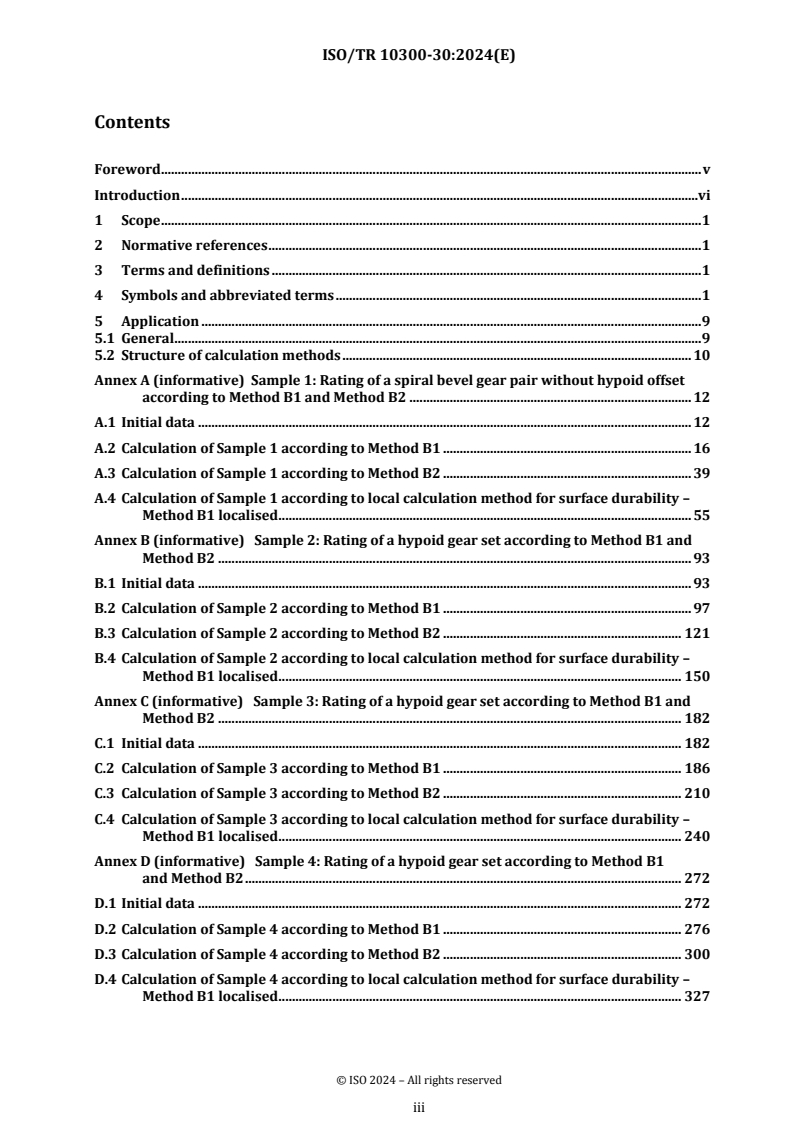
Contents
Foreword . v
Introduction .vi
1 Scope . 1
2 Normative references . 1
3 Terms and definitions . 1
4 Symbols and abbreviated terms . 1
5 Application . 9
5.1 General . 9
5.2 Structure of calculation methods . 10
Annex A (informative) Sample 1: Rating of a spiral bevel gear pair without hypoid offset
according to Method B1 and Method B2 . 12
A.1 Initial data . 12
A.2 Calculation of Sample 1 according to Method B1 . 16
A.3 Calculation of Sample 1 according to Method B2 . 39
A.4 Calculation of Sample 1 according to local calculation method for surface durability –
Method B1 localised . 55
Annex B (informative) Sample 2: Rating of a hypoid gear set according to Method B1 and
Method B2 . 93
B.1 Initial data . 93
B.2 Calculation of Sample 2 according to Method B1 . 97
B.3 Calculation of Sample 2 according to Method B2 . 121
B.4 Calculation of Sample 2 according to local calculation method for surface durability –
Method B1 localised . 150
Annex C (informative) Sample 3: Rating of a hypoid gear set according to Method B1 and
Method B2 . 182
C.1 Initial data . 182
C.2 Calculation of Sample 3 according to Method B1 . 186
C.3 Calculation of Sample 3 according to Method B2 . 210
C.4 Calculation of Sample 3 according to local calculation method for surface durability –
Method B1 localised . 240
Annex D (informative) Sample 4: Rating of a hypoid gear set according to Method B1
and Method B2 . 272
D.1 Initial data . 272
D.2 Calculation of Sample 4 according to Method B1 . 276
D.3 Calculation of Sample 4 according to Method B2 . 300
D.4 Calculation of Sample 4 according to local calculation method for surface durability –
Method B1 localised . 327
iii
Annex E (informative) Graphical representation of the calculation results for Sample 1 to
Sample 4 . 359
Bibliography . 362
iv
Foreword
ISO (the International Organization for Standardization) is a worldwide federation of national standards
bodies (ISO member bodies). The work of preparing International Standards is normally carried out
through ISO technical committees. Each member body interested in a subject for which a technical
committee has been established has the right to be represented on that committee. International
organizations, governmental and non-governmental, in liaison with ISO, also take part in the work. ISO
collaborates closely with the International Electrotechnical Commission (IEC) on all matters of
electrotechnical standardization.
The procedures used to develop this document and those intended for its further maintenance are
described in the ISO/IEC Directives, Part 1. In particular, the different approval criteria needed for the
different types of ISO documents should be noted. This document was drafted in accordance with the
editorial rules of the ISO/IEC Directives, Part 2 (see www.iso.org/directives).
ISO draws attention to the possibility that the implementation of this document may involve the use of
patents. ISO takes no position concerning the evidence, validity or applicability of any claimed patent
rights in respect thereof. As of the date of publication of this document, ISO had not received notice of
patents which may be required to implement this document. However, implementers are cautioned that
this may not represent the latest information, which may be obtained from the patent database available
at www.iso.org/patents. ISO shall not be held responsible for identifying any or all such patent rights.
Any trade name used in this document is information given for the convenience of users and does not
constitute an endorsement.
For an explanation of the voluntary nature of standards, the meaning of ISO specific terms and
expressions related to conformity assessment, as well as information about ISO's adherence to the World
Trade Organization (WTO) principles in the Technical Barriers to Trade (TBT), see
www.iso.org/iso/foreword.html.
This document was prepared by Technical Committee ISO/TC 60, Gears, Subcommittee SC 2, Gear
capacity calculation.
This second edition cancels and replaces the first edition (ISO/TR 10300-30:2017), which has been
technically revised.
The main changes are as follows:
— all sample calculations have been revised according to ISO 10300-1:2023, ISO 10300-2:2023 and ISO
10300-3:2023;
— all sample calculations include localised calculation method for Method B1.
A list of all parts in the ISO 10300 series can be found on the ISO website.
Any feedback or questions on this document should be directed to the user’s national standards body. A
complete listing of these bodies can be found at www.iso.org/members.html.
v
Introduction
The ISO 10300 series consists of International Standards, Technical Specifications (TS) and Technical
Reports (TR) under the general title Calculation of load capacity of bevel gears (see Table 1).
— International Standards contain calculation methods that are based on widely accepted practices and
have been validated.
— TS contain calculation methods that are still subject to further development.
— TR contain data that is informative, such as example calculations.
The procedures specified in ISO 10300-1 to ISO 10300-19 cover fatigue analyses for gear rating. The
procedures described in ISO 10300-20 to ISO 10300-29 are predominantly related to the tribological
behaviour of the lubricated flank surface contact. ISO 10300-30 to ISO 10300-39 include example
calculations. The ISO 10300 series allows the addition of new parts under appropriate numbers to reflect
knowledge gained in the future.
Requesting standardized calculations according to the ISO 10300 series without referring to specific
parts requires the use of only those parts that are currently designated as International Standards (see
Table 1 for listing). When requesting further calculations, the relevant part or parts of the ISO 10300
series need to be specified. The use of a Technical Specification as acceptance criteria for a specific design
needs to be agreed in advance between manufacturer and purchaser.
Table 1 — Overview of the ISO 10300 series
International Technical Technical
Calculation of load capacity of bevel gears
Standard Specification Report
Part 1: Introduction and general influence factors X
Part 2: Calculation of surface durability (macropitting) X
Part 3: Calculation of tooth root strength X
Part 4 to 19: to be assigned
Part 20: Calculation of scuffing load capacity – Flash temperature
X
method
Part 21 to 29: to be assigned
Part 30: ISO rating system for bevel and hypoid gears — Sample
X
calculations
Part 32: ISO rating system for bevel and hypoid gears — Sample
X
calculation for scuffing load capacity
NOTE At the time of publication of this document, some of the parts listed here were under development. Consult the ISO
website.
This document was prepared with sample calculations for different bevel gear designs. They are intended
for users of the ISO 10300 series to follow a whole calculation procedure formula by formula. Practical
experience has shown that this way, to get into a complex subject, is very helpful.
However, this document is not intended for use by the average engineer. Rather, it is aimed at the well-
versed engineer capable of selecting reasonable values for the parameters and factors in these formulae
based on knowledge of similar designs and on awareness of the effects behind these formulae.
vi
TECHNICAL REPORT ISO/TR 10300-30:2024(E)
Calculation of load capacity of bevel gears —
Part 30:
ISO rating system for bevel and hypoid gears — Sample
calculations
1 Scope
This document provides sample calculations for the load capacity of different bevel gear designs,
determined according to the methods and formulae of the ISO 10300 series. The initial geometric gear
data necessary for these calculations are according to ISO 23509.
The term “bevel gear” is used to mean straight, helical (skew), spiral bevel, zerol and hypoid gear designs.
Where this document pertains to one or more, but not all, the specific forms are identified.
The manufacturing process of forming the desired tooth form is not intended to imply any specific
process, but rather to be general in nature and applicable to all calculation methods of the
ISO 10300 series. The fact that there are bevel gear designs with tapered teeth and others where the tooth
depth remains constant along the facewidth (uniform depth) does not require to apply Method B2 for the
first and Method B1 for the second tooth configuration.
The rating system of the ISO 10300 series is based on virtual cylindrical gears and restricted to bevel
gears whose virtual cylindrical gears have transverse contact ratios of ε < 2. Additionally, the given
vα
relations are valid for bevel gears of which the sum of profile shift coefficients of pinion and wheel is zero
(see ISO 23509).
WARNING The user is cautioned that when the formulae are used for large average mean spiral
angles, (β + β )/2 > 45°, for effective pressure angles, α > 30° and/or for large facewidths, b > 13 m ,
m1 m2 e mn
to confirm the calculated results of the ISO 10300 series by experience.
2 Normative references
The following documents are referred to in the text in such a way that some or all of their content
constitutes requirements of this document. For dated references, only the edition cited applies. For
undated references, the latest edition of the referenced document (including any amendments) applies.
ISO 10300-1:2023, Calculation of load capacity of bevel gears — Part 1: Introduction and general influence
factors
ISO 10300-2:2023, Calculation of load capacity of bevel gears — Part 2: Calculation of surface durability
(macropitting)
ISO 10300-3:2023, Calculation of load capacity of bevel gears — Part 3: Calculation of tooth root strength
3 Terms and definitions
For the purposes of this document, the terms and definitions given in ISO 10300-1, ISO 10300-2 and
ISO 10300-3 apply.
ISO and IEC maintain terminology databases for use in standardization at the following addresses:
— ISO Online browsing platform: available at https://www.iso.org/obp
— IEC Electropedia: available at https://www.electropedia.org/
4 Symbols and abbreviated terms
For the purposes of this document, the symbols and units given in ISO 10300-1:2023, Table 1 and Table 2,
ISO 10300-2:2023, Table 1 and Table 2, ISO 10300-3:2023, Table 1 and Table 2 as well as the abbreviated
terms given in ISO 10300-2:2023, Table 3, and ISO 10300-3:2023, Table 3, apply.
Table 2 — Symbols and units used in ISO 10300 (all parts)
Symbol Description or term Unit
A Auxiliary factor for calculating the dynamic factor Kv − C —
A* Related area for calculating the load sharing factor Z mm
LS
Asne Outer tooth thickness allowance mm
a Hypoid offset mm
arel Relative hypoid offset —
a Centre distance of virtual cylindrical gear pair mm
v
avn Centre distance of virtual cylindrical gear pair in normal section mm
B Accuracy grade according to ISO 17485 —
b Facewidth mm
b Related base facewidth —
b
bce Calculated effective facewidth mm
b Effective facewidth (e.g. measured length of contact pattern) mm
eff
bv Facewidth of virtual cylindrical gears mm
b Effective facewidth of virtual cylindrical gears mm
v,eff
CF Correction factor of tooth stiffness for non-average conditions —
C Correction factor for the length of contact lines —
lb
CZL, CZR, CZV Constants for determining lubricant film factors —
c Mean addendum factor of wheel —
ham
cv Empirical parameter to determine the dynamic factor —
c Mean value of mesh stiffness per unit facewidth N/(mm · µm)
γ
cγ0 Mesh stiffness for average conditions N/(mm · µm)
c’ Single stiffness N/(mm · µm)
c0’ Single stiffness for average conditions N/(mm · µm)
d Outer pitch diameter mm
e
dm Mean pitch diameter mm
d Tolerance diameter according to ISO 17485 mm
T
dv Reference diameter of virtual cylindrical gear mm
d Tip diameter of virtual cylindrical gear mm
va
dvan Tip diameter of virtual cylindrical gear in normal section mm
d Base diameter of virtual cylindrical gear mm
vb
Symbol Description or term Unit
dvbn Base diameter of virtual cylindrical gear in normal section mm
d Root diameter of virtual cylindrical gear mm
vf
dvn Reference diameter of virtual cylindrical gear in normal section mm
E Modulus of elasticity, Young’s modulus N/mm
E, G, H Auxiliary variables for tooth form factor (Method B1) —
e Exponent for the distribution of the load peaks along the —
LS
lines of contact
F Auxiliary variable for mid-zone factor —
F Nominal tangential force at mid facewidth of the reference cone N
mt
FmtH Determinant tangential force at mid facewidth of the reference cone N
F Nominal normal force N
n
Fvmt Nominal tangential force of virtual cylindrical gears N
f Distance from the centre of the zone of action to a contact line mm
fmax Maximum distance to middle contact line mm
f Maximum distance to middle contact line at right side of mm
maxB
the contact pattern
fmax0 Maximum distance to middle contact line at left side of mm
the contact pattern
f Single pitch deviation µm
pt
fp eff Effective pitch deviation µm
f Influence factor of limit pressure angle
αlim
gc Length of contact line (Method B2) mm
g Length of path of contact of virtual cylindrical gear in transverse mm
vα
section
gvαn Related length of action in normal section —
g Length of action from mean point to point of load application mm
J
(Method B2)
gη Relative length of action within the contact ellipse mm
HB Brinell hardness —
ham Mean addendum mm
h Tool addendum mm
a0
hFa Bending moment arm for tooth root stress (load application at tooth tip) mm
h Mean dedendum mm
fm
hfP Dedendum of the basic rack profile mm
h Mean whole depth used for bevel spiral angle factor mm
m
hvfm Relative mean virtual dedendum —
h Load height from critical section (Method B2) mm
N
jen Outer normal backlash mm
Symbol Description or term Unit
K Constant; factor for calculating the dynamic factor Kv−B —
K Application factor —
A
KF0 Lengthwise curvature factor for bending stress —
K Transverse load factor for bending stress —
Fα
KFα* Preliminary transverse load factor for bending stress for non-hypoid gears —
K Face load factor for bending stress —
Fβ
KHα Transverse load factor for contact stress —
K * Preliminary transverse load factor for contact stress for non-hypoid gears —
Hα
KHβ Face load factor for contact stress —
K Mounting factor —
Hβ−be
Kv Dynamic factor —
K * Preliminary dynamic factor for non-hypoid gears —
v
′
—
Contact shift factor
k
kc Clearance factor —
k Depth factor —
d
khap Basic crown gear addendum factor (related to mmn) —
k Basic crown gear dedendum factor (related to m ) —
hfp mn
kt Circular thickness factor —
l Length of contact line (Method B1) mm
b
lb0 Theoretical length of contact line mm
l Theoretical length of middle contact line mm
bm
met Outer transverse module mm
m Mean normal module mm
mn
mmt Mean transverse module mm
m Mass per unit facewidth reduced to the line of action of kg/mm
red
dynamically equivalent cylindrical gears
m* Related individual gear mass per unit facewidth referred to kg/mm
the line of action
N Reference speed related to resonance speed n —
E1
NL Number of load cycles —
–1
n Rotational speed min
–1
nE1 Resonance speed of pinion min
P Nominal power kW
p Peak load N/mm
p Transverse base pitch (Method B2) mm
et
pmax Maximum peak load N/mm
p* Related peak load for calculating the load sharing factor (Method B1) —
Symbol Description or term Unit
pmn Relative mean normal pitch —
p Relative mean normal base pitch —
nb
pvet Transverse base pitch of virtual cylindrical gear (Method B1) mm
q Exponent in the formula for lengthwise curvature factor —
qs Notch parameter —
q Notch parameter (Method B2) —
s
Ra = CLA = AA arithmetic average roughness µm
R Outer cone distance mm
e
Rm Mean cone distance mm
R Relative mean back cone distance —
mpt
Rz Mean roughness µm
Rz Mean roughness for gear pairs with relative curvature radius µm
ρ = 10 mm
rel
rc0 Cutter radius mm
r Tooth fillet radius at the root in mean section mm
mf
rmpt Mean pitch radius mm
r Mean transverse radius to point of load application (Method B2) mm
my 0
rva Relative mean virtual tip radius —
r Relative mean virtual pitch radius —
vn
SF Safety factor for bending stress (against breakage) —
S Minimum safety factor for bending stress —
F min
SH Safety factor for contact stress (against macropitting) —
S Minimum safety factor for contact stress —
H min
sFn Tooth root chord in calculation section mm
s Mean normal circular thickness mm
mn
sN One-half tooth thickness at critical section (Method B2) mm
s Amount of protuberance at the tool mm
pr
T1,2 Nominal torque of pinion and wheel Nm
u Gear ratio of bevel gear —
uv Gear ratio of virtual cylindrical gear —
v Tangential speed at outer end (heel) of the reference cone m/s
et
vet max Maximum pitch line velocity at operating pitch diameter m/s
v Sliding velocity in the mean point P m/s
g
vg par Sliding velocity parallel to the contact line m/s
v Sliding velocity vertical to the contact line m/s
g vert
vmt Tangential speed at mid facewidth of the reference cone m/s
v Sum of velocities in the mean point P m/s
Σ
Symbol Description or term Unit
vΣh Sum of velocities in profile direction m/s
v Sum of velocities in lengthwise direction m/s
Σl
vΣ vert Sum of velocities vertical to the contact line m/s
W Wheel mean slot width mm
m2
w Angle of contact line relative to the root cone °
x Profile shift coefficient —
hm
xsm Thickness modification coefficient (backlash included) —
x Thickness modification coefficient (theoretical) —
smn
xN Tooth strength factor (Method B2) mm
x Distance from mean section to point of load application mm
oo
YA Root stress adjustment factor (Method B2) —
Y Bevel spiral angle factor —
BS
YFa Tooth form factor for load application at the tooth tip (Method B1) —
Y Combined tooth form factor for generated gears —
FS
Yf Stress concentration and stress correction factor (Method B2) —
Y Inertia factor (bending) —
i
YJ Bending strength geometry factor (Method B2) —
Y Load sharing factor (bending) —
LS
YNT Life factor (bending) —
Y Relative surface condition factor —
R rel T
YSa Stress correction factor for load application at the tooth tip —
Y Stress correction factor for dimensions of the standard test gear —
ST
YX Size factor for tooth root stress —
Y Tooth form factor of pinion and wheel (Method B2) —
1,2
Yδ rel T Relative notch sensitivity factor —
Y Contact ratio factor for bending (Method B1) —
ε
yp Running-in allowance for pitch deviation related to the polished µm
test piece
y Location of point of load application for maximum bending stress mm
J
on path of action (Method B2)
y3 Location of point of load application on path of action for mm
maximum root stress
y Running-in allowance for pitch error µm
α
ZA Contact stress adjustment factor (Method B2) —
Z Elasticity factor —
E
ZFW Facewidth factor —
Z Hypoid factor —
Hyp
Symbol Description or term Unit
ZI Macropitting resistance geometry factor (Method B2) —
Z Inertia factor (macropitting) —
i
ZKP Bevel gear factor (Method B1) —
Z Lubricant factor —
L
ZLS Load sharing factor (Method B1) —
Z Mid zone factor —
M-B
ZNT Life factor (macropitting) —
Z Roughness factor for contact stress —
R
ZS Bevel slip factor —
Z Speed factor —
v
ZW Work hardening factor —
Z Size factor —
X
z Number of teeth —
z Number of teeth of virtual cylindrical gear —
v
zvn Number of teeth of virtual cylindrical gear in normal section —
z Number of blade groups of the cutter —
αa Adjusted pressure angle (Method B2) °
α Normal pressure angle at tooth tip °
an
αdD,C Nominal design pressure angle for drive side/coast side °
α Effective pressure angle in transverse section °
et
αeD,C Effective pressure angle for drive side/coast side °
α Limit pressure angle in wheel root coordinates (Method B2) °
f
αlim Limit pressure angle °
α Generated pressure angle for drive side/coast side °
nD,C
αvet Transverse pressure angle of virtual cylindrical gears °
α Load application angle at tooth tip of virtual cylindrical gear °
Fan
(Method B1)
αL Normal pressure angle at point of load application (Method B2) °
β Mean base spiral angle °
bm
βm Mean spiral angle °
β Helix angle of virtual gear (Method B1), °
v
virtual spiral angle (Method B2)
βvb Helix angle at base circle of virtual cylindrical gear °
β Inclination angle of contact line °
B
γ Auxiliary angle for length of contact line calculation (Method B1) °
γ′ Projected auxiliary angle for length of contact line °
γa Auxiliary angle for tooth form and tooth correction factor °
Symbol Description or term Unit
δ Pitch angle of bevel gear °
δ Face angle °
a
δf Root angle °
ε Transverse contact ratio of virtual cylindrical gears —
vα
εvαn Transverse contact ratio of virtual cylindrical gears in normal section —
ε Face contact ratio of virtual cylindrical gears —
vβ
εvγ Virtual contact ratio (Method B1), modified contact ratio (Method B2) —
ε Load sharing ratio for bending (Method B2) —
N
εNI Load sharing ratio for macropitting (Method B2) —
ζ Pinion offset angle in axial plane °
m
ζmp Pinion offset angle in pitch plane °
ζ Pinion offset angle in root plane °
R
θ Auxiliary quantity for tooth form and tooth correction factors —
θ Auxiliary angle for virtual facewidth (Method B1) °
mp
θa2 Addendum angle of wheel °
θ Dedendum angle of wheel °
f2
θv2 Angular pitch of virtual cylindrical wheel radiant
ν Poisson’s ratio —
ν0 Lead angle of face hobbing cutter °
ν , ν Nominal kinematic viscosity of the oil at 40 °C and 50 °C, respectively mm /s
40 50
ξ Assumed angle in locating weakest section °
ξ One half of angle subtended by normal circular tooth thickness °
h
at point of load application
ρ Density of gear material kg/mm
ρ Cutter edge radius mm
a0
ρF Fillet radius at point of contact of 30° tangent mm
ρ Fillet radius at point of contact of 30° tangent in normal section mm
Fn
ρfP Root fillet radius of basic rack for cylindrical gears mm
ρ Radius of relative curvature vertical to contact line at mm
rel
virtual cylindrical gears
ρt Radius of relative profile curvature (Method B2) mm
ρ Relative edge radius of tool —
va0
ρ′ Slip layer thickness mm
Σ Shaft angle °
σF Tooth root stress N/mm
σ Nominal tooth root stress N/mm
F0
σF lim Nominal stress number (bending) N/mm
Symbol Description or term Unit
σFE Allowable stress number (bending) N/mm
σ Permissible tooth root stress N/mm
FP
σH Contact stress N/mm
σ Allowable stress number for contact stress N/mm
H lim
σHP Permissible contact stress N/mm
τ Angle between tangent of root fillet at weakest point and °
centreline of tooth
ϕ Auxiliary angle to determine the position of the pitch point °
X −1
χ Relative stress drop in notch root mm
X −1
χ
Relative stress drop in notch root of standardized test gear mm
T
ω Angular velocity rad/s
ω Angle between the sum of velocities vector and the trace of pitch cone °
Σ
Table 3 — Generally used subscripts in ISO 10300 (all parts)
Subscripts Description
0 Tool
1 Pinion
2 Wheel
A, B, B1, B2, C Value according to Method A, B, B1, B2 or C
D Drive flank
C Coast flank
T Relative to standardized test gear dimensions
(1), (2) Trials of interpolation
5 Application
5.1 General
This document provides four sample calculations:
— Sample 1 is a rating of a spiral bevel gear pair without hypoid offset according to Method B1,
including the localised calculation method, and Method B2 (see Annex A);
— Sample 2 is a rating of a hypoid gear set according to Method B1, including the localised calculation
method, and Method B2 (see Annex B);
— Sample 3 is a rating of a hypoid gear set according to Method B1, including the localised calculation
method, and Method B2 (see Annex C);
— Sample 4 is a rating of a hypoid gear set according to Method B1, including the localised calculation
method, and Method B2 (see Annex D).
— Figures E.1 to E.3 provide a graphical representation of the calculation results for Samples 1 to 4.
While this document states the results of calculations to a three decimal accuracy, the calculations
themselves use more significant digits.
Table 4 refers to each table of the annexes showing the input parameters and calculation results for the
different sample calculation steps.
Table 4 — Content of tables of Annexes A to D
Content of Table Sample 1 Sample 2 Sample 3 Sample 4
Initial data for pitch cone parameters Table A.1 Table B.1 Table C.1 Table D.1
Input data for tooth profile parameters Table A.2 Table B.2 Table C.2 Table D.2
Geometric data from calculation according to ISO 23509 Table A.3 Table B.3 Table C.3 Table D.3
Operation parameters and additional considerations Table A.4 Table B.4 Table C.4 Table D.4
Method B1
Virtual cylindrical gears Table A.5 Table B.5 Table C.5 Table D.5
General influence factors Table A.6 Table B.6 Table C.6 Table D.6
Calculation of surface durability (macropitting) Table A.7 Table B.7 Table C.7 Table D.7
Calculation of tooth root strength for pinion Table A.8 Table B.8 Table C.8 Table D.8
Calculation of tooth root strength for wheel Table A.9 Table B.9 Table C.9 Table D.9
Method B2
Calculation of surface durability (macropitting) Table A.10 Table B.10 Table C.10 Table D.10
Calculation of tooth root strength on pinion Table A.11 — — —
Calculation of tooth root strength on pinion and wheel — Table B.11 Table C.11 Table D.11
Calculation of tooth root strength on wheel Table A.12 — — —
Method B1 localised
Virtual cylindrical gears Table A.13 Table B.12 Table C.12 Table D.12
Local velocities and slip Table A.14 Table B.13 Table C.13 Table D.13
Calculation of local surface durability (macropitting) Table A.15 Table B.14 Table C.14 Table D.14
5.2 Structure of calculation methods
Figure 1 shows three boxes that represent the individual three parts of ISO 10300. However, these boxes
are subdivided into a left side where influence factors are determined on the basis of mainly operational
data according to Methods A, B or C (see ISO 10300-1:2023, 5.1) and a right side where separate
calculation procedures are provided according to Method B1 and Method B2 which are assumed to have
the same level B but different approaches. These two methods refer to the determination of virtual
cylindrical gears in ISO 10300-1, the gear flank rating formulae in ISO 10300-2 and the gear tooth rating
formulae in ISO 10300-3.
a
Generally drive and coast side pressure angles are balanced in initial design. However, some applications may be
optimized with unbalanced pressure angles, see ISO 23059:2016, Annex C for guidance.
b
One set of formulae for both, bevel and hypoid gears.
c
Separate sets of formulae for bevel and for hypoid gears.
Figure 1 — Structure of calculation methods in ISO 10300 (all parts)
Annex A
(informative)
Sample 1: Rating of a spiral bevel gear pair without hypoid offset
according to Method B1 and Method B2
A.1 Initial data
Sample 1 is for a spiral bevel gear pair without hypoid offset which uses Method 0 according to
ISO 23509.
Table A.1 — Initial data for pitch cone parameters
Symbol Description Method 0 Method 1 Method 2 Method 3
Σ Shaft angle 90° X X X
a Hypoid offset 0 mm X X X
z Number of teeth 14/39 X X X
1,2
dm2 Mean pitch diameter of wheel — — X —
d Outer pitch diameter of wheel 176,893 mm X — X
e2
b2 Wheel facewidth 25,4 mm X X X
β Mean spiral angle of pinion 35° X — —
m1
βm2 Mean spiral angle of wheel 35° — X X
r Cutter radius 114,3 mm X X X
c0
Number of blade groups
z0 — — X X
(only face hobbing)
Table A.2 — Input data for tooth profile parameters
Data type I Data type II
Symbol Description Symbol Description
αdD 20°
α 20°
dC
fαlim 0
x — c 0,247 37
hm1 ham
khap — kd 2,000
k — k 0,125
hfp c
kt 0,091 5
xsmn —
Wm2 —
j 0,127 mm
en
θa2 2,134 2°
θ 6,493 4°
f2
ρa01D,C 0,8 mm/0,8 mm
ρ 1,2 mm/1,2 mm
a02D,C
spr1D,C 0 mm/0 mm
s 0 mm/0 mm
pr2D,C
Table A.3 and Table A.4 show geometric and operational data and text for explanation.
Table A.3 — Geometric data from calculation according to ISO 23509
Symbol Description Values Symbol Description Value
Mean pitch diameter 54,918 mm/ Offset angle
d ζ 0°
m1,2 mp
of pinion/wheel 152,987 mm on pitch plane
Mean addendum 4,837 mm/ Pinion offset angle
ham1,2 ζR 0°
of pinion/wheel 1,590 mm on root plane
Mean dedendum 2,393 mm/ Outer cone distance
h R 93,973 mm
fm1,2 e1,2
of pinion/wheel 5,640 mm on pinion and wheel
Effective pressure angle Mean cone distance
αeD,C 20°/20° Rm1,2 81,273 mm
for drive side/coast side on pinion and wheel
Generated pressure angle Pitch angle 19,747°/
α 20°/20° δ
nD,C 1,2
for drive side/coast side on pinion/wheel 70,253°
Face angle 26,240°/
αlim Limit pressure angle 0° δa1,2
on pinion/wheel 72,387°
Root angle 17,613°/
m Mean normal module 3,213 mm δ
mn f1,2
on pinion/wheel 63,760°
Thickness modification
Basic crown gear 0,036/
khfp 1,25 xsm1,2 coefficient on
dedendum factor −0,055
pinion/wheel
Pinion offset angle
ζ 0,000° m Outer transverse module 4,536 mm
m et2
on axial plane
Mean normal circular
6,464 mm/
smn1,2 tooth thickness —
3,511 mm
of pinion/wheel
Table A.4 — Operation parameters and additional considerations
Symbol Description Value
Additional data
Wheel profile Generated
Roughing/finishing method Face milling
b2eff Effective facewidth on wheel 0,85 · b2
Profile crowning Low
Verification of contact pattern Checked under light test load for each gear
Mounting conditions of pinion and wheel One member cantilever-mounted
Operation parameters
T Pinion torque 300 Nm
−1
n Pinion rotational speed 1 200 min
KA Application factor 1,1
Active flank Drive
Material data for pinion and wheel (case hardened steel)
E Modulus of elasticity 210 000 N/mm²
Poisson’s ratio 0,3
σH lim Allowable stress number (contact) 1 500 N/mm
σF lim Nominal stress number (bending) 480 N/mm
Surface hardness Same for pinion and wheel
Quality parameters
Rz Flank roughness on pinion/wheel 8 μm/8 μm
Rz Tooth root roughness on pinion/wheel 16 μm/16 μm
f Single pitch deviation on pinion/wheel 12 μm/26 μm
pt
Lubrication parameters
Oil type ISO-VG-150
Oil temperature 90 °C
A.2 Calculation of Sample 1 according to Method B1
Table A.5 — Virtual cylindrical gears
References to
ISO ISO ISO
Description Formula Result
10300-1 10300-2 10300-3
E: Formula, T: Table, F: Figure
Virtual cylindrical gears in transverse section
d
m1
Reference diameter
58,350 mm E: A.1
d =
on pinion
v1
cos
Reference diameter
452,804 mm E: A.4
d =u d
v2 v1
on wheel
+
m1 m2
Helix angle 35° E: A.8
=
v
Transverse pressure
= arctan(tan /cos )
vet e v
angle of virtual 23,957° E: A.10
cylindrical gears since = for drive side
e eD
mm= cos
Transverse module 3,923 mm E: A.11
vt mn v
Number of teeth on
z = d /m 14,875 E: A.12
v1 v1 vt
pinion
z = d /m
Number of teeth on wheel 115,431 E: A.12
v2 v2 vt
Gear ratio
u = z / z
7,760 E: A.13
v v2 v1
References to
ISO ISO ISO
Description Formula Result
10300-1 10300-2 10300-3
E: Formula, T: Table, F: Figure
Auxiliary angle for virtual
=arctan sin tan
( )
0° E: A.21
mp 2 m
facewidth
Projected auxiliary
'=− 2
angle for length of 0° E: A.20
mp mp
contact line
Centre distance
a=+d d 2
of virtual cylindrical 255,577 mm E: A.5
( )
v v1 v2
gear pair
Helix angle of virtual
=arcsin sin cos
( )
vb v e
cylindrical gear at base 32,615° E: A.16
circle
since = for drive side
e eD
Tip diameter on pinion d =+d 2 h 68,023 mm E: A.6
va1 v1 am1
d =+d 2 h
Tip diameter on wheel 455,984 mm E: A.6
va2 v2 am2
d =−d 2 h
Root diameter on pinion 53,563 mm E: A.7
vf1 v1 fm1
Root diameter on wheel d =−d 2 h 441,524 mm E: A.7
vf2 v2 fm2
dd=cos
Base diameter on pinion 53,323 mm E: A.9
vb1 v1 vet
dd=cos
Base diameter on wheel 413,796 mm E: A.9
vb2 v2 vet
Transverse base pitch pm= cos/cos 11,262 mm E: A.17
vet mn vet v
References to
ISO ISO ISO
Description Formula Result
10300-1 10300-2 10300-3
E: Formula, T: Table, F: Figure
Length of path of contact
of virtual cylindrical
2 2 2 2
g = d −d −d sin+ d −d −d sin 13,120 mm E: A.18
v va1 vb1 v1 vet ) va2 vb2 v2 vet )
( (
gear in transverse
section
=gp
Transverse contact ratio 1,165 E: A.23
vv vet
bg/ cos /2 − cos tan /2
( ( ) ( ))
2,eff mp v vet mp
Effective facewidth
b =
21,590 mm E: A.19
v,eff
with b2 eff = 0,85·b2
1−tantan /2
( )
mp
b
v ,eff
bb=
Facewidth 25,400 mm E: A.22
v2
b
2,eff
Virtual cylindrical gears in normal section
z
v1
Number of pinion teeth
z =
vn1 25,594 E: A.41
of virtual cylindrical gears
coscos
vb v
Number of wheel teeth
z =u z
198,613 E: A.42
vn2 v vn1
of virtual cylindrical gears
Reference diameter
d =z m
82,241 mm E: A.43
vn1 vn1 mn
on pinion
Reference diameter
d =z m
638,207 mm E: A.43
vn2 vn2 mn
on wheel
Tip diameter on pinion d =+d 2h 91,915 mm E: A.44
van1 vn1 am1
Tip diameter on wheel d =+d 2h 641,387 mm E: A.44
van2 vn2 am2
References to
ISO ISO ISO
Description Formula Result
10300-1 10300-2 10300-3
E: Formula, T: Table, F: Figure
Base diameter on pinion dd= cos 77,281 mm E: A.45
vbn1 vn1 e
dd= cos
Base diameter on wheel 599,719 mm E: A.45
vbn2 vn2 e
b sin
v ,eff v
Face contact ratio = 1,227 E: A.24
v
m
mn
=+
Virtual contact ratio 2,392 E: A.25
v v v
Inclination angle
=arctan(tan sin ) 13,468° E: A.38
B v e
of contact line
−1
Radius of relative
1 cos cos 1 1
m1 m2
curvature in normal = + 13,173 mm E: A.39
t
cos (tan − tan ) + tan tan cos RR tan tan
section at the mean point nD nD lim mp B mp m2 2 m1 1
Radius of relative
curvature vertical 12,459 mm E: A.37
= cos
( )
rel t B
to the contact line
Table A.6 — General influence factors
References to
ISO ISO ISO
Description Formula Result
10300-1 10300-2 10300-3
E: Formula, T: Table, F: Figure
2000T
1,2
Nominal tangential
F =
10 925,3 N E: 1
mt1,2
force of bevel gears
d
m1,2
Nominal tangential
cos
v
FF=
force of virtual 10 925,3 N E: 2
vmt mt1
cos
m1
cylindrical gears
Nominal tangential
dn
m1 1
v =
speed at mean point 3,451 m/s E: 5
mt1
of the pinion
Nominal tangential
dn
m2 2
v =
speed at mean point 3,451 m/s E: 5
mt2
of the wheel
Correction factor for
non-average conditions
C
1,000 E: 12
F
for F K / b
vmt A v,eff
100 N/mm
Mean value of mesh
c=c C
stiffness per unit face 20 N/(mm · m) E: 11
0F
width
c=c C
Single stiffness 14 N/(mm · m) E: 18
0F
Max. single pitch
f
deviation as given 26 m
pt
in Table A.4.
References to
ISO ISO ISO
Description Formula Result
10300-1 10300-2 10300-3
E: Formula, T: Table, F: Figure
Running-in allowance
yf=0,075
for case hardened and 1,950 m E: 51
pt
nitrided gears
Effective pitch deviation
f =−f y
24,050 µm E: 17
p,eff pt p
with y = y
p
d
* m1
Relative pinion mass
m = π
cos + /2
per unit facewidth ( )
nD nC
0,010 kg/mm E: 14
reduced to the line of
where ρ is the density of the gear material
action
−6 3
(for steel ρ = 7,8610 kg/mm )
1 d
* m2
Relative wheel mass
m = π
cos + /2
( )
per unit facewidth
nD nC
0,078 kg/mm E: 14
reduced to the line of
where ρ is the density of the gear material
action
−6 3
(for steel ρ = 7,8610 kg/mm )
Mass reduced to the line
**
mm
of action of the 12
m =
0,009 kg/mm E: 10
red
**
dynamically equivalent
mm+
cylindrical gear pair
c
3010
−1
Resonance speed of pinion E: 9
n= 32 314 min
E1
πzm
1 red
n
Dimensionless reference 1
N =
0,037 E: 8
speed
n
E1
References to
ISO ISO ISO
Description Formula Result
10300-1 10300-2 10300-3
E: Formula, T: Table, F: Figure
c = c + c 0,593 T: 3
v1,2 v1 v2
0,115 T: 3
c
v3
For virtual contact ratio,
c 0,473 T: 3
v4
= 2,392 > 2
v
0,654 T: 3
cv5,6
c 0,993 T: 3
v7
Constant for the dynamic
bf c
v p,eff
factor with K = 1,1
K = c + c 0,537 E: 16
A
v1,2 v3
FK
vmt A
as given in Table A.4.
K = N K +1
Dynamic factor 1,020 E: 15
vB−
Determination of the length of contact lines
ft = +pvet cosvb 9,486 mm T: A.2
For virtual contact ratio,
fm 0,000 mm T: A.2
= 1,227, ε ≥ 1
v v
−9,486 mm T: A.2
fr = −pvet cosvb
f = g + b tan + tan cos 11,344 mm E: A.33
( )
maxB v v ,eff vb vb
Maximum distances
f = g −b tan + tan cos −0,293 mm E: A.34
( )
max0 v v,eff vb vb
from middle contact line
fmax = fmaxB
11,344 mm
since fmaxB > fmax0
-----------
...