


IEC/FDIS 62264-2
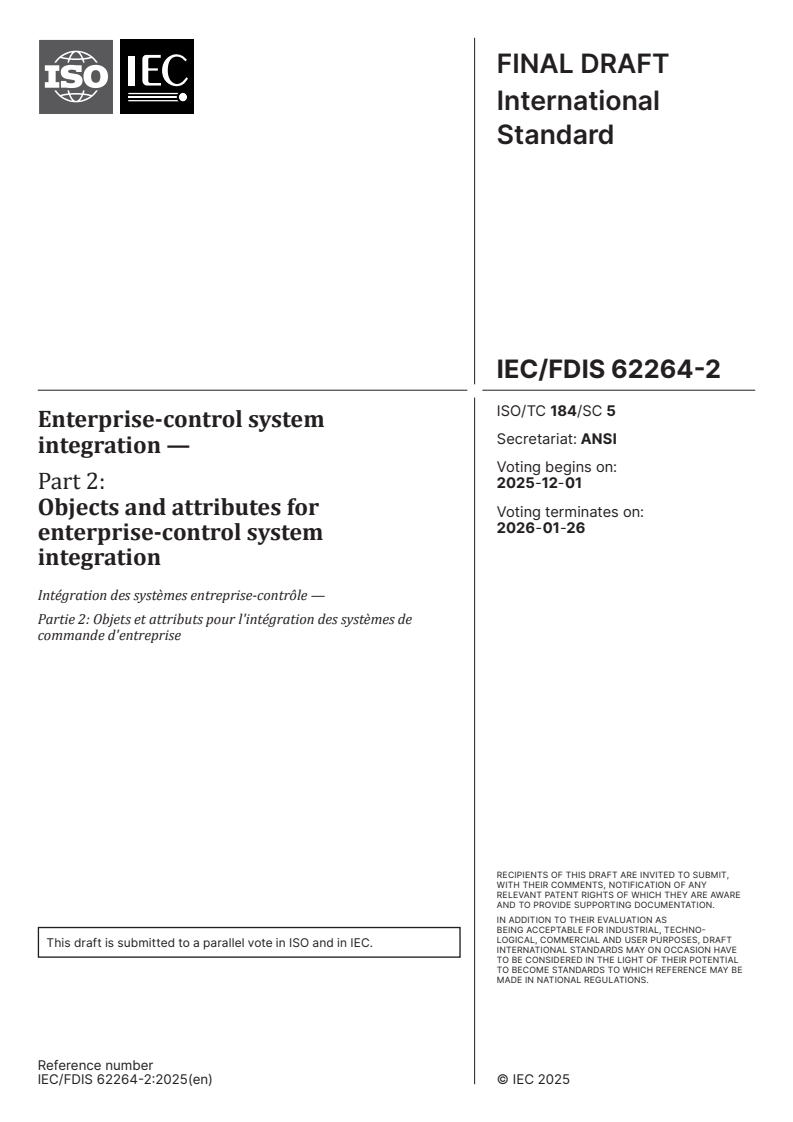
(Main)Enterprise-control system integration — Part 2: Objects and attributes for enterprise-control system integration
Enterprise-control system integration — Part 2: Objects and attributes for enterprise-control system integration
This part of IEC 62264 specifies generic interface content exchanged between manufacturing control functions and other enterprise functions. The interface considered is between Level 3 manufacturing systems and Level 4 business systems in the hierarchical model defined in IEC 62264-1. The goal is to reduce the risk, cost, and errors associated with implementing the interface. Since this standard covers many domains, and there are many different standards in those domains, the semantics of this standard are described at a level intended to enable the other standards to be mapped to these semantics. To this end this standard defines a set of elements contained in the generic interface, together with a mechanism for extending those elements for implementations. The scope of IEC 62264-2 is limited to the definition of object models and attributes of the exchanged information defined in IEC 62264-1. This part of IEC 62264 standard does not define attributes to represent the object relationships.
Intégration des systèmes entreprise-contrôle — Partie 2: Objets et attributs pour l'intégration des systèmes de commande d'entreprise
La présente partie de la CEI 62264 spécifie le contenu de l'interface générique échangé entre les fonctions de commande de fabrication et d'autres fonctions d'entreprise. L'interface considérée est comprise entre les systèmes de fabrication de niveau 3 et les systèmes métier de niveau 4 du modèle hiérarchique défini dans la CEI 62264-1. Il s'agit de réduire les risques, les coûts et les erreurs liés à la mise en œuvre de l'interface. Dans la mesure où la présente Norme couvre de nombreux domaines, et où il existe de nombreuses normes différentes dans lesdits domaines, la sémantique de la présente norme est décrite à un niveau permettant d'adapter les autres normes à cette sémantique. La présente Norme définit ainsi un ensemble d'éléments contenus dans l’interface générique, ainsi qu'un mécanisme d'extension de ces éléments en vue de leurs différentes mises en œuvre. Le domaine d'application de la CEI 62264-2 se limite à la définition des modèles d’objets et des attributs des informations échangées définis dans la CEI 62264-1. La présente partie de la CEI 62264 ne définit pas les attributs permettant de représenter les relations entre les objets.
General Information
- Status
- Not Published
- Current Stage
- 5060 - Close of voting Proof returned by Secretariat
- Start Date
- 27-Jan-2026
- Completion Date
- 26-Jan-2026
Relations
- Effective Date
- 18-Feb-2023
Overview
IEC/FDIS 62264-2 (ISO/TC 184/SC 5) defines the objects and attributes used for enterprise-control system integration between Level 3 manufacturing systems and Level 4 business systems. As a part of the IEC 62264 series, Part 2 focuses on a generic interface content model that enables consistent mapping of domain-specific standards and reduces risk, cost, and implementation errors. The draft is submitted for parallel vote (voting begins 2025-12-01 and terminates 2026-01-26).
Key Topics
- Object models and attribute definitions: Provides conceptual object models and a standard set of attributes for objects exchanged across the Level 3–Level 4 interface.
- Scope and semantics: Describes semantics at a level intended to allow other domain standards to be mapped to these concepts without prescribing implementation-specific details.
- Extensibility mechanism: Defines how implementations can extend the base elements to meet specific industry or application needs while preserving interoperability.
- Separation of concerns: Clarifies conceptual vs logical and physical data models to guide implementers in translating object models into concrete data representations.
- MOM information models: Aligns with manufacturing operations management (MOM) information models described in IEC 62264-1, covering objects such as personnel, equipment, material, process segments, records, and events.
Keywords: enterprise-control system integration, IEC 62264-2, object models, attributes, Level 3, Level 4, MOM, extensibility, mapping semantics.
Applications
IEC/FDIS 62264-2 is designed for practitioners and system integrators working to connect manufacturing control systems with enterprise resource planning and business systems. Typical applications include:
- Integrating MES and ERP interfaces to exchange consistent production, material, and resource data.
- Designing interoperable data exchanges for multi-vendor environments, reducing custom mappings and integration costs.
- Establishing a common semantic foundation for digital transformation projects in discrete and process industries.
- Supporting vendors and standard bodies in mapping existing domain models to a common enterprise-control semantic layer.
Benefits:
- Reduced integration risk through standardized object and attribute definitions.
- Lower implementation cost by minimizing bespoke interface designs.
- Improved data consistency across Level 3 and Level 4 systems.
Related Standards
- IEC 62264-1: Hierarchical models and terminology for enterprise-control system integration (context and definitions used by Part 2).
- Industry-specific standards and domain models: use IEC/FDIS 62264-2 semantics as a mapping target to ensure interoperability.
- Other MOM and ISA/IEC standards that define operational exchange formats and protocols.
For implementers, IEC/FDIS 62264-2 is a practical reference to define the conceptual objects and attribute sets needed to build consistent, extensible interfaces between manufacturing operations and enterprise business systems.

Get Certified
Connect with accredited certification bodies for this standard

BSI Group
BSI (British Standards Institution) is the business standards company that helps organizations make excellence a habit.

National Aerospace and Defense Contractors Accreditation Program (NADCAP)
Global cooperative program for special process quality in aerospace.
CARES (UK Certification Authority for Reinforcing Steels)
UK certification for reinforcing steels and construction.
Sponsored listings
Frequently Asked Questions
IEC/FDIS 62264-2 is a draft published by the International Organization for Standardization (ISO). Its full title is "Enterprise-control system integration — Part 2: Objects and attributes for enterprise-control system integration". This standard covers: This part of IEC 62264 specifies generic interface content exchanged between manufacturing control functions and other enterprise functions. The interface considered is between Level 3 manufacturing systems and Level 4 business systems in the hierarchical model defined in IEC 62264-1. The goal is to reduce the risk, cost, and errors associated with implementing the interface. Since this standard covers many domains, and there are many different standards in those domains, the semantics of this standard are described at a level intended to enable the other standards to be mapped to these semantics. To this end this standard defines a set of elements contained in the generic interface, together with a mechanism for extending those elements for implementations. The scope of IEC 62264-2 is limited to the definition of object models and attributes of the exchanged information defined in IEC 62264-1. This part of IEC 62264 standard does not define attributes to represent the object relationships.
This part of IEC 62264 specifies generic interface content exchanged between manufacturing control functions and other enterprise functions. The interface considered is between Level 3 manufacturing systems and Level 4 business systems in the hierarchical model defined in IEC 62264-1. The goal is to reduce the risk, cost, and errors associated with implementing the interface. Since this standard covers many domains, and there are many different standards in those domains, the semantics of this standard are described at a level intended to enable the other standards to be mapped to these semantics. To this end this standard defines a set of elements contained in the generic interface, together with a mechanism for extending those elements for implementations. The scope of IEC 62264-2 is limited to the definition of object models and attributes of the exchanged information defined in IEC 62264-1. This part of IEC 62264 standard does not define attributes to represent the object relationships.
IEC/FDIS 62264-2 is classified under the following ICS (International Classification for Standards) categories: 25.040.40 - Industrial process measurement and control; 35.240.50 - IT applications in industry. The ICS classification helps identify the subject area and facilitates finding related standards.
IEC/FDIS 62264-2 has the following relationships with other standards: It is inter standard links to IEC 62264-2:2015. Understanding these relationships helps ensure you are using the most current and applicable version of the standard.
IEC/FDIS 62264-2 is available in PDF format for immediate download after purchase. The document can be added to your cart and obtained through the secure checkout process. Digital delivery ensures instant access to the complete standard document.
Standards Content (Sample)
FINAL DRAFT
International
Standard
ISO/TC 184/SC 5
Enterprise-control system
Secretariat: ANSI
integration —
Voting begins on:
2025-12-01
Part 2:
Objects and attributes for
Voting terminates on:
2026-01-26
enterprise-control system
integration
Intégration des systèmes entreprise-contrôle —
Partie 2: Objets et attributs pour l'intégration des systèmes de
commande d'entreprise
RECIPIENTS OF THIS DRAFT ARE INVITED TO SUBMIT,
WITH THEIR COMMENTS, NOTIFICATION OF ANY
RELEVANT PATENT RIGHTS OF WHICH THEY ARE AWARE
AND TO PROVIDE SUPPOR TING DOCUMENTATION.
IN ADDITION TO THEIR EVALUATION AS
BEING ACCEPTABLE FOR INDUSTRIAL, TECHNO-
LOGICAL, COMMERCIAL AND USER PURPOSES, DRAFT
This draft is submitted to a parallel vote in ISO and in IEC.
INTERNATIONAL STANDARDS MAY ON OCCASION HAVE
TO BE CONSIDERED IN THE LIGHT OF THEIR POTENTIAL
TO BECOME STAN DARDS TO WHICH REFERENCE MAY BE
MADE IN NATIONAL REGULATIONS.
Reference number
FINAL DRAFT
International
Standard
ISO/TC 184/SC 5
Enterprise-control system
Secretariat: ANSI
integration —
Voting begins on:
Part 2: 2025-12-01
Objects and attributes for
Voting terminates on:
2026-01-26
enterprise-control system
integration
Intégration des systèmes entreprise-contrôle —
Partie 2: Objets et attributs pour l'intégration des systèmes de
commande d'entreprise
RECIPIENTS OF THIS DRAFT ARE INVITED TO SUBMIT,
WITH THEIR COMMENTS, NOTIFICATION OF ANY
RELEVANT PATENT RIGHTS OF WHICH THEY ARE AWARE
AND TO PROVIDE SUPPOR TING DOCUMENTATION.
© ISO 2025
IN ADDITION TO THEIR EVALUATION AS
All rights reserved. Unless otherwise specified, or required in the context of its implementation, no part of this publication may
BEING ACCEPTABLE FOR INDUSTRIAL, TECHNO-
LOGICAL, COMMERCIAL AND USER PURPOSES, DRAFT
be reproduced or utilized otherwise in any form or by any means, electronic or mechanical, including photocopying, or posting on
This draft is submitted to a parallel vote in ISO and in IEC.
INTERNATIONAL STANDARDS MAY ON OCCASION HAVE
the internet or an intranet, without prior written permission. Permission can be requested from either ISO at the address below
TO BE CONSIDERED IN THE LIGHT OF THEIR POTENTIAL
or ISO’s member body in the country of the requester.
TO BECOME STAN DARDS TO WHICH REFERENCE MAY BE
MADE IN NATIONAL REGULATIONS.
ISO copyright office
CP 401 • Ch. de Blandonnet 8
CH-1214 Vernier, Geneva
Phone: +41 22 749 01 11
Email: copyright@iso.org
Website: www.iso.org
Published in Switzerland Reference number
© IEC 2025 – All rights reserved
ii
IEC 62264-2:2026(en)
IEC FDIS 62264-2 © IEC 2025
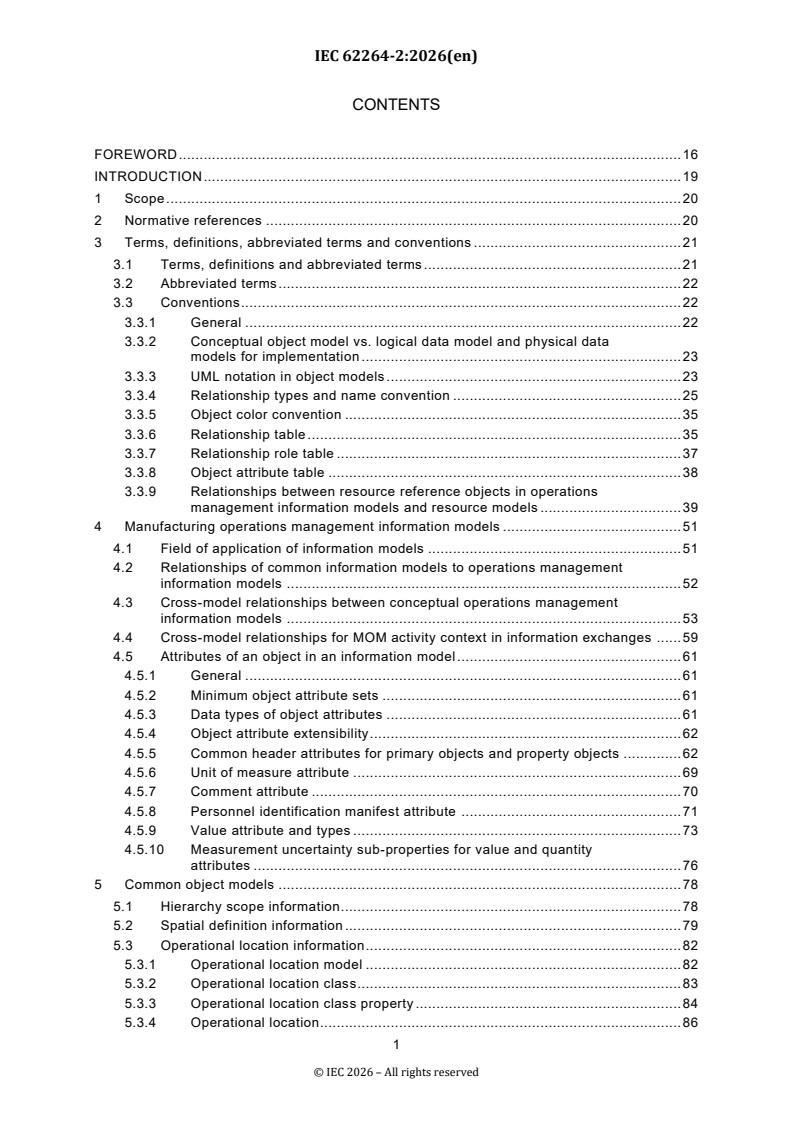
CONTENTS
FOREWORD . 16
INTRODUCTION . 19
1 Scope . 20
2 Normative references . 20
3 Terms, definitions, abbreviated terms and conventions . 21
3.1 Terms, definitions and abbreviated terms . 21
3.2 Abbreviated terms . 22
3.3 Conventions . 22
3.3.1 General . 22
3.3.2 Conceptual object model vs. logical data model and physical data
models for implementation . 23
3.3.3 UML notation in object models . 23
3.3.4 Relationship types and name convention . 25
3.3.5 Object color convention . 35
3.3.6 Relationship table . 35
3.3.7 Relationship role table . 37
3.3.8 Object attribute table . 38
3.3.9 Relationships between resource reference objects in operations
management information models and resource models . 39
4 Manufacturing operations management information models . 51
4.1 Field of application of information models . 51
4.2 Relationships of common information models to operations management
information models . 52
4.3 Cross-model relationships between conceptual operations management
information models . 53
4.4 Cross-model relationships for MOM activity context in information exchanges . 59
4.5 Attributes of an object in an information model . 61
4.5.1 General . 61
4.5.2 Minimum object attribute sets . 61
4.5.3 Data types of object attributes . 61
4.5.4 Object attribute extensibility . 62
4.5.5 Common header attributes for primary objects and property objects . 62
4.5.6 Unit of measure attribute . 69
4.5.7 Comment attribute . 70
4.5.8 Personnel identification manifest attribute . 71
4.5.9 Value attribute and types . 73
4.5.10 Measurement uncertainty sub-properties for value and quantity
attributes . 76
5 Common object models . 78
5.1 Hierarchy scope information. 78
5.2 Spatial definition information . 79
5.3 Operational location information. 82
5.3.1 Operational location model . 82
5.3.2 Operational location class . 83
5.3.3 Operational location class property . 84
5.3.4 Operational location. 86
© IEC 2026 – All rights reserved
IEC 62264-2:2026(en)
IEC FDIS 62264-2 © IEC 2025
5.3.5 Operational location property . 87
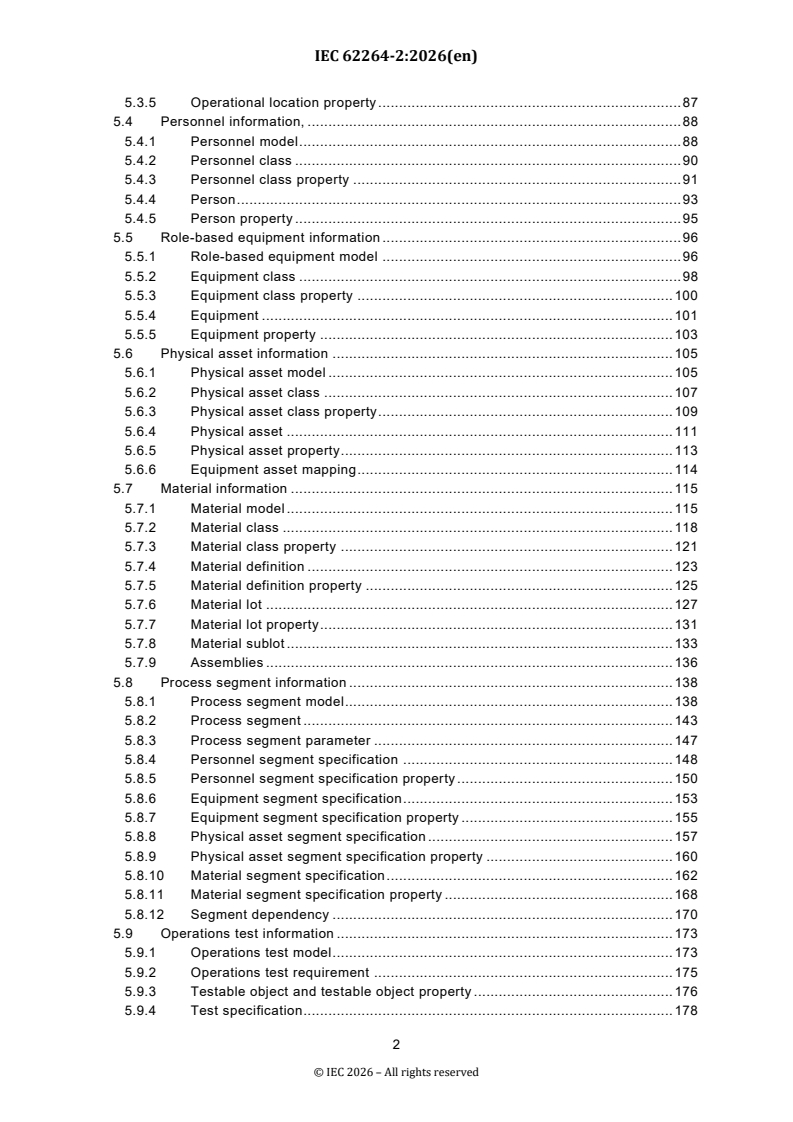
5.4 Personnel information, . 88
5.4.1 Personnel model . 88
5.4.2 Personnel class . 90
5.4.3 Personnel class property . 91
5.4.4 Person . 93
5.4.5 Person property . 95
5.5 Role-based equipment information . 96
5.5.1 Role-based equipment model . 96
5.5.2 Equipment class . 98
5.5.3 Equipment class property . 100
5.5.4 Equipment . 101
5.5.5 Equipment property . 103
5.6 Physical asset information . 105
5.6.1 Physical asset model . 105
5.6.2 Physical asset class . 107
5.6.3 Physical asset class property . 109
5.6.4 Physical asset . 111
5.6.5 Physical asset property. 113
5.6.6 Equipment asset mapping . 114
5.7 Material information . 115
5.7.1 Material model . 115
5.7.2 Material class . 118
5.7.3 Material class property . 121
5.7.4 Material definition . 123
5.7.5 Material definition property . 125
5.7.6 Material lot . 127
5.7.7 Material lot property . 131
5.7.8 Material sublot . 133
5.7.9 Assemblies . 136
5.8 Process segment information . 138
5.8.1 Process segment model. 138
5.8.2 Process segment . 143
5.8.3 Process segment parameter . 147
5.8.4 Personnel segment specification . 148
5.8.5 Personnel segment specification property . 150
5.8.6 Equipment segment specification . 153
5.8.7 Equipment segment specification property . 155
5.8.8 Physical asset segment specification . 157
5.8.9 Physical asset segment specification property . 160
5.8.10 Material segment specification . 162
5.8.11 Material segment specification property . 168
5.8.12 Segment dependency . 170
5.9 Operations test information . 173
5.9.1 Operations test model . 173
5.9.2 Operations test requirement . 175
5.9.3 Testable object and testable object property . 176
5.9.4 Test specification. 178
© IEC 2026 – All rights reserved
IEC 62264-2:2026(en)
IEC FDIS 62264-2 © IEC 2025
5.9.5 Test specification property . 181
5.9.6 Test specification criteria . 182
5.9.7 Evaluated property . 183
5.9.8 Test result . 184
5.9.9 Property measurement . 186
5.9.10 Resource actual. 188
5.10 Operations record information . 189
5.10.1 Operations record model (abstract) . 189
5.10.2 Operations record specification (abstract) . 190
5.10.3 Operations record template (abstract) . 194
5.10.4 Operations record entry template (abstract) . 197
5.11 Operations event information . 199
5.11.1 Operations event model . 199
5.11.2 Operations event class . 201
5.11.3 Operations event class property . 203
5.11.4 Operations event class record specification . 205
5.11.5 Operations event definition . 208
5.11.6 Operations event definition property . 213
5.11.7 Operations event definition record specification . 214
5.11.8 Operations event . 218
5.11.9 Operations event property . 222
5.11.10 Operations event record . 223
5.11.11 Operations event record entry . 225
5.12 Containers, tools, and software . 228
5.12.1 Containers . 228
5.12.2 Tools . 228
5.12.3 Software . 229
6 Operations management information . 229
6.1 Operations definition information . 229
6.1.1 Operations definition model . 229
6.1.2 Operations definition. 234
6.1.3 Operations material bill . 238
6.1.4 Operations material bill item . 240
6.1.5 Operations segment . 242
6.1.6 Parameter specification . 246
6.1.7 Personnel specification . 248
6.1.8 Personnel specification property . 251
6.1.9 Equipment specification . 254
6.1.10 Equipment specification property . 256
6.1.11 Physical asset specification . 259
6.1.12 Physical asset specification property . 261
6.1.13 Material specification . 264
6.1.14 Material specification property . 268
6.1.15 Segment dependency . 271
6.2 Operations schedule information . 273
6.2.1 Operations schedule model . 273
6.2.2 Operations schedule . 277
6.2.3 Operations request . 280
© IEC 2026 – All rights reserved
IEC 62264-2:2026(en)
IEC FDIS 62264-2 © IEC 2025
6.2.4 Segment requirement . 282
6.2.5 Segment parameter . 286
6.2.6 Personnel requirement . 288
6.2.7 Personnel requirement property . 292
6.2.8 Equipment requirement . 294
6.2.9 Equipment requirement property . 297
6.2.10 Physical asset requirement . 299
6.2.11 Physical asset requirement property . 303
6.2.12 Material requirement . 305
6.2.13 Material requirement property . 310
6.2.14 Requested segment response . 313
6.3 Operations performance information . 313
6.3.1 Operations performance model . 313
6.3.2 Operations performance . 317
6.3.3 Operations response . 320
6.3.4 Segment response . 322
6.3.5 Segment data . 325
6.3.6 Personnel actual . 327
6.3.7 Personnel actual property . 329
6.3.8 Equipment actual . 331
6.3.9 Equipment actual property . 334
6.3.10 Physical asset actual . 336
6.3.11 Physical asset actual property . 338
6.3.12 Material actual . 340
6.3.13 Material actual property . 344
6.4 Operations capability information . 346
6.4.1 Operations capability model . 346
6.4.2 Operations capability . 348
6.4.3 Personnel capability . 351
6.4.4 Personnel capability property . 354
6.4.5 Equipment capability . 356
6.4.6 Equipment capability property . 359
6.4.7 Physical asset capability . 361
6.4.8 Physical asset capability property . 364
6.4.9 Material capability. 365
6.4.10 Material capability property . 370
6.5 Process segment capability information . 372
6.5.1 Process segment capability model . 372
6.5.2 Process segment capability . 374
6.6 Operations segment capability information . 378
6.6.1 Operations segment capability model . 378
6.6.2 Operations segment capability . 380
7 Cross-reference between IEC 62264-1 data flow models and the corresponding
IEC 62264-2 object model . 384
8 List of objects . 388
9 Conformance . 391
Annex A (informative) Value syntax in the value attribute . 392
© IEC 2026 – All rights reserved
IEC 62264-2:2026(en)
IEC FDIS 62264-2 © IEC 2025
Annex B (informative) Implementation options for specifying values in unit of
measurement attribute . 393
B.1 Specifying value(s) for the “value unit of measurement” attribute in
operations-related class and definition property objects (IEC 62264-2) and
work-related definition and type property objects (IEC 62264-4). 393
B.2 Specifying value(s) for the “unit of measurement” attribute where no object
specifies permissible values. 394
Annex C (informative) Use cases and examples . 398
C.1 Use case and examples . 398
C.2 Application of the standard . 403
C.3 Database mapping of the models . 404
C.4 XML usage . 405
Annex D (informative) Example data sets. 410
D.1 General . 410
D.2 Material model example . 410
D.3 Equipment model and hierarchy scope examples . 414
D.4 Personnel model example . 418
D.5 Operations capability example . 420
D.6 Operations performance example . 421
D.7 Operations test model use case examples . 422
D.8 Example of planning and response state attributes and defined values . 431
D.9 Operations event definition record specification example . 433
D.10 Resource acquired example . 434
D.11 Work commenced/redirected/completed/aborted example . 437
Annex E (informative) Questions and answers about object use . 439
E.1 General . 439
E.2 Inflow materials . 439
E.3 Multiple products per process segment . 439
E.4 Process segments vs. operations segments . 440
E.5 Segment parameter references . 441
E.6 Use of hierarchy scope in parameter objects . 441
E.7 Use of spatial definition in personnel objects . 442
E.8 How class name and property IDs are used to identify elements . 443
E.9 Possible capability overcounts . 444
E.10 Routing and process capability . 445
E.11 Product and process capability dependencies . 447
E.12 Representation of dependencies . 448
E.13 How a material transfer is handled . 449
E.14 How to extend the standard when properties cannot be used . 449
E.15 Modeling of tools as equipment and materials . 449
E.16 What is difference between equipment and a physical asset? . 450
E.17 How should dependencies in the operations schedule and operations
response be handled? . 450
E.18 How are “mixed” operations types used? . 451
E.19 What is the relationship between this standard and MESA International’s
B2MML? . 452
Annex F (informative) Implementation considerations for inheritance and persistence
of data exchange object models . 453
F.1 Object inheritance considerations . 453
© IEC 2026 – All rights reserved
IEC 62264-2:2026(en)
IEC FDIS 62264-2 © IEC 2025
F.2 Record inheritance . 454
F.3 Object persistence considerations. 455
Annex G (informative) Logical information flows . 458
Annex H (informative) Conceptual model to implementation model transformations . 460
Annex I (informative) Conceptual model to implementation data model examples . 464
I.1 General . 464
I.2 Conceptual object model example: personnel model . 464
I.3 MESA – B2MML 7.0 (XSD) implementation model . 466
I.4 Simplified XSD implementation model . 467
I.5 Object Management Group (OMG) – Interface Definition Language (IDL) –
Common Data Representation (CDR) implementation model. 468
I.6 OPC Unified Architecture (UA) implementation model . 468
I.7 Flat buffers – Interactive Data Language (IDL) implementation model . 470
I.8 Internet Engineering Task Force (IETF) – JavaScript Object Notation (JSON)
– Schema implementation model . 471
I.9 Open Source Robotics Foundation (OSRF) as so known as Open Robotics,
Robot Operating System (ROS) message description specifications (MDS) . 471
I.10 World Wide Web Consortium (W3C) Resource Description Framework (RDF)
schema . 472
I.11 SQL database model . 472
I.12 Transport Protocols . 472
Bibliography . 474
Figure 1 – Example of aggregation relationship notation . 27
Figure 2 – Example of composition relationship notation . 28
Figure 3 – Example: Object model using the simplified UML diagram for an information
model, personnel model . 36
Figure 4 – Simplified UML model convention for cross-model relationships between
resource objects . 39
Figure 5 – Operations information models supporting operations management activities. 51
Figure 6 – Information and object model inter-relationships for operations management
information exchanges . 54
Figure 7 – Data flow diagram for defined cross-model MOM relationships between
operations management and work information models . 60
Figure 8 – Hierarchy scope model . 78
Figure 9 – Example, value attribute for WKT in 2D (3D is equally supported) . 81
Figure 10 – Operational location model . 82
Figure 11 – Personnel model . 89
Figure 12 – Role-based equipment model . 97
Figure 13 – Physical asset model . 106
Figure 14 – Physical asset and equipment relationships . 107
Figure 15 – Material model . 116
Figure 16 – Example, material with an assembly . 138
Figure 17 – Process segment model . 139
Figure 18 – Example, Segment dependency . 173
Figure 19 – Operations test model . 174
Figure 20 – Operations record model (abstract) . 190
© IEC 2026 – All rights reserved
IEC 62264-2:2026(en)
IEC FDIS 62264-2 © IEC 2025
Figure 21 – Operations event model . 200
Figure 22 – Example, Relationship of operations event definition with operations
events . 209
Figure 23 – Operations definition model . 230
Figure 24 – Operations schedule model . 273
Figure 25 – Operations performance model . 314
Figure 26 – Operations capability model . 347
Figure 27 – Process segment capability model . 373
Figure 28 – Operations segment capability model . 379
Figure C.1 – Personnel model . 399
Figure C.2 – Instances of a person class . 401
Figure C.3 – UML model for class and class properties . 401
Figure C.4 – Class property . 402
Figure C.5 – Instances of a person properties . 402
Figure C.6 – Instances of person and person properties . 403
Figure C.7 – XML schema for a person object . 406
Figure C.8 – XML schema for person properties . 407
Figure C.9 – Example of person and person property. 408
Figure C.10 – Example of person class information. 408
Figure C.11 – Adaptor to map different property IDs and values . 409
Figure D.1 – Example of simplified job order state model . 433
Figure D.2 – Typical MOM functions subscribing to the ResourceAcquired event . 434
Figure D.3 – Typical MOM functions subscribing to the WorkCommenced,
WorkRedirected, WorkCompleted and WorkAborted events . 437
Figure E.1 – Class and property IDs used to identify elements . 443
Figure E.2 – A property defining overlapping subsets of the capability . 445
Figure E.3 – Routing for a product . 446
Figure E.4 – Routing with co-products and material dependencies . 446
Figure E.5 – Product and process capability relationships . 447
Figure E.6 – Time-based dependencies . 448
Figure E.7 – Mixed operation example . 451
Figure G.1 – Enterprise to manufacturing system conceptual information flows . 458
Figure G.2 – Conceptual information flows among multiple systems . 459
Figure I.1 – Conceptual object model example: personnel model . 464
Figure I.2 – OPC UA Specification Notation . 469
Figure I.3 – OPC UA representation of the personnel model . 470
Table 1 – Simplified UML symbols and notation used in object models . 24
Table 2 – Relationship role name template with examples for each relationship name
by relationship type . 30
Table 3 – Object color convention . 35
Table 4 – Example: Relationship table for an object model, personnel model
relationships . 36
Table 5 – Example: Relationship role table, Personnel class relationship roles . 37
© IEC 2026 – All rights reserved
IEC 62264-2:2026(en)
IEC FDIS 62264-2 © IEC 2025
Table 6 – Example: Usage of object attribute table . 38
Table 7 – Detailed UML model relationships in Figure 4 . 40
Table 8 – Resource reference object relationship roles . 42
Table 9 – Example: Personnel requirement cross-model relationships to the personnel
model (resource group and resource) . 43
Table 10 – Example: Personnel requirement cross-model relationships to the
personnel reference objects . 43
Table 11 – Resource reference object property relationship roles . 44
Table 12 – Example: Personnel requirement property cross-model relationships to the
personnel model . 44
Table 13 – Example: Personnel requirement property cross-model relationships to the
personnel reference object properties . 45
Table 14 – Resource group relationship roles . 45
Table 15 – Example: Personnel requirement cross-model relationships to the
personnel class . 46
Table 16 – Resource group property relationship roles . 46
Table 17 – Example: Personnel requirement property cross-model relationships with
the personnel class property . 46
Table 18 – Resource relationship roles . 47
Table 19 – Example: Personnel requirement cross-model relationships to the person . 47
Table 20 – Resource property relationship roles . 47
Table 21 – Example: Personnel requirement property cross-model relationships with
the person property . 48
Table 22 – Base resource reference object relationship roles . 48
Table 23 – Example: Personnel requirement cross-model relationships to the
personnel specification . 48
Table 24 – Base resource reference object property relationship roles . 49
Table 25 – Example: Personnel requirement property cross-model relationships to the
personnel specification property . 49
Table 26 – Applied resource reference object relationship roles . 49
Table 27 – Example: Personnel actual cross-model relationships to the personnel
requirement . 50
Table 28 – Applied resource reference object property relationship roles . 50
Table 29 – Example: Personnel actual property cross-model relationships to the
personnel requirement property . 50
Table 30 – Operations management and work information models cross-model
relationships to resource information models and base/applied resource reference
objects . 55
Table 31 – Cross-model MOM relationship description . 60
Table 32 – Common header attributes for a primary object .
...
Questions, Comments and Discussion
Ask us and Technical Secretary will try to provide an answer. You can facilitate discussion about the standard in here.
Loading comments...