

ISO 9013:2017/Amd 1:2024
(Amendment)Thermal cutting — Classification of thermal cuts — Geometrical product specification and quality tolerances — Amendment 1
General Information
- Abstract
- Status
- Published
- Publication Date
- 12-Sep-2024
- Technical Committee
- ISO/TC 44/SC 8 - Equipment for gas welding, cutting and allied processes
- Current Stage
- 6060 - International Standard published
- Start Date
- 13-Sep-2024
- Due Date
- 28-Mar-2025
- Completion Date
- 13-Sep-2024
Buy Documents

ISO 9013:2017/Amd 1:2024 - Thermal cutting — Classification of thermal cuts — Geometrical product specification and quality tolerances — Amendment 1 Released:9/13/2024

ISO 9013:2017/Amd 1:2024 - Coupage thermique — Classification des coupes thermiques — Spécification géométrique des produits et tolérances relatives a la qualité — Amendement 1 Released:10/3/2024
Overview
ISO 9013:2017/Amd 1:2024 is the latest amendment to the internationally recognized standard for thermal cutting, focusing on the classification of thermal cuts and their geometrical product specification (GPS) and quality tolerances. Developed by the International Organization for Standardization (ISO), this amendment updates references and normative documents to maintain global alignment with the latest advances in surface texture specification and product quality requirements. This ensures that professionals using thermal cutting processes benefit from up-to-date practices and quality benchmarks for machined components.
Key Topics
- Thermal Cutting Process: Focused on standards related to procedures that use heat (such as plasma, laser, or oxyfuel cutting) to cut materials, typically metals.
- Classification of Cuts: Guidelines for sorting and specifying the quality and type of cut achieved through thermal cutting methods.
- Geometrical Product Specification (GPS): Establishes precise requirements for the geometry and surface quality of cut components, supporting interoperability and consistency across manufacturing operations.
- Quality Tolerances: Defines acceptable levels of variation in thermal cuts, ensuring reliable, repeatable outcomes.
- Updated Normative References:
- Deprecated the use of ISO 1302:2002 (withdrawn).
- Updated from ISO 4288 to ISO 21920-3 for surface texture profile specifications.
- Additional reference to ISO 21920-1 regarding the indication of surface texture in cut products.
- Alignment with Latest Standards: Ensures ongoing compliance with the most recent measurement and specification techniques in manufacturing.
Applications
ISO 9013:2017/Amd 1:2024 serves professionals in sectors such as metal fabrication, shipbuilding, construction, and machinery manufacturing where thermal cutting technologies are central to production processes. Its practical applications include:
- Manufacturers and Fabricators: Assists in maintaining precise and repeatable product quality, optimizing thermal cutting operations, and achieving compliance with client and regulatory requirements.
- Quality Control Teams: Provides benchmarks for inspection and acceptance of cut components, ensuring surface texture and tolerances meet standardized criteria.
- Design Engineers: Offers a reliable reference for specifying quality requirements in technical drawings and contracts, based on current GPS standards.
- Auditors and Inspectors: Supports consistent evaluation of thermal cutting processes in line with the latest internationally recognized best practices.
By implementing this amendment, organizations ensure greater accuracy, interoperability, and confidence in the performance of their cut products.
Related Standards
Professionals working with ISO 9013:2017/Amd 1:2024 should consider the following standards for best results:
- ISO 9013:2017 - The foundational standard for thermal cutting classification and product specification.
- ISO 21920-1 - Geometrical product specifications (GPS) – Surface texture: Profile – Part 1: Indication of surface texture.
- ISO 21920-3 - Geometrical product specifications (GPS) – Surface texture: Profile – Part 3: Specification operators.
- ICS 25.160.10 - Section of the International Classification for Standards (ICS) covering welding processes and related equipment.
Summary
In summary, ISO 9013:2017/Amd 1:2024 modernizes the reference framework for thermal cutting classification and quality control, ensuring continued relevance and global harmonization. Manufacturers, quality professionals, and design engineers can rely on these guidelines to drive precision, efficiency, and compliance in thermal cutting applications, supporting the highest standards of industrial product quality.
Relations
- Effective Date
- 12-Feb-2026
- Consolidates
ISO/IEC 27403:2024 - Cybersecurity – IoT security and privacy – Guidelines for IoT-domotics - Effective Date
- 28-Oct-2023
- Effective Date
- 28-Oct-2023
Buy Documents
ISO 9013:2017/Amd 1:2024 - Thermal cutting — Classification of thermal cuts — Geometrical product specification and quality tolerances — Amendment 1 Released:9/13/2024
ISO 9013:2017/Amd 1:2024 - Coupage thermique — Classification des coupes thermiques — Spécification géométrique des produits et tolérances relatives a la qualité — Amendement 1 Released:10/3/2024
Get Certified
Connect with accredited certification bodies for this standard

DVS-ZERT GmbH
German welding certification society.
CARES (UK Certification Authority for Reinforcing Steels)
UK certification for reinforcing steels and construction.
EWF/IIW (European/International Welding Federation)
International welding personnel certification.
Sponsored listings
Frequently Asked Questions
ISO 9013:2017/Amd 1:2024 is a standard published by the International Organization for Standardization (ISO). Its full title is "Thermal cutting — Classification of thermal cuts — Geometrical product specification and quality tolerances — Amendment 1". This standard covers: Thermal cutting — Classification of thermal cuts — Geometrical product specification and quality tolerances — Amendment 1
Thermal cutting — Classification of thermal cuts — Geometrical product specification and quality tolerances — Amendment 1
ISO 9013:2017/Amd 1:2024 is classified under the following ICS (International Classification for Standards) categories: 25.160.10 - Welding processes. The ICS classification helps identify the subject area and facilitates finding related standards.
ISO 9013:2017/Amd 1:2024 has the following relationships with other standards: It is inter standard links to EN ISO 9013:2017/A1:2024, ISO/IEC 27403:2024, ISO 9013:2017. Understanding these relationships helps ensure you are using the most current and applicable version of the standard.
ISO 9013:2017/Amd 1:2024 is available in PDF format for immediate download after purchase. The document can be added to your cart and obtained through the secure checkout process. Digital delivery ensures instant access to the complete standard document.
Standards Content (Sample)
International
Standard
ISO 9013
Third edition
Thermal cutting — Classification
2017-02
of thermal cuts — Geometrical
product specification and quality
AMENDMENT 1
tolerances
2024-09
AMENDMENT 1
Coupage thermique — Classification des coupes thermiques —
Spécification géométrique des produits et tolérances relatives à
la qualité
AMENDEMENT 1
Reference number
ISO 9013:2017/Amd.1:2024(en) © ISO 2024
ISO 9013:2017/Amd.1:2024(en)
© ISO 2024
All rights reserved. Unless otherwise specified, or required in the context of its implementation, no part of this publication may
be reproduced or utilized otherwise in any form or by any means, electronic or mechanical, including photocopying, or posting on
the internet or an intranet, without prior written permission. Permission can be requested from either ISO at the address below
or ISO’s member body in the country of the requester.
ISO copyright office
CP 401 • Ch. de Blandonnet 8
CH-1214 Vernier, Geneva
Phone: +41 22 749 01 11
Email: copyright@iso.org
Website: www.iso.org
Published in Switzerland
ii
ISO 9013:2017/Amd.1:2024(en)
Foreword
ISO (the International Organization for Standardization) is a worldwide federation of national standards
bodies (ISO member bodies). The work of preparing International Standards is normally carried out through
ISO technical committees. Each member body interested in a subject for which a technical committee
has been established has the right to be represented on that committee. International organizations,
governmental and non-governmental, in liaison with ISO, also take part in the work. ISO collaborates closely
with the International Electrotechnical Commission (IEC) on all matters of electrotechnical standardization.
The procedures used to develop this document and those intended for its further maintenance are described
in the ISO/IEC Directives, Part 1. In particular, the different approval criteria needed for the different types
of ISO documents should be noted. This document was drafted in accordance with the editorial rules of the
ISO/IEC Directives, Part 2 (see www.iso.org/directives).
ISO draws attention to the possibility that the implementation of this document may involve the use of (a)
patent(s). ISO takes no position concerning the evidence, validity or applicability of any claimed patent
rights in respect thereof. As of the date of publication of this document, ISO had not received notice of (a)
p
...
Norme
internationale
ISO 9013
Troisième édition
Coupage thermique —
2017-02
Classification des coupes
thermiques — Spécification
AMENDEMENT 1
géométrique des produits et
2024-09
tolérances relatives à la qualité
AMENDEMENT 1
Thermal cutting — Classification of thermal cuts — Geometrical
product specification and quality tolerances
AMENDMENT 1
Numéro de référence
ISO 9013:2017/Amd.1:2024(fr) © ISO 2024
ISO 9013:2017/Amd.1:2024(fr)
DOCUMENT PROTÉGÉ PAR COPYRIGHT
© ISO 2024
Tous droits réservés. Sauf prescription différente ou nécessité dans le contexte de sa mise en œuvre, aucune partie de cette
publication ne peut être reproduite ni utilisée sous quelque forme que ce soit et par aucun procédé, électronique ou mécanique,
y compris la photocopie, ou la diffusion sur l’internet ou sur un intranet, sans autorisation écrite préalable. Une autorisation peut
être demandée à l’ISO à l’adresse ci-après ou au comité membre de l’ISO dans le pays du demandeur.
ISO copyright office
Case postale 401 • Ch. de Blandonnet 8
CH-1214 Vernier, Genève
Tél.: +41 22 749 01 11
E-mail: copyright@iso.org
Web: www.iso.org
Publié en Suisse
ii
ISO 9013:2017/Amd.1:2024(fr)
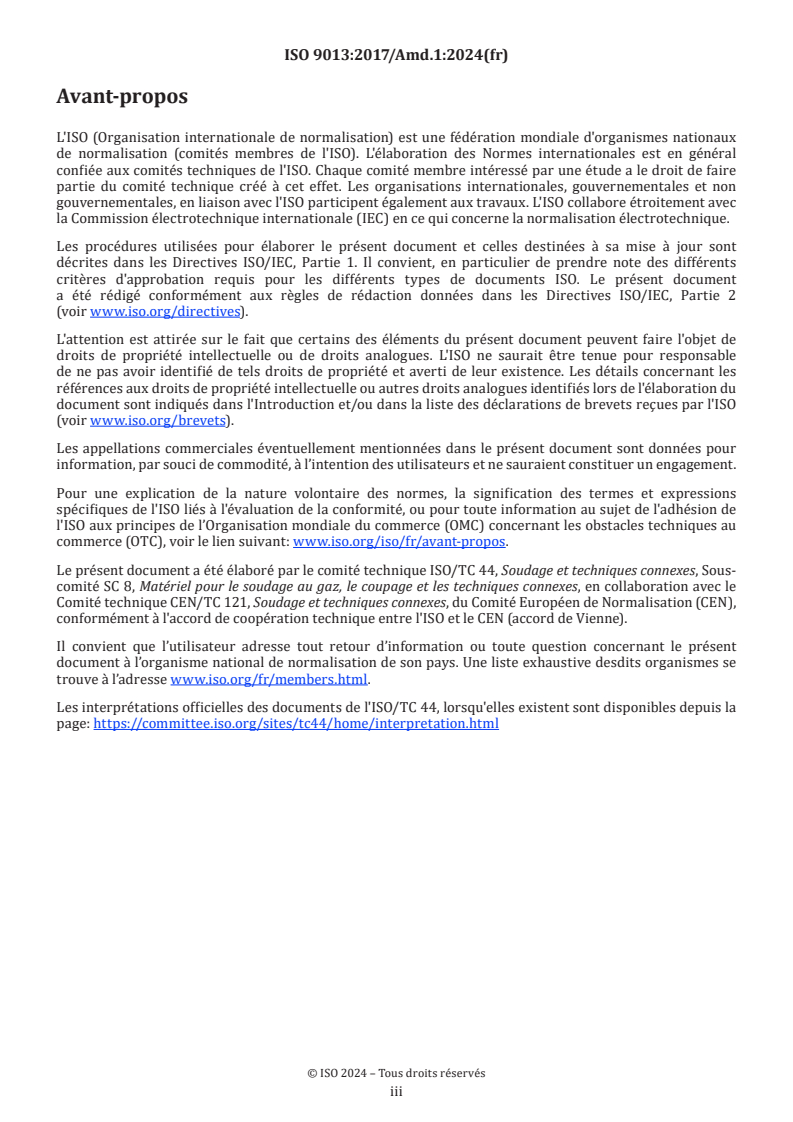
Avant-propos
L'ISO (Organisation internationale de normalisation) est une fédération mondiale d'organismes nationaux
de normalisation (comités membres de l'ISO). L'élaboration des Normes internationales est en général
confiée aux comités techniques de l'ISO. Chaque comité membre intéressé par une étude a le droit de faire
partie du comité technique créé à cet effet. Les organisations internationales, gouvernementales et non
gouvernementales, en liaison avec l'ISO participent également aux travaux. L'ISO collabore étroitement avec
la Commission électrotechnique internationale (IEC) en ce qui concerne la normalisation électrotechnique.
Les procédures utilisées pour élaborer le présent document et celles destinées à sa mise à jour sont
décrites dans les Directives ISO/IEC, Partie 1. Il convient, en particulier de prendre note des différents
critères d'approbation requis pour les différents types de documents ISO. Le présent document
a été rédigé conformément aux règles de rédaction données dans les Directives ISO/IEC, Partie 2
(voir www.iso.org/directives).
L'attention est attirée sur le fait que certains des éléments du présent document peuvent faire l'objet de
droits de propriété intellectuelle ou de droits analogues. L'ISO ne saurait être tenue pour responsable
de ne pas avoir identifié de tels droits de propriété et averti de leur existence. Les détails concernant les
références aux droits de propriété intellectuelle ou autres droits analogues identifiés lors de l'élaborati
...