

ISO 21026-1
(Main)Heat supply network — Vocabulary — Part 1: System
- Abstract
This document defines general terms for district heating and cooling systems, including sources, pipelines, substations, and consumers.
- Status
- Not Published
- Technical Committee
- ISO/TC 341 - ISO/TC 341
- Drafting Committee
- ISO/TC 341 - ISO/TC 341
- Current Stage
- 6000 - International Standard under publication
- Start Date
- 28-Aug-2026
- Completion Date
- 10-Oct-2026
Buy Documents
ISO/FDIS 21026-1 - Heat supply network — Vocabulary — Part 1: System
REDLINE ISO/FDIS 21026-1 - Heat supply network — Vocabulary — Part 1: System
ISO 21026-1 is an ISO vocabulary standard for heat supply networks. It defines general terms for district heating and/or cooling systems, including sources, pipelines, substations and users, so engineers and other stakeholders can use the same language.
What does ISO 21026-1 specify?
ISO 21026-1 specifies the vocabulary for district heating and/or cooling systems. Clause 1 states the scope, clause 2 covers normative references, and clause 3 contains the terms and definitions grouped by topic.
The document is organized around five main term groups:
- district heating and/or cooling system
- heat and cold source
- pipeline
- substation and station
- heat and cold user
A bibliography and an index close the document. In practice, this structure makes it a terminology reference for writing specifications, drawings, training material and technical discussions.
What are the key requirements of ISO 21026-1?
ISO 21026-1 is a vocabulary document, so its main technical content is the set of defined terms. The most important point is that it standardizes how the parts of a heat supply network are named and related to each other.
System structure and operating modes
Clause 3.1 defines the district heating and/or cooling system as the pipe-based transport and distribution of a heating and/or cooling medium from sources to multiple users in a district. It also defines related system types such as open system, closed system, circulation system, direct connection, indirect connection, mixing loop, primary system and secondary system. In practice, these terms help you describe whether media are hydraulically separated, how temperature is controlled, and where responsibility changes from one part of the network to another.
Sources and storage
Clause 3.2 defines the heat/cold source, cogeneration and thermal energy storage (TES). ISO 21026-1 uses these terms to describe where thermal energy comes from and how it may be accumulated, retained and released for later use. That matters when you document plant functions, energy flows and storage roles in a network.
Pipelines and network layout
Clause 3.3 defines pipeline, network, supply pipeline, return pipeline, transmission pipeline, distribution pipeline and user connection, as well as bonded and non-bonded pipeline, above-ground pipeline and underground pipeline variants. It also distinguishes directly buried bonded and non-bonded pipelines and underground in-duct pipeline. These definitions matter because design, installation, inspection and maintenance depend on the pipe type and its location.
Substations and stations
Clause 3.4 defines substation as a facility for metering, monitoring, regulating, mixing and/or hydraulic separation of medium. It also defines user substation, area substation, boost pump station, pressure reduction station, circulating pump and boost pump. In practice, this section tells you how the network interfaces with buildings or areas and how pressure and flow are managed.
Users and end uses
Clause 3.5 defines heat user, cold user and several end-use categories: space heating user, space cooling user, ventilation user, air conditioning user, domestic hot water user and process heating user. This helps readers name the service being delivered instead of using vague terms like “load” or “consumer.”
Smart systems
Clause 3.1.11 defines a smart district heating and/or cooling system as one that uses information and communications technology (ICT) to improve efficiency, economy and resilience. In practice, this points to digital monitoring and control as part of the terminology.
What terms does ISO 21026-1 define?
ISO 21026-1 defines the core vocabulary of district heating and/or cooling systems. These are the terms readers most often need to use consistently.
- District heating and/or cooling system - a pipe network that carries heating and/or cooling medium from sources to multiple users across a district.
- Primary system - the part of the system from a heat or cold source to a substation.
- Secondary system - the part of the system from a substation to a heat or cold user.
- Substation - a facility for measuring, monitoring, regulating, mixing and/or separating the medium.
- Pipeline - a pipe assembly used to transport heating or cooling medium between locations in the network.
- Thermal energy storage (TES) - the action or method of storing thermal energy for later use.
- Smart district heating and/or cooling system - a district heating and/or cooling system that uses ICT to improve performance and resilience.
Who uses ISO 21026-1?
ISO 21026-1 is intended for experts developing ISO standards for heat supply networks, and for professionals involved in design, construction, operation, maintenance and decommissioning. It is also useful for new entrants and external stakeholders who need basic knowledge of the field. In practice, it supports consistent terminology in contracts, project documents, asset records, training and technical reviews.
Which standards are used with ISO 21026-1?
ISO 21026-1 states that it has no normative references. Its bibliography cites ISO/IEC 13273-1:2015, which provides background terminology for energy efficiency, and ISO 5598:2020, which provides general vocabulary for fluid power systems and components.
What does the ISO 21026-1 document contain?
ISO 21026-1 contains clause 1 scope, clause 2 normative references and clause 3 terms and definitions. It includes Figure 1, which shows the principle structure of a district heating and/or cooling system, and Figure 2, which illustrates a mixing loop. The document also includes an index that lists the defined terms for quick lookup.
Buy Documents
ISO/FDIS 21026-1 - Heat supply network — Vocabulary — Part 1: System
REDLINE ISO/FDIS 21026-1 - Heat supply network — Vocabulary — Part 1: System
Get Certified
Connect with accredited certification bodies for this standard

Institut za varilstvo d.o.o. (Welding Institute)
Slovenia's leading welding institute since 1952. ISO 3834, EN 1090, pressure equipment certification, NDT personnel, welder qualification. Only IIW Au
Sponsored listings
Frequently Asked Questions
ISO 21026-1 is a draft published by the International Organization for Standardization (ISO). Its full title is "Heat supply network — Vocabulary — Part 1: System". This standard covers: This document defines general terms for district heating and cooling systems, including sources, pipelines, substations, and consumers.
This document defines general terms for district heating and cooling systems, including sources, pipelines, substations, and consumers.
ISO 21026-1 is classified under the following ICS (International Classification for Standards) categories: 01.040.23 - Fluid systems and components for general use (Vocabularies); 23.040.07 - Pipeline and its parts for district heat. The ICS classification helps identify the subject area and facilitates finding related standards.
ISO 21026-1 is available in PDF format for immediate download after purchase. The document can be added to your cart and obtained through the secure checkout process. Digital delivery ensures instant access to the complete standard document.
Standards Content (Sample)
FINAL DRAFT
International
Standard
ISO/FDIS 21026-1
ISO/TC 341
Heat supply network —
Secretariat: SAC
Vocabulary —
Voting begins on:
2026-07-02
Part 1:
System
Voting terminates on:
2026-08-27
Réseau de distribution de chaleur — Vocabulaire —
Partie 1: Système
RECIPIENTS OF THIS DRAFT ARE INVITED TO SUBMIT,
WITH THEIR COMMENTS, NOTIFICATION OF ANY
RELEVANT PATENT RIGHTS OF WHICH THEY ARE AWARE
AND TO PROVIDE SUPPOR TING DOCUMENTATION.
IN ADDITION TO THEIR EVALUATION AS
BEING ACCEPTABLE FOR INDUSTRIAL, TECHNO-
LOGICAL, COMMERCIAL AND USER PURPOSES, DRAFT
INTERNATIONAL STANDARDS MAY ON OCCASION HAVE
TO BE CONSIDERED IN THE LIGHT OF THEIR POTENTIAL
TO BECOME STAN DARDS TO WHICH REFERENCE MAY BE
MADE IN NATIONAL REGULATIONS.
Reference number
ISO/FDIS 21026-1:2026(en) © ISO 2026
FINAL DRAFT
ISO/FDIS 21026-1:2026(en)
International
Standard
ISO/FDIS 21026-1
ISO/TC 341
Heat supply network —
Secretariat: SAC
Vocabulary —
Voting begins on:
Part 1:
System
Voting terminates on:
Réseau de distribution de chaleur — Vocabulaire —
Partie 1: Système
RECIPIENTS OF THIS DRAFT ARE INVITED TO SUBMIT,
WITH THEIR COMMENTS, NOTIFICATION OF ANY
RELEVANT PATENT RIGHTS OF WHICH THEY ARE AWARE
AND TO PROVIDE SUPPOR TING DOCUMENTATION.
© ISO 2026
IN ADDITION TO THEIR EVALUATION AS
All rights reserved. Unless otherwise specified, or required in the context of its implementation, no part of this publication may
BEING ACCEPTABLE FOR INDUSTRIAL, TECHNO-
LOGICAL, COMMERCIAL AND USER PURPOSES, DRAFT
be reproduced or utilized otherwise in any form or by any means, electronic or mechanical, including photocopying, or posting on
INTERNATIONAL STANDARDS MAY ON OCCASION HAVE
the internet or an intranet, without prior written permission. Permission can be requested from either ISO at the address below
TO BE CONSIDERED IN THE LIGHT OF THEIR POTENTIAL
or ISO’s member body in the country of the requester.
TO BECOME STAN DARDS TO WHICH REFERENCE MAY BE
MADE IN NATIONAL REGULATIONS.
ISO copyright office
CP 401 • Ch. de Blandonnet 8
CH-1214 Vernier, Geneva
Phone: +41 22 749 01 11
Email: copyright@iso.org
Website: www.iso.org
Published in Switzerland Reference number
ISO/FDIS 21026-1:2026(en) © ISO 2026
ii
ISO/FDIS 21026-1:2026(en)
Contents Page
Foreword .iv
Introduction .v
1 Scope . 1
2 Normative references . 1
3 Terms and definitions . 1
3.1 District heating and/or cooling system .1
3.2 Heat and cold source .4
3.3 Pipeline .4
3.4 Substation and station .6
3.5 Heat and cold user .7
Bibliography . 9
Index . 10
iii
ISO/FDIS 21026-1:2026(en)
Foreword
ISO (the International Organization for Standardization) is a worldwide federation of national standards
bodies (ISO member bodies). The work of preparing International Standards is normally carried out through
ISO technical committees. Each member body interested in a subject for which a technical committee
has been established has the right to be represented on that committee. International organizations,
governmental and non-governmental, in liaison with ISO, also take part in the work. ISO collaborates closely
with the International Electrotechnical Commission (IEC) on all matters of electrotechnical standardization.
The procedures used to develop this document and those intended for its further maintenance are described
in the ISO/IEC Directives, Part 1. In particular, the different approval criteria needed for the different types
of ISO document should be noted. This document was drafted in accordance with the editorial rules of the
ISO/IEC Directives, Part 2 (see www.iso.org/directives).
ISO draws attention to the possibility that the implementation of this document may involve the use of (a)
patent(s). ISO takes no position concerning the evidence, validity or applicability of any claimed patent
rights in respect thereof. As of the date of publication of this document, ISO had not received notice of (a)
patent(s) which may be required to implement this document. However, implementers are cautioned that
this may not represent the latest information, which may be obtained from the patent database available at
www.iso.org/patents. ISO shall not be held responsible for identifying any or all such patent rights.
Any trade name used in this document is information given for the convenience of users and does not
constitute an endorsement. For an explanation of the voluntary nature of standards, the meaning of ISO
specific terms and expressions related to conformity assessment, as well as information about ISO's
adherence to the World Trade Organization (WTO) principles in the Technical Barriers to Trade (TBT), see
www.iso.org/iso/foreword.html.
This document was prepared by Technical Committee ISO/TC 341, Heat supply network.
A list of all parts in the ISO 21026 series can be found on the ISO website.
Any feedback or questions on this document should be directed to the user’s national standards body. A
complete listing of these bodies can be found at www.iso.org/members.html.
iv
ISO/FDIS 21026-1:2026(en)
Introduction
This document provides terms and definitions for district heating and/or cooling systems and their
components to support consistent use of terminology in International Standards.
This document aims to facilitate effective communication among the following groups:
— experts engaged in the development of ISO standards for heat supply networks;
— professionals involved in the design, construction, operation, maintenance, and decommissioning of heat
supply networks;
— new entrants to the field and external stakeholders seeking to acquire basic knowledge of heat supply
networks.
v
FINAL DRAFT International Standard ISO/FDIS 21026-1:2026(en)
Heat supply network — Vocabulary —
Part 1:
System
1 Scope
This document defines general terms for district heating and/or cooling systems.
2 Normative references
There are no normative references in this document.
3 Terms and definitions
ISO and IEC maintain terminology databases for use in standardization at the following addresses:
— IEC Electropedia: available at http:// www .electropedia .org/
— ISO Online browsing platform: available at http:// www .iso .org/ obp
3.1 District heating and/or cooling system
3.1.1
district heating and/or cooling system
system that transports and distributes heating and/or cooling medium through pipes from heat and/or cold
sources to a number of users across a district
Note 1 to entry: A district heating and/or cooling system includes sources, pipelines, substations, and users.
Note 2 to entry: The medium can be water or steam. When the medium is water, it is referred to as a water district
heating and/or cooling system. When the medium is steam, it is referred to as a steam district heating system.
Note 3 to entry: For the principle of the structure of a district heating and/or cooling system, see Figure 1.
ISO/FDIS 21026-1:2026(en)
Key
1 heat or cold source
2 thermal energy storage
3 area substation
4 user substation
5 transmission pipeline
6 distribution pipeline
7 user connection
8 primary system
9 secondary system
Figure 1 — Principle for the structure of district heating and/or cooling system
3.1.2
condensate return system
system that collects condensed steam and returns it to the heat sources
Note 1 to entry: Depending on the temperature and pressure, condensed steam can be present as water or consist of
water and steam fractions (wet steam, flash steam).
Note 2 to entry: Condensate return system is normally part of a steam district heating system.
ISO/FDIS 21026-1:2026(en)
3.1.3
circulation system
system in which the medium is returned to heat or cold sources
3.1.4
closed system
sealed system
system in which the medium is closed to the atmosphere
3.1.5
open system
system in which the medium is open to the atmosphere
EXAMPLE A steam district heating system is an open system, in which steam is extracted and directly in contact
with the atmosphere or when open water tanks are used in the condensate return system. A water district heating
system is an open system, in which water is extracted and directly in contact with the atmosphere.
3.1.6
direct connection
configuration in which medium flows from heat or cold sources directly to users without hydraulic
separation
3.1.7
indirect connection
configuration that separates media of two hydraulically independent systems but can transfer heat between
them
Note 1 to entry: The two hydraulically independent systems can be primary and secondary systems, or secondary and
user systems.
3.1.8
mixing loop
configuration that adjusts the temperature of supply medium by blending water from return pipeline or
other heat or cold sources to a
...
ISO/DISFDIS 21026-1
ISO/TC 341
Secretariat: SAC
Date: 2026-05-11
Heat supply network — Vocabulary —
Part 1:
System
Réseau de distribution de chaleur — Vocabulaire —
Partie 1: Système
DISFDIS stage
Voting bVoting bVoting bVoting bVoting bVoting begins on:egins on:egins on:egins on:egins on:egins on: 2025 2025 2025 2025 2025 2025------121212121212------1111115 5 5 5 5 5
Voting tVoting tVoting tVoting tVoting tVoting tererererererminates on: 20minates on: 20minates on: 20minates on: 20minates on: 20minates on: 20262626262626------030303030303------090909090909
ISO/DISFDIS 21026-1:2026(en)
All rights reserved. Unless otherwise specified, or required in the context of its implementation, no part of this publication
may be reproduced or utilized otherwise in any form or by any means, electronic or mechanical, including photocopying,
or posting on the internet or an intranet, without prior written permission. Permission can be requested from either ISO
at the address below or ISO’s member body in the country of the requester.
ISO copyright office
CP 401 • Ch. de Blandonnet 8
CH-1214 Vernier, Geneva
Phone: + 41 22 749 01 11
E-mail: copyright@iso.org
Website: www.iso.org
Published in Switzerland
ii
ISO/DISFDIS 21026-1:2026(en)
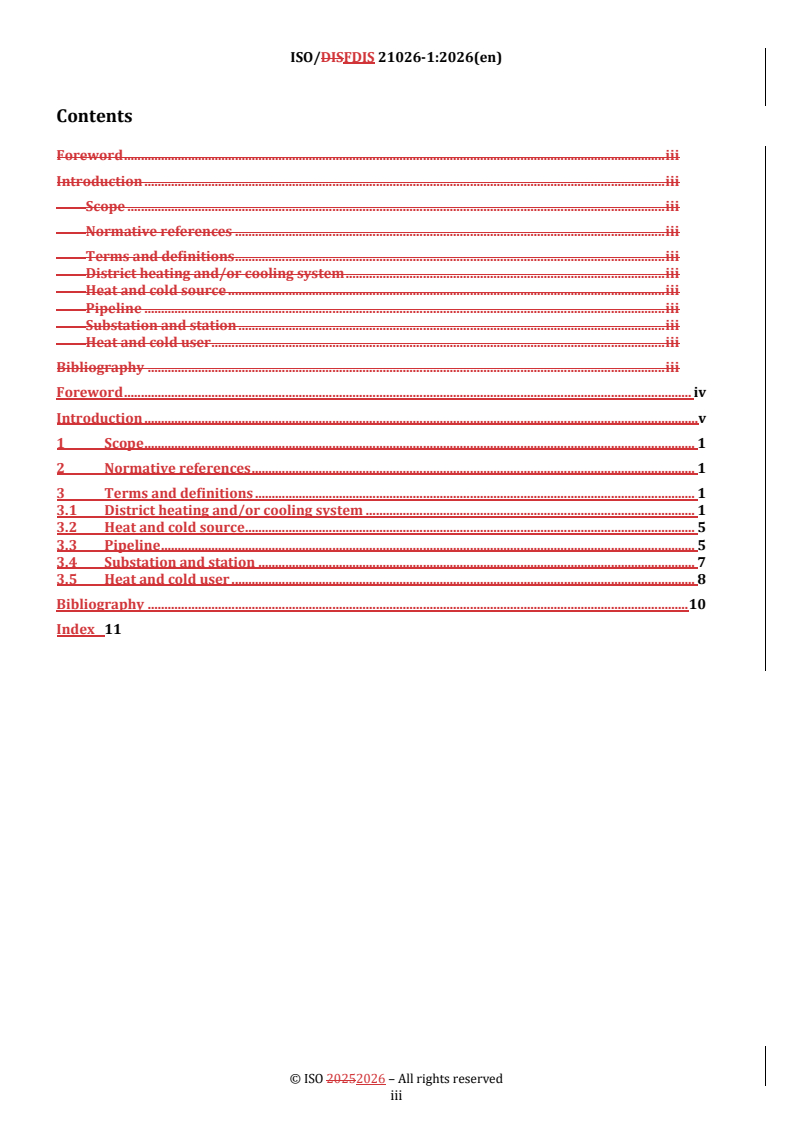
Contents
Foreword . iii
Introduction . iii
Scope . iii
Normative references . iii
Terms and definitions . iii
District heating and/or cooling system . iii
Heat and cold source . iii
Pipeline . iii
Substation and station . iii
Heat and cold user . iii
Bibliography . iii
Foreword . iv
Introduction . v
1 Scope . 1
2 Normative references . 1
3 Terms and definitions . 1
3.1 District heating and/or cooling system . 1
3.2 Heat and cold source . 5
3.3 Pipeline . 5
3.4 Substation and station . 7
3.5 Heat and cold user . 8
Bibliography . 10
Index 11
iii
ISO/DISFDIS 21026-1:2026(en)
Foreword
ISO (the International Organization for Standardization) is a worldwide federation of national standards
bodies (ISO member bodies). The work of preparing International Standards is normally carried out through
ISO technical committees. Each member body interested in a subject for which a technical committee has been
established has the right to be represented on that committee. International organizations, governmental and
non-governmental, in liaison with ISO, also take part in the work. ISO collaborates closely with the
International Electrotechnical Commission (IEC) on all matters of electrotechnical standardization.
The procedures used to develop this document and those intended for its further maintenance are described
in the ISO/IEC Directives, Part 1. In particular, the different approval criteria needed for the different types of
ISO document should be noted. This document was drafted in accordance with the editorial rules of the
ISO/IEC Directives, Part 2 (see www.iso.org/directives).www.iso.org/directives).
ISO draws attention to the possibility that the implementation of this document may involve the use of (a)
patent(s). ISO takes no position concerning the evidence, validity or applicability of any claimed patent rights
in respect thereof. As of the date of publication of this document, ISO had not received notice of (a) patent(s)
which may be required to implement this document. However, implementers are cautioned that this may not
represent the latest information, which may be obtained from the patent database available at
www.iso.org/patents.www.iso.org/patents. ISO shall not be held responsible for identifying any or all such
patent rights.
Any trade name used in this document is information given for the convenience of users and does not
constitute an endorsement. For an explanation of the voluntary nature of standards, the meaning of ISO
specific terms and expressions related to conformity assessment, as well as information about ISO's adherence
to the World Trade Organization (WTO) principles in the Technical Barriers to Trade (TBT), see
www.iso.org/iso/foreword.html.www.iso.org/iso/foreword.html.
This document was prepared by Technical Committee ISO/TC 341, Heat supply network.
A list of all parts in the ISO 21026 series can be found on the ISO website.
Any feedback or questions on this document should be directed to the user’s national standards body. A
complete listing of these bodies can be found at www.iso.org/members.html.www.iso.org/members.html.
iv
ISO/DISFDIS 21026-1:2026(en)
Introduction
This document provides terms and definitions for district heating and/or cooling systems and their
components to support consistent use of terminology in International Standards.
This document aims to facilitate effective communication among the following groups:
— experts engaged in the development of ISO standards for heat supply networks;
— professionals involved in the design, construction, operation, maintenance, and decommissioning of heat
supply networks;
— new entrants to the field and external stakeholders seeking to acquire basic knowledge of heat supply
networks.
v
ISO/DISFDIS 21026-1:2026(en)
Heat supply network — Vocabulary —
Part 1:
System
1 Scope
This document defines general terms for district heating and/or cooling systems.
2 Normative references
There are no normative references in this document.
3 Terms and definitions
ISO and IEC maintain terminology databases for use in standardization at the following addresses:
— IEC Electropedia: available at http://www.electropedia.org/
— ISO Online browsing platform: available at http://www.iso.org/obp
3.1 District heating and/or cooling system
3.1.1
district heating and/or cooling system
system that transports and distributes heating and/or cooling medium through pipes from heat and/or cold
sources to a number of users across a district
Note 1 to entry: A district heating and/or cooling system includes sources, pipelines, substations, and users.
Note 2 to entry: The medium can be water or steam. When the medium is water, it is referred to as a water district heating
and/or cooling system. When the medium is steam, it is referred to as a steam district heating system.
Note 3 to entry: For the principle of the structure of a district heating and/or cooling system, see Figure 1 .
ISO/DISFDIS 21026-1:2026(en)
ISO/DISFDIS 21026-1:2026(en)
Key
1 heat or cold source
2 thermal energy storage
3 area substation
4 user substation
5 transmission pipeline
6 distribution pipeline
7 user connection
8 primary system
9 secondary system
Figure 1 — Principle for the structure of district heating and/or cooling system
3.1.2
condensate return system
system that collects condensed steam and returns it to the heat sources
Note 1 to entry: Depending on the temperature and pressure, condensed steam can be present as water or consist of
water and steam fractions (wet steam, flash steam).
Note 2 to entry: Condensate return system is normally part of a steam district heating system.
ISO/DISFDIS 21026-1:2026(en)
3.1.3
circulation system
system in which the medium is returned to heat or cold sources
3.1.4
closed system
sealed system, noun
system in which the medium is closed to the atmosphere
3.1.5
open system
system in which the medium is open to the atmosphere
EXAMPLE A steam district heating system is thean open system, in which steam is extracted and directly in contact
with the atmosphere or when open water tanks are used in the condensate return system. A water district heating system
is thean open system, in which water is extracted and directly in contact with the atmosphere.
3.1.6
direct connection
configuration in which medium flows from heat or cold sources directly to users without hydraulic separation
3.1.7
indirect connection
configuration that separates media of two hydraulically independent systems but can transfer heat between
them
Note 1 to entry: The two hydraulically independent systems can be primary and secondary systems, or secondary and
user systems.
3.1.8
mixing loop
configuration that adjusts the temperature of supply medium by blending water from return pipe
...