


ISO/IEC Guide 76:2008
(Main)Development of service standards — Recommendations for addressing consumer issues
Development of service standards — Recommendations for addressing consumer issues
ISO/IEC Guide 76:2008 provides general guidance on the issues to be considered in standards for services. On the basis of this guidance, detailed standards can be prepared for any service. ISO/IEC Guide 76:2008 provides a checklist which can be used by consumer representatives and others participating in the process of standards development. Use of the checklist enables full consideration to be given to all matters of consumer interest, including the needs of children, older persons, persons with disabilities and those from different ethnic and cultural heritages. ISO/IEC Guide 76:2008 is relevant to the full range of services, whether or not a formal contract is entered into or purchase price paid, but it also has relevance for public or charitable services in which there is a consumer, a user or a participant, but not necessarily a purchase, e.g. education, health and care provision.
Élaboration des normes de service — Recommandations pour répondre aux attentes des consommateurs
L'ISO/CEI Guide 76:2008 fournit des directives générales relatives aux questions à traiter dans les normes pour les services. Ces directives peuvent servir de base à l'élaboration de normes détaillées pour tout service. L'ISO/CEI Guide 76:2008 propose une liste de contrôle qui peut être utilisée par les représentants des consommateurs et par toute autre personne participant au processus d'élaboration de normes. L'utilisation de cette liste de contrôle permet de pleinement prendre en considération tous les sujets présentant un intérêt pour les consommateurs, y compris les besoins des enfants, des personnes âgées, des personnes présentant des incapacités et celles d'origines ethniques et culturelles différentes. L'ISO/CEI Guide 76:2008 s'applique à l'ensemble de la gamme des services, qu'ils soient assurés par conclusion d'un contrat formel ou par règlement direct du prix d'achat. Il concerne également les services publics et de bienfaisance qui impliquent un consommateur, un utilisateur ou un participant mais pas nécessairement un achat, par exemple dans le domaine de l'éducation, de la santé et des soins.
General Information
- Status
- Withdrawn
- Publication Date
- 15-Jan-2008
- Withdrawal Date
- 15-Jan-2008
- Technical Committee
- ISO/COPOLCO - Committee on consumer policy
- Drafting Committee
- ISO/COPOLCO - Committee on consumer policy
- Current Stage
- 9599 - Withdrawal of International Standard
- Start Date
- 28-Apr-2020
- Completion Date
- 12-Feb-2026
Relations
- Effective Date
- 06-May-2017
ISO/IEC Guide 76:2008 - Development of service standards -- Recommendations for addressing consumer issues
ISO/IEC Guide 76:2008 - Élaboration des normes de service -- Recommandations pour répondre aux attentes des consommateurs
Get Certified
Connect with accredited certification bodies for this standard

Great Wall Tianjin Quality Assurance Center
Established 1993, first batch to receive national accreditation with IAF recognition.
Hong Kong Quality Assurance Agency (HKQAA)
Hong Kong's leading certification body.

Innovative Quality Certifications Pvt. Ltd. (IQCPL)
Known for integrity, providing ethical & impartial Assessment & Certification. CMMI Institute Partner.
Sponsored listings
Frequently Asked Questions
ISO/IEC Guide 76:2008 is a guide published by the International Organization for Standardization (ISO). Its full title is "Development of service standards — Recommendations for addressing consumer issues". This standard covers: ISO/IEC Guide 76:2008 provides general guidance on the issues to be considered in standards for services. On the basis of this guidance, detailed standards can be prepared for any service. ISO/IEC Guide 76:2008 provides a checklist which can be used by consumer representatives and others participating in the process of standards development. Use of the checklist enables full consideration to be given to all matters of consumer interest, including the needs of children, older persons, persons with disabilities and those from different ethnic and cultural heritages. ISO/IEC Guide 76:2008 is relevant to the full range of services, whether or not a formal contract is entered into or purchase price paid, but it also has relevance for public or charitable services in which there is a consumer, a user or a participant, but not necessarily a purchase, e.g. education, health and care provision.
ISO/IEC Guide 76:2008 provides general guidance on the issues to be considered in standards for services. On the basis of this guidance, detailed standards can be prepared for any service. ISO/IEC Guide 76:2008 provides a checklist which can be used by consumer representatives and others participating in the process of standards development. Use of the checklist enables full consideration to be given to all matters of consumer interest, including the needs of children, older persons, persons with disabilities and those from different ethnic and cultural heritages. ISO/IEC Guide 76:2008 is relevant to the full range of services, whether or not a formal contract is entered into or purchase price paid, but it also has relevance for public or charitable services in which there is a consumer, a user or a participant, but not necessarily a purchase, e.g. education, health and care provision.
ISO/IEC Guide 76:2008 is classified under the following ICS (International Classification for Standards) categories: 03.080.01 - Services in general. The ICS classification helps identify the subject area and facilitates finding related standards.
ISO/IEC Guide 76:2008 has the following relationships with other standards: It is inter standard links to ISO/IEC Guide 76:2020. Understanding these relationships helps ensure you are using the most current and applicable version of the standard.
ISO/IEC Guide 76:2008 is available in PDF format for immediate download after purchase. The document can be added to your cart and obtained through the secure checkout process. Digital delivery ensures instant access to the complete standard document.
Standards Content (Sample)
GUIDE 76
Development of service
standards — Recommendations
for addressing consumer issues
First edition 2008
Corrected version 2008
©
ISO/IEC 2008
PDF disclaimer
This PDF file may contain embedded typefaces. In accordance with Adobe's licensing policy, this file may be printed or viewed but
shall not be edited unless the typefaces which are embedded are licensed to and installed on the computer performing the editing. In
downloading this file, parties accept therein the responsibility of not infringing Adobe's licensing policy. The ISO Central Secretariat
accepts no liability in this area.
Adobe is a trademark of Adobe Systems Incorporated.
Details of the software products used to create this PDF file can be found in the General Info relative to the file; the PDF-creation
parameters were optimized for printing. Every care has been taken to ensure that the file is suitable for use by ISO member bodies. In
the unlikely event that a problem relating to it is found, please inform the Central Secretariat at the address given below.
© ISO/IEC 2008
All rights reserved. Unless otherwise specified, no part of this publication may be reproduced or utilized in any form or by any means,
electronic or mechanical, including photocopying and microfilm, without permission in writing from either ISO at the address below or
ISO's member body in the country of the requester.
ISO copyright office
Case postale 56 • CH-1211 Geneva 20
Tel. + 41 22 749 01 11
Fax + 41 22 749 09 47
E-mail copyright@iso.org
Web www.iso.org
Published in Switzerland
ii © ISO/IEC 2008 – All rights reserved
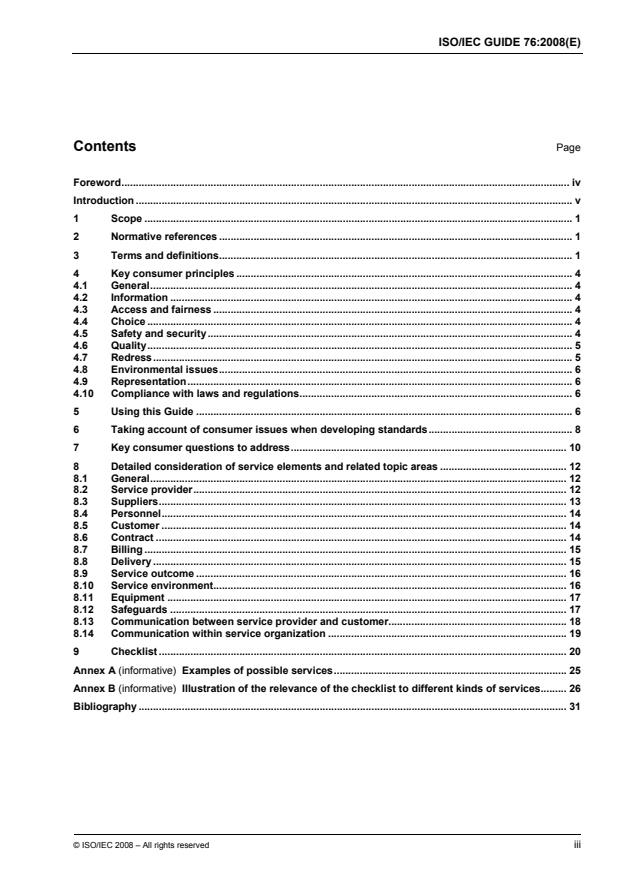
Contents Page
Foreword. iv
Introduction . v
1 Scope . 1
2 Normative references . 1
3 Terms and definitions. 1
4 Key consumer principles . 4
4.1 General. 4
4.2 Information . 4
4.3 Access and fairness . 4
4.4 Choice . 4
4.5 Safety and security. 4
4.6 Quality. 5
4.7 Redress. 5
4.8 Environmental issues. 6
4.9 Representation. 6
4.10 Compliance with laws and regulations. 6
5 Using this Guide . 6
6 Taking account of consumer issues when developing standards. 8
7 Key consumer questions to address. 10
8 Detailed consideration of service elements and related topic areas . 12
8.1 General. 12
8.2 Service provider. 12
8.3 Suppliers. 13
8.4 Personnel. 14
8.5 Customer . 14
8.6 Contract . 14
8.7 Billing . 15
8.8 Delivery . 15
8.9 Service outcome . 16
8.10 Service environment. 16
8.11 Equipment . 17
8.12 Safeguards . 17
8.13 Communication between service provider and customer. 18
8.14 Communication within service organization . 19
9 Checklist . 20
Annex A (informative) Examples of possible services. 25
Annex B (informative) Illustration of the relevance of the checklist to different kinds of services. 26
Bibliography . 31
© ISO/IEC 2008 – All rights reserved iii
Foreword
ISO (the International Organization for Standardization) is a worldwide federation of national standards bodies
(ISO member bodies). The work of preparing International Standards is normally carried out through ISO
technical committees. Each member body interested in a subject for which a technical committee has been
established has the right to be represented on that committee. International organizations, governmental and
non-governmental, in liaison with ISO, also take part in the work. ISO collaborates closely with the
International Electrotechnical Commission (IEC) on all matters of electrotechnical standardization.
International Standards are drafted in accordance with the rules given in the ISO/IEC Directives, Part 2.
Draft Guides adopted by the responsible Committee or Group are circulated to the member bodies for voting.
Publication as a Guide requires approval by at least 75 % of the member bodies casting a vote.
Attention is drawn to the possibility that some of the elements of this document may be the subject of patent
rights. ISO shall not be held responsible for identifying any or all such patent rights.
ISO/IEC Guide 76 was prepared by the ISO Committee on consumer policy (COPOLCO).
This corrected version of ISO/IEC Guide 76:2008 incorporates the following correction:
⎯ correction of the term “responsibility” to “social responsibility” in the example to point 5 in Table 1 on
page 10.
iv © ISO/IEC 2008 – All rights reserved
Introduction
0.1 Standards are increasingly being developed to cover services. This Guide has been prepared to help
standards developers in these areas to take account of consumer requirements. It elaborates on the aims of
service standards, set out in the ISO/IEC publication The consumer and standards — Guidance and principles
[25]
for consumer participation in standards development . In addressing the major concerns of consumers,
standards can help by representing a consensus on the best knowledge and experience available worldwide.
0.2 This Guide is intended for those involved in the preparation and revision of standards for services,
whether International Standards or national standards in developed or developing countries. With its checklist
and examples, it also contains information which might be useful for others, such as service providers and
educators.
0.3 Service delivery can involve complex relationships and structures, frequently involving many different
organizations. Additionally, consumers engage with a variety of public services, such as medical provision or
education, for which formal contracts and direct payment might not be applicable.
0.4 In a global market, it is logical that consumers expect to benefit from access to a wider choice of
services and service providers. There is also continuing demand for lower prices that are not contrived to
disadvantage certain markets and communities. Quality, economy and efficiency are sought, whether or not
the consumer pays directly for a service. There is also increasing consumer concern about the need for
sustainable development.
0.5 The Internet fuels comparisons and the growth of knowledge and provision of information on which to
base choices. Globally, consumers expect that the services they engage with, contract to and purchase will
not only be consistent in quality, durability and ease of use, but also safe, environmentally friendly and fair for
the communities affected by the services.
0.6 Although all people have a right of access to services, this will not always be relevant or feasible.
However, it is advisable that service providers consider the needs of all potential users, including children and
those from different cultural and ethnic heritages. This will enable the services to be available to as many
people as possible. The issue of accessibility and usability of products and services has become more critical
with the increasing percentage of older persons in the world's population. While not all older persons have
disabilities, the prevalence of disability or limitations is highest among this demographic group.
0.7 The standardization of services can provide the following benefits:
⎯ build consumer confidence by assuring safety, security, quality, durability and ease of use;
⎯ supply accurate and appropriate information and take into account user requirements;
⎯ support the development of choice and access to a wide range of users;
⎯ provide appropriate and fair forms of redress, where necessary.
0.8 Many national and sectoral codes of practice exist in relation to parts of service delivery which can be
considered when developing standards. However, these are most commonly drawn up from the viewpoint of
the service provider and are thus not necessarily those of the consumer. This Guide seeks to ensure that
consumer needs are addressed. It also allows a common set of criteria for services across countries in which
there can be many differences in the scope and application of national consumer protection legislation.
0.9 It is recognized that when developing service standards, it is advisable to take account of applicable
statutory or regulatory requirements.
© ISO/IEC 2008 – All rights reserved v
Development of service standards — Recommendations for
addressing consumer issues
1 Scope
This Guide provides general guidance on the issues to be considered in standards for services. On the basis
of this guidance, detailed standards can be prepared for any service. This Guide provides a checklist (see
Clause 9) which can be used by consumer representatives and others participating in the process of
standards development. Use of the checklist enables full consideration to be given to all matters of consumer
interest, including the needs of children, older persons, persons with disabilities and those from different
ethnic and cultural heritages.
This Guide is relevant to the full range of services, whether or not a formal contract is entered into or purchase
price paid, but it also has relevance for public or charitable services in which there is a consumer, a user or a
participant, but not necessarily a purchase, e.g. education, health and care provision.
2 Normative references
The following referenced documents are indispensable for the application of this document. For dated
references, only the edition cited applies. For undated references, the latest edition of the referenced
document (including any amendments) applies.
ISO 9000, Quality management systems — Fundamentals and vocabulary
3 Terms and definitions
For the purposes of this document, the terms and definitions given in ISO 9000 and the following apply.
3.1
service
result of at least one activity, necessarily performed at the interface between the supplier and customer, that is
generally intangible
NOTE 1 Examples of possible services are given in Annex A.
NOTE 2 In ISO 9000, “product” is defined as the “result of a process” that encompasses four generic product
categories [services (e.g. transport), software (e.g. computer program, dictionary), hardware (e.g. engine mechanical part)
and processed materials (e.g. lubricant)] and that indicates that the product category used is based on the dominant
element. A service can therefore include the delivery of software, hardware and processed materials. For the purposes of
this Guide, a separate definition of “service” is given here.
© ISO/IEC 2008 – All rights reserved 1
3.2
goods
products excluding services
EXAMPLE Software, hardware and processed materials, e.g. domestic appliances, home care articles, food.
NOTE In ISO 9000, “product” is defined as the “result of a process” that encompasses four generic product
categories [services (e.g. transport), software (e.g. computer program, dictionary), hardware (e.g. engine mechanical part)
and processed materials (e.g. lubricant)] and that indicates that the product category used is based on the dominant
element. A service can therefore include the delivery of software, hardware and processed materials. For the purposes of
this Guide, a separate definition of “goods” is given here.
3.3
service provider
entity that offers one or more services
NOTE The entity can be an individual or an organization.
3.4
consumer
individual member of the general public purchasing or using goods, property or services, for personal, family
or household purposes
[26]
NOTE Adapted from the ISO/IEC Statement on Consumer participation in standardization work .
3.5
customer
organization or person that receives a product
EXAMPLE Consumer, client, end-user, retainer, beneficiary or purchaser.
NOTE 1 For the purposes of this Guide, use of the term “customer” includes potential customers in the reference.
NOTE 2 Adapted from ISO 9000.
3.6
customer satisfaction
customer's perception of the degree to which the customer's requirements have been fulfilled
NOTE 1 Customer complaints are a common indicator of low customer satisfaction, but their absence does not
necessarily imply high customer satisfaction.
NOTE 2 Even when customer requirements have been agreed to with the customer and fulfilled, this does not
necessarily ensure high customer satisfaction.
NOTE 3 Adapted from ISO 9000.
3.7
user
participant
person who uses the service(s) of the service provider
3.8
impairment
problem in body function or structure such as a significant deviation or loss which can be temporary due, for
example, to injury, or permanent, slight or severe and can fluctuate over time, in particular, deterioration due
to ageing
[ISO/IEC Guide 71:2001, 3.4]
2 © ISO/IEC 2008 – All rights reserved
3.9
contract
agreement by which one or more parties are obligated towards one or several other parties to provide a
service
3.10
code of conduct
customer promise(s) made by an organization, and related provisions
NOTE 1 The promise(s) are used by the organization for the purpose of maintaining and enhancing customer
satisfaction (3.6) and relate to the organization's products or the interaction of the organization with its existing or
potential customers.
NOTE 2 See also ISO 10001 on guidelines for codes of conduct for organizations.
3.11
customer service
interaction of an organization with the customer throughout the phases of service provision
NOTE Adapted from ISO 10002.
3.12
delivery
action of providing a service
3.13
usability
extent to which a service can be used by specified users to achieve specified goals with effectiveness,
efficiency and satisfaction in a specified context of use
[ISO/IEC Guide 71:2001, 3.7]
3.14
assistive technology
assistive device
piece of equipment, product system, hardware, software or service that is used to increase, maintain or
improve functional capabilities of individuals with disabilities
NOTE This can be acquired commercially off-the-shelf, modified or customized. The term includes technical aids for
persons with disabilities. Assistive devices do not eliminate an impairment but may lessen the difficulty an individual has in
carrying out a task or activity in specific environments.
[ISO/IEC Guide 71:2001, 3.3]
3.15
alternative format
different presentation which can make services accessible by the use of another movement or sensory ability
NOTE Adapted from ISO/IEC Guide 71.
3.16
complaint
expression of dissatisfaction made to an organization, related to its products, or the complaints-handling
process itself, where a response or resolution is explicitly or implicitly expected
[ISO 10002:2004, 3.2]
© ISO/IEC 2008 – All rights reserved 3
3.17
complainant
person, organization or its representative, making a complaint
[ISO 10002:2004, 3.1]
3.18
feedback
opinions, comments and expressions of interest in the service or the complaints-handling process
NOTE Adapted from ISO 10002 and from ISO/IEC Guide 51.
3.19
safeguard
precaution taken to prevent or reduce the impact of a failure in some aspect of service provision
4 Key consumer principles
4.1 General
Services cover a wide range of activities (see Annex A). The common features are a service provided by a
commercial, public or private organization, for which claims are made, products or assistance are delivered,
an organization on whose quality of provision consumers rely, often without individual or immediate means to
judge this. The key consumer principles, as described in subclauses 4.2 to 4.10, should be taken into account.
4.2 Information
Information and its communication play a crucial role in the selection, provision and effective use of services
because, unlike products such as shoes and food, there are less tangible elements to assist the consumer in
gauging quality, fitness for purpose, value for money, etc. Communication of information, especially prior to
contract signature, and the manner of doing it (including the attitude of staff) is a fundamental consideration.
The role of communication at every step in the decision-making process is illustrated in Figure 1.
4.3 Access and fairness
Access to services is a function of consumers' ability to afford the things they need or want, and of the
availability of these things to all consumers regardless of location, social and economic considerations and
physical or mental impairment. Thus, to be credible, the interests of the full range of consumers (from children
to older persons, with different cultural and ethnic backgrounds and with all variations in abilities) should be
acknowledged and included from the outset in the development of relevant standards. In maintaining the
principle of fairness, standards should ensure that services do not unreasonably discriminate against any
particular group of consumers.
4.4 Choice
Promoting consumer choice is fundamental to consumer policy. In standardization, this means that a standard
should not favour any one particular supplier or be unnecessarily restrictive of the form of service provision.
Various characteristics of a service will be balanced with the need to maintain value for money and a
competitive market.
4.5 Safety and security
The safety (including hygiene and physical safety) and security (including financial security and privacy)
afforded by services are key priorities, with a particular emphasis on protecting vulnerable people, e.g.
children, older persons, persons with disabilities or persons disadvantaged through poverty or an inability
(perhaps due to language) to access relevant information and assistance.
4 © ISO/IEC 2008 – All rights reserved
Figure 1 — Service elements and role of communication at all stages of service provision
4.6 Quality
Quality is the extent to which the characteristics of a service fulfil the requirements. Therefore, quality
encompasses the many other intangible features that contribute to “good” service. These include factors
already considered in subclauses 4.2 to 4.5, such as access to helpful and accurate information, good
customer handling and timely provision, but also factors within a framework of environmental impact
assessment and sustainable development, such as sustainable use of resources and the ability to recycle.
Ease of use is a quality feature for the general populace, but also an access factor for those with some form of
impairment. Quality and value for money, as well as safety, are central issues for consumers.
4.7 Redress
Consumers need to feel confident of service delivery and of the fact that, should something go wrong, there
are appropriate provisions in place to handle any concerns or claims, irrespective of whether the service is
provided nationally or from another country.
© ISO/IEC 2008 – All rights reserved 5
4.8 Environmental issues
Environmental considerations are of increasing importance to consumers and may affect their decision-
making. Factors include promoting respect for the natural and human environment through reduction of waste,
odours, noise and visual pollution, and conservation of the physical, cultural and human heritage.
4.9 Representation
Standards development organizations should ensure that consumers are represented in all technical
committees or working groups where the subject matter has an effect on consumers. If this is not feasible,
they should use other ways to ensure that consumer interests are taken into account, e.g. through
consultation. Where appropriate, the standards themselves should make provision for consumer
representation, e.g. through consultation when developing new services.
4.10 Compliance with laws and regulations
Service providers should ensure compliance and proper consideration of applicable statutory and regulatory
requirements, from the earliest planning and design stages of the service to service delivery and redress.
5 Using this Guide
5.1 This Guide provides an overview on how consumer interests should be identified and taken into
account in the development of standards for services. Standards include international, regional and national
standards, as well as sectoral and organizational or company standards. This Guide indicates the areas in
which detailed requirements may be drawn up for particular sector-specific standards.
5.2 The documents listed below should all form part of the toolkit for the standards developer.
a) The ISO/IEC Policy Statement, Addressing the needs of older persons and people with disabilities in
[24]
, and the complementary guide, ISO/IEC Guide 71, provide standards developers
standardization work
and others with a systematic approach to addressing ageing and disability issues in the writing and
revision of International Standards. These documents also help Technical Committees to evaluate how
they are addressing such issues in their Work Programmes.
b) ISO/IEC Guide 51 provides guidance on general safety considerations. ISO/IEC Guide 50 provides more
specific guidelines for child safety.
c) Detailed guidance on specific aspects of service delivery, such as the internationally agreed criteria for
customer satisfaction given in ISO 10001, ISO 10002 and ISO 10003, constitutes useful guidance on
global customer care.
NOTE ISO 10001 provides guidelines on codes of conduct; ISO 10002 provides guidelines on complaints
handling; ISO 10003 provides guidelines on external customer dispute resolution.
5.3 Clause 6 outlines a process which standards developers may use to address the key areas of
consumer interest, including the needs of older persons and persons with disabilities.
5.4 Clause 7 identifies the key consumer questions that may be asked when selecting, purchasing or
engaging with a service, and indicates the link with the various “service elements” listed in Table 1.
5.5 The service elements, identified from the key consumer questions, may be considered when developing
organizational or company standards, or sector-specific standards. Within each service element, there are a
number of “topic areas”. Clause 8 describes the various topic areas for each service element. Taking all topic
areas into account should ensure that consumers' needs are addressed when developing a standard. In the
delivery of any service, there may be a sequence of phases in the provision of the service, all involving
interaction between the service provider and customer.
NOTE See Figure 2 for an example related to a sporting event; this figure also shows that there can be associated
support activities.
6 © ISO/IEC 2008 – All rights reserved
5.6 In Clause 9, Tables 2 to 6 provide checklists of the topic areas identified in Clause 8 as a quick way of
enabling standards developers to ensure that all relevant aspects are covered.
5.7 Annex B illustrates how different service elements may assume greater or lesser significance when this
systematic checklist approach is used to develop standards in very different service sectors (i.e. hair care
providers, hotels and life insurance).
NOTE Annex B gives examples rather than exhaustive lists of all necessary requirements for each of these services.
5.8 The Bibliography provides a list of sources that standards developers can use to investigate more
1)
detailed and specific guidance materials.
5.9 In developing a new service standard, the expectation should be to identify the criteria required to
ensure best practice, regardless of the size or location of the service provider. However, the more complex the
service, the more optional features there may be to consider. To facilitate the use of standards by even the
smallest organization, it is recommended that issues of overriding importance for the particular service being
standardized should be identified by means of checklists, from which should be formulated a set of the key
criteria with which a small organization should comply. This may be included as an annex (e.g. Annex A of
ISO 10002:2004).
Figure 2 illustrates the provision of services by a professional soccer club, where the spectator is the
2)
customer . Several services may be offered during each phase of the experience. For example, during half-
time, music may be played, spectators may buy a drink or snack, or go to the toilet. Support activities include
other provision for the same customers, but not directly related to the match, e.g. selling club articles or
issuing a magazine. All of these activities need to be planned for and done well if the resulting service is to
provide customer satisfaction.
1) The Bibliography is not exhaustive. Users are encouraged to check for current updates and future publications and
investigate websites for further material.
[27]
2) Based on “ISO 9000 scores in professional soccer – but who is the customer?” .
© ISO/IEC 2008 – All rights reserved 7
Figure 2 — Example of phases in provision of service (professional soccer)
6 Taking account of consumer issues when developing standards
3)
Committees may find the process outlined in Figure 3 helpful in ensuring that key consumer issues are
identified and addressed when developing a new service standard or at each revision of an existing one. The
process reads from left to right, with guidance on achieving each objective provided in the columns
underneath.
3) Based on a process described in ISO/IEC Guide 71.
8 © ISO/IEC 2008 – All rights reserved
Figure 3 — Identification of consumer issues at each stage of developing standards for services
© ISO/IEC 2008 – All rights reserved 9
7 Key consumer questions to address
7.1. When selecting, purchasing or engaging with a service, consumers may ask a variety of questions at
each of the stages of service provision. The development of standards that address such questions is likely to
increase consumer confidence. Customer complaints and survey data should also be examined to ensure that
the requirements in a standard for a service adequately address those areas of dissatisfaction that are of
particular importance to consumers.
7.2 Table 1 illustrates the sorts of questions consumers may ask and maps them onto service elements that
should be considered when developing any standard for a consumer service. The questions relate to the
service provider or service prior to purchase or engagement, during the contract phase, at the time of service
delivery and after sales or engagement, which may be after the contract term has ended, or when it is
terminated prematurely. The list of questions is not exhaustive; further questions may arise in relation to
particular service sectors, which can be mapped across to service elements in the same way.
7.3 The service could be a single event (e.g. attending a music concert, staying at a resort hotel or having
an operation in hospital) or continuous (e.g. telephone service provision). It may be made up of a single
activity or include several activities, as illustrated in Figure 2. Examples of possible services are given in
Annex A.
Table 1 — Key questions consumers may ask and the service element to which they relate
Consumer questions Service element
Pre-engagement questions about the service provider and service
1. Do I trust the service provider? Service provider
Need for up-front information about the honesty, integrity, reputation, solvency, Communication
reliability, good quality service, etc.
Supplier
Information may come direct from the service provider, including through association
of brand names and/or use of codes pertaining to customer service. It may also come
from third parties, such as consumers and other organizations, which rate services,
and certification bodies, which do conformity assessments.
2. Am I eligible for the service? Customer
Some services are open to all. Others require qualification, e.g. age or skills. Communication
3. Do I have enough information from the service provider about the service to Communication
allow me to make the right decision, in terms of price, value for money, options
available, etc.?
4. Can I understand the information, use it easily, and is there enough but not too Communication
much?
5. Are there any aspects about the service provider or the service that may affect Service provider
my decision?
Communication
e.g. environmental, health and safety, social aspects/impacts of the organization or
the service, social responsibility.
6. Are the organization and its personnel courteous and helpful to me? Personnel
Communication
7. Is it easy for me to contact the organization? Service environment
e.g. office opening hours, website, freephone helpline number, e-mail access, etc. Equipment
Communication
8. Does the organization take into account my specific needs and limitations? Service environment
e.g. older persons, persons with disabilities, youths, different cultures and languages. Equipment
10 © ISO/IEC 2008 – All rights reserved
Table 1 (continued)
Consumer questions Service element
Questions about the purchase or engagement stage of service
9. Do I understand the contract (or implied contract)? Contract
Communication
10. Does the contract give me enough information to make an informed decision? Contract
e.g. rights and obligations of buyer, seller and any third party clearly spelled out, Communication
standardized format, cancellation right.
11. Can I see clearly what the service will give me? Delivery
Communication
12. Am I able to trial the service? Service environment
Equipment
Communication
13. Do I have a choice of different types or levels of service and, if so, is this made Delivery
clear?
Service environment
Equipment
Communication
14. Are there different ways I can pay and is this made clear? Billing
e.g. payments through Internet, deductions from bank account. Service environment
Equipment
Communication
Questions about service delivery
15. Am I getting what I expected, when I expected it, in the way I expected it, and of Delivery
the quality expected?
Service outcomes
Communication
16. Is the service being provided safely, respecting my privacy, taking account of Delivery
environmental issues, and without detriment to health or the environment?
Service outcomes
If not, how do I get assistance?
Equipment
e.g. helplines.
Service environment
Safeguards
Communication
17. Is the service being provided in a courteous, knowledgeable, friendly manner Personnel
and with an appropriate attitude?
Communication
Questions about after-sales/post-engagement service
18. How do I complain and is there a choice of ways of doing so? Safeguards
Communication
19. Is my complaint handled promptly, courteously and knowledgeably, whether the Personnel
service is provided nationally or from another country?
Communication
20. Can I get someone independent to consider my complaint if the organization Personnel
doesn't sort things out?
Safeguards
Communication
21. Are emergency services available if needed? Safeguards
© ISO/IEC 2008 – All rights reserved 11
8 Detailed consideration of service elements and related topic areas
8.1 General
The service elements identified in Clause 7 relate to the parties involved in service delivery (provider, supplier,
personnel and customer), the stages of provision (contract, billing and delivery) and related aspects, which
may be of equal importance (service environment, equipment, outcome and safeguards). The communication
of information is a key aspect of service provision from the consumer's perspective, at all stages of service
delivery. Communication is also of great importance within the organization providing a service and between
the service provider and its suppliers. Figure 1 illustrates the importance of communication at all stages of
service engagement and delivery. Within each service element, there are a number of topic areas to consider,
which are detailed in subclauses 8.2 to 8.14. The importance of the various topic areas will depend on the
sector for which the standard is being developed. Clause 9 presents the information from subclauses 8.2 to
8.14 in the form of checklists, with prompts for ease of use by standards developers.
8.2 Service provider
8.2.1 General
The service provider may provide one or more of a range of services. These may include
⎯ expert advice or support (e.g. legal advice or financial services),
⎯ the selling of intangible products (e.g. insurance),
⎯ training or education (e.g. language schools or instruction in sports, or other physical activities),
⎯ accommodation and entertainment (e.g. hotel, restaurant or theatre),
⎯ organized and guided activities (particularly connected with tourism),
⎯ hire of equipment (e.g. tools, premises, such as letting agencies, or intangible products, such as Internet
service providers), and
⎯ care or treatment (e.g. hairdressers or alternative therapists).
8.2.2 Quality management
Quality encompasses many factors that contribute to ensuring consistently good service provision. Sector-
specific service standards could require adherence to, for example, ISO 9001 (which specifies requirements
for a quality management system that can be used for internal application by organizations, or for certification,
or for contractual purposes) and/or identify key quality requirements for that sector.
8.2.3 Environmental management
Services may have environmental impacts in numerous direct and indirect ways, e.g. in the destruction of
forests to provide amenities for tourists in previously undeveloped areas, through increased energy use
related to the transportation of people or products and in the disposal of waste materials. ISO Guide 64 has
some relevance to the provision of services, many of which include the provision of goods. Sectoral standards
could require adherence to ISO 14001 or instead identify key environmental requirements for that sector.
NOTE A number of International Standards for environmental management exist, including Standards for
environmental declarations and life-cycle assessments. A non-exhaustive list appears in the Bibliography.
12 © ISO/IEC 2008 – All rights reserved
8.2.4 Occupational health and safety management
Most countries have national requirements and agreements governing some aspects of occupational health
and safety management; those applicable will depend on the service for which a standard is being developed.
There will often be differences between the legislation prevailing in the country in which a service is contracted
and that in which the activity is undertaken (e.g. when purchasing holidays). This may directly impact on the
consumer (e.g. the length of shift permitted for a coach driver may have potential safety consequences) or be
of concern (e.g. an “ethical” purchaser of services).
8.2.5 Solvency and other financial aspects
Solvency of the supplier is a concern for the purchaser of any service, but particularly where there is reliance
on a long-term investment, e.g. a private personal pension. Many countries have national requirements and
agreements governing some aspects of financial trading which should be taken into account in setting
requirements in standards, particularly as financial services are an increasing part of the global market.
Liability insurance is one aspect that may be considered.
8.2.6 Integrity
The integrity of the provider may be governed by professional and organizational codes related particularly to
that sector. They can include issues such as responsible advertising, selling methods or compliance with
national requirements and agreements. In addition, service providers are required to comply with all laws and
regulations that apply to their organization.
NOTE 1 Reference can be made to other standards, sector-specific or organizational codes, such as responsible
advertising.
NOTE 2 See also ISO 10001.
8.2.7 Capacity
The size or resources of an organization may impact on safeguards available for customers. Consequently,
minimum requirements may need to be considered, either at the organizational level or through agreements
with other service providers, e.g. networks of small bed and breakfast establishments operating to ensure that
customers may be passed on if circumstances require it.
8.2.8 Social responsibility
Social responsibility is a wide area, itself open to interpretation, for which international agreements, national
requirements and agreements and organizational or sector requirements may exist, e.g. related to the care of
workers or the environment or child labour.
NOTE A future International Standard giving guidance on social responsibility is currently under development.
8.2.9 Human resources
The number, skill and competence of personnel may impact on safety, security or safeguards. Consequently,
standards may need to specify the staffing arrangements required of the service provider, e.g. the minimum
number of staff (including where this is determined by the type of service provided), their competence and the
minimum number of managers per number of employees.
8.3 Suppliers
Organizations supplying the service provider may themselves have a positive or negative impact on the
quality of service ultimately provided to the customer. There may be a need to specify minimum requirements
for the supplier in the same way as for the direct service provider, e.g. adherence to quality standards.
Account may be taken of international agreements, national requirements and agreements, sector-specific
codes and any relevant sector-specific standards (e.g. a tour operator uses airlines which comply with national
aircraft safety standards, and a kitchen design firm installs equipment which complies with product safety and
performance standards).
© ISO/IEC 2008 – All rights reserved 13
8.4 Personnel
8.4.1 General
Sectoral standards need to deal principally with personnel, whether employees or volunteers, in direct contact
with customers.
8.4.2 Knowledge
Standards could specify minimum requirements in necessary areas, e.g. a need for personnel in direct contact
with customers to be fluent in the language of the target user, or to fully understand and be able to explain the
organization's complaints procedure.
8.4.3 Skills and competencies
The skills required include the minimum qualifications and experience necessary to carry out the primary
service task under the personnel's responsibility as well as ancillary competencies, such as communication
skills (particularly where personal care is being delivered), the flexibility to deal with different types of ability
and understanding amongst customers, or physical fitness, where appropriate.
8.4.4 Attitude
Professionalism is a requirement of personnel in all phases of delivery, including a
...
GUIDE 76
Élaboration des normes de
service — Recommandations
pour répondre aux attentes des
consommateurs
Première édition 2008
©
ISO/CEI 2008
GUIDE ISO/CEI 76:2008(F)
PDF – Exonération de responsabilité
Le présent fichier PDF peut contenir des polices de caractères intégrées. Conformément aux conditions de licence d'Adobe, ce fichier
peut être imprimé ou visualisé, mais ne doit pas être modifié à moins que l'ordinateur employé à cet effet ne bénéficie d'une licence
autorisant l'utilisation de ces polices et que celles-ci y soient installées. Lors du téléchargement de ce fichier, les parties concernées
acceptent de fait la responsabilité de ne pas enfreindre les conditions de licence d'Adobe. Le Secrétariat central de l'ISO décline toute
responsabilité en la matière.
Adobe est une marque déposée d'Adobe Systems Incorporated.
Les détails relatifs aux produits logiciels utilisés pour la création du présent fichier PDF sont disponibles dans la rubrique General Info
du fichier; les paramètres de création PDF ont été optimisés pour l'impression. Toutes les mesures ont été prises pour garantir
l'exploitation de ce fichier par les comités membres de l'ISO. Dans le cas peu probable où surviendrait un problème d'utilisation,
veuillez en informer le Secrétariat central à l'adresse donnée ci-dessous.
DOCUMENT PROTÉGÉ PAR COPYRIGHT
© ISO/CEI 2008
Droits de reproduction réservés. Sauf prescription différente, aucune partie de cette publication ne peut être reproduite ni utilisée sous
quelque forme que ce soit et par aucun procédé, électronique ou mécanique, y compris la photocopie et les microfilms, sans l'accord écrit
de l'ISO à l'adresse ci-après ou du comité membre de l'ISO dans le pays du demandeur.
ISO copyright office
Case postale 56 • CH-1211 Geneva 20
Tel. + 41 22 749 01 11
Fax. + 41 22 749 09 47
E-mail copyright@iso.org
Web www.iso.org
Publié en Suisse
ii © ISO/CEI 2008 – Tous droits réservés
GUIDE ISO/CEI 76:2008(F)
Sommaire Page
Avant-propos. iv
Introduction . v
1 Domaine d'application. 1
2 Références normatives . 1
3 Termes et définitions. 1
4 Principes clés des consommateurs. 4
4.1 Généralités . 4
4.2 Informations . 4
4.3 Accès et équité. 4
4.4 Choix . 4
4.5 Sûreté et sécurité. 4
4.6 Qualité. 5
4.7 Réparation . 6
4.8 Questions environnementales . 6
4.9 Représentation. 6
4.10 Conformité à la loi et à la réglementation . 6
5 Utilisation du présent Guide. 6
6 Prise en considération des attentes des consommateurs lors de l'élaboration des normes . 8
7 Questions clés des consommateurs à prendre en compte. 10
8 Analyse détaillée des éléments de service et des thèmes y afférents. 12
8.1 Généralités . 12
8.2 Prestataire de service. 12
8.3 Fournisseur(s). 14
8.4 Personnel. 14
8.5 Client . 14
8.6 Contrat . 15
8.7 Facturation . 15
8.8 Prestation . 16
8.9 Service réalisé. 17
8.10 Environnement du service. 17
8.11 Équipement . 17
8.12 Clauses de sauvegarde. 18
8.13 Communication entre le prestataire de service et le client. 19
8.14 Communication au sein de l'organisme prestataire de service. 20
9 Liste de contrôle . 20
Annexe A (informative) Exemples de services possibles. 26
Annexe B (informative) Illustration de la pertinence de la liste de contrôle pour différents types de
services. 27
Bibliographie . 32
© ISO/CEI 2008 – Tous droits réservés iii
GUIDE ISO/CEI 76:2008(F)
Avant-propos
L'ISO (Organisation internationale de normalisation) est une fédération mondiale d'organismes nationaux de
normalisation (comités membres de l'ISO). L'élaboration des Normes internationales est en général confiée
aux comités techniques de l'ISO. Chaque comité membre intéressé par une étude a le droit de faire partie du
comité technique créé à cet effet. Les organisations internationales, gouvernementales et non
gouvernementales, en liaison avec l'ISO participent également aux travaux. L'ISO collabore étroitement avec
la Commission électrotechnique internationale (CEI) en ce qui concerne la normalisation électrotechnique.
Les Normes internationales sont rédigées conformément aux règles données dans les Directives ISO/CEI,
Partie 2.
Les projets de Guides adoptés par le comité ou le groupe responsable sont soumis aux comités membres
pour vote. Leur publication comme Guides requiert l'approbation de 75 % au moins des comités membres
votants.
L'attention est appelée sur le fait que certains des éléments du présent document peuvent faire l'objet de
droits de propriété intellectuelle ou de droits analogues. L'ISO ne saurait être tenue pour responsable de ne
pas avoir identifié de tels droits de propriété et averti de leur existence.
Le Guide ISO 76 a été élaboré par le Comité ISO pour la politique en matière de consommation (COPOLCO).
iv © ISO/CEI 2008 – Tous droits réservés
GUIDE ISO/CEI 76:2008(F)
Introduction
0.1 Le nombre de normes relatives aux services est en constante augmentation. Le présent Guide a été
élaboré pour aider les rédacteurs de normes traitant de ces domaines à tenir compte des exigences des
consommateurs. Il approfondit les objectifs des normes de service qui sont établis dans la publication ISO/CEI
Les consommateurs et les normes — Lignes directrices et principes relatifs à la participation des
[25]
consommateurs à l'élaboration des normes . Pour répondre aux principales préoccupations des
consommateurs, les normes peuvent se révéler utiles dans la mesure où elles représentent un consensus sur
les meilleures connaissances et expériences disponibles dans le monde.
0.2 Le présent Guide est destiné aux personnes impliquées dans l'élaboration et la révision de Normes
internationales ou nationales applicables aux services, dans les pays développés et en développement. À
travers sa liste de contrôle et les exemples donnés, il contient également des informations qui peuvent être
utiles à d'autres personnes, telles que les prestataires de services et les éducateurs.
0.3 La prestation de service peut impliquer des relations et des organisations complexes, auxquelles
participent souvent de nombreux organismes différents. En outre, les consommateurs ont recours à une
grande diversité de services publics, tels que les prestations de santé ou l'éducation, pour lesquels des
contrats formels et le paiement direct peuvent ne pas être applicables.
0.4 Dans un marché mondial, les consommateurs estiment généralement pouvoir bénéficier de l'accès à un
vaste choix de services et de prestataires de services. On observe également une demande permanente de
prix plus bas qui ne pénaliseraient pas forcément certains marchés et collectivités. Indépendamment du mode
de règlement direct ou non pour un service, le consommateur recherche avant tout la qualité, l'économie et
l'efficacité. La préoccupation du consommateur eu égard à la nécessité de favoriser le développement
durable est également croissante.
0.5 L'internet permet de multiplier les comparaisons et d'enrichir les connaissances en assurant l'accès aux
informations de base sur lesquelles fonder ses choix. De manière générale, les consommateurs considèrent
que les services qu'ils utilisent, par voie de souscription, de contrat ou d'achat, doivent répondre à leurs
exigences en matière de qualité, de durabilité et de facilité d'utilisation, mais également être sûrs, respectueux
de l'environnement et équitables envers le public concerné par ces services.
0.6 Bien que tous les individus disposent du droit d'accès aux services, cela ne sera pas toujours pertinent
ou réaliste. Il convient cependant que les prestataires de services prennent en considération les besoins de
tous les utilisateurs potentiels, y compris les enfants et les personnes d'origines culturelles et ethniques
différentes, afin que les services soient à la disposition d'un maximum de personnes. La question de
l'accessibilité et de la facilité d’utilisation des produits et des services est devenue plus critique du fait de
l'augmentation du pourcentage de personnes âgées dans la population mondiale. Les personnes âgées ne
présentent pas toutes des contraintes, mais c'est au sein de ce groupe démographique que les incapacités ou
les limitations sont les plus importantes.
0.7 La normalisation des services peut apporter les avantages suivants:
⎯ établir la confiance du consommateur en garantissant la sécurité, la sûreté, la qualité, la durabilité et la
facilité d'utilisation;
⎯ fournir des informations précises et appropriées et tenir compte des exigences de l'utilisateur;
⎯ favoriser le développement du choix et de l'accès à une large gamme d'utilisateurs;
⎯ fournir des formulaires appropriés et équitables pour réparation, si nécessaire.
© ISO/CEI 2008 – Tous droits réservés v
GUIDE ISO/CEI 76:2008(F)
0.8 Il existe de nombreux codes de bonnes pratiques, nationaux et sectoriels, relatifs à des phases de la
prestation de service et qui peuvent être pris en considération lors de l'élaboration des normes. Cependant,
ces codes sont le plus souvent établis du point de vue du prestataire de service et n'adoptent pas
nécessairement celui du consommateur. Le présent Guide vise à s'assurer que les besoins des
consommateurs sont pris en considération. Il prévoit également un ensemble commun de critères applicables
aux services fournis dans des pays où la portée et l'application de la législation nationale relative à la
protection des consommateurs peuvent varier considérablement.
0.9 Il est reconnu, lors de l'élaboration de normes de service, qu'il est préférable de prendre en
considération les exigences légales ou réglementaires applicables.
vi © ISO/CEI 2008 – Tous droits réservés
GUIDE ISO/CEI 76:2008(F)
Élaboration des normes de service — Recommandations pour
répondre aux attentes des consommateurs
1 Domaine d'application
Le présent Guide fournit des directives générales relatives aux questions à traiter dans les normes pour les
services. Ces directives peuvent servir de base à l'élaboration de normes détaillées pour tout service. Le
Guide propose une liste de contrôle (voir Article 9) qui peut être utilisée par les représentants des
consommateurs et par toute autre personne participant au processus d'élaboration de normes. L'utilisation de
cette liste de contrôle permet de pleinement prendre en considération tous les sujets présentant un intérêt
pour les consommateurs, y compris les besoins des enfants, des personnes âgées, des personnes présentant
des incapacités et celles d'origines ethniques et culturelles différentes.
Le présent Guide s'applique à l'ensemble de la gamme des services, qu'ils soient assurés par conclusion d'un
contrat formel ou par règlement direct du prix d'achat. Il concerne également les services publics et de
bienfaisance qui impliquent un consommateur, un utilisateur ou un participant, mais pas nécessairement un
achat, par exemple dans le domaine de l'éducation, de la santé et des soins.
2 Références normatives
Les documents de référence suivants sont indispensables pour l'application du présent document. Pour les
références datées, seule l'édition citée s'applique. Pour les références non datées, la dernière édition du
document de référence s'applique (y compris les éventuels amendements).
ISO 9000, Systèmes de management de la qualité — Principes essentiels et vocabulaire
3 Termes et définitions
Pour les besoins du présent document, les termes et définitions donnés dans l'ISO 9000 ainsi que les
suivants s'appliquent.
3.1
service
résultat d'au moins une activité, nécessairement réalisée à l'interface entre le fournisseur et le client, et qui est
généralement immatériel
NOTE 1 Des exemples de services possibles sont fournis à dans l'Annexe A.
NOTE 2 Dans l'ISO 9000, «produit» est défini comme le «résultat d'un processus» et identifie quatre catégories
génériques de produits: les services (par exemple le transport), les «software» (par exemple logiciel, dictionnaire), le
matériel (par exemple pièces mécaniques de moteur) et les produits issus de processus à caractère continu (par exemple
lubrifiant) et indique que la catégorie de produit utilisée est fonction de l'élément dominant; par conséquent, un service
peut inclure la fourniture de logiciels, de matériels et de produits issus de processus à caractère continu. Pour les besoins
du présent Guide, des définitions distinctes pour les services et les biens figurent ci-après.
3.2
biens
produits à l'exclusion des services
EXEMPLE Logiciels, matériels et produits issus de processus à caractère continu, par exemple les appareils
électroménagers, les articles de soins à domicile, les produits alimentaires.
© ISO/CEI 2008 – Tous droits réservés 1
GUIDE ISO/CEI 76:2008(F)
3.3
prestataire de service
entité qui propose un ou des services
NOTE L'entité peut être une personne ou un organisme.
3.4
consommateur
individu membre du grand public qui achète ou qui utilise des biens, des biens immobiliers ou des services à
des fins personnelles, familiales ou domestiques
[26]
NOTE Adapté de l'ISO/CEI relative à la participation des consommateurs à l'élaboration des normes .
3.5
client
organisme ou personne qui reçoit un produit
EXEMPLE Consommateur, client, utilisateur final, détaillant, bénéficiaire ou acheteur.
NOTE 1 Pour les besoins du présent Guide, l'utilisation du terme «client» inclut les clients potentiels.
NOTE 2 Adapté de l'ISO 9000:2005, définition 3.3.5.
3.6
satisfaction du client
perception du client sur le niveau de réalisation de ses exigences
NOTE 1 Les réclamations des clients sont un indicateur habituel d'un faible niveau de satisfaction du client, mais leur
absence n'implique pas nécessairement un niveau élevé de satisfaction du client.
NOTE 2 Même lorsque les exigences du client ont été convenues avec lui et satisfaites, cela n'entraîne pas
nécessairement une forte satisfaction du client.
NOTE 3 Adapté de l'ISO 9000:2005, définition 3.1.4.
3.7
utilisateur
participant
personne qui utilise le(s) service(s) du prestataire de service
3.8
déficience
problème d'une fonction ou d'une structure corporelle, comme une déviation ou une perte significative, qui
peut être temporaire (dû à une blessure, par exemple) ou permanent, léger ou grave, et qui peut fluctuer dans
le temps, en particulier la détérioration en raison du vieillissement
[ISO/CEI Guide 71:2001, définition 3.4]
3.9
contrat
accord par lequel une ou plusieurs parties se sont engagées envers une ou plusieurs autres parties à fournir
un service
3.10
code de conduite
promesse(s) faite(s) au client par un organisme et dispositions correspondantes
NOTE 1 Ces promesses permettent à l'organisme de maintenir et d'accroître la satisfaction du client (3.6) et
concernent les produits de l'organisme ou l'interaction avec ses clients existants ou potentiels.
NOTE 2 Voir également l'ISO 10001 sur les lignes directrices relatives aux codes de conduite des organismes.
2 © ISO/CEI 2008 – Tous droits réservés
GUIDE ISO/CEI 76:2008(F)
3.11
service au client
interaction entre un organisme et le client tout au long des phases de la fourniture du service
NOTE Adapté de l'ISO 10002, 2004, définition 3.5.
3.12
prestation
action de fournir un service
3.13
facilité d'utilisation
degré selon lequel un service peut être utilisé, par des utilisateurs identifiés, pour atteindre des buts définis
avec efficacité, efficience et satisfaction, dans un contexte d'utilisation spécifié
NOTE Adapté de l'ISO/CEI Guide 71:2001, définition 3.7.
3.14
technologie d'aide
aide technique
pièce d'équipement, système, matériel informatique, logiciel ou service utilisé pour augmenter, maintenir ou
améliorer les capacités fonctionnelles des individus ayant des incapacités
NOTE Cette technologie peut être disponible dans le commerce ou résulter d'une modification ou d'une
personnalisation. Ce terme inclut les aides techniques destinées aux personnes ayant des incapacités. Les aides
techniques ne suppriment pas une déficience, mais peuvent réduire la difficulté qu'a un individu à accomplir une tâche ou
à mener une activité dans des environnements spécifiques.
[ISO/CEI Guide 71:2001, définition 3.3]
3.15
autre support
présentation différente permettant de rendre des services accessibles en faisant appel à une autre mobilité ou
à une autre capacité sensorielle
NOTE Adapté de l'ISO/CEI Guide 71:2001, définition 3.8.
3.16
réclamation
toute expression de mécontentement adressée à un organisme, concernant ses produits ou le processus
même de traitement des réclamations, duquel une réponse ou une solution est explicitement ou implicitement
attendue
[ISO 10002:2004, définition 3.2]
3.17
réclamant
plaignant
personne, organisme ou leur représentant qui formule une réclamation
[ISO 10002:2004, définition 3.1]
3.18
retour d'informations
opinions, commentaires et expressions de l'intérêt dans les services ou le processus de traitement des
réclamations
NOTE Adapté de l'ISO 10002:2004, définition 3.6 et de l'ISO/CEI Guide 51:1999.
© ISO/CEI 2008 – Tous droits réservés 3
GUIDE ISO/CEI 76:2008(F)
3.19
clause de sauvegarde
précaution prise pour prévenir ou réduire l'impact d'une défaillance dans un aspect de la fourniture de service
4 Principes clés des consommateurs
4.1 Généralités
Les services recouvrent une large gamme d'activités (voir Annexe A). Ces activités présentent les
caractéristiques communes suivantes: le service est assuré par un organisme commercial, public ou privé,
faisant l'objet de revendications; des produits ou une assistance sont fournis et les consommateurs, en qualité
de clients ou de simples utilisateurs, se fondent sur la qualité de la prestation, souvent sans disposer de
moyens individuels ou directs pour en juger. Il convient que les principes clés des consommateurs, tels que
décrits de 4.2 à 4.10, soient pris en considération.
4.2 Informations
Les informations et leur communication jouent un rôle essentiel dans la sélection, la fourniture et l'utilisation
effective des services. En effet, à la différence de produits tels que des chaussures ou des produits
alimentaires, le consommateur dispose de moins d'éléments matériels pour l'aider à déterminer la qualité,
l'aptitude à l'emploi, la valeur d'achat, etc. La communication des informations et la manière dont elles sont
divulguées (y compris les comportements du personnel) constituent des éléments fondamentaux. Le rôle de
la communication à chaque étape du processus de prise de décision est illustré à la Figure 1.
4.3 Accès et équité
L'accès aux services dépend de l'aptitude des consommateurs à déterminer leurs besoins ou leurs désirs et
de la disponibilité des services pour tous les consommateurs, indépendamment des considérations d'ordre
géographique, social et économique, et des déficiences physiques ou mentales. Par conséquent, pour être
crédible, il convient de reconnaître et de considérer les intérêts de l'ensemble des consommateurs (enfants,
personnes âgées, personnes d'origines culturelles et ethniques différentes ou présentant des aptitudes
variées) dès le début de l'élaboration des normes correspondantes. Pour garantir le principe d'équité, il
convient que les normes garantissent que les services ne présentent aucune discrimination abusive contre un
groupe particulier de consommateurs.
4.4 Choix
La politique en matière de consommation se fonde essentiellement sur la promotion du choix du
consommateur. Dans le domaine de la normalisation, cela signifie qu'il convient qu'une norme ne favorise
aucun fournisseur particulier ni qu'elle soit inutilement restrictive concernant la forme sous laquelle un service
est fourni. Il convient de parvenir à un équilibre entre les diverses caractéristiques d'un service et la nécessité
de maintenir la valeur d'achat et la compétitivité sur le marché.
4.5 Sûreté et sécurité
La sécurité (y compris l'hygiène et l'intégrité physique) et la sûreté (y compris la sécurité financière et le
respect de la vie privée) associées aux services constituent des priorités essentielles pour accéder aux
informations et à l'assistance correspondantes, en prêtant une attention toute particulière à la protection des
personnes vulnérables, telles que les enfants, les personnes âgées, handicapées ou défavorisées du fait de
la pauvreté ou d'une incapacité, voire de problème lié au langage.
4 © ISO/CEI 2008 – Tous droits réservés
GUIDE ISO/CEI 76:2008(F)
Figure 1 — Éléments de service et rôle de la communication à toutes les étapes de la fourniture
de service
4.6 Qualité
La qualité est l'aptitude des caractéristiques d'un service à satisfaire aux exigences. Par conséquent, la
qualité comprend les nombreuses autres caractéristiques immatérielles qui contribuent à un «bon» service.
Ces caractéristiques englobent les facteurs mentionnés ci-dessus, tels que l'accès à des informations utiles et
précises, les bonnes relations avec les clients et la fourniture du service dans les délais. Ces caractéristiques
comprennent également les facteurs établis dans un contexte d'évaluation de l'impact sur l'environnement et
de développement durable, tels que l'utilisation durable des ressources et l'aptitude à recycler. La facilité
d'utilisation représente une caractéristique de qualité pour la population en général, mais également un
facteur d'accès pour les personnes présentant certains types de déficience. La qualité et la valeur d'achat
sont, avec la sécurité, des questions centrales pour les consommateurs.
© ISO/CEI 2008 – Tous droits réservés 5
GUIDE ISO/CEI 76:2008(F)
4.7 Réparation
Les consommateurs ont besoin de se sentir en confiance lors de la prestation de service et avoir l'assurance
qu'en cas d'anomalie ou autre dysfonctionnement, des dispositions appropriées sont prises pour résoudre tout
problème ou traiter toute réclamation, que le service soit fourni au niveau national ou depuis un autre pays.
4.8 Questions environnementales
Les questions environnementales ont une importance croissante pour les consommateurs et peuvent affecter
leur prise de décision. Ces facteurs incluent de promouvoir le respect de l'environnement naturel et humain,
en réduisant les déchets, la pollution olfactive, sonore et visuelle, et la préservation du patrimoine physique,
culturel et humain.
4.9 Représentation
Il convient que les organismes de normalisation s'assurent que les consommateurs sont représentés dans
tous les comités techniques ou les groupes de travail dont le thème affecte les consommateurs. Si cela n'est
pas possible, il convient d'utiliser d'autres moyens pour s'assurer que les intérêts des consommateurs sont
pris en compte, par exemple par voie de consultation. Le cas échéant, il convient que les normes elles-
mêmes prévoient des dispositions pour la représentation des consommateurs, par exemple par voie de
consultation pour le développement de nouveaux services.
4.10 Conformité à la loi et à la réglementation
Il convient que les prestataires de services s'assurent de la conformité et de la prise en compte des exigences
légales et réglementaires, depuis les premières étapes de la planification et de la conception du service
jusqu'à la prestation du service et la réparation.
5 Utilisation du présent Guide
5.1 Le présent Guide fournit un aperçu de la manière dont il convient d'identifier les intérêts et les attentes
des consommateurs et de les prendre en considération lors de l'élaboration des normes pour les services.
Ces normes incluent les Normes internationales, régionales et nationales, ainsi que les normes sectorielle ou
d'organisation ou des standards d'entreprise. Le présent Guide indique les domaines dans lesquels des
exigences détaillées peuvent être établies pour des normes dédiées à un secteur.
5.2 Il convient que l'ensemble des documents suivants fasse partie intégrante des outils mis à la disposition
des rédacteurs de normes:
a) La déclaration politique ISO/CEI, Prise en compte dans la normalisation des besoins des personnes
[24]
âgées et de celles ayant des incapacités et les lignes directrices complémentaires (ISO/CEI Guide 71)
fournissent aux rédacteurs de normes et aux autres personnes concernées une approche systématique
pour prendre en considération les problèmes liés au vieillissement et aux incapacités lors de la rédaction
et de la révision des Normes internationales. Elles aident également les Comités techniques à évaluer
leur réponse à ces questions dans leurs programmes de travail.
b) L'ISO/CEI Guide 51 fournit des recommandations sur des considérations générales en matière de
sécurité et l'ISO/CEI Guide 50 fournit des lignes directrices plus spécifiques pour la sécurité des enfants.
c) Des recommandations détaillées sur des aspects spécifiques de la prestation de service, telles que les
critères convenus au niveau international pour les codes de conduite relatifs à la satisfaction du client
donnés dans l'ISO 10001, dans l'ISO 10002 et dans l'ISO 10003, fournissent des recommandations utiles
pour la prise en charge globale des clients.
NOTE L'ISO 10001 fournit des lignes directrices relatives aux codes de conduite, l'ISO 10002 fournit des lignes
directrices pour le traitement des réclamations et l'ISO 10003 fournit des lignes directrices relatives à la résolution
externe de conflits.
6 © ISO/CEI 2008 – Tous droits réservés
GUIDE ISO/CEI 76:2008(F)
5.3 L'Article 6 propose un processus que les rédacteurs de normes peuvent utiliser pour traiter les
domaines essentiels présentant un intérêt pour les consommateurs, y compris les besoins des personnes
âgées et des personnes présentant des incapacités.
5.4 L'Article 7 identifie les questions clés que des consommateurs peuvent se poser lorsqu'ils choisissent,
achètent ou souscrivent à un service et met en évidence les liens entre ces questions et les différents
«éléments de service» listés dans le Tableau 1.
5.5 Les éléments de service, identifiés à partir des questions clés des consommateurs, peuvent être pris en
considération lors de l'élaboration des normes de l'organisme ou de l'entreprise ou des normes dédiées à un
secteur. Chaque élément de service comprend plusieurs «thèmes». L'Article 8 décrit les différents thèmes
relatifs à chaque élément de service. Lors de l'élaboration d'une norme, il convient de prendre en compte tous
les thèmes afin de s'assurer que les besoins des consommateurs sont traités en conséquence. Toute
prestation de service peut comprendre une séquence de phases dans la fourniture du service, impliquant
toutes une interaction entre le prestataire de service et le client.
NOTE Voir la Figure 2 qui donne un exemple relatif à une manifestation sportive; cette figure montre également
qu'une prestation de service peut être associée à des activités de soutien.
5.6 L'Article 9, Tableaux 2 à 6, fournit des listes de contrôle des thèmes identifiés à l'Article 8 comme un
moyen rapide mis à la disposition des rédacteurs de normes pour s'assurer que tous les aspects pertinents
sont couverts par la norme correspondante.
5.7 L'Annexe B illustre les degrés d'importance que peuvent revêtir les différents éléments de service
lorsque cette approche systématique au moyen des listes de contrôle est adoptée pour élaborer des normes
applicables à des secteurs de service très différents (par exemple salons de coiffure, hôtels et compagnies
d'assurance-vie).
NOTE L'Annexe B donne des exemples plutôt que des listes exhaustives de toutes les exigences requises pour
chacun de ces services.
5.8 La Bibliographie donne une liste de sources que les rédacteurs de normes peuvent utiliser pour
1)
rechercher des informations plus détaillées et plus spécifiques .
5.9 Lors de l'élaboration d'une nouvelle norme de service, il est généralement prévu d'identifier les critères
requis pour garantir les meilleures pratiques, indépendamment de la taille ou de la localisation géographique
du prestataire de service. Toutefois, les caractéristiques optionnelles à considérer peuvent être d'autant plus
nombreuses que le service est complexe. Pour simplifier l'utilisation de normes, même par le plus petit des
organismes, il est recommandé d'identifier les sujets les plus importants pour le service particulier à
normaliser, au moyen des listes de contrôle et de les utiliser pour établir un ensemble de critères essentiels
auxquels il convient qu'un petit organisme se conforme. Cela peut figurer en annexe (par exemple
l'ISO 10002:2004, Annexe A).
La Figure 2 illustre la fourniture de services par un club de football professionnel où les spectateurs sont
2)
définis comme les clients . Plusieurs services peuvent être proposés à chaque phase de cette expérience.
Par exemple, pendant la mi-temps, il est possible de diffuser de la musique, les spectateurs peuvent acheter
à boire ou à manger ou se rendre aux toilettes. Les activités de soutien comprennent d'autres prestations qui
sont proposées aux mêmes clients, mais qui ne sont pas directement liées au match, par exemple la vente
d'articles du club ou la publication d'un magazine. Toutes ces activités doivent être planifiées et réalisées de
manière appropriée si l'on considère que le service résultant vise à obtenir la satisfaction du client.
1) La Bibliographie n’est pas exhaustive. Les utilisateurs sont encouragés à vérifier les mises à jour en cours et les
futures publications, ainsi qu’à consulter les sites Web pour obtenir de plus amples informations.
[27]
2) Fondé sur l'ISO 9000 marque des points dans le milieu du football professionnel — mais qui est donc le client? .
© ISO/CEI 2008 – Tous droits réservés 7
GUIDE ISO/CEI 76:2008(F)
Figure 2 — Exemple de phases de la fourniture de service (football professionnel)
6 Prise en considération des attentes des consommateurs lors de l'élaboration
des normes
3)
Les comités peuvent s'aider du processus décrit à la Figure 3 pour s'assurer que les attentes clés des
consommateurs sont identifiées et prises en considération lors de l'élaboration d'une nouvelle norme de
service ou à chaque révision d'une norme existante. Le processus se lit de gauche à droite et les colonnes
ci-dessous indiquent comment réaliser chaque objectif.
3) Fondé sur un processus décrit dans l’ISO/CEI Guide 71.
8 © ISO/CEI 2008 – Tous droits réservés
GUIDE ISO/CEI 76:2008(F)
Figure 3 — Identification des attentes des consommateurs à chaque étape de l'élaboration
de normes de services
© ISO/CEI 2008 – Tous droits réservés 9
GUIDE ISO/CEI 76:2008(F)
7 Questions clés des consommateurs à prendre en compte
7.1 Lorsque les consommateurs choisissent, achètent ou utilisent un service, ils peuvent se poser
différentes questions à chaque étape de la fourniture du service. La confiance des consommateurs peut être
accrue en élaborant des normes qui répondent à de telles questions. Il convient également que les
réclamations des clients et les données de sondage soient examinées pour s'assurer que les exigences d'une
norme pour un service donné intègrent les sujets de mécontentement qui revêtent une importance particulière
pour les consommateurs.
7.2 Le Tableau 1 indique les types de questions que les consommateurs peuvent se poser et montre le lien
entre ces questions et les éléments de service qu'il convient de prendre en considération lors de l'élaboration
de toute norme couvrant un service proposé à un consommateur. Les questions portent sur le prestataire de
service ou le service, elles sont posées avant l'achat ou avant la contractualisation du service, pendant la
phase du contrat ou au moment de la prestation de service ou après la vente ou la contractualisation, ce qui
peut intervenir après l'échéance du contrat ou après une rupture prématurée du contrat. La liste des questions
n'est pas exhaustive; d'autres questions peuvent résulter de secteurs de service particuliers et être mises en
correspondance avec les éléments de service de manière similaire.
7.3 Le service peut concerner une simple manifestation (par exemple un concert de musique, un séjour
dans un complexe hôtelier ou une intervention chirurgicale dans un hôpital) ou une prestation continue (par
exemple la fourniture d'un service téléphonique). Il peut être composé d'une seule activité ou comprendre
plusieurs activités, comme cela est illustré précédemment à la Figure 2. Des exemples de services possibles
sont donnés dans l'Annexe A.
Tableau 1 — Questions clés que des consommateurs peuvent se poser et éléments de service
auxquels ces questions sont liées
Questions du consommateur Élément de service
Questions préalables à la contractualisation sur le prestataire de service et le service
1) Dois-je faire confiance au prestataire de service? Prestataire du service
Nécessité de disposer d'informations initiales sur l'honnêteté, l'intégrité, la réputation, la Communication
solvabilité, la fiabilité, la qualité du service, etc.
Fournisseur
Les informations peuvent provenir directement du prestataire de service, y compris par le
biais de son association à des noms de marques et/ou l'utilisation de codes afférents au
service au client. Elles peuvent également provenir de tiers, tels que des consommateurs
et d'autres organismes, qui évaluent les services et des organismes de certification, qui
réalisent des évaluations de la conformité.
2) Est-ce que je remplis toutes les conditions pour accéder à ce service? Client
Certains services sont ouverts à tous. D'autres requièrent des qualifications liées, par Communication
exemple, à l'âge ou aux compétences.
3) Les informations fournies par le prestataire sur le service et dont je dispose sont-elles Communication
suffisantes pour me permettre de prendre la bonne décision, en termes de prix, de
valeur d'achat, d'options disponibles, etc.?
4) Les informations sont-elles compréhensibles, faciles à utiliser et sont-elles suffisantes Communication
sans être trop abondantes?
5) Existe-t-il des aspects concernant le prestataire ou le service susceptibles d'influencer Prestataire de service
ma décision?
Communication
Par exemple des aspects des impacts environnementaux, de santé et de sécurité, ou
sociaux de l'organisme ou du service, et responsabilité sociétale.
6) L'organisme et son personnel sont-ils courtois et prêts à m'aider? Personnel
Communication
7) Est-il facile de contacter l'organisme? Environnement du service
Par exemple horaires d'ouverture des bureaux, site internet, assistance téléphonique Équipement
gratuite, adresse électronique, etc.
Communication
10 © ISO/CEI 2008 – Tous droits réservés
GUIDE ISO/CEI 76:2008(F)
Tableau 1 (suite)
Questions du consommateur Élément de service
Questions préalables à la contractualisation sur le prestataire de service et le service
8) L'organisme prend-il en considération mes besoins et mes limitations spécifiques? Environnement du service
Par exemple personnes âgées, personnes handicapées, jeunes, différences culturelles et Équipement
linguistiques.
9) Le contrat est-il compréhensible (ou s'agit-il d'un contrat tacite)? Contrat
Communication
10) Le contrat contient-il suffisamment d'informations qui me permettent de prendre une Contrat
décision en connaissance de cause?
Communication
Par exemple, les droits et les obligations de l'acheteur, du vendeur et de tout autre tiers
sont clairement exposés; le contrat est conforme à un format standard; contient une clause
d'annulation.
11) Est-ce que je peux déterminer clairement ce que le service m'apportera? Prestation
Communication
12) Est-ce que je peux essayer le service? Environnement du service
Équipement
Communication
13) Le choix m'est-il offert entre différents types ou niveaux de services et, si tel est le cas, Prestation
cela apparaît-il clairement?
Environnement du service
Équipement
Communication
14) Existe-t-il différents modes de paiement et cela apparaît-il clairement? Facturation
Par exemple paiements via internet, prélèvement sur un compte bancaire Environnement du service
Équipement
Communication
Questions sur la prestation de service
15) La prestation correspond-elle à mes attentes, en termes de service, de délai, de mode Prestation
et de qualité?
Services réalisés
Communication
16) Le service est-il fourni de manière sûre, dans le respect de ma vie privée, en tenant Prestation
compte des questions environnementales, et pas au détriment de la santé ou de
Services réalisés
l'environnement?
Équipement
Si tel n'est pas le cas, comment puis-je obtenir de l'aide?
Environnement du service
Par exemple assistance téléphonique.
Clauses de sauvegarde
Communication
17) Le service est-il fourni avec courtoisie, de manière avisée et conviviale et le Personnel
comportement du personnel est-il approprié?
Communication
Questions sur le service après-vente/après contractualisation
18) Comment puis-je formuler une réclamation et existe-t-il plusieurs manières de le faire? Clauses de sauvegarde
Communication
19) Ma réclamation est-elle traitée rapidement, de manière courtoise et avisée, que le Personnel
service soit fourni au niveau national ou depuis un autre pays?
Communication
Personnel
20) Puis-je faire appel à une entité indépendante pour examiner ma réclamation si
l'organisme ne régularise pas la situation?
Clauses de sauvegarde
Communication
21) Des services d'urgence sont-ils prévus en cas de besoin? Clauses de sauvegarde
© ISO/CEI 2008 – Tous droits réservés 11
GUIDE ISO/CEI 76:2008(F)
8 Analyse détaillée des éléments de service et des thèmes y afférents
8.1 Généralités
Les éléments de service identifiés à l'Article 7 concernent les parties impliquées dans la prestation de service
(prestataire de service, fournisseur, personnel et client), les étapes de la prestation (contrat, facturation et
prestation) et les aspects y afférents qui peuvent être aussi importants (environnement du service,
équipements, résultat et clauses de sauvegarde). La communication des informations est un aspect essentiel
de la fourniture de service du point de vue du consommateur, à toutes les étapes de la prestation de service.
La communication joue également un rôle très important au sein de l'organisme prestataire et entre le
prestataire de service et ses fournisseurs. L'importance de la communication à toutes les étapes de la
contractualisation et de la prestation du service est illustrée précédemment à la Figure 1. Les différents
thèmes abordés dans le cadre de chaque élément de service sont présentés de manière détaillée de 8.2 à
8.14. L'importance des différents thèmes dépend du secteur pour lequel la norme est élaborée. L'Article 9
fournit les informations de 8.2 à 8.14 sous la forme d'une liste de contrôle avec des recommandations pour
faciliter son utilisation par les rédacteurs de normes.
8.2 Prestataire de service
8.2.1 Généralités
Le prestataire de service peut fournir une ou plusieurs gammes de services. Cela peut comprendre
⎯ des conseils d'experts ou une assistance (par exemple des conseils juridiques ou des services financiers),
⎯ la vente de produits immatériels (par exemple des assurances),
⎯ la formation ou l'enseignement (par exemple des écoles de langues ou des cours de sport, ou d'autres
activités physiques),
⎯ l'hébergement et le diver
...
Questions, Comments and Discussion
Ask us and Technical Secretary will try to provide an answer. You can facilitate discussion about the standard in here.
Loading comments...