


ISO/IEC 14169:1995
(Main)Information technology — 90 mm flexible disk cartridges — 21 MBytes formatted capacity — ISO Type 305
Information technology — 90 mm flexible disk cartridges — 21 MBytes formatted capacity — ISO Type 305
Specifies the mechanical, physical and magnetical characteristics of the cartridge, so as to provide physical interchangeability between data processing systems. It also specifies the method of recording, the quality of recorded signals, the track layouts and the track formats. Such flexible disk cartridges are identified as ISO type 305. Together with a standard for volume and file structure, for instance ISO/IEC 9293, it allows full data interchange between data processing systems.
Technologies de l'information — Cartouches à disquette de 90 mm — Capacité formatée de 21 MB — Type ISO 305
General Information
- Status
- Withdrawn
- Publication Date
- 13-Sep-1995
- Withdrawal Date
- 13-Sep-1995
- Current Stage
- 9599 - Withdrawal of International Standard
- Start Date
- 17-Nov-2021
- Completion Date
- 12-Feb-2026
Get Certified
Connect with accredited certification bodies for this standard

BSI Group
BSI (British Standards Institution) is the business standards company that helps organizations make excellence a habit.

NYCE
Mexican standards and certification body.
Sponsored listings
Frequently Asked Questions
ISO/IEC 14169:1995 is a standard published by the International Organization for Standardization (ISO). Its full title is "Information technology — 90 mm flexible disk cartridges — 21 MBytes formatted capacity — ISO Type 305". This standard covers: Specifies the mechanical, physical and magnetical characteristics of the cartridge, so as to provide physical interchangeability between data processing systems. It also specifies the method of recording, the quality of recorded signals, the track layouts and the track formats. Such flexible disk cartridges are identified as ISO type 305. Together with a standard for volume and file structure, for instance ISO/IEC 9293, it allows full data interchange between data processing systems.
Specifies the mechanical, physical and magnetical characteristics of the cartridge, so as to provide physical interchangeability between data processing systems. It also specifies the method of recording, the quality of recorded signals, the track layouts and the track formats. Such flexible disk cartridges are identified as ISO type 305. Together with a standard for volume and file structure, for instance ISO/IEC 9293, it allows full data interchange between data processing systems.
ISO/IEC 14169:1995 is classified under the following ICS (International Classification for Standards) categories: 35.220.21 - Magnetic disks. The ICS classification helps identify the subject area and facilitates finding related standards.
ISO/IEC 14169:1995 is available in PDF format for immediate download after purchase. The document can be added to your cart and obtained through the secure checkout process. Digital delivery ensures instant access to the complete standard document.
Standards Content (Sample)
INTERNATIONAL lSO/IEC
STANDARD 14169
First edition
1995-09-15
Information technology - 90 mm flexible
disk cartridges for information
interchange - 21 MBytes formatted
capacity - ISO Type 305
Cartouches a disquette de 90 mm pour
TechnoIogies de I ’informa tion -
I ’bhange d ’informa tion - Capacite formatke de 21 MB - Type ISO 305
Weference number
ISO/IEC 14% 691% 995(E)
ISOIIEC 14169:1995(E)
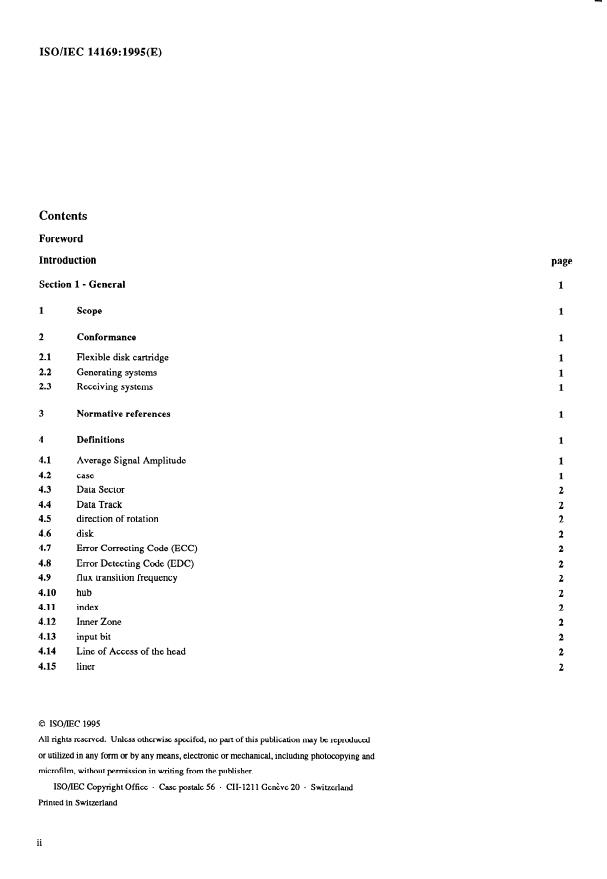
Contents
Foreword
Introduction Page
Section 1 - General
1 Scope
2 Conformance
2.1 Flexible disk cartridge
2.2 Generating Systems
2.3 Receiving Systems
3 Normative references
4 Defini tions
4.1 Average Signal Amplitude
4.2 case
4.3 Data Seetor
4.4 Data Track
4.5 direction of rotation
4.6 disk
4.7 Error Correcting Code (ECC)
4.8 Error Detecting Code (EDC)
4.9 flux transition frequency
4.10 hub
4.11 index
4.12 Inner Zone
4.13 input bit
4.14 Line of Access of the head
4.15 liner
0 ISO/IEC 1995
All rights reserved. Unless otherwise specifed, no part of this publication may be reproduced
or utilized in any form or by any means, electro& or mechanical, including photocopying and
microflm, without permission in writing from the publisher.
ISO/IEC Copyright Office l Case postale 56 l CH-121 1 Geneve 20 l Switzerland
Printed in Switzerland
ii
0 ISO/IEC
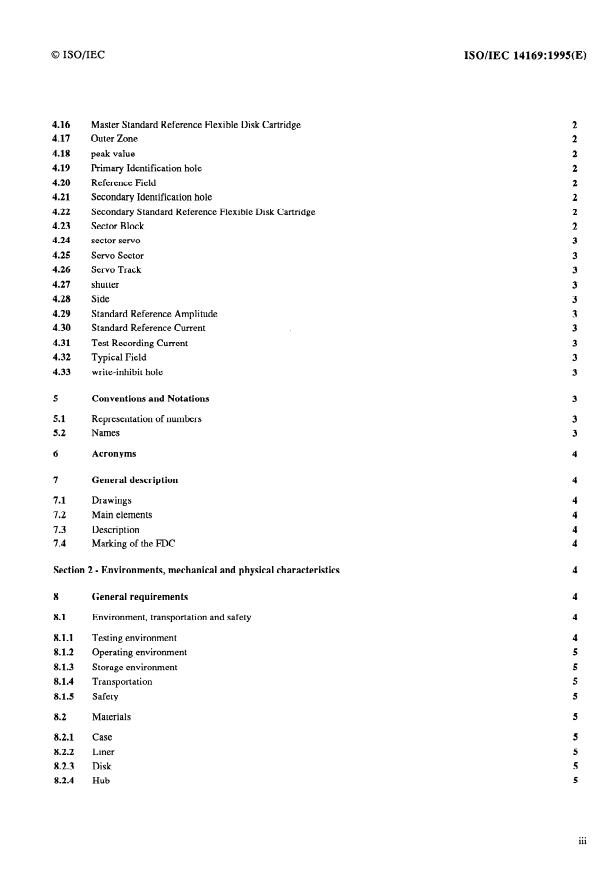
4.16 Master Standard Reference Flexible Disk Cartridge
4.17 Outer Zone
4.18 peak value
4.19 Primary Identification hole
4.20 Reference Field
4.21 Secondary Identification hole
4.22 Secondary Standard Reference Flexible Disk Cartridge
4.23 Seetor Block
4.24 sector servo
4.25 Servo Seetor
4.26 Servo Track
4.27 shutter
Side
4.28
4.29 Standard Reference Amplitude
4.30 Standard Reference Current
4.31 Test Recording Current
4.32 Typical Field
4.33 write-inhibit hole
5 Conventions and Notations
5.1 Representation of numbers
5.2 Names
6 Acronyms
7 General description
7.1 Drawings
7.2 Main elements
7.3 Description
7.4 Marking of the FDC
Section 2 - Environments, mechanical and physical characteristics
8 General requirements
8.1 Environment, transportation and safety
8.1.1 Testing environment
8.1.2 Operating environment
8.1.3 S torage environment
8.1.4 Transportation
8.1.5 Safety
8.2 Materials
8.2.1 Case
8.2.2 Liner
8.2.3 Disk
8.2.4 Hub
. . .
0 ISO/IEC
ISOIIEC 14169:1995(E)
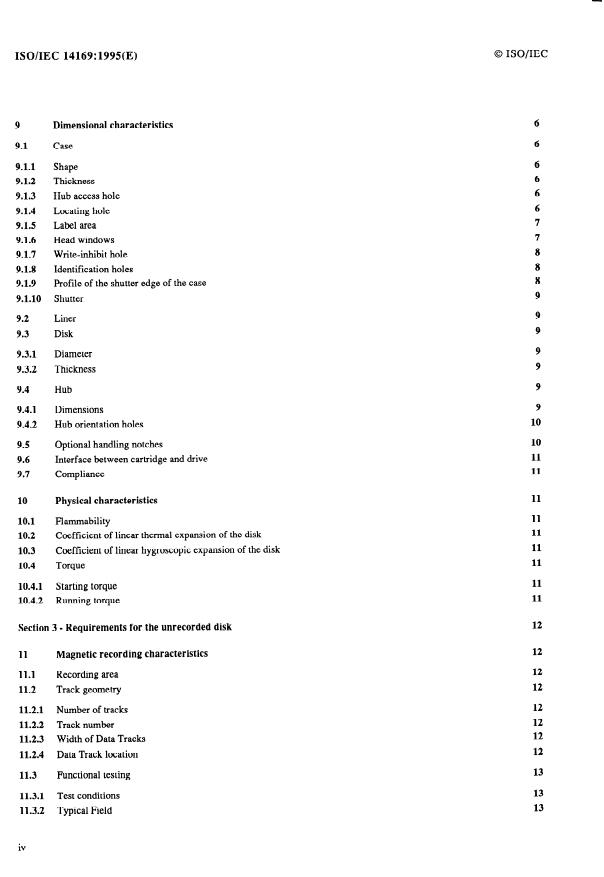
9 Dimensional characteristics
9.1 Case
Shape
9.1.1
Thickness
9.1.2
9.1.3 Hub access hole
9.1.4 Locating hole
9.1.5 Label area
Head windows
9.1.6
Write-inhibit hole
9.1.7
9.1.8 Identification holes
9.1.9 Profile of the shutter edge of the case
9.1.10 Shutter
9.2 Liner
Disk
9.3
9.3.1 Diameter
9.3.2 Thickness
9.4 Hub
Dimensions
9.4.1
9.4.2 Hub orientation holes
9.5 Optional handling notches
9.6 Interface between cartridge and drive
9.7 Compliance
10 Physical characteristics
Flammability
10.1
10.2 Coefficient of linear thermal expansion of the disk
10.3 Coefficient of linear hygroscopic expansion of the disk
10.4 Torque
10.4.1 Starting torque
Running torque
10.4.2
Section 3 - Requirements for the unrecorded disk
Magnetit recording characteristics
11.1 Recording area
11.2 Track geometry
11.2.1 Number of tracks
11.2.2 Track number
11.2.3 Width of Data Tracks
11.2.4 Data Track location
11.3 Functional testing
Test conditions
11.3.1
11.3.2 Typical Field
iv
0 ISO/IEC ISO/IEC 14169:1995(E)
11.3.3 Average Signal Amplitude
11.3.4 Resolution
11.3.5 Peak shift
11.3.6 Overwrite
11.3.7 Modulation
11.4 Track quality tests
11.4.1 Missing pulse
11.4.2 Extra pulse
11.4.3 Requirement for tracks
11.4.4 Rejected cartridge
Section 4 - Requirements for the interchanged disk
12 Recording of Data Tracks
12.1 Method of recording
12.2 Tolerantes of the track locations
12.3 Recording offset angle
12.4 Density of recording
12.4.1 Nominal density of recording
12.4.2 Lang-term average Channel bit cell length
12.4.3 Short-term average Channel bit cell length
12.5 Flux transition spacing
Average Signal Amplitude
12.6
12.7 Byte
12.8 Data Seetor
12.9 Cylinder
12.10 Cylinder number
12.11 Data capacity of a track
12.12 Hexadecimal notation
13 Disk layout
13.1 Layout of a Data Seetor
13.1.1 Compensation field
13.1.2 Seetor Identifier
13.1.3 Identifier Gap
13.1.4 Data Block
13.1.5 Data Block Gap
13.1.6 Defective Data Seetor
Data Tracks
13.2
13.2.1 Data Tracks for the user
13.2.2 Data Tracks for the management of defective Data Seetors
13.2.3 Data Tracks for servo recovery
13.3 Coded representation of data
0 ISO/IEC
14 General requirements for recording Servo Tracks
14.1 Method of recording
14.2 Servo Tracks
14.2.1
Number of Servo Tracks
14.2.2
Width of Servo Tracks
14.2.3
Servo Track location
14.3 Average Signal Amplitude of servo data
14.4 Displacement due to fluctuations of Signal amplitude of servo data
15 Layout of the Servo Track
15.1 Layout of the Servo Seetor
15.1.1 Servo Identifier
15.1.2 Servo data
16 Relative Position of Data Tracks and Servo Tracks
Annexes
A - Cartridge distortion test gauge
B - Measurement of light transmittance
C - Test for compliance
D - Method for measuring the effective track width
E - Head and read amplifier for functional testing
F - Method of measuring peak shift
G - Method for measuring overwrite
H - Procedure and equipment for measuring flux transition spacing
- Handling of defective Data Seetors
J
K - Method for measuring the eccentricity of Servo Tracks
L - Method of measuring the offset between Data Tracks and Servo Tracks
M - Torque measurements
N - Data separators for decoding 2-7 RLL recording
P - EDC Implementation
Q - ECC Implementation
R - Servo Track recording conditions
s - Method for measuring the displacement of the head due to amplitude fluctuations of
servo data
T - Institute supplying Secondary Standard Reference Flexible Disk Cartridges
Vl
0 ISO/IEC
Foreword
ISO (the International Organization for Standardization) and IEC (the International Electrotechnical Commission) form the specialized
System for worldwide standardization. National bodies that are members of ISO or IEC participate in the development of International
Standards through technical committees established by the respective organization to deal with particular fields of technical activity. ISO
and IEC technical committees collaborate in fields of mutual interest. Other international organizations, govemmental and non-
govemmental, in liaison with ISO and IEC, also take part in the work.
In the field of information technology, ISO and IEC have established a joint technical committee, ISO/IEC JTCl. Draft International
Standards adopted by the joint technical committee are circulated to national bodies for voting. Publication as an International Standard
requires approval by at least 75 % of the national bodies casting a vote.
International Standard ISO/IEC 14169 was prepared by the Japanese Industrial Standards Committee (as StandardJIS X 6228 - 1994) with
document support and contribution from ECMA and was adopted, under a special “fast-track procedure” by Joint Technical Committee
ISO/IEC JTCl, Information technology, in parallel with its approval by national bodies of ISO and IEC.
Annexes A to L form an integral part of this International Standard. Annexes M to T are for inforrnation only.
vii
0 ISO/IEC
Introduction
This International Standard specifies the characteristics of 90 mm flexible disk cartridges of 21 MBytes forrnatted capacity, recorded at
3 1 83 1 ftprad in the Inner Zone and 47 747 ftprad in the Outer Zone with sector servo tracking on 326 Data Tracks on each side, using
2-7 RLL recording.
This International Standard specifies the physical interchangeability of the unrecorded disk and the fomrat interchangeability of recorded
Data Tracks and Servo Tracks.
In reference to ISO/IEC 9983, flexible disk cartridges confortning to this International Standard are designated as ISO Type 305.
. . .
Vlll
INTERNATIONAL STANDARD o ISO/IEC ISO/IEC 14169: 1995 (E)
Information technology - 90 mm flexible disk cartridges for information interchange
- 21 MBytes formatted capacity - ISO Type 305
Section 1 - General
1 Scope
This International Standard specifies the characteristics of 90 mm flexible disk cartridges (FDC) of 21 Mbytes formatted capacity,
recorded at 3 1 83 1 ftprad in the Inner Zone and 47 747 ftprad in the Outer Zone with sector servo tracking on 326 data tracks on each
side, using 2-7 RLL recording.
It specifies the mechanical, physical and magnetic characteristics of the cartridge, so as to provide physical interchangeability between
data processing Systems.
It also specifies the method of recording, the quality of recorded Signals, the track layouts and the track formats of Data Tracks and
Servo Tracks.
Such flexible disk cartridges are identified as ISO Type 305.
Together with a Standard for volume and file structure, for instance ISO/IEC 9293, this International Standard provides for full data
interchange between data processing Systems.
2 Conformance
2.1 Flexible disk cartridge
A 90 mm flexible disk cartridge shall be in conformance with this International Standard if it meets all the mandatory requirements
specified herein.
2.2 Generating Systems
A System generating an FDC for interchange shall be entitled to Claim conformance with this International Standard if all recordings
on the flexible disk meet the mandatory requirements of this International Standard.
2.3 Receiving Systems
A System receiving an FDC for interchange shall be entitled to Claim full conformance with this International Standard if it is able to
handle any recording made on the flexible disk according to this International Standard.
3 Normative references
The following Standards contain provisions which, through reference in this text, constitute provisions of this International Standard.
At the time of publication, the editions indicated were valid. All Standards are subject to revision, and Parties to agreements based on
this International Standard are encouraged to investigate the possibility of applying the most recent editions of the Standards indicated
below. Members of IEC and ISO maintain registers of currently valid International Standards.
ISO 683-13: 1986, Heat-treatable steels, alloy steels and free-cutting steels - Part 13: Wrought stainless steels.
ISO/IEC 9293: 1994, Information technology - Volume and file structure of disk cartridges for information interchange.
ISO/IEC 9983: 1995, Information technology - Designation of unrecordedflexible disk cartridges.
IEC 950: 199 1, Safety of information technology equipment, including electrical business equipment.
4 Defini tions
For the purposes of this International Standard, the following definitions apply.
4.1 Average Signal Amplitude: The Average Signal Amplitude for a track is the arithmetically averaged value of the output
voltages measured peak-to-peak over the whole track.
4.2 case: A protective enclosure including a shutter mechanism, identification holes and a write-inhibit hole.
0 ISO/IEC
ISOIIEC 14169:1995(E)
4.3 Data Seetor: A sector comprising a Seetor Identifier and a Data Block.
4.4 Data Track: A track on which data are recorded on Data Seetors.
4.5 direction of rotation: The direction of rotation shall be counter-clockwise when looking at Side 0.
4.6 disk: A flexible disk which accepts and retains, on the specified side or sides, magnetic Signals intended for input/output and
storage purposes.
4.7 Error Correcting Code (ECC): A mathematical procedure yielding bits used for the detection and correction of errors.
4.8 Error Detecting Code (EDC): A mathematical procedure yielding bits used for the detection of errors.
4.9 flux transition frequency: The number of flux transition per second (ftps).
NOTE 1 - In this International Standard, the frequencies to be used in the Outer Zone are indicated by the subscript 02, those to be used in the
Inner Zone are indicated by the subscript IZ (see 11.3.1.1).
which allows torque to be transmi tted to the disk. The hub is
4.10 hub: A centring and referencing device attached to the disk
disk on the drive shaft in a unique angular Position.
attached to the centre of the disk. It ensures centring of the
4.11 index: The Signal generated in the index transducer of the drive by the drive spindle once per revolution.
4.12 Inner Zone: The inner subdivision of the recording area of a surface of the disk.
input bit: Bits which represent input data.
4.13
4.14 Line of Access of the head: The straight line described by the centre of the gap of the read/write head when positioned from
Track -004 to Track 328.
4.15 liner: Suitable material between the case and the disk to provide cleaning action and protection from abrasion.
4.16 Master Standard Reference Flexible Disk Cartridge: A flexible disk cartridge selected as the Standard for Reference
Fields, Signal amplitudes, resolution, peak shift, and overwrite. Tracks 000 and 325 are declared as Reference Tracks.
The reference tracks are calibrated at 600 rpm.
NOTE 2 - This Master Standard has been established at the Reliability Centre for Electronie Components of Japan (RCJ), l-1 -12 Hachiman-cho,
Higashikurume-shi, Tokyo 203, Japan.
Outer Zone: The outer subdivision of the recording area of a surface of the disk.
4.17
peak value: The zero to crest value of the output voltage of the read head.
4.18
4.19 Primary Identification hole: A through-hole provided on the case to identify the FDC specified by this International
Standard.
Reference Field: The Typical Field of the Master Standard Reference Flexible Disk Cartridge. There are two Reference
4.20
Fields, one for each side.
Secondary Identification hole: An identification hole provided on Side 0 of the case to identify the FDCs specified by this
4.21
International Standard.
Secondary Standard Reference Flexible Disk Cartridge: A flexible disk cartridge the Performance of which is known and
4.22
stated in relation to that of the Master Standard Reference Flexible Disk Cartridge.
NOTE 3 - Secondary Standard Reference Flexible Disk Cartridges tan be ordered under part number JRM 6228 from the Reliability Centre for
Electronie Components of Japan (RCJ), 1- 1- 12 Hachiman-cho, Higashikurume-shi, Tokyo 203, Japan until the year 2004. (see annex T).
It is intended that these be used for calibrating tertiary reference disks for use in routine calibration.
Seetor Block: A block consisting of a Servo Seetor followed by either two or three Data Seetors, and a Seetor Block Gap.
4.23
0 ISO/IEC ISO/IEC 14169:1995(E)
4.24 Seetor servo: A method of Position control, whereby head positioning information is recorded at the beginning of each Seetor
Block.
4.25 Servo Seetor: A sector which has a Servo Identifier and servo data.
4.26 Servo Track: A track on which Servo Seetors are permanently recorded.
4.27 shutter: A device which uncovers the head windows upon insertion of the cartridge into a drive, and automatically covers
them upon removal from the drive.
4.28 Side: Side 0 is the side engaged by the spindle. Side 1 is the opposite side.
4.29 Standard Reference Amplitude: The Standard Reference Amplitudes (SRAs) are the Average Signal Amplitudes derived
from the reference tracks of the Master Standard Reference Flexible Disk Cartridge using the Test Recording Current.
There are four SRAs, two for each side (see 11.3.1.1):
SRAl is the Average Signal Amplitude from a recording written using 3foZ at Track 000.
SRA2 is the Average Signal Amplitude from a recording written using 8frz at Track 325.
4.30 Standard Reference Current: The current that produces the Reference Field.
Test Recording Current: The current the relationship of which to the Standard Reference Current is defined for each zone
4.31
and for each flux transition frequency.
4.32 Typical Field: In the plot of the Average Signal Amplitude against the Recording Field at a specified recording density, the
minimum field that Causes an Average Signal Amplitude equal to 95% of the maximum Average Signal Amplitude.
write-inhibit hole: A through-hole with a sliding cover, provided on the case to inhibit writing on the disk when the hole
4.33
is uncovered.
5 Conventions and Notations
5.1 Representation of numbers
-
A measured value is rounded off to the least significant digit of the corresponding specified value. It implies that a specified
value of 1,26 with a positive tolerante of +O,Ol, and a negative tolerante of -0,02 allows arange of measured values from 1,235
to 1,275.
Letters and digits in parentheses represent numbers in hexadecimal notation.
The setting of a bit is denoted by ZERO or ONE.
Numbers in binar-y notation and bit combinations are represented by strings of ZEROS and ONEs.
Numbers in binary notation and bit combinations are shown with the most significant byte to the left, and with the most
significant bit in each byte to the left.
Negative values of numbers in binary notation are given in TWO ’s complement.
In each field the data is processed so that the most significant byte (byte 1) is processed first. Within each byte the least
significant bit, numbered B 1, is processed last, the most significant bit, numbered B,, is processed first. This Order of processing
applies also to the data input to the Error Detecting and Correcting circuits and to their output.
5.2 Names
The names of entities, e.g. specific tracks, fields, etc., are given with a capital initial.
0 ISO/IEC
6 Acronyms
ECC Error Correcting Code
EDC Error Detecting Code
FFT Fast Fourier Transform
LED Light Emitting Diode
Standard Reference Amplitude
SRA
SVDT Servo data
SVIDA Servo Identifier A
SVIDB Servo Identifier B
2-7 RLL 2-7 Run Length Limited (Code)
7 General description
7.1 Drawings
In the enclosed drawings:
Shows Side 0 and enlarged Cross-sections through the Location and Secondary Identification holes;
Figure 11
Figure 12 Shows Side 1;
Shows at a larger scale the top part of Side 0 without shutter;
Figure 13
Show the disk with hub;
Figures 14, 15
Figure 16 Shows the interface between the cartridge and the drive.
7.2 Main elements
The main elements of the flexible disk cartridge are
-
the disk,
-
the liner,
-
the case.
7.3 Description
The case is of a substantially Square form. It includes a central hole on one side, head windows covered by a shutter on both sides,
identification holes and a write-inhibit hole.
The liner is provided between the case and the disk. It comprises two layers of material between which the disk lies. The disk has a
central hole with a metal hub attached.
7.4 Marking of the FDC
It is recommended that the case be clearly marked with the ISO Type No. ISO 305 of the FDC.
Section 2 - Environments, mechanical and physical characteristics
8 General requirements
8.1 Environment, transportation and safety
8.1.1 Testing environment
Tests and measurements made on the cartridge to check the requirements of this International Standard shall be carried out under the
following conditions:ISO
23 OC + 2 OC
temperature:
40 % to 60 %
relative humidity:
24 h min.
conditioning before testing:
0 ISO/IEC
For the tests specified in 11.3 the temperature and relative humidity shall be measured in the air immediately surmunding the cartridge
drive. For all other tests the temperature and the relative humidity shall be measured in the air immediately surmunding the cartridge.
The stray magnetic field at any Point on the disk surface, including that resulting from the concent.nhg effect of the magnetic head,
shall not exceed 4 000 A/m.
8.1.2 Operating environment
Cartridges used for data interchange shall be capable of operating under the following conditions:
temperature: 10 OC to 51,5 OC
relative humidity: 20 % to 80 %
wet bulb temperature: less than 29 OC
the relative humidity shall be measured in the air
The temperature and immediately surrounding the cartridge. It is recommended that
the rate of Change of the temperature should not exceed 20 OC per h.
There shall be no deposit of moisture on or in the cartridge.
The stray magnetic field at any Point on the disk surface, including that resulting from the concentrating effect of the magnetic head,
shall not exceed 4 000 A/m.
8.1.3 Storage environment
During storage the cartridges shall be kept within the following conditions:
temperature: 4 “C to 53 “C
relative humidity: 8 % to 90 %
The ambient stray magnetic field shall not exceed 4 000 A/m. There shall be no deposit of moisture on or in the cartridge.
NOTE 4 - Cartridges which have been stored at temperatures and humidities exceeding the operating performante
conditions may exhibit degraded
characteristics. Such cartridges should be subjected to a conditioning period of not less than 24 h within the operating environment Prior to use.
8.1.4 Transportation
Responsibility for ensuring that adequate precautions are taken during the transportation shall be with the sender. The cartridge shall
be in a protective package free from dust or extraneous matter. It is recommended that a sufficient space exists between cartridge and
outer surface of the final Container, so that risk of erasure due to stray magnetic fields will be negligible.
It is recommended that the following conditions are not exceeded:
temperature: -40 OC to 60 OC
maximum rate of temperature Change: 20 OC per h
relative humidity: 8 % to 90 %
There should be no deposit of moisture on or in the cartridge.
8.1.5 Safety
The flexible disk cartridge and its components shall satisfy the requirements of IEC 950.
8.2 Materials
8.2.1 Case
The case may be constructed from any sui table material such that it meets the requirements of 9.7.
8.2.2 Liner
The material of the liner shall be able to retain dust or debris without darnage to the disk.
8.2.3 Disk
The d isk may be constructed from any suitable material e. . bi-axially oriented polyethylene terephthalate) coated on both sides with
( 8
.es).
a flex .ible layer of magnetic material (e.g. metal particl
8.2.4 Hub
The hub shall be made of any suitable material (e.g. stainless steel alloy according to ISO 683-13, type 8).
0 ISO/IEC
ISOIIEC 14169:1995(E)
9 Dimensional characteristics
9.1
Case
The dimensions of the cartridge are referred to two Reference Axes X and Y. They are two lines in space intersecting at right angles.
The plane they define is the Reference Plane XY of the cartridge (figures 11 and 12).
9.1.1 Shape
The case has a rectangular form, its sides shall be
2, = 94,0 mm*O,3 mm
+ 0,4
22 = 90,o nm0 lI=
The radius of three of its comers shall be
r1 = 2,Omm* 1,Omm
The angle of its fourth comer shall be
w=45"+2"
9.1.2 Thickness (figure 12)
In the area extending 8,5 mm from each of the two edges as shown in figure 12, the thickness of the case shall be
el= 3,3 mm+O,2 mm
When the cartridge is inserted in the test gauge specified in annex A, a forte of 0,2 N maximum, applied to the centre of the back edge
shall Cause the cartridge to pass through the gauge.
The edge radius shall be
r2= 0,40mmf0,25 mm
9.1.3 Hub access hole (figure 11)
On Side 0 there shall be a hub access hole, the diameter of which shall be
d, = 26,50 mm min.
The Position of the centre of this hole shall be defined by
2, = 40,OO mm + 0,15 mm
Z4 = 31,00 mm + 0,15 mm
Locating holes (figures 11 and 13)
9.1.4
9.1.4.1 Primary Locating hole
The centre of the Primary Locating hole shall be at the intersection of Reference Axes X and Y.
Its diameter shall be
dz= 3,6 mmk 0,l mm
The dimensions of its section (see Cross-section A-A in figure 11) shall be
d, = 1,5 mmmin.
I, = 0,2 mm + 0,l mm
Z9 = 1,Ommmin.
Z,, = 2,5 mm min.
0 ISO/IEC ISO/IEC 14169:1995(E)
9.1.4.2 Secondary Locating hole
The centre of the Secondary Locating hole shall be on Reference Axis X, its distance from Reference Axis Y shall be
Z5 = 80,O mmf0,2 mm
It shall have a substantially rectangular shape. Its short axis shall be (see Cross-section B-B in figure 11)
Z6 = 3,6 mm + 0,l mm
Its long axis shall be
27 = 4,4 mm*o,2mm
The dimensions d,, Z,, l9 and I,, of the Cross-section of the Secondary Locating hole are as specified in 9.1.4.1.
9.1.5 Label area
9.1.5.1 Side 0 (figure 11)
The locations and dimensions of the label area of Side 0 shall be defined by
I,, = 3,5 mm min.
Z,,= 76,5 mmmax.
I,, = 60,O mm min.
9.1.5.2 Side 1 (figure 12)
The locations and dimensions of the label area of Side 1 shall be defined by
Z,, = 3,5 mm min.
I,, = 76,5 mm max.
Z,, = 20,O mm min.
Head windows (figure 13)
9.1.6
The locations and dimensions of the two head windows are specified by the same set of dimensions.
9.1.6.1 Location
The location of the head windows shall be defined by
I,, = 12,3 mm min.
Z,, = 11,5 mrn min.
21, = 35,5 mm+o,2mm
9.1.6.2 Dimensions
The width of the head windows shall be
21, = 9,OOmmkO,2Omm
The radius of their comers shall be
‘3 = 0,5 nun It 0,l mm
‘4 = 0,5 mm + 0,l mm
ISOIIEC 14169:1995(E) 0 ISO/IEC
9.1.7 Write-inhibit hole (figures 11 and 12)
The write-inhibit hole is intended for useeither with amechanical switch or with anoptical detector so that only when the hole is covered
is writing on the disk possible. When covered, the closure device shall not extend outside the Reference Plane nor shall it deflect by
more than 0,3 mm fiom the Reference Plane inside the case under the action of a forte of 3 N.
Also when covered, the light transmittance of the write-inhibit hole area shall not exceed 1 %, when measured with an Optical System
such as described in annex B.
NOTE 5 - The position of write-inhibit hole is reversed compared with that of the cartridges specified by ISO 8860, ISO 9529 and ISO/IEC 10994 ; and it
agrees with the position specified in ISO/IEC 13422.
9.1.7.1 Location
The centre of the write-inhibit hole shall be specified by Zs and
219 = 67,75 mm+o,25 mm
9.1.7.2 Dimensions
The dimensions of the write-inhibit hole shall be
Zb9 = 35 mm min.
I,, = 4,0 mm min.
9.1.8 Identification holes (figures 11 to 13)
The Identification holes are provided to distinguish between the FDC according to this International Standard from those specified by
ISO 8860, ISO 9529, ISO/IEC 10994 and ISO/EC 13422.
NOTE 6 - As the Secondary Identification hole is not a through-hole, it is recommended that the Identification holes be detected by mechanical means.
9.1.8.1 Primary Identification hole
The Position of the centre of the Primar-y Identification hole shall be on Reference Axis Y. Its distance from Reference Axis X shall
be specified by I,,.
The dimensions of the Primary Identification hole shall be
Z20 = 35 mm min.
Z21 = 4,0 mm min.
9.1.8.2 Secondary Identification hole
The Position of the centre of the Secondary Identification hole shall be
I, = 7,50 mm -f: 0,15 mm
261 = 69,O mm+o,2 mm
Its diameter shall be
d,, = 3,5 mm min.
The dimensions of its section (see Cross-section C-C in figure 11) shall be specified by I, and
ZG2 = 2,5 mm min.
Profile of the shutter edge of the case (figures 11 and 13)
9.1.9
The edge on which the shutter is mounted shall have a Profile defined by the following dimensions:
122= 80,O mmf0,2 mm
$3 = 76,O mmkO,3 mm
Z24 = 68,0 mm+O,3 mm
Zz = 64,50 mm * 0,35 mm
126 = 57,00 mm * 0,35 mm
0 ISO/IEC
Z27 = 55,5 mm f0,6 mm
Z2* = 3,5 mm min.
Z29 = 17,5 mm + 0,2 mm
23, = 17,00 mm + 0,15 mm
Z,, = 15,50 mrn + 0,25 mm
Zb5 = 12,50 mm * 0,25 mm
a =45 ”Ik2”
ß = 135 ”+ 2”
9.1.10 Shutter (figures 12 and 13)
The shutter shall slide upon insertion of the cartridge into the drive so as to uncover the head windows, and close automatically upon
removal. The maximum resistance forte at the fully open Position shall be 1 N, and the minimum resistance forte at the fully closed
Position shall be 0,2 N.
The path along which the shutter tan slide is defined by 2, and Z,,.
In the open Position of the shutter, the distance from its leading edge to the Reference Axis Y shall be
Z,, = 53,75 mm 21 1,25 nun
The width of the windows of the shutter shall be
I,, = 12,0 mm + 0,2 mm
NOTE 7 - It is a requirement that the drive shall provide a mechanism cartridge into the drive causes the to slide so
as to uncover the head windows.
9.2 Liner
No part of the liner shall protrude by more than 0,2 mm into the head access windows.
Disk (figures 14 and 15)
9.3
9.3.1 Diameter
The diameter of the disk shall be
d4= 85,8 mmf0,2 mm
9.3.2 Thickness
The thickness of the disk shall be
e2=0,067mm~0,008mm
9.4 Hub (figures 14 and 15)
The hub shall have a central part and a flange.
9.4.1 Dimensions
The diameter of the central part shall be
dg=25,00mm '-zmm
>
The diameter of the flange shall be
d6= 29,5Omm max.
The distance from the surface of the central part of the hub to the surface of Side 0 of the disk shall be
Z,,= 1,36mmfO,lOmm
when measured at a radius r7
r7 = 14 mm nominal
9.4.2
Hub orientation holes (figures 14 and 15)
The hub shall have two orientation holes. The first one at its centre, the second off-centre.
9.4.2.1 Primary Orientation hole
The Primar-y Orientation hole shall have a Square form defined by
Z35 = 4,0 mm min.
The Position of the centre of rotation of the disk is defined by
I,,= 1,995 5 mm
measured from two sides of the hole. The centre of rotation shall be within 0,5 mm of the geometric centre of the disk. The radius of
the four comers of this hole shall be
r5= 1,0mm~0,3mm
The angles of two sides of the hole which are in contact with the spindle shaft shall be
9.4.2.2 Secondary Orientation hole
The Position and dimensions of the sides of the rectangular Secondary Orientation hole are referred to two radial Reference Lines A
and B that are perpendicular to each other. Their positions shall be specified by
y= 15” +3O
The length of the sides of this hole shall be
l,, = 8,0 nun k 0,3 mm
I,, = 4,5 mm min.
These sides shall be parallel to Reference Lines A and B, respectively, at a distance:
2y-j = 2,0 nun * 0,2 mm
240 = 10,OO mm + 0,15 mm
The radius of one comer of this hole shall be
r6 = 2,0 mtn + o,l mm
The radius of the three other comers shall be
rs= l,Omm*0,3mm
9.5 Optional handling notches (figures 11 and 12)
Two handling notches are permitted. If present they shall satisfy the following requirements. Their centres shall be on a line parallel
to, and lying above, Reference Axis X at a distance
141 = 7,50 mm + 0,15 mm
Their dimensions shall be
Za2 = 3,0 mm min.
Za3 = 4,2 nun + 0,2 mm
Their depth below the Reference Plane XY shall be
Zb4 = 2,0 mm min.
0 ISO/IEC
9.6 Interface between cartridge and drive (figure 16)
When the cartridge is inserted into the drive, the drive spindle engages the cartridge as shown in figure 16. The hub is held against the
drive spindle by means of a magnetic attraction forte. When in this Position the distance between the hub surface on Side 0 and
Reference Plane XY shall be
146 = 0,3 m.m nominal
The inside dimensions of the case with the centre plate on Side 1 shall be
mm min.
d+ = 7,0
e3= 1,3 mm*O,l mm
with the exception sf the annular zone defined by Z,, and Z,, where the thickness shall be
e4 = 2,5 mm max.
Z47 shall be sufficiently large to ensure that the circumference of the disk shall not tauch the inside edges of the case. The value of Z47
specifred below is a recommended value therefore it is stated without tolerante.
Z47 = 22,6 mm
148 = 21,7 mm + 0,2 mm
Compliance
9.7
When the cartridge is constrained in the manner described in annex C, the cartridge shall be in contact with posts Pl to P4.
10 Physical characteristics
10.1 Flammability
The disk, case and liner components shall be made from materials that, if ignited from a match flame, do not continue to bum in a still
carbon dioxide atmosphere.
10.2 Coefficient of linear thermal expansion of the disk
The coefficient of thermal expansion of the disk shall be
(17 + 8) x 10m6 per degree Celsius
The range from maximum value to minimum value on the disk surface shall be
8 x 10e6 per degree Celsius max.
10.3 Coefficient of linear hygroscopic expansion of the disk
The coefficient of hygroscopic expansion of the disk shall be
(0 to 15) x 10m6 per percent of relative humidity.
The range from maximum value to minimum value on the disk surface shall be
5 x 10w6 per percent of relative humidity max.
10.4 Torque
10.4.1 Starting torque
The starting torque, without the heads loaded, shall not exceed 0,006 Nm (see annex M).
10.4.2 Running torque
The torque necessary to turn the disk,without the heads loaded, shall be in the range 0,000 5 Nm to 0,002 5 Nm (see annex M).
ISOIIEC 14169:1995(E) 0 ISO/IEC
Section 3 - Requirements for the unrecorded disk
11 Magnetit recording characteristics
11.1 Recording area
On each side the magnetic properties specified shall be uniform in the recording area, which shall be the area limited by two radii:
20,6 mm max.
42,0 mm min.
11.2 Track geometry
11.2.1 Number of tracks
In the recording area there shall be 342 concentric tracks of which 326 contain user data on each side of the disk.
11.2.2 Track number
The track number shall be a three-digit number identifying the tracks consecutively, starting at the outermost track (figure 9).
11.2.2.1 Data Tracks
Data Tracks shall be numbered from -004, the outermost Data Track, to 328, the innermost Data Track.
11.2.2.2 Servo Tracks
Servo Tracks shall be numbered from -10,5 , the outermost Servo Track, to 330,5 , the innermost Servo Track.
11.2.3 Width of Data Tracks
The width of a recorded track shall be
0,044 mm + 0,003 mm
The method of measuring effective track width is given in D. 1 of annex D.
11.2.4 Data Track location
11.2.4.1 Nominal locations
The nominal radius (RnD) of the centrelines of the Data Tracks shall be calculated by using the formula:
Rn, = x - 0,046 875 nJ ’)
where
nD is the track number, nD = -004 to 328
x = 39,875 mm for Side 0
x = 38,375 mm for Side 1
11.2.4.2 Track location tolerante
For testing purposes the centrelines of the recorded tracks shall be within 0,050 mm of the nominal positions, when measured in the
testing environment (8.1.1). The nominal distance between centrelines of adjacent tracks shall be 0,046 875 mm, and its tolerante shall
be +o,OlO mm.
11.2.4.3 Line of Access of the heads
The Line of Access of the heads shall be a line parallel to a radial line and spaced 0,35 mm from it (see 12.3).
11.2.4.4 Zone of tracks
The tracks of the disk are grouped into two zones: an Outer Zone and an Inner Zone. The innermost track of the Outer Zone constitutes
the boundary between the two zones. On Side 0, it is Track 112, on Side 1, it is Track 080.
0 ISO/IEC ISO/IEC 14169:1995(E)
Functional testing
11.3
For the purposes of the following tests the same drive unit shall be used for writing and reading operations, both for the disk under test
and for the Secondary Standard Reference Flexible Disk Cartridge.
The in-contact condition shall be used.
Unless otherwise specified, tests shall be performed on both sides.
11.3.1 Test conditions
The magnetic properties of both surfaces are defined by the testing requirements given below.
11.3.1.1 Flux transition frequency
Two test frequencies, expressed in flux transitions per second (ftps), shall be used in each Zone. In the Outer Zone:
sfoz = 3 000 000 ftps ir 3 000 ftps
3foz = 1 125 000 ftps + 1 125 ftps
In the Inner Zone:
8fIz = 2 000 000 ftps + 2 000 ftps
750 000 ftps + 750 ftps
3f
lz=
The frequency(ies) to be used is(are) specified for each test.
11.3.1.2 Test Recording Currents
The Test Recording Currents shall have the following relationships to the Standard Reference Current at 8fz on Track 325.
Side 0 tracks -004 to 112 and 219 to 328 : (130f2) %
Side 0 tracks 113 to 218 :(180f2)%
Side 1 tracks -004 to 080 and 203 to 328 : (130f2) %
Side 1 tracks 081 to 202 : (180+2) %
11.3.1.3 Erasure
Erasure shall be performed using the d.c. equivalent to the quiescent value Iq of the Test Recording Current before recording the data,
unless otherwise specified.
r
q
’ 1
Time
Figure 1 - Quiescent value of the Test Recording Current
11.3.1.4 Rotational Speed of the disk
The rotational Speed of the disk shall be 600 rpm + 6 rpm. The direction of rotation shall be counter-clockwise as seen from Side 0
of the flexible disk cartridge.
11.3.2 Typical Field
The Typical Field of the disk under test shall be (100 $- 20) % of the Reference Field. It shall be measured using 8fE on Track 325.
Traceability to the Reference Field is provided by the calibration factors supplied with each Secondary Standard Reference Flexible
Disk Cartridge.
0 ISO/IEC
11.3.3 Average Signal Amplitude
with the Secondary Standard
When the disk under test has been recorded with the Test Recording Current, then read back and compared
shall be
Reference Flexible Disk Cartridge recorded under the same conditions, the Average Signal Amplitude
-
on Track 000, using 3foz : less than 130 % of SRA 1
-
on Track 325, using 8fIz : more than 85 % of SRA2
Traceability to the Standard Reference Amplitudes is provided by the calibration factors supplied with each Secondary Standard
Reference Flexible Disk Cartridge.
11.3.4 Resolution
After recording on Track 325, using the Test Recording Current, the ratio:
Average Signal Amplitude using 8fu x 1o04
Average Signal Amplitude using 3fIz
shall be equal to (1,00 + 0,15) times the same ratio for the Master Standard Reference Flexible Disk Cartridge.
Traceability to the resolution of the Master Standard Reference Flexible Disk Cartridge is provided by the calibration factors supplied
with each Secondary Standard Reference Flexible Disk Cartridge.
11.3.5 Peak shift
The average peak shift measured on the disk cartridge under test, using the method specified in annex F, shall be (100 9~ 37) % of that
of the Master Standard Reference Flexible Disk Cartridge when measured on the Secondary Standard Reference Flexible Disk
Cartridge under the same conditions. This test shall be performed on Track 325.
Traceability to the,peak shift of the Master Standard Reference Flexible Disk Cartridge is provided by the calibration factors supplied
with each Secondary Standard Reference Flexible Disk Cartridge.
11.3.6 Overwrite
The overwrite measured on Track 113 on Side 0 and on Track 08 1 on Side 1, using the method specified in annex G, shall not exceed
1,25 times the value of the overwrite of the Master Standard Reference Flexible Disk Cartridge.
Traceability to the overwrite of the Master Standard Reference Flexible Disk Cartridge is provided by the calibration factors supplied
with each Secondary Standard Reference Flexible Disk Cartridge.
11.3.7 Modulation
Modulation shall be
A-B
x 100%
A+B
where
maximum value of the average values of the amplitude-modulated outpu .t voltage of about 2 000 consecutive flux transitions
A: The
in a track. Output voltage shall be measured peak-to-peak.
B: The minimum value of the average values of the amplitude-modulated output voltage of about 2 000 consecutive flux transitions
in a track. Output voltage shall be measured peak-to-peak.
On all tracks of the Outer Zone using 8foz and on all tracks of the Inner Zone using 8fIz, modulation shall be less than 10 %.
11.4 Track quality tests
These tests shall apply to Tracks -001 to 325 on each side. The appropriate Test Recording Cunent shall be used.
11.4.1 Missing pulse
track using 8foz and in the Inner Zone write a track using 8fu. Any playback Signal which, when measured
In the Outer Zone write a
base-to-peak, is less than 65 % of half the Average Signal Amplitude of the track, is a missing pulse.
0 ISO/IEC
ISOIIEC 14169:1995(E)
11.4.2 Extra pulse
In the Outer Zone write a track using 8foz and in the Inner Zone write a track using 8fE. Measure the Average Signal Amplitude. Then
erase the track for one revolution with a d.c. equal to the quiescent value of the Test Recording Current applied to the head
(see figure 1). Any playback Signal which, when measured base-to-peak, exceeds 20 % of half the Average Signal Amplitude is an extra
pulse.
11.4.3 Requirement for tracks
A cartridge shall meet the requirements in 11.4.3.1 and 11.4.3.2.
Defects shall be missing and./or extra pulses detected in the same Position(s) on three consecutive Passes.
11.4.3.1 Tracks -001 to 005
As initially received fiom the medium supplier, the cartridge shall have no defects on tracks -001 to 005.
11.4.3.2 Tracks 006 to 325
The acceptable number of defects on these tracks of the F ’DCs initially received from the medium supplier, is a matter of agreement
between supplier and purchaser. A reasonable number could be less than 20 per disk.
11.4.4 Rejected cartridge
A cartridge that does not meet the requirements of 11.4.3.1 shall be rejected.
Section 4 - Requirements for the interchanged disk
Recording of Data Tracks
12.1 Method of recording
The method of recording shall be the 2-7 Run Length Limited (2-7 RLL) method in which
-
a ONE is represented by a flux transition at the centre of a bit cell,
-
a ZERO is represented by no flux transition at the centre of a bit cell,
-
the number of ZEROS between two consecutive ONEs is at least two and at most seven.
Table 1 indicates how the input bit series shall be converted into Channel bits series to meet the requirements of the recording method.
Table 1 - Code conversion
Input bits series
Channel bits series
ooo 000100
010 100100
011 001000
0010 00100100
0011 OW01000
Tolerantes of the track locations
12.2
Within the testing environment specified in 8.1.1 the centrelines of the recorded Data Tracks shall meet both following requirements:
-
they shall be within 0,050 mm of their nominal location,
-
their distance, in millimetres, from Track Ooo shall be as follows
where nD is the Data Track number,
l multiply 0,046 875 by nD,
l round off the result to three digits after the decimal comma to obtain this distance,
l the tolerante on this distance shall be + 0,020 mm.
0 ISO/IEC
ISOIIEC 14169:1995(3)
12.3 Recording offset angle
At the instant of writing or reading a magnetic transition, the transition shall have an angle 0 (figure 2)
* 0°15’
where Rn, is the radius through that transition (see 11.2.4. l), and d = 0,35 mm.
Figure 2 - Recording offset angle, seen on Side 1
12.4 Density of recording
12.4.1 Nominal density of recording
The nominal density of recording shall be 47 747 ftprad in the Outer Zone and 3 183 1 ftprad in the Inner Zone. The resulting nominal
minimum flux transition spacing shall be 20,944 prad in the Outer Zone, 3 1,416 prad in t
...
Questions, Comments and Discussion
Ask us and Technical Secretary will try to provide an answer. You can facilitate discussion about the standard in here.
Loading comments...