

ISO 18479-2:2016
(Main)Rough-terrain trucks — Non-integrated personnel work platforms — Part 2: User requirements
General Information
- Abstract
ISO 18479-2:2016, intended to be used together with ISO 18479‑1 and ISO 10896‑1, defines user requirements for rough-terrain trucks when fitted with a non-integrated personnel work platform (PWP) as an attachment. This includes non-integrated PWPs that have a means of being affixed to the truck forks. NOTE National or local requirements can apply, which could be more stringent. User requirements for rough-terrain trucks fitted with a personnel work platform having controls which affect travel or movement of the rough-terrain truck are not covered by this part of ISO 18479 (see ISO 18893).
- Status
- Published
- Publication Date
- 22-May-2016
- Technical Committee
- ISO/TC 110/SC 4 - Rough-terrain trucks
- Drafting Committee
- ISO/TC 110/SC 4/WG 2 - Users requirements
- Current Stage
- 9093 - International Standard confirmed
- Start Date
- 03-Oct-2022
- Completion Date
- 29-Aug-2026
Buy Documents


ISO 18479-2:2016 - Rough-terrain trucks -- Non-integrated personnel work platforms
ISO 18479-2:2016 - Rough-terrain trucks — Non-integrated personnel work platforms — Part 2: User requirements/23/2016
Overview
ISO 18479-2:2016, "Rough‑terrain trucks - Non‑integrated personnel work platforms - Part 2: User requirements," defines the user-focused safety, training and operational requirements for rough‑terrain trucks when fitted with a non‑integrated personnel work platform (PWP). Intended to be used together with ISO 18479‑1 (design and verification) and ISO 10896‑1, this standard covers PWPs that can be attached to truck forks and clarifies user responsibilities, operator qualifications and safe operating practices. National or local regulations may be more stringent and take precedence.
Key topics
- Scope and applicability: Use with ISO 18479‑1 and ISO 10896‑1; excludes PWPs with controls that affect truck travel (see ISO 18893).
- Operator documentation: Requirement to keep the truck operator’s manual and any safety bulletins available to operators and maintenance staff.
- Modifications and alterations: Prohibits changes that affect capacity, stability or safe operation without written approval from the original manufacturer or a competent person (conditions if manufacturer is unavailable).
- Operator qualifications and responsibilities: Only competent, authorized persons may operate trucks; operators must be trained and familiar with manuals and workplace conditions.
- Operator training program: Mandatory training elements include truck characteristics, load charts, stability (e.g., stability triangle), controls and instrumentation, steering/braking, visibility, attachment use, and inspection procedures.
- Inspection and maintenance: Visual inspections, functional tests, and maintenance procedures are required to ensure continued safe operation of truck/non‑integrated PWP combinations.
- Operating safety rules: Guidance on travelling, positioning, use conditions, capacity, attachment procedures, damaged PWP handling, and occupant responsibilities.
- Safety equipment: Defines terms like personal fall protection equipment (PFPE) and emphasizes use of appropriate fall‑protection systems where required.
- Hazardous environments: Users must assess and apply additional precautions for varying operating conditions.
Applications
ISO 18479‑2 is practical for:
- Fleet and safety managers implementing safe work at height procedures with rough‑terrain trucks
- Equipment operators and trainers developing operator training curricula
- Maintenance personnel responsible for inspections, repairs and modification records
- Employers and site supervisors ensuring compliance with safe operating rules
- Manufacturers and integrators coordinating user information and modification approvals
Related standards
- ISO 18479‑1 - Design, safety requirements and verification (companion document)
- ISO 10896‑1 - Rough‑terrain trucks safety requirements (variable‑reach trucks)
- ISO 18893 - PWPs with controls that affect travel (referenced exclusion)
- ISO 5057 - Fork arm inspection and repair
- ISO 11525‑5 - Interface requirements for integrated PWPs
This standard helps organizations reduce fall‑ and tip‑over risks, ensure correct PWP attachments, and structure operator training and inspection regimes for safe use of rough‑terrain trucks with non‑integrated PWPs.
Relations
- Effective Date
- 06-Jun-2022
Buy Documents
ISO 18479-2:2016 - Rough-terrain trucks -- Non-integrated personnel work platforms
ISO 18479-2:2016 - Rough-terrain trucks — Non-integrated personnel work platforms — Part 2: User requirements/23/2016
Frequently Asked Questions
ISO 18479-2:2016 is a standard published by the International Organization for Standardization (ISO). Its full title is "Rough-terrain trucks — Non-integrated personnel work platforms — Part 2: User requirements". This standard covers: ISO 18479-2:2016, intended to be used together with ISO 18479‑1 and ISO 10896‑1, defines user requirements for rough-terrain trucks when fitted with a non-integrated personnel work platform (PWP) as an attachment. This includes non-integrated PWPs that have a means of being affixed to the truck forks. NOTE National or local requirements can apply, which could be more stringent. User requirements for rough-terrain trucks fitted with a personnel work platform having controls which affect travel or movement of the rough-terrain truck are not covered by this part of ISO 18479 (see ISO 18893).
ISO 18479-2:2016, intended to be used together with ISO 18479‑1 and ISO 10896‑1, defines user requirements for rough-terrain trucks when fitted with a non-integrated personnel work platform (PWP) as an attachment. This includes non-integrated PWPs that have a means of being affixed to the truck forks. NOTE National or local requirements can apply, which could be more stringent. User requirements for rough-terrain trucks fitted with a personnel work platform having controls which affect travel or movement of the rough-terrain truck are not covered by this part of ISO 18479 (see ISO 18893).
ISO 18479-2:2016 is classified under the following ICS (International Classification for Standards) categories: 53.060 - Industrial trucks. The ICS classification helps identify the subject area and facilitates finding related standards.
ISO 18479-2:2016 has the following relationships with other standards: It is inter standard links to ISO 14713-3:2017. Understanding these relationships helps ensure you are using the most current and applicable version of the standard.
ISO 18479-2:2016 is available in PDF format for immediate download after purchase. The document can be added to your cart and obtained through the secure checkout process. Digital delivery ensures instant access to the complete standard document.
Standards Content (Sample)
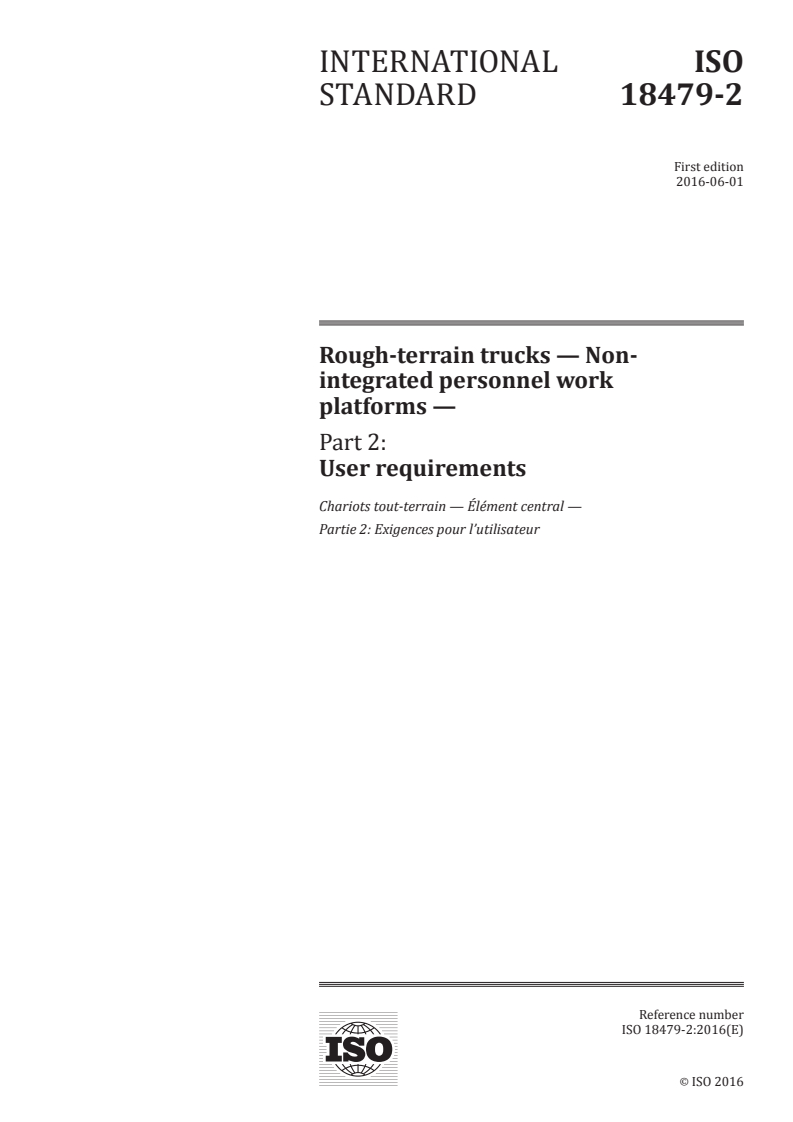
INTERNATIONAL ISO
STANDARD 18479-2
First edition
2016-06-01
Rough-terrain trucks — Non-
integrated personnel work
platforms —
Part 2:
User requirements
Chariots tout-terrain — Élément central —
Partie 2: Exigences pour l’utilisateur
Reference number
©
ISO 2016
© ISO 2016, Published in Switzerland
All rights reserved. Unless otherwise specified, no part of this publication may be reproduced or utilized otherwise in any form
or by any means, electronic or mechanical, including photocopying, or posting on the internet or an intranet, without prior
written permission. Permission can be requested from either ISO at the address below or ISO’s member body in the country of
the requester.
ISO copyright office
Ch. de Blandonnet 8 • CP 401
CH-1214 Vernier, Geneva, Switzerland
Tel. +41 22 749 01 11
Fax +41 22 749 09 47
copyright@iso.org
www.iso.org
ii © ISO 2016 – All rights reserved
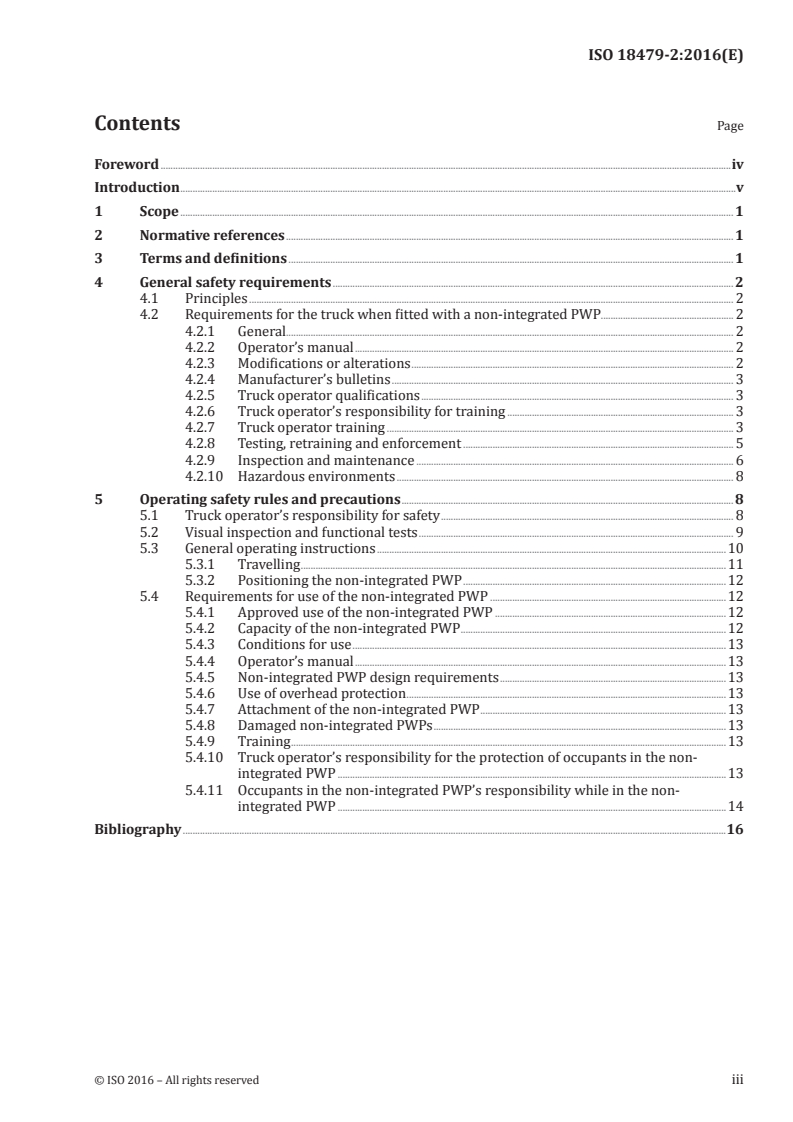
Contents Page
Foreword .iv
Introduction .v
1 Scope . 1
2 Normative references . 1
3 Terms and definitions . 1
4 General safety requirements . 2
4.1 Principles . 2
4.2 Requirements for the truck when fitted with a non-integrated PWP. 2
4.2.1 General. 2
4.2.2 Operator’s manual . 2
4.2.3 Modifications or alterations . 2
4.2.4 Manufacturer’s bulletins . 3
4.2.5 Truck operator qualifications . 3
4.2.6 Truck operator’s responsibility for training . 3
4.2.7 Truck operator training . 3
4.2.8 Testing, retraining and enforcement . 5
4.2.9 Inspection and maintenance . 6
4.2.10 Hazardous environments . 8
5 Operating safety rules and precautions . 8
5.1 Truck operator’s responsibility for safety . 8
5.2 Visual inspection and functional tests . 9
5.3 General operating instructions .10
5.3.1 Travelling .11
5.3.2 Positioning the non-integrated PWP .12
5.4 Requirements for use of the non-integrated PWP .12
5.4.1 Approved use of the non-integrated PWP .12
5.4.2 Capacity of the non-integrated PWP .12
5.4.3 Conditions for use .13
5.4.4 Operator’s manual .13
5.4.5 Non-integrated PWP design requirements .13
5.4.6 Use of overhead protection .13
5.4.7 Attachment of the non-integrated PWP .13
5.4.8 Damaged non-integrated PWPs .13
5.4.9 Training .13
5.4.10 Truck operator’s responsibility for the protection of occupants in the non-
integrated PWP .13
5.4.11 Occupants in the non-integrated PWP’s responsibility while in the non-
integrated PWP .14
Bibliography .16
Foreword
ISO (the International Organization for Standardization) is a worldwide federation of national standards
bodies (ISO member bodies). The work of preparing International Standards is normally carried out
through ISO technical committees. Each member body interested in a subject for which a technical
committee has been established has the right to be represented on that committee. International
organizations, governmental and non-governmental, in liaison with ISO, also take part in the work.
ISO collaborates closely with the International Electrotechnical Commission (IEC) on all matters of
electrotechnical standardization.
The procedures used to develop this document and those intended for its further maintenance are
described in the ISO/IEC Directives, Part 1. In particular the different approval criteria needed for the
different types of ISO documents should be noted. This document was drafted in accordance with the
editorial rules of the ISO/IEC Directives, Part 2 (see www.iso.org/directives).
Attention is drawn to the possibility that some of the elements of this document may be the subject of
patent rights. ISO shall not be held responsible for identifying any or all such patent rights. Details of
any patent rights identified during the development of the document will be in the Introduction and/or
on the ISO list of patent declarations received (see www.iso.org/patents).
Any trade name used in this document is information given for the convenience of users and does not
constitute an endorsement.
For an explanation on the meaning of ISO specific terms and expressions related to conformity assessment,
as well as information about ISO’s adherence to the World Trade Organization (WTO) principles in the
Technical Barriers to Trade (TBT) see the following URL: www.iso.org/iso/foreword.html.
The committee responsible for this document is ISO/TC 110, Industrial trucks, Subcommittee SC 4,
Rough-terrain trucks.
ISO 18479 consists of the following parts, under the general title Rough-terrain trucks — Non-integrated
personnel work platforms:
— Part 1: Design, safety requirements and verification
— Part 2: User requirements
iv © ISO 2016 – All rights reserved
Introduction
ISO 18479 is one of a set of International Standards produced by ISO/TC 110/SC 4 as part of its program
of work regarding standardization of terminology, general safety, performance, and user requirements
for rough-terrain trucks (hereafter also referred to as trucks).
Rough-terrain trucks, when permitted, may be fitted with an integrated or non-integrated personnel
work platforms which is designed to elevate occupants and materials to elevated work heights.
See ISO 11525-5 for user requirements for the interface between a rough-terrain truck and an integrated
personnel work platform.
INTERNATIONAL STANDARD ISO 18479-2:2016(E)
Rough-terrain trucks — Non-integrated personnel work
platforms —
Part 2:
User requirements
1 Scope
This part of ISO 18479, intended to be used together with ISO 18479-1 and ISO 10896-1, defines user
requirements for rough-terrain trucks when fitted with a non-integrated personnel work platform
(PWP) as an attachment. This includes non-integrated PWPs that have a means of being affixed to the
truck forks.
NOTE National or local requirements can apply, which could be more stringent.
User requirements for rough-terrain trucks fitted with a personnel work platform having controls
which affect travel or movement of the rough-terrain truck are not covered by this part of ISO 18479
(see ISO 18893).
2 Normative references
The following documents, in whole or in part, are normatively referenced in this document and are
indispensable for its application. For dated references, only the edition cited applies. For undated
references, the latest edition of the referenced document (including any amendments) applies.
ISO 5057, Industrial trucks — Inspection and repair of fork arms in service on fork-lift trucks
ISO 10896-1, Rough-terrain trucks — Safety requirements and verification — Part 1: Variable-reach trucks
ISO 18479-1, Rough-terrain trucks — Non-integrated personnel work platforms — Part 1: Design, safety
requirements and verification
3 Terms and definitions
For the purposes of this document, the terms and definitions given in ISO 10896-1 and ISO 18479-1, and
the following, apply.
3.1
personal fall protection equipment
PFPE
personal safety system consisting of a full-body harness and lanyard
Note 1 to entry: A full-body harness typically is a body support designed to contain the torso and distribute the
fall arrest forces over at least the upper thighs, pelvis, chest and shoulders.
Note 2 to entry: A lanyard is a component consisting of a flexible rope, wire rope, or strap, which typically has
a connector at each end for connecting to the body support and to a fall arrester, energy absorber, anchorage
connector, or anchorage.
3.2
truck operator
competent and authorized person who controls the operation of the truck
4 General safety requirements
4.1 Principles
This part of ISO 18479 shall be supplemented by good management practices, safety controls and
application of sound principles of safety, training, inspection, maintenance, application selection and
operation. All data available regarding the parameters of intended use and expected environment shall
be considered. Those with direct control over the application and operation of the truck and occupants
in the non-integrated PWP shall be responsible for the conformance with good safety practices.
NOTE Different operating conditions can require additional safety precautions, training, and special safe
operating procedures.
The operation of any truck as well as the non-integrated PWP is subject to certain hazards that can
be protected against only by the exercise of care and common sense. It is essential to have competent
persons trained in the intended use, safe operation, maintenance and service of this equipment.
The user shall ensure that the operator understands that safe operation of the truck as well as the use
of the non-integrated PWP is also the truck operator’s responsibility.
The user shall ensure that the truck operator’s mental or physical condition will not impair his/her
ability to operate the truck.
4.2 Requirements for the truck when fitted with a non-integrated PWP
4.2.1 General
The user shall ensure that the precautions as given in 4.2 are taken when using a non-integrated PWP
with a rough-terrain truck.
4.2.2 Operator’s manual
The user shall ensure that the operator’s manual and any additional safety manual provided by the
manufacturer with the truck are always available to the truck operator and maintenance personnel.
4.2.3 Modifications or alterations
Except as provided below, no modifications or alterations to a truck or a non-integrated PWP that may
affect its capacity, stability or safe operation of the truck fitted with a non-integrated PWP shall be
made without the prior written approval of the original truck manufacturer or its successor. When the
truck manufacturer or its successor approves a modification or alteration, the user shall be responsible,
prior to operation, for ensuring that appropriate changes are made to information plate(s), documents,
certificates, labels, tags, and operator’s manual(s).
If the truck manufacturer is no longer in business and there is no successor, modifications or alterations
to the truck shall be carried out under the following conditions:
a) the design, testing and implementation of the modification or alteration is made in accordance with
ISO 18479-1 by a competent person;
b) a permanent record is kept of the design, tests and implementation of the modification or alteration;
c) appropriate changes are made to the information plate(s), documents, certificates, labels, tags, and
operator’s manual(s);
d) a permanent and readily visible label is affixed to the truck or non-integrated PWP stating the
manner in which the truck or the non-integrated PWP has been modified or altered, together with
the date of the modification or alteration, and the name of the person or organization responsible
for the design, testing and implementation of the modifications.
2 © ISO 2016 – All rights reserved
4.2.4 Manufacturer’s bulletins
The user shall comply with the applicable bulletins as directed by the responsible entity.
4.2.5 Truck operator qualifications
Users shall allow only competent and authorized persons to operate a truck. Truck operators shall be
competent to operate the equipment safely, in addition to being trained in accordance with this part of
ISO 18479.
4.2.6 Truck operator’s responsibility for training
Before operating any truck, the truck operator shall be trained in accordance with 4.2.7 and 5.4.9,
and shall have read and be familiar with the operator’s manual(s) and any other safety information
provided by the manufacturer and user on the particular truck being operated, the application and the
environment in which the truck is to be used and any attachments used.
4.2.7 Truck operator training
4.2.7.1 Operator training programme
Personnel who are not considered competent to operate a truck shall operate the truck only as part of
the operator training programme. This training shall be conducted under the direct supervision of a
trainer.
The operator training programme shall be based on user policies, industry standards, local regulations
and policies, operating conditions and the manufacturer’s instructions.
NOTE Information on operator training is available from sources including users, truck manufacturers,
government agencies dealing with employee safety, trade organizations of truck users, public and private
organizations and safety consultants.
The training programme shall emphasize safe and proper operation that avoids injury to the truck
operator and others and prevent property damage. The training program shall include the following
items.
a) Information about the truck(s), the trainee will operate:
1) characteristics of the truck(s), including possible variations between truck/non-integrated
work platform combinations in the workplace;
2) similarities to, and differences from, other mobile equipment and lifting devices, i.e. an aerial
work platform;
3) significance of information plates, load charts, warnings and instructions affixed to the truck;
4) operating and safety instructions in the operator’s manual for the truck and for the non-
integrated PWP;
5) instructions for inspections and maintenance to be performed by the operator;
6) engine operation;
7) type of drive system and its characteristics;
8) methods of steering and manoeuvring;
9) braking methods and characteristics;
10) visibility, with and without loads;
11) load charts for trucks fitted with a non-integrated PWP, how to read and comprehend them
and the limitations;
12) explanation of the stability triangle and other stability characteristics affected by stabilizers
(if equipped), speed, acceleration, braking, raising or lowering a non-integrated PWP;
13) operation/manoeuvring with a non-integrated PWP affixed, sharp cornering, height,
attachments, grade/ramps, centre of gravity of the non-integrated PWP and truck,
counterbalance principle;
14) controls and instrumentation, including their location, function and method of operation and
the identification of symbols;
15) load-handling capabilities and proper use of forks and other attachments;
16) refuelling and battery charging;
17) guards and protective devices for the specific type of truck;
18) how and when to use stabilizing devices, chassis levelling and other stability-related functions,
and examples of improper operation and the risks associated with them;
19) how to correctly use the truck’s operator restraints, e.g. seat belt, and other safety devices;
20) how to use personal fall protection equipment (PFPE) in the non-integrated PWP;
21) basic steps to take in the event of a tip-over, e.g. bracing for impact;
22) wheel loadings when loaded and unloaded;
23) when entering and exiting the operator’s station, the need to always maintain three points of
contact, i.e. one hand and two feet or two hands and one foot;
24) types of attachments and their applications/limitations, and;
25) other characteristics, if any, of the specific truck.
b) Operation and worksite-related topics:
1) surface conditions on which the truck is to be operated, loaded and unloaded, e.g. floor and
ground conditions, ramps and inclines, trailers;
2) rules regarding non-integrated PWP positioning at height including ensuring that the truck
chassis is level and that the truck is not to be driven with occupants in the non-integrated PWP;
3) pedestrian traffic in areas where the truck is to be used;
4) narrow-aisle and other confined-area operations;
5) potentially hazardous locations where the truck will be operated;
6) overhead obstructions that could crush occupants in the non-integrated PWP if contacted;
7) energized conductors;
8) ramps and gradients and how the stability of the truck could be affected by them;
9) enclosed environments and other areas where insufficient ventilation could result in a
concentration of carbon monoxide gas from the engine exhaust;
4 © ISO 2016 – All rights reserved
10) other unique or potentially hazardous environmental conditions at the worksite that could
affect other workers and the safe operation of the truck.
c) Information about the non-integrated PWP that occupants will occupy:
1) characteristics of the non-integrated PWP;
2) significance of information plates, load charts, warnings and instructions affixed to the non-
integrated PWP;
3) operating and safety instructions in the operator’s manual for the non-integrated PWP;
4) how to use personal fall protection equipment (PFPE) in the non-integrated PWP;
5) when entering and exiting the non-integrated PWP, the need to always maintain three points
of contact, i.e. one hand and two feet or two hands and one foot;
6) instructions for inspections and maintenance to be performed by occupants in the non-
integrated PWP.
4.2.8 Testing, retraining and enforcement
4.2.8.1 Testing
During training, performance and oral and/or written tests, these shall be given by the examiner to
measure the skill and knowledge of the trainee in meeting the requirements of the operator training
programme based on this part of ISO 18479. Examiners shall establish a pass/fail requirement for such
tests. The user shall verify that the testing has been satisfactorily performed.
Following the completion of instruction and practice, all trainees shall be evaluated.
The evaluation shall be conducted on the specific work tasks including the following items:
a) preoperational inspection;
b) function test;
c) start-up;
d) travelling (including pedestrian safety);
e) non-integrated PWP selection and its proper securement to the attachment and forks;
f) non-integrated PWP positioning;
g) attachment of personal fall protection equipment (PFPE);
h) handling specific to docks, trucks, and rail cars;
i) driving on ramps and grades;
j) proper use of the truck’s safety features;
k) shutdown;
l) refuelling/recharging;
m) operational maintenance.
Records shall be retained in accordance with 4.2.8.4.
4.2.8.2 Retraining
Operators shall be retrained when new equipment is introduced, existing equipment is modified,
operating conditions change, different non-integrated PWPs are affixed, current training expires or an
operator’s performance is deemed unsatisfactory by the user.
The user shall determine the extent of operator retraining, as well as the need for retraining, taking
into consideration regional or local requirements.
4.2.8.3 Enforcement
The user shall be responsible for enforcing the safe use of the truck according to the provisions of this
part of ISO 18479.
4.2.8.4 Record keeping
Records of the person or persons trained in the operation of the truck shall be retained for at least the
period of time the training is valid. In addition
a) the successful trainee shall be furnished with proof of training, verifying compliance with the
operator training program based
...
INTERNATIONAL ISO
STANDARD 18479-2
First edition
2016-06-01
Rough-terrain trucks — Non-
integrated personnel work
platforms —
Part 2:
User requirements
Chariots tout-terrain — Élément central —
Partie 2: Exigences pour l’utilisateur
Reference number
©
ISO 2016
© ISO 2016, Published in Switzerland
All rights reserved. Unless otherwise specified, no part of this publication may be reproduced or utilized otherwise in any form
or by any means, electronic or mechanical, including photocopying, or posting on the internet or an intranet, without prior
written permission. Permission can be requested from either ISO at the address below or ISO’s member body in the country of
the requester.
ISO copyright office
Ch. de Blandonnet 8 • CP 401
CH-1214 Vernier, Geneva, Switzerland
Tel. +41 22 749 01 11
Fax +41 22 749 09 47
copyright@iso.org
www.iso.org
ii © ISO 2016 – All rights reserved
Contents Page
Foreword .iv
Introduction .v
1 Scope . 1
2 Normative references . 1
3 Terms and definitions . 1
4 General safety requirements . 2
4.1 Principles . 2
4.2 Requirements for the truck when fitted with a non-integrated PWP. 2
4.2.1 General. 2
4.2.2 Operator’s manual . 2
4.2.3 Modifications or alterations . 2
4.2.4 Manufacturer’s bulletins . 3
4.2.5 Truck operator qualifications . 3
4.2.6 Truck operator’s responsibility for training . 3
4.2.7 Truck operator training . 3
4.2.8 Testing, retraining and enforcement . 5
4.2.9 Inspection and maintenance . 6
4.2.10 Hazardous environments . 8
5 Operating safety rules and precautions . 8
5.1 Truck operator’s responsibility for safety . 8
5.2 Visual inspection and functional tests . 9
5.3 General operating instructions .10
5.3.1 Travelling .11
5.3.2 Positioning the non-integrated PWP .12
5.4 Requirements for use of the non-integrated PWP .12
5.4.1 Approved use of the non-integrated PWP .12
5.4.2 Capacity of the non-integrated PWP .12
5.4.3 Conditions for use .13
5.4.4 Operator’s manual .13
5.4.5 Non-integrated PWP design requirements .13
5.4.6 Use of overhead protection .13
5.4.7 Attachment of the non-integrated PWP .13
5.4.8 Damaged non-integrated PWPs .13
5.4.9 Training .13
5.4.10 Truck operator’s responsibility for the protection of occupants in the non-
integrated PWP .13
5.4.11 Occupants in the non-integrated PWP’s responsibility while in the non-
integrated PWP .14
Bibliography .16
Foreword
ISO (the International Organization for Standardization) is a worldwide federation of national standards
bodies (ISO member bodies). The work of preparing International Standards is normally carried out
through ISO technical committees. Each member body interested in a subject for which a technical
committee has been established has the right to be represented on that committee. International
organizations, governmental and non-governmental, in liaison with ISO, also take part in the work.
ISO collaborates closely with the International Electrotechnical Commission (IEC) on all matters of
electrotechnical standardization.
The procedures used to develop this document and those intended for its further maintenance are
described in the ISO/IEC Directives, Part 1. In particular the different approval criteria needed for the
different types of ISO documents should be noted. This document was drafted in accordance with the
editorial rules of the ISO/IEC Directives, Part 2 (see www.iso.org/directives).
Attention is drawn to the possibility that some of the elements of this document may be the subject of
patent rights. ISO shall not be held responsible for identifying any or all such patent rights. Details of
any patent rights identified during the development of the document will be in the Introduction and/or
on the ISO list of patent declarations received (see www.iso.org/patents).
Any trade name used in this document is information given for the convenience of users and does not
constitute an endorsement.
For an explanation on the meaning of ISO specific terms and expressions related to conformity assessment,
as well as information about ISO’s adherence to the World Trade Organization (WTO) principles in the
Technical Barriers to Trade (TBT) see the following URL: www.iso.org/iso/foreword.html.
The committee responsible for this document is ISO/TC 110, Industrial trucks, Subcommittee SC 4,
Rough-terrain trucks.
ISO 18479 consists of the following parts, under the general title Rough-terrain trucks — Non-integrated
personnel work platforms:
— Part 1: Design, safety requirements and verification
— Part 2: User requirements
iv © ISO 2016 – All rights reserved
Introduction
ISO 18479 is one of a set of International Standards produced by ISO/TC 110/SC 4 as part of its program
of work regarding standardization of terminology, general safety, performance, and user requirements
for rough-terrain trucks (hereafter also referred to as trucks).
Rough-terrain trucks, when permitted, may be fitted with an integrated or non-integrated personnel
work platforms which is designed to elevate occupants and materials to elevated work heights.
See ISO 11525-5 for user requirements for the interface between a rough-terrain truck and an integrated
personnel work platform.
INTERNATIONAL STANDARD ISO 18479-2:2016(E)
Rough-terrain trucks — Non-integrated personnel work
platforms —
Part 2:
User requirements
1 Scope
This part of ISO 18479, intended to be used together with ISO 18479-1 and ISO 10896-1, defines user
requirements for rough-terrain trucks when fitted with a non-integrated personnel work platform
(PWP) as an attachment. This includes non-integrated PWPs that have a means of being affixed to the
truck forks.
NOTE National or local requirements can apply, which could be more stringent.
User requirements for rough-terrain trucks fitted with a personnel work platform having controls
which affect travel or movement of the rough-terrain truck are not covered by this part of ISO 18479
(see ISO 18893).
2 Normative references
The following documents, in whole or in part, are normatively referenced in this document and are
indispensable for its application. For dated references, only the edition cited applies. For undated
references, the latest edition of the referenced document (including any amendments) applies.
ISO 5057, Industrial trucks — Inspection and repair of fork arms in service on fork-lift trucks
ISO 10896-1, Rough-terrain trucks — Safety requirements and verification — Part 1: Variable-reach trucks
ISO 18479-1, Rough-terrain trucks — Non-integrated personnel work platforms — Part 1: Design, safety
requirements and verification
3 Terms and definitions
For the purposes of this document, the terms and definitions given in ISO 10896-1 and ISO 18479-1, and
the following, apply.
3.1
personal fall protection equipment
PFPE
personal safety system consisting of a full-body harness and lanyard
Note 1 to entry: A full-body harness typically is a body support designed to contain the torso and distribute the
fall arrest forces over at least the upper thighs, pelvis, chest and shoulders.
Note 2 to entry: A lanyard is a component consisting of a flexible rope, wire rope, or strap, which typically has
a connector at each end for connecting to the body support and to a fall arrester, energy absorber, anchorage
connector, or anchorage.
3.2
truck operator
competent and authorized person who controls the operation of the truck
4 General safety requirements
4.1 Principles
This part of ISO 18479 shall be supplemented by good management practices, safety controls and
application of sound principles of safety, training, inspection, maintenance, application selection and
operation. All data available regarding the parameters of intended use and expected environment shall
be considered. Those with direct control over the application and operation of the truck and occupants
in the non-integrated PWP shall be responsible for the conformance with good safety practices.
NOTE Different operating conditions can require additional safety precautions, training, and special safe
operating procedures.
The operation of any truck as well as the non-integrated PWP is subject to certain hazards that can
be protected against only by the exercise of care and common sense. It is essential to have competent
persons trained in the intended use, safe operation, maintenance and service of this equipment.
The user shall ensure that the operator understands that safe operation of the truck as well as the use
of the non-integrated PWP is also the truck operator’s responsibility.
The user shall ensure that the truck operator’s mental or physical condition will not impair his/her
ability to operate the truck.
4.2 Requirements for the truck when fitted with a non-integrated PWP
4.2.1 General
The user shall ensure that the precautions as given in 4.2 are taken when using a non-integrated PWP
with a rough-terrain truck.
4.2.2 Operator’s manual
The user shall ensure that the operator’s manual and any additional safety manual provided by the
manufacturer with the truck are always available to the truck operator and maintenance personnel.
4.2.3 Modifications or alterations
Except as provided below, no modifications or alterations to a truck or a non-integrated PWP that may
affect its capacity, stability or safe operation of the truck fitted with a non-integrated PWP shall be
made without the prior written approval of the original truck manufacturer or its successor. When the
truck manufacturer or its successor approves a modification or alteration, the user shall be responsible,
prior to operation, for ensuring that appropriate changes are made to information plate(s), documents,
certificates, labels, tags, and operator’s manual(s).
If the truck manufacturer is no longer in business and there is no successor, modifications or alterations
to the truck shall be carried out under the following conditions:
a) the design, testing and implementation of the modification or alteration is made in accordance with
ISO 18479-1 by a competent person;
b) a permanent record is kept of the design, tests and implementation of the modification or alteration;
c) appropriate changes are made to the information plate(s), documents, certificates, labels, tags, and
operator’s manual(s);
d) a permanent and readily visible label is affixed to the truck or non-integrated PWP stating the
manner in which the truck or the non-integrated PWP has been modified or altered, together with
the date of the modification or alteration, and the name of the person or organization responsible
for the design, testing and implementation of the modifications.
2 © ISO 2016 – All rights reserved
4.2.4 Manufacturer’s bulletins
The user shall comply with the applicable bulletins as directed by the responsible entity.
4.2.5 Truck operator qualifications
Users shall allow only competent and authorized persons to operate a truck. Truck operators shall be
competent to operate the equipment safely, in addition to being trained in accordance with this part of
ISO 18479.
4.2.6 Truck operator’s responsibility for training
Before operating any truck, the truck operator shall be trained in accordance with 4.2.7 and 5.4.9,
and shall have read and be familiar with the operator’s manual(s) and any other safety information
provided by the manufacturer and user on the particular truck being operated, the application and the
environment in which the truck is to be used and any attachments used.
4.2.7 Truck operator training
4.2.7.1 Operator training programme
Personnel who are not considered competent to operate a truck shall operate the truck only as part of
the operator training programme. This training shall be conducted under the direct supervision of a
trainer.
The operator training programme shall be based on user policies, industry standards, local regulations
and policies, operating conditions and the manufacturer’s instructions.
NOTE Information on operator training is available from sources including users, truck manufacturers,
government agencies dealing with employee safety, trade organizations of truck users, public and private
organizations and safety consultants.
The training programme shall emphasize safe and proper operation that avoids injury to the truck
operator and others and prevent property damage. The training program shall include the following
items.
a) Information about the truck(s), the trainee will operate:
1) characteristics of the truck(s), including possible variations between truck/non-integrated
work platform combinations in the workplace;
2) similarities to, and differences from, other mobile equipment and lifting devices, i.e. an aerial
work platform;
3) significance of information plates, load charts, warnings and instructions affixed to the truck;
4) operating and safety instructions in the operator’s manual for the truck and for the non-
integrated PWP;
5) instructions for inspections and maintenance to be performed by the operator;
6) engine operation;
7) type of drive system and its characteristics;
8) methods of steering and manoeuvring;
9) braking methods and characteristics;
10) visibility, with and without loads;
11) load charts for trucks fitted with a non-integrated PWP, how to read and comprehend them
and the limitations;
12) explanation of the stability triangle and other stability characteristics affected by stabilizers
(if equipped), speed, acceleration, braking, raising or lowering a non-integrated PWP;
13) operation/manoeuvring with a non-integrated PWP affixed, sharp cornering, height,
attachments, grade/ramps, centre of gravity of the non-integrated PWP and truck,
counterbalance principle;
14) controls and instrumentation, including their location, function and method of operation and
the identification of symbols;
15) load-handling capabilities and proper use of forks and other attachments;
16) refuelling and battery charging;
17) guards and protective devices for the specific type of truck;
18) how and when to use stabilizing devices, chassis levelling and other stability-related functions,
and examples of improper operation and the risks associated with them;
19) how to correctly use the truck’s operator restraints, e.g. seat belt, and other safety devices;
20) how to use personal fall protection equipment (PFPE) in the non-integrated PWP;
21) basic steps to take in the event of a tip-over, e.g. bracing for impact;
22) wheel loadings when loaded and unloaded;
23) when entering and exiting the operator’s station, the need to always maintain three points of
contact, i.e. one hand and two feet or two hands and one foot;
24) types of attachments and their applications/limitations, and;
25) other characteristics, if any, of the specific truck.
b) Operation and worksite-related topics:
1) surface conditions on which the truck is to be operated, loaded and unloaded, e.g. floor and
ground conditions, ramps and inclines, trailers;
2) rules regarding non-integrated PWP positioning at height including ensuring that the truck
chassis is level and that the truck is not to be driven with occupants in the non-integrated PWP;
3) pedestrian traffic in areas where the truck is to be used;
4) narrow-aisle and other confined-area operations;
5) potentially hazardous locations where the truck will be operated;
6) overhead obstructions that could crush occupants in the non-integrated PWP if contacted;
7) energized conductors;
8) ramps and gradients and how the stability of the truck could be affected by them;
9) enclosed environments and other areas where insufficient ventilation could result in a
concentration of carbon monoxide gas from the engine exhaust;
4 © ISO 2016 – All rights reserved
10) other unique or potentially hazardous environmental conditions at the worksite that could
affect other workers and the safe operation of the truck.
c) Information about the non-integrated PWP that occupants will occupy:
1) characteristics of the non-integrated PWP;
2) significance of information plates, load charts, warnings and instructions affixed to the non-
integrated PWP;
3) operating and safety instructions in the operator’s manual for the non-integrated PWP;
4) how to use personal fall protection equipment (PFPE) in the non-integrated PWP;
5) when entering and exiting the non-integrated PWP, the need to always maintain three points
of contact, i.e. one hand and two feet or two hands and one foot;
6) instructions for inspections and maintenance to be performed by occupants in the non-
integrated PWP.
4.2.8 Testing, retraining and enforcement
4.2.8.1 Testing
During training, performance and oral and/or written tests, these shall be given by the examiner to
measure the skill and knowledge of the trainee in meeting the requirements of the operator training
programme based on this part of ISO 18479. Examiners shall establish a pass/fail requirement for such
tests. The user shall verify that the testing has been satisfactorily performed.
Following the completion of instruction and practice, all trainees shall be evaluated.
The evaluation shall be conducted on the specific work tasks including the following items:
a) preoperational inspection;
b) function test;
c) start-up;
d) travelling (including pedestrian safety);
e) non-integrated PWP selection and its proper securement to the attachment and forks;
f) non-integrated PWP positioning;
g) attachment of personal fall protection equipment (PFPE);
h) handling specific to docks, trucks, and rail cars;
i) driving on ramps and grades;
j) proper use of the truck’s safety features;
k) shutdown;
l) refuelling/recharging;
m) operational maintenance.
Records shall be retained in accordance with 4.2.8.4.
4.2.8.2 Retraining
Operators shall be retrained when new equipment is introduced, existing equipment is modified,
operating conditions change, different non-integrated PWPs are affixed, current training expires or an
operator’s performance is deemed unsatisfactory by the user.
The user shall determine the extent of operator retraining, as well as the need for retraining, taking
into consideration regional or local requirements.
4.2.8.3 Enforcement
The user shall be responsible for enforcing the safe use of the truck according to the provisions of this
part of ISO 18479.
4.2.8.4 Record keeping
Records of the person or persons trained in the operation of the truck shall be retained for at least the
period of time the training is valid. In addition
a) the successful trainee shall be furnished with proof of training, verifying compliance with the
operator training program based
...