


ISO 9869-1:2014
(Main)Thermal insulation — Building elements — In-situ measurement of thermal resistance and thermal transmittance — Part 1: Heat flow meter method
Thermal insulation — Building elements — In-situ measurement of thermal resistance and thermal transmittance — Part 1: Heat flow meter method
ISO 9869-1:2014 describes the heat flow meter method for the measurement of the thermal transmission properties of plane building components, primarily consisting of opaque layers perpendicular to the heat flow and having no significant lateral heat flow. The properties which can be measured are: a) the thermal resistance, R, and thermal conductance, Λ, from surface to surface; b) the total thermal resistance, RT, and transmittance from environment to environment, U, if the environmental temperatures of both environments are well defined. The heat flow meter measurement method is also suitable for components consisting of quasi homogeneous layers perpendicular to the heat flow, provided that the dimensions of any inhomogeneity in close proximity to the heat flow meter (HFM) is much smaller than its lateral dimensions and are not thermal bridges which can be detected by infrared thermography. ISO 9869-1:2014 describes the apparatus to be used, the calibration procedure for the apparatus, the installation and the measurement procedures, the analysis of the data, including the correction of systematic errors and the reporting format.
Isolation thermique — Éléments de construction — Mesurage in situ de la résistance thermique et du coefficient de transmission thermique — Partie 1: Méthode du fluxmètre
General Information
Relations
Standards Content (Sample)
INTERNATIONAL ISO
STANDARD 9869-1
First edition
2014-08-01
Thermal insulation — Building
elements — In-situ measurement
of thermal resistance and thermal
transmittance —
Part 1:
Heat flow meter method
Isolation thermique — Éléments de construction — Mesurage in
situ de la résistance thermique et du coefficient de transmission
thermique —
Partie 1: Méthode du fluxmètre
Reference number
©
ISO 2014
© ISO 2014
All rights reserved. Unless otherwise specified, no part of this publication may be reproduced or utilized otherwise in any form
or by any means, electronic or mechanical, including photocopying, or posting on the internet or an intranet, without prior
written permission. Permission can be requested from either ISO at the address below or ISO’s member body in the country of
the requester.
ISO copyright office
Case postale 56 • CH-1211 Geneva 20
Tel. + 41 22 749 01 11
Fax + 41 22 749 09 47
E-mail copyright@iso.org
Web www.iso.org
Published in Switzerland
ii © ISO 2014 – All rights reserved
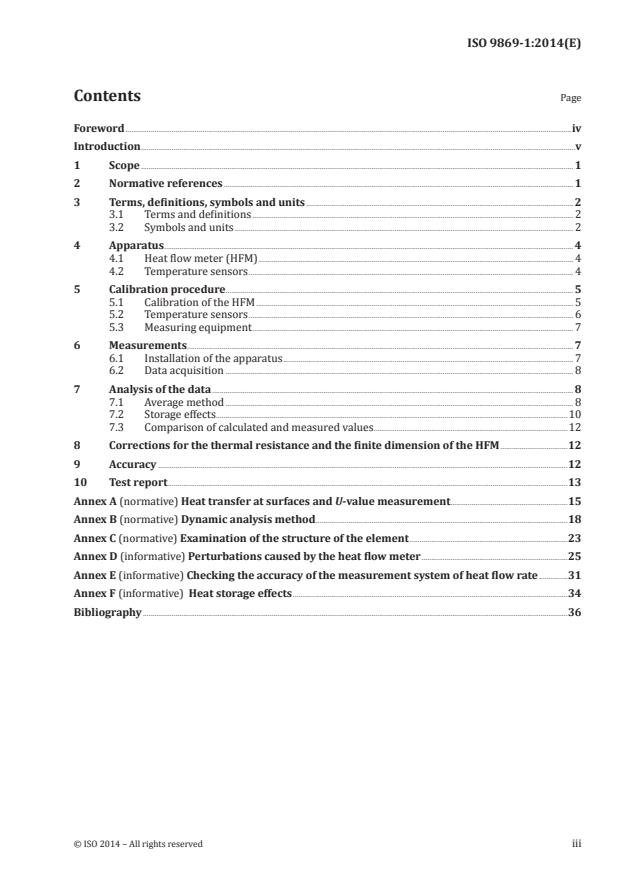
Contents Page
Foreword .iv
Introduction .v
1 Scope . 1
2 Normative references . 1
3 Terms, definitions, symbols and units . 2
3.1 Terms and definitions . 2
3.2 Symbols and units . 2
4 Apparatus . 4
4.1 Heat flow meter (HFM) . 4
4.2 Temperature sensors . 4
5 Calibration procedure . 5
5.1 Calibration of the HFM . 5
5.2 Temperature sensors . 6
5.3 Measuring equipment . 7
6 Measurements . 7
6.1 Installation of the apparatus . 7
6.2 Data acquisition . 8
7 Analysis of the data . 8
7.1 Average method . 8
7.2 Storage effects .10
7.3 Comparison of calculated and measured values .12
8 Corrections for the thermal resistance and the finite dimension of the HFM .12
9 Accuracy .12
10 Test report .13
Annex A (normative) Heat transfer at surfaces and U-value measurement .15
Annex B (normative) Dynamic analysis method .18
Annex C (normative) Examination of the structure of the element .23
Annex D (informative) Perturbations caused by the heat flow meter .25
Annex E (informative) Checking the accuracy of the measurement system of heat flow rate .31
Annex F (informative) Heat storage effects .34
Bibliography .36
Foreword
ISO (the International Organization for Standardization) is a worldwide federation of national standards
bodies (ISO member bodies). The work of preparing International Standards is normally carried out
through ISO technical committees. Each member body interested in a subject for which a technical
committee has been established has the right to be represented on that committee. International
organizations, governmental and non-governmental, in liaison with ISO, also take part in the work.
ISO collaborates closely with the International Electrotechnical Commission (IEC) on all matters of
electrotechnical standardization.
The procedures used to develop this document and those intended for its further maintenance are
described in the ISO/IEC Directives, Part 1. In particular the different approval criteria needed for the
different types of ISO documents should be noted. This document was drafted in accordance with the
editorial rules of the ISO/IEC Directives, Part 2 (see www.iso.org/directives).
Attention is drawn to the possibility that some of the elements of this document may be the subject of
patent rights. ISO shall not be held responsible for identifying any or all such patent rights. Details of
any patent rights identified during the development of the document will be in the Introduction and/or
on the ISO list of patent declarations received (see www.iso.org/patents).
Any trade name used in this document is information given for the convenience of users and does not
constitute an endorsement.
For an explanation on the meaning of ISO specific terms and expressions related to conformity
assessment, as well as information about ISO’s adherence to the WTO principles in the Technical Barriers
to Trade (TBT) see the following URL: Foreword - Supplementary information
The committee responsible for this document is ISO/TC 163, Thermal performance and energy use in the
built environment, Subcommittee SC 1, Test and measurement methods.
This first edition cancels and replaces ISO 9869:1994, which has been technically revised.
Annexes A, B and C form an integral part of this part of ISO 9869. Annexes D, E and F are for information
only.
iv © ISO 2014 – All rights reserved
Introduction
The thermal transmittance of a building element (U-value) is defined in ISO 7345 as the “Heat flow rate
in the steady state divided by area and by the temperature difference between the surroundings on each
side of a system”.
In principle, the U-value can be obtained by measuring the heat flow rate through an element with a heat
flow meter or a calorimeter, together with the temperatures on both sides of the element under steady-
state conditions.
However, since steady-state conditions are never encountered on a site in practice, such a simple
measurement is not possible. But there are several ways of overcoming this difficulty:
a) Imposing steady-state conditions by the use of a hot and a cold box. This method is commonly used
in the laboratory (ISO 8990) but is cumbersome in the field;
b) Assuming that the mean values of the heat flow rate and temperatures over a sufficiently long period
of time give a good estimate of the steady-state. This method is valid if:
1) the thermal properties of the materials and the heat transfer coefficients are constant over the
range of temperature fluctuations occurring during the test;
2) the change of amount of heat stored in the element is negligible when compared to the amount
of heat going through the element. This method is widely used but may lead to long periods of
measurement and may give erroneous results in certain cases.
c) Using a dynamic theory to take into account the fluctuations of the heat flow rate and temperatures
in the analysis of the recorded data.
NOTE The temperatures of the surroundings, used in the definition of the U-value, are not precisely defined
in ISO 7345. Their exact definition depends on the subsequent use of the U-value and may be different in different
countries (see Annex A).
INTERNATIONAL STANDARD ISO 9869-1:2014(E)
Thermal insulation — Building elements — In-situ
measurement of thermal resistance and thermal
transmittance —
Part 1:
Heat flow meter method
1 Scope
This part of ISO 9869 describes the heat flow meter method for the measurement of the thermal
transmission properties of plane building components, primarily consisting of opaque layers
perpendicular to the heat flow and having no significant lateral heat flow.
The properties which can be measured are:
a) the thermal resistance, R, and thermal conductance, Λ, from surface to surface;
b) the total thermal resistance, R , and transmittance from environment to environment, U, if the
T
environmental temperatures of both environments are well defined.
The heat flow meter measurement method is also suitable for components consisting of quasi
homogeneous layers perpendicular to the heat flow, provided that the dimensions of any inhomogeneity
in close proximity to the heat flow meter (HFM) is much smaller than its lateral dimensions and are not
thermal bridges which can be detected by infrared thermography (see 6.1.1).
This part of ISO 9869 describes the apparatus to be used, the calibration procedure for the apparatus,
the installation and the measurement procedures, the analysis of the data, including the correction of
systematic errors and the reporting format.
NOTE 1 It is not intended as a high precision method replacing the laboratory instruments such as hot boxes
that are specified in ISO 8990:1994.
NOTE 2 For other components, an average thermal transmittance may be obtained using a calorimeter or by
averaging the results of several heat flow meter measurements.
NOTE 3 In building with large heat capacities, the average thermal transmittance of a component can be
obtained by measurement over an extended period, or the apparent transmittance of the part can be estimated
by a dynamic analysis of its thermal absorption response (see Annex B).
2 Normative references
The following documents, in whole or in part, are normatively referenced in this document and are
indispensable for its application. For dated references, only the edition cited applies. For undated
references, the latest edition of the referenced document (including any amendments) applies.
ISO 6781:1983, Thermal insulation — Qualitative detection of thermal irregularities in building envelopes —
Infrared method
ISO 6946:2007, Building components and building elements — Thermal resistance and thermal
transmittance — Calculation method
ISO 7345:1987, Thermal insulation — Physical quantities and definitions
ISO 8301:1991, Thermal insulation — Determination of steady-state thermal resistance and related
properties — Heat flow meter apparatus
ISO 8302:1991, Thermal insulation — Determination of steady-state thermal resistance and related
properties — Guarded hot plate apparatus
ISO 8990:1994, Thermal insulation — Determination of steady-state thermal transmission properties —
Calibrated and guarded hot box
3 Terms, definitions, symbols and units
3.1 Terms and definitions
For the purpose of this document, the terms and definitions given in ISO 7345:1987 apply.
3.2 Symbols and units
Symbol Quantity Unit
thermal resistance m ·K/W
R
total thermal resistance m ·K/W
R
T
internal surface thermal resistance m ·K/W
R
si
external surface thermal resistance m ·K/W
R
se
thermal conductance W/(m ·K)
Λ
thermal transmittance W/(m ·K)
U
heat flow rate W
Φ
area m
A
density of heat flow rate =Φ/A W/m
q
interior environmental (ambient) temperature °C or K
T
i
2 © ISO 2014 – All rights reserved
Symbol Quantity Unit
exterior environmental (ambient) temperature °C or K
T
e
interior surface temperature of the building ele-
°C or K
T
si
ment
exterior surface temperature °C or K
T
se
density of a material kg/m
ρ
thickness of a layer m
d
specific heat capacity J/(kg·K)
c
thermal capacity of a layer: C=ρcd J/(m ·K))
C
correction factors calculated with Formula (8) to
[J/(m ·K)]
F , F
i e
take into account the storage effects
operational error (of an installed HFM) which is
the relative error between the measured and the -
E
actual heat flow
NOTE The environmental (ambient) temperatures shall correspond with those used in the definition adopted
for the U-value (see Annex A).
In the steady-state, the thermal properties of the elements have the following definitions:
R is the thermal resistance of an element, surface to surface and is given by
TT− 1
si se
R= = (1)
q Λ
where Λ is the thermal conductance of the building element, surface to surface.
U is the thermal transmittance of the element, environment to environment and is given by
q 1
U = = (2)
TT− R
()
ie T
where R is the total thermal resistance which is given by
T
RR=+ RR+ (3)
Tsise
where R and R are the internal and external surface thermal resistances, respectively.
si se
R and R have units of square metres kelvin per watt (m ·K/W); U and Λ have units of watts per square
T
metre kelvin [W/(m ·K)].
4 Apparatus
4.1 Heat flow meter (HFM)
The HFM is a transducer giving an electrical signal which is a direct function of the heat flow transmitted
through it.
Most HFMs are thin, thermally resistive plates with temperature sensors arranged in such a way that the
electrical signal given by the sensors is directly related to the heat flow through the plate (see Figure 1).
The essential properties of an HFM are that it should have a low thermal resistance in order to minimize
the perturbation caused by the HFM, and a high enough sensitivity to give a sufficiently large signal for
the lowest heat flow rates measured. Recent HFMs are very thin, with low thermal resistance, and highly
sensitive. If the thermal resistance of the HFM is low enough, the effects of perturbation of the surface
heat flow by positioning the HFM is negligible. The heat flow rate is influenced by building elements
and the difference between indoor and outdoor temperature. Therefore, HFM with an appropriate
sensitivity shall be selected in consideration of these influences (see Annex E).
NOTE More detailed information on the structure and calibration of HFMs can be found in ISO 8301:1991.
4.2 Temperature sensors
Temperature sensors are transducers giving an electrical signal which is a monotonic function of its
temperature.
The effects of the heat flow going through the sensor and on other physical quantities, such as stresses,
electromagnetic radiation on the signal have to be taken into account (see Clause 5).
Suitable surface temperature sensors (for R- or Λ-value measurements) are thin thermocouples and flat
resistance thermometers. It is possible, for the conductance measurements, for one or several sensors
to be incorporated within one side of the HFM, the side which will be in contact with the surface of the
element being measured.
Environmental (ambient) temperature sensors (for U-value measurements) shall be chosen according
to the temperature to be measured. For example, if the U-value is defined by the ratio of density of heat
flow rate to the air temperature difference, air temperature sensors are to be used. These sensors are
shielded against solar and thermal radiation and are ventilated. Other sensors may measure the so-
called sol-air temperature, the comfort temperature etc. (see Annex A).
4 © ISO 2014 – All rights reserved
Dimensions in millimetres
Key
1 base material 5 upper surface
2 metal A 6 cross-section
3 metal B 7 under surface
4 coating
Figure 1 — A typical heat flow meter showing the various parts
(the vertical scale is enlarged)
5 Calibration procedure
5.1 Calibration of the HFM
The HFM calibration factors (e.g. the density of heat flow rate for a signal equal to one unit) may change
with the temperature, the thermal conductivity of the material on which the HFM is installed, and the heat
flow itself. Therefore, the calibration factor of a new type of heat flow meter shall be evaluated on various
materials through an absolute test method such as the guarded hot plate apparatus (ISO 8302:1991) or a
heat flow meter apparatus (ISO 8301) on various materials, at various temperatures, and heat flow rates.
The HFM is placed, with its facings and a guard ring of similar average resistance and same thickness, in
the guarded hot plate apparatus, the side adjacent to the element being measured on a material of known
thermal conductivity and the other side, which will be in the air, against an insulating layer [thermal
conductivity less than 0,04 W/(m·K)]. The HFM calibration with the hot box method (ISO 8990:1994)
shall be suited since the calibration condition of the method is closer to the condition of the practical
measurement.
The calibration procedure shall be such that the calibration factor is known with an accuracy of ± 2 % in
the conditions of use. The heat flow rates as well as the temperatures and the thermal conductivities of
the materials shall cover the range of values usually encountered in practice.
5.1.1 Calibration of a new type of HFM
A set of calibration curves or an equation shall be prepared (calibration factor versus mean temperature,
thermal conductivity of the underlying material, and eventually the density of heat flow rate) for any
new type of heat flow meter or any modified HFM (e.g. new facing or new incorporated guard ring).
2 2
The calibration shall be done at three different densities of heat flow rate (e.g. 3 W/m , 10 W/m and
20 W/m ) in order to check the linearity of the response of the HFM versus q. If the relationship is
not linear, more densities of heat flow rate shall be tested and the precise function shall be taken into
account during the measurements.
The calibration shall be done at a minimum of two temperatures (minimum and maximum limits). If there
is a significant difference between the two results, a third point shall be measured at the average of the
two temperatures to test the linearity of the relationship of the calibration factor to the temperature. If
the relationship is not linear, more temperatures shall be used in order to obtain the dependence of the
calibration factor on the temperature.
The complete calibration shall be done with the HFM placed on at least two materials (low and high
thermal conductivity). If any dependence of the calibration factor to this parameter is found, more
materials shall be used in order to get the complete relationship between the thermal conductivity of
the material and the calibration factor.
A partial calibration may be done if the HFM is used only for a specific application. In this case, it may
be calibrated only on the material on which the HFM will be installed and/or for the temperatures used.
The HFM shall be tested for the following characteristics:
a) zero offset: if there is a nonzero output for zero heat flow (HFM placed in a thermally homogeneous
medium), this can be due to a bad electrical connection, which shall be checked;
b) effect of stresses on the calibration factor. This effect shall be negligible in the range of perpendicular
and parallel stresses involved in the measurements;
c) effect of electromagnetic radiation (50 Hz to 60 Hz, radio waves). This effect shall be negligible in
the range of electromagnetic fields encountered in practice.
5.1.2 Calibration of a known type of HFM
For an HFM whose effects mentioned above are well known, the calibration factor shall be measured for
one heat flow, at a temperature close to its temperature in use and on a typical building material.
Every two years, or more frequently if required, the calibration factor shall be verified by a measurement
at one temperature on one material. A drift of the calibration factor can be caused by material ageing or
delamination. If the variation of the calibration factor is more than 2 %, a complete calibration procedure
shall be followed.
In all cases, a correction shall be applied to the measurements where a change in the calibration factor
of greater than ± 2 % occurs over the range of operation.
5.2 Temperature sensors
The calibration procedure shall be such that the temperature difference between a pair of sensors is
determined with an accuracy better than ± 2 % and that the temperature can be measured with an
accuracy better than 0,5 K. If the temperature difference is obtained by subtracting two temperatures,
the sensors shall be calibrated to an accuracy of ± 0,1 K.
6 © ISO 2014 – All rights reserved
The surface and air temperature sensors are calibrated for several temperatures in the relevant range
(generally −10 °C to 50 °C) in a well-stirred medium (e.g. water or air), in a well-insulated container, in
comparison with a reference thermometer having an accuracy better than 0,1 K. Sensors manufactured
to this accuracy may be used without calibration.
Special procedures shall be used for the sensors measuring the environment (ambient) temperatures,
according to the temperature to be measured.
The effects of stresses and of electromagnetic radiation (solar and thermal radiation, 50 Hz to 60 Hz,
radio waves) at reasonable levels have to be examined and eliminated if the changes are greater than
the accuracy mentioned above.
5.3 Measuring equipment
Where direct readout equipment is provided, adequate provision shall be made for calibration of this
equipment. Calibrated voltage sources and resistances can be used in place of the HFM and temperature
sensors.
6 Measurements
6.1 Installation of the apparatus
6.1.1 Location of the measured area
The sensors (HFMs and thermometers) shall be mounted according to the purpose of the test. The
appropriate location(s) may be investigated by thermography (in accordance with ISO 6781:1983).
Sensors shall be mounted in such a way so as to ensure a result which is representative of the whole
element.
NOTE It can be appropriate to install several HFMs so as to obtain a representative average.
HFMs shall not be installed in the vicinity of thermal bridges, cracks or similar sources of error. Sensors
shall not be under the direct influence of either a heating or a cooling device or under the draught of a
fan.
The outer surface of the element should be protected from rain, snow and direct solar radiation. Artificial
screening may be used for that purpose.
6.1.2 Installation of the HFM
The dimensions of the HFM are chosen according to the structure of the element under test. For
homogeneous elements, any reasonable dimensions can be used, but some corrections may be necessary
(see Clause 8).
The HFM (with its surface temperature sensor if any) shall be mounted directly on the face of the element
adjacent to the more stable temperature. The HFM shall be in direct thermal contact with the surface of
the element over the whole area of the sensor. A thin layer of thermal contact paste can be used for this
purpose.
A guard ring, made of a material which has similar thermal properties as the HFM and of the same
thickness, may be mounted around the HFM.
6.1.3 Temperature sensors
If the thermal resistance (or the conductance) is to be measured, surface temperature sensors shall be
used. If not incorporated in the HFM, the internal surface temperature sensor shall be mounted on the
internal surface either under or in the vicinity of the HFM. The external surface temperature sensor
shall be mounted on the external surface opposite the HFM.
Both surface temperature sensors shall be mounted so as to achieve good thermal contact between the
surface and both the sensor and 0,1 m of lead wires.
NOTE For accurate results, it is recommended that the HFM and surface temperature sensors have the
same colour and emissivity as their respective substrates. This is particularly important for sensors exposed to
sunlight.
To measure the U-value or the total resistance, environmental (ambient) temperature sensors shall
be used. These sensors shall measure the temperature used in the definition of the U-value. They are
chosen and installed accordingly at both sides of the element being measured (see Annex A).
The duration of the test can be greatly reduced if the temperatures on both sides of the element, but
particularly on the side where the HFM is installed are stable before and during the test.
6.2 Data acquisition
The electrical data from the HFM and the temperature sensors shall be recorded continuously or at
fixed intervals over a period of complete days. The maximum time period between two records and the
minimum test duration depends on
— the nature of the element (heavy, light, inside or outside insulation);
— indoor and outdoor temperatures (average and fluctuations, before and during measurement);
— the method used for analysis.
The minimum test duration is 72 h (3 d) if the temperature is stable around the HFM. Otherwise, this
duration may be more than 7 d. However, the actual duration of test shall be determined by applying
criteria to values obtained during the course of the test. These values shall be obtained without
interrupting the data acquisition process.
It is useful to record the data so that it can be used for computer analysis. It is recommended that
recordings are made at fixed time intervals which are the average values of several measurements
sampled at shorter intervals.
The recording interval depends on the method used for analysis (see Clause 7). It is typically 0,5 h to 1 h
for the average method and may be less for the dynamic method.
The sampling interval shall be shorter than half the smallest time constant of the sensors.
7 Analysis of the data
Two methods may be used for analysis of the data in accordance with this part of ISO 9869: the so-called
average method, which is simple, or the dynamic method, which is more sophisticated but which gives
a quality criteria of the measurement and may shorten the test duration for medium to heavy elements
submitted to variable indoor and outdoor temperatures.
The average method is described below and the dynamic method is described in Annex B.
7.1 Average method
This method assumes that the conductance or transmittance can be obtained by dividing the mean
density of heat flow rate by the mean temperature difference, the average being taken over a long
8 © ISO 2014 – All rights reserved
enough period of time. If the index j enumerates the individual measurements, then an estimate of the
resistance is obtained by
n
TT−
()
∑ sijjse
j=1
R = (4)
n
q
∑
j
j=1
an estimate of the conductance, Λ, is obtained by
n
q
∑
j
j=1
Λ= (5)
n
TT−
()
∑ sijjse
j=1
and an estimate of the transmittance, U, is obtained by
n
q
∑ j
j=1
U = (6)
n
TT−
()
∑
iejj
j=1
When the estimate is computed after each measurement, a convergence to an asymptotical value is
observed. This asymptotical value is close to the real value if the following conditions are met:
a) the heat content of the element is the same at the end and the beginning of the measurement (same
temperatures and same moisture distribution);
b) the HFM is not exposed to direct solar radiation. It should be noted that a false result can be
obtained when there is solar radiation on the exterior surface. For R- or Λ-value measurements, the
emissivity of the surface temperature sensor will generally be different to that of the undisturbed
surface, giving a false reading. The external environmental (ambient) temperature in the U-value
measurement generally takes no account of the solar flux to the exterior surface of the element;
c) the thermal conductance of the element is constant during the test.
If these conditions are not fulfilled, misleading results can be obtained.
For light elements, which have a specific heat capacity per unit area of less than 20 kJ/(m K), it is
recommended that the analysis is carried out only on data acquired at night (from 1 h after sunset until
sunrise), to avoid the effects of solar radiation. The test may be stopped when the results after three
subsequent nights do not differ by more than ± 5 %. Otherwise, it shall be continued.
For heavier elements, which have a specific heat per unit area of more than 20 kJ/(m K), the analysis
shall be carried out over a period which is an integer multiple of 24 h. The test shall be ended only when
the following conditions are fulfilled:
— the duration of the test exceeds 72 h;
— the R-value obtained at the end of the test does not deviate by more than ± 5 % from the value
obtained 24 h before;
— the R-value obtained by analysing the data from the first time period during INT(2 x D /3) d does
T
not deviate by more than ± 5 % from the values obtained from the data of the last time period of the
same duration. D is the duration of the test in days; INT is the integer part;
T
— if the change in heat stored in the wall is more than 5 % of the heat passing through the wall over
the test period, one of the methods described in 7.2 or in Annex B shall be used.
7.2 Storage effects
The following procedure, relevant for structures of high R-value and high thermal mass, shall be applied
in cases where the criteria of 7.1 (i.e. the criteria which determines when sufficient data have been
recorded) are not fulfilled. The use of this correction procedure often permits a shorter measurement
time than would otherwise be required to meet these criteria. The basis of the procedure is discussed
further in Annex F.
The procedure involves
— the calculation of internal and external thermal mass factors (F and F , respectively) for the
i e
structure concerned;
— an adjustment, involving these factors, to the measured flux at each data point.
7.2.1 Calculation of the thermal mass factors
The factors shall be obtained for a structure consisting of N plane parallel layers, numbered from 1 to N
with layer 1 at the interior surface, for heat flux measured at the interior surface, as follows.
For each layer k, estimate its thermal resistance R in square metres kelvin per watt (m ·K/W) (thickness
k
divided by thermal conductivity or thermal resistance of airspace) and its thermal capacity C in joules
k
per square metre kelvin [J/(m ·K)] [product of specific heat capacity in joules per kilogram density
in kilograms per cubic metre (kg/m ) and thickness of component (m)]. Let R be the estimated total
thermal resistance of the wall, i.e. the sum of all R s.
k
Then for each layer k calculate the inner (R ) and outer (R ):
ik ek
k−1 N
RR= RR= (7)
ikj∑ ekj∑
j=1 jk=+1
and the factors:
R RR+ RR
1
k iekk iekk
FC=+ +
ekk
R 63R
R
R R RR
ek k iekk
FC=+ − (8)
ikk
2 2
R 3R R
NOTE 1 For the interior layer ( j = k = 1), R , = 0; for the exterior layer ( j = k = N), R = 0.
ik ek
NOTE 2 When thermal transmittance is being measured, surface resistance should be included so that the
measured temperatures are environmental (ambient) temperatures rather than surface temperatures.
— add R to each value of R
si ik
— add R to each value of R
se ek
— add R + R to R
si se
The thermal mass factors for the structure are then given by
N N
FF= and FF= (9)
ii∑ k ee∑ k
k=1 k=1
10 © ISO 2014 – All rights reserved
7.2.2 Correction to measured heat flux
No correction is applied to the data during the first 24 h. Thereafter, Σq in Formulae (4), (5) or (6) is
j
replaced by
FTδδ+FT
()
ii ee
q − (10)
∑
j
Δt
where
Δt is the interval between readings, in seconds;
δT is the difference between internal averaged temperature over the 24 h prior to the reading j
i
and internal averaged temperature averaged over the first 24 h of the analysis period;
δT is the difference between external averaged temperature averaged over the 24 h prior to
e
the reading j and external averaged temperature averaged over the first 24 h of the analysis
period.
The corrected R-, Λ- or U-value shall be plotted against time.
NOTE It is desirable to plot this on the same graph as the uncorrected value.
7.2.3 Interpretation of the results
The R-, Λ- or U-value of the structure shall be taken as the value of the corrected curve at the end of the
measurement, with an uncertainty band equal to the range of the corrected curve over the final 24 h,
provided that each of the following conditions hold:
a) the analysis period is not less than 96 h;
b) the analysis period is an integer multiple of 24 h;
c) the R-value so obtained is equal to the value of R used to derive the correction factors, to within 5 %;
d) the values of the corrected curve are all the same within 5 %
1) at the end of the test;
2) 24 h before the end of the test;
3) 48 h before the end of the test;
e) the same results to within 5 % are obtained if the first 12 h of data are discarded.
If condition c) above is not met, the thermal resistance chosen for each layer of the structure shall
be reviewed and if alternative values can be justified (so as to make R consistent with the measured
value), the data shall be re-analysed and new correction factors calculated using the revised thermal
resistances. Any such revision shall be reported.
If conditions d) or e) above are not met, the first few hours of data should be discarded and the remaining
data examined and judged against all five of the above conditions. This will be possible only if more than
4 d of data are available.
If the above conditions are not met, the result of the test is subject to a greater uncertainty band (see
Clause 9).
NOTE When the composition of the structure is unknown but an estimate of its thermal mass can still be
made, it can be of assistance in interpreting results to use the correction factors for a single layer structure. These
are
C
C
F = and F =
i e
where C is the product of specific heat capacity [approximately 1 000 J/(kg·K) for most materials], density and
thickness of the element. The use of these factors will not give a valid result if the element contains an insulation
layer.
7.3 Comparison of calculated and measured values
The calculated value, based on the structure of the element and obtained using ISO 6946, may be
compared with the measurements. For that purpose, the structure of the element may be examined
using the method described in Annex C.
Significant differences (>20 %) between the calculated value and the R- or U-value measurement may be
caused by a combination of any of the following factors:
— the values assumed for the thermal conductivities are not the true values. This may arise from
incorrect identification of the materials, particularly the insulating ones, from differences between
the actual properties of the material and the assumed values, or from moisture effects;
— the values assumed for the surface resistances are not the true values. This source of error is usually
important only for poorly insulated elements;
— the exact thicknesses of the layers, especially those made of insulating materials, were not properly
measured;
— the R- or U-value measurements were not properly carried out or were done under poor thermal
conditions;
— the examination of the element and the R- or U-value measurements were not applied to the same
location in a nonhomogeneous element;
— the heat flow lines during the measurement were not straight and perpendicular to the element;
— there were convective air flows in the element, which influenced the R- or U-value measurements
but were not taken into account in the computation of the theoretical value;
— there are phase changes such as freezing, thawing, condensing or evaporating of water or moisture;
— the environmental (ambient) temperatures used for the calculation of the U-value are not those
measured (see Annex A).
All these sources of error shall be taken into account when interpreting the comparison of the results
given by calculation and measurement.
8 Corrections for the thermal resistance and the finite dimension of the HFM
If the HFM is very thin and the thermal resistance of the HFM is low enough, the effects of perturbation
of the surface heat flow by positioning the HFM is negligible. In this case, the corrections for the thermal
resistance and the finite dimension of the HFM are not required.
If necessary, the correction for the thermal resistance and the finite dimension of the HFM can be
determined by Annex D.
9 Accuracy
The accuracy of the measurement depends on
— the accuracy of the calibration of the HFM and the temperature sensors. The error is about 5 % if
these instruments are well calibrated;
12 © ISO 2014 – All rights reserved
— the accuracy of the data logging system (see Annex E);
— random variations caused by slight differences in the thermal contact between the sensors and the
surface. This variation is about 5 % of the mean value if the sensors are carefully installed. This
contribution to the total error can be reduced by using several HFMs;
— the operational error of the HFM due to modifications of the isotherms caused by the presence of
the HFM (see Clause 8). If the operational error has been estimated by a suitable method such as
finite-element analysis, and a correction is applied to the data, the residual uncertainty is about 2 %
to 3 %;
— errors caused by the variations over time of the temperatures and heat flow. Such errors can be very
large but, if the criteria described in 7.1 and 7.2 or Annex C are fulfilled, they can be reduced to less
than ± 10 % of the measured value. This contribution can be reduced by recording the data during
an extended period of time, by reducing the variations of the indoor temperature to a minimum, and
by using the dynamic interpretation method (see Annex C);
— for U-value measurements, temperature variations within the space and differences between air
and radiant temperatures.
If the above conditions are met, the total uncertainty can be expected to be between the quadrature sum
and arithmetic sum, i.e. between
222 22
5531+++ 05+ %%=14
( )
and
()553++ ++10 52%%= 8
If the above conditions are not met, the test remains valid in terms of this part of ISO 9869 provided that
a greater uncertainty, calculated according to the circumstances of the test, is quoted.
The probability of obtaining a large error is increased when
— the temperatures (particularly the indoor temperature) show large fluctuations (before or during
the test) compared to the temperature difference between both sides of the element;
— the element is heavy and the duration of the test is too short;
— the element is submitted to solar radiation or other strong thermal influences;
— no estimate is made of the operational error of the HFM (which can be up to 30 % in some
circumstances);
— the accuracy of the measurement of the U-value depends on the definition of the environment
temperatures adopted for the U-value and their measurement.
10 Test report
The report shall contain
a) Data on the element measured:
— location of the building where the element is measured;
— location of the element in the building, particularly its orientation;
— purpose of the test (suspected bad workmanship, moisture, ageing of the materials, etc.);
— type of element (wall, ceiling, floor, etc.);
— probable structure of the element;
— thickness of the element.
b) Data on the measurements:
— name of the measuring institution;
— type and characteristics (make, serial number, calibration factors, history) of the temperature
sensors and HFM;
— method used to fix the sensors;
— precise location of the sensors (HFM and temperature sensors);
— temperature measured (i.e. surface, air, radiant or other temperature);
— date and time of the beginning and end of the measurement;
— interval between records and number of measurements averaged in each record;
— graphs of the recorded data (heat flow rate and temperatures versus time) showing also
the data discarded before analysis.
c) Data on the method of analysis:
— method used: average (Clause 7) or dynamic (see Annex C);
— graph of the integrated heat flow divided by the integrated temperature difference or the
reciprocal, whichever is app
...
Questions, Comments and Discussion
Ask us and Technical Secretary will try to provide an answer. You can facilitate discussion about the standard in here.
Loading comments...