


ISO/IEC 27050-1:2016
(Main)Information technology — Security techniques — Electronic discovery — Part 1: Overview and concepts
Information technology — Security techniques — Electronic discovery — Part 1: Overview and concepts
Electronic discovery is the process of discovering pertinent Electronically Stored Information (ESI) or data by one or more parties involved in an investigation or litigation, or similar proceeding. ISO/IEC 27050:2016 provides an overview of electronic discovery. In addition, it defines related terms and describes the concepts, including, but not limited to, identification, preservation, collection, processing, review, analysis, and production of ESI. This document also identifies other relevant standards (e.g. ISO/IEC 27037) and how they relate to, and interact with, electronic discovery activities. ISO/IEC 27050-1:2016 is relevant to both non-technical and technical personnel involved in some or all of the electronic discovery activities, and it is not intended to contradict or supersede local jurisdictional laws and regulations, so exercise care to ensure compliance with the prevailing jurisdictional requirements.
Technologies de l'information — Techniques de sécurité — Découverte électronique — Partie 1: Aperçu général et concepts
General Information
- Status
- Withdrawn
- Publication Date
- 31-Oct-2016
- Withdrawal Date
- 31-Oct-2016
- Drafting Committee
- ISO/IEC JTC 1/SC 27/WG 4 - Security controls and services
- Current Stage
- 9599 - Withdrawal of International Standard
- Start Date
- 14-Nov-2019
- Completion Date
- 12-Feb-2026
Relations
- Revised
ISO/IEC 27050-1:2019 - Information technology — Electronic discovery — Part 1: Overview and concepts - Effective Date
- 23-Apr-2020

Get Certified
Connect with accredited certification bodies for this standard

BSI Group
BSI (British Standards Institution) is the business standards company that helps organizations make excellence a habit.

Bureau Veritas
Bureau Veritas is a world leader in laboratory testing, inspection and certification services.

DNV
DNV is an independent assurance and risk management provider.
Sponsored listings
Frequently Asked Questions
ISO/IEC 27050-1:2016 is a standard published by the International Organization for Standardization (ISO). Its full title is "Information technology — Security techniques — Electronic discovery — Part 1: Overview and concepts". This standard covers: Electronic discovery is the process of discovering pertinent Electronically Stored Information (ESI) or data by one or more parties involved in an investigation or litigation, or similar proceeding. ISO/IEC 27050:2016 provides an overview of electronic discovery. In addition, it defines related terms and describes the concepts, including, but not limited to, identification, preservation, collection, processing, review, analysis, and production of ESI. This document also identifies other relevant standards (e.g. ISO/IEC 27037) and how they relate to, and interact with, electronic discovery activities. ISO/IEC 27050-1:2016 is relevant to both non-technical and technical personnel involved in some or all of the electronic discovery activities, and it is not intended to contradict or supersede local jurisdictional laws and regulations, so exercise care to ensure compliance with the prevailing jurisdictional requirements.
Electronic discovery is the process of discovering pertinent Electronically Stored Information (ESI) or data by one or more parties involved in an investigation or litigation, or similar proceeding. ISO/IEC 27050:2016 provides an overview of electronic discovery. In addition, it defines related terms and describes the concepts, including, but not limited to, identification, preservation, collection, processing, review, analysis, and production of ESI. This document also identifies other relevant standards (e.g. ISO/IEC 27037) and how they relate to, and interact with, electronic discovery activities. ISO/IEC 27050-1:2016 is relevant to both non-technical and technical personnel involved in some or all of the electronic discovery activities, and it is not intended to contradict or supersede local jurisdictional laws and regulations, so exercise care to ensure compliance with the prevailing jurisdictional requirements.
ISO/IEC 27050-1:2016 is classified under the following ICS (International Classification for Standards) categories: 35.030 - IT Security; 35.040 - Information coding. The ICS classification helps identify the subject area and facilitates finding related standards.
ISO/IEC 27050-1:2016 has the following relationships with other standards: It is inter standard links to ISO/IEC 27050-1:2019. Understanding these relationships helps ensure you are using the most current and applicable version of the standard.
ISO/IEC 27050-1:2016 is available in PDF format for immediate download after purchase. The document can be added to your cart and obtained through the secure checkout process. Digital delivery ensures instant access to the complete standard document.
Standards Content (Sample)
INTERNATIONAL ISO/IEC
STANDARD 27050-1
First edition
2016-11-01
Information technology — Security
techniques — Electronic discovery —
Part 1:
Overview and concepts
Technologies de l’information — Techniques de sécurité —
Découverte électronique —
Partie 1: Aperçu général et concepts
Reference number
©
ISO/IEC 2016
© ISO/IEC 2016, Published in Switzerland
All rights reserved. Unless otherwise specified, no part of this publication may be reproduced or utilized otherwise in any form
or by any means, electronic or mechanical, including photocopying, or posting on the internet or an intranet, without prior
written permission. Permission can be requested from either ISO at the address below or ISO’s member body in the country of
the requester.
ISO copyright office
Ch. de Blandonnet 8 • CP 401
CH-1214 Vernier, Geneva, Switzerland
Tel. +41 22 749 01 11
Fax +41 22 749 09 47
copyright@iso.org
www.iso.org
ii © ISO/IEC 2016 – All rights reserved
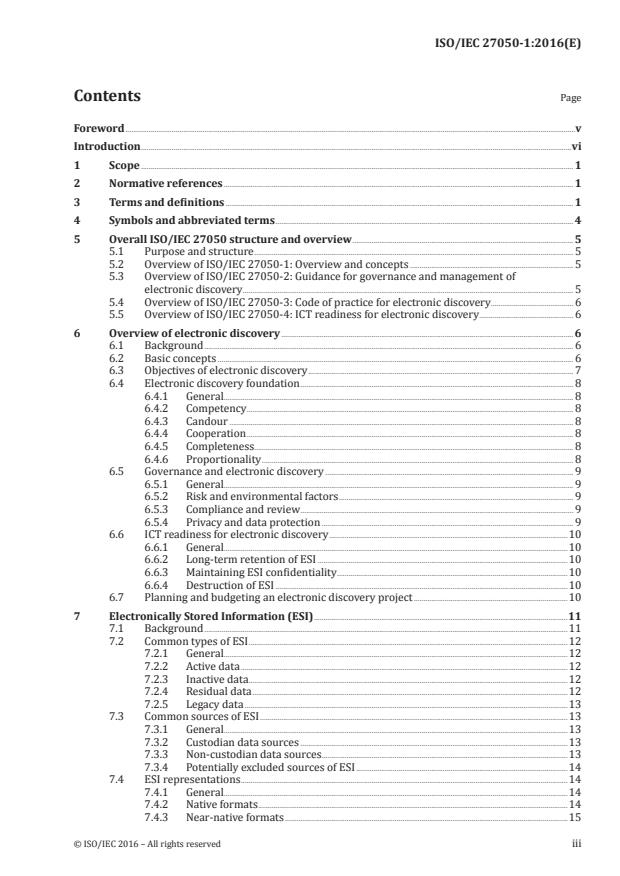
Contents Page
Foreword .v
Introduction .vi
1 Scope . 1
2 Normative references . 1
3 Terms and definitions . 1
4 Symbols and abbreviated terms . 4
5 Overall ISO/IEC 27050 structure and overview . 5
5.1 Purpose and structure . 5
5.2 Overview of ISO/IEC 27050-1: Overview and concepts . 5
5.3 Overview of ISO/IEC 27050-2: Guidance for governance and management of
electronic discovery . 5
5.4 Overview of ISO/IEC 27050-3: Code of practice for electronic discovery . 6
5.5 Overview of ISO/IEC 27050-4: ICT readiness for electronic discovery . 6
6 Overview of electronic discovery . 6
6.1 Background . 6
6.2 Basic concepts . 6
6.3 Objectives of electronic discovery . 7
6.4 Electronic discovery foundation . 8
6.4.1 General. 8
6.4.2 Competency . 8
6.4.3 Candour . 8
6.4.4 Cooperation . 8
6.4.5 Completeness . 8
6.4.6 Proportionality . 8
6.5 Governance and electronic discovery . 9
6.5.1 General. 9
6.5.2 Risk and environmental factors . 9
6.5.3 Compliance and review . 9
6.5.4 Privacy and data protection . 9
6.6 ICT readiness for electronic discovery .10
6.6.1 General.10
6.6.2 Long-term retention of ESI .10
6.6.3 Maintaining ESI confidentiality .10
6.6.4 Destruction of ESI .10
6.7 Planning and budgeting an electronic discovery project .10
7 Electronically Stored Information (ESI) .11
7.1 Background .11
7.2 Common types of ESI .12
7.2.1 General.12
7.2.2 Active data .12
7.2.3 Inactive data . .12
7.2.4 Residual data .12
7.2.5 Legacy data .13
7.3 Common sources of ESI .13
7.3.1 General.13
7.3.2 Custodian data sources .13
7.3.3 Non-custodian data sources .13
7.3.4 Potentially excluded sources of ESI .14
7.4 ESI representations .14
7.4.1 General.14
7.4.2 Native formats .14
7.4.3 Near-native formats .15
© ISO/IEC 2016 – All rights reserved iii
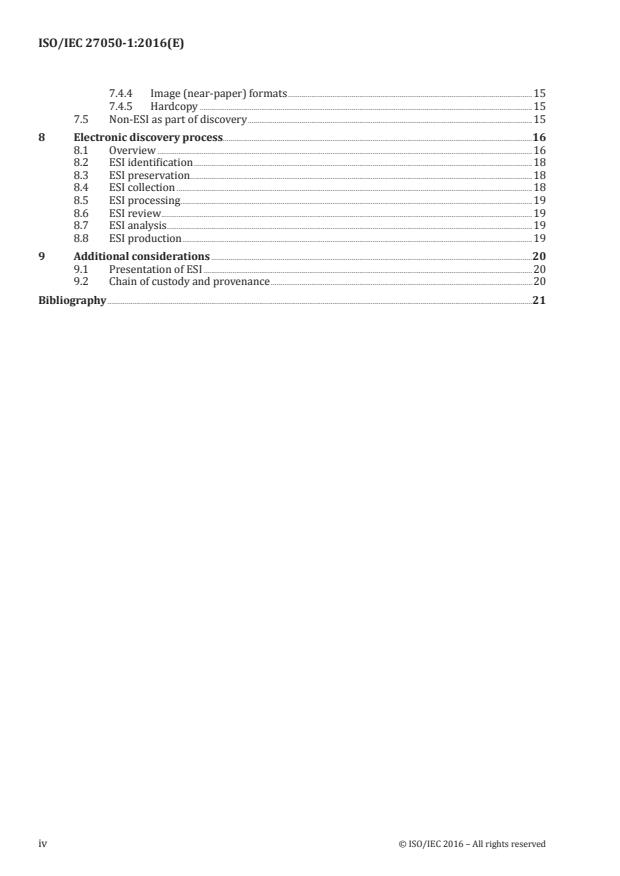
7.4.4 Image (near-paper) formats .15
7.4.5 Hardcopy .15
7.5 Non-ESI as part of discovery .15
8 Electronic discovery process.16
8.1 Overview .16
8.2 ESI identification .18
8.3 ESI preservation .18
8.4 ESI collection .18
8.5 ESI processing .19
8.6 ESI review .19
8.7 ESI analysis .19
8.8 ESI production .19
9 Additional considerations .20
9.1 Presentation of ESI .20
9.2 Chain of custody and provenance .20
Bibliography .21
iv © ISO/IEC 2016 – All rights reserved
Foreword
ISO (the International Organization for Standardization) and IEC (the International Electrotechnical
Commission) form the specialized system for worldwide standardization. National bodies that are
members of ISO or IEC participate in the development of International Standards through technical
committees established by the respective organization to deal with particular fields of technical
activity. ISO and IEC technical committees collaborate in fields of mutual interest. Other international
organizations, governmental and non-governmental, in liaison with ISO and IEC, also take part in the
work. In the field of information technology, ISO and IEC have established a joint technical committee,
ISO/IEC JTC 1.
The procedures used to develop this document and those intended for its further maintenance are
described in the ISO/IEC Directives, Part 1. In particular the different approval criteria needed for
the different types of document should be noted. This document was drafted in accordance with the
editorial rules of the ISO/IEC Directives, Part 2 (see www.iso.org/directives).
Attention is drawn to the possibility that some of the elements of this document may be the subject
of patent rights. ISO and IEC shall not be held responsible for identifying any or all such patent
rights. Details of any patent rights identified during the development of the document will be in the
Introduction and/or on the ISO list of patent declarations received (see www.iso.org/patents).
Any trade name used in this document is information given for the convenience of users and does not
constitute an endorsement.
For an explanation on the meaning of ISO specific terms and expressions related to conformity assessment,
as well as information about ISO’s adherence to the World Trade Organization (WTO) principles in the
Technical Barriers to Trade (TBT) see the following URL: www.iso.org/iso/foreword.html.
The committee responsible for this document is ISO/IEC JTC 1, Information technology, Subcommittee
SC 27, IT Security techniques.
A list of all parts in the ISO/IEC 27050 series can be found on the ISO website.
© ISO/IEC 2016 – All rights reserved v
Introduction
This document provides an overview of electronic discovery and describes related terminology,
concepts, and processes that are intended to be leveraged by other parts of ISO/IEC 27050.
Electronic discovery often serves as a driver for investigations as well as evidence acquisition and
handling activities (covered in ISO/IEC 27037). In addition, the sensitivity and criticality of the data
sometimes necessitate protections like storage security to guard against data breaches (covered in
ISO/IEC 27040).
This document is not a reference or normative document for regulatory and legislative security
requirements. Although it emphasizes the importance of these influences, it cannot state them
specifically, since they are dependent on the country, the type of business, etc.
vi © ISO/IEC 2016 – All rights reserved
INTERNATIONAL STANDARD ISO/IEC 27050-1:2016(E)
Information technology — Security techniques —
Electronic discovery —
Part 1:
Overview and concepts
1 Scope
Electronic discovery is the process of discovering pertinent Electronically Stored Information (ESI)
or data by one or more parties involved in an investigation or litigation, or similar proceeding. This
document provides an overview of electronic discovery. In addition, it defines related terms and
describes the concepts, including, but not limited to, identification, preservation, collection, processing,
review, analysis, and production of ESI. This document also identifies other relevant standards (e.g.
ISO/IEC 27037) and how they relate to, and interact with, electronic discovery activities.
This document is relevant to both non-technical and technical personnel involved in some or all of the
electronic discovery activities, and it is not intended to contradict or supersede local jurisdictional laws
and regulations, so exercise care to ensure compliance with the prevailing jurisdictional requirements.
2 Normative references
There are no normative references in this document.
3 Terms and definitions
For the purposes of this document, the terms and definitions given in ISO/IEC 27000 and the
following apply.
ISO and IEC maintain terminological databases for use in standardization at the following addresses:
— IEC Electropedia: available at http://www.electropedia.org/
— ISO Online browsing platform: available at http://www.iso.org.obp
3.1
chain of custody
demonstrable possession, movement, handling, and location of material from one point in time
until another
3.2
custodian
person or entity that has custody, control or possession of Electronically Stored Information (3.9)
3.3
data breach
compromise of security that leads to the accidental or unlawful destruction, loss, alteration,
unauthorized disclosure of, or access to protected data transmitted, stored (3.26) or otherwise
processed
[SOURCE: ISO/IEC 27040:2015, 3.7]
© ISO/IEC 2016 – All rights reserved 1
3.4
discovery
process by which each party obtains information held by another party or non-party concerning a matter
Note 1 to entry: Discovery is applicable more broadly than to parties in adversarial disputes.
Note 2 to entry: Discovery is also the disclosure of hardcopy documents, Electronically Stored Information (3.9)
and tangible objects by an adverse party.
Note 3 to entry: In some jurisdictions, the term disclosure is used interchangeably with discovery.
3.5
disposition
range of processes associated with implementing records retention, destruction or transfer decisions
which are documented in disposition authorities (3.6) or other instruments
[SOURCE: ISO 15489-1:2016, 3.8]
3.6
disposition authority
instrument that defines the disposition (3.5) actions that are authorized for specified records
[SOURCE: ISO 15489-1:2016, 3.9]
3.7
electronic archive
long-term repository of Electronically Stored Information (3.9)
Note 1 to entry: Electronic archives can be online, and therefore accessible, or off-line and not easily accessible.
Note 2 to entry: Backup systems (e.g. tape, virtual tape, etc.) are not intended to be electronic archives, but rather
data protection systems (i.e. recovery mechanisms for disaster recovery and business continuity).
3.8
electronic discovery
discovery (3.4) that includes the identification, preservation, collection, processing, review, analysis, or
production of Electronically Stored Information (3.9)
Note 1 to entry: Although electronic discovery is often considered a legal process, its use is not limited to the
legal domain.
3.9
Electronically Stored Information
ESI
data or information of any kind and from any source, whose temporal existence is evidenced by being
stored (3.26) in or on any electronic medium
Note 1 to entry: ESI includes traditional e-mail, memos, letters, spreadsheets, databases, office documents,
presentations and other electronic formats commonly found on a computer. ESI also includes system, application
and file-associated metadata (3.19) such as timestamps, revision history, file type, etc.
Note 2 to entry: Electronic medium can take the form of, but is not limited to, storage devices and storage
elements.
[SOURCE: ISO/IEC 27040:2015, 3.16]
3.10
ESI analysis
element of an electronic discovery (3.8) process focused on evaluating Electronically Stored Information
(3.9) for content and context to identify facts, relationships, key patterns, and other features that can
lead to improved understanding of an ESI (3.9) corpus
Note 1 to entry: Content and context can include key patterns, topics, people and discussions.
2 © ISO/IEC 2016 – All rights reserved
3.11
ESI collection
element of an electronic discovery (3.8) process focused on gathering Electronically Stored Information
(3.9) and other related material
3.12
ESI identification
element of an electronic discovery (3.8) process focused on locating potential sources and the criteria
for selecting potentially relevant Electronically Stored Information (3.9)
3.13
ESI preservation
element of an electronic discovery (3.8) process focused on maintaining Electronically Stored Information
(3.9) in its original or existing state
Note 1 to entry: In some matters or jurisdictions, there can be requirements to prevent spoliation (3.24) of
Electronically Stored Information (3.9).
3.14
ESI processing
element of an electronic discovery (3.8) process focused on extracting Electronically Stored Information
(3.9) and converting it, if necessary, to forms more suitable for ESI review (3.16) and ESI analysis (3.10)
3.15
ESI production
element of an electronic discovery (3.8) process focused on delivering or making available Electronically
Stored Information (3.9)
Note 1 to entry: ESI production can also include getting Electronically Stored Information (3.9) in appropriate
forms and using appropriate delivery mechanisms.
Note 2 to entry: ESI production can be to any person or organization.
3.16
ESI review
element of an electronic discovery (3.8) process focused on screening Electronically Stored Information
(3.9) based on specific criteria
Note 1 to entry: In some matters or jurisdictions, Electronically Stored Information (3.9) that is considered
privileged can be excluded from production.
3.17
investigation
systematic or formal process of inquiring into or researching, and examining facts or materials
associated with a matter
Note 1 to entry: Materials can take the form of hardcopy documents or Electronically Stored Information (3.9).
3.18
legal hold
process of suspending the normal disposition (3.5) or processing of records and Electronically Stored
Information (3.9) as a result of current or anticipated litigation, audit, government investigation or
other such matters
Note 1 to entry: The issued communication that implements the legal hold can also be called a “hold,”
“preservation order,” “preservation notice,” “suspension order,” “freeze notice,” “hold order,” or “hold notice.”
3.19
metadata
data that defines and describes other data
[SOURCE: ISO/IEC 11179-1:2015, 3.2.16]
© ISO/IEC 2016 – All rights reserved 3
3.20
non-volatile storage
storage (3.25) that retains its contents even after power is removed
[SOURCE: ISO/IEC 27040:2015, 3.30]
3.21
production file format
organization and representation of data and metadata (3.19) that is presented to a requesting party
3.22
provenance
information that documents the origin or source of Electronically Stored Information (3.9), any changes
that have taken place since it was originated, and who has had custody of it since it was originated
3.23
sanitize
process to remove information from media such that data recovery is not possible at a given level of effort
[SOURCE: ISO/IEC 27040:2015, 3.38, modified]
Note 1 to entry: Clear, purge, and destruct are actions that can be taken to sanitize storage media.
3.24
spoliation
act of making or allowing a change to or destruction of Electronically Stored Information (3.9) where
there is a requirement to keep it intact
Note 1 to entry: Spoliation can take the form of ESI (3.9) destruction, corruption, or alteration of the ESI (3.9) or
associated metadata (3.19) as well as rendering ESI (3.9) unavailable (e.g. due to encryption with no access to the
decryption key, loss of media, under the control of a third party, etc.).
3.25
storage
device, function, or service supporting data entry and retrieval
[SOURCE: ISO/IEC 27040:2015, 3.43]
3.26
store
record data on volatile storage (3.27) or non-volatile storage (3.20)
[SOURCE: ISO/IEC 27040:2015, 3.50]
3.27
volatile storage
storage (3.25) that fails to retain its contents after power is removed
[SOURCE: ISO/IEC 27040:2015, 3.53]
4 Symbols and abbreviated terms
CD compact disc
DVD digital versatile disc
EDMS electronic document management system
ERMS electronic records management system
4 © ISO/IEC 2016 – All rights reserved
ICT information and communications technology
NAS network attached storage
OCR optical character recognition
PII personally identifiable information
RAM random access memory
5 Overall ISO/IEC 27050 structure and overview
5.1 Purpose and structure
ISO/IEC 27050 (all parts) provides requirements and guidance for the process of discovering pertinent
Electronically Stored Information (ESI) or data by one or more parties involved in an investigation or
litigation, or similar proceeding. Figure 1 provides a notional architecture of ISO/IEC 27050 (all parts).
Figure 1 — ISO/IEC 27050 architecture
5.2 Overview of ISO/IEC 27050-1: Overview and concepts
This document provides an overview of electronic discovery, introducing relevant terminology,
concepts, and processes. This document is an informative document.
5.3 Overview of ISO/IEC 27050-2: Guidance for governance and management of
electronic discovery
This document addresses how personnel at senior levels within an organization can identify and take
ownership of risks related to electronic discovery, set policy relating to electronic discovery and achieve
compliance with external and internal requirements relating to electronic discovery.
© ISO/IEC 2016 – All rights reserved 5
5.4 Overview of ISO/IEC 27050-3: Code of practice for electronic discovery
This document considers each of the distinct elements of the electronic discovery process (ESI
identification, ESI preservation, ESI collection, ESI processing, ESI review, ESI analysis, and ESI
production) and, for each process element, identifies (i) the objectives, (ii) considerations to avoid
failures, and (iii) the specific requirements and guidance for adherence to ISO/IEC 27050 (all parts).
5.5 Overview of ISO/IEC 27050-4: ICT readiness for electronic discovery
This document provides guidance on the ways an organization can be better prepared to address
electronic discovery from the perspective of both technology and processes.
6 Overview of electronic discovery
6.1 Background
Electronic discovery is increasingly important, both within organizations and in the legal systems
of some jurisdictions. This trend is expected to continue as more and more electronic records and
information (or ESI) are created, modified, manipulated, used, and ultimately destroyed without ever
taking on a physical form (e.g. a printed document). The emergence of ESI as the preferred representation
of information is introducing new challenges associated with locating the ESI, handling massive
quantities of data, preservation and retention of ESI, authenticity, data integrity, data confidentiality,
data or media sanitization, etc. While electronic discovery needs and responses vary by matter, failure
to appropriately handle the electronic discovery process in view of the context of a particular matter
can result in rework, unnecessary costs, possible sanctions, and legal liabilities.
ISO/IEC 27050 (all parts) addresses these challenges by
— promoting a common approach, understanding, and language for electronic discovery,
— encouraging practical and cost-effective discovery by those tasked with managing ESI through the
process,
— identifying competency areas for those involved in electronic discovery,
— promoting consideration of the proactive use of technology, in reducing costs and risks, while
increasing efficiencies throughout the discovery process, and
— suggesting ways of avoiding inadvertent disclosures of potentially privileged, confidential, or
sensitive ESI.
The overriding goal is to help organizations plan for and meet their electronic discovery objectives and
obligations, if any, commensurate with the needs of each particular matter.
6.2 Basic concepts
It is useful to consider in advance the following electronic discovery issues. The significance of these
issues and the need to address them vary by matter and need to be calibrated to the needs of the matter.
— scope of electronic discovery;
— governance and management of electronic discovery;
— establishing responsibilities for each aspect of an electronic discovery project;
— identification of systems holding potentially relevant ESI;
— identification of potentially relevant ESI;
— developing appropriate documentation throughout the electronic discovery process;
6 © ISO/IEC 2016 – All rights reserved
— anticipated costs and their proposed allocation;
— preservation of ESI, including the legal hold process;
— disclosure of information on the ESI storage methods, hardware, and software;
— collection/acquisition of ESI;
— processing of ESI;
— review and analysis of ESI;
— production of ESI including the form of production.
Those engaging in electronic discovery have many influencing factors specific to the context. Cost can
be significant among these. The primary cost drivers include:
— Collection: finding and retrieving the potentially relevant ESI;
— Volume: the raw quantity of ESI to be collected, processed, or reviewed;
— Number of sources: the number of custodians, enterprise systems, and external systems and
applications under the control of the entity involved in the collection of ESI can increase exponentially
the amount of time and effort involved;
— Human competencies: the need for qualified people who can perform the functions needed for
effective data retrieval, handling, searching, and final review for relevance, privilege, and review
for classification (e.g. relevance, privilege, trade secret, confidentiality or special treatment); these
competencies can include information technology, computer technology, statistics, search sciences,
and law;
— Case complexity: simple cases can require a limited scope and review process, but more complex
cases can involve elaborate document review strategies and processes.
The time it takes to find and retrieve ESI, the volume of ESI, the number of sources subject to an
ESI investigation and, ultimately, the acceptance of that ESI as reliable in a legal proceeding or ESI
investigation are intimately tied to the practices and policies an organization has put in place to address
the management of ESI throughout its life cycle in the organization. Organizations that build electronic
discovery readiness into their comprehensive information governance structures prior to engaging
in electronic discovery are likely to more efficiently and cost-effectively meet the requirements of
electronic discovery. ISO/IEC 27050-2 and ISO/IEC 27050-4 provide specific guidance for doing so.
6.3 Objectives of electronic discovery
Objectives of electronic discovery vary by matter. As adjusted for each matter, the objectives can include
the following:
— comply with confidentiality, data privacy, and other restrictions on data access, use, handling, or
transfer imposed by applicable laws, regulations, rules, and expectations;
— identify potentially relevant sources of ESI;
— properly preserve and retain potentially relevant ESI;
— process relevant ESI into a format that facilitates its efficient searching or review;
— minimize the potential of failing to designate as responsive ESI that is responsive;
— minimize the potential of designating as responsive ESI that is not responsive;
— minimize the potential of failing to designate for withholding or special treatment responsive ESI
that qualifies for withholding or special treatment;
© ISO/IEC 2016 – All rights reserved 7
— minimize the potential of designating for withholding or special treatment responsive ESI that does
not qualify for withholding or special treatment;
— produce responsive ESI in a form that is useable by the requesting party;
— consider the proportionality of the response in the context of the matter and the costs;
— utilize technology in order to reduce risks and costs throughout the project.
6.4 Electronic discovery foundation
6.4.1 General
Electronic discovery often involves parties with conflicting interests and, in a worst-case scenario, they
can be adversarial parties. Electronic discovery can be key to resolving a conflict or matter, but only
when it is conducted on a foundation that facilitates a measure of trust.
For electronic discovery, this foundation includes adequately addressing competency, candour,
cooperation, completeness, and proportionality issues that can require the reconciliation of the
requirements of electronic discovery with the requirements of other processes, values or principles.
6.4.2 Competency
Given the complexities associated with electronic discovery, it is important that the individuals
engaging in the electronic discovery process have the relevant technical or legal competencies. They
potentially need to be able to demonstrate that they are properly trained and have sufficient technical
or legal understanding to handle ESI appropriately and to execute the electronic discovery process on
behalf of a party.
6.4.3 Candour
The parties conducting electronic discovery are expected to adhere to the applicable standards of
professionalism and ethical conduct. In some jurisdictions, this means the parties have an obligation
to correct and supplement the record (e.g. additional disclosures or to amend prior responses). In
addition, purposeful sluggishness in executing the electronic discovery process needs to be avoided by
all parties involved.
6.4.4 Cooperation
Cooperation on issues relating to the preservation, collection, search, review, and production of ESI
can be expected in courts of some jurisdictions and, in such courts, cooperation typically does not
compromise representation of a client. In addition, in the context of litigation, cooperation in reasonably
limiting ESI discovery requests, on the one hand, and in reasonably responding to ESI discovery
requests, on the other hand, can reduce costs and delays. Cooperative exchanges of information at the
earliest stages of discovery can be useful as appropriate.
6.4.5 Completeness
The objective of a producing party is to retrieve and produce a set of (non-privileged) ESI that
represents, under the specific circumstances of the matter, a complete and accurate production.
6.4.6 Proportionality
With the explosive growth of ESI, there are increased concerns over how to best address the costs
and burdens associated with the discovery process. One approach to address this problem is to take
steps to help ensure that the benefits of discovery be commensurate with the corresponding burdens.
The burdens of electronic discovery can be varied including, but not limited to, disruption of business
operations, financial cost, or intrusions on individual privacy.
8 © ISO/IEC 2016 – All rights reserved
6.5 Governance and electronic discovery
6.5.1 General
ISO/IEC 38500 sets out six principles for good governance of ICT that are associated with responsibility,
strategy, acquisition, performance, conformance, and human behaviour. Each principle is expressed
as a preferred behaviour to guide decision making (i.e. each principle refers to what is expected to
happen, but does not prescribe how, when or by whom the principles would be implemented, as these
aspects are dependent on the nature of the organization implementing the principles). Governing
bodies are encouraged to require that these principles are applied, and as a result, they can be assisted
in managing risks and encouraging the exploitation of opportunities arising from the use of ICT.
According to ISO/IEC 38500, good governance of ICT also assists governing bodies in assuring
conformance with obligations (regulatory, legislation, common law, contractual) concerning the
acceptable use of ICT.
The general topic of governance, as it relates to electronic discovery, is addressed in ISO/IEC 27050-2,
but 6.5 highlights some of the more important elements to help draw attention to the issues.
6.5.2 Risk and environmental factors
Electronic discovery has the potential of exposing an organization or its governing bodies to causes of
failure that can have detrimental effects. Governance can help avoid negative consequences that can
take the form of
— breaches of privacy, health and safety, record keeping legislation and regulations,
— non-compliance with standards relating to security, social responsibility, and
— matters relating to intellectual property rights including licensing agreements.
Avoiding negative consequences associated with these failures requires awareness and mitigations that
cover the electronic discovery process as well as things such as inadequate ICT systems and improper
or inappropriate use of ICT.
6.5.3 Compliance and review
Many organizations are faced with compliance issues that originate from statutory, regulatory, legal,
or other requirements. These requirements can be the reason that an organization undertakes an
electronic discovery activity, but more likely, they have an impact on how the electronic discovery
process is carried out. For example, there can be restrictions on who can see the ESI, how the ESI is
transmitted or stored, and specific retention or destruction issues. It is important to ensure that the
electronic discovery process is executed within the confines of the relevant compliance requirements.
6.5.4 Privacy and data protection
Besides regulatory restrictions and compliance issues as mentioned in 6.5.3, it is important to be aware
of some privacy limitations on the use of custodian data (see also ISO/IEC 29100). In particular, there
might be some restrictions on personally identifiable information (PII) at custodian data sources that
need to be considered as part of ESI management.
When electronic discovery involves PII in some jurisdictions, there can be severe restrictions on what
can be done with it (e.g. it cannot be transported across borders). Even without such restrictions,
additional data protection measures are often necessary to protect confidentiality and guard against
data breaches. ISO/IEC 27050-4, in conjunction with ISO/IEC 27040, provides additional materials that
can help deal with these kinds of issues.
© ISO/IEC 2016 – All rights reserved 9
6.6 ICT readiness for electronic discovery
6.6.1 General
Throughout the electronic discovery process, the parties involved in a matter are gathering, handling,
and manipulating ESI. Often, this ESI has been extracted from a computing or storage environment
that is specifically designed to protect it. Similar protections might be needed for the ESI that has been
removed or copied from these environments.
ISO/IEC 27050-4 addresses many of these issues within the context of electronic discovery.
6.6.2 Long-term retention of ESI
Electronic discovery is commonly employed early in litigation, audit, government investigation or
other such matters. While the matter proceeds, the parties need to retain the associated ESI in such
a way that it continues to be available and its integrity is maintained. Adequate disaster recovery and
business continuity measures along with common data protection mechanisms (e.g. backups) can be
important elements of a retention program for ESI.
It is important to consider the timeframes involved when making decisions about long-term retention
of ESI. There are significant differences between the approaches for retaining ESI for a few weeks
or months versus retaining ESI for decades (e.g. complex civil litigation that goes through multiple
appeals) in electronic archives.
An additional consideration is whether data protection and privacy requirements affect how long
personal data may be retained and if the matter requires normal data retention periods to be suspended.
This can vary significantly between jurisdictions.
6.6.3 Maintaining ESI confidentiality
ESI often contains proprietary, privileged, and sensitive information that needs to be handled and
stored in a way that protects the confidentiality of the information. Failure to adequately control
sensitive ESI can result in serious repercussions if there is a data breach.
Depending on the sensitivity of the ESI, security measures such as data in motion and data at rest
encryption along with the corresponding key management are likely to be needed.
6.6.4 Destruction of ESI
When ESI is no longer needed, it is important to eliminate it in a way that avoids data breaches. This
typically means that the logical storage or the storage media used to retain the ESI has to be properly
sanitized (e.g. cleared using overwrite techniques or cryptographic erase).
6.7 Planning and budgeting an electronic discovery project
The varied drivers behind an electronic discovery project make it difficult to plan such a project many
months in advance. As such, they are typically managed on an individual basis, which can increase costs
significantly. Regardless of the urgency of the request, as with any project, time invested in planning at
the outset typically saves significant time and costs later in the project. This is especially so, as many
of the steps in a typical electronic discovery project are disproportionately expensive to repeat at a
later stage. For example, if the production structure and format are not agreed upon in advance of the
review, and families of ESI or hardcopy documents are not marked consistently, then it can cause the
review to have to be partially repeated.
An important early step is to establish an electronic discovery project team that, at a minimum, includes
a project sponsor and manager from the business/organization, a project manager from the legal or
investigative team, and a project manager from the ICT perspective. This triangle of communication
between the business/organization, the legal/investigators, and the ICT team is vital to a successful
project.
10 © ISO/IEC 2016 – All rights reserved
Also, an early step is the establishment of an electronic discovery project plan, with as much detail
...
Questions, Comments and Discussion
Ask us and Technical Secretary will try to provide an answer. You can facilitate discussion about the standard in here.
Loading comments...