

ISO 15686-4:2014
(Main)Building Construction — Service Life Planning — Part 4: Service Life Planning using Building Information Modelling
General Information
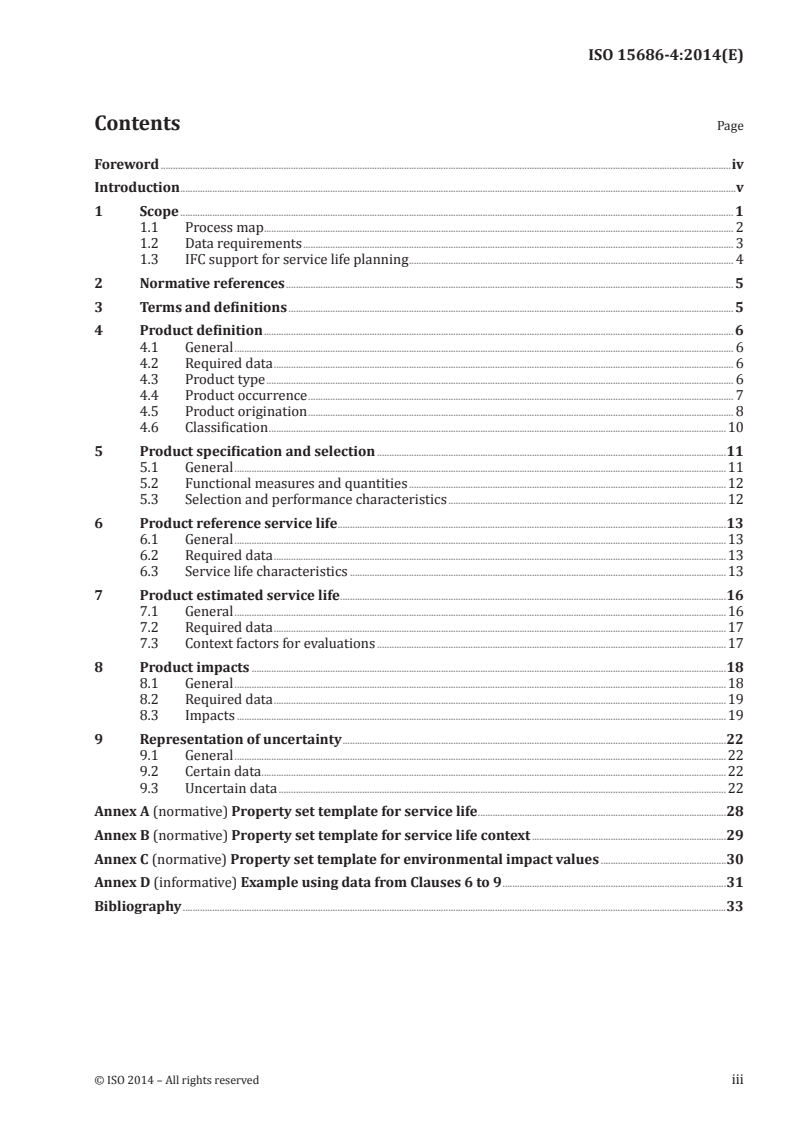
- Abstract
ISO 15686-4:2014 provides information and guidance on the use of standards for information exchange for service life planning of buildings and constructed assets and their components as well as the required supporting data. It provides guidance on structuring information from existing data sources to enable delivery of their information content in a structure that conforms to international standards for information exchange. In particular, reference is made to ISO 16739. The Construction Operations Building Information Exchange (COBie) standard for the exchange of facility information in tabular data are used as an alternative representation. COBie is a tabular representation of a handover view of the IFC schema. ISO 15686-4:2014 is also applicable to the exchange of service life information between categories of design and information management software applications that have standards-based information exchange interfaces including: a) Building construction Information Modelling (BIM); b) Computer Aided Facilities Management (CAFM).
- Status
- Published
- Publication Date
- 13-Jan-2014
- Technical Committee
- ISO/TC 59/SC 14 - Design life
- Drafting Committee
- ISO/TC 59/SC 14 - Design life
- Current Stage
- 9092 - International Standard to be revised
- Start Date
- 12-Jan-2023
- Completion Date
- 29-Aug-2026
Buy Documents

ISO 15686-4:2014 - Building Construction -- Service Life Planning

ISO 15686-4:2014 - Building Construction — Service Life Planning — Part 4: Service Life Planning using Building Information Modelling/14/2014
Overview
ISO 15686-4:2014 - "Building Construction - Service Life Planning - Part 4: Service Life Planning using Building Information Modelling" provides guidance on structuring and exchanging service life planning information using open data standards. The standard focuses on how service life data for buildings, constructed assets and components can be captured, structured and exchanged via Building Information Modelling (BIM) formats to support design, operation, maintenance and whole-life decision-making.
Key topics and technical requirements
- Information exchange framework: Specifies structures for delivering service life information in ways that conform to international exchange standards (notably IFC / ISO 16739) and alternative tabular representations such as COBie.
- Data requirements and property sets: Defines required data for product definition, specification, selection, classification, and occurrences; includes normative property-set templates (Annex A–C) and examples (Annex D).
- Service life metrics: Covers reference service life and estimated service life, required supporting data, context factors (environment, usage), and procedures to express uncertainty.
- Process map and lifecycle flow: Describes information exchanges across lifecycle stages (design, testing, prediction, costing, in-use inspection) and how service life data feed ISO 15686 series processes.
- Interoperability focus: Emphasizes standards-based exchange between BIM and other tools such as Computer Aided Facilities Management (CAFM); excludes proprietary exchange methods and internal application processing.
- Uncertainty and impacts: Guidance on representing uncertainty and recording product impacts (including environmental impact values).
Practical applications
- Enable consistent exchange of service life data between architects, engineers, contractors, facility managers and software systems.
- Support lifecycle costing, maintenance scheduling, durability assessment and whole-life performance evaluation using BIM models.
- Facilitate handover documentation (COBie) and integration of service life data into CAFM and asset-management workflows.
- Help information managers structure national, project or facility-level BIM guidance for durability and service life planning.
Who should use this standard
- Information managers responsible for BIM data frameworks and handover
- Designers and specifiers applying service life data to BIM objects
- Facility managers and CAFM integrators using lifecycle and maintenance data
- Owners, operators and lifecycle-cost analysts involved in whole-life decision making
Related standards
- ISO 16739 (IFC - Industry Foundation Classes)
- COBie (Construction Operations Building Information Exchange)
- Other parts of ISO 15686 series (Parts 1, 2, 3, 5, 7, 8, 9, 10, 11) for prediction, costing, audits and terminology
Keywords: ISO 15686-4, service life planning, BIM, IFC, COBie, CAFM, lifecycle, service life data, interoperability.
Relations
- Effective Date
- 25-Aug-2026
- Effective Date
- 22-Oct-2022
- Effective Date
- 22-Oct-2022
- Effective Date
- 22-Oct-2022
Buy Documents
ISO 15686-4:2014 - Building Construction -- Service Life Planning
ISO 15686-4:2014 - Building Construction — Service Life Planning — Part 4: Service Life Planning using Building Information Modelling/14/2014
Get Certified
Connect with accredited certification bodies for this standard

DIBt (Deutsches Institut für Bautechnik)
German Institute for Building Technology.
DIN CERTCO
DIN Group product certification.

Aboma Certification B.V.
Specialized in construction, metal, and transport sectors.
Sponsored listings
Frequently Asked Questions
ISO 15686-4:2014 is a standard published by the International Organization for Standardization (ISO). Its full title is "Building Construction — Service Life Planning — Part 4: Service Life Planning using Building Information Modelling". This standard covers: ISO 15686-4:2014 provides information and guidance on the use of standards for information exchange for service life planning of buildings and constructed assets and their components as well as the required supporting data. It provides guidance on structuring information from existing data sources to enable delivery of their information content in a structure that conforms to international standards for information exchange. In particular, reference is made to ISO 16739. The Construction Operations Building Information Exchange (COBie) standard for the exchange of facility information in tabular data are used as an alternative representation. COBie is a tabular representation of a handover view of the IFC schema. ISO 15686-4:2014 is also applicable to the exchange of service life information between categories of design and information management software applications that have standards-based information exchange interfaces including: a) Building construction Information Modelling (BIM); b) Computer Aided Facilities Management (CAFM).
ISO 15686-4:2014 provides information and guidance on the use of standards for information exchange for service life planning of buildings and constructed assets and their components as well as the required supporting data. It provides guidance on structuring information from existing data sources to enable delivery of their information content in a structure that conforms to international standards for information exchange. In particular, reference is made to ISO 16739. The Construction Operations Building Information Exchange (COBie) standard for the exchange of facility information in tabular data are used as an alternative representation. COBie is a tabular representation of a handover view of the IFC schema. ISO 15686-4:2014 is also applicable to the exchange of service life information between categories of design and information management software applications that have standards-based information exchange interfaces including: a) Building construction Information Modelling (BIM); b) Computer Aided Facilities Management (CAFM).
ISO 15686-4:2014 is classified under the following ICS (International Classification for Standards) categories: 91.040.01 - Buildings in general. The ICS classification helps identify the subject area and facilitates finding related standards.
ISO 15686-4:2014 has the following relationships with other standards: It is inter standard links to CEN/TR 16970:2016, ISO/FDIS 15686-3, ISO/FDIS 15686-1, ISO/FDIS 15686-2. Understanding these relationships helps ensure you are using the most current and applicable version of the standard.
ISO 15686-4:2014 is available in PDF format for immediate download after purchase. The document can be added to your cart and obtained through the secure checkout process. Digital delivery ensures instant access to the complete standard document.
Standards Content (Sample)
INTERNATIONAL ISO
STANDARD 15686-4
First edition
2014-01-15
Building Construction — Service Life
Planning —
Part 4:
Service Life Planning using Building
Information Modelling
Bâtiments et biens immobiliers construits — Conception prenant en
compte la durée de vie —
Partie 4: Conception prenant en compte la durée de vie utilisant le
modèle d’information du bâtiment fondée sur l’IFC
Reference number
©
ISO 2014
© ISO 2014
All rights reserved. Unless otherwise specified, no part of this publication may be reproduced or utilized otherwise in any form
or by any means, electronic or mechanical, including photocopying, or posting on the internet or an intranet, without prior
written permission. Permission can be requested from either ISO at the address below or ISO’s member body in the country of
the requester.
ISO copyright office
Case postale 56 • CH-1211 Geneva 20
Tel. + 41 22 749 01 11
Fax + 41 22 749 09 47
E-mail copyright@iso.org
Web www.iso.org
Published in Switzerland
ii © ISO 2014 – All rights reserved
Contents Page
Foreword .iv
Introduction .v
1 Scope . 1
1.1 Process map . 2
1.2 Data requirements . 3
1.3 IFC support for service life planning . 4
2 Normative references . 5
3 Terms and definitions . 5
4 Product definition . 6
4.1 General . 6
4.2 Required data . 6
4.3 Product type . 6
4.4 Product occurrence . 7
4.5 Product origination . 8
4.6 Classification .10
5 Product specification and selection .11
5.1 General .11
5.2 Functional measures and quantities .12
5.3 Selection and performance characteristics .12
6 Product reference service life .13
6.1 General .13
6.2 Required data .13
6.3 Service life characteristics .13
7 Product estimated service life .16
7.1 General .16
7.2 Required data .17
7.3 Context factors for evaluations .17
8 Product impacts .18
8.1 General .18
8.2 Required data .19
8.3 Impacts .19
9 Representation of uncertainty .22
9.1 General .22
9.2 Certain data .22
9.3 Uncertain data .22
Annex A (normative) Property set template for service life .28
Annex B (normative) Property set template for service life context .29
Annex C (normative) Property set template for environmental impact values .30
Annex D (informative) Example using data from Clauses 6 to 9 .31
Bibliography .33
Foreword
ISO (the International Organization for Standardization) is a worldwide federation of national standards
bodies (ISO member bodies). The work of preparing International Standards is normally carried out
through ISO technical committees. Each member body interested in a subject for which a technical
committee has been established has the right to be represented on that committee. International
organizations, governmental and non-governmental, in liaison with ISO, also take part in the work.
ISO collaborates closely with the International Electrotechnical Commission (IEC) on all matters of
electrotechnical standardization.
The procedures used to develop this document and those intended for its further maintenance are
described in the ISO/IEC Directives, Part 1. In particular the different approval criteria needed for the
different types of ISO documents should be noted. This document was drafted in accordance with the
editorial rules of the ISO/IEC Directives, Part 2. www.iso.org/directives
Attention is drawn to the possibility that some of the elements of this document may be the subject of
patent rights. ISO shall not be held responsible for identifying any or all such patent rights. Details of any
patent rights identified during the development of the document will be in the Introduction and/or on
the ISO list of patent declarations received. www.iso.org/patents
Any trade name used in this document is information given for the convenience of users and does not
constitute an endorsement.
For an explanation on the meaning of ISO specific terms and expressions related to conformity
assessment, as well as information about ISO’s adherence to the WTO principles in the Technical Barriers
to Trade (TBT), see the following URL: Foreword - Supplementary information
The committee responsible for this document is ISO/TC 59, Building Construction, Subcommittee SC 14,
Design life.
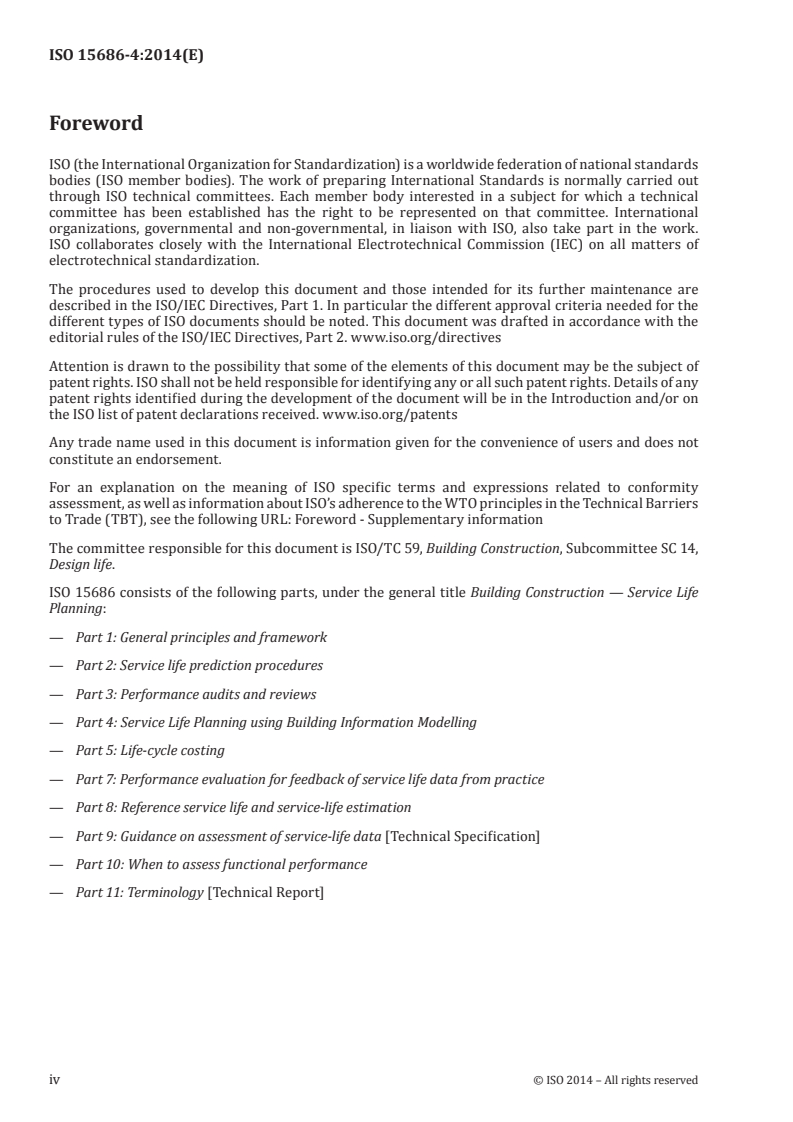
ISO 15686 consists of the following parts, under the general title Building Construction — Service Life
Planning:
— Part 1: General principles and framework
— Part 2: Service life prediction procedures
— Part 3: Performance audits and reviews
— Part 4: Service Life Planning using Building Information Modelling
— Part 5: Life-cycle costing
— Part 7: Performance evaluation for feedback of service life data from practice
— Part 8: Reference service life and service-life estimation
— Part 9: Guidance on assessment of service-life data [Technical Specification]
— Part 10: When to assess functional performance
— Part 11: Terminology [Technical Report]
iv © ISO 2014 – All rights reserved
Introduction
The ISO 15686 series on buildings and constructed assets, including service life planning, is an essential
contribution to the development of a policy for service life planning of buildings and constructed assets.
This part of ISO 15686 establishes the basic procedures necessary for the service life planning process
of buildings. However, for this to occur it is considered that an information system is needed. An
information management system suitable for carrying out the service life planning process needs to
meet a number of rigorous requirements including being able to
— capture enough information and support the methods needed to calculate the effect of the
environment (and microclimate) on the building materials and components used,
— define maintenance schedules for different qualities of building materials installed under different
environmental conditions.
— apply life cycle costing methodologies using the captured data to calculate the benefits of using
either high performance materials with little maintenance or lower performance materials with
better maintenance procedures. Procedures need to be able to take ease of replacement and
demolition into account,
— incorporate new knowledge and predictive methods for material performance and maintenance
without affecting methods and data structures that enable calculations based on current knowledge,
— support interoperability between software applications, and
— be used by designers, constructors, owners, operators and demolishers throughout the construction
lifecycle.
Practically, this means applying the technology that is generally being termed Building construction
Information Modelling (BIM) systems. BIM and the use of software applications that enable it is becoming
a normal way of working within the construction industry. It offers significant benefits including the
ability to work with construction components and assemblies as objects that encapsulate both shape
(in the form of geometric information) and other information about performance, delivery, operation
and more. Performance can include information about durability and sustainability metrics. This
offers powerful capabilities for dealing with these key areas of interest at every level from individual
component to constructed facility.
This standard is particularly concerned with the provision of information for service life planning.
It proposes structures for the capture and exchange of service life planning information based on
the Industry Foundation Classes (IFC) standard for information exchange and sharing and on the
Construction Operations Building Information Exchange (COBie) standard.
The standard starts by providing the service life planning context within which it is prepared. Each-
subsequent section covers a stage of the lifecycle of service life information, starting with its measurement
and publication, followed by its adjustment in the context of a particular facility and finally its use in
whole-life calculations. The annexes summarize the standard properties and provide worked examples
of how the data might be used in manual or automated calculations.
INTERNATIONAL STANDARD ISO 15686-4:2014(E)
Building Construction — Service Life Planning —
Part 4:
Service Life Planning using Building Information Modelling
1 Scope
This part of ISO 15686 provides information and guidance on the use of standards for information
exchange for service life planning of buildings and constructed assets and their components as well as
the required supporting data.
It provides guidance on structuring information from existing data sources to enable delivery of their
information content in a structure that conforms to international standards for information exchange. In
particular, reference is made to ISO 16739. The Construction Operations Building Information Exchange
(COBie) standard for the exchange of facility information in tabular data are used as an alternative
representation. COBie is a tabular representation of a handover view of the IFC schema.
It is also applicable to the exchange of service life information between categories of design and
information management software applications that have standards-based information exchange
interfaces including:
a) Building construction Information Modelling (BIM);
b) Computer Aided Facilities Management (CAFM).
Excluded from this part of the standard are
— information exchange using proprietary methods, and
— processing and analysis of data within individual software applications, though examples are
provided.
The main target audience is the Information manager who will use the framework to assist in structuring
the International, national or project/facility level BIM guidance document.
This Standard specifies the structure and representation of service life data. It is focused on key exchange
requirements underlying the common transactions.
This document may be used for a variety of purposes
a) to achieve and maintain a common understanding within the national and project contexts;
b) to establish the desired outcomes and to define appropriate quality;
c) to identify appropriate management effort and tools;
d) to identify necessary effort and resourcing.
Service life planning involves the application of data about elements within a building or constructed
assets to enable their design, predicted or estimated service life to be determined and communicated.
Buildings are increasingly designed using Building Information Modelling (BIM), an approach that can
provide a specification of all the objects in building and how they are aggregated into parts, assemblies
and systems. An architect or engineer can define the objects using BIM; it is anticipated that the actor
having the service life planning role will apply service life data to these objects and make the data
available for other purposes through the use of data exchange standards.
Using information exchange standards to describe the structure of service life planning information
is important because it normalizes the way in which service life information should be delivered from
source to user so that relevant different attributes can be exchanged and a range of software applications
can be used to capture the information.
1.1 Process map
The process map (see Figure 1) shows the key sequence of information exchanges and places the
information exchanges in context, identifying the sending and receiving roles. It is based on the process
map for design given in ISO 15686-1:2011, Annex B, and the management plan given in ISO 15686-3.
In summary, ISO 15686-2, ISO 15686-8, ISO 15686-5 and ISO 15686-7 define four processes which use
service life data.
— ISO 15686-2 (Testing): Product and testing are brought together to obtain the service life
characteristics.
— ISO 15686-8 (Prediction): The characteristics are brought into a specific context to obtain a
predicted service life.
— ISO 15686-5 (Costing): The predicted or measured service life is used with cost or environmental
impact rates to obtain a life cycle cost or assessment.
— ISO 15686-7 (In-use inspection): The context factors are revised to reflect in-use surveys.
Figure 1 — Exchange requirements detailed in this part and their relationship to other parts
The process map document covers the determining of the service life of a type of product (during
early design stages) and of occurrences of products of a particular type (during later design stages,
construction and operation/maintenance).
NOTE The data requirements for ISO 15686-7 (In-Use inspection) are used in Clause 7 and Annex B.
2 © ISO 2014 – All rights reserved
1.2 Data requirements
The determination of service life is undertaken at various times during the design, construction and
operation of a project. During the early design stages when product information is aggregated a level
such as the whole building or as specifications of whole systems; it is only the design life of a product
that can be determined. At the earliest design stages when only product occurrences are defined, design
life is estimated at the occurrence level. At later design stages, when individual products are located and
these products are designated by type, design life can be indicated for all occurrences at the type level.
Similarly, when individual products are identified, it becomes possible to determine a reference service
life when a manufacturer/supplier can be identified. As with design life, reference service life can be
allocated to the product type level.
At later design stages and during construction, when the configuration and location of products has
been fully established, it becomes possible to analyse the service life of products according to ‘in use’
conditions. These conditions can vary the reference service life depending on factors such as exposure
to weather, aggressiveness of the local environment and other degrading (or upgrading) factors. The
result of applying in-use conditions is to define an estimated service life which is simply the length of
time of a product occurrence lifecycle.
Finally, the condition of a product occurrence can be checked from time to time during the operational
stage. From the condition of the product, a residual service life can be assessed. If degradation is more
than has been expected, the residual service life is reduced to less than the value that might have been
expected from the estimated service life.
The overall data requirements for the process are summarized in Figure 2.
Figure 2 — The ‘service life planning view’
Clause 4 of this part of ISO 15686 defines the data requirements to identify the product.
Clause 5 suggests the data required for the specification/selection of product.
Clause 6 adds the testing regimen and the key service life metrics.
Clause 7 adds the context and the predicated estimated service life.
Clause 8 adds the impacts (to date and predicted) for stages in the life cycle value.
Clause 9 suggests a representation where uncertainty and ranges of values are relevant.
Annex A provides a formal representation for Service Life definition.
Annex B provides a formal representation for Service Life factors.
Annex C provides a formal representation for Environmental and Economic Impact measures.
Annex D offers example calculations.
1.3 IFC support for service life planning
IFC contains support for a wide range of building and construction topics. The information needed for
service life planning and related topics is supported by specific objects (entity types) in the schema (e.g. an
object handling functional measures’), but also as general objects handling the technical performance of
building components and systems, property information (e.g. material) about the building components,
information about needed measures of care and maintenance etc.
There are several concepts captured in the IFC schema that are relevant to service life planning and that
can be applied in a specific subset (view) of the IFC schema about service life planning. These include the
following. See Table 1.
Table 1 — Concepts in IFC relevant to service life and impact assessment
Ideas in the IFC schema Purpose
Service life Can be applied to any physical object either as a single occurrence or an aggrega-
tion or assembly of physical objects acting as a single object. A service life can
Service life factors
have one or more related service life factors according to the ISO 15686 factor
method.
The term ‘physical object is used here to identify the difference between an object
that has physical existence as opposed to an abstract object such as a cost or
constraint.
Material A material definition can be related to a physical object
Impact One or many economic or environmental impacts can be associated with physical
product or process objects. Impacts are associated to specific stages in the life
cycle.
Condition The current condition of physical objects can be determined by applying one or
more condition criteria. Condition can be determined using either subjective
assessment (e.g. condition on a scale from 1 to 10 where 10 is good and 1 is bad)
or by objective assessment using measured values.
Quantity sets IFC has a capability to associate measured quantities (for example count, distance
or weight measures) to an object where it is not possible to measure that quantity
from the representation used or were there are specific national rules that need
to be applied for quantity measurement.
Property sets Properties are additional attributes that can be defined and captured in an IFC
model. Properties are typically grouped into named collections called property
sets. Property sets can be used as a basis for storing external data or for deliver-
ing data from an external data source.
4 © ISO 2014 – All rights reserved
2 Normative references
The following documents, in whole or in part, are normatively referenced in this document and are
indispensable for its application. For dated references, only the edition cited applies. For undated
references, the latest edition of the referenced document (including any amendments) applies.
ISO 16739, Industry Foundation Classes (IFC) for data sharing in the construction and facility management
industries
3 Terms and definitions
For the purposes of this document, the following terms and definitions apply.
3.1
Globally Unique Identifier
GUID
identifier given to a product that guarantees its uniqueness throughout its entire life
Note 1 to entry: Once the designed product is realized as an asset then this can be complemented with an asset
tag, bar-code or other identifier.
3.2
object
unique occurrence of an item belonging to a class such that the attributes and constraints are defined by
the class, having its own identity, behaviour and values for its attributes (state)
3.3
impact
representation of an economic, environmental or social dis-benefit of a product
3.4
property set
grouping of properties that belong together based on some principle, e.g. viewpoint, lifecycle stage
Note 1 to entry: See 1.2.
3.5
quantity set
grouping of characteristic measure properties
Note 1 to entry: See 1.2.
3.6
utilization ratio
proportion of time that the facility or the product is expected to be fully utilized
EXAMPLE Typically utilization will be 1,0 (100 %) for architectural fabric elements, but can be less for
mechanical and electrical equipment that are used intermittently such as plant or a light bulb.
3.7
Construction Operation Buildings information exchange
COBie
representation of a handover view of the IFC schema, typically seen as a spread-sheet
Note 1 to entry: See Bibliography.
4 Product definition
4.1 General
This clause provides for the definition of a product so that the information associated can be exchanged
and used. The identification of a product is central to the effective persistence of the information.
4.2 Required data
Information shall be provided for
a) the product, initially as an abstract library type and latterly as an instantiated occurrence,
b) the identity of the product, including its name, description and other properties that make it uniquely
identified,
c) the source of the product, in terms of the originating organizations, author, and any reference
documents, and
d) optionally, classification and grouping of the product according to local practice which aids in the
searching and the reporting of the product.
4.3 Product type
Products are represented in abstract by the subtypes of IfcElementType and in use by subtypes of
IfcElement. Each of these have attributes allowing selection from predefined enumerations and free
text to further define the nature of the product. Typically the IfcElementType will be developed with a
PredefinedType attribute. Further specialization can be given in the IfcElement’s ObjectType property.
See Tables 2 and 3.
Table 2 — Example product Type row in COBie
CreatedBy ExtObject
Name Description ExtIdentifier
(lookup) (lookup)
info@company.com Covering acousti-
eAcoustical panel cal panel ceilings
ceiling example IfcCoveringType 1234567890123456789012
6 © ISO 2014 – All rights reserved
Table 3 — Example of a product type in IFCXML
> The type, name and global identifier
uniquely define the product.
1234567890123456789012
The ‘id’ and ‘ref’ attributes are tempo-
rary identifiers used within a model.
Products have their source documented
in a separate owner history object.
The type is associated to both quantity
Acoustical Panel Ceiling
and property sets.
Covering Acoustical Panel Ceilings
The type can have shape representa-
example
tions.
The predefined type further defines the
type.
ref=”eq1”/>
href=”rm1”/>
Acoustical Panel Ceilings example
ceiling
4.4 Product occurrence
An occurrence of a product in a project uses a subtype of IfcElement. The occurrence in a building model
has a placement in 2D or 3D space, and at least one shape representation. See Tables 4 and 5.
Table 4 — Example row from COBie Component sheet (selected columns)
CreatedBy ExtObject
TypeName Space
Name Description ExtIdentifeir
(lookup) (lookup) (lookup) (lookup)
info@com- Covering R103
Acoustical pany.com acoustical
panel ceiling panel ceilings Acoustical
in Room 103 in Room 103 panel ceiling IfcCovering 37N4UypQzHIfXhrSJ8E8EP
Table 5 — Example of a product occurrence in IFCXML
The Occurrence will have shape
representations and placement
37N4UypQzHIfXhrSJ8E8EP
relative to its context in the
facility.
Acoustical Panel Ceiling in Room 103
Covering Acoustical Panel Ceilings in Room 103
Acoustical Panel Ceiling
4.5 Product origination
An owner history shall be associated to products with a definition of the authoring person and/or
organization. These can have full address and contact details:
— authoring person and/or organization with role;
— application or method used;
— date created.
See Tables 6 and 7.
Table 6 — Example row from COBie Contact sheet (selected columns)
Email Category Company
info@company.com manufacturer Company
8 © ISO 2014 – All rights reserved
Table 7 — Example of owner history in IFCXML
The owner history can associate
a person, an organization or
both to any product.
It also allows the application
used to capture the information
to be documented.
The date is represented in an
A.Person@Company.com
integer format.
Person
Any
userdefined
Role>
importer
info@company.com
Company
Company Ltd
Table 7 (continued)
Organization
Organization
Organization Ltd
tion>
2.0
Application 2.0
Name>
Application
created
1244156536
4.6 Classification
One or more classifications can be associated to a product.
— Name, source and edition of the classification system.
— Name and description of the classification entry.
See Tables 8 and 9.
Table 8 — Example of a classification entry for a product type in COBie. (selected columns)
Category
Name
(lookup)
Acoustical panel QQ1234: Ceiling coverings
ceiling
10 © ISO 2014 – All rights reserved
Table 9 — Example of a classification entry for a product type in IFCXML
A relationship is created
between the product
1234567890123456789002
type(s) and the classifica-
tion entry.
The classification entry
can have an association to
its classification system
CF2004_AcousticalPanelCeilings
Classification of Acoustical Panel Ceilings according to CL 2004
Description>
http://www.CF2004.com/tables#_QQ1234
QQ1234
Ceiling coverings
2004 Edition
15
Component>
11
MonthComponent>
2004
YearComponent>
ClassificationFormat 2004
This subclause defines the representation of the characteristic measures of a product as a quantity
set. Performance characteristics specific to its specification and selection can also be added. These
characteristics are relevant to deeper searching and the construction of benchmarks and comparators.
5 Product specification and selection
5.1 General
This clause suggests representation of the characteristic measures of a product as a quantity set. It
optionally suggests that performance characteristics specific to its specification and selection may also
be added. These characteristics are relevant to deeper searching and the construction of benchmarks
and comparators.
5.2 Functional measures and quantities
Information can be provided for characteristic functional measures and quantities. If no measure is
given then a unit count should be assumed. In the case of materials and layered constructions, a unit
volume or area should be assumed. See Tables 10 and 11.
Table 10 — Example of functional measures from COBie Attribute sheet (selected columns)
Sheet
Row Name Unit
Name
Name Value Ext Object Description
(lookup) (lookup)
(lookup)
Volume Type Acoustical panel ceiling 0,018 m Base quantities Volume from product data
Area Type Acoustical panel ceiling 1,000 m Base quantities Nominal area for example
Table 11 — Example of functional measures for a product type in IFCXML
One or more characteristic measures
can be provided. Mass and Volume
0IOPV0Z9vEMvZlFLUKm9EM
should be given in preference to a
density
Base Quantities
Measurement method used
volume
Volume from product data
0,018
area
Nominal area for example
1,000
5.3 Selection and performance characteristics
Information may be provided for characteristic selection and performance properties. The selection
of these properties may be specific to the type of product, the locale and the procurement method. See
Tables 12 and 13.
12 © ISO 2014 – All rights reserved
Table 12 — Example rows from COBie Attribute sheet (selected columns)
Sheet Name Row Name
Name Value Unit Ext Object Description
(lookup) (lookup)
Grade Type Acoustical panel ceiling Grade 3 Pset_CoveringCommon Grade
Table 13 — Example of a property set in IFCXML
One or more proper-
ties can be given in a
1hfLRDZAz8$QVWSrY4eISL
property set.
Pset_CoveringCommon
Common Properties for Coverings
Grade
Grade 3
6 Product reference service life
6.1 General
This clause adds representation of the testing regime that has evaluated a product and/or the key service
life metrics for use in the subsequent use cases. The authority for the metrics is documented so that the
metrics can be verified by recourse to the original source.
6.2 Required data
Information shall be provided for
a) characteristics such as service life type, service life and the seven service life factors fA-fG, except
where they are defaulted to 1.0, and
b) authority and documentation, which are represented using owner history attached to the property
set.
6.3 Service life characteristics
See Tables 14 and 15.
Table 14 — Example service life data in COBie Attribute sheet (selected columns)
Sheet
Row Name Unit
Descrip-
Name
Name Value Ext Object
tion
(lookup) (lookup)
(lookup)
The typical
service
life that is
quoted for
Acoustical panel REFERENCESER- Pset_Service-
ServiceLifeType Type an artefact
ceiling VICELIFE Life
under
reference
operating
conditions.
The length
ServiceLifeDura- Acoustical panel Pset_Service- or duration
Type 24 years
tion ceiling Life of a service
life
The pro-
portion of
time that
Acoustical panel Pset_Service- the facil-
Utilization Type 12,5 percent
ceiling Life ity or the
product is
expected to
be utilized.
14 © ISO 2014 – All rights reserved
Table 15 — Example service life data in IFCXML
The description of a prop-
erty can include informa-
2hfLRDZAz8$QVWSrY4eISL
tion about the source and
confidence of that particu-
lar value.
‘quality of components’ is
one of the seven context
factors. See Annex D for the
Pset_ServiceLife
full list.
Captures the period of time that an artefact will last along with various factors
that impact the expected service life.
ServiceLifeType
Name>
ACTUALSERVICELIFE: The service life that an asset has given.
EXPECTEDSERVICELIFE: The service life that an artefact is expected to have
under current operating conditions. OPTIMISTICREFERENCESERVICELIFE: The
best or most optimistic estimate of service life that is quoted for an artefact under
reference operating conditions.
PESSIMISTICREFERENCESERVICELIFE: The least or most pessimistic estimate of
service life that is quoted for an artefact under reference operating conditions.
REFERENCESERVICELIFE: The typical service life that is quoted for an artefact
under reference operating conditions.
REFERENCESERVICELIFE
Table 15 (continued)
ServiceLifeDuration
Name>
The length or duration of a service life
Measure>24
QualityOfComponents
Adjustment of the service life resulting from the effect of the quality of compo-
nents used.
tioMeasure>1,1
Utilization
The proportion of time that the facility or the product is expected to be utilized.
ure>0,125
NOTE Annex A summarizes the definition of the Pset_ServiceLife.
7 Product estimated service life
7.1 General
This clause adds representation of the context of a product and/or the predicted service life. The context
is provided so that the estimate can be verified. The estimate is provided so that it can be reviewed and
used in whole life value assessments. D.2 gives an example calculation.
16 © ISO 2014 – All rights reserved
7.2 Required data
Data representations are provided for:
a) Predicted/estimated service life. This uses the same property set as for product reference service
life (Section 6) but with the service life type set to EXPECTED SERVICE LIFE.
b) Context factors for evaluations (matching Pa-Pg). These should be associated to the product or to
the nearest space, storey, building, site or project in which the product occurs, based on a n-point,
typically 5 point, scale. The product utilization can also be given.
See Tables 16 and 17.
NOTE 1 The context parameters that are neutral or have no effect on service life can be omitted from this data
set. A utilization of 1,0 (100 %) shall be assumed if not available.
NOTE 2 ISO 15686-8 gives guidance on the use of context factors with service life characteristics.
NOTE 3 ISO 15686-7 gives guidance on the collection of context factors from existing facilities
NOTE 4 Justification and documentation of service life data used in Environmental Product Declarations are
required by EN 15804. These requirements are based on ISO 15686 series.
7.3 Context factors for evaluations
Table 16 — Example of context factors from COBie Attribute sheet (selected columns)
Sheet
Row Name
Name
Name Value Ext Object Description
(lookup)
(lookup)
Graded contextual
effect from the quality
Qualit
...
INTERNATIONAL ISO
STANDARD 15686-4
First edition
2014-01-15
Building Construction — Service Life
Planning —
Part 4:
Service Life Planning using Building
Information Modelling
Bâtiments et biens immobiliers construits — Conception prenant en
compte la durée de vie —
Partie 4: Conception prenant en compte la durée de vie utilisant le
modèle d’information du bâtiment fondée sur l’IFC
Reference number
©
ISO 2014
© ISO 2014
All rights reserved. Unless otherwise specified, no part of this publication may be reproduced or utilized otherwise in any form
or by any means, electronic or mechanical, including photocopying, or posting on the internet or an intranet, without prior
written permission. Permission can be requested from either ISO at the address below or ISO’s member body in the country of
the requester.
ISO copyright office
Case postale 56 • CH-1211 Geneva 20
Tel. + 41 22 749 01 11
Fax + 41 22 749 09 47
E-mail copyright@iso.org
Web www.iso.org
Published in Switzerland
ii © ISO 2014 – All rights reserved
Contents Page
Foreword .iv
Introduction .v
1 Scope . 1
1.1 Process map . 2
1.2 Data requirements . 3
1.3 IFC support for service life planning . 4
2 Normative references . 5
3 Terms and definitions . 5
4 Product definition . 6
4.1 General . 6
4.2 Required data . 6
4.3 Product type . 6
4.4 Product occurrence . 7
4.5 Product origination . 8
4.6 Classification .10
5 Product specification and selection .11
5.1 General .11
5.2 Functional measures and quantities .12
5.3 Selection and performance characteristics .12
6 Product reference service life .13
6.1 General .13
6.2 Required data .13
6.3 Service life characteristics .13
7 Product estimated service life .16
7.1 General .16
7.2 Required data .17
7.3 Context factors for evaluations .17
8 Product impacts .18
8.1 General .18
8.2 Required data .19
8.3 Impacts .19
9 Representation of uncertainty .22
9.1 General .22
9.2 Certain data .22
9.3 Uncertain data .22
Annex A (normative) Property set template for service life .28
Annex B (normative) Property set template for service life context .29
Annex C (normative) Property set template for environmental impact values .30
Annex D (informative) Example using data from Clauses 6 to 9 .31
Bibliography .33
Foreword
ISO (the International Organization for Standardization) is a worldwide federation of national standards
bodies (ISO member bodies). The work of preparing International Standards is normally carried out
through ISO technical committees. Each member body interested in a subject for which a technical
committee has been established has the right to be represented on that committee. International
organizations, governmental and non-governmental, in liaison with ISO, also take part in the work.
ISO collaborates closely with the International Electrotechnical Commission (IEC) on all matters of
electrotechnical standardization.
The procedures used to develop this document and those intended for its further maintenance are
described in the ISO/IEC Directives, Part 1. In particular the different approval criteria needed for the
different types of ISO documents should be noted. This document was drafted in accordance with the
editorial rules of the ISO/IEC Directives, Part 2. www.iso.org/directives
Attention is drawn to the possibility that some of the elements of this document may be the subject of
patent rights. ISO shall not be held responsible for identifying any or all such patent rights. Details of any
patent rights identified during the development of the document will be in the Introduction and/or on
the ISO list of patent declarations received. www.iso.org/patents
Any trade name used in this document is information given for the convenience of users and does not
constitute an endorsement.
For an explanation on the meaning of ISO specific terms and expressions related to conformity
assessment, as well as information about ISO’s adherence to the WTO principles in the Technical Barriers
to Trade (TBT), see the following URL: Foreword - Supplementary information
The committee responsible for this document is ISO/TC 59, Building Construction, Subcommittee SC 14,
Design life.
ISO 15686 consists of the following parts, under the general title Building Construction — Service Life
Planning:
— Part 1: General principles and framework
— Part 2: Service life prediction procedures
— Part 3: Performance audits and reviews
— Part 4: Service Life Planning using Building Information Modelling
— Part 5: Life-cycle costing
— Part 7: Performance evaluation for feedback of service life data from practice
— Part 8: Reference service life and service-life estimation
— Part 9: Guidance on assessment of service-life data [Technical Specification]
— Part 10: When to assess functional performance
— Part 11: Terminology [Technical Report]
iv © ISO 2014 – All rights reserved
Introduction
The ISO 15686 series on buildings and constructed assets, including service life planning, is an essential
contribution to the development of a policy for service life planning of buildings and constructed assets.
This part of ISO 15686 establishes the basic procedures necessary for the service life planning process
of buildings. However, for this to occur it is considered that an information system is needed. An
information management system suitable for carrying out the service life planning process needs to
meet a number of rigorous requirements including being able to
— capture enough information and support the methods needed to calculate the effect of the
environment (and microclimate) on the building materials and components used,
— define maintenance schedules for different qualities of building materials installed under different
environmental conditions.
— apply life cycle costing methodologies using the captured data to calculate the benefits of using
either high performance materials with little maintenance or lower performance materials with
better maintenance procedures. Procedures need to be able to take ease of replacement and
demolition into account,
— incorporate new knowledge and predictive methods for material performance and maintenance
without affecting methods and data structures that enable calculations based on current knowledge,
— support interoperability between software applications, and
— be used by designers, constructors, owners, operators and demolishers throughout the construction
lifecycle.
Practically, this means applying the technology that is generally being termed Building construction
Information Modelling (BIM) systems. BIM and the use of software applications that enable it is becoming
a normal way of working within the construction industry. It offers significant benefits including the
ability to work with construction components and assemblies as objects that encapsulate both shape
(in the form of geometric information) and other information about performance, delivery, operation
and more. Performance can include information about durability and sustainability metrics. This
offers powerful capabilities for dealing with these key areas of interest at every level from individual
component to constructed facility.
This standard is particularly concerned with the provision of information for service life planning.
It proposes structures for the capture and exchange of service life planning information based on
the Industry Foundation Classes (IFC) standard for information exchange and sharing and on the
Construction Operations Building Information Exchange (COBie) standard.
The standard starts by providing the service life planning context within which it is prepared. Each-
subsequent section covers a stage of the lifecycle of service life information, starting with its measurement
and publication, followed by its adjustment in the context of a particular facility and finally its use in
whole-life calculations. The annexes summarize the standard properties and provide worked examples
of how the data might be used in manual or automated calculations.
INTERNATIONAL STANDARD ISO 15686-4:2014(E)
Building Construction — Service Life Planning —
Part 4:
Service Life Planning using Building Information Modelling
1 Scope
This part of ISO 15686 provides information and guidance on the use of standards for information
exchange for service life planning of buildings and constructed assets and their components as well as
the required supporting data.
It provides guidance on structuring information from existing data sources to enable delivery of their
information content in a structure that conforms to international standards for information exchange. In
particular, reference is made to ISO 16739. The Construction Operations Building Information Exchange
(COBie) standard for the exchange of facility information in tabular data are used as an alternative
representation. COBie is a tabular representation of a handover view of the IFC schema.
It is also applicable to the exchange of service life information between categories of design and
information management software applications that have standards-based information exchange
interfaces including:
a) Building construction Information Modelling (BIM);
b) Computer Aided Facilities Management (CAFM).
Excluded from this part of the standard are
— information exchange using proprietary methods, and
— processing and analysis of data within individual software applications, though examples are
provided.
The main target audience is the Information manager who will use the framework to assist in structuring
the International, national or project/facility level BIM guidance document.
This Standard specifies the structure and representation of service life data. It is focused on key exchange
requirements underlying the common transactions.
This document may be used for a variety of purposes
a) to achieve and maintain a common understanding within the national and project contexts;
b) to establish the desired outcomes and to define appropriate quality;
c) to identify appropriate management effort and tools;
d) to identify necessary effort and resourcing.
Service life planning involves the application of data about elements within a building or constructed
assets to enable their design, predicted or estimated service life to be determined and communicated.
Buildings are increasingly designed using Building Information Modelling (BIM), an approach that can
provide a specification of all the objects in building and how they are aggregated into parts, assemblies
and systems. An architect or engineer can define the objects using BIM; it is anticipated that the actor
having the service life planning role will apply service life data to these objects and make the data
available for other purposes through the use of data exchange standards.
Using information exchange standards to describe the structure of service life planning information
is important because it normalizes the way in which service life information should be delivered from
source to user so that relevant different attributes can be exchanged and a range of software applications
can be used to capture the information.
1.1 Process map
The process map (see Figure 1) shows the key sequence of information exchanges and places the
information exchanges in context, identifying the sending and receiving roles. It is based on the process
map for design given in ISO 15686-1:2011, Annex B, and the management plan given in ISO 15686-3.
In summary, ISO 15686-2, ISO 15686-8, ISO 15686-5 and ISO 15686-7 define four processes which use
service life data.
— ISO 15686-2 (Testing): Product and testing are brought together to obtain the service life
characteristics.
— ISO 15686-8 (Prediction): The characteristics are brought into a specific context to obtain a
predicted service life.
— ISO 15686-5 (Costing): The predicted or measured service life is used with cost or environmental
impact rates to obtain a life cycle cost or assessment.
— ISO 15686-7 (In-use inspection): The context factors are revised to reflect in-use surveys.
Figure 1 — Exchange requirements detailed in this part and their relationship to other parts
The process map document covers the determining of the service life of a type of product (during
early design stages) and of occurrences of products of a particular type (during later design stages,
construction and operation/maintenance).
NOTE The data requirements for ISO 15686-7 (In-Use inspection) are used in Clause 7 and Annex B.
2 © ISO 2014 – All rights reserved
1.2 Data requirements
The determination of service life is undertaken at various times during the design, construction and
operation of a project. During the early design stages when product information is aggregated a level
such as the whole building or as specifications of whole systems; it is only the design life of a product
that can be determined. At the earliest design stages when only product occurrences are defined, design
life is estimated at the occurrence level. At later design stages, when individual products are located and
these products are designated by type, design life can be indicated for all occurrences at the type level.
Similarly, when individual products are identified, it becomes possible to determine a reference service
life when a manufacturer/supplier can be identified. As with design life, reference service life can be
allocated to the product type level.
At later design stages and during construction, when the configuration and location of products has
been fully established, it becomes possible to analyse the service life of products according to ‘in use’
conditions. These conditions can vary the reference service life depending on factors such as exposure
to weather, aggressiveness of the local environment and other degrading (or upgrading) factors. The
result of applying in-use conditions is to define an estimated service life which is simply the length of
time of a product occurrence lifecycle.
Finally, the condition of a product occurrence can be checked from time to time during the operational
stage. From the condition of the product, a residual service life can be assessed. If degradation is more
than has been expected, the residual service life is reduced to less than the value that might have been
expected from the estimated service life.
The overall data requirements for the process are summarized in Figure 2.
Figure 2 — The ‘service life planning view’
Clause 4 of this part of ISO 15686 defines the data requirements to identify the product.
Clause 5 suggests the data required for the specification/selection of product.
Clause 6 adds the testing regimen and the key service life metrics.
Clause 7 adds the context and the predicated estimated service life.
Clause 8 adds the impacts (to date and predicted) for stages in the life cycle value.
Clause 9 suggests a representation where uncertainty and ranges of values are relevant.
Annex A provides a formal representation for Service Life definition.
Annex B provides a formal representation for Service Life factors.
Annex C provides a formal representation for Environmental and Economic Impact measures.
Annex D offers example calculations.
1.3 IFC support for service life planning
IFC contains support for a wide range of building and construction topics. The information needed for
service life planning and related topics is supported by specific objects (entity types) in the schema (e.g. an
object handling functional measures’), but also as general objects handling the technical performance of
building components and systems, property information (e.g. material) about the building components,
information about needed measures of care and maintenance etc.
There are several concepts captured in the IFC schema that are relevant to service life planning and that
can be applied in a specific subset (view) of the IFC schema about service life planning. These include the
following. See Table 1.
Table 1 — Concepts in IFC relevant to service life and impact assessment
Ideas in the IFC schema Purpose
Service life Can be applied to any physical object either as a single occurrence or an aggrega-
tion or assembly of physical objects acting as a single object. A service life can
Service life factors
have one or more related service life factors according to the ISO 15686 factor
method.
The term ‘physical object is used here to identify the difference between an object
that has physical existence as opposed to an abstract object such as a cost or
constraint.
Material A material definition can be related to a physical object
Impact One or many economic or environmental impacts can be associated with physical
product or process objects. Impacts are associated to specific stages in the life
cycle.
Condition The current condition of physical objects can be determined by applying one or
more condition criteria. Condition can be determined using either subjective
assessment (e.g. condition on a scale from 1 to 10 where 10 is good and 1 is bad)
or by objective assessment using measured values.
Quantity sets IFC has a capability to associate measured quantities (for example count, distance
or weight measures) to an object where it is not possible to measure that quantity
from the representation used or were there are specific national rules that need
to be applied for quantity measurement.
Property sets Properties are additional attributes that can be defined and captured in an IFC
model. Properties are typically grouped into named collections called property
sets. Property sets can be used as a basis for storing external data or for deliver-
ing data from an external data source.
4 © ISO 2014 – All rights reserved
2 Normative references
The following documents, in whole or in part, are normatively referenced in this document and are
indispensable for its application. For dated references, only the edition cited applies. For undated
references, the latest edition of the referenced document (including any amendments) applies.
ISO 16739, Industry Foundation Classes (IFC) for data sharing in the construction and facility management
industries
3 Terms and definitions
For the purposes of this document, the following terms and definitions apply.
3.1
Globally Unique Identifier
GUID
identifier given to a product that guarantees its uniqueness throughout its entire life
Note 1 to entry: Once the designed product is realized as an asset then this can be complemented with an asset
tag, bar-code or other identifier.
3.2
object
unique occurrence of an item belonging to a class such that the attributes and constraints are defined by
the class, having its own identity, behaviour and values for its attributes (state)
3.3
impact
representation of an economic, environmental or social dis-benefit of a product
3.4
property set
grouping of properties that belong together based on some principle, e.g. viewpoint, lifecycle stage
Note 1 to entry: See 1.2.
3.5
quantity set
grouping of characteristic measure properties
Note 1 to entry: See 1.2.
3.6
utilization ratio
proportion of time that the facility or the product is expected to be fully utilized
EXAMPLE Typically utilization will be 1,0 (100 %) for architectural fabric elements, but can be less for
mechanical and electrical equipment that are used intermittently such as plant or a light bulb.
3.7
Construction Operation Buildings information exchange
COBie
representation of a handover view of the IFC schema, typically seen as a spread-sheet
Note 1 to entry: See Bibliography.
4 Product definition
4.1 General
This clause provides for the definition of a product so that the information associated can be exchanged
and used. The identification of a product is central to the effective persistence of the information.
4.2 Required data
Information shall be provided for
a) the product, initially as an abstract library type and latterly as an instantiated occurrence,
b) the identity of the product, including its name, description and other properties that make it uniquely
identified,
c) the source of the product, in terms of the originating organizations, author, and any reference
documents, and
d) optionally, classification and grouping of the product according to local practice which aids in the
searching and the reporting of the product.
4.3 Product type
Products are represented in abstract by the subtypes of IfcElementType and in use by subtypes of
IfcElement. Each of these have attributes allowing selection from predefined enumerations and free
text to further define the nature of the product. Typically the IfcElementType will be developed with a
PredefinedType attribute. Further specialization can be given in the IfcElement’s ObjectType property.
See Tables 2 and 3.
Table 2 — Example product Type row in COBie
CreatedBy ExtObject
Name Description ExtIdentifier
(lookup) (lookup)
info@company.com Covering acousti-
eAcoustical panel cal panel ceilings
ceiling example IfcCoveringType 1234567890123456789012
6 © ISO 2014 – All rights reserved
Table 3 — Example of a product type in IFCXML
> The type, name and global identifier
uniquely define the product.
1234567890123456789012
The ‘id’ and ‘ref’ attributes are tempo-
rary identifiers used within a model.
Products have their source documented
in a separate owner history object.
The type is associated to both quantity
Acoustical Panel Ceiling
and property sets.
Covering Acoustical Panel Ceilings
The type can have shape representa-
example
tions.
The predefined type further defines the
type.
ref=”eq1”/>
href=”rm1”/>
Acoustical Panel Ceilings example
ceiling
4.4 Product occurrence
An occurrence of a product in a project uses a subtype of IfcElement. The occurrence in a building model
has a placement in 2D or 3D space, and at least one shape representation. See Tables 4 and 5.
Table 4 — Example row from COBie Component sheet (selected columns)
CreatedBy ExtObject
TypeName Space
Name Description ExtIdentifeir
(lookup) (lookup) (lookup) (lookup)
info@com- Covering R103
Acoustical pany.com acoustical
panel ceiling panel ceilings Acoustical
in Room 103 in Room 103 panel ceiling IfcCovering 37N4UypQzHIfXhrSJ8E8EP
Table 5 — Example of a product occurrence in IFCXML
The Occurrence will have shape
representations and placement
37N4UypQzHIfXhrSJ8E8EP
relative to its context in the
facility.
Acoustical Panel Ceiling in Room 103
Covering Acoustical Panel Ceilings in Room 103
Acoustical Panel Ceiling
4.5 Product origination
An owner history shall be associated to products with a definition of the authoring person and/or
organization. These can have full address and contact details:
— authoring person and/or organization with role;
— application or method used;
— date created.
See Tables 6 and 7.
Table 6 — Example row from COBie Contact sheet (selected columns)
Email Category Company
info@company.com manufacturer Company
8 © ISO 2014 – All rights reserved
Table 7 — Example of owner history in IFCXML
The owner history can associate
a person, an organization or
both to any product.
It also allows the application
used to capture the information
to be documented.
The date is represented in an
A.Person@Company.com
integer format.
Person
Any
userdefined
Role>
importer
info@company.com
Company
Company Ltd
Table 7 (continued)
Organization
Organization
Organization Ltd
tion>
2.0
Application 2.0
Name>
Application
created
1244156536
4.6 Classification
One or more classifications can be associated to a product.
— Name, source and edition of the classification system.
— Name and description of the classification entry.
See Tables 8 and 9.
Table 8 — Example of a classification entry for a product type in COBie. (selected columns)
Category
Name
(lookup)
Acoustical panel QQ1234: Ceiling coverings
ceiling
10 © ISO 2014 – All rights reserved
Table 9 — Example of a classification entry for a product type in IFCXML
A relationship is created
between the product
1234567890123456789002
type(s) and the classifica-
tion entry.
The classification entry
can have an association to
its classification system
CF2004_AcousticalPanelCeilings
Classification of Acoustical Panel Ceilings according to CL 2004
Description>
http://www.CF2004.com/tables#_QQ1234
QQ1234
Ceiling coverings
2004 Edition
15
Component>
11
MonthComponent>
2004
YearComponent>
ClassificationFormat 2004
This subclause defines the representation of the characteristic measures of a product as a quantity
set. Performance characteristics specific to its specification and selection can also be added. These
characteristics are relevant to deeper searching and the construction of benchmarks and comparators.
5 Product specification and selection
5.1 General
This clause suggests representation of the characteristic measures of a product as a quantity set. It
optionally suggests that performance characteristics specific to its specification and selection may also
be added. These characteristics are relevant to deeper searching and the construction of benchmarks
and comparators.
5.2 Functional measures and quantities
Information can be provided for characteristic functional measures and quantities. If no measure is
given then a unit count should be assumed. In the case of materials and layered constructions, a unit
volume or area should be assumed. See Tables 10 and 11.
Table 10 — Example of functional measures from COBie Attribute sheet (selected columns)
Sheet
Row Name Unit
Name
Name Value Ext Object Description
(lookup) (lookup)
(lookup)
Volume Type Acoustical panel ceiling 0,018 m Base quantities Volume from product data
Area Type Acoustical panel ceiling 1,000 m Base quantities Nominal area for example
Table 11 — Example of functional measures for a product type in IFCXML
One or more characteristic measures
can be provided. Mass and Volume
0IOPV0Z9vEMvZlFLUKm9EM
should be given in preference to a
density
Base Quantities
Measurement method used
volume
Volume from product data
0,018
area
Nominal area for example
1,000
5.3 Selection and performance characteristics
Information may be provided for characteristic selection and performance properties. The selection
of these properties may be specific to the type of product, the locale and the procurement method. See
Tables 12 and 13.
12 © ISO 2014 – All rights reserved
Table 12 — Example rows from COBie Attribute sheet (selected columns)
Sheet Name Row Name
Name Value Unit Ext Object Description
(lookup) (lookup)
Grade Type Acoustical panel ceiling Grade 3 Pset_CoveringCommon Grade
Table 13 — Example of a property set in IFCXML
One or more proper-
ties can be given in a
1hfLRDZAz8$QVWSrY4eISL
property set.
Pset_CoveringCommon
Common Properties for Coverings
Grade
Grade 3
6 Product reference service life
6.1 General
This clause adds representation of the testing regime that has evaluated a product and/or the key service
life metrics for use in the subsequent use cases. The authority for the metrics is documented so that the
metrics can be verified by recourse to the original source.
6.2 Required data
Information shall be provided for
a) characteristics such as service life type, service life and the seven service life factors fA-fG, except
where they are defaulted to 1.0, and
b) authority and documentation, which are represented using owner history attached to the property
set.
6.3 Service life characteristics
See Tables 14 and 15.
Table 14 — Example service life data in COBie Attribute sheet (selected columns)
Sheet
Row Name Unit
Descrip-
Name
Name Value Ext Object
tion
(lookup) (lookup)
(lookup)
The typical
service
life that is
quoted for
Acoustical panel REFERENCESER- Pset_Service-
ServiceLifeType Type an artefact
ceiling VICELIFE Life
under
reference
operating
conditions.
The length
ServiceLifeDura- Acoustical panel Pset_Service- or duration
Type 24 years
tion ceiling Life of a service
life
The pro-
portion of
time that
Acoustical panel Pset_Service- the facil-
Utilization Type 12,5 percent
ceiling Life ity or the
product is
expected to
be utilized.
14 © ISO 2014 – All rights reserved
Table 15 — Example service life data in IFCXML
The description of a prop-
erty can include informa-
2hfLRDZAz8$QVWSrY4eISL
tion about the source and
confidence of that particu-
lar value.
‘quality of components’ is
one of the seven context
factors. See Annex D for the
Pset_ServiceLife
full list.
Captures the period of time that an artefact will last along with various factors
that impact the expected service life.
ServiceLifeType
Name>
ACTUALSERVICELIFE: The service life that an asset has given.
EXPECTEDSERVICELIFE: The service life that an artefact is expected to have
under current operating conditions. OPTIMISTICREFERENCESERVICELIFE: The
best or most optimistic estimate of service life that is quoted for an artefact under
reference operating conditions.
PESSIMISTICREFERENCESERVICELIFE: The least or most pessimistic estimate of
service life that is quoted for an artefact under reference operating conditions.
REFERENCESERVICELIFE: The typical service life that is quoted for an artefact
under reference operating conditions.
REFERENCESERVICELIFE
Table 15 (continued)
ServiceLifeDuration
Name>
The length or duration of a service life
Measure>24
QualityOfComponents
Adjustment of the service life resulting from the effect of the quality of compo-
nents used.
tioMeasure>1,1
Utilization
The proportion of time that the facility or the product is expected to be utilized.
ure>0,125
NOTE Annex A summarizes the definition of the Pset_ServiceLife.
7 Product estimated service life
7.1 General
This clause adds representation of the context of a product and/or the predicted service life. The context
is provided so that the estimate can be verified. The estimate is provided so that it can be reviewed and
used in whole life value assessments. D.2 gives an example calculation.
16 © ISO 2014 – All rights reserved
7.2 Required data
Data representations are provided for:
a) Predicted/estimated service life. This uses the same property set as for product reference service
life (Section 6) but with the service life type set to EXPECTED SERVICE LIFE.
b) Context factors for evaluations (matching Pa-Pg). These should be associated to the product or to
the nearest space, storey, building, site or project in which the product occurs, based on a n-point,
typically 5 point, scale. The product utilization can also be given.
See Tables 16 and 17.
NOTE 1 The context parameters that are neutral or have no effect on service life can be omitted from this data
set. A utilization of 1,0 (100 %) shall be assumed if not available.
NOTE 2 ISO 15686-8 gives guidance on the use of context factors with service life characteristics.
NOTE 3 ISO 15686-7 gives guidance on the collection of context factors from existing facilities
NOTE 4 Justification and documentation of service life data used in Environmental Product Declarations are
required by EN 15804. These requirements are based on ISO 15686 series.
7.3 Context factors for evaluations
Table 16 — Example of context factors from COBie Attribute sheet (selected columns)
Sheet
Row Name
Name
Name Value Ext Object Description
(lookup)
(lookup)
Graded contextual
effect from the quality
Qualit
...