

ISO/TR 15686-11:2014
(Main)Buildings and constructed assets — Service life planning — Part 11: Terminology
General Information
- Abstract
ISO/TR 15686-11:2014 provides a compilation of the terms and definitions of concepts that have been standardized to establish a vocabulary applicable to the aspects of both the construction and use of a building or civil engineering works and the service life planning of the same, as applied in the documents of ISO/TC 59/SC 14 Design life. ISO/TR 15686-11:2014 consists of terms and definitions included in the different parts of ISO 15686, along with their abbreviated designations, where applicable. The terms and definitions of concepts listed in Clause 3, along with any relevant abbreviated designations, include those representing concepts that have been standardized and/or applied within SC 14, as well as a number of others that have originally been developed elsewhere within the ISO technical structure. A cross reference is included in each of the definitions to the specific part of ISO 15686 in which the concept is defined, as well as to the International Standard (s) from where the definition originates, unless otherwise noted.
- Status
- Published
- Publication Date
- 05-Aug-2014
- Technical Committee
- ISO/TC 59/SC 14 - Design life
- Drafting Committee
- ISO/TC 59/SC 14 - Design life
- Current Stage
- 9092 - International Standard to be revised
- Start Date
- 12-Jan-2023
- Completion Date
- 29-Aug-2026
Buy Documents
ISO/TR 15686-11:2014 - Buildings and constructed assets -- Service life planning

ISO/TR 15686-11:2014 - Buildings and constructed assets — Service life planning — Part 11: Terminology/6/2014
Overview
ISO/TR 15686-11:2014 - "Buildings and constructed assets - Service life planning - Part 11: Terminology" is a Technical Report from ISO/TC 59/SC 14 that compiles the terms, definitions and abbreviated designations used across the ISO 15686 series. Rather than prescribing methods, this document establishes a consistent vocabulary for service life planning, design life and related concepts applied to buildings and constructed assets. Each entry includes cross-references to the specific ISO 15686 part or other ISO standards from which the definition originates.
Keywords: ISO/TR 15686-11:2014, service life planning, terminology, buildings, constructed assets, ISO 15686, design life, vocabulary.
Key Topics
- Structure and presentation of vocabulary: alphabetical listings, generic relations and entry numbering conventions.
- Compilation of terms relating to service life planning, including examples such as:
- agent, agent intensity, ageing, ageing exposure
- asset, component, behaviour in service
- acquisition cost, capital cost, availability
- Inclusion of abbreviated terms and cross-references to the original source part (e.g., ISO 15686-1 through -10).
- Guidance on how terms reference other ISO terminological documents (e.g., ISO 6707-1, ISO 1087-1, ISO 10241-1).
- Note that ISO/TR 15686-11:2014 is a terminography resource intended to reduce ambiguity across standards and practice.
Practical Applications
This terminology report is practical for anyone who needs consistent language in life-cycle and service-life work:
- Standards developers and committee members aligning new parts of ISO 15686.
- Architects, engineers and specifiers producing technical specifications and contracts where service life is defined.
- Asset and facility managers applying service life planning, maintenance strategies and life-cycle costing.
- Researchers and consultants performing service life prediction, performance audits, or building information modelling (BIM) integration.
- Procurement bodies and regulators who require unambiguous terms in contract documents and regulations.
Using a common vocabulary improves clarity in service life prediction, life-cycle costing, performance evaluation and BIM-based planning.
Related Standards
- ISO 15686 series (Parts 1–10): framework, prediction procedures, life-cycle costing, reference service life, etc.
- ISO 6707-1: general terms for buildings and civil engineering works.
- ISO 1087-1 (terminology theory) and ISO 10241-1 (terminology entry presentation).
- ISO 14050 (environmental management system vocabulary), where environmental service-life concepts intersect.
For authoritative look-ups, the terminological entries are available on ISO’s Online Browsing Platform (search for 15686-11).
Relations
- Effective Date
- 22-Oct-2022
Buy Documents
ISO/TR 15686-11:2014 - Buildings and constructed assets -- Service life planning
ISO/TR 15686-11:2014 - Buildings and constructed assets — Service life planning — Part 11: Terminology/6/2014
Get Certified
Connect with accredited certification bodies for this standard

DIBt (Deutsches Institut für Bautechnik)
German Institute for Building Technology.
DIN CERTCO
DIN Group product certification.

Aboma Certification B.V.
Specialized in construction, metal, and transport sectors.
Sponsored listings
Frequently Asked Questions
ISO/TR 15686-11:2014 is a technical report published by the International Organization for Standardization (ISO). Its full title is "Buildings and constructed assets — Service life planning — Part 11: Terminology". This standard covers: ISO/TR 15686-11:2014 provides a compilation of the terms and definitions of concepts that have been standardized to establish a vocabulary applicable to the aspects of both the construction and use of a building or civil engineering works and the service life planning of the same, as applied in the documents of ISO/TC 59/SC 14 Design life. ISO/TR 15686-11:2014 consists of terms and definitions included in the different parts of ISO 15686, along with their abbreviated designations, where applicable. The terms and definitions of concepts listed in Clause 3, along with any relevant abbreviated designations, include those representing concepts that have been standardized and/or applied within SC 14, as well as a number of others that have originally been developed elsewhere within the ISO technical structure. A cross reference is included in each of the definitions to the specific part of ISO 15686 in which the concept is defined, as well as to the International Standard (s) from where the definition originates, unless otherwise noted.
ISO/TR 15686-11:2014 provides a compilation of the terms and definitions of concepts that have been standardized to establish a vocabulary applicable to the aspects of both the construction and use of a building or civil engineering works and the service life planning of the same, as applied in the documents of ISO/TC 59/SC 14 Design life. ISO/TR 15686-11:2014 consists of terms and definitions included in the different parts of ISO 15686, along with their abbreviated designations, where applicable. The terms and definitions of concepts listed in Clause 3, along with any relevant abbreviated designations, include those representing concepts that have been standardized and/or applied within SC 14, as well as a number of others that have originally been developed elsewhere within the ISO technical structure. A cross reference is included in each of the definitions to the specific part of ISO 15686 in which the concept is defined, as well as to the International Standard (s) from where the definition originates, unless otherwise noted.
ISO/TR 15686-11:2014 is classified under the following ICS (International Classification for Standards) categories: 91.040.01 - Buildings in general. The ICS classification helps identify the subject area and facilitates finding related standards.
ISO/TR 15686-11:2014 has the following relationships with other standards: It is inter standard links to ISO/FDIS 15686-1. Understanding these relationships helps ensure you are using the most current and applicable version of the standard.
ISO/TR 15686-11:2014 is available in PDF format for immediate download after purchase. The document can be added to your cart and obtained through the secure checkout process. Digital delivery ensures instant access to the complete standard document.
Standards Content (Sample)
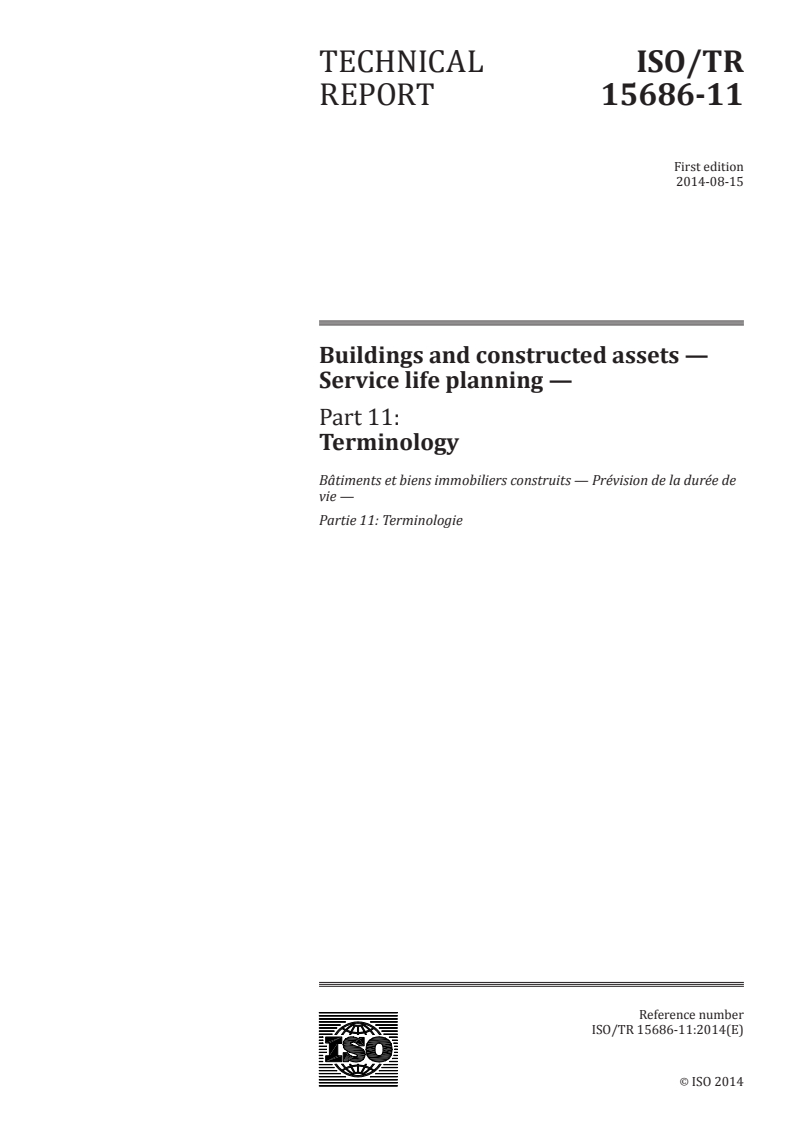
TECHNICAL ISO/TR
REPORT 15686-11
First edition
2014-08-15
Buildings and constructed assets —
Service life planning —
Part 11:
Terminology
Bâtiments et biens immobiliers construits — Prévision de la durée de
vie —
Partie 11: Terminologie
Reference number
©
ISO 2014
© ISO 2014
All rights reserved. Unless otherwise specified, no part of this publication may be reproduced or utilized otherwise in any form
or by any means, electronic or mechanical, including photocopying, or posting on the internet or an intranet, without prior
written permission. Permission can be requested from either ISO at the address below or ISO’s member body in the country of
the requester.
ISO copyright office
Case postale 56 • CH-1211 Geneva 20
Tel. + 41 22 749 01 11
Fax + 41 22 749 09 47
E-mail copyright@iso.org
Web www.iso.org
Published in Switzerland
ii © ISO 2014 – All rights reserved
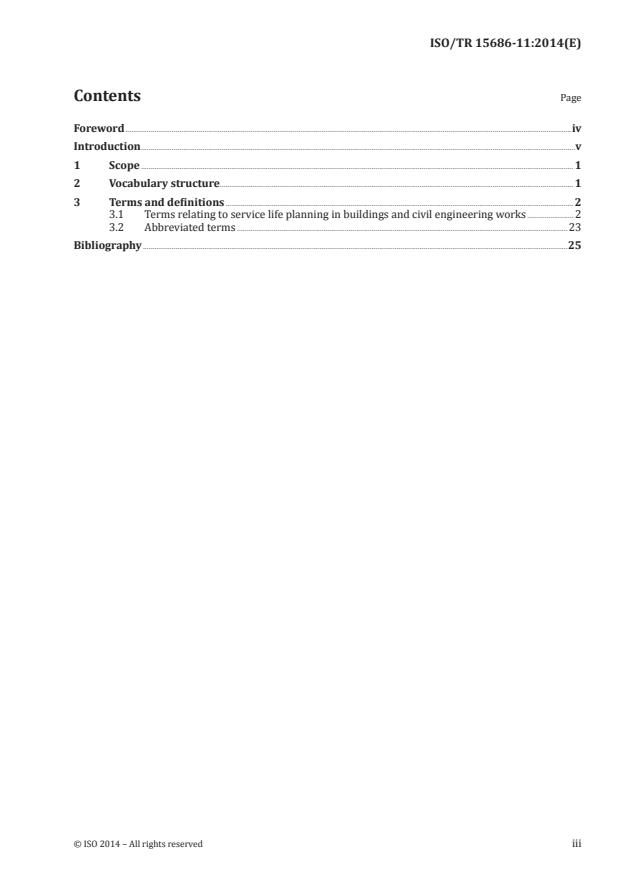
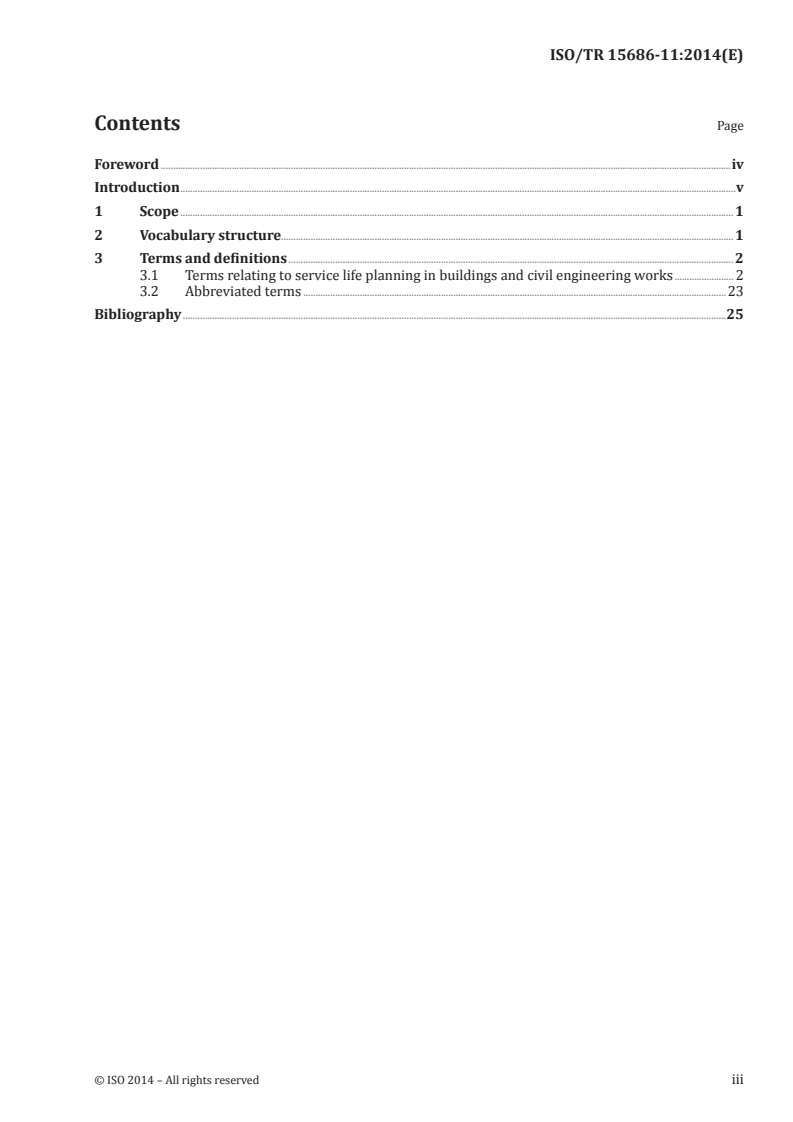
Contents Page
Foreword .iv
Introduction .v
1 Scope . 1
2 Vocabulary structure. 1
3 Terms and definitions . 2
3.1 Terms relating to service life planning in buildings and civil engineering works . 2
3.2 Abbreviated terms .23
Bibliography .25
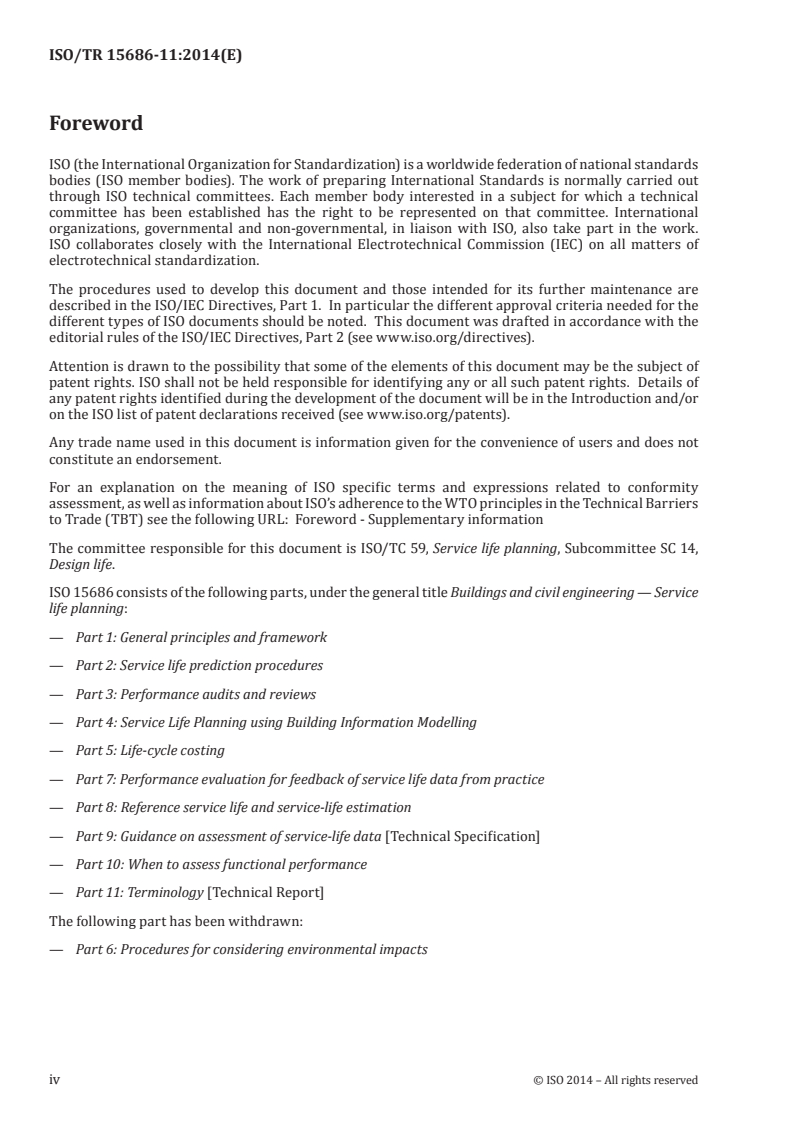
Foreword
ISO (the International Organization for Standardization) is a worldwide federation of national standards
bodies (ISO member bodies). The work of preparing International Standards is normally carried out
through ISO technical committees. Each member body interested in a subject for which a technical
committee has been established has the right to be represented on that committee. International
organizations, governmental and non-governmental, in liaison with ISO, also take part in the work.
ISO collaborates closely with the International Electrotechnical Commission (IEC) on all matters of
electrotechnical standardization.
The procedures used to develop this document and those intended for its further maintenance are
described in the ISO/IEC Directives, Part 1. In particular the different approval criteria needed for the
different types of ISO documents should be noted. This document was drafted in accordance with the
editorial rules of the ISO/IEC Directives, Part 2 (see www.iso.org/directives).
Attention is drawn to the possibility that some of the elements of this document may be the subject of
patent rights. ISO shall not be held responsible for identifying any or all such patent rights. Details of
any patent rights identified during the development of the document will be in the Introduction and/or
on the ISO list of patent declarations received (see www.iso.org/patents).
Any trade name used in this document is information given for the convenience of users and does not
constitute an endorsement.
For an explanation on the meaning of ISO specific terms and expressions related to conformity
assessment, as well as information about ISO’s adherence to the WTO principles in the Technical Barriers
to Trade (TBT) see the following URL: Foreword - Supplementary information
The committee responsible for this document is ISO/TC 59, Service life planning, Subcommittee SC 14,
Design life.
ISO 15686 consists of the following parts, under the general title Buildings and civil engineering — Service
life planning:
— Part 1: General principles and framework
— Part 2: Service life prediction procedures
— Part 3: Performance audits and reviews
— Part 4: Service Life Planning using Building Information Modelling
— Part 5: Life-cycle costing
— Part 7: Performance evaluation for feedback of service life data from practice
— Part 8: Reference service life and service-life estimation
— Part 9: Guidance on assessment of service-life data [Technical Specification]
— Part 10: When to assess functional performance
— Part 11: Terminology [Technical Report]
The following part has been withdrawn:
— Part 6: Procedures for considering environmental impacts
iv © ISO 2014 – All rights reserved
Introduction
Concern has been expressed for many years over the lack of a comprehensive list of the terms and
definitions for the different concepts applied within the ISO 15686 series of standards regarding design
life and service life planning for buildings and civil engineering works.
This Technical Report is the result of the terminography and other terminology work that was undertaken
within ISO/TC 59/SC 14 on Design life to establish consistent terminology for concepts related to the
subject field of service life planning in buildings and civil engineering works.
The first edition of Part 1 of ISO 15686 was published in 2000, followed by Part 2 in 2001 and Part 3 in
2002. The publication of other parts followed in subsequent years, with the most recent new part, Part
10, being published in 2010. Revisions of the original parts started in 2009 and both Part 1 and Part
2 were republished in 2011 and 2012, respectively. These recent updates, along with the addition of
several new parts over the past five years have led to some of the concepts being applied with more than
one definition, which is leading to some confusion.
NOTE 1 ISO 1087-1, Terminology work — Vocabulary — Part 1: Theory and application, defines the concepts of
terminology, terminology work and terminography as follows:
terminology
set of designations belonging to one special language
terminology work
work concerned with the systematic collection, description, processing and presentation of concepts and their
designations
terminography
part of terminology work concerned with the recording and presentation of terminological data
NOTE 2 The work items undertaken on different subjects of standardization related to service life planning
within ISO/TC 59/SC 14 and its working groups include both buildings and civil engineering works, collectively
referred to using the designation construction works.
In 2005, a joint ISO/TC 59 meeting was held with members of a number of ISO/TC 59 SCs to discuss
the common concerns and issues related to the preparation and use of terminology within a number
of ISO/TC 59 Subcommittees. This included individuals also involved in the parallel standardization
and terminology work going on within the European Committee for Standardization (CEN), under the
technical committee CEN/TC 350 on Sustainability of Construction Works (Formerly CEN BT/WG174
Integrated Environmental Performance of Buildings). In addition to the CEN/TC 350 representation, the
ISO/TC 59 subcommittees represented at the joint meeting were SC 2 – Terminology and harmonization
of languages; SC 14 – Design life; SC 15 – Performance criteria for single family attached and detached
dwellings; and SC 17 – Sustainability in buildings and civil engineering works (formerly Sustainability in
building construction).
Subsequent to this joint meeting, an ISO/TC 59 Ad hoc Group (AHG) on Terminology was established. The
AHG was directed to maintain close liaison on any terminology work occurring across the participating
committees and to work to help resolve different terminology requirements within the different
Subcommittees of ISO/TC 59 and CEN/TC 350. Also, it was acknowledged and agreed that the main
terminology document on general concepts regarding buildings and civil engineering works, ISO 6707-1,
which was developed by ISO/TC 59/SC2, would be used as the primary reference vocabulary for any of
the work on terminology undertaken within all the Committees.
Individual representatives from the ISO/TC 59 Subcommittees (SC 2, SC 14, SC 15, SC 17) and the CEN/TC
350 committee were identified as members of the AHG to provide input and act as liaison on behalf
of the various committees. A database of terms and definitions was developed as an initial working
document, which was based on information submitted from the four ISO/TC 59 SCs involved as well
as from the CEN/TC 350. The working list of terms and definitions generally included a mix of both
standardized ISO terms and definitions, as well as definitions that were contained in working drafts
within the various Committees. A number of the AHG experts were involved with more than one of
the targeted committees, which proved to be extremely beneficial, as it provided continuity within the
discussions from meeting to meeting and committee to committee.
The database of terms and definitions developed by SC 14 on design life and service life planning was
submitted to the AHG on terminology in September, 2006. To ensure that proper terminology (terms
and definitions) are clearly delineated and understood for the concepts applied within both the existing
and new Parts of ISO 15686, at the 2007 SC14 plenary meeting, a resolution was passed that SC14 work
to develop a Technical Specification on service life planning terminology. The intent was that the TS
would be used as a normative reference for the various parts of ISO 15686. In 2011, it was agreed that
the document would instead take the form of a Technical Report.
As part of ISO 15686, this Technical Report compiles a complete set of the specific terms and
definitions of concepts that have been applied and standardized in the documents developed to date
under ISO/TC 59/SC 14 related to design life and service life planning in buildings and other types of
construction works.
This Technical Report presents a mix of terms and definitions, some of which are repeated from other
ISO publications.
The compilation of terms and definitions, and related abbreviations, included in Clause 3 of this Technical
Report are for concepts that have been standardized and/or applied through publication of individual
parts of ISO 15686 within ISO/TC 59/SC 14.
The gradual evolution of all of these concepts inevitably means that the “service life planning in
buildings and civil engineering works” terminology will continue to develop and that therefore this
document might be subject to regular revision and updating. As a resumé of terms and definitions
in this domain, this Technical Report provides a resource for any future standardization in a general
vocabulary. It is expected that the information contained within this Technical Report might be given
further consideration within ISO/TC 59 SC 2 on Terminology and harmonization of languages for
possible inclusion in a part of the ISO 6707 series.
vi © ISO 2014 – All rights reserved
TECHNICAL REPORT ISO/TR 15686-11:2014(E)
Buildings and constructed assets — Service life planning —
Part 11:
Terminology
1 Scope
This Technical Report provides a compilation of the terms and definitions of concepts that have been
standardized to establish a vocabulary applicable to the aspects of both the construction and use of a
building or civil engineering works and the service life planning of the same, as applied in the documents
of ISO/TC 59/SC 14 Design life.
This Technical Report consists of terms and definitions included in the different parts of ISO 15686,
along with their abbreviated designations, where applicable.
The terms and definitions of concepts listed in Clause 3, along with any relevant abbreviated designations,
include those representing concepts that have been standardized and/or applied within SC 14, as well
as a number of others that have originally been developed elsewhere within the ISO technical structure.
A cross reference is included in each of the definitions to the specific part of ISO 15686 in which the
concept is defined, as well as to the International Standard (s) from where the definition originates,
unless otherwise noted.
2 Vocabulary structure
The terms are generally presented alphabetically except that, in some cases, they are arranged and
numbered within generic relations to allow ready comparison of related concepts. Where a given term
designates more than one concept, each concept has been treated in a separate entry.
As recommended in ISO 10241-1, in a definition, example or note, reference to another listed entry
(concept) is highlighted in italics and followed by the entry number in brackets, when it is first mentioned.
In the case of those terms and definitions for concepts that originate from other referenced sources
and are specifically listed within Clause 3, the entry numbers cross-referenced coincide with the term
entries in this document and not the source document. In the case of cross-referencing those terms
and definitions for concepts that originate from other referenced sources, but are not specifically listed
within Clause 3, both the source document and related entry numbers within that source are cross-
referenced.
NOTE 1 With the mixed structure used in Clause 3, the term-entry numbering does not exactly follow the
format recommended in the ISO/IEC Directives, Part 2 or ISO 10241-1.
NOTE 2 Cross-references within the terminological data in Clause 3 to terms and definitions contained in
other referenced ISO documents is in addition to any references shown in the original ISO/TC 59/SC 14 documents
and follows the format recommended ISO 10241-1:2011, 6.4.7.(b) regarding references to terms and symbols in
definitions.
A term following the preferred term not given in boldface type is a non-preferred synonym.
For general terms and definitions related to buildings and civil engineering works, reference should also
be made to ISO 6707-1.
For general terms and definitions related to environmental management systems and life cycle
assessment, reference should also be made to the ISO 14050.
NOTE 3 The terminological entries are loaded on ISO’s Online Browsing Platform (https://www.iso.org/obp/
ui/). Search for 15686-11 and click on Terms and definitions to find the terms. Sort by term to find the terms in
alphabetical order.
3 Terms and definitions
3.1 Terms relating to service life planning in buildings and civil engineering works
3.1.1
accelerated short-term exposure
short-term exposure (3.1.119) in which the agent intensity (3.1.6) is raised above the levels expected in
service
[SOURCE: ISO 15686-2:2012, 3.1.1]
3.1.2
acquisition cost
all costs included in acquiring an asset (3.1.7.1)(3.1.7.2) by purchase/lease or construction procurement
(ISO 10845-1:2010, 3.30) route, excluding costs during the occupation and use or end-of-life phases of
the life cycle (3.1.60) of the constructed asset (3.1.15)
[SOURCE: ISO 15686-5:2008, 3.1.1]
3.1.3
ageing
degradation (3.1.17) due to long term influence of agents (3.1.5) related to use
[SOURCE: ISO 15686-2:2012, 3.1.2]
3.1.4
ageing exposure
procedure in which a product (ISO 6707-1:2014, 6.1.2)(3.1.92) is exposed to agents (3.1.5) believed or
known to cause ageing (3.1.3) for the purpose of undertaking/initiating a service life prediction (3.1.117)
or comparison of relative performance (3.1.78.1)(3.1.78.2)
[SOURCE: ISO 15686-2:2012, 3.1.3]
3.1.5
agent
whatever acts on a building (ISO 6707-1:2014, 3.1.3)(3.1.10) or its parts to adversely affect its performance
(3.1.78.1)(3.1.78.2)
EXAMPLE Person, water load, heat.
[SOURCE: ISO 15686-2:2012, 3.1.4]
3.1.6
agent intensity
measure (ISO 6707-1:2014, 9.1.7) of the extent to or level at which an agent (3.1.5) is present
Note 1 to entry: In ISO 15686-2, the term “agent intensity” refers figuratively to any quantity that conforms to the
requirements for a measure; i.e. not only to UV radiation and rain intensity, etc., but also to relative humidity, SO
concentration, freeze–thaw rate and mechanical pressure, etc.
[SOURCE: ISO 15686-2:2012, 3.1.5]
2 © ISO 2014 – All rights reserved
3.1.7.1
asset
whole building (ISO 6707-1:2014, 3.1.3)(3.1.10) or structure (ISO 6707-1:2014, 3.1.4), system or a
component (3.1.13) or part
[SOURCE: ISO 15686-5:2008, 3.4.1]
3.1.7.2
asset
whole building (ISO 6707-1:2014, 3.1.3)(3.1.10), structure (ISO 6707-1:2014, 3.1.4) or unit of construction
works (ISO 6707-1:2014, 3.1.1), or a system or component (3.1.13) or part thereof
[SOURCE: ISO 15686-10:2010, 3.1]
3.1.8
availability
period(s) during which a facility (3.1.37) or service is serviceable
[SOURCE: ISO 15686-3:2002, 4.11]
3.1.9
behaviour in service
how a whole building (ISO 6707-1:2014, 3.1.3)(3.1.10), structure (ISO 6707-1:2014, 3.1.4) or unit of
construction works (ISO 6707-1:2014, 3.1.1), or a system or component (3.1.13) or part thereof actually
functions in its intended place and use
[SOURCE: ISO 15686-10:2010, 3.2]
3.1.10
building
construction works (ISO 6707-1:2014, 3.1.1) that has the provision of shelter for its occupants or contents
as one of its main purposes and is usually enclosed and designed to stand permanently in one place
[SOURCE: ISO 15686-1:2011, 3.1]
3.1.11
capital cost
initial construction costs (ISO 6707-1:2014, 9.3.85) and the costs of initial adaptation where these are
treated as capital expenditure
Note 1 to entry: The capital cost may be identical to the acquisition cost (3.1.2) if initial adaptation costs are not
included.
[SOURCE: ISO 15686-5:2008, 3.1.2]
3.1.12
client
person or organization responsible for initiating and financing a project, and approving
the brief
Note 1 to entry: Adapted from ISO 6707-1:2014, definition 8.3.
Note 2 to entry: In some countries, the role and qualification of “construction client” is defined by law and
[43]
regulation, according to the scope and complexity of a project (see Reference ).
[SOURCE: ISO 15686-10:2010, 3.3]
3.1.13
component
product (ISO 6707-1:2014, 6.1.2) manufactured as a distinct unit to serve a specific function (3.1.43) or
functions
[SOURCE: ISO 6707-1:2014, 6.1.3]
3.1.14
consequence degree
expression of the seriousness of consequences in relation to a defined reference level
[SOURCE: ISO 15686-7:2006, 3.1]
3.1.15
constructed asset
anything of value that is constructed or results from construction operations
[SOURCE: ISO 15686-1:2011, 3.2]
3.1.16
data record
set of reference service life data (3.1.102.1)(3.1.102.2)(3.1.102.3) compiled into a prescribed format
[SOURCE: ISO 15686-8:2008, 3.1]
3.1.17
degradation
process whereby an action on an item causes a deterioration of one or more properties (ISO 6707-1:2014,
9.1.3)
Note 1 to entry: Properties affected may/can be, for example, physical, mechanical or electrical.
[SOURCE: ISO 15686-8:2008, 3.4]
3.1.18
degradation indicator
deficiency which shows when a performance characteristic (3.1.80.1)(3.1.80.2) fails to conform to a
requirement
EXAMPLE When gloss is a performance characteristic, gloss loss is the corresponding degradation indicator.
When mass (or thickness) is a performance characteristic, mass loss is the corresponding degradation indicator.
[SOURCE: ISO 15686-2:2012, 3.1.8]
3.1.19
demand
requirement for functional performance (3.1.44)
[SOURCE: ISO 15686-10:2010, 3.5]
3.1.20
design life
DL
DEPRECATED: intended service life
DEPRECATED: expected service life
service life (3.1.113.1)(3.1.113.2) intended by the designer
Note 1 to entry: As stated by the designer to the client (3.1.12) to support specification decisions.
[SOURCE: ISO 15686-1:2011, 3.3]
3.1.21
design option
one of several product (ISO 6707-1:2014, 6.1.2)(3.1.92) alternatives that is a candidate for inclusion into
the design, including functionality (3.1.46) and service provided
[SOURCE: ISO 15686-6:2004, 3.2]
4 © ISO 2014 – All rights reserved
3.2.22
design team
individuals involved in the decision-making process affecting the service life (3.1.113.1)(3.1.113.2) of the
constructed asset (3.1.15)
[SOURCE: ISO 15686-6:2004, 3.3]
3.1.23
detailed design
drawings (ISO 6707-1:2014, 7.2.10), data, calculations and specifications from which constructed works,
components (3.1.13) and assemblies (ISO 6707-1:2014, 5.5.5) can be constructed
[SOURCE: ISO 15686-3:2002, 4.5]
3.1.24
discount rate
factor or rate reflecting the time value of money (3.1.127) that is used to convert cash flows occurring at
different times to a common time
Note 1 to entry: This can be used to convert future values to present-day values and vice versa.
[SOURCE: ISO 15686-5:2008, 3.3.1]
3.1.25
discounted cost
resulting cost when the real cost (3.1.96) is discounted by the real discount rate (3.1.97) or when the
nominal cost (3.1.71) is discounted by the nominal discount rate (3.1.72)
[SOURCE: ISO 15686-5:2008, 3.1.3]
3.1.26.1
disposal
transfer of ownership of, or responsibility for, the object of consideration
[SOURCE: ISO 15686-10:2010, 3.6]
3.1.26.2
disposal
transformation of the state of a building (ISO 6707-1:2014, 3.1.3)(3.1.10) or facility (3.1.37)
that is no longer of use
Note 1 to entry: Transformation can include, either individually or in some combination, the decommissioning,
deconstruction, recycling and demolition of the object of consideration.
[SOURCE: ISO 15686-10:2010, 3.7]
3.1.27
disposal cost
costs associated with disposal (3.1.26.1)(3.1.26.2) of the asset (3.1.7.1)(3.1.7.2) at the end of its life cycle
(3.1.60), including taking account of any asset transfer obligations
Note 1 to entry: Asset transfer obligations could include bringing the assets up to a predefined condition.
Note 2 to entry: Income from selling the asset is part of WLC (3.1.133), where the residual value (3.1.109) of the
building components (3.1.13), materials (ISO 6707-1:2014, 6.1.1) and appliances can be included.
[SOURCE: ISO 15686-5:2008, 3.1.4]
3.1.28
dose-response function
function that relates the dose(s) of a degradation (3.1.17)agent (3.1.5) to a degradation indicator (3.1.18)
[SOURCE: ISO 15686-2:2012, 3.1.9]
3.1.29
end-of-life cost
net cost or fee for disposing of an asset (3.1.7.1)(3.1.7.2) at the end of its service life (3.1.113.1)(3.1.113.2)
or interest period, including costs resulting from decommissioning, deconstruction and demolition of
a building (ISO 6707-1:2014, 3.1.3)(3.1.10), recycling, making environmentally safe and recovery and
disposal (3.1.26.2) of components (3.1.13) and materials (ISO 6707-1:2014, 6.1.1), and transport and
regulatory costs
[SOURCE: ISO 15686-5:2008, 3.1.5]
3.1.30
environment
natural, man-made or induced external and internal conditions that may influence performance (3.1.78.1)
(3.1.78.2) and use of a building (ISO 6707-1:2014, 3.1.3)(3.1.10) and its parts
[SOURCE: ISO 6707-1:2014, 10.3, modified — to also apply to internal conditions and to remove reference
to civil engineering works.]
3.1.31
environmental aspect
element of an organization’s (ISO 14050:2009, 3.4) activities or products (ISO 14050:2009, 6.2)(3.1.92) or
services that can interact with the environment (ISO 14050:2009, 3.1)(3.1.30)
[SOURCE: ISO 14001:2004, 3.6, modified — to remove the Note.]
3.1.32
environmental impact
any change to the environment (ISO 14050:2009, 3.1)(3.1.31), whether adverse or beneficial, wholly or
partially resulting from an organization’s (ISO 14050:2009, 3.4) environmental aspects (3.1.31)
[SOURCE: ISO 14001:2004, 3.7]
3.1.33
escalation rate
positive or negative factor or rate reflecting an estimate of differential increase/decrease in the general
price level for a particular commodity, or group of commodities, or resource
Note 1 to entry: An escalation rate is derived by tracking the change in price over time of a single commodity, or
group of commodities or resource, which might or might not be one of the items in the typical “basket” of goods
that is used to derive a general inflation/deflation (3.1.49) factor.
[SOURCE: ISO 15686-5:2008, 8, 3.3.2]
3.3.2
escalation rate
positive or negative factor or rate reflecting an estimate of differential
increase/decrease in the general price level for a particular commodity, or group of commodities, or resource
NOTE An escalation rate is derived by tracking the change in price over time of a single commodity,
group or commodities or resource, which might or might not be one of the items in the typical “basket”
of goods that is used to derive a general inflation/deflation factor.
3.1.34
estimated service life
ESL
service life (3.1.113.1)(3.1.113.2) that a building (ISO 6707-1:2014, 3.1.3)(3.1.10) or parts of a building
would be expected to have in a set of specific in-use conditions (3.1.53.1)(3.1.53.2)(3.1.53.3), determined
from the reference service life data (3.1.102.1)(3.1.102.2)(3.1.102.3) after taking into account any
differences from the reference in-use conditions (3.1.100)
[SOURCE: ISO 15686-1:2011, 3.7]
6 © ISO 2014 – All rights reserved
3.1.35
external costs
costs associated with an asset (3.1.7.1)(3.1.7.2) that are not necessarily reflected in the transaction costs
between provider and consumer and that, collectively, are referred to as externalities (3.1.36)
Note 1 to entry: These costs may include business staffing, productivity and user (3.1.131) costs; these can be
taken into account in a LCC (3.1.62) analysis but should be explicitly identified.
[SOURCE: ISO 15686-5:2008, 3.1.6]
3.1.36
externality
quantifiable cost or benefit that occurs when the actions of organizations and individuals have an effect
on people other than themselves
EXAMPLE Non-construction costs, income and wider social and business costs.
Note 1 to entry: Externalities are positive if their effects are benefits to other people and negative, or external
costs (3.1.35), if the external effects are costs on other people. There may be external costs and benefits from both
production and consumption. Adding the externality to the private cost/benefit, the total social cost or benefit.
[SOURCE: ISO 15686-5:2008, 3.4.2]
3.1.37
facility
physical setting used to serve a specific purpose
Note 1 to entry: A facility may be part of a building (ISO 6707-1:2014, 3.1.3)(3.1.10), a whole building or more than
one building, and may include related constructions (such as roads and walkways), which, taken as a whole, serve
a specific function (3.1.43).
Note 2 to entry: The term encompasses both the physical object(s) and its (their) use.
[SOURCE: ISO 15686-10:2010, 3.8]
3.1.38
factor category
category of in-use conditions (3.1.53.1)(3.1.53.2)(3.1.53.3) that are considered in the determination of an
ESL (3.1.34) from an RSL (3.1.101.1)(3.1.101.2)
EXAMPLE 1 Inherent performance level, design level, work execution level, indoor environment, outdoor
environment, usage conditions (3.1.130.2) and maintenance level.
EXAMPLE 2 In-use conditions, such as temperature and moisture level, can be considered under the factor
category, outdoor environment, in determining factor E.
Note 1 to entry: Factor categories are used in the factor method (3.1.40) to determine the factors A to G, and can
be applicable in a similar way in any feasible alternative method.
[SOURCE: ISO 15686-8:2008, 3.2]
3.1.39
factor class
label of an in-use condition (3.1.53.1)(3.1.53.2)(3.1.53.3) indicating which factor of the factor method
(3.1.40) the condition will influence
[SOURCE: ISO 15686-7:2006, 3.16]
3.1.40
factor method
modification of reference service life (3.1.101.1)(3.1.101.2) by factors to take account of the specific in-use
conditions (3.1.53.1)(3.1.53.2)(3.1.53.3)
[SOURCE: ISO 15686-1:2011, 3.8]
3.1.41
failure
loss of the ability of a building (ISO 6707-1:2014, 3.1.3)(3.1.10) or its parts to perform a specific function
(3.1.43)
[SOURCE: ISO 15686-1:2011, 3.9]
3.1.42
feature
element or attribute of a facility (3.1.37) that indicates an aspect of its serviceability (3.1.118.2)
[SOURCE: ISO 15686-10:2010, 3.9]
3.1.43
function
purpose or activity of users (3.1.131) and other stakeholders (3.1.120) for which an asset (3.1.7.1)(3.1.7.2)
or a facility (3.1.37) is designed, used, or required to be used
[SOURCE: ISO 15686-10:2010, 3.10]
3.1.44
functional performance
performance (3.1.78.1)(3.1.78.2) of a facility (3.1.37) to support required function(s)
(3.1.43) under specified use conditions
[SOURCE: ISO 15686-10:2010, 3.11]
3.1.45
functional performance requirement
type and level of functionality (3.1.56) that is required by stakeholders (3.1.120) of a facility (3.1.37), building
(ISO 6707-1:2014, 3.1.3)(3.1.10) or other constructed asset (3.1.15), or of an assembly (ISO 6707-1:2014,
5.5.5), component (3.1.13) or product (ISO 6707-1:2014, 6.1.2)(3.1.92) thereof, or a moveable asset (3.1.7.1)
(3.1.7.2) for a specific function (3.1.43)
[SOURCE: ISO 15686-10:2010, 3.12]
3.1.46
functionality
suitability (3.1.121) or usefulness for a specific purpose or activity
[SOURCE: ISO 15686-10:2010, 3.13]
3.1.47
gap
difference between the level of functionality (3.1.56) (or other attribute) that is required and the level of
serviceability (3.1.58) [capability (ISO 6707-1:2014, 9.1.11)] that is or will be provided
[SOURCE: ISO 15686-10:2010, 3.14]
3.1.48
general data
data of any format related to service life (3.1.113.1)(3.1.113.2) as opposed to reference service life data
(3.1.102.1)(3.1.102.2) (3.1.102.3)
[SOURCE: ISO 15686-8:2008, 3.3]
3.1.49
inflation/deflation
sustained increase/decrease in the general price level
Note 1 to entry: Inflation/deflation can be measured monthly, quarterly or annually against a known index.
8 © ISO 2014 – All rights reserved
[SOURCE: ISO 15686-5:2008, 3.3.3]
3.1.50
initial design
early stage in the development of a design before many of the materials (ISO 6707-1:2014, 6.1.1),
components (3.1.13) or assemblies (ISO 6707-1:2014, 5.5.5) have been selected
[SOURCE: ISO 15686-3:2002, 4.4]
3.1.51
inspection of buildings
performance evaluation (3.1.83) or assessment of residual service life (3.1.113.1)(3.1.113.2) of building
parts in existing buildings (ISO 6707-1:2014, 3.1.3)(3.1.10)
[SOURCE: ISO 15686-2:2012, 3.1.10]
3.1.52
intangible
quantifiable cost and benefit that have been allocated monetary values for calculation purposes
[SOURCE: ISO 15686-5:2008, 3.4.3]
3.1.53.1
in-use condition
any circumstance that can impact on the performance (3.1.78.1)(3.1.78.2) of a building (ISO 6707-1:2014,
3.1.3)(3.1.10) or a constructed asset (3.1.15), or a part thereof, under normal use
[SOURCE: ISO 15686-1:2011, 3.10]
3.1.53.2
in-use condition
any circumstance that contributes to or causes the degradation (3.1.17) of a building (ISO 6707-1:2014,
3.1.3)(3.1.10)/ constructed assets (3.1.15) or a part of it under normal use
Note 1 to entry: In order to encompass all of the seven factor classes (3.1.39) of the factor method (3.1.40), this
definition has been extended relative to that given in ISO 15686-2:2001, 3.3.5, thus being in accordance with
ISO 15686-1:2000, 3.1.2, where “in-use condition” is referred to as influencing any of the seven factors.
[SOURCE: ISO 15686-7:2006, 3.14]
3.1.53.3
in-use condition
any circumstance that can impact the performance (3.1.78.1)(3.1.78.2) of a building (ISO 6707-1:2014,
3.1.3)(3.1.10) or a constructed asset (3.1.15), or a part thereof under normal use
Note 1 to entry: In order to encompass all of the seven factors and their related factor categories (3.1.38), this
definition is an extended version of the definition given in ISO 15686-2:2001, 3.3.5, [thus being in accordance
with ISO 15686-1:2000, 3.1.2, where “in-use condition” is referred to as influencing any of the seven factors of the
factor method (3.1.40)].
[SOURCE: ISO 15686-8:2008, 3.5]
3.1.54.1
in-use condition grade
outcome of an in-use condition grading (3.1.55.1)(3.1.55.2)
[SOURCE: ISO 15686-7:2006, 3.18]
3.1.54.2
in-use condition grade
designation representing a qualitative description of an in-use condition (3.1.53.1)(3.1.53.2)(3.1.53.3)
Note 1 to entry: An in-use condition grade is the outcome of the in-use condition grading (3.1.55.1)(3.1.55.2).
Note 2 to entry: In-use condition grades are designated qualitatively in terms of not available, very high/very
mild, high/mild, normal, low/severe, very low/very severe and not applicable.
Note 3 to entry: In-use condition grades are designated numerically using numbers in the range from 0 to 5, with
3 representing a “normal” condition.
[SOURCE: ISO 15686-8:2008, 3.7]
3.1.55.1
in-use condition grading
act of collective judgement of all qualitative information of in-use conditions (3.1.53.1)(3.1.53.2)(3.1.53.3)
within a factor class (3.1.39)
[SOURCE: ISO 15686-7:2006, 3.17]
3.1.55.2
in-use condition grading
act of applying collective judgment of all qualitative information of an in-use condition (3.1.53.1)(3.1.53.2)
(3.1.53.3) within a factor category (3.1.38)
[SOURCE: ISO 15686-8:2008, 3.6]
3.1.56
level of functionality
number indicating the relative functionality (3.1.46) required for a user (3.1.131) group or customer for
one topic (3.1.128) on a predetermined demand scale (3.1.111.2) from the level of the least (functionality)
to the level of the most (functionality)
EXAMPLE Scale of integers from 0 to 9.
Note 1 to entry: The level of functionality may be the consequence of several distinct functions (3.1.43) required
to act in combination.
[SOURCE: ISO 15686-10:2010, 3.15]
3.1.57
level of performance
number indicating the relative performance (3.1.78.1)(3.1.78.2) required or provided for one topic
(3.1.128) on a predetermined scale (3.1.111.1) from the level of the least (performance) to the level of
the most (performance)
EXAMPLE Scale of integers from 0 to 9.
Note 1 to entry: The level of performance may be the consequence of several distinct performances [behaviours in
service (3.1.9)], of which one may be functional performance (3.1.44), which act in combination.
[SOURCE: ISO 15686-10:2010, 3.16]
3.1.58
level of serviceability
number indicating the relative serviceability (3.1.118.2) [capability (ISO 6707-1:2014, 9.1.11) of a facility
(3.1.37)] for a user (3.1.131) group or customer for one topic (3.1.128) on a predetermined supply scale
(3.1.111.3) from the level of least (serviceability) to the most (serviceability)
EXAMPLE Scale of integers from 0 to 9.
Note 1 to entry: The level of serviceability may be the consequence of several distinct physical features (3.1.42)
acting in combination.
[SOURCE: ISO 15686-10:2010, 3.17]
10 © ISO 2014 – All rights reserved
3.1.59
life care
measures that promote achievement of the design life (3.1.20), including cleaning, maintenance (3.1.65),
servicing, repair (3.1.107), refurbishment (3.1.103), protection (ISO 6707-1:2014, 9.3.86), control of use
and avoidance of neglect
[SOURCE: ISO 15686-3:2002, 4.6]
3.1.60
life cycle
consecutive and interlinked stages of the object under consideration
Note 1 to entry: The life cycle comprises all stages from construction, operation and maintenance (3.1.65) to end
of life, including decommissioning, deconstruction and disposal (3.1.26.2).
Note 2 to entry: Adapted from the definition of “life cycle” contained in ISO 14040, 7.1.
[SOURCE: ISO 15686-5:2008, 3.3.4]
3.1.61
life cycle assessment
LCA
method of measuring and evaluating the environmental impacts (3.1.32) associated with a product
(ISO 14050:2009, 6.2)(ISO 6707-1:2014, 6.1.2)(3.1.92), system or activity, by describing and assessing
the energy and materials (ISO 6707-1:2014, 6.1.1) used and released to the environment (ISO 14050:2009,
3.1)(3.1.30) over the life cycle (3.1.60)
[SOURCE: ISO 15686-5:2008, 3.2.1]
3.1.62
life-cycle cost
LCC
cost of an asset (3.1.7.1)(3.1.7.2) or its parts throughout its life cycle (3.1.60), while fulfilling the
performance requirements (ISO 6707-1:2014, 9.1.16)(3.1.85.2)
[SOURCE: ISO 15686-5:2008, 3.1.7]
3.1.63.1
life-cycle costing
methodology for systematic economic evaluation of life-cycle costs (3.1.62) over a period of analysis
(3.1.87), as defined in the agreed scope
Note 1 to entry: Life-cycle costing can address a period of analysis that covers the entire life cycle (3.1.60) or (a)
selected stage(s) or (b) periods of interest thereof.
[SOURCE: ISO 15686-5:2008, 3.1.8]
3.1.63.2
life-cycle costing
methodology for systematic economic evaluation of life-cycle costs (3.1.62) over a period of analysis
(3.1.87), as defined in the agreed scope
[SOURCE: ISO 15686-5:2008, 3.1.8, modified — to remove the Note.]
3.1.64
long-term exposure
ageing exposure (3.1.4) under in-use conditions (3.1.53.1)(3.1.53.2)(3.1.53.3) and with a duration of the
same order as the service life (3.1.113.1)(3.1.113.2) anticipated
[SOURCE: ISO 15686-2:2012, 3.1.12]
3.1.65
maintenance
combination of all technical and associated administrative actions during the service life (3.1.113.1)
(3.1.113.2) to retain a building, or its parts, in a state in which it can perform its required functions
(3.1.43)
[SOURCE: ISO 6707-1:2014, 7.1.41, modified — to also apply in the broad context of the service life of a
whole building.]
3.1.66
maintenance cost
total of necessarily incurred labour, material (ISO 6707-1:2014, 6.1.1) and other related costs
(ISO 6707-1:2014, 9.3.85) incurred to retain a building (ISO 6707-1:2014, 3.1.3)(3.1.10) or its parts in a
state in which it can perform its required functions (3.1.43)
Note 1 to entry: Maintenance (3.1.65) includes conducting corrective, responsive and preventative maintenance
on constructed assets (3.1.15), or their parts, and includes all associated management, cleaning, servicing,
repainting, repairing (3.1.107) and replacing of parts where needed to allow the constructed asset to be used for
its intended purposes.
[SOURCE: ISO 15686-5:2008, 3.1.9]
3.1.67
mechanism
process causing change over time in the composition or micro-structure of a component (3.1.13) or
material (ISO 6707-1:2014, 6.1.1) that can cause degradation (3.1.17)
[SOURCE: ISO 15686-2:2012, 3.1.13]
3.1.68
net present cost
NPC
sum of the discounted future costs
[SOURCE: ISO 15686-5:2008, 3.2.3]
3.1.69
net present value
NPV
sum of the discounted future cash flows
Note 1 to entry: Where only costs are included, this may be termed net present cost (3.1.68)
Note 2 to entry: This is the standard criterion for deciding whether an option can be justified on economic
principles, but other techniques are also used.
[SOURCE: ISO 15686-5:2008, 3.2.2]
3.1.70
network level
stock of objects [ facilities (3.1.37), e.g. bridges (ISO 6707-1:2014, 3.3.19), tunnels (ISO 6707-1:2014,
3.3.18), power plants, buildings (ISO 6707-1:2014, 3.1.3)(3.1.10)] under management of an owner
[SOURCE: ISO 15686-7:2006, 3.2]
3.1.71
nominal cost
expected price that will be paid when a cost is due to be paid, including estimated changes in price due
to, for example, forecast change in efficiency, inflation (3.1.49) or deflation (3.1.49) and technology
[SOURCE: ISO 15686-5:2008, 3.1.10]
12 © ISO 2014 – All rights reserved
3.1.72
nominal discount rate
factor or rate used to relate present and future money values in comparable terms taking into account
the general inflation/deflation (3.1.49) rate
[SOURCE: ISO 15686-5:2008, 3.3.5]
3.1.73
nonconformity
non-fulfilment of specified requirements
[SOURCE: ISO 15686-3:2002, 4.12]
3.1.74
object level
basic level of the network serving a specific function (3.1.43)
[SOURCE: ISO 15686-7:2006, 3.3]
3.1.75
observation
statement of fact made during an audit (3.1.114) or review (3.1.115) and substantiated by objective
evidence
[SOURCE: ISO 15686-3:2002, 4.13]
3.1.76.1
obsolescence
loss of ability of an item to perform satisfactorily due to changes in performance requirements
(ISO 6707-1:2014, 9.1.16)(3.1.85.1)
[SOURCE: ISO 15686-1:2011, 3.14]
3.1.76.2
obsolescence
inability of a facility (3.1.37) or component (3.1.13) thereof to perform satisfactorily due to
changes in performance requirements (ISO 6707-1:2014, 9.1.16)(3.1.85.2)
[SOURCE: ISO 15686-10:2010, 3.18]
3.1.77
operation cost
costs incurred in running and managing the facility (3.1.37) or built environment (ISO 15392:2008, 3.5),
including administrative support services
Note 1 to entry: Operation costs could include rent, rates, insurances, energy and other environmental/ regulatory
inspection costs, local fees and charges.
[SOURCE: ISO 15686-5:2008, 3.1.11]
3.1.78.1
performance
performance in-use
qualitative level of a critical property (ISO 6707-1:2014, 9.1.3) at any point in time considered
[SOURCE: ISO 15686-1:2011, 3.15]
3.1.78.2
performance
behaviour in service (3.1.9) of a facility (3.1.37) for a specified use
Note 1 to entry: The scope of this performance is of the facility as a system, including its subsystems, components
(3.1.13) and materials (ISO 6707-1:2014, 6.1.1), and their interactions, such as acoustical, hygrothermal, economic
and so on, as well as the relative importance (3.1.104) of each performance requirement (ISO 6707-1:2014, 9.1.16)
(3.1.85.2).
[SOURCE: ISO 15686-10:2010, 3.19]
3.1.79
performance assessment
all material that accounts for an item’s performance (3.1.78.1)(3.1.78.2) throughout its service life
(3.1.113.1)(3.1.113.2)
[SOURCE: ISO 15686-7:2006, 3.5]
3.1.80.1
performance characteristic
physical quantity that is related to a critical property (ISO 6707-1:2014, 9.1.3)
Note 1 to entry: In some cases, the performance characteristic can be the same as the critical property, e.g. gloss.
On the other hand, if the critical property is strength, for instance, thickness (ISO 6707-1:2014, 9.2.24) or mass can
be utilized as a performance characteristic, working as an indirect measure (ISO 6707-1:2014, 9.1.7) of strength.
[SOURCE: ISO 15686-1:2011, 3.16]
3.1.80.2
performance characteristic
physical quantity that is a measure (ISO 6707-1:2014, 9.1.7) of a critical property (ISO 6707-1:2014, 9.1.3)
EXAMPLE A performance characteristic can be the same as the critical property, for instance reflectance. On
the other hand, if the critical property is strength, the thickness (ISO 6707-1:2014, 9.2.24) or mass can in certain
cases be utilized as a performance characteristic.
[SOURCE: ISO 15686-2:2012, 3.1.14]
3.1.81
performance control
comparison between performance (3.1.78.1)(3.1.78.2) and defined requirem
...
TECHNICAL ISO/TR
REPORT 15686-11
First edition
2014-08-15
Buildings and constructed assets —
Service life planning —
Part 11:
Terminology
Bâtiments et biens immobiliers construits — Prévision de la durée de
vie —
Partie 11: Terminologie
Reference number
©
ISO 2014
© ISO 2014
All rights reserved. Unless otherwise specified, no part of this publication may be reproduced or utilized otherwise in any form
or by any means, electronic or mechanical, including photocopying, or posting on the internet or an intranet, without prior
written permission. Permission can be requested from either ISO at the address below or ISO’s member body in the country of
the requester.
ISO copyright office
Case postale 56 • CH-1211 Geneva 20
Tel. + 41 22 749 01 11
Fax + 41 22 749 09 47
E-mail copyright@iso.org
Web www.iso.org
Published in Switzerland
ii © ISO 2014 – All rights reserved
Contents Page
Foreword .iv
Introduction .v
1 Scope . 1
2 Vocabulary structure. 1
3 Terms and definitions . 2
3.1 Terms relating to service life planning in buildings and civil engineering works . 2
3.2 Abbreviated terms .23
Bibliography .25
Foreword
ISO (the International Organization for Standardization) is a worldwide federation of national standards
bodies (ISO member bodies). The work of preparing International Standards is normally carried out
through ISO technical committees. Each member body interested in a subject for which a technical
committee has been established has the right to be represented on that committee. International
organizations, governmental and non-governmental, in liaison with ISO, also take part in the work.
ISO collaborates closely with the International Electrotechnical Commission (IEC) on all matters of
electrotechnical standardization.
The procedures used to develop this document and those intended for its further maintenance are
described in the ISO/IEC Directives, Part 1. In particular the different approval criteria needed for the
different types of ISO documents should be noted. This document was drafted in accordance with the
editorial rules of the ISO/IEC Directives, Part 2 (see www.iso.org/directives).
Attention is drawn to the possibility that some of the elements of this document may be the subject of
patent rights. ISO shall not be held responsible for identifying any or all such patent rights. Details of
any patent rights identified during the development of the document will be in the Introduction and/or
on the ISO list of patent declarations received (see www.iso.org/patents).
Any trade name used in this document is information given for the convenience of users and does not
constitute an endorsement.
For an explanation on the meaning of ISO specific terms and expressions related to conformity
assessment, as well as information about ISO’s adherence to the WTO principles in the Technical Barriers
to Trade (TBT) see the following URL: Foreword - Supplementary information
The committee responsible for this document is ISO/TC 59, Service life planning, Subcommittee SC 14,
Design life.
ISO 15686 consists of the following parts, under the general title Buildings and civil engineering — Service
life planning:
— Part 1: General principles and framework
— Part 2: Service life prediction procedures
— Part 3: Performance audits and reviews
— Part 4: Service Life Planning using Building Information Modelling
— Part 5: Life-cycle costing
— Part 7: Performance evaluation for feedback of service life data from practice
— Part 8: Reference service life and service-life estimation
— Part 9: Guidance on assessment of service-life data [Technical Specification]
— Part 10: When to assess functional performance
— Part 11: Terminology [Technical Report]
The following part has been withdrawn:
— Part 6: Procedures for considering environmental impacts
iv © ISO 2014 – All rights reserved
Introduction
Concern has been expressed for many years over the lack of a comprehensive list of the terms and
definitions for the different concepts applied within the ISO 15686 series of standards regarding design
life and service life planning for buildings and civil engineering works.
This Technical Report is the result of the terminography and other terminology work that was undertaken
within ISO/TC 59/SC 14 on Design life to establish consistent terminology for concepts related to the
subject field of service life planning in buildings and civil engineering works.
The first edition of Part 1 of ISO 15686 was published in 2000, followed by Part 2 in 2001 and Part 3 in
2002. The publication of other parts followed in subsequent years, with the most recent new part, Part
10, being published in 2010. Revisions of the original parts started in 2009 and both Part 1 and Part
2 were republished in 2011 and 2012, respectively. These recent updates, along with the addition of
several new parts over the past five years have led to some of the concepts being applied with more than
one definition, which is leading to some confusion.
NOTE 1 ISO 1087-1, Terminology work — Vocabulary — Part 1: Theory and application, defines the concepts of
terminology, terminology work and terminography as follows:
terminology
set of designations belonging to one special language
terminology work
work concerned with the systematic collection, description, processing and presentation of concepts and their
designations
terminography
part of terminology work concerned with the recording and presentation of terminological data
NOTE 2 The work items undertaken on different subjects of standardization related to service life planning
within ISO/TC 59/SC 14 and its working groups include both buildings and civil engineering works, collectively
referred to using the designation construction works.
In 2005, a joint ISO/TC 59 meeting was held with members of a number of ISO/TC 59 SCs to discuss
the common concerns and issues related to the preparation and use of terminology within a number
of ISO/TC 59 Subcommittees. This included individuals also involved in the parallel standardization
and terminology work going on within the European Committee for Standardization (CEN), under the
technical committee CEN/TC 350 on Sustainability of Construction Works (Formerly CEN BT/WG174
Integrated Environmental Performance of Buildings). In addition to the CEN/TC 350 representation, the
ISO/TC 59 subcommittees represented at the joint meeting were SC 2 – Terminology and harmonization
of languages; SC 14 – Design life; SC 15 – Performance criteria for single family attached and detached
dwellings; and SC 17 – Sustainability in buildings and civil engineering works (formerly Sustainability in
building construction).
Subsequent to this joint meeting, an ISO/TC 59 Ad hoc Group (AHG) on Terminology was established. The
AHG was directed to maintain close liaison on any terminology work occurring across the participating
committees and to work to help resolve different terminology requirements within the different
Subcommittees of ISO/TC 59 and CEN/TC 350. Also, it was acknowledged and agreed that the main
terminology document on general concepts regarding buildings and civil engineering works, ISO 6707-1,
which was developed by ISO/TC 59/SC2, would be used as the primary reference vocabulary for any of
the work on terminology undertaken within all the Committees.
Individual representatives from the ISO/TC 59 Subcommittees (SC 2, SC 14, SC 15, SC 17) and the CEN/TC
350 committee were identified as members of the AHG to provide input and act as liaison on behalf
of the various committees. A database of terms and definitions was developed as an initial working
document, which was based on information submitted from the four ISO/TC 59 SCs involved as well
as from the CEN/TC 350. The working list of terms and definitions generally included a mix of both
standardized ISO terms and definitions, as well as definitions that were contained in working drafts
within the various Committees. A number of the AHG experts were involved with more than one of
the targeted committees, which proved to be extremely beneficial, as it provided continuity within the
discussions from meeting to meeting and committee to committee.
The database of terms and definitions developed by SC 14 on design life and service life planning was
submitted to the AHG on terminology in September, 2006. To ensure that proper terminology (terms
and definitions) are clearly delineated and understood for the concepts applied within both the existing
and new Parts of ISO 15686, at the 2007 SC14 plenary meeting, a resolution was passed that SC14 work
to develop a Technical Specification on service life planning terminology. The intent was that the TS
would be used as a normative reference for the various parts of ISO 15686. In 2011, it was agreed that
the document would instead take the form of a Technical Report.
As part of ISO 15686, this Technical Report compiles a complete set of the specific terms and
definitions of concepts that have been applied and standardized in the documents developed to date
under ISO/TC 59/SC 14 related to design life and service life planning in buildings and other types of
construction works.
This Technical Report presents a mix of terms and definitions, some of which are repeated from other
ISO publications.
The compilation of terms and definitions, and related abbreviations, included in Clause 3 of this Technical
Report are for concepts that have been standardized and/or applied through publication of individual
parts of ISO 15686 within ISO/TC 59/SC 14.
The gradual evolution of all of these concepts inevitably means that the “service life planning in
buildings and civil engineering works” terminology will continue to develop and that therefore this
document might be subject to regular revision and updating. As a resumé of terms and definitions
in this domain, this Technical Report provides a resource for any future standardization in a general
vocabulary. It is expected that the information contained within this Technical Report might be given
further consideration within ISO/TC 59 SC 2 on Terminology and harmonization of languages for
possible inclusion in a part of the ISO 6707 series.
vi © ISO 2014 – All rights reserved
TECHNICAL REPORT ISO/TR 15686-11:2014(E)
Buildings and constructed assets — Service life planning —
Part 11:
Terminology
1 Scope
This Technical Report provides a compilation of the terms and definitions of concepts that have been
standardized to establish a vocabulary applicable to the aspects of both the construction and use of a
building or civil engineering works and the service life planning of the same, as applied in the documents
of ISO/TC 59/SC 14 Design life.
This Technical Report consists of terms and definitions included in the different parts of ISO 15686,
along with their abbreviated designations, where applicable.
The terms and definitions of concepts listed in Clause 3, along with any relevant abbreviated designations,
include those representing concepts that have been standardized and/or applied within SC 14, as well
as a number of others that have originally been developed elsewhere within the ISO technical structure.
A cross reference is included in each of the definitions to the specific part of ISO 15686 in which the
concept is defined, as well as to the International Standard (s) from where the definition originates,
unless otherwise noted.
2 Vocabulary structure
The terms are generally presented alphabetically except that, in some cases, they are arranged and
numbered within generic relations to allow ready comparison of related concepts. Where a given term
designates more than one concept, each concept has been treated in a separate entry.
As recommended in ISO 10241-1, in a definition, example or note, reference to another listed entry
(concept) is highlighted in italics and followed by the entry number in brackets, when it is first mentioned.
In the case of those terms and definitions for concepts that originate from other referenced sources
and are specifically listed within Clause 3, the entry numbers cross-referenced coincide with the term
entries in this document and not the source document. In the case of cross-referencing those terms
and definitions for concepts that originate from other referenced sources, but are not specifically listed
within Clause 3, both the source document and related entry numbers within that source are cross-
referenced.
NOTE 1 With the mixed structure used in Clause 3, the term-entry numbering does not exactly follow the
format recommended in the ISO/IEC Directives, Part 2 or ISO 10241-1.
NOTE 2 Cross-references within the terminological data in Clause 3 to terms and definitions contained in
other referenced ISO documents is in addition to any references shown in the original ISO/TC 59/SC 14 documents
and follows the format recommended ISO 10241-1:2011, 6.4.7.(b) regarding references to terms and symbols in
definitions.
A term following the preferred term not given in boldface type is a non-preferred synonym.
For general terms and definitions related to buildings and civil engineering works, reference should also
be made to ISO 6707-1.
For general terms and definitions related to environmental management systems and life cycle
assessment, reference should also be made to the ISO 14050.
NOTE 3 The terminological entries are loaded on ISO’s Online Browsing Platform (https://www.iso.org/obp/
ui/). Search for 15686-11 and click on Terms and definitions to find the terms. Sort by term to find the terms in
alphabetical order.
3 Terms and definitions
3.1 Terms relating to service life planning in buildings and civil engineering works
3.1.1
accelerated short-term exposure
short-term exposure (3.1.119) in which the agent intensity (3.1.6) is raised above the levels expected in
service
[SOURCE: ISO 15686-2:2012, 3.1.1]
3.1.2
acquisition cost
all costs included in acquiring an asset (3.1.7.1)(3.1.7.2) by purchase/lease or construction procurement
(ISO 10845-1:2010, 3.30) route, excluding costs during the occupation and use or end-of-life phases of
the life cycle (3.1.60) of the constructed asset (3.1.15)
[SOURCE: ISO 15686-5:2008, 3.1.1]
3.1.3
ageing
degradation (3.1.17) due to long term influence of agents (3.1.5) related to use
[SOURCE: ISO 15686-2:2012, 3.1.2]
3.1.4
ageing exposure
procedure in which a product (ISO 6707-1:2014, 6.1.2)(3.1.92) is exposed to agents (3.1.5) believed or
known to cause ageing (3.1.3) for the purpose of undertaking/initiating a service life prediction (3.1.117)
or comparison of relative performance (3.1.78.1)(3.1.78.2)
[SOURCE: ISO 15686-2:2012, 3.1.3]
3.1.5
agent
whatever acts on a building (ISO 6707-1:2014, 3.1.3)(3.1.10) or its parts to adversely affect its performance
(3.1.78.1)(3.1.78.2)
EXAMPLE Person, water load, heat.
[SOURCE: ISO 15686-2:2012, 3.1.4]
3.1.6
agent intensity
measure (ISO 6707-1:2014, 9.1.7) of the extent to or level at which an agent (3.1.5) is present
Note 1 to entry: In ISO 15686-2, the term “agent intensity” refers figuratively to any quantity that conforms to the
requirements for a measure; i.e. not only to UV radiation and rain intensity, etc., but also to relative humidity, SO
concentration, freeze–thaw rate and mechanical pressure, etc.
[SOURCE: ISO 15686-2:2012, 3.1.5]
2 © ISO 2014 – All rights reserved
3.1.7.1
asset
whole building (ISO 6707-1:2014, 3.1.3)(3.1.10) or structure (ISO 6707-1:2014, 3.1.4), system or a
component (3.1.13) or part
[SOURCE: ISO 15686-5:2008, 3.4.1]
3.1.7.2
asset
whole building (ISO 6707-1:2014, 3.1.3)(3.1.10), structure (ISO 6707-1:2014, 3.1.4) or unit of construction
works (ISO 6707-1:2014, 3.1.1), or a system or component (3.1.13) or part thereof
[SOURCE: ISO 15686-10:2010, 3.1]
3.1.8
availability
period(s) during which a facility (3.1.37) or service is serviceable
[SOURCE: ISO 15686-3:2002, 4.11]
3.1.9
behaviour in service
how a whole building (ISO 6707-1:2014, 3.1.3)(3.1.10), structure (ISO 6707-1:2014, 3.1.4) or unit of
construction works (ISO 6707-1:2014, 3.1.1), or a system or component (3.1.13) or part thereof actually
functions in its intended place and use
[SOURCE: ISO 15686-10:2010, 3.2]
3.1.10
building
construction works (ISO 6707-1:2014, 3.1.1) that has the provision of shelter for its occupants or contents
as one of its main purposes and is usually enclosed and designed to stand permanently in one place
[SOURCE: ISO 15686-1:2011, 3.1]
3.1.11
capital cost
initial construction costs (ISO 6707-1:2014, 9.3.85) and the costs of initial adaptation where these are
treated as capital expenditure
Note 1 to entry: The capital cost may be identical to the acquisition cost (3.1.2) if initial adaptation costs are not
included.
[SOURCE: ISO 15686-5:2008, 3.1.2]
3.1.12
client
person or organization responsible for initiating and financing a project, and approving
the brief
Note 1 to entry: Adapted from ISO 6707-1:2014, definition 8.3.
Note 2 to entry: In some countries, the role and qualification of “construction client” is defined by law and
[43]
regulation, according to the scope and complexity of a project (see Reference ).
[SOURCE: ISO 15686-10:2010, 3.3]
3.1.13
component
product (ISO 6707-1:2014, 6.1.2) manufactured as a distinct unit to serve a specific function (3.1.43) or
functions
[SOURCE: ISO 6707-1:2014, 6.1.3]
3.1.14
consequence degree
expression of the seriousness of consequences in relation to a defined reference level
[SOURCE: ISO 15686-7:2006, 3.1]
3.1.15
constructed asset
anything of value that is constructed or results from construction operations
[SOURCE: ISO 15686-1:2011, 3.2]
3.1.16
data record
set of reference service life data (3.1.102.1)(3.1.102.2)(3.1.102.3) compiled into a prescribed format
[SOURCE: ISO 15686-8:2008, 3.1]
3.1.17
degradation
process whereby an action on an item causes a deterioration of one or more properties (ISO 6707-1:2014,
9.1.3)
Note 1 to entry: Properties affected may/can be, for example, physical, mechanical or electrical.
[SOURCE: ISO 15686-8:2008, 3.4]
3.1.18
degradation indicator
deficiency which shows when a performance characteristic (3.1.80.1)(3.1.80.2) fails to conform to a
requirement
EXAMPLE When gloss is a performance characteristic, gloss loss is the corresponding degradation indicator.
When mass (or thickness) is a performance characteristic, mass loss is the corresponding degradation indicator.
[SOURCE: ISO 15686-2:2012, 3.1.8]
3.1.19
demand
requirement for functional performance (3.1.44)
[SOURCE: ISO 15686-10:2010, 3.5]
3.1.20
design life
DL
DEPRECATED: intended service life
DEPRECATED: expected service life
service life (3.1.113.1)(3.1.113.2) intended by the designer
Note 1 to entry: As stated by the designer to the client (3.1.12) to support specification decisions.
[SOURCE: ISO 15686-1:2011, 3.3]
3.1.21
design option
one of several product (ISO 6707-1:2014, 6.1.2)(3.1.92) alternatives that is a candidate for inclusion into
the design, including functionality (3.1.46) and service provided
[SOURCE: ISO 15686-6:2004, 3.2]
4 © ISO 2014 – All rights reserved
3.2.22
design team
individuals involved in the decision-making process affecting the service life (3.1.113.1)(3.1.113.2) of the
constructed asset (3.1.15)
[SOURCE: ISO 15686-6:2004, 3.3]
3.1.23
detailed design
drawings (ISO 6707-1:2014, 7.2.10), data, calculations and specifications from which constructed works,
components (3.1.13) and assemblies (ISO 6707-1:2014, 5.5.5) can be constructed
[SOURCE: ISO 15686-3:2002, 4.5]
3.1.24
discount rate
factor or rate reflecting the time value of money (3.1.127) that is used to convert cash flows occurring at
different times to a common time
Note 1 to entry: This can be used to convert future values to present-day values and vice versa.
[SOURCE: ISO 15686-5:2008, 3.3.1]
3.1.25
discounted cost
resulting cost when the real cost (3.1.96) is discounted by the real discount rate (3.1.97) or when the
nominal cost (3.1.71) is discounted by the nominal discount rate (3.1.72)
[SOURCE: ISO 15686-5:2008, 3.1.3]
3.1.26.1
disposal
transfer of ownership of, or responsibility for, the object of consideration
[SOURCE: ISO 15686-10:2010, 3.6]
3.1.26.2
disposal
transformation of the state of a building (ISO 6707-1:2014, 3.1.3)(3.1.10) or facility (3.1.37)
that is no longer of use
Note 1 to entry: Transformation can include, either individually or in some combination, the decommissioning,
deconstruction, recycling and demolition of the object of consideration.
[SOURCE: ISO 15686-10:2010, 3.7]
3.1.27
disposal cost
costs associated with disposal (3.1.26.1)(3.1.26.2) of the asset (3.1.7.1)(3.1.7.2) at the end of its life cycle
(3.1.60), including taking account of any asset transfer obligations
Note 1 to entry: Asset transfer obligations could include bringing the assets up to a predefined condition.
Note 2 to entry: Income from selling the asset is part of WLC (3.1.133), where the residual value (3.1.109) of the
building components (3.1.13), materials (ISO 6707-1:2014, 6.1.1) and appliances can be included.
[SOURCE: ISO 15686-5:2008, 3.1.4]
3.1.28
dose-response function
function that relates the dose(s) of a degradation (3.1.17)agent (3.1.5) to a degradation indicator (3.1.18)
[SOURCE: ISO 15686-2:2012, 3.1.9]
3.1.29
end-of-life cost
net cost or fee for disposing of an asset (3.1.7.1)(3.1.7.2) at the end of its service life (3.1.113.1)(3.1.113.2)
or interest period, including costs resulting from decommissioning, deconstruction and demolition of
a building (ISO 6707-1:2014, 3.1.3)(3.1.10), recycling, making environmentally safe and recovery and
disposal (3.1.26.2) of components (3.1.13) and materials (ISO 6707-1:2014, 6.1.1), and transport and
regulatory costs
[SOURCE: ISO 15686-5:2008, 3.1.5]
3.1.30
environment
natural, man-made or induced external and internal conditions that may influence performance (3.1.78.1)
(3.1.78.2) and use of a building (ISO 6707-1:2014, 3.1.3)(3.1.10) and its parts
[SOURCE: ISO 6707-1:2014, 10.3, modified — to also apply to internal conditions and to remove reference
to civil engineering works.]
3.1.31
environmental aspect
element of an organization’s (ISO 14050:2009, 3.4) activities or products (ISO 14050:2009, 6.2)(3.1.92) or
services that can interact with the environment (ISO 14050:2009, 3.1)(3.1.30)
[SOURCE: ISO 14001:2004, 3.6, modified — to remove the Note.]
3.1.32
environmental impact
any change to the environment (ISO 14050:2009, 3.1)(3.1.31), whether adverse or beneficial, wholly or
partially resulting from an organization’s (ISO 14050:2009, 3.4) environmental aspects (3.1.31)
[SOURCE: ISO 14001:2004, 3.7]
3.1.33
escalation rate
positive or negative factor or rate reflecting an estimate of differential increase/decrease in the general
price level for a particular commodity, or group of commodities, or resource
Note 1 to entry: An escalation rate is derived by tracking the change in price over time of a single commodity, or
group of commodities or resource, which might or might not be one of the items in the typical “basket” of goods
that is used to derive a general inflation/deflation (3.1.49) factor.
[SOURCE: ISO 15686-5:2008, 8, 3.3.2]
3.3.2
escalation rate
positive or negative factor or rate reflecting an estimate of differential
increase/decrease in the general price level for a particular commodity, or group of commodities, or resource
NOTE An escalation rate is derived by tracking the change in price over time of a single commodity,
group or commodities or resource, which might or might not be one of the items in the typical “basket”
of goods that is used to derive a general inflation/deflation factor.
3.1.34
estimated service life
ESL
service life (3.1.113.1)(3.1.113.2) that a building (ISO 6707-1:2014, 3.1.3)(3.1.10) or parts of a building
would be expected to have in a set of specific in-use conditions (3.1.53.1)(3.1.53.2)(3.1.53.3), determined
from the reference service life data (3.1.102.1)(3.1.102.2)(3.1.102.3) after taking into account any
differences from the reference in-use conditions (3.1.100)
[SOURCE: ISO 15686-1:2011, 3.7]
6 © ISO 2014 – All rights reserved
3.1.35
external costs
costs associated with an asset (3.1.7.1)(3.1.7.2) that are not necessarily reflected in the transaction costs
between provider and consumer and that, collectively, are referred to as externalities (3.1.36)
Note 1 to entry: These costs may include business staffing, productivity and user (3.1.131) costs; these can be
taken into account in a LCC (3.1.62) analysis but should be explicitly identified.
[SOURCE: ISO 15686-5:2008, 3.1.6]
3.1.36
externality
quantifiable cost or benefit that occurs when the actions of organizations and individuals have an effect
on people other than themselves
EXAMPLE Non-construction costs, income and wider social and business costs.
Note 1 to entry: Externalities are positive if their effects are benefits to other people and negative, or external
costs (3.1.35), if the external effects are costs on other people. There may be external costs and benefits from both
production and consumption. Adding the externality to the private cost/benefit, the total social cost or benefit.
[SOURCE: ISO 15686-5:2008, 3.4.2]
3.1.37
facility
physical setting used to serve a specific purpose
Note 1 to entry: A facility may be part of a building (ISO 6707-1:2014, 3.1.3)(3.1.10), a whole building or more than
one building, and may include related constructions (such as roads and walkways), which, taken as a whole, serve
a specific function (3.1.43).
Note 2 to entry: The term encompasses both the physical object(s) and its (their) use.
[SOURCE: ISO 15686-10:2010, 3.8]
3.1.38
factor category
category of in-use conditions (3.1.53.1)(3.1.53.2)(3.1.53.3) that are considered in the determination of an
ESL (3.1.34) from an RSL (3.1.101.1)(3.1.101.2)
EXAMPLE 1 Inherent performance level, design level, work execution level, indoor environment, outdoor
environment, usage conditions (3.1.130.2) and maintenance level.
EXAMPLE 2 In-use conditions, such as temperature and moisture level, can be considered under the factor
category, outdoor environment, in determining factor E.
Note 1 to entry: Factor categories are used in the factor method (3.1.40) to determine the factors A to G, and can
be applicable in a similar way in any feasible alternative method.
[SOURCE: ISO 15686-8:2008, 3.2]
3.1.39
factor class
label of an in-use condition (3.1.53.1)(3.1.53.2)(3.1.53.3) indicating which factor of the factor method
(3.1.40) the condition will influence
[SOURCE: ISO 15686-7:2006, 3.16]
3.1.40
factor method
modification of reference service life (3.1.101.1)(3.1.101.2) by factors to take account of the specific in-use
conditions (3.1.53.1)(3.1.53.2)(3.1.53.3)
[SOURCE: ISO 15686-1:2011, 3.8]
3.1.41
failure
loss of the ability of a building (ISO 6707-1:2014, 3.1.3)(3.1.10) or its parts to perform a specific function
(3.1.43)
[SOURCE: ISO 15686-1:2011, 3.9]
3.1.42
feature
element or attribute of a facility (3.1.37) that indicates an aspect of its serviceability (3.1.118.2)
[SOURCE: ISO 15686-10:2010, 3.9]
3.1.43
function
purpose or activity of users (3.1.131) and other stakeholders (3.1.120) for which an asset (3.1.7.1)(3.1.7.2)
or a facility (3.1.37) is designed, used, or required to be used
[SOURCE: ISO 15686-10:2010, 3.10]
3.1.44
functional performance
performance (3.1.78.1)(3.1.78.2) of a facility (3.1.37) to support required function(s)
(3.1.43) under specified use conditions
[SOURCE: ISO 15686-10:2010, 3.11]
3.1.45
functional performance requirement
type and level of functionality (3.1.56) that is required by stakeholders (3.1.120) of a facility (3.1.37), building
(ISO 6707-1:2014, 3.1.3)(3.1.10) or other constructed asset (3.1.15), or of an assembly (ISO 6707-1:2014,
5.5.5), component (3.1.13) or product (ISO 6707-1:2014, 6.1.2)(3.1.92) thereof, or a moveable asset (3.1.7.1)
(3.1.7.2) for a specific function (3.1.43)
[SOURCE: ISO 15686-10:2010, 3.12]
3.1.46
functionality
suitability (3.1.121) or usefulness for a specific purpose or activity
[SOURCE: ISO 15686-10:2010, 3.13]
3.1.47
gap
difference between the level of functionality (3.1.56) (or other attribute) that is required and the level of
serviceability (3.1.58) [capability (ISO 6707-1:2014, 9.1.11)] that is or will be provided
[SOURCE: ISO 15686-10:2010, 3.14]
3.1.48
general data
data of any format related to service life (3.1.113.1)(3.1.113.2) as opposed to reference service life data
(3.1.102.1)(3.1.102.2) (3.1.102.3)
[SOURCE: ISO 15686-8:2008, 3.3]
3.1.49
inflation/deflation
sustained increase/decrease in the general price level
Note 1 to entry: Inflation/deflation can be measured monthly, quarterly or annually against a known index.
8 © ISO 2014 – All rights reserved
[SOURCE: ISO 15686-5:2008, 3.3.3]
3.1.50
initial design
early stage in the development of a design before many of the materials (ISO 6707-1:2014, 6.1.1),
components (3.1.13) or assemblies (ISO 6707-1:2014, 5.5.5) have been selected
[SOURCE: ISO 15686-3:2002, 4.4]
3.1.51
inspection of buildings
performance evaluation (3.1.83) or assessment of residual service life (3.1.113.1)(3.1.113.2) of building
parts in existing buildings (ISO 6707-1:2014, 3.1.3)(3.1.10)
[SOURCE: ISO 15686-2:2012, 3.1.10]
3.1.52
intangible
quantifiable cost and benefit that have been allocated monetary values for calculation purposes
[SOURCE: ISO 15686-5:2008, 3.4.3]
3.1.53.1
in-use condition
any circumstance that can impact on the performance (3.1.78.1)(3.1.78.2) of a building (ISO 6707-1:2014,
3.1.3)(3.1.10) or a constructed asset (3.1.15), or a part thereof, under normal use
[SOURCE: ISO 15686-1:2011, 3.10]
3.1.53.2
in-use condition
any circumstance that contributes to or causes the degradation (3.1.17) of a building (ISO 6707-1:2014,
3.1.3)(3.1.10)/ constructed assets (3.1.15) or a part of it under normal use
Note 1 to entry: In order to encompass all of the seven factor classes (3.1.39) of the factor method (3.1.40), this
definition has been extended relative to that given in ISO 15686-2:2001, 3.3.5, thus being in accordance with
ISO 15686-1:2000, 3.1.2, where “in-use condition” is referred to as influencing any of the seven factors.
[SOURCE: ISO 15686-7:2006, 3.14]
3.1.53.3
in-use condition
any circumstance that can impact the performance (3.1.78.1)(3.1.78.2) of a building (ISO 6707-1:2014,
3.1.3)(3.1.10) or a constructed asset (3.1.15), or a part thereof under normal use
Note 1 to entry: In order to encompass all of the seven factors and their related factor categories (3.1.38), this
definition is an extended version of the definition given in ISO 15686-2:2001, 3.3.5, [thus being in accordance
with ISO 15686-1:2000, 3.1.2, where “in-use condition” is referred to as influencing any of the seven factors of the
factor method (3.1.40)].
[SOURCE: ISO 15686-8:2008, 3.5]
3.1.54.1
in-use condition grade
outcome of an in-use condition grading (3.1.55.1)(3.1.55.2)
[SOURCE: ISO 15686-7:2006, 3.18]
3.1.54.2
in-use condition grade
designation representing a qualitative description of an in-use condition (3.1.53.1)(3.1.53.2)(3.1.53.3)
Note 1 to entry: An in-use condition grade is the outcome of the in-use condition grading (3.1.55.1)(3.1.55.2).
Note 2 to entry: In-use condition grades are designated qualitatively in terms of not available, very high/very
mild, high/mild, normal, low/severe, very low/very severe and not applicable.
Note 3 to entry: In-use condition grades are designated numerically using numbers in the range from 0 to 5, with
3 representing a “normal” condition.
[SOURCE: ISO 15686-8:2008, 3.7]
3.1.55.1
in-use condition grading
act of collective judgement of all qualitative information of in-use conditions (3.1.53.1)(3.1.53.2)(3.1.53.3)
within a factor class (3.1.39)
[SOURCE: ISO 15686-7:2006, 3.17]
3.1.55.2
in-use condition grading
act of applying collective judgment of all qualitative information of an in-use condition (3.1.53.1)(3.1.53.2)
(3.1.53.3) within a factor category (3.1.38)
[SOURCE: ISO 15686-8:2008, 3.6]
3.1.56
level of functionality
number indicating the relative functionality (3.1.46) required for a user (3.1.131) group or customer for
one topic (3.1.128) on a predetermined demand scale (3.1.111.2) from the level of the least (functionality)
to the level of the most (functionality)
EXAMPLE Scale of integers from 0 to 9.
Note 1 to entry: The level of functionality may be the consequence of several distinct functions (3.1.43) required
to act in combination.
[SOURCE: ISO 15686-10:2010, 3.15]
3.1.57
level of performance
number indicating the relative performance (3.1.78.1)(3.1.78.2) required or provided for one topic
(3.1.128) on a predetermined scale (3.1.111.1) from the level of the least (performance) to the level of
the most (performance)
EXAMPLE Scale of integers from 0 to 9.
Note 1 to entry: The level of performance may be the consequence of several distinct performances [behaviours in
service (3.1.9)], of which one may be functional performance (3.1.44), which act in combination.
[SOURCE: ISO 15686-10:2010, 3.16]
3.1.58
level of serviceability
number indicating the relative serviceability (3.1.118.2) [capability (ISO 6707-1:2014, 9.1.11) of a facility
(3.1.37)] for a user (3.1.131) group or customer for one topic (3.1.128) on a predetermined supply scale
(3.1.111.3) from the level of least (serviceability) to the most (serviceability)
EXAMPLE Scale of integers from 0 to 9.
Note 1 to entry: The level of serviceability may be the consequence of several distinct physical features (3.1.42)
acting in combination.
[SOURCE: ISO 15686-10:2010, 3.17]
10 © ISO 2014 – All rights reserved
3.1.59
life care
measures that promote achievement of the design life (3.1.20), including cleaning, maintenance (3.1.65),
servicing, repair (3.1.107), refurbishment (3.1.103), protection (ISO 6707-1:2014, 9.3.86), control of use
and avoidance of neglect
[SOURCE: ISO 15686-3:2002, 4.6]
3.1.60
life cycle
consecutive and interlinked stages of the object under consideration
Note 1 to entry: The life cycle comprises all stages from construction, operation and maintenance (3.1.65) to end
of life, including decommissioning, deconstruction and disposal (3.1.26.2).
Note 2 to entry: Adapted from the definition of “life cycle” contained in ISO 14040, 7.1.
[SOURCE: ISO 15686-5:2008, 3.3.4]
3.1.61
life cycle assessment
LCA
method of measuring and evaluating the environmental impacts (3.1.32) associated with a product
(ISO 14050:2009, 6.2)(ISO 6707-1:2014, 6.1.2)(3.1.92), system or activity, by describing and assessing
the energy and materials (ISO 6707-1:2014, 6.1.1) used and released to the environment (ISO 14050:2009,
3.1)(3.1.30) over the life cycle (3.1.60)
[SOURCE: ISO 15686-5:2008, 3.2.1]
3.1.62
life-cycle cost
LCC
cost of an asset (3.1.7.1)(3.1.7.2) or its parts throughout its life cycle (3.1.60), while fulfilling the
performance requirements (ISO 6707-1:2014, 9.1.16)(3.1.85.2)
[SOURCE: ISO 15686-5:2008, 3.1.7]
3.1.63.1
life-cycle costing
methodology for systematic economic evaluation of life-cycle costs (3.1.62) over a period of analysis
(3.1.87), as defined in the agreed scope
Note 1 to entry: Life-cycle costing can address a period of analysis that covers the entire life cycle (3.1.60) or (a)
selected stage(s) or (b) periods of interest thereof.
[SOURCE: ISO 15686-5:2008, 3.1.8]
3.1.63.2
life-cycle costing
methodology for systematic economic evaluation of life-cycle costs (3.1.62) over a period of analysis
(3.1.87), as defined in the agreed scope
[SOURCE: ISO 15686-5:2008, 3.1.8, modified — to remove the Note.]
3.1.64
long-term exposure
ageing exposure (3.1.4) under in-use conditions (3.1.53.1)(3.1.53.2)(3.1.53.3) and with a duration of the
same order as the service life (3.1.113.1)(3.1.113.2) anticipated
[SOURCE: ISO 15686-2:2012, 3.1.12]
3.1.65
maintenance
combination of all technical and associated administrative actions during the service life (3.1.113.1)
(3.1.113.2) to retain a building, or its parts, in a state in which it can perform its required functions
(3.1.43)
[SOURCE: ISO 6707-1:2014, 7.1.41, modified — to also apply in the broad context of the service life of a
whole building.]
3.1.66
maintenance cost
total of necessarily incurred labour, material (ISO 6707-1:2014, 6.1.1) and other related costs
(ISO 6707-1:2014, 9.3.85) incurred to retain a building (ISO 6707-1:2014, 3.1.3)(3.1.10) or its parts in a
state in which it can perform its required functions (3.1.43)
Note 1 to entry: Maintenance (3.1.65) includes conducting corrective, responsive and preventative maintenance
on constructed assets (3.1.15), or their parts, and includes all associated management, cleaning, servicing,
repainting, repairing (3.1.107) and replacing of parts where needed to allow the constructed asset to be used for
its intended purposes.
[SOURCE: ISO 15686-5:2008, 3.1.9]
3.1.67
mechanism
process causing change over time in the composition or micro-structure of a component (3.1.13) or
material (ISO 6707-1:2014, 6.1.1) that can cause degradation (3.1.17)
[SOURCE: ISO 15686-2:2012, 3.1.13]
3.1.68
net present cost
NPC
sum of the discounted future costs
[SOURCE: ISO 15686-5:2008, 3.2.3]
3.1.69
net present value
NPV
sum of the discounted future cash flows
Note 1 to entry: Where only costs are included, this may be termed net present cost (3.1.68)
Note 2 to entry: This is the standard criterion for deciding whether an option can be justified on economic
principles, but other techniques are also used.
[SOURCE: ISO 15686-5:2008, 3.2.2]
3.1.70
network level
stock of objects [ facilities (3.1.37), e.g. bridges (ISO 6707-1:2014, 3.3.19), tunnels (ISO 6707-1:2014,
3.3.18), power plants, buildings (ISO 6707-1:2014, 3.1.3)(3.1.10)] under management of an owner
[SOURCE: ISO 15686-7:2006, 3.2]
3.1.71
nominal cost
expected price that will be paid when a cost is due to be paid, including estimated changes in price due
to, for example, forecast change in efficiency, inflation (3.1.49) or deflation (3.1.49) and technology
[SOURCE: ISO 15686-5:2008, 3.1.10]
12 © ISO 2014 – All rights reserved
3.1.72
nominal discount rate
factor or rate used to relate present and future money values in comparable terms taking into account
the general inflation/deflation (3.1.49) rate
[SOURCE: ISO 15686-5:2008, 3.3.5]
3.1.73
nonconformity
non-fulfilment of specified requirements
[SOURCE: ISO 15686-3:2002, 4.12]
3.1.74
object level
basic level of the network serving a specific function (3.1.43)
[SOURCE: ISO 15686-7:2006, 3.3]
3.1.75
observation
statement of fact made during an audit (3.1.114) or review (3.1.115) and substantiated by objective
evidence
[SOURCE: ISO 15686-3:2002, 4.13]
3.1.76.1
obsolescence
loss of ability of an item to perform satisfactorily due to changes in performance requirements
(ISO 6707-1:2014, 9.1.16)(3.1.85.1)
[SOURCE: ISO 15686-1:2011, 3.14]
3.1.76.2
obsolescence
inability of a facility (3.1.37) or component (3.1.13) thereof to perform satisfactorily due to
changes in performance requirements (ISO 6707-1:2014, 9.1.16)(3.1.85.2)
[SOURCE: ISO 15686-10:2010, 3.18]
3.1.77
operation cost
costs incurred in running and managing the facility (3.1.37) or built environment (ISO 15392:2008, 3.5),
including administrative support services
Note 1 to entry: Operation costs could include rent, rates, insurances, energy and other environmental/ regulatory
inspection costs, local fees and charges.
[SOURCE: ISO 15686-5:2008, 3.1.11]
3.1.78.1
performance
performance in-use
qualitative level of a critical property (ISO 6707-1:2014, 9.1.3) at any point in time considered
[SOURCE: ISO 15686-1:2011, 3.15]
3.1.78.2
performance
behaviour in service (3.1.9) of a facility (3.1.37) for a specified use
Note 1 to entry: The scope of this performance is of the facility as a system, including its subsystems, components
(3.1.13) and materials (ISO 6707-1:2014, 6.1.1), and their interactions, such as acoustical, hygrothermal, economic
and so on, as well as the relative importance (3.1.104) of each performance requirement (ISO 6707-1:2014, 9.1.16)
(3.1.85.2).
[SOURCE: ISO 15686-10:2010, 3.19]
3.1.79
performance assessment
all material that accounts for an item’s performance (3.1.78.1)(3.1.78.2) throughout its service life
(3.1.113.1)(3.1.113.2)
[SOURCE: ISO 15686-7:2006, 3.5]
3.1.80.1
performance characteristic
physical quantity that is related to a critical property (ISO 6707-1:2014, 9.1.3)
Note 1 to entry: In some cases, the performance characteristic can be the same as the critical property, e.g. gloss.
On the other hand, if the critical property is strength, for instance, thickness (ISO 6707-1:2014, 9.2.24) or mass can
be utilized as a performance characteristic, working as an indirect measure (ISO 6707-1:2014, 9.1.7) of strength.
[SOURCE: ISO 15686-1:2011, 3.16]
3.1.80.2
performance characteristic
physical quantity that is a measure (ISO 6707-1:2014, 9.1.7) of a critical property (ISO 6707-1:2014, 9.1.3)
EXAMPLE A performance characteristic can be the same as the critical property, for instance reflectance. On
the other hand, if the critical property is strength, the thickness (ISO 6707-1:2014, 9.2.24) or mass can in certain
cases be utilized as a performance characteristic.
[SOURCE: ISO 15686-2:2012, 3.1.14]
3.1.81
performance control
comparison between performance (3.1.78.1)(3.1.78.2) and defined requirem
...