


ISO 16961:2015
(Main)Petroleum, petrochemical and natural gas industries — Internal coating and lining of steel storage tanks
Petroleum, petrochemical and natural gas industries — Internal coating and lining of steel storage tanks
ISO 16961:2015 specifies the minimum requirements for surface preparation, materials, application, inspection and testing of internal coating lining systems that are intended to be applied on internal surfaces of steel storage tanks of crude oil, hydrocarbons and water for corrosion protection. It covers both new construction and maintenance works of tank internal coating and lining as well as the repair of defective and deteriorated systems. ISO 16961:2015 also provides the minimum requirements for shop performance testing of the coated/lined samples and the criteria for their approval.
Industries du pétrole, de la pétrochimie et du gaz naturel — Revêtement intérieur et doublage interne des réservoirs de stockage en acier
L'ISO 16961:2015 spécifie les exigences minimales concernant la préparation de surface, les matériaux, l'application, le contrôle et les essais des systèmes de revêtement ou de doublage destinés à être appliqués sur les surfaces internes des réservoirs en acier pour le stockage de pétrole brut, d'hydrocarbures et d'eau dans le but d'assurer leur protection contre la corrosion. Elle couvre à la fois les nouvelles constructions et les travaux de maintenance pour le revêtement intérieur et le doublage interne des réservoirs ainsi que la réparation de systèmes défectueux et détériorés. L'ISO 16961:2015 fournit également les exigences minimales pour les essais de performance en atelier des échantillons revêtus/doublés ainsi que les critères d'acceptation.
General Information
- Status
- Withdrawn
- Publication Date
- 15-Jul-2015
- Technical Committee
- ISO/TC 67 - Materials, equipment and offshore structures for petroleum, petrochemical and natural gas industries
- Drafting Committee
- ISO/TC 67/WG 11 - Coating and lining of structures and equipment
- Parallel Committee
- ISO/TC 60/SC 2 - Gear capacity calculation
- Current Stage
- 9599 - Withdrawal of International Standard
- Start Date
- 08-May-2024
- Completion Date
- 12-Feb-2026
Relations
- Effective Date
- 12-Feb-2026
- Effective Date
- 06-Jun-2022
- Effective Date
- 23-Apr-2020

ISO 16961:2015 - Petroleum, petrochemical and natural gas industries -- Internal coating and lining of steel storage tanks

ISO 16961:2015 - Industries du pétrole, de la pétrochimie et du gaz naturel -- Revetement intérieur et doublage interne des réservoirs de stockage en acier
Get Certified
Connect with accredited certification bodies for this standard

ABS Quality Evaluations Inc.
American Bureau of Shipping quality certification.

Element Materials Technology
Materials testing and product certification.

ABS Group Brazil
ABS Group certification services in Brazil.
Sponsored listings
Frequently Asked Questions
ISO 16961:2015 is a standard published by the International Organization for Standardization (ISO). Its full title is "Petroleum, petrochemical and natural gas industries — Internal coating and lining of steel storage tanks". This standard covers: ISO 16961:2015 specifies the minimum requirements for surface preparation, materials, application, inspection and testing of internal coating lining systems that are intended to be applied on internal surfaces of steel storage tanks of crude oil, hydrocarbons and water for corrosion protection. It covers both new construction and maintenance works of tank internal coating and lining as well as the repair of defective and deteriorated systems. ISO 16961:2015 also provides the minimum requirements for shop performance testing of the coated/lined samples and the criteria for their approval.
ISO 16961:2015 specifies the minimum requirements for surface preparation, materials, application, inspection and testing of internal coating lining systems that are intended to be applied on internal surfaces of steel storage tanks of crude oil, hydrocarbons and water for corrosion protection. It covers both new construction and maintenance works of tank internal coating and lining as well as the repair of defective and deteriorated systems. ISO 16961:2015 also provides the minimum requirements for shop performance testing of the coated/lined samples and the criteria for their approval.
ISO 16961:2015 is classified under the following ICS (International Classification for Standards) categories: 75.200 - Petroleum products and natural gas handling equipment. The ICS classification helps identify the subject area and facilitates finding related standards.
ISO 16961:2015 has the following relationships with other standards: It is inter standard links to EN ISO 16961:2015, ISO 10001:2007, ISO 16961:2024. Understanding these relationships helps ensure you are using the most current and applicable version of the standard.
ISO 16961:2015 is available in PDF format for immediate download after purchase. The document can be added to your cart and obtained through the secure checkout process. Digital delivery ensures instant access to the complete standard document.
Standards Content (Sample)
INTERNATIONAL ISO
STANDARD 16961
First edition
2015-08-01
Petroleum, petrochemical and natural
gas industries — Internal coating and
lining of steel storage tanks
Industries du pétrole, de la pétrochimie et du gaz naturel —
Revêtement de protection interne et doublure des réservoirs de
stockage en acier
Reference number
©
ISO 2015
© ISO 2015, Published in Switzerland
All rights reserved. Unless otherwise specified, no part of this publication may be reproduced or utilized otherwise in any form
or by any means, electronic or mechanical, including photocopying, or posting on the internet or an intranet, without prior
written permission. Permission can be requested from either ISO at the address below or ISO’s member body in the country of
the requester.
ISO copyright office
Ch. de Blandonnet 8 • CP 401
CH-1214 Vernier, Geneva, Switzerland
Tel. +41 22 749 01 11
Fax +41 22 749 09 47
copyright@iso.org
www.iso.org
ii © ISO 2015 – All rights reserved
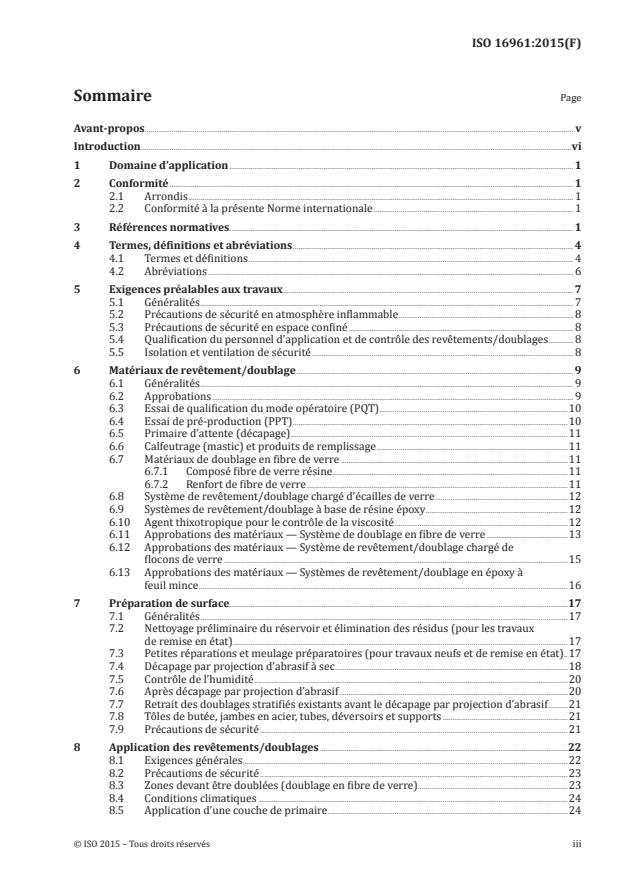
Contents Page
Foreword .v
Introduction .vi
1 Scope . 1
2 Conformance . 1
2.1 Rounding . 1
2.2 Compliance to this International Standard . 1
3 Normative references . 1
4 Terms, definitions and abbreviated terms . 3
4.1 Terms and definitions . 3
4.2 Abbreviated terms . 6
5 Pre-work requirements . 7
5.1 General . 7
5.2 Safety precautions in flammable atmosphere . 7
5.3 Safety precautions in confined space . 7
5.4 Qualification of coating/lining application and inspection personnel . 7
5.5 Positive isolation and ventilation . 8
6 Coating/lining materials . 8
6.1 General . 8
6.2 Approvals . 8
6.3 Procedure qualification trial (PQT) . 9
6.4 Pre-production trial (PPT) . 9
6.5 Holding (blast) primer . 9
6.6 Caulking (putty) and filler compounds .10
6.7 Fibreglass lining materials .10
6.7.1 Fibreglass resin compound .10
6.7.2 Glass fibre reinforcement .10
6.8 Glass flake filled coating/lining system .10
6.9 Epoxy coating/lining systems .11
6.10 Thixotropic agent for viscosity control .11
6.11 Material approvals — Fibreglass lining system .11
6.12 Material approvals — Glass flake filled coating/lining system .14
6.13 Material approvals — Thin film epoxy coating/lining systems .15
7 Surface preparation .16
7.1 General .16
7.2 Tank pre-cleaning and residue removal (for rehabilitation work) .17
7.3 Preparatory patching and grinding (for new and rehabilitation work) .17
7.4 Dry abrasive blasting cleaning .18
7.5 Humidity control .19
7.6 After blast cleaning.19
7.7 Removal of existing laminate linings prior to abrasive blasting .20
7.8 Striker plates, steel legs, risers, down comers and supports .20
7.9 Safety precautions .20
8 Coating/lining application .20
8.1 General requirements .20
8.2 Safety precautions .21
8.3 Areas to be lined (fibreglass lining) .22
8.4 Weather conditions .22
8.5 Primer application .22
8.6 Caulking (putty) application .23
8.7 Fibreglass laminate application .23
8.8 Lining thickness .24
8.9 Glass flake filled coating application .24
8.10 Thin film coating application .26
8.11 Curing .27
9 Inspection and testing .27
9.1 General requirements .27
9.2 Environmental conditions testing .28
9.3 Materials and equipment inspection .28
9.4 Compressed air and abrasive .28
9.5 Surface preparation inspection .28
9.6 Coating/lining inspection and testing .29
9.7 Coating/lining film thickness .29
9.8 Holiday detection test .29
9.9 Curing hardness test .30
9.10 Defects and pinhole repair .30
9.11 Adhesion test .30
10 Quality requirements .30
11 Documentation .31
11.1 General .31
11.2 Work proposal .31
11.3 Work records/reports .31
11.4 Inspection and testing reports and certificates of compliance .32
11.5 Final report .32
Annex A (informative) Dew point calculation chart .33
Annex B (informative) Caulking (putty) application .34
Annex C (informative) Example of coating/lining work record/data sheet .35
Annex D (informative) Example of coating/lining inspection and testing data sheet .36
Bibliography .37
iv © ISO 2015 – All rights reserved
Foreword
ISO (the International Organization for Standardization) is a worldwide federation of national standards
bodies (ISO member bodies). The work of preparing International Standards is normally carried out
through ISO technical committees. Each member body interested in a subject for which a technical
committee has been established has the right to be represented on that committee. International
organizations, governmental and non-governmental, in liaison with ISO, also take part in the work.
ISO collaborates closely with the International Electrotechnical Commission (IEC) on all matters of
electrotechnical standardization.
The procedures used to develop this document and those intended for its further maintenance are
described in the ISO/IEC Directives, Part 1. In particular the different approval criteria needed for the
different types of ISO documents should be noted. This document was drafted in accordance with the
editorial rules of the ISO/IEC Directives, Part 2 (see www.iso.org/directives).
Attention is drawn to the possibility that some of the elements of this document may be the subject of
patent rights. ISO shall not be held responsible for identifying any or all such patent rights. Details of
any patent rights identified during the development of the document will be in the Introduction and/or
on the ISO list of patent declarations received (see www.iso.org/patents).
Any trade name used in this document is information given for the convenience of users and does not
constitute an endorsement.
For an explanation on the meaning of ISO specific terms and expressions related to conformity
assessment, as well as information about ISO’s adherence to the WTO principles in the Technical
Barriers to Trade (TBT) see the following URL: Foreword - Supplementary information
The committee responsible for this document is ISO/TC 67, Materials, equipment and offshore structures
for petroleum, petrochemical and natural gas industries.
Introduction
This International Standard is based on GSO 2057 – 2010 (E). The objectives of this International
Standard are to define minimum technical requirements for the corrosion protection by coating and
lining of internal surfaces of steel storage tanks, to provide technical guidance for developing local
standards and specifications, and to ensure compliance in coating and lining material selection and
performance with contract requirements.
Users of this International Standard should be aware that further or differing requirements can be
needed for individual applications. This International Standard is not limiting the contractor and/or
manufacturer from proposing or the company from accepting alternative engineering solutions for
the individual application. This can be particularly applicable where there is innovative or developing
technology. Where an alternative is proposed, the specification issuer should identify any deviations
from this International Standard and provide details.
Annexes A, B, C and D of this International Standard are informative only.
vi © ISO 2015 – All rights reserved
INTERNATIONAL STANDARD ISO 16961:2015(E)
Petroleum, petrochemical and natural gas industries —
Internal coating and lining of steel storage tanks
1 Scope
This International Standard specifies the minimum requirements for surface preparation, materials,
application, inspection and testing of internal coating lining systems that are intended to be applied on
internal surfaces of steel storage tanks of crude oil, hydrocarbons and water for corrosion protection.
It covers both new construction and maintenance works of tank internal coating and lining as well as
the repair of defective and deteriorated systems.
This International Standard also provides the minimum requirements for shop performance testing of
the coated/lined samples and the criteria for their approval.
2 Conformance
2.1 Rounding
Unless otherwise stated in this International Standard, to determine conformance with the specified
requirements, observed or calculated values shall be rounded to the nearest unit in the last right-
hand place of figures used in expressing the limiting value, in accordance with ISO 80000-1:2009,
Annex B, Rule A.
NOTE For the purpose of this provision, the rounding method of ASTM E29–08 is equivalent to
ISO 80000-1:2009, Annex B, Rule A.
2.2 Compliance to this International Standard
A quality system should be applied to assist compliance with the requirements of this International
Standard. ISO/TS 29001 gives sector-specific guidance on quality management systems.
The applicator shall comply with all of the applicable requirements of this International Standard.
It shall be permissible for the client to make any investigations necessary in order to be ensured of
compliance by the applicator and to reject any material that does not comply.
3 Normative references
The following documents, in whole or in part, are normatively referenced in this document and are
indispensable for its application. For dated references, only the edition cited applies. For undated
references, the latest edition of the referenced document (including any amendments) applies.
API RP 652, Lining of Aboveground Petroleum Storage Tank Bottoms
API STD 653, Tank Inspection, Repair, Alteration and Reconstruction
API STD 2015, Requirements for Safe Entry and Cleaning of Petroleum Storage Tanks
ASTM C868-02 (2012), Standard Test Method for Chemical Resistance of Protective Linings
ASTM D412, Standard Test Methods for Vulcanized Rubber and Thermoplastic Elastomers — Tension
ASTM D522, Standard Test Methods for Mandrel Bend Test of Attached Organic Coatings
ASTM D610, Standard Practice for Evaluating Degree of Rusting on Painted Steel Surfaces
ASTM D714, Standard Test Method for Evaluating Degree of Blistering of Paints
ASTM D790, Standard Test Methods for Flexural Properties of Unreinforced and Reinforced Plastics and
Electrical Insulating Materials
ASTM D870, Standard Practice for Testing Water Resistance of Coatings Using Water Immersion
ASTM D2583, Standard Test Method for Indentation Hardness of Rigid Plastics by Means of a Barcol Impressor
ASTM D4060, Standard Test Method for Abrasion Resistance of Organic Coatings by the Taber Abraser
ASTM D4285, Standard Test Method for Indicating Oil or Water in Compressed Air
ASTM D4541, Standard Test Method for Pull-Off Strength of Coatings Using Portable Adhesion Testers
ASTM D4940, Standard Test Method for Conductimetric Analysis of Water Soluble Ionic Contamination of
Blasting Abrasives
ASTM D5420, Standard Test Method for Impact Resistance of Flat, Rigid Plastic Specimen by Means of a
Striker Impacted by a Falling Weight (Gardner Impact)
ASTM F21, Standard Test Method for Hydrophobic Surface Films by the Atomizer Test
ASTM G42, Standard Test Method for Cathodic Disbonding of Pipeline Coatings Subjected to Elevated
Temperatures
EN 14020 (all parts), Reinforcements — Specification for textile glass roving’s
ISO 2808, Paints and varnishes — Determination of film thickness
ISO 2812-1, Paints and varnishes — Determination of resistance to liquids — Part 1: Immersion in liquids
other than water
ISO 3233 (all parts), Paints and varnishes — Determination of percentage volume of non-volatile matter by
measuring the density of a dried coating
ISO 4624, Paints and varnishes — Pull-off test
ISO 4628-2, Paints and varnishes — Evaluation of degradation of coatings — Designation of quantity and
size of defects, and of intensity of uniform changes in appearance — Part 2: Assessment of degree of blistering
ISO 4628-3, Paints and varnishes — Evaluation of degradation of coatings — Designation of quantity and
size of defects, and of intensity of uniform changes in appearance — Part 3: Assessment of degree of rusting
ISO 7027, Water quality — Determination of turbidity
ISO 8501-1, Preparation of steel substrates before application of paints and related products — Visual
assessment of surface cleanliness — Part 1: Rust grades and preparation grades of uncoated steel substrates
and of steel substrates after overall removal of previous coatings
ISO 8501-3, Preparation of steel substrates before application of paints and related products — Visual
assessment of surface cleanliness — Part 3: Preparation grades of welds, edges and other areas with surface
imperfections
ISO 8502-3, Preparation of steel substrates before application of paints and related products — Tests for
the assessment of surface cleanliness — Part 3: Assessment of dust on steel surfaces prepared for painting
(pressure-sensitive tape method)
ISO 8502-6, Preparation of steel substrates before application of paints and related products — Tests for
the assessment of surface cleanliness — Part 6: Extraction of soluble contaminants for analysis — The
Bresle method
2 © ISO 2015 – All rights reserved
ISO 8502-9, Preparation of steel substrates before application of paints and related products -- Tests for the
assessment of surface cleanliness -- Part 9: Field method for the conductometric determination of water-
soluble salts
ISO 10474, Steel and steel products — Inspection documents
ISO 11124 (all parts), Preparation of steel substrates before application of paints and related products —
Specifications for metallic blast-cleaning abrasives
ISO 11126 (all parts), Preparation of steel substrates before application of paints and related products —
Specifications for non-metallic blast-cleaning abrasives
ISO 11127-7, Preparation of steel substrates before application of paints and related products — Test
methods for non-metallic blast-cleaning abrasives — Part 7: Determination of water-soluble chlorides
ISO 12944-3, Paints and varnishes — Corrosion protection of steel structures by protective paint systems —
Part 3: Design considerations
ISO 19840, Paints and varnishes — Corrosion protection of steel structures by protective paint systems —
Measurement of, and acceptance criteria for, the thickness of dry films on rough surfaces
ISO 29601, Paints and varnishes — Corrosion protection by protective paint systems — Assessment of
porosity in a dry film
ISO 80000-1:2009, Quantities and units — Part 1: General
NACE SP0188, Discontinuity (Holiday) Testing of New Protective Coatings on Conductive Substrates
NACE/TM 0174, Standard Test Method — Laboratory Methods for the Evaluation of Protective Coatings
and Lining Materials on Metallic Substrates in Immersion Service
SSPC-AB1, Abrasive Specification No.1, Mineral and Slag Abrasive
SSPC-AB2, Abrasive Specification No.2, Cleanliness of Recycled Ferrous Metallic Abrasives
SSPC-Guide 12, Guide for Illumination of Industrial Painting Projects
SSPC-PA 2, Steel Structure Painting Council Surface Preparation Specifications Measurement of Dry
Coating Thickness with Magnetic Gages
SSPC-SP 1, Steel Structure Painting Council Surface Preparation Specifications — Solvent Cleaning
SSPC-SP 5/NACE No.1, Joint Surface Preparation Standard-White Metal Blast Cleaning
SSPC-SP 11, Surface Preparation Standard, Power-Tool Cleaning to Bare Metal
4 Terms, definitions and abbreviated terms
4.1 Terms and definitions
For the purpose of this document, the following terms and definitions apply.
4.1.1
application procedure specification
APS
document describing procedures, methods, equipment and tools used for coating application
4.1.2
applicator
organization, contractor or subcontractor having the technical capability, knowledge, equipment
and qualified personnel that is approved by the client for the coating processes as required by this
International Standard
4.1.3
C glass
glass fibre that provides greater resistance to chemicals and is used in advanced composites, mainly used
in the form of surface tissue in the outer layer of laminates used in chemical and water pipes and tanks
4.1.4
caulking
the process of applying a 98 % to 100 % solid catalysed epoxy material (caulking compound) on tank
internal surfaces to fill pores/pits or to cover weld seams, lap joints, large projections, connections, etc.
Note 1 to entry: This is to provide a uniform gradual transition and smooth surfaces.
4.1.5
client
party or organization for which professional services are rendered or person that receives a product
4.1.6
coat
paint, varnish or lacquer applied to surface in a single application (one layer) to form an evenly
distributed film when dry
4.1.7
contractor
vendor company or business that agrees to furnish materials and/or perform specific
project/services to client
4.1.8
curing
chemical process of developing the intended properties of a coating/polymerized product in the lining
system, generally due to a reaction between two or more chemicals (e.g. resin and curing compound)
4.1.9
dew point
temperature of a given air/water vapour mixture at which condensation starts, since, at that
temperature, its maximum water content saturation is reached
4.1.10
dry abrasive blasting
surface preparation method that uses an abrasive propelled by air pressure, centrifugal force, to clean
and provide a surface profile
4.1.11
dry film thickness
DFT
thickness of a coat or coating system in its fully cured and dry condition
Note 1 to entry: The dry film thickness of coating is measured by film thickness calibrated gauge and expressed
in mils or microns (1 000 microns is equivalent to 40 mils).
4.1.12
E glass
glass containing not more than 1 % by mass of alkali (calculated as Na O) and used for the manufacture
of glass fibre
4.1.13
epoxy
resin containing epoxide functional groups that allow for curing by polymerization with a variety of
curing agents
4 © ISO 2015 – All rights reserved
4.1.14
fibreglass lining
cold curing resin linings to repair and/or add strength to tank bottoms with fibre mat
Note 1 to entry: Examples are pure epoxies, phenolic epoxies, polyesters, vinyl esters being chemically cured
with curing agents.
4.1.15
fibreglass reinforced lining
resin linings, usually polyester, vinyl ester or epoxies, into which layers of fibreglass are incorporated
to enhance the lining’s structural capability, corrosion and chemical resistance performance
4.1.16
fibre mat
woven glass fibre that is used as reinforcement of the thermosetting resin (e.g. epoxy) lining to repair
and/or add strength to tank bottoms
Note 1 to entry: Fibre mat is typically applied to a wet resin at about 450 g/m area.
4.1.17
gel coat
final coat applied over the fibreglass lining laminate to seal the laminate surface and enhance water
and hydrocarbon resistance
4.1.18
holiday
discontinuity in a lining (e.g. pinhole, void, crack, thin spot, and inclusion of foreign material) or
contamination in the coating film that significantly lowers the dielectric strength of the coating
4.1.19
lining
material applied to the internal surfaces of a tank to serve as a barrier to corrosion and/or product
contamination
Note 1 to entry: The term coating is also used for the purposes of this International Standard.
4.1.20
manufacturer
company responsible for the manufacture of coating material(s)
4.1.21
pinhole
small film defect characterized by small pore-like flaws in the lining that would permit corrosion of the
substrate under the conditions for which the lining is designed
Note 1 to entry: A pinhole may extend entirely through the film to the substrate and lead to a holiday.
4.1.22
pre-production trial
PPT
application of coating and inspection/testing of its properties, to confirm that the APS is able to produce
a coating with the specified properties
4.1.23
surface profile
micro-roughness of a surface, generally expressed as the average height of the major peaks relative to
the major valleys, sometimes referred to as amplitude
Note 1 to entry: It is typically Ra/Ry/Rz value.
4.2 Abbreviated terms
ANSI American National Standardization Institute
API American Petroleum Institute
APS Application Procedure Specification
ASTM American Society for Testing and Materials
AWWA American Water Works Association
BGAS British Gas
CV Curriculum Vitae
DFT Dry Film Thickness
GRE Glass Reinforced Epoxy
GRUP Glass Reinforced Unsaturated Polyester
GRVE Glass Reinforced Vinyl Ester
GSO Gulf Standardization Organization
HBE High Build Epoxy
HSE Health, Safety and Environment
ITP Inspection and Testing Plan
MSDS Materials Safety Data Sheets
NACE National Association of Corrosion Engineers
OSHA Occupational Safety and Health Administration
PPE Personal Protective Equipment
PPT Pre-Production Trial
PQT Procedure Qualification Trial
QA/QC Quality Assurance/Quality Control
QP Qualification Procedure
RH Relative Humidity
RP Recommended Practice
SOW Scope of Work
SSPC The Society for Protecting Coatings
WFT Wet Film Thickness
WRAS Water Regulations Advisory Scheme
6 © ISO 2015 – All rights reserved
5 Pre-work requirements
5.1 General
5.1.1 All necessary health, safety and environmental (HSE) procedures shall be employed to protect
personnel and the surrounding environment during on-site/field works.
5.1.2 The contractor shall submit their HSE manual for client approval. The approved HSE procedures
for the safe lining processes shall be strictly followed.
5.1.3 Adherence to all relevant international safety requirements, client safety regulations for
contractors and lifting equipment regulations are required while performing coating and lining works.
5.1.4 Materials Safety Data Sheets (MSDS) for all chemicals to be used within operation areas shall be
submitted for review and approval by client. Health and safety precautions shall be clearly described on
each chemical container/package.
5.1.5 All wastes resulting from supply and application shall be contained, collected and properly
disposed off in accordance with international/local environmental protection standards/regulations.
5.2 Safety precautions in flammable atmosphere
5.2.1 Where there is a risk of flammable atmosphere being present in a particular tank, the client may,
with relevant safety authority, impose restrictions on methods of surface preparation.
5.2.2 The client shall advise on the hazardous area classification for plant design and construction/
maintenance projects.
5.2.3 The contractor shall provide the client with all necessary data for the proposed coating/lining
systems, solvents and coating procedure in order to permit area classification to be determined for the
duration of coating work. Special care shall be observed when mixing resins to avoid fire hazards.
5.2.4 All equipment used in surface preparation, coating/lining application and inspection, including
floodlight or spotlights, shall be explosion-proof and spark-proof.
5.3 Safety precautions in confined space
The procedures for performing safe work in confined spaces shall be in accordance with OSHA 29 CFR
1910, API STD 2217A or according to national legislation.
5.4 Qualification of coating/lining application and inspection personnel
5.4.1 The coating/lining operatives shall be competent to undertake the coating application,
inspection/ testing procedures and repair work. The qualification may be obtained as agreed with the
client or by demonstration at a procedure qualification trial (PQT) during pre-production trial (PPT).
5.4.2 Inspectors and applicator personnel carrying out the coating inspection shall be competent to
carry out the requirements of this International Standard. The applicator shall request the manufacturer
of the coating/lining material(s) and equipment to provide technical assistance to the coating/lining
operatives if necessary.
5.5 Positive isolation and ventilation
5.5.1 All pipeline/piping shall be disconnected at the tank valves and the open ends of pipes shall be
blanked off. All tubular housing and conduits connected to the tanks for gauging or other instrumentation
purpose shall be disconnected. Cathodic protection system shall be disconnected only during the actual
surface preparation and coating application works. The tank shall have provision to exhaust gases from
the tank by at least two air changes per hour and vented at high level on the downwind side. The exhaust
and ventilation shall comply with local and national HSE regulations.
5.5.2 The tank shall be lighted in accordance with SSPC-Guide 12 and shall be ventilated. Any client-
related standards shall take precedence. All parts of the work shall be clearly visible.
6 Coating/lining materials
6.1 General
6.1.1 Typical coating and lining systems include high build solvent free glass-flake filled coating, hand
lay fibreglass reinforced lining (GRE, GRVE, GRUP), solvent free epoxy, phenolic epoxy, epoxy novolac and
high build epoxies.
6.1.2 All coating/lining materials shall be free of foreign elements and contaminants. The age of
materials components shall not exceed the recommended shelf-life as limited by the manufacturers.
6.1.3 The coating/lining materials shall be delivered to the site in original manufacturer’s sealed un-
opened containers with batch number, date of manufacture and expiry date clearly marked thereon.
6.1.4 All coating/lining materials intended to be used shall have five years’ proven performance in the
relevant service liquid. The details shall be submitted to the client for review and approval.
6.1.5 The coating and lining systems to be used and the areas to be lined for each tank shall be specified
by the client project specification and equipment data sheet.
6.1.6 The coating work shall be undertaken by applicators, including supervisors and workers, with
experience on installing the type of internal coating/lining specified as per the manufacturer instructions
and client requirements.
6.2 Approvals
6.2.1 All coating/lining materials and thinners in any (multi-coat) system shall be manufactured by a
single manufacturer to avoid any compatibility issues. For a particular project or maintenance job, the
use of different materials shall be subject to the client’s and paints manufacturers’ written approval.
6.2.2 The contractor’s submittal for coating/lining materials shall include details of the
manufacturer, technical specifications and performance testing of the materials to be used for the
client’s review and approval.
6.2.3 Manufacturer’s certificates shall be furnished with all coating/lining materials and shall confirm
that the material complies with the requirements of this International Standard.
6.2.4 The selected coating/lining materials, provided by the contractor, shall comply with 6.3 to 6.13
or as mentioned in relevant technical specification/datasheets.
8 © ISO 2015 – All rights reserved
6.2.5 For potable water service the lining shall possess certificate of clearance to store water for
human consumption from the local water regulating authority or should comply with ANSI/AWWA/
WRAS standards for interior of potable water storage tanks with the appropriate temperature rating.
6.3 Procedure qualification trial (PQT)
6.3.1 If specified by the client or otherwise required by this International Standard, the application
procedure specification (APS) shall be qualified by a PQT. Test methods and frequencies for PQT are
specified in 6.5 to 6.13. Acceptance criteria are given in the relevant subclauses referred to in 6.5 to 6.13.
6.3.2 The applicator may request the manufacturer(s) to assist during the PQT to ensure the correct
use of the coating/lining material(s) and to train applicator personnel.
6.3.3 Qualification tests shall be carried out on representative test plates having the same specification
and thickness as the storage tank to be internally coated/lined.
6.3.4 All tools and equipment (e.g. for abrasive blasting, coating/lining application and inspection)
being used for PQT shall be of the same type as those being used for the actual coating/lining.
6.3.5 The method of coating repairs and stripping of defective internal tank coating/lining shall be
included in PQT.
6.3.6 The applicator shall submit a complete report of the qualification test results to the client or his
representative for approval.
6.4 Pre-production trial (PPT)
6.4.1 If specified or otherwise required by the client, a PPT shall be performed on site to verify the:
— coating/lining system;
— coating/lining materials;
— coating/lining application procedure;
— qualification of equipment being used for surface preparation and coating application;
— application of the coating system;
— qualification of the coating operatives and inspectors that will actually be used in the field.
6.4.2 The PPT work and performance shall comply with the requirements of this International
Standard and the results of any previous PQT.
6.4.3 Test methods, frequencies and acceptance criteria for PPT are identified and specified in the
relevant subclauses of 6.5 to 6.13.
6.4.4 The PPT shall be carried out in the presence of the client and/or applicator (or their
representative) at the start of operations when equipment and personnel are mobilized on site. The PPT
shall be performed on the first test plate to be coated.
6.5 Holding (blast) primer
An approved rapid curing primer can be used as holding primer. Holding primer shall be spray applied.
Holding primer can be applied by brush on small surfaces in case of minor repair. The approved holding
primer shall be compatible with the lining system and as specified in the lining system material datasheet.
6.6 Caulking (putty) and filler compounds
6.6.1 Caulking (putty) compound shall be a mixture of solvent-free resin and aggregates. The caulking
shall provide great strength and chemical resistance and shall be compatible with the lining system.
6.6.2 Filler compound shall be 100 % volume solids and compatible with the lining system.
6.6.3 The approved putties and fillers shall be as specified in the lining system material data sheet.
6.6.4 Surface preparation for better anchoring and maximum thickness of caulking (putty) and sealer
compounds to be applied shall be mentioned considering corrosion allowance of metal substrate and
operating conditions (loading /unloading vibrations) of tank in scope.
6.7 Fibreglass lining materials
6.7.1 Fibreglass resin compound
The resin compound for the fibreglass lining system shall be chemical and corrosion resistance type,
which include bisphenol epoxy resin, epoxy phenolic or novolac epoxy, polyester and vinyl ester. The
resin shall be of high quality in order to meet the performance requirements as mentioned in this
International Standard. The epoxy resin should be type 1 Grade 1 as per ISO 3673-1 or ASTM D1763.
The bisphenol epychlorohydrin epoxide resin shall be 100 % pure of low viscosity at normal room
temperature. Epoxy resin may be an amine adduct cured. Epoxy base blends shall be high molecular
weight, resins of low viscosity at normal room temperature. Also, it shall be as per material manufacturer
recommendation for specified storage services with coverage of proven performance assurance.
6.7.2 Glass fibre reinforcement
6.7.2.1 Glass fibre reinforcement shall be type E or C glass fibre roving as per EN 14020 of size 0,4 mm
in diameter of low alkali borosilicate glass, evenly distributed in a random pattern and bound together
with a chemical binder highly soluble in the laminating resin. Also, it shall be as per material manufacturer
recommendation for specified storage services with coverage of proven performance assurance.
6.7.2.2 For laminated fibreglass reinforced lining (hand applied), the mat shall have a minimum weight
of 300 g/m , a minimum width of 1 250 mm and shall contain a high solubility binder. The fibreglass mat
shall be of suitable lengths. The overlap between the fibreglass mats should be minimum 100 mm along
the length of the mat.
6.7.2.3 The glass surface tissue (surface veil) shall be a light weight glass fibre with a minimum weight
of 300 g/m , if required.
6.7.2.4 Top coat shall be applied over the fibreglass lining laminate to seal the laminate surface
and enhance water and hydrocarbon resistance. This top coat is also referr
...
NORME ISO
INTERNATIONALE 16961
Première édition
2015-08-01
Industries du pétrole, de la
pétrochimie et du gaz naturel —
Revêtement intérieur et doublage
interne des réservoirs de stockage
en acier
Petroleum, petrochemical and natural gas industries — Internal
coating and lining of steel storage tanks
Numéro de référence
©
ISO 2015
DOCUMENT PROTÉGÉ PAR COPYRIGHT
© ISO 2015, Publié en Suisse
Droits de reproduction réservés. Sauf indication contraire, aucune partie de cette publication ne peut être reproduite ni utilisée
sous quelque forme que ce soit et par aucun procédé, électronique ou mécanique, y compris la photocopie, l’affichage sur
l’internet ou sur un Intranet, sans autorisation écrite préalable. Les demandes d’autorisation peuvent être adressées à l’ISO à
l’adresse ci-après ou au comité membre de l’ISO dans le pays du demandeur.
ISO copyright office
Ch. de Blandonnet 8 • CP 401
CH-1214 Vernier, Geneva, Switzerland
Tel. +41 22 749 01 11
Fax +41 22 749 09 47
copyright@iso.org
www.iso.org
ii © ISO 2015 – Tous droits réservés
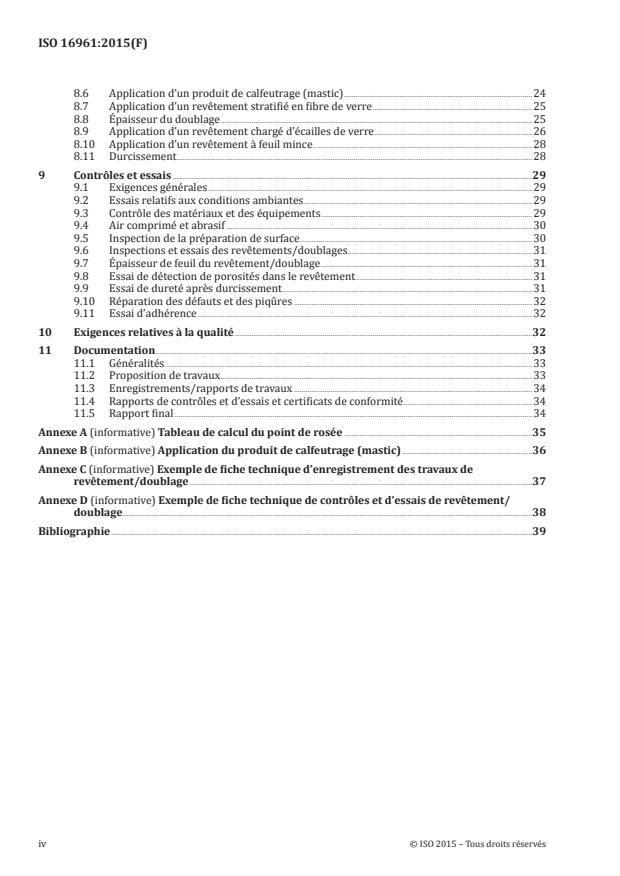
Sommaire Page
Avant-propos .v
Introduction .vi
1 Domaine d’application . 1
2 Conformité . 1
2.1 Arrondis . 1
2.2 Conformité à la présente Norme internationale . 1
3 Références normatives . 1
4 Termes, définitions et abréviations . 4
4.1 Termes et définitions . 4
4.2 Abréviations . 6
5 Exigences préalables aux travaux . 7
5.1 Généralités . 7
5.2 Précautions de sécurité en atmosphère inflammable . 8
5.3 Précautions de sécurité en espace confiné . 8
5.4 Qualification du personnel d’application et de contrôle des revêtements/doublages . 8
5.5 Isolation et ventilation de sécurité . 8
6 Matériaux de revêtement/doublage . 9
6.1 Généralités . 9
6.2 Approbations . 9
6.3 Essai de qualification du mode opératoire (PQT) .10
6.4 Essai de pré-production (PPT) .10
6.5 Primaire d’attente (décapage) .11
6.6 Calfeutrage (mastic) et produits de remplissage .11
6.7 Matériaux de doublage en fibre de verre .11
6.7.1 Composé fibre de verre résine .11
6.7.2 Renfort de fibre de verre .11
6.8 Système de revêtement/doublage chargé d’écailles de verre .12
6.9 Systèmes de revêtement/doublage à base de résine époxy.12
6.10 Agent thixotropique pour le contrôle de la viscosité .12
6.11 Approbations des matériaux — Système de doublage en fibre de verre .13
6.12 Approbations des matériaux — Système de revêtement/doublage chargé de
flocons de verre .15
6.13 Approbations des matériaux — Systèmes de revêtement/doublage en époxy à
feuil mince .16
7 Préparation de surface .17
7.1 Généralités .17
7.2 Nettoyage préliminaire du réservoir et élimination des résidus (pour les travaux
de remise en état) .17
7.3 Petites réparations et meulage préparatoires (pour travaux neufs et de remise en état) .17
7.4 Décapage par projection d’abrasif à sec .18
7.5 Contrôle de l’humidité .20
7.6 Après décapage par projection d’abrasif .20
7.7 Retrait des doublages stratifiés existants avant le décapage par projection d’abrasif .21
7.8 Tôles de butée, jambes en acier, tubes, déversoirs et supports .21
7.9 Précautions de sécurité .21
8 Application des revêtements/doublages .22
8.1 Exigences générales .22
8.2 Précautions de sécurité .23
8.3 Zones devant être doublées (doublage en fibre de verre) .23
8.4 Conditions climatiques .24
8.5 Application d’une couche de primaire .24
8.6 Application d’un produit de calfeutrage (mastic) .24
8.7 Application d’un revêtement stratifié en fibre de verre .25
8.8 Épaisseur du doublage .25
8.9 Application d’un revêtement chargé d’écailles de verre .26
8.10 Application d’un revêtement à feuil mince .28
8.11 Durcissement . .28
9 Contrôles et essais .29
9.1 Exigences générales .29
9.2 Essais relatifs aux conditions ambiantes .29
9.3 Contrôle des matériaux et des équipements .29
9.4 Air comprimé et abrasif .30
9.5 Inspection de la préparation de surface .30
9.6 Inspections et essais des revêtements/doublages .31
9.7 Épaisseur de feuil du revêtement/doublage .31
9.8 Essai de détection de porosités dans le revêtement .31
9.9 Essai de dureté après durcissement .31
9.10 Réparation des défauts et des piqûres .32
9.11 Essai d’adhérence .32
10 Exigences relatives à la qualité .32
11 Documentation .33
11.1 Généralités .33
11.2 Proposition de travaux .33
11.3 Enregistrements/rapports de travaux .34
11.4 Rapports de contrôles et d’essais et certificats de conformité .34
11.5 Rapport final .34
Annexe A (informative) Tableau de calcul du point de rosée .35
Annexe B (informative) Application du produit de calfeutrage (mastic) .36
Annexe C (informative) Exemple de fiche technique d’enregistrement des travaux de
revêtement/doublage .37
Annexe D (informative) Exemple de fiche technique de contrôles et d’essais de revêtement/
doublage .38
Bibliographie .39
iv © ISO 2015 – Tous droits réservés
Avant-propos
L’ISO (Organisation internationale de normalisation) est une fédération mondiale d’organismes
nationaux de normalisation (comités membres de l’ISO). L’élaboration des Normes internationales est
en général confiée aux comités techniques de l’ISO. Chaque comité membre intéressé par une étude
a le droit de faire partie du comité technique créé à cet effet. Les organisations internationales,
gouvernementales et non gouvernementales, en liaison avec l’ISO participent également aux travaux.
L’ISO collabore étroitement avec la Commission électrotechnique internationale (IEC) en ce qui
concerne la normalisation électrotechnique.
Les procédures utilisées pour élaborer le présent document et celles destinées à sa mise à jour sont
décrites dans les Directives ISO/IEC, Partie 1. Il convient, en particulier de prendre note des différents
critères d’approbation requis pour les différents types de documents ISO. Le présent document a été
rédigé conformément aux règles de rédaction données dans les Directives ISO/IEC, Partie 2 (voir www.
iso.org/directives).
L’attention est appelée sur le fait que certains des éléments du présent document peuvent faire l’objet de
droits de propriété intellectuelle ou de droits analogues. L’ISO ne saurait être tenue pour responsable
de ne pas avoir identifié de tels droits de propriété et averti de leur existence. Les détails concernant
les références aux droits de propriété intellectuelle ou autres droits analogues identifiés lors de
l’élaboration du document sont indiqués dans l’Introduction et/ou dans la liste des déclarations de
brevets reçues par l’ISO (voir www.iso.org/brevets).
Les appellations commerciales éventuellement mentionnées dans le présent document sont données
pour information, par souci de commodité, à l’intention des utilisateurs et ne sauraient constituer un
engagement.
Pour une explication de la signification des termes et expressions spécifiques de l’ISO liés à
l’évaluation de la conformité, ou pour toute information au sujet de l’adhésion de l’ISO aux principes
de l’OMC concernant les obstacles techniques au commerce (OTC), voir le lien suivant: Avant-propos —
Informations supplémentaires.
Le comité chargé de l’élaboration du présent document est l’ISO/TC 67, Matériel, équipement et structures
en mer pour les industries pétrolière, pétrochimique et du gaz naturel.
Introduction
La présente Norme internationale est fondée sur la norme GSO 2057 – 2010 (E). Les objectifs de la
présente Norme internationale sont de définir des exigences techniques minimales pour la protection
contre la corrosion par revêtement ou doublage des surfaces internes des réservoirs de stockage en acier,
de fournir des lignes directrices techniques pour l’élaboration de normes locales et de spécifications
et d’assurer la conformité en termes de choix et de performances des matériaux de revêtement et de
doublage avec les exigences contractuelles.
L’attention des utilisateurs de la présente Norme internationale est attirée sur le fait que pour certaines
applications particulières des exigences supplémentaires ou différentes peuvent être nécessaires. La
présente Norme internationale n’est pas destinée à interdire à un contracteur et/ou à un fabricant de
proposer ou à une société d’accepter d’autres solutions techniques pour une application particulière.
Cela est d’autant plus vrai lorsque la technologie est innovante ou en cours de développement.
Lorsqu’une solution alternative est proposée, il convient que l’émetteur de la spécification identifie tout
écart par rapport à la présente Norme internationale et en fournisse les détails.
Les Annexes A, B, C et D de la présente Norme internationale sont données uniquement à titre
d’information.
vi © ISO 2015 – Tous droits réservés
NORME INTERNATIONALE ISO 16961:2015(F)
Industries du pétrole, de la pétrochimie et du gaz
naturel — Revêtement intérieur et doublage interne des
réservoirs de stockage en acier
1 Domaine d’application
La présente Norme internationale spécifie les exigences minimales concernant la préparation de
surface, les matériaux, l’application, le contrôle et les essais des systèmes de revêtement ou de doublage
destinés à être appliqués sur les surfaces internes des réservoirs en acier pour le stockage de pétrole
brut, d’hydrocarbures et d’eau dans le but d’assurer leur protection contre la corrosion.
Elle couvre à la fois les nouvelles constructions et les travaux de maintenance pour le revêtement
intérieur et le doublage interne des réservoirs ainsi que la réparation de systèmes défectueux et
détériorés.
La présente Norme internationale fournit également les exigences minimales pour les essais de
performance en atelier des échantillons revêtus/doublés ainsi que les critères d’acceptation.
2 Conformité
2.1 Arrondis
Sauf convention contraire indiquée dans la présente Norme internationale, pour déterminer la
conformité aux exigences spécifiées, les valeurs observées ou calculées doivent être arrondies à l’unité
la plus proche à l’emplacement correspondant au dernier chiffre de droite parmi les chiffres utilisés
pour exprimer la valeur limite, conformément à l’ISO 80000-1:2009, Annexe B, Règle A.
NOTE Pour les besoins de cette disposition, la méthode d’approximation de l’ASTM E29–08 équivaut à
l’ISO 80000-1:2009, Annexe B, Règle A.
2.2 Conformité à la présente Norme internationale
Il convient de mettre en œuvre un système qualité pour faciliter la mise en conformité aux exigences
de la présente Norme internationale. L’ISO/TS 29001 donne des recommandations sur les systèmes de
management de la qualité spécifiques au secteur.
L’applicateur doit être en conformité à toutes les exigences applicables de la présente Norme
internationale. Le client doit être autorisé à effectuer toutes les investigations nécessaires pour
s’assurer que l’applicateur s’y conforme et à refuser tout produit non conforme.
3 Références normatives
Les documents ci-après, dans leur intégralité ou non, sont des références normatives indispensables à
l’application du présent document. Pour les références datées, seule l’édition citée s’applique. Pour les
références non datées, la dernière édition du document de référence s’applique (y compris les éventuels
amendements).
API RP 652, Lining of Aboveground Petroleum Storage Tank Bottoms
API STD 653, Tank Inspection, Repair, Alteration and Reconstruction
API STD 2015, Requirements for Safe Entry and Cleaning of Petroleum Storage Tanks
ASTM C868-02 (2012), Standard Test Method for Chemical Resistance of Protective Linings
ASTM D412, Standard Test Methods for Vulcanized Rubber and Thermoplastic Elastomers — Tension
ASTM D522, Standard Test Methods for Mandrel Bend Test of Attached Organic Coatings
ASTM D610, Standard Practice for Evaluating Degree of Rusting on Painted Steel Surfaces
ASTM D714, Standard Test Method for Evaluating Degree of Blistering of Paints
ASTM D790, Standard Test Methods for Flexural Properties of Unreinforced and Reinforced Plastics and
Electrical Insulating Materials
ASTM D870, Standard Practice for Testing Water Resistance of Coatings Using Water Immersion
ASTM D2583, Standard Test Method for Indentation Hardness of Rigid Plastics by Means of a Barcol
Impressor
ASTM D4060, Standard Test Method for Abrasion Resistance of Organic Coatings by the Taber Abraser
ASTM D4285, Standard Test Method for Indicating Oil or Water in Compressed Air
ASTM D4541, Standard Test Method for Pull-Off Strength of Coatings Using Portable Adhesion Testers
ASTM D4940, Standard Test Method for Conductimetric Analysis of Water Soluble Ionic Contamination of
Blasting Abrasives
ASTM D5420, Standard Test Method for Impact Resistance of Flat, Rigid Plastic Specimen by Means of a
Striker Impacted by a Falling Weight (Gardner Impact)
ASTM F21, Standard Test Method for Hydrophobic Surface Films by the Atomizer Test
ASTM G42, Standard Test Method for Cathodic Disbonding of Pipeline Coatings Subjected to Elevated
Temperatures
EN 14020 (toutes les parties), Renforts — Spécification des stratifils (rovings) de verre textile
ISO 2808, Peintures et vernis — Détermination de l’épaisseur du feuil
ISO 2812-1, Peintures et vernis — Détermination de la résistance aux liquides — Partie 1: Immersion dans
des liquides autres que l’eau
ISO 3233 (toutes les parties), Peintures et vernis — Détermination du pourcentage en volume de matière
non volatile par mesurage de la masse volumique d’un revêtement sec
ISO 4624, Peintures et vernis — Essai de traction
ISO 4628-2, Peintures et vernis — Évaluation de la dégradation des revêtements — Désignation de la
quantité et de la dimension des défauts, et de l’intensité des changements uniformes d’aspect — Partie 2:
Évaluation du degré de cloquage
ISO 4628-3, Peintures et vernis — Évaluation de la dégradation des revêtements — Désignation de la
quantité et de la dimension des défauts, et de l’intensité des changements uniformes d’aspect — Partie 3:
Évaluation du degré d’enrouillement
ISO 7027, Qualité de l’eau — Détermination de la turbidité
ISO 8501-1, Préparation des subjectiles d’acier avant application de peintures et de produits assimilés —
Évaluation visuelle de la propreté d’un subjectile — Partie 1: Degrés de rouille et degrés de préparation
des subjectiles d’acier non recouverts et des subjectiles d’acier après décapage sur toute la surface des
revêtements précédents
2 © ISO 2015 – Tous droits réservés
ISO 8501-3, Préparation des subjectiles d’acier avant application de peintures et de produits assimilés —
Évaluation visuelle de la propreté d’un subjectile — Partie 3: Degrés de préparation des soudures, arêtes et
autres zones présentant des imperfections
ISO 8502-3, Préparation des subjectiles d’acier avant application de peintures et de produits assimilés —
Essais pour apprécier la propreté d’un subjectile — Partie 3: Évaluation de la poussière sur les surfaces
d’acier préparées pour la mise en peinture (méthode du ruban adhésif sensible à la pression)
ISO 8502-6, Préparation des subjectiles d’acier avant application de peintures et de produits assimilés —
Essais pour apprécier la propreté d’une surface — Partie 6: Extraction des contaminants solubles en vue de
l’analyse — Méthode de Bresle
ISO 8502-9, Préparation des subjectiles d’acier avant application de peintures et de produits assimilés —
Essais pour apprécier la propreté d’une surface — Partie 9: Méthode in situ pour la détermination des sels
solubles dans l’eau par conductimétrie
ISO 10474, Aciers et produits sidérurgiques — Documents de contrôle
ISO 11124 (toutes les parties), Préparation des subjectiles d’acier avant application de peintures et de
produits assimilés — Spécifications pour abrasifs métalliques destinés à la préparation par projection
ISO 11126 (toutes les parties), Préparation des subjectiles d’acier avant application de peintures et de
produits assimilés — Spécifications pour abrasifs non métalliques destinés à la préparation par projection
ISO 11127-7, Préparation des subjectiles d’acier avant application de peintures et de produits assimilés —
Méthodes d’essai pour abrasifs non métalliques destinés à la préparation par projection — Partie 7:
Détermination des chlorures solubles dans l’eau
ISO 12944-3, Peintures et vernis — Anticorrosion des structures en acier par systèmes de peinture —
Partie 3: Conception et dispositions constructives
ISO 19840, Peintures et vernis — Anticorrosion des structures en acier par systèmes de peinture — Mesure
et critères d’acceptation de l’épaisseur d’un feuil sec sur des surfaces rugueuses
ISO 29601, Peintures et vernis — Anticorrosion par systèmes de peinture — Évaluation de la porosité d’un
feuil sec
ISO 80000-1:2009, Grandeurs et unités — Partie 1: Généralités
NACE/SP 0188, Discontinuity (Holiday) Testing of New Protective Coatings on Conductive Substrates
NACE/TM 0174, Standard Test Method — Laboratory Methods for the Evaluation of Protective Coatings
and Lining Materials on Metallic Substrates in Immersion Service
SSPC-AB1, Abrasive Specification No.1, Mineral and Slag Abrasive
SSPC-AB2, Abrasive Specification No.2, Cleanliness of Recycled Ferrous Metallic Abrasives
SSPC-Guide 12, Guide for Illumination of Industrial Painting Projects
SSPC-PA 2, Steel Structure Painting Council Surface Preparation Specifications Measurement of Dry
Coating Thickness with Magnetic Gages
SSPC-SP 1, Steel Structure Painting Council Surface Preparation Specifications — Solvent Cleaning
SSPC-SP 5/NACE No.1, Joint Surface Preparation Standard-White Metal Blast Cleaning
SSPC-SP 11, Surface Preparation Standard, Power-Tool Cleaning to Bare Metal
4 Termes, définitions et abréviations
4.1 Termes et définitions
Pour les besoins du présent document, les termes et définitions suivants s’appliquent.
4.1.1
procédure d’application
APS
document décrivant les modes opératoires, les méthodes, les équipements et les outils utilisés pour
l’application d’un revêtement
4.1.2
applicateur
organisation, contracteur ou sous-traitant possédant l’aptitude technique, les connaissances, les
équipements et le personnel qualifié approuvé par le client pour les processus de revêtement tels que
requis par la présente Norme internationale
4.1.3
verre de type C
fibre de verre procurant une résistance améliorée aux produits chimiques et utilisée dans les matériaux
composites avancés, principalement employée sous forme de tissu de surface dans la couche externe des
stratifiés utilisés dans les réservoirs et les canalisations véhiculant des produits chimiques et de l’eau
4.1.4
calfeutrage
procédé consistant à appliquer un matériau époxy catalysé contenant de 98 % à 100 % de solide (produit
de calfeutrage) sur les surfaces internes des réservoirs pour colmater les pores/piqûres ou pour couvrir
des cordons de soudure, des joints à recouvrement, des saillies importantes, des raccords, etc
Note 1 à l’article: Le but de cette opération est d’assurer une transition progressive uniforme et de fournir des
surfaces lisses.
4.1.5
client
partie ou organisation pour laquelle des prestations sont fournies ou personne recevant un produit
4.1.6
couche
peinture, vernis ou laque qui est appliqué à une surface en une seule application (une couche) et qui, une
fois sec, forme un feuil uniformément réparti
4.1.7
contracteur
entreprise qui accepte de fournir des matériaux et/ou de réaliser des projets ou services à un client
4.1.8
durcissement
processus chimique permettant d’obtenir les propriétés prévues d’un revêtement/produit polymérisé
dans le système de doublage, en général suite à une réaction entre deux produits chimiques ou plus (par
exemple, résine et durcisseur)
4.1.9
point de rosée
température d’un mélange gazeux donné d’air et d’eau à laquelle la condensation démarre, sa teneur
maximale en eau ayant atteint le niveau de saturation
4 © ISO 2015 – Tous droits réservés
4.1.10
décapage par projection d’abrasif à sec
méthode de préparation de surface utilisant un abrasif projeté par pression d’air et d’une force
centrifuge, pour nettoyer une surface et lui procurer un profil
4.1.11
épaisseur de feuil sec
DFT
épaisseur d’une couche ou de système de revêtement totalement durci et sec
Note 1 à l’article: L’épaisseur de feuil sec du revêtement est mesurée à l’aide d’un appareil étalonné de mesure
d’épaisseur de feuil exprimée en mils ou en microns (1 000 microns équivalent à 40 mils).
4.1.12
verre de type E
verre ne contenant pas plus de 1 % en masse d’alcalins (calculé sous forme de Na O) et utilisé pour la
fabrication de fibre de verre
4.1.13
époxy
résine contenant des groupes fonctionnels époxide qui permettent le durcissement par polymérisation
avec différents durcisseurs
4.1.14
doublage en fibre de verre
doublage en résine durcissant à froid utilisé pour réparer et/ou accroître la résistance des fonds de
réservoirs avec un mat de fibre de verre
Note 1 à l’article: Les exemples comprennent les résines époxy pures, les résines époxy phénoliques, les polyesters,
les esters vinyliques étant durcis chimiquement avec des durcisseurs.
4.1.15
doublage renforcé en fibre de verre
doublage en résine, habituellement polyester, vinylester ou époxy, dans lequels des couches de fibre de
verre sont incorporées pour améliorer la capacité structurale du doublage ainsi que sa résistance à la
corrosion et aux produits chimiques
4.1.16
mat de fibre de verre
fibre de verre tissée, utilisée comme renfort du doublage en résine thermodurcissable (par exemple
époxy) pour réparer et/ou accroître la résistance des fonds de réservoirs
Note 1 à l’article: Un mat de fibre de verre est typiquement appliqué à une résine humide à raison de 450 g/m
environ.
4.1.17
gel coat
couche finale appliquée au-dessus du doublage stratifié en fibre de verre pour assurer l’étanchéité de la
surface stratifiée et améliorer la résistance à l’eau et aux hydrocarbures
4.1.18
porosité
discontinuité dans un doublage (par exemple piqûre, vide, fissure, sous-épaisseur locale et inclusion
d’impureté) ou contamination dans le feuil de revêtement qui entraîne une réduction significative de la
continuité diélectrique du revêtement
4.1.19
doublage
matériau appliqué sur les surfaces internes d’un réservoir pour servir de barrière de protection contre
la corrosion et/ou pour empêcher la contamination des produits
Note 1 à l’article: Le terme revêtement est également utilisé pour les besoins de la présente Norme internationale.
4.1.20
fabricant
entreprise responsable de la fabrication du (des) matériau(x) de revêtement
4.1.21
piqûre
petit défaut du feuil, caractérisé par des petits défauts similaires à des pores dans le doublage pouvant
favoriser la corrosion du subjectile dans les conditions pour lesquelles le doublage est conçu
Note 1 à l’article: Une piqûre peut s’étendre entièrement à travers le feuil jusqu’au subjectile et conduire à un
défaut dans le revêtement.
4.1.22
essai de pré-production
PPT
application d’un revêtement, et contrôle et essais de ses caractéristiques, destinés à confirmer que l’APS
permet de produire un revêtement ayant les caractéristiques spécifiées
4.1.23
profil de surface
microrugosité d’une surface, généralement exprimée comme la hauteur moyenne des principales crêtes
par rapport aux principaux creux, parfois appelée amplitude
Note 1 à l’article: Typiquement caractérisé par les valeurs Ra/Ry/Rz.
4.2 Abréviations
ANSI American National Standardization Institute
API American Petroleum Institute
APS Procédure d’application
ASTM American Society for Testing & Materials
AWWA American Water Works Association
BGAS British Gas
CV Curriculum vitae
DFT Épaisseur de feuil sec
EPI Équipement de protection individuelle
GRE Époxy renforcé de fibre de verre
GRUP Polyester insaturé renforcé de fibre de verre
GRVE Vinylester renforcé de fibre de verre
GSO Gulf Standardization Organization
HBE Époxy à haut extrait sec en volume
6 © ISO 2015 – Tous droits réservés
HSE Santé, sécurité et environnement
ITP Plan de contrôles et d’essais
MSDS Fiche médicale de données sécurité
NACE National Association of Corrosion Engineers
OSHA Occupational Safety et Health Administration
PPT Essai de pré-production
PQT Essai de qualification du mode opératoire
QA/QC Assurance qualité/Contrôle qualité
QP Procédure de qualification
RH Humidité relative
RP Pratique recommandée (règle de l’art)
SOW Étendue des travaux
SSPC The Society for Protecting Coatings
WFT Épaisseur de feuil humide de revêtement/doublage
WRAS Water Regulations Advisory Scheme
5 Exigences préalables aux travaux
5.1 Généralités
5.1.1 Toutes les procédures nécessaires en matière de santé, sécurité et environnement (HSE) doivent
être mises en œuvre pour assurer la protection du personnel et de l’environnement ambiant durant les
travaux sur le site/terrain.
5.1.2 Le contracteur doit soumettre son manuel HSE à l’approbation du client. Les modes opératoires
HSE approuvés pour la réalisation en toute sécurité des processus de revêtement doivent être
rigoureusement suivis.
5.1.3 Le respect de toutes les exigences internationales applicables en matière de sécurité, ainsi
que le respect des règlements du client en matière de sécurité pour les contracteurs et des règlements
applicables en matière d’équipements de levage sont impératifs lors de l’exécution des travaux
d’application des revêtements et des doublages.
5.1.4 Les fiches de données de sécurité des matériaux (MSDS), relatives à tous les produits chimiques
devant être utilisés dans les zones d’intervention, doivent être soumises au client pour examen et
approbation. Les précautions à prendre en matière de santé et de sécurité doivent être clairement
décrites sur chaque récipient/emballage de produit chimique.
5.1.5 Tous les déchets résultant de la fourniture et de l’application doivent être confinés, collectés et
dûment éliminés conformément aux normes/règlementations internationales/locales applicables en
matière de protection de l’environnement.
5.2 Précautions de sécurité en atmosphère inflammable
5.2.1 S’il y a un risque qu’une atmosphère inflammable soit présente dans un réservoir particulier, le
client peut, en accord avec l’autorité concernée en charge de la sécurité, imposer des restrictions sur les
méthodes de préparation des surfaces.
5.2.2 Le client doit fournir des informations sur la classification des zones dangereuses pour les projets
de conception et de construction/maintenance des installations.
5.2.3 L’entreprise doit fournir au client toutes les informations nécessaires concernant les systèmes
de revêtement/doublage ainsi que les solvants et la procédure d’application du revêtement proposés,
afin de pouvoir déterminer la classification des zones pendant la durée des travaux d’application du
revêtement. Des précautions particulières doivent être prises lors du mélange des résines afin d’éviter
les risques d’incendie.
5.2.4 Tous les équipements utilisés pour la préparation des surfaces, l’application et le contrôle
des revêtements/doublages, y compris les éclairages et projecteurs, doivent être antidéflagrants et à
l’épreuve des étincelles.
5.3 Précautions de sécurité en espace confiné
Les procédures suivies pour l’exécution de travaux en toute sécurité dans des espaces confinés doivent
être conformes à OSHA 29 CFR 1910, à API STD 2217A, ou à une législation nationale.
5.4 Qualification du personnel d’application et de contrôle des revêtements/doublages
5.4.1 Les applicateurs de revêtements/doublages doivent avoir les compétences requises pour mettre
en œuvre les procédures d’application, de contrôle/d’essai ainsi que les travaux de réparation des
revêtements. La qualification peut être obtenue comme agréé avec le client ou par une démonstration,
lors de l’essai de qualification du mode opératoire (PQT), pendant l’essai de pré-production (PPT).
5.4.2 Les inspecteurs et le personnel de l’applicateur, réalisant le contrôle du revêtement doivent
avoir les compétences requises pour exécuter les exigences de la présente Norme internationale.
Si nécessaire, l’applicateur doit demander au fabricant du (des) matériau(x) et de l’équipement de
revêtement/doublage de fournir une assistance technique aux applicateurs de revêtement/doublage.
5.5 Isolation et ventilation de sécurité
5.5.1 Toute canalisation/tuyauterie doit être débranchée au niveau des vannes du réservoir et les
extrémités ouvertes des tuyaux doivent être obturées. Tous les logements tubulaires et les conduits
raccordés aux réservoirs pour le calibrage ou autre opération d’instrumentation doivent être débranchés.
Le système de protection cathodique doit être débranché uniquement durant les travaux effectifs
de préparation de surface et d’application du revêtement. Le réservoir doit être muni d’un dispositif
permettant d’évacuer les gaz avec au moins deux renouvellements d’air par heure et une purge à haut
débit du côté sous le vent. Ce dispositif d’évacuation et de ventilation doit être conforme aux règlements
HSE locaux et nationaux.
5.5.2 Le réservoir doit être éclairé conformément au Guide SSPC 12 et il doit être ventilé. Toute
spécification émanant du client doit prévaloir. Toutes les parties de l’ouvrage doivent être clairement
visibles.
8 © ISO 2015 – Tous droits réservés
6 Matériaux de revêtement/doublage
6.1 Généralités
6.1.1 Les systèmes de revêtements et de doublages typiques comprennent les revêtements sans
solvant à pouvoir garnissant élevé renforcés de flocons de verre, les doublages renforcés de fibre de verre
et appliquées manuellement (GRE, GRVE, GRUP), les époxy sans solvant, les époxy phénoliques, les époxy
novolac et les époxy à haut extrait sec.
6.1.2 Tous les matériaux de revêtement/doublage doivent être exempts d’impuretés et de
contaminants. L’âge des composants des matériaux ne doit pas dépasser la durée de conservation limite
recommandée par les fabricants.
6.1.3 Les matériaux de revêtement/doublage doivent être livrés sur le site dans leurs emballages
d’origine scellés et non ouverts, sur lesquels figure un marquage indiquant clairement le numéro de lot,
la date de fabrication et la date limite d’utilisation.
6.1.4 Tous les matériaux de revêtement/doublage destinés à être utilisés doivent avoir 5 ans de
performances prouvées par rapport au liquide stocké concerné. Les détails doivent être soumis au client
pour examen et approbation.
6.1.5 Les systèmes de revêtement et de doublage à utiliser ainsi que les zones devant être
revêtues/doublées pour chaque réservoir doivent être spécifiés dans la spécification de projet du client
et les fiches techniques des équipements.
6.1.6 Les travaux de revêtement doivent être réalisés par des applicateurs, y compris leurs superviseurs
et opérateurs, ayant une bonne expérience dans l’application du type de revêtement/doublage interne
spécifié selon les instructions du fabricant et les exigences du client.
6.2 Approbations
6.2.1 Tous les matériaux de revêtement/doublage et diluants utilisés dans un système (multi-couche)
quelconque doivent être produits par un seul fabricant pour éviter tout problème de compatibilité. Pour
un projet particulier ou une tâche de maintenance particulière, l’utilisation de matériaux différents doit
faire l’objet d’une approbation écrite par le client et les fabricants de peintures.
6.2.2 La proposition du contracteur concernant les matériaux de revêtement/doublage doit inclure les
détails du fabricant, les spécifications techniques et les essais de performances des matériaux à utiliser,
qui doivent être soumis au client pour examen et approbation.
6.2.3 Les certificats du fabricant doivent être fournis en même temps que tous les matériaux de
revêtement/doublage et doivent confirmer que le matériau est conforme aux exigences de la présente
Norme internationale.
6.2.4 Les matériaux de revêtement/doublage choisis, livrés par le contracteur, doivent être conformes
aux exigences des paragraphes 6.3 à 6.13 ou être tels que mentionnés dans la Spécification technique/les
fiches techniques.
6.2.5 Pour un service en eau potable, le doublage doit faire l’objet d’un certificat de conformité sanitaire
autorisant le stockage d’eau destinée à la consommation humaine délivré par l’organisme réglementaire
local chargé de l’approvisionnement en eau, ou il convient que le doublage soit conforme aux normes
ANSI/AWWA/WRAS concernant la partie intérieure des réservoirs de stockage d’eau potable pour la
gamme de température appropriée.
6.3 Essai de qualification du mode opératoire (PQT)
6.3.1 Lorsque cela est spécifié par le client ou requis par la présente Norme internationale, la
procédure d’application (APS) doit être qualifiée par un essai de qualification du mode opératoire (PQT).
Les méthodes et fréquences d’essais pour le PQT sont spécifiées aux paragraphes 6.5 à 6.13. Les critères
d’acceptation sont donnés dans les paragraphes correspondants mentionnés en 6.5 à 6.13.
6.3.2 L’applicateur peut demander au(x) fabricant(s) d’assister au PQT afin de s’assurer que le(s)
matériau(x) de revêtement/doublage est (sont) correctement utilisé(s) et de former le person
...
Questions, Comments and Discussion
Ask us and Technical Secretary will try to provide an answer. You can facilitate discussion about the standard in here.
Loading comments...