


ISO 22450:2020
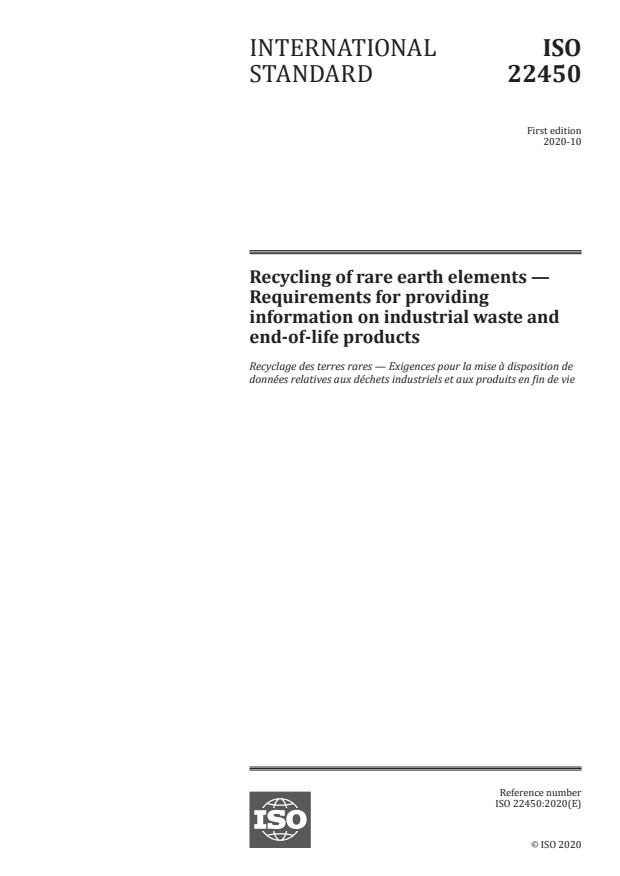
(Main)Recycling of rare earth elements — Requirements for providing information on industrial waste and end-of-life products
Recycling of rare earth elements — Requirements for providing information on industrial waste and end-of-life products
This document specifies the recycling information to be provided for rare earth elements (REEs) in industrial waste and end-of-life (EOL) products from manufacturers/producers to recyclers. It includes a classification system and forms for providing the recycling information.
Recyclage des terres rares — Exigences pour la mise à disposition de données relatives aux déchets industriels et aux produits en fin de vie
General Information
- Status
- Published
- Publication Date
- 14-Oct-2020
- Technical Committee
- ISO/TC 298 - Rare earth
- Drafting Committee
- ISO/TC 298/WG 2 - Elements recycling
- Current Stage
- 9060 - Close of review
- Completion Date
- 04-Jun-2031
Overview - ISO 22450:2020 (REE recycling information)
ISO 22450:2020 specifies the information manufacturers and producers must provide to recyclers about rare earth elements (REEs) present in industrial waste and end-of-life (EOL) products. The standard establishes a common classification system (WRExxxx) and standardized forms to communicate composition, form and recycling-relevant details that enable efficient recovery of REEs from magnets, LEDs, NiMH batteries, catalysts and other REE-containing wastes.
Key topics and technical requirements
- Scope and definitions: Clear terminology for REE waste products, REE magnets, phosphors, NiMH batteries, processing waste, scrap and EOL products.
- Forms of REEs in waste: Describes typical physical and chemical forms encountered in recycling streams (e.g., flakes, chips, oxides, phosphors, electrode pieces, slurries).
- Classification and coding (WRExxxx): A four-digit coding system where the first two digits identify product type (e.g., WRE01xx for REE magnets, WRE02xx for LED phosphors) and the second two digits denote elemental or key characteristics. Codes reserve “99” for “other” categories to allow expansion.
- Recycling information requirements: Specifies the data elements manufacturers should supply to recyclers (composition indicators, manufacturing method, expected contamination, form of material) and references forms for information exchange (Annex A).
- Context and rationale: Includes industry-level waste-stock estimates and highlights the gap between REE waste generated and amounts recycled, underscoring the need for standardized information exchange to improve recycling yield.
Practical applications - who uses ISO 22450
- Manufacturers / OEMs (motors, EVs, consumer electronics, LEDs, batteries, catalysts) - to document REE content and facilitate end-of-life recovery.
- Recyclers and waste processors - to identify feedstock, choose appropriate separation and metallurgical routes, and improve recovery rates.
- Design and materials engineers - to design products with recyclability in mind and supply required disclosure data.
- Regulators, waste managers and sustainability teams - to harmonize reporting, support circular economy goals and manage REE resource security.
- Supply-chain and compliance officers - for traceability and communication between producers and recyclers.
Related standards
- ISO/TS 22451 - measurement methods for REEs in industrial waste and EOL products.
- ISO 22453 - database management for information exchanged among producers, recyclers and authorities.
ISO 22450:2020 supports improved REE recovery by standardizing the classification, data fields and forms needed to move information smoothly from producers to recyclers - a practical tool for increasing recycling efficiency, reducing supply risk and advancing circular economy practices for critical rare earth elements.
Buy Documents
ISO 22450:2020 - Recycling of rare earth elements -- Requirements for providing information on industrial waste and end-of-life products


ISO 22450:2020 - Recycling of rare earth elements — Requirements for providing information on industrial waste and end-of-life products/15/2020
Get Certified
Connect with accredited certification bodies for this standard

NSF International
Global independent organization facilitating standards development and certification.

CIS Institut d.o.o.
Personal Protective Equipment (PPE) certification body. Notified Body NB-2890 for EU Regulation 2016/425 PPE.

Kiwa BDA Testing
Building and construction product certification.
Sponsored listings
Frequently Asked Questions
ISO 22450:2020 is a standard published by the International Organization for Standardization (ISO). Its full title is "Recycling of rare earth elements — Requirements for providing information on industrial waste and end-of-life products". This standard covers: This document specifies the recycling information to be provided for rare earth elements (REEs) in industrial waste and end-of-life (EOL) products from manufacturers/producers to recyclers. It includes a classification system and forms for providing the recycling information.
This document specifies the recycling information to be provided for rare earth elements (REEs) in industrial waste and end-of-life (EOL) products from manufacturers/producers to recyclers. It includes a classification system and forms for providing the recycling information.
ISO 22450:2020 is classified under the following ICS (International Classification for Standards) categories: 13.030.30 - Special wastes; 13.030.50 - Recycling. The ICS classification helps identify the subject area and facilitates finding related standards.
ISO 22450:2020 is available in PDF format for immediate download after purchase. The document can be added to your cart and obtained through the secure checkout process. Digital delivery ensures instant access to the complete standard document.
Standards Content (Sample)
INTERNATIONAL ISO
STANDARD 22450
First edition
2020-10
Recycling of rare earth elements —
Requirements for providing
information on industrial waste and
end-of-life products
Recyclage des terres rares — Exigences pour la mise à disposition de
données relatives aux déchets industriels et aux produits en fin de vie
Reference number
©
ISO 2020
© ISO 2020
All rights reserved. Unless otherwise specified, or required in the context of its implementation, no part of this publication may
be reproduced or utilized otherwise in any form or by any means, electronic or mechanical, including photocopying, or posting
on the internet or an intranet, without prior written permission. Permission can be requested from either ISO at the address
below or ISO’s member body in the country of the requester.
ISO copyright office
CP 401 • Ch. de Blandonnet 8
CH-1214 Vernier, Geneva
Phone: +41 22 749 01 11
Email: copyright@iso.org
Website: www.iso.org
Published in Switzerland
ii © ISO 2020 – All rights reserved
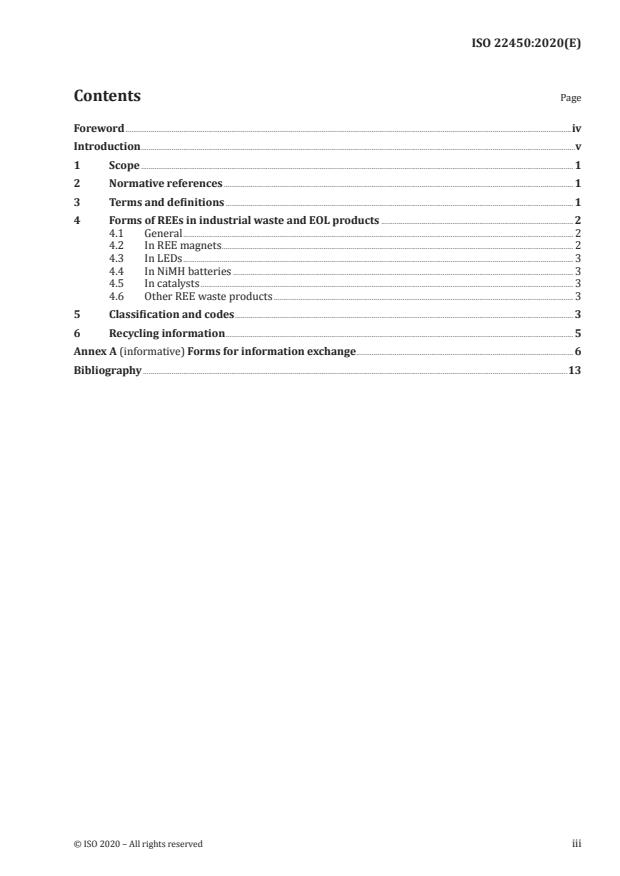
Contents Page
Foreword .iv
Introduction .v
1 Scope . 1
2 Normative references . 1
3 Terms and definitions . 1
4 Forms of REEs in industrial waste and EOL products . 2
4.1 General . 2
4.2 In REE magnets . 2
4.3 In LEDs . 3
4.4 In NiMH batteries . 3
4.5 In catalysts . 3
4.6 Other REE waste products . 3
5 Classification and codes . 3
6 Recycling information . 5
Annex A (informative) Forms for information exchange . 6
Bibliography .13
Foreword
ISO (the International Organization for Standardization) is a worldwide federation of national standards
bodies (ISO member bodies). The work of preparing International Standards is normally carried out
through ISO technical committees. Each member body interested in a subject for which a technical
committee has been established has the right to be represented on that committee. International
organizations, governmental and non-governmental, in liaison with ISO, also take part in the work.
ISO collaborates closely with the International Electrotechnical Commission (IEC) on all matters of
electrotechnical standardization.
The procedures used to develop this document and those intended for its further maintenance are
described in the ISO/IEC Directives, Part 1. In particular, the different approval criteria needed for the
different types of ISO documents should be noted. This document was drafted in accordance with the
editorial rules of the ISO/IEC Directives, Part 2 (see www .iso .org/ directives).
Attention is drawn to the possibility that some of the elements of this document may be the subject of
patent rights. ISO shall not be held responsible for identifying any or all such patent rights. Details of
any patent rights identified during the development of the document will be in the Introduction and/or
on the ISO list of patent declarations received (see www .iso .org/ patents).
Any trade name used in this document is information given for the convenience of users and does not
constitute an endorsement.
For an explanation of the voluntary nature of standards, the meaning of ISO specific terms and
expressions related to conformity assessment, as well as information about ISO’s adherence to the
World Trade Organization (WTO) principles in the Technical Barriers to Trade (TBT), see www .iso .org/
iso/ foreword .html.
This document was prepared by Technical Committee ISO/TC 298, Rare earth.
Any feedback or questions on this document should be directed to the user’s national standards body. A
complete listing of these bodies can be found at www .iso .org/ members .html.
iv © ISO 2020 – All rights reserved
Introduction
Rare earth elements (REEs) comprise the lanthanoid series elements plus scandium and yttrium,
which have similar chemical and physical properties and are often found in the same ores and deposits.
The importance of REEs has increased greatly due to their important role in high performance and
functional applications in permanent magnets, electric vehicles, motors, wind generators, light-
emitting diodes (LED), nickel-metal hydride (NiMH) batteries, etc. Magnets can be also classified into
manufacturing methods. The type of magnet is useful information for recycling procedures.
Magnets account for the highest market share of REEs by value. REE-containing multi-component
alloys can have a complex compositional make-up. The variants include compositions such as
Sm Co , Sm(Co Fe Cu Zr ) , Sm(Co Fe Cu Zr Ti ) , Sm Fe N , Nd(Fe,Mo) N ,
62 38 0.69 0.2 0.1 0.01 7.2 0.67 0.22 0.1 0.07 0.01 7.1 2 17 x 12 x
Sm (Fe,M) N , sintered Nd Fe B/α-Fe, Sm Fe N /α-Fe, PrFeCuB, Tb Dy Fe (x ~0,3) and others are
3 29 x 2 14 2 17 x x 1−x 2
used in permanent magnets. Due to the complexity involved in processing of these magnets, several
different manufacturing routes are used. During the production stages, industrial waste containing
REEs is produced and often recycled. Magnets found in end-of-life (EOL) or broken electronics, hard
disk drives, motors, generators, etc. also contribute to waste.
Phosphors and luminescence applications of REEs constitute about a one-third share of the total
demand for REEs. REEs contained in (La Ce Tb )PO , (Y Eu )O , (Ba Eu )MgAl O ,
0.6 0.27 0.13 4 1.94 0.06 3 0.9 0.1 10 17
Ca Eu AlSiN , (Y Ce ) Al O , etc. are important materials used in phosphor and LED
0.98 0.02 3 0.98 0.02 3 5 12
semiconductor technology. The LED manufacturing process is complex and is undergoing much change
with the growth of the industry and the changes in demand patterns of associated commodities. During
the production stages of LEDs, a lot of waste is created, which is recycled. EOL LEDs found in broken
smartphones, TVs, display panels, cameras, etc. also contribute to waste.
Batteries make up a relatively lower amount of the total demand for REEs. REEs contained in multi-
component alloys such as LaNi , La Nd Ni Co Si , La Nd Ni Co Al and MmNi Co Al
5 0.8 0.2 2.5 2.4 0.1 0.8 0.2 2.5 2.4 0.1 3.5 0.7 0.8
are used in rechargeable NiMH batteries due to their superior hydrogen storage properties. The
production of these NiMH batteries produces waste, which is generally recycled. EOL batteries also
contribute to waste.
Numerous categories are schematically illustrated in Figure 1 in which waste can be generated during
manufacturing to the EOL stage for magnets, LEDs and batteries.
Figure 1 — Waste generation during various processes
Resource scarcity of these valuable commodities is inevitable. Furthermore, the accumulation of waste
materials creates environmental and economic problems. A viable option to ensure a smooth balance of
supply and demand is to recycle these elements.
[3]
Table 1 summarizes the expected REE waste stock that will be accumulated until 2020 . It also gives
the indication of recycled REE stock until 2020 by keeping in view the maturity of recycling techniques
and industry.
[3]
Table 1 — Expected REE waste stock in the year 2020
Expected REE stock in 2020 Recycling process Recycled REE in 2020
REE application
(tons) efficiency (tons)
Magnets 300 000 55 % 2 333
Lamp phosphors 23 000 80 % 6 600
NiMH batteries 50 000 50 % 1 750
NOTE This table presents the current distribution, however, markets and waste distribution can change over time.
There is a big difference in amount of waste generated by REEs and what is recycled due to a lack of
maturity of recycling technologies and communication formats between manufacturers/producers
and recyclers. In the REE recycling process, an important initial step is the identification of products
containing REEs. A typical recycling process is shown in Figure 2.
vi © ISO 2020 – All rights reserved
Key
black arrows forward steps
red arrows additional steps proposed in this document
NOTE This document, ISO/TS 22451 and ISO 22453 are documents for ensuring a smooth recovery of REE from waste.
Figure 2 — Typical recycling process
This document defines REE-related substances that are recycled at the product stage as waste or
EOL products and suggests ways to facilitate their recycling through an identification of the waste
composition. ISO/TS 22451 specifies measurement methods of REEs in industrial waste and EOL
products. ISO 22453 focuses on the management of a database obtained from communication with the
producer, recycler and a management agency for effective recycling. The simultaneous application of
these three documents is necessary to ensure the complete and efficient recycling of valuable REEs.
INTERNATIONAL STANDARD ISO 22450:2020(E)
Recycling of rare earth elements — Requirements for
providing information on industrial waste and end-of-life
products
1 Scope
This document specifies the recycling information to be provided for rare earth elements (REEs) in
industrial waste and end-of-life (EOL) products from manufacturers/producers to recyclers. It includes
a classification system and forms for providing the recycling information.
2 Normative references
The following documents are referred to in the text in such a way that some or all of their content
constitutes requirements of this document. For dated references, only the edition cited applies. For
undated references, the latest edition of the referenced document (including any amendments) applies.
ISO 21067-1, Packaging — Vocabulary — Part 1: General terms
ISO 22444-1, Rare earth — Vocabulary — Part 1: Minerals, oxides and other compounds
ISO 22444-2, Rare earth
...
INTERNATIONAL ISO
STANDARD 22450
First edition
2020-10
Recycling of rare earth elements —
Requirements for providing
information on industrial waste and
end-of-life products
Recyclage des terres rares — Exigences pour la mise à disposition de
données relatives aux déchets industriels et aux produits en fin de vie
Reference number
©
ISO 2020
© ISO 2020
All rights reserved. Unless otherwise specified, or required in the context of its implementation, no part of this publication may
be reproduced or utilized otherwise in any form or by any means, electronic or mechanical, including photocopying, or posting
on the internet or an intranet, without prior written permission. Permission can be requested from either ISO at the address
below or ISO’s member body in the country of the requester.
ISO copyright office
CP 401 • Ch. de Blandonnet 8
CH-1214 Vernier, Geneva
Phone: +41 22 749 01 11
Email: copyright@iso.org
Website: www.iso.org
Published in Switzerland
ii © ISO 2020 – All rights reserved
Contents Page
Foreword .iv
Introduction .v
1 Scope . 1
2 Normative references . 1
3 Terms and definitions . 1
4 Forms of REEs in industrial waste and EOL products . 2
4.1 General . 2
4.2 In REE magnets . 2
4.3 In LEDs . 3
4.4 In NiMH batteries . 3
4.5 In catalysts . 3
4.6 Other REE waste products . 3
5 Classification and codes . 3
6 Recycling information . 5
Annex A (informative) Forms for information exchange . 6
Bibliography .13
Foreword
ISO (the International Organization for Standardization) is a worldwide federation of national standards
bodies (ISO member bodies). The work of preparing International Standards is normally carried out
through ISO technical committees. Each member body interested in a subject for which a technical
committee has been established has the right to be represented on that committee. International
organizations, governmental and non-governmental, in liaison with ISO, also take part in the work.
ISO collaborates closely with the International Electrotechnical Commission (IEC) on all matters of
electrotechnical standardization.
The procedures used to develop this document and those intended for its further maintenance are
described in the ISO/IEC Directives, Part 1. In particular, the different approval criteria needed for the
different types of ISO documents should be noted. This document was drafted in accordance with the
editorial rules of the ISO/IEC Directives, Part 2 (see www .iso .org/ directives).
Attention is drawn to the possibility that some of the elements of this document may be the subject of
patent rights. ISO shall not be held responsible for identifying any or all such patent rights. Details of
any patent rights identified during the development of the document will be in the Introduction and/or
on the ISO list of patent declarations received (see www .iso .org/ patents).
Any trade name used in this document is information given for the convenience of users and does not
constitute an endorsement.
For an explanation of the voluntary nature of standards, the meaning of ISO specific terms and
expressions related to conformity assessment, as well as information about ISO’s adherence to the
World Trade Organization (WTO) principles in the Technical Barriers to Trade (TBT), see www .iso .org/
iso/ foreword .html.
This document was prepared by Technical Committee ISO/TC 298, Rare earth.
Any feedback or questions on this document should be directed to the user’s national standards body. A
complete listing of these bodies can be found at www .iso .org/ members .html.
iv © ISO 2020 – All rights reserved
Introduction
Rare earth elements (REEs) comprise the lanthanoid series elements plus scandium and yttrium,
which have similar chemical and physical properties and are often found in the same ores and deposits.
The importance of REEs has increased greatly due to their important role in high performance and
functional applications in permanent magnets, electric vehicles, motors, wind generators, light-
emitting diodes (LED), nickel-metal hydride (NiMH) batteries, etc. Magnets can be also classified into
manufacturing methods. The type of magnet is useful information for recycling procedures.
Magnets account for the highest market share of REEs by value. REE-containing multi-component
alloys can have a complex compositional make-up. The variants include compositions such as
Sm Co , Sm(Co Fe Cu Zr ) , Sm(Co Fe Cu Zr Ti ) , Sm Fe N , Nd(Fe,Mo) N ,
62 38 0.69 0.2 0.1 0.01 7.2 0.67 0.22 0.1 0.07 0.01 7.1 2 17 x 12 x
Sm (Fe,M) N , sintered Nd Fe B/α-Fe, Sm Fe N /α-Fe, PrFeCuB, Tb Dy Fe (x ~0,3) and others are
3 29 x 2 14 2 17 x x 1−x 2
used in permanent magnets. Due to the complexity involved in processing of these magnets, several
different manufacturing routes are used. During the production stages, industrial waste containing
REEs is produced and often recycled. Magnets found in end-of-life (EOL) or broken electronics, hard
disk drives, motors, generators, etc. also contribute to waste.
Phosphors and luminescence applications of REEs constitute about a one-third share of the total
demand for REEs. REEs contained in (La Ce Tb )PO , (Y Eu )O , (Ba Eu )MgAl O ,
0.6 0.27 0.13 4 1.94 0.06 3 0.9 0.1 10 17
Ca Eu AlSiN , (Y Ce ) Al O , etc. are important materials used in phosphor and LED
0.98 0.02 3 0.98 0.02 3 5 12
semiconductor technology. The LED manufacturing process is complex and is undergoing much change
with the growth of the industry and the changes in demand patterns of associated commodities. During
the production stages of LEDs, a lot of waste is created, which is recycled. EOL LEDs found in broken
smartphones, TVs, display panels, cameras, etc. also contribute to waste.
Batteries make up a relatively lower amount of the total demand for REEs. REEs contained in multi-
component alloys such as LaNi , La Nd Ni Co Si , La Nd Ni Co Al and MmNi Co Al
5 0.8 0.2 2.5 2.4 0.1 0.8 0.2 2.5 2.4 0.1 3.5 0.7 0.8
are used in rechargeable NiMH batteries due to their superior hydrogen storage properties. The
production of these NiMH batteries produces waste, which is generally recycled. EOL batteries also
contribute to waste.
Numerous categories are schematically illustrated in Figure 1 in which waste can be generated during
manufacturing to the EOL stage for magnets, LEDs and batteries.
Figure 1 — Waste generation during various processes
Resource scarcity of these valuable commodities is inevitable. Furthermore, the accumulation of waste
materials creates environmental and economic problems. A viable option to ensure a smooth balance of
supply and demand is to recycle these elements.
[3]
Table 1 summarizes the expected REE waste stock that will be accumulated until 2020 . It also gives
the indication of recycled REE stock until 2020 by keeping in view the maturity of recycling techniques
and industry.
[3]
Table 1 — Expected REE waste stock in the year 2020
Expected REE stock in 2020 Recycling process Recycled REE in 2020
REE application
(tons) efficiency (tons)
Magnets 300 000 55 % 2 333
Lamp phosphors 23 000 80 % 6 600
NiMH batteries 50 000 50 % 1 750
NOTE This table presents the current distribution, however, markets and waste distribution can change over time.
There is a big difference in amount of waste generated by REEs and what is recycled due to a lack of
maturity of recycling technologies and communication formats between manufacturers/producers
and recyclers. In the REE recycling process, an important initial step is the identification of products
containing REEs. A typical recycling process is shown in Figure 2.
vi © ISO 2020 – All rights reserved
Key
black arrows forward steps
red arrows additional steps proposed in this document
NOTE This document, ISO/TS 22451 and ISO 22453 are documents for ensuring a smooth recovery of REE from waste.
Figure 2 — Typical recycling process
This document defines REE-related substances that are recycled at the product stage as waste or
EOL products and suggests ways to facilitate their recycling through an identification of the waste
composition. ISO/TS 22451 specifies measurement methods of REEs in industrial waste and EOL
products. ISO 22453 focuses on the management of a database obtained from communication with the
producer, recycler and a management agency for effective recycling. The simultaneous application of
these three documents is necessary to ensure the complete and efficient recycling of valuable REEs.
INTERNATIONAL STANDARD ISO 22450:2020(E)
Recycling of rare earth elements — Requirements for
providing information on industrial waste and end-of-life
products
1 Scope
This document specifies the recycling information to be provided for rare earth elements (REEs) in
industrial waste and end-of-life (EOL) products from manufacturers/producers to recyclers. It includes
a classification system and forms for providing the recycling information.
2 Normative references
The following documents are referred to in the text in such a way that some or all of their content
constitutes requirements of this document. For dated references, only the edition cited applies. For
undated references, the latest edition of the referenced document (including any amendments) applies.
ISO 21067-1, Packaging — Vocabulary — Part 1: General terms
ISO 22444-1, Rare earth — Vocabulary — Part 1: Minerals, oxides and other compounds
ISO 22444-2, Rare earth
...
Questions, Comments and Discussion
Ask us and Technical Secretary will try to provide an answer. You can facilitate discussion about the standard in here.
Loading comments...