

ISO/IEC 19823-21:2026
(Main)Information technology — Conformance test methods for security service crypto suites — Part 21: Crypto suite SIMON
General Information
- Abstract
This document describes the test methods for determining conformance to the security crypto suite SIMON defined in ISO/IEC 29167-21. This document contains conformance tests for all mandatory functions. Unless otherwise specified, the tests in this document are only applicable to radio frequency identification (RFID) Tags and Interrogators defined in the ISO/IEC 18000 series using ISO/IEC 29167-21.
- Status
- Published
- Publication Date
- 05-Mar-2026
- Technical Committee
- ISO/IEC JTC 1/SC 31 - Automatic identification and data capture techniques
- Drafting Committee
- ISO/IEC JTC 1/SC 31/WG 4 - Radio communications
- Current Stage
- 6060 - International Standard published
- Start Date
- 06-Mar-2026
- Due Date
- 01-Mar-2027
- Completion Date
- 06-Mar-2026


Overview
ISO/IEC 19823-21:2026 specifies conformance test methods for the security service crypto suite SIMON, as defined in ISO/IEC 29167-21. Developed by the International Organization for Standardization (ISO) and the International Electrotechnical Commission (IEC), this international standard applies primarily to radio frequency identification (RFID) Tags and Interrogators that operate according to the ISO/IEC 18000 series and implement the SIMON cryptographic suite specification.
The document provides a framework for testing all mandatory functions of the SIMON crypto suite, ensuring that RFID products claiming conformance to the standard meet defined security and interoperability requirements. These conformance tests play an essential role in verifying secure air interface communications through standardized protocols and cryptographic mechanisms.
Key Topics
Scope of Testing
The standard defines test methods specifically for the SIMON crypto suite as described in ISO/IEC 29167-21. It covers all mandatory functions that must be implemented by compliant RFID Tags and Interrogators.Types of Test Methods
- By Design: Involves verification through analysis of technical documentation or theoretical review.
- By Demonstration: Involves laboratory testing using selected products to ensure practical compliance.
Conformance Parameters
The tests assess system parameters for protocol compliance, command and reply handling, and the use of nominal values and tolerances essential for interoperability.Optional Features and Test Patterns
The document includes a test map and a set of predefined test patterns to evaluate support for optional features such as tag authentication, interrogator authentication, mutual authentication, and secure communications.Integration with Related Standards
Testing is intended to be used alongside the ISO/IEC 18047 series to avoid redundancy and ensure complete assessment of RFID product conformance.
Applications
ISO/IEC 19823-21:2026 delivers practical value for a wide range of applications within the RFID and automatic identification sectors:
- RFID Tag and Interrogator Manufacturers
Provides a clear and authoritative test framework to verify that products implementing the SIMON crypto suite are compliant with global interoperability and security requirements. - Testing Laboratories
Offers standard test procedures and parameters that ensure consistent validation and certification of RFID devices across international markets. - System Integrators and Solution Providers
Facilitates reliable integration of RFID components by confirming security capabilities and protocol interoperability, especially in sensitive or high-security environments. - Users and End Customers
Ensures that implemented RFID solutions have undergone rigorous conformance testing, boosting trust in secure communication and data protection.
Related Standards
ISO/IEC 19823-21:2026 works in conjunction with several other international standards in information technology, security, and RFID:
- ISO/IEC 29167-21: Defines the technical specification for the SIMON cryptographic suite.
- ISO/IEC 18000 series: Provides foundational protocols and air interface communication standards for RFID devices.
- ISO/IEC 18047 series: Describes conformance test methods for the ISO/IEC 18000 RFID device specification.
- ISO/IEC 19762: Supplies terminology for automatic identification and data capture (AIDC) techniques.
- ISO/IEC 17025: Specifies general requirements for the competence of testing and calibration laboratories.
By adhering to ISO/IEC 19823-21:2026, stakeholders ensure that products and systems are rigorously tested against recognized international standards, supporting secure and interoperable RFID deployments across various industries.
Relations
- Effective Date
- 03-Feb-2024
Get Certified
Connect with accredited certification bodies for this standard

BSI Group
BSI (British Standards Institution) is the business standards company that helps organizations make excellence a habit.

Bureau Veritas
Bureau Veritas is a world leader in laboratory testing, inspection and certification services.

DNV
DNV is an independent assurance and risk management provider.
Sponsored listings
Frequently Asked Questions
ISO/IEC 19823-21:2026 is a standard published by the International Organization for Standardization (ISO). Its full title is "Information technology — Conformance test methods for security service crypto suites — Part 21: Crypto suite SIMON". This standard covers: This document describes the test methods for determining conformance to the security crypto suite SIMON defined in ISO/IEC 29167-21. This document contains conformance tests for all mandatory functions. Unless otherwise specified, the tests in this document are only applicable to radio frequency identification (RFID) Tags and Interrogators defined in the ISO/IEC 18000 series using ISO/IEC 29167-21.
This document describes the test methods for determining conformance to the security crypto suite SIMON defined in ISO/IEC 29167-21. This document contains conformance tests for all mandatory functions. Unless otherwise specified, the tests in this document are only applicable to radio frequency identification (RFID) Tags and Interrogators defined in the ISO/IEC 18000 series using ISO/IEC 29167-21.
ISO/IEC 19823-21:2026 is classified under the following ICS (International Classification for Standards) categories: 35.030 - IT Security. The ICS classification helps identify the subject area and facilitates finding related standards.
ISO/IEC 19823-21:2026 has the following relationships with other standards: It is inter standard links to ISO/IEC 19823-21:2019. Understanding these relationships helps ensure you are using the most current and applicable version of the standard.
ISO/IEC 19823-21:2026 is available in PDF format for immediate download after purchase. The document can be added to your cart and obtained through the secure checkout process. Digital delivery ensures instant access to the complete standard document.
Standards Content (Sample)
International
Standard
ISO/IEC 19823-21
Second edition
Information technology —
2026-03
Conformance test methods for
security service crypto suites —
Part 21:
Crypto suite SIMON
Technologies de l'information — Méthodes d'essai de conformité
pour les suites cryptographiques des services de sécurité —
Partie 21: Suite cryptographique SIMON
Reference number
© ISO/IEC 2026
All rights reserved. Unless otherwise specified, or required in the context of its implementation, no part of this publication may
be reproduced or utilized otherwise in any form or by any means, electronic or mechanical, including photocopying, or posting on
the internet or an intranet, without prior written permission. Permission can be requested from either ISO at the address below
or ISO’s member body in the country of the requester.
ISO copyright office
CP 401 • Ch. de Blandonnet 8
CH-1214 Vernier, Geneva
Phone: +41 22 749 01 11
Email: copyright@iso.org
Website: www.iso.org
Published in Switzerland
© ISO/IEC 2026 – All rights reserved
ii
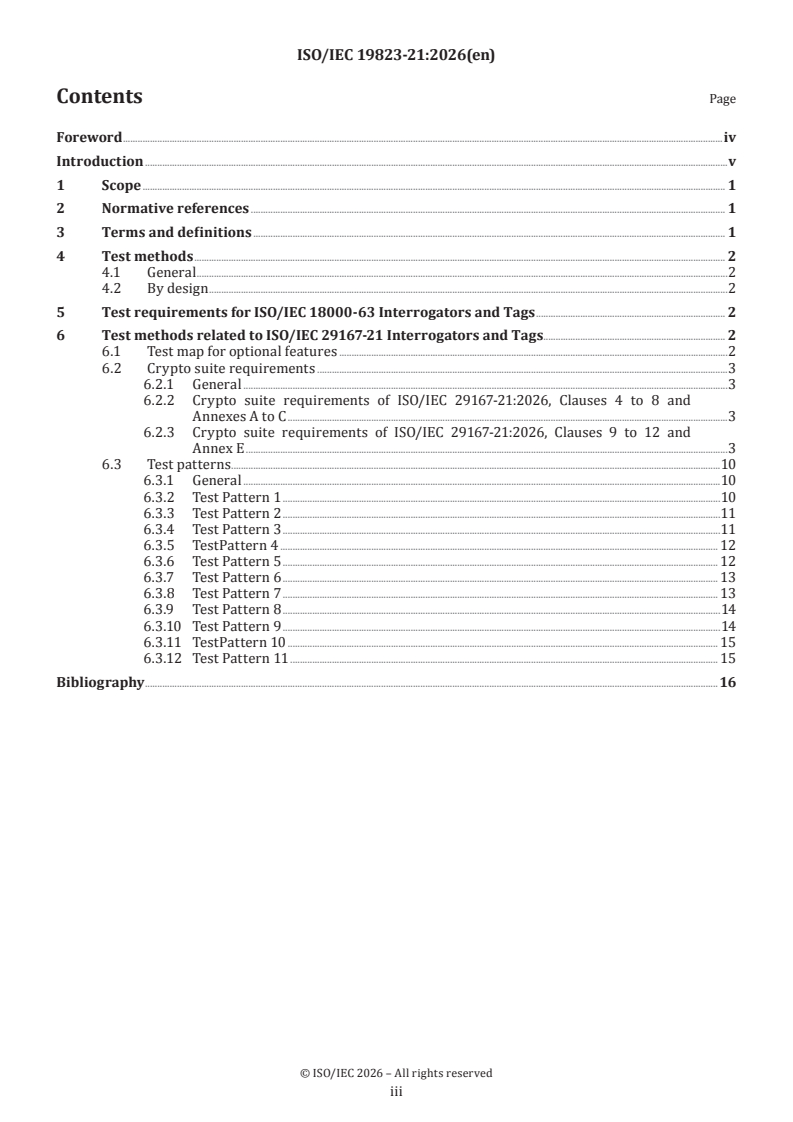
Contents Page
Foreword .iv
Introduction .v
1 Scope . 1
2 Normative references . 1
3 Terms and definitions . 1
4 Test methods . 2
4.1 General .2
4.2 By design .2
5 Test requirements for ISO/IEC 18000-63 Interrogators and Tags . 2
6 Test methods related to ISO/IEC 29167-21 Interrogators and Tags . 2
6.1 Test map for optional features .2
6.2 Crypto suite requirements .3
6.2.1 General .3
6.2.2 Crypto suite requirements of ISO/IEC 29167-21:2026, Clauses 4 to 8 and
Annexes A to C .3
6.2.3 Crypto suite requirements of ISO/IEC 29167-21:2026, Clauses 9 to 12 and
Annex E .3
6.3 Test patterns . .10
6.3.1 General .10
6.3.2 Test Pattern 1 .10
6.3.3 Test Pattern 2 .11
6.3.4 Test Pattern 3 .11
6.3.5 TestPattern 4 . 12
6.3.6 Test Pattern 5 . 12
6.3.7 Test Pattern 6 . 13
6.3.8 Test Pattern 7 . 13
6.3.9 Test Pattern 8 .14
6.3.10 Test Pattern 9 .14
6.3.11 TestPattern 10 . 15
6.3.12 Test Pattern 11 . 15
Bibliography .16
© ISO/IEC 2026 – All rights reserved
iii
Foreword
ISO (the International Organization for Standardization) and IEC (the International Electrotechnical
Commission) form the specialized system for worldwide standardization. National bodies that are
members of ISO or IEC participate in the development of International Standards through technical
committees established by the respective organization to deal with particular fields of technical activity.
ISO and IEC technical committees collaborate in fields of mutual interest. Other international organizations,
governmental and non-governmental, in liaison with ISO and IEC, also take part in the work.
The procedures used to develop this document and those intended for its further maintenance are described
in the ISO/IEC Directives, Part 1. In particular, the different approval criteria needed for the different types
of document should be noted. This document was drafted in accordance with the editorial rules of the ISO/
IEC Directives, Part 2 (see www.iso.org/directives or www.iec.ch/members_experts/refdocs).
ISO and IEC draw attention to the possibility that the implementation of this document may involve the
use of (a) patent(s). ISO and IEC take no position concerning the evidence, validity or applicability of any
claimed patent rights in respect thereof. As of the date of publication of this document, ISO and IEC had
received notice of (a) patent(s) which may be required to implement this document. However, implementers
are cautioned that this may not represent the latest information, which may be obtained from the patent
database available at www.iso.org/patents and https://patents.iec.ch. ISO and IEC shall not be held
responsible for identifying any or all such patent rights.
Any trade name used in this document is information given for the convenience of users and does not
constitute an endorsement.
For an explanation of the voluntary nature of standards, the meaning of ISO specific terms and expressions
related to conformity assessment, as well as information about ISO's adherence to the World Trade
Organization (WTO) principles in the Technical Barriers to Trade (TBT) see www.iso.org/iso/foreword.html.
In the IEC, see www.iec.ch/understanding-standards.
This document was prepared by Joint Technical Committee ISO/IEC JTC 1, Information technology,
Subcommittee SC 31, Automatic identification and data capture techniques.
This second edition cancels and replaces the first edition (ISO/IEC 19823-21:2019), which has been
technically revised.
The main change is as follows: test items have been updated to reflect changes to the over-the-air protocol.
A list of all parts in the ISO/IEC 19823 series can be found on the ISO and IEC websites.
Any feedback or questions on this document should be directed to the user’s national standards
body. A complete listing of these bodies can be found at www.iso.org/members.html and
www.iec.ch/national-committees.
© ISO/IEC 2026 – All rights reserved
iv
Introduction
The ISO/IEC 29167 series describes security services that are applicable for the ISO/IEC 18000 series.
The various parts of the ISO/IEC 29167 series describe crypto suites that are optional extensions to the
ISO/IEC 18000 air interfaces.
The ISO/IEC 19823 series describes conformance test methods for security service crypto suites.
The ISO/IEC 19823 series is related to the ISO/IEC 18047 series, which describes the radio frequency
identification device conformance test methods, in the same way as the ISO/IEC 29167 series is related
to the ISO/IEC 18000 series. These relations mean that, for a product that is claimed to conform to a pair
ISO/IEC 18000-n and ISO/IEC 29167-m, the test methods of ISO/IEC 18047-n and ISO/IEC 19823-m apply. If
a product supports more than one part of the ISO/IEC 18000 series or the ISO/IEC 29167 series, all related
parts of the ISO/IEC 18047 series and the ISO/IEC 19823 series apply.
The conformance parameters are:
— parameters that apply directly affecting system functionality and inter-operability;
— protocol including commands and replies;
— nominal values and tolerances.
NOTE 1 ISO/IEC 18047-6 contains the conformance test requirements of ISO/IEC 18000-6, ISO/IEC 18000-61,
ISO/IEC 18000-62, ISO/IEC 18000-63 and ISO/IEC 18000-64.
NOTE 2 Test methods for Interrogator and Tag performance are covered by the ISO/IEC 18046 series.
© ISO/IEC 2026 – All rights reserved
v
International Standard ISO/IEC 19823-21:2026(en)
Information technology — Conformance test methods for
security service crypto suites —
Part 21:
Crypto suite SIMON
1 Scope
This document describes the test methods for determining conformance to the security crypto suite SIMON
defined in ISO/IEC 29167-21.
This document contains conformance tests for all mandatory functions.
Unless otherwise specified, the tests in this document are only applicable to radio frequency identification
(RFID) Tags and Interrogators defined in the ISO/IEC 18000 series using ISO/IEC 29167-21.
2 Normative references
The following documents are referred to in the text in such a way that some or all of their content constitutes
requirements of this document. For dated references, only the edition cited applies. For undated references,
the latest edition of the referenced document (including any amendments) applies.
ISO/IEC 17025, General requirements for the competence of testing and calibration laboratories
ISO/IEC 18000-63, Information technology — Radio frequency identification for item management — Part 63:
Parameters for air interface communications at 860 MHz to 930 MHz Type C
ISO/IEC 18047-6:2025, Information technology — Radio frequency identification device conformance test
methods — Part 6: Test methods for air interface communications at 860 MHz to 930 MHz
ISO/IEC 19762, Information technology — Automatic identification and data capture (AIDC) techniques —
Vocabulary
ISO/IEC 29167-21:2026, Information technology — Automatic identification and data capture techniques —
Part 21: Crypto suite SIMON security services for air interface communications
3 Terms and definitions
For the purposes of this document, the terms and definitions given in ISO/IEC 19762 and ISO/IEC 29167-21
apply.
ISO and IEC maintain terminology databases for use in standardization at the following addresses:
— ISO Online browsing platform: available at https:// www .iso .org/ obp
— IEC Electropedia: available at https:// www .electropedia .org/
© ISO/IEC 2026 – All rights reserved
4 Test methods
4.1 General
This document describes the test methods for ISO/IEC 29167-21. As parts of the ISO/IEC 19823 series are
always intended to be tested in conjunction with the ISO/IEC 18047 series, duplication of information,
requirements and specifications present in the ISO/IEC 18047 series has been avoided.
Clause 5 describes elements that are covered in the respective part of the ISO/IEC 18047 series.
Clause 6 describes elements that are not covered by the ISO/IEC 18047 series and that are therefore
addressed in this document.
By demonstration
If tests are labelled “by demonstration”, then laboratory testing of one or (if required for statistical reasons)
multiple products, processes or services is required to ensure conformance.
A test laboratory that meets the requirements of ISO/IEC 17025 shall perform the indicated testing to ensure
conformance of the component or system.
For protocol requirements that are verified by demonstration, the test conditions are specified in this
document. The detailed test plan is left to the discretion of the test laboratory.
4.2 By design
If tests are labelled “by design”, then either the verification of design parameters or theoretical analysis, or
both, are used to ensure conformance. A vendor submitting a component or system for conformance testing
shall provide the necessary technical information, in the form of a technical memorandum or similar. A
test laboratory shall issue a test report indicating whether the technical analysis was sufficient to ensure
conformance of the component or system.
For protocol requirements that are verified by design, the method of technical analysis is at the discretion
of the submitting vendor and is not specified by this document. In general, the technical analysis shall have
sufficient rigor and technical depth to convince a test engineer knowledgeable of the protocol that the
particular requirement has been met.
5 Test requirements for ISO/IEC 18000-63 Interrogators and Tags
The requirements and recommendations of ISO/IEC 18047-6:2025, Clauses 4 and 5 shall be fulfilled.
Before a device under test is tested according to this document, it shall successfully pass ISO/IEC 18047-6:2025,
Clause 7.
6 Test methods related to ISO/IEC 29167-21 Interrogators and Tags
6.1 Test map for optional features
Table 1 lists all optional features of this crypto suite and shall be used as a template to report the test results.
Furthermore, it is used to refer to the test requirements in 6.2.
© ISO/IEC 2026 – All rights reserved
Table 1 — Test map for optional features
Mark item to be
Item Test
Feature Additional requirement tested for
no. result
supplied product
Shall be tested with the Authenticate command
1 Tag authentication
of ISO/IEC 18000-63.
Shall be tested with the Authenticate command
2 Interrogator authentication
of ISO/IEC 18000-63.
Shall be tested with the Authenticate command
3 Mutual authentication
of ISO/IEC 18000-63.
Shall be tested with the SecureComm command
4 Secure communication
of ISO/IEC 18000-63.
6.2 Crypto suite requirements
6.2.1 General
Subclause 6.2 refers to the requirements of ISO/IEC 29167-21.
6.2.2 Crypto suite requirements of ISO/IEC 29167-21:2026, Clauses 4 to 8 and Annexes A to C
All the requirements of ISO/IEC 29167-21:2026, Clauses 4 to 8 and Annexes A to C shall be met and
conformance shall be verified by design only.
6.2.3 Crypto suite requirements of ISO/IEC 29167-21:2026, Clauses 9 to 12 and Annex E
The requirements of ISO/IEC 29167-21:2026, Clauses 9 to 12 and Annex E listed in Table 2 shall be met. This
document shall be read in conjunction with ISO/IEC 29167-21 to provide a full explanation of the terms used.
Table 2 — Crypto suite requirements of ISO/IEC 29167-21:2026, Clauses 9 to 12 and Annex E
Item Protocol Verification
Requirements M/O Applies to
a
no. subclause method
The Interrogator shall generate a random Interrogator chal-
1 9.3.2 M Interrogator By design
lenge (IChallenge-b/k) that is carried in the TAM1 message.
The Tag shall accept the TAM1 message at any time (unless
occupied by internal processing and not capable of receiv-
ing messages), i.e. upon receipt of the message with valid
2 9.3.3 M Tag By design
parameters, the Tag shall abort any cryptographic protocol
that has not yet been completed and shall remain in the
Initial state.
The Tag shall check if the Step is "00 ". If the value of Step is
3 9.3.3 M Tag Test Pattern 2
different, the Tag shall return a "Not Supported" error.
The Tag shall check if the RFU is "00 ". If the value of RFU is
4 9.3.3 M Tag Test Pattern 2
different, the Tag shall return a "Not Supported" error.
The Tag shall check whether the values of BlockSize and
KeySize are supported by the Tag. If at least one of these
5 9.3.3 M Tag By design
checks is failed, the Tag shall return a "Not Supported"
error.
The Tag shall check whether the values of BlockSize and
KeySize are supported by Key.KeyID and that Key.KeyID is
6 9.3.3 authorized for use in Tag authentication. If either or both of M Tag By design
these checks is failed, the Tag shall return a "Not Supported"
error.
The Tag shall check whether the parameter set PS is sup-
7 9.3.3 ported. If the parameter set PS is not supported, the Tag M Tag Test Pattern 2
shall return a "Not Supported" error.
© ISO/IEC 2026 – All rights reserved
TTabablele 2 2 ((ccoonnttiinnueuedd))
Item Protocol Verification
Requirements M/O Applies to
a
no. subclause method
Assuming that the TAM1 message is successfully parsed by
8 9.3.3 M Tag By design
the Tag, the Tag shall prepare the TAM1 response.
The Tag shall generate a random salt TRnd-b/k of length r
9 9.3.4 M Tag By design
bits were r is given for the parameter set in Table 4.
The Tag shall use Key.KeyID and SIMON encryption to form
a b-bit string TResponse such that:
10 9.3.4 M Tag Test Pattern 1
TResponse = SIMON-b/k-ENC ( Key.KeyID, C_TAM-b/k ‖
TRnd-b/k ‖ IChallenge-b/k )
11 9.3.4 The Tag shall return TResponse to the Interrogator. M Tag By design
After receiving TAM1 response, the Interrogator shall use
Key.KeyID to compute the b-bit string S where:
12 9.3.5 M Interrogator By design
S = SIMON-b/k-DEC ( Key.KeyID, TResponse ).
The Interrogator shall check that S[t-1:0] = IChallenge-b/k.
The Interrogator shall send an initial message IAM1 to
the Tag prompting the Tag to start a challenge-response
exchange.
13 9.4.2 O Interrogator By design
The Interrogator shall also indicate the variant of SIMON to
be used.
The Tag shall accept this message at any time (unless oc-
cupied by internal processing and not capable of receiv-
ing messages), i.e. upon receipt of the message with valid
14 9.4.3 O Tag By design
parameters, the Tag shall abort any cryptographic protocol
that has not yet been completed and shall remain in the
Initial state.
If Interrogator authentication is not supported on the Tag,
15 9.4.3 i.e. if "01 " is not a valid value for AuthMethod, the Tag shall O Tag By design
return a "Not Supported" error condition.
The Tag shall check if the Step is "00 ". If the value of Step is
16 9.4.3 O Tag Test Pattern 3
different, the Tag shall return a "Not Supported" error.
The Tag shall check if the RFU is "00 ". If the value of RFU is
17 9.4.3 O Tag Test Pattern 3
different, the Tag shall return a "Not Supported" error.
The Tag shall check whether the values of BlockSize and
KeySize are supported by the Tag. If at least one of these
18 9.4.3 O Tag By design
checks is failed, the Tag shall return a "Not Supported"
error.
The Tag shall check whether the values of BlockSize and
KeySize are supported by Key.KeyID and that Key.KeyID is
19 9.4.3 authorized for use in Interrogator authentication. If at least O Tag By design
one of these checks is failed, the Tag shall return a "Not
Supported" error.
The Tag shall check whether the value of parameter set PS
20 9.4.3 is supported by the Tag. If not, the Tag shall return a "Not O Tag Test Pattern 3
Supported" error.
If the IAM1 message is successfully parsed by the Tag, the
21 9.4.3 O Tag By design
Tag shall calculate the IAM1 response.
The Tag shall generate a random challenge TChallenge-b/k
22 9.4.4 of length t bits, where t is determined by the parameter set, O Tag By design
and shall send this to the Interrogator.
23 9.4.5 The Interrogator shall construct the IAM2 message. O Interrogator By design
The Interrogator shall form a b-bit string IResponse such
that:
IResponse = SIMON-b/k-DEC ( Key.KeyID, C_IAM-b/k ‖ IRnd-
24 9.4.6 O Interrogator Test Pattern 4
b/k ‖ TChallenge-b/k ).
The Interrogator shall send IResponse to the Tag as part of
the IAM2 message; see Table 10.
© ISO/IEC 2026 – All rights reserved
TTabablele 2 2 ((ccoonnttiinnueuedd))
Item Protocol Verification
Requirements M/O Applies to
a
no. subclause method
The Tag shall only accept the IAM2 message when the cryp-
25 9.4.7 O Tag By design
tographic engine is in state PA1.
If Interrogator authentication is not supported on the Tag,
26 9.4.7 i.e. if "01 " is not a valid value for AuthMethod, the Tag shall O Tag By design
return a "Not Supported" error condition.
The Tag shall check if the Step is "01 ". If the value of Step is
27 9.4.7 O Tag Test Pattern 5
different, the Tag shall return a "Not Supported" error.
The Tag shall check if the RFU is "0000 ". If the value of RFU
28 9.4.7 O Tag Test Pattern 5
is different, the Tag shall return a "Not Supported" error.
The Tag shall use Key.KeyID to compute the b-bit string S
where:
29 9.4.7 O Tag By design
S = SIMON-b/k-ENC ( Key.KeyID, IResponse ).
30 9.4.7 The Tag shall check that S[t-1:0] = TChallenge-b/k. O Tag By design
31 9.4.7 The Tag shall prepare IAM2 response. O Tag By design
32 9.4.8 The Tag shall return the value of TStatus to the Interrogator. O Tag Test Pattern 6
If, under conditions laid out in the over-the-air protocol,
there is no response from the Tag or if the returned value
33 9.4.9 O Interrogator By design
of TStatus is 0 , then the Interrogator shall abandon the
cryptographic protocol.
The Interrogator shall generate a random Interrogator chal-
34 9.5.2 O Interrogator By design
lenge (IChallenge-b/k) that is carried in the MAM1 message.
The Interrogator shall indicate the variant of SIMON to be
35 9.5.2 O Interrogator By design
used.
The Tag shall accept MAM1 message at any time (unless
occupied by internal processing and not capable of receiv-
ing messages), i.e. upon receipt of the message with valid
36 9.5.3 O Tag By design
parameters, the Tag shall abort any cryptographic protocol
that has not yet been completed and shall remain in the
Initial state.
If Mutual authentication is not supported on the Tag, i.e.
37 9.5.3 if "10 " is not a valid value for AuthMethod, the Tag shall O Tag By design
return a "Not Supported" error condition.
The Tag shall check if the Step is "00 ". If the value of Step is
38 9.5.3 O Tag Test Pattern 7
different, the Tag shall return a "Not Supported" error.
The Tag shall check if the RFU is "00 ". If the value of RFU is
39 9.5.3 O Tag Test Pattern 7
different, the Tag shall return a "Not Supported" error.
The Tag shall check whether the values of BlockSize and
KeySize are supported by the Tag. If at least one of these
40 9.5.3 O Tag By design
checks is failed, the Tag shall return a "Not Supported"
error.
The Tag shall check whether the values of BlockSize and
KeySize are supported by Key.KeyID and that Key.KeyID is
41 9.5.3 authorized for use in Interrogator-Tag Mutual authentica- O Tag By design
tion. If at least one of these checks is failed, the Tag shall
return a "Not Supported" error.
The Tag shall check whether the value of parameter set PS
42 9.5.3 is supported by the Tag. If not, the Tag shall return a "Not O Tag By design
Supported" error.
43 9.5.3 The Tag shall generate a random challenge TChallenge-b/k. O Tag By design
The Tag shall construct a b-bit string by concatenating
44 9.5.3 C_MAM-b/k with the (b-t-c) most significant bits of TChal- O Tag By design
lenge-b/k and the entirety of IChallenge-b/k.
© ISO/IEC 2026 – All rights reserved
TTabablele 2 2 ((ccoonnttiinnueuedd))
Item Protocol Verification
Requirements M/O Applies to
a
no. subclause method
The Tag shall use Key.KeyID to compute the b-bit string S
where:
45 9.5.3 S = SIMON-b/k-ENC ( Key.KeyID, C_MAM-b/k ‖ TChal- O Tag Test Pattern 8
lenge-b/k [t-1:2t-b+c] ‖
IChallenge-b/k ).
After receiving MAM1 Response, the Interrogator shall use
Key.KeyID to compute the b-bit string T where:
46 9.5.5 T = SIMON-b/k-DEC ( Key.KeyID, TResponse[b-1:0] ). O Interrogator By design
1) The Interrogator shall check that T[t-1:0] = IChal-
lenge-b/k.
If the cryptographic protocol has not been abandoned, the
Interrogator shall form a b-bit string IResponse depending
on the parameter set PS as follows:
1) If PS = 00 then IResponse is equal to
SIMON-b/k-DEC ( Key.KeyID, C_MAM-b/k ‖ T[b-t-c-1:0] ‖
T[b-c-1:t] ‖
TResponse[2t+c-1:b] ).
47 9.5.6 O Interrogator By design
2) If PS = 01 then IResponse is equal to T[b-c:t].
The Interrogator shall set SecureComm = 0001 if secure
communications as described in Clause 10 is used after Mu-
tual authentication is completed. Otherwise, the Interroga-
tor shall set SecureComm = 0000 .
The Interrogator shall send IResponse and the value of Se-
cureComm to the Tag as part of the MAM2 message.
The Tag shall only accept this message when the cryp-
48 9.5.7 O Tag By design
tographic engine is in the state PA2.
If Mutual authentication is not supported on the Tag, i.e.
49 9.5.7 if "10 " is not a valid value for AuthMethod, the Tag shall O Tag
...