

ISO/IEC 15693-1:2018
(Main)Cards and security devices for personal identification — Contactless vicinity objects — Part 1: Physical characteristics
General Information
- Abstract
This document defines the physical characteristics of vicinity cards (VICCs). It is intended to be used in conjunction with other parts of the ISO/IEC 15693 series.
- Status
- Published
- Publication Date
- 04-Jul-2018
- Technical Committee
- ISO/IEC JTC 1/SC 17 - Cards and security devices for personal identification
- Drafting Committee
- ISO/IEC JTC 1/SC 17/WG 8 - Integrated circuit cards without contacts
- Current Stage
- 9093 - International Standard confirmed
- Start Date
- 22-Oct-2024
- Completion Date
- 29-Aug-2026
Buy Documents

ISO/IEC 15693-1:2018 - Cards and security devices for personal identification -- Contactless vicinity objects

ISO/IEC 15693-1:2018 - Cards and security devices for personal identification — Contactless vicinity objects — Part 1: Physical characteristics/5/2018
Overview
ISO/IEC 15693-1:2018 specifies the physical characteristics of contactless vicinity cards (VICCs). It is Part 1 of the ISO/IEC 15693 series and is intended to be used in conjunction with the other parts of the series that define radio-frequency interfaces and test methods. The document defines form-factor options, antenna constraints, magnetic-field resilience requirements, and informative guidance on printing surfaces and hole/slot design to support interoperability of vicinity objects.
Key Topics
Form factor and conformity
- A VICC may be produced as a standard card conforming to ISO/IEC 7810 or as a thin flexible card conforming to ISO/IEC 15457-1, or it may be an object of another shape or size.
Antenna limits
- For VICCs whose overall dimensions conform to ISO/IEC 7810 or ISO/IEC 15457-1, the antenna dimensions shall not exceed 86 mm × 54 mm × 3 mm. This restriction improves interoperability because RF power and signal tests in related parts of the series are based on ID-1 card dimensions.
- Note: test methods in ISO/IEC 10373-7 and RF requirements in ISO/IEC 15693-2 rely on ID-1 sized antennas; antennas larger than the stated limit can give unreliable test results.
Alternating magnetic field tolerance
- The VICC shall continue to operate as intended after continuous exposure to an alternating magnetic field with an average level of 10 A/m rms at 13.56 MHz (averaging time 30 s), with a maximum level limited to 12 A/m rms.
Additional design considerations
- Surface quality for printing (Annex A): areas intended for overprinting should be of sufficient quality for the chosen printing technique.
- Hole/slot guidance (Annex B): any slot or hole added to a card body must not interfere with the integrated circuit (IC) or the inductive coupling element (antenna).
Applications
- Issuers and manufacturers of contactless vicinity cards and tags can use this part as the primary reference for physical design constraints to ensure device interoperability and reliable testing.
- System integrators benefit from clear antenna and magnetic-field requirements when selecting VICCs for access control, asset identification, ticketing, and other contactless applications.
- Card personalization and printing services will find the surface quality guidance useful to avoid printing defects and maintain readability.
Related Standards
- ISO/IEC 7810 - Identification cards: physical characteristics
- ISO/IEC 15457-1 - Thin flexible cards: physical characteristics
- ISO/IEC 15693-2 - RF interface for vicinity cards (see for radio requirements)
- ISO/IEC 10373-7 - Test methods: vicinity cards
- Other related contactless series: ISO/IEC 10536, ISO/IEC 14443, and parts of ISO/IEC 7811 cited in the bibliography.
For implementers, following ISO/IEC 15693-1:2018 helps ensure VICCs meet expected physical constraints and perform reliably in established test environments, promoting interoperability across manufacturers and systems.
Relations
- Effective Date
- 25-Aug-2026
- Effective Date
- 17-Jun-2026
- Effective Date
- 10-Feb-2026
- Referred By
EN IEC 63365:2022 - Industrial process measurement, control and automation - Digital nameplate - Effective Date
- 10-Feb-2026
- Consolidated By
ISO 11267:2023 - Soil quality — Inhibition of reproduction of Collembola (Folsomia candida) by soil contaminants - Effective Date
- 06-Jun-2022
- Effective Date
- 20-Feb-2016
Buy Documents
ISO/IEC 15693-1:2018 - Cards and security devices for personal identification -- Contactless vicinity objects
ISO/IEC 15693-1:2018 - Cards and security devices for personal identification — Contactless vicinity objects — Part 1: Physical characteristics/5/2018
Get Certified
Connect with accredited certification bodies for this standard

BSI Group
BSI (British Standards Institution) is the business standards company that helps organizations make excellence a habit.

NYCE
Mexican standards and certification body.
Sponsored listings
Frequently Asked Questions
ISO/IEC 15693-1:2018 is a standard published by the International Organization for Standardization (ISO). Its full title is "Cards and security devices for personal identification — Contactless vicinity objects — Part 1: Physical characteristics". This standard covers: This document defines the physical characteristics of vicinity cards (VICCs). It is intended to be used in conjunction with other parts of the ISO/IEC 15693 series.
This document defines the physical characteristics of vicinity cards (VICCs). It is intended to be used in conjunction with other parts of the ISO/IEC 15693 series.
ISO/IEC 15693-1:2018 is classified under the following ICS (International Classification for Standards) categories: 35.240.15 - Identification cards. Chip cards. Biometrics. The ICS classification helps identify the subject area and facilitates finding related standards.
ISO/IEC 15693-1:2018 has the following relationships with other standards: It is inter standard links to CEN ISO/TS 21719-3:2021, EN 18220:2026, EN IEC 61406-1:2022, EN IEC 63365:2022, ISO 11267:2023, ISO/IEC 15693-1:2010. Understanding these relationships helps ensure you are using the most current and applicable version of the standard.
ISO/IEC 15693-1:2018 is available in PDF format for immediate download after purchase. The document can be added to your cart and obtained through the secure checkout process. Digital delivery ensures instant access to the complete standard document.
Standards Content (Sample)
INTERNATIONAL ISO/IEC
STANDARD 15693-1
Third edition
2018-07
Cards and security devices for
personal identification — Contactless
vicinity objects —
Part 1:
Physical characteristics
Cartes et dispositifs de sécurité pour l'identification personnelle —
Objets sans contact de voisinage —
Partie 1: Caractéristiques physiques
Reference number
©
ISO/IEC 2018
© ISO/IEC 2018
All rights reserved. Unless otherwise specified, or required in the context of its implementation, no part of this publication may
be reproduced or utilized otherwise in any form or by any means, electronic or mechanical, including photocopying, or posting
on the internet or an intranet, without prior written permission. Permission can be requested from either ISO at the address
below or ISO’s member body in the country of the requester.
ISO copyright office
CP 401 • Ch. de Blandonnet 8
CH-1214 Vernier, Geneva
Phone: +41 22 749 01 11
Fax: +41 22 749 09 47
Email: copyright@iso.org
Website: www.iso.org
Published in Switzerland
ii © ISO/IEC 2018 – All rights reserved
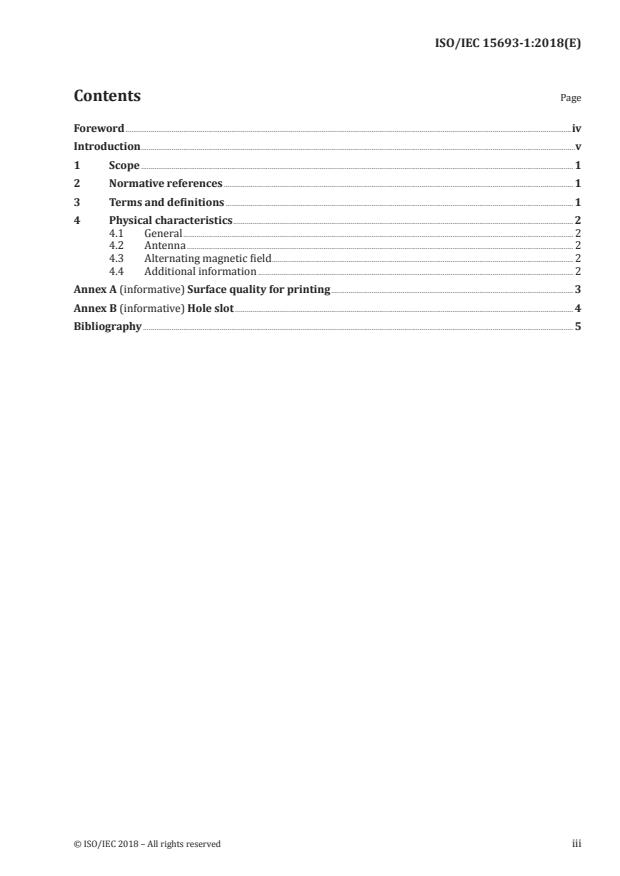
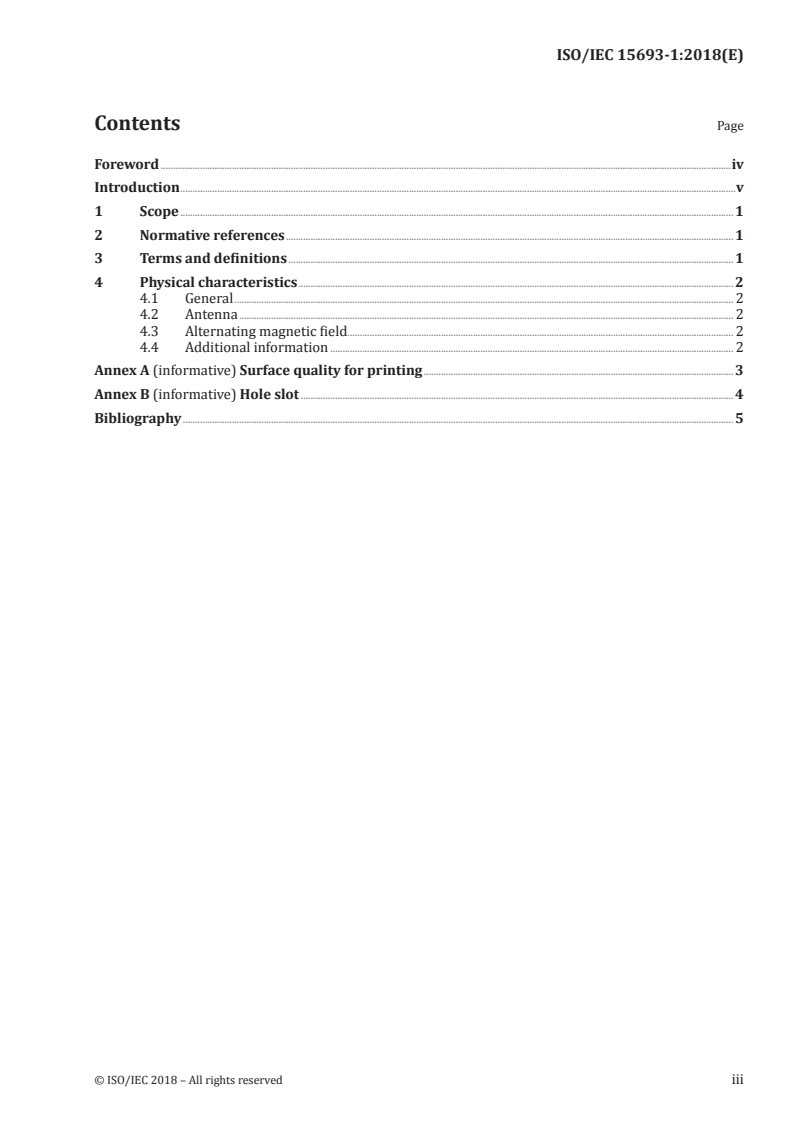
Contents Page
Foreword .iv
Introduction .v
1 Scope . 1
2 Normative references . 1
3 Terms and definitions . 1
4 Physical characteristics . 2
4.1 General . 2
4.2 Antenna . 2
4.3 Alternating magnetic field . 2
4.4 Additional information . 2
Annex A (informative) Surface quality for printing . 3
Annex B (informative) Hole slot . 4
Bibliography . 5
© ISO/IEC 2018 – All rights reserved iii
Foreword
ISO (the International Organization for Standardization) and IEC (the International Electrotechnical
Commission) form the specialized system for worldwide standardization. National bodies that are
members of ISO or IEC participate in the development of International Standards through technical
committees established by the respective organization to deal with particular fields of technical
activity. ISO and IEC technical committees collaborate in fields of mutual interest. Other international
organizations, governmental and non-governmental, in liaison with ISO and IEC, also take part in the
work. In the field of information technology, ISO and IEC have established a joint technical committee,
ISO/IEC JTC 1.
The procedures used to develop this document and those intended for its further maintenance are
described in the ISO/IEC Directives, Part 1. In particular the different approval criteria needed for
the different types of document should be noted. This document was drafted in accordance with the
editorial rules of the ISO/IEC Directives, Part 2 (see www .iso .org/directives).
Attention is drawn to the possibility that some of the elements of this document may be the subject
of patent rights. ISO and IEC shall not be held responsible for identifying any or all such patent
rights. Details of any patent rights identified during the development of the document will be in the
Introduction and/or on the ISO list of patent declarations received (see /www .iso .org/patents).
Any trade name used in this document is information given for the convenience of users and does not
constitute an endorsement.
For an explanation on the voluntary nature of standards, the meaning of ISO specific terms and
expressions related to conformity assessment, as well as information about ISO's adherence to the
World Trade Organization (WTO) principles in the Technical Barriers to Trade (TBT) see the following
URL: www .iso .org/iso/foreword .html.
This document was prepared by ISO/IEC JTC 1, Information technology, SC 17, Cards and security devices
for personal identification.
This third edition cancels and replaces the second edition (ISO/IEC 15693-1:2010), which has been
technically revised.
The main changes from the previous edition are:
— It incorporates changes to subclauses 3.2, 3.3 and 3.5 to bring the vicinity card into line with the
proximity card;
— Annex B has been amended to remove the mandated positions of access control card slot holes.
A list of all the parts in the ISO 15693 series can be found on the ISO website.
iv © ISO/IEC 2018 – All rights reserved
I
...
INTERNATIONAL ISO/IEC
STANDARD 15693-1
Third edition
2018-07
Cards and security devices for
personal identification — Contactless
vicinity objects —
Part 1:
Physical characteristics
Cartes et dispositifs de sécurité pour l'identification personnelle —
Objets sans contact de voisinage —
Partie 1: Caractéristiques physiques
Reference number
©
ISO/IEC 2018
© ISO/IEC 2018
All rights reserved. Unless otherwise specified, or required in the context of its implementation, no part of this publication may
be reproduced or utilized otherwise in any form or by any means, electronic or mechanical, including photocopying, or posting
on the internet or an intranet, without prior written permission. Permission can be requested from either ISO at the address
below or ISO’s member body in the country of the requester.
ISO copyright office
CP 401 • Ch. de Blandonnet 8
CH-1214 Vernier, Geneva
Phone: +41 22 749 01 11
Fax: +41 22 749 09 47
Email: copyright@iso.org
Website: www.iso.org
Published in Switzerland
ii © ISO/IEC 2018 – All rights reserved
Contents Page
Foreword .iv
Introduction .v
1 Scope . 1
2 Normative references . 1
3 Terms and definitions . 1
4 Physical characteristics . 2
4.1 General . 2
4.2 Antenna . 2
4.3 Alternating magnetic field . 2
4.4 Additional information . 2
Annex A (informative) Surface quality for printing . 3
Annex B (informative) Hole slot . 4
Bibliography . 5
© ISO/IEC 2018 – All rights reserved iii
Foreword
ISO (the International Organization for Standardization) and IEC (the International Electrotechnical
Commission) form the specialized system for worldwide standardization. National bodies that are
members of ISO or IEC participate in the development of International Standards through technical
committees established by the respective organization to deal with particular fields of technical
activity. ISO and IEC technical committees collaborate in fields of mutual interest. Other international
organizations, governmental and non-governmental, in liaison with ISO and IEC, also take part in the
work. In the field of information technology, ISO and IEC have established a joint technical committee,
ISO/IEC JTC 1.
The procedures used to develop this document and those intended for its further maintenance are
described in the ISO/IEC Directives, Part 1. In particular the different approval criteria needed for
the different types of document should be noted. This document was drafted in accordance with the
editorial rules of the ISO/IEC Directives, Part 2 (see www .iso .org/directives).
Attention is drawn to the possibility that some of the elements of this document may be the subject
of patent rights. ISO and IEC shall not be held responsible for identifying any or all such patent
rights. Details of any patent rights identified during the development of the document will be in the
Introduction and/or on the ISO list of patent declarations received (see /www .iso .org/patents).
Any trade name used in this document is information given for the convenience of users and does not
constitute an endorsement.
For an explanation on the voluntary nature of standards, the meaning of ISO specific terms and
expressions related to conformity assessment, as well as information about ISO's adherence to the
World Trade Organization (WTO) principles in the Technical Barriers to Trade (TBT) see the following
URL: www .iso .org/iso/foreword .html.
This document was prepared by ISO/IEC JTC 1, Information technology, SC 17, Cards and security devices
for personal identification.
This third edition cancels and replaces the second edition (ISO/IEC 15693-1:2010), which has been
technically revised.
The main changes from the previous edition are:
— It incorporates changes to subclauses 3.2, 3.3 and 3.5 to bring the vicinity card into line with the
proximity card;
— Annex B has been amended to remove the mandated positions of access control card slot holes.
A list of all the parts in the ISO 15693 series can be found on the ISO website.
iv © ISO/IEC 2018 – All rights reserved
I
...