


ISO 558:1980
(Main)Conditioning and testing - Standard atmospheres - Definitions
Conditioning and testing - Standard atmospheres - Definitions
Defines three types. They are often required in order to investigate the effect of extreme climatic conditions on test specimens. Such atmospheres often differ greatly from ordinary ambient conditions.
Conditionnement et essais — Atmosphères normales — Définitions
General Information
- Status
- Published
- Publication Date
- 31-Aug-1980
- Withdrawal Date
- 31-Aug-1980
- Technical Committee
- ISO/TMBG - Technical Management Board - groups
- Drafting Committee
- ISO/TMBG - Technical Management Board - groups
- Current Stage
- 9093 - International Standard confirmed
- Start Date
- 11-May-2023
- Completion Date
- 13-Dec-2025
Overview
ISO 558:1980, published by ISO/TC 12.5, provides vocabulary and definitions for standard atmospheres used in conditioning and testing of materials, components and equipment. The standard recognizes that measured properties often depend on external influences - principally temperature, relative humidity and pressure - and therefore specifies agreed ambient conditions to achieve reproducible and comparable results.
The document emphasizes the need to re-establish identical ambient conditions when: (a) bringing samples into contact with a conditioning atmosphere prior to testing and (b) carrying out tests in a standard test atmosphere. It also notes that many tests may be performed under conditions close to ordinary ambient values and refers to ISO 554 for standardization of such ordinary ambient conditions.
Key Topics
- Core parameters: temperature, relative humidity and pressure are the parameters that define an atmosphere and are kept within prescribed tolerances.
- Defined terms: the standard provides precise definitions for several essential concepts, including:
- atmosphere: ambient conditions defined by one or more parameters (temperature, relative humidity, pressure);
- conditioning atmosphere: the atmosphere in which a sample is kept before testing, characterized by specified parameter values and tolerances for a given period or until equilibrium;
- test atmosphere: the atmosphere to which a sample is exposed throughout a test and which is maintained within prescribed tolerances;
- reference atmosphere: an agreed atmosphere used as the basis for correcting test results obtained in other atmospheres when suitable correlation data exist.
- Three types: the International Standard specifies three types of standard atmosphere used for conditioning and testing (the standard itself distinguishes and defines the types and their intended use).
- Practical notes: the standard clarifies that conditioning may be performed in a dedicated conditioning chamber, in a test chamber, or in the laboratory depending on the specimen and test.
Applications
ISO 558:1980 is valuable for laboratories, test houses and manufacturers that need:
- Reproducible test conditions to compare material properties across samples and laboratories.
- Controlled pre-test conditioning to ensure specimens reach equilibrium before measurement.
- Investigation of climatic effects, including studies of extreme conditions where atmospheres differ greatly from ordinary ambient environments.
Benefits include improved comparability of data, reduced variability due to uncontrolled ambient factors, and clearer traceability of test conditions.
Related Standards
- ISO 554 - referenced in ISO 558 for standardization of ordinary ambient conditions.
- ISO Recommendation R 558-1967 - the earlier recommendation cancelled and replaced by ISO 558:1980.
Keywords: standard atmospheres, conditioning, test atmosphere, temperature, relative humidity, pressure, conditioning chamber, test chamber, reproducible testing, laboratory comparison.

ISO 558:1980 - Conditioning and testing -- Standard atmospheres -- Definitions

ISO 558:1980 - Conditionnement et essais -- Atmospheres normales -- Définitions
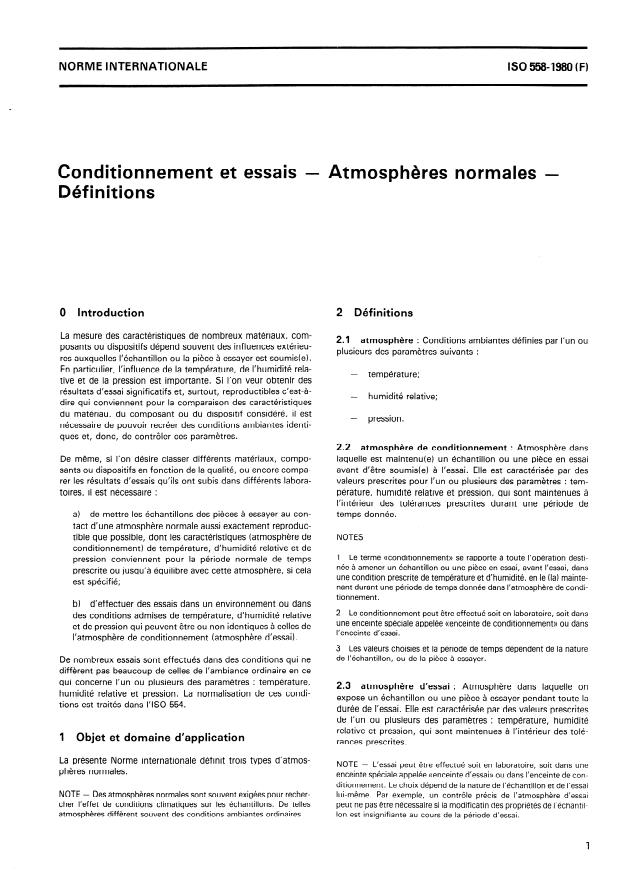

ISO 558:1980 - Conditionnement et essais -- Atmospheres normales -- Définitions
Frequently Asked Questions
ISO 558:1980 is a standard published by the International Organization for Standardization (ISO). Its full title is "Conditioning and testing - Standard atmospheres - Definitions". This standard covers: Defines three types. They are often required in order to investigate the effect of extreme climatic conditions on test specimens. Such atmospheres often differ greatly from ordinary ambient conditions.
Defines three types. They are often required in order to investigate the effect of extreme climatic conditions on test specimens. Such atmospheres often differ greatly from ordinary ambient conditions.
ISO 558:1980 is classified under the following ICS (International Classification for Standards) categories: 19.020 - Test conditions and procedures in general. The ICS classification helps identify the subject area and facilitates finding related standards.
ISO 558:1980 is available in PDF format for immediate download after purchase. The document can be added to your cart and obtained through the secure checkout process. Digital delivery ensures instant access to the complete standard document.
Standards Content (Sample)
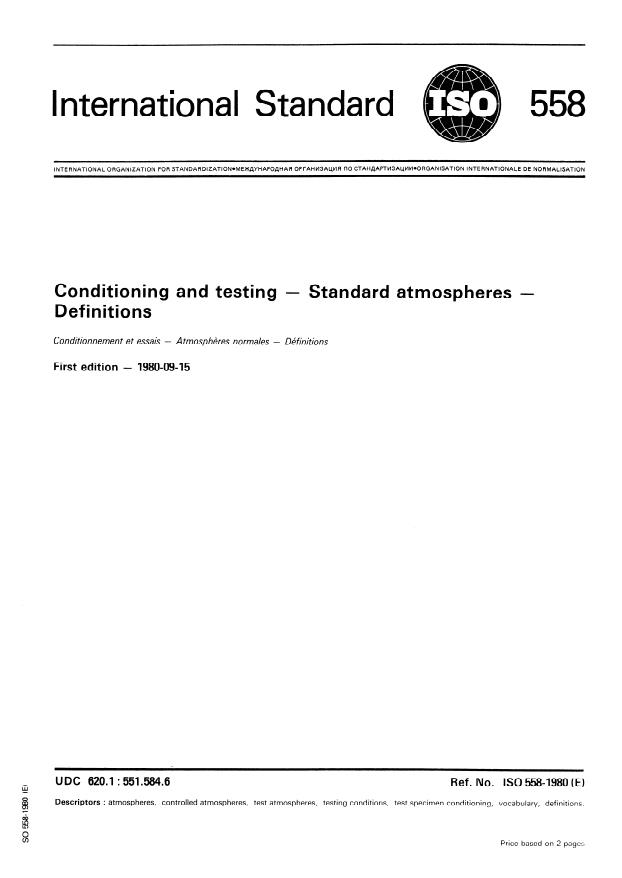
International Standard
INTERNATIONAL ORGANIZATION FOR STANDARDIZATION.ME)t(RYHAPO~HAR OPl-AHM3ALWlR fl0 CTAH,QAPTM3ALWl~ORGANlSATION INTERNATIONALE DE NORMALISATION
- Standard atmospheres -
Conditioning and testing
Definitions
Conditionnement et essais - Atmosphhes normales - Definitions
First edition - 1980-09-15
UDC 620.1 : 551584.6 Ref. No. ISO 558-1980 (E)
Gi
Descriptors : atmospheres, controlled atmospheres, test atmospheres, testing conditions, test specimen conditioning, vocabulary, definitions.
ri
Price based on 2 pages
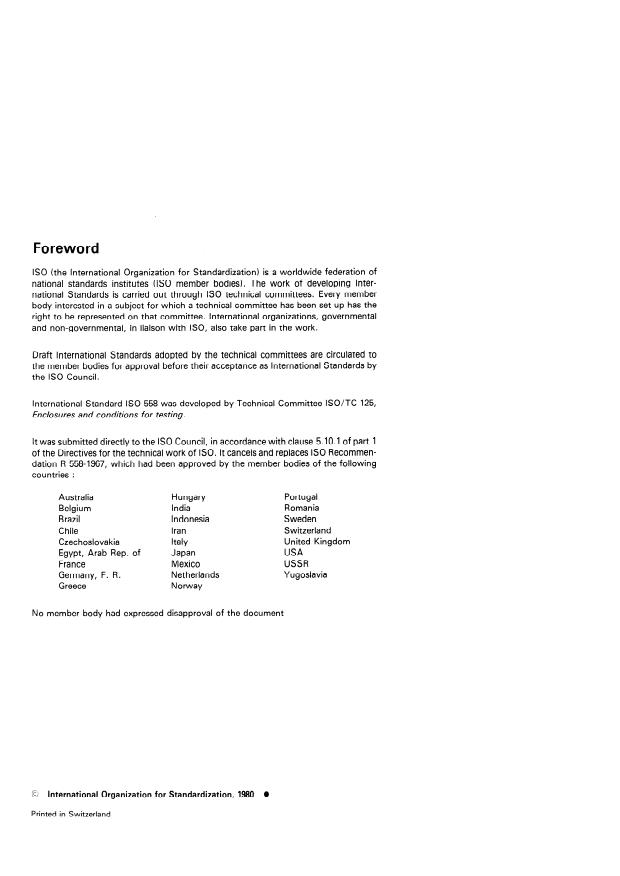
Foreword
ISO (the International Organization for Standardization) is a worldwide federation of
national Standards institutes (ISO member bodies). The work of developing Inter-
national Standards is carried out through ISO technical committees. Every member
body interested in a subject for which a technical committee has been set up has the
right to be represented on that committee. International organizations, governmental
and non-governmental, in liaison with ISO, also take part in the work.
Draft International Standards adopted by the technical committees are circulated to
the member bodies for approval before their acceptance as International Standards by
the ISO Council.
International Standard ISO 558 was developed by Technical Committee ISO/TC 12.5,
Enclosures and conditions for testing.
lt was submitted directly to the ISO Council, in accordance with clause 5.10.1 of part 1
of the Directives for the technical work sf ISO. lt cancels and replaces ISO Recommen-
dation R 558-1967, which had been approved by the member bodies of the following
countries :
Australia Hungary Portugal
Belgium India Romania
Brazil Indonesia Sweden
Chile Iran Switzerland
Czechoslovakia Italy United Kingdom
Egypt, Arab Rep. of Japan USA
France Mexico USSR
Germany, F. R. Netherlands Y ugoslavia
Greece Norway
No member body had expressed disapproval of the document
International Organkation for Standardkation, 1980
Printed in Switzerland
INTERNATIONAL STANDARD ISO 5584980 (EI
Conditioning and testing - Standard atmospheres -
Definitions
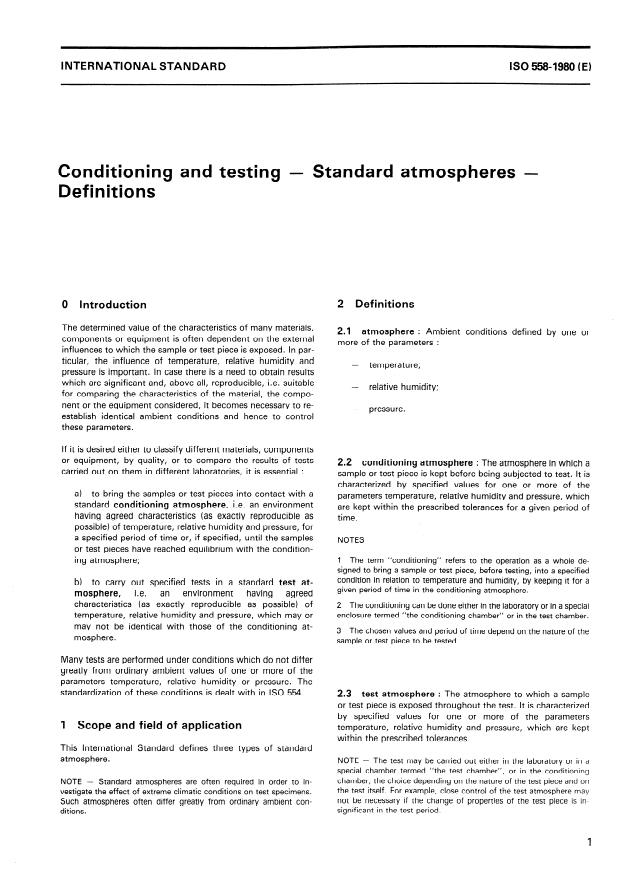
2 Definitions
0 Introduction
The determined value of the characteristics of many materials,
2.1 atmosphere : Ambient conditions defined by one or
components or equipment is often dependent on the external
more of the Parameters :
influences to which the Sample or test piece is exposed. In par-
ticular, the influence of temperature, relative humidity and
- temperature;
pressure is important. In case there is a need to obtain results
which are significant and, above all, reproducible, i.e. suitable
-
relative humidity;
for comparing the characteristics of the material, the compo-
nent or the equipment considered, it becomes necessary to re-
- pressure.
establish identical ambient conditions and hence to control
these Parameters.
If it is desired either to classify different materials, components
or equipment, by quality, or to compare the results of tests
2.2 conditioning atmosphere : The atmosphere in which a
carried out on them in different laboratories, it is essential :
Sample or test piece is kept before being subjected to test. lt is
characterized
...
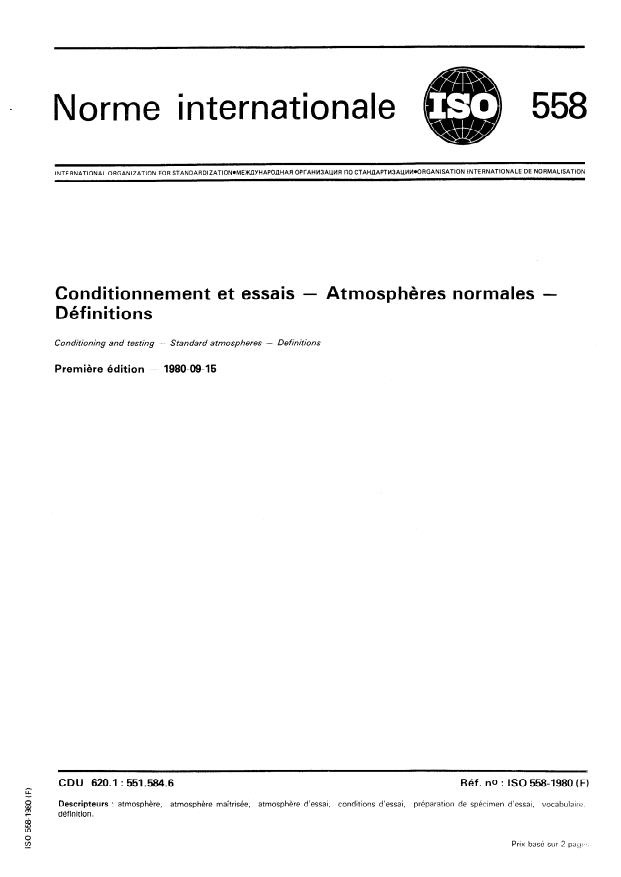
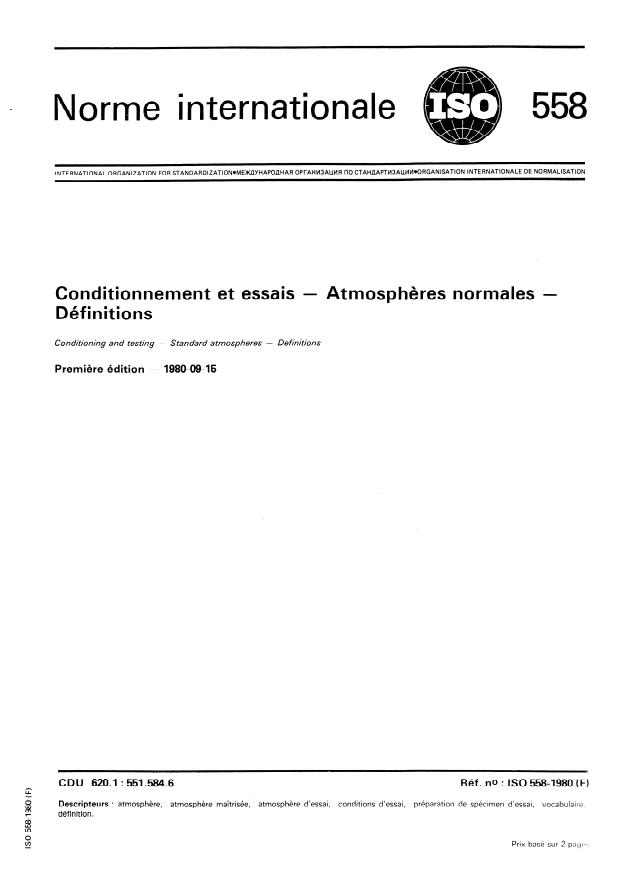
Norme internationale
INTERNATIONAL ORGANIZATION FOR STANDARDIZATION.MEWYHAPOLZHAR OPTAHM3ALU’lR Il0 CTAH~APTM3AL&lM.ORGANISATION INTERNATIONALE DE NORMALISATION
Conditionnement et essais - Atmosphères normales -
Définitions
Conditioning and testing - Standard atmospheres - Definitions
Première édition - 1980-09-15
CDU 620.1 : 551.5841s - -
Réf. no : KO 558-1980 (F)
Descripteurs : atmosphère, atmosphère maîtrisée, atmosphère d’essai, conditions d’essai,
préparation de spécimen d’essai, vocabulaire.
définition.
Prix basé sur 2 paq”,
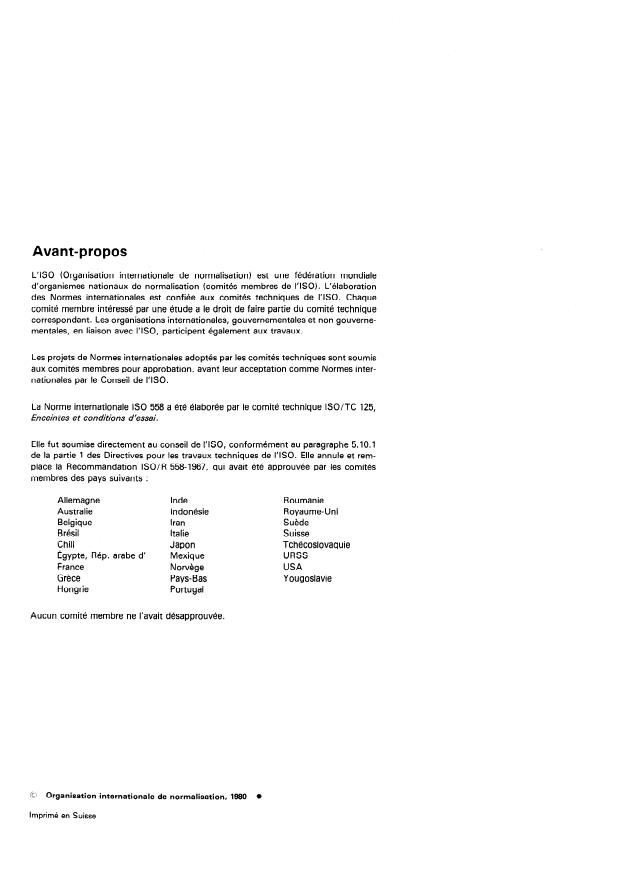
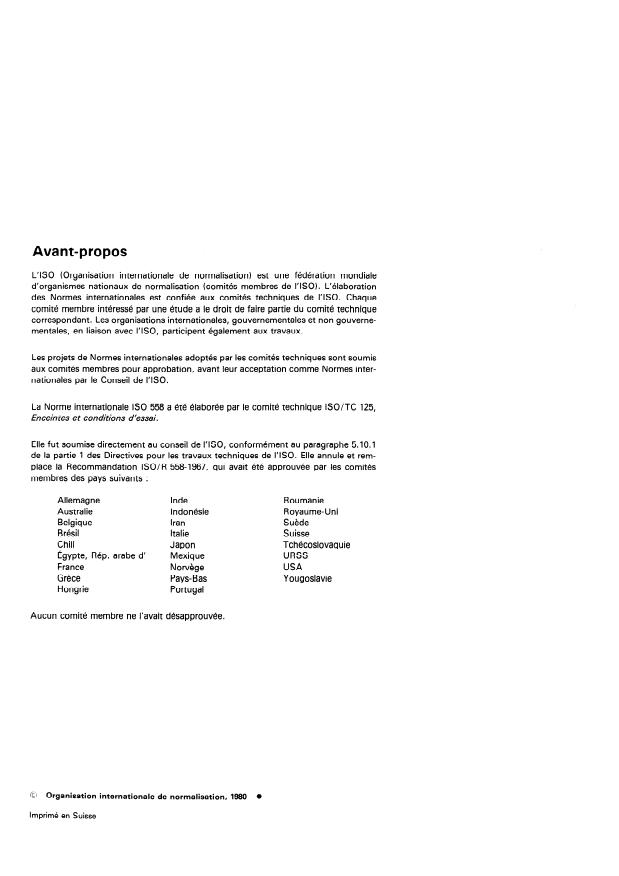
Avant-propos
L’ISO (Organisation internationale de normalisation) est une fédération mondiale
d’organismes nationaux de normalisation (comités membres de I’ISO). L’élaboration
des Normes internationales est confiée aux comités techniques de I’ISO. Chaque
comité membre intéressé par une étude a le droit de faire partie du comité technique
correspondant. Les organisations internationales, gouvernementales et non gouverne-
mentales, en liaison avec I’ISO, participent également aux travaux.
Les projets de Normes internationales adoptés par les comités techniques sont soumis
aux comités membres pour approbation, avant leur acceptation comme Normes inter-
nationales par le Conseil de I’ISO.
La Norme internationale ISO 558 a été élaborée par le comité technique ISO/TC 125,
Enceintes et conditions d’essai.
Elle fut soumise directement au conseil de I’ISO, conformément au paragraphe 5.10.1
de la partie 1 des Directives pour les travaux techniques de I’ISO. Elle annule et rem-
place la Recommandation ISO/R 558-1967, qui avait été approuvée par les comités
membres des pays suivants :
Allemagne Inde Roumanie
Australie Indonésie Royaume-Uni
Belgique Iran Suède
Brésil Italie Suisse
Chili Tchécoslovaquie
Japon
Égypte, Rép. arabe d’ Mexique URSS
France Norvège USA
Grèce Pays- Bas Yougoslavie
Hongrie Portugal
Aucun comité membre ne l’avait désapprouvée.
Organisation internationale de normalisation, 1980
imprimé en Suisse
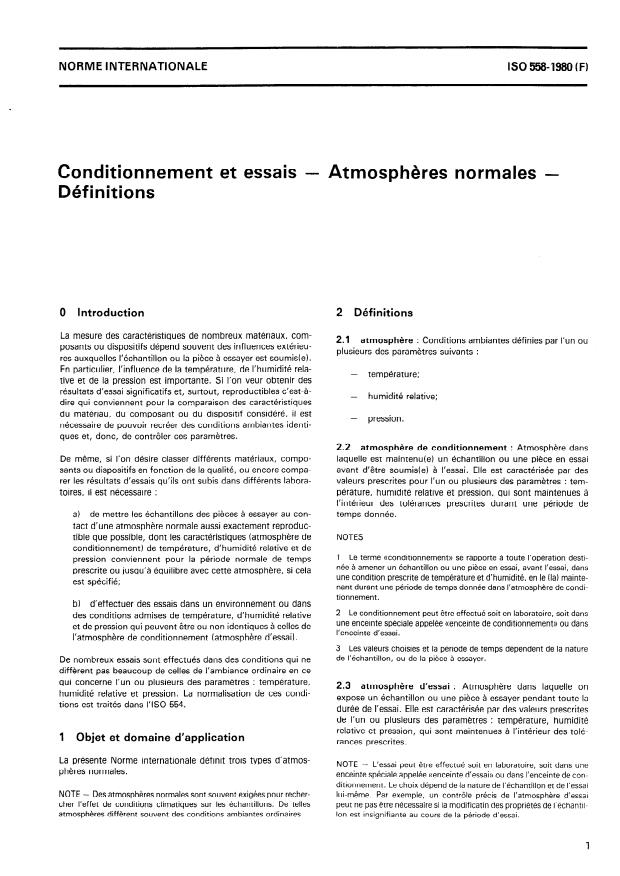
NORME INTERNATIONALE ISO 558-1980 (F)
Conditionnement et essais - Atmosphères normales -
Définitions
0 Introduction 2 Définitions
La mesure des caractéristiques de nombreux matériaux, com-
2.1 atmosphère : Conditions ambiantes définies par l’un ou
posants ou dispositifs dépend souvent des influences extérieu-
plusieurs des paramètres suivants :
res auxquelles l’échantillon ou la pièce à essayer est soumis(e).
En particulier, l’influence de la température, de l’humidité rela-
- température;
tive et de la pression est importante. Si l’on veur obtenir des
résultats d’essai significatifs et, surtout, reproductibles c’est-à-
- humidité relative;
dire qui conviennent pour la comparaison des caractéristiques
du matériau, du composant ou du dispositif considéré, il est
- pression.
nécessaire de pouvoir recréer des conditions ambiantes identi-
ques et, donc, de contrôler ces paramètres.
2.2 atmosphère de conditionnement : Atmosphère dans
laquelle est maintenu(e) un échantillon ou une pièce en essai
De même, si l’on désire classer différents matériaux, compo-
sants ou dispositifs en fonction de la qualité, ou encore compa- avant d’être soumis(e) à l’essai. Elle est caractérisée par des
rer les résultats d’essais qu’ils ont subis dans différents labora- valeurs prescrites pour l’un ou plusieurs des paramètres : tem-
pérature, humidité relative et pression, qui sont maintenues à
to
...
Norme internationale
INTERNATIONAL ORGANIZATION FOR STANDARDIZATION.MEWYHAPOLZHAR OPTAHM3ALU’lR Il0 CTAH~APTM3AL&lM.ORGANISATION INTERNATIONALE DE NORMALISATION
Conditionnement et essais - Atmosphères normales -
Définitions
Conditioning and testing - Standard atmospheres - Definitions
Première édition - 1980-09-15
CDU 620.1 : 551.5841s - -
Réf. no : KO 558-1980 (F)
Descripteurs : atmosphère, atmosphère maîtrisée, atmosphère d’essai, conditions d’essai,
préparation de spécimen d’essai, vocabulaire.
définition.
Prix basé sur 2 paq”,
Avant-propos
L’ISO (Organisation internationale de normalisation) est une fédération mondiale
d’organismes nationaux de normalisation (comités membres de I’ISO). L’élaboration
des Normes internationales est confiée aux comités techniques de I’ISO. Chaque
comité membre intéressé par une étude a le droit de faire partie du comité technique
correspondant. Les organisations internationales, gouvernementales et non gouverne-
mentales, en liaison avec I’ISO, participent également aux travaux.
Les projets de Normes internationales adoptés par les comités techniques sont soumis
aux comités membres pour approbation, avant leur acceptation comme Normes inter-
nationales par le Conseil de I’ISO.
La Norme internationale ISO 558 a été élaborée par le comité technique ISO/TC 125,
Enceintes et conditions d’essai.
Elle fut soumise directement au conseil de I’ISO, conformément au paragraphe 5.10.1
de la partie 1 des Directives pour les travaux techniques de I’ISO. Elle annule et rem-
place la Recommandation ISO/R 558-1967, qui avait été approuvée par les comités
membres des pays suivants :
Allemagne Inde Roumanie
Australie Indonésie Royaume-Uni
Belgique Iran Suède
Brésil Italie Suisse
Chili Tchécoslovaquie
Japon
Égypte, Rép. arabe d’ Mexique URSS
France Norvège USA
Grèce Pays- Bas Yougoslavie
Hongrie Portugal
Aucun comité membre ne l’avait désapprouvée.
Organisation internationale de normalisation, 1980
imprimé en Suisse
NORME INTERNATIONALE ISO 558-1980 (F)
Conditionnement et essais - Atmosphères normales -
Définitions
0 Introduction 2 Définitions
La mesure des caractéristiques de nombreux matériaux, com-
2.1 atmosphère : Conditions ambiantes définies par l’un ou
posants ou dispositifs dépend souvent des influences extérieu-
plusieurs des paramètres suivants :
res auxquelles l’échantillon ou la pièce à essayer est soumis(e).
En particulier, l’influence de la température, de l’humidité rela-
- température;
tive et de la pression est importante. Si l’on veur obtenir des
résultats d’essai significatifs et, surtout, reproductibles c’est-à-
- humidité relative;
dire qui conviennent pour la comparaison des caractéristiques
du matériau, du composant ou du dispositif considéré, il est
- pression.
nécessaire de pouvoir recréer des conditions ambiantes identi-
ques et, donc, de contrôler ces paramètres.
2.2 atmosphère de conditionnement : Atmosphère dans
laquelle est maintenu(e) un échantillon ou une pièce en essai
De même, si l’on désire classer différents matériaux, compo-
sants ou dispositifs en fonction de la qualité, ou encore compa- avant d’être soumis(e) à l’essai. Elle est caractérisée par des
rer les résultats d’essais qu’ils ont subis dans différents labora- valeurs prescrites pour l’un ou plusieurs des paramètres : tem-
pérature, humidité relative et pression, qui sont maintenues à
to
...
Questions, Comments and Discussion
Ask us and Technical Secretary will try to provide an answer. You can facilitate discussion about the standard in here.
Loading comments...