

ISO 19150-4:2019
(Main)Geographic information — Ontology — Part 4: Service ontology
General Information
- Abstract
This document sets a framework for geographic information service ontology and the description of geographic information Web services in Web Ontology Language (OWL). OWL is the language adopted for ontologies. This document makes use of service metadata (ISO 19115-1) and service definitions (ISO 19119) whenever appropriate. This document does not define semantics operators, rules for ontologies, and does not develop any application ontology. In relation to ISO 19101-1:2014, 6.2, this document defines and formalizes the following purpose of the ISO geographic information reference model: — geographic information service components and their behaviour for data processing purposes over the Web, and — OWL ontologies to cast ISO/TC 211 standards to benefit from and support the Semantic Web. In relation to ISO 19101-1:2014, 8.3, this document addresses the Meta:Service foundation of the ISO geographic information reference model.
- Status
- Published
- Publication Date
- 21-May-2019
- Technical Committee
- ISO/TC 211 - Geographic information/Geomatics
- Drafting Committee
- ISO/TC 211/WG 7 - Information communities
- Current Stage
- 9093 - International Standard confirmed
- Start Date
- 05-Sep-2024
- Completion Date
- 29-Aug-2026
Buy Documents
ISO 19150-4:2019 - Geographic information -- Ontology
ISO 19150-4:2019 - Geographic information — Ontology — Part 4: Service ontology/22/2019
Overview - ISO 19150-4:2019 (Service ontology)
ISO 19150-4:2019 defines a framework for representing geographic information Web services as ontologies using the Web Ontology Language (OWL). The standard specifies how to describe GeoWeb service components, behaviour and metadata so services can be published, discovered, composed and invoked on the Semantic Web. It leverages existing ISO service metadata and definitions (notably ISO 19115-1 and ISO 19119) and formalizes the Meta:Service foundation of the ISO geographic information reference model. ISO 19150-4 does not prescribe semantic operators, ontology rule languages, or application-specific ontologies - it provides the OWL modelling framework and requirements for GeoWeb service descriptions.
Key topics and technical requirements
- OWL-based service ontology: A formal ontology structure to model geographic Web services in OWL for machine-readable semantics.
- Service identification & description: Model elements for uniquely identifying and describing GeoWeb services on the Web.
- Taxonomy and function: Classification of GeoWeb services and formalization of their functional capabilities.
- Service lifecycle and parameters: Representation of lifecycle states, inputs/outputs, and configurable service parameters.
- Service capabilities: Modelling of capability attributes including accuracy, performance and security characteristics.
- Service metadata alignment: Reuse and mapping to ISO 19115-1 metadata and ISO 19119 service definitions to ensure interoperability with existing standards.
- Conformance & testing: Requirements for conformance and an abstract test suite (normative) for validating OWL service descriptions.
- Informative annexes: Use cases and OWL resources to guide implementation.
Practical applications - who uses ISO 19150-4
ISO 19150-4 is intended for organizations and professionals involved in spatial data infrastructures (SDI), GeoWeb service development, and Semantic Web integration, including:
- GIS software vendors and API designers who publish GeoWeb services.
- SDI architects and catalog/registry implementers responsible for service discovery and metadata harvesting.
- Ontology engineers and semantic developers building OWL service descriptions and reasoning workflows.
- Data providers and integrators seeking automated service composition, discovery, and invocation across heterogeneous systems. Benefits include improved semantic interoperability, automated service discovery/composition, richer metadata for catalogues, and better alignment of ISO/TC 211 standards with Semantic Web technologies.
Related standards
- ISO 19101-1 (reference model for geographic information)
- ISO 19150-2 (rules for developing ontologies in OWL)
- ISO 19115-1 (service metadata framework)
- ISO 19119 (service definitions)
- ISO 19103 (conceptual schema language)
Keywords: ISO 19150-4, service ontology, geographic information, OWL, GeoWeb services, Semantic Web, ISO 19115-1, ISO 19119, SDI, service metadata.
Relations
- Effective Date
- 25-Aug-2026
Buy Documents
ISO 19150-4:2019 - Geographic information -- Ontology
ISO 19150-4:2019 - Geographic information — Ontology — Part 4: Service ontology/22/2019
Get Certified
Connect with accredited certification bodies for this standard

BSI Group
BSI (British Standards Institution) is the business standards company that helps organizations make excellence a habit.

NYCE
Mexican standards and certification body.
Sponsored listings
Frequently Asked Questions
ISO 19150-4:2019 is a standard published by the International Organization for Standardization (ISO). Its full title is "Geographic information — Ontology — Part 4: Service ontology". This standard covers: This document sets a framework for geographic information service ontology and the description of geographic information Web services in Web Ontology Language (OWL). OWL is the language adopted for ontologies. This document makes use of service metadata (ISO 19115-1) and service definitions (ISO 19119) whenever appropriate. This document does not define semantics operators, rules for ontologies, and does not develop any application ontology. In relation to ISO 19101-1:2014, 6.2, this document defines and formalizes the following purpose of the ISO geographic information reference model: — geographic information service components and their behaviour for data processing purposes over the Web, and — OWL ontologies to cast ISO/TC 211 standards to benefit from and support the Semantic Web. In relation to ISO 19101-1:2014, 8.3, this document addresses the Meta:Service foundation of the ISO geographic information reference model.
This document sets a framework for geographic information service ontology and the description of geographic information Web services in Web Ontology Language (OWL). OWL is the language adopted for ontologies. This document makes use of service metadata (ISO 19115-1) and service definitions (ISO 19119) whenever appropriate. This document does not define semantics operators, rules for ontologies, and does not develop any application ontology. In relation to ISO 19101-1:2014, 6.2, this document defines and formalizes the following purpose of the ISO geographic information reference model: — geographic information service components and their behaviour for data processing purposes over the Web, and — OWL ontologies to cast ISO/TC 211 standards to benefit from and support the Semantic Web. In relation to ISO 19101-1:2014, 8.3, this document addresses the Meta:Service foundation of the ISO geographic information reference model.
ISO 19150-4:2019 is classified under the following ICS (International Classification for Standards) categories: 35.240.70 - IT applications in science. The ICS classification helps identify the subject area and facilitates finding related standards.
ISO 19150-4:2019 has the following relationships with other standards: It is inter standard links to EN ISO 19150-6:2023. Understanding these relationships helps ensure you are using the most current and applicable version of the standard.
ISO 19150-4:2019 is available in PDF format for immediate download after purchase. The document can be added to your cart and obtained through the secure checkout process. Digital delivery ensures instant access to the complete standard document.
Standards Content (Sample)
INTERNATIONAL ISO
STANDARD 19150-4
First edition
2019-05
Geographic information —
Ontology —
Part 4:
Service ontology
Information géographique — Ontologie —
Partie 4: Ontologie de service
Reference number
©
ISO 2019
© ISO 2019
All rights reserved. Unless otherwise specified, or required in the context of its implementation, no part of this publication may
be reproduced or utilized otherwise in any form or by any means, electronic or mechanical, including photocopying, or posting
on the internet or an intranet, without prior written permission. Permission can be requested from either ISO at the address
below or ISO’s member body in the country of the requester.
ISO copyright office
CP 401 • Ch. de Blandonnet 8
CH-1214 Vernier, Geneva
Phone: +41 22 749 01 11
Fax: +41 22 749 09 47
Email: copyright@iso.org
Website: www.iso.org
Published in Switzerland
ii © ISO 2019 – All rights reserved
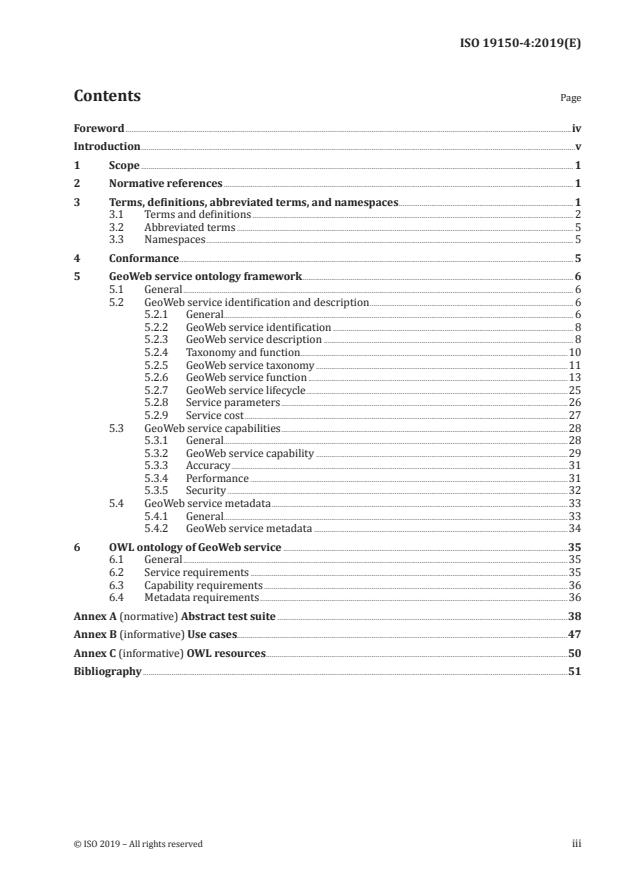
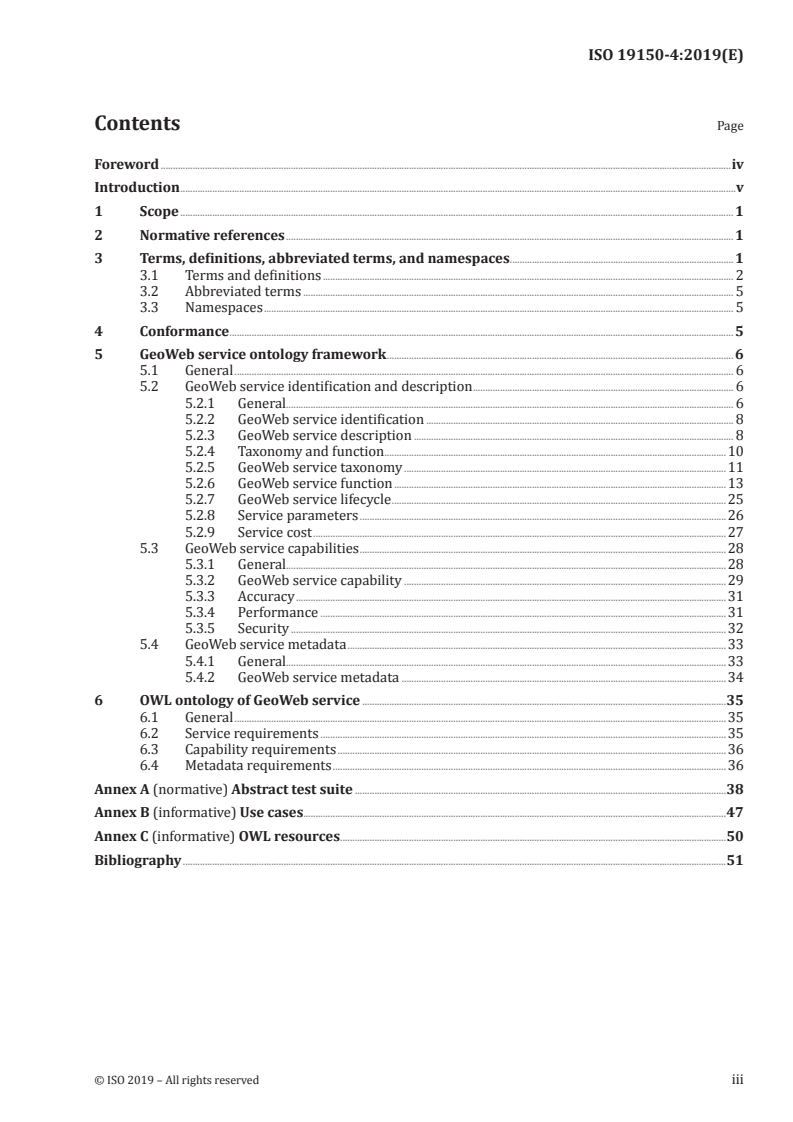
Contents Page
Foreword .iv
Introduction .v
1 Scope . 1
2 Normative references . 1
3 Terms, definitions, abbreviated terms, and namespaces . 1
3.1 Terms and definitions . 2
3.2 Abbreviated terms . 5
3.3 Namespaces . 5
4 Conformance . 5
5 GeoWeb service ontology framework . 6
5.1 General . 6
5.2 GeoWeb service identification and description . 6
5.2.1 General. 6
5.2.2 GeoWeb service identification . 8
5.2.3 GeoWeb service description . 8
5.2.4 Taxonomy and function .10
5.2.5 GeoWeb service taxonomy .11
5.2.6 GeoWeb service function .13
5.2.7 GeoWeb service lifecycle .25
5.2.8 Service parameters .26
5.2.9 Service cost .27
5.3 GeoWeb service capabilities .28
5.3.1 General.28
5.3.2 GeoWeb service capability .29
5.3.3 Accuracy .31
5.3.4 Performance .31
5.3.5 Security .32
5.4 GeoWeb service metadata .33
5.4.1 General.33
5.4.2 GeoWeb service metadata .34
6 OWL ontology of GeoWeb service .35
6.1 General .35
6.2 Service requirements .35
6.3 Capability requirements .36
6.4 Metadata requirements .36
Annex A (normative) Abstract test suite .38
Annex B (informative) Use cases.47
Annex C (informative) OWL resources .50
Bibliography .51
Foreword
ISO (the International Organization for Standardization) is a worldwide federation of national standards
bodies (ISO member bodies). The work of preparing International Standards is normally carried out
through ISO technical committees. Each member body interested in a subject for which a technical
committee has been established has the right to be represented on that committee. International
organizations, governmental and non-governmental, in liaison with ISO, also take part in the work.
ISO collaborates closely with the International Electrotechnical Commission (IEC) on all matters of
electrotechnical standardization.
The procedures used to develop this document and those intended for its further maintenance are
described in the ISO/IEC Directives, Part 1. In particular, the different approval criteria needed for the
different types of ISO documents should be noted. This document was drafted in accordance with the
editorial rules of the ISO/IEC Directives, Part 2 (see www .iso .org/directives).
Attention is drawn to the possibility that some of the elements of this document may be the subject of
patent rights. ISO shall not be held responsible for identifying any or all such patent rights. Details of
any patent rights identified during the development of the document will be in the Introduction and/or
on the ISO list of patent declarations received (see www .iso .org/patents).
Any trade name used in this document is information given for the convenience of users and does not
constitute an endorsement.
For an explanation of the voluntary nature of standards, the meaning of ISO specific terms and
expressions related to conformity assessment, as well as information about ISO's adherence to the
World Trade Organization (WTO) principles in the Technical Barriers to Trade (TBT) see www .iso
.org/iso/foreword .html.
This document was prepared by Technical Committee ISO/TC 211, Geographic information/Geomatics.
A list of all parts in the ISO 19150 series can be found on the ISO website.
Any feedback or questions on this document should be directed to the user’s national standards body. A
complete listing of these bodies can be found at www .iso .org/members .html.
iv © ISO 2019 – All rights reserved
Introduction
The Semantic Web has introduced the Web of data. The Web of data is essentially an extension of the Web
oriented towards machine-processable data as opposed to documents. It could be seen as a tremendous
worldwide open database that people can query from their own perspective, understanding, or
abstraction of real-world phenomena or events and get accurate, detailed, and appropriate answers
as people communicate between each other. This approach involves reasoning capabilities based on
ontologies. The Semantic Web brings new opportunities for the geographic information realm to lay out
a new generation of standards in order to benefit from these in achieving semantic interoperability of
geographic information.
Fundamentally, ontology comes from philosophy and refers to the study of the nature of the world
itself. The information technology and artificial intelligence communities borrowed the term ontology
[2]
for the explicit specification of a conceptualization . In geographic information, ontology consists
of a formal representation of phenomena of a universe of discourse with an underlying vocabulary
including definitions and axioms that make the intended meaning explicit and describe phenomena
[1]
and their interrelationships . Information technology and artificial intelligence consider that reality
may be abstracted differently depending on the context from which “things” are perceived and, as
such, recognize that multiple ontologies about the same part of reality may exist. An ontology can be
formalized differently ranging from weak to strong semantics: taxonomy, thesaurus, conceptual model,
[2]
logical theory .
On the Semantic Web, ontology defines the meaning of data and describes it in a format that machines
and applications can read. An application using data also has access to their inherent semantics through
the ontology associated with it. Ontologies can support integration of heterogeneous data captured by
different communities by relating them based on their semantic similarity. The W3C has proposed the
Web Ontology Language (OWL) family of knowledge representation languages for authoring ontologies
[3][36]
characterised by formal semantics on the Web .
ISO 19101-1 introduces the fundamental role of semantics in geographic information, and how the
new technologies such as the Web, the Semantic Web, and many other emerging ways can support
interoperability in the field of geographic information. It also provides an umbrella under which
additional specific reference models on particular facets of geographic information standardization
would be required. This document, introduced by ISO/TS 19150-1, particularly contributes to the
description of geographic information service components and their behaviour for data processing
purposes over the Web and to cast ISO geographic information standards to benefit from and support
the Semantic Web by the way of ontologies as identified in ISO 19101-1.
Geographic information Web services are important components that compose the Web. The Semantic
Web can contribute to facilitate the interaction between them by introducing an ontology for
geographic information Web Services. It can support geographic information Web services to automate
their discovery, composition, and invocation in order to enable seamless machine interoperation with
minimum human interaction. Through ontologies, semantic annotation of geographic information
services in terms of capabilities, selection, access, composition, and invocation are required to support
[24]
interoperability of geographic information Web services on the Semantic Web . Accordingly,
this document sets a framework for geographic information service ontology and the description of
geographic information Web services in OWL.
INTERNATIONAL STANDARD ISO 19150-4:2019(E)
Geographic information — Ontology —
Part 4:
Service ontology
1 Scope
This document sets a framework for geographic information service ontology and the description of
geographic information Web services in Web Ontology Language (OWL).
OWL is the language adopted for ontologies.
This document makes use of service metadata (ISO 19115-1) and service definitions (ISO 19119)
whenever appropriate.
This document does not define semantics operators, rules for ontologies, and does not develop any
application ontology.
In relation to ISO 19101-1:2014, 6.2, this document defines and formalizes the following purpose of the
ISO geographic information reference model:
— geographic information service components and their behaviour for data processing purposes over
the Web, and
— OWL ontologies to cast ISO/TC 211 standards to benefit from and support the Semantic Web.
In relation to ISO 19101-1:2014, 8.3, this document addresses the Meta: Service foundation of the ISO
geographic information reference model.
2 Normative references
The following documents are referred to in the text in such a way that some or all of their content
constitutes requirements of this document. For dated references, only the edition cited applies. For
undated references, the latest edition of the referenced document (including any amendments) applies.
ISO 19103, Geographic information — Conceptual schema language
ISO 19115-1, Geographic information — Metadata — Part 1: Framework
ISO 19119, Geographic information — Service
ISO 19150-2, Geographic information — Ontology — Part 2: Rules for developing ontologies in the Web
Ontology Language (OWL)
3 Terms, definitions, abbreviated terms, and namespaces
For the purposes of this document, the following terms and definitions apply.
ISO and IEC maintain terminological databases for use in standardization at the following addresses:
— ISO Online browsing platform: available at https: //www .iso .org/obp
— IEC Electropedia: available at http: //www .electropedia .org/
3.1 Terms and definitions
3.1.1
aggregation
special form of association (3.1.2) that specifies a whole-part relationship between the aggregate
(whole) and a component part
Note 1 to entry: See composition (3.1.8).
[SOURCE: ISO 19103:2015, 4.1]
3.1.2
association
semantic relationship that can occur between typed instances
Note 1 to entry: A binary association is an association among exactly two classifiers (including the possibility of
an association from a classifier to itself).
[SOURCE: UML 2]
3.1.3
attribute
feature within a classifier that describes a range of values that instances of the classifier may hold
[SOURCE: UML 1]
3.1.4
cardinality
number of elements in a set
Note 1 to entry: Contrast with multiplicity (3.1.17), which is the range of possible cardinalities a set may hold.
[SOURCE: UML 1]
3.1.5
class
set of individuals (3.1.14)
[SOURCE: OWL]
3.1.6
class
description of a set of objects that share the same attributes (3.1.3), operations, methods,
relationships, and semantics
[SOURCE: UML 1]
3.1.7
codelist
value domain including a code for each permissible value
[SOURCE: ISO 19136:2007, 4.1.7]
3.1.8
composition
aggregation (3.1.1) where the composite object (whole) has responsibility for the existence and
storage of the composed objects (parts)
[SOURCE: UML 2]
2 © ISO 2019 – All rights reserved
3.1.9
constraint
condition or restriction expressed in natural language text or in a machine readable language
for the purpose of declaring some of the semantics of an element
[SOURCE: UML 2]
3.1.10
data property
semantic association (3.1.2) between an individual (3.1.14) and a typed literal (3.1.15)
Note 1 to entry: Data properties were sometimes referred to as ‘concrete properties’ in Description Logic.
[SOURCE: OWL]
3.1.11
data type
specification of a value domain with operations allowed on values in this domain
EXAMPLE xsd: string, xsd: integer, xsd: decimal.
Note 1 to entry: Datatypes are distinct from classes of individuals (3.1.14), the latter are denoted by URIs and may
be used by reference.
[SOURCE: ISO 19103:2015, 4.14, modified — EXAMPLE and Note 1 to entry have been replaced.]
3.1.12
domain
restriction to constrain the subject class which participates in a subject-predicate-
object triple
3.1.13
generalization
taxonomic relationship between a more general element and a more specific element of the
same element type
Note 1 to entry: An instance of the more specific element can be used where the more general element is allowed.
[SOURCE: UML 2]
3.1.14
individual
instance of a class (3.1.5)
Note 1 to entry: "Individual" refers to a resource belonging to the extension of the class.
[SOURCE: OWL Web Ontology Language Guide — modified]
3.1.15
literal value
literal
constant, explicitly specified value
EXAMPLE “1”^^xsd: integer, “abc”^^xsd: string.
Note 1 to entry: This contrasts with a value that is determined by resolving a chain of substitution (e.g. a variable).
[SOURCE: ISO 19143:2010, 4.15]
3.1.16
metadata
information about a resource
[SOURCE: ISO 19115-1:2014, 4.10]
3.1.17
multiplicity
specification of the range of allowable cardinalities that a set may assume
[SOURCE: ISO 19103:2015, 4.24]
3.1.18
object property
semantic association (3.1.2) between a pair of individuals (3.1.14)
Note 1 to entry: Object properties have sometimes been referred to as ‘abstract properties’ in Description Logic.
[SOURCE: OWL]
3.1.19
ontology
formal representation of phenomena of a universe of discourse (3.1.23) with an underlying vocabulary
including definitions and axioms that make the intended meaning explicit and describe phenomena and
their interrelationships
[SOURCE: ISO 19101-1:2014, 4.1.26]
3.1.20
property
relation between subject resources and object resources
[SOURCE: RDF]
3.1.21
property restriction
special kind of class (3.1.5) description through the definition of constraints on values and
cardinalities
[SOURCE: OWL]
3.1.22
range
restriction to constrain the class of objects which participate in a subject-predicate-
object triple
Note 1 to entry: A range restriction can be thought of as a type constraint on the value of a function or range of a
relation.
3.1.23
universe of discourse
view of the real or hypothetical world that includes everything of interest
[SOURCE: ISO 19101-1:2014, 4.1.38]
4 © ISO 2019 – All rights reserved
3.2 Abbreviated terms
OWL Web Ontology Language (version 2)
RDF Resource Description Framework
RDFS RDF Schema
SKOS Simplified Knowledge Organization System
UML Unified Modeling Language
URI Universal Resource Identifier
3.3 Namespaces
19150-4service Requirements class for the identification and description of
GeoWeb services http: //standards .isotc211 .org/iso19150/
-4/1/req/geowebServiceIdenficationAndDescription/
19150-4service-conf Conformance class for the identification and description of
GeoWeb Services http: //standards .isotc211 .org/iso19150/
-4/1/conf/geowebServiceIdentificationAndDescription/
19150-4capabilities Requirements class for the capabilities of GeoWeb ser-
vices http: //standards .isotc211 .org/iso19150
-4/req/geowebServiceIdenficationAndDescription/
19150-4capabilities-conf Conformance class for the capabilities of GeoWeb Ser-
vices http: //standards .isotc211 .org/iso19150/
-4/1/conf/GeoWebServiceCapabilitiesgeowebServiceCapabilities/
19150-4metadata Requirements class for the metadata of GeoWeb ser-
vices http: //standards .isotc211 .org/iso19150/
-4/1/req/geowebServiceMetadata/
19150-4metadata-conf Conformance class for the metadata of GeoWeb Ser-
vices http: //standards .isotc211 .org/iso19150/
-4/1/conf/geowebServiceMetadata/
19150-4owl Requirements class for the OWL ontology http: //standards .isotc211
.org/iso19150/ -4/1/req/owl/
19150-4owl-conf Conformance class for the OWL ontology http: //standards .isotc211
.org/iso19150/ -4/1/conf/owl/
4 Conformance
Any service description claiming conformance with this document shall pass the requirements
described in the abstract test suite, presented in Annex A.
The abstract test suite is organized in four conformance classes (name and namespace) that address
the following purposes:
— Geographic information Web service identification and description (19150-4service-conf);
— Geographic information Web service capabilities (19150-4capabilities-conf);
— Geographic information Web service metadata (19150-4metadata-conf); and
— Geographic information Web service ontology (19150-4owl-conf).
5 GeoWeb service ontology framework
5.1 General
Clause 5 sets the framework for the description of GeoWeb services. This framework is based on
ISO 19119 for the description of geospatial services and ISO 19115-1 which defines the elements for
the documentation of such services through service metadata. These two international standards set
a foundation for the definition of GeoWeb service ontology framework. This framework is hereafter
illustrated in UML. It also has been developed with consideration of the following documents:
— OWL-S: Semantic Markup for Web Services (OWL-S 1.1) (W3C Member Submission 22 November
2004);
— OWL-S: Semantic Markup for Web Services (OWL-S release 1.2);
— Semantic Web Services Ontology (SWSO) (W3C Member Submission 9 September 2005);
— Web Service Modeling Ontology (WSMO) (W3C Member Submission 3 June 2005);
— WSMO-Lite: Lightweight Semantic Descriptions for Services on the Web (W3C Member Submission
23 August 2010);
— OGC Web Service Common Implementation Specification, version 2.0.0, document #06-121r9.
This framework has been developed to support the use cases that are documented in Annex B.
The GeoWeb service framework consists of four elements that are GeoWeb service identification,
GeoWeb service description, GeoWeb service capabilities, GeoWeb service metadata.
This document requires the use of standard HTTP URIs to identify resources in geographic information
for the purpose of ontologies. The URI structures are defined in ISO 19150-2:2015, Annex B.
The requirements for representing GeoWeb Services in OWL ontologies comprise
three requirements classes, identified as http: //standards .isotc211 .org/iso19150/
-4/1/req/geowebServiceIdenficationAndDescription/ (i.e. 19150-4service), http: //standards .isotc211
.org/iso19150/ -4/1/req/geowebServiceCapabilities/ (i.e. 19150-4capabilities) and http: //standards
.isotc211 .org/iso19150/ -4/1/req/geowebServiceMetadata/ (i.e. 19150-4metadata).
5.2 GeoWeb service identification and description
5.2.1 General
The requirements for the identification and description of GeoWeb services are listed in Table 1 and
illustrated in UML in Figure 1.
Table 1 — Requirements class for GeoWeb service identification and description
Requirements class
19150-4service = http: //standards .isotc211 .org/iso19150/
-4/1/req/geowebServiceIdenficationAndDescription/
Target type Ontology Framework
Dependency http: //standards .iso .org/iso/19103/ed -2/en/ (Conceptual schema language)
Dependency http: //standards .iso .org/iso/19119/ed -2/en/ (Service), clause 10
Requirement 19150-4service:GeoWebServiceIdentification
Requirement 19150-4service:GeoWebServiceDescription
6 © ISO 2019 – All rights reserved
Table 1 (continued)
Requirements class
Requirement 19150-4service:TaxonomyAndFunction
Requirement 19150-4service:GeoWebServiceTaxonomy
Requirement 19150-4service:GeoWebServiceFunction
Requirement 19150-4service:GeoWebServiceLifeCycle
Requirement 19150-4service:ServiceParameters
Requirement 19150-4service:ServiceCost
Figure 1 — UML diagram for GeoWeb service identification and description
5.2.2 GeoWeb service identification
5.2.2.1 Semantics
A GeoWeb service is a computational entity which is able (by invocation) to achieve a user's goal related
to geographic information. The class GeoWebServiceIdentification provides basic information about
the GeoWeb service.
5.2.2.2 Requirements
Table 2 lists the requirements for the identification of GeoWeb services.
Table 2 — GeoWeb service identification requirements
Requirement
19150-4service:GeoWebServiceIdentification
A GeoWeb service shall be described by a class and identified with the following properties which are further
described in 5.2.2.3:
— identifier;
— name;
— taxonomyAndFunction;
— lifeCycle; and
— description.
5.2.2.3 Properties
Table 3 sets the properties for the identification of GeoWeb services.
Table 3 — GeoWeb service identification properties
Name Semantics Multiplicity Range
Unambiguous reference to the
identifier 1.1 URI
GeoWeb service.
Name identifying the GeoWeb ser-
name 1.1 CharacterString
vice that is being offered.
A pair of taxonomy and function(s)
taxonomyAndFunction 1.* TaxonomyFunctionPair
values.
Usage oriented life cycle perspec-
lifeCycle 1.* GeoWebServiceLifeCycle
tive description.
Account of the content of the
description (role) 1.1 GeoWebServiceDescription
GeoWeb service.
5.2.3 GeoWeb service description
5.2.3.1 Semantics
The class GeoWebServiceDescription provides detailed information about the GeoWeb Service.
5.2.3.2 Requirements
Table 4 lists the requirements for the description of GeoWeb services.
8 © ISO 2019 – All rights reserved
Table 4 — GeoWeb service description requirements
Requirement
19150-4service:GeoWebServiceDescription
A GeoWeb service shall be described with the following properties which are further described in 5.2.3.3:
— description;
— subject;
— version;
— date;
— language;
— source;
— contact;
— rights;
— cost;
— url;
— parameters; and
— ServiceChainingInformation.
5.2.3.3 Properties
Table 5 sets the properties for the description of GeoWeb services.
Table 5 — GeoWeb service description properties
Name Semantics Multiplicity Range
Brief account of the content of
the GeoWeb service which may
description include a summary of what the 1.1 CharacterString
service offers and any require-
ments that the service has.
subject Topic of the GeoWeb service. 1.1 GenericName
Identifier for the specific re-
version lease of the GeoWeb service at a 1.1 CharacterString
precise time.
Date of an event in the life cycle
date 0.* CI_Date
of the GeoWeb service.
ISO 639-1 2 letter code or
ISO 639-2 3 letter code iden-
language 1.* LanguageCode
tifier of the language of the
GeoWeb service.
Reference to an element from
source which the present GeoWeb 0.* URI
service is derived.
Reference to humans or in-
dividuals responsible for the
contact 0.* CI_Responsibility
GeoWeb service or to some
aspects of the service.
Information about rights held
rights 0.* CharacterString
in and over the GeoWeb service.
Table 5 (continued)
Name Semantics Multiplicity Range
Cost information requested for
accessing the GeoWeb service.
cost 0.1 ServiceCost
NOTE The service may be free.
URL associated with the
url 0.* URI
GeoWeb service.
Parameters required to invoke
parameters (role) 0.1 ServiceParameters
the GeoWeb service.
serviceChainingInformation Description of the GeoWeb
0.* SV_OperationChainMetadata
(role) service chaining.
5.2.4 Taxonomy and function
5.2.4.1 Semantics
TaxonomyFunctionPair provides synchronized function values to the taxonomy value.
5.2.4.2 Requirements
Table 6 lists the requirements for the taxonomy and function pair.
10 © ISO 2019 – All rights reserved
Table 6 — Taxonomy and function pair requirements
Requirement
19150-4service:TaxonomyFunctionPair
A taxonomy and function pair shall be described with the following properties which are further described in
5.2.4.3:
— taxonomy; and
— function.
The function property value shall be synchronized with the taxonomy property value:
— use the codelist GeoWebBoundaryHumanInteractionServiceFunction when taxonomy is set to
"geographicBoundaryHumanInteraction";
— use the codelist GeoWebcWorkflowTaskFunction when taxonomy is set to
"geographicModelInformationManagement";
— use the codelist GeoWebWorkflowTaskManagementFunction when taxonomy is set to
"geographicWorkflowTaskManagement";
— use the codelist GeoWebProcessingFunction when taxonomy is set to "geographicProcessing";
— use the codelist GeoWebProcessingSpatialFunction when taxonomy is set to
"geographicProcessingSpatial";
— use the codelist GeoWebProcessingThematicFunction when taxonomy is set to
"geographicProcessingThematic";
— use the codelist GeoWebProcessingTemporalFunction when taxonomy is set to
"geographicProcessingTemporal";
— use the codelist GeoWebProcessingMetadataFunction when taxonomy is set to
"geographicProcessingMetadata";
— use the codelist GeoWebCommunicationFunction when taxonomy is set to "communication";
— use the codelist GeoWebSystemManagementSecurityFunction when taxonomy is set to
"SystemManagementSecurity.
5.2.4.3 Properties
Table 7 sets the properties for taxonomy and function of GeoWeb services.
Table 7 — GeoWeb service taxonomy and function properties
Name Semantics Multiplicity Range
taxonomy Nature of the GeoWeb service. 1.1 GeoWebServiceTaxonomy
function Purpose of the GeoWeb service. 0.* GeoWebServiceFunction
5.2.5 GeoWeb service taxonomy
5.2.5.1 Semantics
GeoWebServiceTaxonomy is a codelist providing taxonomy code values.
5.2.5.2 Requirements
Table 8 lists the requirements for GeoWeb service taxonomy.
Table 8 — GeoWeb service taxonomy requirements
Requirement
19150-4service:GeoWebServiceTaxonomy
The code values for GeoWebServiceTaxonomy shall include the following values which are further described in
5.2.5.3:
— geographicBoundaryHumanInteraction;
— geographicModelInformationManagement;
— geographicWorkflowTaskManagement;
— geographicProcessing;
— geographicProcessingSpatial;
— geographicProcessingThematic;
— geographicProcessingTemporal;
— geographicProcessingMetadata;
— communication; and
— systemManagementSecurity.
5.2.5.3 Code values
Table 9 sets the code values for GeoWeb service taxonomy.
Table 9 — GeoWeb service taxonomy code values
Code value Semantics
GeoWeb services for management of user interfaces, graphics,
multimedia and for presentation of compound document, user
geographicBoundaryHumanInteraction
interface dialogues and interaction with other system bounda-
ry elements like physical sensors.
GeoWeb services for management of the development, ma-
geographicModelInformationManagement nipulation and storage of metadata, conceptual schemas and
datasets.
GeoWeb services for support of specific tasks or work-related
activities conducted by humans. These services support use of
geographicWorkflowTaskManagement
resources and development of products involving a sequence of
activities or steps that may be conducted by different persons.
GeoWeb services that perform large-scale computations involv-
ing substantial amounts of data. Examples include services for
providing the time of day, spelling checkers and services that
perform coordinate transformations (e.g. that accept a set of co-
geographicProcessing
ordinates expressed using one reference system and converting
them to a set of coordinates in a different reference system). A
processing service does not include capabilities for providing
persistent storage of data or transfer of data over networks.
GeoWeb services that perform large-scale computations involv-
geographicProcessingSpatial
ing substantial amounts of spatial data.
GeoWeb services that perform large-scale computations involv-
geographicProcessingThematic
ing substantial amounts of thematic data.
GeoWeb services that perform large-scale computations involv-
geographicProcessingTemporal
ing substantial amounts of temporal data.
12 © ISO 2019 – All rights reserved
Table 9 (continued)
Code value Semantics
GeoWeb services that perform large-scale computations involv-
geographicProcessingMetadata
ing substantial amounts of metadata.
GeoWeb services for encoding and transfer of data across com-
communication
munications networks.
GeoWeb services for the management of system components,
systemManagementSecurity applications and networks. These services also include manage-
ment of user accounts and user access privileges.
5.2.6 GeoWeb service function
5.2.6.1 Semantics
GeoWebServiceFunction is the root of a hierarchy of codelists providing function code values aligned
with the different taxonomy values.
It is illustrated in UML in Figures 2 and 3.
Figure 2 — UML diagram for GeoWeb service functions
Figure 3 — UML diagram for GeoWeb service processing functions
5.2.6.2 Requirements
Table 10 lists the requirements for GeoWeb service functions.
14 © ISO 2019 – All rights reserved
Table 10 — GeoWeb service function requirements
Requirement
19150-4service:GeoWebServiceFunction
The GeoWebServiceFunction shall be set as the root of the following sub-codelists:
— GeoWebBoundaryHumanInteractionServiceFunction;
— GeoWebModelInformationManagementFunction;
— GeoWebWorkflowTaskManagementFunction;
— GeoWebProcessingFunction;
— GeoWebCommunicationFunction; and
— GeoWebSystemManagementSecurityFunction.
The GeoWebProcessingFunction shall be set as the root of the following sub-codelists:
— GeoWebProcessingSpatialFunction;
— GeoWebProcessingThematicFunction;
— GeoWebProcessingTemporalFunction; and
— GeoWebProcessingMetadataFunction.
The code values for GeoWebBoundaryHumanInteractionServiceFunction shall include the following values
which are further described in 5.2.6.3:
— catalogueViewer;
— geographicViewer;
— geographicViewerAnimation;
— geographicViewerMosaicing;
— geographicViewerPerspective;
— geographicViewerImagery;
— geographicSpreadsheetViewer;
— serviceEditor;
— chainDefinitionEditor;
— workflowEnactmentManager;
— geographicFeatureEditor;
— geographicSymbolEditor;
— featureGeneralizationEditor; and
— geographicDataStructureViewer.
Table 10 (continued)
Requirement
The code values for GeoWebModelInformationManagementFunction shall include the following values which
are further described in 5.2.6.3:
— featureAccessService;
— mapAccessService;
— coverageAccessService;
— coverageAccessServiceSensor;
— sensorDescriptionService;
— productAccessService;
— featureTypeService;
— catalogueService;
— registryService;
— gazetteerService;
— orderHandlingService; and
— standingOrderService.
The code values for GeoWebWorkflowTaskManagementFunction shall include the following values which are
further described in 5.2.6.3:
— chainDefinitionService;
— workflowEnactmentService; and
— subscriptionService.
The code values for GeoWebProcessingSpatialFunction shall include the following values which are further
described in 5.2.6.3:
— coordinateConversionService;
— coordinateTransformationService;
— coverageVectorConversionService;
— imageCoordinateConversionService;
— rectificationService;
— orthorectificationService;
— sensorGeometryModelAdjustmentService;
— imageGeometryModelConversionService;
— spatialSubsettingService;
— spatialSamplingService;
— tilingChangeService;
— dimensionMeasurementService;
— featureManipulationService;
16 © ISO 2019 – All rights reserved
Table 10 (continued)
Requirement
— featureMatchingService;
— featureGeneralizationServiceSpatial;
— routeDeterminationService;
— positioningService; and
— proximityAnalysisService.
The code values for GeoWebProcessingThematicFunction shall include the following values which are further
described in 5.2.6.3:
— geoparameterCalculationService;
— thematicClassificationService;
— featureGeneralizationServiceThematic;
— thematicSubsettingService;
— spatialCountingService;
— geographicInformationExtractionService;
— imageProcessingService;
— reducedResolutionGenerationService;
— imageManipulationService;
— imageUnderstandingService;
— imageSynthesisService;
— multiBandImageManipulationService;
— objectDetectionService;
— geoparsingService; and
— geocodingService.
The code values for GeoWebProcessingTemporalFunction shall include the following values which are further
described in 5.2.6.3:
— changeDetectionService;
— temporalReferenceSystemTransformationService;
— temporalSubsettingService;
— temporalSamplingService; and
— temporalProximityAnalysisService.
The code values for GeoWebProcessingMetadataFunction shall include the following values which are further
described in 5.2.6.3:
— statisticalCalculationService; and
— geographicAnnotationService.
Table 10 (continued)
Requirement
The code values for GeoWebCommunicationFunction shall include the following values which are further de-
scribed in 5.2.6.3:
— encodingService;
— transferService;
— geographicCompressionService;
— geographicFormatConversionService;
— messagingService; and
— remoteFileAndExecutableManagementService.
The code values for GeoWebSystemManagementSecurityFunction shall include the following values which are
further described in 5.2.6.3:
— geoRM.
5.2.6.3 Code values
Table 11 sets the code values for the codelist GeoWebBoundaryHumanInteractionServiceFunction.
Table 11 — GeoWebBoundaryHumanInteractionServiceFunction code values
Code value Semantics
Client GeoWeb service that allows a user to interact with a cata-
catalogueViewer logue to locate, browse, and manage metadata about geographic
data or geographic services.
Client GeoWeb service that allows a user to view one or more fea-
ture collections or coverages. This viewer allows a user to interact
with map data, e.g. displaying, overlaying and querying.
geographicViewer
NOTE ISO 19128 and OGC Web Map Service compliant services
are part of this kind of viewer.
Geographic viewer that allows a human to sequence views of the
geographicViewerAnimation
same geographic location at different times.
Geographic viewer that allows combination of views of geographic
geographicViewerMosaicing
data for adjacent areas into a single view.
Geographic viewer that allows the viewpoint to be changed; for
geographicViewerPerspective example, to specify how high off the ground, what direction, and
from what angle a viewpoint is seeing a scene.
Geographic viewer that visualizes coverage data including the
geographicViewerImagery mapping of sample dimensions in the coverage to colours in the
display.
Client GeoWeb service that allows a user to interact with multiple
geographicSpreadsheetViewer data objects and to request calculations similar to an arithmetic
spreadsheet, but extended to geographic data.
Client GeoWeb service that allows a user to control geograph-
ic processing services. Views include understanding a service,
serviceEditor composing/scripting service chains, invoking a service, status of
a service, scheduling services for peak performance times, and
invoking a service chain.
Client GeoWeb service that provides user interaction with a chain
chainDefinitionEditor
definition service.
Client GeoWeb service that provides user interaction with a work-
workflowEnactmentManager
flow enactment service.
18 © ISO 2019 – All rights reserved
Table 11 (continued)
Code value Semantics
Geographic viewer that allows a user to interact with feature data,
e.g. displaying, querying; supports feature annotation. The user
controls view orientation, perspective, depth cueing, hidden-line/
geographicFeatureEditor
surface, light-sources, transparency, and texture mapping onto the
objects. Objects in view can be picked or drawn on to generate new
objects in the model.
Client GeoWeb service that allows a human to select and manage
symbol libraries.
geographicSymbolEditor
NOTE ISO 19117 is relevant to symbol libraries.
Client GeoWeb service that allows a user to modify the cartograph-
ic characteristics of a feature or feature collection by simplifying
featureGeneralizationEditor
its visualization, while maintaining its salient elements — the
spatial equivalent of simplification.
Client GeoWeb service that allows a user to access part of a dataset
to see its internal structure, to request creation of new objects
geographicDataStructureViewer
from parts of an object being browsed and to request a check of an
object, e.g. type checking.
Table 12 sets the code values for the codelist GeoWebModelInformationManagementFunction.
Table 12 — GeoWebModelInformationManagementFunction code values
Code value Semantics
GeoWeb service that provides a client access to and management of
a feature store. An access service may incl
...
INTERNATIONAL ISO
STANDARD 19150-4
First edition
2019-05
Geographic information —
Ontology —
Part 4:
Service ontology
Information géographique — Ontologie —
Partie 4: Ontologie de service
Reference number
©
ISO 2019
© ISO 2019
All rights reserved. Unless otherwise specified, or required in the context of its implementation, no part of this publication may
be reproduced or utilized otherwise in any form or by any means, electronic or mechanical, including photocopying, or posting
on the internet or an intranet, without prior written permission. Permission can be requested from either ISO at the address
below or ISO’s member body in the country of the requester.
ISO copyright office
CP 401 • Ch. de Blandonnet 8
CH-1214 Vernier, Geneva
Phone: +41 22 749 01 11
Fax: +41 22 749 09 47
Email: copyright@iso.org
Website: www.iso.org
Published in Switzerland
ii © ISO 2019 – All rights reserved
Contents Page
Foreword .iv
Introduction .v
1 Scope . 1
2 Normative references . 1
3 Terms, definitions, abbreviated terms, and namespaces . 1
3.1 Terms and definitions . 2
3.2 Abbreviated terms . 5
3.3 Namespaces . 5
4 Conformance . 5
5 GeoWeb service ontology framework . 6
5.1 General . 6
5.2 GeoWeb service identification and description . 6
5.2.1 General. 6
5.2.2 GeoWeb service identification . 8
5.2.3 GeoWeb service description . 8
5.2.4 Taxonomy and function .10
5.2.5 GeoWeb service taxonomy .11
5.2.6 GeoWeb service function .13
5.2.7 GeoWeb service lifecycle .25
5.2.8 Service parameters .26
5.2.9 Service cost .27
5.3 GeoWeb service capabilities .28
5.3.1 General.28
5.3.2 GeoWeb service capability .29
5.3.3 Accuracy .31
5.3.4 Performance .31
5.3.5 Security .32
5.4 GeoWeb service metadata .33
5.4.1 General.33
5.4.2 GeoWeb service metadata .34
6 OWL ontology of GeoWeb service .35
6.1 General .35
6.2 Service requirements .35
6.3 Capability requirements .36
6.4 Metadata requirements .36
Annex A (normative) Abstract test suite .38
Annex B (informative) Use cases.47
Annex C (informative) OWL resources .50
Bibliography .51
Foreword
ISO (the International Organization for Standardization) is a worldwide federation of national standards
bodies (ISO member bodies). The work of preparing International Standards is normally carried out
through ISO technical committees. Each member body interested in a subject for which a technical
committee has been established has the right to be represented on that committee. International
organizations, governmental and non-governmental, in liaison with ISO, also take part in the work.
ISO collaborates closely with the International Electrotechnical Commission (IEC) on all matters of
electrotechnical standardization.
The procedures used to develop this document and those intended for its further maintenance are
described in the ISO/IEC Directives, Part 1. In particular, the different approval criteria needed for the
different types of ISO documents should be noted. This document was drafted in accordance with the
editorial rules of the ISO/IEC Directives, Part 2 (see www .iso .org/directives).
Attention is drawn to the possibility that some of the elements of this document may be the subject of
patent rights. ISO shall not be held responsible for identifying any or all such patent rights. Details of
any patent rights identified during the development of the document will be in the Introduction and/or
on the ISO list of patent declarations received (see www .iso .org/patents).
Any trade name used in this document is information given for the convenience of users and does not
constitute an endorsement.
For an explanation of the voluntary nature of standards, the meaning of ISO specific terms and
expressions related to conformity assessment, as well as information about ISO's adherence to the
World Trade Organization (WTO) principles in the Technical Barriers to Trade (TBT) see www .iso
.org/iso/foreword .html.
This document was prepared by Technical Committee ISO/TC 211, Geographic information/Geomatics.
A list of all parts in the ISO 19150 series can be found on the ISO website.
Any feedback or questions on this document should be directed to the user’s national standards body. A
complete listing of these bodies can be found at www .iso .org/members .html.
iv © ISO 2019 – All rights reserved
Introduction
The Semantic Web has introduced the Web of data. The Web of data is essentially an extension of the Web
oriented towards machine-processable data as opposed to documents. It could be seen as a tremendous
worldwide open database that people can query from their own perspective, understanding, or
abstraction of real-world phenomena or events and get accurate, detailed, and appropriate answers
as people communicate between each other. This approach involves reasoning capabilities based on
ontologies. The Semantic Web brings new opportunities for the geographic information realm to lay out
a new generation of standards in order to benefit from these in achieving semantic interoperability of
geographic information.
Fundamentally, ontology comes from philosophy and refers to the study of the nature of the world
itself. The information technology and artificial intelligence communities borrowed the term ontology
[2]
for the explicit specification of a conceptualization . In geographic information, ontology consists
of a formal representation of phenomena of a universe of discourse with an underlying vocabulary
including definitions and axioms that make the intended meaning explicit and describe phenomena
[1]
and their interrelationships . Information technology and artificial intelligence consider that reality
may be abstracted differently depending on the context from which “things” are perceived and, as
such, recognize that multiple ontologies about the same part of reality may exist. An ontology can be
formalized differently ranging from weak to strong semantics: taxonomy, thesaurus, conceptual model,
[2]
logical theory .
On the Semantic Web, ontology defines the meaning of data and describes it in a format that machines
and applications can read. An application using data also has access to their inherent semantics through
the ontology associated with it. Ontologies can support integration of heterogeneous data captured by
different communities by relating them based on their semantic similarity. The W3C has proposed the
Web Ontology Language (OWL) family of knowledge representation languages for authoring ontologies
[3][36]
characterised by formal semantics on the Web .
ISO 19101-1 introduces the fundamental role of semantics in geographic information, and how the
new technologies such as the Web, the Semantic Web, and many other emerging ways can support
interoperability in the field of geographic information. It also provides an umbrella under which
additional specific reference models on particular facets of geographic information standardization
would be required. This document, introduced by ISO/TS 19150-1, particularly contributes to the
description of geographic information service components and their behaviour for data processing
purposes over the Web and to cast ISO geographic information standards to benefit from and support
the Semantic Web by the way of ontologies as identified in ISO 19101-1.
Geographic information Web services are important components that compose the Web. The Semantic
Web can contribute to facilitate the interaction between them by introducing an ontology for
geographic information Web Services. It can support geographic information Web services to automate
their discovery, composition, and invocation in order to enable seamless machine interoperation with
minimum human interaction. Through ontologies, semantic annotation of geographic information
services in terms of capabilities, selection, access, composition, and invocation are required to support
[24]
interoperability of geographic information Web services on the Semantic Web . Accordingly,
this document sets a framework for geographic information service ontology and the description of
geographic information Web services in OWL.
INTERNATIONAL STANDARD ISO 19150-4:2019(E)
Geographic information — Ontology —
Part 4:
Service ontology
1 Scope
This document sets a framework for geographic information service ontology and the description of
geographic information Web services in Web Ontology Language (OWL).
OWL is the language adopted for ontologies.
This document makes use of service metadata (ISO 19115-1) and service definitions (ISO 19119)
whenever appropriate.
This document does not define semantics operators, rules for ontologies, and does not develop any
application ontology.
In relation to ISO 19101-1:2014, 6.2, this document defines and formalizes the following purpose of the
ISO geographic information reference model:
— geographic information service components and their behaviour for data processing purposes over
the Web, and
— OWL ontologies to cast ISO/TC 211 standards to benefit from and support the Semantic Web.
In relation to ISO 19101-1:2014, 8.3, this document addresses the Meta: Service foundation of the ISO
geographic information reference model.
2 Normative references
The following documents are referred to in the text in such a way that some or all of their content
constitutes requirements of this document. For dated references, only the edition cited applies. For
undated references, the latest edition of the referenced document (including any amendments) applies.
ISO 19103, Geographic information — Conceptual schema language
ISO 19115-1, Geographic information — Metadata — Part 1: Framework
ISO 19119, Geographic information — Service
ISO 19150-2, Geographic information — Ontology — Part 2: Rules for developing ontologies in the Web
Ontology Language (OWL)
3 Terms, definitions, abbreviated terms, and namespaces
For the purposes of this document, the following terms and definitions apply.
ISO and IEC maintain terminological databases for use in standardization at the following addresses:
— ISO Online browsing platform: available at https: //www .iso .org/obp
— IEC Electropedia: available at http: //www .electropedia .org/
3.1 Terms and definitions
3.1.1
aggregation
special form of association (3.1.2) that specifies a whole-part relationship between the aggregate
(whole) and a component part
Note 1 to entry: See composition (3.1.8).
[SOURCE: ISO 19103:2015, 4.1]
3.1.2
association
semantic relationship that can occur between typed instances
Note 1 to entry: A binary association is an association among exactly two classifiers (including the possibility of
an association from a classifier to itself).
[SOURCE: UML 2]
3.1.3
attribute
feature within a classifier that describes a range of values that instances of the classifier may hold
[SOURCE: UML 1]
3.1.4
cardinality
number of elements in a set
Note 1 to entry: Contrast with multiplicity (3.1.17), which is the range of possible cardinalities a set may hold.
[SOURCE: UML 1]
3.1.5
class
set of individuals (3.1.14)
[SOURCE: OWL]
3.1.6
class
description of a set of objects that share the same attributes (3.1.3), operations, methods,
relationships, and semantics
[SOURCE: UML 1]
3.1.7
codelist
value domain including a code for each permissible value
[SOURCE: ISO 19136:2007, 4.1.7]
3.1.8
composition
aggregation (3.1.1) where the composite object (whole) has responsibility for the existence and
storage of the composed objects (parts)
[SOURCE: UML 2]
2 © ISO 2019 – All rights reserved
3.1.9
constraint
condition or restriction expressed in natural language text or in a machine readable language
for the purpose of declaring some of the semantics of an element
[SOURCE: UML 2]
3.1.10
data property
semantic association (3.1.2) between an individual (3.1.14) and a typed literal (3.1.15)
Note 1 to entry: Data properties were sometimes referred to as ‘concrete properties’ in Description Logic.
[SOURCE: OWL]
3.1.11
data type
specification of a value domain with operations allowed on values in this domain
EXAMPLE xsd: string, xsd: integer, xsd: decimal.
Note 1 to entry: Datatypes are distinct from classes of individuals (3.1.14), the latter are denoted by URIs and may
be used by reference.
[SOURCE: ISO 19103:2015, 4.14, modified — EXAMPLE and Note 1 to entry have been replaced.]
3.1.12
domain
restriction to constrain the subject class which participates in a subject-predicate-
object triple
3.1.13
generalization
taxonomic relationship between a more general element and a more specific element of the
same element type
Note 1 to entry: An instance of the more specific element can be used where the more general element is allowed.
[SOURCE: UML 2]
3.1.14
individual
instance of a class (3.1.5)
Note 1 to entry: "Individual" refers to a resource belonging to the extension of the class.
[SOURCE: OWL Web Ontology Language Guide — modified]
3.1.15
literal value
literal
constant, explicitly specified value
EXAMPLE “1”^^xsd: integer, “abc”^^xsd: string.
Note 1 to entry: This contrasts with a value that is determined by resolving a chain of substitution (e.g. a variable).
[SOURCE: ISO 19143:2010, 4.15]
3.1.16
metadata
information about a resource
[SOURCE: ISO 19115-1:2014, 4.10]
3.1.17
multiplicity
specification of the range of allowable cardinalities that a set may assume
[SOURCE: ISO 19103:2015, 4.24]
3.1.18
object property
semantic association (3.1.2) between a pair of individuals (3.1.14)
Note 1 to entry: Object properties have sometimes been referred to as ‘abstract properties’ in Description Logic.
[SOURCE: OWL]
3.1.19
ontology
formal representation of phenomena of a universe of discourse (3.1.23) with an underlying vocabulary
including definitions and axioms that make the intended meaning explicit and describe phenomena and
their interrelationships
[SOURCE: ISO 19101-1:2014, 4.1.26]
3.1.20
property
relation between subject resources and object resources
[SOURCE: RDF]
3.1.21
property restriction
special kind of class (3.1.5) description through the definition of constraints on values and
cardinalities
[SOURCE: OWL]
3.1.22
range
restriction to constrain the class of objects which participate in a subject-predicate-
object triple
Note 1 to entry: A range restriction can be thought of as a type constraint on the value of a function or range of a
relation.
3.1.23
universe of discourse
view of the real or hypothetical world that includes everything of interest
[SOURCE: ISO 19101-1:2014, 4.1.38]
4 © ISO 2019 – All rights reserved
3.2 Abbreviated terms
OWL Web Ontology Language (version 2)
RDF Resource Description Framework
RDFS RDF Schema
SKOS Simplified Knowledge Organization System
UML Unified Modeling Language
URI Universal Resource Identifier
3.3 Namespaces
19150-4service Requirements class for the identification and description of
GeoWeb services http: //standards .isotc211 .org/iso19150/
-4/1/req/geowebServiceIdenficationAndDescription/
19150-4service-conf Conformance class for the identification and description of
GeoWeb Services http: //standards .isotc211 .org/iso19150/
-4/1/conf/geowebServiceIdentificationAndDescription/
19150-4capabilities Requirements class for the capabilities of GeoWeb ser-
vices http: //standards .isotc211 .org/iso19150
-4/req/geowebServiceIdenficationAndDescription/
19150-4capabilities-conf Conformance class for the capabilities of GeoWeb Ser-
vices http: //standards .isotc211 .org/iso19150/
-4/1/conf/GeoWebServiceCapabilitiesgeowebServiceCapabilities/
19150-4metadata Requirements class for the metadata of GeoWeb ser-
vices http: //standards .isotc211 .org/iso19150/
-4/1/req/geowebServiceMetadata/
19150-4metadata-conf Conformance class for the metadata of GeoWeb Ser-
vices http: //standards .isotc211 .org/iso19150/
-4/1/conf/geowebServiceMetadata/
19150-4owl Requirements class for the OWL ontology http: //standards .isotc211
.org/iso19150/ -4/1/req/owl/
19150-4owl-conf Conformance class for the OWL ontology http: //standards .isotc211
.org/iso19150/ -4/1/conf/owl/
4 Conformance
Any service description claiming conformance with this document shall pass the requirements
described in the abstract test suite, presented in Annex A.
The abstract test suite is organized in four conformance classes (name and namespace) that address
the following purposes:
— Geographic information Web service identification and description (19150-4service-conf);
— Geographic information Web service capabilities (19150-4capabilities-conf);
— Geographic information Web service metadata (19150-4metadata-conf); and
— Geographic information Web service ontology (19150-4owl-conf).
5 GeoWeb service ontology framework
5.1 General
Clause 5 sets the framework for the description of GeoWeb services. This framework is based on
ISO 19119 for the description of geospatial services and ISO 19115-1 which defines the elements for
the documentation of such services through service metadata. These two international standards set
a foundation for the definition of GeoWeb service ontology framework. This framework is hereafter
illustrated in UML. It also has been developed with consideration of the following documents:
— OWL-S: Semantic Markup for Web Services (OWL-S 1.1) (W3C Member Submission 22 November
2004);
— OWL-S: Semantic Markup for Web Services (OWL-S release 1.2);
— Semantic Web Services Ontology (SWSO) (W3C Member Submission 9 September 2005);
— Web Service Modeling Ontology (WSMO) (W3C Member Submission 3 June 2005);
— WSMO-Lite: Lightweight Semantic Descriptions for Services on the Web (W3C Member Submission
23 August 2010);
— OGC Web Service Common Implementation Specification, version 2.0.0, document #06-121r9.
This framework has been developed to support the use cases that are documented in Annex B.
The GeoWeb service framework consists of four elements that are GeoWeb service identification,
GeoWeb service description, GeoWeb service capabilities, GeoWeb service metadata.
This document requires the use of standard HTTP URIs to identify resources in geographic information
for the purpose of ontologies. The URI structures are defined in ISO 19150-2:2015, Annex B.
The requirements for representing GeoWeb Services in OWL ontologies comprise
three requirements classes, identified as http: //standards .isotc211 .org/iso19150/
-4/1/req/geowebServiceIdenficationAndDescription/ (i.e. 19150-4service), http: //standards .isotc211
.org/iso19150/ -4/1/req/geowebServiceCapabilities/ (i.e. 19150-4capabilities) and http: //standards
.isotc211 .org/iso19150/ -4/1/req/geowebServiceMetadata/ (i.e. 19150-4metadata).
5.2 GeoWeb service identification and description
5.2.1 General
The requirements for the identification and description of GeoWeb services are listed in Table 1 and
illustrated in UML in Figure 1.
Table 1 — Requirements class for GeoWeb service identification and description
Requirements class
19150-4service = http: //standards .isotc211 .org/iso19150/
-4/1/req/geowebServiceIdenficationAndDescription/
Target type Ontology Framework
Dependency http: //standards .iso .org/iso/19103/ed -2/en/ (Conceptual schema language)
Dependency http: //standards .iso .org/iso/19119/ed -2/en/ (Service), clause 10
Requirement 19150-4service:GeoWebServiceIdentification
Requirement 19150-4service:GeoWebServiceDescription
6 © ISO 2019 – All rights reserved
Table 1 (continued)
Requirements class
Requirement 19150-4service:TaxonomyAndFunction
Requirement 19150-4service:GeoWebServiceTaxonomy
Requirement 19150-4service:GeoWebServiceFunction
Requirement 19150-4service:GeoWebServiceLifeCycle
Requirement 19150-4service:ServiceParameters
Requirement 19150-4service:ServiceCost
Figure 1 — UML diagram for GeoWeb service identification and description
5.2.2 GeoWeb service identification
5.2.2.1 Semantics
A GeoWeb service is a computational entity which is able (by invocation) to achieve a user's goal related
to geographic information. The class GeoWebServiceIdentification provides basic information about
the GeoWeb service.
5.2.2.2 Requirements
Table 2 lists the requirements for the identification of GeoWeb services.
Table 2 — GeoWeb service identification requirements
Requirement
19150-4service:GeoWebServiceIdentification
A GeoWeb service shall be described by a class and identified with the following properties which are further
described in 5.2.2.3:
— identifier;
— name;
— taxonomyAndFunction;
— lifeCycle; and
— description.
5.2.2.3 Properties
Table 3 sets the properties for the identification of GeoWeb services.
Table 3 — GeoWeb service identification properties
Name Semantics Multiplicity Range
Unambiguous reference to the
identifier 1.1 URI
GeoWeb service.
Name identifying the GeoWeb ser-
name 1.1 CharacterString
vice that is being offered.
A pair of taxonomy and function(s)
taxonomyAndFunction 1.* TaxonomyFunctionPair
values.
Usage oriented life cycle perspec-
lifeCycle 1.* GeoWebServiceLifeCycle
tive description.
Account of the content of the
description (role) 1.1 GeoWebServiceDescription
GeoWeb service.
5.2.3 GeoWeb service description
5.2.3.1 Semantics
The class GeoWebServiceDescription provides detailed information about the GeoWeb Service.
5.2.3.2 Requirements
Table 4 lists the requirements for the description of GeoWeb services.
8 © ISO 2019 – All rights reserved
Table 4 — GeoWeb service description requirements
Requirement
19150-4service:GeoWebServiceDescription
A GeoWeb service shall be described with the following properties which are further described in 5.2.3.3:
— description;
— subject;
— version;
— date;
— language;
— source;
— contact;
— rights;
— cost;
— url;
— parameters; and
— ServiceChainingInformation.
5.2.3.3 Properties
Table 5 sets the properties for the description of GeoWeb services.
Table 5 — GeoWeb service description properties
Name Semantics Multiplicity Range
Brief account of the content of
the GeoWeb service which may
description include a summary of what the 1.1 CharacterString
service offers and any require-
ments that the service has.
subject Topic of the GeoWeb service. 1.1 GenericName
Identifier for the specific re-
version lease of the GeoWeb service at a 1.1 CharacterString
precise time.
Date of an event in the life cycle
date 0.* CI_Date
of the GeoWeb service.
ISO 639-1 2 letter code or
ISO 639-2 3 letter code iden-
language 1.* LanguageCode
tifier of the language of the
GeoWeb service.
Reference to an element from
source which the present GeoWeb 0.* URI
service is derived.
Reference to humans or in-
dividuals responsible for the
contact 0.* CI_Responsibility
GeoWeb service or to some
aspects of the service.
Information about rights held
rights 0.* CharacterString
in and over the GeoWeb service.
Table 5 (continued)
Name Semantics Multiplicity Range
Cost information requested for
accessing the GeoWeb service.
cost 0.1 ServiceCost
NOTE The service may be free.
URL associated with the
url 0.* URI
GeoWeb service.
Parameters required to invoke
parameters (role) 0.1 ServiceParameters
the GeoWeb service.
serviceChainingInformation Description of the GeoWeb
0.* SV_OperationChainMetadata
(role) service chaining.
5.2.4 Taxonomy and function
5.2.4.1 Semantics
TaxonomyFunctionPair provides synchronized function values to the taxonomy value.
5.2.4.2 Requirements
Table 6 lists the requirements for the taxonomy and function pair.
10 © ISO 2019 – All rights reserved
Table 6 — Taxonomy and function pair requirements
Requirement
19150-4service:TaxonomyFunctionPair
A taxonomy and function pair shall be described with the following properties which are further described in
5.2.4.3:
— taxonomy; and
— function.
The function property value shall be synchronized with the taxonomy property value:
— use the codelist GeoWebBoundaryHumanInteractionServiceFunction when taxonomy is set to
"geographicBoundaryHumanInteraction";
— use the codelist GeoWebcWorkflowTaskFunction when taxonomy is set to
"geographicModelInformationManagement";
— use the codelist GeoWebWorkflowTaskManagementFunction when taxonomy is set to
"geographicWorkflowTaskManagement";
— use the codelist GeoWebProcessingFunction when taxonomy is set to "geographicProcessing";
— use the codelist GeoWebProcessingSpatialFunction when taxonomy is set to
"geographicProcessingSpatial";
— use the codelist GeoWebProcessingThematicFunction when taxonomy is set to
"geographicProcessingThematic";
— use the codelist GeoWebProcessingTemporalFunction when taxonomy is set to
"geographicProcessingTemporal";
— use the codelist GeoWebProcessingMetadataFunction when taxonomy is set to
"geographicProcessingMetadata";
— use the codelist GeoWebCommunicationFunction when taxonomy is set to "communication";
— use the codelist GeoWebSystemManagementSecurityFunction when taxonomy is set to
"SystemManagementSecurity.
5.2.4.3 Properties
Table 7 sets the properties for taxonomy and function of GeoWeb services.
Table 7 — GeoWeb service taxonomy and function properties
Name Semantics Multiplicity Range
taxonomy Nature of the GeoWeb service. 1.1 GeoWebServiceTaxonomy
function Purpose of the GeoWeb service. 0.* GeoWebServiceFunction
5.2.5 GeoWeb service taxonomy
5.2.5.1 Semantics
GeoWebServiceTaxonomy is a codelist providing taxonomy code values.
5.2.5.2 Requirements
Table 8 lists the requirements for GeoWeb service taxonomy.
Table 8 — GeoWeb service taxonomy requirements
Requirement
19150-4service:GeoWebServiceTaxonomy
The code values for GeoWebServiceTaxonomy shall include the following values which are further described in
5.2.5.3:
— geographicBoundaryHumanInteraction;
— geographicModelInformationManagement;
— geographicWorkflowTaskManagement;
— geographicProcessing;
— geographicProcessingSpatial;
— geographicProcessingThematic;
— geographicProcessingTemporal;
— geographicProcessingMetadata;
— communication; and
— systemManagementSecurity.
5.2.5.3 Code values
Table 9 sets the code values for GeoWeb service taxonomy.
Table 9 — GeoWeb service taxonomy code values
Code value Semantics
GeoWeb services for management of user interfaces, graphics,
multimedia and for presentation of compound document, user
geographicBoundaryHumanInteraction
interface dialogues and interaction with other system bounda-
ry elements like physical sensors.
GeoWeb services for management of the development, ma-
geographicModelInformationManagement nipulation and storage of metadata, conceptual schemas and
datasets.
GeoWeb services for support of specific tasks or work-related
activities conducted by humans. These services support use of
geographicWorkflowTaskManagement
resources and development of products involving a sequence of
activities or steps that may be conducted by different persons.
GeoWeb services that perform large-scale computations involv-
ing substantial amounts of data. Examples include services for
providing the time of day, spelling checkers and services that
perform coordinate transformations (e.g. that accept a set of co-
geographicProcessing
ordinates expressed using one reference system and converting
them to a set of coordinates in a different reference system). A
processing service does not include capabilities for providing
persistent storage of data or transfer of data over networks.
GeoWeb services that perform large-scale computations involv-
geographicProcessingSpatial
ing substantial amounts of spatial data.
GeoWeb services that perform large-scale computations involv-
geographicProcessingThematic
ing substantial amounts of thematic data.
GeoWeb services that perform large-scale computations involv-
geographicProcessingTemporal
ing substantial amounts of temporal data.
12 © ISO 2019 – All rights reserved
Table 9 (continued)
Code value Semantics
GeoWeb services that perform large-scale computations involv-
geographicProcessingMetadata
ing substantial amounts of metadata.
GeoWeb services for encoding and transfer of data across com-
communication
munications networks.
GeoWeb services for the management of system components,
systemManagementSecurity applications and networks. These services also include manage-
ment of user accounts and user access privileges.
5.2.6 GeoWeb service function
5.2.6.1 Semantics
GeoWebServiceFunction is the root of a hierarchy of codelists providing function code values aligned
with the different taxonomy values.
It is illustrated in UML in Figures 2 and 3.
Figure 2 — UML diagram for GeoWeb service functions
Figure 3 — UML diagram for GeoWeb service processing functions
5.2.6.2 Requirements
Table 10 lists the requirements for GeoWeb service functions.
14 © ISO 2019 – All rights reserved
Table 10 — GeoWeb service function requirements
Requirement
19150-4service:GeoWebServiceFunction
The GeoWebServiceFunction shall be set as the root of the following sub-codelists:
— GeoWebBoundaryHumanInteractionServiceFunction;
— GeoWebModelInformationManagementFunction;
— GeoWebWorkflowTaskManagementFunction;
— GeoWebProcessingFunction;
— GeoWebCommunicationFunction; and
— GeoWebSystemManagementSecurityFunction.
The GeoWebProcessingFunction shall be set as the root of the following sub-codelists:
— GeoWebProcessingSpatialFunction;
— GeoWebProcessingThematicFunction;
— GeoWebProcessingTemporalFunction; and
— GeoWebProcessingMetadataFunction.
The code values for GeoWebBoundaryHumanInteractionServiceFunction shall include the following values
which are further described in 5.2.6.3:
— catalogueViewer;
— geographicViewer;
— geographicViewerAnimation;
— geographicViewerMosaicing;
— geographicViewerPerspective;
— geographicViewerImagery;
— geographicSpreadsheetViewer;
— serviceEditor;
— chainDefinitionEditor;
— workflowEnactmentManager;
— geographicFeatureEditor;
— geographicSymbolEditor;
— featureGeneralizationEditor; and
— geographicDataStructureViewer.
Table 10 (continued)
Requirement
The code values for GeoWebModelInformationManagementFunction shall include the following values which
are further described in 5.2.6.3:
— featureAccessService;
— mapAccessService;
— coverageAccessService;
— coverageAccessServiceSensor;
— sensorDescriptionService;
— productAccessService;
— featureTypeService;
— catalogueService;
— registryService;
— gazetteerService;
— orderHandlingService; and
— standingOrderService.
The code values for GeoWebWorkflowTaskManagementFunction shall include the following values which are
further described in 5.2.6.3:
— chainDefinitionService;
— workflowEnactmentService; and
— subscriptionService.
The code values for GeoWebProcessingSpatialFunction shall include the following values which are further
described in 5.2.6.3:
— coordinateConversionService;
— coordinateTransformationService;
— coverageVectorConversionService;
— imageCoordinateConversionService;
— rectificationService;
— orthorectificationService;
— sensorGeometryModelAdjustmentService;
— imageGeometryModelConversionService;
— spatialSubsettingService;
— spatialSamplingService;
— tilingChangeService;
— dimensionMeasurementService;
— featureManipulationService;
16 © ISO 2019 – All rights reserved
Table 10 (continued)
Requirement
— featureMatchingService;
— featureGeneralizationServiceSpatial;
— routeDeterminationService;
— positioningService; and
— proximityAnalysisService.
The code values for GeoWebProcessingThematicFunction shall include the following values which are further
described in 5.2.6.3:
— geoparameterCalculationService;
— thematicClassificationService;
— featureGeneralizationServiceThematic;
— thematicSubsettingService;
— spatialCountingService;
— geographicInformationExtractionService;
— imageProcessingService;
— reducedResolutionGenerationService;
— imageManipulationService;
— imageUnderstandingService;
— imageSynthesisService;
— multiBandImageManipulationService;
— objectDetectionService;
— geoparsingService; and
— geocodingService.
The code values for GeoWebProcessingTemporalFunction shall include the following values which are further
described in 5.2.6.3:
— changeDetectionService;
— temporalReferenceSystemTransformationService;
— temporalSubsettingService;
— temporalSamplingService; and
— temporalProximityAnalysisService.
The code values for GeoWebProcessingMetadataFunction shall include the following values which are further
described in 5.2.6.3:
— statisticalCalculationService; and
— geographicAnnotationService.
Table 10 (continued)
Requirement
The code values for GeoWebCommunicationFunction shall include the following values which are further de-
scribed in 5.2.6.3:
— encodingService;
— transferService;
— geographicCompressionService;
— geographicFormatConversionService;
— messagingService; and
— remoteFileAndExecutableManagementService.
The code values for GeoWebSystemManagementSecurityFunction shall include the following values which are
further described in 5.2.6.3:
— geoRM.
5.2.6.3 Code values
Table 11 sets the code values for the codelist GeoWebBoundaryHumanInteractionServiceFunction.
Table 11 — GeoWebBoundaryHumanInteractionServiceFunction code values
Code value Semantics
Client GeoWeb service that allows a user to interact with a cata-
catalogueViewer logue to locate, browse, and manage metadata about geographic
data or geographic services.
Client GeoWeb service that allows a user to view one or more fea-
ture collections or coverages. This viewer allows a user to interact
with map data, e.g. displaying, overlaying and querying.
geographicViewer
NOTE ISO 19128 and OGC Web Map Service compliant services
are part of this kind of viewer.
Geographic viewer that allows a human to sequence views of the
geographicViewerAnimation
same geographic location at different times.
Geographic viewer that allows combination of views of geographic
geographicViewerMosaicing
data for adjacent areas into a single view.
Geographic viewer that allows the viewpoint to be changed; for
geographicViewerPerspective example, to specify how high off the ground, what direction, and
from what angle a viewpoint is seeing a scene.
Geographic viewer that visualizes coverage data including the
geographicViewerImagery mapping of sample dimensions in the coverage to colours in the
display.
Client GeoWeb service that allows a user to interact with multiple
geographicSpreadsheetViewer data objects and to request calculations similar to an arithmetic
spreadsheet, but extended to geographic data.
Client GeoWeb service that allows a user to control geograph-
ic processing services. Views include understanding a service,
serviceEditor composing/scripting service chains, invoking a service, status of
a service, scheduling services for peak performance times, and
invoking a service chain.
Client GeoWeb service that provides user interaction with a chain
chainDefinitionEditor
definition service.
Client GeoWeb service that provides user interaction with a work-
workflowEnactmentManager
flow enactment service.
18 © ISO 2019 – All rights reserved
Table 11 (continued)
Code value Semantics
Geographic viewer that allows a user to interact with feature data,
e.g. displaying, querying; supports feature annotation. The user
controls view orientation, perspective, depth cueing, hidden-line/
geographicFeatureEditor
surface, light-sources, transparency, and texture mapping onto the
objects. Objects in view can be picked or drawn on to generate new
objects in the model.
Client GeoWeb service that allows a human to select and manage
symbol libraries.
geographicSymbolEditor
NOTE ISO 19117 is relevant to symbol libraries.
Client GeoWeb service that allows a user to modify the cartograph-
ic characteristics of a feature or feature collection by simplifying
featureGeneralizationEditor
its visualization, while maintaining its salient elements — the
spatial equivalent of simplification.
Client GeoWeb service that allows a user to access part of a dataset
to see its internal structure, to request creation of new objects
geographicDataStructureViewer
from parts of an object being browsed and to request a check of an
object, e.g. type checking.
Table 12 sets the code values for the codelist GeoWebModelInformationManagementFunction.
Table 12 — GeoWebModelInformationManagementFunction code values
Code value Semantics
GeoWeb service that provides a client access to and management of
a feature store. An access service may incl
...