


ISO 19109:2005
(Main)Geographic information — Rules for application schema
Geographic information — Rules for application schema
ISO 19109:2005(E) defines rules for creating and documenting application schemas, including principles for the definition of features. Its scope includes the following: conceptual modelling of features and their properties from a universe of discourse; definition of application schemas; use of the conceptual schema language for application schemas; transition from the concepts in the conceptual model to the data types in the application schema; integration of standardized schemas from other ISO geographic information standards with the application schema. The following are outside the scope: choice of one particular conceptual schema language for application schemas; definition of any particular application schema; representation of feature types and their properties in a feature catalogue; representation of metadata; rules for mapping one application schema to another; implementation of the application schema in a computer environment; computer system and application software design; programming.
Information géographique — Règles de schéma d'application
General Information
- Status
- Withdrawn
- Publication Date
- 22-Jun-2005
- Withdrawal Date
- 22-Jun-2005
- Technical Committee
- ISO/TC 211 - Geographic information/Geomatics
- Drafting Committee
- ISO/TC 211 - Geographic information/Geomatics
- Current Stage
- 9599 - Withdrawal of International Standard
- Start Date
- 25-Nov-2015
- Completion Date
- 12-Feb-2026
Relations
- Effective Date
- 05-Feb-2011
Get Certified
Connect with accredited certification bodies for this standard

BSI Group
BSI (British Standards Institution) is the business standards company that helps organizations make excellence a habit.

NYCE
Mexican standards and certification body.
Sponsored listings
Frequently Asked Questions
ISO 19109:2005 is a standard published by the International Organization for Standardization (ISO). Its full title is "Geographic information — Rules for application schema". This standard covers: ISO 19109:2005(E) defines rules for creating and documenting application schemas, including principles for the definition of features. Its scope includes the following: conceptual modelling of features and their properties from a universe of discourse; definition of application schemas; use of the conceptual schema language for application schemas; transition from the concepts in the conceptual model to the data types in the application schema; integration of standardized schemas from other ISO geographic information standards with the application schema. The following are outside the scope: choice of one particular conceptual schema language for application schemas; definition of any particular application schema; representation of feature types and their properties in a feature catalogue; representation of metadata; rules for mapping one application schema to another; implementation of the application schema in a computer environment; computer system and application software design; programming.
ISO 19109:2005(E) defines rules for creating and documenting application schemas, including principles for the definition of features. Its scope includes the following: conceptual modelling of features and their properties from a universe of discourse; definition of application schemas; use of the conceptual schema language for application schemas; transition from the concepts in the conceptual model to the data types in the application schema; integration of standardized schemas from other ISO geographic information standards with the application schema. The following are outside the scope: choice of one particular conceptual schema language for application schemas; definition of any particular application schema; representation of feature types and their properties in a feature catalogue; representation of metadata; rules for mapping one application schema to another; implementation of the application schema in a computer environment; computer system and application software design; programming.
ISO 19109:2005 is classified under the following ICS (International Classification for Standards) categories: 35.240.70 - IT applications in science. The ICS classification helps identify the subject area and facilitates finding related standards.
ISO 19109:2005 has the following relationships with other standards: It is inter standard links to ISO 19109:2015. Understanding these relationships helps ensure you are using the most current and applicable version of the standard.
ISO 19109:2005 is available in PDF format for immediate download after purchase. The document can be added to your cart and obtained through the secure checkout process. Digital delivery ensures instant access to the complete standard document.
Standards Content (Sample)
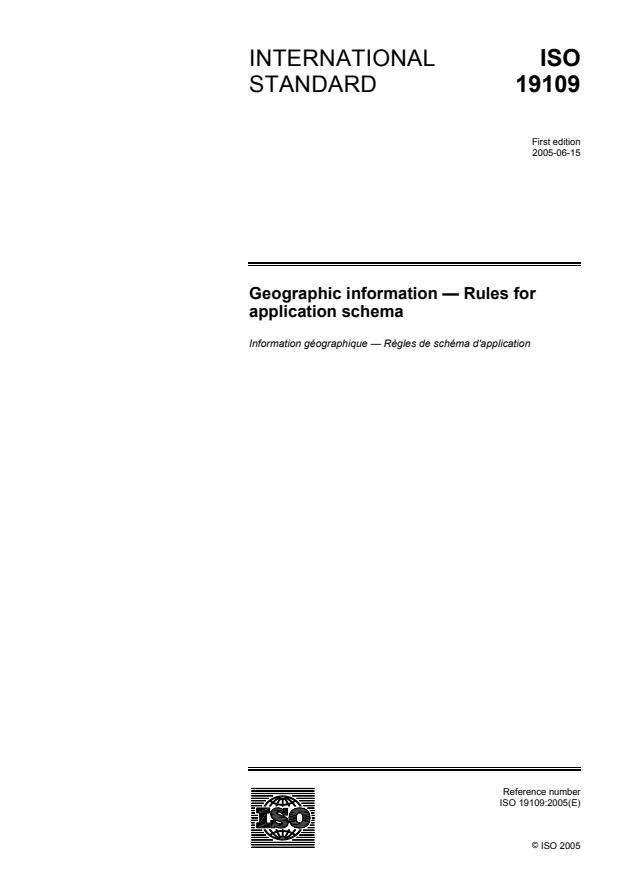
INTERNATIONAL ISO
STANDARD 19109
First edition
2005-06-15
Geographic information — Rules for
application schema
Information géographique — Règles de schéma d'application
Reference number
©
ISO 2005
PDF disclaimer
This PDF file may contain embedded typefaces. In accordance with Adobe's licensing policy, this file may be printed or viewed but
shall not be edited unless the typefaces which are embedded are licensed to and installed on the computer performing the editing. In
downloading this file, parties accept therein the responsibility of not infringing Adobe's licensing policy. The ISO Central Secretariat
accepts no liability in this area.
Adobe is a trademark of Adobe Systems Incorporated.
Details of the software products used to create this PDF file can be found in the General Info relative to the file; the PDF-creation
parameters were optimized for printing. Every care has been taken to ensure that the file is suitable for use by ISO member bodies. In
the unlikely event that a problem relating to it is found, please inform the Central Secretariat at the address given below.
© ISO 2005
All rights reserved. Unless otherwise specified, no part of this publication may be reproduced or utilized in any form or by any means,
electronic or mechanical, including photocopying and microfilm, without permission in writing from either ISO at the address below or
ISO's member body in the country of the requester.
ISO copyright office
Case postale 56 • CH-1211 Geneva 20
Tel. + 41 22 749 01 11
Fax + 41 22 749 09 47
E-mail copyright@iso.org
Web www.iso.org
Published in Switzerland
ii © ISO 2005 – All rights reserved
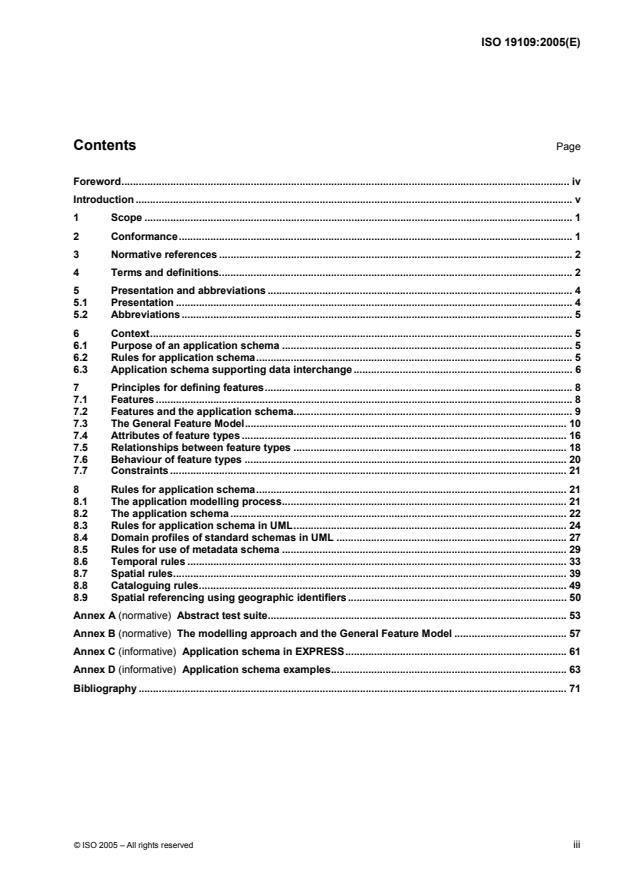
Contents Page
Foreword. iv
Introduction . v
1 Scope . 1
2 Conformance. 1
3 Normative references . 2
4 Terms and definitions. 2
5 Presentation and abbreviations . 4
5.1 Presentation . 4
5.2 Abbreviations . 5
6 Context. 5
6.1 Purpose of an application schema . 5
6.2 Rules for application schema. 5
6.3 Application schema supporting data interchange . 6
7 Principles for defining features. 8
7.1 Features . 8
7.2 Features and the application schema. 9
7.3 The General Feature Model. 10
7.4 Attributes of feature types . 16
7.5 Relationships between feature types . 18
7.6 Behaviour of feature types . 20
7.7 Constraints . 21
8 Rules for application schema. 21
8.1 The application modelling process. 21
8.2 The application schema . 22
8.3 Rules for application schema in UML. 24
8.4 Domain profiles of standard schemas in UML . 27
8.5 Rules for use of metadata schema . 29
8.6 Temporal rules . 33
8.7 Spatial rules. 39
8.8 Cataloguing rules. 49
8.9 Spatial referencing using geographic identifiers. 50
Annex A (normative) Abstract test suite. 53
Annex B (normative) The modelling approach and the General Feature Model . 57
Annex C (informative) Application schema in EXPRESS. 61
Annex D (informative) Application schema examples. 63
Bibliography . 71
Foreword
ISO (the International Organization for Standardization) is a worldwide federation of national standards bodies
(ISO member bodies). The work of preparing International Standards is normally carried out through ISO
technical committees. Each member body interested in a subject for which a technical committee has been
established has the right to be represented on that committee. International organizations, governmental and
non-governmental, in liaison with ISO, also take part in the work. ISO collaborates closely with the
International Electrotechnical Commission (IEC) on all matters of electrotechnical standardization.
International Standards are drafted in accordance with the rules given in the ISO/IEC Directives, Part 2.
The main task of technical committees is to prepare International Standards. Draft International Standards
adopted by the technical committees are circulated to the member bodies for voting. Publication as an
International Standard requires approval by at least 75 % of the member bodies casting a vote.
Attention is drawn to the possibility that some of the elements of this document may be the subject of patent
rights. ISO shall not be held responsible for identifying any or all such patent rights.
ISO 19109 was prepared by Technical Committee ISO/TC 211, Geographic information/Geomatics.
iv © ISO 2005 – All rights reserved
Introduction
Any description of reality is always an abstraction, always partial, and always just one of many possible
“views”, depending on the application field.
The widespread application of computers and geographic information systems (GIS) has led to an increased
use of geographic data within multiple disciplines. With current technology as an enabler, society’s reliance on
such data is growing. Geographic datasets are increasingly being shared and exchanged. They are also used
for purposes other than those for which they were produced.
To ensure that data will be understood by both computer systems and users, the data structures for data
access and exchange must be fully documented. The interfaces between systems, therefore, need to be
defined with respect to data and operations, using the methods standardized in this International Standard.
For the construction of internal software and data storage within proprietary systems, any method may be
used that enables the standardized interfaces to be supported.
An application schema provides the formal description of the data structure and content required by one or
more applications. An application schema contains the descriptions of both geographic data and other related
data. A fundamental concept of geographic data is the feature.
INTERNATIONAL STANDARD ISO 19109:2005(E)
Geographic information — Rules for application schema
1 Scope
This International Standard defines rules for creating and documenting application schemas, including
principles for the definition of features.
The scope of this International Standard includes the following:
conceptual modelling of features and their properties from a universe of discourse;
definition of application schemas;
use of the conceptual schema language for application schemas;
transition from the concepts in the conceptual model to the data types in the application schema;
integration of standardized schemas from other ISO geographic information standards with the
application schema.
The following are outside the scope:
choice of one particular conceptual schema language for application schemas;
definition of any particular application schema;
representation of feature types and their properties in a feature catalogue;
representation of metadata;
rules for mapping one application schema to another;
implementation of the application schema in a computer environment;
computer system and application software design;
programming.
2 Conformance
Any application schema claiming conformance to this International Standard shall pass all of the requirements
described in the abstract test suites in Annex A.
3 Normative references
The following referenced documents are indispensable for the application of this document. For dated
references, only the edition cited applies. For undated references, the latest edition of the referenced
document (including any amendments) applies.
1)
ISO/TS 19103:— , Geographic information — Conceptual schema language
ISO 19107:2003, Geographic information — Spatial schema
ISO 19108:2002, Geographic information — Temporal schema
ISO 19112:2003, Geographic information — Spatial referencing by geographic identifiers
ISO 19113:2002, Geographic information — Quality principles
ISO 19115:2003, Geographic information — Metadata
ISO/IEC 19501, Information technology — Open Distributed Processing — Unified Modeling Language (UML)
Version 1.4.2
4 Terms and definitions
For the purposes of this document, the following terms and definitions apply.
4.1
application
manipulation and processing of data in support of user requirements
[ISO 19101]
4.2
application schema
conceptual schema for data required by one or more applications
[ISO 19101]
4.3
complex feature
feature composed of other features
4.4
conceptual model
model that defines concepts of a universe of discourse
[ISO 19101]
4.5
conceptual schema
formal description of a conceptual model
[ISO 19101]
1) To be published.
2 © ISO 2005 – All rights reserved
4.6
dataset
identifiable collection of data
[ISO 19115]
4.7
domain
well-defined set
[ISO 19107]
NOTE Well-defined means that the definition is both necessary and sufficient, as everything that satisfies the
definition is in the set and everything that does not satisfy the definition is necessarily outside the set.
4.8
feature
abstraction of real-world phenomena
NOTE A feature may occur as a type or an instance. Feature type or feature instance should be used when only one
is meant.
[ISO 19101]
4.9
feature association
relationship that links instances of one feature type with instances of the same or a different feature type
[ISO 19110]
4.10
feature attribute
characteristic of a feature
NOTE 1 A feature attribute may occur as a type or an instance. Feature attribute type or feature attribute instance is
used when only one is meant.
NOTE 2 A feature attribute type has a name, a data type and a domain associated to it. A feature attribute instance has
an attribute value taken from the domain of the feature attribute type.
[adapted from ISO 19101]
4.11
feature operation
operation that every instance of a feature type may perform
EXAMPLE 1 A feature operation upon the feature type “dam” is to raise the dam. The results of this operation are to
raise the height of the “dam” and the level of water in a “reservoir”.
EXAMPLE 2 A feature operation by the feature type “dam” might be to block vessels from navigating along a
watercourse.
[adapted from ISO 19110]
4.12
geographic data
data with implicit or explicit reference to a location relative to the earth
NOTE Geographic information is also used as a term for information concerning phenomena implicitly or explicitly
associated with a location relative to the earth.
4.13
metadata
data about data
[ISO 19115]
4.14
model
abstraction of some aspects of reality
4.15
portrayal
presentation of information to humans
[ISO 19117]
4.16
quality
totality of characteristics of a product that bear on its ability to satisfy stated and implied needs
[ISO 19101]
4.17
universe of discourse
view of the real or hypothetical world that includes everything of interest
[ISO 19101]
5 Presentation and abbreviations
5.1 Presentation
This International Standard describes how to create an application schema that integrates conceptual
schemas defined in the ISO 19100 series of International Standards for geographic information. In addition to
stating the rules for creating application schemas, this International Standard provides guidance through
examples. This International Standard adopts the following conventions for presentation purposes:
a) Rules:
All rules are normative, and are described as follows.
Rules:
1)
2)
b) Tables:
Tables that are not referenced from the rules are informative.
c) Conceptual schemas:
Conceptual schemas in the normative part of this International Standard are presented in the Unified
Modelling Language (UML) in conformance with ISO/TS 19103. UML diagrams are presented in compliance
with ISO/IEC 19501.
4 © ISO 2005 – All rights reserved
5.2 Abbreviations
CSL Conceptual schema language
GFM General feature model
OCL Object constraint language
UML Unified modelling language
6 Context
6.1 Purpose of an application schema
An application schema is a conceptual schema for data required by one or more applications. An application
schema defines
content and structure of data; and
specifications of operations for manipulating and processing data by an application.
The purpose of an application schema is twofold:
to provide a computer-readable data description defining the data structure, which makes it possible to
apply automated mechanisms for data management; and
to achieve a common and correct understanding of the data, by documenting the data content of the
particular application field, thereby making it possible to unambiguously retrieve information from the data.
6.2 Rules for application schema
This International Standard does not standardize application schemas; it only defines rules for creating
application schemas in a consistent manner (including the consistent definition of features) to facilitate the
acquiring, processing, analysing, accessing, presenting and transferring of geographic data between different
users, systems and locations. The rules in this International Standard are, in the case of data transfer or
interchange, used by suppliers and users of geographic data to
build a transfer application schema for data interchange;
interpret the semantics of the transferred dataset with respect to user's local data and content and
structure of data; and
determine the necessary transformations between the two datasets.
The rules in this International Standard will assist the users of applications with similar data requirements in
creating a common application schema for the interface between their systems and data. This includes an
agreement about the elements from the universe of discourse. This is described in more detail in 6.3.
The mapping from one application schema to another application schema may be difficult and even
impossible if the two schemas are too divergent. The mapping is facilitated if the application schema used
within a system is designed considering also the requirements for the data interchange. The rules can also be
used for building an application schema used within a system, although such application schemas are not
within the scope of this International Standard.
The creation of an application schema is a process. The content of an application schema has to be settled
according to the view of reality in the universe of discourse. This is modelled in terms of types of features and
their properties. Clause 7 contains principles for consistently defining features.
The application schema defines the structure and content of data. It is expressed in a conceptual schema
language (CSL). Clause 7 also includes a model expressed in UML that defines the concepts required to
describe types of features. Feature type definition may be documented in feature catalogues. Such definitions
may be used in an applications schema. Other standards in the ISO 19100 series define reusable modules of
conceptual schemas that may be integrated in an application schema. Clause 8 gives the main rules for
integrating these predefined modules into a conceptual schema in UML.
NOTE ISO 19118 defines how a dataset defined by an application schema in UML is encoded.
6.3 Application schema supporting data interchange
6.3.1 Introduction
Data interchange between information systems may take place in two ways.
In the traditional data transfer model, the data supplier creates a dataset that is transferred to the user.
The structure and the content of data are described in the application schema for the dataset. The
dataset is sent in a transfer format.
In the interoperability model, the user application communicates with the supplier application through a
common communication protocol. In this scenario, the user invokes services that result in data being
passed from the service provider to the user application. The application schema describes not only the
structure and content of the exchanged data, but also the structure of the interfaces involved in the
transaction.
There is a fundamental distinction between a data transfer and a data transaction. In data transfer, a data set
is predefined in an application schema. The spatial extent and the rules for inclusion of feature instances are
also predefined. The user requests and receives a copy of the dataset (or may receive it automatically through
a long-term agreement for distribution of datasets). In a data transaction, a requester first specifies selection
criteria, such as spatial extent and feature instance inclusion rules for the data from the producer’s data store.
Data meeting the selection criteria are then retrieved from the data store and provided to the user.
NOTE Conformance to the rules in this International Standard does not guarantee that data conforming to any given
application schema can be transformed in a meaningful way to conform to any other application schema. At best, it allows
the user to determine which elements are common to the two schemas and which could be transformed from one schema
to another, as well as those that cannot be transformed. Complete interoperability can only occur when user and supplier
have identical application schemas.
6.3.2 Data interchange by transfer
Figure 1 shows the traditional data transfer model for data suppliers and data users. The structure and content
of the data provided by the supplier and received by the user are described in application schemas. To be
able to transfer data, three conditions must be fulfilled.
6 © ISO 2005 – All rights reserved
Figure 1 — Data interchange by transfer
First, the user and the supplier must agree on creating an application schema for the data being exchanged in
accordance with this International Standard. In order to facilitate the transfer of data, this application schema
shall be developed using the application schemas from the user and the supplier. One mapping will be made
from the supplier’s application schema to this application schema for the exchanged data, and a second
mapping will be made from this application schema to the application schema of the user.
Second, the supplier must be able to transform the application data defined according to the supplier
application schema into a transfer dataset defined according to the application schema for the exchanged
data.
Third, the user must be able to transform the transfer dataset defined according to its application schema to
the application data defined according to the user’s application schema.
6.3.3 Data interchange by transactions
Figure 2 shows data interchange through transactions described in the interoperability model. The user
application makes a request for data that is received by the supplier application. In response, the supplier
application delivers a resulting dataset. Both the request and the resulting dataset are defined according to a
common application schema. The supplier application is responsible for transforming the data in system A into
the data in the exchanged dataset. After receipt, the user application is responsible for transforming the
exchanged data into data in system B. Data interchange by transaction is provided by geospatial services as
defined in ISO 19119. In particular, feature access services are defined in Geographic model/information
management services.
NOTE The unbroken lines show the flow of data. Broken lines denote the role of the application schema on the data
interchange.
Figure 2 — Data interchange by transactions
7 Principles for defining features
7.1 Features
A fundamental unit of geographic information is called a feature. ISO 19110 provides a standard framework
for organizing and reporting the classification of features. It also gives a broader discussion on different
aspects of geographic features.
This International Standard gives rules for creating application schemas, including the principles for the
definition of features. The term feature is used in different contexts defined according to the four-layer
architecture. Annex B describes the use of the term feature in the four-layer architecture.
This International Standard distinguishes four aspects of defining features: the definitions or description used
to group them into types, the attributes associated with each type, the relationships among the types and the
behaviour of the features.
EXAMPLE “Tower Bridge” is the abstraction of a certain real-world bridge in London. The term “bridge” is the
abstraction of the collection of all real-world phenomena that is classified into the concept behind the term “bridge”. Later
in the document, the terms “feature type” and “feature instance” are used to separate the concept of “feature” describing
the whole collection from the concept of describing a certain instance occurrence.
Figure 3 describes the most abstract level of defining and structuring geographic data. The classification of
real-world phenomena as features depends on their significance to a particular universe of discourse.
8 © ISO 2005 – All rights reserved
Figure 3 — The process from universe of discourse to data
7.2 Features and the application schema
This International Standard supports the definition of features with respect to their representation in data
structures defined by application schemas.
Figure 4 shows the process of structuring data from the universe of discourse to the geographic dataset. The
definitions of the feature types and their properties, as perceived in context of an application field, will be
derived from the universe of discourse. A feature catalogue documents the feature types.
An application schema defines the logical structure of data and may define operations that can be performed
on or with the data. An application schema addresses the logical organization, rather than the physical.
The developer of an application schema may use feature definitions from feature catalogues that already exist.
This will reduce the costs of data acquisition, allowing the developer to use existing data, and simplify the
process of developing the application schema.
The application schema shall be expressed in a conceptual schema language. Each conceptual schema
language has its own terms and concepts. When creating an application schema, the concepts of the General
Feature Model (GFM; see 7.3) are mapped to the concepts of the chosen conceptual schema language. For
UML, these rules are described in 8.3.
NOTE Annex C gives as an example the rules for mapping the concepts of the GFM to the concepts of ISO 10303-11.
Figure 4 — From reality to geographic data
7.3 The General Feature Model
7.3.1 Introduction
This subclause identifies and describes the concepts used to define features and how these concepts are
related. The description is expressed in a conceptual model, also called the General Feature Model (GFM).
Annex B provides discussions regarding the purpose and design of the GFM.
NOTE The complete kernel of GFM is found in Annex B.3.
The concepts of the GFM are used in the feature catalogue structure described in ISO 19110. ISO 19117 also
uses these concepts for specifying the portrayal of geographic information. The concepts of the GFM are used
to establish categories of geographic processing services taxonomy in ISO 19119.
Subclauses 7.4 to 7.7 depict how different aspects of the properties of a feature are managed. Subclause 7.4
describes different aspects of attributes and 7.5 describes different aspects of relationships. Subclause 7.6
includes a more detailed description of behaviour of features, and 7.7 describes the concept of constraints.
7.3.2 The purpose of the GFM
The GFM is a model of the concepts required to classify a view of the real world. It is expressed in a CSL, that
is in UML class diagrams, but it could be in any CSL. UML has its own model of concepts (metamodel). As
10 © ISO 2005 – All rights reserved
both the GFM and the UML metamodel deal with classification, the concepts are very similar. There is one big
difference: the concepts in the GFM establish a basis for the classification of features, whereas the UML
metamodel provides a basis for classification of any kind.
The things we want to classify we call features; the relations between feature types are feature association
types and inheritance. Feature types have properties that are feature attributes, feature operations and feature
association roles. All these concepts are expressed as UML metaclasses in the GFM. The GFM is a
metamodel of feature types.
Feature types may be documented in feature catalogues. The GFM may serve as the conceptual model of the
feature-catalogue structure, but the feature catalogue has additional concepts for documenting feature types.
There is a Feature Catalogue Model (FCM) that realizes the GFM concepts and also adds some more
concepts (see ISO 19110). Some new concepts are, for example, a list of the feature attributes of each
feature type, aliases of the feature type name, and codes for the feature type name. These additional
concepts are not in conflict with the concepts from the GFM.
An application schema shall be expressed in a CSL. It shall describe the structure and content of the dataset
that represents a universe of discourse. The GFM specifies the requirements for the classification of features,
but is not a CSL. This means that we have to use an existing CSL to define the application schema. Within the
ISO 19100 series of International Standards, UML is used. As we want to integrate standard schemas from
the ISO 19100 series into our application schemas, it is convenient to express the application schema in UML.
In this International Standard, we have defined the main rules for mapping the GFM concepts into the UML
language. This may be done for other CSLs as well; in Annex C we have exemplified the mapping from GFM
to ISO 10303-11 EXPRESS.
The GFM defines the structure for classifying features that we need to keep in mind when we make our
application schema in UML. However, the mapping from GFM to UML is a one-way mapping; it is not possible
to map backwards. For example, the application schema has UML classes. Some of these classes are GFM
feature types and some are the datatypes for feature attributes; it is not possible to keep these things apart.
The GFM does not define feature-attribute values to the depth that is needed. That is not necessary to do as
the GFM only specifies the structure and content of definition of features.
The conclusion is that the GFM is a metamodel for definition of features that also is used to define the
structure of feature catalogues. The chosen CSL metamodel (e.g. the UML metamodel as restricted by
ISO 19103) is the metamodel for an application schema. As the application schema deals with data
representing features, the structure of the GFM has to be kept in mind while creating the application schema.
7.3.3 The main structure of the GFM
Figure 5 shows the concepts used to define types of features. Figure 5 is an extract from the whole model.
Subclause B.3 provides a figure (Figure B.2) showing all concepts of the GFM and the relationships between
them.
Besides a name and a description, a feature type is defined by its properties such as
feature attributes;
feature association roles characterizing the feature type; and
defined behaviour of the feature type.
Additional concepts are
feature associations between the feature type and itself or other feature types;
generalization and specialization relationships to other feature types; and
constraints on the feature type.
Figure 5 — Extract from the General Feature Model
NOTE Figure 8 shows additional relationships from GF_Operation to GF_AttributeType and GF_AssociationType.
7.3.4 GF_FeatureType
A feature is an abstraction of real-world phenomena. GF_FeatureType is a metaclass that is instantiated as
classes that represent individual feature types. A certain feature type is the class for all instances of that
feature type. The instances of a class that represents an individual feature type are feature instances.
NOTE 1 Feature types are equivalent to classes and feature instances are equivalent to objects, in object-oriented
modelling.
NOTE 2 Annex B provides a table on the use of the term “feature”.
typeName
name of the feature type. The name shall be unique within an application schema. TypeName is optional
only for GF_AssociationType.
LocalName
identifier within a name space for a local object. Types defined in ISO/TS 19103, LocalName is a subtype
of GenericName which is a component of the NameSpace definition. This could be the target object of
12 © ISO 2005 – All rights reserved
the GenericName, or a pointer to another NameSpace (with a new GenericName) one step closer to the
target of the identifier.
definition
definition that describes the feature type.
isAbstract
Boolean attribute. If true, the feature type acts as an abstract supertype.
includes
The association role specifies that an instance of a feature association may include any number of
instances of feature types.
7.3.5 GF_PropertyType
GF_PropertyType is the metaclass for any class of property of a feature type that describes characteristics of
the feature, the behaviour of a feature, or the association roles that the feature is in.
GF_Property Type is the supertype of GF_Operation, GF_AttributeType and GF_AssociationRole.
memberName
name of the behaviour, attribute or role. Only name of role is optional.
LocalName
identifier within a name space for a local object. This could be the target object of the GenericName,
or a pointer to another NameSpace (with a new GenericName) one step closer to the target of the
identifier. In the Basic Types defined in ISO/TS 19103, LocalName is a subtype of GenericName
which is a component of the NameSpace definition.
definition
description of the behaviour, attribute or role of a feature type.
carrierOfCharacteristics
The association role carrierOfCharacteristics specifies that any feature operation, any feature attribute
type and any feature association role carries characteristics of a feature type.
7.3.6 GF_AttributeType
GF_AttributeType is the metaclass for attribute definitions of a feature type (see also 7.4).
valueType
data type of the attribute value.
NOTE ISO/TS 19103 defines data types that may be used for the valueType of a feature attribute.
EXAMPLE 1 Integer, character String or GM_Object.
TypeName
identifier within a type space for a local object. In the Basic Types defined in ISO/TS 19103,
TypeName is subtype of LocalName (see 7.3.4).
domainOfValues
description of a set of values.
EXAMPLE 2 Positive, from 3 to 7, GM_Object and all its subtypes as defined in ISO 19107.
cardinality
number of instances of the attribute that may be associated with a single instance of a feature type.
Multiplicity
specification of the range of allowable cardinalities that a set may assume. This data type is defined
in ISO/TS 19103.
7.3.7 GF_AssociationRole
GF_AssociationRole is the metaclass for the classes of roles that are part of a GF_AssociationType
(see 7.3.9).
NOTE GF_AssociationRole indicates the role played by the feature type through the association. The instance of
GF_AssociationRole that gives the role for one feature type can also be seen as part of this feature type.
cardinality
number of instances of the feature type that can act in this role relative to a single instance of the feature
type at the other end of the association.
Multiplicity
specification of the range of allowable cardinalities that a set may assume.
Role
The association role specifies the roles associated to a GF_AssociationType.
roleName
role of being a specific role assigned to a GF_AssociationType.
7.3.8 GF_Operation
GF_Operation is the metaclass for describing behaviour of feature types in terms of operations (see also 7.6).
NOTE 1 GF_operations only apply to the interoperability model and do not apply to the data transfer model as
described in 6.3.1
NOTE 2 Instances of GF_Operation are of three kinds: observer operations, mutator operations and constructor
operations. Observer operations return the current values of attributes. Mutator operations include actions that change
those values. A mutator operation creates an instance of a class for which it is defined. For example, an observer
operation may be used to find the height of a dam. Raising the dam is a mutator operation that changes the height of the
dam and also affects the attributes of the watercourse and the reservoir associated with the dam. Values may be observed
or affected for another feature instance if there is an association between the feature types involved.
signature
description that indicates the name, the arguments and the return values of an operation.
14 © ISO 2005 – All rights reserved
NOTE 3 In UML, signature is expressed in the form operation_name(input_parameter1, input_parameter2,.) :
output_value_type, for example has_height() : real.
7.3.9 GF_AssociationType
GF_AssociationType is the metaclass for describing associations between feature types (see also 7.5).
A feature association may have attributes. This is allowed because GF_AssociationType is a subtype of
GF_FeatureType.
NOTE GF_AssociationType is subclassed under GF_Feature type for a variety of reasons. First, from a philosophical
point of view, an association instance between feature instances meets the requirements in the definition of feature as an
“abstraction of real-world phenomenon”. In the case of an instance of an association type, the “phenomenon” is the
interaction of the two features. Second, from a pragmatic point of view, because an association meets the philosophical
test for feature, it also meets some of the more pragmatic requirements. Associations often have spatial attributes, such as
the location of the feature interaction. Associations may need to carry other attributes to describe the interaction, such as
in 2D, road-rail intersections need to be classified as “road-overpass”, “road-underpass”, “rail-overpass”, “rail underpass”
or “at-grade”, and may need to carry other attributes such as “clearance”. In many cases, the infrastructure at the point of
interaction is naturally treated as a feature in its own right (such as a “rail-bridge”). In addition to the classical feature
attributes, association instances can also carry metadata information. Pragmatically, association instances carry attributes
just like feature instances, and inheriting the semantics and the code to accomplish that simplifies geographic information
software.
linkBetween
The association role linkBetween specifies that a GF_AssociationType will be a link from one instance of
a feature type to the same or another instance of a feature type.
7.3.10 GF_InheritanceRelation
GF_InheritanceRelation is the class for a generic relationship between a more general feature type
(supertype) and one specialized feature type (subtype).
Any instance of a specialized feature type is also an instance of the general feature type.
EXAMPLE The feature type “bridge” may belong to both the general class of “transportation feature” for road
features and to the general class of “hazards” for navigation features. A specific instance of “bridge” is then also an
instance of “transportation feature” and “hazards”.
Each specialization expresses a purpose. A feature type can act as supertype in a number of generic
relationships, each having a different purpose.
name
name of generalization/specialization; optional.
description
explanation of the generalization/specialization.
uniqueInstance
UniqueInstance is a Boolean variable, where .TRUE. means that an instance of the supertype shall not
be an instance of more than one of the subtypes, whereas .FALSE. means that an instance of the
supertype may be an instance of more than one subtype.
Generalization
The association Generalization specifies that a feature type has the role of being a supertype in an
inheritance relationship with another feature type.
Specialization
The association Specialization specifies that a feature type has the role of being a subtype in an
inheritance relationship with another feature type.
supertype
role of being the more generic feature type of one other or other feature types.
subtype
role of being the more specific feature type of one other or other feature types.
7.3.11 GF_Constraint
GF_Constraint is the class for constraints that may be associated with feature types and the properties of
feature types (see also 7.7).
description
The constraint described in natural language and/or in formal notation.
constrainedBy
The role specifies that constraint is made on the GF_FeatureType or specified on GF_Properties within a
feature type.
7.4 Attributes of feature types
7.4.1 Introduction
This subclause describes in more detail the role of attributes of features. An attribute type (GF_AttributeType)
has a name (memberName), a description (definition), a type, a domain and cardinality associated with it.
The attributes carry all static information of a feature. This covers both spatial and non-spatial properties. In
the ISO 19100 series of International Standards, some attribute types are of specific interest. These types are
shown in Figure 6 as subtypes of GF_AttributeType. The attribute provides the interface to these other
ISO 19100 International Standards because it uses their schemas. The attribute type will get the value type
definition from those schemas and the value domain according to those schemas. For example, a spatial
attribute type (GF_SpatialAttributeType) will have its value type and value domain according to the definition
of GM_Object or TP_Object described in ISO 19107.
7.4.2 attributeOfAttribute
The association attributeOfAttribute links an attribute to another attribute that describes some characteristics
of the first attribute.
EXAMPLE An attribute that carries the position of a feature may have another attribute that holds the positional
accuracy (data value of GF_QualityAttributeType) of this position.
16 © ISO 2005 – All rights reserved
Figure 6 — Attributes of feature types
7.4.3 GF_SpatialAttributeType
GF_SpatialAttributeType represents a spatial attribute, which shall be used to express spatial characteristics
of a feature type. A spatial attribute type shall have a GM_Object or a TP_Object as value type. The structures
of GM_Object and TP_Object are defined in the Spatial Schema described in ISO 19107.
7.4.4 GF_TemporalAttributeType
GF_TemporalAttributeType represents a temporal attribute, which shall be used as the time reference
characteristic of a feature. A temporal attribute type shall have a TM_Object as value ty
...
Questions, Comments and Discussion
Ask us and Technical Secretary will try to provide an answer. You can facilitate discussion about the standard in here.
Loading comments...