


ISO 8783:2026
(Main)Alpine skis — Guidelines and requirements for conducting slope performance tests
General Information
- Abstract
This document provides requirements and recommendations for carrying out comparative testing of alpine skis with the objective of evaluating the performance characteristics. It is applicable to alpine skis in accordance with ISO 6289.
- Status
- Published
- Publication Date
- 23-Jul-2026
- Technical Committee
- ISO/TC 83/SC 4 - Snowsports equipment
- Drafting Committee
- ISO/TC 83/SC 4/WG 3 - Skis and snowboards
- Current Stage
- 6060 - International Standard published
- Start Date
- 24-Jul-2026
- Due Date
- 16-Jul-2028
- Completion Date
- 24-Jul-2026


Overview
ISO 8783:2026 – Alpine skis - Guidelines and requirements for conducting slope performance tests is an international standard developed by ISO. This document outlines comprehensive requirements and best practices for executing comparative performance tests of alpine skis, with the goal of evaluating skis according to standardized criteria. The standard applies to all alpine skis as defined under ISO 6289, ensuring consistency and objectivity in test procedures within the snowsports equipment industry.
Key Topics
ISO 8783:2026 covers critical elements in conducting reliable and reproducible slope performance tests for alpine skis, including but not limited to:
- Test Criteria: Establishes clear criteria such as turnability, edge grip, steering behavior, stability, smooth running, and skier friendliness for ski evaluation.
- Test Conditions: Specifies that tests should take place on well-prepared, grippy snow under controlled circumstances to ensure fairness and comparability.
- Test Personnel: Recommends that test personnel be independent and skilled, with appropriate physical conditioning and expertise in ski assessment and rating scales.
- Test Committee: Mandates supervision by a committee of technical experts to ensure objectivity and proper evaluation procedures.
- Test Skis Preparation: Requires that skis be tested in their delivered condition unless retuning is necessary, and mandates proper maintenance and setup as per manufacturer instructions.
- Rating and Classification: Details a five-point scale for ski assessment (from “very good” to “very poor”) and advocates the use of reference skis for comparative analysis.
- Reporting and Publication: Defines required contents for official test reports and outlines transparency standards for publishing test results.
Applications
The practical applications of ISO 8783:2026 are broad and benefit a range of stakeholders in the ski industry:
- Manufacturers and Developers: Use the standard to conduct fair and objective product testing for new alpine ski models, supporting product development and comparison.
- Testing Laboratories and Certification Bodies: Standardizes methods for independent testing and verification, promoting consistency and trust in published results.
- Retailers and Distributors: Reference test outcomes adhering to ISO 8783 in marketing and technical material, offering credible performance claims to consumers.
- Ski Instructors and Coaches: Utilize standardized performance data to guide equipment recommendations and athlete training programs.
- Consumers: Access reliable, comparable information when choosing alpine skis, based on robust test methods outlined in ISO 8783.
By providing a uniform approach to slope performance testing, ISO 8783:2026 helps support transparency, product quality, and consumer protection in the global alpine ski market.
Related Standards
ISO 8783:2026 references and is complemented by several other standards relevant to the snowsports equipment domain:
- ISO 6289 – Skis - Vocabulary: Defines terminology for consistent communication in the industry.
- Other ISO/TC 83 Standards: Covering sports and recreational facilities and equipment, providing broader context and requirements.
- Binding and Safety Standards: Although not specified in ISO 8783, adherence to relevant binding safety standards is crucial for comprehensive ski evaluation.
Implementing ISO 8783:2026 alongside these related standards ensures an integrated and systematic approach to the safety, performance, and comparability of alpine ski equipment.
Keywords: ISO 8783:2026, alpine skis, slope performance tests, ski testing standards, ski evaluation, ski test criteria, snowsports equipment, ISO 6289, ski rating, ski test procedures, ski industry standards
Relations
- Effective Date
- 12-Jul-2025
Frequently Asked Questions
ISO 8783:2026 is a standard published by the International Organization for Standardization (ISO). Its full title is "Alpine skis — Guidelines and requirements for conducting slope performance tests". This standard covers: This document provides requirements and recommendations for carrying out comparative testing of alpine skis with the objective of evaluating the performance characteristics. It is applicable to alpine skis in accordance with ISO 6289.
This document provides requirements and recommendations for carrying out comparative testing of alpine skis with the objective of evaluating the performance characteristics. It is applicable to alpine skis in accordance with ISO 6289.
ISO 8783:2026 is classified under the following ICS (International Classification for Standards) categories: 97.220.20 - Winter sports equipment. The ICS classification helps identify the subject area and facilitates finding related standards.
ISO 8783:2026 has the following relationships with other standards: It is inter standard links to ISO 8783:2015. Understanding these relationships helps ensure you are using the most current and applicable version of the standard.
ISO 8783:2026 is available in PDF format for immediate download after purchase. The document can be added to your cart and obtained through the secure checkout process. Digital delivery ensures instant access to the complete standard document.
Standards Content (Sample)
International
Standard
ISO 8783
Third edition
Alpine skis — Guidelines and
2026-07
requirements for conducting slope
performance tests
Skis alpins — Lignes directrices et exigences pour la réalisation
d'essais de performance sur piste
Reference number
© ISO 2026
All rights reserved. Unless otherwise specified, or required in the context of its implementation, no part of this publication may
be reproduced or utilized otherwise in any form or by any means, electronic or mechanical, including photocopying, or posting on
the internet or an intranet, without prior written permission. Permission can be requested from either ISO at the address below
or ISO’s member body in the country of the requester.
ISO copyright office
CP 401 • Ch. de Blandonnet 8
CH-1214 Vernier, Geneva
Phone: +41 22 749 01 11
Email: copyright@iso.org
Website: www.iso.org
Published in Switzerland
ii
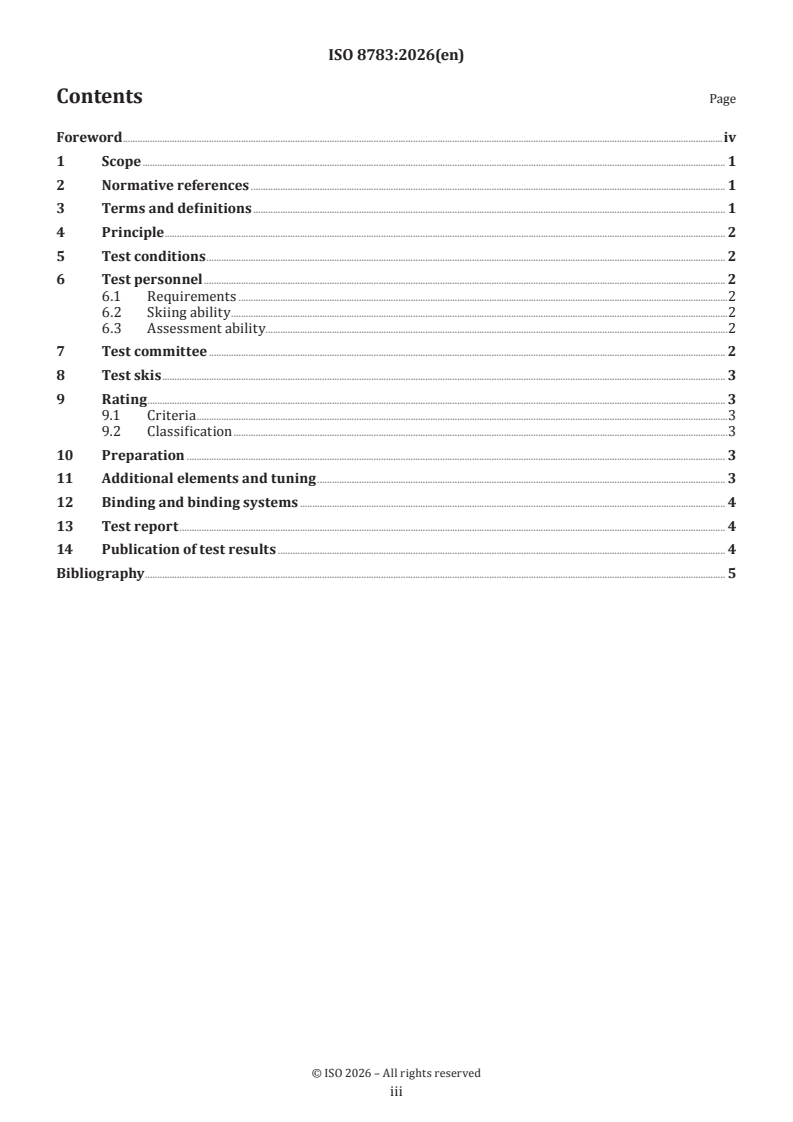
Contents Page
Foreword .iv
1 Scope . 1
2 Normative references . 1
3 Terms and definitions . 1
4 Principle . 2
5 Test conditions . 2
6 Test personnel . 2
6.1 Requirements .2
6.2 Skiing ability .2
6.3 Assessment ability.2
7 Test committee . 2
8 Test skis . 3
9 Rating . 3
9.1 Criteria .3
9.2 Classification .3
10 Preparation . 3
11 Additional elements and tuning . 3
12 Binding and binding systems . 4
13 Test report . 4
14 Publication of test results . 4
Bibliography . 5
iii
Foreword
ISO (the International Organization for Standardization) is a worldwide federation of national standards
bodies (ISO member bodies). The work of preparing International Standards is normally carried out through
ISO technical committees. Each member body interested in a subject for which a technical committee
has been established has the right to be represented on that committee. International organizations,
governmental and non-governmental, in liaison with ISO, also take part in the work. ISO collaborates closely
with the International Electrotechnical Commission (IEC) on all matters of electrotechnical standardization.
The procedures used to develop this document and those intended for its further maintenance are described
in the ISO/IEC Directives, Part 1. In particular, the different approval criteria needed for the different types
of ISO document should be noted. This document was drafted in accordance with the editorial rules of the
ISO/IEC Directives, Part 2 (see www.iso.org/directives).
ISO draws attention to the possibility that the implementation of this document may involve the use of (a)
patent(s). ISO takes no position concerning the evidence, validity or applicability of any claimed patent
rights in respect thereof. As of the date of publication of this document, ISO had not received notice of (a)
patent(s) which may be required to implement this document. However, implementers are cautioned that
this may not represent the latest information, which may be obtained from the patent database available at
www.iso.org/patents. ISO shall not be held responsible for identifying any or all such patent rights.
Any trade name used in this document is information given for the convenience of users and does not
constitute an endorsement.
For an explanation of the voluntary nature of standards, the meaning of ISO specific terms and expressions
related to conformity assessment, as well as information about ISO's adherence to the World Trade
Organization (WTO) principles in the Technical Barriers to Trade (TBT), see www.iso.org/iso/foreword.html.
This document was prepared by Technical Committee ISO/TC 83, Sports and other recreational facilities and
equipment, Subcommitte
...