

ISO 8589:2007/Amd 1:2014
(Amendment)Sensory analysis — General guidance for the design of test rooms — Amendment 1
General Information
- Abstract
- Status
- Published
- Publication Date
- 05-Jun-2014
- Technical Committee
- ISO/TC 34/SC 12 - Sensory analysis
- Drafting Committee
- ISO/TC 34/SC 12 - Sensory analysis
- Current Stage
- 6060 - International Standard published
- Start Date
- 06-Jun-2014
- Due Date
- 16-Dec-2014
- Completion Date
- 16-Dec-2014
Buy Documents


ISO 8589:2007/Amd 1:2014 - Sensory analysis — General guidance for the design of test rooms — Amendment 1 Released:6/6/2014


ISO 8589:2007/Amd 1:2014 - Analyse sensorielle — Directives générales pour la conception de locaux destinés a l'analyse — Amendement 1 Released:6/6/2014
Overview
ISO 8589:2007/Amd 1:2014 is an amendment to the internationally recognized standard ISO 8589:2007, which provides general guidance for the design of sensory analysis test rooms. Sensory analysis is critical in evaluating products based on human senses such as taste, smell, sight, and touch. This amendment specifically updates the guidance on the interior color of testing booths to optimize the sensory evaluation environment. Developed by the ISO/TC 34 committee on Food Products, Subcommittee SC 12 on Sensory Analysis, this amendment aligns with current best practices to ensure unbiased and reliable sensory test results.
Key Topics
- Test Room Environment: The standard outlines design principles that reduce external distractions and influence on the testing results.
- Booth Interior Color: Amendment 1 updates clause 6.2.5 on booth coloration, specifying the use of matte, neutral colors such as white, light grey, or off-white with very low saturation to avoid impacting sensory judgments.
- Material Finishes: Emphasis on matte surfaces helps prevent glare and reflections, which can distract or bias participants during sensory evaluations.
- Standardization Practices: Following ISO 8589:2007/Amd 1:2014 helps laboratories maintain consistency, comparability, and reproducibility of sensory data across tests and locations.
- Collaborative Development: ISO developed this amendment in cooperation with national standard bodies and experts, considering patent rights and trade regulations to ensure global applicability.
Applications
- Food and Beverage Industry: Sensory test rooms designed according to ISO 8589:2007/Amd 1:2014 enable producers to assess flavors, textures, and aromas accurately, supporting quality control and product development.
- Consumer Product Testing: Cosmetic, fragrance, and household product manufacturers use standardized test environments to evaluate sensory acceptance and detect product changes.
- Research Facilities: Academic and contract research organizations benefit from compliance by enhancing the validity of sensory experiments and studies.
- Regulatory Compliance: Organizations conducting sensory evaluations in regulated markets utilize this standard to meet requirements and provide documented evidence of proper testing conditions.
- Training Sensory Panels: Consistent test room conditions improve panelist performance, minimizing variability due to environmental factors.
Related Standards
- ISO 13299 - Sensory Analysis - Methodology - General Guidance for Establishing a Sensory Profile
- ISO 5492 - Sensory Analysis - Vocabulary
- ISO/IEC Directives, Part 1 and Part 2 - Procedures for Developing International Standards and Editorial Rules
- ISO 8586 - Sensory Analysis - General Guidance for the Selection, Training, and Monitoring of Assessors
- ISO 13300 Series - Sensory Analysis Equipment Specifications
Implementing ISO 8589:2007/Amd 1:2014 enhances the design and operation of sensory test rooms, ensuring that sensory evaluations are conducted in controlled, neutral environments. This leads to more accurate and reliable sensory data, critical for informed decision-making in product development and quality assurance across various industry sectors.
Relations
- Effective Date
- 12-Feb-2026
- Consolidates
ISO 14694:2003 - Industrial fans — Specifications for balance quality and vibration levels - Effective Date
- 06-Jun-2022
- Effective Date
- 06-Jun-2022
- Effective Date
- 09-May-2020
Buy Documents
ISO 8589:2007/Amd 1:2014 - Sensory analysis — General guidance for the design of test rooms — Amendment 1 Released:6/6/2014
ISO 8589:2007/Amd 1:2014 - Analyse sensorielle — Directives générales pour la conception de locaux destinés a l'analyse — Amendement 1 Released:6/6/2014
Get Certified
Connect with accredited certification bodies for this standard

BSI Group
BSI (British Standards Institution) is the business standards company that helps organizations make excellence a habit.

Bureau Veritas
Bureau Veritas is a world leader in laboratory testing, inspection and certification services.

DNV
DNV is an independent assurance and risk management provider.
Sponsored listings
Frequently Asked Questions
ISO 8589:2007/Amd 1:2014 is a standard published by the International Organization for Standardization (ISO). Its full title is "Sensory analysis — General guidance for the design of test rooms — Amendment 1". This standard covers: Sensory analysis — General guidance for the design of test rooms — Amendment 1
Sensory analysis — General guidance for the design of test rooms — Amendment 1
ISO 8589:2007/Amd 1:2014 is classified under the following ICS (International Classification for Standards) categories: 67.240 - Sensory analysis. The ICS classification helps identify the subject area and facilitates finding related standards.
ISO 8589:2007/Amd 1:2014 has the following relationships with other standards: It is inter standard links to EN ISO 8589:2010/A1:2014, ISO 14694:2003, ISO 10545-3:2018, ISO 8589:2007. Understanding these relationships helps ensure you are using the most current and applicable version of the standard.
ISO 8589:2007/Amd 1:2014 is available in PDF format for immediate download after purchase. The document can be added to your cart and obtained through the secure checkout process. Digital delivery ensures instant access to the complete standard document.
Standards Content (Sample)
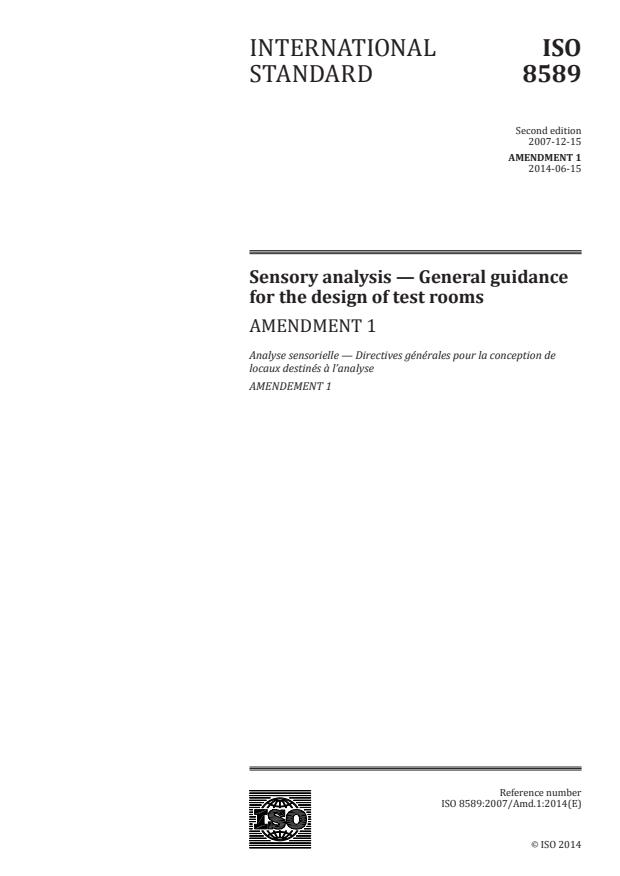
INTERNATIONAL ISO
STANDARD 8589
Second edition
2007-12-15
AMENDMENT 1
2014-06-15
Sensory analysis — General guidance
for the design of test rooms
AMENDMENT 1
Analyse sensorielle — Directives générales pour la conception de
locaux destinés à l’analyse
AMENDEMENT 1
Reference number
ISO 8589:2007/Amd.1:2014(E)
©
ISO 2014
ISO 8589:2007/Amd.1:2014(E)
© ISO 2014
All rights reserved. Unless otherwise specified, no part of this publication may be reproduced or utilized otherwise in any form
or by any means, electronic or mechanical, including photocopying, or posting on the internet or an intranet, without prior
written permission. Permission can be requested from either ISO at the address below or ISO’s member body in the country of
the requester.
ISO copyright office
Case postale 56 • CH-1211 Geneva 20
Tel. + 41 22 749 01 11
Fax + 41 22 749 09 47
E-mail copyright@iso.org
Web www.iso.org
Published in Switzerland
ii © ISO 2014 – All rights reserved
ISO 8589:2007/Amd.1:2014(E)
Foreword
ISO (the International Organization for Standardization) is a worldwide federation of national standards
bodies (ISO member bodies). The work of preparing International Standards is normally carried out
through ISO technical committees. Each member body interested in a subject for which a technical
committee has been established has the right to be represented on that committee. International
organizations, governmental and non-governmental, in liaison with ISO, also take part in the work.
ISO collaborates closely with the International Electrotechnical Commission (IEC) on all matters of
electrotechnical standardization.
The procedures used to develop this document and those intended for its further maintenance are
described in the ISO/IEC Direct
...
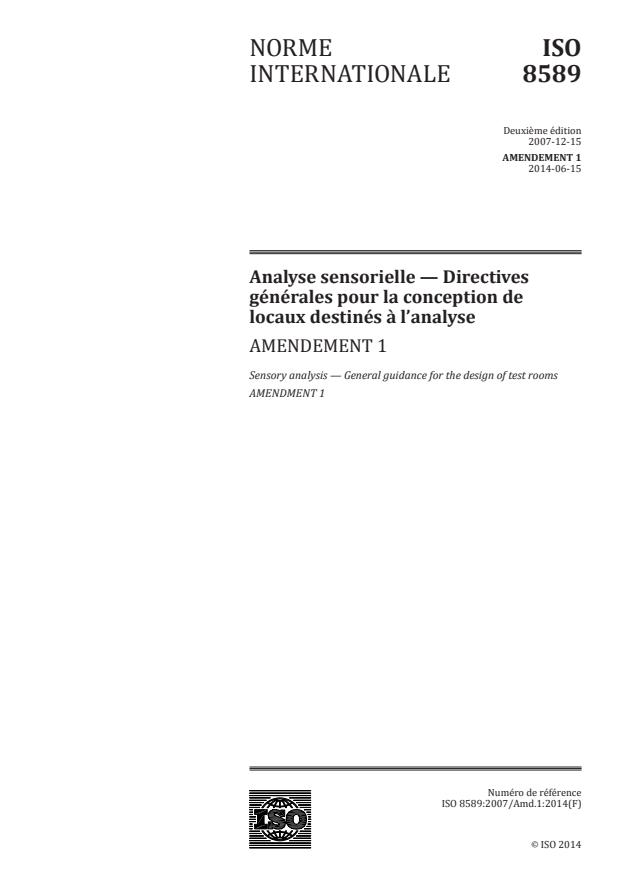
NORME ISO
INTERNATIONALE 8589
Deuxième édition
2007-12-15
AMENDEMENT 1
2014-06-15
Analyse sensorielle — Directives
générales pour la conception de
locaux destinés à l’analyse
AMENDEMENT 1
Sensory analysis — General guidance for the design of test rooms
AMENDMENT 1
Numéro de référence
ISO 8589:2007/Amd.1:2014(F)
©
ISO 2014
ISO 8589:2007/Amd.1:2014(F)
DOCUMENT PROTÉGÉ PAR COPYRIGHT
© ISO 2014
Droits de reproduction réservés. Sauf indication contraire, aucune partie de cette publication ne peut être reproduite ni utilisée
sous quelque forme que ce soit et par aucun procédé, électronique ou mécanique, y compris la photocopie, l’affichage sur
l’internet ou sur un Intranet, sans autorisation écrite préalable. Les demandes d’autorisation peuvent être adressées à l’ISO à
l’adresse ci-après ou au comité membre de l’ISO dans le pays du demandeur.
ISO copyright office
Case postale 56 • CH-1211 Geneva 20
Tel. + 41 22 749 01 11
Fax + 41 22 749 09 47
E-mail copyright@iso.org
Web www.iso.org
Publié en Suisse
ii © ISO 2014 – Tous droits réservés
ISO 8589:2007/Amd.1:2014(F)
Avant-propos
L’ISO (Organisation internationale de normalisation) est une fédération mondiale d’organismes
nationaux de normalisation (comités membres de l’ISO). L’élaboration des Normes internationales est
en général confiée aux comités techniques de l’ISO. Chaque comité membre intéressé par une étude
a le droit de faire partie du comité technique créé à cet effet. Les organisations internationales,
gouvernementales et non gouvernementales, en liaison avec l’ISO participent également aux travaux.
L’ISO collabore étroitement avec la Commission électrotechnique internationale (IEC) en ce qui concerne
la normalisation électrotechnique.
Les procédures utilisées pour élaborer le présent document et celles destinées à sa mise à jour sont
décrites dans les Directives ISO/IEC, Partie 1. Il convient, en particulier de prendre note des différents
critères d’approbation requis pour les différents types de documents ISO. Le présent document a été
rédigé confo
...