


ISO 2451:2014
(Main)Cocoa beans — Specification
Cocoa beans — Specification
ISO 2451:2014 specifies the requirements, classification, test methods, sampling, packaging, and marking for cocoa beans. Recommendations relating to storage and disinfestation are given as a guide in annexes.
Fèves de cacao — Spécifications
General Information
- Status
- Withdrawn
- Publication Date
- 19-Oct-2014
- Withdrawal Date
- 19-Oct-2014
- Technical Committee
- ISO/TC 34/SC 18 - Cocoa
- Drafting Committee
- ISO/TC 34/SC 18 - Cocoa
- Current Stage
- 9599 - Withdrawal of International Standard
- Start Date
- 13-Nov-2017
- Completion Date
- 12-Feb-2026
Relations
- Effective Date
- 05-Nov-2015
- Effective Date
- 24-Apr-2010
Get Certified
Connect with accredited certification bodies for this standard

BSI Group
BSI (British Standards Institution) is the business standards company that helps organizations make excellence a habit.

Bureau Veritas
Bureau Veritas is a world leader in laboratory testing, inspection and certification services.

DNV
DNV is an independent assurance and risk management provider.
Sponsored listings
Frequently Asked Questions
ISO 2451:2014 is a standard published by the International Organization for Standardization (ISO). Its full title is "Cocoa beans — Specification". This standard covers: ISO 2451:2014 specifies the requirements, classification, test methods, sampling, packaging, and marking for cocoa beans. Recommendations relating to storage and disinfestation are given as a guide in annexes.
ISO 2451:2014 specifies the requirements, classification, test methods, sampling, packaging, and marking for cocoa beans. Recommendations relating to storage and disinfestation are given as a guide in annexes.
ISO 2451:2014 is classified under the following ICS (International Classification for Standards) categories: 67.140.30 - Cocoa. The ICS classification helps identify the subject area and facilitates finding related standards.
ISO 2451:2014 has the following relationships with other standards: It is inter standard links to ISO 2451:2017, ISO 2451:1973. Understanding these relationships helps ensure you are using the most current and applicable version of the standard.
ISO 2451:2014 is available in PDF format for immediate download after purchase. The document can be added to your cart and obtained through the secure checkout process. Digital delivery ensures instant access to the complete standard document.
Standards Content (Sample)
INTERNATIONAL ISO
STANDARD 2451
Second edition
2014-10-15
Cocoa beans — Specification
Fèves de cacao — Spécifications
Reference number
©
ISO 2014
© ISO 2014
All rights reserved. Unless otherwise specified, no part of this publication may be reproduced or utilized otherwise in any form
or by any means, electronic or mechanical, including photocopying, or posting on the internet or an intranet, without prior
written permission. Permission can be requested from either ISO at the address below or ISO’s member body in the country of
the requester.
ISO copyright office
Case postale 56 • CH-1211 Geneva 20
Tel. + 41 22 749 01 11
Fax + 41 22 749 09 47
E-mail copyright@iso.org
Web www.iso.org
Published in Switzerland
ii © ISO 2014 – All rights reserved
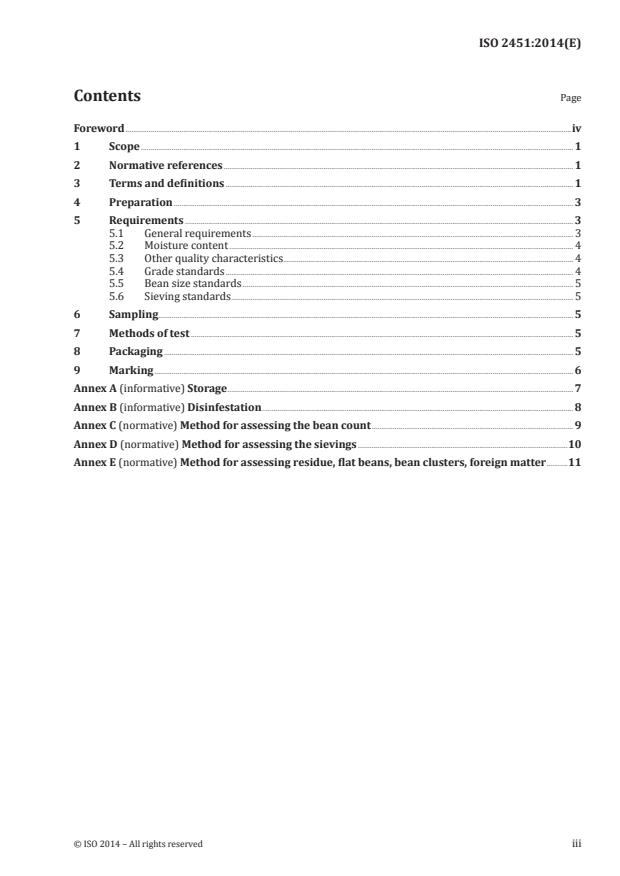
Contents Page
Foreword .iv
1 Scope . 1
2 Normative references . 1
3 Terms and definitions . 1
4 Preparation . 3
5 Requirements . 3
5.1 General requirements . 3
5.2 Moisture content . 4
5.3 Other quality characteristics . 4
5.4 Grade standards . 4
5.5 Bean size standards . 5
5.6 Sieving standards . 5
6 Sampling . 5
7 Methods of test . 5
8 Packaging . 5
9 Marking . 6
Annex A (informative) Storage . 7
Annex B (informative) Disinfestation . 8
Annex C (normative) Method for assessing the bean count . 9
Annex D (normative) Method for assessing the sievings .10
Annex E (normative) Method for assessing residue, flat beans, bean clusters, foreign matter .11
Foreword
ISO (the International Organization for Standardization) is a worldwide federation of national standards
bodies (ISO member bodies). The work of preparing International Standards is normally carried out
through ISO technical committees. Each member body interested in a subject for which a technical
committee has been established has the right to be represented on that committee. International
organizations, governmental and non-governmental, in liaison with ISO, also take part in the work.
ISO collaborates closely with the International Electrotechnical Commission (IEC) on all matters of
electrotechnical standardization.
The procedures used to develop this document and those intended for its further maintenance are
described in the ISO/IEC Directives, Part 1. In particular the different approval criteria needed for the
different types of ISO documents should be noted. This document was drafted in accordance with the
editorial rules of the ISO/IEC Directives, Part 2 (see www.iso.org/directives).
Attention is drawn to the possibility that some of the elements of this document may be the subject of
patent rights. ISO shall not be held responsible for identifying any or all such patent rights. Details of
any patent rights identified during the development of the document will be in the Introduction and/or
on the ISO list of patent declarations received (see www.iso.org/patents).
Any trade name used in this document is information given for the convenience of users and does not
constitute an endorsement.
For an explanation on the meaning of ISO specific terms and expressions related to conformity
assessment, as well as information about ISO’s adherence to the WTO principles in the Technical Barriers
to Trade (TBT) see the following URL: Foreword - Supplementary information
The committee responsible for this document is ISO/TC 34, Food products, Subcommittee SC 18, Cocoa
(former WG 4, Cocoa, of ISO/TC 34).
This second edition cancels and replaces the first edition (ISO 2451:1973), which has been technically
revised.
iv © ISO 2014 – All rights reserved
INTERNATIONAL STANDARD ISO 2451:2014(E)
Cocoa beans — Specification
1 Scope
This International Standard specifies the requirements, classification, test methods, sampling,
packaging, and marking for cocoa beans.
Recommendations relating to storage and disinfestation are given as a guide in Annexes A and B
respectively.
2 Normative references
The following documents, in whole or in part, are normatively referenced in this document and are
indispensable for its application. For dated references, only the edition cited applies. For undated
references, the latest edition of the referenced document (including any amendments) applies.
ISO 1114, Cocoa beans — Cut test
ISO 2291, Cocoa beans — Determination of moisture content (Routine method)
ISO 2292, Cocoa beans — Sampling
3 Terms and definitions
For the purposes of this document, the following terms and definitions apply.
3.1
adulteration
alteration of the composition of graded cocoa by any means whatsoever so that the resulting mixture or
combination is either not of the grade prescribed, or its quality or flavour is injuriously affected, or its
bulk or mass is altered
3.2
bean cluster
two or more beans joined together which cannot be separated by using the finger and thumb of both
hands
3.3
bean count
total number of whole beans per 100 g derived in accordance with the test method specified in Annex C
3.4
broken bean
cocoa bean of which a fragment is missing, the remaining part being more than half of a whole bean
3.5
cocoa bean
seed of the cocoa tree (Theobroma cacao Linnaeus)
Note 1 to entry: Commercially, and for the purposes of this International Standard, the term refers to the whole
seed, which has been fermented and dried.
3.6
contamination
presence of a smoky, hammy, or other smell not typical to cocoa, or a substance not natural to cocoa,
which is revealed during the cut test or physical inspection of a sample
3.7
cut test
procedure by which the cotyledons of cocoa beans are exposed for the purpose of determining the
incidence of defective and/or slaty cocoa beans, and/or violet or purple beans, and/or the presence of
contamination within a sample
3.8
defective bean
internally mouldy or insect-damaged bean
3.9
dry cocoa
commercial term designating cocoa beans which have been evenly dried throughout and of which the
moisture content corresponds to the specified requirements as in 5.2
3.10
fair fermented beans
cocoa beans that are not more than 10 % slaty and 10 % defective by count of the sample
3.11
flat bean
cocoa bean that is too thin to be cut to give a complete surface of the cotyledons
3.12
foreign matter
any substance other than cocoa beans and residue
3.13
fragment
piece of cocoa bean equal to or less than half the original bean
3.14
germinated bean
cocoa bean of which the shell has been pierced, split, or broken by the growth of the seed-germ
3.15
good fermented beans
cocoa beans that are not more than 5 % slaty and 5 % defective by count of the sample
3.16
insect-damaged/infested bean
a cocoa bean of which the internal parts are found to contain insects or mites at any stage of development,
or show signs of damage caused thereby, which are visible to the naked eye
3.17
main crop
the bean count consistent/typical for the main crop period during peak harvest for that particular origin
3.18
mouldy bean
cocoa bean on the internal parts of which mould is visible to the naked eye
Note 1 to entry: Mould is not to be confused with white spot, which is a concentration of theobromine or cocoa fat.
3.19
piece of shell
part of the shell without any of the kernel
2 © ISO 2014 – All rights reserved
3.20
residue
any cocoa element other than whole cocoa beans, flat beans, and clusters which does not pass through
the sieve (broken beans, fragments, and pieces of shell) with the exception of husk or placenta which is
to be considered as foreign matter
3.21
sieve
screen with round holes the diameter of which shall be 5,0 mm
3.22
sieving
material that passes through the sieve
3.23
slaty bean
cocoa bean that shows a slaty colour on at least half of the
...
Questions, Comments and Discussion
Ask us and Technical Secretary will try to provide an answer. You can facilitate discussion about the standard in here.
Loading comments...