


ISO 14404-1:2013
(Main)Calculation method of carbon dioxide emission intensity from iron and steel production — Part 1: Steel plant with blast furnace
Calculation method of carbon dioxide emission intensity from iron and steel production — Part 1: Steel plant with blast furnace
ISO 14404-1:2013 specifies calculation methods for the carbon dioxide (CO2) intensity of plant where steel is produced through a blast furnace. It includes boundary definition, material and energy flow definition and emission factor of CO2. Besides direct source import to the boundary, upstream and credit concept is applied to exhibit the plant CO2 intensity. ISO 14404-1:2013 supports the steel producer to establish CO2 emissions attributable to a site. ISO 14404-1:2013 cannot be used to calculate benchmarks or to compare CO2 intensities of production processes that are operated inside the site.
Méthode de calcul de l'intensité de l'émission de dioxyde de carbone de la production de la fonte et de l'acier — Partie 1: Usine sidérurgique avec haut fourneau
General Information
- Status
- Published
- Publication Date
- 14-Mar-2013
- Technical Committee
- ISO/TC 17 - Steel
- Drafting Committee
- ISO/TC 17 - Steel
- Current Stage
- 9599 - Withdrawal of International Standard
- Start Date
- 16-Sep-2024
- Completion Date
- 12-Feb-2026
Relations
- Effective Date
- 28-Oct-2023
Overview
ISO 14404-1:2013 - Calculation method of carbon dioxide emission intensity from iron and steel production - Part 1: Steel plant with blast furnace defines a standardized method to calculate CO2 emission intensity for steel plants that operate a blast furnace (integrated steel works). The standard specifies how to set site boundaries, define material and energy flows, and apply CO2 emission factors, including treatment of direct emissions, upstream emissions (imports), and credit concepts for exported materials or energy. ISO 14404-1:2013 supports site-level greenhouse gas (GHG) accounting but is not intended for product carbon footprints, benchmarking or comparing internal production processes.
Key technical topics and requirements
- Boundary definition: Establishes the site boundary for calculations (categories defined in the standard) so that all relevant flows are consistently captured.
- Emissions classification: Distinguishes direct CO2 emissions, upstream CO2 emissions (e.g., from imported materials, electricity, steam), and credit CO2 emissions for exports.
- Material and energy flow definitions: Requires identification and accounting of fuels, by-product gases (BFG, COG, BOF/LDG gas), auxiliary materials and other inputs commonly recorded by plants.
- Emission factors: Specifies the use of emission factors for different fuels and by-product gases; Annexes provide explanatory material and templates.
- Principles for calculation: Emphasizes relevance, completeness, consistency, accuracy and transparency in reporting.
- Annexes: Informative annexes include energy conversion and intensity calculation guidance, templates for emission-factor application, worked examples and explanations of by-product gas factors.
Practical applications and intended users
- Who uses it: Steel producers (integrated plants), sustainability and environmental managers, corporate GHG reporting teams, regulatory compliance officers, external auditors, consultants and supply‑chain sustainability specialists.
- What it supports:
- Site-level CO2 intensity reporting for internal management, target-setting and improvement planning.
- Consistent calculation of net site emissions including upstream and credit treatments.
- Converting material and energy flows into CO2 intensity metrics (see Annex A for energy conversion).
- Limitations: Not suitable for establishing regulatory emission caps, cross-region benchmarking, or product-level carbon footprinting.
Related standards
- ISO 14064-1 (GHG accounting and reporting) - ISO 14404-1 maps its direct, upstream and credit emission concepts to ISO 14064-1 categories.
- ISO 14404-2 - companion part covering electric arc furnace (EAF) steel plants.
Keywords: ISO 14404-1:2013, CO2 emission intensity, steel plant, blast furnace, carbon dioxide calculation method, emission factors, integrated steel works, greenhouse gas accounting.

Get Certified
Connect with accredited certification bodies for this standard

BSI Group
BSI (British Standards Institution) is the business standards company that helps organizations make excellence a habit.

Bureau Veritas
Bureau Veritas is a world leader in laboratory testing, inspection and certification services.

DNV
DNV is an independent assurance and risk management provider.
Sponsored listings
Frequently Asked Questions
ISO 14404-1:2013 is a standard published by the International Organization for Standardization (ISO). Its full title is "Calculation method of carbon dioxide emission intensity from iron and steel production — Part 1: Steel plant with blast furnace". This standard covers: ISO 14404-1:2013 specifies calculation methods for the carbon dioxide (CO2) intensity of plant where steel is produced through a blast furnace. It includes boundary definition, material and energy flow definition and emission factor of CO2. Besides direct source import to the boundary, upstream and credit concept is applied to exhibit the plant CO2 intensity. ISO 14404-1:2013 supports the steel producer to establish CO2 emissions attributable to a site. ISO 14404-1:2013 cannot be used to calculate benchmarks or to compare CO2 intensities of production processes that are operated inside the site.
ISO 14404-1:2013 specifies calculation methods for the carbon dioxide (CO2) intensity of plant where steel is produced through a blast furnace. It includes boundary definition, material and energy flow definition and emission factor of CO2. Besides direct source import to the boundary, upstream and credit concept is applied to exhibit the plant CO2 intensity. ISO 14404-1:2013 supports the steel producer to establish CO2 emissions attributable to a site. ISO 14404-1:2013 cannot be used to calculate benchmarks or to compare CO2 intensities of production processes that are operated inside the site.
ISO 14404-1:2013 is classified under the following ICS (International Classification for Standards) categories: 13.020.40 - Pollution, pollution control and conservation; 77.080.01 - Ferrous metals in general. The ICS classification helps identify the subject area and facilitates finding related standards.
ISO 14404-1:2013 has the following relationships with other standards: It is inter standard links to ISO 14404-1:2024. Understanding these relationships helps ensure you are using the most current and applicable version of the standard.
ISO 14404-1:2013 is available in PDF format for immediate download after purchase. The document can be added to your cart and obtained through the secure checkout process. Digital delivery ensures instant access to the complete standard document.
Standards Content (Sample)
INTERNATIONAL ISO
STANDARD 14404-1
First edition
2013-03-15
Calculation method of carbon dioxide
emission intensity from iron and
steel production —
Part 1:
Steel plant with blast furnace
Méthode de calcul de l’intensité de l’émission de dioxyde de carbone
de la production de la fonte et de l’acier —
Partie 1: Usine sidérurgique avec fourneau
Reference number
©
ISO 2013
© ISO 2013
All rights reserved. Unless otherwise specified, no part of this publication may be reproduced or utilized otherwise in any form
or by any means, electronic or mechanical, including photocopying, or posting on the internet or an intranet, without prior
written permission. Permission can be requested from either ISO at the address below or ISO’s member body in the country of
the requester.
ISO copyright office
Case postale 56 • CH-1211 Geneva 20
Tel. + 41 22 749 01 11
Fax + 41 22 749 09 47
E-mail copyright@iso.org
Web www.iso.org
Published in Switzerland
ii © ISO 2013 – All rights reserved
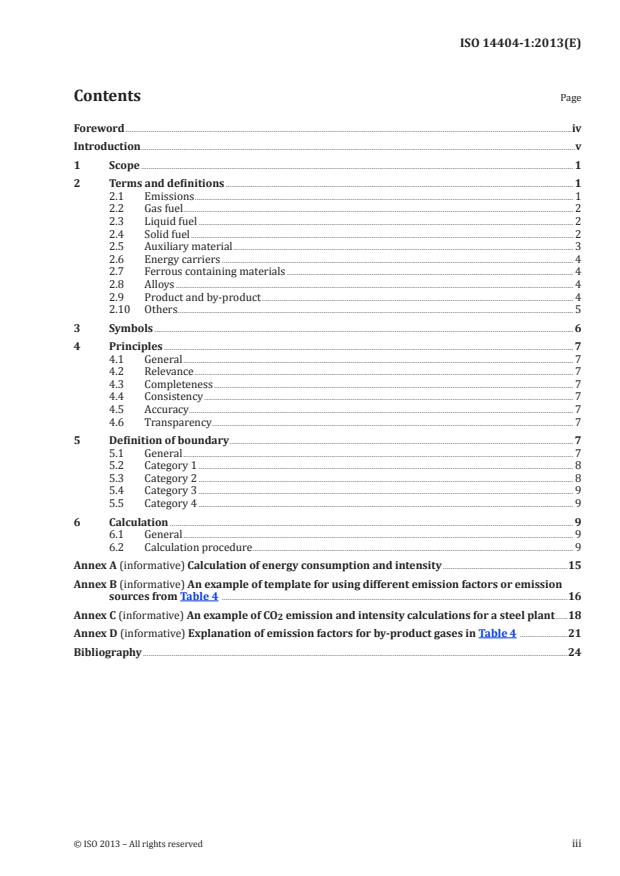
Contents Page
Foreword .iv
Introduction .v
1 Scope . 1
2 Terms and definitions . 1
2.1 Emissions . 1
2.2 Gas fuel . 2
2.3 Liquid fuel . 2
2.4 Solid fuel . 2
2.5 Auxiliary material . 3
2.6 Energy carriers . 4
2.7 Ferrous containing materials . 4
2.8 Alloys . 4
2.9 Product and by-product . 4
2.10 Others . 5
3 Symbols . 6
4 Principles . 7
4.1 General . 7
4.2 Relevance . 7
4.3 Completeness . 7
4.4 Consistency . 7
4.5 Accuracy . 7
4.6 Transparency . 7
5 Definition of boundary . 7
5.1 General . 7
5.2 Category 1 . 8
5.3 Category 2 . 8
5.4 Category 3 . 9
5.5 Category 4 . 9
6 Calculation . 9
6.1 General . 9
6.2 Calculation procedure . 9
Annex A (informative) Calculation of energy consumption and intensity .15
Annex B (informative) An example of template for using different emission factors or emission
sources from Table 4 .16
Annex C (informative) An example of CO emission and intensity calculations for a steel plant .18
Annex D (informative) Explanation of emission factors for by-product gases in Table 4 .21
Bibliography .24
Foreword
ISO (the International Organization for Standardization) is a worldwide federation of national standards
bodies (ISO member bodies). The work of preparing International Standards is normally carried out
through ISO technical committees. Each member body interested in a subject for which a technical
committee has been established has the right to be represented on that committee. International
organizations, governmental and non-governmental, in liaison with ISO, also take part in the work.
ISO collaborates closely with the International Electrotechnical Commission (IEC) on all matters of
electrotechnical standardization.
International Standards are drafted in accordance with the rules given in the ISO/IEC Directives, Part 2.
The main task of technical committees is to prepare International Standards. Draft International
Standards adopted by the technical committees are circulated to the member bodies for voting.
Publication as an International Standard requires approval by at least 75 % of the member bodies
casting a vote.
Attention is drawn to the possibility that some of the elements of this document may be the subject of
patent rights. ISO shall not be held responsible for identifying any or all such patent rights.
ISO 14404-1 was prepared by Technical Committee ISO/TC 17, Steel.
ISO 14404 consists of the following parts, under the general title of Calculation method of carbon dioxide
emission intensity from iron and steel production:
Part 1: Steel plant with blast furnace
Part 2: Steel plant with electric arc furnace (EAF)
iv © ISO 2013 – All rights reserved
Introduction
The steel industry recognizes the urgent need to take actions concerning climate change. Slowing
and halting global warming requires reductions in GHG emissions on a global scale. To play a part in
achieving these reductions, it is necessary for steel plants to identify the amount of CO emitted during
the production of steel products, in order to identify next opportunities for reduction of CO .
The production process of steel involves complex chemical reactions, various heating cycles, and the
recycling of various by-products. This variety of imports, including raw materials, reactive agents,
fuel and heat sources are transformed into wide range of steel products, by-products, waste materials
and waste heat.
Steel plants manufacture various products including: sheet products, plate products, long products,
pipe and tubes and many other types of products. In addition, steel plants produce unique speciality
grade steel products with high-performance, which are achieved by various sub-processes including
micro-alloying and applying surface treatments like galvanizing and coating that require additional
heat treatments. Therefore, none of the steel plants in the world is exactly identical.
Climate regulations in each country require steel companies to devise methods to lower CO emissions
from steel plants while continuing to produce steel products by these diverse and complex steelmaking
processes. To accomplish this, it is desirable to have universally common indicators for determining
steel plant CO emissions.
There are many methods for calculating CO emission intensity for steel plants and specific processes.
Each method was created to match the objectives of a particular country or region. In some cases, a
single country can have several calculation methods in order to fulfill different objectives. Every one
of these methods reflects the unique local characteristics of a particular country or region. As a result,
these methods cannot be used for comparisons of CO emission intensity of steel plants in different
countries and regions.
The World Steel Association (worldsteel), which consists of more than 130 major steel companies in 55
countries and regions of the world, has been working on the development of a calculation method for CO
emission intensity of steel plants to facilitate steel plant CO emissions improvement by the objective
comparison of the intensity among the member companies’ steel plants located in various places in the
world. An agreement was reached among members, and worldsteel has issued the method as a guideline
called “CO Emissions Data Collection User Guide.” Actual data collection among worldsteel members
based upon the guide started in 2007. Furthermore, worldsteel is encouraging even non-member steel
companies to begin using the guide to calculate CO emission intensity of their steel plants.
This calculation method establishes clear boundaries for collection of CO emissions data. The net CO
2 2
emissions and production from a steel plant are calculated using all parameters within the boundaries.
The CO emission intensity of the steel plant is calculated by the net CO emission from the plant using
2 2
the boundaries divided by the amount of crude steel production of the plant. With this methodology, the
CO emission intensity of steel plants is calculated irrespective of the variance in the type of process
used, products manufactured and geographic characteristics.
This calculation method only uses basic imports and exports that are commonly measured and recorded
by the plants; thus, the method requires neither the measurement of the specific efficiency of individual
equipments or processes nor dedicated measurements of the complex flow and recycling of materials
and waste heat. In this way, the calculation method ensures its simplicity and universal applicability
without requiring steel plants to install additional dedicated measuring devices or to collect additional
dedicated data other than commonly used data in the management of plants. However, because different
regions have different energy sources and raw materials available to them, the resulting calculations
cannot be used to determine a benchmark or best in class across regions.
With this method, a steel company can calculate a single figure for the CO emissions intensity of a plant
as a whole. As was explained earlier, most steel plants manufacture vast range of products with various
shapes and specifications. This calculation method ensures the simplicity and universal applicability
by not accommodating the differences in the production processes of such diverse products, and treats
a whole steel plant as one unit with one CO emission intensity. Therefore, this calculation method is
not applicable for calculating and determining the carbon footprint of any specific steel product. Also,
and for this reason, this method can be used neither for establishing caps or benchmarks for emissions
under emissions trading scheme in any specific local or regional economic system, nor for the generation
of CO data that would allow a comparison of CO intensities of production processes that are operated
2 2
inside the site.
vi © ISO 2013 – All rights reserved
INTERNATIONAL STANDARD ISO 14404-1:2013(E)
Calculation method of carbon dioxide emission intensity
from iron and steel production —
Part 1:
Steel plant with blast furnace
1 Scope
This part of ISO 14404 specifies calculation methods for the carbon dioxide (CO ) intensity of plant
where steel is produced through a blast furnace.
NOTE The steel plant is generally called “the integrated steel works”.
It includes boundary definition, material and energy flow definition and emission factor of CO . Besides direct
source import to the boundary, upstream and credit concept is applied to exhibit the plant CO intensity.
This part of ISO 14404 supports the steel producer to establish CO emissions attributable to a site. This
part of ISO 14404 cannot be used to calculate benchmarks or to compare CO intensities of production
processes that are operated inside the site.
Conversion to energy consumption and to consumption efficiency can be obtained using Annex A.
2 Terms and definitions
For the purposes of this document, the following terms and definitions apply.
2.1 Emissions
2.1.1
emission source
process emitting CO during production of steel products
Note 1 to entry: There are three categories of CO emission sources: direct, upstream and credit. Examples of
emission sources that are subject to this part of ISO 14404 are given in 2.1.2, 2.1.3 and 2.1.4.
2.1.2
direct CO emission
CO emissions from steel production activity inside the boundary
Note 1 to entry: Direct CO emission is categorized as “direct GHG emissions“ in ISO 14064-1.
2.1.3
upstream CO emission
CO emissions from imported material related to outsourced steel production activities outside the
boundary and from imported electricity and steam into the boundary
Note 1 to entry: Possible outsourced activities are, for example, production of coke, burnt lime, burnt dolomite,
pellet, sintered ore, hot metal, cold iron, direct reduced iron, oxygen, nitrogen and argon.
Note 2 to entry: CO emissions from imported material in this term is categorized as “other indirect GHG
emissions“ in ISO 14064-1.
Note 3 to entry: CO emissions from imported electricity and steam in this term are categorized as “energy
indirect GHG emissions“ in ISO 14064-1.
2.1.4
credit CO emission
CO emission that corresponds to exported material and electricity or steam
Note 1 to entry: Credit CO emission is categorized as “direct GHG emissions“ in ISO 14064-1.
2.2 Gas fuel
2.2.1
natural gas
mixture of gaseous hydrocarbons, primarily methane, occurring naturally in the earth and used
principally as a fuel
2.2.2
coke oven gas
COG
gas recovered from coke oven
2.2.3
blast furnace gas
BFG
gas recovered from blast furnace
2.2.4
BOF gas
LDG
gas recovered from basic oxygen furnace (Linze Donawitz converter)
Note 1 to entry: BOF: basic oxygen furnace
2.3 Liquid fuel
2.3.1
heavy oil
No. 4- No. 6 fuel oil defined by ASTM
Note 1 to entry: ASTM: American Society for Testing and Materials
2.3.2
light oil
No. 2- No. 3 fuel oil defined by ASTM
2.3.3
kerosene
paraffin (oil)
2.3.4
LPG
liquefied petroleum gas
2.4 Solid fuel
2.4.1
coking coal
coal for making coke, including anthracite
2 © ISO 2013 – All rights reserved
2.4.2
BF injection coal
pulverized coal injection (PCI) coal, including anthracite
Note 1 to entry: BF: blast furnace
2.4.3
sinter coal
BOF coal
coal for sinter/BOF, including anthracite
2.4.4
steam coal
boiler coal for producing electricity and steam, including anthracite
2.4.5
coke
solid carbonaceous material
2.4.6
charcoal
devolatilized or coked carbon neutral materials
EXAMPLE Trees, plants.
2.5 Auxiliary material
2.5.1
limestone
calcium carbonate, CaCO
2.5.2
burnt lime
CaO
2.5.3
crude dolomite
calcium magnesium carbonate, CaMg(CO )
3 2
2.5.4
burnt dolomite
CaMgO
2.5.5
nitrogen
N
inert gas separated from air at oxygen plant, imported from outside the boundary or exported to
outside the boundary
2.5.6
argon
Ar
inert gas separated from air at oxygen plant, imported from outside the boundary or exported to
outside the boundary
2.5.7
oxygen
O
gas separated from air at oxygen plant, imported from outside the boundary or exported to outside the
boundary
2.6 Energy carriers
2.6.1
electricity
electricity imported from outside the boundary or exported to outside the boundary
2.6.2
steam
pressurized water vapour imported from/exported to outside the boundary
2.7 Ferrous containing materials
2.7.1
pellets
agglomerated spherical iron ore calcinated by rotary kiln
2.7.2
sinter
bulk iron ore sintered by baking mixture of fine iron ore, coke breeze and pulverized lime
2.7.3
hot metal
intermediate liquid iron products containing 3 % to 5 % by mass carbon produced by smelting iron ore
with equipment such as blast furnace
2.7.4
cold iron
solidified hot metal as an intermediate solid iron products
2.7.5
gas-based DRI
direct reduced iron (DRI) reduced by a reducing gas such as reformed natural gas
2.7.6
coal-based DRI
direct reduced iron (DRI) reduced by coal
2.8 Alloys
2.8.1
ferro-nickel
alloy of iron and nickel
2.8.2
ferro-chromium
alloy of iron and chromium
2.8.3
ferro-molybdenum
alloy of iron and molybdenum
2.9 Product and by-product
2.9.1
CO for external use
CO exported to outside the boundary
4 © ISO 2013 – All rights reserved
2.9.2
coal tar
by-products of the carbonization of coal to coke, containing complex and variable mixtures of phenols
and polycyclic aromatic hydrocarbons
2.9.3
coal light oil
benzole
light oil recovered by COG gas purification, consisting mainly of benzene, toluene and xylene (BTX)
2.9.4
BF slag to cement
blast furnace slag supplied to cement industry
2.9.5
BOF slag to cement
BOF slag supplied to cement industry
2.10 Others
2.10.1
other emission source
other related emission sources such as plastics, scraps, desulfurization additives, graphite electrodes,
alloys, fluxes for secondary metallurgy, dust, sludges, etc.
2.10.2
boundary
limit of activity used to calculate CO emissions intensity for steel production activities
Note 1 to entry: Generally, the boundary is set to be the same as the site boundary.
Note 2 to entry: Major facilities in iron and steel production in boundaries are given in 2.10.2.1 to 2.10.2.13.
2.10.2.1
blast furnace
BF
vertical shaft furnace for producing hot metal from iron ore
2.10.2.2
basic oxygen furnace
BOF
vessel where hot metal from blast furnace and scrap is converted into molten steel using oxygen
2.10.2.3
casting
pouring steel directly from a ladle through a tundish into a mold shaped to form billets, blooms, or slabs,
or pouring steel from a ladle into a mold shaped to form ingots
2.10.2.4
sinter plant
plant used to produce a fused clinker-like aggregate or sinter of fine iron-bearing materials suited for
use in a blast furnace
2.10.2.5
pellet plant
plant for agglomeration and thermal treatment to convert the raw fine iron ore into spherical pellets
with characteristics appropriate for use in a blast furnace
2.10.2.6
lime kiln
kiln used to produce burnt lime by the calcination of limestone (calcium carbonate)
2.10.2.7
coke oven
oven for the conversion of coal into coke by heating the coal in the absence of air to distill the
volatile ingredients
2.10.2.8
oxygen plant
cryogenic air separator to produce high-purity oxygen
2.10.2.9
steam boiler
boiler for production of steam
2.10.2.10
power plant
plant that generates electricity
2.10.2.11
hot rolling
rolling at elevated temperature
2.10.2.12
cold rolling
rolling at room temperature
2.10.2.13
coating
covering steel with another material (tin, chrome, zinc, etc.), primarily for corrosion resistance
Note 1 to entry: Coating materials may include tin, chrome, zinc, etc.
3 Symbols
The symbols used in this part of ISO 14404 are given in Table 1.
Table 1 — Symbols
Symbol Unit Descriptions
E tons (or tonnes) of CO Direct CO emissions
d,CO2 2 2
E tons (or tonnes) of CO Upstream CO emissions
u,CO2 2 2
E tons (or tonnes) of CO Credit CO emissions
c,CO2 2 2
E tons (or tonnes) of CO Annual CO emissions
CO2,annual 2 2
I tons (or tonnes)of CO per ton (or tonne) CO intensity factor
CO2 2 2
K tons (or tonnes) of CO per unit Emission factor for calculation of direct CO emissions
t,d,CO2 2 2
K tons (or tonnes) of CO per unit Emission factor for calculation of upstream CO emis-
t,u,CO2 2 2
sions
K tons (or tonnes) o
...
Questions, Comments and Discussion
Ask us and Technical Secretary will try to provide an answer. You can facilitate discussion about the standard in here.
Loading comments...