

ISO/FDIS 21870
(Main)Rubber compounding ingredients — Carbon black — Determination of high-temperature loss on heating by thermogravimetry
- Abstract
ISO 21870:2005 describes a method for quantitative determination of the loss on heating (pyrolysis) of carbon black due to the elimination of volatile materials other than those liberated when heating to 125 °C (ISO 1126). The method is applicable to carbon black for the rubber industry. It serves to assess the decomposition of functional groups and adsorbed substances (e.g. hydrocarbons) present on the surface of the carbon black.
- Status
- Not Published
- Drafting Committee
- ISO/TC 45/SC 3/WG 3 - Carbon black, silica and rubber chemicals
- Current Stage
- 5020 - Proof sent to secretariat or FDIS ballot initiated: 8 weeks - 50 Approval
- Start Date
- 27-Oct-2026
- Due Date
- 27-Oct-2026
- Completion Date
- 27-Oct-2026
Buy Documents

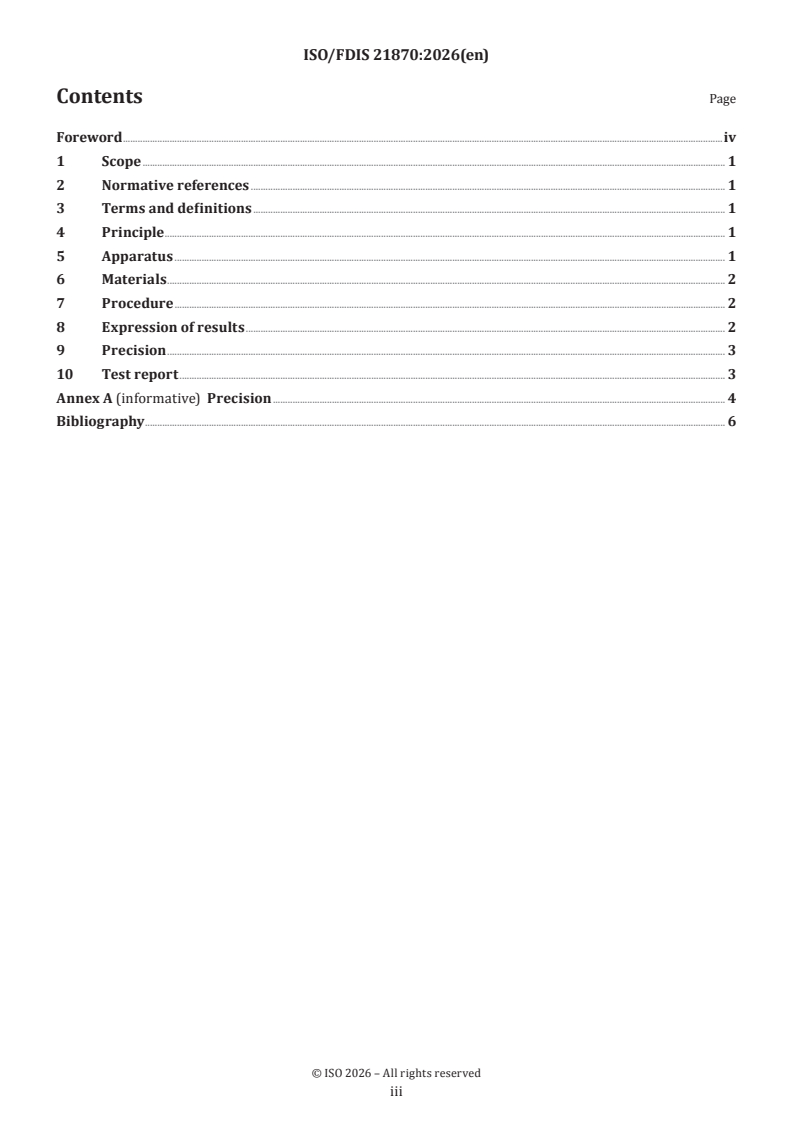
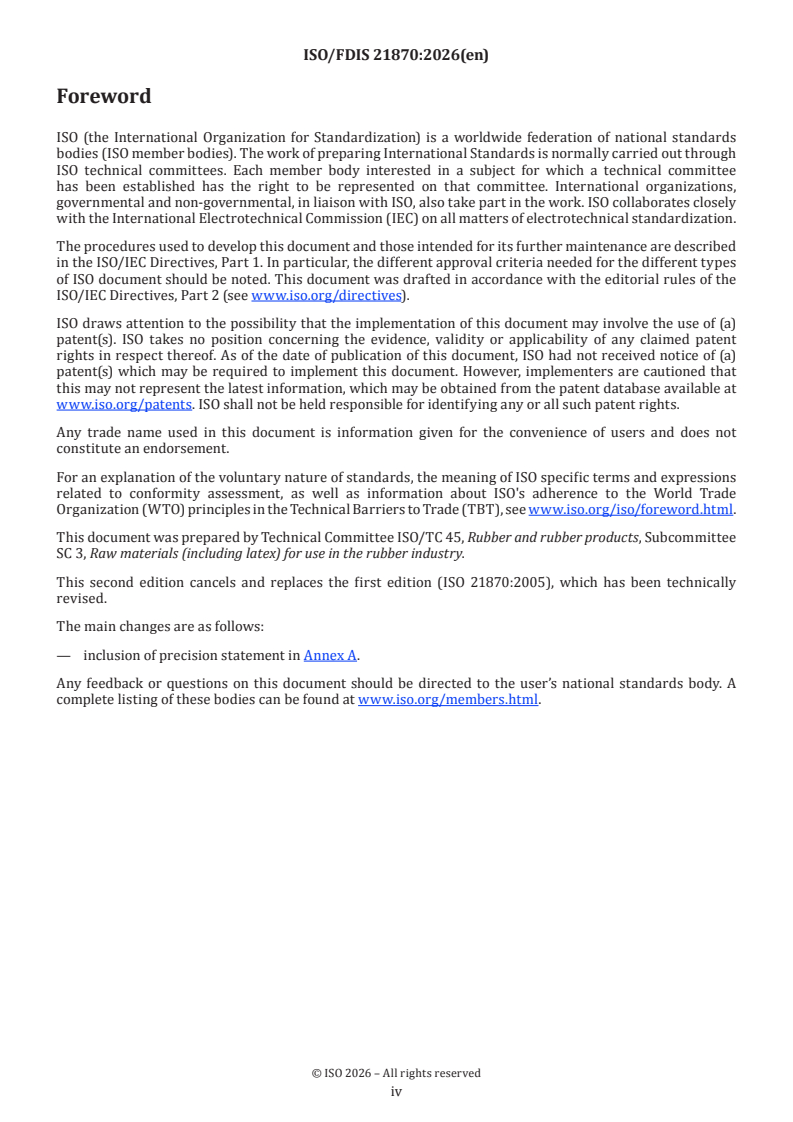
ISO/FDIS 21870 - Rubber compounding ingredients — Carbon black — Determination of high-temperature loss on heating by thermogravimetry

REDLINE ISO/FDIS 21870 - Rubber compounding ingredients — Carbon black — Determination of high-temperature loss on heating by thermogravimetry
ISO/FDIS 21870 is an ISO document for measuring the high-temperature loss on heating of carbon black by thermogravimetry. It specifies a laboratory method for carbon black used in the rubber industry, focusing on volatile materials released above 125 °C and on surface species such as functional groups and adsorbed hydrocarbons. In practice, it gives labs a defined heating and weighing procedure so different carbon black samples can be compared under the same conditions.
What does ISO/FDIS 21870 specify?
ISO/FDIS 21870 specifies a quantitative thermogravimetric method for carbon black to determine loss on heating caused by pyrolysis and the release of volatile materials beyond the fraction released at 125 °C. The document is aimed at carbon black for the rubber industry and links the result to surface decomposition and adsorbed substances.
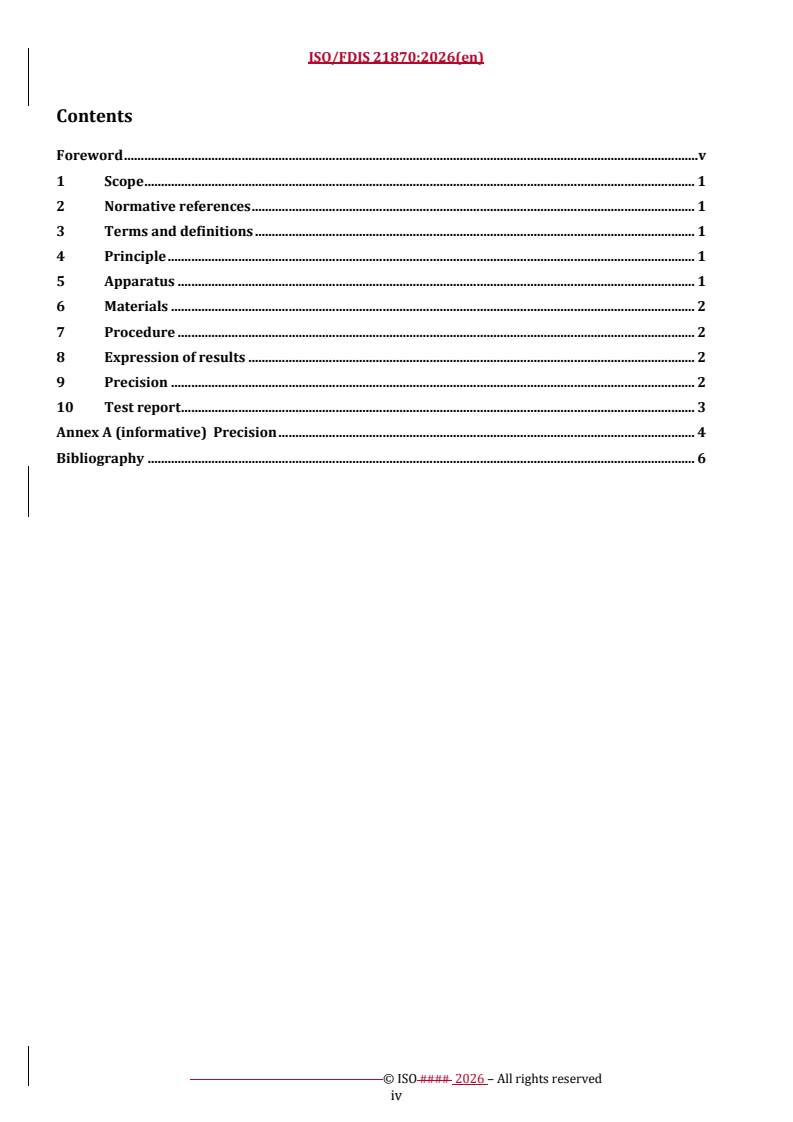
The document is organized into Scope, Normative references, Terms and definitions, Principle, Apparatus, Materials, Procedure, Expression of results, Precision, and Test report, followed by informative Annex A and a bibliography.
| Annex | What it covers |
|---|---|
| Annex A | Precision of the test method, including the interlaboratory study and statistical results |
What are the key requirements of ISO/FDIS 21870?
Clause 4 sets the measurement principle. A known mass of carbon black is placed in a thermobalance, heated under a predetermined programme in a controlled oxygen-free atmosphere, and the mass change is recorded as a thermogram. In practice, the analyst must control the atmosphere and heating profile so the mass loss reflects the material itself, not the test setup.
Clause 5 specifies the apparatus. The method uses a thermobalance with 1 μg sensitivity, a furnace that can reach approximately 1 000 °C, a temperature programmer up to 50 °C/min, nitrogen flow control from 10 cm³/min to 250 cm³/min, and a data acquisition system. This matters because the instrument must be able to follow the required heating steps and detect small mass changes.
Clause 6 requires high-purity nitrogen. The nitrogen supply shall contain less than 10 ppm of oxygen. This limit supports the oxygen-free atmosphere needed to avoid unwanted oxidation during the test.
Clause 7 sets the test conditions. The sample shall be weighed to the nearest 0.01 mg, and its mass shall be at least 5 mg. The furnace is heated to 125 °C at 20 °C/min, held for 15 min, then heated to 950 °C at 20 °C/min and held for 15 min. The practical point is that the operator must follow the same thermal history for every sample.
Clause 7 also allows a lower maximum temperature when needed. If the instrument cannot reach 950 °C, a lower maximum temperature such as 800 °C may be used, but the report shall state this because it can slightly lower the loss on pyrolysis result. That tells users to document any departure from the reference procedure.
Clause 8 defines how results are expressed. The document calculates volatile matter at 125 °C in nitrogen and loss on pyrolysis at 950 °C in nitrogen as percentages of the initial mass, using the masses measured at 40 °C, 125 °C and 950 °C. This gives a consistent way to report both the early volatile fraction and the higher-temperature loss.
Clause 10 defines the test report content. The report shall identify the sample, cite ISO 21870:2026, state the apparatus type, give both results to the nearest 0.1 %, list deviations and anomalies, and include the test date. This is the information needed for traceability and comparison between laboratories.
What terms does ISO/FDIS 21870 use?
ISO/FDIS 21870 uses several technical terms to describe the test and its result.
- Thermogravimetry - the method of measuring mass change while a sample is heated.
- Thermobalance - the instrument that holds the sample and records its mass during heating.
- Thermogram - the recorded mass-change curve produced during the test.
- Pyrolysis - the loss on heating caused by decomposition at elevated temperature.
- Volatile matter - material released at 125 °C in nitrogen before the higher-temperature pyrolysis step.
- Oxygen-free atmosphere - the nitrogen environment used to keep the sample from reacting with oxygen during heating.
Who uses ISO/FDIS 21870?
ISO/FDIS 21870 is used by laboratories and technical teams working with carbon black for the rubber industry. It supports product characterization, incoming inspection, and quality control where surface volatiles and high-temperature mass loss need to be measured in a repeatable way.
What changed in ISO/FDIS 21870 from the previous edition?
ISO/FDIS 21870 is the second edition and it cancels and replaces ISO 21870:2005. The foreword states that the document was technically revised, and the main stated change is the inclusion of a precision statement in Annex A.
Which standards are used with ISO/FDIS 21870?
- ISO/TR 9272:2005 - used in Annex A for the precision study, including terminology and statistical details for the repeatability and reproducibility work.
- ISO 1126 - cited in the scope as the reference point for the 125 °C heating step that separates the lower-temperature volatile fraction from the high-temperature loss.
What does the ISO/FDIS 21870 document contain?
ISO/FDIS 21870 contains the full laboratory method, from the test principle and required equipment to the nitrogen atmosphere, heating programme, and result calculation. It also includes the reporting items that must be documented after the test. Annex A gives the precision study, with tables for volatile matter and loss on pyrolysis, and the bibliography lists ISO/TR 9272:2005.
Relations
- Effective Date
- 16-Dec-2023
Buy Documents
ISO/FDIS 21870 - Rubber compounding ingredients — Carbon black — Determination of high-temperature loss on heating by thermogravimetry
REDLINE ISO/FDIS 21870 - Rubber compounding ingredients — Carbon black — Determination of high-temperature loss on heating by thermogravimetry
Get Certified
Connect with accredited certification bodies for this standard

DIN CERTCO
DIN Group product certification.

Smithers Quality Assessments
US management systems and product certification.
Sponsored listings
Frequently Asked Questions
ISO/FDIS 21870 is a draft published by the International Organization for Standardization (ISO). Its full title is "Rubber compounding ingredients — Carbon black — Determination of high-temperature loss on heating by thermogravimetry". This standard covers: ISO 21870:2005 describes a method for quantitative determination of the loss on heating (pyrolysis) of carbon black due to the elimination of volatile materials other than those liberated when heating to 125 °C (ISO 1126). The method is applicable to carbon black for the rubber industry. It serves to assess the decomposition of functional groups and adsorbed substances (e.g. hydrocarbons) present on the surface of the carbon black.
ISO 21870:2005 describes a method for quantitative determination of the loss on heating (pyrolysis) of carbon black due to the elimination of volatile materials other than those liberated when heating to 125 °C (ISO 1126). The method is applicable to carbon black for the rubber industry. It serves to assess the decomposition of functional groups and adsorbed substances (e.g. hydrocarbons) present on the surface of the carbon black.
ISO/FDIS 21870 is classified under the following ICS (International Classification for Standards) categories: 83.040.20 - Rubber compounding ingredients. The ICS classification helps identify the subject area and facilitates finding related standards.
ISO/FDIS 21870 has the following relationships with other standards: It is inter standard links to ISO 21870:2005. Understanding these relationships helps ensure you are using the most current and applicable version of the standard.
ISO/FDIS 21870 is available in PDF format for immediate download after purchase. The document can be added to your cart and obtained through the secure checkout process. Digital delivery ensures instant access to the complete standard document.
Standards Content (Sample)
Contents
- 1 Scope
- 2 Normative references
- 3 Terms and definitions
- 4 Principle
- 5 Apparatus
- 5.2 Furnace, allowing temperature regulation from the ambient temperature up to approximately
- 6 Materials
- 7 Procedure
- 8 Expression of results
- 9 Precision
- 10 Test report
- Annex A
- Bibliography
1 Scope
This document specifies a method for the quantitative determination of the loss on heating (pyrolysis) of carbon black due to the elimination of volatile materials other than those liberated when heating to 125 °C. The method serves to assess the decomposition of functional groups and adsorbed substances (e.g. hydrocarbons) present on the surface of the carbon black.
This document is applicable to carbon black for the rubber industry.
2 Normative references
There are no normative references in this document.
3 Terms and definitions
No terms and definitions are listed in this document.
ISO and IEC maintain terminology databases for use in standardization at the following addresses:
- ISO Online browsing platform: available at https:// www .iso .org/ obp
- IEC Electropedia: available at https:// www .electropedia .org/
4 Principle
A known mass of carbon black is placed in the cradle of a thermobalance and heated according to a predetermined temperature programme in a controlled, oxygen-free atmosphere. The mass variation recorded provides a thermogram which can be used for quantitative evaluation.
5 Apparatus
The usual laboratory apparatus and, in particular, the following shall be used. 5.1 Thermobalance, with a sensitivity of 1 μg and equipped with an appropriate cradle made of a nonoxidizing material.
5.2 Furnace, allowing temperature regulation from the ambient temperature up to approximately
1 000 °C.
NOTE There are several thermogravimetric measurement instruments available commercially. 5.3 Temperature programmer, allowing a heating rate of up to 50 °C/min.
ISO/FDIS 21870:2026(en) 5.4 Nitrogen gas distributor, associated with flow-control equipment allowing measurements in a range 3 3 from 10 cm /min to 250 cm /min.
5.5 Data acquisition and processing system.
6 Materials
6.1 Cylinder of compressed nitrogen containing less than 10 ppm of oxygen.
7 Procedure
7.1 Power up the various elements of the analyser and preheat the furnace to 40 °C in accordance with the instructions of the instrument manufacturer.
7.2 Close the furnace of the thermobalance, purge with a constant, predefined flow of nitrogen (usually
...
Contents
- 1 Scope
- 2 Normative references
- 3 Terms and definitions
- 4 Principle
- 5 Apparatus
- 6 Materials
- 7 Procedure
- 8 Expression of results
- 9 Precision
- 10 Test report
- Annex A
- Bibliography
1 Scope
This document specifies a method for the quantitative determination of the loss on heating (pyrolysis) of carbon black due to the elimination of volatile materials other than those liberated when heating to 125 °C. The method serves to assess the decomposition of functional groups and adsorbed substances (e.g. hydrocarbons) present on the surface of the carbon black.
This document is applicable to carbon black for the rubber industry.
2 Normative references
There are no normative references in this document.
3 Terms and definitions
No terms and definitions are listed in this document.
ISO and IEC maintain terminology databases for use in standardization at the following addresses:
- — ISO Online browsing platform: available at https://www.iso.org/obp
- — IEC Electropedia: available at https://www.electropedia.org/
4 Principle
A known mass of carbon black is placed in the cradle of a thermobalance and heated according to a predetermined temperature programme in a controlled, oxygen-free atmosphere. The mass variation recorded provides a thermogram which can be used for quantitative evaluation.
5 Apparatus
The usual laboratory apparatus and, in particular, the following shall be used. 5.1 5.1 Thermobalance, with a sensitivity of 1 μg and equipped with an appropriate cradle made of a non-oxidizing material.
5.2 5.2 Furnace, allowing temperature regulation from the ambient temperature up to approximately 1 000 °C.
NOTE There are several thermogravimetric measurement instruments available commercially. 5.3 5.3 Temperature programmer, allowing a heating rate of up to 50 °C/min. 5.4 5.4 Nitrogen gas distributor, associated with flow-control equipment allowing measurements 3 3 in a range from 10 cm /min to 250 cm /min.
ISO/FDIS 21870:2026(en) 5.5 5.5 Data acquisition and processing system.
6 Materials
6.1 6.1 Cylinder of compressed nitrogen containing less than 10 ppm of oxygen.
7 Procedure
7.1 7.1 Power up the various elements of the analyser and preheat the furnace to 40 °C in accordance with the instructions of the instrument manufacturer.
7.2 7.2 Close the furnace of the thermobalance, purge with a constant, predefined flow of nitrogen
(usually 100 cm /min) in accordance with instructions of the instrument manufacturer and maintain a
constant flow for the duration of the test.
...