


ISO/IEC 15944-10:2023
(Main)Information technology - Business operational view - Part 10: IT-enabled coded domains as semantic components in business transactions
Information technology - Business operational view - Part 10: IT-enabled coded domains as semantic components in business transactions
This document specifies the fundamental principles governing coded domains, identification and description of the coded domains from the BOV view, the rules governing the rule-base of coded domains, the rules for management of ID codes, rules for specifying Human Interface Equivalents (HIEs) to an ID Code, the relations between the coded domain and controlled vocabularies, the rules governing the registration of coded domains as re-usable business objects, and the IT-enablement of coded domains. The document is applicable to the use of standards, specifications, authority files, etc., of a “codes representing X” nature being used in electronic business transactions among parties engaged in Open-edi, which pertains to flows of information using information bundles which cause pre-defined (or pre-definable) changes in the states of the IT systems of the parties to such electronic data interchanges. Detailed exclusions to the scope of this document are provided in Annex I.
Technologies de l'information — Vue opérationnelle d'affaires — Partie 10: Domaines codés activés comme composantes sémantiques dans les transactions d'affaires
General Information
Relations
Overview
ISO/IEC 15944-10:2023 defines how IT-enabled coded domains function as semantic components in electronic business transactions. Published as Part 10 of the ISO/IEC 15944 series, this standard provides the Business Operational View (BOV) principles, rules and templates for using code lists, ID codes and their human-facing equivalents in Open-edi (open electronic data interchange) scenarios. Its goal is to ensure precise, unambiguous semantics and semantic interoperability when codes are used to trigger or document business commitments across autonomous IT systems.
Key topics and technical requirements
- Fundamental principles for coded domains: definition, construct and purpose of coded domains in business transactions.
- Rule-based coded domains: requirements for a rule-base that governs inclusion/exclusion, semantic granularity and boundaries of a coded domain.
- Identification and description: standardized ways to identify coded domains, levels of semantic unambiguity and table structures for ID codes and Human Interface Equivalents (HIEs).
- Management of ID codes: lifecycle rules for assignment, change management, registration of user extensions and governance of code changes.
- Human Interface Equivalents (HIEs): rules for specifying multiple HIEs, linguistic representations, accessibility and composite semantics.
- Controlled vocabularies and relations: how coded domains relate to controlled vocabularies and common rules applying to both.
- Registration and re‑use: processes and schema for registering coded domains as reusable business objects.
- IT-enablement and templates: platform-neutral templates and attributes for scoping Open-edi scenarios, roles, information bundles and semantic components to support IT implementation.
- Annexes include case studies (multilingual HIEs, matrix/XML examples), accessibility considerations (UN CRPD), and detailed exclusions.
Practical applications and users
ISO/IEC 15944-10 is intended for:
- Standards developers and registry authorities creating or managing code lists and authority files.
- Enterprise architects, data modelers and software developers implementing Open-edi or other electronic business transaction systems.
- Vendors and system integrators delivering e‑invoicing, supply‑chain, customs, government and cross‑border trade IT solutions that require unambiguous coded semantics.
- Organizations aiming for semantic interoperability, consistent human interfaces (multilingual/accessibility), and governance of reusable code domains.
Implementing this standard reduces ambiguity in automated commitment exchanges, supports legal clarity in electronic transactions, and improves cross-system interoperability and cultural adaptability.
Related standards
- ISO/IEC 15944 series (other Parts: 1, 2, 5, 8 referenced)
- ISO/IEC 14662 (Open-edi reference model)
- ISO/IEC 5218 (example codes - referenced in annexes)
Keywords: ISO/IEC 15944-10, coded domains, Human Interface Equivalents, Open-edi, semantic components, IT-enabled coded domains, semantic interoperability.
Frequently Asked Questions
ISO/IEC 15944-10:2023 is a standard published by the International Organization for Standardization (ISO). Its full title is "Information technology - Business operational view - Part 10: IT-enabled coded domains as semantic components in business transactions". This standard covers: This document specifies the fundamental principles governing coded domains, identification and description of the coded domains from the BOV view, the rules governing the rule-base of coded domains, the rules for management of ID codes, rules for specifying Human Interface Equivalents (HIEs) to an ID Code, the relations between the coded domain and controlled vocabularies, the rules governing the registration of coded domains as re-usable business objects, and the IT-enablement of coded domains. The document is applicable to the use of standards, specifications, authority files, etc., of a “codes representing X” nature being used in electronic business transactions among parties engaged in Open-edi, which pertains to flows of information using information bundles which cause pre-defined (or pre-definable) changes in the states of the IT systems of the parties to such electronic data interchanges. Detailed exclusions to the scope of this document are provided in Annex I.
This document specifies the fundamental principles governing coded domains, identification and description of the coded domains from the BOV view, the rules governing the rule-base of coded domains, the rules for management of ID codes, rules for specifying Human Interface Equivalents (HIEs) to an ID Code, the relations between the coded domain and controlled vocabularies, the rules governing the registration of coded domains as re-usable business objects, and the IT-enablement of coded domains. The document is applicable to the use of standards, specifications, authority files, etc., of a “codes representing X” nature being used in electronic business transactions among parties engaged in Open-edi, which pertains to flows of information using information bundles which cause pre-defined (or pre-definable) changes in the states of the IT systems of the parties to such electronic data interchanges. Detailed exclusions to the scope of this document are provided in Annex I.
ISO/IEC 15944-10:2023 is classified under the following ICS (International Classification for Standards) categories: 35.240.63 - IT applications in trade. The ICS classification helps identify the subject area and facilitates finding related standards.
ISO/IEC 15944-10:2023 has the following relationships with other standards: It is inter standard links to ISO/IEC 15944-10:2013. Understanding these relationships helps ensure you are using the most current and applicable version of the standard.
You can purchase ISO/IEC 15944-10:2023 directly from iTeh Standards. The document is available in PDF format and is delivered instantly after payment. Add the standard to your cart and complete the secure checkout process. iTeh Standards is an authorized distributor of ISO standards.
Standards Content (Sample)
INTERNATIONAL ISO/IEC
STANDARD 15944-10
Second edition
2023-06
Information technology — Business
operational view —
Part 10:
IT-enabled coded domains as semantic
components in business transactions
Technologies de l'information — Vue opérationnelle d'affaires —
Partie 10: Domaines codés activés comme composantes sémantiques
dans les transactions d'affaires
Reference number
© ISO/IEC 2023
© ISO/IEC 2023
All rights reserved. Unless otherwise specified, or required in the context of its implementation, no part of this publication may
be reproduced or utilized otherwise in any form or by any means, electronic or mechanical, including photocopying, or posting on
the internet or an intranet, without prior written permission. Permission can be requested from either ISO at the address below
or ISO’s member body in the country of the requester.
ISO copyright office
CP 401 • Ch. de Blandonnet 8
CH-1214 Vernier, Geneva
Phone: +41 22 749 01 11
Email: copyright@iso.org
Website: www.iso.org
Published in Switzerland
ii
© ISO/IEC 2023 – All rights reserved
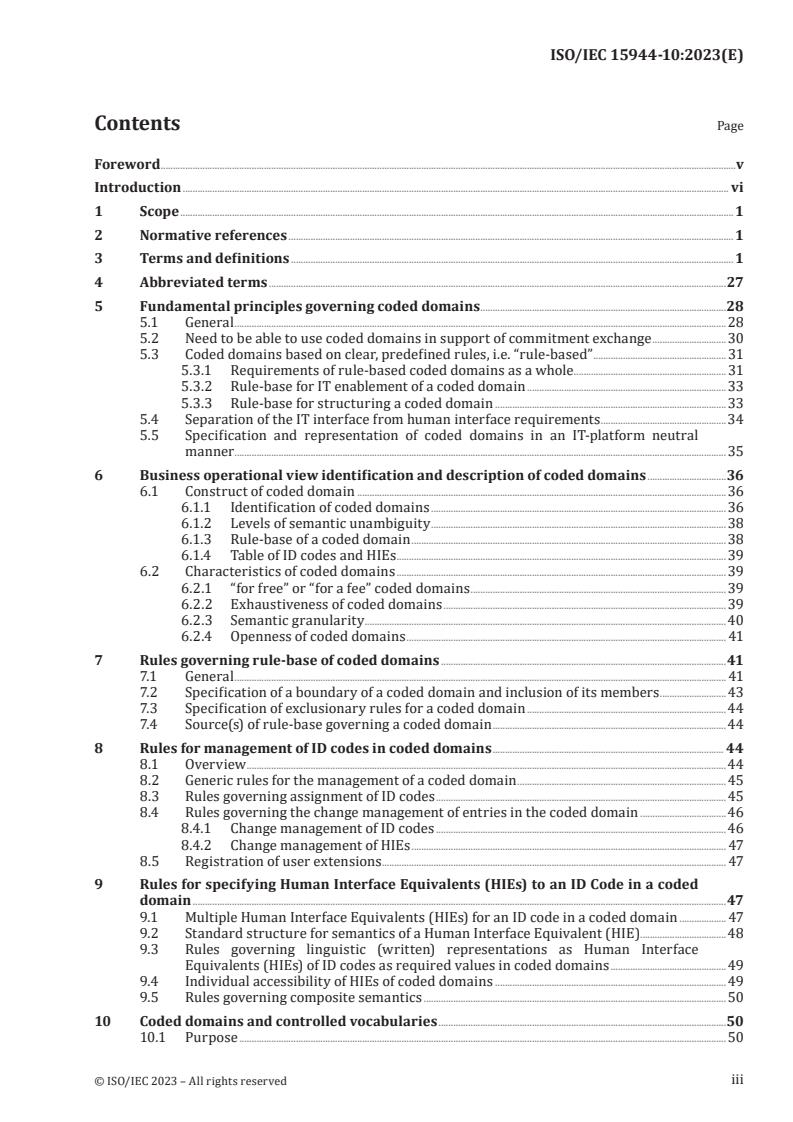
Contents Page
Foreword .v
Introduction . vi
1 Scope . 1
2 Normative references . 1
3 Terms and definitions . 1
4 Abbreviated terms .27
5 Fundamental principles governing coded domains .28
5.1 General .28
5.2 Need to be able to use coded domains in support of commitment exchange .30
5.3 Coded domains based on clear, predefined rules, i.e. “rule-based” . 31
5.3.1 Requirements of rule-based coded domains as a whole . 31
5.3.2 Rule-base for IT enablement of a coded domain . 33
5.3.3 Rule-base for structuring a coded domain . 33
5.4 Separation of the IT interface from human interface requirements .34
5.5 Specification and representation of coded domains in an IT-platform neutral
manner . 35
6 Business operational view identification and description of coded domains .36
6.1 Construct of coded domain .36
6.1.1 Identification of coded domains .36
6.1.2 Levels of semantic unambiguity .38
6.1.3 Rule-base of a coded domain .38
6.1.4 Table of ID codes and HIEs . 39
6.2 Characteristics of coded domains . 39
6.2.1 “for free” or “for a fee” coded domains .39
6.2.2 Exhaustiveness of coded domains .39
6.2.3 Semantic granularity .40
6.2.4 Openness of coded domains . 41
7 Rules governing rule-base of coded domains .41
7.1 General . 41
7.2 Specification of a boundary of a coded domain and inclusion of its members . 43
7.3 Specification of exclusionary rules for a coded domain .44
7.4 Source(s) of rule-base governing a coded domain .44
8 Rules for management of ID codes in coded domains . 44
8.1 Overview .44
8.2 Generic rules for the management of a coded domain . 45
8.3 Rules governing assignment of ID codes . 45
8.4 Rules governing the change management of entries in the coded domain .46
8.4.1 Change management of ID codes .46
8.4.2 Change management of HIEs . 47
8.5 Registration of user extensions . 47
9 Rules for specifying Human Interface Equivalents (HIEs) to an ID Code in a coded
domain .47
9.1 Multiple Human Interface Equivalents (HIEs) for an ID code in a coded domain . 47
9.2 Standard structure for semantics of a Human Interface Equivalent (HIE).48
9.3 Rules governing linguistic (written) representations as Human Interface
Equivalents (HIEs) of ID codes as required values in coded domains .49
9.4 Individual accessibility of HIEs of coded domains .49
9.5 Rules governing composite semantics .50
10 Coded domains and controlled vocabularies .50
10.1 Purpose . 50
iii
© ISO/IEC 2023 – All rights reserved
10.2 Rules common to controlled vocabularies and coded domains . 51
10.3 Rules governing a controlled vocabulary . 51
10.4 Rules governing a coded domain. 52
11 Rules governing the registration of coded domains as re-usable business objects .53
11.1 Principles of registration .53
11.2 Process of registration .54
11.3 Coded Domain Registration schema .54
12 IT-enablement of coded domains .55
12.1 Purpose . 55
12.2 Templates for IT-enabled coded domains — Attributes for Scoping an Open-edi
scenario (OeS) . 55
12.2.1 Purpose . 55
12.2.2 Template structure and content . 55
12.3 Template for Scoping Open-edi scenarios .56
12.4 Specification and consolidated template of attributes of Open-edi scenarios, roles,
information bundles (IBs) and semantic components (SCs) . 59
Annex A (normative) Coded domain registration administration attributes .64
Annex B (normative) Use of IT-enabled coded domains to ensure semantic interoperability
in support of the “UN Convention on the Rights of Persons with Disabilities” .68
Annex C (informative) Concept and definition of “coded domain” .70
Annex D (informative) Case Study: Example of “e-potato” .75
Annex E (informative) Case study: Example of a coded domain with two writing systems
for Human Interface Equivalents (HIEs) of a set of ID codes - in Russian use of the
Cyrillic alphabet and the romanized form .77
Annex F (informative) Case study: Example of coded domain in Matrix form and XML
format as found in Table 2 in ISO/IEC 5218 “Codes representing the human sexes” .78
Annex G (informative) Determining whether the membership in a coded domain is
exhaustive or non-exhaustive .90
Annex H (informative) Examples of identification of different object classes within a coded
domain through the use of semantic qualifiers .95
Annex I (informative) Exclusions and aspects not currently addressed to the scope . 102
Bibliography . 104
iv
© ISO/IEC 2023 – All rights reserved
Foreword
ISO (the International Organization for Standardization) and IEC (the International Electrotechnical
Commission) form the specialized system for worldwide standardization. National bodies that are
members of ISO or IEC participate in the development of International Standards through technical
committees established by the respective organization to deal with particular fields of technical
activity. ISO and IEC technical committees collaborate in fields of mutual interest. Other international
organizations, governmental and non-governmental, in liaison with ISO and IEC, also take part in the
work.
The procedures used to develop this document and those intended for its further maintenance
are described in the ISO/IEC Directives, Part 1. In particular, the different approval criteria
needed for the different types of document should be noted. This document was drafted in
accordance with the editorial rules of the ISO/IEC Directives, Part 2 (see www.iso.org/directives or
www.iec.ch/members_experts/refdocs).
ISO and IEC draw attention to the possibility that the implementation of this document may involve the
use of (a) patent(s). ISO and IEC take no position concerning the evidence, validity or applicability of
any claimed patent rights in respect thereof. As of the date of publication of this document, ISO and IEC
had not received notice of (a) patent(s) which may be required to implement this document. However,
implementers are cautioned that this may not represent the latest information, which may be obtained
from the patent database available at www.iso.org/patents and https://patents.iec.ch. ISO and IEC shall
not be held responsible for identifying any or all such patent rights.
Any trade name used in this document is information given for the convenience of users and does not
constitute an endorsement.
For an explanation of the voluntary nature of standards, the meaning of ISO specific terms and
expressions related to conformity assessment, as well as information about ISO's adherence to
the World Trade Organization (WTO) principles in the Technical Barriers to Trade (TBT) see
www.iso.org/iso/foreword.html. In the IEC, see www.iec.ch/understanding-standards.
This document was prepared by Joint Technical Committee ISO/IEC JTC 1, Information technology,
Subcommittee SC 32, Data management and interchange.
This second edition cancels and replaced the first edition (ISO/IEC 15944-10:2013), of which it
constitutes a minor revision.
The changes are as follows:
— Clause 1 (Scope) has been amended to move the detailed description of "Exclusions" and "Aspects
not currently addressed" to a separate informative annex;
— entries in Clause 2 and Clause 3 have been removed to be more conformant to ISO Directives;
— definitions in Clause 3 have been updated to be aligned with other referenced source definitions;
— clauses and annexes have been aligned to changes in ISO/IEC Directives, Part 2;
— minor edits of a temporal nature with respect to dated references, changes in URLs referenced,
minor edits, change of font to Cambria, as well as application of the new “ISO House Style”, etc.
A list of all parts in the ISO/IEC 15944 series can be found on the ISO and IEC websites.
Any feedback or questions on this document should be directed to the user’s national standards
body. A complete listing of these bodies can be found at www.iso.org/members.html and
www.iec.ch/national-committees.
v
© ISO/IEC 2023 – All rights reserved
Introduction
0.1 Overview of purpose and nature of coded domains
Coded domains already exist in ISO/IEC 15944 series eBusiness standards, especially ISO/IEC 15944-1,
ISO/IEC 15944-2, ISO/IEC 15944-5 and ISO/IEC 15944-8. There are also widely used standards,
specifications, authority files, etc., of a “codes representing X” nature used in business transactions
involving the making of (legally-binding) commitments, based on common business practices, and doing
so in an IT-enabled manner. The primary purpose of this document is to provide an integrated approach,
methodology and tool in a single consolidated document the key concepts and their definitions as well
as rules pertaining to coded domains.
This document supports all three strategic directions for standards development of ISO/IEC JTC1:
namely “portability”, “interoperability”, and “cultural adaptability”.
1)
Within an Open-edi context (based on the ISO/IEC 14662 “Open-edi reference model” ), business
transactions are viewed from both a Business Operational View (BOV) and the Functional Services
View (FSV). ISO/IEC 15944 focuses on the many requirements of the business operational view aspects
of Open-edi in support of electronic business transactions. The primary aspect which distinguishes
and differentiates “Open-edi” (and ISO/IEC 14662 Open-edi Reference Model compliant standards) is
that they are developed to be able to support the making of commitments among autonomous parties.
This requires that the set(s) of recorded (SRIs) information interchanged in the form of Information
Bundles (IBs) as well as Semantic Components (SCs), which form part of an IB, are not only IT-enabled
and IT-platform neutral. It is especially important that, where these semantics are captured, recorded,
referenced and used via a specified coded domain, these are communicated in a very precise and in an
“unambiguous” manner, i.e. at the “level of certainty and explicitness required” to support the goal of
the commitment exchange forming the goal of the business transaction.
In addition, the following Open-edi requirements need to be supported:
a) need for unambiguity in commitment exchange applies especially to semantics of the data
interchanged among the parties concerned;
b) ensure as high a degree of data integrity of the semantics of the data interchanged;
c) maximize an IT-enabled approach;
d) maximize granularity and flexibility.
Given the fact that in Open-edi there are many differing internal and external constraints as well as the
wide variety of applications and sectors, it is important that the recorded information interchanged
among the parties concerned be as “granular” and precise as possible. Here “coded domains” serve
as flexible “lego blocks” from which data values can be retrieved and used as unambiguous semantic
components.
The concept of “coded domain” is unique in the context of an Open-edi approach and has been defined in
an ISO/IEC 15944 context. This concept and its definition represent an approach, methodology and tool
which is needed to support appropriate level of unambiguity of (electronic) data interchange needed
to support. The concept of “coded domain” covers several perspectives. For the definition, see entry
“D033” in ISO/IEC 15944-7:2009 and ISO/IEC 15944-7:2009, 5.3.2.
1) Business and information (modelling) perspective, i.e., those of users and the BOVs;
rd
1) ISO/IEC 14662(E/F) is an English/French, side-by-side, International Standard. Its 2010 3 edition has become
a stabilized standard and is now also an ISO/IEC declared “horizontal” standard, i.e., one serving as a base standard for
those developing standards in the various fields of EDI, including eBusiness. The stabilized status of ISO/IEC 14662
st
was re-affirmed for another 10 years by ISO/IEC JTC1 in 2021. ISO/IEC 14662 has since its 1997 1 edition been an
ISO/SO freely available standard. [See further https://standards.iso.org/ittf/PubliclyAvailableStandards/index.html
]
vi
© ISO/IEC 2023 – All rights reserved
2) IT modelling perspectives such as:
a) Entity-relationship modelling where a coded domain is viewed as an entity type functioning as
a “domain”; and,
b) Object-oriented modelling where a coded domain is viewed as an “object class”.
3) An information science (information management, library, records management, etc.) perspective
where coded domains are viewed as “schedules”, “authority files”, “tables” (which one at
times “attaches” to a concept/term thesauri (or indexing/classification schemes of “instance
relationships”;
4) An electronic data interchange perspective where coded domains are known as “code sets” i.e., a
set of codes representing “xyz”. (pop-ups choices in a data entry module); and,
5) Application and implementation perspective (and physical data model) where coded domains are
commonly known as (edi) tables (or reference tables).
The term “coded domain” is introduced to differentiate Open-edi, BOV and e-Business requirements
from various other concepts and associated terms such as generic (encodable) value domains,
“enumerated domains”, code sets, which appear to be similar in nature similar in nature in ISO
standards. (See Annex C for more detailed information).
In addition, a key purpose of this document is to ensure that at the granular level as much information
is made available about a semantic component, at whatever level of granularity as is required to ensure
unambiguity in a commitment exchange.
Another key purpose of this document is to maximize the level of “intelligence” at the highest most
precise level, i.e., that of the actual data values being interchanged. Here, use of coded domains presents
a simple and pragmatic approach. No “expert system”, intelligent interface, use of heuristics, etc., can
metamorphose “dumb” fuzzy data into unambiguous data values which are precise enough to be able
to serve as EDI IBs or SCs in support of the making of commitments as actualized in a instantiated
business transaction. On the other hand, “smart data” within an intelligent structure, i.e., as part of a
coded domain, can not only stand on its own but also be much simpler, precise, easier to reference and
use.
This approach at the data element level focuses on the development of intelligently coded data elements
as part of coded domains. This involves rule-based, structured and pre-defined values whose purpose
and use has been stated clearly and unambiguously (hereby facilitating an IT-enabled approach).
0.2 Benefits of the use of coded domains
The benefits of using the construct, methodology and implementation of “coded domains”, in compliance
with this document, presented below include (in no order of importance):
1) maximizing if not ensuring unambiguity in semantics among parties to a commitment exchange
instantiated as a business transaction;
2) ensuring ability to support Human Interface Equivalencies (HIEs) in support of multilingualism
and individual accessibility requirements;
3) maximize a total quality management (TQM) approach for data integrity control and
trustworthiness and quality assurance;
4) maximize exchange ability of data among Persons and their applications through computer-to-
computer electronic data interchange (EDI) among the IT-systems of the parties involved;
5) serve as a methodology and tool which its IT-neutral, i.e., ISO/IEC 15944-10 conformant “coded
domains” are completely independent of application software and IT-platforms used;
6) minimization of data entry costs and simplification data entry processes;
vii
© ISO/IEC 2023 – All rights reserved
7) enables more efficient and effective search, retrieval and use of recorded information (in multiple
languages);
8) significant minimization in costs and duplication of effort due to the inherent shareable nature of
coded domains;
9) increased efficiencies and cost reductions in both the internal operations of organizations and
public administrations as well as among them via EDI;
10) promotes modularity, re-usability of shared solutions supporting both paperless environments;
11) increased productivity, through reduction of common (non-competitive) costs at organizations and
public administrations as well as at the jurisdictional domain level; and,
12) serve as a methodology in support of the development of consensus building with respect to the
development of permitted values of a data element in support of the use of a semantic component in
2)
(electronic) data interchange (based on the Pareto principle ).
0.3 Identification, mapping and IT-enablement of existing standards for widely-used code sets
A coded domain consists of entries of “entities” which the responsible Source Authority (SA) has
decided to include into its “Set of codes representing X” for the specified and particular purpose for
which this SA has decided to establish and maintain the resulting “set of codes representing X” to be
used by its members. However, it is recognized that many “Persons” of different nature, i.e., either as
an “organization” and/or “public administration”, and at times, “individuals” as well use a “Set of codes
representing X” for a purpose and in a context which is quite different from that of the purpose and use
of the Source Authority which created and maintains that “Set of Codes representing X”.
Two primary examples here are ISO 3166-1 and ISO 3166-2 and ISO 4217 which from an “object class”
methodology perspective contain several distinct object classes (see the ISO/IEC definition for “object
class” from ISO/IEC 11179-1:2023, 3.31 (as referenced as entry “D147” in ISO/IEC 15944-7 and so used
in all parts of the ISO/IEC 15944 series where applicable including in this document as found in 3.94).
Annex H provides further information on these two examples via the use of a “semantic qualifier”.
In this document, there is frequent use of the phrase “set of codes representing X”. This is because there
are many existing and widely used sets of codes which need to be converted into “coded domains” from
an Open-edi, eBusiness, commitment exchange, etc., user perspective.
In an Open-edi and/or eBusiness context of the use of an actual values of SRIs, i.e. as instantiations,
that are intended to be used as “coded domains”, are already widely used in existing ISO, IEC, and ITU
standards in the form of a “codes representing X” nature, as well as those found in specifications of
differing industry sectors. These standards are managed and maintained by recognized authorities and
implemented in business practices. From an Open-edi and generic commitment exchange perspective
in general as well as that of eBusiness requirements in particular, Open-edi standards support their use
and implementation in an IT-enabled form.
As illustrated in Figure 1, the standard for the IT-enablement of the widely used “codes representing
X” standards is needed to provide guidance for the transformation and achieve consistency among
applications of different standards. Requirements need to be specified for the coded domain, including
identification, mapping to existing codes, as well as cultural adaptability features. In this document,
these specifications are based on explicitly stated rules and scope of coded domains, rules and
guidelines for the construct and characteristics of coded domain and its member codes, especially from
the semantic perspectives, to support commitment exchanges of Open-edi.
It is a general rule and practice in ISO/IEC 15944 standards series development that one maximizes the
use of Formal Description Techniques (FDTs). The rules and guidelines along with associated definitions
2) This document, which focuses on the more primitive aspects of “coded domain”, also applies the “Pareto
Principle” Also known as the “80-20 rule”, or the “law of the vital few”, it states that in many cases 80 % of the
effects come from 20 % of the causes. In this context, the concepts and definitions as well as the rules and guidelines
presented in this document can be viewed to be the 20 % which covers 80 % of the common user requirements.
viii
© ISO/IEC 2023 – All rights reserved
of concepts is an approach of using a lexical model as the formal approach to specify requirements
from a business operational view (BOV) perspective. The FDTs can also be used to produce the formal
models or to describe the rule-base for coded domain, which in turn become a integrate part of coded
domains.
This document also specifies that Open-edi coded domains need to be registered as such in compliance
with ISO/IEC 15944-2:2015 requirement. (See further Clause 11).
Figure 1 — Need for standard and methodologies for coded domains
Thus, this document facilitates and allows for the:
— development of Referenceable Semantic Components in Open-edi Scenarios (e.g. as “roles” and
“information bundles”)
— mapping into existing standards and tools for repositories, interchange, access, encoding, syntax,
(e.g. ASN.1, IRDS, SQL, 11179-based registries, HTML, XML, ANSI X.12, UN/CEFACT, ISO 9735
“EDIFACT”, etc.).
ix
© ISO/IEC 2023 – All rights reserved
0.4 Link to fundamental components in Business Transaction Model (BTM)
As described in ISO/IEC 15944-1:2023, 6.1.5, a business transaction requires three basic components,
namely “Person”, “process” and “data”.
These three fundamental elements of the Business Transaction Model (BTM) are represented
graphically in Figure 2, which has been adapted from ISO/IEC 15944-1:2023, Figure 7.
Figure 2 — Business Transaction Model — Fundamental components
The “coded domains” apply to all three of these fundamental components of the BTM. For example, with
respect to “data” (and data element), numerous sets of codes representing XYZ” exist which are already
or can be transformed into IT-enabled domains. With respect to “Person”, ISO/IEC 15944-1 identified
existing “coded domains” for the identification and registration of Persons in the form of ISO standards:
— ISO/IEC 6532 for organizations;
— ISO/IEC 7812 for individuals, organizations and public administrations; and
— ISO/IEC 7501 for individuals (See ISO/IEC 15944-1:2023, Annex D for further information on these
identification schemas.)
With respect to the “process” component, ISO/IEC 15944-1 identified a set of five fundamental activities
which may take place in any order. The five fundamental activities are: (a) planning; (b) identification;
(c) negotiation; (d) actualization; and, (e) post-actualization.
— On the whole, a coded domain consists of predefined and structured data elements.
ISO/IEC 15944-1:2023, 6.4.2 described the relations between concepts of “recorded information”
and “data”. Data is one type of recorded information that can be processed by computer systems.
Data is data-element based or non-data element based, as described by Figure 3 and Figure 4, which
are adapted from ISO/IEC 15944-1:2023, 6.4.2.
x
© ISO/IEC 2023 – All rights reserved
Figure 3 — Relation of “recorded information”, “data” and “computer system” in electronic
business transactions/Open-edi
Figure 4 — Relations “data” and “data elements” in electronic business transactions / Open-edi
0.5 IT-enabled and content predefined semantic components
As specified by ISO/IEC 14662, Open-edi scenarios include components of roles, information bundles,
and scenario attributes. The coded domain is related to information bundles, which consist of semantic
components (SC). A semantic component is a unit of recorded information unambiguously defined in
the context of business goal of the business transaction.
Since not specifically required by the ISO/IEC 14662, the semantic components for “Person”, “process”
and “data” can be either structured or unstructured, and they can also have predefined contents or
undefined contents. It is an ISO/IEC JTC1 requirement that a standard shall support IT-enablement and
computational integrity when possible. Therefore, it is the purpose of this document to maximize the
IT-enablement, interoperability, computational integrity approach through the use of coded domains
whose context provided predefined and structured data values for use as semantic component, as
shown in Figure 5.
xi
© ISO/IEC 2023 – All rights reserved
Figure 5 — Purpose of coded domain as IT-enabled and content predefined semantic
components
The focus of this document is to support “Quadrant A” requirements in the development and use of
“coded domains”. This means that the rules governing the allowable contents, i.e., values, in a set of
recorded information which (1) support and enable a structured approach; and (2) all the permitted
values for the semantic component are predefined (and if not there is a very systematic and rule-base to
deal with “Others” in an IT-enabled manner).”
0.6 Coded domains as reusable business objects
In existing business transactions, whether conducted on a for-profit or not-for-profit basis, business
information documents as well as implementable (executable) computer programs consist of reusable
components unambiguously understood among participating parties. Coded domains can be used in
support of any type of scenario component, i.e., “roles”, “Information Bundles (IBs)”, and “semantic
components” (SCs). Coded domains can also be used in support of a scenario attribute registered
through procedures specified by ISO/IEC 15944-2.
Registration of coded domains offers several benefits to the e-Business community, including the
following:
a) supports wider use of registered coded domains both by providing international recognition to the
fact that such coded domains conform to an International Standard and by making them publicly
available to potential users;
b) provides both immediate recognition to extensions of an International Standard and a source for
updates to that International Standard during the regular maintenance cycle;
c) may provide a single mechanism to access information concerning coded domains that are specified
in different standards;
xii
© ISO/IEC 2023 – All rights reserved
d) provides a mechanism for managing temporal change. Coded domains specified in a standard
or in a register may change over time either due to changes in technology or for other reasons.
Published standards do not clearly document what changes may have occurred, and do not include
information about earlier versions of specified code sets. Such information can be maintained in a
register;
e) may be used to make sets of standardized tags available for encoding of registered coded domains
in data sets;
f) supports cultural and linguistic adaptability by providing both a means for recording equivalent
HIEs of coded domains used in different languages, cultures, application areas, and professions and
a means for making those equivalent names publicly available.
0.7 Use of "Person", "organization" and "party" in the context of business transaction and
commitment exchange
In electronic business transactions, whether undertaken on a for profit or not-for-profit basis, the key
element of any type of business transaction is commitment exchange among Persons made among their
Decision Making Applications (DMAs) of the Information Technology Systems (IT Systems) acting on
behalf of "Persons". (For the applicable normative elements here, see further ISO/IEC 14662:2010, 5.2.)
"Persons" are the only entities able to make commitments (The text in this section is based on existing
text in ISO/IEC 15944-1:2023, 0.3 and ISO/IEC 14662:2010). Quoting from ISO/IEC 15944-1:2023, 0.4:
"When the ISO/IEC 14662 Open-edi Reference Model standard was being developed, the "Internet" and
"WWW" were an embryonic stage and their impact on private and public sector organizations was not
fully understood. The Business Operational View (BOV) was therefore initially defined as:
"a perspective of business transactions limited to those aspects regarding the making of business
decisions and commitments among organizations which are needed for the description of a business
transaction".
st
The existing and widely-used ISO/IEC 6523 definition of "organization" was used in the 1 edition of
ISO/IEC 14662. The fact that today Open-edi through the Internet and WWW also involves "individuals"
has now been taken into account in the current editions of both ISO/IEC 14662 and all parts of
st
ISO/IEC 15944. [The 1 edition of ISO/IEC 14662 (1997) did not define "commitment", nor the discrete
properties and behaviours an entity must have to be capable of making a "commitment" as well as
bridging legal and IT perspectives in the dematerialized world of the Internet].
During the development of ISO/IEC 15944-1:2023, the term "commitment" was defined. At the same
time, it was recognized that in order to be able to make a commitment, the term "Open-edi Party"
was not specific enough to satisfy scenario specifications when the legal aspects of commitment were
considered. In many instances, commitments were noted as being actually among IT systems acting
under the direction of those legally capable of making commitment, rather than the individuals in
their own capacities. It was also recognized that in some jurisdictions a commitment can be made by
"artificial" persons such as corporate bodies. Finally, it was recognized that there are occasions where
agents act, either under the instruction of a principal, or as a result of requirement(s) laid down by a
jurisdiction, or where an individual is prevented by a relevant jurisdiction from being able to make a
commitment.
To address these extended requirements, the additional concept and term of "Person" was defined. The
construct of Person has been defined in such a way that it is capable of having the potential legal and
regulatory constraints applied to it".
There are three categories, i.e. sub-types, of Persons as players in Open-edi, namely (1) the Person as
"individual", (2) the Person as "organization", and (3) the Person as "public administration". There are
also three basic (or primitive) roles of Persons in business transactions, namely "buyer", "seller", and
"regulator".
In modelling business transactions, jurisdictional domains prescribe their external constraints in the
role of "regulator" and execute them as "public administration". (See ISO/IEC 15944-1:2023, 5.4)
xiii
© ISO/IEC 2023 – All rights reserved
Very often, the requirements of jurisdictional domains are specified through the use of sets of
"Codes representing X.”. These sets of codes are created and maintained by Source Authorities via a
rulebase with a resulting coded domain(s) in the form of a data element(s) whose permitted values
represent predefined semantics and in a structured form, i.e. as a type of semantic component. As such,
jurisdictional domains serve as Source Authorities for coded domains.
These three sub-types of Persons are also the possible Source Authorities for coded domains. On the
whole, Source Authorities for coded domains are either "organizations" or "public administrations".
In this document:
— the use of Person with a capital "P" represents Person as a defined term, i.e. as the entity within an
Open-edi Party that carries the legal responsibility for making commitment(s);
— "individual", "organization", and "public administration" are defined terms representing the three
common sub-types of "Person"; and,
— the words "person(s)" and/or "party(ies)" are used in their generic contexts independent of roles of
"Person" as defined in ISO/IEC 14662 and ISO/IEC 15944-1. A "party" to a business transaction has
the properties and behaviours of a "Person".
0.8 Importance and role of terms and definitions
An essential element of any standard is that of having clearly and explicitly stated definitions for the
concepts which it uses or introduces. Definitions capture the key concepts of a standard and form the
essential foundation for any standard. As such, it is important that definitions be explicit, unambiguous
and precise with respect to the semantics conveyed. At times, in order to ensure that the concept being
defined is not confused with other related concepts (or words that have common or possible different
meanings), International Standards introduce, i.e. “invent”, new terms as labels for these concepts. This
is also because the use of “synonyms” is not allowed in definitions in International Standards. The same
approach has been taken in ISO/IEC 15944. (See further 5.3.2, 5.4, as well as Clause 6 and Clause 7)
The ISO/IEC Directives, Part 2 provide for “Terms and definitions” as a “Technical normative element”,
necessary for the understanding of certain terms used in the document. A primary reason for having
“Terms and definitions” in a standard is because one cannot assume that there exists a common
understanding, worldwide, for a specific concept. And even if one assumes that such an understanding
exists, then having such a common definition in Clause 3 serves to formally and explicitly affirm
(re-affirm) such a common understanding, i.e. ensure that all parties concerned share this common
understanding as stated through the text of the definitions of these concepts in Clause 3.
A primary objective of ISO/IEC 15944 is to ensure that there is a common understanding of the Business
Operational View (BOV) from commercial, legal, ITC, public policy and cross-sectoral perspectives.
It is therefore very important to ascertain and confirm that which may be considered a “common
understanding” in one of these domains is also unambiguously understood and accepted in the others.
One concludes this introductory clause by:
1) noting that the “definition” of the concept “definition” is “representation of a concept by a descriptive
statement which serves to differentiate it from related concepts” [ISO 2087-1:2000, 3.3.1]
2) noting that an essential characteristic of eBusiness standards is that they involve and support
the making of (legally recognized) “commitments” among two or more autonomous Persons. This
requires not only a “common understanding” among all the parties involved but also is one which
is as unambiguous as possible, especially where such business transactions are executed via Open-
edi based IT systems; and
3) stating that a very effective and practical approach to supporting the requirements noted in 1)
and 2) above, is to develop and provide bilingual/multilingual equivalencies of the definition
...
Questions, Comments and Discussion
Ask us and Technical Secretary will try to provide an answer. You can facilitate discussion about the standard in here.
Loading comments...